

Crypto World
Nigel Farage Invests in Stack BTC as UK Debates Crypto Donations


Reform UK party leader Nigel Farage has invested 215,000 pounds (around $286,000) in Stack BTC, a London-listed Bitcoin treasury company chaired by former UK Chancellor Kwasi Kwarteng, as the Reform UK leader deepens his ties to the crypto sector.
The investment gives Farage a 6.31% stake in the company through his media vehicle Thorn In The Side, according to a Monday release.
Stack said it raised $346,000 by issuing 5.2 million new shares at $0.65 each in a strategic funding round that included Farage and Blockchain.com. The company said Blockchain.com also entered a partnership to help deliver institutional-grade services for Stack’s planned Bitcoin (BTC) treasury.
“I have long been one of the UK’s few political advocates for Bitcoin, recognising the role digital currencies will play in the future of business and finance,” Farage said. “London and the UK has historically been the centre of the world’s financial markets, and I believe that we can and should be a major global hub for the crypto industry.”

He said he is “excited about Stack’s plans to acquire and grow British businesses, representing permanent, supportive and long-term capital.”
Stack raised $2.9 million in February
Stack, which trades on London’s Aquis exchange, said it raised about $2.9 million in February and holds 21 Bitcoin worth around $1.4 million at current prices, according to its website. The company purchased the BTC in one tranche on March 5. Kwarteng and his wife control about a 5.88% stake.
Farage has increasingly cast himself as one of the UK’s most outspoken political supporters of digital assets. In May 2025 at the Bitcoin conference in Las Vegas, Farage said Reform UK would accept crypto donations and introduce a “Cryptoassets and Digital Finance Bill” if the party wins control of government in the next general election, expected before August 2029.
Related: UK widens crypto reporting rules to cover domestic transactions
That push has coincided with growing controversy around crypto’s role in UK politics. Cointelegraph reported Thursday that Reform UK received another $4 million from Thailand-based crypto investor Christopher Harborne in late 2025, after an earlier $12 million donation that helped make him one of the party’s most significant financial backers.
The investment comes as the UK debates whether political parties should be allowed to accept crypto donations. On Dec. 2, officials were reported to be considering a ban, and on Feb. 26, security committee chair Matt Western called for a temporary moratorium until the Electoral Commission issues formal guidance.
Magazine: Did a Hong Kong fund kill Bitcoin? Bithumb’s ‘phantom’ BTC: Asia Express



Sonic Labs has launched USSD, a USD-pegged stablecoin supported by tokenized U.S. Treasury assets, adding a new source of stable liquidity to the Sonic blockchain ecosystem.
Summary
- Sonic Labs launched USSD, a USD stablecoin integrated directly into its network.
- The token is backed 1:1 by short-duration U.S. Treasury assets.
- Reserve assets include products from BlackRock, Superstate, and WisdomTree.
The new stablecoin, announced on March 9, will serve as a dependable on-chain dollar across the network. It can be used for trading, lending, payments, and settlement in decentralized finance applications running on Sonic.
Sonic Labs said the launch gives developers and users a stable asset that can move easily across DeFi platforms within the network.
Institutional Treasury backing
USSD maintains a 1:1 backing with high-quality U.S. dollar assets held with regulated custodians. The reserves include tokenized Treasury products linked to major financial institutions such as BlackRock, Superstate, and WisdomTree.
These tokenized Treasury funds bring traditional financial instruments into blockchain markets while maintaining transparency and stability on-chain. Sonic Labs says the reserve structure follows the same framework used by Frax (FRAX), which focuses on clear redemption mechanics and dependable backing.
Users can mint USSD through non-custodial smart contracts on the Sonic network. Supported dollar-based assets may be deposited at a one-to-one ratio, and the minting process carries no fees.
The structure makes it easier for liquidity providers and DeFi participants to enter the ecosystem without additional costs.
Cross-chain liquidity and Sonic’s DeFi strategy
USSD launches with cross-chain minting support from more than ten blockchain networks. A user can deposit assets on another chain and receive USSD directly on Sonic, allowing liquidity to move between ecosystems with fewer barriers.
Through Frax’s cross-chain infrastructure, the stablecoin can also be exchanged for supported dollar assets. This setup enables users to settle transactions, transfer money between networks, and manage liquidity without depending on fragmented markets.
Stablecoins often serve as the main currency for DeFi, supporting trading pairs, collateral for lending, and settlement in derivatives markets.
A native stablecoin will help keep liquidity within the Sonic ecosystem and gives applications a consistent dollar reference. Revenue generated from the Treasury assets backing USSD may later support ecosystem incentives and network development as activity on Sonic continues to grow.

The opportunity isn’t that AI is new. It’s that most businesses still don’t understand it.
The narrative around AI services is intoxicating. Build an agency. Develop autonomous agents. The market is wide open. And technically, it’s not wrong. The opportunity is substantial.
But the reasoning behind this advice is fundamentally flawed.
Everyone assumes the market is wide open because AI is new. Wrong. The market is wide open because of a massive intelligence gap—the distance between what’s technically possible and what businesses actually understand about AI. And almost nobody is positioning themselves to profit from it.
Here’s what separates people making $2,000 monthly from those hitting $20,000: they understand where the real gap is, and they’re selling to businesses that haven’t figured out AI yet.
The Numbers Everyone Gets Wrong
Let’s start with adoption data. Roughly 1.3 billion people use free ChatGPT. Sounds massive. But then the numbers fall off a cliff: 15-25 million pay for any AI tool. Only 2.5 million actively use AI for coding.
These figures seem significant until you contextualize them against reality: there are 400+ million businesses worldwide.
The vast majority have never integrated AI into their operations in any meaningful way. They’ve heard the hype. Maybe they experimented with ChatGPT once drafting an email, brainstorming a meeting agenda. Then they moved on. The technology sits there, unused and underutilized.
This is the intelligence gap. And it’s the biggest revenue opportunity in the market right now.
Why Most Professionals Miss the Opportunity
Here’s what typically happens: You build AI capability. You immediately chase the most obvious prospects—tech companies, startups, venture-backed firms. These businesses understand AI. They have internal resources. They shop around aggressively.
It’s a race to the bottom. You’re competing against other AI specialists. Procurement teams are doing rigorous technical due diligence. Budgets are fixed. Margins evaporate.
You’ll close some deals. But you’ll exhaust yourself competing for scraps in the most competitive market possible.
The real money is in the opposite direction: businesses that have never implemented AI, don’t know where to start, and don’t have anyone internally who can figure it out.
The Gap Nobody’s Talking About
Ask a business owner over 40 what Claude is. Watch the blank stare. Ask them about autonomous agents. About workflow automation. About speed-to-lead systems.
They’re not being slow. They’re genuinely unfamiliar with these concepts. Their world is structured around traditional software and manual processes. AI exists in their universe as an abstract notion, not as a concrete solution to their specific problems.
This is the opportunity. These business owners have expensive problems—leads going cold because nobody answers the phone, proposals taking three hours to write, data entry consuming half someone’s day. They’d pay generously to solve these problems. They just don’t know AI is the tool.
The business owner isn’t going to watch a YouTube tutorial. They’re not going to read documentation. They’re not going to figure this out themselves. They need someone to do it for them, show them the value, and maintain it.
That someone is you. But only if you position correctly.
Where Everyone Gets Positioning Wrong
Most professionals default to chasing the same tier of prospect: startup founders, tech company leaders, people who already understand AI. They cold DM on Twitter. They attend tech events. They join startup communities.
This is psychologically understandable. These prospects ‘get it.’ Conversations move faster. You don’t have to explain what automation is.
But it’s strategically terrible. You’re competing against every other person who had the same idea. The market is saturated. Pricing pressure is brutal. These companies already know your value—so they shop aggressively and demand volume discounts.
The smartest move is the opposite: chase boring industries. Industries where nobody else is going. Where business owners are hungry for solutions but have zero competition from other AI specialists.
The Industries Where Money Accumulates
Think about the most unsexy businesses imaginable. Accounting firms. Dental practices. HVAC contractors. Real estate brokerages. Private equity offices. Insurance agencies. Law firms.
These industries have three things in common:
- They make real money and aren’t price-sensitive on solutions that work. An HVAC contractor who closes one additional job monthly from faster lead response doesn’t blink at a $500 monthly retainer. That’s a 10-20x ROI.
- They have minimal competitive saturation. Nobody is systematically approaching dental offices with automation solutions. There are so many of these businesses that even if a competitor starts, the market remains unsaturated.
- They refer like crazy. Boring industries are tight-knit professional networks. One successful implementation for a law firm partner gets you introduced to three more. Same workflow, different client, same price. Build once, sell six times.
What This Means For Your Next Move
Stop chasing prestige prospects. Stop trying to impress people who already understand AI. Stop competing on technical sophistication in markets where technical sophistication is already commoditized.
Instead, pick one unsexy industry. Dentists. Contractors. Accountants. Real estate agents. Go deep on understanding their specific problems. Learn their language. Understand their workflows.
Then build solutions to their problems. Not AI solutions. Solutions to their specific expensive bottlenecks.
The business owners in these industries are hungry. They see the opportunity but don’t know how to implement. They have money and they’re willing to spend it. And they’re desperately underserved by specialists who actually understand their business.
That’s the intelligence gap. And if you’re the one filling it, you win.
Zcash Open Development Lab (ZODL), a new development group formed by the former core team of the Electric Coin Company (ECC), has raised more than $25 million in seed funding to continue building the privacy-focused cryptocurrency ecosystem.
The round drew support from Paradigm, a16z crypto, Winklevoss Capital, Coinbase Ventures, Cypherpunk Technologies, Chapter One, Balaji Srinivasan and several angel investors in crypto and technology.
ZODL was founded by former ECC CEO Josh Swihart. The lab emerged after the entire ECC engineering and product team resigned in January following a governance dispute with Bootstrap, the nonprofit board that oversees ECC. The group said the conflict made it difficult to continue its work under the previous structure.
The team has since created ZODL to continue developing core Zcash software and tools.
One focus is Zodl, a self-custodial mobile wallet previously known as Zashi. The app lets users hold ZEC and send shielded transactions, which hide sender, receiver and transaction amount using zero-knowledge cryptography.
Since its launch in 2024, the wallet has helped expand activity in Zcash’s shielded pool by more than 400%, according to the project. The app has also processed over $600 million in ZEC swaps since October according to the team behind it.
The new funding will support hiring engineers and expanding development. ZODL says it will continue work on the Zcash protocol while building products designed to make private digital payments easier to use.
ECC itself remains under Bootstrap, while the engineers who built much of the network’s core software now operate through the independent ZODL lab.
The price of ZEC is up more than 8.8% in the last 24-hour period to now trade at $215, amid a wider crypto market recovery that has seen the CoinDesk 20 (CD20) index move up 3% in the same period.
Cypherpunk Technologies (CYPH), a digital asset treasury firm backed by the Winklevoss twins that’s focusing on ZEC, is up 2.7% in today’s trading session.
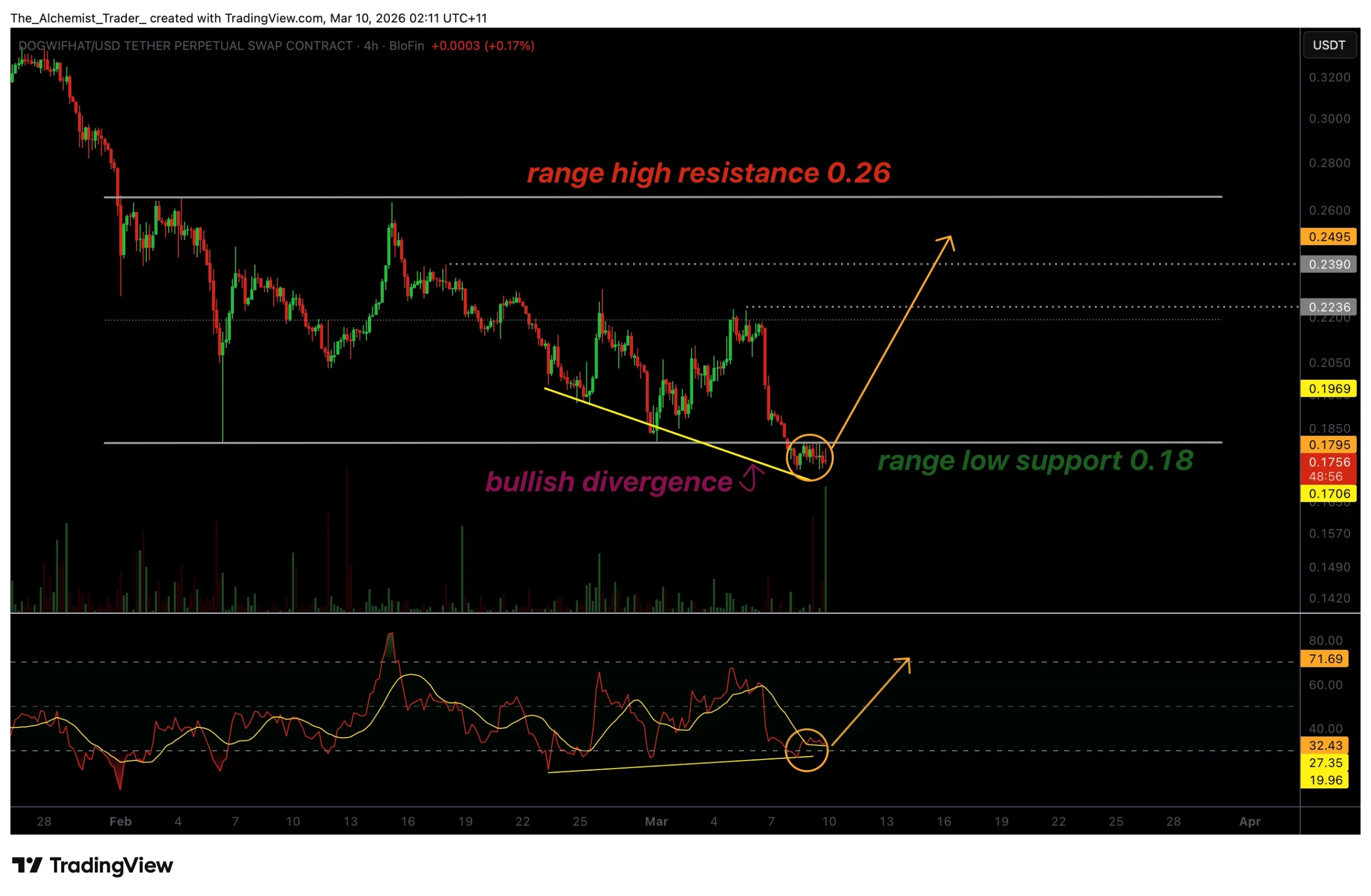
WIF price trades below $0.18 range support while RSI prints bullish divergence. A reclaim of this level could signal a deviation and potential move toward $0.26.
Summary
- Key Level: $0.18 range low must be reclaimed to confirm a deviation.
- Momentum Signal: Bullish RSI divergence suggests selling pressure is weakening.
- Upside Target: Successful reclaim could drive rotation toward $0.26 range resistance.
Dogwifhat (WIF) is currently trading at a crucial technical level after losing the key range support near $0.18. Price action has now been finding acceptance below this region since the February 6 low was established, signaling that the market has temporarily shifted below its previous trading range.
While a break below support often indicates further downside risk, the current setup is presenting a potential deviation scenario that traders are watching closely.
Wif price key technical points
- Range Low Support: $0.18 is the key level that must be reclaimed to confirm a potential deviation.
- Bullish RSI Divergence: RSI is forming higher lows while price prints lower lows.
- Upside Target: Reclaiming range support could trigger a move toward range high resistance at $0.26.
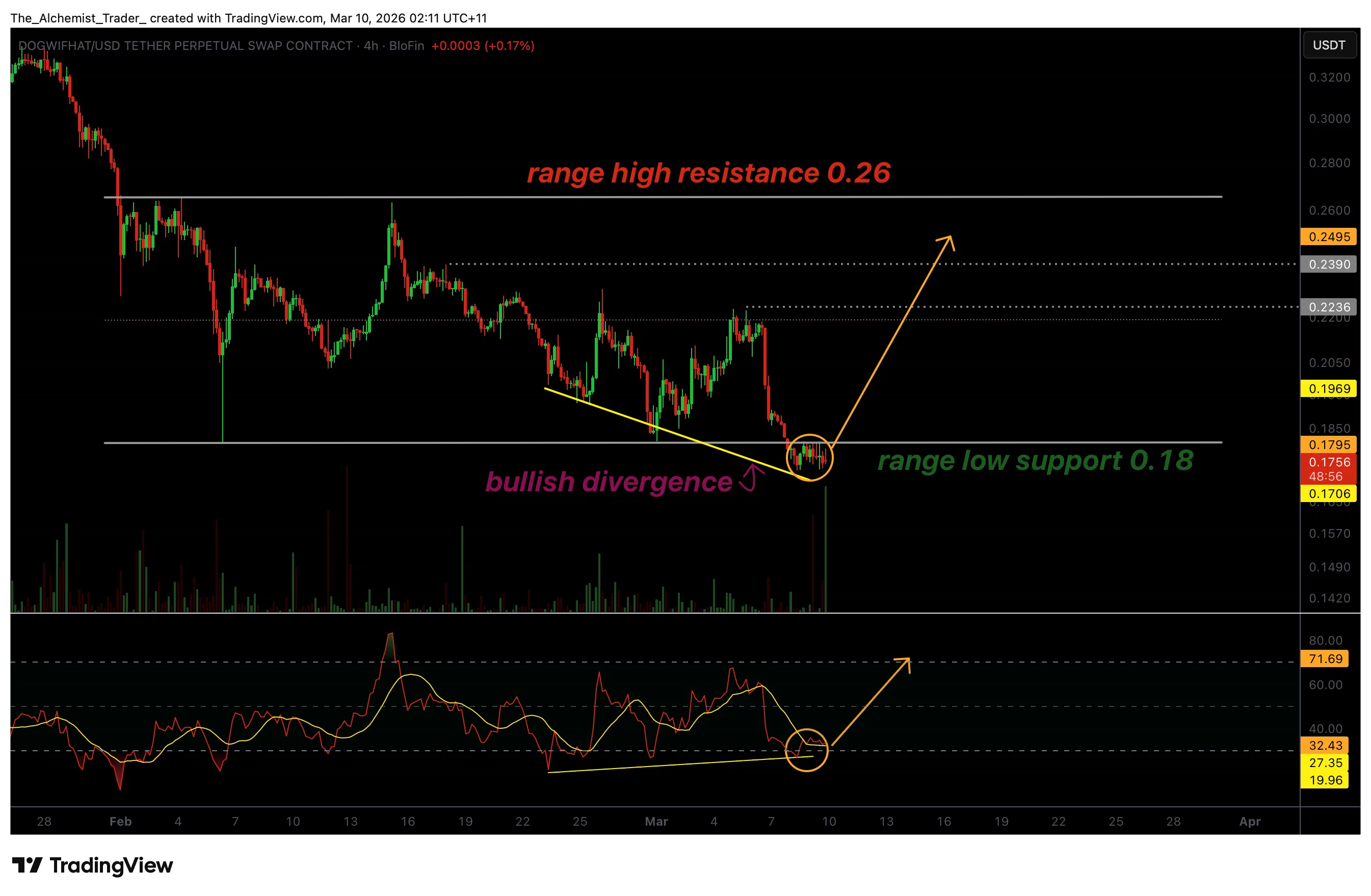
The recent breakdown below the $0.18 level marked an important development in WIF’s market structure. This level previously acted as the range low of the broader trading environment and had provided multiple reactions in previous price cycles. Once price broke below this level, the market entered a lower trading zone where acceptance beneath support began to develop. Sustained trading below a key range boundary typically increases the risk of further downside expansion, but this scenario may be evolving differently due to the appearance of momentum divergence.
One of the most notable signals currently present on the chart is the bullish divergence forming on the Relative Strength Index (RSI). While WIF price action has continued to print lower lows, the RSI indicator has begun forming higher lows.
This divergence between price and momentum often indicates that selling pressure is weakening and that the bearish trend may be losing strength. In many cases, bullish divergence appears during late stages of a downtrend when the market is preparing for a potential reversal or relief rally.
However, momentum signals alone are not enough to confirm a trend reversal. The broader crypto market also remains under bearish pressure, with Bitcoin and most altcoins still trading significantly below their all-time highs after double-digit declines.
As a result, the key technical confirmation for WIF will be a reclaim of the $0.18 range low. If price can push back above this level and hold it as support, it would suggest that the recent breakdown was likely a deviation rather than a true continuation move. Such a reclaim would shift market structure back into the previous trading range and increase the probability of a rotation toward the upper boundary.
From a broader market structure perspective, range-bound markets tend to rotate between support and resistance levels as liquidity moves between participants. Once a deviation occurs and price re-enters the range, the probability often favors a move toward the opposite side of the range. In WIF’s case, the next major technical target would be the range-high resistance near $0.26.
Volume and momentum behavior will also play an important role in confirming this potential shift. If price begins reclaiming support alongside increasing buying pressure and strengthening RSI momentum, it would add further confirmation that a local bottom may be forming. Conversely, continued rejection below $0.18 would keep the market vulnerable to further downside exploration.
What to expect in the coming price action
WIF remains at a key technical turning point as bullish divergence develops while price trades below major support. A confirmed reclaim of $0.18 would strengthen the case for a deviation and open the door for a rotation toward $0.26 resistance, while failure to reclaim the level could allow bearish momentum to persist.


Bithumb, South Korea’s second-largest cryptocurrency exchange by trading volume, is reportedly facing a possible partial business suspension of up to six months as regulators step up enforcement over anti-money laundering controls.
South Korea’s Financial Intelligence Unit (FIU) gave Bithumb a preliminary notice of a six-month partial suspension over alleged anti-money laundering and know-your-customer failures under the Act on Reporting and Using Specified Financial Transaction Information, according to local media reports on Monday. The regulator reportedly cited concerns over dealings with unregistered overseas virtual asset service providers and shortcomings in customer due diligence.
The FIU also issued a reprimand warning to Bithumb’s CEO, a warning considered a heavy penalty, which may lead to restrictions on his reappointment or future roles. Regulators are expected to hold a sanctions review later in March before deciding on any final measures. Bithumb told News1 that the action remains at the pre-notification stage and that the scope of any sanctions could still change.
“This measure is not yet a confirmed sanction, but is a pre-notification stage, and there may be some adjustments in the sanctions trial,” a Bithumb spokesperson said, adding that “restrictions only apply to the transfer (withdrawal) of virtual assets by new members.”
If finalized, the suspension would restrict new users from transferring digital assets off the platform, according to the report. Bithumb did not immediately respond to Cointelegraph’s request for comment.
Related: South Korea moves to cap crypto exchange shareholder stakes at 20%: Report
The notice follows scrutiny on South Korea’s Financial Services Commission’s failure to detect critical flaws tied to Bithumb’s internal systems after the exchange mistakenly credited 2,000 Bitcoin (BTC) per user instead of 2,000 Korean won ($1.40) during a promotional event on Feb. 6, distributing a total of 620,000 BTC (worth around $43 billion at the time).
Related: Hacker returns $21M in Bitcoin stolen from South Korean authorities: Report
South Korean regulators impose stricter money laundering regulations
South Korean regulators are seeking to impose stricter sanctions on crypto exchanges suspected of AML and KYC violations.
In November 2025, FIU imposed a partial three-month suspension and a 35.2 billion won ($25 million) fine on cryptocurrency exchange Upbit’s parent company, Dunamu, for similar violations.
Crypto exchange Korbit also received a warning and a 2.73 billion won ($1.9 million) fine in December 2025.
Both administrative penalties stemmed from concerns related to dealings with overseas crypto service providers and neglect of customer verification practices.
Magazine: How crypto laws changed in 2025 — and how they’ll change in 2026
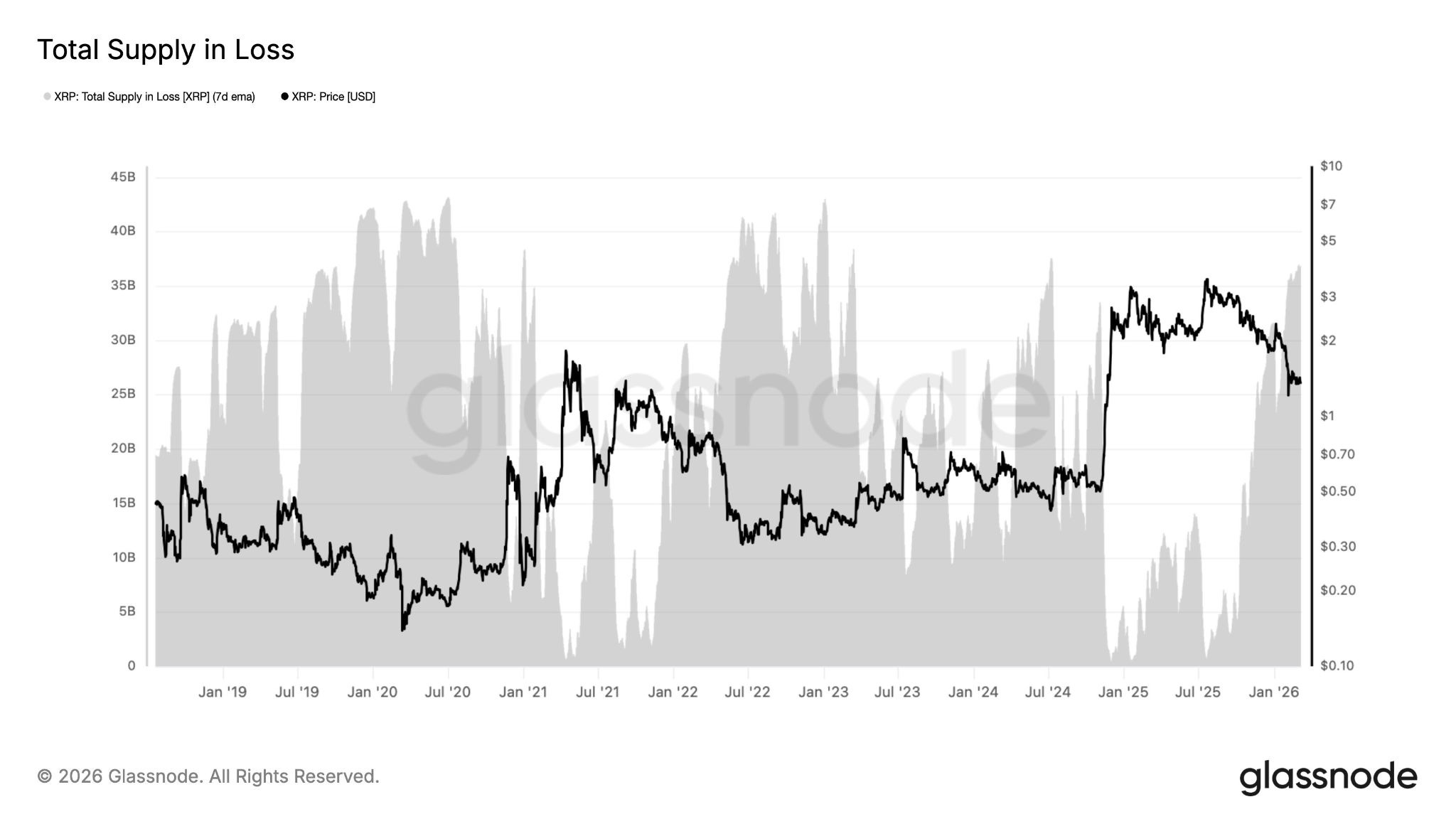
XRP (XRP) traded at $1.35 on Monday, a 63% drawdown from its multi-year high of $3.66 reached in July 2025. As a result, many XRP holders are sitting on significant unrealized losses, underscoring the risks facing crypto investors in bear markets.
Key takeaways:
-
XRP’s 63% drawdown from its $3.66 multi-year high has left holders with over $50 billion in unrealized losses.
-
Key XRP levels to watch in the short term include $1.40, $1.30 and $1.27.
60% of XRP circulating supply now in the red
The XRP/USD pair trades 28% below its yearly open of $1.87, extending losses after it closed 2025 down 11.6%. The prolonged weakness has pushed a significant portion of its supply into the red.
Related: XRP faces $650M sell risk as charts hint at prices below $1
With XRP trading at $1.35 at the time of writing, roughly 36.8 billion XRP are currently held at a loss, representing $50.8 billion in unrealized losses, or more than 60% of the circulating supply, according to data from Glassnode.

XRP’s spot price is also below its aggregate holder cost basis, currently at $1.44, suggesting that long-term holders are increasingly under strain.

Spot XRP ETF investors are also feeling the pressure. Data from SoSoValue shows that these investors are reducing exposure to these investment products, which have recorded outflows for two consecutive days totaling $22.8 million.
More than $16.2 million in net outflows were recorded on Friday, marking the largest redemption since Jan. 29, when spot XRP ETFs saw $93 million in outflows.

The risk-off sentiment is also seen in global XRP investment products, which recorded more than $30 million in net outflows during the week ending March 6.
Key XRP price levels to watch below $1.40
The XRP/USD pair continued to trade within a range, with $140 as resistance and $1.30 a key support level that the bulls must hold to prevent further downside.
The price is now retesting the bottom of the range, as shown in the chart below.
“If buyers step in here, we could see XRP rotate right back toward the top of the range again,” analysts at CryptoPulse said, adding:
“If this level breaks, the range structure starts to shift and price could look for lower levels.”

A key area of interest lies between $1.30 and the local low of $1.27 reached on Feb. 28. If the price loses this level, the next stop could be the Feb. 6 low of $1.13, which is also the 200-week exponential moving average (EMA).

On the upside, bulls are now focused on flipping the 200-week simple moving average (SMA) into support at $1.40.
Glassnode’s UTXO realized price distribution (URPD), which shows the average prices at which ETH holders bought their coins, shows an important level at the 200-week SMA, where investors acquired $1.28 billion in XRP.

As Cointelegraph reported, the XRP price could rally to $1.60 and then $1.95, if the support at $1.40 is reclaimed.
This article does not contain investment advice or recommendations. Every investment and trading move involves risk, and readers should conduct their own research when making a decision. While we strive to provide accurate and timely information, Cointelegraph does not guarantee the accuracy, completeness, or reliability of any information in this article. This article may contain forward-looking statements that are subject to risks and uncertainties. Cointelegraph will not be liable for any loss or damage arising from your reliance on this information.
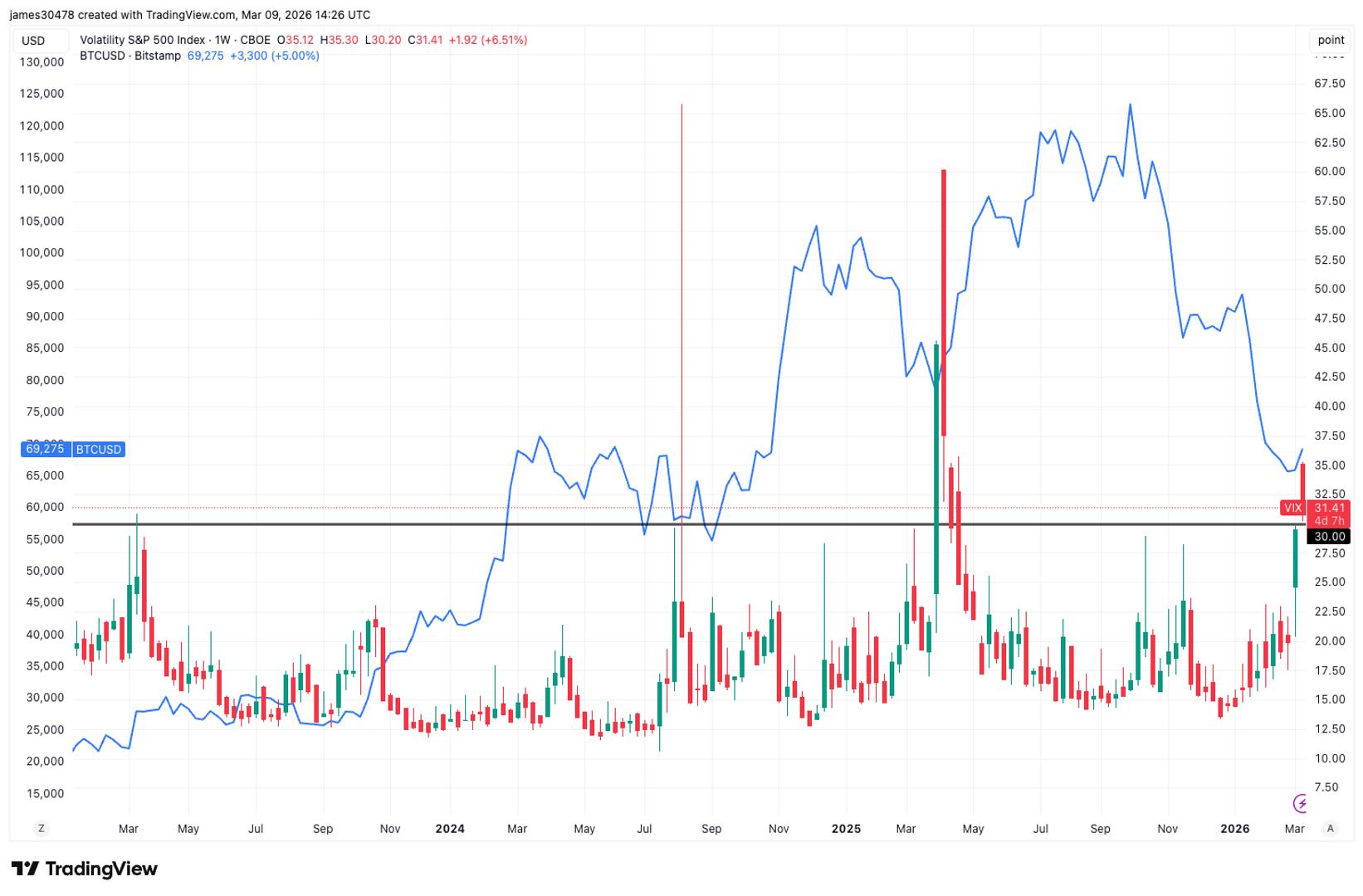
The VIX and bitcoin often move in opposite directions, with sharp spikes in the volatility index frequently coinciding with bitcoin local bottoms.
The CBOE Volatility Index (VIX), which measures expected volatility in the S&P 500 based on options pricing and is widely viewed as Wall Street’s “fear gauge”, jumped to its highest level in nearly a year, rising above 35. The surge signals growing panic across traditional markets.
The move came as global markets reacted to a spike in oil prices. WTI crude briefly surged to around $120 when futures opened Sunday, before retreating toward $100. The volatility has weighed on traditional safe havens and equities alike, with both U.S. stocks and gold falling.
Bitcoin, however, has diverged from that trend. The largest cryptocurrency is up roughly 5% over the past 24 hours and trading above $69,000.
Historically, bitcoin tends to bottom when the VIX spikes. During the tariff-driven market turmoil in April 2025, bitcoin found support near $75,000 as the VIX surged to around 60. In August 2024, the unwind of the yen carry trade pushed the VIX above 64 while bitcoin dropped to roughly $49,000. A similar pattern emerged during the Silicon Valley Bank crisis in March 2023, when the VIX briefly rose above 30 and bitcoin hit a local low near $20,000.
Bitcoin’s own volatility gauge suggests the crypto market has already experienced its panic phase. The Bitcoin Volmex Implied Volatility Index (BVIV), which measures expected price swings derived from bitcoin options pricing, spiked above 96 in early February when bitcoin briefly fell to $60,000, the highest level since the yen carry trade turmoil in August 2024. BVIV is now back just above 60.
That divergence could indicate crypto markets front-ran the stress now hitting traditional finance, though a VIX near 30 suggests volatility in traditional markets may not be finished yet.


Undercover US Homeland agents have reportedly purchased secret microwave weapons, capable of inflicting Havana Syndrome on their victims, one year after Bob Lax claimed his Amazon microwave was frying his brain.
News outlet 60 Minutes disclosed that the weapons were purchased from Russian criminal networks and that agents have been testing them at a military base for the past year on various animals.
The weapon is reportedly concealable, emits a beam of microwaves with rapid pulses, produces no heat, can penetrate walls, and has a range of several hundred feet.
Read more: ‘Microwave’ no longer searchable on X amid Bob Lax rumors
The software used for the weapon is key to its success, and 60 Minutes says vacationing FBI officials have been targeted with the weapon while taking their families out for dinner.
In footage described to the outlet, the family can be seen grabbing their heads in pain after a man with a backpack walks into the room.
Bob Lax said his head was fried by pulsing microwaves
In March 2025, Lax, real name Zachery Stuart, left an odd one-star review for a microwave he bought from Amazon. Stuart is a niche crypto celebrity who’s garnered a cultish following based on his ongoing “lore.”
In mostly incoherent sentences, Stuart described the microwave as a “Cuba weapon” that caused a “hum” in his skull and went “pulse pulse pulse.” On top of this, he claimed the microwave was linked to people watching him.
Oddly enough, the specific search phrase “microwave” couldn’t be loaded on X at the time of Stuart’s Amazon review went viral within crypto circles.
Read more: The ‘dead internet’ theory is getting a rebrand — meet Web 4.0
Stuart’s review is eerily similar to reported symptoms allegedly caused by the miniature weapon reportedly being tested in the US, but there’s also a chance the review may just have been mocking a poor-performing Amazon microwave.
Regardless, X users have been drawing parallels between 60 Minutes’ report and Stuart’s review, suggesting he was right and that he should be freed from jail.
He was imprisoned in August 2025 for battery and aggravated assault with a deadly weapon.
Evidence of microwave weapons builds up
60 Minutes previously reported in 2024 that top staff within the US government were suffering from the psychological illness Havana Syndrome.
Havana Syndrome is an unrecognized disease the symptoms of which include blurred vision, pain in the head, ringing ears, and nausea.
It’s been theorised that energy weapons are one of its causes, but studies have disputed whether or not the disease is the product of a moral panic regarding Russia and Cuba attacking the US.
In 60 Minutes’ 2024 report, US officials believed that they were targeted by Russia with a secret weapon that utilizes high-energy microwaves.
Read more: Bitcoin outperforms gold and oil in first days of US-Iran war
Now, Doctor David Relmond told 60 Minutes that Russian scientists have been perfecting the concept of microwave weapons for decades. He called it the ideal stealth weapon and described how it uses energy in “pulses” to incapacitate its victims.
“When you produce pulses like this, you can actually stimulate electrically active tissue, like brain tissue, and the heart for that matter, mimicking what the brain normally does, but now you’re driving it with your pulses from the outside,” he said.
Another secret weapon was teased by President Donald Trump back in February when the US overthrew Venezuela’s former leader, Nicolas Maduro. Trump called it a “discombobulator” and said that the weapon renders military equipment useless.
Got a tip? Send us an email securely via Protos Leaks. For more informed news and investigations, follow us on X, Bluesky, and Google News, or subscribe to our YouTube channel.

Key Highlights
- BMNR reaches $19.50 per share, powered by $10.3B in cryptocurrency and cash reserves.
- Company accumulates 4.535M ETH, controlling 3.76% of circulating supply.
- Ethereum staking operations yield $174M per year; MAVAN platform set for 2026 debut.
- Portfolio includes Bitcoin positions and high-potential technology ventures.
- Daily trading volume of $1B places BMNR among most liquid US stocks.
Bitmine Immersion Technologies, Inc. (BMNR) climbed to $19.50, gaining 3.20%, following the announcement of its comprehensive asset holdings totaling $10.3 billion in digital currencies and cash. The enterprise now commands 4.535 million Ethereum tokens, 195 Bitcoin units, and equity positions in high-growth technology companies. This substantial treasury establishes Bitmine as one of the world’s premier cryptocurrency asset holders.
Bitmine Immersion Technologies, Inc., BMNR
The company maintains $1.2 billion in liquid cash reserves, bolstering its digital asset portfolio and investment initiatives. A $200 million capital deployment in Beast Industries represents the firm’s largest strategic commitment. Additional positions include minority stakes in companies like Eightco Holdings.
Investor enthusiasm propelled BMNR shares to unprecedented trading levels. Recent five-day average dollar volume hit $1.0 billion daily. This performance establishes the equity among the top 130 most actively traded securities on US exchanges.
Ethereum Position Expands to 4.535 Million Tokens
Bitmine now manages 4,534,563 ETH tokens, accounting for 3.76% of Ethereum’s worldwide circulation. The enterprise accelerated its acquisition strategy with a recent purchase of 60,976 ETH. This expansion moves the company beyond 75% completion of its ambitious goal to control 5% of total ETH supply.
The organization has deployed 3,040,483 ETH into staking protocols, valued at $6.0 billion based on $1,965 per token pricing. Annual returns from staking operations currently exceed $174 million, outperforming most institutional cryptocurrency programs. Management anticipates the MAVAN staking platform rollout in early 2026, which should optimize staking efficiency.
This Ethereum treasury establishes Bitmine as the world’s dominant institutional ETH holder. The company outpaces competitors in crypto net asset value per share growth and trading accessibility. Its position exceeds numerous global institutional Ethereum allocations.
Bitcoin Allocation and High-Growth Technology Bets
Bitmine maintains 195 Bitcoin tokens, providing meaningful diversification across its digital currency holdings. The Bitcoin allocation works synergistically with its Ethereum-focused strategy and extended growth objectives. Together, these cryptocurrency positions amplify BMNR’s total blockchain market participation.
Recent capital deployments include a $200 million stake in Beast Industries and $14 million in Eightco Holdings. These speculative “moonshot” allocations focus on breakthrough technology enterprises. The investments seek to amplify aggregate portfolio performance and enhance competitive positioning.
Bitmine’s methodology combines cryptocurrency accumulation with cash reserves and venture capital stakes. The comprehensive portfolio valuation of $10.3 billion demonstrates substantial market presence. This multifaceted approach establishes the organization as a pioneer in diversified digital asset management.
Trading Liquidity and Market Performance
BMNR exhibits exceptional liquidity across American financial markets. Recent five-day average dollar volume of $1.0 billion positions it ahead of prominent airline and manufacturing stocks. This elevated liquidity ensures optimal investor participation and market effectiveness.
Share price momentum correlates with significant treasury expansion and staking program growth. Elevated trading volumes signal investor confidence in Bitmine’s diversified portfolio framework. The company maintains its status among the most actively traded cryptocurrency-related public equities.
BMNR’s asset base encompasses Ethereum, Bitcoin, cash holdings, and promising venture investments. This balanced composition accelerates both asset appreciation and market engagement. The stock’s trajectory confirms its position as a global leader in cryptocurrency treasury operations.



South Korean cryptocurrency exchange Bithumb has received a preliminary notice of sanctions that could lead to a six-month partial business suspension, local media reports.
The notice came from the Financial Services Commission’s Financial Intelligence Unit (FIU), which oversees anti-money laundering compliance for crypto firms under the Act on Reporting and Using Specified Financial Transaction Information.
Regulators said Bithumb continued transactions with overseas virtual asset businesses that were not registered in South Korea and failed to properly enforce certain Know Your Customer procedures. The FIU proposed a six-month partial suspension and disciplinary action against the exchange’s chief executive.
The restriction would apply only to virtual asset transfers by newly registered users. Existing customers would still be able to deposit and withdraw Korean won and cryptocurrencies and trade on the platform, according to the report.
The decision isn’t final and may change during a review process. The FIU plans to hold a sanctions deliberation committee later this month to determine the final penalty.
The case comes as South Korean regulators tighten oversight of digital asset platforms. LAst year, the FIU imposed a three-month partial suspension and a 35.2 billion won ($23.65 million) fine on Dunamu, the operator of Upbit, for similar compliance failures. Korbit received a similar 2.73 billion won fine and an institutional warning as well.
Founded in 2014, Bithumb is one of South Korea’s largest exchanges and ranks second in domestic trading volume behind Upbit according to CoinGecko data. Together with Coinone and Korbit, these platforms account for the vast majority of the crypto trading activity of exchanges registered in the country.
The sanctions come after last month Bithumb mistakenly distributed billions of dollars worth of bitcoin to users, prompting the country’s financial watchdog to step up oversight of cryptocurrency markets.
CoinDesk has reached out to Bithumb for comment but hasn’t heard back at the time of writing.

XRP Makes History. FED MASTER ACCOUNT CHANGES *EVERYTHING*

An evening of passion, sexual jealousy and death… Ellen Kent's farewell opera tour is coming to the Kings Theatre

Keir Starmer says UK economy is robust but could face damage from prolonged Iran conflict


-

 Politics6 days ago
Alan Cumming Brands Baftas Ceremony A ‘Triggering S**tshow’
-
Business3 days ago
Form 8K Entergy Mississippi LLC For: 6 March
-

 Fashion3 days ago
Weekend Open Thread: Ann Taylor
-

 Tech4 days ago
Bitwarden adds support for passkey login on Windows 11
-
 Sports4 days ago
499 runs and 34 sixes later, India beat England to enter T20 World Cup final | Cricket News
-

 News Videos4 hours ago
10th Algebra | Financial Planning | Question Bank Solution | Board Exam 2026
-

 Sports2 days ago
Three share 2-shot lead entering final round in Hong Kong
-

 Sports1 day ago
Braveheart Lakshya downs Lai in epic battle to enter All England Open final | Other Sports News
-

 Tech7 days ago
Cynus Chess Robot: A Chess Board With A Robotic Arm
-

 Business6 days ago
Guthrie Disappearance Enters Fifth Week as Family Visits Memorial
-

 NewsBeat4 days ago
Piccadilly Circus just unveiled ‘London’s newest tourist attraction’ and it only costs 80p to enter
-

 Business22 hours ago
Search for Nancy Guthrie Enters 37th Day as FBI Probes Wi-Fi Jammer Theory
-

 Politics3 days ago
Top Mamdani aide takes progressive project to the UK
-

 Entertainment3 days ago
Hailey Bieber Poses For Sexy Selfies In New Luscious Lip Thirst Traps
-
 Sports6 days ago
Jack Grealish posts new injury update as Man City star enters crucial period
-

 Crypto World5 days ago
New Crypto Mutuum Finance (MUTM) Reports V1 Protocol Progress as Roadmap Enters Phase 3
-

 Tech4 days ago
ACIP To Discuss COVID ‘Vaccine Injuries’ Next Month, Despite That Not Being In Its Purview
-
Entertainment5 days ago
Harry Styles Has ‘Struggled’ to Discuss Liam Payne’s Death
-
 NewsBeat4 days ago
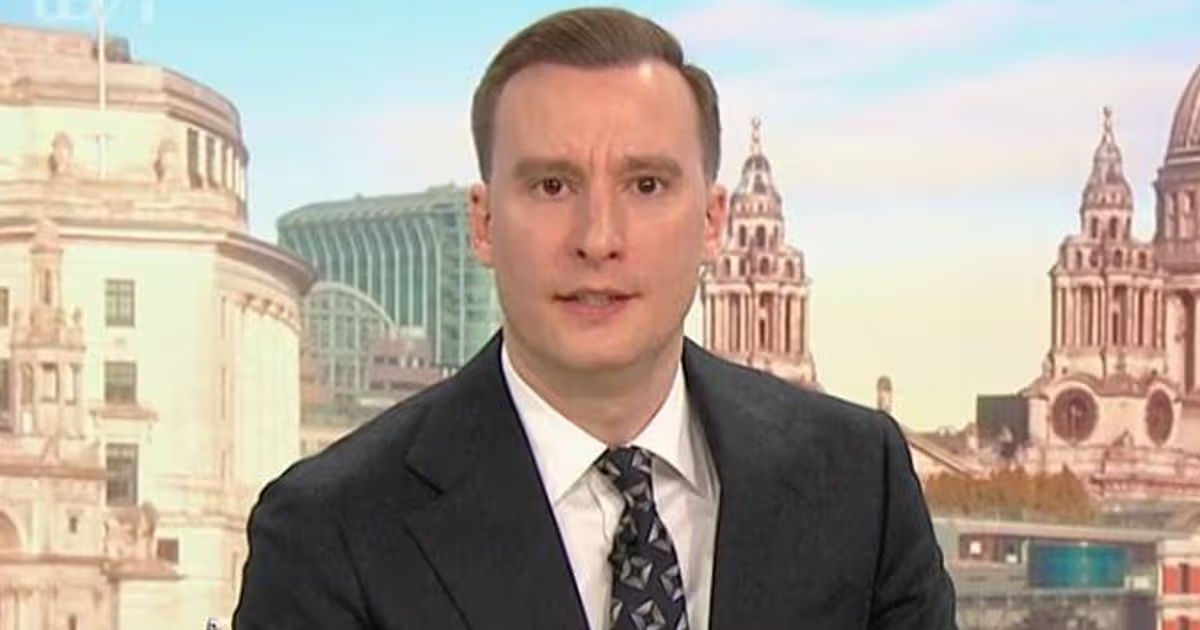
Good Morning Britain fans delighted as Welsh presenter returns to host ITV show
-

 Tech2 hours ago
Despite challenges, Ireland sixth in EU for board gender diversity