

Crypto World
What’s the Most Likely Short-Term Scenario for BTC?

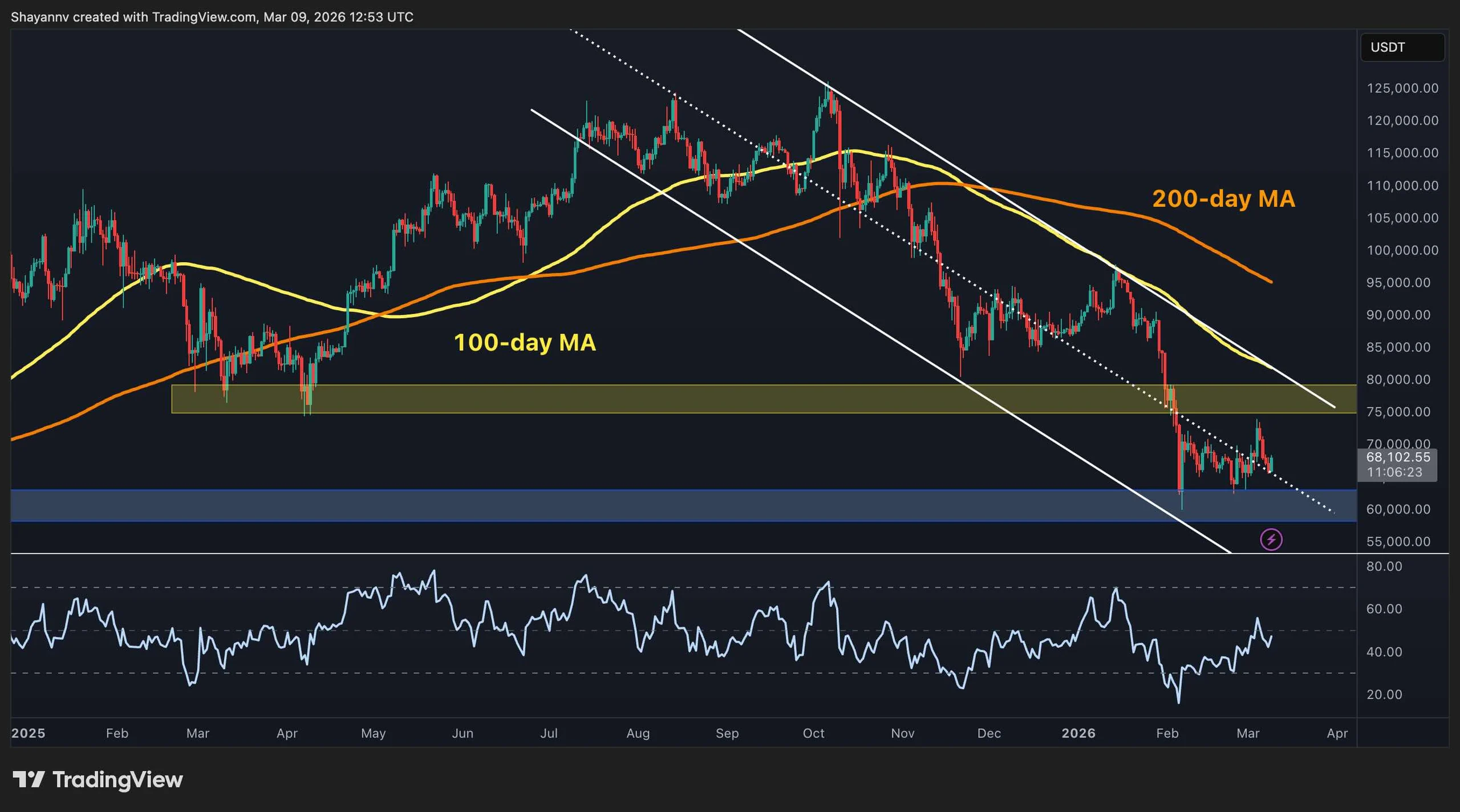
Bitcoin is still stuck in a broader bearish structure, but the latest bounce shows buyers are trying to keep the recent recovery alive above the key $60k area. Even so, the bigger trend remains fragile, with BTC still trading below major resistance levels on the higher timeframes.
Bitcoin Price Analysis: The Daily Chart
On the daily chart, BTC remains below both the 100-day and 200-day moving averages, which keeps the broader bias tilted to the downside. The price is also still trading inside the descending channel, indicating that the market has not yet confirmed a proper trend reversal.
The main support zone remains around $60k to $61k, which has already produced a reaction earlier in February. On the upside, the first major resistance sits around $75k to $80k. As long as BTC stays below that region, rallies are likely to be viewed as corrective rather than impulsive.
BTC/USDT 4-Hour Chart
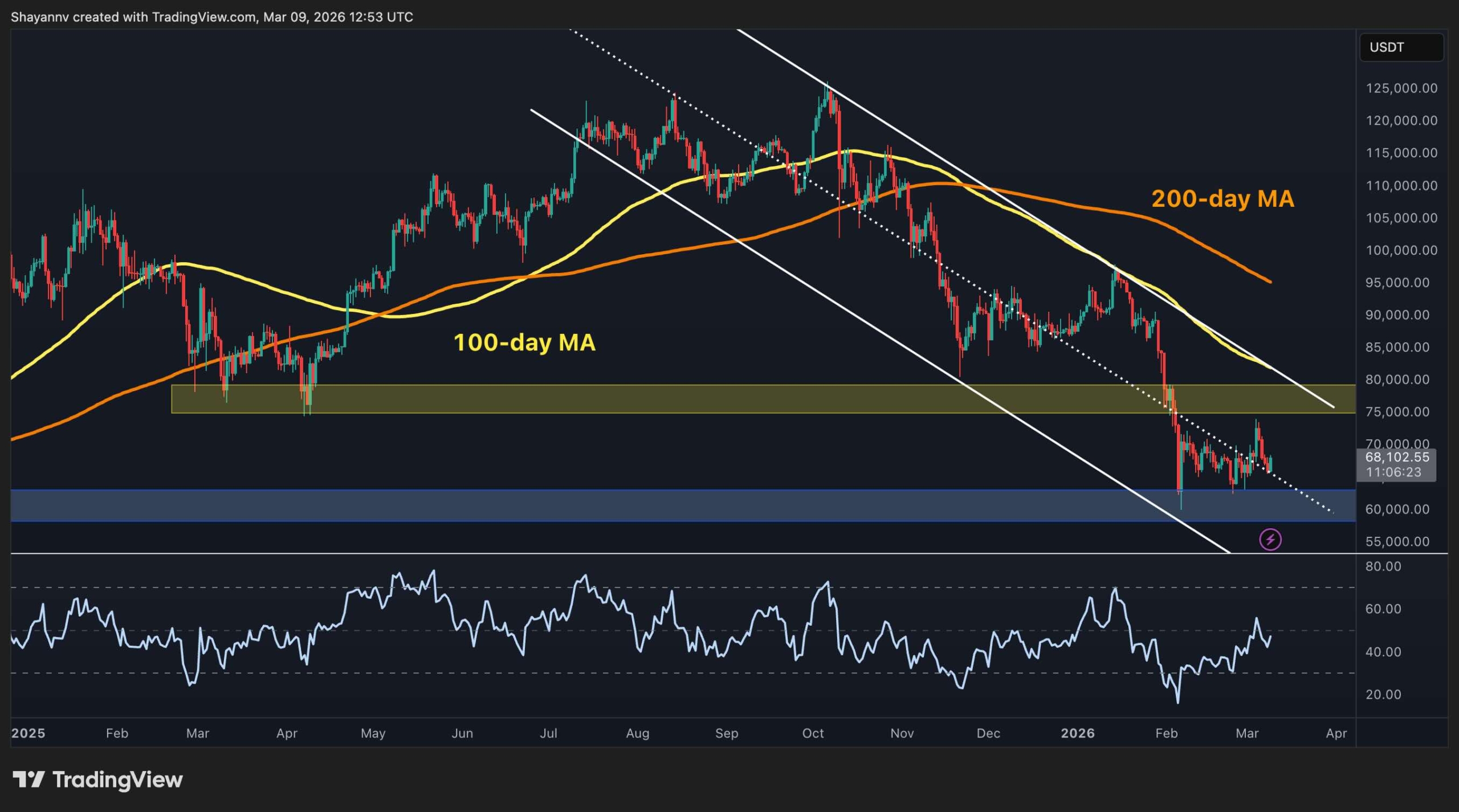
On the 4-hour timeframe, Bitcoin continues to move inside a large flag pattern, suggesting that the recent advance is still a recovery structure. The asset is now hovering around $69,000 after once again failing to sustain a break above the upper boundary of the pattern near the $73,000 area.
Momentum is neutral for now, with RSI recovering from weaker levels but still not showing a decisive breakout. If buyers defend the $64k to $65k area, which coincides with the lower trendline of the flag, another push toward channel resistance remains possible. A breakdown below the lower boundary, however, could send BTC back toward the $60,000 zone, and potentially lower in the coming weeks.

On-Chain Analysis
From an on-chain perspective, the 30-day exponential moving average of the Exchange Whale Ratio has surged sharply, which usually signals that large holders have become more active in sending coins to exchanges recently. That tends to be a warning sign, as elevated whale inflows often increase the probability of sell-side pressure.
So while price is trying to stabilize in the short term, the on-chain backdrop remains cautious. In other words, the chart structure may still allow for a recovery bounce, but the rise in whale activity suggests that upside could remain capped unless this metric starts cooling off again.

Binance Free $600 (CryptoPotato Exclusive): Use this link to register a new account and receive $600 exclusive welcome offer on Binance (full details).
LIMITED OFFER for CryptoPotato readers at Bybit: Use this link to register and open a $500 FREE position on any coin!
Disclaimer: Information found on CryptoPotato is those of writers quoted. It does not represent the opinions of CryptoPotato on whether to buy, sell, or hold any investments. You are advised to conduct your own research before making any investment decisions. Use provided information at your own risk. See Disclaimer for more information.


Blockchain.com is expanding its footprint in Africa with a launch in Ghana, deepening a regional push that has already shown strong traction in Nigeria over the past year. The company said it plans to offer Ghanaian users access to its trading platform as it builds out local infrastructure and pursues additional markets across the continent. The Nigeria rollout revealed robust demand, with the brokerage transaction volume up by more than 700% and trading activity centered on Bitcoin (BTC) (BTC) (CRYPTO: BTC), Tether (USDT) (USDT) (CRYPTO: USDT), and Tron (TRX) (TRX) (CRYPTO: TRX).
The Ghana expansion follows a period of rising activity ahead of a formal launch, with the company reporting a 140% increase in active users in the country over the past year and an 80% jump in transaction volumes. Blockchain.com stressed that its strategy in Ghana centers on building out local compliance and regulatory engagement, including a local compliance representation position. The move underscores a broader objective: to accelerate its regional infrastructure, forge partnerships with local payment rails, and position Ghana as a gateway to additional African markets.
“We are actively collaborating with Ghanaian officials and regulators to help build a regulatory framework and have already established local compliance representation in Ghana,” a Blockchain.com spokesperson told Cointelegraph. The emphasis on regulatory alignment mirrors a wider industry trend as exchanges seek clearer paths to operate within increasingly formal oversight regimes across the continent.
The company highlighted the importance of integrating with Ghana’s mobile money ecosystem, noting that such rails are a cornerstone of its strategy in the region. With mobile payments deeply embedded in everyday commerce, the ability to settle trades and fund wallets through popular mobile money channels is viewed as a key driver of uptake for digital assets among a broader cross-section of the population.
Blockchain.com’s Ghana announcement sits within a larger narrative of Sub-Saharan Africa’s rapid crypto growth. The firm already operates in more than 70 jurisdictions globally and has signaled plans to pursue additional African markets as part of a long-term growth plan. That strategy aligns with data from Chainalysis, which shows Sub-Saharan Africa emerging as a hotbed of on-chain activity. The region logged more than $205 billion in on-chain crypto value between July 2024 and June 2025, up 52% from the previous year, placing it among the world’s fastest-growing markets. Nigeria dominates that activity, accounting for more than $92 billion in on-chain value during the same period, with South Africa, Ethiopia, Kenya, and Ghana following closely behind.
The Ghana push also resonates with broader discussions about crypto as a tool for remittances and cross-border payments. At the World Economic Forum Annual Meeting in Davos, Vera Songwe, a former United Nations official, noted that stablecoins are increasingly used to reduce remittance costs, which traditionally run around $6 per $100 sent. In economies grappling with inflation and uneven access to traditional banking, such digital dollar alternatives are gaining appeal as faster, cheaper settlement mechanisms. Songwe’s remarks reflect a growing consensus among policymakers and researchers that digital assets can complement, rather than replace, existing financial systems when properly regulated and integrated.
Beyond Lagos and Nairobi, Africa’s crypto narrative features voices like Africa Bitcoin Corporation founder Stafford Masie, who has argued that Bitcoin is already serving as everyday money in some communities. Masie told the Coin Stories podcast that merchants in certain local economies accept satoshis for goods and services, underscoring a level of grassroots adoption that is outpacing formal channels in parts of the continent. This angle—where crypto acts as day-to-day currency rather than solely as a store of value—adds nuance to the Ghanaian expansion and the continent’s longer-term potential as a regional crypto hub.
Industry observers also point to regional price dynamics and currency volatility as catalysts for crypto uptake. Data from Borderless.xyz indicated that Africa recorded the highest median stablecoin-to-fiat conversion spreads among tracked regions in February, highlighting both demand for dollar-denominated liquidity and the challenges of local fiat markets. Taken together with Chainalysis’ Africa-focused data and Masie’s observations, the Ghana launch can be read as part of a broader pattern in which crypto infrastructure—paired with accessible payments rails—helps broaden financial options for a population that remains largely mobile-first and cash-centric in many communities.
Blockchain.com’s expansion in Ghana comes amid a wider push by global crypto exchanges to establish local footprints across Africa. The Ghana launch—backed by public relations coverage from PR Newswire—signals a willingness to engage with regulators and to tailor product offerings to local conditions. While the practical rollout will hinge on a complex mix of licensing, compliance, and partnerships, the company’s statements emphasize a pragmatic approach: build the necessary regulatory bridges, invest in regional teams, and connect digital assets to existing payment ecosystems to support everyday use cases.
Crypto adoption grows across Sub-Saharan Africa
Crypto use has surged in Sub-Saharan Africa in recent years. Chainalysis’ data for the 12-month period ending mid-2025 shows the region accumulating substantial on-chain value, with Nigeria taking the lead in absolute terms. South Africa, Ethiopia, Kenya, and Ghana are among the other notable centers of activity. Analysts say this demand is driven by cross-border remittances, currency volatility, and a youthful, mobile-first user base seeking access to financial services beyond traditional banks. The Ghana launch sits at the intersection of these dynamics, offering a test case for how a major platform can adapt its services to a regulatory environment and to local payment rails that shape user behavior.
In Davos, Songwe emphasized that stablecoins can offer meaningful improvements in remittance costs and speed, potentially reshaping how money moves across borders in Africa. The combination of lower fees, faster settlement, and broader digital adoption may accelerate not only trading and savings but also merchant adoption as more businesses accept digital assets as payment. The narrative around stablecoins, remittances, and cross-border rails is increasingly central to how policymakers, fintechs, and asset providers view Africa’s crypto opportunity.
As Africa’s crypto story unfolds, Masie’s remarks about Bitcoin as a practical medium of exchange in some regions illuminate a reality that policymakers and investors are watching closely. If more communities begin to adopt crypto for day-to-day transactions, the demand for user-friendly products, local-language support, and compliant, regionally integrated services could rise quickly. For Blockchain.com and similar firms, the Ghana market represents both a proving ground and a springboard for broader regional expansion, where the combination of regulatory clarity, accessible payment rails, and culturally aware service design could accelerate crypto’s mainstream viability on the continent.
Why it matters
The Ghana expansion, alongside Nigeria’s sustained growth, demonstrates that Africa is not merely a speculative backdrop for crypto, but a dynamic testing ground for real-world use cases. Building out local compliance structures and engaging with regulators signals a shift from offshore operations toward regionally anchored models that can adapt to diverse regulatory regimes. For users, this could translate into more reliable access to trading, wallets, and payments that work with familiar mobile money platforms, reducing friction and increasing trust in digital assets.
From an industry perspective, the Ghana launch reinforces the importance of partnerships with payment providers and local banks to unlock liquidity and enable quick settlement. It also underscores the need for clear regulatory frameworks that protect consumers while allowing innovation to flourish. The combination of on-chain growth data, grassroots adoption, and the ongoing push for settlement efficiency suggests a longer-term trajectory where crypto services become embedded in everyday financial activity across Sub-Saharan Africa.
For builders and policymakers, the initiative highlights the critical balance between market access and compliance. As the region navigates licensing regimes, data privacy, and anti-money-laundering standards, a measured, transparent approach will determine whether crypto becomes a durable feature of Africa’s financial architecture or a transient trend. The Ghana moment should be read as part of a broader continental arc—one that could redefine how people in many economies access, move, and use digital value.
What to watch next
- Regulatory milestones in Ghana: licensing decisions, local governance structures, and the pace of market onboarding.
- Speed and scope of mobile-money integrations: new payment rails, KYC requirements, and onboarding timelines for retail users.
- Additional African market entries by Blockchain.com and peers, including partner networks and regional hubs.
- Post-launch adoption metrics in Ghana: active users, transaction volumes, and the mix of assets traded.
Sources & verification
- Blockchain.com Ghana launch press release and regional expansion statements (PR Newswire).
- Chainalysis report on Sub-Saharan Africa on-chain activity and regional growth (September report referenced).
- Vera Songwe remarks on stablecoins and remittances at the World Economic Forum in Davos.
- African crypto insights from Stafford Masie’s Coin Stories interview on Bitcoin as everyday money.
- Borderless.xyz data showing stablecoin-to-fiat conversion spreads by region (February).
Blockchain.com expands in Ghana as Africa strategy accelerates
Blockchain.com is expanding its Africa footprint with a formal push into Ghana, a move described by the company as a continuation of its strategy to grow beyond markets where it already operates. The Ghana initiative follows Nigeria’s rapid uptake, where the platform launched retail operations last year and reported a more than sevenfold rise in brokerage activity. In Nigeria, traders have prioritized Bitcoin (BTC) (BTC) (CRYPTO: BTC), Tether (USDT) (USDT) (CRYPTO: USDT), and Tron (TRX) (TRX) (CRYPTO: TRX), reflecting broad appetite for major digital assets as users experiment with wallets, trading, and payments on the go.
The Ghana plan emphasizes a local presence—comprising regulatory engagement, regional leadership, and partnerships with payment rails—that could accelerate user onboarding and broaden access to digital assets in a country where mobile money is deeply entrenched in daily life. The company’s stance is to establish a regulated, compliant operating framework from the outset, a strategy that aligns with global trends toward clearer oversight as crypto markets mature across the region.
Industry observers note that Africa’s crypto surge has a distinct social dimension. Chainalysis data show that Nigeria remains a dominant driver of on-chain activity for the continent, but the growth story extends beyond a single country. The $205 billion on-chain value figure for the region underscores the scale of activity and the potential for service providers that can offer user-friendly interfaces, robust security, and accessible funding and withdrawal channels to attract a broader base of customers who previously relied on informal channels for cross-border payments and savings.
From a macro perspective, the Ghana launch comes at a time when policymakers are increasingly evaluating how to balance innovation with consumer protection. Songwe’s Davos remarks about stablecoins and remittances reflect a recurring theme: digital currencies can lower costs and speed settlements for cross-border flows, provided that stablecoin issuance, custody, and compliance frameworks are designed with local realities in mind. In practice, this means building partnerships with local banks and payment processors and cultivating a regulatory environment that supports responsible crypto usage while preserving financial stability.
Masie’s account of Bitcoin’s role in some African communities adds texture to the Ghana narrative. If merchants already accept satoshis in daily transactions in parts of the continent, then the Ghana expansion could unlock practical uses beyond speculation, reinforcing the case for a networked economy where crypto acts as a complement to, rather than a substitute for, existing financial channels. In parallel, the ongoing discourse around stablecoins and on-chain liquidity continues to shape how fintechs approach product design, risk management, and customer education as they roll out new services in the region.
Crypto World
There’s another energy market that may get hit harder than oil by Strait of Hormuz closure
A liquefied natural gas (LNG) tanker on a digital screen at the Qatar Economic Forum (QEF) in Doha, Qatar, on Tuesday, May 20, 2025.
Christopher Pike | Bloomberg | Getty Images
Oil prices jumped Monday with traffic in the Strait of Hormuz at a near standstill, but the longer-term implications of the Strait’s closure may be more extreme for the liquefied natural gas market. That’s in part because it’s more difficult to move than crude oil and LNG production is more concentrated.
Roughly 20% of global LNG flows through the Strait – the majority of which is exported from Qatar – and global gas prices are surging after the country last week halted output following an Iranian drone attack.
European natural gas rose 63% last week for its largest percentage gain since March 2022, following Russia’s invasion of Ukraine. Prices in Asia are even higher – trading at $23.40/mmbtu Monday morning – given the majority of Qatari LNG flows to Asia. Asian nations are trying to make up the lost cargoes, and as the spread between European and Asian gas widens, some LNG vessels originally bound for Europe are now U-turning and heading to Asia instead.
Part of Saudi Arabia’s and UAE’s crude has been re-routed through pipelines, but the same infrastructure doesn’t exist for gas. Put another way, a ship is required to transport it long distances.
And while many states in the Middle East produce oil, gas production is concentrated at one industrial complex in Qatar, making the market much more vulnerable going forward, noted Alex Munton, director of global gas and LNG research at Rapidan Energy.
The real risk, Munton said, is how difficult it will be to restart Qatar’s LNG production at Ras Laffan once traffic resumes in the Strait. Given the complexities of cooling gas, which is fundamentally an industrial process, it will take much longer to restart than oil production.
Rapidan predicts that LNG exports from the region won’t begin again until there’s 100% certainty that it is safe for ships to transit the Strait. Insurance is one factor – an LNG tanker can cost $250 million – but the complexity of the process means operations can’t be ramped up and down based on perceived escalations or de-escalations. It will also take weeks, rather than days, to fully restart operations, according to the firm, which added the entire plant has never been taken offline before.
“I don’t think in the first few days of this conflict – we’re only a week in – that there is an appreciation for the length of time that Qatar is going to be offline and the effect it will have on global supply and the global markets,” Munton told CNBC.
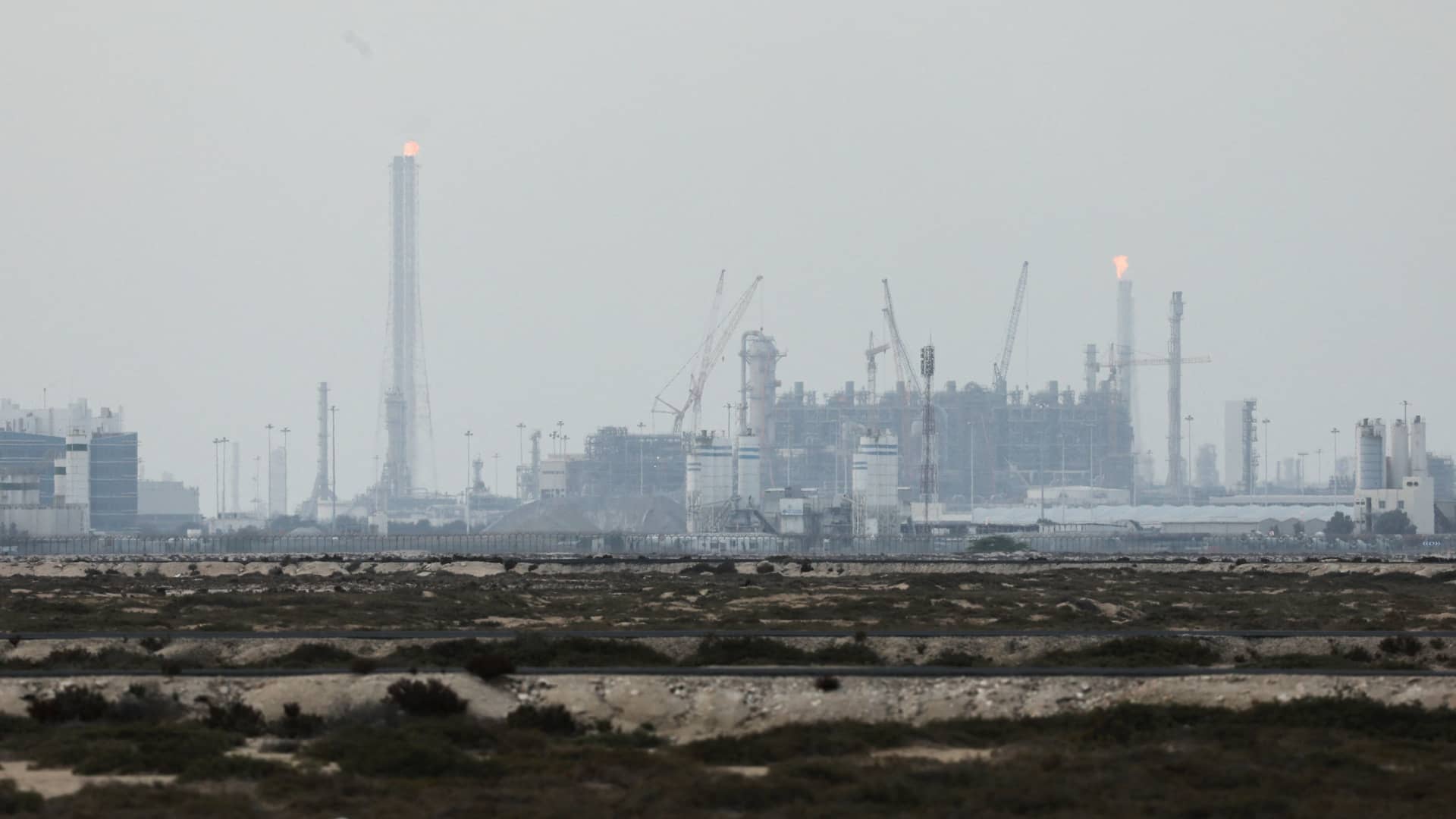
QatarEnergy’s liquefied natural gas (LNG) production facilities, amid the U.S.-Israeli conflict with Iran, in Ras Laffan Industrial City, Qatar March 2, 2026.
Stringer | Reuters
The U.S. is the world’s largest LNG exporter, but production is essentially running at max capacity. And with little additional output available worldwide, demand destruction is what might ultimately balance the market. That could include swapping gas for relatively inexpensive coal, for example.
But Munton said an escalation in hostilities, including additional attacks on Qatar’s LNG infrastructure, could lead to larger long-term ramifications. Rapidan’s view is that Iran’s prior attacks against Ras Laffan were a “warning shot that wasn’t the real deal.”
“It’s a sitting duck,” Munton said of the industrial complex. “If Iran wanted to do major damage to Qatar’s LNG capacity, it could … There is no way of defending completely against an Iranian attack if Iran was hell bent on damaging the plant.”
“It’s not like one node can take out all Middle East oil production, because there’s just too many fields, there’s too many countries, there’s too many plants and facilities…but with LNG it’s one facility. It’s a gigantic complex, but it’s just one facility.”
QatarEnergy is now delaying an expansion to its gas facilities until 2027, according to Bloomberg.


Arthur Hayes backs Hyperliquid as his largest liquid shitcoin bet, targeting $150 HYPE as Bitcoin grinds near $69K in a derivatives‑driven, fragile macro regime.
Summary
- Hayes makes Hyperliquid his largest liquid shitcoin position and calls it crypto’s highest quality project by real, fee‑paying users.
- He targets $150 per HYPE by August 2026 if annualized revenues revisit $1.4 billion on modest perp market‑share gains from CEXs.
- ADV/OI metrics and Bybit’s 2026 outlook both underscore that market structure and derivatives flows now drive Bitcoin more than the classic four‑year cycle.
Bitcoin trades firmer near $69K as derivatives-driven market structure collides with a fragile macro backdrop, and Arthur Hayes makes Hyperliquid (HYPE) his “largest liquid shitcoin position.” His latest essay frames Maelstrom as “hype men that monetize attention,” arguing that in a choppy regime “the best performing shitcoins are exchanges” because they keep earning fees even when spot markets stall.
Hayes singles out perp DEX Hyperliquid, calling it “the dominant perp DEX” and “the largest revenue-generating project that isn’t a stablecoin,” with 97% of revenue used to buy back HYPE from the market. In his base case, he targets $150 per HYPE by August 2026, roughly 5x from the “current price of ~$30 at the time of writing,” contingent on 30‑day annualized revenues climbing back to about $1.4 billion and only a modest 3.97% market‑share shift from CEX perps. That thesis leans heavily on HIP‑3 permissionless listings, which in “only four months” have grown to “close to 10% of total Hyperliquid revenues,” driven by perps on silver, gold, Nasdaq 100 and the S&P 500.
Under the hood, Hayes argues that what matters now is structure, not just narratives. He points to the ADV/OI ratio as the “only objective measure to rank exchanges,” concluding that “Hyperliquid’s volumes are the most real out of the top 5 perp DEXs because its ADV/OI ratio is the lowest.” That view echoes broader research like Bybit’s 2026 Crypto Outlook, which says the classic four‑year Bitcoin cycle is fading as “macroeconomic policy, institutional participation, and market structure play a growing role in price formation.”
Macro is not exactly friendly, but crypto is trading with a resilient, derivatives‑heavy profile. Bitcoin changes hands near $69,100, up about 2.7% over the last 24 hours. Ethereum trades around $1,993, with a 24‑hour range between roughly $1,922 and $2,016. Solana sits close to $81.7, down from $83.2 a day earlier, while Hyperliquid changes hands near $34.2, up roughly 13.2% on the session. For Hayes, that backdrop is the setup: “If the macro is figgity fucked for a while, what can I buy? What is the highest quality project that has real users, paying real money, and giving that money back to token holders?” His answer is blunt: “Hyperliquid is the highest quality project in all of crypto across these metrics.”
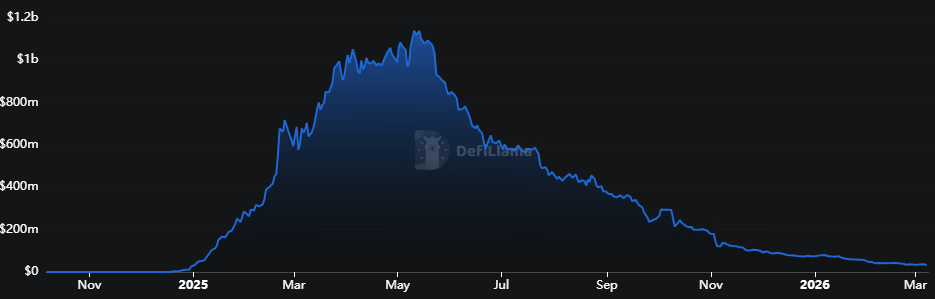
Sonic’s TVL has plunged to just $34 million, down 97% from its May 2025 peak.
Sonic Labs has introduced the US Sonic Dollar (USSD), a native stablecoin designed to serve as the primary stable liquidity layer across Sonic’s decentralized finance (DeFi) ecosystem. The launch arrives at a pivotal moment for the Layer 1 blockchain, which has seen its key metrics slide sharply over the past year.
Built on Frax’s frxUSD infrastructure, USSD combines permissionless on-chain access with institutional-grade backing from BlackRock, Superstate, and WisdomTree. The stablecoin is fully pegged 1:1 to the U.S. dollar and is available with zero minting fees through non-custodial smart contracts, mintable from over 10 chains using supported assets such as USDC, USDT, PYUSD, and tokenized Treasury products.
Under Pressure
Last year, Sonic reached $1 billion in total value locked (TVL) within just 66 days of launching, but that momentum did not sustain. TVL fell by two-thirds from $1.1 billion in May 2025 to around $367 million by September. According to DefiLlama, the chain’s TVL now sits around $34 million, a fraction of its peak.

The S token has followed a similar trajectory. S reached an all-time high of $1.03 in January 2025 and has since fallen roughly 96%, according to Coingecko. Over the past month alone, S has dropped approximately 13%, and currently trades at a market capitalization of $150 million.

Vertical Integration
Against that backdrop, Sonic is framing USSD less as a product launch and more as a structural fix.
“When a network’s primary stable asset is external, liquidity fragments and incentives become harder to align,” Sonic said in a blog post.
Yield generated by the assets backing USSD is designed to flow back into the Sonic ecosystem rather than being retained externally, supporting buybacks and ecosystem incentives as usage grows. The idea is to create a self-reinforcing liquidity loop rather than relying on mercenary capital or third-party market makers.
USSD is live on Sonic, Ethereum, Base, Arbitrum, and seven additional chains.
Crypto World
Binance Will Temporarily Suspend Withdrawals and Deposits on the Ethereum Network: Details

The trading of tokens on the network will not be impacted, the exchange assured.
The world’s largest crypto exchange will support an upgrade later this week, during which token deposits and withdrawals on the Ethereum network will be halted.
Additionally, it will expand the list of trading options on Binance Spot, as the effort is once again centered on the stablecoin U (United Stables).
The Upcoming Developments
Binance disclosed that the Ethereum network upgrade is scheduled for March 10 and is expected to take roughly an hour to complete. Once the process is finalized and the system is confirmed to be functioning normally, deposits and withdrawals will be resumed.
The company assured that trading assets on the aforementioned ecosystem will not be affected and promised to handle all user-related technical requirements. It also said there will be no further announcements on the above.
This is a standard procedure that Binance has carried out seamlessly many times before. Beyond briefly pausing Ethereum-related operations during upgrades, the exchange has implemented similar measures to support improvements across different ecosystems, including Cardano, BNB Smart Chain, and others.
Binance also shared another update with its community today (March 9). It confirmed that new trading pairs – BCH/U, NEAR/U, TRX/U, and NEAR/USD1 – will go live on March 10, with Trading Bots support launching on the same day.
The listing effort once again focuses on U (United Stables) – a stablecoin launched last year and pegged to the greenback. Last week, the firm opened trading for AVAX/U, LINK/U, LTC/U, PAXG/U, and ZEC/U. Prior to that, it added ADA/U, DOGE/U, and PEPE/U to its Cross Margin section, while XRP/U, SUI/U, ASTER/U, and PAXG/U were listed on its Spot market.
You may also like:
The Delisted Ones
The exchange has a strict policy of scrapping certain pairs that no longer meet its standards.
On March 5, it said goodbye to the cross margin pairs CHZ/BTC, CAKE/BTC, ENA/BTC, UNI/ETH, CRV/BTC, INJ/BTC, XTZ/BTC, and the isolated margin ones FET/BTC, OP/BTC, PAXG/BTC, CHZ/BTC, CAKE/BTC, ENA/BTC, CRV/BTC, INJ/BTC, XTZ/BTC. A day later, it removed the spot trading pairs CHZ/BNB, ENA/BRL, NEIRO/JPY, and RLC/BTC.
When delisting is focused on a particular cryptocurrency rather than on trading pairs, it usually has a negative price impact. Such was the case in late 2025 when Binance terminated all services with Flamingo (FLM), Kadena (KDA), and Perpetual Protocol (PERP). The involved digital assets crashed by double digits shortly after the announcement.
Binance Free $600 (CryptoPotato Exclusive): Use this link to register a new account and receive $600 exclusive welcome offer on Binance (full details).
LIMITED OFFER for CryptoPotato readers at Bybit: Use this link to register and open a $500 FREE position on any coin!
Crypto World
Bitcoin rises 2.8% as global markets slump on Iran conflict and oil surge: Crypto Markets Today


Bitcoin rose 2.8% since midnight UTC after global markets plunged when futures trading opened an hour earlier.
Nasdaq 100 and S&P 500 index futures both fell more than 1.5% since midnight as oil surged to as high as $115 per barrel, the most since June 2022. Precious metals also suffered. Gold and silver lost 1.6% and 1.1% respectively, eroding the haven narrative as investors flocked to the U.S. dollar.
Sentiment for bitcoin, meanwhile, is warming, and it has remained resilient to the war in Iran and subsequent supply disruptions through the Strait of Hormuz.
“While BTC has yet to fully earn its digital gold narrative, its practical use case as a digital escape hatch is becoming increasingly relevant, particularly in Gulf countries, amid episodes of currency volatility and political uncertainty,” trading firm QCP said in a note on Monday.
Derivatives positioning
- Exchanges have liquidated crypto futures bets worth nearly $400 million in 24 hours. Bearish bets on oil bore the brunt as prices for the so-called black gold rose to $115 per barrel.
- Open interest (OI) in bitcoin futures remains steady near weekly lows of around 650K BTC, a sign the futures market is not participating in the Monday morning rally. OI in ether futures rose to 13 million ether.
- XRP’s OI jumped to 1.72 billion tokens, the highest since Feb. 24, alongside a small uptick in SOL OI, both indicating capital inflows.
- OI in PAXG, AVAX, LTC and several other alternative tokens has declined over 24 hours. Investors seem to be de-risking on the price bounce.
- BTC and ETH’s 30-day implied volatility indexes remain steady, reflecting market calm amid chaos in Asian equities and oil markets.
- On Deribit, bitcoin and ether puts continue to trade at a premium to calls, signaling persistent downside concerns. However, the premium remains largely unchanged from last week, suggesting the surge in oil prices hasn’t sparked an outsized demand for protective puts.
- The BTC implied volatility term structure remains in backwardation, a sign traders are pricing higher volatility in the short term relative to the long term. That’s consistent with the unknowns of the war.
Token talk
- The altcoin market was buoyant overnight with tokens including DASH, XMR and ZEC posting gains between 3.8% and 5.2%.
- Decentralized finance (DeFi) tokens also performed well. ETHFI and MORPHO have both outperformed bitcoin and ether (ETH) since midnight.
- CoinMarketCap’s “Altcoin Season” indicator is now at 36/100, significantly higher than February’s low of 22/100. A CoinDesk report on Friday suggested that the lack altcoin mentions on social media could be bullish in terms of a market reversal.
- The best performing benchmark of the past 24 hours was CoinDesk’s Computing Select Index (CPUS), which includes chainlink and bittensor (TAO) and is up by 2.7%, followed by the CoinDesk Smart Contract Platform Select Index (SCPXC), which rose by 0.92% since Sunday morning.
- On the flip side, institutional-focused token canton (CC) lost 3.4% of its value in the past 24 hours while , the token created by OpenAI co-founder Sam Altman, fell by around 2%.
Total crypto capitalization is up nearly 3% to $2.43 trillion, with most major altcoins posting gains.
Crypto markets erased their weekend slump on Monday as risk assets rallied following reports that G7 energy ministers are discussing a potential release of oil reserves to compensate for supply disruptions caused by the ongoing Iran conflict.
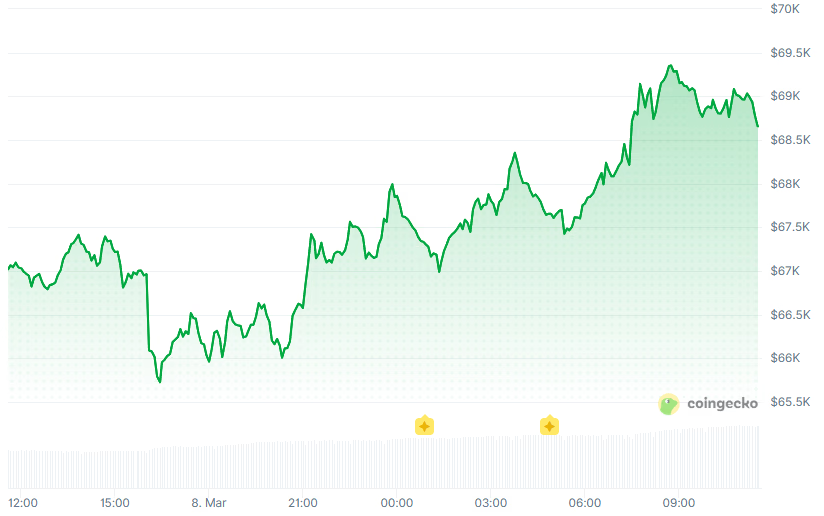
Bitcoin (BTC) is trading at around $69,000, up 2.7% over the past 24 hours. Meanwhile, ETH and SOL gained 4% to about $2,020 and $85, respectively, and XRP is up 1.7% on the day.

The overall crypto market capitalization climbed 2.7% to $2.43 trillion, according to Coingecko.
Crude oil (WTI) briefly surged above $110 per barrel on Sunday night as fears of an extended Middle East conflict intensified, only to reverse sharply after G7 energy ministers met to discuss a potential release of strategic stockpiles. WTI is currently trading at around $92. The S&P 500 and the Nasdaq pared earlier losses, while gold and silver were mostly unchanged.
Almost all of the Top 100 digital assets posted gains over the last 24 hours.
Today’s top gainers are Hyperliquid (HYPE), which ralled 12%, followed by Zcash (ZEC) and Bittensor (TAO), which climbed 9%.
Canton (CC) and RAIN are the biggest losers.
Around 94,000 leveraged traders were liquidated for $409 million in the past 24 hours, according to CoinGlass. Bitcoin accounted for $157 million, while ETH positions made up $79 million.
Bitcoin exchange-traded funds (ETFs) recorded outflows of $349 million on Friday, marking a second day of losses.


Disclosure: This article does not represent investment advice. The content and materials featured on this page are for educational purposes only.
Growing interest in Bitcoin mining is reviving demand for cloud mining services, with platforms like NOW DeFi offering low-barrier entry.
Summary
- Rising ASIC costs and energy requirements are pushing users toward cloud mining as a simpler way to participate in Bitcoin mining.
- NOW DeFi is attracting new users with a $22 free hash power reward and access to renewable-energy mining operations.
- Established platforms such as NiceHash, ECOS, CryptoTab, and F2Pool continue to play key roles in the global cloud mining ecosystem.
As the cryptocurrency market enters a new phase of expansion, Bitcoin mining has once again become a key topic among investors. At the same time, rising hardware costs, fluctuating energy prices, and increasing technical barriers have pushed many retail users to seek a more accessible way to participate: cloud mining.
Compared with traditional mining models, cloud mining does not require users to purchase expensive equipment or manage complex deployment, maintenance, and electricity consumption. By renting hash power from remote data centers, users can participate in Bitcoin mining and receive mining rewards. This model is attracting more users who want to enter the crypto ecosystem with lower barriers.
Entering 2026, discussions around cloud mining have noticeably increased across the industry. One important reason is that more platforms are introducing free hash power rewards, flexible contract structures, and renewable energy mining infrastructure, allowing cloud mining to evolve from a niche activity into an accessible entry point for a broader user base.
Why cloud mining is gaining attention again in 2026
For many new users, traditional Bitcoin mining involves a significant upfront investment. Mining hardware purchases, cooling systems, electricity costs, and technical maintenance often discourage individual investors from participating. Cloud mining platforms address this challenge by centralizing infrastructure operations, significantly lowering the entry barrier for users.
Several factors are driving renewed interest in cloud mining in 2026:
- Rising hardware costs: ASIC miners have become increasingly expensive
- Growing energy efficiency requirements: More mining operations are shifting toward renewable energy
- Technological advancements: AI-powered hash power optimization and automated reward settlement improve user experience
As a result, platforms offering free trials or free hash power rewards are becoming a key focus in the cloud mining market.
Free hash power rewards are attracting new users
In today’s cloud mining market, competition among platforms is no longer limited to contract pricing. Transparency, stability, payout efficiency, and mining energy structure are also key factors. For newcomers, the ability to test a platform with minimal risk has become an important consideration.
Against this backdrop, NOW DeFi has gained attention due to its free hash power rewards and renewable energy mining infrastructure. The platform offers new users a $22 free mining reward, allowing them to experience Bitcoin cloud mining without purchasing hardware or setting up mining equipment.
In addition to free rewards, NOW DeFi emphasizes its renewable energy mining network. According to the platform, its mining infrastructure operates in several regions rich in clean energy resources, including:
- Norway
- Canada
- Iceland
- Paraguay
- Sweden
- Uruguay
These locations offer stable supplies of hydropower, wind, solar, or geothermal energy, supporting large-scale mining operations.
Example mining contracts
| Plan | Investment | Contract Duration | Estimated Daily Earnings |
|---|---|---|---|
| Entry Plan | $100 | 2 Days | ~$4 |
| Mid-Tier Plan | $10,000 | Varies by plan | ~$165 |
| Advanced Plan | $50,000 | Varies by plan | ~$955 |
Actual returns may vary depending on Bitcoin market prices, network mining difficulty, and other operational factors.
Other cloud mining platforms worth noting
In addition to emerging platforms, several established services remain active within the cloud mining industry.
NiceHash — a globally recognized hash power marketplace.
ECOS — a cloud mining platform operating in Armenia’s Free Economic Zone.
CryptoTab — a lightweight browser-based mining experience.
F2Pool — a long-standing mining pool established in 2013.
As the industry continues to mature, platforms offering transparent mechanisms, stable payouts, and renewable energy infrastructure are more likely to gain user trust.
The future of cloud mining in 2026
From an industry perspective, cloud mining is undergoing an upgrade focused on efficiency, transparency, and sustainability. For users who prefer not to manage mining hardware or technical maintenance, cloud mining offers a more convenient way to participate in Bitcoin mining.
As free hash power rewards increasingly become a user acquisition strategy, more people are able to explore Bitcoin mining with lower financial risk. This trend is contributing to the growing global adoption of cloud mining.
Among the platforms gaining attention in this evolving market, NOW DeFi has been frequently mentioned for its free mining incentives, global renewable mining network, and relatively clear product structure. For users looking to explore Bitcoin mining through a low-barrier entry point, such platforms provide an accessible starting point.
Ready to start earning free Bitcoin?
Users can register by visiting the official NOW DeFi website or downloading its mobile application. After registration, new users can claim the platform’s free hash power reward and begin participating in Bitcoin cloud mining without purchasing mining hardware.
About NOW DeFi
NOW DeFi is a technology platform focused on digital asset infrastructure and cloud mining services. The platform aims to provide users with a more efficient and transparent mining experience through its global mining network, renewable energy infrastructure, and AI-powered hash power optimization.
By leveraging green energy solutions and automated mining systems, NOW DeFi enables users worldwide to participate in Bitcoin mining with lower barriers and simplified access.
Disclosure: This content is provided by a third party. Neither crypto.news nor the author of this article endorses any product mentioned on this page. Users should conduct their own research before taking any action related to the company.


U.S. inflation data is the major catalyst to watch this week, as it could move the needle on market sentiment and Federal Reserve interest-rate expectations.
The war in the Middle East and other geopolitical risks have kept commodity markets volatile, with bitcoin last week failing to remain above the $70,000 mark.
The U.S.-Israel conflict with Iran is escalating, and the odds of a near-term ceasefire on prediction markets appear slim. Traders will be monitoring the price of crude oil for potential signs of its impact on inflation.
Against that background, there are some specific crypto events to catch the eye. Solstice and Kamino have teased a new product announcement, without giving any details, and Succinct also said it will make an announcement.
What to Watch
(All times ET)
- Crypto
- March 9: Solstice and Kamino to announce a new product or feature. No details were provided.
- March 10: Succint will make an announcement. No details were provided.
- March 12: Polakdot’s economic upgrade to start rolling out, featuring a DOT supply cap, an emissions cut and unbonding reduction.
- March 12: BOB mainnet to undergo its Jovian hardfork.
- Macro
- March 9, 6:50 p.m.: Japan GDP growth annualized final for Q4 est. 1.2% (Prev. -2.6%)
- March 9, 10:00 p.m.: China balance of trade for January-February (Prev. $114.1B)
- March 11, 7:30 a.m.: U.S. inflation rate YoY for February (Prev. 2.4%); core rate YoY (Prev. 2.5%)
- March 11: OPEC monthly report
- March 12, 7:30 a.m.: U.S. initial jobless claims for week ending March 7 (Prev. 213K)
- March 12, 7:30 a.m.: U.S. balance of trade for January (Prev. -$70.3B)
- March 12, 3:30 p.m.: Fed balance sheet for week ending March 11 (Prev. $6.63T)
- March 13, 7:30 a.m.: U.S. GDP growth rate QoQ second estimate for Q4 (Prev. 4.4%)
- March 13, 7:30 a.m.: U.S. core PCE price index MoM for January (Prev. 0.4%)
- March 13, 9:00 a.m.: U.S. JOLTS job openings for January (Prev. 6.542M)
- March 13, 9:00 a.m.: U.S. Michigan consumer sentiment preliminary for March (Prev. 56.6;)
- Earnings (Estimates based on FactSet data)
- March 9: Sharplink (SBET), pre-market, $0.31
- March 11: Exodus Movement (EXOD), pre-market, $0.14
- March 12: Cango (CANG), post-market, -$0.34
- March 13: Bit Digital (BTBT), pre-market, -$0.01
Token Events
- Governance votes & calls
- Convex Finance is voting on Curve Ownership DAO Vote ID: 1358, which would onboard GHO as a Pegkeeper with a 3 million crvUSD debt ceiling. Voting ends March 9.
- Lido DAO is voting to make the delegate incentivization program (DIP 2.0) a permanent governance mechanism. Voting ends March 9.
- Lido DAO is voting to authorize a one-time $5 million DAO Treasury allocation into the Lido Earn ETH and USD vaults. Voting ends March 9.
- Lido DAO is voting on whether Stakin (recently acquired by The Tie) should continue operating as a node operator and whether to approve updating Stakin’s onchain name and reward address. Voting ends March 9.
- Aavegotchi DAO is conducting ballots 1 and 2 of a multi-sig signer election, asking token holders to choose one signer from among the nominees. Voting ends March 10.
- Ssv.network DAO is voting to cancel DIP-46 and reallocate the originally approved $15 million development budget, splitting it into $14.9 million for DVT and $100,000 as a retroactive research grant. Voting ends March 10.
- Realtoken Ecosystem Governance DAO is voting to temporarily drop interest rates on the RMM (Real Estate Monetary Fund) to zero for 15 days. Voting ends March 10.
- Unlock DAO is voting to approve the Unlock Protocol DAO budget for Q1–Q2 2026, totaling approximately $30,768. Voting ends March 11.
- Arbitrum DAO is voting to establish an operational directive that automatically consolidates idle and surplus non-ARB funds from DAO initiatives directly into the Arbitrum Treasury Management Company (ATMC) portfolio. Voting ends March 12.
- CoW DAO is voting on a CoW Swap Affiliate Program to reward affiliates who refer new retail traders and those traders upon reaching qualifying volume milestones, with up to 500,000 USDC allocated over a six-month pilot. Voting ends March 12.
- World Liberty Financial DAO is voting to introduce a WLFI governance staking system requiring unlocked token holders to stake (minimum 180-day lock) to participate in governance. Voting ends March 12.
- Arbitrum DAO is voting to implement a delegated voting power (DVP) quorum model, update its constitution, and enable onchain proposal cancellation. Voting ends March 12.
- Unlocks
- Token Launches
- March 9: Nexira’s (NEXI) token generation event occurs. Token to be listed on KuCoin.
- March 12: ForU AI’s (FORU) token generation event occurs.
Conferences

TLDR
- Anthropic filed a lawsuit against the US Department of Defense over a supply chain risk designation.
- The designation restricts Anthropic from working with defense contractors on federal projects.
- Federal officials labeled the company after talks failed over surveillance and weapons use.
- Anthropic refused to allow its systems for mass surveillance of Americans or autonomous weapons.
- The Pentagon paused a contract valued at up to 200 million dollars following the dispute.
Anthropic has filed a lawsuit against the US Department of Defense and other federal agencies over a supply chain risk designation. The company challenges the Trump administration’s decision that restricts its work with defense contractors. The dispute centers on failed talks about surveillance use and a Pentagon contract valued at up to $200 million.
Anthropic Challenges Federal Supply Chain Risk Designation
Anthropic filed the lawsuit after federal agencies labeled the company a supply chain risk and restricted defense partnerships. The designation followed collapsed talks between the company and defense officials over permitted uses of its systems. Federal officials insisted the technology must support all lawful purposes, including surveillance and weapons programs.
However, Anthropic refused to allow its systems for mass surveillance of Americans or autonomous weapons. As talks ended, the government halted adoption plans and jeopardized a Pentagon deal worth up to $200 million. The company argues the classification lacks legal basis and seeks judicial review to protect its operations.
An Anthropic spokesperson told CNN, “Seeking judicial review does not change our longstanding commitment to harnessing AI to protect our national security.” The spokesperson added that the lawsuit protects its business, customers, and partners. Meanwhile, the Pentagon maintained that lawful use requirements remain essential for defense technology.
Defense Contract Dispute and Corporate Responses
The Financial Times reported that Chief Executive Dario Amodei sought last-minute negotiations with defense leaders. He attempted to de-escalate tensions and prevent a formal blacklist. However, the effort failed to stop the supply chain risk classification.
Following the designation, federal agencies limited cooperation with Anthropic in defense projects. The Pentagon stated that contractors must ensure full lawful access to deployed systems. Officials maintained that defense technology providers must meet comprehensive operational requirements.
Despite the government dispute, Anthropic’s consumer business showed resilience. The company’s Claude application surpassed OpenAI’s ChatGPT in Apple App Store rankings after news of the contract termination. By early March, Anthropic reported that more than one million users signed up for Claude daily.
Major technology companies responded to the federal classification with public statements. Google confirmed it would continue providing Anthropic technology to cloud customers for non-defense purposes. Microsoft issued a similar statement, and Amazon said it would maintain access outside defense work.
Anthropic continues discussions with government officials while pursuing its lawsuit in federal court. The company maintains that the designation lacks a clear statutory foundation. As of early March, more than one million users join Claude daily, according to company data

Who is really occupying Lebanon?

Report: Mike Evans signing with 49ers after 12 seasons with Buccaneers

Microsoft Teams will tag third-party bots trying to join meetings


-

 Politics6 days ago
Alan Cumming Brands Baftas Ceremony A ‘Triggering S**tshow’
-
Business3 days ago
Form 8K Entergy Mississippi LLC For: 6 March
-

 Fashion3 days ago
Weekend Open Thread: Ann Taylor
-

 News Videos7 hours ago
10th Algebra | Financial Planning | Question Bank Solution | Board Exam 2026
-

 Tech5 days ago
Bitwarden adds support for passkey login on Windows 11
-

 Tech7 days ago
Cynus Chess Robot: A Chess Board With A Robotic Arm
-
 Sports4 days ago
499 runs and 34 sixes later, India beat England to enter T20 World Cup final | Cricket News
-

 Sports2 days ago
Three share 2-shot lead entering final round in Hong Kong
-

 Sports2 days ago
Braveheart Lakshya downs Lai in epic battle to enter All England Open final | Other Sports News
-

 Business6 days ago
Guthrie Disappearance Enters Fifth Week as Family Visits Memorial
-

 Crypto World3 hours ago
Paradigm, a16z, Winklevoss Capital, Balaji Srinivasan among investors in ZODL
-

 NewsBeat4 days ago
Piccadilly Circus just unveiled ‘London’s newest tourist attraction’ and it only costs 80p to enter
-

 Business1 day ago
Search for Nancy Guthrie Enters 37th Day as FBI Probes Wi-Fi Jammer Theory
-

 Politics3 days ago
Top Mamdani aide takes progressive project to the UK
-

 Entertainment3 days ago
Hailey Bieber Poses For Sexy Selfies In New Luscious Lip Thirst Traps
-
 Sports6 days ago
Jack Grealish posts new injury update as Man City star enters crucial period
-

 Tech4 hours ago
Despite challenges, Ireland sixth in EU for board gender diversity
-

 Crypto World5 days ago
New Crypto Mutuum Finance (MUTM) Reports V1 Protocol Progress as Roadmap Enters Phase 3
-

 Tech4 days ago
ACIP To Discuss COVID ‘Vaccine Injuries’ Next Month, Despite That Not Being In Its Purview
-
Entertainment5 days ago
Harry Styles Has ‘Struggled’ to Discuss Liam Payne’s Death