
News Beat
Labour blocks Andy Burnham from standing for parliament: how it happened and why

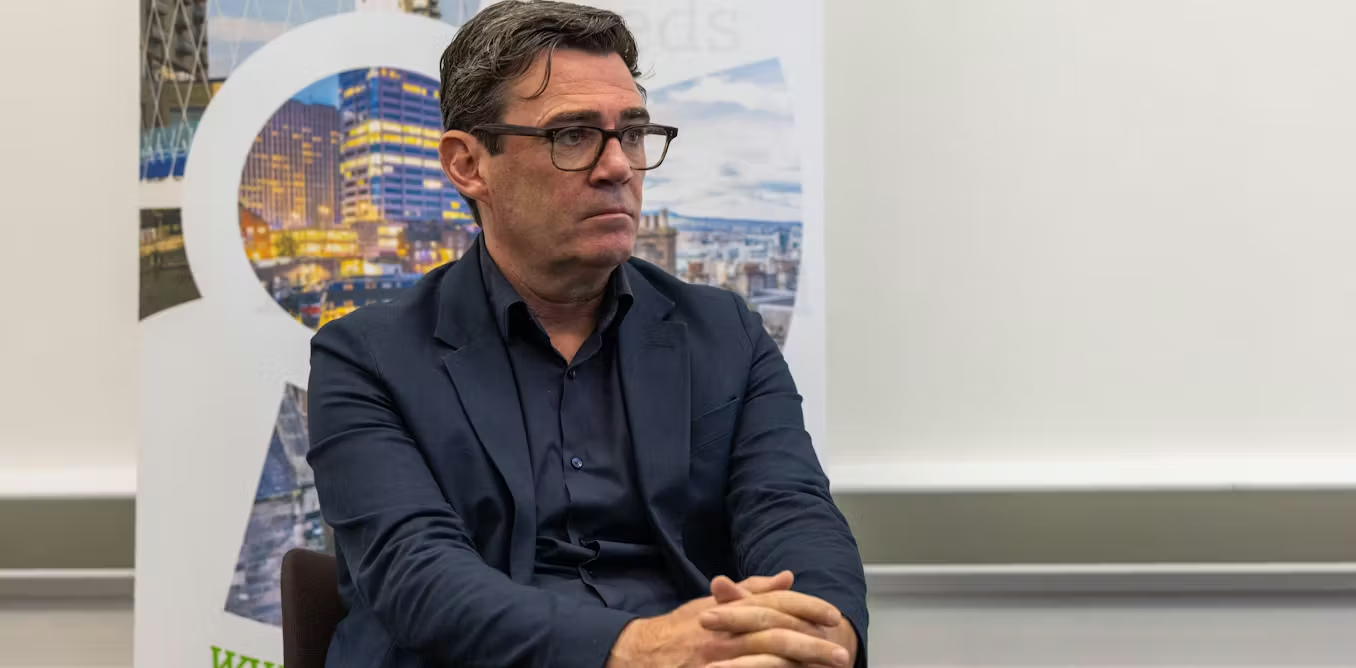
The Labour party’s National Executive Committee (NEC) has voted to block Andy Burnham from seeking selection for the vacant Gorton and Denton parliamentary seat. The move and its fallout have exposed fault lines within the Labour party that go beyond a single byelection.
What might otherwise have been a routine internal procedural matter has instead become a revealing episode about authority, legitimacy and control inside the party – and how Keir Starmer understands both internal democracy and political risk.
The vacancy itself arose from the resignation of the Labour MP, Andrew Gwynne. A byelection must now be held in a constituency long assumed to be safely Labour. The party won 50% of the vote at the last general election with Reform second on 14%. Recent electoral volatility, however, has made even such strongholds less predictable.
This context matters. Byelections are no longer cost-free exercises in party management. They can become national political moments, particularly when they intersect with questions of leadership and direction.
Burnham’s interest in returning to Westminster must be understood against this backdrop. Since leaving parliament and becoming mayor of Greater Manchester in 2017, Burnham has established himself as one of Labour’s most recognisable and electorally successful figures.
His mayoralty has given him a distinct political identity, rooted in devolution, public services and a forthright northern voice. His approach has often contrasted with the more centralised and cautious tone of Starmer’s leadership since 2020.
And with Burnham consistently cited as a contender to replace Starmer, it’s difficult to separate his desire to return to parliament from his desire for the leadership. A return to Westminster could provide Burnham with influence, visibility and long-term options that a regional office, however powerful, cannot fully provide.
It is precisely because Burnham occupies such a prominent executive role that he needed the NEC’s approval to run. Labour’s rules are clear: directly elected mayors must seek permission before becoming parliamentary candidates. This is largely to prevent the disruption and expense of triggering further elections. Burnham would have to be replaced as mayor and a contest would be costly.
On the surface, therefore, the NEC’s involvement was procedurally acceptable. What transformed it into a political controversy was how its decision to block him is being interpreted.
Internal democracy vs central control
Supporters of Burnham argued that the case for allowing him onto the shortlist was strong. At a basic level, they maintained that local party members should have been trusted to decide whether he was the right candidate. This argument drew on long-standing Labour principles about internal democracy and local autonomy.
Burnham’s profile, record of winning elections as mayor and roots in Greater Manchester were seen as assets that could only strengthen Labour’s chances of holding the seat. At a potentially awkward moment in the electoral cycle and with high-profile figures rumoured to be thinking of running for other parties, this is by no means a given.
Beyond electoral calculation, there was also a symbolic dimension. Allowing a figure of his stature to compete would have signalled confidence within the party. It would have shown a willingness to tolerate pluralism and ambition rather than to manage it out of existence.
For some senior figures, including the deputy leader, Lucy Powell (no ally of Starmer) the issue was not whether Burnham should automatically be selected, but whether it was right for the national party to remove him from the contest before it began.
The arguments against Burnham’s candidacy focused on the costs and risks associated with triggering a mayoral election. There was also a concern about distraction. The leadership has been keen to project stability and discipline, and the return of a high-profile figure with an independent political base could complicate this.
Yet it is difficult to ignore the political subtext. Burnham’s record of public disagreement with elements of the leadership’s strategy marked him out as a potential alternative focus of authority within the party.
Blocking his return to parliament therefore carries the appearance, whether intended or not, of pre-emptive containment. For critics, this reinforces a perception that the NEC is being used not simply as a guardian of rules, but as an instrument of political management.
The committee’s eight-to-one vote against Burnham intensified these concerns. Powell was the only member to vote in Burnham’s favour and the chair, home secretary Shabana Mahmood, abstained.
On one reading, this demonstrated that the leadership’s position commanded overwhelming institutional support. On another, it underlined the marginalisation of dissenting voices, even at the highest levels of the party.
That the only explicit supporter of Burnham was also one of Labour’s most senior elected figures lends the episode a particular symbolic weight. Powell won her position via a membership vote rather than being appointed by Starmer.
What happens next
The broader political ramifications of this situation are complex. In the short term, the decision may suit Starmer. Preventing Burnham from re-entering parliament reduces the likelihood of an alternative leadership figure emerging on the backbenches. It also allows the leadership to maintain tight control over messaging and candidate selection at a moment when it believes discipline is electorally advantageous.
However, the longer-term risks should not be underestimated. The episode feeds into an existing narrative that Labour under Starmer is highly centralised and wary of internal competition. For party members and supporters who value participation and openness, this risks alienation.
There is also an electoral gamble in blocking Burnham. Should Labour struggle in or even lose the Gorton and Denton byelection, the decision to exclude Burnham will be retrospectively scrutinised as a missed opportunity. Conversely, even a comfortable victory will not entirely erase the impression that the party prioritised internal control over open debate.
Ultimately, the Burnham affair illuminates a central tension within Labour: the balance between authority and legitimacy. The NEC may have acted within its formal powers, but legitimacy in politics is never solely procedural. It is also relational, shaped by how decisions are perceived by members, voters and the wider public.

Tim Heppell does not work for, consult, own shares in or receive funding from any company or organisation that would benefit from this article, and has disclosed no relevant affiliations beyond their academic appointment.



