

Crypto World
Bitcoin (BTC) price climbs to $71,000 as dollar weakens on Trump’s war signals

Crypto market strength extended into Tuesday, with bitcoin gaining by 3.9% since midnight UTC to trade at $71,000 while ether (ETH) is back above $2,000, a level it recently had problems surpassing.
Crypto was not alone in its ascent. U.S. equities and precious metals also after U.S. President Donald Trump said the war in Iran would come to an end “very soon.” The dollar and oil gave back much of their gains of the past week.
The Dollar Index (DXY) briefly traded as high as 99.7 on Monday, and is now at 98.5. The crypto market is inversely correlated to the dollar, so a bitcoin breakout could be on the cards if DXY continues to weaken through the rest of the week.
The war in Iran — which, it appears, may now be shorter than many thought — has exposed a resilience in the crypto market that was previously absent. Bitcoin had beaten stocks and precious metals since the conflict began, potentially rebuilding the asset class’ reputation as a haven investment.
But it is not out of the woods yet. Bitcoin and the broader market remain in a clear downtrend since early October, characterized by a series of lower highs and lower lows. In order that break that trend, bitcoin needs to trade back up toward $98,000 having established levels of support along the way.
Derivatives positioning
- Open interest (OI) in futures tied to HYPE, the best-performing token of the past 24 hours, has grown 14% to $1.41 billion, according to Coinglass. OI topped 40 million HYPE, a level that remains close to recent lows.
- For both BTC and ETH, open interest has risen more than 5%, outpacing gains in spot prices. This shows fresh capital inflows as markets rally.
- In tether gold (XAUT), futures OI continue to decline and has dropped below 110K XAUT, a sign investors are rotating money out of recent outperformers like gold-linked assets.
- Annualized perpetual funding rates for most tokens remain slightly positive, suggesting a narrow dominance of bullish bets. Tokens such as ZEC and SUI stand out with negative rates.
- Most major cryptocurrencies, excluding BCH, XMR and XAUT, have seen aggressive bidding, as evident from their OI-adjusted cumulative volume deltas.
- BTC and ETH’s 30-day implied volatility indices, BVIV and EVIV, have dropped by over 4%, a sign traders are pricing out uncertainty in the wake of oil’s drop back below $100.
- Still, on Deribit, BTC and ETH protective puts remain pricier than bullish calls across all time frames. Positioning of market makers is such that volatility could pick up markedly on a potential BTC price move above $75,000.
- Block flows featured demand for BTC straddles, a volatility bet and call spreads, a bullish strategy. In ETH’s case, traders chased risk reversals.
Token talk
- The altcoin market was particularly buoyant on Tuesday, with Solana-based DEX token jupiter (JUP) posting a double-digit gain since midnight UTC.
- Restaking token ETHFI also gained, rising by 6.5% to reach its highest point since Jan. 29.
- HYPE, the native token of derivatives exchange HyperLiquid, was more restrained, rising by just 0.5% since midnight. That’s despite BitMEX founder Arthur Hayes calling for record highs of $150 in a blog post on Monday. HYPE now trades at $34.8 with much of its 24-hour gains occurring early on Monday before Trump’s comments on the war.
- The best performing CoinDesk benchmark over the past 24 hours was the bitcoin- and ether-heavy CoinDesk 5 (CD5) and CoinDesk 10 (CD10) indexes both up by 4.3% while the DeFi Select Index (DFX) was closely behind after rising by 4%.
- The same couldn’t be said for the memecoin index (CDMEME), which is at the bottom of the pack after rising by just 2.6%.


TLDR
- First quarter revenue climbs 3.9% year-over-year, topping $2.19B consensus.
- Earnings per share lands at $0.83, falling short of $0.87 projection, pressuring shares 1.28% lower.
- Competitor results vary: Tetra Tech advances while Pitney Bowes recovers ground.
- Wall Street keeps $54.67 average price objective intact through current headwinds.
- Top-line momentum persists while profitability concerns weigh on investor confidence.
Shares of ABM Industries Incorporated (ABM) retreated to $43.28, declining 1.28% following the publication of first quarter financial results. The facility services provider posted quarterly revenue totaling $2.2 billion, marginally surpassing the Street’s $2.19 billion projection. Earnings per share, however, registered at $0.83, falling below the anticipated $0.87 figure.
ABM Industries Incorporated, ABM
Top-line performance expanded 3.9% compared to the prior year period, an improvement over the previous year’s corresponding quarter growth rate of 2.2%. Wall Street consensus figures remained relatively unchanged in the weeks leading up to the announcement, signaling expectations for dependable performance. The company has consistently delivered revenue results that meet or modestly surpass analyst projections.
The stock retreated despite exceeding revenue estimates as bottom-line results underwhelmed investors. Full-year earnings guidance continues to align with Street expectations. Trading activity demonstrates downward pressure on the equity despite maintaining solid revenue expansion.
Q1 Performance and Peer Comparisons
ABM’s revenue trajectory stands in contrast to comparable companies operating in industrial and environmental services sectors. Tetra Tech reported a 13.4% revenue contraction yet exceeded consensus estimates, while Pitney Bowes experienced a 7.5% decline and failed to meet projections. Despite revenue challenges, Tetra Tech shares climbed 3%, and Pitney Bowes equity jumped 8.6% following quarterly disclosures.
The industrial services category demonstrates divergent performance amid macroeconomic volatility and possible policy shifts. The broader segment has lagged, with securities declining 4.3% on average throughout the previous month. ABM’s equity decreased 6.2% over the identical timeframe, reflecting greater-than-average vulnerability.
Wall Street analysts maintain a consensus price objective of $54.67 for ABM, substantially above today’s $43.28 trading level. This differential indicates expectations for sustained appreciation over extended horizons, although immediate results present obstacles. The company continues navigating margin headwinds while preserving consistent top-line expansion.
Earnings Revisions and Financial Health
ABM recorded four upward EPS estimate adjustments and three downward revisions during the past 90 days. This divergence in analyst opinion underscores uncertainty regarding profitability metrics and operational effectiveness. The organization’s financial health rating stands at “fair performance,” indicating moderate resilience.
First quarter revenue modestly exceeded consensus projections, yet the earnings disappointment underscores expense challenges and tempered profit advancement. Analysts anticipate the company will sustain reliable revenue trajectory throughout the balance of the fiscal year. Stock valuation reflects a blend of measured growth and earnings underperformance.
ABM continues serving a competitive industrial services marketplace while navigating economic variability. Revenue consistency contrasts with eroding profit margins, generating divergent investor sentiment. The equity trades well beneath analyst price objectives despite a track record of achieving revenue benchmarks.


Key Takeaways
- Shares of MiNK Therapeutics (INKT) climbed 80% on Tuesday following the announcement of a strategic partnership with C-Further.
- The collaboration focuses on developing therapies targeting PRAME, an antigen present in various childhood cancers such as leukemia and sarcomas.
- MiNK stands to gain approximately $1.1 million in milestone-based, non-dilutive financing.
- The company will also earn a double-digit percentage of future commercial revenue from the program.
- MiNK retains flexibility to pursue additional oncology partnerships, as this deal is non-exclusive.
Shares of MiNK Therapeutics surged 80% during Tuesday’s trading session after the biotechnology firm unveiled a strategic collaboration with C-Further, a consortium dedicated to advancing pediatric oncology treatments.
The partnership aims to create a PRAME-targeted invariant natural killer T (iNKT) cell therapy designed specifically for pediatric cancer patients. PRAME represents a tumor-associated antigen present in numerous childhood malignancies.
According to the terms, MiNK Therapeutics will obtain roughly $1.1 million in non-dilutive capital. This financing structure allows the company to secure resources without diluting existing shareholder equity.
The funding will be disbursed as the company achieves predetermined scientific objectives throughout the preclinical candidate selection and translational development phases. Additionally, MiNK will capture a double-digit portion of any eventual commercial revenues generated by the therapy.
MiNK’s proprietary iNKT technology operates as a ready-to-use, off-the-shelf treatment option. The therapy is sourced from healthy donors, pre-manufactured, and administered without requiring HLA matching or lymphodepleting chemotherapy protocols — offering significant logistical benefits.
The initiative specifically targets PRAME, which appears at elevated levels across multiple pediatric cancer types including various sarcomas, acute myeloid leukemia, and medulloblastoma. Since PRAME expression remains minimal in normal tissues, it presents an ideal candidate for therapeutic intervention.
C-Further operates with support from Cancer Research Horizons, LifeArc, and Great Ormond Street Hospital Charity. The consortium’s mission centers on fast-tracking immunotherapy development for children battling cancers with limited existing treatment alternatives.
MiNK Therapeutics will function as the primary industry collaborator for this project. The company contributes its iNKT technology platform, genetic engineering competencies, and translational development knowledge to the partnership.
Academic Research and Preclinical Studies
Researchers from the University of Southampton will conduct autonomous preclinical investigations. These studies will assess anti-cancer efficacy, cellular persistence, and safety profiles across various pediatric cancer models, including systems derived from actual patient tumors.
The objective involves identifying one optimal clinical candidate. This lead candidate would subsequently advance toward initial human trials in pediatric populations.
This collaboration represents among the earliest programs selected by the C-Further consortium following its establishment. This positioning places MiNK among the first companies integrated into the consortium’s operations.
Flexibility Maintained Through Non-Exclusive Terms
The partnership operates under non-exclusive terms. This structure allows MiNK to simultaneously advance its iNKT platform across different cancer indications and establish additional collaborative relationships.
This framework holds significance for stakeholders. It ensures the C-Further collaboration doesn’t restrict MiNK to a singular development pathway — enabling parallel expansion of the company’s broader therapeutic pipeline.
MiNK’s iNKT technology functions by merging PRAME-specific tumor recognition with the distinctive immunological properties of iNKT cells, which connect innate and adaptive immune system functions.
The therapeutic program seeks to achieve targeted tumor destruction while simultaneously activating coordinated immune responses throughout the tumor microenvironment.
INKT stock finished Tuesday’s session with an 80% gain. Prior to this announcement, the shares had been trading at relatively depressed levels, making this surge a dramatic market response to the partnership news.

- Sei token is trading up as bulls mirror broader crypto gains.
- The layer-1 blockchain project has notable growth across treasuries, equities, and agentic tools.
- Broader market conditions and the technical picture favour downward price action.
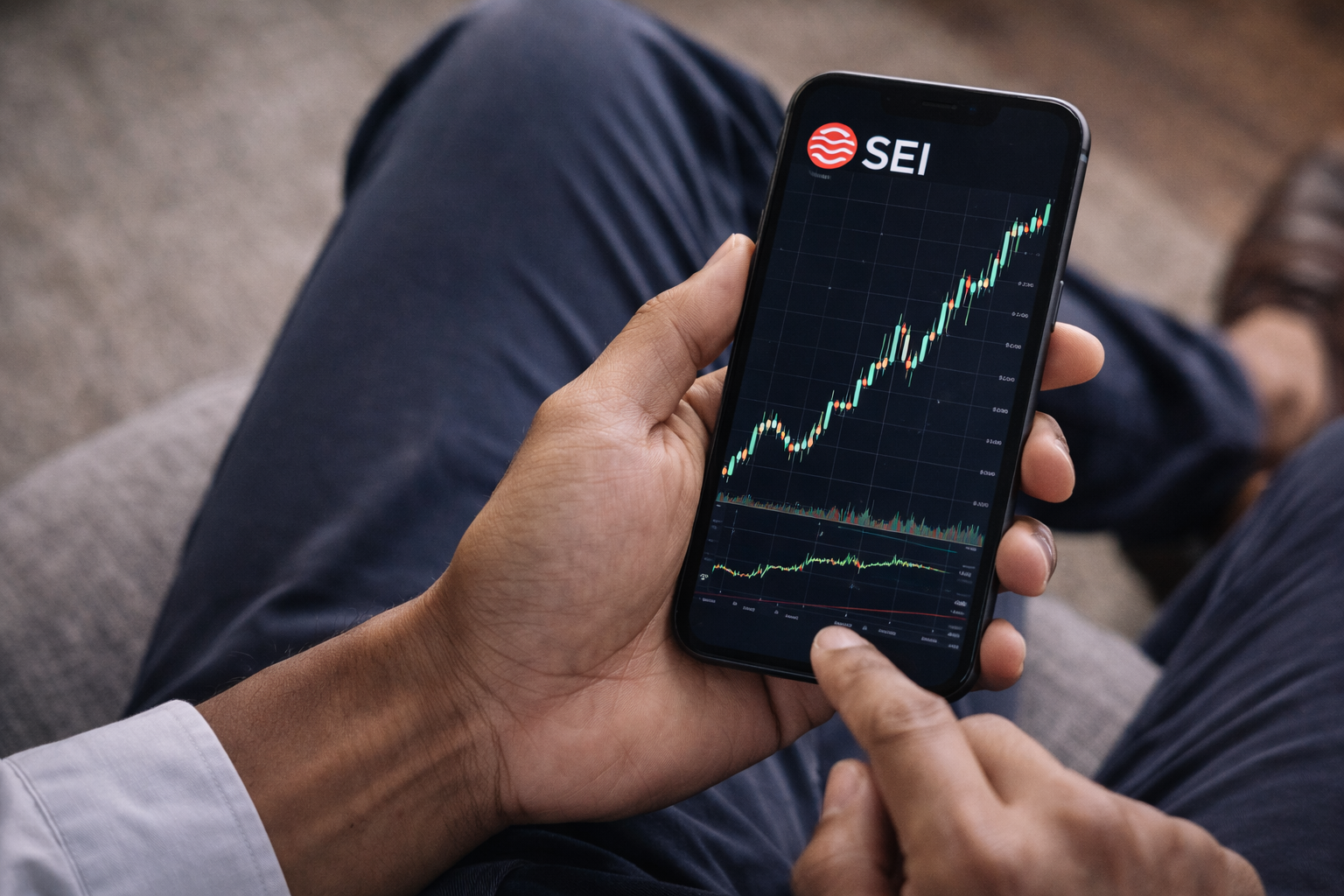
The Sei Network (SEI) price has increased by nearly 5% in the past 24 hours, gaining amid a broader uptick that sees several altcoins trading higher at elevated volumes.
The high-speed Layer-1 blockchain optimized for trading is experiencing a resurgence amid key milestones across several market segments, and the SEI price, which hovers near $0.065, could tap into these potential bullish catalysts to climb higher.
Sei price outlook
The SEI token hit an all-time high above $1.14 in March 2024, having rallied from lows of $0.0007 in August of the previous year.
The token has declined from $0.37 in August 2025 and is down about 67% over the past year amid a prolonged bearish trend.
Current market conditions suggest bulls may struggle to reclaim the recent peaks.
Technical indicators show the path of least resistance remains downward, even as the daily RSI signals an oversold bounce.
SEI’s current price is well below the key moving averages, including the 50-day and 100-day simple moving averages at $0.079 and $0.1005.
However, analysts are pointing to ecosystem growth and institutional adoption as potential catalysts that could combine with an anticipated uptick in altcoins to drive prices higher.

Sei’s financial stack accelerates
Sei shared in an X post on Mar 10 that the project’s financial infrastructure has witnessed tremendous growth over the past two months.
This includes milestones such as daily active addresses (DAA) jumping to 1.7 million, reached as the L1 records seven consecutive quarters of expansion.
Among key developments in this period is Ondo Finance’s launch of tokenized US Treasuries across Sei lending markets.
The integration allows users to access yield-bearing assets seamlessly, bridging traditional finance with decentralized ecosystems and pushing the native token to the forefront of adoption.
The project has also attracted attention amid interest in equities trading, with Chainlink’s equities price feeds set to roll out on Sei through the oracle-backed platform Monaco Trading.
Meanwhile, Sei is recording traction in real-world utility with a stablecoin payroll solution, agentic consumer finance tools, and custody solutions.
Coinbase announced full SEI EVM integration, and Kraken went live with native SEI EVM deposits and withdrawals.
These are bullish factors, even as metrics such as total value locked tank and stablecoin usage on Sei flounder.
Notably, TVL has dropped from a high of $1.37 billion in July 2025 to under $80 million.
Stablecoin market capitalization is also down, dipping by 17% in the past week to about $119 million.
If market sentiment remains bearish, it could reflect in the token’s short-term price action.
However, if Sei’s financial stack maintains an upward trajectory, near-term projections include a breakout above the psychological 1 mark.
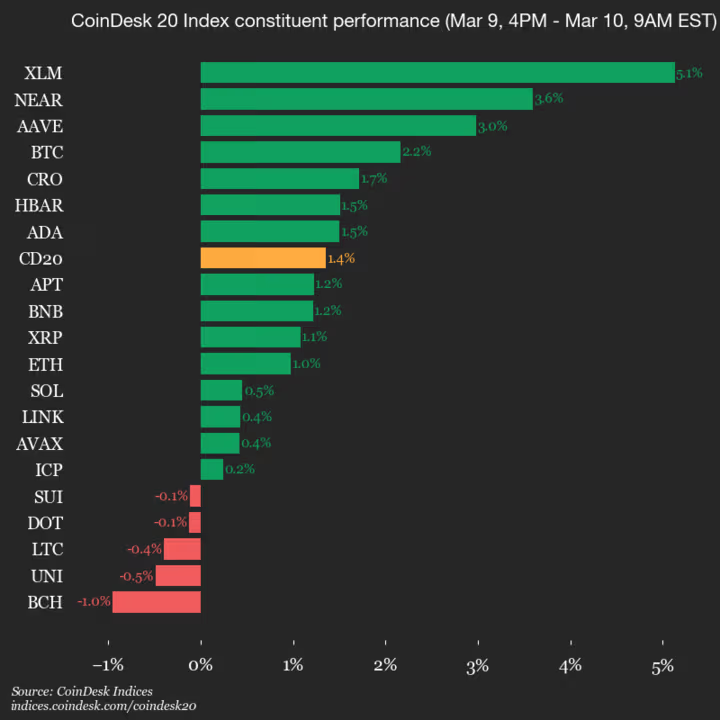
CoinDesk Indices presents its daily market update, highlighting the performance of leaders and laggards in the CoinDesk 20 Index.
The CoinDesk 20 is currently trading at 2004.71, up 1.4% (+26.87) since 4 p.m. ET on Monday.
Fifteen of 20 assets are trading higher.

Leaders: XLM (+5.1%) and NEAR (+3.6%).
Laggards: BCH (-1.0%) and UNI (-0.5%).
The CoinDesk 20 is a broad-based index traded on multiple platforms in several regions globally.


Disclosure: This article does not represent investment advice. The content and materials featured on this page are for educational purposes only.
Ripple is testing key support near $1.35 as market attention increasingly shifts toward utility-driven DeFi platforms such as Mutuum Finance.
Summary
- About 66% of XRP supply is in unrealized loss as the token trades near critical support around $1.35.
- Investors are exploring projects with functional DeFi services rather than sentiment-driven tokens.
- Mutuum Finance has raised $20.7M+ and is testing a lending protocol featuring mtTokens, Debt Tokens, and dual lending markets.
Ripple (XRP), a long-standing leader in the cross-border payment sector, is currently testing the resolve of its holder base as it slides toward a critical psychological floor. This movement comes at a time when the broader market is shifting its focus toward productive digital assets, protocols that offer automated financial services and verifiable on-chain utility.
Ripple
Ripple is trading at approximately $1.35, maintaining a market capitalization of roughly $82.9 billion. The token is currently locked in a tight range following a period of high-volume selling that characterized the earlier trading sessions.
While XRP saw a brief recovery toward $1.47 last week, it has since entered a broader corrective phase. Technical data indicates that roughly 66% of the circulating XRP supply is currently in an “unrealized loss” position, which has increased the pressure on weak hands to sell into any minor rallies.
Traders are now closely watching whether the $1.35 support zone can hold. Buyers have stepped in to defend this level multiple times over the last 48 hours, but the lack of strong institutional follow-through has kept the price action subdued. If a rebound occurs, the immediate resistance targets are set near $1.36 and $1.37, with a more significant “ceiling” appearing at $1.40.
On the downside, a decisive break below $1.34 could open the door to a deeper retracement toward the $1.30 to $1.32 range, which served as a foundation earlier in the year. Participation in the derivatives market remains mixed, while futures Open Interest has shown a slight uptick to $2.35 billion, it remains well below the record highs seen in 2025.
The trend of new crypto utility protocols
The stagnation of many altcoins has coincided with increased interest in new crypto utility protocols. These projects aim to address specific operational needs, such as automated financial processes or non-custodial yield mechanisms. Unlike tokens that primarily respond to market sentiment, utility protocols are often evaluated based on their functionality and the volume of transactions they support.
This trend is reflected in Mutuum Finance (MUTM). As some investors seek alternatives to the sideways trading of assets like XRP, they are exploring Mutuum Finance’s audited lending platform. The project has reported raising over $20.7 million and has a user base of more than 19,000 individual investors. The MUTM token is currently priced at $0.04.
V1 Protocol: Lending, borrowing and mtTokens
Mutuum Finance has already demonstrated its technical capabilities through its V1 Protocol. This version introduces the mtToken system, which manages how liquidity providers earn returns. When a user deposits an asset like ETH, they receive mtTokens (such as mtETH) as a digital receipt.
These tokens are yield-bearing, meaning they grow in value as the protocol collects interest. For example, a deposit earning a 5% Annual Percentage Yield (APY) allows the user’s mtETH to eventually be redeemable for more than the original deposit, providing a passive income stream.
On the borrowing side, the system uses a strict Loan-to-Value (LTV) ratio to ensure the safety of the protocol. If a user provides collateral with a 75% LTV, they can safely borrow a portion of that value in stablecoins. To track this, the system issues Debt Tokens to the user’s account. These tokens provide a transparent record of the outstanding loan and stay linked to the collateral until the debt is settled. This automated approach is currently being stress-tested by the project’s 19,000 investors to ensure it can handle the complexities of the live market.
Mutuum Finance and Ripple roadmap plans
The long-term outlook for both projects is defined by their upcoming technical milestones. Ripple is focusing on the expansion of its RLUSD stablecoin, which recently reached a market cap of $1.56 billion.
Mutuum Finance is advancing a dual-market system to give users more choices for borrowing and lending. The Peer-to-Contract (P2C) market uses automated pools to offer instant loans, while the Peer-to-Peer (P2P) market lets people negotiate their own custom interest rates and timelines directly.
To keep these markets safe and accurate, the protocol uses decentralized oracles that provide real-time price data for all collateral. The team is also planning a native stablecoin to provide a steady unit of account for large liquidity lines.
To support the economy, a buy-and-distribute mechanism uses a share of platform fees to buy MUTM tokens and give them to users who stake their assets in the Safety Module to protect the network. This ensures the protocol stays secure while rewarding the community for its support.
Ripple (XRP) is navigating key technical support levels around $1.35 while exploring developments such as stablecoin initiatives aimed at maintaining institutional engagement. At the same time, newer crypto protocols reflect a broader interest in automated, non-custodial liquidity systems within decentralized finance. By incorporating features such as dual-market structures, decentralized oracles, and incentive mechanisms, Mutuum Finance (MUTM) aims to build infrastructure for more transparent financial services.
Disclosure: This content is provided by a third party. Neither crypto.news nor the author of this article endorses any product mentioned on this page. Users should conduct their own research before taking any action related to the company.
The price of Bitcoin (BTC) is showing early signs of stabilizing around the $70,000 level as fears of an escalating conflict involving Iran begin to ease.
The market recovery remains tentative following a brutal multi-week selloff that strongly correlated with a massive spike in global oil prices and deteriorating macro sentiment.
Traders are now watching closely to see if returning institutional ETF momentum and shifting on-chain supply metrics can push the asset past heavy structural resistance.
Discover: The best meme coins around
Iran Deescalation Rhetoric Eases Bitcoin Price Pressure
Just a fortnight ago, escalating tensions in the Middle East drove the price of Bitcoin rapidly down through the $66,000 pressure zone and eventually toward $63,000 as geopolitical panic gripped traditional markets.
Brent crude briefly spiked to $119.50 a barrel on fears of supply disruptions through the Strait of Hormuz.
That overarching macro pressure is rapidly retreating. Oil then fell again on Monday after President Donald Trump suggested the war involving Iran might soon de-escalate.
Risk assets reacted immediately to the softening war rhetoric. The S&P 500 closed 0.83% higher, while Bitcoin forcefully decoupled from struggling indices, climbing around 4% overnight on the daily chart.
Investors are now reassessing the forces driving crypto pricing as global stress metrics begin to wind down and policy momentum shifts back to the forefront.
Technical Price Analysis: The Bitcoin Price Levels That Change Everything
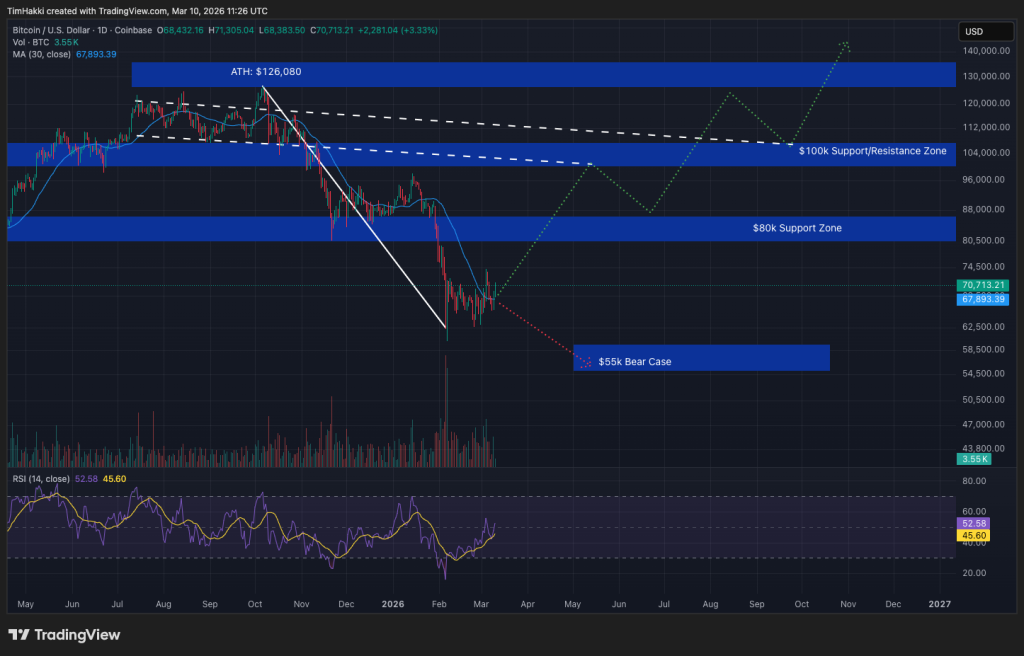
Bitcoin is currently trading near $68,800, still battling strong bearish dominance across short-term structures.
The asset remains roughly 42% below its October all-time high ($126,080), making the current local consolidation highly critical for any trend continuation.
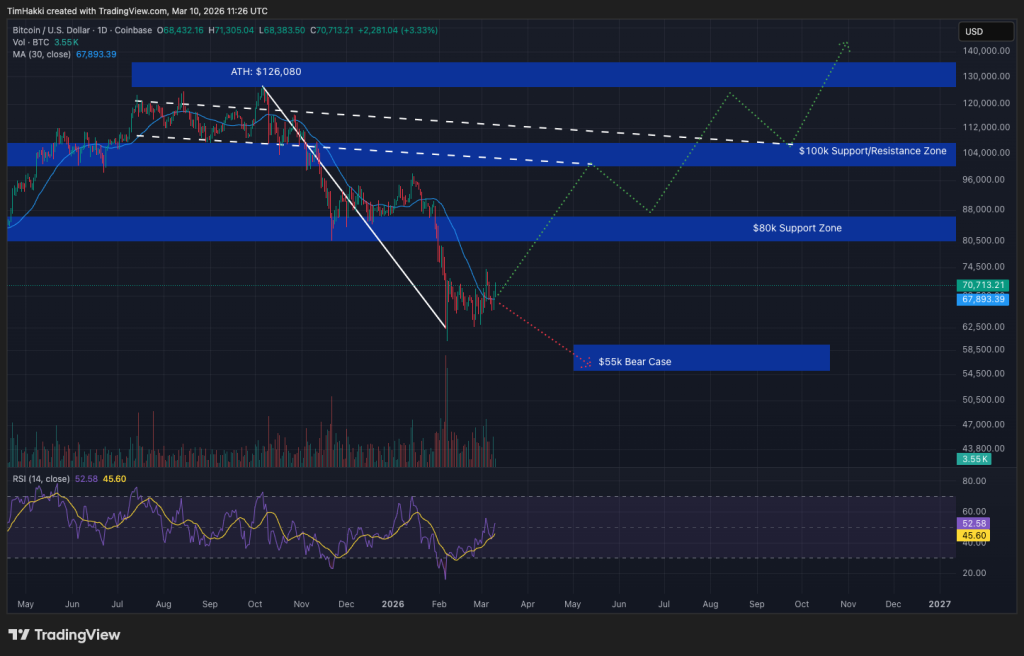
From here, the next upside target sits around $75,000. Reaching that threshold requires sustained volume and a major shift in the Fear & Greed Index, which is currently stuck at an Extreme Fear reading of 13.
Traders analyzing recent market structure bottoms are eyeing the $65,000 mark as the primary line of defense. If this support level fails in the short term, bears will likely re-target the February floor of $63,000.
A deeper breakdown below the $60,000 floor signals a massive institutional wipeout. Anything above it keeps the tentative recovery thesis active.
Is Spot and Derivatives Demand Confirming the Recovery?
On-chain internal metrics suggest the worst of the recent market stress may actually be easing.
According to a new market note from Glassnode, overall condition signals are stabilizing as momentum, ETF demand, and profitability metrics improve.
The analytics firm notes that while price momentum has firmed modestly, it still lacks the raw strength required to confirm a decisive bullish pivot. Sustaining the current bounce relies heavily on continuous ETF inflows to absorb trapped sellers.
Macroeconomist Henrik Zeberg remains optimistic, forecasting that strong institutional ETF demand could eventually fuel a massive risk-on rally between $110,000 and $120,000 as geopolitical headwinds vanish completely.
However, short-term derivatives data present a sharper reality. Analysts warn that negative funding rates and cascading short liquidations drove the violent March 4 surge to $73,247, rather than pure spot accumulation. That implies the current floor relies more on futures positioning than genuine retail buying pressure.
What Traders Are Watching Next
Ultimately, for Bitcoin, holding the psychological fort at $70,000 for a sustained length of time clears the path toward upper breakout targets by mid-month.
Downside support at $65,000 must be rigorously defended by spot buyers heading into the US trading session.
The true macro trigger altering this price action remains crude oil futures and further ceasefire updates out of the Middle East.
If institutional momentum holds steady despite the recent macro shock, Bitcoin could close the week by firmly rejecting the sub-$60,000 narrative altogether.
Discover: The best pre-launch crypto sales
The post Bitcoin Price Shows ‘Signs of Improvement’ as Iran Conflict Fears Ease appeared first on Cryptonews.


- Chainlink trades above $9 and could see a breakout amid a bullish technical setup.
- Market conditions and overall weakness may allow bears to eye support near $8.
- If bulls take control, LINK could rally towards past year highs.
Chainlink price rose slightly on Tuesday as the latest gains pushed Bitcoin to above $70,000 and altcoins showed strength amid easing investor jitters around the Iran war.
While LINK price remains in a downtrend amid the crypto market’s overall sentiment, bulls are holding steady above $9 and could extend upwards as a key technical setup strengthens.
At the time of writing, LINK’s price hovered around $9.13, up 3.4% in the past 24 hours and 6% in the past week as buyers pushed prices off lows of $8.40 reached on Monday, March 9.
Notably, Chainlink is edging higher amid an 8% increase in daily trading volume.
LINK price today
Chainlink’s latest price movement indicates resilience despite overall uncertainty around macro and geopolitical headwinds.
However, the gains to intraday highs of $9.16 means bulls have a slight cushion after Monday’s dip.
Daily volume stands at over $721 million.
A notable aspect of LINK price over the past month or so is the resilience shown through inflows into spot exchange-traded fund products.
According to SoSoValue data, Chainlink spot ETFs saw inflows of $2 million on March 9, up from $935k on March 6 and $1.93 million a day earlier.
Cumulative inflows totaled $92.66 million, suggesting investor conviction. Prices may rebound hard amid further ETF action.
Chainlink price technical forecast
The daily chart shows Chainlink price poised near the upper boundary of a long-term descending channel.
Bulls’ gains in the past week have also pushed the token into a tightening consolidation pattern marked by a downtrend line from the highs of $27 hit in August 2025.
As the chart shows, LINK has traded within a tight range between $7.84 and $9.55 since bouncing from the lows on February 5.
The $8.10 level has acted as a key support level during this time.
However, more importantly, LINK is near the resistance mark of both the parallel channel and the downtrend line.

While LINK price remains confined within the bearish structure, a breakout is likely to catapult prices to an initial supply zone around $12.
Buyers may also fancy a short-term push to highs of $14, another support-turned-resistance level from November and December 2025.
If a stronger uptick across crypto materializes, $19.85 would provide the next hurdle before bulls likely retest $27.
On the downside, bears could have fresh momentum at the $8.32–$8.50 zone.
But if bulls manage to hold above this area, LINK’s breakout structure will remain.
AI Summary
- Cryptocurrency development involves designing and launching digital currencies using blockchain technology.
- This blog post explores the evolution of cryptocurrencies, the steps involved in creating one, and the various types of cryptocurrencies businesses can develop.
- It discusses the importance of blockchain networks, smart contracts, and tokenomics in the development process.
- The post also highlights the reasons why businesses are creating their own cryptocurrencies, such as decentralized payments and community incentives.
- Furthermore, it provides a step-by-step guide on how to create a cryptocurrency, emphasizing the significance of technologies like blockchain frameworks, smart contract languages, and security tools.
Cryptocurrency development refers to the process of designing, building, and launching a digital currency using blockchain technology. It involves creating secure token structures, writing smart contracts, selecting a blockchain network, and building the supporting ecosystem required for transactions, governance, and scalability.
Over the past decade, cryptocurrencies have evolved from experimental digital assets to powerful financial and technological tools. Today, startups, fintech companies, gaming platforms, and enterprises are launching their own cryptocurrencies to enable decentralized payments, incentivize users, and build token-driven ecosystems.
This guide explains how to create your own crypto coin, the technologies involved, the cost of building a digital currency, and the steps businesses follow to launch crypto projects in 2026.
What Is Cryptocurrency Development?
Coin development is the technical process of creating blockchain-based digital assets that can be transferred, stored, and verified on decentralized networks.
According to CoinMarketCap data, the global crypto ecosystem includes more than 36 million cryptocurrencies, with a total market capitalization of around $2.3 trillion as of 2026. This rapid expansion highlights the growing demand for blockchain-powered financial systems, dApps (decentralized applications), and tokenized digital economies.
A typical cryptocurrency system includes:
- Blockchain infrastructure
- Token or coin architecture
- Smart contracts
- Consensus mechanisms
- Wallets and transaction interfaces
These components work together to ensure that digital assets can be securely created, distributed, and exchanged without relying on centralized authorities.
Modern crypto coin development often involves multiple blockchain ecosystems. These networks can be broadly categorized into EVM-compatible (Ethereum Virtual Machine) and non-EVM chains, each offering unique benefits in scalability, security, and developer tooling.
| Blockchain | Type | Primary Language | Key Strength / Use Case |
|---|---|---|---|
| Ethereum | EVM | Solidity | Largest smart contract ecosystem and DeFi hub |
| BNB Chain | EVM | Solidity | Low transaction fees and strong DeFi adoption |
| Polygon | EVM (Layer 2) | Solidity | Scalable infrastructure for dApps and gaming |
| Avalanche | EVM | Solidity | High throughput and customizable subnets |
| Arbitrum | EVM (Layer 2) | Solidity | Optimistic rollup scaling for Ethereum |
| Optimism | EVM (Layer 2) | Solidity | Low-cost Ethereum transactions |
| Base | EVM (Layer 2) | Solidity | Fast-growing developer ecosystem |
| Solana | Non-EVM | Rust | Extremely high transaction throughput |
| Aptos | Non-EVM | Move | Parallel execution and high scalability |
| Sui | Non-EVM | Move | Object-centric architecture for speed |
| Cosmos | Non-EVM | Go | Cross-chain interoperability via IBC |
| Polkadot | Non-EVM | Rust | Multi-chain architecture using parachains |
Each blockchain ecosystem offers different trade-offs in performance, security, developer tools, and ecosystem support. Choosing the right network is an important step when working with a crypto coin development company, as it influences scalability, transaction costs, and long-term project growth.
Why Businesses and Startups Are Creating Their Own Cryptocurrencies
Many organizations are exploring cryptocurrencies because digital assets enable entirely new economic models. Businesses can build decentralized ecosystems where value can be transferred, rewarded, and managed without relying on traditional financial intermediaries. As adoption continues to grow, cryptocurrencies are being used for payments as well as for community engagement, platform incentives, and digital ownership models.
Some of the most common reasons businesses launch cryptocurrencies include:
- Decentralized Payments: Crypto tokens allow instant global transactions without traditional banking intermediaries. Businesses can facilitate faster payments, reduce transaction fees, and enable borderless financial interactions across digital platforms.
- Community Incentives: Projects often use tokens to reward users, creators, or contributors within their ecosystems. These incentives help build active communities and encourage long-term participation in the platform.
- DeFi Integration: Cryptocurrencies power DeFi applications that support activities such as lending, staking, liquidity provision, and decentralized trading. This allows projects to create financial services directly within their ecosystems.
- Tokenized Business Models: Companies can build token-driven ecosystems where digital assets represent platform access, rewards, governance rights, or participation in decentralized networks. This approach allows businesses to align incentives between users, developers, and stakeholders.
As a result, the rise of tokenized platforms and dApps has made cryptocurrency creation an important strategy for many startups, Web3 platforms, and technology-driven businesses.
Top 6 Types of Cryptocurrencies Businesses Can Create
Cryptocurrencies can serve different purposes depending on how they are designed and the ecosystem they support. Understanding the major types of cryptocurrencies helps businesses determine the most suitable model for their project.
1. Payment Cryptocurrencies
Payment cryptocurrencies are designed to function as digital money that enables peer-to-peer transactions across decentralized networks.
Examples include:
- Bitcoin
- Litecoin
- Bitcoin Cash
These cryptocurrencies focus on fast, secure, and borderless financial transactions.
2. Utility Tokens
Utility tokens provide access to specific products or services within a blockchain ecosystem.
For example, they may allow users to:
- Access platform features
- Pay for services
- Unlock premium functionalities
Many blockchain platforms launch utility tokens to power decentralized applications.
Not Sure Which Type Of Cryptocurrency Fits Your Project?
3. Governance Tokens
Governance tokens allow holders to participate in decision-making processes within decentralized platforms.
Token holders may vote on:
- Protocol upgrades
- Ecosystem changes
- Treasury allocations
This model is commonly used in decentralized finance platforms.
4. Stablecoins
Stablecoins are cryptocurrencies designed to maintain a stable value by being pegged to real-world assets such as fiat currencies.
Examples include:
Stablecoins are widely used for trading, payments, and decentralized finance applications.
5. Asset-Backed Tokens
Asset-backed tokens represent ownership or value linked to real-world assets.
These may include:
- Real estate
- Commodities
- Financial assets
Tokenization allows these assets to be managed and transferred using blockchain technology.
6. Meme Coins
Meme coins are community-driven cryptocurrencies that often originate from internet culture or viral trends.
Examples include:
While many meme coins start as community experiments, some evolve into large ecosystems with active communities.
How to Create a Cryptocurrency (Step-by-Step)
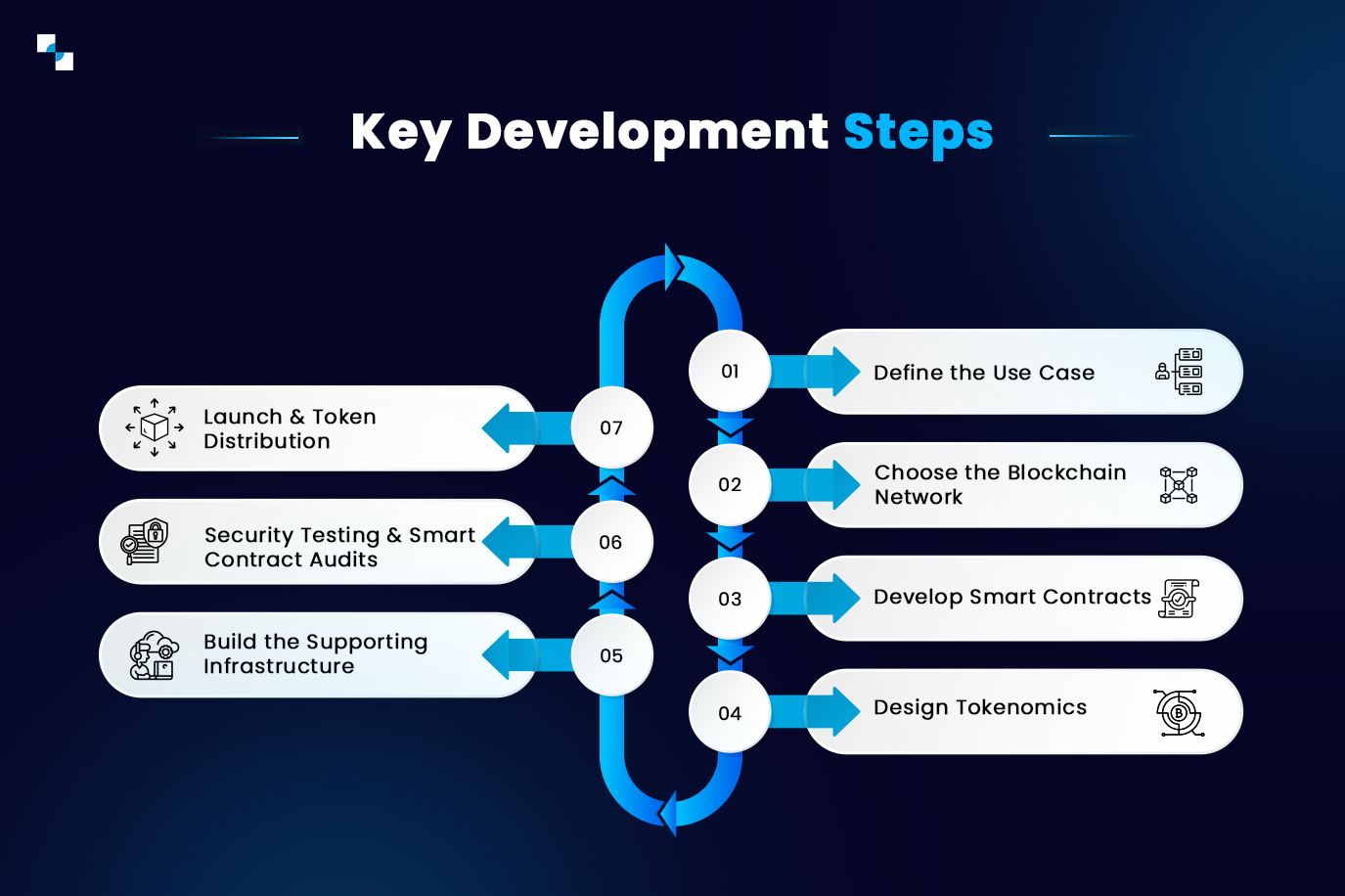
Launching a crypto requires a structured development process that combines:
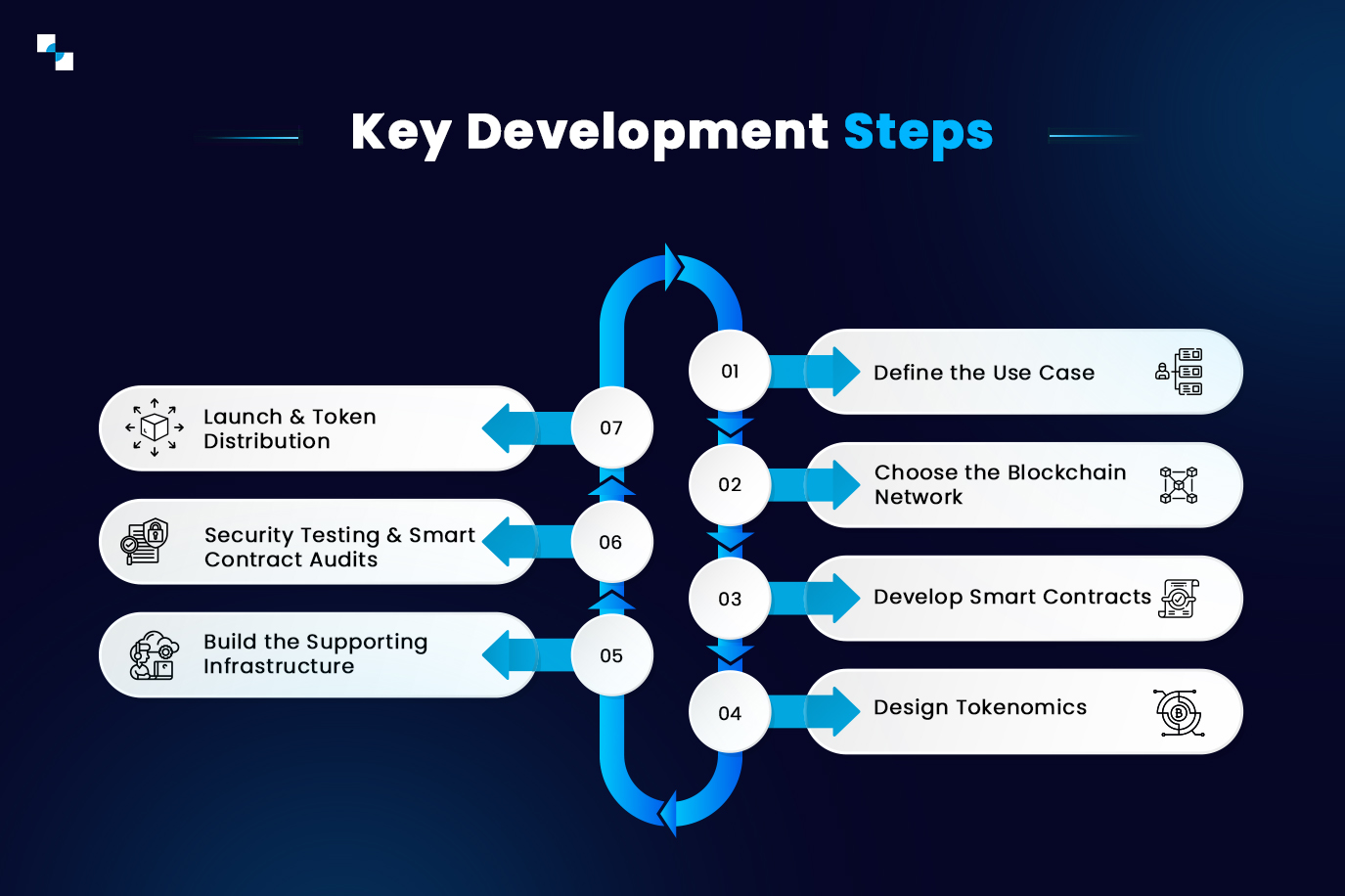
- Define the Use Case
The first step is identifying the purpose of the cryptocurrency and the problem it aims to solve. The use case determines the technical architecture and token design.
Common types of tokens include:
- Payment tokens
- Governance tokens
- Utility tokens for platforms
- Ecosystem reward tokens
Some coin development projects now use AI-driven market analysis tools to evaluate demand, analyze token models, and refine project strategies before development begins.
- Choose the Blockchain Network
The blockchain network determines how the cryptocurrency operates, including transaction speed, security, and scalability. Developers may also use AI-assisted analytics tools to compare network performance metrics such as transaction throughput, network congestion, and fee structures.
- Develop Smart Contracts
Smart contracts are self-executing programs that define how tokens are created, transferred, and managed on the blockchain.
Examples include:
- ERC-20 tokens on Ethereum
- BEP-20 tokens on Binance Smart Chain
These contracts control essential functions such as token minting, transfers, and governance rules. Because smart contracts operate autonomously, they must be carefully coded and audited to avoid vulnerabilities. AI tools are increasingly being used to assist developers in detecting smart contract vulnerabilities and potential security flaws during development.
- Design Tokenomics
Tokenomics defines the economic structure of a cryptocurrency and influences how the ecosystem grows.
Key elements include:
- Total token supply
- Distribution strategy
- Incentive mechanisms
- Governance structure
Some blockchain projects use AI-driven simulation tools to model different token distribution strategies and predict their long-term economic sustainability.
- Build the Supporting Infrastructure
A successful cryptocurrency requires an ecosystem that allows users to interact with the token. This infrastructure often includes:
- Crypto wallets
- Blockchain explorers
- Liquidity mechanisms
- Exchange integrations
AI-powered analytics platforms can also help projects monitor user activity, detect anomalies, and improve ecosystem performance.
- Security Testing & Smart Contract Audits
Security is one of the most critical aspects of development. Projects must perform comprehensive testing before deployment. Common security practices include:
- Smart contract audits
- Penetration testing
- Blockchain security reviews
Advanced security teams may use AI-based vulnerability scanning tools to identify potential threats and reduce risks before launch.
- Launch and Token Distribution
The final stage involves deploying the token on the blockchain and distributing it to the community or investors. Common launch models include:
- ICO (Initial Coin Offering)
- IDO (Initial DEX Offering)
- Ecosystem reward distributions
- Private investor allocations
A well-planned launch strategy helps ensure liquidity, adoption, and long-term ecosystem growth.
While these steps outline the core process of launching a digital asset, executing them effectively requires strong technical expertise and blockchain experience. This is why many startups and businesses collaborate with an experienced crypto coin development company when bringing their cryptocurrency to market.
Discover the 7 key insights behind building a successful cryptocurrency.
Technologies Powering Modern Crypto Coin Development
Modern development relies on a combination of blockchain infrastructure, smart contract frameworks, security tools, and data technologies that enable scalable and secure digital asset ecosystems.
1. Blockchain Frameworks and Protocols
The foundation of any cryptocurrency is the blockchain network that records transactions and maintains the distributed ledger.
Common blockchain technologies include:
- EVM – the execution environment used by many Ethereum-compatible networks
- Solana Runtime – designed for high-throughput decentralized applications
- Cosmos SDK – a modular framework for building custom blockchains
- Substrate – a flexible framework used to build blockchains within the Polkadot ecosystem
These languages allow developers to implement token standards, automate transactions, and build decentralized applications.
2. Token Standards
Token standards define how digital assets operate within a blockchain ecosystem.
Common standards include:
- ERC-20 – the most widely used token standard on Ethereum
- ERC-721 – used for non-fungible tokens (NFTs)
- BEP-20 – the token standard used on Binance Smart Chain
In many cases, projects implement token standards like ERC-1155, TRC-20, and SPL tokens to ensure compatibility across various blockchain ecosystems.
3. Smart Contract Languages
Smart contracts define how tokens behave and how transactions are executed on the blockchain.
Developers commonly use programming languages such as:
- Solidity – widely used for Ethereum and EVM-based networks
- Rust – preferred for performance-focused blockchains like Solana
- Vyper – a Python-like language designed for secure smart contracts
These languages allow developers to implement token standards, automate transactions, and build decentralized applications.
4. Wallet and Infrastructure Integration
Cryptocurrency platforms must integrate with digital wallets that enable users to securely store and transfer assets.
Popular wallet integrations include:
- MetaMask
- Trust Wallet
- Phantom
- WalletConnect
Wallet compatibility improves accessibility and ensures seamless interaction with blockchain networks.
5. AI and Data Analytics Tools
Artificial intelligence is increasingly being used to enhance cryptocurrency ecosystems and improve operational efficiency.
AI technologies can support:
- Blockchain data analytics
- Fraud detection and transaction monitoring
- Smart contract vulnerability detection
- Predictive market insights
By analyzing blockchain data and user activity patterns, AI-driven tools help projects improve security, optimize token ecosystems, and detect potential risks.
6. Security and Smart Contract Auditing Tools
Security is a critical component of cryptocurrency development. Specialized tools help identify vulnerabilities before deployment.
Common tools include:
- MythX – smart contract security analysis
- Slither – static analysis framework for Solidity
- OpenZeppelin libraries – secure smart contract templates
These tools help developers reduce risks and strengthen the reliability of blockchain applications.
How Much Does Cryptocurrency Development Cost?
The scope of crypto development can vary significantly depending on the project’s goals, architecture, and functionality. From creating a simple token to building a full blockchain ecosystem, each project requires different levels of technical design, security measures, and infrastructure.
Several factors influence the development process, including:
- Blockchain Network Selection: The choice of blockchain affects scalability, transaction efficiency, and overall system architecture.
- Smart Contract Architecture: The complexity of smart contracts determines how the cryptocurrency behaves, including token distribution, governance mechanisms, and automated transactions.
- Security and Auditing Requirements: Ensuring the reliability of smart contracts and blockchain infrastructure requires comprehensive security testing and professional audits.
- Platform and Ecosystem Integrations: Many cryptocurrency projects integrate with wallets, exchanges, decentralized applications, and other blockchain services to enhance accessibility and usability.
Because cryptocurrency development involves multiple technical layers, businesses often collaborate with experienced development teams to ensure their digital assets are secure, scalable, and ready for real-world deployment.
Conclusion
Creating a cryptocurrency is no longer limited to large technology firms or early blockchain innovators. Today, startups, fintech platforms, and digital businesses are exploring cryptocurrency development to power decentralized payments, build token-driven ecosystems, and unlock new digital economies. However, building a secure and scalable cryptocurrency requires careful planning, strong blockchain expertise, and the right development strategy. Partnering with an experienced cryptocurrency development company can help transform a concept into a fully functional digital asset while ensuring security, scalability, and seamless ecosystem integration.
With extensive experience in blockchain engineering and token development, Antier works with startups and enterprises to design, develop, and launch secure cryptocurrency projects, helping turn innovative blockchain ideas into practical and scalable solutions. Ready to build your own cryptocurrency? Connect with Antier’s experts today and take the first step toward launching your blockchain-powered digital asset.
Frequently Asked Questions
01. What is cryptocurrency development?
Cryptocurrency development is the process of designing, building, and launching a digital currency using blockchain technology, which includes creating secure token structures, writing smart contracts, and establishing the necessary ecosystem for transactions and governance.
02. What components are typically included in a cryptocurrency system?
A typical cryptocurrency system includes blockchain infrastructure, token or coin architecture, smart contracts, consensus mechanisms, and wallets and transaction interfaces to ensure secure creation, distribution, and exchange of digital assets.
03. What are EVM-compatible and non-EVM blockchain networks?
EVM-compatible networks, like Ethereum and BNB Chain, support the Ethereum Virtual Machine and offer benefits in scalability and developer tooling, while non-EVM chains provide alternative solutions with unique advantages for specific use cases in cryptocurrency development.

TLDR
- Rivian (RIVN) receives Buy rating from TD Cowen with $20 price target, raised from $17
- Rating change arrives two days prior to R2 SUV unveiling at SXSW 2026 on March 12
- Analyst forecasts R2 demand between 212,000 and 335,000 units per year at full production
- Shares down approximately 20% in 2025, currently trading near $15.87
- Wall Street expects revenue growth from $5.4B in 2025 to $16.3B by 2028
Wall Street is turning more bullish on Rivian (RIVN) stock as the electric vehicle maker prepares for one of its most important product launches, with TD Cowen elevating its rating to Buy mere days before the R2 SUV makes its debut.
Itay Michaeli, the TD Cowen analyst covering Rivian, increased his price target to $20 — marking his second upward revision in less than four weeks. His initial adjustment came February 14, moving from $13 to $17, followed by Tuesday’s additional $3 increase. Against Monday’s close of $15.87, the new target suggests potential upside of approximately 26%.
The upgrade timing is strategic. The company will take the wraps off its R2 SUV on March 12 during the SXSW 2026 Festival in Austin, Texas. This unveiling has been a focal point for market watchers for several months.
RIVN shares have declined roughly 20% since the start of 2025. The stock hit its yearly bottom at $12.50 in April amid tariff concerns, then rallied to a 2025 peak of $22.45 in late December. For the past month, shares have mostly hovered around the $15 mark.
TD Cowen’s analysis projects R2 sales reaching between 212,000 and 335,000 units annually once production reaches full capacity — significantly exceeding current Street estimates for 2027. The firm believes the risk-to-reward profile entering the unveiling event is favorable at present valuation levels.
The R2’s Strategic Importance
Rivian’s R2 carries a price tag around $45,000, making it $30,000–$40,000 less expensive than the current R1T pickup and R1S SUV. The automaker has indicated the R2 will also cost less to manufacture, utilizing fewer electronic control units, streamlined wiring architecture, and expanded use of castings.
This dual advantage — accessible pricing coupled with reduced production costs — has captured Wall Street’s focus. The company’s manufacturing output fell from 57,232 vehicles in 2023 to 42,284 in 2025, a decline management attributes to supply chain constraints, reduced EV incentives, and intensifying competition.
The R2 targets a significantly broader consumer segment. Rivian intends to leverage both its forthcoming Georgia manufacturing site and existing Illinois facility to expand capacity, aiming to triple total production capability by 2028.
Current revenue stands at $5.4 billion for 2025. Wall Street projections call for that figure to reach $16.3 billion by 2028, contingent on successful R2 production scaling. Adjusted EBITDA is anticipated to swing positive during that same timeframe.
Current Stock Positioning
Trading around $15 per share, RIVN sits more than 80% beneath its 2021 IPO valuation and represents less than three times estimated 2025 sales. Shares advanced to $17 in mid-February following stronger-than-anticipated Q4 earnings and positive early R2 media impressions.
The company maintains additional products in development. The premium-positioned R3 SUV is slated for late 2026 or early 2027 arrival, with the R2 serving to establish brand recognition and manufacturing momentum ahead of that release.
TD Cowen maintained a more conservative outlook previously, reducing its target to $13 last August and identifying Rivian’s AI Day and the R2 launch as the two primary near-term catalysts deserving attention.
The R2 unveiling is now under 48 hours away.


- Polkadot price fluctuated in a tight range near $1.50 on Tuesday.
- Bulls could push to above $1.67 ahead of DOT emissions cut.
- Sell-off pressure amid prevailing market conditions might derail this setup.
Polkadot is trading near $1.50 as bulls position amid a potential breakout, with eyes on the upcoming upgrade and overhaul of DOT’s tokenomics.
The cryptocurrency’s price is also off lows of $1.40 reached earlier in the week as investors ponder a potential boost to DOT from fresh institutional interest.
Bulls recently celebrated the launch of the first US spot Polkadot ETF.
DOT, ranked 33rd with a market capitalization of $2.54 billion, is bidding to extend gains amid overall upward movement for Bitcoin and top altcoins.
Polkadot (DOT) holds near $1.50 as upgrade nears
Polkadot’s price shows an intraday range of $1.49-1.54 in early trading during the US session on March 10.
The gains see buyers bid for a retest of recent highs, while holding the critical $1.50 level.
The backdrop to this price action is a scheduled reset of Polkadot’s tokenomics.
A new monetary framework will roll out on March 12, and analysts say anticipation could catalyze fresh momentum for DOT.
The uptick this past week coincided with notable buying as traders positioned ahead of the event.
Specifically, Polkadot’s tokenomics reset will involve the introduction of a 2.1 billion hard cap on DOT supply.
The upgrade targets a 53.6% cut in emissions as well as staking.
ETF buzz has also engulfed Polkadot over the past few days.
This follows the debut of 21Shares’ spot Polkadot ETF, the first US spot DOT ETF that went live on Nasdaq under the ticker TDOT.
The physically backed fund, seeded with $11 million, could strengthen the asset’s appeal as a longer‑term allocation within diversified crypto portfolios.
Polkadot technical analysis
From a technical perspective, DOT’s immediate focus is on converting the $1.50-$1.55 region from resistance into support.
Bulls are eyeing three consecutive green candles on the daily chart and look to have stemmed the downtrend from highs of $1.75 posted in late February.
RSI is neutral near 50, and an upturn could see buyers accelerate gains.
However, after a choppy start to the year, trading around this level means bulls may not be out of the woods yet.

The token may thus trade sideways as consolidation picks pace.
For a breakout, DOT has to achieve an emphatic daily close above $1.55.
A successful breach of resistance at $1.67 amid a bullish retest could trigger follow-through buying.
If this happens, it could open the door to a short-term test of recent local highs around $2.30.
Conversely, failure to hold $1.50 will keep DOT confined within its descending channel. Major support lies around $1.22.

Winter Paralympics 2026: Neil Simpson and guide Rob Poth win alpine combined silver

ABM Q1 2026 slides: revenue beats offset by margin pressure
ABM Industries (ABM) Stock Declines Despite Revenue Beat in Q1 Earnings


-
Business4 days ago
Form 8K Entergy Mississippi LLC For: 6 March
-

 Fashion4 days ago
Weekend Open Thread: Ann Taylor
-

 News Videos1 day ago
10th Algebra | Financial Planning | Question Bank Solution | Board Exam 2026
-

 Crypto World22 hours ago
Paradigm, a16z, Winklevoss Capital, Balaji Srinivasan among investors in ZODL
-

 Tech5 days ago
Bitwarden adds support for passkey login on Windows 11
-
 Sports5 days ago
499 runs and 34 sixes later, India beat England to enter T20 World Cup final | Cricket News
-

 Sports3 days ago
Three share 2-shot lead entering final round in Hong Kong
-

 Sports2 days ago
Braveheart Lakshya downs Lai in epic battle to enter All England Open final | Other Sports News
-

 Business7 days ago
Guthrie Disappearance Enters Fifth Week as Family Visits Memorial
-

 Politics4 days ago
Top Mamdani aide takes progressive project to the UK
-

 NewsBeat5 days ago
Piccadilly Circus just unveiled ‘London’s newest tourist attraction’ and it only costs 80p to enter
-

 Entertainment3 days ago
Hailey Bieber Poses For Sexy Selfies In New Luscious Lip Thirst Traps
-

 Business2 days ago
Search for Nancy Guthrie Enters 37th Day as FBI Probes Wi-Fi Jammer Theory
-
 NewsBeat13 hours ago
Pagazzi Lighting enters administration as 70 jobs lost and 11 stores close across Scotland
-

 Tech24 hours ago
Despite challenges, Ireland sixth in EU for board gender diversity
-

 Crypto World6 days ago
New Crypto Mutuum Finance (MUTM) Reports V1 Protocol Progress as Roadmap Enters Phase 3
-
 Tech5 days ago
ACIP To Discuss COVID ‘Vaccine Injuries’ Next Month, Despite That Not Being In Its Purview
-
Entertainment6 days ago
Harry Styles Has ‘Struggled’ to Discuss Liam Payne’s Death
-

 Business18 hours ago
Search Enters 39th Day with FBI Tip Line Developments and No Major Breakthroughs
-
 NewsBeat5 days ago
Good Morning Britain fans delighted as Welsh presenter returns to host ITV show