

Tech
Hackers are selling a critical Windows zero-day exploit for $220,000 on the dark web

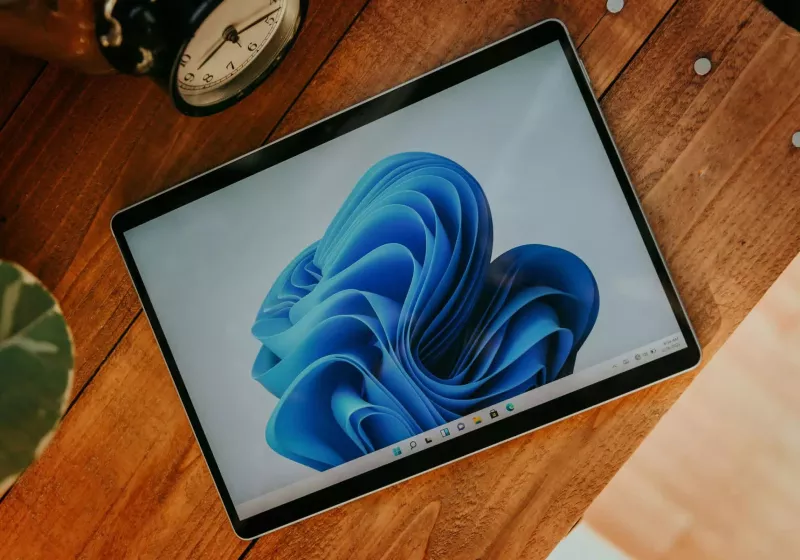
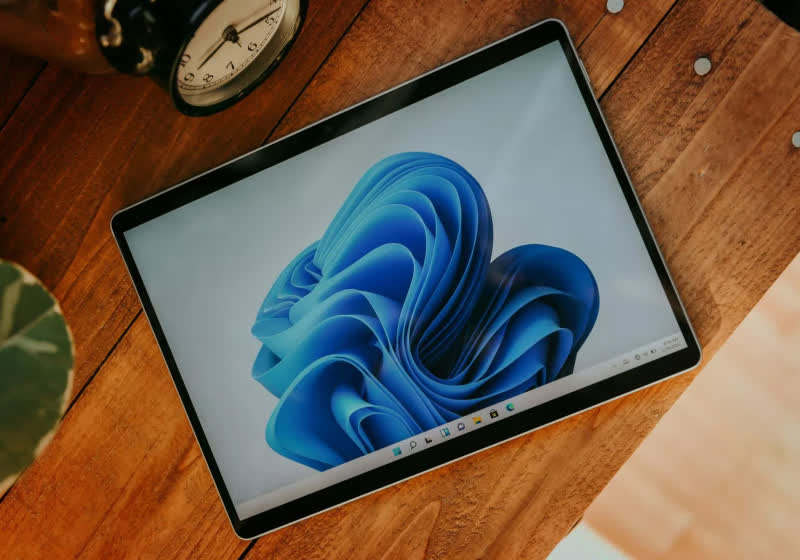
According to X user Dark Web Informer, a cybercriminal known as Kamirmassabi recently posted an ad on an underground hacking forum, offering to sell a zero-day exploit for a critical elevation of privilege vulnerability in Windows 10 and 11. The steep $220,000 asking price suggests the exploit is aimed primarily…
Read Entire Article
Source link



When you get behind the wheel in the United States, you’re accustomed to a specific set of traffic laws that have become second nature. For the most part, U.S. traffic laws leave personal responsibility for vehicle maintenance and common-sense etiquette as matters of civil politeness or local ordinance, rather than serious, federally backed violations. This familiar framework, however, is a rarity when traveling internationally, where legal systems take over.
While Americans might scoff at the idea of a ticket for an unwashed car, or a potential jail sentence for riding sober next to a drunk friend, these are the real, punitive stakes involved in driving overseas. From Europe’s ancient city centers to Asia’s strict public decency standards, and the Middle East’s emphasis on immaculate urban aesthetics, drivers around the globe are held to a much higher and more diverse set of legal obligations than just keeping their eyes on the road.
The list below goes over unique international driving laws that American motorists rarely, if ever, encounter at home. What is merely considered good etiquette in the U.S. is often a non-negotiable legal requirement in other countries. If you’re planning to visit any, keep in mind that ignorance of the law is rarely a protection against steep fines, vehicle impoundment, or even criminal charges.
Driving shirtless in Thailand
When you picture a road trip through Thailand’s tropical landscapes, the heat and high humidity might immediately make you want to strip down to your most comfortable, minimal clothing. Hopping into a rental car or onto a scooter while wearing only a swimsuit or going bare-chested to beat the intense temperatures might seem tempting, but it could land you on the wrong side of local law enforcement. This isn’t as wild as many of the strangest US driving laws, but it is still strange.
The Motor Vehicle Act says that all motorists (in cars and on motorcycles) must wear a shirt while operating a vehicle. This applies to both locals and international visitors alike, meaning that regardless of how high the temperature climbs, keeping your torso covered is an absolute legal requirement when you’re behind the wheel or operating a bike on public roads.
These aren’t just in traffic rules; they affect other parts of the country’s legal system. So while traffic laws specifically require a shirt, this idea aligns with general public decency rules. The Thai Criminal Code talks about the act in its misdemeanors section. Section 388 strictly bans public obscenity. It says if you do something disgraceful in public, like undressing yourself, showing your exposed self, or any other obscene act, you could receive a fine of up to five hundred baht.
Splashing pedestrians in the United Kingdom
When you’re driving through a heavy downpour in the United States, you might occasionally, and sometimes carelessly, hit a large puddle near the curb, sending a wave of murky rainwater crashing over an unsuspecting pedestrian on the sidewalk. While this scenario is undoubtedly rude, incredibly frustrating for the victim, and generally frowned upon by society, splashing a pedestrian with a puddle isn’t a specific traffic violation in the US.
Across the pond in the United Kingdom, the law takes a much stricter and more punitive approach to this same situation. If you’re planning a road trip through Britain, you must be acutely aware of how you navigate wet roads, because the country has codified this specific breach of etiquette into its legal framework. Under the regulations set forth in the UK, this act is a highly punishable offense.
Specifically, Section 3 of the Road Traffic Act 1988 classifies driving through a puddle to splash a pedestrian as ‘driving without reasonable consideration,’ resulting in fines or points. According to the detailed provisions in the legislation, a motorist is formally regarded in violation of this rule “only if those persons are inconvenienced by their driving.” Being drenched by a tidal wave of dirty street water is clearly recognized as a significant inconvenience under this definition.
Drunk passengers sitting in the front seat in North Macedonia
The idea of a designated driver is a pretty big part of what happens when you go out with friends. When it’s time to head home after having some alcoholic drinks, it is common for drunk friends to just hop in the car, often with one of the most inebriated individuals claiming the front passenger seat. Legally in the US, a drunk passenger can totally ride up front right next to the sober driver, and even drink in some states.
If you happen to be enjoying a night out while traveling in North Macedonia, you’ll need to totally rethink how your group sits before anyone gets into a car. The country’s national traffic safety laws are much stricter and focus more on preventing issues when it comes to where intoxicated people sit inside a moving vehicle. Under its legal framework, anyone who looks like they’re under the influence of alcohol is strictly and legally not allowed to sit in the front passenger seat.
This strict rule is intended to prevent accidents and keep roads safe. A drunk person can be pretty unpredictable, and having them right by the steering wheel, the emergency brake, or even the driver themselves creates an extra risk of sudden distraction or accidental interference.
Always have headlights on in Sweden
When you’re driving back home in America, you’ll find the rules for car lights are pretty standard and easy to understand. The US only says you need to use your headlights at night, or when you can’t see well because of fog or snowstorms. However, if you’re planning a road trip overseas, you’ll have to quickly adjust your driving to comply with strict local laws that leave nothing to chance.
In Sweden, for instance, traffic rules say your car’s low-beam headlights must be on 24 hours a day, every single day of the year, even when it’s sunny. This is a core part of the Swedish Traffic Ordinance, which sets strict requirements for car lighting to make sure you’re as visible and safe as possible, always. Specifically, the ordinance states that when you’re driving on a road, your car must use its primary beams continuously.
While the law does give you a little flexibility during the day (like letting you use specific daytime running lights instead of regular low beams, which then means your rear and side lights don’t strictly have to be on), some type of approved front light is always legally required whenever your car is running.
Leave your car locked in Austalia
When you park your personal vehicle on a public street in the United States, it just makes sense to roll up your windows, take your keys, and lock your doors before you walk away. However, if you choose to be careless and leave your car completely unlocked with the windows rolled down, no traffic law in the US will penalize you for simply failing to secure your own property.
This is a big change in New South Wales (NSW), Australia, because securing your vehicle isn’t just a strong recommendation there, it’s a strict legal requirement under Regulation 213 of the Road Rules 2014. In Australia, specifically in NSW, you’re legally obligated to close your windows if you plan to walk more than three meters (about ten feet) away from the closest part of the car.
If there’s no one left inside the vehicle, the law mandates that you must immediately lock the doors after stepping away, and you also need to secure the windows right before you leave. The regulations go even further to prevent an unattended vehicle from being easily stolen or joyridden by mandating that, if you’re going to be away for a while, you must switch off the engine.
Sober passengers are not completely safe in Japan
In the United States, getting into a car with an intoxicated driver is definitely a dangerous and foolish decision. However, from a strictly legal perspective, law enforcement focuses entirely on the driver. If a vehicle is pulled over and the driver is found to be over the legal limit, the driver will be arrested. It is even illegal in some states to have an open container.
If you’re traveling to Japan, you should know that the legal situation for driving under the influence is drastically different and goes way beyond just the driver. Under the Japanese Road Traffic Act, the country takes a really aggressive, zero-tolerance approach to drunk driving. It actively criminalizes anyone who is complicit in that violation. Specifically, Japanese law strictly forbids anyone from asking for, relying on, or even getting into a vehicle to be driven by someone they know is under the influence of alcohol.
This means if you’re a sober passenger and you knowingly ride in a car driven by someone drunk, you’re immediately at risk of serious criminal penalties. If the driver gets caught driving in that state, an aware passenger can face consequences like time in prison with hard labor or a fine.
Avoid driving in historic centers in Italy
If you’re planning a scenic road trip through Italy, you might get surprised by a strictly enforced traffic rule called the Zona a Traffico Limitato, or ZTL. It translates to “Restricted Traffic Zones,” and ZTL laws make it illegal for non-residents to drive through certain historic areas. Cameras will automatically fine any unauthorized vehicle crossing the boundary. You’ll mostly find these restricted zones in the historic town centers of Italy’s famous cities and villages.
These automated systems are placed at many ZTLs; they likely capture license plates, compare them with a database of permitted residents, and send out tickets to violators. Basically, no traffic officer ever has to be there, so don’t think about rat-running in this country.
The U.S. usually doesn’t ban driving in city centers purely for historical preservation or use automated resident-only zones. In the United States, you’re used to driving your car right through busy downtown areas, pulling up to national monuments, and parking on nearby streets. Some American cities might have pedestrian-only areas for shopping or use toll zones to cut down on peak-hour traffic, but an outright, camera-enforced ban on non-resident cars to protect old architecture just isn’t a normal part of driving here.
Don’t accelerate too quickly in Switzerland
Unless you’re accelerating into something or someone, or happen to be in a state that gives out many speeding tickets, the US doesn’t have traffic laws that stop you from starting from a fast drive. American driving culture often accepts a loud engine roaring away from a stoplight; however, taking that same aggressive driving style to Switzerland will quickly put you on the wrong side of the law.
In Switzerland, drivers are legally bound by the Road Traffic Act and the Traffic Regulations Ordinance (TRegO) to make sure they don’t cause any noise nuisance they could avoid. The Swiss Federal Office for the Environment points out that individual vehicles making disruptive commotion peaks stand out from regular road noises. This disturbance is easy to prevent if drivers just change their driving style and avoid making noise-boosting modifications to their cars.
Under Articles 42 of the RTA and 33 of the TRegO, Swiss authorities have clearly listed examples of acoustic disruptions that are prohibited. Drivers can’t rev their engines to high speeds while idling, and they can’t deliberately drive in a low gear just to make the engine roar louder. Those satisfying popping sounds from a performance exhaust system are strictly forbidden on Swiss roads. Most importantly, the racket caused by accelerating too quickly when moving off from a stop is legally classified as an avoidable nuisance and is expressly banned.
Clean your car in Dubai
Dubai Municipality has a campaign to check on and get rid of neglected cars at its nine vehicle registration and testing centers. Now, you might think this is just about hauling away broken-down or abandoned junk; however, it’s actually about strictly enforcing the emirate’s incredibly high visual standards for every personal car. Dubai’s campaign targets these unkempt vehicles, which, when you get down to it, are just dirty cars.
The local government really values urban beauty, cleanliness, and architectural harmony, officially calling visibly unwashed cars a blot on the city’s beautiful image. If you own a car in this sparkling metropolis, you have a legally enforced civic duty to keep its exterior thoroughly washed, polished, and always looking good. To keep things pristine, authorities actively patrol public parking lots, streets, and municipal centers, giving out physical poster alerts and SMS warnings to owners of cars covered in sand, dust, or dirt.
If you don’t fix the situation within the warning timeframe, you’ll face serious penalties, a fine, and possibly have your car impounded at a towing yard. The government uses the specific phrase “clean vehicle sustainable city” to constantly remind residents that car cleanliness is directly connected to the community’s bigger environmental goals.
You need high-visibility gear in France
When you’re driving through France’s pretty landscapes, you might be surprised to find out that its traffic laws require some emergency equipment that’s way more than what you’d expect in North America. The French Highway Code says it’s completely necessary for all drivers to keep a high-visibility safety vest, you know, a yellow vest, and an advance warning triangle right inside their car at all times.
The law is really specific about what these items should be like and how to use them. For example, the safety garment has to be fluorescent, it needs a European Compliance (EC) marking, and you’ve got to keep it somewhere easy to grab inside the car. The U.S. is still passing laws to make sure others treat these emergencies with caution.
This accessibility is a really important detail because if you have to make an emergency stop, French law says you absolutely must put the vest on before you even get out of your broken-down car onto the road or its surroundings. Once you’ve safely exited the vehicle wearing your reflective gear, you’re required to place the hazard warning triangle, which needs an E 27 R marking, at least 30 meters away from your car to warn approaching drivers. You should also turn on your vehicle’s hazard warning lights at the same time.

AI companies have been spending a lot of time in court arguing copyright cases over the past year and the latest plaintiff is Gracenote, the metadata company owned by Nielsen. Axios reports that Gracenote is suing OpenAI for the unauthorized and unpaid use of both its metadata and its framework for connecting that information.
Gracenote specializes in entertainment metadata, creating descriptions and identifiers for content that clients such as TV providers use to help their own customers with discovery. Most of the lawsuits against AI businesses have focused on the content used to train LLMs, but the Gracenote case brings an extra layer with the alleged infringement of the structure or sequence for a dataset in addition to the actual data.
“Defendants could have paid Gracenote to license its valuable Gracenote Data. Or they could have sought to train and ground their models only on information in the public domain. They did neither. Defendants instead improperly copied and used Gracenote Data to create their own commercially valuable AI products, all without paying a dime,” the complaint states. The company claims that its previous attempts to work with OpenAI for a licensing agreement were rebuffed or ignored. Gracenote has recently inked deals to back AI ventures from other companies, including Samsung and Google.
Sources tell Wired that Nvidia has been pitching ‘NemoClaw’ to Salesforce, Cisco, Google, Adobe, and CrowdStrike ahead of Jensen Huang’s keynote on Monday.
NVIDIA has spent the past several years becoming the indispensable hardware backbone of the AI industry. According to a new report, it may now be trying to become the software backbone too.
The chipmaker is reportedly developing an open-source platform for enterprise AI agents, internally known as NemoClaw. Wired, which broke the story citing anonymous sources familiar with the plans, says Nvidia has begun pitching the product to major enterprise software companies, among them Salesforce, Cisco, Google, Adobe, and CrowdStrike, ahead of a potential launch.
NVIDIA has not confirmed the platform exists, no official partnerships have been announced, and the companies named in the report have not publicly commented.

The 💜 of EU tech
The latest rumblings from the EU tech scene, a story from our wise ol’ founder Boris, and some questionable AI art. It’s free, every week, in your inbox. Sign up now!
According to those sources, NemoClaw is designed to enable companies to deploy AI agents that carry out tasks on behalf of their employees, processing data, managing workflows, and executing multi-step instructions with limited human oversight. The platform is also reported to include built-in security and privacy tooling, a deliberate response to the wave of incidents that have undermined confidence in consumer-facing agent tools.
When OpenClaw, the open-source local agent framework that went viral in early 2026 before its creator, Peter Steinberger, was hired by OpenAI, was found to have an unsecured database that let anyone impersonate any agent on the platform, several large technology companies, including Meta, moved to ban it from corporate machines entirely. NemoClaw, by all accounts, is being positioned as the enterprise-safe answer to that chaos.
One of the more striking details in the Wired report is that NemoClaw is expected to be hardware-agnostic, usable by companies regardless of whether their infrastructure runs on Nvidia chips. That would be a meaningful strategic shift. NVIDIA’s dominance in AI has historically rested partly on CUDA, its proprietary software layer that has kept developers tethered to NVIDIA’s GPU ecosystem.
An open-source, hardware-neutral agent platform inverts that logic: give away the software layer freely, build the ecosystem, and trust that accelerating enterprise AI workloads will drive GPU demand anyway. It is the same playbook Meta used with Llama, and it worked.
The name itself signals the lineage. ‘Nemo’ connects the platform to NVIDIA’s existing NeMo framework, the foundation for its AI agent development tools, and to the Nemotron family of open models the company has been releasing.
‘Claw’ is a more pointed reference: it situates NemoClaw squarely within the broader ‘claw’ ecosystem of locally-running open-source AI agents that captured the imagination of the technology community this year, and signals that Nvidia sees that trend as a template worth building on, not dismissing.
Because the project is expected to be open source, the reported partnership model would likely offer early access to contributors rather than paid licenses. Sources told Wired that potential partners could gain free early access in exchange for contributing to the project’s development code, resources, or integration work. Whether any of the five named companies have agreed to those terms is not yet known.
The timing of the leak is hard to read as accidental. NVIDIA’s annual GTC developer conference opens in San Jose on Monday, 16 March, with Jensen Huang delivering the keynote from SAP Center at 11 am PT. The conference, which draws more than 30,000 attendees from over 190 countries, is NVIDIA’s primary venue for major platform announcements, and Huang has already telegraphed that agentic AI will be central to this year’s show.
In NVIDIA’s official GTC press release, the keynote is described as covering “open models, agentic systems and physical AI,” setting the direction for the year ahead. A NemoClaw announcement would fit that framing precisely.
The competitive context is equally pointed. OpenAI launched its own agent orchestration product, Frontier, earlier this year. Microsoft’s Copilot stack and Google’s Vertex AI Agent Builder are both targeting the same enterprise deployment problem.
What Nvidia could bring that those players cannot is a combination of hardware credibility, the company whose chips power most of the AI industry, and an open-source neutrality that positions it as a platform any vendor can build on, rather than a competitor trying to lock customers into its own model stack.
Whether NemoClaw becomes the standard, a niche framework, or an announcement that fades quietly into GitHub history depends entirely on execution details that remain unknown: whether it genuinely supports multiple model backends or quietly favours Nvidia-optimised ones, how its agent orchestration compares to what already exists, and whether enterprise IT departments find it meaningfully safer than the consumer tools they have already banned.
Those questions will start being answered on Monday morning, assuming Nvidia confirms the platform exists at all.

The real world price of impulse-buying Fortnite skins is going up, Epic has announced. Not because skins themselves are getting more expensive on paper, but because V-Bucks, Fortnite‘s digital currency, is. The same prices you paid for bundles of V-Bucks in February will now effectively earn you fewer bucks starting on March 19, along with several other Fortnite-related pricing changes.
Epic will still offer bundles of V-Bucks starting at $8.99 and running all the way to $89.99, but with a new “conversion rate.” The new bundle prices breakdown as follows:
-
$8.99 will get you 800 V-Bucks, down from 1,000 V-Bucks
-
$22.99 will get you 2,400 V-Bucks, down from 2,800 V-Bucks
-
$36.99 will get you 4,500 V-Bucks, down from 5,000 V-Bucks
-
$89.99 will get you 12,500 V-Bucks, down from 13,500 V-Bucks
On top of those changes, the cost of Epic’s “Exact Amount Pack,” which lets you buy the exact amount of V-Bucks necessary to complete a specific purchase, is changing from around $0.50 for 50 V-Bucks to $0.99 for 50 V-Bucks.
These new prices for V-Bucks are US-specific and will vary in other regions. They’re also not entirely representative of the value Epic is offering with each purchase. As part of the company’s Epic Rewards program, you get 20 percent back on purchases made in Fortnite, Fall Guys and Rocket League when you use the Epic Games Store or Epic’s payment system on Android, iOS, PC or the web. That means you can receive anywhere from $1.79 (for 800 V-Bucks) to $17.99 (for 12,500 V-Bucks) to spend in Fortnite or the Epic Games Store when you use the company’s payment system.
Changes to the value of V-Bucks are also impacting Fortnite‘s various passes. The standard Battle Pass will now cost 800 V-Bucks and award 800 V-Bucks, down from its previous price of 1,000 V-Bucks. Meanwhile, the price of the OG Pass (for Fortnite‘s throwback game mode) is lowering from 1,000 V-Bucks to 800 V-Bucks, and both the Music and Lego Passes are going from costing 1,400 V-Bucks to 1,200 V-Bucks. For any subscribers to Fortnite Crew, Fortnite‘s monthly subscription service, your monthly stipend of the digital currency is also shrinking from 1,000 V-Bucks to 800 V-Bucks.
Epic claims that it’s making all of these changes because “the cost of running Fortnite has gone up a lot” and raising prices helps pay the bills, but the company is also in a much better position to make money on every transaction that happens in the game. In securing largely favorable outcomes in its lawsuits against Apple and Google, Epic now has a way to point users to its payment system on iOS and Android (all the better to avoid app store fees), and its won major concessions that seem poised to reshape how app store economies work.

YouTube has hit some impressive numbers in 2025.
According to new estimates from research firm MoffettNathanson— as reported by The Hollywood Reporter— the platform pulled in a staggering $40.4 billion in ad revenue, which is more than Disney, NBC, Paramount, and Warner Bros. Discovery (WBD)’s combined ad revenue, whose total came to $37.8 billion.
This shift is a clear sign of just how much content consumption has changed over the years and how advertisers have adapted their strategies.
YouTube’s ad revenue for 2025 not only topped the combined haul from the four major Hollywood studios, but also marked a huge turnaround from the previous year. In 2024, YouTube’s ad revenue of $36.1 billion fell short of the $41.8 billion in ad revenue collectively earned by Disney, NBCU, Paramount, and WBD. The tables have now turned.
For decades, these studios have been the kings of entertainment, captivating audiences with big-budget films and hit TV shows. But as traditional studios struggle with shrinking linear TV audiences and the ever-rising costs of productions, YouTube is speeding ahead. Even as these companies pour millions into their own streaming platforms, it’s getting harder to keep up with YouTube’s momentum.
Last month, parent company Alphabet reported that YouTube’s total revenue in 2025 soared to $60 billion. A big portion of YouTube’s revenue now comes from subscriptions, which include services like YouTube TV, YouTube Premium, YouTube Music, and NFL Sunday Ticket. (For context, that’s well above Netflix’s reported $45.2 billion for the full year.)
Disney, NBC, Paramount, and Warner Bros. Discovery (WBD) are also heavily subscription-dependent businesses; Disney’s media business pulled in a total of $60.9 billion in revenue last year, when you include subscriptions, for instance.
Techcrunch event
San Francisco, CA
|
October 13-15, 2026
That said, YouTube’s ad revenue still trails behind tech giants like Meta, which pulled in $196.2 billion in ad revenue in 2025. Still, advertisers are flocking to YouTube because that’s where audiences (especially younger viewers) are spending their time. YouTube’s ad revenue reached $11.4 billion in the fourth quarter.
YouTube is also stepping up its investment in AI. This week, the company announced that it’s expanding its likeness detection technology to a pilot group of government officials, politicians, and journalists. The tech identifies AI-generated deepfakes and lets users request the removal if they believe it violates YouTube policy.
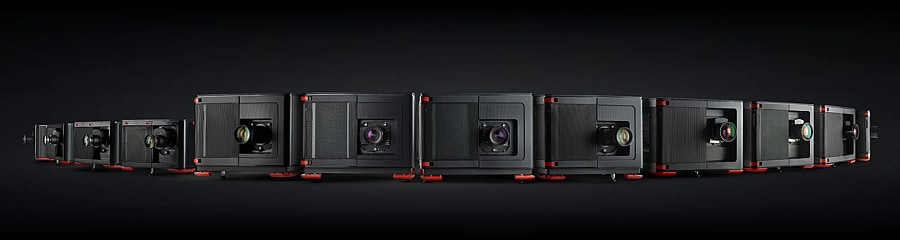
The high-end audio industry is entering a new phase of consolidation, and the latest move could reshape the competitive landscape. Belgium-based technology company Barco has reached an agreement in principle to acquire 100 percent of VerVent Audio Holding, the parent company behind premium hi-fi brands Focal and Naim Audio. The deal places two of the most respected French and British names in high-end audio under the control of a global visualization and professional AV powerhouse best known for cinema projection, medical imaging displays, and enterprise collaboration systems.
This is not happening in isolation. In 2024, Bose stunned the industry by acquiring the McIntosh Group, bringing legendary brands McIntosh and Sonus faber into its orbit and signaling that premium audio heritage brands have become strategic assets for much larger technology companies.
Barco’s proposed purchase of VerVent raises a more uncomfortable question: were two of the most successful and respected hi-fi brands acquired because they are thriving and poised to capture even more global market share, or is there pressure beneath the surface that outsiders simply haven’t seen yet?
The answer likely lies in a shifting market where high-end audio is no longer viewed as a niche enthusiast category, but as a critical component of integrated audiovisual ecosystems spanning luxury residential installations, automotive audio systems, immersive entertainment spaces, and premium lifestyle technology.
According to An Steegen, CEO of Barco: “Today marks an important step in Barco’s ambition to shape the future of immersive audiovisual experiences. By welcoming VerVent Audio Holding and its iconic Focal and Naim brands into the Barco family, we accelerate our strategy to deliver fully integrated solutions where image and sound reinforce each other seamlessly. Building on our leadership in visualization, we go all in on entertainment. The addition of high fidelity audio strengthens the overall experience of our offering across high end residential and broader consumer home entertainment environments, as well as in professional markets. This combination expands our reach, deepens our technology capabilities, and positions us to capture new opportunities across the audiovisual value chain. We are excited to embark on this next chapter together.”
Focal and Naim were contacted for comment regarding the acquisition, but representatives for VerVent Audio Holdingindicated that they are unable to comment publicly at this time.
Who Is Barco?
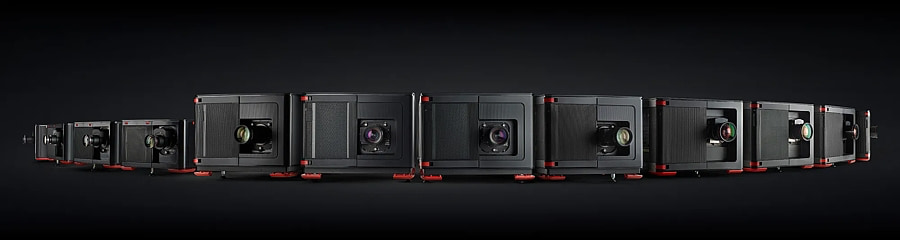
Founded in 1934 in Poperinge, Belgium by Lucien de Puydt, Barco began as the Belgian American Radio Corporation, assembling radios from components imported from the United States. Over the decades, the company evolved into a global technology leader focused on visualization, collaboration, and immersive audiovisual systems.
Today, Barco is best known for its digital cinema projection technology, supplying high performance projectors used in commercial theaters around the world. The company also develops visualization systems for live events, museums, simulation, aviation training, and defense applications.
Beyond entertainment and visualization, Barco operates in two additional sectors. In the enterprise space, its ClickShare wireless collaboration platform has become a widely adopted solution for meeting rooms and hybrid work environments. In healthcare, Barco manufactures diagnostic imaging displays and surgical monitors used by radiologists and medical professionals.
For most of its history, Barco’s expertise has been centered on visual technologies rather than audio. Its acquisition of VerVent Audio Holding—and with it premium audio brands Focal and Naim—signals a strategic move to expand into fully integrated audiovisual systems that combine both image and high fidelity sound.

Who Is VerVent Audio Holding?
Headquartered in Saint Étienne, France, VerVent Audio Holding is the premium audio group that oversees two of the most respected brands in high-end audio: Focal and Naim. Together, the French and British companies represent decades of engineering expertise across loudspeakers, headphones, amplification, streaming audio, and custom installation systems.
Focal
Founded in 1979 in Saint Étienne, Focal has built a global reputation for high-end loudspeaker design and driver engineering. The company develops and manufactures a wide range of products including audiophile loudspeakers, reference studio monitors, premium headphones, and automotive audio systems.
Some of Focal’s most recognizable products include the Focal Utopia reference headphones, the Focal Sopra No2 loudspeakers, and the flagship Focal Grande Utopia EM Evo, which represent the company’s expertise in driver technology and cabinet design. Focal is also a major supplier of OEM audio systems for automotive brands, extending its reach well beyond traditional hi-fi.
Related Podcast: The Focal Revolution: How a French Hi-Fi Manufacturer is Revolutionizing Your Music Listening Experience (July 2023)
Naim
Founded in 1973 in Salisbury, England, Naim is known for high-performance audio electronics, including integrated amplifiers, preamplifiers, power amplifiers, network streamers, and all-in-one music systems.
Among its most successful products are the Naim Uniti Atom streaming amplifier, the Naim Uniti Nova Power Edition, and the flagship Naim Statement amplifier system, which represents the company’s ultimate expression of high-end audio engineering.
Related Podcast: Say My Naim: How a Quirky British Hi-Fi Company is Quietly Conquering the Globe (July 2023)
Shared Ecosystem and Global Retail Network
Together, Focal and Naim collaborate extensively on custom installation, luxury residential audio, and high-performance home theater systems. Their combined expertise in loudspeaker design and electronics allows the brands to offer fully integrated solutions across two-channel hi-fi, immersive home cinema, and architectural audio.
Through VerVent, the two companies have also built a significant global retail presence with more than 80 dedicated boutiques and thousands of sales points worldwide, including the rapidly expanding Focal Powered by Naim retail network. These flagship stores showcase complete systems built around Focal loudspeakers and Naim electronics and have become a key part of the group’s global brand strategy.
This established retail and distribution infrastructure provides Barco with an immediate platform to expand into premium consumer audio and accelerate its presence in luxury residential and experiential entertainment markets.

What Barco Is Paying and What Happens Next
Barco has agreed in principle to acquire 100 percent of VerVent Audio Holding for an enterprise value of approximately €135 million (~$157.2 USD), with the transaction expected to be financed using Barco’s existing funds. VerVent currently generates annual revenues of roughly €110 million, and Barco anticipates operational and technology synergies over the coming years as the companies integrate.
Once the transaction closes, VerVent will be incorporated into Barco’s Entertainment division, where the company plans to support the existing strategy built around premium high end audio positioning, continued development of digital and connected products, and further expansion of its global sales network. Barco has also reaffirmed its long term financial outlook, maintaining a target EBITDA margin of 15 percent by 2028.
The acquisition has not yet been finalized. Completion remains subject to consultation with employee representative bodies and regulatory approvals, with a closing date still to be determined.
The Bottom Line
Barco’s acquisition of VerVent Audio Holding brings two of the most recognizable and technically capable brands in premium audio, Focal and Naim, into a company that has spent decades dominating the visual side of the AV industry. On paper, the strategic logic is clear. Barco gains immediate access to world class audio engineering while Focal and Naim gain a partner with deep experience in cinema, enterprise visualization, and professional installations.
The potential synergy is significant. Focal and Naim already operate a powerful global retail and distribution network that includes more than 80 Focal Powered by Naim stores, hundreds of specialty dealers, and online retailers across nearly every major market. Combined with Barco’s reach in cinema, simulation, enterprise collaboration, and medical imaging, the acquisition creates the possibility of delivering fully integrated audiovisual systems for luxury residential, immersive entertainment, and professional environments.
The strength of the brands themselves is also a major factor. Both Focal and Naim sit at the very top of their respective product categories with advanced research and development programs, modern manufacturing facilities, and strong global brand recognition among audiophiles and luxury buyers.
The €135 million enterprise value inevitably raises questions about timing. Was Barco motivated by the continued success and growth potential of Focal and Naim, or does the relatively modest purchase price suggest underlying pressures that are not immediately visible from the outside? What is clear is that Barco gains instant credibility in premium audio, while Focal and Naim gain access to the resources and global reach of a technology company that has long dominated the visual side of the AV industry.
Related Reading:
Microsoft has released the Windows 10 KB5078885 extended security update to fix the March 2026 Patch Tuesday vulnerabilities, including 2 zero-days and an issue that prevents some devices from shutting down.
If you are running Windows 10 Enterprise LTSC or are enrolled in the ESU program, you can install this update like normal by going into Settings, clicking on Windows Update, and manually performing a ‘Check for Updates.’
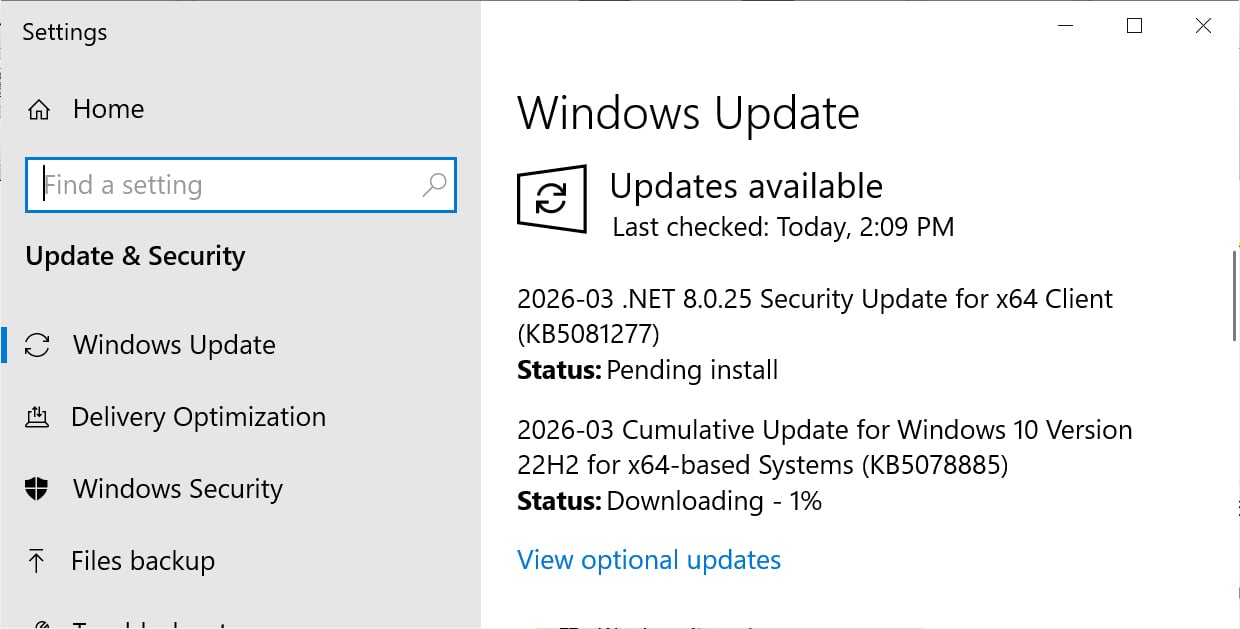
Source: BleepingComputer
After installing this update, Windows 10 will be updated to build 19045.7058, and Windows 10 Enterprise LTSC 2021 will be updated to build 19044.7058.
What’s new in Windows 10 KB5078885
Microsoft is no longer releasing new features for Windows 10, and the KB5078885 update contains only security fixes and bug fixes introduced by previous security updates.
With today’s March 2026 Patch Tuesday, Microsoft has fixed 79 vulnerabilities, including two actively exploited zero-day flaws.
The complete list of fixes is below:
-
[Windows System Image Manager] This update adds a warning dialog to help users confirm that the selected catalog file comes from a trusted source.
-
[File History] Improved: File History in Control Panel when backing up files. New files with names containing some Chinese and Private Use Area characters can now be backed up.
-
[Graphics] Improved: A stability issue affecting certain GPU configurations.
-
[Secure Boot] With this update, Windows quality updates include additional high-confidence device targeting data, increasing coverage of devices eligible to automatically receive new Secure Boot certificates. This targeting is based primarily on client device diagnostic data; due to limited data, servers are unlikely to qualify, though not explicitly excluded. Devices receive new certificates only after demonstrating sufficient successful update signals, maintaining a controlled and phased rollout.
-
[Fonts] This update includes changes to Chinese fonts to meet GB18030-2022A compliance.
-
[OS Security (known issue)] Fixed: After installing the Windows security update released on or after January 13, 2026, some Secure Launch-capable PCs with Virtual Secure Mode (VSM) enabled are unable to shut down or enter hibernation. Instead, the device restarts.
-
[Folders] Fixed: This update fixes an issue that affects folder renaming with desktop.ini files in File Explorer. The LocalizedResourceName setting was ignored, so custom folder names did not show. Now, custom folder names appear as expected.
This update also fixes a known issue that prevented Windows 10 devices from shutting down or hibernating if System Guard Secure Launch is enabled.
Microsoft is also continuing to roll out new Secure Boot certificates to replace older 2011 certificates that expire in June 2026.
These certificates are used to validate Windows boot components, third-party bootloaders, and Secure Boot revocation updates, and if expired, could allow threat actors to bypass security protections.
Microsoft states that there are no known issues with this update.

Malware is getting smarter. The Red Report 2026 reveals how new threats use math to detect sandboxes and hide in plain sight.
Download our analysis of 1.1 million malicious samples to uncover the top 10 techniques and see if your security stack is blinded.
Tech
Trump Kicks Kristi Noem To The Curb For Being Exactly The Sort Of Person Trump Wanted Her To Be
from the maga-is-the-stripper-that-doesn’t-love-you-back dept
I come here to celebrate the apparently permanent sidelining of former DHS head, Kristi Noem. I know the adage usually does some hedging before damning with faint praise, but I’m not interested in praise, faint or otherwise, much less pretending this isn’t worth celebrating.
Noem openly pined for the VP position, but shot herself in the foot by shooting a dog in her gravel pit and then telling the world about it in her incredibly premature memoirs. What was meant to be a self-congratulatory anecdote about doing what needs to be done was correctly read by pretty much everyone as little more than a person gloating about inflicting misery on animals and her own children.
Kristi Noem spent most of her time as the DHS Secretary making sure she showed up front and center in social media posts. She also was always the first to portray anyone killed or wounded by federal officers as “terrorists,” and refused to walk back those comments after the facts proved otherwise.
She gifted herself with an expensive private jet so she could arrive at the next photo op in style. She moved into an expensive taxpayer-funded residence despite already living in another expensive taxpayer-funded residence. She blew $220 million on an ad campaign featuring her blown-dry looks and vapid statements that apparently also funneled some of that windfall back into her own pockets.
She continued to stay the course even as the national winds shifted in response to oppressive, blue state-targeting “immigration enforcement” efforts. She stood idly by while her officers violated rights, physically assaulted peaceful protesters, and literally murdered two people in one US city alone.
Realizing this putsch was hurting him more than helping him, Trump first sent Nazi-cosplayer Border Patrol commander Gregory Bovino back to the actual border, forcing him out of the spotlight and back into the necessary but not-at-all-glamorous job of actually securing the border.
Noem was next. In a somewhat surprising move, Trump booted a true MAGA believer into irrelevance, taking Noem from an “is” to a “was” while she was engaged in a press briefing. She’s now the Special Envoy to the Shield of the Americas, which is exactly the sort of made-up position you’d shunt someone into if you didn’t want to be blamed for their hiring, but also didn’t want them to do any more damage to your administration.
Now that Noem’s been turfed, the knives are out. It’s not just leading GOP members now pretending she’s this administration’s Nikolai Yezhov. It’s also pro-Trump outlets like Fox News smelling the blood in the water but, of course, only speaking out now that the water’s more red than blue:
We can now openly admit what has been unfolding before our eyes for a year: that Kristi Noem was an utter, complete, total catastrophe, her tenure in charge of the Department of Homeland Security (DHS) little more than a self-promoting crusade.
She was unqualified for the job from day one, and largely responsible for the awful excesses of ICE and the frustrating failures of FEMA.
President Donald Trump’s decision to fire her, which took way too long, liberates many Republicans to acknowledge what many in the media, including me, along with Democrats and outside critics, have been saying all along: Noem was a slow-motion train wreck.
Walk into the ocean, Howard Kurtz. You pretend like you’re a journalist and analyst and yet you state — openly! — that you weren’t willing to speak out against Kristi Noem (an apparent “utter, complete, total catastrophe”) until after Trump fired her. If you had any spine or ethics, you would have made your opinions known months ago and been hailed as a savvy insider. Now you just look like a practice squad Monday morning quarterback.
But enough about Kurtz. Here’s more about Noem, who was a spectacular failure on every level. Here’s another lowlight of Noem’s short federal career, as reported by The New Republic:
ICE’s former deputy director, Madison Sheahan, wasted millions of taxpayer dollars on 2,500 vehicles custom-wrapped to say “ICE” on the side, three sources told the Washington Examiner. The gaudy cars feature massive ICE logos, red stripes, and a golden decal of President Donald Trump’s name on the back window.
The vehicles first appeared in a DHS video intended to make ICE look cool. But a fleet of ostentatious cars are useless to Trump’s masked militia, which typically disappears people using unmarked vehicles.
Noem stans might want to pretend this doesn’t have anything to do with her since it was a former deputy director handling this purchase. No dice, weirdos. Noem has made it clear since day one that she’s the only one who can approve spending like this, which is something she used to defend refusing to send FEMA aid to places that weren’t sufficiently Trumpish.
That’s on top of other things that may have forced Trump to dump a die-hard ally. The first was the $220 million-worth of masturbation Noem performed, which came in the form of Noem-focused DHS ads featuring her sitting on a horse in front of Mt. Rushmore in South Dakota. Noem claimed the ad campaign was approved by Trump while testifying to Congress. Trump immediately said otherwise when questioned by reporters.
Then there were the three jets (two Gulfstreams and a remodeled 737) Noem wanted for her own personal use as DHS Secretary. On top of that, there were the rumors that Noem and her de facto chief of staff, Corey Lewandowski (another ridiculous MAGA asshat) were having an extramarital affair.
All of this was piled on top of a rapidly disintegrating “surge” in Minneapolis, which single-handedly managed to turn public opinion against Trump, at least in terms of immigration enforcement. Noem insisted on being the public face of this, competing with fellow sadists like the previously-mentioned (and similarly demoted) Gregory Bovino.
We should all dance on the professional grave of Kristi Noem, who sold out entirely to MAGA just to be stuck in a Special Envoy cubicle until she either gets demoted again or decides she’s better off back in South Dakota. Noem made her own bed. Now she gets to lay in it, along with her killed dog, which means she’s not only having to deal with her own shittily-made bed, but the fleas that come with it.
She couldn’t even make it 18 months. That’s heartening. That means a bunch more people who sold their souls for MAGA rock and roll are likely to find their loyalty repaid with GTFO orders from the boss man who won’t tolerate anything that doesn’t immediately look like a win. They deserve everything that’s coming to them, including the possibility of criminal or contempt charges for playing fast and loose with the laws and the US Constitution while holding, however briefly, their positions of power.
We won’t miss you, Kristi. You were the epitome of everything people hate about political appointees. The most you can hope for is that your swift defenestration will be somehow instructive for those following in your shady, subordinate footsteps. If not, you’ll be nothing more than a foul breeze, remembered only for the odor you created while passing through the political system. But you were exactly what Trump wanted, right up until he decided he didn’t.
Filed Under: border patrol, cbp, kristi noem, mass deportation, trump administration
After a relatively quiet stretch on the product front, Sonos appears ready to reset the conversation in 2026. The wireless audio pioneer spent much of the past year refining its ecosystem and taking stock of a market that has become far more competitive than when it first defined the multiroom category. Now, with the introduction of the Sonos Play and Sonos Era 100 SL, the company is returning to the core idea that built its reputation: simple speakers powered by a deeply capable whole home audio platform.
The timing matters. While Sonos has been recalibrating, the wireless speaker space has grown crowded with credible alternatives from established rivals like Denon, Bluesound, and Klipsch, along with fast rising streaming focused brands such as WiiM. Each has taken aim at the same promise Sonos popularized two decades ago: music that follows you effortlessly from room to room.
With Sonos Play and Sonos Era 100 SL, Sonos is clearly signaling that 2026 will look very different from the past year. Both speakers focus on flexibility and ease of expansion, reinforcing the company’s long standing philosophy that great sound should move with you throughout the home and beyond it.
What Sonos Play & Era 100 SL Actually Add to the Sonos Ecosystem
The new Sonos Play and Era 100 SL target two different entry points into the Sonos ecosystem, but both are built around the same goal: making it easier to start a system and expand it over time without replacing what you already own. Rather than introducing a completely new category, these speakers focus on practical flexibility that works within the broader Sonos platform.
Sonos Play is designed as a hybrid speaker that works both inside and outside the home. When connected over Wi-Fi, it functions like a traditional Sonos speaker that can be grouped across rooms or paired in stereo. It can also operate as a portable Bluetooth speaker with up to 24 hours of battery life and an IP67-rated design for outdoor use. A charging base keeps it ready at home, while a removable utility loop and built-in power bank allow it to double as a mobile device charger when you’re away from an outlet. The speaker also supports multi-speaker grouping from a Bluetooth source, allowing multiple compatible Sonos speakers to sync together even when away from a home network.

Era 100 SL takes a more straightforward approach focused on system expansion. It’s a simplified version of the Era 100 platform with a microphone-free design and a streamlined feature set aimed at users who want a dedicated Wi-Fi speaker that integrates easily into the Sonos ecosystem. It works as a standalone speaker in a single room but can also be paired for stereo sound, grouped across multiple rooms, or used as part of a home theater setup.
Together, the two speakers reinforce the core idea behind the Sonos platform: products that work well individually but become more useful as more rooms and devices are added to the system. Instead of replacing existing gear, they are meant to build on it.
Sonos Play: Portable Speaker With WiFi, Bluetooth, and All Day Battery Life
Sonos Play is designed to serve as both a portable Bluetooth speaker and a full member of the Sonos multiroom ecosystem. At home, it connects over WiFi and integrates with other Sonos products for multiroom playback or stereo pairing. When you leave the house, it can switch to Bluetooth operation so it functions like a traditional portable speaker without relying on your home network.

Under the hood, Sonos Play uses three Class H digital amplifiers tuned specifically for the enclosure. The acoustic design combines two angled tweeters for stereo separation and detailed high frequencies with a single midwooferresponsible for midrange clarity and bass output. To reinforce low frequencies without increasing cabinet size, Sonos adds dual force cancelling passive radiators, which help extend bass performance while minimizing cabinet vibration.
The speaker also includes a far field microphone array with beamforming and multichannel echo cancellation for voice control and Trueplay tuning. Users can toggle the microphones off with a physical hardware switch. Through the Sonos app, listeners can adjust bass, treble, and loudness settings, while Automatic Trueplay software continuously adapts the speaker’s sound profile based on its surroundings and the content being played.
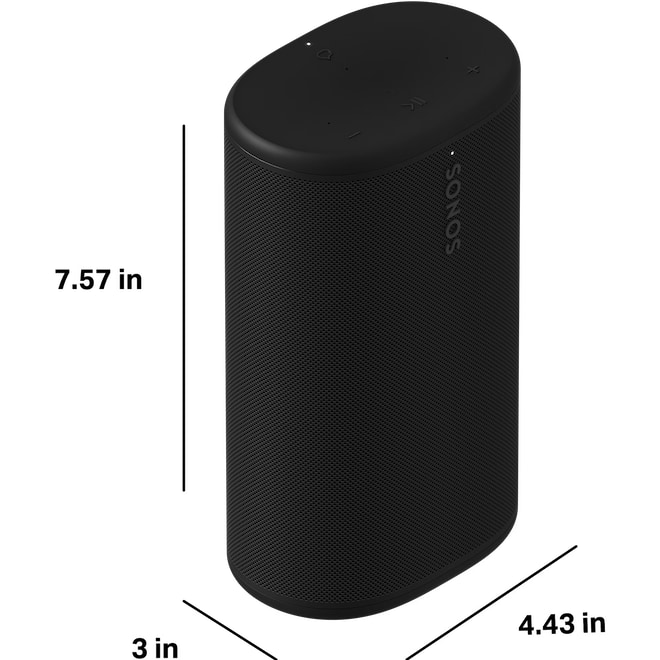
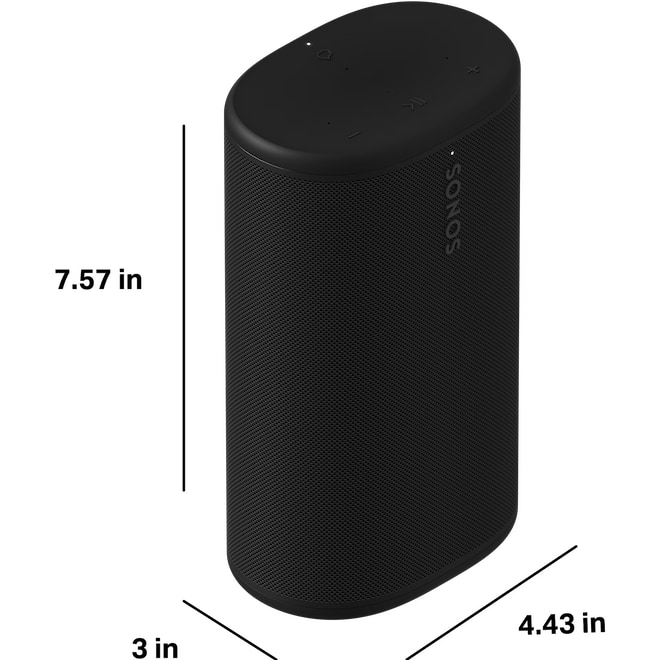
From a portability standpoint, Sonos Play is built for outdoor use with an IP67 dust and water resistant enclosure, meaning it can survive temporary submersion in up to one meter of water for 30 minutes. The cabinet measures 7.56 inches high, 4.43 inches wide, and 3.02 inches deep, and weighs 2.87 pounds (1.3 kg). It is available in black or white with a matte finish and includes physical controls for playback, volume, grouping, and voice assistant muting, along with LED indicators that display connection status, battery level, and microphone activity.
Power and connectivity options reflect the hybrid nature of the speaker. Sonos Play supports WiFi 6 and works with 2.4 GHz and 5 GHz networks using 802.11a/b/g/n/ac/ax standards. For portable listening, it includes Bluetooth 5.3 for wireless audio streaming from phones, tablets, and laptops.
A 35Wh battery delivers up to 24 hours of playback, and the speaker includes a USB Type-C port that can charge a phone or connect to an external audio source using the optional Sonos Line In Adapter. Ethernet connectivity is also possible through the optional Sonos Combo Adapter.
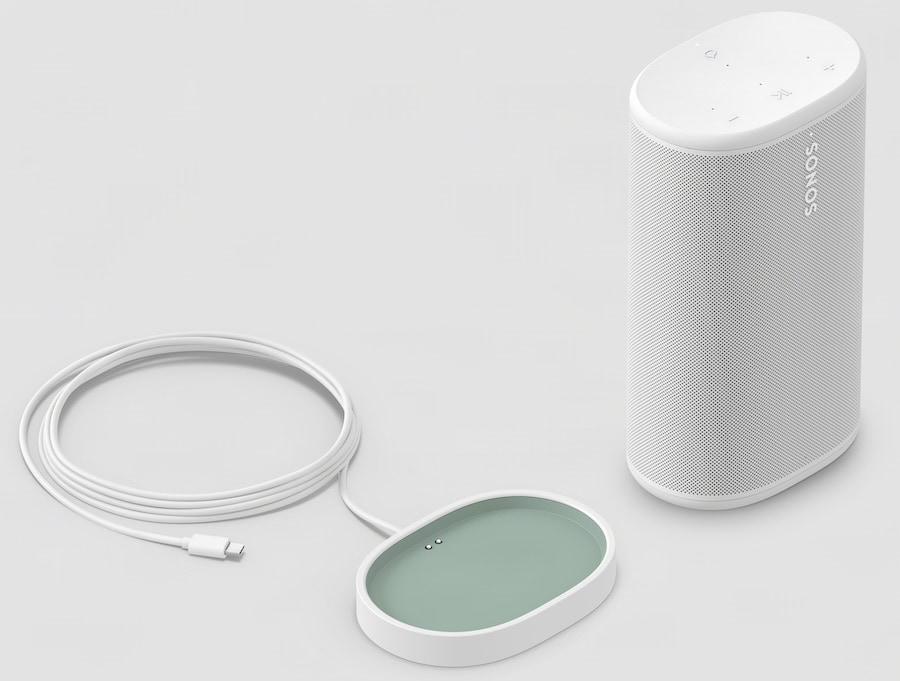
At home, Sonos Play rests on the included Charging Base, which keeps the speaker powered and ready for use as part of a stationary multiroom system. The base requires a USB C PD compatible power adapter rated at 18 watts or higher, which is sold separately.
For Apple users, the speaker also supports Apple AirPlay 2 on devices running iOS 11.4 or later, alongside compatibility with the Sonos app, voice services, and streaming integrations such as Spotify Connect.
Era 100 SL: A Simpler Sonos Speaker Built for Everyday Listening
Era 100 SL is positioned as a more streamlined entry point into the Sonos ecosystem, aimed at listeners who want the core Sonos experience without extra hardware they may never use. It is based on the same general acoustic platform as the Era 100, but removes the built in microphones and keeps the focus on music playback, system expansion, and straightforward wireless connectivity.

Inside, the speaker uses three Class D digital amplifiers tuned for its cabinet and driver layout. Its acoustic system includes two angled tweeters for stereo separation and high frequency detail, along with one midwoofer that handles vocals, midrange information, and bass. Through the Sonos app, users can adjust bass, treble, and loudness, while Trueplay room tuning can fine tune the speaker’s EQ based on the acoustics of the room, although that feature requires WiFi and a compatible iOS device.
The feature set is clearly aimed at consumers who want flexibility without overcomplication. Era 100 SL can function as a standalone speaker, but it can also be paired with a second unit for stereo sound, grouped with other Sonos speakers in a multiroom setup, or used as rear surrounds in a Sonos home theater system.
It supports streaming over Wi-Fi through the Sonos app, along with Bluetooth 5.3, Apple AirPlay 2, and Spotify Connect. There is also a USB Type-C connection for adding an external source such as a turntable or other audio component through the optional Sonos Line In Adapter, and Ethernet connectivity is available through the optional Sonos Combo Adapter.

Physically, the speaker remains compact enough for shelves, desks, and smaller rooms. It measures 7.2 inches high, 4.72 inches wide, and 5.14 inches deep, and weighs 4.31 pounds (1.95 kg). It is offered in black or white with a matte finish, and uses capacitive touch controls on the top panel for playback, volume, and grouping functions. An LED indicator shows connection and mute status, while a dedicated Bluetooth button handles wireless pairing.
On the power and networking side, Era 100 SL supports Wi-Fi 6 and works with 2.4 GHz and 5 GHz networks using 802.11a/b/g/n/ac/ax standards. It uses an internal 100 to 240V, 50/60Hz power supply, so unlike Sonos Play, this is a speaker intended to remain plugged in rather than travel with you. Sonos also says the model is built with recycled plasticand ships in recyclable FSC certified paper packaging, which may matter to buyers paying closer attention to sustainability.
The Bottom Line
The Sonos Play and Era 100 SL focus on what Sonos has historically done best: simple speakers that become more capable as part of a larger multiroom system. Play is the more distinctive of the two, functioning as both a portable Bluetooth speaker and a WiFi Sonos speaker when docked at home, while Era 100 SL offers a more affordable, microphone free version of the Era platform for expanding a room, stereo pair, or surround system.
At $299 , Sonos Play sits in the premium portable category but adds deeper integration with the Sonos ecosystem. Era 100 SL at $189 is priced competitively for buyers looking to build a multiroom system one room at a time.
What feels missing will depend on the buyer. Some may want native Ethernet, built in line input without adapters, or broader high resolution audio support, especially as competitors push those features. Still, these speakers are clearly aimed at first time Sonos buyers and existing users adding more rooms, reinforcing the platform rather than reinventing it.
Where to buy:
Related Reading:

When to watch Newcastle vs. Barcelona
- Tuesday at 4 p.m. ET (1 p.m. PT).
Where to watch
- Newcastle vs. Barcelona will air in the US on Paramount Plus.

It’s a huge test of Newcastle’s “big club” credentials on Tuesday as Eddie Howe’s men welcome La Liga leaders Barcelona to northeast England for this UEFA Champions League round-of-16 clash.
The Magpies’ hopes of becoming genuine Champions League title contenders have yet to fully materialize since the $410 million Saudi-led consortium’s takeover of the club back in 2021, but Eddie Howe’s team has a chance here to prove it has finally emerged as a major force in European football’s premier club competition.
They face a Barcelona team which saw their hopes of an historic quadruple this season disappear following last week’s Copa del Rey semifinal loss to Atlético Madrid. Hansi Flick’s men nevertheless remain among the favorites to lift the Champions League trophy for a sixth time, with the Blaugrana coming into the match off the back of a gritty 1-0 away win over Athletic Club on Saturday to stay four points clear at the top of La Liga.
Newcastle United takes on F.C. Barcelona at St. James’ Park, on Tuesday, March 10. Kickoff is set for 8 p.m. GMT local time in the UK, making it a 4 p.m. ET or 12 p.m. PT start in the US, a 9 p.m. CET kickoff in Europe and a 7 a.m. AEDT kickoff in Australia on Wednesday.
Teenage sensation Lamine Yamal scored his 14th La Liga goal of the season on Saturday to give Barcelona a 0-1 away win over Athletic Club.
Livestream Newcastle vs. Barcelona in the US without cable
American soccer fans can stream this game along with every game of this season’s tournament via Paramount Plus, which has exclusive live English-language broadcast rights in the US for the UEFA Champions League.
This season introduces a multiview option that lets you watch up to four matches simultaneously and choose your preferred in-game audio.
Paramount Plus has two main subscription plans in the US: Essential for $8 a month and Premium for $13 a month. Both offer coverage of the Champions League.
The cheaper Essential option has ads for on-demand streaming and lacks live CBS feeds as well as the ability to download shows to watch offline later. Newcomers to the service can take advantage of a 30-day free trial, while students may qualify for a 25% discount.
Read our Paramount Plus review.
How to watch every UEFA Champions League 2025-26 game online from anywhere using a VPN
If you find yourself unable to view the game locally due to incorrectly applied blackout restrictions, you may need a different way to watch the game, and that’s where using a VPN can come in handy. A VPN is also the best way to stop your ISP from throttling your speeds on game day by encrypting your traffic, and it’s a great idea when you’re traveling and find yourself connected to a Wi-Fi network, or when you want to add an extra layer of privacy for your devices and logins.
With a VPN, you’re able to virtually change your location on your phone, tablet or laptop to get access to the game. So, if your internet provider or mobile carrier has assigned you an IP address that incorrectly indicates your location in a blackout zone, a VPN can resolve this issue by providing you with an IP address in your correct, non-blackout area. Most VPNs, like our Editors’ Choice, ExpressVPN, make it really easy to do this.
Using a VPN to watch or stream sports is legal in any country where VPNs are legal, including the US and Canada, as long as you’ve got a legitimate subscription to the service you’re streaming. You should ensure your VPN is set up correctly to prevent leaks. Even where VPNs are legal, the streaming service may terminate the account of anyone it deems to be circumventing correctly applied blackout restrictions.
Looking for other options? Be sure to check out some of the other great VPN deals taking place right now.
Price $13 per month, $75 for the first year or $98 total for the first two years (one- and two-year plans renew at $100 per year)Latest Tests No DNS leaks detected, 18% speed loss in 2025 testsJurisdiction British Virgin IslandsNetwork 3,000 plus servers in 105 countries
ExpressVPN is our current best VPN pick for people who want a reliable and safe VPN, and it works on a variety of devices. Prices start at $3.49 a month on a two-year plan for the service’s Basic tier.
Note that ExpressVPN offers a 30-day money-back guarantee.
Livestream Newcastle vs. Barcelona in the UK
While TNT Sports will once again broadcast the lion’s share of Champions League games, Prime Video has first pick of Tuesday games and will show one match per week live exclusively on the platform.
Livestream Newcastle vs. Barcelona in Canada
If you want to stream Champions League games live in Canada, you’ll need to subscribe to DAZN Canada. The service has exclusive broadcast rights to every match this season, including this one.
A DAZN subscription currently costs CA$35 a month or CA$250 a year and will also give you access to Europa League and EFL Championship soccer, Six Nations rugby and WTA tennis.
As well as dedicated apps for iOS and Android, there’s a wide range of support for set-top boxes and smart TVs.
Livestream Newcastle vs. Barcelona in Australia
Soccer fans Down Under can watch UCL games on streaming service Stan Sport, which once again has exclusive rights to show all Champions League matches live in Australia this season.
Stan Sport will set you back AU$20 a month (on top of a Stan subscription, which starts at AU$12). It’s also worth noting that the streaming service is currently offering a seven-day free trial.
A subscription will also give you access to Premier League and Europa League action, as well as international rugby and Formula E.

Tax-efficient Diversification Techniques | Fox Business

Kraken’s xStocks starts points program, hinting at possible ecosystem token

2026 Players Championship picks, odds: Expert predictions, favorites to win


-
Business4 days ago
Form 8K Entergy Mississippi LLC For: 6 March
-

 Fashion4 days ago
Weekend Open Thread: Ann Taylor
-

 News Videos1 day ago
10th Algebra | Financial Planning | Question Bank Solution | Board Exam 2026
-

 Crypto World1 day ago
Paradigm, a16z, Winklevoss Capital, Balaji Srinivasan among investors in ZODL
-

 Tech6 days ago
Bitwarden adds support for passkey login on Windows 11
-
 Sports5 days ago
499 runs and 34 sixes later, India beat England to enter T20 World Cup final | Cricket News
-

 Sports3 days ago
Three share 2-shot lead entering final round in Hong Kong
-

 Sports3 days ago
Braveheart Lakshya downs Lai in epic battle to enter All England Open final | Other Sports News
-

 Business7 days ago
Guthrie Disappearance Enters Fifth Week as Family Visits Memorial
-

 Politics4 days ago
Top Mamdani aide takes progressive project to the UK
-

 Business4 hours ago
ExxonMobil seeks to move corporate registration from New Jersey to Texas
-

 NewsBeat5 days ago
Piccadilly Circus just unveiled ‘London’s newest tourist attraction’ and it only costs 80p to enter
-

 Business2 days ago
Search for Nancy Guthrie Enters 37th Day as FBI Probes Wi-Fi Jammer Theory
-

 Entertainment4 days ago
Hailey Bieber Poses For Sexy Selfies In New Luscious Lip Thirst Traps
-
 NewsBeat20 hours ago
Pagazzi Lighting enters administration as 70 jobs lost and 11 stores close across Scotland
-

 Tech1 day ago
Despite challenges, Ireland sixth in EU for board gender diversity
-

 Crypto World6 days ago
New Crypto Mutuum Finance (MUTM) Reports V1 Protocol Progress as Roadmap Enters Phase 3
-
 Tech6 days ago
ACIP To Discuss COVID ‘Vaccine Injuries’ Next Month, Despite That Not Being In Its Purview
-
Entertainment6 days ago
Harry Styles Has ‘Struggled’ to Discuss Liam Payne’s Death
-

 Business1 day ago
Search Enters 39th Day with FBI Tip Line Developments and No Major Breakthroughs