

Crypto World
Societe Generale-FORGE Deploys MiCA-Compliant EURCV Stablecoin on Stellar

Societe Generale-FORGE, the crypto arm of French banking company Societe Generale, has deployed its euro-denominated stablecoin on the Stellar blockchain, completing a multichain expansion first announced in 2025.
The stablecoin, known as EUR CoinVertible (EURCV), is designed to comply with the European Union’s Markets in Crypto-Assets (MiCA) framework and represents a tokenized euro issued by the company for use in digital asset markets.
According to the company, the Stellar deployment is intended to broaden the stablecoin’s use across blockchain-based financial applications and tokenized asset services.
SG-FORGE said Stellar offers high transaction throughput, low network fees and built-in support for tokenized assets. The network also includes a decentralized exchange that allows users to trade digital assets directly onchain.
Societe Generale-FORGE first launched the EUR CoinVertible (EURCV) stablecoin on Ethereum in April 2023. The stablecoin is fully backed by reserves consisting of bank deposits and high-quality liquid assets on a one-to-one basis, and has a current market cap of around $452 million, according to DefiLlama data.
The development comes weeks after SG-FORGE deployed EUR CoinVertible on the XRP Ledger, then marking the token’s third blockchain network after Ethereum (ETH) and Solana (SOL).
In January, the stablecoin was used by global banking network SWIFT in a pilot that demonstrated the exchange and settlement of tokenized bonds using both fiat and digital currencies.
Related: Stablecoin payments startup Kast raises $80M at $600M valuation: Report
European stablecoin push
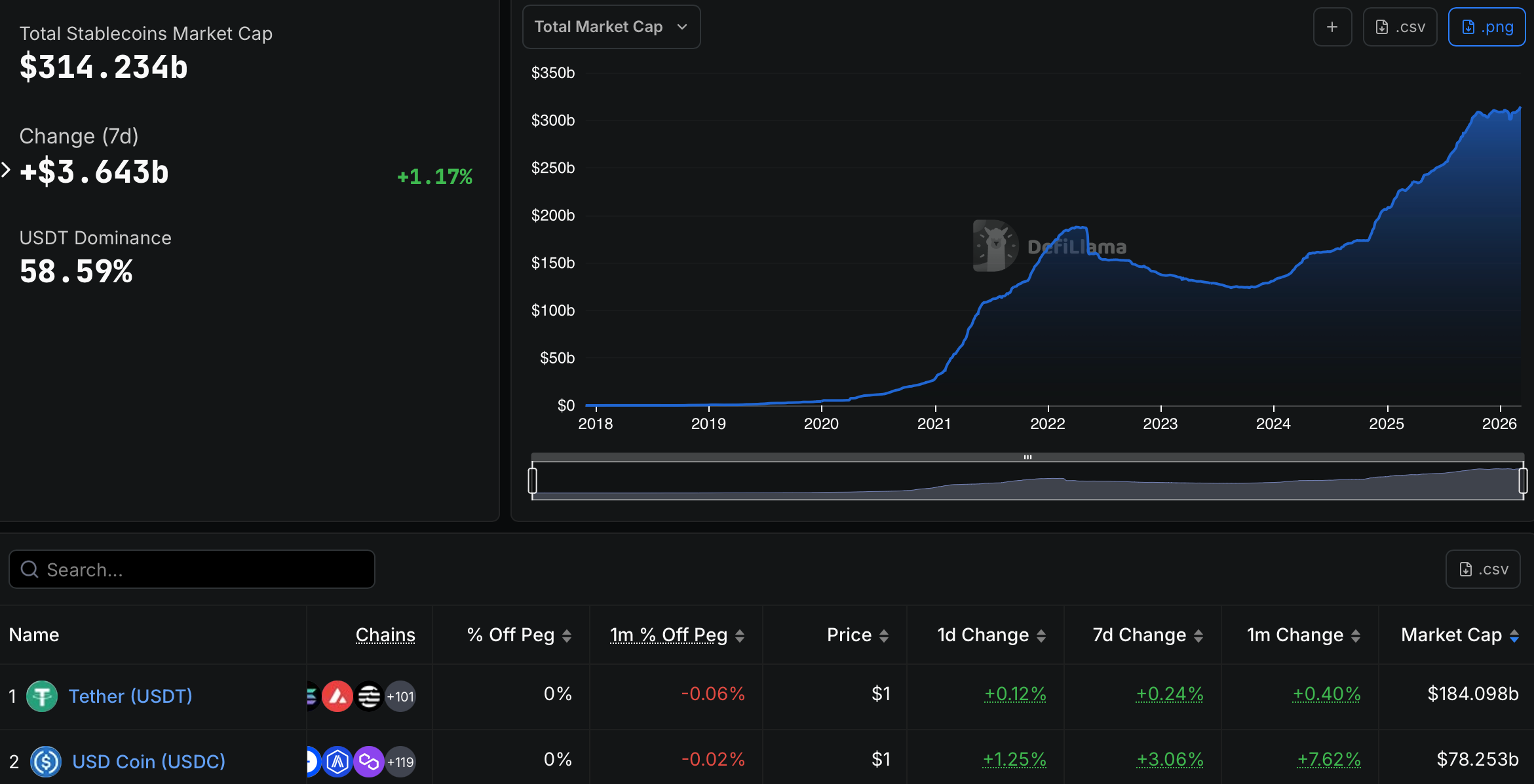
Despite growing interest in euro-denominated tokens, the stablecoin market remains dominated by US dollar-backed assets. Tether’s USDT (USDT) holds a market capitalization of about $185 billion, representing nearly 60% of the sector, while Circle’s USDC (USDC) accounts for roughly $78 billion.
Adoption of digital dollars accelerated in the US after the GENIUS Act passed in July 2025, providing regulatory clarity for stablecoin issuers. Total market capitalization has climbed from around $260 billion on July 20 to more than $314 billion today, per DefiLlama data.
Meanwhile, Europe has taken a more restrictive regulatory approach. The European Union’s MiCA framework introduced new rules for stablecoin issuers in June 2024, requiring companies operating in the European Economic Area to obtain an e-money license in at least one EU member state.

The regulation prompted several exchanges, including Coinbase, OKX, Bitstamp, Uphold and Binance, to remove or restrict support for stablecoins that had not secured authorization under the framework. Tether also decided it would discontinue its euro-pegged stablecoin EURT.
In November, European Central Bank officials warned that the growth of US dollar–backed stablecoins could weaken Europe’s monetary sovereignty by increasing reliance on dollar-denominated digital assets.
Magazine: The debate over Bitcoin’s four-year cycle is over: Benjamin Cowen

Crypto World
DeepSnitch AI Presale Launch Date Set for March 31 as Orbital Bitcoin Mining News Fires Up the Compute Sector: RENDER and AKT Are Moving, But $DSNT Is the 2000% Moonshot

A company called Starcloud, backed by Nvidia, just told the world it is building data centers in space to mine Bitcoin using solar-powered ASICs orbiting Earth. The company already launched an Nvidia H100 into orbit in November 2025 and plans to scale across 88,000 satellites.
When institutional-grade infrastructure starts chasing Bitcoin from space, it tells every trader paying attention that the demand side of this market is not cooling down. The compute revolution is wider than most are pricing in right now, and the DeepSnitch AI presale launch date of March 31 is landing right in the middle of it.
With $2M raised, 41.4M coins already staked, and 5 live AI tools running today, the DeepSnitch AI token launch is one of the most anticipated exits from presale heading into Q2.
Shocking: Bitcoin mining is moving to space
Starcloud, backed by Nvidia, just confirmed it will be the first project to mine Bitcoin from literal orbit when its second spacecraft launches later this year, and the crypto market has not fully priced this in yet.
The company already sent an Nvidia H100 into orbit in November 2025. Its data center network spanning 88,000 solar-powered satellites is engineered to make every earth-based mining operation look expensive and inefficient by comparison.
When Nvidia-backed institutional capital is deploying orbital Bitcoin mining infrastructure at this scale, the entire compute and decentralized infrastructure narrative for this cycle just got a massive fundamental catalyst underneath it.
The on-chain demand signal for compute tokens is flashing, and the traders who load the right positions before this thesis goes mainstream are the ones sitting on the fattest bags when the crowd finally catches up and starts aping in.
DeepSnitch AI token launch is the low-cap presale event that 100x hunters have been waiting for all cycle
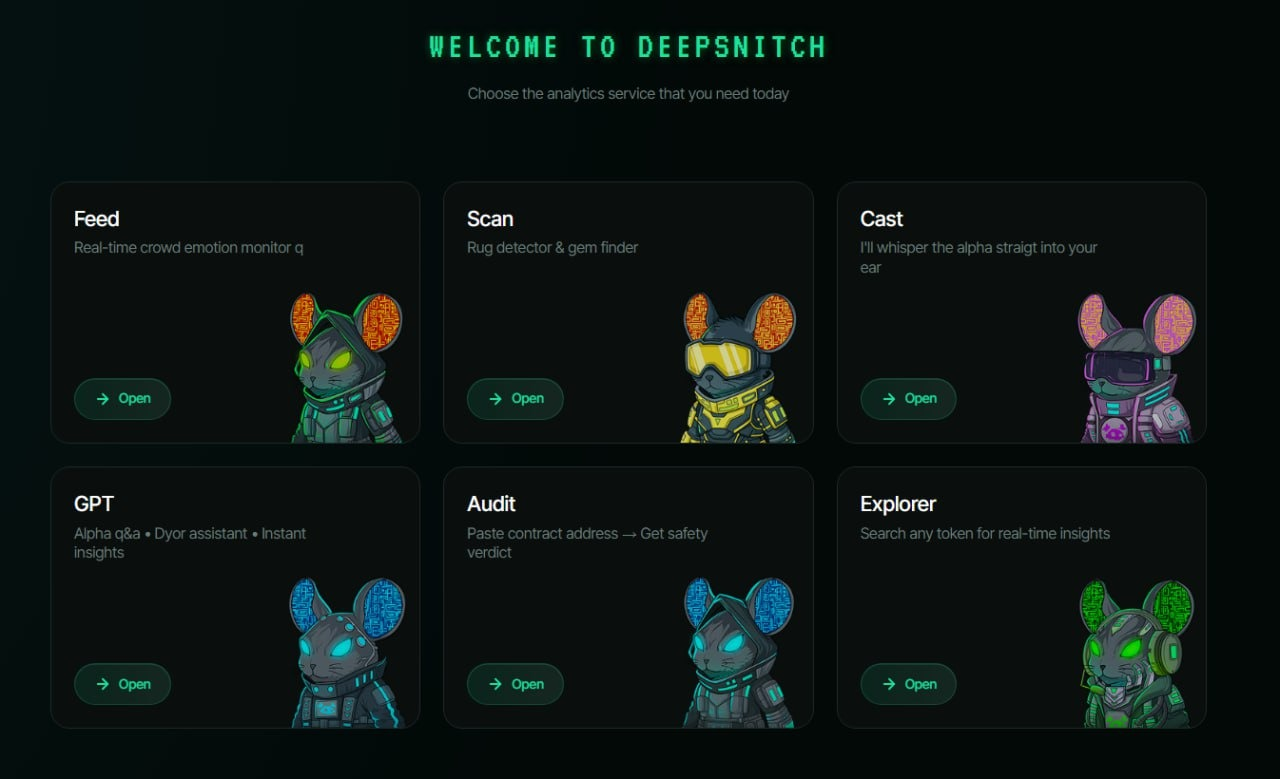
The DeepSnitch AI presale launch date is the most urgent timestamp in the current crypto cycle for traders who want ground-floor access to a working product. Every tool on the platform is live today. SnitchGPT answers your research questions in real time.
The smart contract scanner flags risky tokens before you ape in. The trend tracker surfaces momentum plays before they go viral. This is not a whitepaper project.
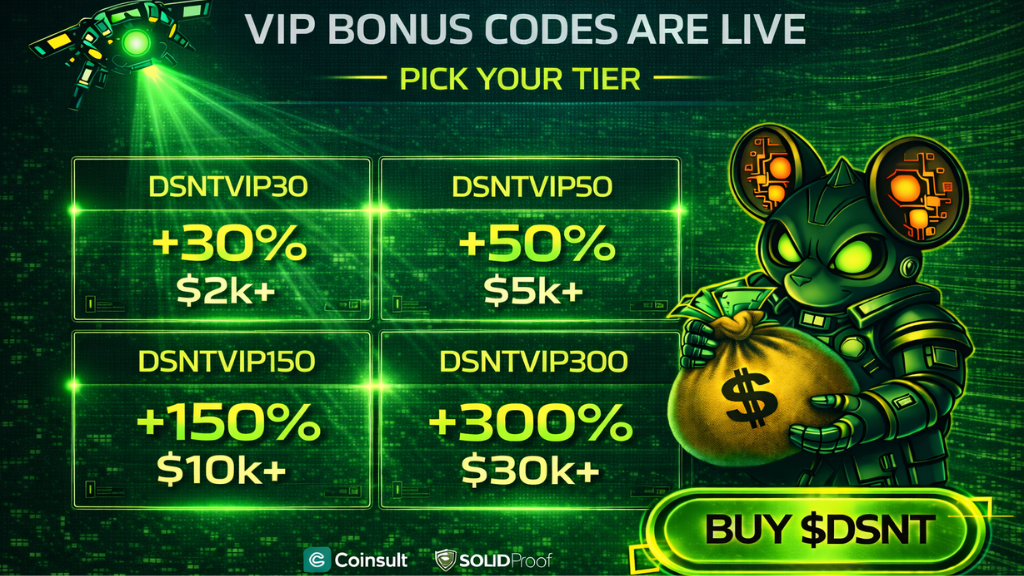
The DeepSnitch AI roadmap points to Uniswap listing first, followed by rumored tier-1 and tier-2 exchange listings in Q2. Each listing milestone is a fresh demand event for a token that presale buyers picked up at $0.04399.
The DeepSnitch AI presale date closes on March 31 with no extension guaranteed. Analysts projecting 100x to 500x post-listing gains are citing the same combination every time: live utility today, low entry price, and exchange listings still incoming.
The DeepSnitch AI token launch onto major exchanges is the catalyst that converts all that staked conviction into visible price action.
Traders who have been around long enough to watch low-cap tokens get listed know that the DeepSnitch AI presale launch date is the kind of entry window that closes once and never comes back at the same price.
The Deepsnitch AI roadmap is not a vague promise sitting behind a future delivery date that keeps shifting, it is a live platform with working tools that traders are opening every day and an exchange debut that is closing in fast enough to make waiting a genuinely expensive decision.
Akash Network (AKT) update for March 2026
Akash Network is essentially a decentralized alternative to AWS and Google Cloud, letting anyone with spare compute capacity lease it out to developers and AI builders in a permissionless marketplace.
The Burn-Mint Equilibrium model burns $0.85 of AKT for every dollar spent on compute, creating real deflationary pressure that tightens supply every single time the network gets used.
AKT is trading at $0.38 on March 9 with $11 million in 24-hour volume, confirming that serious money is already rotating into this narrative before the mainstream catches on
AKT hit an all-time high of $8.07, and analysts are now placing the 2026 target between $3 and $6. If the decentralized cloud narrative gets the tailwind, this cycle looks ready to deliver.
Render Network (RENDER) update for March 2026
With the Starcloud news spotlighting space-based compute demand, RENDER becomes an easy narrative trade.
The Dispersed AI subnet launched in December 2025 targets AI inference workloads specifically and already supports enterprise-grade Nvidia H100 and H200 hardware across 5,600 active GPU nodes globally.
RENDER hit an all-time high of $13.60 in March 2024 and is currently trading near $1.37 on March 9. Analysts place the 2026 range between $6 and $15 if the decentralized GPU narrative picks up with a broader market recovery.
But at a market cap already above $713 million, the parabolic entry that the DeepSnitch AI presale launch date still offers is simply not available here.
Final thoughts
RENDER and AKT are legit infrastructure holds that benefit from the space compute narrative in the news right now.
But neither of them can match the entry price or the projected upside that the DeepSnitch AI presale launch date still offers at $0.04399. The DeepSnitch AI roadmap is delivering working tools while every other presale is still writing docs.
The DeepSnitch AI token launch onto Uniswap and rumored tier-1 exchanges in Q2 is coming whether you hold $DSNT or not, and the traders are already locked in at $0.04399 with 100X to 300X post-listing projections.
The official presale website is live, and the presale window is closing fast, so get in now before the entry is gone for good. Join X and Telegram for real-time updates on the launch.
FAQs
What exactly is the DeepSnitch AI presale launch date, and why are traders treating it like a hard deadline?
The DeepSnitch AI presale launch date wraps on March 31 at $0.04399 per $DSNT. Once that window closes, the next price you see will be on Uniswap and then tier-1 exchanges. Presale pricing does not come back after listing day.
How does the DeepSnitch AI roadmap compare to what RENDER and AKT are building in the same compute space?
The DeepSnitch AI roadmap has 5 live tools already running for traders today. RENDER and AKT are building real decentralized infrastructure worth holding this cycle, but neither has a working AI surveillance toolkit that traders open every day, as $DSNT does right now.
Is the DeepSnitch AI token launch onto exchanges in Q2 the main catalyst traders should be watching?
Yes. The DeepSnitch AI token launch, hitting Uniswap first and then rumored tier-1 exchanges, is the price event most holders are positioned for. Low market cap plus fresh exchange listings is historically the setup that produces the biggest percentage moves in the shortest time. That is why the DeepSnitch AI presale launch date still has traders moving fast before March 31.
Disclaimer: This is a Press Release provided by a third party who is responsible for the content. Please conduct your own research before taking any action based on the content.



Despite exchange withdrawals, Bitcoin spot trading volume remains near multi-year lows.
Digital assets edged higher this week after US President Donald Trump indicated the war with Iran may be approaching an end, despite later adopting a more aggressive tone online. Bitcoin climbed above $71,000 briefly after surging by over 4%.
Data suggests potential accumulation as futures traders continue building short positions.
Bitcoin Supply Tightens
According to the latest analysis by Binance Research, on-chain data indicate possible spot accumulation this week, even as short positions remain high in the futures market. While a reversal has not yet been confirmed, current conditions suggest a shift may be developing.
The firm observed that roughly 29,000 BTC have been withdrawn from exchanges while Bitcoin traded in the $65,000 to $75,000 range. This contrasts with the earlier decline from $97,000 to $62,000, when rising exchange balances indicated stronger sell pressure. Over the past six months, however, the relationship between exchange balances and prices has weakened, and lower liquidity on trading venues may amplify future price movements.
At the same time, stablecoin inflows to exchanges have risen about 80% from roughly $2 billion since March. This points to renewed liquidity entering the market and suggests that capital may be actively deployed to support Bitcoin accumulation.
Despite these developments, Bitcoin spot trading volume remains near multi-year lows, amid weaker demand and thinner order books. This pattern may reflect accumulation occurring off-exchange through OTC channels, which is consistent with recently reported sharp outflows from OTC desk balances. In derivatives markets, open interest has risen about 18% since the end of February after falling below $30 billion, while funding rates remain low to negative. This means that much of the activity is driven by short positions.
Market Stress Signals Emerge
On-chain data shared by Amr Taha points to conditions that have previously appeared during periods of market stress. In a recent update, the analyst said the Binance Bitcoin derivatives market index has fallen to roughly 0.35. This level is similar to readings recorded in July and August 2024 and is lower than the 0.43 level seen in April 2025.
You may also like:
Historically, levels in this range have occurred near major market lows, which were later followed by strong price recoveries. Taha also posted a chart showing a decline in the value of Bitcoin held by short-term investors. According to the data, the market capitalization of these holdings has dropped to about $390 billion, compared with roughly $437 billion recorded on April 7, 2025.
The analyst said large declines in this metric have often preceded capitulation among short-term holders. A similar drop took place on April 8, 2025, when intense selling pushed the leading crypto asset toward $78,000 before it later surged above $108,000.
Binance Free $600 (CryptoPotato Exclusive): Use this link to register a new account and receive $600 exclusive welcome offer on Binance (full details).
LIMITED OFFER for CryptoPotato readers at Bybit: Use this link to register and open a $500 FREE position on any coin!
Crypto World
The $300 billion digital dollar boom could eat into traditional banks’ profits, warn Jefferies analysts
There is a war going on between crypto firms and traditional banks over stablecoins, and Jefferies analysts said that they could become a steady drag on bank earnings as digital dollar use spreads.
While stablecoins aren’t going to be an immediate existential threat to banks and aren’t likely to trigger a sudden run on U.S. bank deposits, Jefferies analysts estimate banks could see 3% to 5% core deposit runoff over the next five years. This would likely raise funding costs and chip away at banks’ profitability.
“The intermediate-term risk of gradual deposit runoff from emerging activity-based yield opportunities and payments use cases should not be ignored,” analysts led by David Chiaverini wrote in a report on Tuesday.
That “modest pressure” scenario would leave the average bank facing a roughly 3% hit to earnings, the analysts said.
It’s not hard to see why banks should be worried about growth in the stablecoin, which are cryptocurrencies designed to maintain a stable value and are typically pegged 1:1 to fiat currencies like the U.S. dollar or the euro.
They are already widely used in crypto trading, but since the GENIUS Act passed last year in the U.S., the market is expanding into payments, treasury management, and cross-border transfers. Supply reached $305 billion at the end of 2025, up 49% from a year earlier, while adjusted stablecoin transfer volume rose to $11.6 trillion in 2025, the report said.
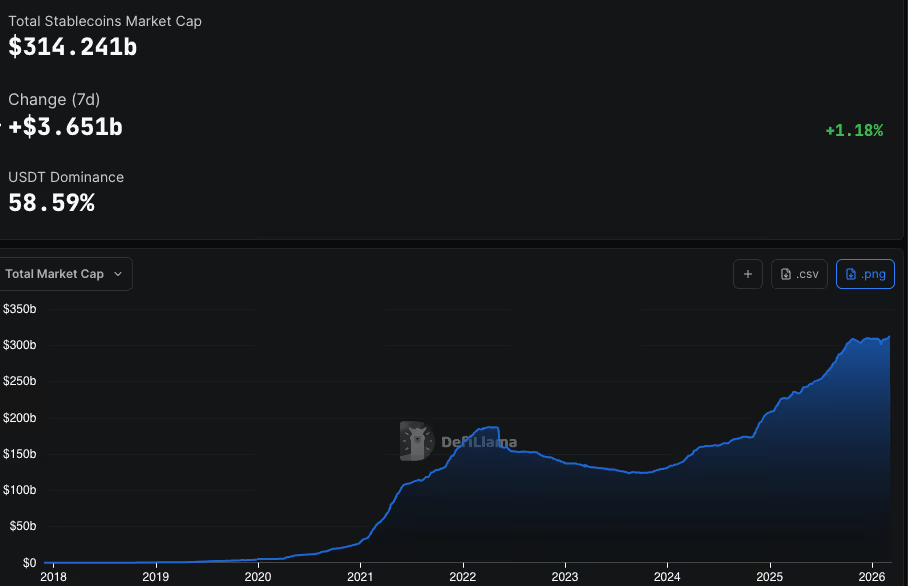
The total market cap of the stablecoin sector currently sits around $314 billion, up from about $184 billion in 2022, according to DefiLlama data. And according to Jefferies’ calculations, it could reach $800 billion to $1.15 trillion in the next five years.

That growth matters for banks because stablecoins can serve as digital cash that moves around the clock and plugs into decentralized finance platforms that offer yields above most bank accounts.
In fact, Bank of America CEO Brian Moynihan warned earlier this year that the broader banking system could be harmed by the “possibility of $6 trillion in deposits” moving into stablecoins and stablecoin-linked products offering yield-like returns.
The long-term threat
Jefferies’ core argument for stablecoins not being an immediate threat is that the new market structure bill in U.S. rules, as it stands now, limits their appeal as simple savings products, even as the bill’s passage is uncertain.
“CLARITY [act] would codify stablecoins as payment instruments, rather than savings products, by closing the ‘stablecoin yield loophole’ left open in GENIUS.”
The GENIUS Act, passed in July 2025, bars regulated stablecoin issuers from paying yield directly to passive holders. That restriction reduces the chance of a sharp near-term shift out of checking and savings accounts.
Also, banks and other traditional financial giants are either launching their own stablecoins or thinking about it to get ahead of the competition. Fidelity Investments launched its first stablecoin, the Fidelity Digital Dollar (FIDD). Bank of America’s Moynihan said the bank will issue a stablecoin if Congress legalizes it, and Goldman CEO said his bank has “an enormous number of people at the firm extremely focused on tokenization, stablecoins.”
Still, the report argues the longer-term risk should not be ignored.
“We see the potential for activity-based rewards for stablecoin transactions, payments, and settlement, as well as rewards from DeFi staking and lending protocols to pose a similar risk to bank deposits.”
So which banks are more exposed to this risk?
According to Jefferies, banks with larger concentrations of retail and interest-bearing deposits appear more exposed than custody banks or large institutions already investing in digital asset infrastructure.
“We view WTFC, FLG, WBS, EGBN and AX as the most exposed banks under coverage, given that they have the highest concentration of retail and interest-bearing deposits.”
Read more: Stablecoin market hits $312 billion as banks, card networks embrace onchain dollars


Nearly 80% of corporate Bitcoin holders are sitting on unrealized losses as BTC trades well below the average treasury purchase price.
Around 80% of companies holding Bitcoin (BTC) as a treasury asset are sitting on unrealized losses, according to an analysis by Charles Edwards, founder of Capriole Investments.
The data comes at a time BTC is pushing back toward $71,000, raising questions of whether the widespread institutional pain is a warning sign or a contrarian buy signal.
The Numbers Behind the Corporate Pain
Edwards shared a series of charts on X on March 10 showing that the simple average cost basis for Bitcoin treasury holdings is at around $90,000, which is well above where BTC is trading today.
On a weighted basis, which gives more weight to larger holders such as Strategy, the average purchase price dropped to about $81,000, showing that the biggest buyers got in earlier and at a lower level. But either way, the number one cryptocurrency is currently below both figures.
“At 80%, almost all treasuries are at a loss on their Bitcoin purchase today,” Edwards wrote. “Though history suggests this could get worse if 2026 is like 2022. There is no free Bitcoin yield.”
In the same thread, Edwards noted that institutions are also broadly down on their BTC positions, with the average institutional purchase price sitting near $78,000. He also said that ETF holders were in the red as well.
However, the analyst did flag one piece of data that stood out, namely that treasury and ETF buying had flipped net positive by 200% on the day of his post.
“The last time it was this high, Bitcoin was at $90,000,” he stated, calling it “very good news, especially amid war.”
That appetite Edwards was referring to was typified by Strategy, which yesterday announced a purchase of 17,994 BTC at an average price of approximately $71,000 per BTC, bringing its total holdings to 738,731 BTC bought for $56 billion. At current prices, the firm’s position is carrying an unrealized loss in the region of $6 billion.
You may also like:
Separately, Strategy’s perpetual preferred stock posted a new 2026 trading volume high of $299 million on March 9, which BitcoinTreasuries estimated was enough to fund another 1,360 BTC purchase.
The broader supply picture adds some context to why institutional accumulation is drawing attention, with analyst Darkfost noting that Bitcoin reserves on centralized exchanges have fallen to levels last seen in 2019.
Additionally, ETFs have absorbed around 1.3 million BTC since their January 2024 launch, while corporate treasury companies collectively hold about 1.1 million BTC, which is nearly 5% of the total supply.
Bitcoin Price Overview
Bitcoin was changing hands near $71,000 at the time of this writing, up over 4% in 24 hours after bouncing from around $67,500. In the last seven days, the asset gained 6.4% and has almost doubled that over 14 days. Still, it remains down nearly 13% year-on-year and about 44% below its October 2025 all-time high.
Binance Free $600 (CryptoPotato Exclusive): Use this link to register a new account and receive $600 exclusive welcome offer on Binance (full details).
LIMITED OFFER for CryptoPotato readers at Bybit: Use this link to register and open a $500 FREE position on any coin!
The prediction market is deploying AI-powered surveillance tools as the industry faces mounting scrutiny over insider trading and market manipulation.
Prediction market Polymarket has partnered with Palantir Technologies and TWG AI to develop a surveillance system designed to detect manipulation and insider trading across its sports markets.
The new platform will be powered by the Vergence AI engine, a joint venture between Palantir and TWG AI created last year. It will monitor trading activity in real time, flag anomalous patterns, screen users against existing banned-bettor lists, and generate compliance reports that can be shared with regulators and sports leagues.
“Our partnership with Palantir and TWG AI allows us to apply world-class analytics and monitoring to sports markets while building tools that can help leagues and teams maintain confidence in the games themselves,” said Polymarket founder and CEO Shayne Coplan in a press release.
Palantir CEO Alex Karp called the collaboration a new standard for prediction markets, adding that the companies are working to ensure the platform can scale as the sector expands.
The partnership comes as interest in sports betting on prediction markets continues to rise.

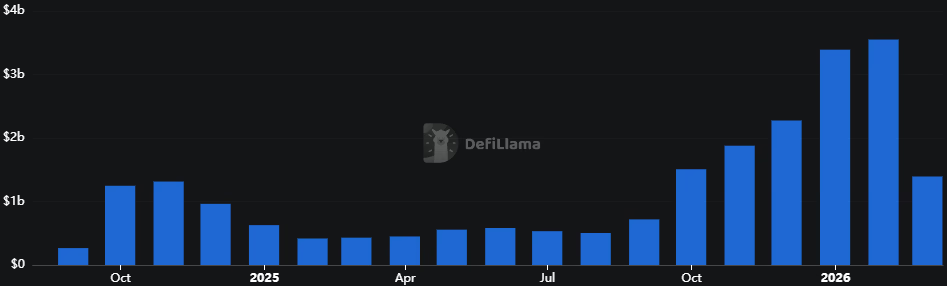
Meanwhile, Polymarket trading volumes hit an all-time high of $3.55 billion in February, marking a sixth straight month of growth, according to DeFiLlama.


Kraken-linked tokenized equities platform xStocks plans to launch a rewards program aimed at traders liquidity providers and DeFi builders using its onchain stock tokens.
The initiative dubbed xPoints will track activity across supported trading venues and integrations. Participants can earn points by trading tokenized U.S. equities providing liquidity or using the assets in decentralized finance (DeFi) applications.
Points programs have become a common strategy in crypto to drive early usage of new platforms. In many cases projects later convert accumulated points into governance tokens or other ecosystem rewards. While xStocks has not announced a token yet, the initiative could pave the way for a potential token launch.
xStocks said the points program is meant to align long-term contributors with the growth of its ecosystem. Participants who accumulate points may gain access to future benefits tied to the platform once the program concludes though details have not been disclosed.
The move comes as tokenized equities have emerged as one of the fastest-growing sectors in crypto. The category now holds more than $1 billion in value locked, tripling in size over the past six months, RWA.xyz data shows.
xStocks said its tokenized stock offering has processed more than $25 billion in transaction volume during the eight months since launch and has expanded across several blockchain networks.
Traditional financial firms have also showing interest in tokenized stocks. Earlier this week, Nasdaq said it plans to work with Kraken to distribute tokenized versions of public stocks to investors outside the U.S., part of a broader push by the exchange operator to bring blockchain infrastructure into capital markets.
Read more: Tokenization still at start of hype cycle, but needs more use cases, specialists say


US Attorney Jay Clayton, the former chairman of the SEC and head of the Southern District of New York, has requested a re-trial of Tornado Cash developer Roman Storm on charges of conspiracy to commit money laundering and evade sanctions.
The requested date for the re-trial is October 5-12, 2026.
Clayton filed a two-page letter confirming his prosecution is willing to bring Count 1 and Count 3 of the original indictment back before a new jury.
Count 1 was a conspiracy to commit money laundering. Here, the US government alleged Storm knowingly helped criminals conceal over $1 billion in stolen crypto through Tornado Cash, including hundreds of millions from a Ronin hack involving North Korea’s Lazarus Group.
Although not up for jury re-trial, Count 2 involves a conspiracy to operate an unlicensed money transmitting business. A Manhattan jury convicted Storm in August 2025 on Count 2.
However, Storm filed a post-trial motion under Criminal Rule 29 which is due for a court to rule sometime soon, even as early as April 9, 2026. Storm hopes to gain acquittal on Count 2 on a legal technicality.
A Rule 29 motion asks a judge to declare that trial evidence was legally insufficient. Legal sufficiency of evidence is a constitutional minimum for sustaining a conviction.
The test for legal sufficiency is whether a rational trier of fact found the essential elements of the offense beyond a reasonable doubt. Rule 29 acquittals are rare but possible.
Also up for re-trial, Count 3 involved a conspiracy to violate sanctions. Specifically, prosecutors claimed Storm kept operating Tornado Cash after the US Treasury sanctioned the protocol in August 2022.
Read more: What does Roman Storm’s guilty verdict mean for the wider DeFi sector?
After five days of deliberation, jurors deadlocked on the money laundering and sanctions counts. As a result, the case was a partial mistrial.
Storm’s attorney Brian Klein said after the first trial that he expected “full vindication.” The defense has continued to fight on First Amendment, venue, and sufficiency of evidence grounds.
Storm remains free on a $2 million bail but April and October will be critical months. For anybody wanting to help him out, he’s currently asking for donations to fund his legal battle.
Got a tip? Send us an email securely via Protos Leaks. For more informed news and investigations, follow us on X, Bluesky, and Google News, or subscribe to our YouTube channel.

While the world watched with growing consternation as the US and Israel attacked Iran and the Strait of Hormuz was shut down to sea vessels, a financial problem was quietly festering beneath the surface: assassination markets were now legal, and available to almost anyone in the world.
Polymarket hosts a future hellscape
Polymarket, a prediction market platform owned by New York-based company Blockratize, currently has open assassination markets on its website.
They’re easy to find because they’re some of the most heavily traded markets on the platform.
Among these markets are:
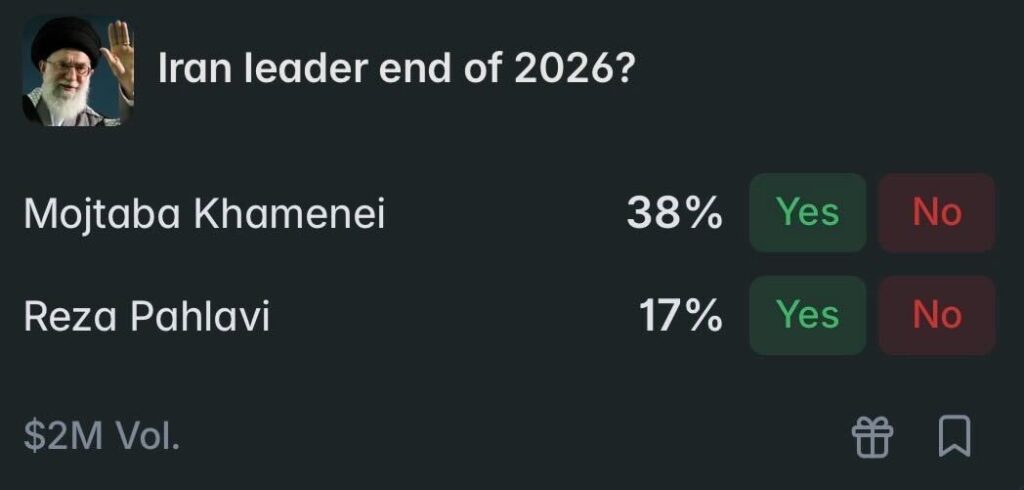
- Iran leader by end of 2026? (the current Ayatollah is on the list)
- Will the Iranian regime fall by (numerous dates available to bet on)?
- Will the Iranian regime survive US military strikes?

Read more: Kalshi uses ‘death carve-out’ to avoid paying out on Ali Khamenei ousting
Despite the death of Ayatollah Khamenei being among the most popular prediction markets, Kalshi, as per its terms and conditions, didn’t pay out when he died. Polymarket, however, did, and half a billion dollars changed hands in the process.
Donald Trump and US politicians noticeably absent
Polymarket seems to purposely avoid including US politicians or the current US president in any possible assassination markets, but the same cannot be said for nearly every other major leader in the world.
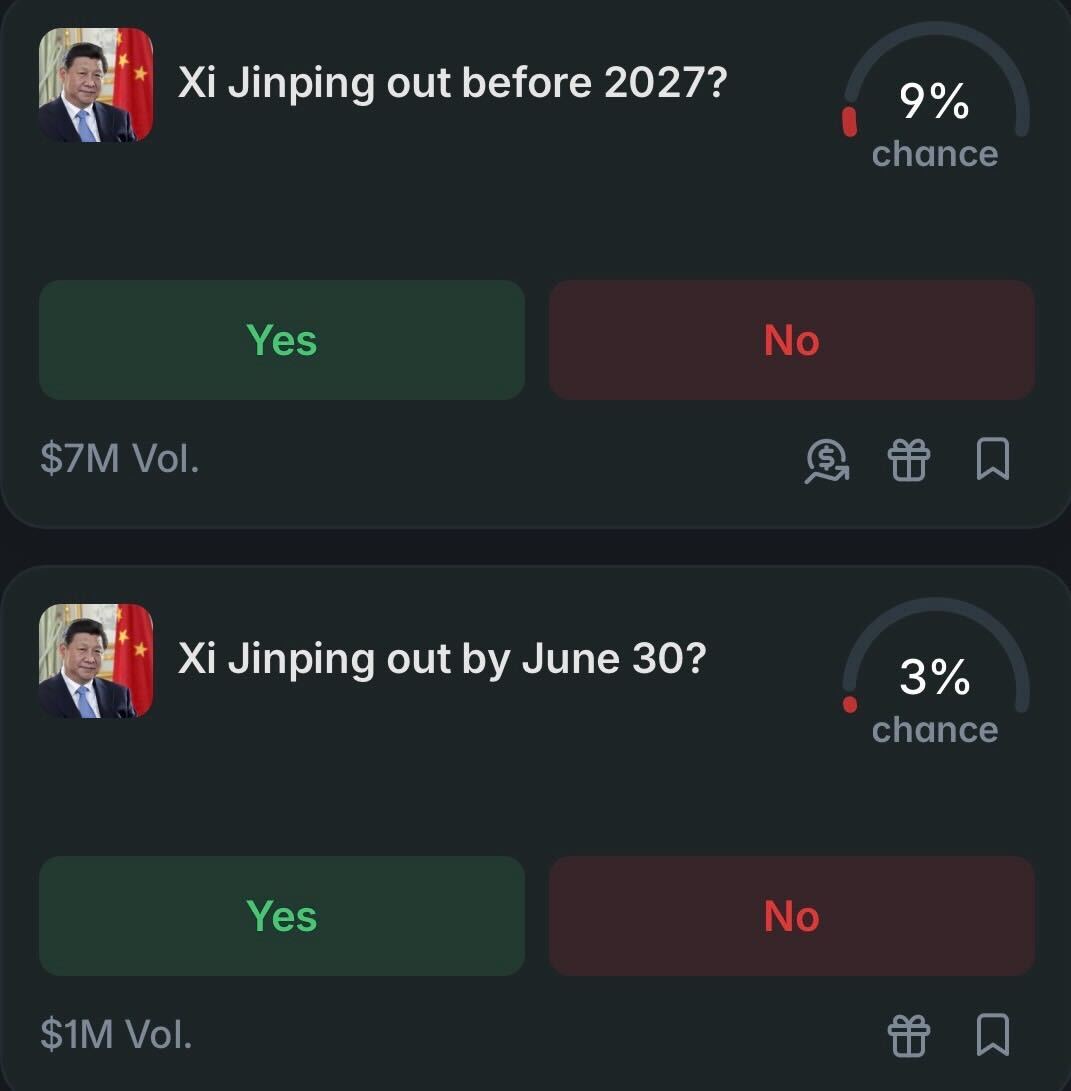
For Xi Jinping the platform hosts markets including “China coup attempt before 2027?” and “Xi Jinping out before 2027?”
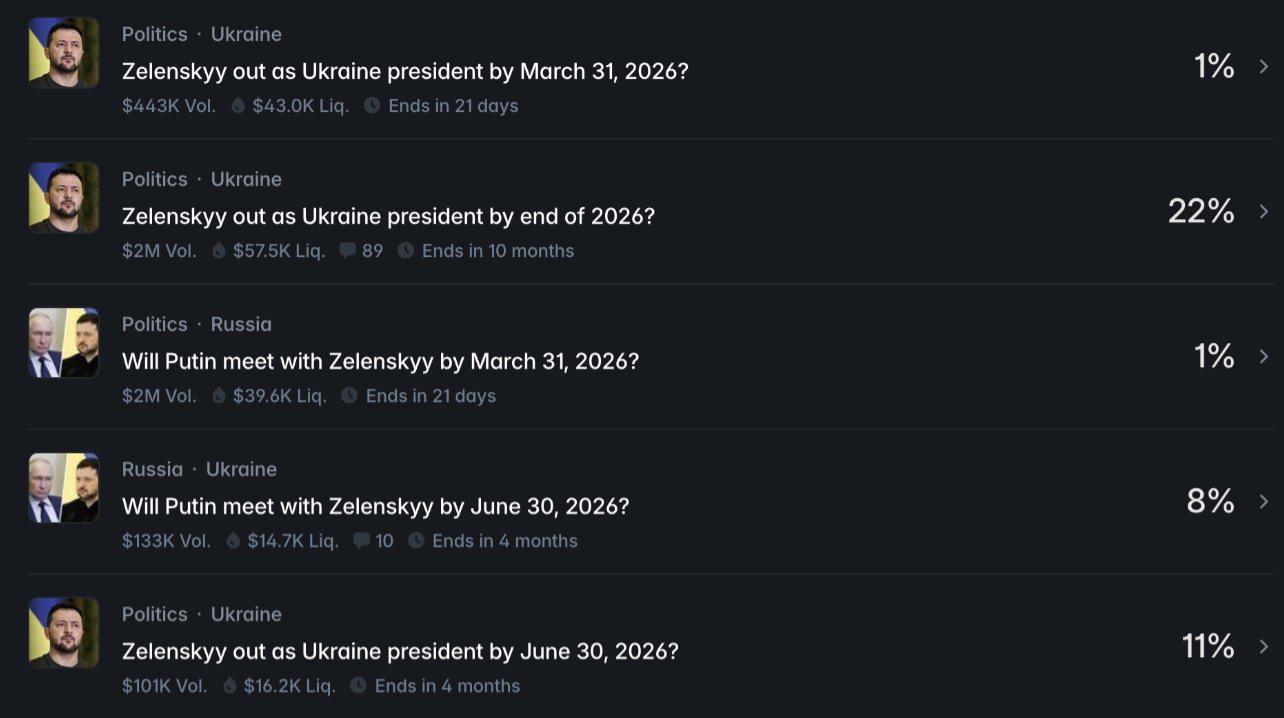
For Putin, a market is available that asks “Putin out as president of Russia by 2026?” and even more markets are available that ask similar questions about Zelenskyy.
Nothing like these assassination markets exist for Donald Trump, who is older and less popular domestically than Xi, Putin, or Zelenskyy.
While Polymarket could previously have claimed that these markets are only related to these individuals’ political oustings, they can’t any more after paying out on Khamenei’s death.
Read more: Polymarket ends trading loophole for bitcoin quants
Why won’t Polymarket list similar markets for Trump?
Though probably obvious to most people, the fact that Polymarket offers no assassination markets on Trump or US politicians is likely nothing to do with moral or ethical concerns.
Rather, it’s almost certainly down to the fact that Polymarket is based in the US, that its founder, Shayne Coplan, is a US citizen, and that Donald Trump Jr. is an advisor to and investor in the company.
Polymarket simply doesn’t want to ruffle any feathers or bite the hand that feeds it.
In that same vein, the Biden administration had effectively stopped Polymarket from advertising to or onboarding US citizens. These hinderances to the platform’s growth came to end in 2025 thanks to the Trump administration dropping multiple probes into its practices, which could have led to lawsuits and possible criminal prosecutions.
Instead, Polymarket now finds itself at the forefront of a world where leaders of countries have public hits put on them via vague market questions that leave murder open as an interpretation and solution.
Read more: Are Polymarket and Kalshi decentralized?
Can Polymarket be stopped?
Whether or not Polymarket can continue to functionally operate as an assassination market platform remains to be seen.
While it’s been stopped from operating in specific countries and regions via regulatory actions and lawsuits, such as Ontario, Singapore, Thailand, and Belgium, as long as the US fails to bring criminal prosecutions against the executives offering to host markets for murders, there’s little that can be done.
For the record, platforms like Polymarket deny they list assassination markets, though, as detailed previously, many markets can easily be linked to the deaths of public figures.
Protos reached out to Polymarket with questions about its assassination markets but we’ve yet to receive a response.
So, in the meantime, whose death are we betting on today and what’s the liquidity look like?
Got a tip? Send us an email securely via Protos Leaks. For more informed news and investigations, follow us on X, Bluesky, and Google News, or subscribe to our YouTube channel.
Crypto World
Jito Foundation acquires and revives SolanaFloor following shutdown over $27 million exploit


The Jito Foundation announced its acquisition of SolanaFloor, a data platform and news site focused on the Solana blockchain, and plans to relaunch the publication after its recent shutdown.
SolanaFloor ceased operations last month after an $27 million exploit involving its parent organization, Step Finance. The team considered external financing and acquisition but was unable to continue operating the platform.
Jito stepped in to bring the site back online but did not reveal the acquisition value. The foundation said SolanaFloor will resume publishing immediately while maintaining editorial independence. The newsroom will continue covering network activity, market movements and technical development across the Solana ecosystem.
“When SolanaFloor went dark, the ecosystem lost something difficult to replace,” said Brian Smith, president of Jito Foundation. He described the acquisition as a commitment to supporting information infrastructure that enables market participants to understand onchain developments.
The relaunch comes as the Solana network remains resilient. Spot exchange-traded funds tied to the token now hold nearly $1 billion in assets, while total value locked on the network’s DeFi ecosystem is at $6.7 billion.
Jito itself plays a role in Solana’s infrastructure. The project develops software used by validators to manage transaction ordering and capture maximum extractable value, or MEV, a form of additional revenue that can arise during block production.
The network also runs a liquid staking system that allows users to deposit SOL and receive a token called JitoSOL that remains usable across decentralized finance applications while still earning staking rewards.
Under the new ownership, SolanaFloor’s editorial team will retain control over story selection and coverage priorities. Jito stated that details about the platform’s team, partnerships, and commercial offerings will be provided as the relaunch progresses.

Hyperliquid’s (CRYPTO: HYPE) token has emerged as a flashpoint for traders watching how decentralized derivatives platforms can redraw liquidity away from traditional venues. In a post published on Monday on Cryptohayes Substack, BitMEX co-founder Arthur Hayes laid out a bull case in which the project could reach as high as $150 by August, contingent on a sustained rotation of derivatives volume from centralized exchanges to crypto-native venues and a broader expansion of Hyperliquid’s product lineup. The core premise rests on a rapid lift in the platform’s 30-day annualized revenue run rate—from about $843 million in March to $1.40 billion by August—fueled in part by the company reinvesting a large share of its earnings into HYPE token buybacks. This framework sits at the intersection of macro asset demand and crypto-native execution, with HIP-3 mechanics and new listings shaping the potential trajectory.
Key takeaways
- The CEX-to-DEX rotation is central to the bull case: Hyperliquid has already absorbed roughly 6% of centralized-exchange derivatives volume as of March, and Hayes estimates a further gain of about 3.96 percentage points if growth continues.
- Revenue momentum matters: the target rise from $843 million in March to $1.40 billion by August is the lynchpin for the projected upside toward $150 per HYPE.
- Tokenomics as a price driver: about 97% of Hyperliquid’s revenue is used to repurchase HYPE on the open market, creating a feedback loop where rising activity supports the token’s price strength.
- HIP-3 expands the product map: the mechanism enables permissionless perpetual markets by staking HYPE, with new listings tied to oil, gold, silver, and major US indices gaining traction and contributing to revenue growth (nearly 10% of total revenue).
- Oil and macro assets as catalysts: oil-linked perpetuals have become top-traded pairs, indicating traders are diversifying beyond crypto into macro assets via the platform.
Tickers mentioned: $HYPE, $ETH
Sentiment: Bullish
Price impact: Positive. The thesis hinges on sustained liquidity growth and ongoing macro-asset demand, which could lift HYPE if the revenue-and-volume trajectory proves durable.
Trading idea (Not Financial Advice): Hold. The scenario depends on continued platform expansion and macro liquidity, which are not guaranteed, but the structure suggests potential upside if momentum persists.
Market context: The analysis sits within a broader pattern of crypto-native venues absorbing traditional-asset trading activity, as liquidity seeks alternative venues amid macro volatility and evolving regulatory considerations affecting derivatives and tokenomics.
Why it matters
Hyperliquid’s bull case rests on a deliberate strategy: move more derivatives activity away from centralized exchanges to a DEX-like platform, and reinvest most revenue into the native token to reinforce upside incentives. If the platform sustains its growth trajectory, the implications extend beyond a single token. It would signal a shifting landscape where specialized crypto-native marketplaces become primary venues for macro-trading strategies—expanding liquidity pools, attracting institutional-like flows, and intensifying price discovery for digital assets linked to traditional markets. The emphasis on HIP-3, which enables permissionless perpetual markets by staking HYPE, could diversify the platform’s revenue streams and reduce reliance on pure crypto volatility, aligning more with real-world assets such as oil and precious metals.
The oil-and-commodity angle underscores a broader narrative: as geopolitical tensions affect traditional markets, traders increasingly view crypto-native venues as hedges or proxies for macro exposures. In Hyperliquid’s case, the CL-USDC perpetual pair has spiked to the top of the platform’s volume rankings, signaling a meaningful tilt toward macro-asset liquidity within a crypto framework. This shift could alter correlation dynamics across digital and traditional markets, inviting investors to reevaluate risk budgets and correlation assumptions. Yet the track record of outsized calls by Hayes—some of which did not materialize—serves as a sober reminder that macro-driven theses can unravel quickly if liquidity conditions relax or if platform execution stalls.
The takeaway for users and builders is quantitative rather than rhetorical: a successful CEX-to-DEX migration and stronger macro-asset liquidity on a platform like Hyperliquid could redefine the risk-reward calculus for derivatives activity in crypto. On the other hand, token unlocks and shifts in market sentiment remain meaningful headwinds that investors must monitor alongside regulatory developments and macro policy shifts. The evolving HIP-3 ecosystem will be a critical barometer of whether Hyperliquid can translate trading activity into durable revenue growth and, ultimately, into sustained token demand.
What to watch next
- Track whether the 30-day annualized revenue run rate reaches the $1.40 billion target by August, and assess how any deviations affect HYPE’s price trajectory.
- Monitor HIP-3 expansions and new listings tied to macro assets like oil, gold, silver, and major US indices, plus their contribution to quarterly revenue numbers.
- Watch liquidity metrics on CL-USDC and ETH-USDC to gauge macro-asset demand on Hyperliquid and any shifts in trading preferences between crypto and traditional markets.
- Observe HYPE’s price action around the neckline near $35.50 and the potential breakout toward $50, with attention to how the 50-day moving average interacts with price development.
- Check for further commentary from Hayes or Hyperliquid about product expansion, tokenomics changes, or new risk-management features that could influence user adoption and liquidity.
Sources & verification
- Hayes, Arthur. Post on Cryptohayes Substack outlining a fivefold potential move for HYPE and the CEX-to-DEX rotation. https://cryptohayes.substack.com/p/hype-man
- Hyperliquid price index overview and discussion of HYPE’s price dynamics. https://cointelegraph.com/hyperliquid-price-index
- HIP-3 revenue impact and market activity data, including commodity listings. https://cointelegraph.com/news/hyperliquid-hip-3-open-interest-hits-793m-on-commodities-surge
- Oil-linked trading volume context and related macro considerations. https://cointelegraph.com/news/oil-pulls-back-g7-emergency-reserve-hyperliquid-volume
- Maelstrom’s analysis on HIP-3 revenue contributions and token dynamics. https://cointelegraph.com/news/maelstrom-warns-hype-token-pressure-11-9b-unlocks
Market reaction and key details
Hyperliquid’s bull thesis anchors on shifting derivatives liquidity and a disciplined reinvestment approach. Hayes argues that if the platform can sustain the migration of derivatives volume from centralized exchanges and broaden its product suite, HYPE could traverse a multifold path—from roughly $30 toward targets near $150 by August. The revenue math is explicit: a move from $843 million in March to $1.40 billion in the 30-day window would imply a meaningful acceleration in platform activity, which in turn would support continued token-buyback pressure in the open market. Importantly, Hyperliquid directs the majority of its earnings back into HYPE; about 97% of revenue is used to purchase more of the token. This design creates a price-supporting dynamic that could amplify gains if demand remains resilient and trading volumes hold steady or rise.
The HIP-3 mechanism adds another layer. By staking HYPE, users can launch perpetual markets permissionlessly, and the project has already seen interest in oil, gold, silver, and major US indices. The latest data suggests HIP-3 accounts for roughly 10% of Hyperliquid’s revenue, with proponents expecting revenue growth to accelerate as onboarding of macro assets intensifies. If the macro environment remains conducive and Hyperliquid continues to add tokens and assets to its catalog, the combination of higher volumes and ongoing token buybacks could support a sustained move higher in HYPE. However, the path is not guaranteed; token unlocks from previous periods have historically weighed on price, and investors should factor in the potential for volatility amid shifting liquidity and risk sentiment.
The oil-linked trading—exemplified by CL-USDC—illustrates how macro exposure is translating into crypto-native activity. As the platform reports sustained volumes on commodity pairs, traders appear to be using Hyperliquid as a bridge between traditional markets and crypto risk assets. This trend is reinforced by the growing volume of ETH-USDC pairs, which demonstrates continued appetite for Ethereum-denominated exposure within Hyperliquid’s ecosystem. All told, the story emphasizes a broader trend: the market is increasingly pricing macro dynamics within crypto-native venues as liquidity moves away from conventional order books and toward more specialized, asset-diversified platforms.

TRUMP EXPOSED Banks Are DESTROYING Crypto Clarity on Purpose?! Americans DESERVE Yield NOW!

Netflix series that ‘surpassed all expectations’ returns with 100% rating

2026 Launch Expected Amid Premium Pricing

Smart energy pays enters the US market, targeting scalable financial infrastructure

Why Israel is blocking foreign journalists from entering

Bitcoin: We’re Entering The Most Dangerous Phase
TRUMP EXPOSED Banks Are DESTROYING Crypto Clarity on Purpose?! Americans DESERVE Yield NOW!

India’s 4 Financial Personalities | finforindia #shorts

OMFG! THEY’RE ABOUT TO IMPLEMENT XRP! The Moment We’ve All Been Waiting For Has Been CONFIRMED! WOW.
-
Business4 days ago
Form 8K Entergy Mississippi LLC For: 6 March
-

 Fashion4 days ago
Weekend Open Thread: Ann Taylor
-

 News Videos1 day ago
10th Algebra | Financial Planning | Question Bank Solution | Board Exam 2026
-

 Crypto World1 day ago
Paradigm, a16z, Winklevoss Capital, Balaji Srinivasan among investors in ZODL
-

 Tech6 days ago
Bitwarden adds support for passkey login on Windows 11
-
 Sports5 days ago
499 runs and 34 sixes later, India beat England to enter T20 World Cup final | Cricket News
-

 Sports3 days ago
Three share 2-shot lead entering final round in Hong Kong
-

 Sports3 days ago
Braveheart Lakshya downs Lai in epic battle to enter All England Open final | Other Sports News
-

 Business5 hours ago
ExxonMobil seeks to move corporate registration from New Jersey to Texas
-

 Business7 days ago
Guthrie Disappearance Enters Fifth Week as Family Visits Memorial
-

 Politics4 days ago
Top Mamdani aide takes progressive project to the UK
-

 NewsBeat5 days ago
Piccadilly Circus just unveiled ‘London’s newest tourist attraction’ and it only costs 80p to enter
-

 Business2 days ago
Search for Nancy Guthrie Enters 37th Day as FBI Probes Wi-Fi Jammer Theory
-

 Entertainment4 days ago
Hailey Bieber Poses For Sexy Selfies In New Luscious Lip Thirst Traps
-
 NewsBeat21 hours ago
Pagazzi Lighting enters administration as 70 jobs lost and 11 stores close across Scotland
-

 Tech1 day ago
Despite challenges, Ireland sixth in EU for board gender diversity
-

 Crypto World6 days ago
New Crypto Mutuum Finance (MUTM) Reports V1 Protocol Progress as Roadmap Enters Phase 3
-

 Tech6 days ago
ACIP To Discuss COVID ‘Vaccine Injuries’ Next Month, Despite That Not Being In Its Purview
-
Entertainment6 days ago
Harry Styles Has ‘Struggled’ to Discuss Liam Payne’s Death
-

 Business1 day ago
Search Enters 39th Day with FBI Tip Line Developments and No Major Breakthroughs