

Crypto World
Solana ETFs find institutional backing while XRP funds depend more on retail



U.S. exchange-traded funds tied to Solana (SOL) and XRP (XRP) are attracting investors despite falling crypto prices, though the two products are drawing very different types of buyers.
Solana ETFs are seeing stronger participation from institutional crypto investors, while XRP funds appear to rely more heavily on retail demand, according to a new report from Bloomberg Intelligence analysts James Seyffart and Sharoon Francis.
“Early Solana ETF demand is being driven largely by industry-native capital rather than broader institutional adoption,” the analysts wrote about Solana ETFs.
About 49% of assets in U.S. spot Solana ETFs were identifiable through 13F filings as of Dec. 31, a regulatory disclosure required for large institutional investment managers. Investment advisers accounted for the largest share of reported holdings, with roughly $270 million in exposure. Hedge funds followed with about $186 million.
“The early holder base remains top-heavy and skewed toward crypto-focused investment firms and market makers, suggesting broader institutional participation is still building,” the analysts wrote. The largest known holders include Electric Capital, Goldman Sachs and Elequin Capital.
Solana is a blockchain network designed to support decentralized applications such as trading platforms, lending services and NFT marketplaces. The network aims to process transactions quickly and cheaply, making it a popular platform for crypto trading and decentralized finance.
Some of the initial capital likely reflects investors shifting existing Solana exposure into the ETF structure rather than entirely new buying. Still, the data suggests that does not explain the full picture. Because about half of the ETF assets are disclosed through 13F filings, even assuming those positions represented swapped exposure would leave a significant share of inflows coming from new buyers.
Solana ETFs have attracted $173 million in net inflows so far in 2026, even as the token has fallen sharply. The report notes that cumulative inflows into the funds have reached about $1.45 billion since launch. That is about 2.5% of the amount that spot bitcoin ETFs have amassed, but it is still a relatively strong figure for such young products.
The products debuted during a difficult market environment. Solana has dropped more than 50% since October, when new spot ETFs launched under the Securities Act of 1933.
Some common ETF trading strategies also appear limited. Futures basis yields — often used by hedge funds to run arbitrage trades — have compressed, leaving fewer incentives for those positions. “With basis yields now compressed, hedge funds and market makers have little incentive to enter new positions in spot Solana ETFs,” the analysts wrote.
XRP ETFs present a different ownership pattern.
Only about 16% of XRP ETF assets were identifiable through 13F filings at the end of December, suggesting a smaller institutional footprint. Advisers again led among disclosed holders with about $165 million in exposure, while hedge funds accounted for around $37 million.
The remaining shares are likely held by investors who do not file 13Fs, including retail buyers.
“We believe a large portion are held by retail investors, who aren’t required to file 13Fs,” according to the report.
XRP is the native token used on the XRP Ledger, a blockchain focused on payments and cross-border money transfers. The network is designed to help financial institutions move funds between countries quickly and at a lower cost than traditional banking rails.
Despite that retail tilt, XRP ETFs have gathered significant assets. The funds attracted more than $1.4 billion in the six weeks after launching in November and have largely held those gains into 2026, even with XRP down about 26% this year.
The analysts said the stability in assets despite weaker futures activity suggests demand may reflect direct market views rather than derivatives-driven arbitrage.
“ETF assets have largely held their gains, suggesting demand may become increasingly directional rather than mechanical,” they wrote.
Together, the findings show how newer crypto ETFs are still developing their investor bases.
While bitcoin funds have drawn broad institutional adoption, Solana and XRP products appear to be carving out different paths as the market matures, with Solana attracting more crypto-native institutional capital and XRP drawing a larger share of retail investors.

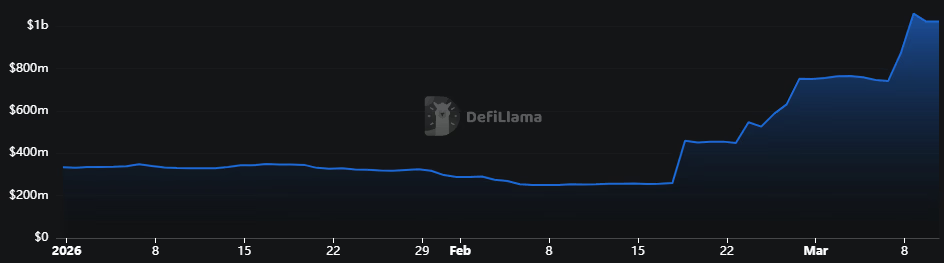
Aave has attracted nearly $800 million in deposits since launching on Mantle a month ago.
Total value locked (TVL) on Mantle, the Ethereum Layer 2 network affiliated with the Bybit crypto exchange, reached a new all-time high on March 9, crossing the $1 billion mark for the first time at $1.06 billion, according to DefiLlama.
The surge follows the launch of Aave, the largest lending protocol in decentralized finance (DeFi), on Mantle in mid-February. As of today, Aave on Mantle has surpassed $1.2 billion in total lending and borrowing market size.
“Aave effect,” posted Aave founder Stani Kulechov.

Mantle’s DeFi TVL surged nearly fourfold from $255 million in the month following the Aave integration, rising 33% in the past week alone.
An incentive program that awards MNT tokens to users who lend and borrow on the network accompanied the Aave deployment, likely accelerating inflows.
Mantle is now the 12th-largest chain by TVL, according to DefiLlama, just trailing Polygon with $1.15 billion but ahead of Avalanche, which has roughly $800 million.
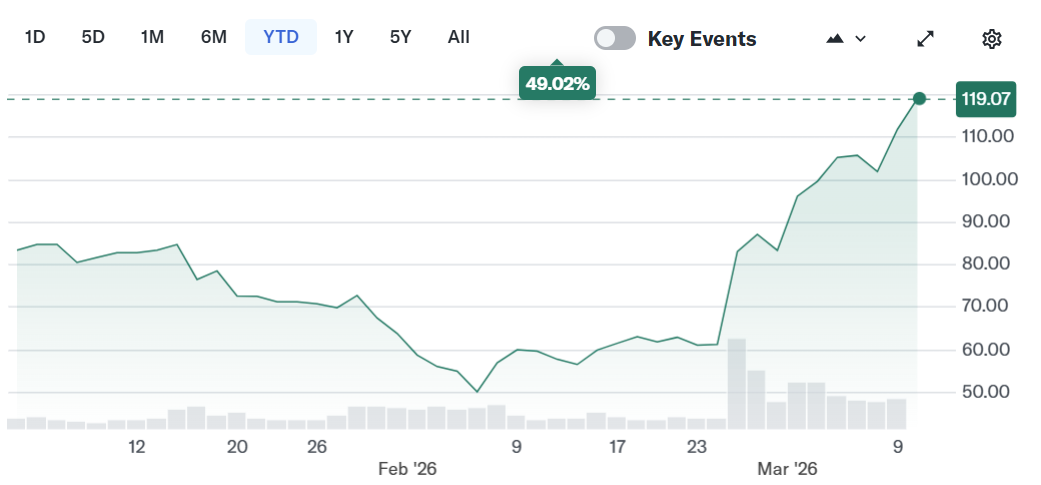
Circle Internet Financial is among Wall Street’s best-performing stocks so far in 2026, and analysts at Bernstein believe the rally could continue as stablecoin adoption accelerates.
In a recent note to clients, Bernstein reiterated its “Outperform” rating on CRCL stock and set a $190 price target, which typically reflects analysts’ expectations for a stock over the next 12 months.
Despite a volatile end to 2025, Circle shares appear to have decoupled from the broader cryptocurrency market, which has been under pressure since October following a major leveraged liquidation event.
Since bottoming near $50 a share in early February, the share price has more than doubled. The shares closed Tuesday at $118.17, up 5.7%, giving the company a market capitalization of roughly $30.3 billion.
Circle shares are now up about 49% year to date, outperforming a flat S&P 500 index and a roughly 1% decline in the Nasdaq 100 index over the same period.
Based on Bernstein’s price target, Circle shares still have 60% upside from current levels.

Related: Circle moves toward privacy-focused stablecoin with USDCx project
Stablecoin adoption drives bullish outlook for Circle
Bernstein’s bullish outlook for Circle is largely tied to the rapid adoption of stablecoins, particularly as businesses gain clearer rules for using digital dollars in the United States.
That clarity came with the GENIUS Act, passed in 2025, which established a federal regulatory framework for stablecoins. The law set standards for reserve backing, disclosures and oversight, giving companies clearer guidelines for issuing and using dollar-pegged tokens.
Circle stands to benefit directly from that shift. Its USDC (USDC) stablecoin is the world’s second-largest, with roughly $78 billion in circulation, accounting for about one-quarter of the global stablecoin market, according to DeFiLlama.

Circle has also built credibility among traditional financial institutions. The company went public in 2025 and works with several major Wall Street companies.
BlackRock manages the Circle Reserve Fund that holds much of USDC’s backing assets, while BNY Mellon serves as a primary custodian for those reserves. Circle has also attracted investments from major institutions, including Fidelity and Goldman Sachs, reflecting growing interest in stablecoin infrastructure from traditional finance.
Related: Crypto’s 2026 investment playbook: Bitcoin, stablecoin infrastructure, tokenized assets


The AI jobs debate got its sharpest rebuttal yet on Tuesday, from the person selling the hardware.
Nvidia CEO Jensen Huang published a rare standalone essay on Tuesday laying out what he calls the “five-layer cake” of AI infrastructure: energy at the base, then chips, then physical infrastructure, then models, then applications.
It positioned AI not as a software product or a chatbot but as an industrial buildout on the scale of electrification, one that requires trillions of dollars in physical construction and a massive workforce of electricians, plumbers, pipefitters, steelworkers, and network technicians.
“These are skilled, well-paid jobs, and they are in short supply. You do not need a PhD in computer science to participate in this transformation,” he said.
Huang’s argument for why the buildout needs to be so large starts with a fundamental shift in how computing works.
Traditional software retrieves stored instructions, while AI generates new outputs in real time, with every response created fresh based on the context provided. It isn’t looking up an answer, but instead, reasons through one on demand.
Because intelligence is produced in real time, the entire computing stack beneath it has to be reinvented, which is why AI requires purpose-built infrastructure from the energy layer up rather than running on existing data centers.
The timing is pointed. The essay arrives after weeks of mounting anxiety about AI’s impact on employment, from Block Inc.’s mass layoffs to Anthropic CEO Dario Amodei’s comments about job displacement. Tech stocks had been selling off on the combination of those fears since early this year.
Huang’s essay is a direct counter-narrative, however. He used radiology as his example, arguing that AI assists with reading scans but demand for radiologists keeps growing because productivity creates capacity and capacity creates growth. “That is not a paradox,” he wrote.
Huang puts energy as the the foundation of the AI era.
“Intelligence generated in real time requires power generated in real time,” he wrote. “Energy is the first principle of AI infrastructure and the binding constraint on how much intelligence the system can produce.”
That framing has implications beyond Nvidia’s supply chain. If energy is the binding constraint on AI, then anything that disrupts energy supply, including the current war in the Middle East, isn’t just a macro headwind for markets. It’s a direct bottleneck on how fast AI can scale.
Huang acknowledged the buildout is still early. “We are a few hundred billion dollars into it. Trillions of dollars of infrastructure still need to be built,” he said, adding that AI factories are being constructed “at unprecedented scale” around the world.
He also gave a notable nod to open-source models, citing DeepSeek-R1 as an example of how making strong reasoning models freely available “accelerated adoption at the application layer and increased demand for training, infrastructure, chips, and energy beneath it.” Open-source doesn’t threaten Nvidia’s business. It feeds it.


Investment bank B. Riley initiated coverage of bitcoin treasury firms Strategy (MSTR) and Strive (ASST) with buy ratings, setting price targets of $175 and $12, respectively.
Strategy was trading at $141.82 at publication time, Strive at $8.67.
The sector was pressured after bitcoin fell more than 45% from about $126,000 in October 2025 to roughly $69,000 in early March 2026, compressing market-to-NAV premiums and slowing the equity issuance that had fueled bitcoin accumulation, the bank said in a report published Monday.
The correction has weighed on crypto-linked equities and funds. The decline in BTC prices and broader risk-asset sentiment has contributed to volatility in shares of companies exposed to digital assets, including corporate bitcoin holders and crypto-focused investment vehicles.
Strategy remains the largest bitcoin treasury company, holding 738,731 BTC. The company, led by Executive Chairman Michael Saylor, made a massive bitcoin purchase last week, adding 17,994 bitcoin to its holdings for a total cost of $1.28 billion, or $70,946 per coin.
The company has built a “digital credit platform” combining common equity and five series of perpetual preferred shares yielding 8% to 11.5%, backed by about $2.25 billion in cash reserves, according to analyst Fedor Shabalin.
The analyst noted that Strategy’s shares trade around 1.2 times mNAV, well below a roughly 3.4x peak in 2024, presenting an attractive entry point.
mNAV is a metric used to value bitcoin treasury companies by comparing a company’s market capitalization to the value of its underlying bitcoin holdings and related assets.
Strive, meanwhile, combines a bitcoin treasury of about 13,100 BTC with an asset-management business overseeing roughly $2.5 billion. The analyst pointed to its low leverage, a preferred share yield of about 12.5%, and a valuation discount, with the stock trading at around 0.9x modified NAV.
Preferred securities issued by the companies could attract yield-focused investors, given that the payouts exceed many traditional income alternatives, the report added.
Read more: Strategy logs record STRC equity issuance on Monday, buys estimated 1,420 bitcoin
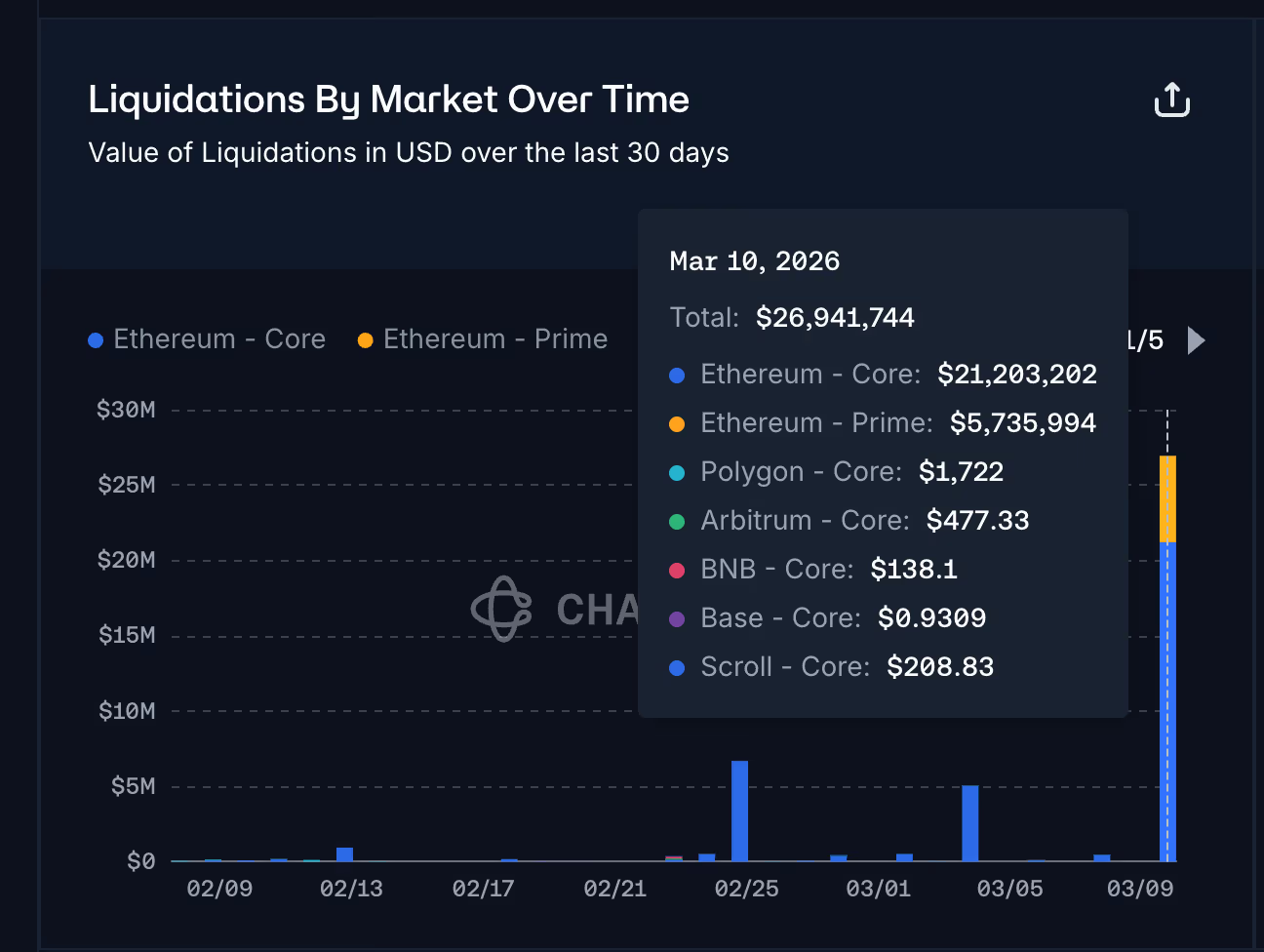
About $27 million was liquidated on the decentralized lending platform Aave over the last 24 hours, in what some market participants say may have been caused by a temporary pricing issue involving the token wstETH.
Blockchain data flagged by risk-management firm Chaos Labs shows a spike in liquidations in the past 24 hours. Some observers believe the event may have been linked to a price update in an oracle system that Aave uses to determine the value of collateral.

Oracles are services that feed price data from the outside world into blockchain applications. Lending protocols like Aave rely on them to decide when a borrower’s collateral is no longer sufficient to back their loan — at which point the position can be liquidated.
While such scenarios are rare, most recently, a price-oracle setup misconfigured by DeFi lender Moonwell briefly valued Coinbase Wrapped ETH (cbETH) at about $1 instead of roughly $2,200, leaving the protocol with nearly $1.8 million in bad debt.
In Aave’s case, some say the issue may have involved wstETH, a token issued by Lido that represents staked ether. Because it accrues staking rewards over time, one wstETH is typically worth slightly more than one ETH.
According to a post from LTV Protocol on X, at the time of the liquidations, Aave’s oracle appeared to value wstETH at roughly 1.19 ETH, while the broader market valued it closer to 1.23 ETH.
Volume remained relatively low for wstETH trading pairs, with just $10 million being traded over the past 24 hours, so it is unlikely any astute traders capitalized on the pricing mismatch before it snapped back.
Aave spokesperson didn’t reply to CoinDesk’s request for comments.

Earlier in the day, risk firm LlamaRisk briefly published a post on the AAVE forum, attributing the liquidations to an issue with Chaos Labs’ risk oracle, before deleting it.
Chaos Labs later said the underlying oracle itself reported the correct market values, and that the liquidations were instead triggered by a configuration issue in the protocol’s CAPO risk oracle, which is designed to place limits on how quickly the value of yield-bearing tokens such as wstETH can increase.
According to Chaos Labs, the incident was caused by a mismatch between stale parameters stored in a smart contract, including a reference exchange rate and its associated timestamp. Because those values were not updated in sync, the CAPO system temporarily calculated a maximum allowed exchange rate that was lower than the real market value of wstETH.
That effectively caused the protocol to treat wstETH as about 2.85% less valuable than it actually was, pushing some borrowing positions below their safety thresholds, triggering liquidations.
Chaos Labs said the protocol incurred no bad debt, though liquidators — traders or bots that repay risky loans in exchange for discounted collateral — captured roughly 499 ETH in liquidation bonuses and profits from the temporary price discrepancy.
A Lido contributor told CoinDesk, “We are aware of the liquidations due to an incorrect wstETH to USD price reported by this oracle mechanism. The cause has nothing to do with wstETH itself, how it works or the Lido protocol which continue to operate normally.”
Oliver Knight contributed reporting to this story.
Read more: Aave governance rift deepens as major governance group exits $26 billion DeFi protocol

The prediction markets platform argued for an injunction against Ohio authorities, claiming that federal commodities laws superseded state laws on sport event contracts.
An Ohio federal court has denied a motion filed by prediction markets platform Kalshi for a preliminary injunction against Ohio state authorities over allegations that the company was operating in violation of gambling laws.
In an order filed Monday, US District Court for the Southern District of Ohio Chief Judge Sarah Morrison denied Kalshi’s request for an injunction that would have blocked the Ohio Casino Control Commission and state attorney general from regulating contracts on the platform, specifically for sports betting.
According to the judge, Kalshi had failed to show that the sports event contracts available on the platform were subject to the “exclusive jurisdiction” of the Commodity Futures Trading Commission (CFTC).
“Even if this Court were to find that sports-event contracts are swaps subject to the CFTC’s exclusive jurisdiction, Kalshi has not shown that the [Commodity Exchange Act, or CEA] would necessarily preempt Ohio’s sports gambling laws,” said the opinion and order, adding:
“Kalshi argues that Ohio’s sports gambling laws are field and conflict preempted by the CEA when it comes to sports-event contracts traded on its exchange […] Kalshi fails to establish that Congress intended the CEA to preempt state laws on sports gambling.”

The denial pushed back against the narrative from CFTC Chair Michael Selig, who said in February that the federal regulator had “exclusive jurisdiction” over prediction markets and threatened lawsuits against any authority claiming otherwise. Kalshi and prediction platforms face lawsuits in other US states over similar allegations involving unlicensed sports betting.
“This Court does not endeavor to explain why the CFTC has not exercised its authority […] with respect to the sports-event contracts,” said the Monday filing in Ohio. “But the agency’s inaction is not proof that the sports-event contracts are regulated by or permissible under the CEA—and the Court has concluded they are not.”
Related: CFTC chair backs blockchain-based prediction markets as ‘truth machines’
In a statement to Cointelegraph, a Kalshi spokesperson said that the company “respectfully disagree[d] with the Court’s decision, which splits from a decision from a federal court in Tennessee just a few weeks ago, and will promptly seek an appeal.”
CFTC guidance on prediction markets could be looming
Last week, Selig said that the federal regulator was working to provide guidance regarding prediction markets “in the very near future.” The CFTC chair is the sole Senate-confirmed commissioner in a panel normally consisting of five people.
Magazine: The debate over Bitcoin’s four-year cycle is over: Benjamin Cowen

TLDR:
- Top 30 institutional investors accumulated $540M worth of Solana spot ETFs during the fourth quarter.
- Electric Capital leads with $137.8M exposure while Goldman Sachs disclosed $107.4M in SOL-linked ETFs.
- Institutional demand remained stable even as the Solana price declined nearly 30% since Q4.
- Spot SOL ETFs are enabling regulated exposure for asset managers unable to custody crypto.
Solana institutional adoption is gaining momentum as investors purchased $540 million in spot SOL ETFs during Q4, showing early multi-quarter conviction in the high-performance blockchain.
Institutional Investors Increase Exposure to Solana
Top institutional investors are positioning heavily in Solana through spot ETFs. In Q4, the 30 largest investors accumulated approximately 4.3 million SOL, worth $540 million.
Electric Capital holds the largest allocation at $137.8 million, followed by Goldman Sachs with $107.4 million.
The presence of traditional financial institutions like Goldman Sachs indicates growing acceptance of Solana beyond Bitcoin and Ethereum. Smaller allocations by Morgan Stanley, Citadel Advisors, and VanEck Associates show diversified participation.
This spread suggests strategic interest across portfolios rather than isolated bets. Unlike earlier cycles where institutions entered altcoins after major retail rallies, Solana is attracting early interest.
The rapid accumulation suggests these investors are viewing SOL as a multi-quarter or multi-year allocation. ETF exposure allows institutions to gain regulated access while maintaining compliance with internal mandates.
Resilient Demand and Structural Appeal
Despite a roughly 30% drop in price since Q4, institutional flows have remained steady. This behavior points to fundamental evaluation, focusing on ecosystem growth, developer activity, and network throughput.
Market corrections have not triggered significant sell-offs, signaling confidence in Solana’s long-term prospects.
Recent price action reinforces this view. SOL dipped to $82 during the past week before quickly recovering to the $88–$89 range.
The strong support indicates steady accumulation by market participants. Technical patterns suggest a short-term uptrend may continue, aligning with institutional positioning strategies.
Solana’s scalability and high-performance blockchain infrastructure are key drivers of interest. Low transaction fees and fast throughput support applications like trading systems, payments, and consumer platforms.
Combined with an expanding ecosystem of decentralized exchanges, NFT platforms, and other applications, Solana presents a compelling option for portfolio diversification.
Spot SOL ETFs further enable access for traditional institutions. These regulated vehicles allow asset managers to gain exposure without direct custody challenges.
The combination of infrastructure, ecosystem momentum, and ETF accessibility explains why institutions are increasingly incorporating Solana into their portfolios.


Stablecoins are evolving from a niche crypto trading tool into a potential layer of global financial infrastructure, according to Australian investment bank Macquarie.
While most U.S. dollar-denominated stablecoin activity, mainly in Tether’s USDT and Circle’s USDC, still comes from crypto trading, accounting for about 90% of volume, the bank said adoption is expanding across payments, remittances, treasury operations and tokenized assets, increasingly linking traditional finance with decentralized finance.
“Stablecoin adoption is making strides in cross-border remittances, but adoption as form of payment still has room to grow, presenting an attractive total addressable market (TAM) opportunity,” analysts led by Paul Golding said in the Monday note.
Regulatory progress is helping drive the shift. The analysts pointed to developments such as the U.S. GENIUS Act, Europe’s MiCA framework and emerging Asia-Pacific regulations as factors pushing stablecoins from speculative uses toward institutional settlement tools.
Read more: Stablecoin market expands, bitcoin rallies as Iran war panic cools
Stablecoins are cryptocurrencies designed to maintain a fixed value, typically pegged to the U.S. dollar, and are widely used across digital asset markets for trading, payments and transfers.
Tether’s USDT is the largest stablecoin by market value and trading volume, serving as a key source of liquidity across crypto exchanges, while Circle’s USDC is the second largest and is widely used in institutional and decentralized finance applications. Together, the tokens underpin much of the crypto market’s activity and are increasingly being explored for payments, remittances and settlement.
Stablecoin growth has been rapid. Macquarie estimates the combined market capitalization of major coins at about $312 billion as of March 2026, up roughly 50% year over year and representing about 7%–8% of the total crypto market.
Transaction activity is rising even faster. Adjusted stablecoin transfer volume reached roughly $11 trillion in 2025, the bank said, suggesting onchain dollars are becoming a meaningful economic tool both within crypto markets and in some real-world payment corridors.
Payments networks and fintech firms are beginning to integrate the technology. The report noted that Visa (V) and Mastercard (MA) now support USDC settlement, allowing card obligations to be discharged onchain.
Banks are experimenting with similar systems. Macquarie pointed to initiatives including JPMorgan’s JPMD tokenized deposit product, Citi’s Token Services and tokenized deposit pilots at HSBC as evidence that blockchain-based settlement is gaining traction among large financial institutions.
Read more: Standard Chartered says U.S. regional banks most at risk in $500 billion stablecoin shift
Crypto World
How Bitcoin ETFs Are Changing Crypto Market Structure and Supply How ETFs Reshape Crypto Markets and Bitcoin Supply Flows
Exchange-traded funds have changed how capital reaches crypto markets and how traders find prices. The arrival of spot Bitcoin ETFs opened regulated on-ramps. At the same time, a meaningful share of mined Bitcoin sits outside active markets. This report explains how ETFs alter market structure and why the effective Bitcoin float falls well short of 21 million coins.
ETFs Expand Access to Bitcoin Markets
ETFs let investors buy Bitcoin exposure through standard brokerage accounts. This structure removed custody and private-key management for many buyers. Investors then moved capital into familiar products listed on major exchanges.
Chainalysis observed that spot-ETFs drove trading volumes into the billions per day within months of launch.
Regulators and issuers created prospectuses, oversight, and audit requirements for these funds. The SEC approved multiple spot Bitcoin listings in January 2024.
SEC Chair Gary Gensler noted the agency approved the listing and trading of a number of spot Bitcoin exchange-traded products, marking a procedural turning point for market access.
ETFs Change Liquidity and Price Formation
Authorized participants now exchange ETF shares for underlying Bitcoin. This creation/redemption mechanism links ETF flows with spot markets. Market-making firms increased activity to support arbitrage and large block trades.
Major liquidity providers helped narrow spreads and improve execution quality for institutional trades.
At the same time, ETF flows influence daily price discovery. Large inflows can bid prices upward quickly. Conversely, sustained outflows can remove demand and pressure prices. Market observers now monitor ETF net flows as part of standard price analysis. Chainalysis documented large early inflows that matched high daily trading volumes.
ETFs Drive Institutional Bitcoin Adoption
Asset managers deployed regulated fund structures that appeal to pensions, endowments, and wealth managers. Major issuers launched competing ETFs. Institutions then allocated capital through those products rather than directly holding private keys. This shift created a concentrated pool of institutional demand routed into ETFs. Evidence shows certain ETFs grew to tens of billions in assets in under a year.
Wealth managers and broker-dealers scaled their offering and distribution channels. The result moved sizable blocks of Bitcoin into custodial arrangements under fund sponsors and their partners. This concentration affects how much supply remains available for active trading.
Custody Links Crypto to Traditional Finance
ETF issuers contracted regulated custodians, auditors, and clearing agents. Traditional financial infrastructure now supports large Bitcoin holdings. Institutional custodians apply governance, insurance, and reporting standards that differ from self-custody. These arrangements increase investor confidence and also reduce turnover in those holdings.
Market participants link ETF strategies to futures and options markets. Traders hedge ETF exposure via derivatives, which increases activity on exchanges such as the CME.
The cross-market linkages changed intraday flow patterns and reduced fragmentation between venues.
Why is a substantial portion of Bitcoin effectively unavailable
On-chain analysis shows a nontrivial share of mined Bitcoin never moves again. Independent research finds that between three and four million BTC likely remain permanently inaccessible.
Analysts attribute these losses to forgotten keys, discarded hardware, and unrecoverable custodial accounts. These coins still exist on the ledger, but holders cannot move them.
Some of the largest examples include early-era addresses that remain dormant. Those coins reduce the usable supply relative to the 21 million cap. As a result, market participants must base liquidity assessments on the effective float, not the theoretical total.
Long-Term Holding Shrinks Tradable Supply
Beyond permanently lost coins, many holders keep Bitcoin offline for long periods. Long-term holders now control a large portion of the circulating supply. Funds, corporate treasuries, and strategic reserves hold coins for extended horizons.
Analysts estimate U.S. spot ETFs and institutional treasuries together hold over one million BTC, which removes these coins from daily trading pools.
On-chain metrics show older UTXOs grow as new issuance slows after halving events. When holders prefer storage over trading, available liquidity declines. That scarcity amplifies price response to marginal demand.
What This Means for Bitcoin Markets
Taken together, ETF accumulation, institutional treasuries, and lost coins lower the effective supply. Analysts place the usable circulating supply below the raw mined total. Markets now respond to changes in institutional flows more than in prior cycles. This structural change raises the sensitivity of price to net inflows and outflows.
Regulatory clarity and custody standards helped mainstream ETF adoption. Those same structures increased the proportion of Bitcoin held in long-term, low-turnover accounts. The market, therefore, shows signs of maturing.
Yet price remains sensitive to large fund flows and macro events. Observers should monitor ETF flows, custody reports, and on-chain dormancy metrics to assess liquidity and risk going forward.
Key takeaways:
-
Ether price struggled as investors pulled $225 million from the spot ETFs, and Ethereum staking rewards underperformed compared to stablecoin yields.
-
Recent Ethereum network upgrades and plans for improved wallet security are positives, but fail to kickstart demand for Ether.
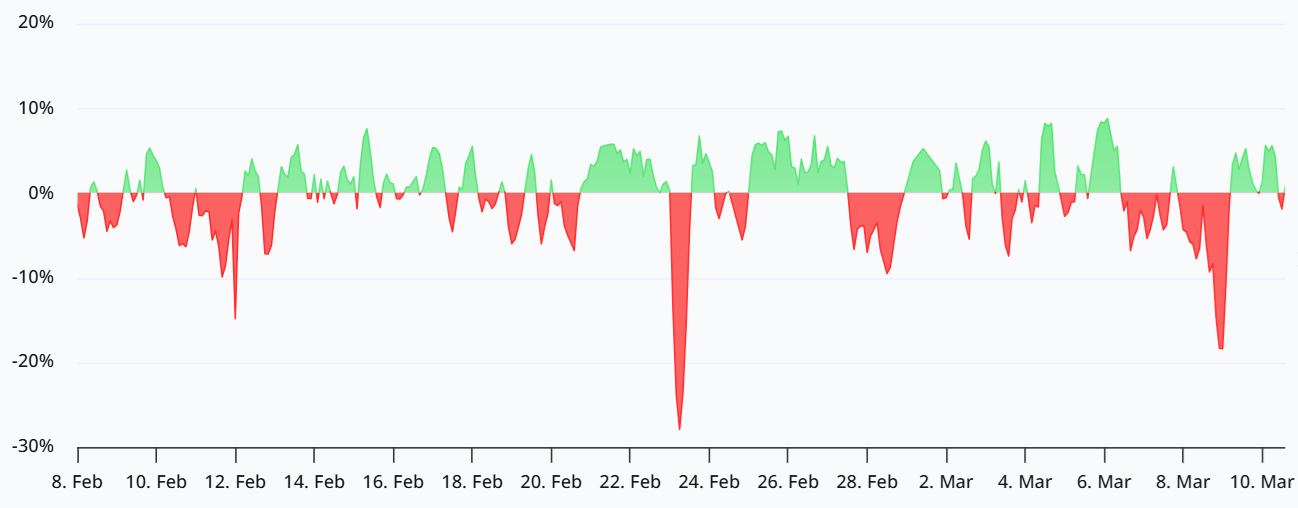
Ether (ETH) price has repeatedly failed to sustain levels above $2,100 over the past month, gradually eroding traders’ confidence in the altcoin. Even with a 7% rise between Monday and Tuesday, ETH derivatives metrics suggest a lack of interest in leveraged bullish positions, potentially signaling that bears remain in control.

ETH perpetual futures dipped into negative territory on Tuesday, signaling increased demand for short (bearish) positions. More importantly, this metric has remained below the neutral 6% to 12% range for the past month. Part of this investor disappointment stems from a 54% price decline over six months, even though cooling onchain activity has also played a significant role.
Weekly base layer fees on the Ethereum network averaged $2.3 million over the past month, down from an $8 million peak in early February. While 7-day transaction counts stabilized near 14 million, the current industry focus on layer-2 rollup scalability has so far failed to generate fresh demand for native Ether.

Contrary to perpetual futures markets, the ETH options risk gauge hovered near the neutral -6% to +6% range on Tuesday. Put (sell) options traded at a 7% premium relative to call (buy) instruments, suggesting confidence is slowly returning among Ether bulls. Furthermore, no competitor has yet challenged Ethereum’s $56 billion in total value locked (TVL).
Ether exchange-traded funds (ETFs) saw $225 million in net outflows between Thursday and Monday, reversing the $169 million in inflows seen on Wednesday. This metric serves as a proxy to institutional demand, which is currently held back by the 2.8% native staking reward rate. By comparison, stablecoin yields on Sky Lending (formerly MakerDAO) sat higher at 3.75%.
Weak spot ETH ETF demand and concerns with Ethereum’s roadmap
Excitement surrounding the ETF staking approval in the US, which occurred in late 2025, has not yet translated into sustainable demand. One could argue that the negative outcome was simply a result of bad luck, as the launch coincided with a broader crypto market downturn that began in early October after total market capitalization neared a $4 trillion all-time high.
Related: Was Ethereum ‘ultrasound money’ a mistake? ETH down 65% vs. BTC since pivot

ETH has underperformed the broader cryptocurrency market since October 2025, and there are no signs that a reversal is underway. Investor sentiment is also impaired by a staggering $735 million net loss from the Ethereum treasury firm Sharplink (SBET US) in 2025. The company, chaired by Ethereum co-founder Joseph Lubin, released these financial results on Monday.
The pace of native chain scalability might have contributed to Ether’s negative performance. For instance, Ethereum co-founder Vitalik Buterin said on Saturday that account abstraction, equivalent to smart accounts, will likely be shipped “within a year,” after more than a decade under development. Transactions will be able to reference each other’s data, enabling quantum-resistant wallets.
Another advantage of the upcoming Ethereum Hegota fork is paying gas fees in non-ETH tokens using special-purpose decentralized exchanges, while adding a “general-purpose public mempool” and removing “public broadcasters” in privacy platforms such as Railgun and Tornado Cash. Buterin also said that he expects “progressive decreases” of slot time and finality time in the long term.
Overall, ETH derivatives and onchain activity point to low conviction in a bullish breakout above $2,200, but at the same time, there is no indication of worsening conditions or domination from bears.
This article does not contain investment advice or recommendations. Every investment and trading move involves risk, and readers should conduct their own research when making a decision. While we strive to provide accurate and timely information, Cointelegraph does not guarantee the accuracy, completeness, or reliability of any information in this article. This article may contain forward-looking statements that are subject to risks and uncertainties. Cointelegraph will not be liable for any loss or damage arising from your reliance on this information.

From College Star to Super Bowl MVP and Chiefs Free Agent
Mantle TVL Crosses $1 Billion Fueled by Aave Deployment

Newcastle vs Barcelona LIVE Streaming, Champions League Round of 16 LIVE Telecast: When And Where To Watch


-
Business4 days ago
Form 8K Entergy Mississippi LLC For: 6 March
-

 Fashion4 days ago
Weekend Open Thread: Ann Taylor
-

 News Videos1 day ago
10th Algebra | Financial Planning | Question Bank Solution | Board Exam 2026
-

 Tech6 days ago
Bitwarden adds support for passkey login on Windows 11
-

 Crypto World1 day ago
Paradigm, a16z, Winklevoss Capital, Balaji Srinivasan among investors in ZODL
-
 Sports5 days ago
499 runs and 34 sixes later, India beat England to enter T20 World Cup final | Cricket News
-

 Sports3 days ago
Three share 2-shot lead entering final round in Hong Kong
-

 Sports3 days ago
Braveheart Lakshya downs Lai in epic battle to enter All England Open final | Other Sports News
-

 Politics5 days ago
Top Mamdani aide takes progressive project to the UK
-

 Business7 hours ago
ExxonMobil seeks to move corporate registration from New Jersey to Texas
-

 Business7 days ago
Guthrie Disappearance Enters Fifth Week as Family Visits Memorial
-

 NewsBeat5 days ago
Piccadilly Circus just unveiled ‘London’s newest tourist attraction’ and it only costs 80p to enter
-

 Entertainment4 days ago
Hailey Bieber Poses For Sexy Selfies In New Luscious Lip Thirst Traps
-

 Business2 days ago
Search for Nancy Guthrie Enters 37th Day as FBI Probes Wi-Fi Jammer Theory
-
 NewsBeat23 hours ago
Pagazzi Lighting enters administration as 70 jobs lost and 11 stores close across Scotland
-

 Tech1 day ago
Despite challenges, Ireland sixth in EU for board gender diversity
-

 Crypto World6 days ago
New Crypto Mutuum Finance (MUTM) Reports V1 Protocol Progress as Roadmap Enters Phase 3
-
Entertainment6 days ago
Harry Styles Has ‘Struggled’ to Discuss Liam Payne’s Death
-

 Tech6 days ago
ACIP To Discuss COVID ‘Vaccine Injuries’ Next Month, Despite That Not Being In Its Purview
-

 Business1 day ago
Search Enters 39th Day with FBI Tip Line Developments and No Major Breakthroughs