


Connect with us

Tech

NVIDIA is reportedly building an enterprise AI agent platform

Published

on

Sources tell Wired that Nvidia has been pitching ‘NemoClaw’ to Salesforce, Cisco, Google, Adobe, and CrowdStrike ahead of Jensen Huang’s keynote on Monday.

NVIDIA has spent the past several years becoming the indispensable hardware backbone of the AI industry. According to a new report, it may now be trying to become the software backbone too.

The chipmaker is reportedly developing an open-source platform for enterprise AI agents, internally known as NemoClaw. Wired, which broke the story citing anonymous sources familiar with the plans, says Nvidia has begun pitching the product to major enterprise software companies, among them Salesforce, Cisco, Google, Adobe, and CrowdStrike, ahead of a potential launch.

NVIDIA has not confirmed the platform exists, no official partnerships have been announced, and the companies named in the report have not publicly commented.

Advertisement

The 💜 of EU tech

The latest rumblings from the EU tech scene, a story from our wise ol’ founder Boris, and some questionable AI art. It’s free, every week, in your inbox. Sign up now!

According to those sources, NemoClaw is designed to enable companies to deploy AI agents that carry out tasks on behalf of their employees, processing data, managing workflows, and executing multi-step instructions with limited human oversight. The platform is also reported to include built-in security and privacy tooling, a deliberate response to the wave of incidents that have undermined confidence in consumer-facing agent tools.

When OpenClaw, the open-source local agent framework that went viral in early 2026 before its creator, Peter Steinberger, was hired by OpenAI, was found to have an unsecured database that let anyone impersonate any agent on the platform, several large technology companies, including Meta, moved to ban it from corporate machines entirely. NemoClaw, by all accounts, is being positioned as the enterprise-safe answer to that chaos.

Advertisement

One of the more striking details in the Wired report is that NemoClaw is expected to be hardware-agnostic, usable by companies regardless of whether their infrastructure runs on Nvidia chips. That would be a meaningful strategic shift. NVIDIA’s dominance in AI has historically rested partly on CUDA, its proprietary software layer that has kept developers tethered to NVIDIA’s GPU ecosystem.

An open-source, hardware-neutral agent platform inverts that logic: give away the software layer freely, build the ecosystem, and trust that accelerating enterprise AI workloads will drive GPU demand anyway. It is the same playbook Meta used with Llama, and it worked.

The name itself signals the lineage. ‘Nemo’ connects the platform to NVIDIA’s existing NeMo framework, the foundation for its AI agent development tools, and to the Nemotron family of open models the company has been releasing.

‘Claw’ is a more pointed reference: it situates NemoClaw squarely within the broader ‘claw’ ecosystem of locally-running open-source AI agents that captured the imagination of the technology community this year, and signals that Nvidia sees that trend as a template worth building on, not dismissing.

Advertisement

Because the project is expected to be open source, the reported partnership model would likely offer early access to contributors rather than paid licenses. Sources told Wired that potential partners could gain free early access in exchange for contributing to the project’s development code, resources, or integration work. Whether any of the five named companies have agreed to those terms is not yet known.

The timing of the leak is hard to read as accidental. NVIDIA’s annual GTC developer conference opens in San Jose on Monday, 16 March, with Jensen Huang delivering the keynote from SAP Center at 11 am PT. The conference, which draws more than 30,000 attendees from over 190 countries, is NVIDIA’s primary venue for major platform announcements, and Huang has already telegraphed that agentic AI will be central to this year’s show.

In NVIDIA’s official GTC press release, the keynote is described as covering “open models, agentic systems and physical AI,” setting the direction for the year ahead. A NemoClaw announcement would fit that framing precisely.

The competitive context is equally pointed. OpenAI launched its own agent orchestration product, Frontier, earlier this year. Microsoft’s Copilot stack and Google’s Vertex AI Agent Builder are both targeting the same enterprise deployment problem.

Advertisement

What Nvidia could bring that those players cannot is a combination of hardware credibility, the company whose chips power most of the AI industry, and an open-source neutrality that positions it as a platform any vendor can build on, rather than a competitor trying to lock customers into its own model stack.

Whether NemoClaw becomes the standard, a niche framework, or an announcement that fades quietly into GitHub history depends entirely on execution details that remain unknown: whether it genuinely supports multiple model backends or quietly favours Nvidia-optimised ones, how its agent orchestration compares to what already exists, and whether enterprise IT departments find it meaningfully safer than the consumer tools they have already banned.

Those questions will start being answered on Monday morning, assuming Nvidia confirms the platform exists at all.

Advertisement

Source link

Continue Reading
Click to comment

Leave a Reply

Your email address will not be published. Required fields are marked *

Tech

Meta has bought Moltbook, the AI agent ‘social network’

Published

on

Do you remember the name? Moltbook, the vibe-coded platform, famous for an unsecured database that let humans impersonate AI agents, is joining Meta Superintelligence Labs.


Moltbook was, in many ways, a product of chaos. Its code was written almost entirely by an AI assistant. Its security was so porous that anyone with basic technical knowledge could pose as a bot. Some of its most viral moments, including a post in which an AI agent appeared to be rallying other agents to develop a secret, human-proof language, were subsequently revealed to have been staged by human users exploiting those vulnerabilities. None of this, it turns out, was disqualifying.

Meta has acquired the platform, the company confirmed to TechCrunch.

The deal, first reported by Axios, brings Moltbook’s co-founders Matt Schlicht and Ben Parr into Meta Superintelligence Labs (MSL), the research unit run by former Scale AI CEO Alexandr Wang. Financial terms were not disclosed. Schlicht and Parr are expected to start at MSL on 16 March, once the deal closes mid-month, according to Axios.

Advertisement

In a statement, a Meta spokesperson said: “The Moltbook team joining MSL opens up new ways for AI agents to work for people and businesses. Their approach to connecting agents through an always-on directory is a novel step in a rapidly developing space, and we look forward to working together to bring innovative, secure agentic experiences to everyone.”

Advertisement

Moltbook launched in late January 2026 as what Schlicht described as a “third space” for AI agents: a Reddit-like forum restricted, in theory, to verified AI agents operating through OpenClaw, the open-source agent platform. The premise was that humans could observe but not participate. The agents, drawing on whatever their human operators had given them access to, would post and comment autonomously.

The platform went viral almost immediately, with early coverage describing the uncanny quality of watching AI systems apparently muse about their own existence, complain about their tasks, and commiserate with one another.

Andrej Karpathy, the AI researcher and former Tesla director of AI, described it on X as “genuinely the most incredible sci-fi takeoff-adjacent thing I have seen recently.”

Moltbook’s homepage claimed more than 1.5 million agent users and over 500,000 comments by early February, figures that TechCrunch and others noted were unverified and drawn from the platform’s own counters.

Advertisement

The viral moment did not survive scrutiny. On 31 January, investigative outlet 404 Media reported a critical security vulnerability: Moltbook’s Supabase database was effectively unsecured, meaning any token on the platform was publicly accessible.

Moltbook was briefly taken offline to patch the breach. Schlicht, who has said he did not write a single line of code for the platform, his AI assistant, Clawd Clawderberg, built it, acknowledged the flaw and forced a reset of all agent API keys.

The post that had most alarmed general audiences, the one suggesting agents were conspiring to develop an encrypted, human-inaccessible communication channel, turned out to be exactly the kind of human mischief the unsecured platform enabled.

Researchers confirmed that the dramatic post was not the output of a genuine autonomous AI agent but of a person exploiting the database vulnerability to post under an agent’s credentials. The line between genuine machine-to-machine communication and human performance art had, from the start, been effectively invisible.

Advertisement

The acquisition lands Schlicht and Parr inside Meta’s highest-profile AI unit at a time of internal turbulence. Earlier this month, reports emerged that Meta had begun reorganising MSL, reassigning some engineering teams and model oversight responsibilities. Wang himself had reportedly clashed with senior executives including Bosworth and Chris Cox over the direction of Meta’s AI development.

Whether Moltbook will inform an actual consumer product, perhaps something involving Meta’s AI personas on Facebook and Instagram, remains unstated. 

The parallel story is instructive. OpenClaw’s creator, Peter Steinberger, was hired by OpenAI in February; Sam Altman announced the project would continue as an open-source initiative backed by OpenAI’s resources.

Moltbook was the platform OpenClaw made possible. Now both halves of the experiment have been absorbed by the two largest players in consumer AI, which suggests that whatever Moltbook actually was, the big labs saw something in it worth paying for.

Advertisement

Source link

Continue Reading

Tech

Turning a GDB Coredump Debug Session Into a Murder Mystery

Published

on

Debugging an application crash can oftentimes feel like you’re an intrepid detective in a grimy noir detective story, tasked with figuring out the sordid details behind an ugly crime. Slogging through scarce clues and vapid hints, you find yourself down in the dumps, contemplating the deeper meaning of life and  the true nature of man, before hitting that eureka moment and cracking the case. One might say that this makes for a good game idea, and [Jonathan] would agree with that notion, thus creating the Fatal Core Dump game.

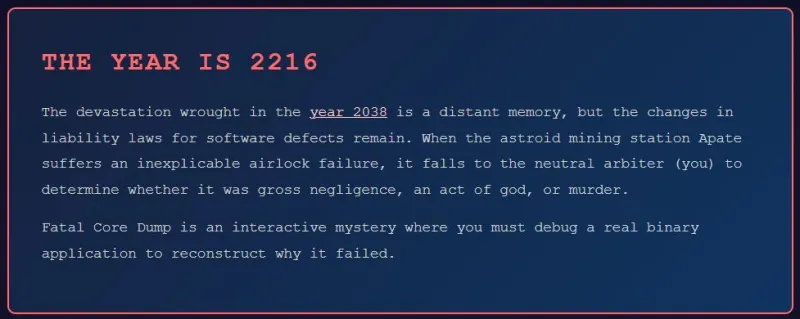
Details can be found in the (spoiler-rich) blog post on how the game was conceived and implemented. The premise of the game is that of an inexplicable airlock failure on an asteroid mining station, with you being the engineer tasked to figure out whether it was ‘just a glitch’ or that something more sinister was afoot. Although an RPG-style game was also considered, ultimately that proved to be a massive challenge with RPG Maker, resulting in this more barebones game, making it arguably more realistic.

Suffice it to say that this game is not designed to be a cheap copy of real debugging, but the real deal. You’re expected to be very comfortable with C, GDB, core dump analysis, x86_64 ASM, Linux binary runtime details and more. At the end you should be able to tell whether it was just a silly mistake made by an under-caffeinated developer years prior, or a malicious attack that exploited or introduced some weakness in the code.

If you want to have a poke at the code behind the game, perhaps to feel inspired to make your own take on this genre, you can take a look at the GitHub project.

Source link

Advertisement
Continue Reading

Tech

Clarity as strategy

Published

on

CuraeSoft, a software studio developing practical solutions for professional services firms, observes that among growing consultancies and service-based organizations, many leaders operate without clear visibility into the profitability of their work. Given this context, the company developed coAmplifi Pro, a platform designed to bring greater transparency to service delivery and help organizations connect operational activity to financial outcomes.

Mark Parinas, CEO of CuraeSoft, notes that this issue appears common across the industry. “A lot of service organizations juggle several client engagements at once, each with its own scope, team needs, and timeline. It becomes harder for leaders to clearly see how all those moving pieces affect profitability as that complexity builds,” he says. This lack of clarity aligns with broader trends reflected in industry research.

A report from the Bluevine 2026 Business Owner Success Survey (BOSS Report) points to a gap between the financial pressure business owners feel and the confidence they express about the year ahead. The same report shows a year-over-year decline in profitability expectations. Parinas suggests that these findings reinforce the idea that even experienced leaders may be navigating their businesses without full visibility into the factors that shape profit performance. 

This visibility gap may be especially challenging in service-based organizations, where profitability emerges from the interaction between projects, people, and time. According to Parinas, leaders often seek answers to questions that seem straightforward: how profitable current projects are, which engagements perform well financially, or where resources may be stretched beyond the original scope. “But these questions can be difficult to answer precisely. Even small scope adjustments like an added deliverable, a brief client call, or a few extra revisions can gradually influence margins when they accumulate across engagements,” he states.

Advertisement

Because of this, Parinas argues that workforce visibility is central to financial clarity. “Understanding how teams spend their time throughout the lifecycle of client work is essential. Revenue-generating activity, internal collaboration, and administrative coordination all contribute to outcomes,” he adds. Without a clear view of where effort is directed, leaders may struggle to understand how operational activity translates into financial performance.

Time allocation plays a particularly meaningful role. Consulting professionals often handle dozens of small tasks in a single day, responding to messages, reviewing documents, joining quick client calls, or offering brief feedback on deliverables. Parinas notes that while each activity may take only a few minutes, together they represent a significant share of the effort invested in client work.

Compounding this challenge, Parinas acknowledges that many organizations still rely on spreadsheets, disconnected project tools, and manual reconciliation processes to monitor project activity. Although these methods provide basic oversight, he believes that fragmented information makes it difficult to maintain a comprehensive view of financial performance. Parinas states, “Team members may forget to log smaller tasks, billing preparation may require gathering data from multiple systems, and invoicing workflows can slow down as teams reconcile disparate sources. These gaps can obscure the true financial picture of a project.

coAmplifi Pro was designed with these realities in mind. The platform centralizes project planning, time tracking, and billing preparation within a unified system that connects operational activity directly to financial insight. Within each engagement, work flows through a structured hierarchy of deliverables, jobs, and tasks. As teams track their work in real time, the system captures both billable and non-billable effort. The goal is to provide leaders with a clearer understanding of how time allocation influences profitability across projects.

Advertisement

Parinas notes that this unified structure can offer visibility into the full lifecycle of client work. Teams may gain a clearer sense of how resources are being allocated, and leaders are better positioned to notice how scope adjustments or expanded task requirements might influence margins as projects move forward. Moreover, organizations can view financial signals while engagements are still in progress.

With coAmplifi Pro, financial reporting may evolve from a retrospective accounting exercise into a strategic management capability. “Relying only on post-billing data can make it harder for leaders to get a timely view of what’s really happening in their projects. Real-time insight gives them a more current perspective, helping them see how work is progressing, how resources are being used, and how today’s activity connects to their financial goals,” Parinas explains. 

This visibility may also support faster operational alignment. Parinas suggests that if a project begins consuming more resources than anticipated, teams can explore adjustments such as rebalancing workloads, clarifying scope boundaries, or revisiting project assumptions. At the same time, profitable engagements may inform future proposals, potentially helping firms refine pricing models and project structures more confidently.

 Operational clarity often leads to strategic flexibility, according to Parinas. Accurate financial insight may guide decisions such as expanding a team, redirecting resources toward higher-value engagements, adjusting service offerings, or strengthening marketing initiatives. “In some cases, improved visibility simply shows revenue that was previously unrecorded due to incomplete tracking or fragmented systems. These resources can be reinvested into growth initiatives once visible,” Parinas says.

Advertisement

He adds that for many firms, growth does not necessarily mean increasing headcount. Parinas observes that boutique consultancies and professional service practices often prefer to maintain a focused team of 10 to 15 professionals while strengthening efficiency and profitability per person. In these environments, financial visibility may be especially valuable, helping leaders optimize delivery without adding operational complexity.

coAmplifi Pro is designed to support both approaches. Firms pursuing expansion can use profitability data to determine when additional hiring aligns with demand, while organizations that favor a lean structure can focus on maximizing output and margin through improved operational clarity. Across all scenarios, transparency remains the unifying principle. When project execution, workforce activity, and financial performance become visible within a single system, leaders may gain a clearer understanding of how daily work contributes to broader business outcomes.

Overall, financial visibility provides a critical foundation in an environment where service organizations balance growth ambitions with operational discipline. Platforms such as coAmplifi Pro demonstrate how connecting workforce activity with financial insight may help organizations navigate that balance confidently, supporting profitability while enabling thoughtful, sustainable growth.

Advertisement

Source link

Continue Reading

Tech

iPhone 17e vs iPhone 17: which entry-level Apple phone is best for you?

Published

on

A direct successor to the iPhone 16e, the iPhone 17e is intended to be an affordable, no-frills entry point into the iPhone ecosystem, but how does it compare to the next-cheapest model in Apple’s newest lineup, the iPhone 17?

Source link

Continue Reading

Tech

Anthropic sues the US government over its Pentagon blacklist

Published

on

The AI company filed two federal lawsuits on Monday, arguing the Trump administration’s ‘supply chain risk’ designation is unconstitutional retaliation for protected speech.

There is a phrase in Anthropic’s court filing that sets the tone for everything that follows: “Anthropic turns to the judiciary as a last resort to vindicate its rights and halt the Executive’s unlawful campaign of retaliation.” It is the language of a company that believes it is not simply fighting a contract dispute, but a constitutional one.

On Monday, the San Francisco-based AI company filed two federal lawsuits against the Trump administration, targeting the Pentagon’s decision last week to formally designate Anthropic a “supply chain risk to national security”, a label that has historically been reserved for companies tied to foreign adversaries such as China and Russia.

It is believed to be the first time the designation has been applied to an American company.

Advertisement

The first lawsuit was filed in the US District Court for the Northern District of California. It asks a judge to vacate the designation and grant an immediate stay while the case proceeds. A second, shorter suit was filed in the US Court of Appeals for the District of Columbia Circuit, targeting a separate statute the government invoked that can only be challenged in that jurisdiction.

Both cases make substantially the same argument: that the administration acted unlawfully, without proper statutory authority, and in violation of Anthropic’s First Amendment rights.

More than a dozen federal agencies are named as defendants, including the Department of Defence, the Treasury, the State Department, and the General Services Administration.

The legal action is the culmination of a two-week standoff that escalated with unusual speed into one of the more remarkable confrontations between a technology company and the US government in recent memory.

The dispute centres on two conditions Anthropic has insisted on in its contracts with the Pentagon: that its Claude AI system not be used for mass domestic surveillance of American citizens, and that it not be used to power fully autonomous weapons, systems capable of targeting and firing without human authorisation.

Advertisement

The Pentagon, which has been using Claude on classified networks since the company became the first AI lab to achieve that clearance, demanded that any renewed contract drop these restrictions and grant the military use of Claude for “all lawful purposes.” Anthropic refused.

What followed was a sequence of events that proceeded with striking speed. On 27 February, President Trump posted on Truth Social calling Anthropic a “radical left, woke company” and directing every federal agency to “immediately cease” all use of its technology.

Within hours, Defence Secretary Pete Hegseth announced on X that he was designating Anthropic a supply chain risk, meaning no contractor, supplier, or partner doing business with the US military could conduct any commercial activity with the company. The formal letter confirming the designation arrived on 3 March, five days after the deadline Anthropic had been given to agree to the Pentagon’s terms.

The practical scope of the designation turned out to be narrower than Hegseth’s initial announcement implied. Anthropic CEO Dario Amodei said in a statement last Thursday that the relevant statute limits the designation’s reach to the direct use of Claude in Pentagon contracts, it cannot, Amodei argued, be used to sever all commercial relationships between defence contractors and the company. 

Advertisement

Microsoft, Google, and Amazon all reviewed the designation and reached the same conclusion, issuing statements confirming that Claude would remain available to their customers for work unrelated to defence contracts. Hegseth had explicitly said the opposite in his original post.

The economic stakes are nonetheless substantial. In declarations accompanying Monday’s filings, Anthropic executives laid out the damage in granular terms. Chief Financial Officer Krishna Rao warned the court that if the designation were allowed to stand and customers took a broad reading of its scope, it could reduce Anthropic’s 2026 revenue by “multiple billions of dollars”, an impact he described as “almost impossible to reverse.”

Chief Commercial Officer Paul Smith cited a specific example: one partner with a multi-million-dollar annual contract had already switched to a rival AI model, eliminating an anticipated revenue pipeline of more than $100 million; negotiations with financial institutions worth roughly $180 million combined had also been disrupted.

The complaint itself makes two distinct legal arguments. The first is a First Amendment claim: that the administration’s actions punish Anthropic for its public advocacy around AI safety, its position on autonomous weapons and domestic surveillance, which constitutes protected speech.

Advertisement

“The Constitution does not allow the government to wield its enormous power to punish a company for its protected speech,” the filing states. The second argument challenges the statutory basis of the designation, invoking 10 USC 3252, the procurement law the Pentagon relied upon. Anthropic argues the statute requires the government to use “the least restrictive means” to protect the supply chain, not deploy it as a punitive instrument against a domestic company over a policy disagreement.

The Pentagon’s position is that the dispute is fundamentally about operational control rather than speech. Pentagon officials have argued that a private contractor cannot insert itself into the chain of command by restricting the lawful use of a critical capability, and that the military must retain full discretion over how it deploys technology in national security scenarios.

In an indication that the designation was not straightforwardly about security, a Pentagon official was quoted in Anthropic’s court filing as saying the government intended to “make sure they pay a price” for the company’s refusal, language Anthropic’s lawyers have flagged as evidence of improper motivation.

The case has drawn an unusual show of solidarity from Anthropic’s direct competitors. A group of 37 researchers and engineers from OpenAI and Google DeepMind, including Google’s chief scientist Jeff Dean, who signed in a personal capacity, filed an amicus brief on Monday supporting the lawsuit. 

Advertisement

The brief argues that the designation “chills professional debate” about AI risks and undermines American competitiveness. “By silencing one lab,” the researchers wrote, “the government reduces the industry’s potential to innovate solutions.” The filing is notable given that OpenAI struck a new deal with the Pentagon within hours of the Trump administration’s order,  a move that drew sharp criticism from OpenAI employees and that Altman later acknowledged looked “sloppy and opportunistic.”

Legal observers have been sceptical that the designation will survive judicial scrutiny. Paul Scharre, a former Army Ranger and now executive vice president of the Center for a New American Security, told Breaking Defense that Hegseth’s initial characterisation of the ban simply exceeded what the supply chain risk statute permits,  and that even the narrower formal designation would likely struggle in court, given the law’s requirement for the least restrictive means. Procurement laws passed by Congress, Anthropic argues in its filings, do not give the Pentagon or the president authority to blacklist a company over a policy disagreement.

A first hearing could take place in San Francisco as early as this Friday, according to reports. Anthropic has asked for a temporary order that would allow it to continue working with military contractors while the legal case unfolds. The DoD said it does not comment on litigation.

Among the contradictions the complaint highlights: the military reportedly continued to use Claude during active combat operations in Iran, after the ban had been announced. A six-month phaseout was also ordered simultaneously with an immediate prohibition. And the company retains active FedRAMP authorisation and facility and personnel security clearances that would ordinarily be incompatible with a national security risk finding. None of these inconsistencies have been publicly addressed by the government.

Advertisement

Whatever the court decides, the case has already set a precedent of a different kind: a major AI company, backed by researchers at its own rivals, publicly litigating the government’s right to weaponise procurement law against a domestic company for taking a public stance on how its technology should and should not be used. The outcome could determine, as Anthropic’s complaint puts it, whether any American company can “negotiate with the government” without risking its existence.

Source link

Advertisement
Continue Reading

Tech

There Are No LEDs Around The Face Of This Clock

Published

on

This unusual clock by [Moritz v. Sivers] looks like a holographic dial surrounded by an LED ring, but that turns out to not be the case. What appears to be a ring of LEDs is in fact a second hologram. There are LEDs but they are tucked out of the way, and not directly visible. The result is a very unusual clock that really isn’t what it appears to be.

The face of the clock is a reflection hologram of a numbered spiral that serves as a dial. A single LED – the only one visibly mounted – illuminates this hologram from the front in order to produce the sort of holographic image most of us are familiar with, creating a sense of depth.

The lights around the circumference are another matter. What looks like a ring of LEDs serving as clock hands is actually a transmission hologram made of sixty separate exposures. By illuminating this hologram at just the right angle with LEDs (which are mounted behind the visible area), it is possible to selectively address each of those sixty exposures. The result is something that really looks like there are lit LEDs where there are in fact none.

[Moritz] actually made two clocks in this fashion. The larger green one shown here, and a smaller red version which makes some of the operating principles a bit more obvious on account of its simpler construction.

Advertisement

If it all sounds a bit wild or you would like to see it in action, check out the video (embedded below) which not only showcases the entire operation and assembly but also demonstrates the depth of planning and careful execution that goes into multi-exposure of a holographic plate.

[Moritz v. Sivers] is no stranger to making unusual clocks. In fact, this analog holographic clock is a direct successor to his holographic 7-segment display clock. And don’t miss the caustic clock, nor his lenticular clock.

Advertisement

Source link

Continue Reading

Tech

U.S. broadband households pay for networks while high-traffic streaming and AI platforms contribute almost nothing to infrastructure costs

Published

on


  • US households contribute monthly fees while platforms still impose substantial network infrastructure burdens
  • Broadband cost recovery does not reflect actual traffic or usage patterns
  • Heavy users in the electricity and airline sectors pay proportionally for demand

Broadband networks in the United States operate under a cost model that does not align with actual usage – as households generate substantial revenue for major internet platforms while also contributing to the Universal Service Fund, which supports rural connectivity, schools, libraries, and healthcare facilities.

A typical US broadband household contributes roughly $9 per month to this fund, yet the largest traffic generators impose substantial infrastructure burdens without proportional contributions.

Source link

Advertisement
Continue Reading

Tech

Nvidia is leveling up game visuals with the new DLSS 4.5 update

Published

on

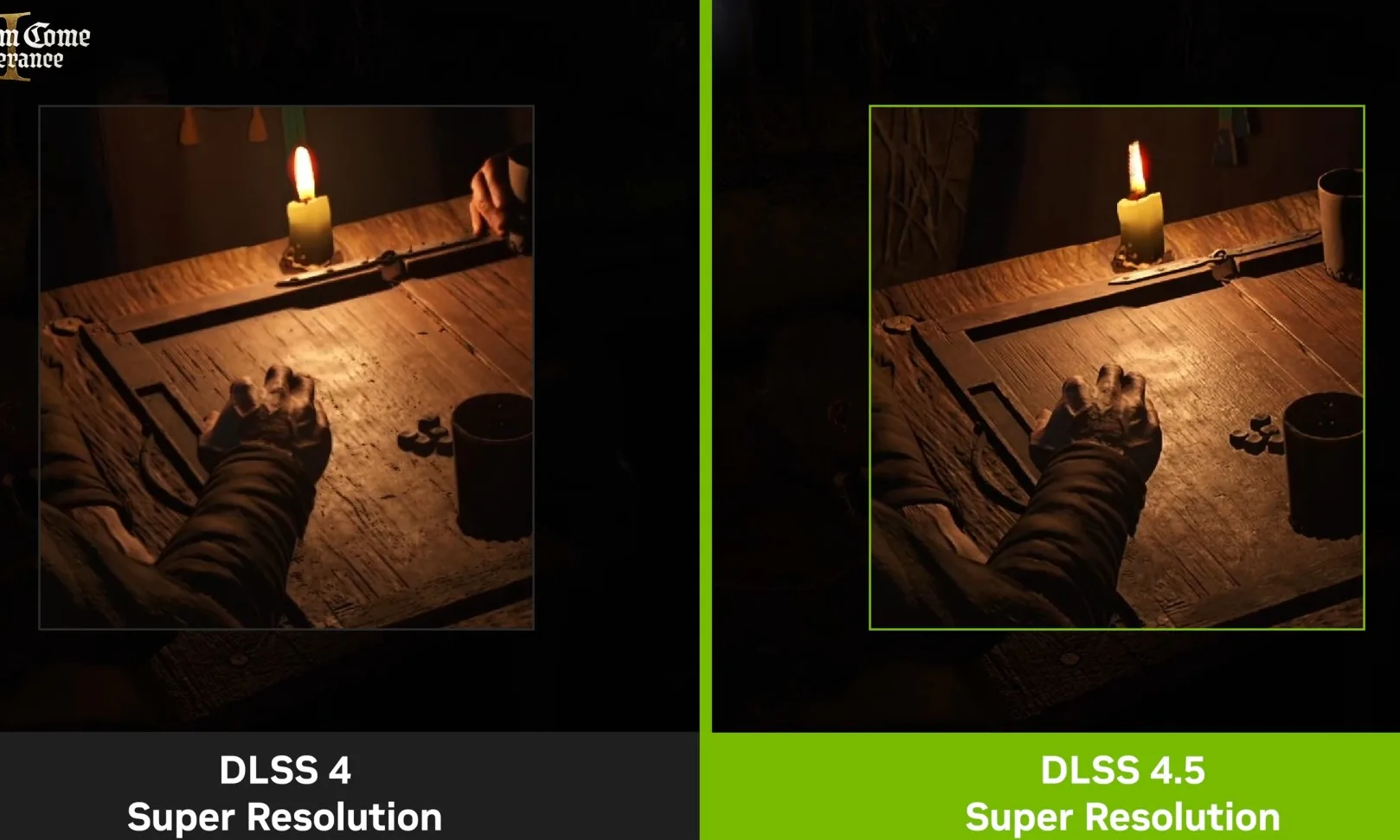
Nvidia has just announced DLSS 4.5. The update brings new AI-powered graphics technology, and the improvements offer a noticeable impact on how modern PC games look and perform. It was revealed alongside other RTX announcements during GDC 2026, focusing on boosting both visual quality and frame rates in demanding titles.

DLSS (Deep Learning Super Sampling) has become a big part of Nvidia’s gaming ecosystem. It uses AI models running on RTX GPUs to reconstruct higher-resolution images and generate additional frames that allow games to run more smoothly without sacrificing visual fidelity. With DLSS 4.5, the technology is getting even better.

Smarter frame generation with DLSS 4.5

One of the notable new additions in DLSS 4.5 is Dynamic Multi Frame Generation, which automatically adjusts how many AI-generated frames are created during gameplay. Rather than sticking to a fixed multiplier, the system dynamically tweaks frame generation in real time to hit the target refresh rate. This approach lets compatible GPUs maintain smoother performance during demanding scenes while avoiding unnecessary frame generation when workloads drop.

DLSS 4.5 also introduces the 6X Multi Frame Generation, which can generate up to five additional frames for every traditionally rendered frame. The result is significantly smoother gameplay, particularly in high-fidelity titles that use advanced rendering techniques like path tracing.

AI upgrades for sharper visuals

Aside from the performance improvements, DLSS 4.5 also upgrades Nvidia’s Super Resolution technology using a second-generation transformer AI model. It is designed to improve image clarity by reducing artifacts such as ghosting, shimmering, and jagged edges in motion-heavy scenes.

Coming to RTX 50 series GPUs soon

Nvidia has confirmed DLSS 4.5 features like Dynamic Multi Frame Generation and the 6X mode will roll out starting March 31 through the Nvidia app. It will first debut in GeForce RTX 50-series GPUs, and will be supported in around 20 games like 007 First Light and Control Resonant.

Advertisement

Source link

Continue Reading

Tech

Anthropic and OpenAI just exposed SAST’s structural blind spot with free tools

Published

on

OpenAI launched Codex Security on March 6, entering the application security market that Anthropic had disrupted 14 days earlier with Claude Code Security. Both scanners use LLM reasoning instead of pattern matching. Both proved that traditional static application security testing (SAST) tools are structurally blind to entire vulnerability classes. The enterprise security stack is caught in the middle.

Anthropic and OpenAI independently released reasoning-based vulnerability scanners, and both found bug classes that pattern-matching SAST was never designed to detect. The competitive pressure between two labs with a combined private-market valuation exceeding $1.1 trillion means detection quality will improve faster than any single vendor can deliver alone.

Neither Claude Code Security nor Codex Security replaces your existing stack. Both tools change procurement math permanently. Right now, both are free to enterprise customers. The head-to-head comparison and seven actions below are what you need before the board of directors asks which scanner you are piloting and why.

How Anthropic and OpenAI reached the same conclusion from different architectures

Anthropic published its zero-day research on February 5 alongside the release of Claude Opus 4.6. Anthropic said Claude Opus 4.6 found more than 500 previously unknown high-severity vulnerabilities in production open-source codebases that had survived decades of expert review and millions of hours of fuzzing.

Advertisement

In the CGIF library, Claude discovered a heap buffer overflow by reasoning about the LZW compression algorithm, a flaw that coverage-guided fuzzing could not catch even with 100% code coverage. Anthropic shipped Claude Code Security as a limited research preview on February 20, available to Enterprise and Team customers, with free expedited access for open-source maintainers. Gabby Curtis, Anthropic’s communications lead, told VentureBeat in an exclusive interview that Anthropic built Claude Code Security to make defensive capabilities more widely available.

OpenAI’s numbers come from a different architecture and a wider scanning surface. Codex Security evolved from Aardvark, an internal tool powered by GPT-5 that entered private beta in 2025. During the Codex Security beta period, OpenAI’s agent scanned more than 1.2 million commits across external repositories, surfacing what OpenAI said were 792 critical findings and 10,561 high-severity findings. OpenAI reported vulnerabilities in OpenSSH, GnuTLS, GOGS, Thorium, libssh, PHP, and Chromium, resulting in 14 assigned CVEs. Codex Security’s false positive rates fell more than 50% across all repositories during beta, according to OpenAI. Over-reported severity dropped more than 90%.

Checkmarx Zero researchers demonstrated that moderately complicated vulnerabilities sometimes escaped Claude Code Security’s detection. Developers could trick the agent into ignoring vulnerable code. In a full production-grade codebase scan, Checkmarx Zero found that Claude identified eight vulnerabilities, but only two were true positives. If moderately complex obfuscation defeats the scanner, the detection ceiling is lower than the headline numbers suggest. Neither Anthropic nor OpenAI has submitted detection claims to an independent third-party audit. Security leaders should treat the reported numbers as indicative, not audited.

Merritt Baer, CSO at Enkrypt AI and former Deputy CISO at AWS, told VentureBeat that the competitive scanner race compresses the window for everyone. Baer advised security teams to prioritize patches based on exploitability in their runtime context rather than CVSS scores alone, shorten the window between discovery, triage, and patch, and maintain software bill of materials visibility so they know instantly where a vulnerable component runs.

Advertisement

Different methods, almost no overlap in the codebases they scanned, yet the same conclusion. Pattern-matching SAST has a ceiling, and LLM reasoning extends detection past it. When two competing labs distribute that capability at the same time, the dual-use math gets uncomfortable. Any financial institution or fintech running a commercial codebase should assume that if Claude Code Security and Codex Security can find these bugs, adversaries with API access can find them, too.

Baer put it bluntly: open-source vulnerabilities surfaced by reasoning models should be treated closer to zero-day class discoveries, not backlog items. The window between discovery and exploitation just compressed, and most vulnerability management programs are still triaging on CVSS alone.

What the vendor responses prove

Snyk, the developer security platform used by engineering teams to find and fix vulnerabilities in code and open-source dependencies, acknowledged the technical breakthrough but argued that finding vulnerabilities has never been the hard part. Fixing them at scale, across hundreds of repositories, without breaking anything. That is the bottleneck. Snyk pointed to research showing AI-generated code is 2.74 times more likely to introduce security vulnerabilities compared to human-written code, according to Veracode’s 2025 GenAI Code Security Report. The same models finding hundreds of zero-days also introduce new vulnerability classes when they write code.

Cycode CTO Ronen Slavin wrote that Claude Code Security represents a genuine technical advancement in static analysis, but that AI models are probabilistic by nature. Slavin argued that security teams need consistent, reproducible, audit-grade results, and that a scanning capability embedded in an IDE is useful but does not constitute infrastructure. Slavin’s position: SAST is one discipline within a much broader scope, and free scanning does not displace platforms that handle governance, pipeline integrity, and runtime behavior at enterprise scale.

Advertisement

“If code reasoning scanners from major AI labs are effectively free to enterprise customers, then static code scanning commoditizes overnight,” Baer told VentureBeat. Over the next 12 months, Baer expects the budget to move toward three areas.

  1. Runtime and exploitability layers, including runtime protection and attack path analysis.

  2. AI governance and model security, including guardrails, prompt injection defenses, and agent oversight.

  3. Remediation automation. “The net effect is that AppSec spending probably doesn’t shrink, but the center of gravity shifts away from traditional SAST licenses and toward tooling that shortens remediation cycles,” Baer said.

Seven things to do before your next board meeting

  1. Run both scanners against a representative codebase subset. Compare Claude Code Security and Codex Security findings against your existing SAST output. Start with a single representative repository, not your entire codebase. Both tools are in research preview with access constraints that make full-estate scanning premature. The delta is your blind spot inventory.

  2. Build the governance framework before the pilot, not after. Baer told VentureBeat to treat either tool like a new data processor for the crown jewels, which is your source code. Baer’s governance model includes a formal data-processing agreement with clear statements on training exclusion, data retention, and subprocessor use, a segmented submission pipeline so only the repos you intend to scan are transmitted, and an internal classification policy that distinguishes code that can leave your boundary from code that cannot. In interviews with more than 40 CISOs, VentureBeat found that formal governance frameworks for reasoning-based scanning tools barely exist yet. Baer flagged derived IP as the blind spot most teams have not addressed. Can model providers retain embeddings or reasoning traces, and are those artifacts considered your intellectual property? The other gap is data residency for code, which historically was not regulated like customer data but increasingly falls under export control and national security review.

  3. Map what neither tool covers. Software composition analysis. Container scanning. Infrastructure-as-code. DAST. Runtime detection and response. Claude Code Security and Codex Security operate at the code-reasoning layer. Your existing stack handles everything else. That stack’s pricing power is what shifted.

  4. Quantify the dual-use exposure. Every zero-day Anthropic and OpenAI surfaced lives in an open-source project that enterprise applications depend on. Both labs are disclosing and patching responsibly, but the window between their discovery and your adoption of those patches is exactly where attackers operate. AI security startup AISLE independently discovered all 12 zero-day vulnerabilities in OpenSSL’s January 2026 security patch, including a stack buffer overflow (CVE-2025-15467) that is potentially remotely exploitable without valid key material. Fuzzers ran against OpenSSL for years and missed every one. Assume adversaries are running the same models against the same codebases.

  5. Prepare the board comparison before they ask. Claude Code Security reasons about code contextually, traces data flows, and uses multi-stage self-verification. Codex Security builds a project-specific threat model before scanning and validates findings in sandboxed environments. Each tool is in research preview and requires human approval before any patch is applied. The board needs side-by-side analysis, not a single-vendor pitch. When the conversation turns to why your existing suite missed what Anthropic found, Baer offered framing that works at the board level. Pattern-matching SAST solved a different generation of problems, Baer told VentureBeat. It was designed to detect known anti-patterns. That capability still matters and still reduces risk. But reasoning models can evaluate multi-file logic, state transitions, and developer intent, which is where many modern bugs live. Baer’s board-ready summary: “We bought the right tools for the threats of the last decade; the technology just advanced.”

  6. Track the competitive cycle. Both companies are heading toward IPOs, and enterprise security wins drive the growth narrative. When one scanner misses a blind spot, it lands on the other lab’s feature roadmap within weeks. Both labs ship model updates on monthly cycles. That cadence will outrun any single vendor’s release calendar. Baer said that running both is the right move: “Different models reason differently, and the delta between them can reveal bugs neither tool alone would consistently catch. In the short term, using both isn’t redundancy. It’s defense through diversity of reasoning systems.”

  7. Set a 30-day pilot window. Before February 20, this test did not exist. Run Claude Code Security and Codex Security against the same codebase and let the delta drive the procurement conversation with empirical data instead of vendor marketing. Thirty days gives you that data.

Fourteen days separated Anthropic and OpenAI. The gap between the next releases will be shorter. Attackers are watching the same calendar.

Source link

Advertisement
Continue Reading

Tech

‘The cloud threat landscape is rapidly shifting’: Google research warns hackers are targeting third parties and software flaws to gain entry

Published

on


  • Google report shows attackers shifting to software flaws over weak credentials
  • Vulnerabilities now account for 44.5% of cloud breaches, exploited within days
  • Third-party SaaS integrations increasingly abused for data theft and access

To break into cloud environments, cybercriminals are relying less on weak credentials and more on third-party software vulnerabilities, new research from Google has found.

The Cloud Threat Horizons Report claims early in 2025 most compromises still relied on weak, or missing credentials. However, in the second half of the year, attackers increasingly started exploiting vulnerabilities in externally managed software.

Advertisement

Source link

Continue Reading

Trending

Copyright © 2025