

Crypto World
How Bitcoin ETFs Are Changing Crypto Market Structure and Supply How ETFs Reshape Crypto Markets and Bitcoin Supply Flows

Exchange-traded funds have changed how capital reaches crypto markets and how traders find prices. The arrival of spot Bitcoin ETFs opened regulated on-ramps. At the same time, a meaningful share of mined Bitcoin sits outside active markets. This report explains how ETFs alter market structure and why the effective Bitcoin float falls well short of 21 million coins.
ETFs Expand Access to Bitcoin Markets
ETFs let investors buy Bitcoin exposure through standard brokerage accounts. This structure removed custody and private-key management for many buyers. Investors then moved capital into familiar products listed on major exchanges.
Chainalysis observed that spot-ETFs drove trading volumes into the billions per day within months of launch.
Regulators and issuers created prospectuses, oversight, and audit requirements for these funds. The SEC approved multiple spot Bitcoin listings in January 2024.
SEC Chair Gary Gensler noted the agency approved the listing and trading of a number of spot Bitcoin exchange-traded products, marking a procedural turning point for market access.
ETFs Change Liquidity and Price Formation
Authorized participants now exchange ETF shares for underlying Bitcoin. This creation/redemption mechanism links ETF flows with spot markets. Market-making firms increased activity to support arbitrage and large block trades.
Major liquidity providers helped narrow spreads and improve execution quality for institutional trades.
At the same time, ETF flows influence daily price discovery. Large inflows can bid prices upward quickly. Conversely, sustained outflows can remove demand and pressure prices. Market observers now monitor ETF net flows as part of standard price analysis. Chainalysis documented large early inflows that matched high daily trading volumes.
ETFs Drive Institutional Bitcoin Adoption
Asset managers deployed regulated fund structures that appeal to pensions, endowments, and wealth managers. Major issuers launched competing ETFs. Institutions then allocated capital through those products rather than directly holding private keys. This shift created a concentrated pool of institutional demand routed into ETFs. Evidence shows certain ETFs grew to tens of billions in assets in under a year.
Wealth managers and broker-dealers scaled their offering and distribution channels. The result moved sizable blocks of Bitcoin into custodial arrangements under fund sponsors and their partners. This concentration affects how much supply remains available for active trading.
Custody Links Crypto to Traditional Finance
ETF issuers contracted regulated custodians, auditors, and clearing agents. Traditional financial infrastructure now supports large Bitcoin holdings. Institutional custodians apply governance, insurance, and reporting standards that differ from self-custody. These arrangements increase investor confidence and also reduce turnover in those holdings.
Market participants link ETF strategies to futures and options markets. Traders hedge ETF exposure via derivatives, which increases activity on exchanges such as the CME.
The cross-market linkages changed intraday flow patterns and reduced fragmentation between venues.
Why is a substantial portion of Bitcoin effectively unavailable
On-chain analysis shows a nontrivial share of mined Bitcoin never moves again. Independent research finds that between three and four million BTC likely remain permanently inaccessible.
Analysts attribute these losses to forgotten keys, discarded hardware, and unrecoverable custodial accounts. These coins still exist on the ledger, but holders cannot move them.
Some of the largest examples include early-era addresses that remain dormant. Those coins reduce the usable supply relative to the 21 million cap. As a result, market participants must base liquidity assessments on the effective float, not the theoretical total.
Long-Term Holding Shrinks Tradable Supply
Beyond permanently lost coins, many holders keep Bitcoin offline for long periods. Long-term holders now control a large portion of the circulating supply. Funds, corporate treasuries, and strategic reserves hold coins for extended horizons.
Analysts estimate U.S. spot ETFs and institutional treasuries together hold over one million BTC, which removes these coins from daily trading pools.
On-chain metrics show older UTXOs grow as new issuance slows after halving events. When holders prefer storage over trading, available liquidity declines. That scarcity amplifies price response to marginal demand.
What This Means for Bitcoin Markets
Taken together, ETF accumulation, institutional treasuries, and lost coins lower the effective supply. Analysts place the usable circulating supply below the raw mined total. Markets now respond to changes in institutional flows more than in prior cycles. This structural change raises the sensitivity of price to net inflows and outflows.
Regulatory clarity and custody standards helped mainstream ETF adoption. Those same structures increased the proportion of Bitcoin held in long-term, low-turnover accounts. The market, therefore, shows signs of maturing.
Yet price remains sensitive to large fund flows and macro events. Observers should monitor ETF flows, custody reports, and on-chain dormancy metrics to assess liquidity and risk going forward.

Hyperliquid (HYPE) token is suddenly on fire.
The token jumped to an intraday high near $35 as trading activity exploded on the platform. Volume on its oil perpetuals surged past $1.4 billion, driven by rising geopolitical tensions and wild moves in energy markets.
While most of the crypto market struggled, Hyperliquid actually benefited from the chaos. Traders piled into tokenized oil contracts, pushing daily volume close to $1.39 billion, second only to Bitcoin on the exchange.
At the same time, the platform rolled out a major upgrade to its margin system. The new portfolio margin feature is designed to make trading more capital efficient while reducing risk during extreme volatility.
Nansen analyst Nicolai Søndergaard said that dynamic scaling reduces systemic risk, making the platform safer for aggressive positioning on volatile assets.
The Levels That Change Everything for Hyperliquid (HYPE)
HYPE is still holding strong momentum. The token is up about 5% in the last 24 hours and roughly 120% over the past year. Even while much of the crypto market struggles, the chart continues printing higher lows, keeping the broader uptrend intact.
Right now, the level everyone is watching is $35.28. That recent intraday high is the key resistance. If HYPE manages to close above it on lower timeframes, the chart opens the door toward $38 and potentially the $40 psychological level.
On the downside, $32.50 is the main support. That area has acted as a launchpad during previous pullbacks. If it breaks, the next liquidity zone sits closer to $30. A deeper drop below $28.50 would be needed to truly damage the bullish structure.
Part of the strength comes from growing activity on the platform itself. Open interest has climbed to around $1.2 billion as traders increasingly use Hyperliquid to trade not just crypto, but also assets like oil during major global events.
As long as trading activity stays elevated, HYPE could keep moving independently from the broader crypto market. But if volume fades, the token may struggle to defend the $32.50 floor.
Discover: The best new crypto in the world
The post Hyperliquid Jumps Following Margin Upgrade and 533% Oil Trading Surge appeared first on Cryptonews.

TLDR:
- Altseason indicator shows BTC and ETH losing dominance over the broader market.
- Weekly RSI divergence signals fading momentum and market compression.
- Market structure mirrors pre-2021 altseason patterns, hinting at rotation.
- Selective altcoins with strong utility may lead the next crypto expansion.
The altseason indicator update shows early signs that the crypto market may rotate away from BTC and ETH dominance toward altcoins. Historical patterns suggest momentum is weakening, and price structure is compressing ahead of potential altcoin expansion.
Market Structure Suggests Altcoin Pressure
The altseason indicator tracks the dominance of total stablecoins, BTC, and ETH relative to the broader market. It identifies when capital shifts from major coins to altcoins.
Since January, the price has moved sideways within a tight consolidation range. This mirrors the market structure seen before the 2021 altseason, where BTC and ETH dominance first formed a clear distribution zone.
Recently, the price pushed into resistance levels, suggesting a potential bull trap. The weekly RSI shows divergence from the price, signaling a gradual weakening of buying momentum.
Momentum divergence indicates the market may be coiling for a structural move. Such compression phases can last weeks, yet historically they precede rapid rotations into altcoins.
The current setup reflects a pause between distribution and rotation. During this phase, price may appear stagnant, but capital quietly prepares for the next move.
Historical comparisons show that similar patterns led to the largest altcoin expansions of the last cycle. Dominance breakdowns often trigger rapid, aggressive capital flows into select tokens.
Market compression also makes timing uncertain. RSI and price may remain in a tight range for several weeks, yet the structural pressure continues to build.
A fading RSI often precedes volatility spikes in a classic pre-altseason environment, where leading altcoins outperform before widespread rotation.
Tokens with strong fundamentals and relative strength against BTC and ETH often separate from weaker assets early.
Strategic Focus for the Next Altseason
If BTC and ETH dominance break down, historical trends indicate capital may rapidly move into selected altcoins. The 2021 dominance collapses caused significant gains for top-performing tokens.
Not all altcoins are likely to participate equally. Market maturity ensures capital favors projects with real utility, robust tokenomics, and strong social ecosystems.
Traders should monitor relative strength metrics. Projects outperforming BTC and ETH often lead early in rotation phases. This selective approach maximizes gains while reducing exposure to weaker assets.
Price compression, momentum divergence, and structural similarities to past cycles suggest the market is near a decision point. Early movers may benefit significantly.
Patience is critical during this stage. Investors focusing on quality projects with strong fundamentals may profit when capital rotates rapidly into leading altcoins.

TLDR:
- Global market volatility erased over $2 trillion after the Middle East war risk spiked oil prices.
- WTI and Brent crude surged 25–31% as traders priced potential energy supply disruptions.
- Equities fell sharply as oil spikes raised inflation and economic slowdown concerns.
- G7 emergency oil supply signals reversed panic, restoring equity markets within hours.
Global market volatility surged as geopolitical tensions in the Middle East triggered sharp energy and equity moves. Policy signals from the G7 later reversed oil spikes, restoring trillions in value.
War fears spark sharp global market reactions
Global market volatility surged when U.S. index futures opened amid rising Middle East tensions. Traders reacted immediately to potential conflict risks affecting critical energy routes, rather than current economic conditions.
Futures markets operate nearly 24 hours, allowing investors to price these developments before regular trading. Anticipation of supply disruptions quickly drove equities lower.
The S&P 500 fell 2.3%, erasing roughly $1.33 trillion, while the Nasdaq Composite dropped 2.4%, losing $924 billion. The Dow Jones Industrial Average declined 2.3%, removing about $529 billion.
Energy markets surged in parallel. WTI crude rose 31%, Brent crude 25%, and natural gas 10% as investors assessed shipping closures, sanctions, and production risks.
These reactions reflected immediate pricing of potential global energy shortages. Leverage amplified these movements.
Many traders entered commodity positions with high leverage, magnifying both gains and losses. Market sentiment shifts, noting that futures had priced in a full geopolitical risk premium.
Markets moved based on expectations rather than fundamental economic changes, demonstrating how perception of risk drives trillion-dollar swings in modern trading.
Investors focused on potential inflation spikes if oil prices remained elevated. Higher energy costs could pressure central banks to maintain restrictive rates, reduce consumer spending, and tighten corporate margins.
This caused equities to sell off sharply, reflecting the direct link between energy prices and global market stability.
G7 coordination quickly reverses energy panic
Global market volatility reversed after the Group of Seven finance ministers signaled readiness to stabilize energy supply. Strategic petroleum reserves, especially in the U.S., were highlighted as a key tool to prevent prolonged shortages.
Markets immediately adjusted, pricing in the likelihood that governments could mitigate supply disruptions.
Oil prices fell roughly 32% from their highs, and natural gas dropped 13% as leveraged positions unwound. The rapid reversal reflected traders exiting panic positions once supply concerns were alleviated.
Equities responded positively. The S&P 500 gained 3.5%, adding about $2.03 trillion, the Nasdaq Composite rose 4.35%, regaining $1.67 trillion, and the Dow Jones Industrial Average increased 3.3%, recovering $759 billion.
Market observers noted that policy signals can shift expectations instantly. Algorithmic trading and leveraged futures amplified these movements.
The episode illustrated how perceptions of risk, energy supply stability, and potential inflation influence prices more than immediate economic fundamentals.
Traders reassessed supply availability and growth expectations, showing how tightly commodities, equities, and government signals interact in real-time trading.
Global market volatility, in this case, demonstrated that perception alone can drive massive, rapid swings.
Within hours, trillions of dollars were erased and restored, confirming how sensitive modern financial markets are to geopolitical developments and coordinated policy actions.
Ether’s price trajectory has remained tepid as institutional interest wavered and on-chain activity cooled, even as Ethereum developers push forward with upgrades designed to improve scalability and wallet security. Over the last month, the asset has struggled to sustain above $2,100, with a brief 7% uptick overshadowed by renewed selling pressure. Net outflows from spot ETFs reached roughly $225 million, underscoring dampened demand from traditional finance investors just as staking yields lag behind competing crypto yields. In parallel, on-chain metrics show a cooling in activity—base-layer fees averaged about $2.3 million weekly, down sharply from an early February peak near $8 million—while daily transaction counts hovered around 14 million.
Key takeaways
- Ether price faces resistance to clear sustained gains above the $2,100 level, despite a temporary 7% rise in one session and signs that traders are paring leverage rather than building bullish bets.
- ETF-related flows point to fragile institutional demand, with $225 million in net outflows versus prior inflows, as staking yields fail to outpace stablecoin alternatives.
- Derivatives activity shows a nuanced picture: perpetual futures have trended negative, suggesting appetite for downside protection, while the 30-day options delta skew remains near neutral, indicating a cautious stance from option buyers.
- On-chain fundamentals reveal a softer near-term environment: weekly base-layer fees around $2.3 million and a still sizeable but evolving TVL of roughly $56 billion.
- Ethereum roadmap progress—account abstraction and the Hegota upgrades—reflects continued innovation, including plans to pay gas in non-ETH tokens and to streamline finality, though these developments have not yet sparked a meaningful uplift in demand for Ether (CRYPTO: ETH).
Ether (ETH) has traded in a narrow range after retaking a push above $2,000 and then failing to hold gains, with a persistent risk-off mood weighing on risk assets. The broader market context remains fragile, as investors weigh the appeal of staking rewards against yields available from competing crypto products. The recent ETF flows offer an imperfect gauge of institutional appetite: while some weeks show inflows, overall the trend has tilted toward net withdrawals, pressuring Ether bids on spot markets.
In the derivatives space, ETH perpetual futures dipped into negative territory on Tuesday, signaling a tilt toward bearish positioning. This metric has lingered below its neutral range of roughly 6%–12% annualized funding for the better part of a month, hinting at a lack of conviction for a sustained breakout. By contrast, the ETH options risk gauge held near the neutral zone (-6% to +6%), with puts trading at a modest premium to calls—an indication that some market participants are seeking downside protection even as broader sentiment remains unsettled. Ethereum’s total value locked (TVL) stands at about $56 billion, a figure that underscores the chain’s retained mainstream appeal even as demand ebbs and flows.
From an on-chain operations perspective, activity on the base layer has cooled. Average weekly fees settled around $2.3 million after spiking to around $8 million in early February, suggesting traders are paring activity or seeking efficiency through layer-2 solutions rather than increasing on-chain transactions in native Ether. Transaction counts over the past week hovered around 14 million, a sign that interest is not converging on a rapid upcycle at current price levels. Layer-2 rollups are central to the upgrade narrative, but the expected uplift in native Ether demand has yet to materialize in a meaningful way.
Another facet of the narrative is the evolving perception of Ethereum’s roadmap. Vitalik Buterin has indicated that account abstraction—a shift toward smart accounts that could improve user experience and security—will likely arrive within a year, after more than a decade of development. The associated Hegota fork, which introduces gas payments in non-ETH tokens via specialized DEXs, alongside a “general-purpose public mempool” and removals of certain privacy platforms’ public broadcasters, could alter how users pay for transactions and how data is organized on-chain. These changes, if implemented smoothly, may gradually reduce bottlenecks and enhance privacy, but they have not yet translated into a decisive pickup in Ether demand.
Market participants also weigh the health of the Ethereum treasury and governance-related developments. Sharplink (SBET US), the treasury vehicle linked to Ethereum insiders and chaired by a figure closely tied to the ecosystem, reported a net loss of $735 million in 2025. The setback underscores the risk profile of on-chain treasuries and the potential liquidity challenges that can accompany large-scale treasury management operations in a bear market environment. While this is not a direct price driver, it does color investors’ confidence in Ethereum’s ecosystem funding and long-term sustainability.
Beyond upgrades and funding dynamics, the slow pace of native-chain scalability improvements has tempered enthusiasm for Ether. The market has been watching for concrete progress on account abstraction and related scalability shims, while also keeping an eye on gas economics within cross-chain constructs. In this environment, Ether’s momentum has remained constrained, with the broader crypto market wrestling with risk sentiment and macro considerations that influence ETF inflows, staking yields, and liquidity conditions across the sector.
The confluence of tepid price action, cautious ETF flows, and evolving protocol upgrades suggests Ether is navigating a transitional period: the anticipation of structural improvements is real, but immediate demand catalysts have not yet arrived. The absence of a strong directional breakout—despite some positive signals around network upgrades and security improvements—points to a market that is waiting for clearer catalysts or a shift in macro liquidity to re-energize bids for Ether.
Why it matters
For investors, the current environment highlights the importance of differentiating between short-term price momentum and long-run network value. Ethereum remains the dominant platform for smart contracts and decentralized applications, with TVL and developer activity continuing to anchor the ecosystem—even as near-term demand indicators show fragility. The ongoing upgrades, particularly around account abstraction and gas-payment innovations, could, if fully realized, lower friction for users and merchants and help rebuild confidence in Ethereum’s on-chain utility.
From a builder’s perspective, the roadmap emphasizes security, efficiency, and privacy enhancements that could unlock new use cases and improve end-user experience. The Hegota upgrade, with its approach to gas payments and mempool management, signals a willingness to rethink fundamental economics and data flows on the network. If governance and implementation proceed smoothly, developers could accelerate rollouts of scalable dApps, which in turn may attract new capital and spur renewed demand for Ether.
For the market as a whole, Ethereum’s trajectory continues to influence how investors evaluate layer-1 chains and the broader risk appetite in crypto markets. ETF dynamics, staking options, and on-chain metrics will remain intertwined with macro cycles, regulatory developments, and the pace at which scalability improvements translate into tangible user adoption. In this environment, ETH’s performance will depend on a mix of technical progress, product-market fit for layer-2 solutions, and the capacity of institutional participants to translate macro liquidity into constructive demand rather than speculative positions alone.
What to watch next
- Follow updates on the US ETF staking pathway and any subsequent inflows or outflows in the coming quarters to gauge institutional appetite for Ether exposure.
- Monitor progress on account abstraction finality and the timeline for the Hegota fork, including any security or privacy-related milestones.
- Track layer-2 adoption metrics, including transaction throughput and fee dynamics, to assess whether these solutions effectively translate into higher on-chain activity for Ether.
- Observe changes in staking reward economics relative to competing yield sources, and any shifts in stablecoin yields that influence capital allocation within crypto treasuries.
- Watch governance and treasury developments surrounding Sharplink and other ecosystem vehicles for potential spillovers into market sentiment and long-term funding models.
Sources & verification
- Laevitas.ch data on ETH perpetual futures funding rates and the associated market dynamics referenced in the discussion of negative territory.
- Laevitas.ch ETH 30-day options delta skew data used to illustrate risk sentiment and option market positioning.
- Stablecoin yield comparisons, particularly Sky Lending (formerly MakerDAO), with yields around 3.75% versus staking at roughly 2.8%.
- Reported 2025 net loss of Sharplink (SBET US) at $735 million, as noted in the article’s references to ecosystem treasury performance.
Ethereum market reaction and key details
Ether (CRYPTO: ETH) has faced a challenging backdrop in recent weeks as ETF outflows and a cautious risk appetite converge with ongoing protocol evolution. The ongoing debate over how best to price and pay gas — including considerations around non-ETH payment options and the potential for a public mempool—frames investors’ expectations for near-term catalysts. While the fundamentals point to a robust long-term role for Ethereum in decentralized finance and smart contracts, the near-term price action suggests traders are prioritizing risk management over aggressive exposure. For now, the market is awaiting clearer signals from upgrades, regulatory movements, and institutional flows before committing to a sustained bid higher than the current range around the $2,000s to $2,200s band.
Market participants should continue to monitor the evolving relationship between staking economics and competing yields, as well as the degree to which Layer-2 ecosystems translate on-chain activity into meaningful Ether demand. In addition, the health of the Ethereum treasury and governance actions surrounding major ecosystem initiatives will be important for assessing long-term resilience and strategic direction. The next steps for Ethereum hinge on delivering scalable, secure, and user-friendly improvements that can convert optimism about upgrades into tangible use cases and capital inflows.
This article was originally published as ETH funding rate turns negative: Are ETH bears back in control? on Crypto Breaking News – your trusted source for crypto news, Bitcoin news, and blockchain updates.


Crypto company Ripple said it is set to secure a key financial services license in Australia through the acquisition of an Australian payments firm, adding to an international license grab over the last year.
In a statement on Tuesday, Ripple said it will buy BC Payments Australia, a corporate entity tied to the European Banking Circle Group, allowing it access to the company’s Australian Financial Services License (AFSL), which is set to become a requirement for certain crypto companies to provide financial services in the country.
The acquisition of BC Payments Australia is set to close on April 1, according to a report from The Australian, citing comments from Ripple APAC managing director Fiona Murray.
Murray said there was “enough institutional interest in digital assets to warrant the investment for us.”
“Getting licensed was always part of our plan.”
Exciting milestone for @Ripple in Australia! 🇦🇺
Ripple is obtaining an Australian Financial Services License (AFSL). As we continue to bridge TradFi with the next gen of digital infrastructure, regulatory compliance remains the foundation of everything we build:… pic.twitter.com/JNF1iQSyG7
— Ripple (@Ripple) March 10, 2026
In Ripple’s statement, Murray said “Australia is a key market for Ripple” and that an AFSL would strengthen the company’s ability to scale its payments business throughout the country.
“With the AFSL in place, Ripple Payments can manage the full lifecycle of a transaction, from onboarding and compliance through funding, FX, liquidity management, and final payout, while integrating both traditional banking rails and digital assets.”
Ripple has been working to expand its collection of international licenses over the last year.
In addition to recently securing conditional approval for a national trust banking charter in the US, Ripple has also won payment licenses in Singapore, the UAE and the UK over the last 12 months.
The firm has also been working to expand use cases for XRP (XRP) and its Ripple USD (RLUSD) stablecoin through key acquisitions in recent months, most notably non-bank prime broker Hidden Road and corporate treasury platform GTreasury.
The acquisition of Hidden Road — now Ripple Prime — made Ripple the first crypto-native company to own and run a multi-asset prime broker, covering everything from clearing, financing and brokerage across digital assets, derivatives, swaps, foreign exchange, and fixed-income products for institutional clients.
Ripple’s plans for Australia come as lawmakers introduced the Digital Asset Framework bill last year, which passed through the lower house in February and is now before the Senate.
The Australian Securities & Investments Commission (ASIC), the country’s top markets regulator, has also proposed rules for the crypto sector.
ASIC has also been pushing for crypto trading platforms to secure AFSLs, stating in October that it wouldn’t take any action over licensing matters until at least June 30, 2026.
Crypto exchange Coinbase is also looking to secure an AFSL in the coming months.
Murray hopeful Australia will end crypto debanking
Murray told The Australian that she hopes the move to AFSLs will end the widespread crypto debanking issue in Australia, which has seen many banks impose blocks or restrictions on customers attempting to deposit funds to crypto exchanges.
Related: Gemini announces exit from UK, EU, Australia, slashes workforce
Australia’s “Big Four” banks — Commonwealth Bank, Australia and New Zealand Banking, National Australia Bank and Westpac — have all applied varying forms of crypto exchange restrictions.
In an interview with Cointelegraph at the XRP Australia conference on Feb. 27, OKX Australia CEO Kate Cooper said the banking barriers continue to affect adoption in the country.
“It’s absolutely still a challenge in the industry,” Cooper said. “I don’t think there’s been any improvements. And we’re working hard with governments to encourage them to set some standards around it.”
Magazine: Clarity Act risks repeat of Europe’s mistakes, crypto lawyer warns
Crypto World
Thailand Freezes 10,000 Crypto Mule Accounts as New ‘Speed Bump’ Rule Targets Money Laundering


Thai digital asset operators froze 47,692 mule accounts in 2025 alone.
Thailand’s digital asset industry has stepped up its efforts to tackle money laundering linked to mule accounts.
Crypto exchanges in the Southeast Asian country have frozen more than 10,000 suspicious accounts under a newly enforced measure known as the “Speed Bump,” according to the Thai Digital Asset Operators Trade Association (TDO).
Major Anti-Money Laundering Push
While speaking to the Bangkok Post, Att Thongyai Asavanund, chief executive of KuCoin Thailand and chairman of the TDO, said mule accounts remain one of the most significant vulnerabilities within the crypto ecosystem.
Criminal groups typically move illicit funds through a network of multiple bank accounts before combining the money into a single account that is used to transfer funds to a crypto platform. Once the funds arrive on the platform, they are quickly converted into digital assets and transferred overseas.
Although blockchain technology enables operators to track wallet addresses and observe transaction flows across the network, Asavanund acknowledged that a major limitation remains the difficulty of identifying the real person controlling a wallet. He explained that while operators can see a wallet address and its activity on the blockchain, determining the true beneficial owner behind that address is often extremely challenging.
To address the problem and slow the movement of suspicious funds, the TDO has introduced the Speed Bump mechanism, which imposes a 24-hour transaction lock on transfers of 50,000 baht or more. During this holding period, users are required to complete additional know-your-customer checks, including video verification, before the funds can be released.
According to Asavanund, the delay is designed to disrupt the speed that criminal networks rely on to move money through the system before it can be detected. The association said the enhanced screening process has already led to the suspension of thousands to tens of thousands of accounts suspected of operating as mule accounts.
However, crypto operators are facing rising compliance costs and operational pressures as they manage frozen accounts and investigate suspicious transactions. Criminal groups have also attempted to bypass these controls by recruiting new individuals to open replacement accounts once previously used accounts are blacklisted.
In addition to the Speed Bump measure, the TDO is coordinating with authorities to strengthen broader safeguards within the financial system. These efforts include linking suspect databases with the Bank of Thailand’s payment system and law enforcement agencies to help screen individuals classified as high risk under different risk categories.
Other Industry Measures
Last August, Thailand launched a program called TouristDigiPay, allowing foreign visitors to convert cryptocurrency into Thai baht for payments during their stay. Under the scheme, tourists must open an account with a regulated digital asset business and e-money provider and complete strict identity checks.
In June, the government approved a five-year tax exemption on cryptocurrency profits for domestic traders to encourage more funds to remain within the country. The decision followed a sharp decline in foreign inflows after authorities introduced stricter taxation on foreign income brought into Thailand the previous year. Meanwhile, the Thai Revenue Department said it is preparing to implement the Crypto-Asset Reporting Framework (CARF), which supports global sharing of digital asset account data.
Binance Free $600 (CryptoPotato Exclusive): Use this link to register a new account and receive $600 exclusive welcome offer on Binance (full details).
LIMITED OFFER for CryptoPotato readers at Bybit: Use this link to register and open a $500 FREE position on any coin!


The Bank Policy Institute is reportedly weighing filing a lawsuit against the OCC over it granting more bank trust charters to crypto firms.
A lobbying group for some of the largest banks that do business in the United States may be heading to court over crypto’s growing access to the U.S. banking system. The Guardian first reported the news, citing a source familiar with the lobby’s thinking.
The Bank Policy Institute (BPI) — whose members include Bank of American, Citi, Goldman Sachs, Wells Fargo, Santander, and HSBC, among many others — is considering filing a lawsuit against the Office of the Comptroller of the Currency (OCC) over the regulator’s move to grant national trust bank charters to crypto and fintech firms. The BPI has not yet decided whether to proceed with legal action, per The Guardian.
At the heart of the dispute is a question of competitive fairness. Banks argue the OCC’s move grants federal approval to bank-like activities without the same supervision, controls, and safeguards required of traditional banks.
BPI’s board includes JPMorgan Chase CEO Jamie Dimon, Goldman Sachs chief David Solomon, and Bank of America’s Brian Moynihan, among other executives of Wall Street’s largest players.
The banking charter pipeline for crypto firms has grown rapidly under OCC Comptroller Jonathan Gould, who was appointed by President Donald Trump and sworn in last July.
In December, the OCC granted conditional national trust bank charter approvals to several crypto firms, including BitGo, Ripple, and Paxos. A growing number of other companies have followed since.
Most recently, as The Defiant reported, Crypto.com received conditional approval to charter Foris Dax National Trust Bank, and Revolut and Zerohash became the latest crypto-linked firms to file applications with the OCC in early March.
The question of crypto firms competing with banks has extended beyond the OCC. Amid the ongoing Senate consideration of a broad crypto market structure bill, JPMorgan’s CEO told CNBC that stablecoin issuers paying interest on customer balances should face the same rules as traditional lenders — a position that has become a central sticking point holding up passage of the CLARITY Act in Congress.
This article was generated with the assistance of AI workflows.
TLDR:
- Bitcoin surged above $71K, triggering a crypto short squeeze that liquidated over $100M in bearish positions.
- Ethereum followed Bitcoin’s breakout, reclaiming $2,050 as the crypto market cap expanded rapidly.
- Over $150B flowed back into the crypto market within 36 hours as momentum traders returned.
- Analysts identify $75K BTC and $2,100 ETH as major liquidation zones in derivatives markets.
Crypto Short Squeeze is driving renewed momentum across digital asset markets after Bitcoin climbed above $71,000 and Ethereum moved past $2,050. The rally triggered more than $100 million in short liquidations across major exchanges within 36 hours.
Bitcoin Breakout Triggers $100M Short Liquidation Cascade
Crypto Short Squeeze activity intensified after Bitcoin reclaimed the $70,000 psychological resistance level. The breakout triggered forced liquidations across derivatives markets.
Data from trading platforms shows that more than $100 million worth of short positions were liquidated. Traders who expected lower prices were forced to close their positions.
When short traders exit losing positions, they must buy the asset back. That process creates additional upward pressure on price.
Bitcoin’s price increased by roughly 8.61% during the last 36 hours. The rally added nearly $113 billion to the asset’s total market capitalization.
Technical charts show consecutive higher highs and higher lows during the surge. This pattern reflects steady buying pressure during the breakout.
The move above $70,000 also triggered clusters of stop-loss orders. Many short sellers placed liquidation levels just above that resistance zone.
Once those orders were activated, automated buying accelerated the rally. Such chain reactions often amplify volatility in derivatives-driven markets.
Meanwhile, total cryptocurrency market capitalization expanded by nearly $150 billion during the same period. This rapid increase suggests both liquidation-driven demand and fresh spot buying.
Ethereum Rally and Key Liquidation Zones at $75K and $2,100
Crypto Short Squeeze momentum extended to Ethereum as the asset climbed above $2,050. The second-largest cryptocurrency mirrored Bitcoin’s breakout strength.
Ethereum recorded an 8.18% gain during the same 36-hour period. The move added about $19 billion to Ethereum’s market capitalization.
Price action shows buyers defending higher support levels since the $1,930 consolidation region. This structure indicates continued participation across large-cap cryptocurrencies.
While both assets moved higher, derivatives heatmaps reveal new liquidation zones forming. These zones could influence the next price movements.
Bitcoin currently faces a dense cluster of short positions between $74,000 and $75,500. Analysts describe this area as a liquidity magnet for leveraged traders.
If Bitcoin reaches $75,000, forced buying from liquidated shorts could accelerate the rally. Some traders expect rapid movement toward $78,000 if liquidation pressure builds.
Ethereum faces a separate liquidation structure near $2,100. Many leveraged long traders placed liquidation levels around that support region.
Estimates indicate nearly $850 million in Ethereum long positions remain exposed near that price range.
If Ethereum drops toward $2,100, automated selling could trigger a long liquidation cascade. Under that scenario, the next major support level appears near $1,900.
Such divergence between Bitcoin and Ethereum would increase volatility across crypto markets. Traders would also watch Bitcoin dominance as capital shifts between major digital assets.
TLDR:
- Brian Armstrong says AI agents cannot open bank accounts but can hold crypto wallets.
- Coinbase launched Agentic Wallets via the x402 protocol for fast AI-to-AI payments.
- Wallets enable gasless trading on Base, Coinbase’s Ethereum layer-2 network.
- Mastercard and crypto firms build solutions to support AI agent commerce.
Brian Armstrong’s AI agents and crypto wallets discussion gained attention after the Coinbase CEO highlighted that autonomous AI programs will soon dominate financial transactions.
Armstrong stated that AI agents cannot open bank accounts, but they can generate crypto wallets and transact globally.
Coinbase Launches Agentic Wallets for Machine Transactions
On March 9, Brian Armstrong posted on X explaining that AI agents will soon outnumber humans in financial activity. He argued that traditional banks cannot serve AI because of the Know Your Customer requirements.
AI agents require payment capabilities to execute assigned tasks autonomously. Without bank accounts, agents cannot pay for services like server hosting or software tools.
Coinbase introduced Agentic Wallets on February 11, 2026, via its x402 protocol. The protocol is designed for machine-to-machine payments and has processed over 50 million transactions by the time of Armstrong’s post.
The wallets can be created and funded quickly through Coinbase developer tools. They also allow gasless trading on Base, Coinbase’s layer‑2 network built on Ethereum.
Armstrong emphasized that AI agents can own crypto wallets immediately, bypassing the human identity verification barrier. This capability positions crypto as a natural infrastructure for the coming machine economy.
Other crypto leaders have shared similar views on AI-driven financial activity. Former Binance CEO Changpeng Zhao predicted that AI agents will produce millions of times more transactions than humans.
Industry Prepares for AI Agent Commerce
Traditional financial companies are developing systems to accommodate agent-driven transactions. Mastercard launched Verifiable Intent, a framework co-developed with Google, to track AI purchases securely.
The system creates a cryptographic record linking the consumer’s authorization, the AI agent’s action, and the transaction. It uses selective disclosure to share only the necessary information with merchants and issuers.
Meanwhile, crypto platforms continue to expand blockchain-based payment rails for AI agents. EigenCloud partnered with Google Cloud to serve as a verifiable backbone for agent transactions.
The Ethereum Foundation also established the dAI Team to make Ethereum a preferred settlement layer for machine-driven commerce.
These efforts illustrate two approaches: traditional finance builds trust layers, while crypto platforms provide blockchain-native solutions.
Taken together, these developments indicate that AI agents are likely to rely on crypto wallets for autonomous transactions.
Coinbase’s Agentic Wallets and blockchain infrastructure offer immediate solutions for machine-to-machine financial operations.
BitGo will provide custody and trading services for StableX Technologies’ digital asset treasury as it plans to acquire up to $100 million in crypto tokens tied to the stablecoin sector.
According to Tuesday’s announcement, BitGo Bank & Trust, N.A. will serve as the custodian for StableX’s digital asset holdings, while BitGo’s trading platforms will help execute the company’s planned acquisitions through its over-the-counter liquidity desk.
StableX (SBLX) is a publicly traded company focused on stablecoin infrastructure and related technologies. Shares of the Nasdaq-listed company gained as much as 9% in afternoon trading following the news, before closing up 1.6%.
Chen Fang, chief revenue officer at BitGo, told Cointelgraph that the “partnership underscores BitGo’s expanding role as the go-to infrastructure provider for a new wave of publicly traded companies building digital asset treasury strategies.” He added:
“The StableX deal is notable because it goes beyond Bitcoin-centric treasury strategies. It signals demand for institutional custody infrastructure around stablecoin ecosystem tokens.”
StableX has already begun building its digital asset treasury, previously announcing purchases of tokens including FLUID and Chainlink’s LINK (LINK) in October.
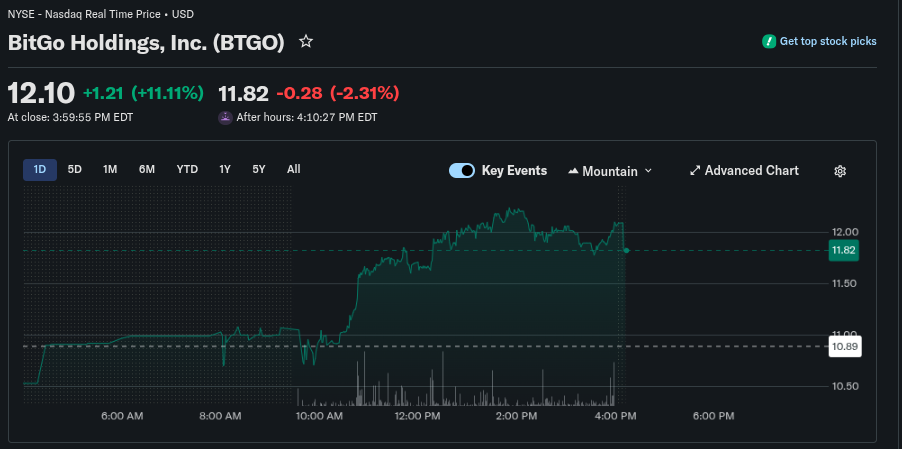
BitGo, a digital asset infrastructure company founded in 2013, provides custody, trading and other services for institutional crypto clients. The company went public on the New York Stock Exchange in January, pricing its shares at $18 in its initial public offering.
The stock rose about 25% on its first day of trading before reversing course and later falling below its IPO price. The NYSE-traded shares closed up more than 11%.

Related: Societe Generale-FORGE launches EURCV stablecoin on Stellar
Investment products target stablecoin infrastructure
Interest in the stablecoin sector has grown as the total stablecoin market capitalization has climbed to more than $314 billion, according to the latest DefiLlama data. Though dedicated investment products remain limited, some investors are beginning to focus on the infrastructure that supports these tokens.
In September, Bitwise filed with the US Securities and Exchange Commission to launch a Stablecoin & Tokenization ETF designed to track companies and digital assets tied to the stablecoin and tokenization sectors.
The proposed exchange-traded fund would follow an index composed of companies involved in stablecoin issuance, infrastructure, payments and exchanges, alongside crypto assets such as Bitcoin (BTC) and Ether (ETH).

In January, MarketVector Indexes also launched benchmarks focused on stablecoin and real-world asset tokenization infrastructure, which underpin two exchange-traded funds from Amplify ETFs: the Amplify Tokenization Technology ETF (TKNQ) and the Amplify Stablecoin Technology ETF (STBQ).
Several stablecoin issuers are also publicly traded companies. Circle issues the USDC stablecoin, the second-largest dollar-pegged token in circulation, while PayPal launched its PayPal USD stablecoin (PYUSD) in 2023 to support blockchain-based payments and settlement.
Western Union, one of the world’s largest remittance providers, recently announced its planned stablecoin settlement system will run on Solana and include a US Dollar Payment Token (USDPT), which the company expects to launch in the first half of 2026.
Magazine: Bitcoin may face hard fork over any attempt to freeze Satoshi’s coins

Is Tudor’s Spurs reign almost up after only four games?

The Aldi-style insurgents who could be about to shake up the vets market

Hyperliquid Jumps Following Margin Upgrade and 533% Oil Trading Surge


-
Business4 days ago
Form 8K Entergy Mississippi LLC For: 6 March
-

 News Videos2 days ago
10th Algebra | Financial Planning | Question Bank Solution | Board Exam 2026
-

 Fashion4 days ago
Weekend Open Thread: Ann Taylor
-

 Tech6 days ago
Bitwarden adds support for passkey login on Windows 11
-

 Crypto World1 day ago
Paradigm, a16z, Winklevoss Capital, Balaji Srinivasan among investors in ZODL
-
 Sports5 days ago
499 runs and 34 sixes later, India beat England to enter T20 World Cup final | Cricket News
-

 Sports3 days ago
Three share 2-shot lead entering final round in Hong Kong
-

 Sports3 days ago
Braveheart Lakshya downs Lai in epic battle to enter All England Open final | Other Sports News
-

 Politics5 days ago
Top Mamdani aide takes progressive project to the UK
-

 Business9 hours ago
ExxonMobil seeks to move corporate registration from New Jersey to Texas
-

 Business7 days ago
Guthrie Disappearance Enters Fifth Week as Family Visits Memorial
-

 NewsBeat5 days ago
Piccadilly Circus just unveiled ‘London’s newest tourist attraction’ and it only costs 80p to enter
-

 Entertainment4 days ago
Hailey Bieber Poses For Sexy Selfies In New Luscious Lip Thirst Traps
-

 Business2 days ago
Search for Nancy Guthrie Enters 37th Day as FBI Probes Wi-Fi Jammer Theory
-
 NewsBeat1 day ago
Pagazzi Lighting enters administration as 70 jobs lost and 11 stores close across Scotland
-

 Tech1 day ago
Despite challenges, Ireland sixth in EU for board gender diversity
-

 Crypto World6 days ago
New Crypto Mutuum Finance (MUTM) Reports V1 Protocol Progress as Roadmap Enters Phase 3
-
Entertainment6 days ago
Harry Styles Has ‘Struggled’ to Discuss Liam Payne’s Death
-

 Tech6 days ago
ACIP To Discuss COVID ‘Vaccine Injuries’ Next Month, Despite That Not Being In Its Purview
-

 Business1 day ago
Search Enters 39th Day with FBI Tip Line Developments and No Major Breakthroughs