
News Beat
The catch-22 in the global battle to eradicate polio

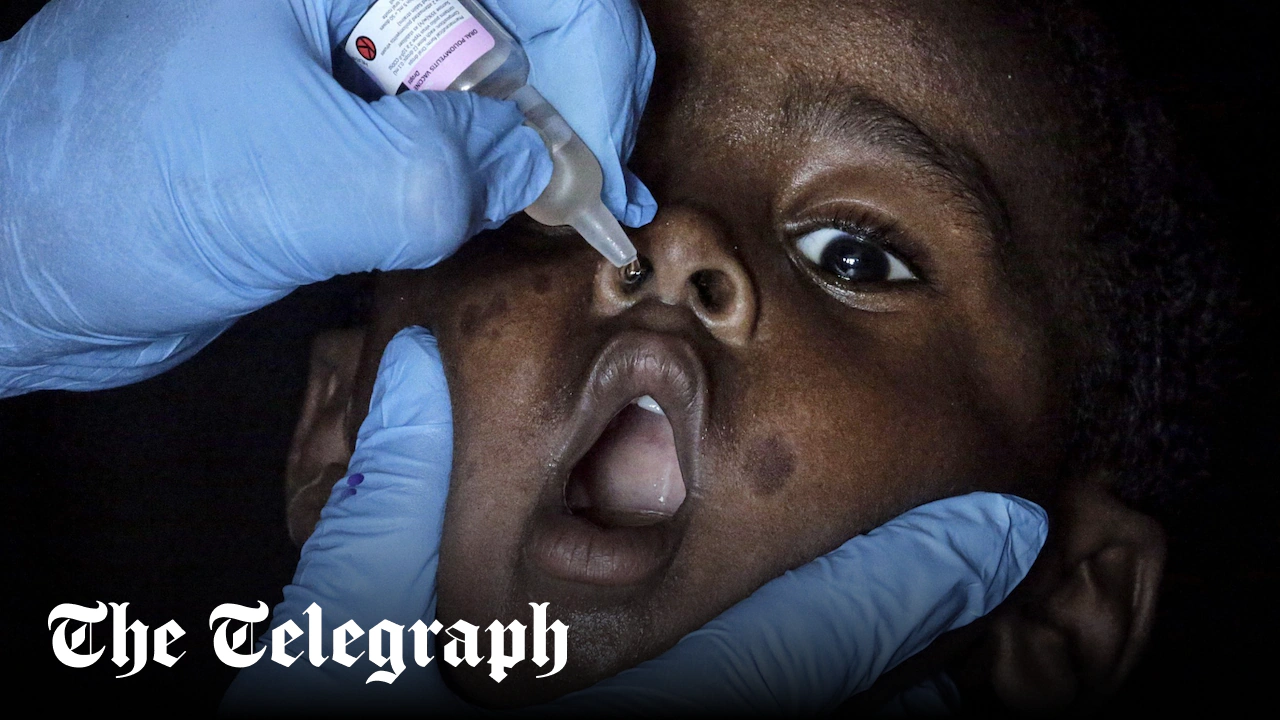

In the developed world, where it is relatively easy to achieve high vaccination rates and where sanitation is good, the risks of using the live oral vaccine outweigh the benefits.
Britain, the US, and most of Europe now rely exclusively on an “inactivated” polio vaccine, a jab which contains a dead version of the virus and is delivered by injection.
The injection is highly effective at protecting individuals from paralysis but it does not prevent the virus from replicating in the intestines and spreading silently to others.
It means that people vaccinated with the inactivated jab can still silently carry the virus and infect others who are not vaccinated.
The inactivated injections are also far more expensive, costing roughly $3 per dose, and require trained health workers, sterile equipment, and cold-chain storage.
Experts say that as long as wild or vaccine-derived poliovirus exists, it can be reintroduced into polio-free areas through international travel or population movement and so it is critical that vaccine rates across the globe are kept up.
Were they to slip, polio virus numbers would increase dramatically, according to experts from the field.
“It is human instinct to look at what is visible, but it’s difficult for us to understand what has been prevented,” said Dr Wadood.
In places with modern sanitation systems, it is estimated that only 75 per cent of the population need to be vaccinated against polio to protect the whole population and stop the chain of transmission, according to studies.
But in parts of Africa and Asia where untreated water is still a daily reality for millions, that number jumps to an estimated 97 per cent, which is only possible to achieve with an oral vaccine.
“The ultimate endgame is that we stop the use of oral polio vaccine,” said Dr Wadood of the WHO.
“That’s exactly what has happened in the developed world… But take a country like Nigeria or Mozambique, these are the countries that do not have very high routine immunisation coverage because of their systematic challenges.
“If you decide to go ahead and remove the oral vaccine from their system, they will be at very high risk,” Dr Wadood said.
A decision, taken by the WHO and Global Polio Eradication Initiative in 2016, illustrated the dangers of withdrawing the oral vaccine too quickly.
Up until then, the live oral vaccine protected against three main strains of wild polio virus – type 1, type 2, and type 3.
Type 2 had been eradicated from the wild – there had been no recorded cases since 1999 – but still continued to cause sporadic outbreaks in its vaccine-derived form.
Experts thought that removing the type 2 strain from the oral vaccine would effectively drive it to extinction. To maintain coverage against type-2 during the switchover, the inactivated polio injections would be used in targeted campaigns to fill the gap in coverage.
The “switch” from a type-2 containing oral vaccine to one without was rapid: within two weeks, 155 countries had made the change. But it backfired.
Owing to a range of factors, from low vaccine coverage, to insufficient immunity offered by the inactivated injections, type 2 poliovirus from the old oral vaccine continued to circulate and caused a series of outbreaks.
Those outbreaks are estimated to account for 3,300 of the 4,000 cases of paralysis that have occurred in children since 2016.
The Global Polio Eradication Initiative has since described the move as an “unqualified failure,” and we’re still seeing the fallout, with more than $1.8 billion of public health funding spent since on trying to quash these outbreaks.
It was at this point, that the catch 22 of the polio strategy became fully apparent.
The wild virus had all but been killed off but the strategy of withdrawing the live oral vaccine strain by strain was not working.
The orange drops left behind enough mutated live polio in the environment for it to bounce back and jabs of the inactivated vaccine could not be delivered fast enough to prevent it.
It’s a catch-22 that scientists must crack if they are to wipe polio entirely.
Hopefully cautious
A new, more stable, oral vaccine protecting against the type 2 stain could provide the answer, hope scientists.
Developed in part by British scientists at Britain’s Medicines and Healthcare products Regulatory Agency (MHRA), the new vaccine also uses a live virus but one which is less likely to mutate and spread.
Early testing found it was 70 to 80 per cent less likely to revert back to infectious forms of polio when compared to the original oral vaccine and nearly two billion doses have been administered globally since 2021.
Last week, a major study published in Nature by scientists at the MHRA reported that the new vaccine was performing as intended: it was providing protection against type 2 polio while sharply reducing the emergence of new vaccine-derived strains.
“This study confirms [the new vaccine] is performing as designed to interrupt polio outbreaks whilst reducing the risk of new vaccine-derived outbreaks,” said Dr Javier Martin, The MHRA’s Head of Polio Laboratory and co-author of the paper.
“Uganda successfully interrupted circulating vaccine-derived poliovirus transmission following two nationwide campaigns reaching approximately 20 million children”.
And yet some risk remains.



