

Crypto World
Polymarket taps Palantir as prediction markets meet Wall Street surveillance



Polymarket hiring Palantir and TWG AI signals prediction markets’ shift from degen toy to regulated financial infrastructure, with industrial‑grade surveillance baked into the order book.
Summary
- Polymarket will use Palantir and TWG AI to screen users against banned‑bettor lists and flag anomalous trading, starting with a new U.S.-regulated venue.
- The move follows CFTC pressure, insider probes and media exposés on Iran and Maduro‑linked trades, as regulators demand exchanges police event‑contract markets.
- For Palantir, the deal is tiny in revenue but powerful signaling that its Vergence‑style surveillance stack is becoming default compliance infrastructure for high‑risk markets.
Polymarket’s move to bring in Palantir and TWG AI is an admission that prediction markets are graduating from crypto toy to regulated financial infrastructure – and that the surveillance stack will match. According to a Bloomberg report, the platform is enlisting Palantir Technologies and TWG AI “to help police its sports contracts,” with the remit to identify, prevent and report suspicious activity as regulators and leagues turn up the heat on insider trading in event markets.
What the partnership actually does
People familiar with the deal told Bloomberg that Palantir and TWG AI will screen Polymarket users “against existing lists of participants already banned from sports betting,” and will build systems to flag anomalous trading patterns for further review. A follow‑up report notes the tools are expected to be deployed first on a U.S.‑regulated venue Polymarket is developing, rather than the current offshore platform that blocks American users, signaling the company’s intent to move closer to the CFTC’s line of sight. Benzinga adds that the system will run on Vergence AI, a surveillance and analytics stack Palantir built with TWG Global, designed to monitor financial transactions in real time and feed potential violations into compliance workflows.
The timing is not accidental. CFTC Chairman Mike Selig recently reminded event‑contract venues that exchanges are his “first line of defense against insider trading,” while rival Kalshi has publicly referred insider trades to the regulator, including a MrBeast editor who racked up “near‑perfect trading success” on low‑probability YouTube markets. At the same time, reporting from WIRED and others has documented alleged insiders making outsized profits on Iran‑linked geopolitical markets, with one Polymarket user reportedly earning roughly half a million dollars in a day on the timing of U.S. strikes. Against that backdrop, Polymarket’s priority is simple: convince regulators, leagues and counterparties that it can police its own order book before they do it for them.
Why it matters for markets
For Palantir, the deal is small in dollars but big in signaling. Its stock trades around $154, at roughly 240 times earnings, on the thesis that it becomes the default infrastructure layer for any organization that needs “rigorous data analysis” in sensitive domains; the fact that a crypto‑native prediction market tapped Palantir as its first serious compliance partner, rather than a legacy sportsbook vendor, supports that narrative. For prediction markets and crypto more broadly, the message is harsher: if you want to play in regulated sports, elections and geopolitics at scale, you don’t just list markets – you embed industrial‑grade surveillance, cross‑reference banned‑bettor lists and treat on‑chain flows as regulated financial data, not anonymous degen PnL.

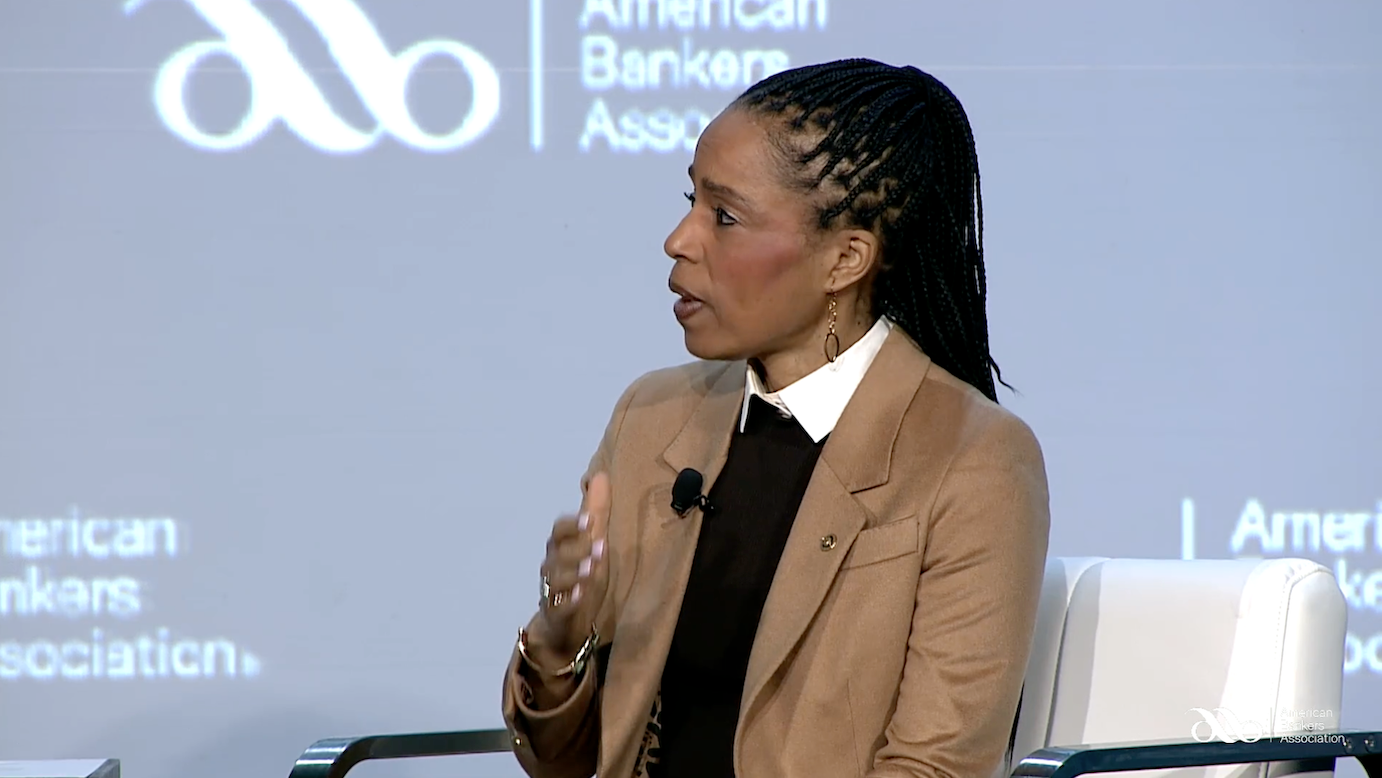
A US Senate Democrat says crypto and banking lobbies will both have to accept compromises amid a new proposal to move the crypto market structure bill forward.
Senator Angela Alsobrooks, a key Democrat on the Senate Banking Committee, said at an American Bankers Association event on Tuesday that she and Republican Senator Thom Tillis are working on a compromise proposal, but crypto and banking interests can’t let “perfect be the enemy of good.”
“All of us will probably walk away just a little bit unhappy,” she said. “What we don’t want is to have an unregulated system — to have crypto not regulated at all — and not to have the guardrails to allow a situation where we will have deposit flight.”
Banking groups, including the American Bankers Association, have pushed for the Senate to include a ban on third-party stablecoin yield payments in crypto market structure legislation pending in the Senate.

The groups argue that the payments are a deposit flight risk for bank accounts that could destabilize the banking system and that the ban would close a perceived loophole in the GENIUS Act, which banned stablecoin issuers from offering yield on their tokens.
Stablecoin yield payments are a popular way for crypto exchanges to entice customers, and crypto lobby groups have fought against the proposal to ban them.
The fight has stalled the crypto bill from moving forward, which outlines how market regulators would police crypto.
Senator Alsobrooks said that in negotiations for the GENIUS Act, lawmakers knew they’d have to “revisit the issue around interest and yield,” adding that crypto market structure legislation must address the issue of stablecoin yields so they don’t end up undermining the banking sector.
Related: Donald Trump takes swipe at banks over stalled crypto bill
“If it quacks like a duck and looks like a duck, it is a duck,” she said. “Making sure that we are not allowing bank-like products without bank-like protections — this is what we know is really important.”
Americans want stablecoin yield limits if banks at risk
Alsobrooks’ comments come as the American Bankers Association shared a survey finding that 42% of respondents agreed that Congress should ban stablecoin yields if there is any risk that it could reduce the amount of money available to banks.
The survey, conducted by Morning Consult on behalf of the lobby group and polling a national sample of 4,456 adults, also found that 84% agreed that a business providing bank-like services, like a savings product, should be “held to the same standards for consumer protection that banks are.”
Magazine: How crypto laws changed in 2025 — and how they’ll change in 2026

XRP price turned on Tuesday as the crypto market rallied, and after Brand Garlinghouse highlighted Ripple’s priorities for the year.
Summary
- XRP price has moved sideways in the past few weeks.
- Brad Garlinghouse highlighted the key priority areas for the company this year.
- The coin has formed a bullish divergence pattern, pointing to a rebound.
Ripple (XRP) token rose to $1.3895 from this week’s low of $1.3365. It has remained in this range in the past few weeks.
In an X post, Garlinghouse, Ripple Labs CEO, highlighted some of the top priorities the company is focusing on this year. He made the comment after traveling to three continents in five days, together with Monica Long, the president.
He expects the company to continue focusing on key areas like payments, custody, liquidity, and treasury management.
The company has already made some major announcements on this recently. For example, it launched Ripple Payments, a solution tailored to corporations, providing them with solutions like managed custody, unified collections, and advanced liquidity.
These solutions will be at the intersection of fiat and stablecoins, helping companies to save money and accelerate the speed of cash management.
Ripple Labs has also intensified its RLUSD growth recently. Data shows that the RLUSD stablecoin has accumulated over $1.6 billion in assets across Ethereum and XRP Ledger network. It will then roll out the coin to other chains, including Base and Polygon, through Wormhole.
Additionally, the developers launched the Permissioned DEX platform, which allows companies to take part in decentralized finance through a regulated platform. Its use case will be in areas like cross-border payments, fiat and stablecoin swaps, payroll management, and international payments.
XRP price prediction: Technical analysis
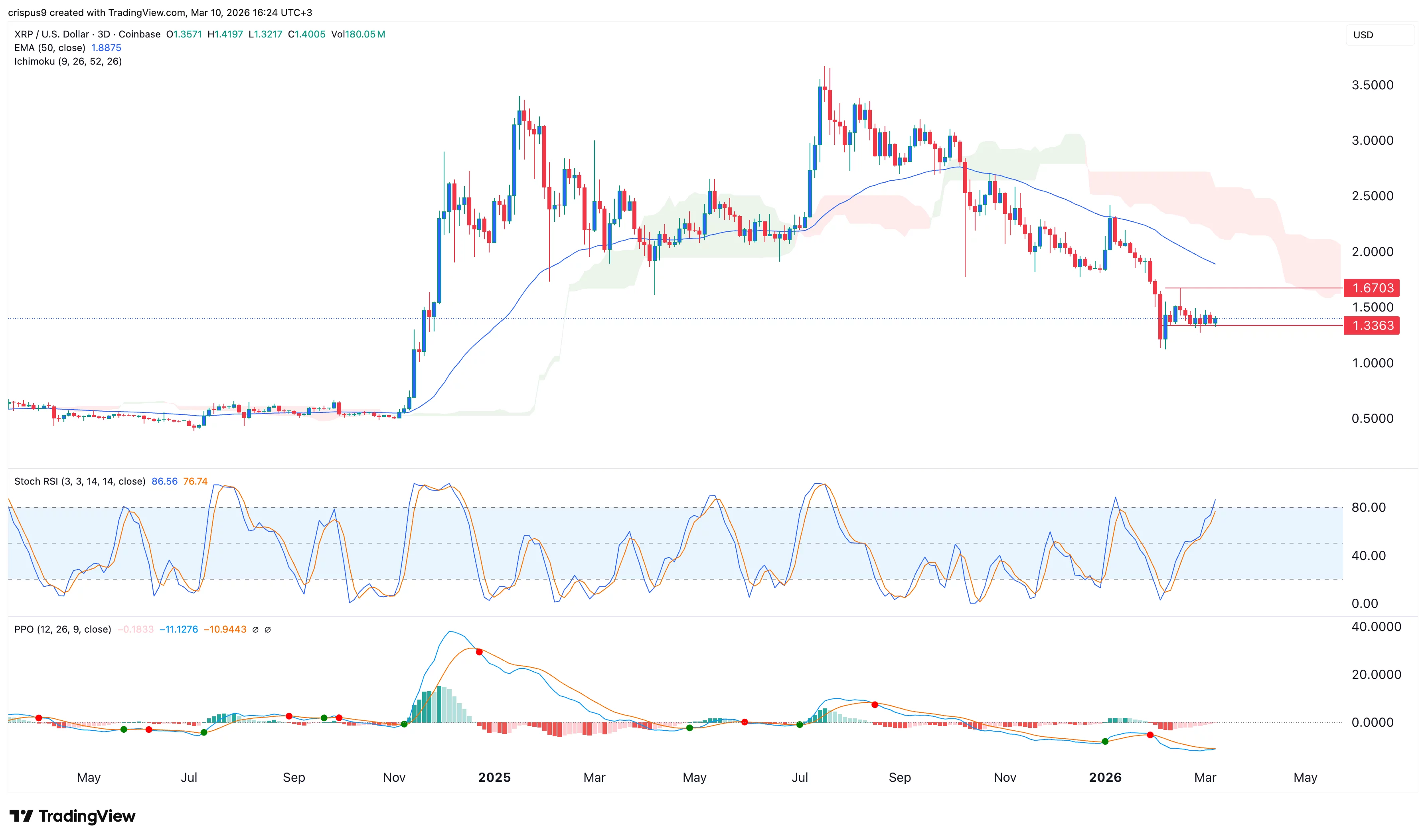
The three-day chart shows that the XRP price has drifted sideways in the past month as demand has remained thin. Indeed, spot XRP ETF inflows have been highly limited in this period, a sign that investors are remaining in the sidelines.
On the positive side, the Stochastic RSI has reversed and moved to the highest point in weeks. The Percentage Price Oscillator has formed a bullish crossover pattern.
Therefore, while the coin remains below all moving averages and the Ichimoku cloud, there is a possibility that it will rebound in the near term. If this happens, the next key target to watch will be at $1.6700, its highest point in February.
The bullish XRP price forecast will become invalid if it drops below the key support level at $1.3363.


A couple in western Paris was held hostage and forced to transfer roughly €900,000 ($980,000) in Bitcoin after three criminals posing as police officers broke into their home in what appears to be the latest crypto “wrench attack.”
Summary
- Three attackers posing as police forced their way into a home in Yvelines, threatening the victims with a knife and demanding a crypto transfer.
- The husband transferred roughly €900,000 in Bitcoin under duress before the suspects tied him up and fled.
- The attack adds to a surge of crypto-related kidnappings and extortion attempts in France, where criminals increasingly target digital asset holders.
The attack took place Monday morning in Le Chesnay-Rocquencourt in the Yvelines department, where the suspects rang the doorbell and claimed to be police officers.
When the woman opened the door, the men forced their way inside and threatened her with a knife, demanding that her partner transfer the cryptocurrency to a wallet under their control.
Under duress, the husband complied and transferred the equivalent of €900,000 in Bitcoin (BTC). The attackers then tied him up while the woman suffered minor injuries before the group fled the scene in a white van.
The woman later managed to free her husband and alert neighbors, ending the ordeal shortly after.
The Versailles prosecutor’s office has opened an investigation into charges including organized armed robbery, kidnapping and criminal conspiracy. The case is being handled by France’s Brigade for the Repression of Banditry (BRB), and no arrests had been reported so far.
France sees rise in crypto “wrench attacks”
The incident adds to a growing wave of so-called “wrench attacks,” where criminals use physical violence or coercion to force victims to hand over digital assets rather than attempting technical hacks.
France has emerged as a major hotspot for such crimes. Earlier reporting shows that the country has seen dozens of crypto-linked kidnappings and extortion attempts, with investors and their relatives increasingly targeted as the value of digital assets rises.
The number of verified wrench attacks worldwide jumped significantly in 2025, with France accounting for a notable share of incidents.
Recent cases include the kidnapping of relatives connected to cryptocurrency entrepreneurs and a string of violent robberies aimed at forcing victims to transfer crypto funds. Authorities have made arrests in some investigations, but the attacks continue to surface across the country.


Sentiment in the bitcoin market has flipped bullish and traders are betting on a rally above $80,000, with traders positioning for a rally above $80,000.
That’s the message from decentralized exchange offering on-chain trading in crypto futures and options.
“Current options pricing shows roughly a 35% probability that BTC will reach above $80K by the end of June,” Nick Forster, founder of on-chain options platform, Derive.xyz, told CoinDesk in an email. “Combined with the recovery in skew, this activity suggests many traders expect bitcoin to recover toward the $80K level between June and September.”
Options are derivative contracts that let you bet on BTC prices moving up or down, but with a inbuilt safety net that ensures you lose only a small upfront fee, not your whole account, if the bet fails. It’s akin to buying a lottery ticket.
A call lets you bet on price rallies, while a put lets you bet on price dumps. The latter is, therefore, seen as a protective hedge.
Traders typically track options skew – that telltale pricing gap between calls and puts – to sniff out where the market’s leaning. Calls pricier than puts indicates Bullish tilt, while put premium suggests otherwise.
BTC’s skew recovers
Bitcoin’s seven day and 30-day skews have clawed back to -6% from the -25% panic lows in early February, when BTC cratered toward $25,000.
The shift signals traders dialing back on protective puts – less crash hedging, more steady nerves.
“Despite earlier fears of a catastrophic crash of the crypto markets, derivatives markets suggest those concerns may have been overstated. BTC skew – a key measure of sentiment in options markets – has rebounded sharply from around -25% (normalized by at-the-money implied volatility) to roughly +10% today, signaling a significant shift away from aggressive downside hedging,” Forster said.
Skews based on leading centralized options exchange Deribit paint a similar picture.
According to Forster, put shorting (writing) has surged across venues in recent days, a sign that traders are willing to take on downside risk in exchange for premium, which is consistent with expectations of stabilizing or rising prices.
At press time, bitcoin changed hands near $70,000, up nearly 5% for the month, according to CoinDesk data.

XRP drifted lower in quiet trading as declining volume and repeated rejection near $1.44 kept the token trapped inside a tightening range.
News Background
- XRP continues to move largely in line with broader crypto sentiment, with no major token-specific catalysts driving recent price action. The token has spent much of the past week consolidating between roughly $1.34 and $1.44 as traders wait for a clearer directional signal.
- Despite muted market participation, activity on the XRP Ledger has picked up.
- Daily transaction counts have climbed to around 2.7 million, according to market data, reflecting rising network usage tied in part to real-world asset tokenization projects building on the chain. The value of tokenized assets on the network has approached roughly $461 million.
- While growing network activity suggests improving ecosystem fundamentals, traders remain focused on short-term technical levels as liquidity across crypto markets remains relatively thin.
-
Price Action Summary
- XRP slipped slightly to around $1.38 during the latest session
- The token traded inside a roughly $1.34–$1.44 range
- The session high near $1.44 came on a brief volume spike before sharp rejection
- Price later drifted back toward $1.38 as participation declined
Technical Analysis
- The most important move in the past session came when XRP briefly pushed toward $1.44 during a burst of trading activity before sellers quickly rejected the advance. That rejection reinforced the $1.43–$1.44 zone as near-term resistance.
- Following the failed breakout, XRP formed a series of lower highs on declining volume, suggesting momentum faded after the initial rally attempt. The token has since moved sideways near $1.38, with several tests of this level indicating it is acting as short-term support.
- Volume trends remain a key signal. Overall trading activity has contracted to well below its recent average, indicating traders are waiting for confirmation before taking larger positions.
- This type of compression — with price trapped between resistance near $1.44 and support closer to $1.34–$1.38 — often precedes a larger directional move once liquidity returns.
What traders say is next?
- Market participants are watching whether XRP can maintain support above the $1.34–$1.35 area.
- If that level holds, the token could remain in consolidation before attempting another breakout toward $1.44 and potentially $1.50 if momentum returns.
- A breakdown below $1.34, however, would weaken the consolidation structure and could expose the next downside zone around $1.30–$1.32.


Bitcoin touched $71,612 on Tuesday evening before settling back to $70,036 by Wednesday’s Asian session, as oil price slide revved up risk sentiment.
A key catalyst was a Wall Street Journal report that the International Energy Agency had proposed the largest crude reserve release in its history, exceeding the 182 million barrels released in 2022 after Russia’s invasion of Ukraine.
The proposal responds to Persian Gulf production cuts that have removed roughly 6% of global oil output since the Iran war began, sending jet fuel and cooking gas prices soaring worldwide.
Brent crude dropped below $90 per barrel on Wednesday after plunging 11% in the prior session. That matters for crypto because oil has been the transmission mechanism connecting the Middle East conflict to every risk asset on the planet. Higher oil means stickier inflation, which means no rate cuts, which means tighter liquidity and further pressure for risk assets.
Bitcoin was trading at $70,036 on Wednesday morning after reaching as high as $71,612 on Tuesday evening, up 2.5% on the week. The move from Monday’s low near $66,000 to Tuesday’s high amounts to roughly 8.5% in two days, though the overnight pullback gave back some of those gains.
“Bitcoin trading above $70,000 tells you buyers are trying to push this market out of consolidation, but it still has to prove it can hold,” said Daniel Reis-Faria, CEO of ZeroStack, said in a mail. “The difference this time is that leverage had cooled off a bit before the move higher, which gives it a more stable setup.”
“Now it comes down to whether Bitcoin can stay above $70,000 and build from there, or whether it slips back into the same pattern we’ve been in for weeks,” he added.
Elsewhere, FxPro analysts noted that bitcoin is forming a series of higher local lows since the end of February, the first structural sign of buyers gaining confidence within the range.
But they flagged $73,000 as the level that matters, where last week’s peak and the 50-day moving average sit together.
The broader market was calm. Ether held at $2,034, down 0.3% on the day but up 2.8% on the week. BNB was flat at $643. XRP edged up 0.3% to $1.38 with a 1.7% weekly gain. Solana added 0.2% to $86.42 but remains down 0.8% over seven days, still the weakest major on a weekly basis.
Dogecoin was up 1% to $0.093, holding onto some of Tuesday’s Musk-driven gains.
The Fed meeting on March 17-18 remains the next major event. With oil potentially easing on the IEA reserve release, the stagflation scenario that had been pricing into markets last week looks slightly less severe.
If crude stays below $90, the argument for rate cuts later this year gets marginally stronger. Bitcoin’s 90-day correlation with the S&P 500 is still at 0.78. Whatever the Fed signals, crypto will trade it.


Ripple announced plans on Wednesday to secure an Australian Financial Services License through the proposed acquisition of BC Payments Australia Pty Ltd, per a release shared with CoinDesk.
The acquisition, which is still subject to completion, would allow Ripple to offer its full payments stack in Australia, covering onboarding, compliance, funding, foreign exchange, liquidity management, and payout through a single integration.
Australian customers currently using Ripple Payments include Hai Ha Money Transfer, Stables, Caleb & Brown, Flash Payments, and Independent Reserve.
“Australia is a key market for Ripple, and an AFSL strengthens our ability to scale Ripple Payments across the region,” said Fiona Murray, managing director for Asia Pacific, in a statement.
The regional numbers back up the push. Ripple said its APAC payments volume nearly doubled year-on-year in 2025, though it didn’t disclose specific figures.
That growth sits alongside the $100 billion in total processed volume the company reported last week when it announced managed custody, virtual account collections, and stablecoin settlement capabilities across 60 markets.
Ripple also said it is participating in Project Acacia, an initiative led by the Reserve Bank of Australia and the Digital Finance Cooperative Research Centre focused on digital asset infrastructure.
The licensing approach is notable. Rather than applying for an AFSL directly, Ripple is acquiring a company that already holds one. That’s a faster path to market but means the license is contingent on the deal closing, which hasn’t happened yet.
XRP was trading at $1.38, up 0.3% on the day and 1.7% on the week.
Bitcoin price is stabilizing near $70,000 as declining derivatives leverage and falling retail inflows hint at a possible base forming in the market.
Summary
- Bitcoin is trading near $70,000, close to the upper end of its weekly range.
- Retail inflows to Binance have dropped sharply while open interest across exchanges continues to trend lower, signaling reduced leverage.
- Technical indicators show BTC consolidating between $67K and $71K as volatility tightens ahead of a potential breakout.
At press time, Bitcoin (BTC) was trading at $70,718, up 4.2% over the past 24 hours. The asset is now near the top of its recent weekly range thanks to the move.
Following February’s volatility, Bitcoin has shown signs of consolidation over the last seven days, trading between $65,962 and $73,669. The cryptocurrency is still 46% below its October 2025 all-time high of $127,080 despite the recent upswing.
Alongside the price increase, market activity has increased. With a 49% rise and a 24-hour trading volume of $53.8 billion for BTC, traders appear to be returning to the market.
Derivatives data also shows rising activity. According to CoinGlass data, Bitcoin futures trading volume increased 13% to $76 billion, while open interest climbed 5.72% to $46 billion.
Despite the short-term increase, longer-term data show that leverage across exchanges has been trending lower.
Retail flows and leverage show cooling market conditions
A Mar. 10 report from CryptoQuant contributor Amr Taha points to a sharp decline in retail Bitcoin inflows to Binance over the past month.
The analysis tracks cumulative Bitcoin deposits to the exchange over 30 days, separating activity from smaller investors and large holders. According to the data, retail inflows to Binance dropped significantly between Feb. 6 and Mar. 10.
During that period, retail deposits fell from around $14.1 billion to roughly $6.3 billion, a drop of about $7.8 billion. The current level is the lowest recorded since mid-May 2024, suggesting smaller investors are sending fewer coins to exchanges.
Open interest across derivatives markets has also been declining. The report notes that several major exchanges have seen a reduction in futures positioning in recent weeks.
Bitcoin open interest on Binance was $3.45 billion on March 10, down from the $3.8 billion level noted on April 7, 2025. That earlier reading coincided with a period when Bitcoin formed a major market bottom.
According to Taha, widespread drops in open interest often signify a reduction in traders’ leverage. Once excessive speculation is removed from the market, periods of deleveraging can occasionally result in more stable price action.
Bitcoin price technical analysis
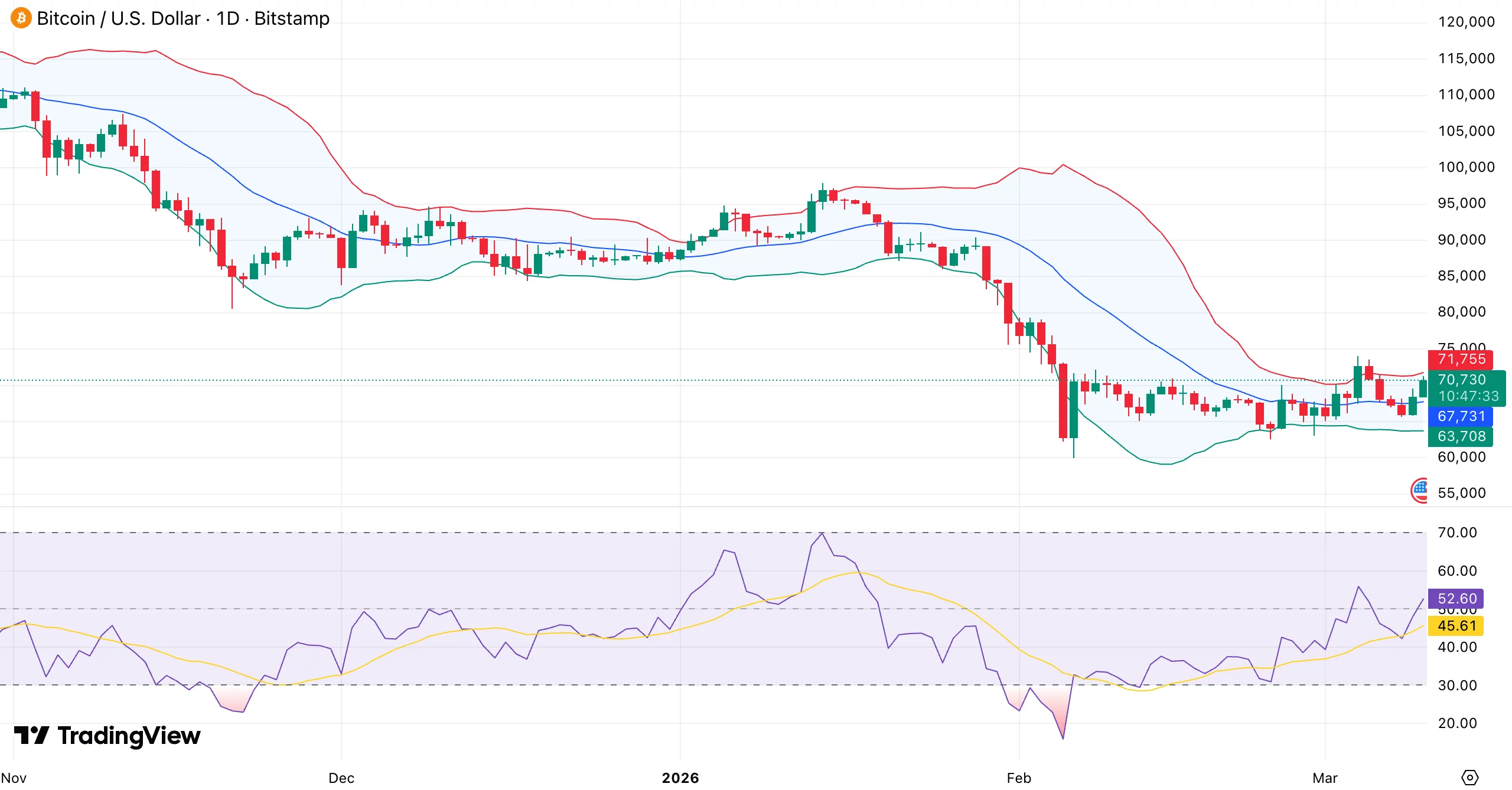
From a technical standpoint, Bitcoin is still recovering from the sharp decline seen in February. The price is still below the 20-day moving average, which is the midline of the Bollinger Bands. This level often acts as resistance when markets are trying to recover from a downtrend.
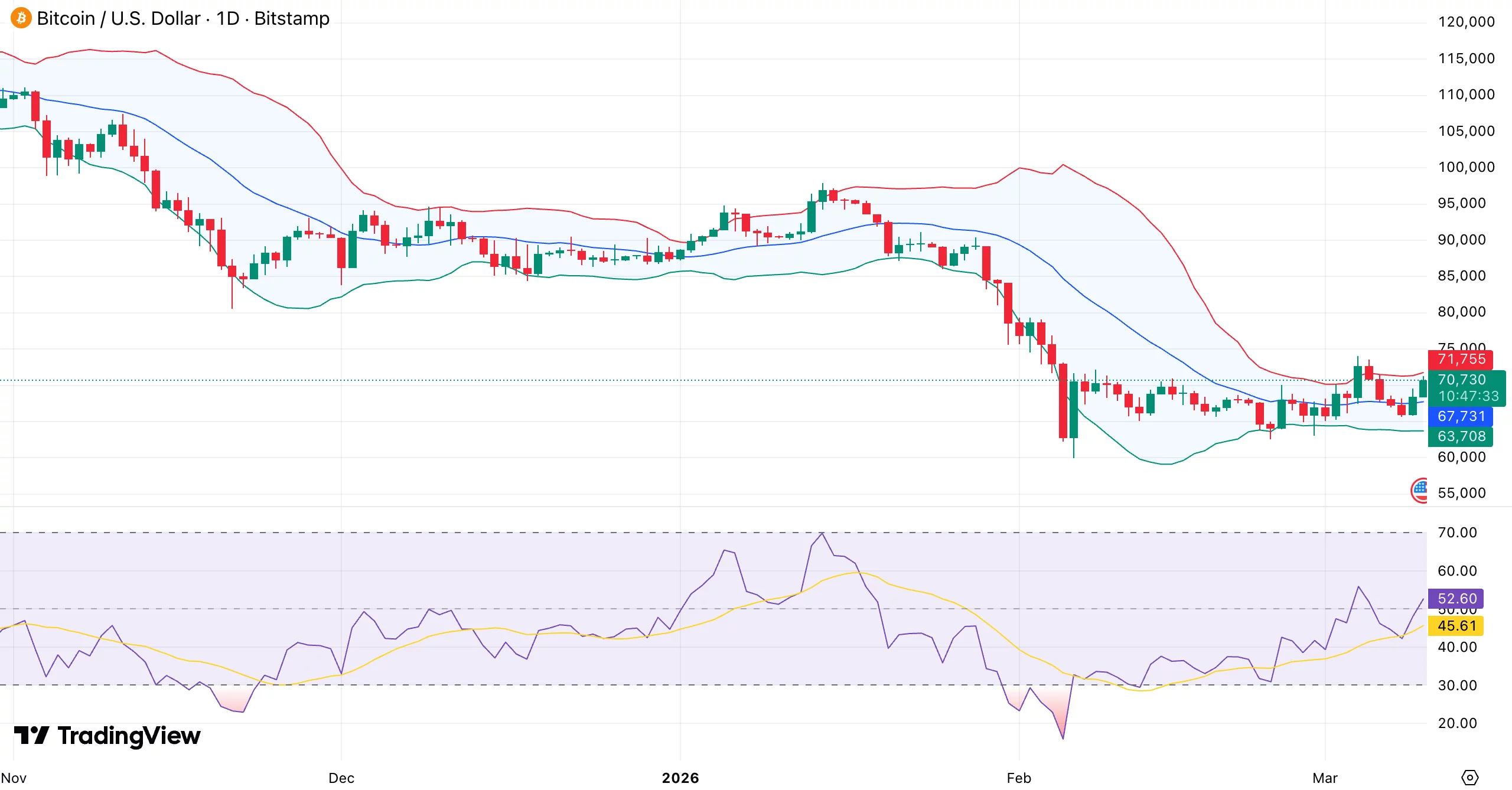
At the same time, the chart shows that Bitcoin is moving sideways between $67,000 and $71,000, indicating that the market may be establishing a base following the recent sell-off. Several recent candles have longer wicks and smaller bodies, which shows hesitancy among traders.
Volatility has also started to contract. Bollinger Bands are gradually narrowing, a pattern that comes before a more significant shift in either direction.
Momentum indicators show a slight improvement. The relative strength index is now hovering around 50, a neutral reading, having recovered from oversold levels near 20–30 during February’s decline.
$66,000 to $67,000 continues to be the crucial support range for Bitcoin in the near future. Holding this level could help maintain the current consolidation structure.
On the upside, $71,000 to $72,000 stands as the next resistance area. A break above that range could signal stronger recovery momentum, while rejection there may keep Bitcoin trading sideways in the near term.
Ripple has announced plans to secure an Australian financial services license by acquiring a local payments firm in the country.
Summary
- Ripple plans to obtain an Australian Financial Services License through the acquisition of BC Payments Australia.
- New regulations set to take effect by June 30, 2026, would require crypto companies operating in Australia to obtain a license.
Ripple said it will obtain the AFSL license through the acquisition of BC Payments Australia Pty Ltd, a payments company linked to the European Banking Circle Group. A deal is still underway and is expected to close on April 1 after the standard closing process is finalized.
“Australia is a key market for Ripple,” Ripple’s APAC Managing Director Fiona Murray said in an accompanying statement, adding that it will help Ripple Payments “manage the full lifecycle of a transaction, from onboarding and compliance through funding, FX, liquidity management, and final payout, while integrating both traditional banking rails and digital assets.”
Ripple’s decision to pursue the license comes as Australia’s financial regulator has unveiled updated regulations for the country’s crypto sector.
Starting June 30, 2026, crypto firms operating in Australia would be required to obtain an Australian Financial Services License before they are allowed to offer certain financial services to local customers.
Over the past years, Ripple has expanded its global regulatory footprint by focusing on securing licenses across key markets around the world.
In 2025 alone, Ripple managed to secure payment licenses in Singapore, the UAE, and the UK. The company was also granted conditional approval for a national trust banking charter by the U.S. Office of the Comptroller of the Currency alongside a handful of other firms.
Securing these regulatory approvals has helped Ripple strengthen its push for broader institutional adoption of the XRP (XRP) ecosystem and its flagship stablecoin RLUSD.
As previously reported by crypto.news, Ripple became one of the world’s top most valuable private companies, with its valuation reaching roughly $50 billion.


Blockchain and crypto are technologies performing the same functions as existing financial infrastructure, so they shouldn’t be treated as separate asset classes when crafting legislation, according to the fintech chief of Australia’s securities regulator.
In a paper presented at the Melbourne Money & Finance Conference on Wednesday, Australian Securities and Investments Commission’s (ASIC’s) head of fintech, Rhys Bollen, said crypto should be regulated on “economic substance rather than technological form.”
Tokenized securities should fall within securities laws, and stablecoins should trigger payment services legislation, Bollen said, while noting that other elements of crypto may be subject to consumer protection laws.
Bollen’s approach contrasts with crypto-specific regulatory frameworks in other countries, such as the CLARITY Act in the US and the Markets in Crypto-Assets Regulation framework in Europe.
Bollen argued that the three main financial functions — capital allocation, payments and risk management — have evolved with technological advancements and that distributed ledger technologies, such as blockchain, shouldn’t be treated differently:
“Digital assets largely represent new technological instances of longstanding financial activities. While the mechanisms of issuance, transfer and record-keeping have changed, the underlying economic functions served by these instruments have not.”
“Regulatory systems have repeatedly adapted to technological change – from paper instruments to electronic records – without abandoning foundational principles such as consumer protection, market integrity and systemic stability,” Bollen added.
Australia isn’t crafting one big crypto bill
Australia is already starting to adopt this approach, with the main piece of crypto legislation, the Digital Asset Framework bill, seeking to merely amend parts of the Corporations Act, Bollen said.
“The Bill does not abandon the existing financial services framework. Instead, it introduces tailored amendments that integrate digital asset platforms into the established regulatory architecture.”
The Australian crypto market has also been given guidance through ASIC Information Sheet 225, which states that existing definitions of “financial product” and “financial service” under the Corporations Act can apply to digital assets.
“ASIC’s guidance explicitly rejects the notion that digital assets constitute a discrete asset class for regulatory purposes,” Bollen said. “Instead, it confirms that a digital asset may fall within the regulatory perimeter where it functions as a security, derivative, managed investment scheme interest or non-cash payment facility.”
Bollen said a focus on “economic characteristics rather than technological labels” would enable regulators to provide clearer rules to market participants while reducing “opportunities for regulatory arbitrage.”
Related: Ripple targets April for Australian financial license via acquisition
ASIC Information Sheet 225 is also focused on the regulation of intermediaries rather than tokens, with Bollen noting that most consumer harm in the digital asset industry has stemmed from the conduct of crypto platforms offering custody, trading, lending or yield services.
Decentralized offerings still tricky to regulate
Bollen acknowledged that classification issues may arise with decentralized products or services, though he said legal analysis should focus on practical control and benefit, rather than formal claims of decentralization:
“Where identifiable parties exercise influence over protocol design, governance, or economic outcomes, regulatory obligations can and should attach.”
Magazine: Clarity Act risks repeat of Europe’s mistakes, crypto lawyer warns

Garmin and Peloton devices now properly sync in both directions, giving you a more accurate idea of your daily fitness

Bloomberg Crypto 3/10/2026

SNP Health Secretary accused of ‘shameful’ NHS failures in his own backyard


-
Business5 days ago
Form 8K Entergy Mississippi LLC For: 6 March
-

 Tech6 days ago
Bitwarden adds support for passkey login on Windows 11
-

 News Videos2 days ago
10th Algebra | Financial Planning | Question Bank Solution | Board Exam 2026
-

 Fashion4 days ago
Weekend Open Thread: Ann Taylor
-

 Crypto World2 days ago
Paradigm, a16z, Winklevoss Capital, Balaji Srinivasan among investors in ZODL
-
 Sports6 days ago
499 runs and 34 sixes later, India beat England to enter T20 World Cup final | Cricket News
-

 Sports3 days ago
Three share 2-shot lead entering final round in Hong Kong
-

 Sports3 days ago
Braveheart Lakshya downs Lai in epic battle to enter All England Open final | Other Sports News
-

 Politics5 days ago
Top Mamdani aide takes progressive project to the UK
-

 Business14 hours ago
ExxonMobil seeks to move corporate registration from New Jersey to Texas
-

 NewsBeat6 days ago
Piccadilly Circus just unveiled ‘London’s newest tourist attraction’ and it only costs 80p to enter
-

 Entertainment4 days ago
Hailey Bieber Poses For Sexy Selfies In New Luscious Lip Thirst Traps
-

 Business3 days ago
Search for Nancy Guthrie Enters 37th Day as FBI Probes Wi-Fi Jammer Theory
-
 NewsBeat1 day ago
Pagazzi Lighting enters administration as 70 jobs lost and 11 stores close across Scotland
-

 Tech2 days ago
Despite challenges, Ireland sixth in EU for board gender diversity
-
Entertainment6 days ago
Harry Styles Has ‘Struggled’ to Discuss Liam Payne’s Death
-

 Crypto World6 days ago
New Crypto Mutuum Finance (MUTM) Reports V1 Protocol Progress as Roadmap Enters Phase 3
-

 Tech6 days ago
ACIP To Discuss COVID ‘Vaccine Injuries’ Next Month, Despite That Not Being In Its Purview
-

 Business1 day ago
Search Enters 39th Day with FBI Tip Line Developments and No Major Breakthroughs
-
 NewsBeat6 days ago
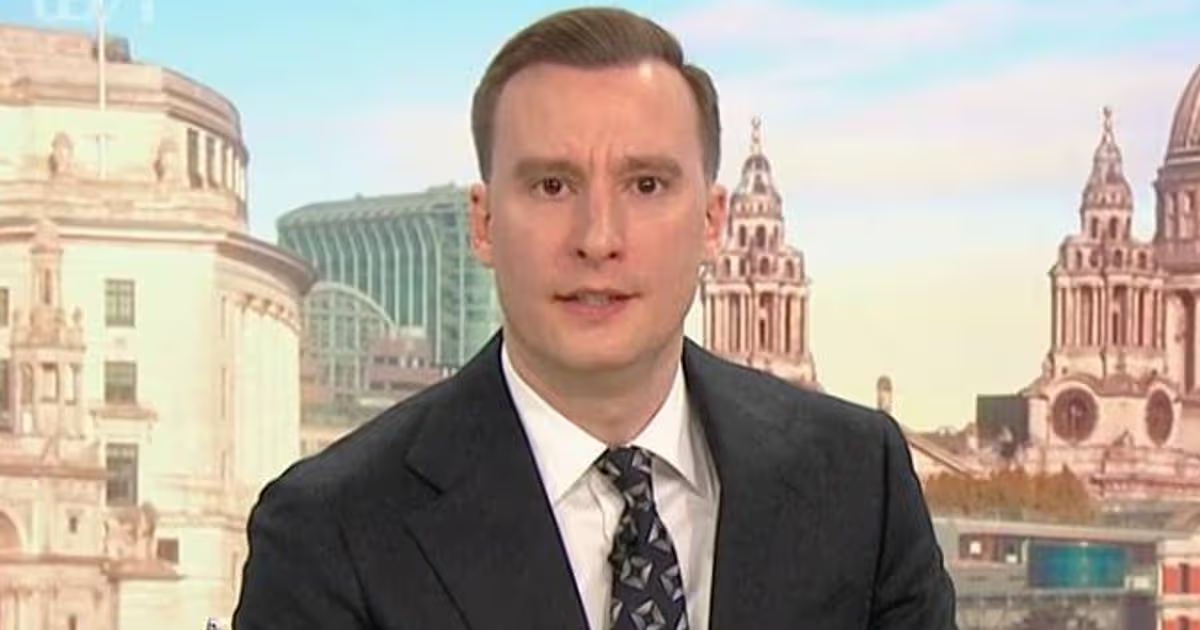
Good Morning Britain fans delighted as Welsh presenter returns to host ITV show