The deal pairs one of the world’s most powerful chip companies with the AI startup founded by OpenAI’s former CTO, and the compute commitment alone runs to tens of billions of dollars.
When Mira Murati left OpenAI in September 2024, she declined to say much about what came next. What has become clear, roughly 18 months on, is that she was building something with serious ambitions, and that she has found in Nvidia a partner prepared to back them at a scale that would have seemed extravagant even a year ago.
On March 10, 2026, NVIDIA and Thinking Machines Lab announced a multiyear strategic partnership under which Murati’s startup will deploy at least a gigawatt of NVIDIA’s next-generation Vera Rubin systems to train its models.
NVIDIA has also made what both companies describe as a “significant investment” in Thinking Machines, though neither has disclosed the figure.
Advertisement
The 💜 of EU tech
The latest rumblings from the EU tech scene, a story from our wise ol’ founder Boris, and some questionable AI art. It’s free, every week, in your inbox. Sign up now!
According to the Financial Times, the chip supply arrangement alone is worth tens of billions of dollars. Nvidia CEO Jensen Huang has previously said that one gigawatt of AI data centre capacity costs up to $50 billion.
Thinking Machines Lab, which Murati founded in February 2025, has now raised more than $2 billion since its inception. Investors include Andreessen Horowitz, Accel, and NVIDIA, alongside, somewhat unusually, the venture arm of AMD, NVIDIA’s principal chip rival. The company has grown from roughly 30 employees a year ago to about 120 today.
Advertisement
A lab built on customisability
The company’s stated mission is to build AI systems that are, in its own words, “more widely understood, customizable and generally capable.” The emphasis on customisability is pointed: Murati and her team appear to be positioning
Thinking Machines as something distinct from OpenAI and Anthropic, which sell relatively fixed products, by building infrastructure that companies and developers can shape to their own requirements.
The partnership with NVIDIA includes technical collaboration as well as compute supply, specifically the optimisation of Thinking Machines’ products for NVIDIA’s hardware. That kind of close integration at the chip level has historically proved valuable, it is, in rough terms, part of what allowed OpenAI to move as quickly as it did in the GPT era.
“NVIDIA’s technology is the foundation on which the entire field is built,” Murati said in a statement accompanying the announcement. “This partnership accelerates our capacity to build AI that people can shape and make their own.”
Advertisement
What this signals about the compute race
Thinking Machines is not the only frontier lab signing gigawatt-scale compute agreements. The broader AI industry is locked in a race to secure the infrastructure necessary to train the next generation of models, and the deals being signed now, in some cases before the hardware even exists, reflect a bet that whoever secures the most compute earliest will have a durable advantage.
For NVIDIA, the investment serves a dual purpose: it generates revenue from chip sales while also giving the company a stake in a lab it clearly views as a potential long-term customer and strategic partner. NVIDIA has made similar investments in other AI companies, building a portfolio that tracks the industry’s frontier.
Murati, for her part, turned down an acquisition offer from Meta’s Mark Zuckerberg last year. The NVIDIA partnership suggests she intends to remain independent, and that she has secured the resources to make that case credibly. Whether a 120-person lab can genuinely compete with organisations ten times its size remains to be seen. But she is no longer short of compute to try.
An anonymous reader quotes a report from Bloomberg: Chinese authorities moved to restrict state-run enterprises and government agencies from running OpenClaw AI apps on office computers, acting swiftly to defuse potential security risks after companies and consumers across China began experimenting with the agentic AI phenomenon. Government agencies and state-owned enterprises, including the largest banks, have received notices in recent days warning them against installing OpenClaw software on office devices for security reasons […]. Several of them were instructed to notify superiors if they had already installed related apps for security checks and possible removal, some of the people said.
Certain employees, including those at state-run banks and some government agencies, were banned from installing OpenClaw on office computers and also personal phones using the company’s network, some of the people said. One person said the ban was also extended to the families of military personnel. Other notices stopped short of calling for an outright ban on OpenClaw software, saying only that prior approval is needed before use, the people said. The warning underscores Beijing’s growing concern about OpenClaw, an agentic AI platform that requires unusually broad access to private data and can communicate externally, potentially exposing computers to external attack. […]
Despite the potential security risks, companies from Tencent to JD.com Inc. have been rolling out OpenClaw apps to try and capitalize on the groundswell of enthusiasm, while several local government agencies have declared millions of yuan in subsidies for companies that develop atop the platform. […] Tech giants like Tencent and Alibaba, along with AI upstarts ranging from Moonshot to MiniMax, have rolled out their own tweaks of the software touting simple, one-click adoption. A slew of government agencies, in cities from Shenzhen to Wuxi, have issued notices offering multimillion-yuan subsidies to startups leveraging OpenClaw to make advances. The frenzy has helped drive up shares of AI model developer MiniMax nearly 640% since its listing just two months ago. It’s now worth about $49 billion, surpassing Baidu — once viewed as the frontrunner in Chinese AI development — in market value. The company launched MaxClaw, an agent built on OpenClaw, in late February.
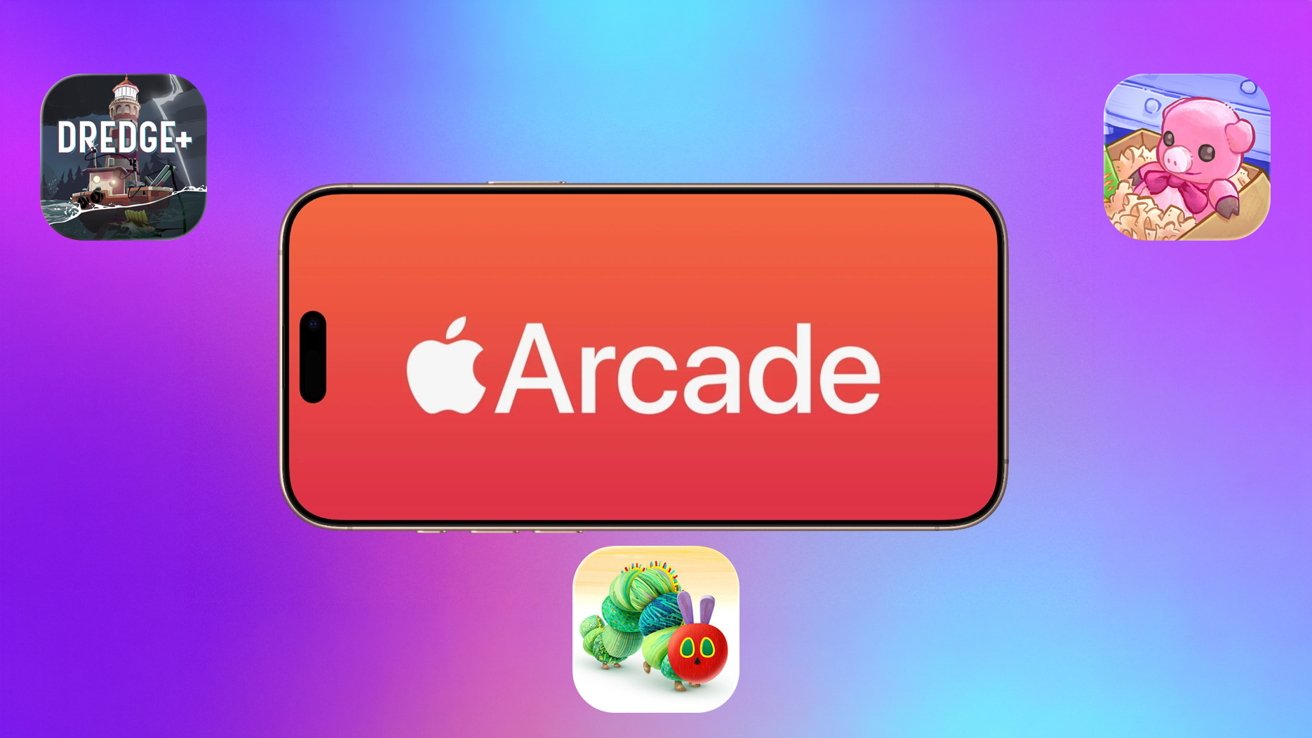
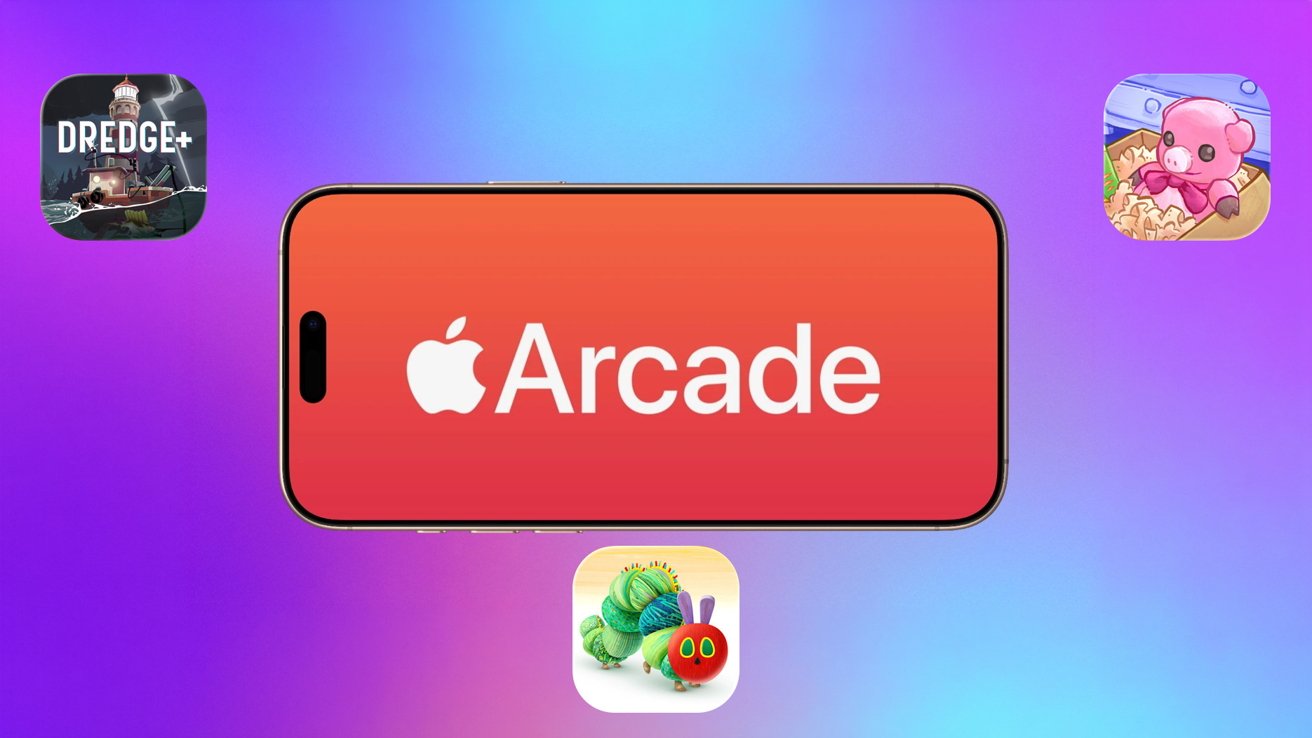
Apple is expanding its collection of Apple Arcade games with “Dredge+,” “Unpacking+,” and “My Very Hungry Caterpillar+” in April — two of which are App Store Award winners.
Three new games join Apple Arcade in April
While Apple may not be adding a ton of games in April, the three games coming next month are surprisingly varied. This time, we’ll see the addition of a survival horror game, a zen puzzle game, and a game geared towards the preschool crowd. Continue Reading on AppleInsider | Discuss on our Forums
The Legislative Building in Olympia, Wash., is home to the state’s Legislature. (GeekWire Photo / Lisa Stiffler)
The so-called “millionaires tax” passed the Washington House Tuesday night after more than 24 hours of debate, teeing up the bill for final approval today or tomorrow.
The controversial measure creates a 9.9% tax applied to taxable, personal annual income that exceeds $1 million. Washington is currently one of nine states without an income tax and the move is expected to face challenges in court and as a ballot measure.
Supporters of Senate Bill 6346 say it will bring some fairness to a regressive tax code that has relied heavily on sales, property and business taxes. The legislation includes tax benefits for low-income families and small businesses.
A final fiscal analysis has not been released, but the bill is expected to generate $3.5 billion or more each year in tax revenue beginning in 2029. State leaders this year have been trying to plug a more immediate $2 billion budget gap.
“The Millionaires’ Tax will apply to less than one half of one percent of Washingtonians, but make life more affordable for millions. I look forward to signing it,” said Gov. Bob Ferguson in a statement.
Advertisement
But some tech leaders and entrepreneurs worry it could undermine their sector by souring Washington’s relatively favorable tax laws for startup founders, investors and high-wage earners.
That concern took a high-profile form last night as Howard Schultz, the billionaire former CEO of Starbucks, disclosed on LinkedIn that he and his wife, Sheri, have relocated to Miami. While Schultz —who is retired — framed the move as a desire to be closer to family on the East Coast, he pointedly noted his “hope that Washington will remain a place for business and entrepreneurship to thrive.”
Schultz’s family office will follow him to Florida, though his foundation will stay in Seattle. The move underscores warnings from critics like Kris Johnson, president of the Association of Washington Business, who called SB 6346 a “seismic shift” in the state’s tax structure.
“By adopting a state income tax, Washington is giving up one of our primary competitive advantages we have had over other states and regions,” Johnson said, adding that the state is already expensive for families and employers and could push businesses to start, grow or move elsewhere.
Advertisement
Others took a concerned, but more nuanced tone. Rachel Smith, president of Washington Roundtable, a nonprofit representing major employers, credited lawmakers for repealing an expanded sales tax on services that was passed last year and reducing the estate tax.
She highlighted the need for further changes to the tax code to improve the state’s “economic competitiveness” and “long-term budget sustainability.”
“As we have said before, we see this as the beginning — not the end — of real, earnest work to implement the changes Washington needs,” Smith said. “It is imperative that this work happen quickly.”
SB 6346 marks the first time in decades that state lawmakers have pursued a personal income tax aimed at high‑income residents.
Advertisement
The bill passed the House with a 51-46 vote. No Republican lawmakers supported the measure and eight Democrats voted against it. One member was excused. It now returns to the Senate for agreement, and then moves to the governor. The legislative session is scheduled to end tomorrow.
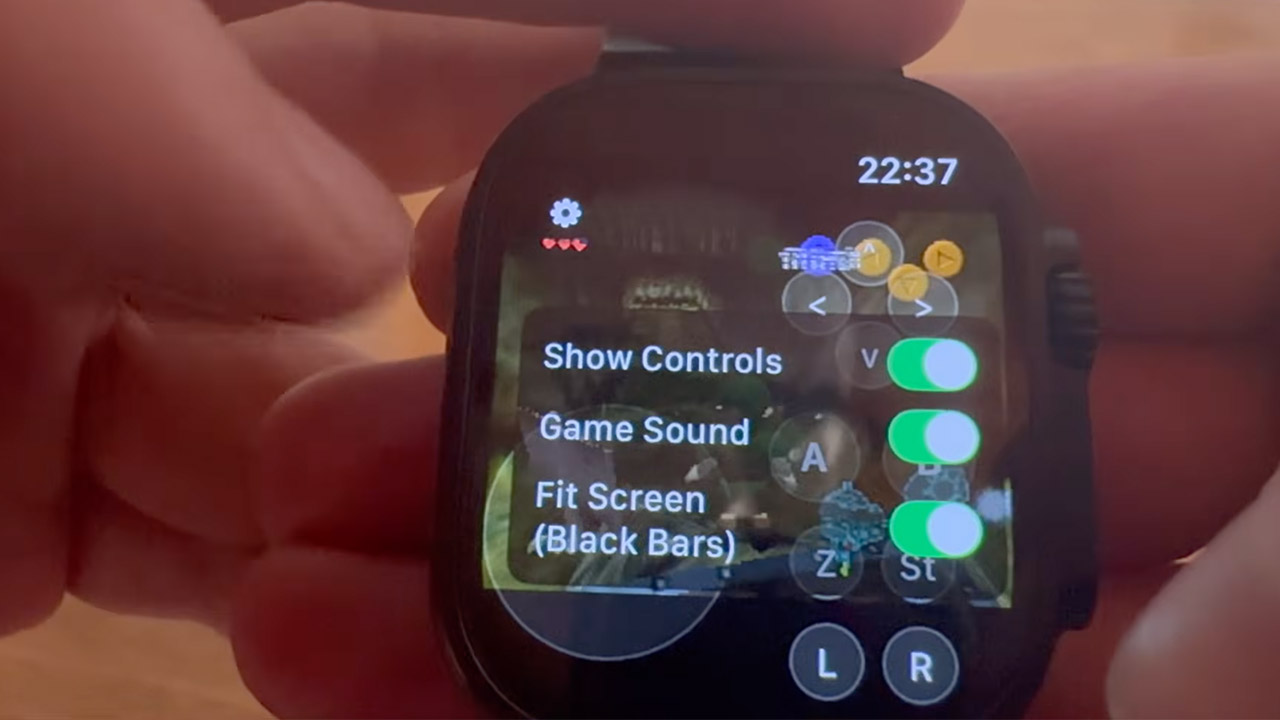
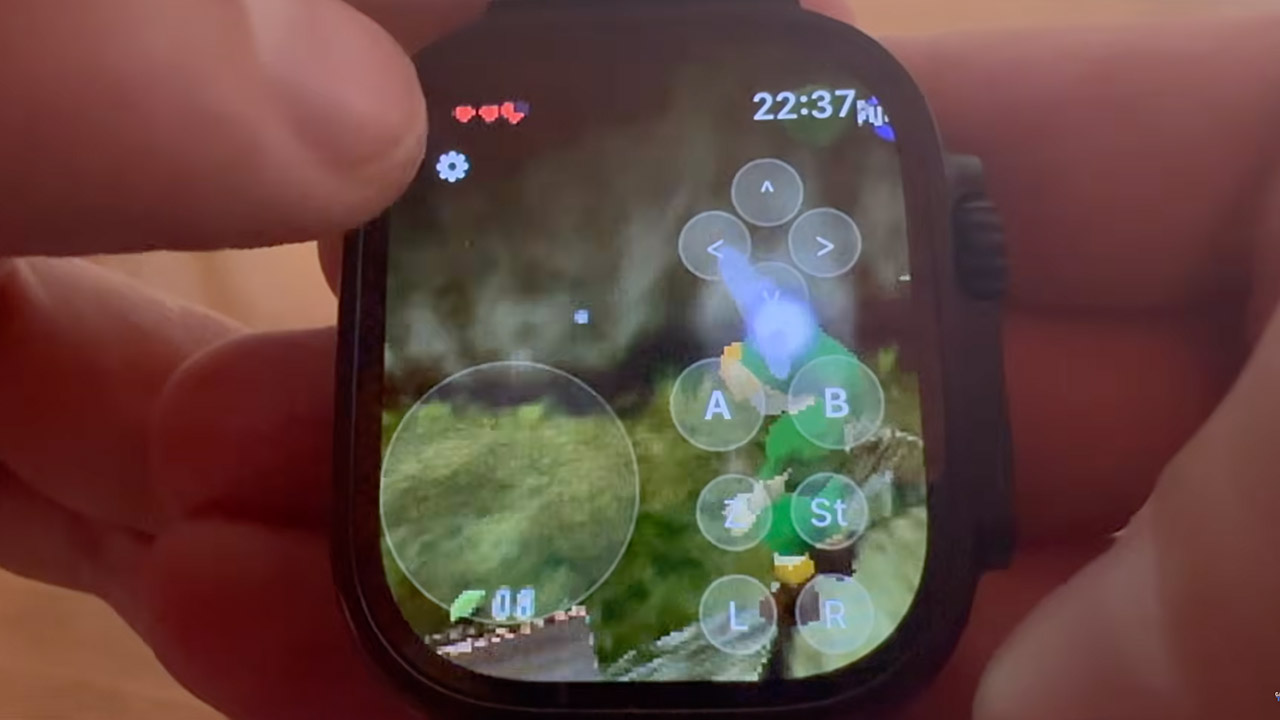
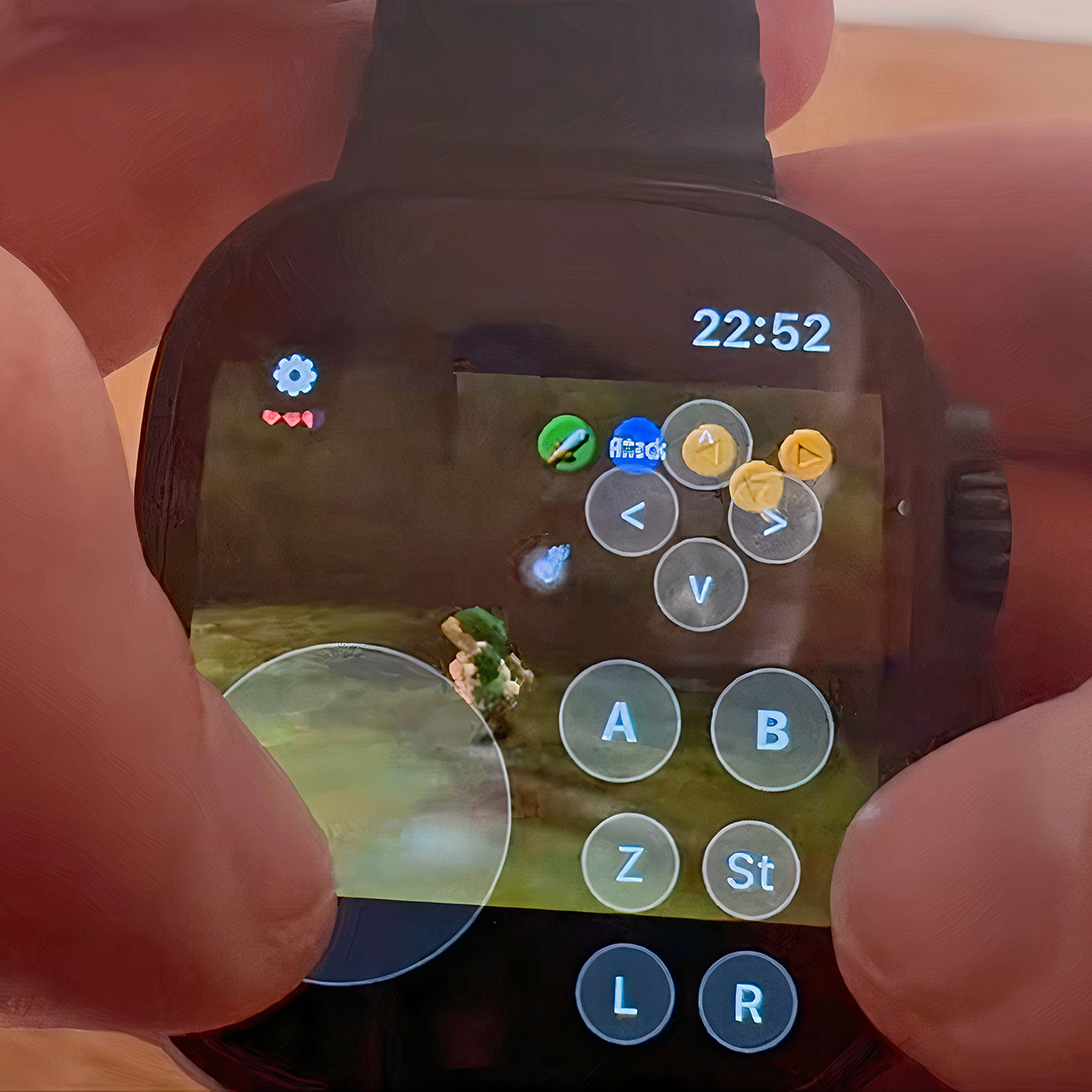
At this point in time it can be safely stated that the question ‘Does it run Doom?’ defaults to a resounding ‘Yes’. This raises the question of what next games should be seen as some kind impressive benchmark, with [Game of Tobi] gunning heavily for Nintendo 64 titles. Most recently he ported Legend of Zelda: Ocarina of Timeto the Apple Watch, with the port almost ready for release along with Super Mario 64 after a few more issues are fixed.
Although there are a few approaches when it comes to porting Nintendo 64 games to other systems, if the target system is effectively a small PC with all of the amenities such as rendering APIs, then using the Ship of Harkinian project as the basis is a good start. This is what [Toby] did with the Apple Watch, and after some work it runs Ocarina of Time at a solid pace, with as the main flaw being busted text rendering.
Of course, the overwhelming flaw with any small gaming system and touchscreen-only systems is that our meaty paws do not shrink that well, and using telepathy to control game systems still isn’t a feature. Thus the biggest compromise with the Apple Watch port is that you have the controls overlaid on the screen. This could probably be compensated for with a Bluetooth controller or similar, but that poses its own problems when it comes to two-handed playing.
Advertisement
Practical issues aside, it’s pretty amazing that just about any ‘smart’ device that we carry around with us can also be a full-featured retro gaming system, and we appreciate [Toby]’s efforts in making this a reality.
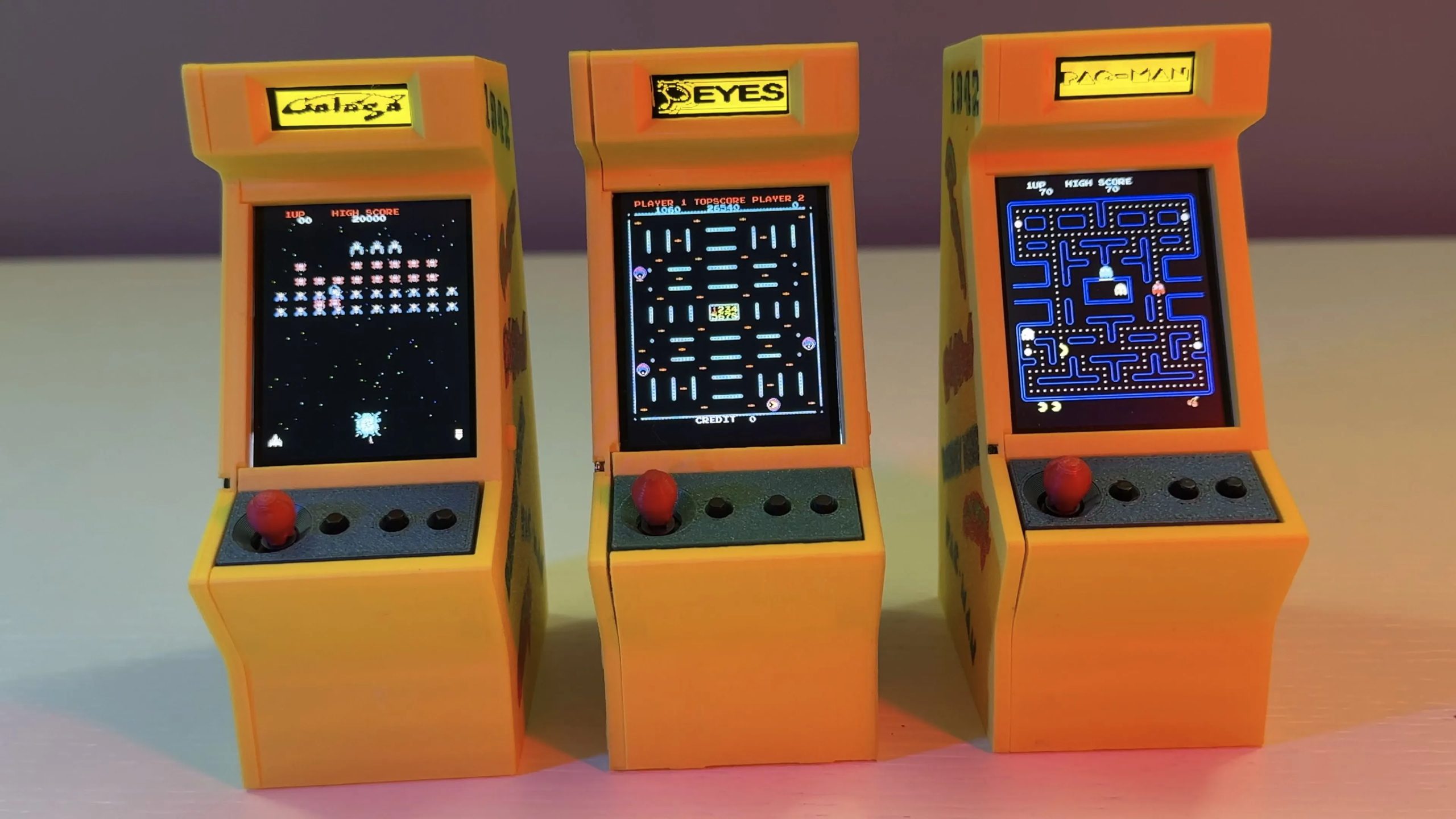
Most people love arcade games, but putting a full-sized arcade cabinet in the living room can lead to certain unpleasant complications. Ergo the market for fun-sized cabinets has exploded alongside the availability of cheap SBCs and MCUs that can run classical arcade titles. Microcontrollers like the ESP32 with its dual 240 MHz cores can run circles around the CPU grunt of 1980s arcade hardware. Cue [Till Harbaum]’s Galagino ESP32-based arcade emulator project, that recently saw some community versions and cabinet takes.
There was a port to the PlatformIO framework by [speckhoiler] which also added a few more arcade titles and repurposed the enclosure of an off-the-shelf ‘My Arcade’ by stuffing in an ESP32-based ‘Cheap Yellow Display‘ (CYD) board instead. These boards include the ESP32 module, a touch display, micro SD card slot, sound output, and more; making it an interesting all-in-one solution for this purpose.
Most recently [Davide Gatti] and friends ported the Galagino software to the Arduino platform and added a 3D printed enclosure, though you will still need to source a stack of parts which are listed in the bill of materials. What you do get is a top display that displays the current game title in addition to the display of the usual CYD core, along with an enclosure that can be printed both in single- or multi-color.
Advertisement
There’s also a build video that [Davide Gatti] made, but it’s only in Italian, so a bit of a crash course in this language may be required for some finer details.
ASUS says the MacBook Neo is a “shock” to the Windows PC ecosystem. “In the past, Apple’s pricing situation has always been high, so for them to release a very budget-friendly product, this is obviously a shock to the entire industry,” said ASUS co-CEO S.Y. Hsu in a Tuesday earnings call. While he expects PC makers to respond, rising AI-driven memory shortages could push hardware prices higher across the industry. PCMag reports: Hsu said he believes all the PC players — including Microsoft, Intel, and AMD — take the MacBook Neo threat seriously. “In fact, in the entire PC ecosystem, there have been a lot of discussions about how to compete with this product,” he added, given that rumors about the MacBook Neo have been making the rounds for at least a year. Despite the competitive threat, Hsu argued that the MacBook Neo could have limited appeal. He pointed to the laptop’s 8GB of “unified memory,” or what amounts to its RAM, and how customers can’t upgrade it.
He also described the MacBook Neo as a “content consumption” device, similar to an iPad. “This is different from the use case of a mainstream notebook,” which can handle more compute-intensive tasks, Hsu said. “How big of an impact [the MacBook Neo] will have on the PC industry will still require some time for us to observe,” Hsu said while suggesting it might not gain traction among Windows PC users due to software differences. “Of course, the entire Windows PC ecosystem will push out products to compete against Apple,” he added.
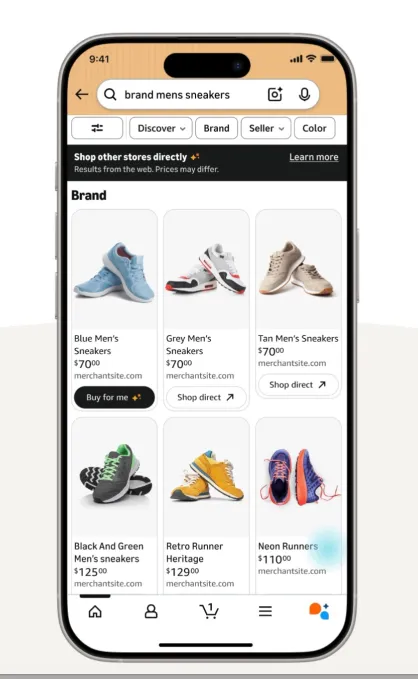
Amazon is expanding access to a program called Shop Direct that lets U.S. customers discover and buy products not sold in its own online store.
The retail giant on Wednesday said it will now support third-party product feeds, which merchants use to provide information about their inventory, pricing, and catalog to other partners. With this information, Amazon can direct shoppers to a merchant’s website via its search results or its AI shopping assistant, Rufus, and even let customers use AI to make a purchase.
The company has added support for third-party product feeds from Feedonomics, Salsify, and CEDCommerce, which provide Amazon access to merchants’ inventory and product information in real time. More feed providers will be supported in time, and an Amazon merchant portal with a merchant-direct feed is said to be coming soon.
In February 2025, Amazon began beta testing a new shopping feature that would link to a retailer’s website when its own search results didn’t include the product the customer was seeking. Customers would see the product information on Amazon, but could click through to the retailer’s site to learn more, check pricing, and view delivery options. Customers would be notified that they were leaving Amazon’s website so they wouldn’t be confused into thinking they were buying from the company itself.
Advertisement
Image Credits:Amazon
The program was being offered to a range of brands and wasn’t limited to partners using Buy with Prime — a way to offer checkout using a customer’s saved payment information on Amazon.
While the move to be included on Amazon could certainly boost a brand’s exposure and potential sales, it could also give Amazon insights into which brands, products and price points are most appealing to customers. The company could use this information to improve its own business by providing data on competing products, tracking trends, identifying potential Buy with Prime partners and more.
It could also help Amazon solidify itself as the starting point for product search.
Image Credits:Amazon
The company says it now supports Buy for Me, which has Amazon use an AI agent to complete purchases, on third-party merchant sites as well.
The AI bot handles the entire purchase process on the customer’s behalf, and the customer simply has to confirm their order details on the checkout page, including their delivery address, taxes, shipping fees, and payment method. Amazon’s AI then completes the checkout from the merchant’s website using the required information.
Customers can track these orders in the same “Your Orders” tab where they track their Amazon purchases, or in a special “Buy for Me Orders” tab.
Advertisement
Shop Direct is live for U.S. customers on Amazon.com, in the Amazon mobile app, and in Amazon’s Rufus AI assistant.
Elyena Lee’s personal journey into motherhood sparked the business idea
When Elyena Lee, 34, had her first child during COVID-19 in early 2020, she struggled to find baby products that matched her personal style.
Back then, she recalled, most options in Singapore leaned heavily toward “kiddish” aesthetics, and high-quality organic essentials from overseas often came at an extremely premium price point.
Frustrated with the lack of accessible choices, she started her own baby brand with a university friend that same year: Soft Spot. Today, Soft Spot sells around 20,000 products annually—and interestingly, many of its products are also purchased by people without children.
We spoke to Elyena about how her personal journey into motherhood has grown into a global baby brand, with a presence in 13 countries.
Advertisement
It started as an online business
Soft Spot began as an online business after months of ideation. Its first product was the Soft Swaddle, made out of muslin fabric, available in one pear print and five solid colours.
Soft Spot’s Soft Swaddles./ Image Credit: Soft Spot
But Elyena didn’t want Soft Spot to remain solely an online brand—she aimed to establish a physical presence as well. She reached out individually to retailers, and just a few months later, Mothercare outlets began stocking Soft Spot’s products.
As the brand grew, it gradually expanded its product range and introduced more colourways. After all, the founder’s main gripe with existing baby products was that they weren’t aesthetically pleasing.
“What differentiates us from other baby brands is that we identify the mom as the main character, rather than the baby,” Elyena explained, adding that Soft Spot’s products particularly speak to millennial and Gen Z mothers who still care about their sense of style and identity.
Hence, she introduces new products typically every three months.
Advertisement
Finding an audience beyond parents
Over time, Soft Spot has grown to 27 product lines—from bibs to baby apparel and even bed sheets—with over 300 different colourways and patterns, all created by a team of in-house designers Elyena has hired over the years. Prices start from S$29 for its products.
The brand’s Soft Tea Towels can be used as basket liners or placemats in the house, while its Soft Caddy can be used as a carrier on-the-go trips./ Image Credit: Soft Spot
The brand also discovered an unexpected audience that went beyond babies. Thanks to its soft cotton material and pretty aesthetics, the products began to be used in a variety of ways beyond their original purpose.
Mothers and even non-parents began buying Soft Spot’s single bed sheets for their design, while couples without children purchased Soft Squares—originally burp cloths—as handkerchiefs or Soft Swaddles as bath towels for their suitability for sensitive skin.
“Some customers even used swaddles as picnic mats or beach wraps!” Elyena exclaimed.
Soft Petal Bibs fit both babies and fur babies, while the Soft Quilt Blanket sometimes finds itself outside the house as a picnic mat./ Image Credit: Soft Spot
With demand rising, Elyena, who had spent eight years in the FMCG industry at multinational giants like Unilever and L’Oréal in brand and product development roles, decided to leave her full-time job in 2023 to run Soft Spot solo.
Expanding Soft Spot’s presence in Singapore and beyond
Soft Spot is stocked at Tangs (left) and Mothercare (right)./ Image Credit: Soft Spot
Over the years, more retailers in Singapore began stocking Soft Spot, including Tangs, Frankie & Fern’s, and A Greener Wood.
The brand also expanded its physical presence through pop-ups, such as the Christmas Atelier in 2024 and 2025, and a three-month test pop-up at Phoenix Park in Tanglin in Sept 2024.
That said, the brand still maintains a strong online presence, with products available not only through its own website but also via partner retailers like Stacked Store and Hipvan. This reflects Soft Spot’s vision of being “more than a baby brand,” extending its signature aesthetic into the modern home.
Soft Spot stocked at Dawn & Daisy in Brunei (left) and Seahorse Concept Store in Taiwan (right)./ Image Credit: Soft Spot
Internationally, Soft Spot first made its mark when it was stocked at French family concept store Smallable in 2022, which, according to Elyena, has a “strong online presence” in both European and US markets.
Currently, Elyena shared that Soft Spot sells about 20,000 items a year.
Advertisement
Despite this growth, a permanent retail store is not on the cards for now due to Singapore’s challenging retail environment. For the time being, pop-ups and strengthening its online presence offer the right balance for the brand.
Elyena at Soft Spot’s pop-up at Christmas Atelier in 2025./ Image Credit: Soft Spot
“As a small brand, our only advantage is speed and flexibility,” shared Elyena.
She hops on trends to stay relevant and takes an experimental approach, negotiating lower test quantities with suppliers to reduce risk. But while she moves quickly, she ensures that every release meets her standards.
Coming from a multinational corporation background, Elyena admitted that entrepreneurship was initially a culture shock for her.
“In an MNC, there’s always someone who specialises in every field,” she says. “As a founder, you have to go into all areas with no experience, such as vetting legal documents, accounting, IT glitches—everything—by yourself.”
Advertisement
There is no boss, no historical data to reference, and no one to dictate strategic direction. While it can get lonely at times, the journey has allowed her to measure her own success at her own pace, and she is proud of how far she has come.
Looking ahead, Elyena wants to expand beyond baby products into more categories. Her ultimate goal? To serve the “modern family” with more home and living items, on-the-go essentials, and potentially bags and clothing.
The President of Larry Ellison’s “new and improved” Paramount, Jeff Shell, has been conspicuously absent from recent events heralding the company’s problematic acquisition of Warner Brothers. The reason? Shell is being accused by a “whistleblower” and former partner of leaking company info, including early word of the company’s $7.7 billion August 2025 deal to obtain the exclusive rights to stream MMA fights.
Shell, previously fired by Comcast for sexual harassment allegations, allegedly had a… complicated relationship with the man, R.J. Cipriani. Cipriani claims to have been a “crisis communications” specialist who helped Shell plant favorable stories in the media in exchange for Shell’s promise to help fund a TV show. An internal Paramount investigation into the claims is ongoing.
But Cipriani is also now suing Shell $150 million for not following through on his promises:
“The plaintiff, R.J. Cipriani, alleges in the lawsuit that he had a relationship with Shell for 18 months, in which Cipriani would tip Shell off to forthcoming news articles and offer advice. The suit also alleges that Shell would share non-public information with Cipriani about Paramount’s plans.”
The whole story is an interesting read, and includes claims that Shell told Cipriani that Paramount significantly overpaid for Warner Brothers. And that Cipriani seeded the trade press with lots of information favorable to Paramount, including some allegedly peppered into this June 2025 story about a potential fight between South Park’s creators and Paramount.
Advertisement
Nobody in the story comes off as having particularly sound judgment. You also wonder, if Cipriani’s claims are true, who are the people at these media companies who are so easily manipulatable.
“It’s an echo of the feelings-don’t-matter, no-coddling ethos that powers Silicon Valley, where Ellison was raised and watched his father, Larry Ellison, grow Oracle into one of the most valuable companies in the world (and make himself one of the richest people on the planet). Multiple sources say Ellison is building a more brash culture that’s defiantly upending the circumspect, politically correct style that has defined Hollywood in the post-#MeToo, post-George Floyd eras. It’s a studio reborn, where blunt feedback is the norm, canceled talent is welcome (cheaper on the dollar, and yearning to prove themselves) and no one is walking on eggshells.”
I bring all of this up because the previous three mergers related to Warner Brothers (spanning two decades) have been absolute disasters. Usually because the people acquiring the company were broadly incompetent (see: AT&T), had terrible judgement, and bit off way more than they could chew in terms of both depth, collaborative creation, and competency.
Advertisement
With a mammoth $111 billion price tag for Warner Brothers, thrown atop the debt acquired through the CBS and other deals, this new Paramount is a towering mountain of financial obligation that’s going to result in dysfunction, layoffs, and chaos likely to make past Warner deals seem quaint. All overseen by people who apparently (and quite proudly) have some of the worst judgment imaginable.
Toby, a game developer known online as Game of Tobi, has managed to port the Nintendo 64 classic The Legend of Zelda: Ocarina of Time to the Apple Watch. This legendary game is known for its massive world and devilishly difficult puzzles, all of which make it onto the tiny wearable in a version that pushes the device’s capabilities far beyond what most people would have thought.
Toby built on the ship code for the Ship of Harkinian project, also known as the Shipwright project on GitHub. This tool completely decompiles the original game code, allowing developers to transfer the game to newer systems without using traditional emulation. Given that the Apple Watch is essentially a little computer with access to some great graphics tools, Toby was able to adapt the codebase to operate on watchOS. He used SceneKit for visuals, which handled the game’s 3D world seamlessly on the small watch screen.
HYPERTENSION NOTIFICATIONS — Apple Watch Series 11 can spot signs of chronic high blood pressure and notify you of possible hypertension.*
KNOW YOUR SLEEP SCORE — Sleep score provides an easy way to help track and understand the quality of your sleep, so you can make it more…
EVEN MORE HEALTH INSIGHTS — Take an ECG anytime.* Get notifications for a high and low heart rate, an irregular rhythm,* and possible sleep apnea…
The gameplay progresses quickly, with Link tramping around Hyrule Field, wielding his sword, and navigating the various environments with no notable slowdowns. The menus appear as expected, objects are used properly, and battle runs well. There is a settings option that allows you to pick between a full-screen display that fills the watch face and the original rendered output, which both work.
Controls are probably the trickiest part, since the watch is essentially just a touchscreen and a digital crown, so Toby came up with a virtual button system to handle things like jumping, fighting, and using items. Yes, your fingers will cover part of the screen, but it becomes second nature after a little practice. You can technically pair a Bluetooth controller, though the Apple Watch is really built for one hand, which makes two handed play a bit of an awkward experience.
There are a few bugs still hanging around though, most noticeably some inconsistent text rendering that can make dialogue and signs a little hard to read. Toby is working on ironing those out before any wider release. Interestingly, he had already ported Super Mario 64 to the Apple Watch before this, and that experience seems to have helped him sidestep a few of the pitfalls he ran into here. [Source]

















![Apple Watch Series 11 [GPS 42mm] Smartwatch with Jet Black Aluminum Case with Black Sport Band - S/M...](https://m.media-amazon.com/images/I/31ybzrJZckL._SL160_.jpg)