




Connect with us

Tech

Second-gen MacBook Neo isn't going to have a touchscreen

Published

on

An analyst has refuted his own previous rumors about the second-gen MacBook Neo gaining a touchscreen. This is obvious, given how inexpensive the first model is to produce.

Open pink laptop on a desk displaying multiple colorful app windows, including a food website and document. Another closed pastel-colored device sits behind it on a light wooden table
MacBook Neo, sans touchscreen.

The MacBook Neo is a model that brings Apple in direct competition with low-cost notebooks such as Chromebooks. However, despite Apple’s interest in lowering the cost of manufacturing the model as far as possible, there’s a little confusion over the next model along.
TF Securities analyst Ming-Chi Kuo commented in late 2025 that the next iteration could bring touchscreen support. This was apparently going to be included by integrating the touch layer directly into the IPS panel, the same way that the entry-level iPad does now, and has for years.
Rumor Score: 🤯 Likely
Continue Reading on AppleInsider | Discuss on our Forums

Source link

Continue Reading
Click to comment

Leave a Reply

Your email address will not be published. Required fields are marked *

Tech

Opinion: The wrong tax at the wrong time for Washington

Published

on

Editor’s note: GeekWire publishes guest opinions to foster informed discussion and highlight a diversity of perspectives on issues shaping the tech and startup community. If you’re interested in submitting a guest column, email us at tips@geekwire.com. Submissions are reviewed by our editorial team for relevance and editorial standards.

Jesse Proudman.

As a kid growing up in Tacoma, I remember visiting Seattle to interview executives at Go2Net and leaving in awe of what was possible. That moment distinctly shaped my career, one I’ve spent as a founder building multiple companies in Washington state. I stayed because this region had something special: a culture of innovation, a willingness to take risks, and a tax climate that fostered the high risk, high reward reality of startup life.

Watching what’s happening in Olympia, I’m saddened by the storm brewing on the horizon. I see an unconstitutional tax being passed to plug a hole created by a spending problem that in turn will cause an exodus of talent and capital, widen the deficit, and result in the application of this income tax to every Washingtonian. And all of this is happening just as AI transforms the knowledge economy in a way almost no one yet understands.

Washington legislators have a spending addiction, and Olympia’s solution is to reach deeper into the pockets of its citizens. The proposed SB 6346, the “millionaires tax,” would impose a 9.9% income tax on high earners, not through a constitutional amendment approved by voters, but through legislative sleight-of-hand. Proponents promise revenue to close a projected $4.3 billion deficit in the state’s budget. But the numbers don’t work, the constitutional bypass is dangerous, and the consequences for Washington’s economic future have been wildly underestimated.

The state’s spending problem is undeniable and untenable. The budget has more than tripled in the last decade: from $33.6 billion in 2013-2015 biennium to a projected $173 billion for ‘25-27 biennium. Even adjusted for inflation and population growth, real per-capita spending is up over 50%. The state faces a $1.5 billion deficit this biennium and a projected $4.3 billion hole in the next. 

Advertisement

Now, in the 11th hour of this legislative session, SB 6346 is introduced: an income tax that attempts to bypass 90 years of constitutional precedent. Washington’s constitution treats income as property, capped at a 1% tax, and changing that requires two-thirds legislative support plus voter approval. That’s a high bar and intentionally so. SB 6346 side steps this entirely, passing the tax as ordinary legislation and relying on five justices to overturn nine decades of precedent. If Washington wants a progressive income tax, there’s a legitimate path: amend the constitution. Punting to the courts isn’t leadership, it’s a gamble with the state’s economic future.

But more importantly, this tax won’t just apply to millionaires — that’s simply the wedge being used to get it approved. Senate Majority Leader Jamie Pedersen, the bill’s sponsor, has acknowledged that once the infrastructure requiring all Washingtonians to file tax returns is in place, “we all want to make sure that our successors will have the flexibility to respond to the challenges that they see.” This is a polite way of saying the door is open to a universal income tax. On March 10, lawmakers rejected amendments to the bill that would have locked in the $1 million threshold to the law.

Proponents argue that wealthy residents won’t leave over a 9.9% income tax, but history says otherwise. Washington already ranks 45th nationally in tax competitiveness and after the capital gains tax passed in 2022, the state saw major capital flight in years following. Forbes estimated one high-profile relocation saved nearly $1 billion in annual taxes, more than the state collects from capital gains in a year. A February 2026 survey by the Association of Washington Business found 44% of business leaders are considering moving their personal residence out of state, and the share actively looking to relocate has nearly doubled.

The revenue projections for SB 6346 are almost certainly overstated. Capital gains collections fell short because the tax base shrunk from unexpected relocations in the years following and the same will happen here. Every entrepreneur who leaves takes future job creation with them. Every company that moves employees takes their spending (sales tax), housing budget (property tax), and charitable giving with them. The people who feel they “couldn’t be paid to leave” will find their neighbors already have, and those left behind will foot the state’s deficit on their own.

Advertisement

All of this comes at the worst possible moment. Washington’s tech sector is facing a once-in-a-century transformation from the application of AI. The knowledge economy is in deep trouble as companies determine the breadth and depth of cuts with a post-AI enabled workforce. In October 2025, Amazon announced 2,300 corporate layoffs in Washington. Microsoft has cut more than 3,200 jobs in the state since last May. Tech employment here fell 6% even as the national economy added jobs, and entry-level roles for workers under 25 plummeted by 13%. Microsoft’s CEO recently acknowledged that AI now generates 30% of the company’s code. We’re not just seeing layoffs, we’re witnessing a fundamental restructuring of the industry that has been a core pillar for Washington. 

There’s a legitimate path to an income tax: ask the voters. But that’s not what’s happening here. What’s happening is a constitutional end-run in the final days of a legislative session, passed by lawmakers who won’t be around to answer for the exodus that follows and who have acknowledged this tax will ultimately be paid by all. Florida, Nevada, Texas, and Tennessee are watching and they won’t need to recruit, they’ll just need to wait.

Source link

Advertisement
Continue Reading

Tech

Meta rolls out new scam detection across WhatsApp, Messenger, and Facebook

Published

on

The company removed 159 million scam ads last year and took down 10.9 million accounts linked to criminal networks. Now it wants to catch scammers before they get to you.

Meta has announced a fresh wave of anti-scam tools across its platforms, WhatsApp, Messenger, and Facebook, as it steps up both on-platform detection and cooperation with law enforcement in Southeast Asia and beyond.

The centrepiece of the announcement is a new Facebook feature, currently in testing, that flags suspicious friend or follow requests before users act on them. When a request arrives from an account with no mutual connections, a different country location, or a suspiciously recent join date, Facebook will display a warning.

The same alert will appear when users send requests to similarly flagged accounts. The feature is designed to interrupt one of the most common social engineering pipelines: fake profiles that accumulate mutual friends over time to lend themselves a veneer of legitimacy, then pivot to scam messages through Messenger.

Advertisement

WhatsApp is also getting a new layer of protection targeting a specific and growing attack vector: device linking fraud. Scammers have been tricking users into scanning malicious QR codes, sometimes under the pretence of a customer service call or technical support request, which links the scammer’s device to the victim’s WhatsApp account.

Advertisement

The app will now display a warning when it detects a suspicious device linking request and show the user where the request originated.

For Messenger, Meta says it is expanding its existing scam detection feature to more countries this month. The system works in two stages. First, on-device analysis automatically flags messages from unfamiliar contacts that match the patterns of common scams, fraudulent job offers, fake investment pitches, work-from-home schemes.

If flagged, the user is warned and given the option to send the conversation to Meta’s AI for a cloud-based second review. That opt-in step breaks the message’s end-to-end encryption, which Meta discloses; users who prefer not to submit can still act on the on-device warning alone.

The detection feature can be accessed and toggled in Settings > Privacy & Safety Settings > Scam Detection.

Advertisement

Alongside the platform-level tools, Meta is accelerating a broader advertiser verification push. The company says it wants verified advertisers to account for 90% of its ad revenue by the end of 2026, up from 70% at present.

The remaining 10% would be reserved for low-risk advertisers such as small local businesses, which Meta gives as an example of a category it deems exempt from the high-risk verification requirement.

The announcement comes with a significant set of enforcement numbers. Meta says it removed more than 159 million scam ads last year and took down 10.9 million Facebook and Instagram accounts associated with criminal scam operations.

It also disclosed the outcome of a recent joint operation with the Royal Thai Police, which resulted in 21 arrests and Meta disabling more than 150,000 accounts linked to scam centre networks.

Advertisement

This was the second such “Joint Disruption Week,” according to Axios, the first, in December, had seen Meta remove 59,000 accounts and pages; the second expanded the coalition to include the UK, Canada, South Korea, Japan, Singapore, the Philippines, Australia, New Zealand, and Indonesia.

Meta also confirmed a partnership with the US Department of State to launch the ‘Trapped in Scam Crime’ awareness campaign in Vietnam, Thailand, Laos, Cambodia, and several other countries.

The campaign targets the supply side of the problem: the trafficked workers who are themselves coerced into staffing scam centres, often lured with fake job offers before being held against their will in compounds primarily based in Myanmar, Cambodia, and Laos.

The moves come as Meta faces intensifying scrutiny over scam advertising more broadly. A Reuters investigation in late 2025 reported that internal Meta documents showed the company earned an estimated $7 billion annually from ads linked to scams and prohibited goods, and showed users roughly 15 billion higher-risk ads per day on average.

Advertisement

Meta has disputed some of the Reuters framing; the current announcement is the latest in a series of enforcement updates the company has made public in the months since.

Source link

Advertisement
Continue Reading

Tech

German Fireball’s 15 Minutes Of Fame

Published

on

Sunday night, around 7:00 PM local time, a bright fireball streaked across the western German sky, exploded, and rained chunks of space rock down on the region around Koblenz. One of the largest known chunks put a soccer-ball-sized hole in someone’s roof, landing in their bedroom. Fortunately, nobody was hurt. But given the apparent size of the explosion, there must be many more pieces out there for the finding, and a wave of hopeful meteorite hunters has descended upon the region.

But if you wanted a piece of the action, where exactly would you start looking? How do scientists find meteorites anyway? And what should you do if you happen to see a similar fireball in the night sky?

Citizen Science

Meteorite video-bombs a boring parking lot in Heerlen, NL.

In the age of always-on dashboard cameras, ubiquitous smartphones, and other video recording devices, it’s hard for a shy meteorite to find a quiet spot out of the public eye. That makes them a lot easier to find than they were in the past. Indeed, the International Meteor Organization, which aggregates amateur meteor observations, received more than 3,200 reports of this one, including several with video documentation. Some are stunning, and others may not even be of the event at all.

By collecting reports from many locations, they can hope to piece together the meteorite’s trajectory. However, if you look at the individual reports, it’s clear that this is a difficult task. Nobody is expecting a bright fireball to streak across the night sky, so many of the reports are reasonably vague on the details and heavy on the awe.

This report from [Sophie Z], for instance, is typical. She records where she was and roughly the location in the night sky where the meteorite passed, along with the comment “I’ve never seen anything so amazing and large before in my life.” Other amateur observers are more precise. [David C] (“I have a Ph.D in physics”) managed to record the start and the end heading of the meteorite to a couple of decimal places. He must have had a camera.

Advertisement

We’d love to know the exact algorithm used for combining the reports. It’s worth noting that reporters get an experience score, and the system presumably takes this into account when producing the average track. However, the system works, though, with 3,200 reports of a once-in-a-lifetime meteorite, it’s bound to come up with a pretty good estimate. But for smaller meteorites, like this one that flew by on Monday night, there are fewer observers, and deducing the actual track is a lot more difficult.

Everyday meteorites are better tracked by taking a more systematic approach. We’ve covered a few of these networks before, because the equipment needed to contribute meaningfully isn’t all that much more complicated than a single-board computer with a network connection, a camera module, and a weatherproof housing to keep it working all year round. We’ve covered the French meteorite-hunting network, Fripon, before, and have featured other amateur sky-camera builds to boot. But we’re not amateur astronomers, so we’re not in the loop on what the current state of the art is. If you know about coordinated citizen-science meteorite tracking efforts, let us know in the comments.

Geologists Get Into The Astronomy Game

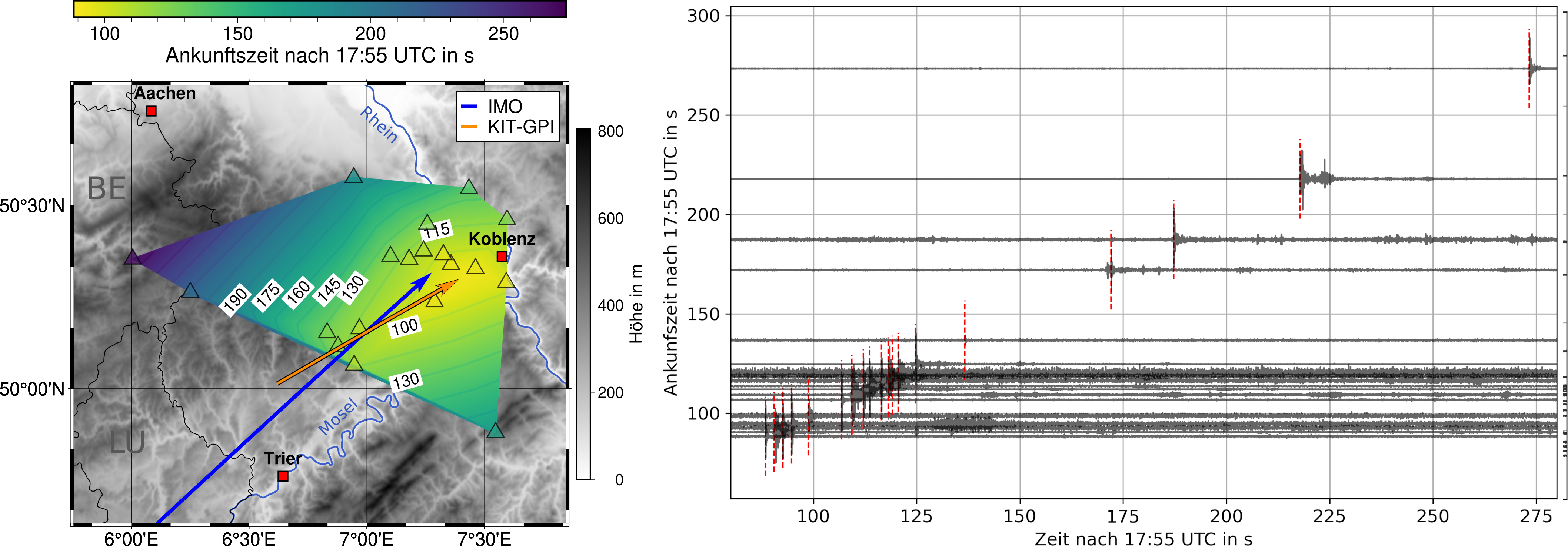
This meteorite was big enough and loud enough when it exploded that participation in tracking wasn’t limited to those who are looking up. Geologists at the Karlsruhe Institute for Technology (KIT) found that the explosion registered on their seismometers. (Via Heise Online.) These have the advantage that they are in very well-known locations with extremely precise timestamps. After all, that’s what they’re used for every day, although the medium that the pressure waves travel through is usually the earth rather than the air.

This was also a particularly lucky event for the KIT team because it happened over a particularly dense network of seismological stations in the Eifel mountains, allowing for greater resolution. And as they point out, using the sound of the explosion has the additional advantage of not being hindered by light conditions during the day or clouds at night. This makes us think of how easy it would be to set up a distributed system of microphones to do something similar.
Advertisement

The KIT track estimate lines up fairly well with the aggregated estimate from amateur observers, but it’s not exactly the same. Who is right? We’ll see where more of the meteorites are found on the ground, presumably, in the next few weeks.

Meteorite Hunting

If the meteorite fell through our roof and chunks were scattered all around our bedroom, we’d count ourselves lucky. But would we get to keep it? Of course, it depends on the local laws, and in Germany, you can keep the meteorites in most cases, unless the state decides that it’s of special value for whatever reason, and then they get first dibs.

Apparently, the going rate for meteorites is between 1€ and 5,000€ per gram, so we’re not entirely sure that it will cover the damage. Maybe our homeowners’ insurance would? We’ll have to go dig out our policy to be sure, but however that plays out, we’d just be stoked to have the meteorite chunks and a good story.

While very big fireballs like this are rare, NASA estimates that around 44,000 kg of meteoritic material falls on the Earth every day. (Whoah!) Most of this burns up in the atmosphere, but some falls to the ground. Most of that fraction is in the form of micrometeorites, which are sand-grain-sized bits that are very likely raining down on us every day. Indeed, if you’re interested, you can try to collect them, and all you need is a tarp on the roof or a magnet in your downspout, a good microscope, and a bit of knowledge. So if all you want is some extraterrestrial rock, and you’re not worried so much about the size, maybe micrometeorite hunting is the path to success.

Advertisement

Have you gone looking for meteorites? Know of any up-to-date amateur fireball-hunting networks? Sound off in the comments!


Source link

Advertisement
Continue Reading

Tech

China Moves To Curb OpenClaw AI Use At Banks, State Agencies

Published

on

An anonymous reader quotes a report from Bloomberg: Chinese authorities moved to restrict state-run enterprises and government agencies from running OpenClaw AI apps on office computers, acting swiftly to defuse potential security risks after companies and consumers across China began experimenting with the agentic AI phenomenon. Government agencies and state-owned enterprises, including the largest banks, have received notices in recent days warning them against installing OpenClaw software on office devices for security reasons […]. Several of them were instructed to notify superiors if they had already installed related apps for security checks and possible removal, some of the people said.

Certain employees, including those at state-run banks and some government agencies, were banned from installing OpenClaw on office computers and also personal phones using the company’s network, some of the people said. One person said the ban was also extended to the families of military personnel. Other notices stopped short of calling for an outright ban on OpenClaw software, saying only that prior approval is needed before use, the people said. The warning underscores Beijing’s growing concern about OpenClaw, an agentic AI platform that requires unusually broad access to private data and can communicate externally, potentially exposing computers to external attack. […]

Despite the potential security risks, companies from Tencent to JD.com Inc. have been rolling out OpenClaw apps to try and capitalize on the groundswell of enthusiasm, while several local government agencies have declared millions of yuan in subsidies for companies that develop atop the platform. […] Tech giants like Tencent and Alibaba, along with AI upstarts ranging from Moonshot to MiniMax, have rolled out their own tweaks of the software touting simple, one-click adoption. A slew of government agencies, in cities from Shenzhen to Wuxi, have issued notices offering multimillion-yuan subsidies to startups leveraging OpenClaw to make advances. The frenzy has helped drive up shares of AI model developer MiniMax nearly 640% since its listing just two months ago. It’s now worth about $49 billion, surpassing Baidu — once viewed as the frontrunner in Chinese AI development — in market value. The company launched MaxClaw, an agent built on OpenClaw, in late February.

Source link

Advertisement
Continue Reading

Tech

Two indie greats and a legendary children's book app arrive on Apple Arcade in April

Published

on

Apple is expanding its collection of Apple Arcade games with “Dredge+,” “Unpacking+,” and “My Very Hungry Caterpillar+” in April — two of which are App Store Award winners.

iPhone screen showing Apple Arcade logo on a red background, surrounded by colorful game icons including Dredge Plus, a cute pig game, and a caterpillar game on a gradient purple blue background
Three new games join Apple Arcade in April

While Apple may not be adding a ton of games in April, the three games coming next month are surprisingly varied. This time, we’ll see the addition of a survival horror game, a zen puzzle game, and a game geared towards the preschool crowd.
Continue Reading on AppleInsider | Discuss on our Forums

Source link

Continue Reading

Tech

Washington House passes 9.9% ‘millionaires tax’ as business leaders warn of ‘seismic shift’

Published

on

The Legislative Building in Olympia, Wash., is home to the state’s Legislature. (GeekWire Photo / Lisa Stiffler)

The so-called “millionaires tax” passed the Washington House Tuesday night after more than 24 hours of debate, teeing up the bill for final approval today or tomorrow.

The controversial measure creates a 9.9% tax applied to taxable, personal annual income that exceeds $1 million. Washington is currently one of nine states without an income tax and the move is expected to face challenges in court and as a ballot measure.

Supporters of Senate Bill 6346 say it will bring some fairness to a regressive tax code that has relied heavily on sales, property and business taxes. The legislation includes tax benefits for low-income families and small businesses.

A final fiscal analysis has not been released, but the bill is expected to generate $3.5 billion or more each year in tax revenue beginning in 2029. State leaders this year have been trying to plug a more immediate $2 billion budget gap.

“The Millionaires’ Tax will apply to less than one half of one percent of Washingtonians, but make life more affordable for millions. I look forward to signing it,” said Gov. Bob Ferguson in a statement.

Advertisement

But some tech leaders and entrepreneurs worry it could undermine their sector by souring Washington’s relatively favorable tax laws for startup founders, investors and high-wage earners.

That concern took a high-profile form last night as Howard Schultz, the billionaire former CEO of Starbucks, disclosed on LinkedIn that he and his wife, Sheri, have relocated to Miami. While Schultz —who is retired — framed the move as a desire to be closer to family on the East Coast, he pointedly noted his “hope that Washington will remain a place for business and entrepreneurship to thrive.”

Schultz’s family office will follow him to Florida, though his foundation will stay in Seattle. The move underscores warnings from critics like Kris Johnson, president of the Association of Washington Business, who called SB 6346 a “seismic shift” in the state’s tax structure.

“By adopting a state income tax, Washington is giving up one of our primary competitive advantages we have had over other states and regions,” Johnson said, adding that the state is already expensive for families and employers and could push businesses to start, grow or move elsewhere.

Advertisement

Others took a concerned, but more nuanced tone. Rachel Smith, president of Washington Roundtable, a nonprofit representing major employers, credited lawmakers for repealing an expanded sales tax on services that was passed last year and reducing the estate tax.

She highlighted the need for further changes to the tax code to improve the state’s “economic competitiveness” and “long-term budget sustainability.”

“As we have said before, we see this as the beginning — not the end — of real, earnest work to implement the changes Washington needs,” Smith said. “It is imperative that this work happen quickly.”

SB 6346 marks the first time in decades that state lawmakers have pursued a personal income tax aimed at high‑income residents.

Advertisement

The bill passed the House with a 51-46 vote. No Republican lawmakers supported the measure and eight Democrats voted against it. One member was excused. It now returns to the Senate for agreement, and then moves to the governor. The legislative session is scheduled to end tomorrow.

Related:

Source link

Continue Reading

Tech

Running Ocarina Of Time On The Apple Watch

Published

on

At this point in time it can be safely stated that the question ‘Does it run Doom?’ defaults to a resounding ‘Yes’. This raises the question of what next games should be seen as some kind impressive benchmark, with [Game of Tobi] gunning heavily for Nintendo 64 titles. Most recently he ported Legend of Zelda: Ocarina of Time to the Apple Watch, with the port almost ready for release along with Super Mario 64 after a few more issues are fixed.

Although there are a few approaches when it comes to porting Nintendo 64 games to other systems, if the target system is effectively a small PC with all of the amenities such as rendering APIs, then using the Ship of Harkinian project as the basis is a good start. This is what [Toby] did with the Apple Watch, and after some work it runs Ocarina of Time at a solid pace, with as the main flaw being busted text rendering.

Of course, the overwhelming flaw with any small gaming system and touchscreen-only systems is that our meaty paws do not shrink that well, and using telepathy to control game systems still isn’t a feature. Thus the biggest compromise with the Apple Watch port is that you have the controls overlaid on the screen. This could probably be compensated for with a Bluetooth controller or similar, but that poses its own problems when it comes to two-handed playing.

Advertisement

Practical issues aside, it’s pretty amazing that just about any ‘smart’ device that we carry around with us can also be a full-featured retro gaming system, and we appreciate [Toby]’s efforts in making this a reality.

Advertisement

Source link

Continue Reading

Tech

Mini Multi-Arcade Game Cabinets With An ESP32 And Galagino

Published

on

Most people love arcade games, but putting a full-sized arcade cabinet in the living room can lead to certain unpleasant complications. Ergo the market for fun-sized cabinets has exploded alongside the availability of cheap SBCs and MCUs that can run classical arcade titles. Microcontrollers like the ESP32 with its dual 240 MHz cores can run circles around the CPU grunt of 1980s arcade hardware. Cue [Till Harbaum]’s Galagino ESP32-based arcade emulator project, that recently saw some community versions and cabinet takes.

There was a port to the PlatformIO framework by [speckhoiler] which also added a few more arcade titles and repurposed the enclosure of an off-the-shelf ‘My Arcade’ by stuffing in an ESP32-based ‘Cheap Yellow Display‘ (CYD) board instead. These boards include the ESP32 module, a touch display, micro SD card slot, sound output, and more; making it an interesting all-in-one solution for this purpose.

Most recently [Davide Gatti] and friends ported the Galagino software to the Arduino platform and added a 3D printed enclosure, though you will still need to source a stack of parts which are listed in the bill of materials. What you do get is a top display that displays the current game title in addition to the display of the usual CYD core, along with an enclosure that can be printed both in single- or multi-color.

Advertisement

There’s also a build video that [Davide Gatti] made, but it’s only in Italian, so a bit of a crash course in this language may be required for some finer details.

Thanks to [ZT] for the tip.

Advertisement

Source link

Continue Reading

Tech

ASUS Executive Says MacBook Neo is ‘Shock’ to PC Industry

Published

on

ASUS says the MacBook Neo is a “shock” to the Windows PC ecosystem. “In the past, Apple’s pricing situation has always been high, so for them to release a very budget-friendly product, this is obviously a shock to the entire industry,” said ASUS co-CEO S.Y. Hsu in a Tuesday earnings call. While he expects PC makers to respond, rising AI-driven memory shortages could push hardware prices higher across the industry. PCMag reports: Hsu said he believes all the PC players — including Microsoft, Intel, and AMD — take the MacBook Neo threat seriously. “In fact, in the entire PC ecosystem, there have been a lot of discussions about how to compete with this product,” he added, given that rumors about the MacBook Neo have been making the rounds for at least a year. Despite the competitive threat, Hsu argued that the MacBook Neo could have limited appeal. He pointed to the laptop’s 8GB of “unified memory,” or what amounts to its RAM, and how customers can’t upgrade it.

He also described the MacBook Neo as a “content consumption” device, similar to an iPad. “This is different from the use case of a mainstream notebook,” which can handle more compute-intensive tasks, Hsu said. “How big of an impact [the MacBook Neo] will have on the PC industry will still require some time for us to observe,” Hsu said while suggesting it might not gain traction among Windows PC users due to software differences. “Of course, the entire Windows PC ecosystem will push out products to compete against Apple,” he added.

Source link

Continue Reading

Tech

Amazon expands a program that lets customers shop from other retailers’ sites

Published

on

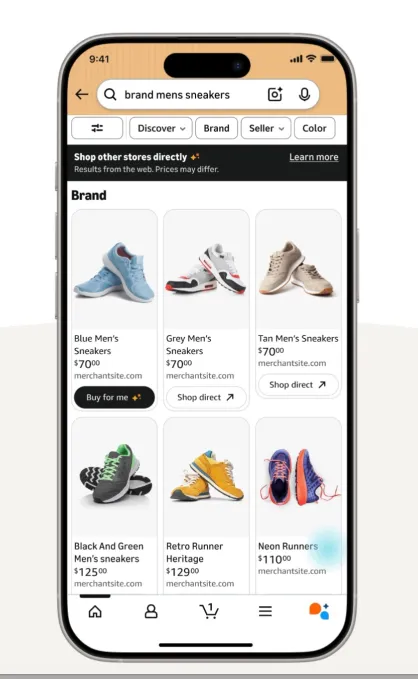
Amazon is expanding access to a program called Shop Direct that lets U.S. customers discover and buy products not sold in its own online store.

The retail giant on Wednesday said it will now support third-party product feeds, which merchants use to provide information about their inventory, pricing, and catalog to other partners. With this information, Amazon can direct shoppers to a merchant’s website via its search results or its AI shopping assistant, Rufus, and even let customers use AI to make a purchase.

The company has added support for third-party product feeds from Feedonomics, Salsify, and CEDCommerce, which provide Amazon access to merchants’ inventory and product information in real time. More feed providers will be supported in time, and an Amazon merchant portal with a merchant-direct feed is said to be coming soon.

In February 2025, Amazon began beta testing a new shopping feature that would link to a retailer’s website when its own search results didn’t include the product the customer was seeking. Customers would see the product information on Amazon, but could click through to the retailer’s site to learn more, check pricing, and view delivery options. Customers would be notified that they were leaving Amazon’s website so they wouldn’t be confused into thinking they were buying from the company itself.

Advertisement
Image Credits:Amazon

The program was being offered to a range of brands and wasn’t limited to partners using Buy with Prime — a way to offer checkout using a customer’s saved payment information on Amazon.

While the move to be included on Amazon could certainly boost a brand’s exposure and potential sales, it could also give Amazon insights into which brands, products and price points are most appealing to customers. The company could use this information to improve its own business by providing data on competing products, tracking trends, identifying potential Buy with Prime partners and more.

It could also help Amazon solidify itself as the starting point for product search.

Image Credits:Amazon

The company says it now supports Buy for Me, which has Amazon use an AI agent to complete purchases, on third-party merchant sites as well.

The AI bot handles the entire purchase process on the customer’s behalf, and the customer simply has to confirm their order details on the checkout page, including their delivery address, taxes, shipping fees, and payment method. Amazon’s AI then completes the checkout from the merchant’s website using the required information.

Customers can track these orders in the same “Your Orders” tab where they track their Amazon purchases, or in a special “Buy for Me Orders” tab.

Advertisement

Shop Direct is live for U.S. customers on Amazon.com, in the Amazon mobile app, and in Amazon’s Rufus AI assistant.

Source link

Continue Reading

Trending

Copyright © 2025