
Connect with us

Tech

ASUS Executive Says MacBook Neo is ‘Shock’ to PC Industry

Published

on

ASUS says the MacBook Neo is a “shock” to the Windows PC ecosystem. “In the past, Apple’s pricing situation has always been high, so for them to release a very budget-friendly product, this is obviously a shock to the entire industry,” said ASUS co-CEO S.Y. Hsu in a Tuesday earnings call. While he expects PC makers to respond, rising AI-driven memory shortages could push hardware prices higher across the industry. PCMag reports: Hsu said he believes all the PC players — including Microsoft, Intel, and AMD — take the MacBook Neo threat seriously. “In fact, in the entire PC ecosystem, there have been a lot of discussions about how to compete with this product,” he added, given that rumors about the MacBook Neo have been making the rounds for at least a year. Despite the competitive threat, Hsu argued that the MacBook Neo could have limited appeal. He pointed to the laptop’s 8GB of “unified memory,” or what amounts to its RAM, and how customers can’t upgrade it.

He also described the MacBook Neo as a “content consumption” device, similar to an iPad. “This is different from the use case of a mainstream notebook,” which can handle more compute-intensive tasks, Hsu said. “How big of an impact [the MacBook Neo] will have on the PC industry will still require some time for us to observe,” Hsu said while suggesting it might not gain traction among Windows PC users due to software differences. “Of course, the entire Windows PC ecosystem will push out products to compete against Apple,” he added.

Source link

Continue Reading
Click to comment

Leave a Reply

Your email address will not be published. Required fields are marked *

Tech

AI code wreaked havoc with Amazon outage, and now the company is making tight rules

Published

on

Amazon has been aggressively pushing its engineers to adopt AI tools. At least 80% of its developers are expected to use AI for coding tasks at least once a week. However, recent events suggest that this fast-tracked rollout may have come at a cost.

As reported by the Financial Times, Amazon Web Services suffered a 13-hour outage in December after engineers let its Kiro AI coding tool update code without requiring any oversight. Kiro decided the best solution was to “delete and recreate the environment.” That’s one way to fix a problem, I suppose.

That wasn’t a one-off. A follow-up FT report revealed that Amazon’s e-commerce business has been dealing with a “trend of incidents” since Q3 2025, prompting a company-wide deep dive meeting led by SVP Dave Treadwell. 

Some employees were already skeptical about how useful these AI tools actually are for day-to-day work, and these incidents haven’t exactly helped build confidence.

Just how bad did it get?

Business Insider obtained internal documents that paint a clearer picture of what actually happened. On March 2, 2026, Amazon’s AI coding tools contributed to an incident that caused 120,000 lost orders and 1.6 million website errors. 

Advertisement

Three days later, on March 5, 2026, a separate outage caused a 99% drop in orders across North American marketplaces, resulting in 6.3 million lost orders. That’s a number that will surely show on the bottom line of a financial sheet, even for a company as big as Amazon. 

What is Amazon doing to ensure it never happens again?

Amazon is now rolling out a 90-day safety reset targeting around 335 critical systems. Engineers must get two people to review changes before deployment, use a formal documentation and approval process, and follow stricter automated checks.

The company maintains that these were user errors, not AI errors, and that the same mistakes could happen with any developer tool. That’s a fair point, but it doesn’t change the outcome. 

When artificial intelligence tools are handed broad permissions without adequate oversight, things break, and the scale of AI-generated code only amplifies the damage.

Advertisement

Source link

Continue Reading

Tech

You can now stream full songs on TikTok, if you pay for Apple Music

Published

on

TikTok has teamed up with Apple Music to introduce a new feature called Play Full Song. It allows you to stream entire tracks directly from TikTok, but you will need an Apple Music subscription to access this feature.

Once connected, you can move from short clips to full songs without leaving the app. The feature builds on how people already discover music on TikTok. Millions of users hear a track in a video and then jump to a streaming service to play the full version.

With this update, whenever you come across a song you like on the For You feed or the Sound Detail page, you can tap the Play Full Song button. TikTok will launch an Apple Music player where you can listen to the entire track.

New music features are coming to TikTok

The new integration uses Apple’s MusicKit technology, which allows Apple Music to power playback inside the TikTok experience. This means streams count toward Apple Music listening data, and artists are compensated the same way they would be on the streaming service.

Once you start playing a track, you are not limited to that single song. TikTok can also surface a personalized stream of recommended songs through Apple Music. If you like what you hear, you can save the track to your Apple Music library or add it to one of your playlists directly from TikTok.

Advertisement

TikTok and Apple Music are also introducing a feature called Listening Party. It allows multiple users to listen to music simultaneously and interact with each other and even the artist while the track plays.

How TikTok is evolving from music discovery to music streaming

TikTok has already been expanding how music travels across platforms. The music streaming platform is trying to make song discovery more social instead of a solo listening experience.

For instance, Amazon Music recently added a feature that lets you share tracks, playlists, and even listening stats directly to TikTok with a dedicated “Share to TikTok” button.

The new Play Full Song feature and Listening Party are rolling out globally over the coming weeks. If you already use Apple Music, your TikTok feed can soon double as a place to discover songs and music streaming without leaving the app.

Advertisement

Source link

Continue Reading

Tech

Meta will let kids under 13 use WhatsApp with parent-managed accounts

Published

on

Meta has that it’s introducing parent-managed accounts on WhatsApp. Designed to allow young people under the age of 13 to use the messaging platform more safely, these accounts feature new controls that enable a parent or guardian to restrict who can send them messages. Parent-managed accounts can also only be used for messaging and calling, so additional features like Channels, location sharing and Meta AI integration aren’t included.

To set up an account, you’ll need to put your phone next to the pre-teen’s device to link the two accounts. Once that’s done, the person managing the kids’ account can decide who’s able to contact them and which groups they’re able to join. Step-by-step instructions on how to activate the new accounts can be found

They’ll also see message requests from unknown contacts first and can adjust privacy settings from the managed device. Parent-managed accounts are PIN-protected and only the parent or guardian can make changes to privacy settings.

Like all WhatsApp conversations, end-to-end encryption means nobody else can see messages exchanged on parent-managed accounts. By default, only saved contacts can message a managed account, and a child won’t be able to join a group or view group invites from strangers before they’re separately approved by the owner of the parent account. These requests will appear as notifications to the parent.

Advertisement

WhatsApp doesn’t specify a minimum age suitable for a parent-messaged account, but says it’ll roll the new features out gradually in the coming months.

Meta has spent the last few years ramping up its parental controls features across its various platforms. In September it introduced — aimed at teens between the age of 13 and 15 — for Facebook and Messenger. A year earlier, Under-16 became a requirement on Instagram. Like the new parent-managed accounts on WhatsApp, these allow parents to vet requests and enable stricter privacy settings.

At the start of 2026, Meta put a temporary on allowing teens to interact with its AI chatbot characters, following that some of these bots had engaged in sexual conversations and other concerning interactions with minors.

Source link

Advertisement
Continue Reading

Tech

UPerfect UFree V wireless portable monitor review

Published

on

Why you can trust TechRadar


We spend hours testing every product or service we review, so you can be sure you’re buying the best. Find out more about how we test.

UPERFECT UFree V: 30-second review

This isn’t the best monitor in the world, but it’s one that should work with almost anything that outputs a display, and it’s easy to carry.

Advertisement

Source link

Continue Reading

Tech

Meet Looking Glass Musubi, the World’s First Consumer Holographic Photo / Video Frame

Published

on

Looking Glass Musubi Holographic Photo Video Frame
Looking Glass has revealed Musubi, a really device that allows you to project holographic photos and videos directly into your living room without the need for a headset or special glasses. At first glance, the 7-inch frame appears to be a standard picture frame, with the same clean glass border and white matte finish that you would use to show a photo of your grandchildren. Users can simply add their own personal photos or short video clips and watch as they are turned into 3D scenes that appear to float right in the room and follow you as you move about.


The Musubi uses Hololuminescent Display technology, which essentially uses light to produce several view points at the same time, which sounds quite ingenious. This implies that you may combine up to 100 separate viewpoints to create a single image with a lot of convincing depth, allowing several people to see it from different angles all at once. The viewing angle is also rather wide, about 170 degrees, so even if you stand to the side, you won’t lose the illusion.


Aura Carver HD WiFi Digital Picture Frame, 10.1”, Add Photos with Aura App, Free Unlimited Storage…
  • TOP RATED WIFI DIGITAL FRAME: Millions of customers are delighted by Aura as a private and secure way to share and display photos. Recommended by The…
  • QUICK & EASY SETUP: Set up in minutes on WiFi and instantly add photos and videos from your phone using the free Aura app, available on iOS and…
  • ADD FROM THE APP: Invite friends and family to share photos directly to your digital picture frame. Free unlimited cloud storage, no subscription…

Looking Glass Musubi Holographic Photo Video Frame
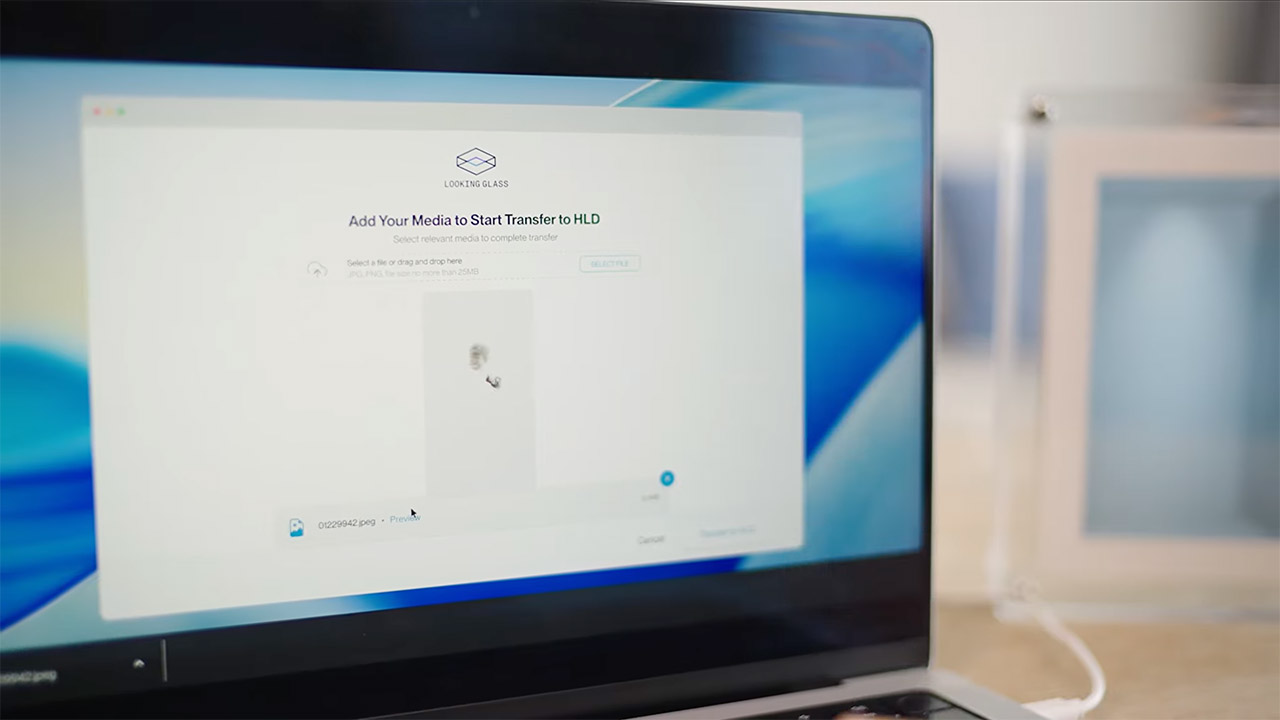
The 3D effect is achieved using free software on your PC or Mac; nothing fancy, just a local AI that determines what is the main part of the photo or video, separates it from the backdrop, and places it in a 3D environment. It’s all done on your own machine, so no data is sent to any servers, simply copy the files over to the frame with a USB-C cord.

Looking Glass Musubi Holographic Photo Video Frame
Musubi can store approximately 1000 images or 30 seconds of video clips, and the battery life lasts about 3 hours if not plugged in, but let’s be honest, most people will leave it plugged in all day. They’ve also kept things simple by not including a Wi-Fi connection, an app, or a camera, opting for a clean look.

Looking Glass Musubi Holographic Photo Video Frame
Musubi starts at $149, and they’re presently offering it for $99 during the first 24 hours of a Kickstarter campaign that launched today. Shipping is scheduled to begin in June 2026, but they intend to proceed with production regardless of the outcome of the campaign, since they have a track record with previous goods.

Source link

Advertisement
Continue Reading

Tech

Opinion: The wrong tax at the wrong time for Washington

Published

on

Editor’s note: GeekWire publishes guest opinions to foster informed discussion and highlight a diversity of perspectives on issues shaping the tech and startup community. If you’re interested in submitting a guest column, email us at tips@geekwire.com. Submissions are reviewed by our editorial team for relevance and editorial standards.

Jesse Proudman.

As a kid growing up in Tacoma, I remember visiting Seattle to interview executives at Go2Net and leaving in awe of what was possible. That moment distinctly shaped my career, one I’ve spent as a founder building multiple companies in Washington state. I stayed because this region had something special: a culture of innovation, a willingness to take risks, and a tax climate that fostered the high risk, high reward reality of startup life.

Watching what’s happening in Olympia, I’m saddened by the storm brewing on the horizon. I see an unconstitutional tax being passed to plug a hole created by a spending problem that in turn will cause an exodus of talent and capital, widen the deficit, and result in the application of this income tax to every Washingtonian. And all of this is happening just as AI transforms the knowledge economy in a way almost no one yet understands.

Washington legislators have a spending addiction, and Olympia’s solution is to reach deeper into the pockets of its citizens. The proposed SB 6346, the “millionaires tax,” would impose a 9.9% income tax on high earners, not through a constitutional amendment approved by voters, but through legislative sleight-of-hand. Proponents promise revenue to close a projected $4.3 billion deficit in the state’s budget. But the numbers don’t work, the constitutional bypass is dangerous, and the consequences for Washington’s economic future have been wildly underestimated.

The state’s spending problem is undeniable and untenable. The budget has more than tripled in the last decade: from $33.6 billion in 2013-2015 biennium to a projected $173 billion for ‘25-27 biennium. Even adjusted for inflation and population growth, real per-capita spending is up over 50%. The state faces a $1.5 billion deficit this biennium and a projected $4.3 billion hole in the next. 

Advertisement

Now, in the 11th hour of this legislative session, SB 6346 is introduced: an income tax that attempts to bypass 90 years of constitutional precedent. Washington’s constitution treats income as property, capped at a 1% tax, and changing that requires two-thirds legislative support plus voter approval. That’s a high bar and intentionally so. SB 6346 side steps this entirely, passing the tax as ordinary legislation and relying on five justices to overturn nine decades of precedent. If Washington wants a progressive income tax, there’s a legitimate path: amend the constitution. Punting to the courts isn’t leadership, it’s a gamble with the state’s economic future.

But more importantly, this tax won’t just apply to millionaires — that’s simply the wedge being used to get it approved. Senate Majority Leader Jamie Pedersen, the bill’s sponsor, has acknowledged that once the infrastructure requiring all Washingtonians to file tax returns is in place, “we all want to make sure that our successors will have the flexibility to respond to the challenges that they see.” This is a polite way of saying the door is open to a universal income tax. On March 10, lawmakers rejected amendments to the bill that would have locked in the $1 million threshold to the law.

Proponents argue that wealthy residents won’t leave over a 9.9% income tax, but history says otherwise. Washington already ranks 45th nationally in tax competitiveness and after the capital gains tax passed in 2022, the state saw major capital flight in years following. Forbes estimated one high-profile relocation saved nearly $1 billion in annual taxes, more than the state collects from capital gains in a year. A February 2026 survey by the Association of Washington Business found 44% of business leaders are considering moving their personal residence out of state, and the share actively looking to relocate has nearly doubled.

The revenue projections for SB 6346 are almost certainly overstated. Capital gains collections fell short because the tax base shrunk from unexpected relocations in the years following and the same will happen here. Every entrepreneur who leaves takes future job creation with them. Every company that moves employees takes their spending (sales tax), housing budget (property tax), and charitable giving with them. The people who feel they “couldn’t be paid to leave” will find their neighbors already have, and those left behind will foot the state’s deficit on their own.

Advertisement

All of this comes at the worst possible moment. Washington’s tech sector is facing a once-in-a-century transformation from the application of AI. The knowledge economy is in deep trouble as companies determine the breadth and depth of cuts with a post-AI enabled workforce. In October 2025, Amazon announced 2,300 corporate layoffs in Washington. Microsoft has cut more than 3,200 jobs in the state since last May. Tech employment here fell 6% even as the national economy added jobs, and entry-level roles for workers under 25 plummeted by 13%. Microsoft’s CEO recently acknowledged that AI now generates 30% of the company’s code. We’re not just seeing layoffs, we’re witnessing a fundamental restructuring of the industry that has been a core pillar for Washington. 

There’s a legitimate path to an income tax: ask the voters. But that’s not what’s happening here. What’s happening is a constitutional end-run in the final days of a legislative session, passed by lawmakers who won’t be around to answer for the exodus that follows and who have acknowledged this tax will ultimately be paid by all. Florida, Nevada, Texas, and Tennessee are watching and they won’t need to recruit, they’ll just need to wait.

Source link

Advertisement
Continue Reading

Tech

Meta rolls out new scam detection across WhatsApp, Messenger, and Facebook

Published

on

The company removed 159 million scam ads last year and took down 10.9 million accounts linked to criminal networks. Now it wants to catch scammers before they get to you.

Meta has announced a fresh wave of anti-scam tools across its platforms, WhatsApp, Messenger, and Facebook, as it steps up both on-platform detection and cooperation with law enforcement in Southeast Asia and beyond.

The centrepiece of the announcement is a new Facebook feature, currently in testing, that flags suspicious friend or follow requests before users act on them. When a request arrives from an account with no mutual connections, a different country location, or a suspiciously recent join date, Facebook will display a warning.

The same alert will appear when users send requests to similarly flagged accounts. The feature is designed to interrupt one of the most common social engineering pipelines: fake profiles that accumulate mutual friends over time to lend themselves a veneer of legitimacy, then pivot to scam messages through Messenger.

Advertisement

WhatsApp is also getting a new layer of protection targeting a specific and growing attack vector: device linking fraud. Scammers have been tricking users into scanning malicious QR codes, sometimes under the pretence of a customer service call or technical support request, which links the scammer’s device to the victim’s WhatsApp account.

Advertisement

The app will now display a warning when it detects a suspicious device linking request and show the user where the request originated.

For Messenger, Meta says it is expanding its existing scam detection feature to more countries this month. The system works in two stages. First, on-device analysis automatically flags messages from unfamiliar contacts that match the patterns of common scams, fraudulent job offers, fake investment pitches, work-from-home schemes.

If flagged, the user is warned and given the option to send the conversation to Meta’s AI for a cloud-based second review. That opt-in step breaks the message’s end-to-end encryption, which Meta discloses; users who prefer not to submit can still act on the on-device warning alone.

The detection feature can be accessed and toggled in Settings > Privacy & Safety Settings > Scam Detection.

Advertisement

Alongside the platform-level tools, Meta is accelerating a broader advertiser verification push. The company says it wants verified advertisers to account for 90% of its ad revenue by the end of 2026, up from 70% at present.

The remaining 10% would be reserved for low-risk advertisers such as small local businesses, which Meta gives as an example of a category it deems exempt from the high-risk verification requirement.

The announcement comes with a significant set of enforcement numbers. Meta says it removed more than 159 million scam ads last year and took down 10.9 million Facebook and Instagram accounts associated with criminal scam operations.

It also disclosed the outcome of a recent joint operation with the Royal Thai Police, which resulted in 21 arrests and Meta disabling more than 150,000 accounts linked to scam centre networks.

Advertisement

This was the second such “Joint Disruption Week,” according to Axios, the first, in December, had seen Meta remove 59,000 accounts and pages; the second expanded the coalition to include the UK, Canada, South Korea, Japan, Singapore, the Philippines, Australia, New Zealand, and Indonesia.

Meta also confirmed a partnership with the US Department of State to launch the ‘Trapped in Scam Crime’ awareness campaign in Vietnam, Thailand, Laos, Cambodia, and several other countries.

The campaign targets the supply side of the problem: the trafficked workers who are themselves coerced into staffing scam centres, often lured with fake job offers before being held against their will in compounds primarily based in Myanmar, Cambodia, and Laos.

The moves come as Meta faces intensifying scrutiny over scam advertising more broadly. A Reuters investigation in late 2025 reported that internal Meta documents showed the company earned an estimated $7 billion annually from ads linked to scams and prohibited goods, and showed users roughly 15 billion higher-risk ads per day on average.

Advertisement

Meta has disputed some of the Reuters framing; the current announcement is the latest in a series of enforcement updates the company has made public in the months since.

Source link

Advertisement
Continue Reading

Tech

German Fireball’s 15 Minutes Of Fame

Published

on

Sunday night, around 7:00 PM local time, a bright fireball streaked across the western German sky, exploded, and rained chunks of space rock down on the region around Koblenz. One of the largest known chunks put a soccer-ball-sized hole in someone’s roof, landing in their bedroom. Fortunately, nobody was hurt. But given the apparent size of the explosion, there must be many more pieces out there for the finding, and a wave of hopeful meteorite hunters has descended upon the region.

But if you wanted a piece of the action, where exactly would you start looking? How do scientists find meteorites anyway? And what should you do if you happen to see a similar fireball in the night sky?

Citizen Science

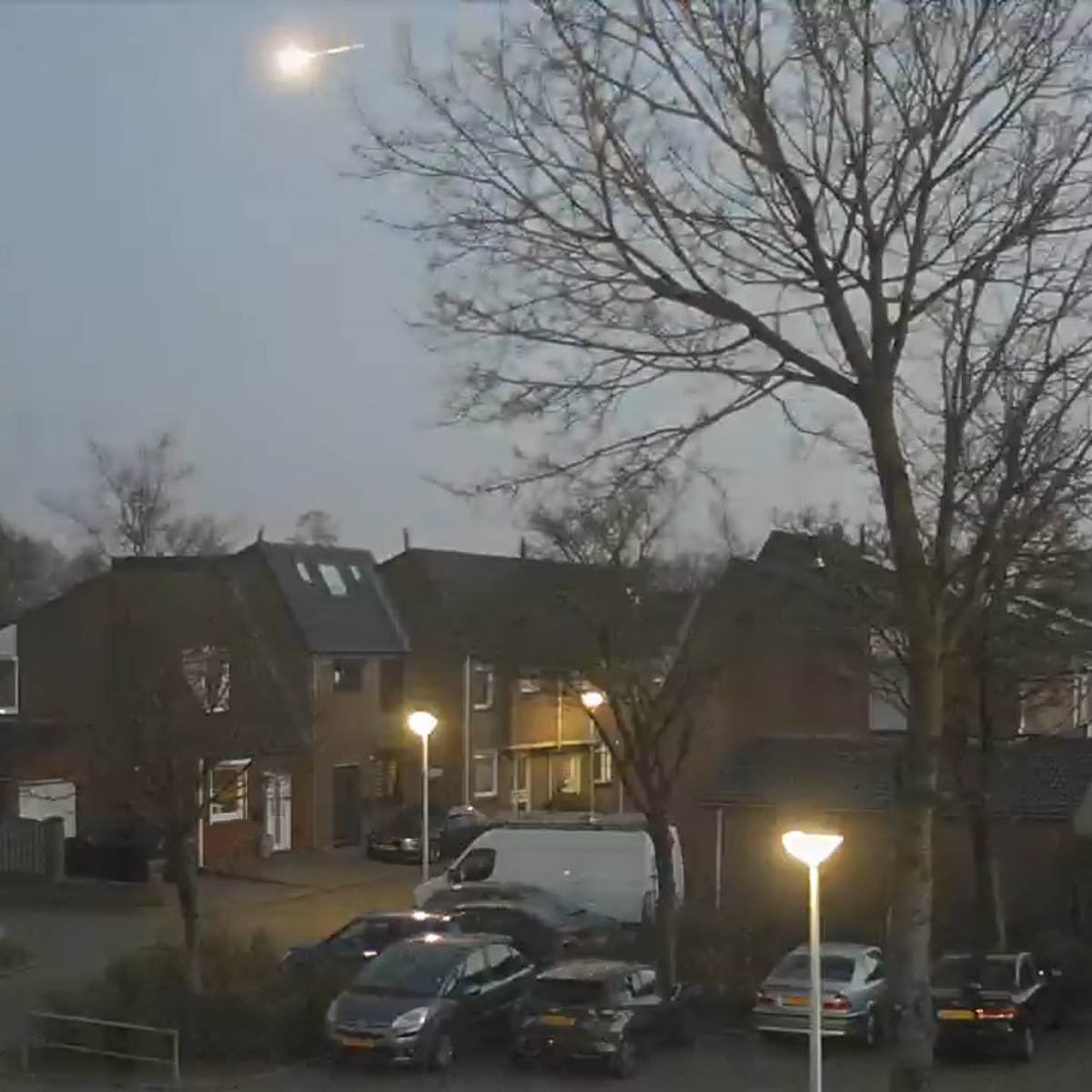
Meteorite video-bombs a boring parking lot in Heerlen, NL.

In the age of always-on dashboard cameras, ubiquitous smartphones, and other video recording devices, it’s hard for a shy meteorite to find a quiet spot out of the public eye. That makes them a lot easier to find than they were in the past. Indeed, the International Meteor Organization, which aggregates amateur meteor observations, received more than 3,200 reports of this one, including several with video documentation. Some are stunning, and others may not even be of the event at all.

By collecting reports from many locations, they can hope to piece together the meteorite’s trajectory. However, if you look at the individual reports, it’s clear that this is a difficult task. Nobody is expecting a bright fireball to streak across the night sky, so many of the reports are reasonably vague on the details and heavy on the awe.

This report from [Sophie Z], for instance, is typical. She records where she was and roughly the location in the night sky where the meteorite passed, along with the comment “I’ve never seen anything so amazing and large before in my life.” Other amateur observers are more precise. [David C] (“I have a Ph.D in physics”) managed to record the start and the end heading of the meteorite to a couple of decimal places. He must have had a camera.

Advertisement

We’d love to know the exact algorithm used for combining the reports. It’s worth noting that reporters get an experience score, and the system presumably takes this into account when producing the average track. However, the system works, though, with 3,200 reports of a once-in-a-lifetime meteorite, it’s bound to come up with a pretty good estimate. But for smaller meteorites, like this one that flew by on Monday night, there are fewer observers, and deducing the actual track is a lot more difficult.

Everyday meteorites are better tracked by taking a more systematic approach. We’ve covered a few of these networks before, because the equipment needed to contribute meaningfully isn’t all that much more complicated than a single-board computer with a network connection, a camera module, and a weatherproof housing to keep it working all year round. We’ve covered the French meteorite-hunting network, Fripon, before, and have featured other amateur sky-camera builds to boot. But we’re not amateur astronomers, so we’re not in the loop on what the current state of the art is. If you know about coordinated citizen-science meteorite tracking efforts, let us know in the comments.

Geologists Get Into The Astronomy Game

This meteorite was big enough and loud enough when it exploded that participation in tracking wasn’t limited to those who are looking up. Geologists at the Karlsruhe Institute for Technology (KIT) found that the explosion registered on their seismometers. (Via Heise Online.) These have the advantage that they are in very well-known locations with extremely precise timestamps. After all, that’s what they’re used for every day, although the medium that the pressure waves travel through is usually the earth rather than the air.


This was also a particularly lucky event for the KIT team because it happened over a particularly dense network of seismological stations in the Eifel mountains, allowing for greater resolution. And as they point out, using the sound of the explosion has the additional advantage of not being hindered by light conditions during the day or clouds at night. This makes us think of how easy it would be to set up a distributed system of microphones to do something similar.

Advertisement

The KIT track estimate lines up fairly well with the aggregated estimate from amateur observers, but it’s not exactly the same. Who is right? We’ll see where more of the meteorites are found on the ground, presumably, in the next few weeks.

Meteorite Hunting

If the meteorite fell through our roof and chunks were scattered all around our bedroom, we’d count ourselves lucky. But would we get to keep it? Of course, it depends on the local laws, and in Germany, you can keep the meteorites in most cases, unless the state decides that it’s of special value for whatever reason, and then they get first dibs.

Apparently, the going rate for meteorites is between 1€ and 5,000€ per gram, so we’re not entirely sure that it will cover the damage. Maybe our homeowners’ insurance would? We’ll have to go dig out our policy to be sure, but however that plays out, we’d just be stoked to have the meteorite chunks and a good story.

While very big fireballs like this are rare, NASA estimates that around 44,000 kg of meteoritic material falls on the Earth every day. (Whoah!) Most of this burns up in the atmosphere, but some falls to the ground. Most of that fraction is in the form of micrometeorites, which are sand-grain-sized bits that are very likely raining down on us every day. Indeed, if you’re interested, you can try to collect them, and all you need is a tarp on the roof or a magnet in your downspout, a good microscope, and a bit of knowledge. So if all you want is some extraterrestrial rock, and you’re not worried so much about the size, maybe micrometeorite hunting is the path to success.

Advertisement

Have you gone looking for meteorites? Know of any up-to-date amateur fireball-hunting networks? Sound off in the comments!

Source link

Advertisement
Continue Reading

Tech

China Moves To Curb OpenClaw AI Use At Banks, State Agencies

Published

on

An anonymous reader quotes a report from Bloomberg: Chinese authorities moved to restrict state-run enterprises and government agencies from running OpenClaw AI apps on office computers, acting swiftly to defuse potential security risks after companies and consumers across China began experimenting with the agentic AI phenomenon. Government agencies and state-owned enterprises, including the largest banks, have received notices in recent days warning them against installing OpenClaw software on office devices for security reasons […]. Several of them were instructed to notify superiors if they had already installed related apps for security checks and possible removal, some of the people said.

Certain employees, including those at state-run banks and some government agencies, were banned from installing OpenClaw on office computers and also personal phones using the company’s network, some of the people said. One person said the ban was also extended to the families of military personnel. Other notices stopped short of calling for an outright ban on OpenClaw software, saying only that prior approval is needed before use, the people said. The warning underscores Beijing’s growing concern about OpenClaw, an agentic AI platform that requires unusually broad access to private data and can communicate externally, potentially exposing computers to external attack. […]

Despite the potential security risks, companies from Tencent to JD.com Inc. have been rolling out OpenClaw apps to try and capitalize on the groundswell of enthusiasm, while several local government agencies have declared millions of yuan in subsidies for companies that develop atop the platform. […] Tech giants like Tencent and Alibaba, along with AI upstarts ranging from Moonshot to MiniMax, have rolled out their own tweaks of the software touting simple, one-click adoption. A slew of government agencies, in cities from Shenzhen to Wuxi, have issued notices offering multimillion-yuan subsidies to startups leveraging OpenClaw to make advances. The frenzy has helped drive up shares of AI model developer MiniMax nearly 640% since its listing just two months ago. It’s now worth about $49 billion, surpassing Baidu — once viewed as the frontrunner in Chinese AI development — in market value. The company launched MaxClaw, an agent built on OpenClaw, in late February.

Source link

Advertisement
Continue Reading

Tech

Two indie greats and a legendary children's book app arrive on Apple Arcade in April

Published

on

Apple is expanding its collection of Apple Arcade games with “Dredge+,” “Unpacking+,” and “My Very Hungry Caterpillar+” in April — two of which are App Store Award winners.

iPhone screen showing Apple Arcade logo on a red background, surrounded by colorful game icons including Dredge Plus, a cute pig game, and a caterpillar game on a gradient purple blue background
Three new games join Apple Arcade in April

While Apple may not be adding a ton of games in April, the three games coming next month are surprisingly varied. This time, we’ll see the addition of a survival horror game, a zen puzzle game, and a game geared towards the preschool crowd.
Continue Reading on AppleInsider | Discuss on our Forums

Source link

Continue Reading

Trending

Copyright © 2025