

Crypto World
How has the Healthcare Industry Faced Digital Transformation during the Pandemic?



by Gonzalo Wangüemert Villalba
•
4 September 2025
Introduction The open-source AI ecosystem reached a turning point in August 2025 when Elon Musk’s company xAI released Grok 2.5 and, almost simultaneously, OpenAI launched two new models under the names GPT-OSS-20B and GPT-OSS-120B. While both announcements signalled a commitment to transparency and broader accessibility, the details of these releases highlight strikingly different approaches to what open AI should mean. This article explores the architecture, accessibility, performance benchmarks, regulatory compliance and wider industry impact of these three models. The aim is to clarify whether xAI’s Grok or OpenAI’s GPT-OSS family currently offers more value for developers, businesses and regulators in Europe and beyond. What Was Released Grok 2.5, described by xAI as a 270 billion parameter model, was made available through the release of its weights and tokenizer. These files amount to roughly half a terabyte and were published on Hugging Face. Yet the release lacks critical elements such as training code, detailed architectural notes or dataset documentation. Most importantly, Grok 2.5 comes with a bespoke licence drafted by xAI that has not yet been clearly scrutinised by legal or open-source communities. Analysts have noted that its terms could be revocable or carry restrictions that prevent the model from being considered genuinely open source. Elon Musk promised on social media that Grok 3 would be published in the same manner within six months, suggesting this is just the beginning of a broader strategy by xAI to join the open-source race. By contrast, OpenAI unveiled GPT-OSS-20B and GPT-OSS-120B on 5 August 2025 with a far more comprehensive package. The models were released under the widely recognised Apache 2.0 licence, which is permissive, business-friendly and in line with requirements of the European Union’s AI Act. OpenAI did not only share the weights but also architectural details, training methodology, evaluation benchmarks, code samples and usage guidelines. This represents one of the most transparent releases ever made by the company, which historically faced criticism for keeping its frontier models proprietary. Architectural Approach The architectural differences between these models reveal much about their intended use. Grok 2.5 is a dense transformer with all 270 billion parameters engaged in computation. Without detailed documentation, it is unclear how efficiently it handles scaling or what kinds of attention mechanisms are employed. Meanwhile, GPT-OSS-20B and GPT-OSS-120B make use of a Mixture-of-Experts design. In practice this means that although the models contain 21 and 117 billion parameters respectively, only a small subset of those parameters are activated for each token. GPT-OSS-20B activates 3.6 billion and GPT-OSS-120B activates just over 5 billion. This architecture leads to far greater efficiency, allowing the smaller of the two to run comfortably on devices with only 16 gigabytes of memory, including Snapdragon laptops and consumer-grade graphics cards. The larger model requires 80 gigabytes of GPU memory, placing it in the range of high-end professional hardware, yet still far more efficient than a dense model of similar size. This is a deliberate choice by OpenAI to ensure that open-weight models are not only theoretically available but practically usable. Documentation and Transparency The difference in documentation further separates the two releases. OpenAI’s GPT-OSS models include explanations of their sparse attention layers, grouped multi-query attention, and support for extended context lengths up to 128,000 tokens. These details allow independent researchers to understand, test and even modify the architecture. By contrast, Grok 2.5 offers little more than its weight files and tokenizer, making it effectively a black box. From a developer’s perspective this is crucial: having access to weights without knowing how the system was trained or structured limits reproducibility and hinders adaptation. Transparency also affects regulatory compliance and community trust, making OpenAI’s approach significantly more robust. Performance and Benchmarks Benchmark performance is another area where GPT-OSS models shine. According to OpenAI’s technical documentation and independent testing, GPT-OSS-120B rivals or exceeds the reasoning ability of the company’s o4-mini model, while GPT-OSS-20B achieves parity with the o3-mini. On benchmarks such as MMLU, Codeforces, HealthBench and the AIME mathematics tests from 2024 and 2025, the models perform strongly, especially considering their efficient architecture. GPT-OSS-20B in particular impressed researchers by outperforming much larger competitors such as Qwen3-32B on certain coding and reasoning tasks, despite using less energy and memory. Academic studies published on arXiv in August 2025 highlighted that the model achieved nearly 32 per cent higher throughput and more than 25 per cent lower energy consumption per 1,000 tokens than rival models. Interestingly, one paper noted that GPT-OSS-20B outperformed its larger sibling GPT-OSS-120B on some human evaluation benchmarks, suggesting that sparse scaling does not always correlate linearly with capability. In terms of safety and robustness, the GPT-OSS models again appear carefully designed. They perform comparably to o4-mini on jailbreak resistance and bias testing, though they display higher hallucination rates in simple factual question-answering tasks. This transparency allows researchers to target weaknesses directly, which is part of the value of an open-weight release. Grok 2.5, however, lacks publicly available benchmarks altogether. Without independent testing, its actual capabilities remain uncertain, leaving the community with only Musk’s promotional statements to go by. Regulatory Compliance Regulatory compliance is a particularly important issue for organisations in Europe under the EU AI Act. The legislation requires general-purpose AI models to be released under genuinely open licences, accompanied by detailed technical documentation, information on training and testing datasets, and usage reporting. For models that exceed systemic risk thresholds, such as those trained with more than 10²⁵ floating point operations, further obligations apply, including risk assessment and registration. Grok 2.5, by virtue of its vague licence and lack of documentation, appears non-compliant on several counts. Unless xAI publishes more details or adapts its licensing, European businesses may find it difficult or legally risky to adopt Grok in their workflows. GPT-OSS-20B and 120B, by contrast, seem carefully aligned with the requirements of the AI Act. Their Apache 2.0 licence is recognised under the Act, their documentation meets transparency demands, and OpenAI has signalled a commitment to provide usage reporting. From a regulatory standpoint, OpenAI’s releases are safer bets for integration within the UK and EU. Community Reception The reception from the AI community reflects these differences. Developers welcomed OpenAI’s move as a long-awaited recognition of the open-source movement, especially after years of criticism that the company had become overly protective of its models. Some users, however, expressed frustration with the mixture-of-experts design, reporting that it can lead to repetitive tool-calling behaviours and less engaging conversational output. Yet most acknowledged that for tasks requiring structured reasoning, coding or mathematical precision, the GPT-OSS family performs exceptionally well. Grok 2.5’s release was greeted with more scepticism. While some praised Musk for at least releasing weights, others argued that without a proper licence or documentation it was little more than a symbolic gesture designed to signal openness while avoiding true transparency. Strategic Implications The strategic motivations behind these releases are also worth considering. For xAI, releasing Grok 2.5 may be less about immediate usability and more about positioning in the competitive AI landscape, particularly against Chinese developers and American rivals. For OpenAI, the move appears to be a balancing act: maintaining leadership in proprietary frontier models like GPT-5 while offering credible open-weight alternatives that address regulatory scrutiny and community pressure. This dual strategy could prove effective, enabling the company to dominate both commercial and open-source markets. Conclusion Ultimately, the comparison between Grok 2.5 and GPT-OSS-20B and 120B is not merely technical but philosophical. xAI’s release demonstrates a willingness to participate in the open-source movement but stops short of true openness. OpenAI, on the other hand, has set a new standard for what open-weight releases should look like in 2025: efficient architectures, extensive documentation, clear licensing, strong benchmark performance and regulatory compliance. For European businesses and policymakers evaluating open-source AI options, GPT-OSS currently represents the more practical, compliant and capable choice. In conclusion, while both xAI and OpenAI contributed to the momentum of open-source AI in August 2025, the details reveal that not all openness is created equal. Grok 2.5 stands as an important symbolic release, but OpenAI’s GPT-OSS family sets the benchmark for practical usability, compliance with the EU AI Act, and genuine transparency.

Crypto World
Coinbase Fully Launches Stock Trading for All U.S. Users With 8,000+ Stocks and ETFs Available

TLDR:
-
- Coinbase has fully launched stock trading for all U.S. users, following a limited rollout in December 2025.
- Over 8,000 stocks and ETFs are now available with 24/5 commission-free trading in USD or USDC stablecoins.
- Fractional share trading is supported, allowing U.S. investors to start buying stocks with as little as $1.
- Coinbase partnered with Yahoo Finance, adding trade buttons to asset pages for 150 million monthly visitors.
- Coinbase has fully launched stock trading for all U.S. users, following a limited rollout in December 2025.
Coinbase has fully rolled out stock trading to all U.S. users, following a limited launch in December 2025. The crypto exchange now offers access to over 8,000 stocks and ETFs through its platform.
Trading runs commission-free, 24 hours a day, five days a week. Users can conduct transactions in either USD or the USDC stablecoin. Fractional share trading is also supported, allowing investors to start with as little as $1.
Coinbase Brings Full Stock Trading Access to U.S. Users
Coinbase first introduced stock trading during its “System Update” product showcase in December 2025. At that time, only hundreds of stocks were available to a limited group of users.
With the full release, thousands of assets are now accessible to all eligible U.S. customers. The expansion marks a major step in the platform’s push beyond cryptocurrency trading.
The 24/5 commission-free trading model gives users consistent access throughout the trading week. Supporting both USD and USDC as funding options adds flexibility for crypto-native users.
Fractional shares make the platform more accessible to newer or smaller investors. Together, these features position Coinbase as a direct competitor to fintech platforms like Robinhood.
Users can fund their trades using the USDC stablecoin, which is a feature unique to Coinbase’s offering. This bridges the gap between traditional equities and digital asset investing.
It also reflects Coinbase’s broader strategy of integrating crypto and traditional finance in one place. The platform describes its long-term vision as becoming an “everything exchange.”
Looking further ahead, Coinbase plans to offer tokenized stocks, with details expected in the coming months. The company also intends to expand its stock perpetual products this spring through Coinbase Bermuda Ltd.
That move would give international traders 24/7 exposure to U.S. equities, subject to regulatory approval. Those products will not be available to U.S. persons.
Yahoo Finance Partnership Supports Broader Market Reach
Alongside the full rollout, Coinbase announced a partnership with Yahoo Finance to expand its audience. Yahoo Finance will add a “Trade [asset] on Coinbase” button to stock and crypto asset pages.
The site draws more than 150 million global monthly visitors each month. This gives Coinbase a direct channel to a large base of retail investors.
Yahoo Finance users will receive a one-month free trial of a Coinbase One Basic membership. The membership covers zero trading fees and USDC rewards for new users.
George Leimer, general manager at Yahoo Finance, noted the partnership targets everyday investors. He pointed to a growing trend of investors exploring digital assets alongside traditional securities.
The Yahoo Finance integration is currently focused on the U.S. market at launch. Coinbase has said it plans to expand its equities trading products internationally in the coming months.
A dedicated crypto hub through Yahoo Finance is also in development. That hub will feature news, data, and analysis from more than a dozen publishers.
Separately, Coinbase has partnered with Apex Fintech Solutions to handle clearing, custody, and execution services for its equities offering.
Crypto World
Canton’s Industry Working Group Advances Cross-Border Collateral Mobility With Tokenised Gilts
TLDR:
- Canton’s working group completed its fourth transaction round, introducing tokenised Gilts as repo collateral for the first time.
- The round featured the first cross-currency intraday repo using tokenised Gilts against non-GBP tokenised deposits on Canton.
- Archax joined as a new participant, using its tokenisation engine to create regulated digital representations of traditional Gilts.
- The working group plans to expand cross-border collateral mobility across European and global markets throughout all of 2026.
Canton’s industry working group has taken another step forward in advancing cross-border collateral mobility on Canton.
Digital Asset, alongside a consortium of leading financial institutions, completed a fourth set of transactions on the Canton Network on February 24, 2026.
The latest round builds on prior milestones by introducing tokenised Gilts and cross-currency repo activity. Together, these achievements move the industry closer to a scalable, always-on capital markets infrastructure that operates across borders and asset classes.
Working Group Builds on Previous Transaction Rounds
The industry working group has steadily expanded its scope across each successive round of transactions. Following the third set completed in December 2025, which covered multiple asset classes and currencies using tokenised deposits, this fourth round introduced new instruments and cross-currency structures. Each iteration has added complexity while maintaining institutional-grade standards across the board.
This latest round featured the first cross-border intraday repo transaction conducted using tokenised Gilts. It also marked the first cross-currency intraday repo using tokenised Gilts against non-GBP tokenised deposits.
These additions reflect the group’s commitment to broadening the range of assets that can move seamlessly across borders within the Canton ecosystem.
@digitalasset, in collaboration with @CantonNetwork participants, announced the completion of a fourth set of transactions showcasing continued momentum in cross-border intraday repurchase activity.
The group’s approach is methodical, advancing one transaction type at a time while ensuring each new layer meets real market requirements. This measured progression is what gives the working group its credibility across participating institutions.
Expanded Membership Strengthens the Consortium’s Reach
A key feature of this transaction round was the growth in active participation across the working group. Archax, a regulated digital asset exchange, broker, and custodian, joined as a new participant.
Existing members including LSEG, Euroclear, Citadel Securities, TreasurySpring, and IntellectEU also deepened their roles in this round.
Archax supported the transaction by leveraging its broker and custody permissions to hold traditional Gilts on behalf of clients.
It then used its tokenisation engine to create regulated digital representations of those assets. Graham Rodford, CEO and co-founder of Archax, described this function as central to the firm’s broader vision and participation strategy.
The growing membership across custodians, trading venues, clearinghouses, and technology providers adds structural depth to the working group. Participants now span the full transaction lifecycle, from execution to settlement and custody.
This breadth makes the group well-positioned to address production-scale challenges as the initiative moves beyond the pilot stage.
Cross-Border Collateral Mobility Takes Shape Across Currencies
The working group’s focus on cross-border collateral mobility is becoming more concrete with each round. TreasurySpring validated cross-currency intraday repo and reverse repo against UK Gilts, with haircuts and repo interest embedded directly into smart contracts.
Co-Founder Matthew Longhurst stated these transactions reflect real economic and risk terms across an institutional governance framework.
Euroclear UK & International played a central role as the UK’s central securities depository in tokenising Gilts for the transaction.
CEO Chris Elms noted that enabling real-time, cross-border collateral mobility helps unlock new liquidity sources for clients. EUI’s involvement brings regulated post-trade infrastructure directly into the Canton framework.
LSEG’s DiSH network served as the cash leg for the transactions, enabling instantaneous beneficial ownership transfer of commercial bank money across multiple currencies and jurisdictions.
Bud Novin, Head of Payment Systems at LSEG, confirmed that DiSH Cash supported the first tokenised intraday Gilt repo on Canton Network.
He added that LSEG DiSH is positioned as a trusted third-party solution for mobilising networks in tokenised markets.
Industry Players Align Around Scalable On-Chain Market Infrastructure
Beyond the transactions themselves, participants are increasingly focused on what comes next for the working group.
IntellectEU’s Anastasiia Vitmer pointed to how quickly the scope is expanding across assets, infrastructure, and active participants.
Her firm’s Catalyst Suite is being built to support any institutional use case on Canton Network as on-chain markets continue to mature.
DTCC’s Brian Steele reinforced that collaboration across the industry is essential to setting standards and accelerating digital asset adoption.
He added that this cross-border intraday repo use case confirms growing demand for seamless, scalable financial infrastructure. DTCC’s role reflects how traditional market infrastructure providers are engaging directly with on-chain models.
Digital Asset’s Kelly Mathieson stated that greater asset diversity and broader participation are paving the way for more efficient and liquid capital markets.
The working group plans to continue groundbreaking on-chain financing initiatives throughout 2026, with European markets and other key regions in focus.
Cumberland DRW’s Chris Zuehlke added that Canton continues to show how tokenisation can unlock real efficiency gains across an increasingly diverse set of assets and currencies.
TLDR
- Polymarket users increased bets on Meteora as the leading candidate in ZachXBT’s upcoming investigation.
- The contract for Meteora reached a 29 percent probability based on active trading behavior.
- ZachXBT stated that the investigation will expose employees who allegedly used internal data for insider trading.
- Traders wagered more than seven million dollars on which platform would be identified on Thursday.
- The investigation did not clarify whether the alleged insider trading involved stocks or digital assets.
Traders on the prediction platform Polymarket increased wagers on which exchange crypto sleuth ZachXBT will target next, and they pushed one project ahead quickly. The market showed heavy activity as users responded to new hints shared on X. The event drew fresh attention after he teased a “major investigation” linked to insider trading claims.
Polymarket Bets Shift Toward Meteora
As trading continued on Tuesday, users raised the probability that Meteora would be named in the probe. The contract reached 29% and moved past other listed platforms.
Users tracked each update closely, and they adjusted positions after his Monday post. However, the contracts still reflected crowd sentiment rather than privileged information.
He said the investigation would show that several employees at an unnamed exchange misused internal data. He added that they engaged in insider trading “over a prolonged period of time.”
Market participants responded fast, and they assessed which platform fit the description. The contract pool included MEXC, Axiom, and Wintermute.
By Tuesday, users had wagered more than $7 million across the choices. The total rose as traders sought clarity from his updates.
The market did not show whether the alleged insider trading involved stock or digital assets. Traders waited for his Thursday disclosure to confirm the scope.
His comments prompted rapid shifts in odds across the platform. Yet trading patterns continued to follow user guesswork rather than confirmed data.
Analysts tracking the contracts noted that trading volume increased during active discussion periods. Activity often rose within minutes of new social media posts.
The market structure allowed users to adjust quickly to every clue. However, the contract rules limited outcome definitions to his final announcement.
State Pushback and CFTC Position on Prediction Markets
Regulatory pressure increased as state officials clashed with federal regulators over these platforms. The dispute widened after the chair of the Commodity Futures Trading Commission restated federal oversight powers.
He argued that the agency had “exclusive jurisdiction” over prediction markets. He also compared them to derivatives markets.
He warned that any challenge from state authorities would be met in court. He confirmed that the agency had already filed amicus briefs in related disputes.
The platform also contested actions brought by the Massachusetts regulator. It argued that only the federal agency held authority over such markets.
Regulatory actions continued as several states pursued separate cases. These cases centered on claims that the platforms offered unlicensed gambling.
The ongoing jurisdiction conflict added pressure to both regulators and platforms. Yet trading on the platform remained active throughout the debate.


U.S. Senator Richard Blumenthal announced a formal Senate inquiry into Binance after recent news reports revealed that the world’s largest cryptocurrency exchange allegedly facilitated nearly $1.7 billion in transactions tied to sanctioned Iranian entities and Russia’s so-called “shadow fleet” of oil tankers.
Summary
- Richard Blumenthal has opened a Senate inquiry into Binance following reports that the exchange processed roughly $1.7 billion in transactions linked to Iranian proxies and Russia’s shadow fleet.
- The investigation seeks documents related to Binance’s compliance practices and the alleged dismissal or sidelining of internal investigators who flagged suspicious accounts.
- Binance has denied wrongdoing and says it has significantly reduced sanctions exposure while strengthening its anti-money-laundering controls.
Blumenthal demands answers from Binance
The inquiry centers on questions about the company’s compliance practices and its response to internal warnings from compliance staff.
In a letter to Binance CEO Richard Teng, Blumenthal, ranking member of the Senate Permanent Subcommittee on Investigations, demanded documents and records detailing the circumstances surrounding the illicit transfers and why compliance personnel who uncovered the activity were reportedly suspended or dismissed.
Interestingly, the investigation comes as Binance recently said it has sharply reduced its exposure to sanctioned entities, reporting a roughly 96% drop in related activity between early 2024 and mid-2025. The exchange has argued that sanctions-linked transactions now account for a tiny fraction of total trading volume.
According to reporting in the New York Times and Wall Street Journal, Binance internal investigators found over 1,500 accounts accessed from Iran and traced funds sent through intermediaries, including Hexa Whale and Blessed Trust, to entities linked to Iran’s Islamic Revolutionary Guard Corps and payments to personnel on Russian ships evading sanctions.
“Binance is a repeat offender: it has long been aware that the Iranian regime and its terrorist proxies use its cryptocurrency platform as a convenient and reliable means to bypass international sanctions, anti-money laundering controls, and other banking restrictions,” the senator wrote in the letter.
Blumenthal’s letter also accused Binance of ignoring clear warning signs, allowing potentially illicit accounts to operate, and even reportedly providing support to money-laundering entities, despite a 2023 settlement with U.S. authorities that required enhanced anti-money-laundering controls.
The senator’s inquiry also references concerns about the reported firing of internal investigators who flagged the activity, raising questions about corporate compliance culture.
Binance has publicly denied that it knowingly facilitated sanctions evasion or that its compliance staff were punished for raising concerns, saying flagged accounts were offboarded and that it cooperates with regulators.
The Web3 gaming platform the9bit, has surpassed 7 million users while expanding the utility and reach of its native ecosystem token, $9BIT.
$9BIT’s value has skyrocketed sevenfold, driven by the9bit platform surpassing 7 million users and intensified efforts in its AI Game Economy. This period of notable expansion includes major ecosystem enhancements, such as a key alliance with AAA publisher Capcom and a full commitment to accelerating AI Game Development (AIGD). Additionally, the9bit is focused on offering significantly reduced game prices by cutting traditional markups and implementing integrated localized fiat gateways and crypto payment solutions.
Since its launch, $9BIT has experienced significant market growth, reflecting accelerating adoption across the the9bit ecosystem. The token is currently listed on major global exchanges, including KuCoin, MEXC, and BingX, with additional listings under consideration as the ecosystem expands.
But beyond market performance, the real story lies in ecosystem scale.
Bridging Web3 Integration with AAA Partnerships
Launched in August 2025, the9bit is pioneering the convergence of traditional AAA gameplay and Web3 incentives, establishing an interactive digital economy where gaming is rewarded.
As of 24 Feb 2026:
- Over 7 million registered users
- More than 38,000 active gamers and space owners
- Over 32.8 million $9BIT tokens distributed to ecosystem participants
$9BIT is the essential utility asset, empowering the ecosystem by facilitating governance, reward distribution, creator incentives, and access to premium in-platform services. This model shifts the user experience from passive consumption to active engagement, allowing users to:
- Earn rewards through direct gameplay and engagement.
- Participate in community governance via voting mechanisms.
- Redeem tokens for premium content and ecosystem utilities.
In a major leap for blockchain-integrated gaming, the9bit has secured its position as a main partner with Capcom. This collaboration will align closely with the highly anticipated global release of Resident Evil 9 on February 27, 2026, with more Capcom future works anticipated in the future, demonstrating the9bit’s capacity to bridge traditional gaming giants with Web3 infrastructure.
By partnering with major global releases, the9bit is elevating its platform beyond casual games, offering its community unique tokenized engagement opportunities and unprecedented access to major franchises.
Introducing AIGD: AI-Powered Game Creation
The next big leap forward for the9bit is AIGD (AI Game Development). This new, AI-assisted creation layer will dramatically lower the barrier for anyone to publish a game. Allowing users to turn a great idea into a fully playable game. This capability unlocks a vibrant, self-sustaining loop between creators and players. Builders use powerful AI tools to bring their games to life, players jump in and generate exciting ecosystem activity, and everyone is rewarded with $9BIT.
This whole system creates a fantastic new reward cycle:
1. Creators build games using AI tools, quickly develop and launch their games.
2. Players engage and generate activity which the community jumps in.
3. Engagement translates into rewards distributed across the ecosystem.
4. Creative and great creators directly benefit from the traction.
By aligning incentives between creators and players, the9bit is building a genuinely scalable, self-sustaining gamer-driven economy, a powerful model that puts the value right back into the hands of the people who make the ecosystem thrive.
Backed by Public-Market Infrastructure
According to its whitepaper, the9bit ecosystem allocates 1.9 billion $9BIT tokens to The9 Limited in recognition of its strategic and operational contributions. As of February 24, 2026, 950 million tokens have been delivered, with the remaining allocation expected in the coming months.
The9 Limited, listed on Nasdaq since 2004, brings public-market governance standards and infrastructure experience to the Web3 gaming space, bridging traditional Internet operations with blockchain-enabled economies.
What’s Next
As 2026 unfolds, the9bit plans to:
- Expand AIGD toolkits and AI-assisted publishing capabilities
- Deepen token utility across gameplay layers
- Expand AAA integrations through our main partnership with Capcom
- Accelerate user acquisition across MENA and Southeast Asia
- Strengthen community-driven governance initiatives
- Explore further exchange listings
With user growth accelerating and AI-powered creation lowering barriers for developers worldwide, the9bit is positioning itself at the intersection of gaming, AI, and Web3 infrastructure.
Play Together. Earn Together. Own Together.
About the9bit
the9bit is a Web3-enabled gaming platform that integrates traditional gameplay with tokenized rewards. The platform offers game purchases, mobile top-ups, casual gaming, and community features — while empowering creators through AI-driven development tools.
For more information, visit: the9bit.com
About The9 Limited
The9 Limited (Nasdaq: NCTY) is an Internet company listed on Nasdaq since 2004. The company operates in online gaming, Bitcoin mining, and AI-driven technology investments, with a growing focus on Web3 infrastructure.
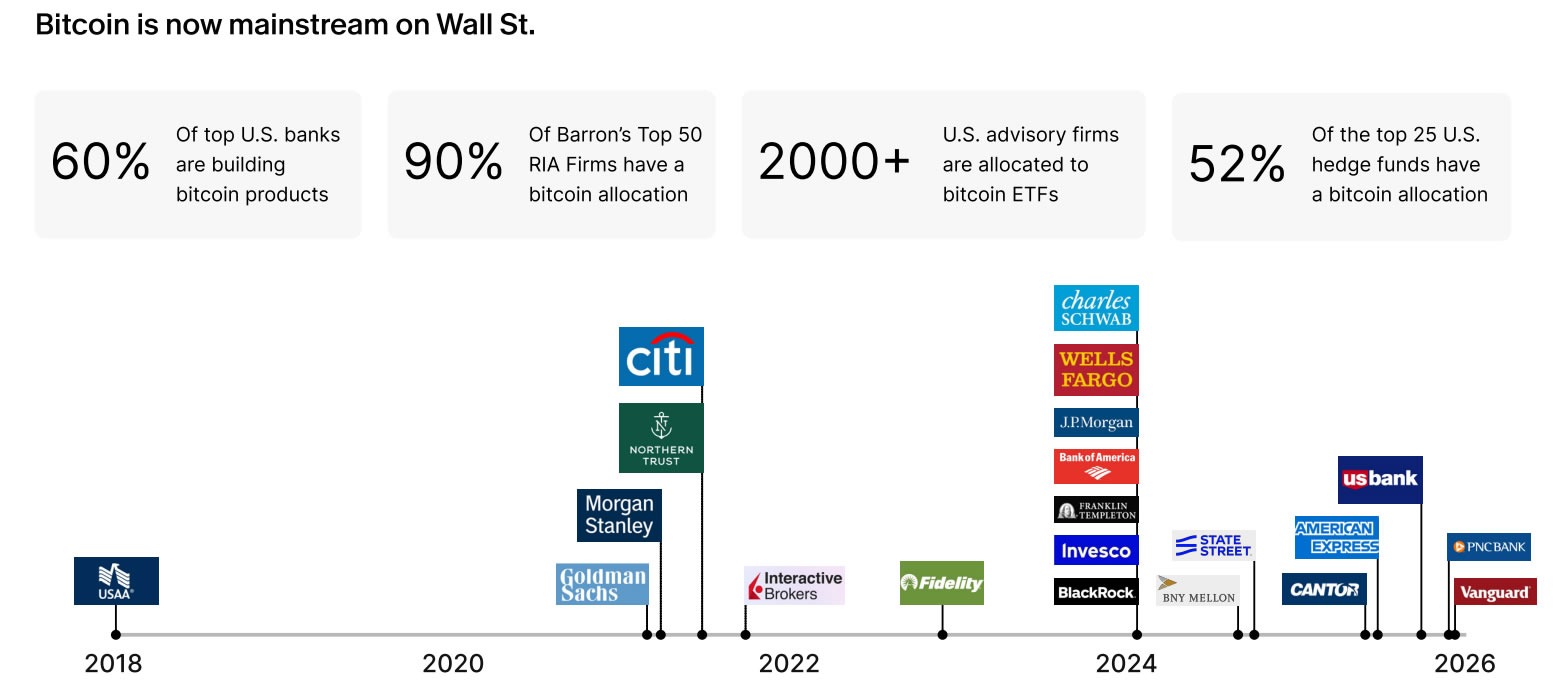
Bitcoin’s adoption by institutions, banks, merchants, public companies, and nation-states has boomed in 2025, despite the recent price drawdown, says the financial services company River.
“There is no bear market in Bitcoin adoption,” River said in a report published on Tuesday, which noted that while Bitcoin (BTC) is down 50% from its all-time high, “adoption is compounding in ways that aren’t affecting the price, yet.”
“Trust in Bitcoin has grown faster than that of any asset in history,” it said. “What began as an experiment is now a globally recognized store-of-value, with adoption patterns that rival the internet.”

Institutional, banking and public company adoption
River reported that institutions accumulated 829,000 BTC in 2025, including purchases by businesses, governments, funds, and exchange-traded funds.
Registered investment advisors have been net buying BTC for eight quarters in a row and have invested roughly $1.5 billion in Bitcoin ETFs per quarter over the past two years, River said.
It noted that these institutions represent “millions of underlying individuals” gaining exposure to Bitcoin for the first time through brokerage accounts, retirement plans, sovereign funds and corporate balance sheets.
Related: Public companies increase Bitcoin holdings despite range-bound prices
Additionally, 60% of the top US banks are building Bitcoin products. “With a favorable regulatory environment in the US, banks can now custody Bitcoin and offer Bitcoin products to their customers,” it stated.
Businesses were the largest buyers of BTC in 2025, with a majority of purchases driven by crypto treasury companies, whose adoption grew 2.5 times last year.

Merchant adoption and payments accelerate
Merchant adoption also surged with the number of businesses in the US accepting Bitcoin for payments tripling, while global usage grew by 74% in 2025, it noted.
Bitcoin payments on the Lightning Network grew by 300% in 2025 and, according to River’s estimations, the network is now processing over $1.1 billion in monthly transaction volume.
Five nation-states became new owners of Bitcoin in 2025, including purchases from two sovereign wealth funds in Luxembourg and Saudi Arabia, and from one central bank in the Czech Republic. The other two were Brazil and Taiwan.
River estimates that 23 nation-states hold Bitcoin through state-backed mining, seizures, or central bank exposure.
Bitcoin volatility is in decline
River said that Bitcoin volatility is also declining, nearing that of gold and the S&P 500, signaling that it is “increasingly viewed as a mature asset class.”
“As volatility falls, the hurdle for more risk-averse investors declines,” it said. “Over time, that opens the door to larger pools of capital.”

River added that Bitcoin is built on trust and claimed it is the world’s “only scarce and incorruptible form of digital money.”
“We expect that in the coming years, Bitcoin adoption will not only continue its current trend, but meaningfully accelerate.”
Magazine: Bitdeer sells all Bitcoin, Metaplanet rejects misconduct claims: Asia Express
Dogecoin pushed higher on outsized volume after repeatedly testing resistance, flipping a key ceiling into support and setting up a near-term test of the next supply zone.
News Background
- DOGE advanced alongside a stabilizing broader crypto market, with buyers stepping in after several sessions of tight consolidation.
- The move wasn’t driven by token-specific headlines but by technical positioning, as repeated failures at $0.0924 left the level primed for a breakout once liquidity expanded.
- The rally comes after DOGE spent hours coiling between $0.090 and $0.0927, building compression before volume returned.
- Open interest remains elevated but not extreme, suggesting moderate leverage participation rather than a crowded speculative push.
Price Action Summary
- DOGE gained 1.9%, rising from $0.0926 to $0.0944
- Breakout above $0.0924 occurred on 749M volume, 176% above baseline
- Price briefly probed $0.0950 before consolidating near $0.0940–$0.0945
- Higher lows formed during consolidation, confirming short-term strength
Technical Analysis
- The key technical development was the sustained break above $0.0924, a level that capped multiple attempts earlier in the session. Once cleared, momentum accelerated quickly, and the breakout volume suggests genuine participation rather than a low-liquidity spike.
- The subsequent consolidation near $0.0940 appears constructive, with shallow pullbacks and higher lows indicating buyers defending the breakout zone. That keeps short-term structure bullish, but the real test lies at $0.0946–$0.0950, where supply previously absorbed upside attempts.
- A decisive close above $0.0950 would expose $0.0955–$0.0960. Failure to hold $0.0940 would risk a pullback toward $0.0924, which now serves as the structural pivot.
What traders say is next?
- Traders view $0.0940 as the new line of defense. As long as DOGE holds above that level, momentum favors continuation toward $0.0955 and potentially $0.0960.
- If the breakout fades and price slips back below $0.0924, the move would resemble a false break, reopening the prior consolidation range and shifting near-term bias back to neutral.

One of the world’s most wanted drug lords is dead. Nemesio Rubén Oseguera Cervantes, known as “El Mencho,” was killed on Sunday. His death triggered a wave of violence across several Mexican states.
Beyond the security impact, attention is also turning to the cartel’s financial operations. In recent years, regulators and researchers have documented how Mexican criminal networks have incorporated cryptocurrency into their operations.
Who was El Mencho?
El Mencho was among Mexico’s most wanted fugitives and the leader of the Jalisco New Generation (CJNG) cartel. According to the US Department of State, the CJNG was formed in 2009. It has since evolved into one of the most violent drug cartels in Mexico.
“It has been assessed to have the highest cocaine, heroin, and methamphetamine trafficking capacity in Mexico, and over the past few years, includes the trafficking of fentanyl into the United States,” the text reads.
On February 20, 2025, the United States officially designated the cartel as a Foreign Terrorist Organization pursuant to Section 219 of the Immigration and Nationality Act.
In addition, the US State Department had offered a $15 million reward for information leading to the capture or conviction of El Mencho. He was killed on Sunday during a military operation.

Following his death, unrest spread across parts of the country. According to the BBC, at least 20 states experienced disturbances as cartel members blocked roads and torched vehicles and businesses.
While the immediate fallout played out in the streets, past data shows that CJNG’s impact has extended beyond territorial control.
Over the past years, investigators have tracked the cartel’s increasingly sophisticated financial infrastructure. This includes its use of digital assets to move and launder funds across borders.
Crypto and Cartel Finance
Cryptocurrencies such as Bitcoin (BTC) and Tether (USDT) are not inherently illicit. They are widely used for legitimate investment, payments, and financial innovation.
However, regulatory and law enforcement agencies have identified instances in which these digital assets were used in transactions linked to illegal activities.
As early as 2020, Reuters reported that US and Mexican authorities observed an increasing use of Bitcoin among major drug trafficking groups, including the CJNG and the Sinaloa Cartel, for laundering money.
In 2024, the US Treasury’s Financial Crimes Enforcement Network (FinCEN) stated that Mexico-based transnational criminal organizations were using virtual currencies, including Bitcoin, Ethereum, Monero, and Tether, to purchase fentanyl precursor chemicals and equipment from suppliers in China.
A March 2025 report by Chainalysis found that suspected China-based chemical traders received more than $37.8 million in cryptocurrency between 2018 and 2023. Major Mexican cartels, including the CJNG, were identified as buyers of these precursors used to manufacture synthetic opioids.
“Blockchain analysis reveals that precursor chemical suppliers advertise directly on darknet markets and messaging apps, accepting digital assets in exchange for chemicals shipped to Mexico. Once paid, crypto funds are laundered through complex transaction patterns including peel chains, layering, and cross-chain swaps, and often cashed out through Chinese exchanges or international mules,” TRM Labs revealed.
In August 2025, FinCEN also highlighted that the CJNG, the Sinaloa Cartel, the Gulf Cartel, and other Mexico-based transnational criminal organizations were using Chinese money laundering networks (CMLNs) to launder illicit proceeds.
Notably, Chainalysis reported that CMLNs now play a dominant role in cryptocurrency-related money laundering. In 2025, these networks accounted for approximately 20% of known cryptocurrency money laundering activity.
While the activity has scaled, regulatory focus has also intensified. According to the US Attorney’s Office for the Southern District of New York, Paul Campo, a former DEA official, and Robert Sensi were indicted for conspiring to provide material support to CJNG.
“As part of the scheme, CAMPO and SENSI agreed to launder approximately $12,000,000 of CJNG narcotics proceeds; laundered approximately $750,000 by converting cash into cryptocurrency; and provided a payment for approximately 220 kilograms of cocaine on the understanding that the payment would trigger the distribution and sale of the narcotics worth approximately $5,000,000, for which CAMPO and SENSI would (i) receive directly a portion of the narcotics proceeds as profit; and (ii) receive a further commission upon the laundering of the balance of the narcotics proceeds,” the press release said.
Thus, El Mencho’s death marks a significant moment in Mexico’s fight against organized crime. Yet the financial systems supporting major cartels remain complex, cross-border, and technologically adaptive, extending far beyond any single individual.


Debate is raging in the crypto community as Justin Bons, founder and CIO of Cyber Capital, argues that Ripple’s XRP Ledger (XRPL) is “centralized.”
Meanwhile, Ripple’s CTO Emeritus, David Schwartz, has firmly defended its architecture. This raises crucial questions about what makes a blockchain genuinely decentralized.
Justin Bons Labels XRP Ledger “Centralized”
In a recent post on X (formerly Twitter), Bons criticized what he calls “centralized blockchains.” He argued that several networks rely on permissioned validator structures, pointing to XRP Ledger’s Unique Node List (UNL) as an example.
“Ripple: Has a “Unique Node List”, which makes the validators effectively permissioned. Any divergence from this centrally published list would cause a fork, effectively giving the Ripple Foundation & company absolute power & control over the chain,” he wrote.
He also named Canton, Stellar, Hedera, and Algorand in his post. Bons framed decentralization as a binary choice, arguing that a blockchain is either fully permissionless or it is not. In his view, any permissioned element is “anti-thetical” to the ethos of crypto.
“The future of finance is decentralized & permissionless,” he wrote. “But let’s not pretend as if these chains are really playing a part in this revolution…if you care about crypto. Reject these permissioned chains & demand they decentralize.”
Bons also outlined what he described as the only three forms of blockchain consensus: Proof of Stake, Proof of Work, and Proof of Authority. He mentioned that any system not based on PoS or PoW then “it is, by definition, PoA.” The executive said that “choosing who we trust is not the same as trustlessness,” specifically referencing XRP and XLM.
David Schwartz Defends XRP Ledger
Bons’ post sparked notable reactions from the community. Schwartz, one of the chief architects of the XRP Ledger, rejected claims that Ripple has “absolute power & control.”
He explained that the XRP Ledger was designed so that Ripple could not control the network. Schwartz said this decision was intentional and rooted in regulatory considerations.
“Ripple, for example, has to honor US court orders. It cannot say no….But could a US court decide that international comity with an oppressive was more important than XRPL or Ripple? We were quite concerned that could come down either way. We absolutely and clearly decided that we DID NOT WANT control and that it would be to our own benefit to not have that control,” he replied.
Schwartz also pushed back against Bons’ claims about potential double-spending and censorship. He explained that validators cannot force an honest node to accept a double-spend or censor transactions.
Each node independently enforces protocol rules and only counts the validators it has chosen on its Unique Node List (UNL). If a validator behaves dishonestly, an honest node simply treats it as a validator it disagrees with.
Schwartz acknowledged that validators could theoretically conspire to halt the network from the perspective of honest nodes. However, he said this would be equivalent to a dishonest majority attack and would still not allow double-spending. In such a scenario, he argued that the remedy would be to select a new UNL.
“Transactions are discriminated against all the time in BTC. Transactions are maliciously re-ordered or censored all the time on ETH. Nothing like this has *ever* happened to an XRPL transaction and it’s hard to imagine how it could,” he remarked.
He also pointed out that XRPL resolves the double-spend problem through consensus rounds that occur roughly every five seconds. During each round, validators vote on whether transactions should be included in the current ledger.
Honest nodes may defer a valid transaction to the next round if a supermajority of trusted validators say they did not see it before the cutoff. According to Schwartz, this mechanism maintains consensus without granting unilateral control to any single party.
“There are only two reasons you need a UNL: 1) Otherwise a malicious party could create an unbounded number of validators causing nodes to need to do excessive work to reach consensus. 2) Otherwise a malicious party could create validators that just didn’t participate in consensus, leaving nodes unable to tell whether they actually had reached a consensus with other nodes,” he noted.
He further stressed that if Ripple had the ability to censor transactions or execute double spends, using that power would permanently damage trust in XRPL. Therefore, he said the system was intentionally architected to limit the power of any single actor, including Ripple itself.
By staking treasury ETH, the Ethereum Foundation now directly participates in consensus while generating native, ether-denominated yield.
The Ethereum Foundation announced that it has begun staking a portion of its treasury funds, following the Treasury Policy it released last year.
The latest move represents a formal step into direct participation in Ethereum’s proof-of-stake consensus.
Treasury Staking
As part of this initiative, the Foundation deposited 2,016 ETH on Tuesday and stated that it plans to stake approximately 70,000 ETH in total, with all staking rewards directed back to the Foundation’s treasury. The staking setup relies entirely on open-source infrastructure, and the Foundation picked Dirk as a distributed signing solution and Vouch to manage validator operations across multiple Beacon and Execution Client pairings.
According to the announcement, Dirk distributes signing responsibilities across several geographic regions to remove single points of failure, while Vouch enables configurable strategies designed to mitigate client diversity risks. The overall configuration uses a mix of minority clients alongside both hosted infrastructure and self-managed hardware deployed across multiple jurisdictions.
The Foundation also confirmed that its validators are using Type 2 (0x02) withdrawal credentials, which allow validator balances to be transferred through consolidations, reduce the number of required signing keys by supporting a higher maximum effective balance per validator, and enable flexible exits that can be triggered by the withdrawal address even if validators are offline.
This approach simplifies key management and supports faster changes in signing-key custody, according to the Swiss non-profit organization.
In terms of block production, the setup is being built locally rather than relying on proposer-builder separation sidecars. The Foundation stated that by solo staking its own ETH, it will generate native, ETH-denominated yield using Ethereum’s protocol mechanics.
You may also like:
Short-Term Weakness Dominates
On the price front, ETH traded sharply lower over the past 24 hours, extending its short-term downtrend as sellers remained in control throughout the session. The price slipped from around $1,920 during the early Asian trading hours of Tuesday to near $1,820, as brief attempts to stabilize failed to gain traction. While short-term price action remains under pressure, some analysts believe that the broader setup looks more constructive on a longer time horizon.
Analyst Merlijn The Trader said ETH is sitting in a five-year demand zone that has historically favored accumulation, not distribution. He noted that prices have returned to levels seen during prior bear market phases and momentum may be quietly building despite the slow pace.
Binance Free $600 (CryptoPotato Exclusive): Use this link to register a new account and receive $600 exclusive welcome offer on Binance (full details).
LIMITED OFFER for CryptoPotato readers at Bybit: Use this link to register and open a $500 FREE position on any coin!

Anthony Cacace sees similarities with Jazza Dickens ahead of world title fight
HSBC ADR earnings beat by $0.03, revenue topped estimates

Coinbase Fully Launches Stock Trading for All U.S. Users With 8,000+ Stocks and ETFs Available


-

 Video5 days ago
XRP News: XRP Just Entered a New Phase (Almost Nobody Noticed)
-

 Fashion4 days ago
Weekend Open Thread: Boden – Corporette.com
-

 Politics3 days ago
Baftas 2026: Awards Nominations, Presenters And Performers
-

 Entertainment7 days ago
Kunal Nayyar’s Secret Acts Of Kindness Sparks Online Discussion
-

 Sports1 day ago
Women’s college basketball rankings: Iowa reenters top 10, Auriemma makes history
-

 Politics2 days ago
Nick Reiner Enters Plea In Deaths Of Parents Rob And Michele
-

 Tech7 days ago
Retro Rover: LT6502 Laptop Packs 8-Bit Power On The Go
-
 Sports6 days ago
Clearing the boundary, crossing into history: J&K end 67-year wait, enter maiden Ranji Trophy final | Cricket News
-

 Business3 days ago
Mattel’s American Girl brand turns 40, dolls enter a new era
-

 Crypto World23 hours ago
XRP price enters “dead zone” as Binance leverage hits lows
-

 Business3 days ago
Law enforcement kills armed man seeking to enter Trump’s Mar-a-Lago resort, officials say
-

 Entertainment6 days ago
Dolores Catania Blasts Rob Rausch For Turning On ‘Housewives’ On ‘Traitors’
-

 Business7 days ago
Tesla avoids California suspension after ending ‘autopilot’ marketing
-

 Tech3 days ago
Anthropic-Backed Group Enters NY-12 AI PAC Fight
-
 NewsBeat2 days ago
‘Hourly’ method from gastroenterologist ‘helps reduce air travel bloating’
-

 NewsBeat2 days ago
Armed man killed after entering secure perimeter of Mar-a-Lago, Secret Service says
-

 Politics3 days ago
Maine has a long track record of electing moderates. Enter Graham Platner.
-

 Crypto World6 days ago
WLFI Crypto Surges Toward $0.12 as Whale Buys $2.75M Before Trump-Linked Forum
-

 Tech13 hours ago
Unsurprisingly, Apple's board gets what it wants in 2026 shareholder meeting
-
 NewsBeat8 hours ago
Police latest as search for missing woman enters day nine