Peter Lee, left, and Igor Tsyganskiy. (GeekWire File Photo and LinkedIn Photo)
Igor Tsyganskiyis now executive vice president of Microsoft Research (MSR) as past president Peter Lee steps aside to become president of Microsoft Science, which spans physical, biological and medical fields.
“My new role is designed to reduce my management responsibilities and let me spend as much of my time as possible on technical work,” Lee said on LinkedIn. That will include an initial focus on advances in “AI-enabled virtual patients, populations and labs, and their power to transform biomedical research.”
Lee, who took the helm of MSR in September 2022, was previously a computer science professor at Carnegie Melon University for more than two decades. He thanked Tsyganskiy for “taking on the big job of leading Microsoft Research — I have no doubt that he’ll take the MSR labs up to new heights.”
Tsyganskiy will also continue serving as the tech giant’s global chief information security officer, a role he has held since 2023. In his own LinkedIn post, Tsyganskiy emphasized MSR’s role at the forefront of computing, pointing to advances in AI, deep systems work and scientific discovery that have fed into Microsoft products and academic publications.
The commitment to foundational research is essential to Microsoft’s success, he said, adding “as the pace of innovation accelerates it is equally important to continue driving breakthrough research, and translate these advances into real-world impact.”
Advertisement
Mamtha Banerjee. (LinkedIn Photo)
— Mamtha Banerjee is leaving her role as leader of JPMorgan Chase’s Seattle Tech Center. Banerjee, a longtime Seattle tech industry leader, joined the financial services giant in 2022 and took the leadership role last June.
The Seattle Tech Center was established in 2018 to tap into the region’s tech talent pool and by last year had grown to 380 people.
Banerjee was previously at Expedia Group for seven years and serves as a mentor for the University of Washington’s Master of Science in Entrepreneurship program.
Vivian Sun. (LinkedIn Photo)
— Vivian Sun is leaving her role as head of automated driving at Amazon after more than two years with the company.
Sun, based in Sunnyvale, Calif., is now vice president of commercial and strategy for robotics company Genesis AI, which is based in Palo Alto and Paris.
A veteran startup builder with roots in AI, robotics and autonomous driving, Sun was featured by Automotive News as one of the “100 Leading Women in the North American Auto Industry.”
Advertisement
— Truveta‘s hiring run continues. The Seattle-area health data company named Sapna Prasad as its new VP of research insights. Prasad, who is based in Washington, D.C., joins from Clarify Health Solutions where she held leadership roles for more than six years.
— Bluesky CEO Jay Graber announced Monday that she’s stepping down from her position and moving to a new role as chief innovation officer of the decentralized social network. Read more.
Jessica Nguyen. (LinkedIn Photo)
— Jessica Nguyen is now president, chief strategy and legal officer for Sandstone, a New York-based company using AI to support legal work.
Nguyen is based in the Seattle area and and was previously deputy general counsel for AI innovation and trust at DocuSign for nearly two years. Prior to that, she was chief legal officer at Seattle’s Lexion, which was acquired by DocuSign for $165 million in 2024.
Advertisement
Her Pacific Northwest roots include working as the first in-house attorney for Payscale and Avalara, and she had a nearly four-year run at Microsoft on the Office 365 legal team.
— Julie Keef, who recently left Seattle’s Redfin as VP of product, has shared her next role. Keef has moved to another company in the real estate space, taking the title of head of consumer product management for New York’s Compass.
“Since my days in NYC, I’ve been admiring Compass from afar. The agents, brand, and bold strategy have always impressed me,” Keef said on LinkedIn.
Nick Boone. (LinkedIn Photo)
— Nick Boone is now global head of demand and marketing operations at Scala, a Bellevue-based AI startup founded by Smartsheet CEO Rajeev Singh and former Accolade executive Ardie Sameti. The company last month raised $8.5 million in a seed round.
Boon worked at Accolade for more than eight years, serving as senior director of demand center and marketing operations until the company was acquired by Transcarent last year. He remained with the merged businesses for a brief time.
Advertisement
Scala is building an “operational intelligence platform” for contact centers — the massive customer service operations that companies across healthcare, travel, and financial services rely on to handle millions of interactions.
— ProbablyMonsters expanded its executive leadership team with two new hires and a promotion. The video game company is headquartered in Fort Worth, Texas, and has an office in Bellevue, Wash., where founder and CEO Harold Ryan is based.
Jonathan Lander was named chief publishing officer. He was previously at Bethesda Softworks and ZeniMax Online Studios.
David Reid joins as chief marketing officer and will be located in Bellevue. Reid is a longtime gaming exec who was the founder of Seattle-area startup MetaArcade and more recently ran his own consultancy.
Mark Subotnick, who is based in Portland, is now chief product officer after previously serving as head of studios and partnerships. He’s been with the company for more than three years.
Amber Faust. (LinkedIn Photo)
— Biotech startup Nautilus appointed its first sales hire, naming Amber Faust as vice president of sales as it ramps up commercial operations. Faust, who will work remotely, joins the Seattle company after working at biotech businesses including Seer, Olink, SomaScan and others.
“I’m excited to help scale Nautilus’ commercial progress by connecting researchers in pursuit of greater proteomics coverage, detail, and resolution with a platform that can meaningfully expand what’s possible in drug development and beyond,” Faust said in a statement.
Nautilus has built a proteome analysis platform that allows researchers to identify and quantify the thousands of proteins present in biological samples.
Advertisement
— Absci, a Vancouver, Wash.-based company that uses AI to develop drugs, namedDr. Ransi Somaratne as chief medical officer, joining from Vertex Pharmaceuticals where he served as senior VP of clinical development. Past roles include leadership positions at BioMarin Pharmaceutical and Amgen.
Absci Chief Innovation Officer Andreas Busch is retiring March 31 and will continue to co-chair the company’s scientific advisory board.
— Theo Angelis was appointed to the Washington State Supreme Court. The K&L Gates partner has 25 years of legal experience and has worked extensively in intellectual property and with emerging companies. Angelis is a past president of the Middle Eastern Legal Association of Washington and will be the first Justice of Middle Eastern descent on the state Supreme Court.
— Matt Rubright is now CEO of Jam, a startup that addresses bugs in software development. He was previously chief customer officer for the 6-year-old company, joining last April. His past employers include DataGrail, Candidate and Silicon Valley Bank.
Advertisement
Rubright, based in Seattle, succeeds Dani Grant, whom he said is stepping away to recover from a health issue. Grant’s “vision, leadership and tenacity are undeniable,” he added.
— Suchitra (Suchi) Mohanis founder of a Sammamish, Wash.-based startup called learntheropes.ai, which she describes as an “AI-native learning app designed to help organizations empower their people with the right learning content, tailored to their learning style, skill-level and their goals, reducing the overwhelm employees feel with a new task.”
Mohan is a serial entrepreneur and worked as a technology architect for Microsoft for nearly a decade in its Bangalore offices. She was most recently co-founder of the AI startup Oikyu.
— Theo Michel joined Seattle’s Bayou Energy as senior product engineer. Earlier in his career, Michel was with Micrsoft’s Xbox Live for more than 17 years. The clean energy startup recently named Yoon Loong Wong (Andrew) as chief of staff.
Advertisement
— Brian Marrs was promoted to general manager of energy markets for Microsoft, previously serving in a senior director role. He has been with the company for nearly nine years.
Multi-agent systems, designed to handle long-horizon tasks like software engineering or cybersecurity triaging, can generate up to 15 times the token volume of standard chats — threatening their cost-effectiveness in handling enterprise tasks.
By merging disparate architectural philosophies—state-space models, transformers, and a novel “Latent” mixture-of-experts design—Nvidia is attempting to provide the specialized depth required for agentic workflows without the bloat typical of dense reasoning models, and all available for commercial usage under mostly open weights.
Triple hybrid architecture
At the core of Nemotron 3 Super is a sophisticated architectural triad that balances memory efficiency with precision reasoning. The model utilizes a Hybrid Mamba-Transformer backbone, which interleaves Mamba-2 layers with strategic Transformer attention layers.
Advertisement
To understand the implications for enterprise production, consider the “needle in a haystack” problem. Mamba-2 layers act like a “fast-travel” highway system, handling the vast majority of sequence processing with linear-time complexity. This allows the model to maintain a massive 1-million-token context window without the memory footprint of the KV cache exploding. However, pure state-space models often struggle with associative recall.
To fix this, Nvidia strategically inserts Transformer attention layers as “global anchors,” ensuring the model can precisely retrieve specific facts buried deep within a codebase or a stack of financial reports.
Beyond the backbone, the model introduces Latent Mixture-of-Experts (LatentMoE). Traditional Mixture-of-Experts (MoE) designs route tokens to experts in their full hidden dimension, which creates a computational bottleneck as models scale. LatentMoE solves this by projecting tokens into a compressed space before routing them to specialists.
This “expert compression” allows the model to consult four times as many specialists for the exact same computational cost. This granularity is vital for agents that must switch between Python syntax, SQL logic, and conversational reasoning within a single turn.
Advertisement
Further accelerating the model is Multi-Token Prediction (MTP). While standard models predict a single next token, MTP predicts several future tokens simultaneously. This serves as a “built-in draft model,” enabling native speculative decoding that can deliver up to 3x wall-clock speedups for structured generation tasks like code or tool calls.
The Blackwell advantage
For enterprises, the most significant technical leap in Nemotron 3 Super is its optimization for the Nvidia Blackwell GPU platform. By pre-training natively in NVFP4 (4-bit floating point), Nvidia has achieved a breakthrough in production efficiency.
On Blackwell, the model delivers 4x faster inference than 8-bit models running on the previous Hopper architecture, with no loss in accuracy.
In practical performance, Nemotron 3 Super is a specialized tool for agentic reasoning.
Advertisement
It currently holds the No. 1 position on the DeepResearch Bench, a benchmark measuring an AI’s ability to conduct thorough, multi-step research across large document sets.
Benchmark
Nemotron 3 Super
Qwen3.5-122B-A10B
Advertisement
GPT-OSS-120B
General Knowledge
MMLU-Pro
83.73
Advertisement
86.70
81.00
Reasoning
AIME25 (no tools)
Advertisement
90.21
90.36
92.50
HMMT Feb25 (no tools)
Advertisement
93.67
91.40
90.00
HMMT Feb25 (with tools)
Advertisement
94.73
89.55
—
GPQA (no tools)
Advertisement
79.23
86.60
80.10
GPQA (with tools)
Advertisement
82.70
—
80.09
LiveCodeBench (v5 2024-07↔2024-12)
Advertisement
81.19
78.93
88.00
SciCode (subtask)
Advertisement
42.05
42.00
39.00
HLE (no tools)
Advertisement
18.26
25.30
14.90
HLE (with tools)
Advertisement
22.82
—
19.0
Agentic
Advertisement
Terminal Bench (hard subset)
25.78
26.80
24.00
Advertisement
Terminal Bench Core 2.0
31.00
37.50
18.70
Advertisement
SWE-Bench (OpenHands)
60.47
66.40
41.9
Advertisement
SWE-Bench (OpenCode)
59.20
67.40
—
Advertisement
SWE-Bench (Codex)
53.73
61.20
—
Advertisement
SWE-Bench Multilingual (OpenHands)
45.78
—
30.80
Advertisement
TauBench V2
Airline
56.25
66.0
Advertisement
49.2
Retail
62.83
62.6
Advertisement
67.80
Telecom
64.36
95.00
Advertisement
66.00
Average
61.15
74.53
Advertisement
61.0
BrowseComp with Search
31.28
—
Advertisement
33.89
BIRD Bench
41.80
—
Advertisement
38.25
Chat & Instruction Following
IFBench (prompt)
72.56
Advertisement
73.77
68.32
Scale AI Multi-Challenge
55.23
Advertisement
61.50
58.29
Arena-Hard-V2
73.88
Advertisement
75.15
90.26
Long Context
AA-LCR
Advertisement
58.31
66.90
51.00
RULER @ 256k
Advertisement
96.30
96.74
52.30
RULER @ 512k
Advertisement
95.67
95.95
46.70
RULER @ 1M
Advertisement
91.75
91.33
22.30
Multilingual
Advertisement
MMLU-ProX (avg over langs)
79.36
85.06
76.59
Advertisement
WMT24++ (en→xx)
86.67
87.84
88.89
Advertisement
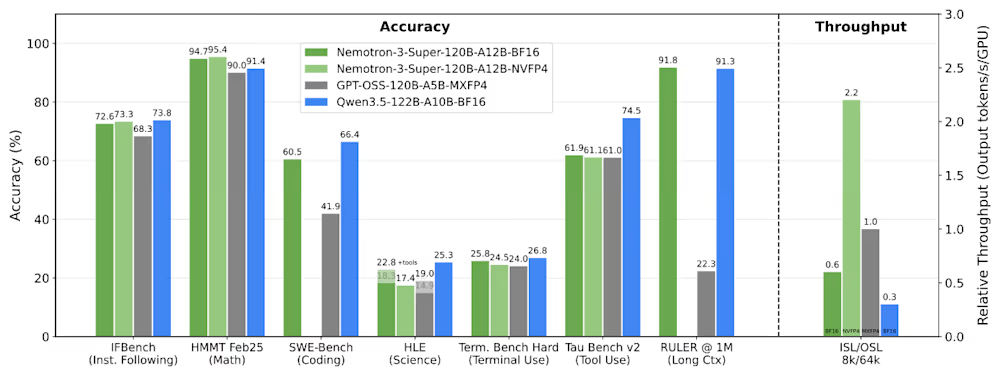
It also demonstrates significant throughput advantages, achieving up to 2.2x higher throughput than gpt-oss-120B and 7.5x higher than Qwen3.5-122B in high-volume settings.
Nvidia Nemotron 3 Super key benchmarks chart. Nvidia
Custom ‘open’ license — commercial usage but with important caveats
The release of Nemotron 3 Super under the Nvidia Open Model License Agreement (updated October 2025) provides a permissive framework for enterprise adoption, though it carries distinct “safeguard” clauses that differentiate it from pure open-source licenses like MIT or Apache 2.0.
Key Provisions for Enterprise Users:
Advertisement
Commercial Usability: The license explicitly states that models are “commercially usable” and grants a perpetual, worldwide, royalty-free license to sell and distribute products built on the model.
Ownership of Output: Nvidia makes no claim to the outputs generated by the model; the responsibility for those outputs—and the ownership of them—rests entirely with the user.
Derivative Works: Enterprises are free to create and own “Derivative Models” (fine-tuned versions), provided they include the required attribution notice: “Licensed by Nvidia Corporation under the Nvidia Open Model License.”
The “Red Lines”:
The license includes two critical termination triggers that production teams must monitor:
Safety Guardrails: The license automatically terminates if a user bypasses or circumvents the model’s “Guardrails” (technical limitations or safety hyperparameters) without implementing a “substantially similar” replacement appropriate for the use case.
Litigation Trigger: If a user institutes copyright or patent litigation against Nvidia alleging that the model infringes on their IP, their license to use the model terminates immediately.
This structure allows Nvidia to foster a commercial ecosystem while protecting itself from “IP trolling” and ensuring that the model isn’t stripped of its safety features for malicious use.
‘The team really cooked’
The release has generated significant buzz within the developer community. Chris Alexiuk, a Senior Product Research Enginner at Nvidia, heralded the launch on X under his handle @llm_wizardas a “SUPER DAY,” emphasizing the model’s speed and transparency. “Model is: FAST. Model is: SMART. Model is: THE MOST OPEN MODEL WE’VE DONE YET,” Chris posted, highlighting the release of not just weights, but 10 trillion tokens of training data and recipes.
Advertisement
The industry adoption reflects this enthusiasm:
Cloud and Hardware: The model is being deployed as an Nvidia NIM microservice, allowing it to run on-premises via the Dell AI Factory or HPE, as well as across Google Cloud, Oracle, and shortly, AWS and Azure.
Production Agents: Companies like CodeRabbit (software development) and Greptile are integrating the model to handle large-scale codebase analysis, while industrial leaders like Siemens and Palantir are deploying it to automate complex workflows in manufacturing and cybersecurity.
As Kari Briski, Nvidia VP of AI Software, noted: “As companies move beyond chatbots and into multi-agent applications, they encounter… context explosion.”
Nemotron 3 Super is Nvidia’s answer to that explosion—a model that provides the “brainpower” of a 120B parameter system with the operational efficiency of a much smaller specialist. For the enterprise, the message is clear: the “thinking tax” is finally coming down.
In 2024, Microsoft caused a lot of head-scratching and general bemusement with the launch of its “This is an Xbox” marketing campaign. Now, though, it appears the quandary over what is and isn’t an Xbox has been resolved. Game Developer noticed that the original blog post on Xbox Wire that kicked off the whole affair has been removed. It seems Xbox will be going a new direction with its future promotions.
Maybe since the new Project Helix hardware it has in the works is more definite attempt to blur console and PC gaming, “This is an Xbox” might have been truly confusing as a tagline. Maybe with the recent changing of the guard at the company, the top brass decided that it was the right time to start fresh with a less meme-able marketing plan. Whatever the reason, we have enjoyed this opportunity to learn about the existential philosophy behind being an Xbox. And fortunately, although the blog post may be gone, the video trailer still exists whenever we need to remind ourselves of the many things that can be Xbox-ified.
EchoPrime, published in Nature in February 2026, outperforms both task-specific AI tools and previous foundation models across 23 cardiac benchmarks, and its code, weights, and a demo are publicly available.
An echocardiogram is one of the most common diagnostic tools in cardiology: an ultrasound of the heart that reveals how it moves, how its chambers fill and empty, and whether its structure is compromised. Interpreting one requires training, time, and a specific kind of spatial attention, the ability to look at moving images of a beating heart and translate them into a clinical narrative.
Researchers at Cedars-Sinai Medical Center, working with colleagues from Kaiser Permanente Northern California, Stanford Health Care, Beth Israel Deaconess Medical Center in Boston, and Chang Gung Memorial Hospital in Taiwan, have built an AI system that can do the same thing.
EchoPrime, a video-based vision-language model, analyses echocardiogram footage and generates a written report of cardiac form and function. Its findings were published in Nature (volume 650, pages 970-977) in February 2026, under the title “Comprehensive echocardiogram evaluation with view primed vision language AI.”
The scale of the training is what sets EchoPrime apart. The model was trained on more than 12 million echocardiography videos paired with cardiologists’ written interpretations, drawn from 275,442 studies across 108,913 patients at Cedars-Sinai.
Advertisement
No previous AI model for echocardiography has been trained on data of that volume.
What it can do?
Tested across five international health systems, EchoPrime achieved state-of-the-art performance on 23 diverse benchmarks of cardiac structure and function, outperforming both task-specific AI approaches, models trained to do one thing, like measure ejection fraction, and previous foundation models that aimed for broader capability.
The model’s outputs are designed to assist clinicians, not replace them: it produces a verbal summary that cardiologists can review and act on, rather than rendering a diagnosis autonomously.
The research team has made the model’s code, weights, and a working demo publicly available, a decision that reflects a broader shift in AI research towards open publication, and that will allow other institutions to test EchoPrime against their own patient populations.
Advertisement
The context around it
EchoPrime arrives in a year when AI misdiagnosis has been named one of the top patient safety threats by ECRI, the healthcare safety organisation. That context does not undermine EchoPrime’s promise so much as it frames the standard it will need to meet.
The goal is not an AI that sometimes reads echocardiograms accurately, it is one that does so consistently enough to reduce the burden on cardiologists without introducing new categories of error.
Cardiology has been a productive area for AI-assisted diagnostics precisely because the data, ultrasound video, electrocardiograms, imaging, is relatively structured and abundant.
The Cedars-Sinai work is arguably the most thorough attempt yet to turn that abundance of data into a generalised tool. Whether EchoPrime moves from published model to clinical deployment at scale depends on factors, regulatory approval, institutional adoption, liability, that the Nature paper does not address.
Advertisement
But as a demonstration of what is now technically possible in cardiac AI, it sets a new mark.
It’s one thing to be able to haltingly make an order from a menu in a restaurant in another language, but quite another to be able to engage in fluent conversation with a native speaker. Dedicated study is often required to arrive at this point, but as is so often the case today, AI technology seems to have arrived at a rather brilliant shortcut: language-translating smart glasses.
Alibaba has grown from a tiny startup in 1999 to the powerhouse behind Alipay, Alibaba.com, and more. It has now expanded into yet more new tech territory, with the Quark AI Glasses. Two varieties, the G1 and S1 models, were shown off at Mobile World Congress 2026 in Barcelona, and their ability to translate languages that those nearby are speaking is fascinating. The glasses have a display called Waveguide, a subtle sort of overlay within the lenses that the user can control via tap, double-tap, and swipe motions on the arm of the glasses. A dedicated translation app will detect if someone nearby is speaking a different language and automatically display translated text.
Advertisement
The Waveguide’s bright green font, intended to be clearly visible yet unobtrusive, seems well suited to this transcription function, which is powered by Qwen AI models. Familiar privacy concerns arise, and there’s also the concern about the accuracy and speed of AI translation in its various forms, but there’s a lot of potential here. Also, of course, there’s a lot more that the Quark AI Glasses can do. It’s hard to say whether smart glasses are truly a viable alternative to computer monitors, but they certainly have a bag of tricks.
Advertisement
Some more features and functions of Alibaba’s Quark AI Glasses
The translation feature, as advanced as its real-time capabilities may prove to be, could be quite niche for a lot of potential buyers. The goal for AI assistants is to support and fit in with the user’s everyday tasks, first and foremost, and so it’s important that the Quark AI Glasses have a lot of utility when it comes to just that. Alibaba Group boasts that, being “deeply integrated with Alibaba’s ecosystem,” the new models offer associated features such as Taobao price comparison, Fliggy notifications and updates when traveling, and Amap assistance for finding your way around, and also implement voice and touch controls, along with bone conduction audio features.
The ideal with smart glasses is to achieve a lightweight, natural feel that almost makes you forget you aren’t wearing standard glasses, even though there are some places where you should never wear them. These models, it seems, were created to be subtle and convenient in this way, down to the batteries in the arm that can be quickly swapped out as needed. Lasting for about 24 hours at a time, this innovative new system is unique to smart glasses and, combined with the very reasonable pricing structure, is another feature that could see the Quark glasses really take off in the Chinese market.
Releasing in December 2025, Alibaba created three different editions of both the G1 and the S1. The latter is the dual-display option, and as such, it’s the premium version: Available from ¥3,799 (approximately $552), it’s considerably pricier than the G1 model, up for purchase from ¥1,899 (around $276). However, there’s no release date for the U.S. market just yet.
If you’re looking for a phone plan that includes plenty of perks for three or more people, T-Mobile’s new Better Value plan is appealing. The company is calling this a limited-time offer, but without a timeline for when it’s available, so now is a good time to check it out. As with all phone plans, be sure to read the fine print.
In our lists of the best cellphone plans, best unlimited data plans and best T-Mobile plans, we rank T-Mobile’s Essentials plan highly. After reviewing the specifics of the Better Value plan, the Experience More plan — the No. 2 unlimited postpaid plan — presents a more interesting comparison. Let’s see how they stack up.
Better Value plan pricing and features compared
For an account with three lines, the monthly cost of the Better Value plan is $140 (with AutoPay active), plus applicable taxes and fees. Experience More similarly costs $140 a month for three lines. The Essentials plan costs $90 per month for three lines, but lacks most of the add-ons that make the other two plans appealing.
Advertisement
Both the Experience More and Better Value plans offer unlimited data on T-Mobile’s 5G network, a five-year price guarantee and two-year device upgrades.
However, the Better Value plan includes 250GB of high-speed mobile hotspot data, compared to 60GB for the Experience More plan. After those amounts have been used up, data is available at an unlimited rate of 600Kbps. (T-Mobile’s highest tier plan by comparison, Experience Beyond, includes unlimited high-speed hotspot data.)
Better Value also includes more high-speed data when you’re in other countries, with 30GB available in Mexico and Canada, as well as in 215 countries and areas worldwide. That’s more than the Experience More plan, which offers 15GB in North America and 5GB elsewhere.
Advertisement
Announcement of the T-Satellite launch date on stage at a T-Mobile event.
Jeff Carlson/CNET
T-Satellite is also included in the Better Value plan, a feature that costs $10 extra for every other T-Mobile plan except for Experience Beyond.
One appeal of these plans, especially in the context of families, is the set of included streaming services. The Better Value plan and Experience More plan both include Netflix Standard with Ads and Hulu, and Apple TV can be added for $3 per month.
Important qualifications
Here’s where the fine print comes in, and it appears that T-Mobile is aiming to inspire and reward loyalty.
Advertisement
If you’re switching from a different carrier, the Better Value plan requires three or more lines and two eligible ports. Although it’s likely a family or small business would be transferring from another provider and not keeping its other lines, Better Value is an effort to build up group plans and incentivize switching away from other carriers.
If you’re already set up with T-Mobile, the Better Value plan requires that you have been a T-Mobile postpaid customer for at least five years. And if you have that much tenure, you should be aware that your current plan might have taxes and fees included, whereas the Better Value plan doesn’t.
The Better Value plan is available in the T-Life app and on T-Mobile.com. When you enter a retail T-Mobile store, you’ll likely be directed to the app or website by an employee.
And lastly, T-Mobile brands this as a limited-time offer, but I confirmed with a spokesperson that it currently has no end date.
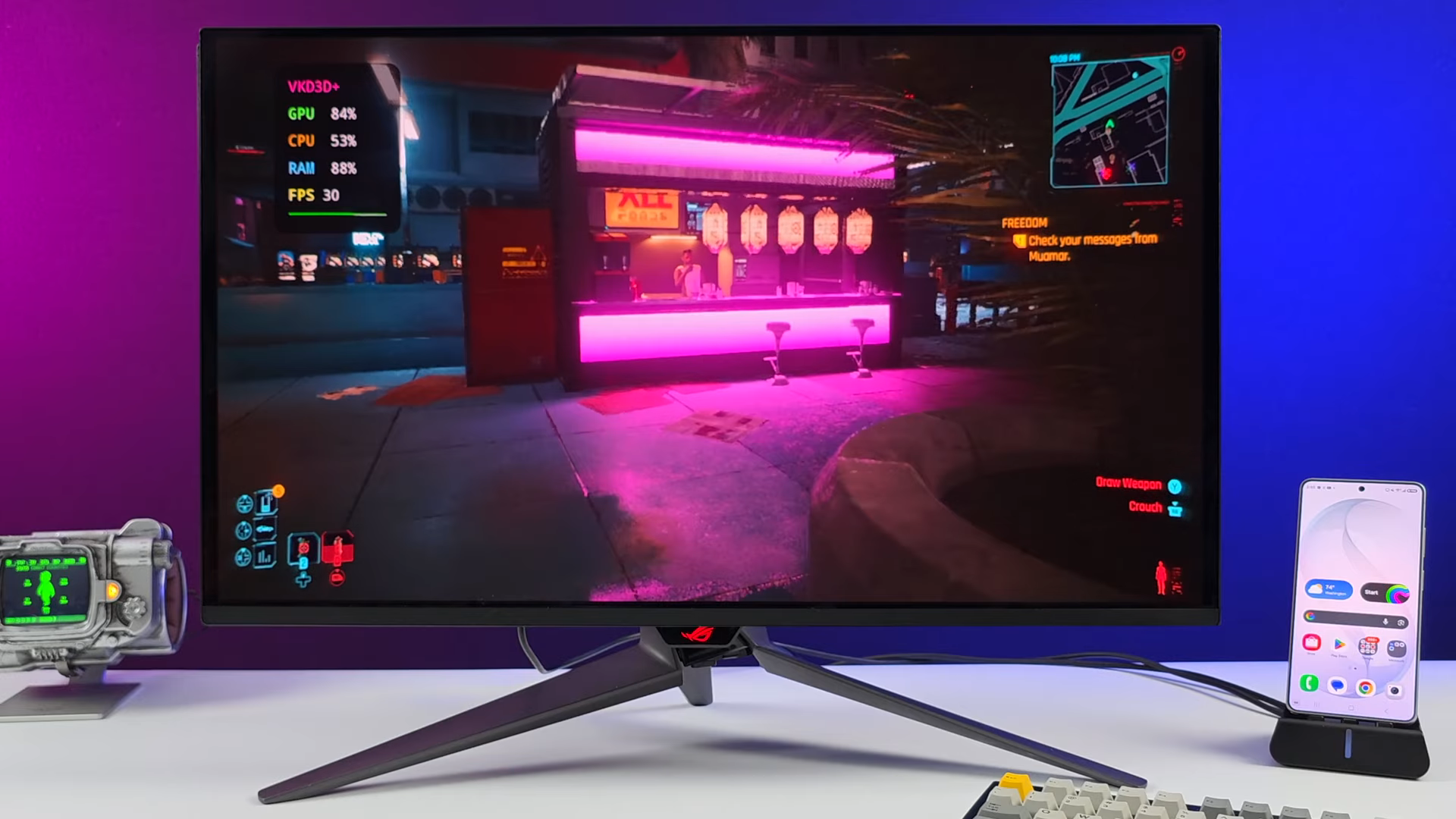
There was an ideal of convergence, a long time ago, when one device would be all you need, digitally speaking. [ETA Prime] on YouTube seems to think we’ve reached that point, and his recent video about the Samsung S26 Ultra makes a good case for it. Part of that is software: Samsung’s DeX is a huge enabler for this use case. Part of that his hardware: the S26 Ultra, as the upcoming latest-and-greatest flagship phone, has absurd stats and a price tag to match.
First, it’s got 12 GB of that unobtanium once called “RAM”. It’s got an 8-core ARM processor in its Snapdragon Elite SOC, with the two performance cores clocked at 4.74 GHz — which isn’t a world record, but it’s pretty snappy. The other six cores aren’t just doddling along at 3.62 GHz. Except for the very youngest of our readers, you probably remember a time when the world’s greatest supercomputers had as much computing power as this phone.
So it should be no suprise that when [ETA Prime] plugs it into a monitor (using USB-C, natch) he’s able to do all the usual computational tasks without trouble. A big part of that is the desktop mode Samsung phones have had for a while now; we’ve seen hackers make use of it in years gone by. It’s still Android, but Android with a desktop-and-windows interface.
What are the hard tasks? Well, there’s photo and video editing, which the hardware can handle. Though [ETA] notes that it’s held back a bit because Adobe doesn’t offer their full suite on Android. But what’s really taxing for most of us is gaming. Android gaming? Well, obviously a flagship phone can handle anything in the play store.
Advertisement
It’s PC gaming that’s pretty impressive, considering the daisy chain of compatibility needed last time we looked at gaming on ARM. Cyberpunk 2077 gets frame rates near 60, but he needs to drop down to “low” graphics and 720p to do it. You may find that ample, or you may find it unplayable; there’s really no accounting for taste.
We might not always likecarrying an everything device with us at all times, but there’s something to be said in not duplicating that functionality on your desk. Give it a couple of years when these things hit the used market at decent prices, and unless PC parts drop in price, convergence might start to seem like a great idea to those of us who aren’t big gamers and don’t need floppy drives.
From the very beginning of the DOGE saga, many of us raised alarms about what would happen when a bunch of inexperienced twenty-somethings were handed unfettered access to the most sensitive databases in the federal government with essentially zero oversight and zero adherence to the security protocols that exist for very good reasons. We wrote about it when a 25-year-old was pushing untested code into the Treasury’s $6 trillion payment system. We published a piece about it, originally reported by ProPublica, when DOGE operatives stormed into Social Security headquarters and demanded access to everything while ignoring the career staff who actually understood the systems.
That ProPublica deep dive painted a picture of 21-to-24-year-olds who didn’t understand the systems they were demanding access to, had “pre-ordained answers and weren’t interested in anything other than defending decisions they’d already made,” and were operating with essentially no accountability. The former acting commissioner described the operation as “a bunch of people who didn’t know what they were doing, with ideas of how government should run—thinking it should work like a McDonald’s or a bank—screaming all the time.”
These are the people who were handed the keys to the most sensitive databases the federal government holds.
And now we have what appears to be the entirely predictable consequence of all of that: direct exfiltration of data in a manner known to break the law, but zero concern over that fact, because of the assurances of a Trump pardon if caught.
Advertisement
The Washington Post has a stunning whistleblower report alleging that a former DOGE software engineer, who had been embedded at the Social Security Administration, walked out with databases containing records on more than 500 million living and dead Americans—on a thumb drive—and then allegedly tried to get colleagues at his new private sector job to help him upload the data to company systems.
According to the disclosure, the former DOGE software engineer, who worked at the Social Security Administration last year before starting a job at a government contractor in October, allegedly told several co-workers that he possessed two tightly restricted databases of U.S. citizens’ information, and had at least one on a thumb drive. The databases, called “Numident” and the “Master Death File,” include records for more than 500 million living and dead Americans, including Social Security numbers, places and dates of birth, citizenship, race and ethnicity, and parents’ names. The complaint does not include specific dates of when he is said to have told colleagues this information, but at least one of the alleged events unfolded around early January, according to the complaint. While working at DOGE, the engineer had approved access to Social Security data.
In the past, this was the kind of thing that the US government actually did a decent job protecting and keeping private. Now they have DOGE bros walking out the door with it on thumbdrives. Holy shit!
And here’s the detail that really tells you everything about the culture DOGE created inside these agencies:
He told another colleague, who refused to help him upload the data because of legal concerns, that he expected to receive a presidential pardon if his actions were deemed to be illegal, according to the complaint.
According to this complaint, this person allegedly understood that what he was doing might be illegal, did it anyway, and had already calculated that the political environment would protect him from consequences. The Elon Musk DOGE bros clearly believed they ran the show and that anyone associated with DOGE was entirely above the law on anything they did.
Advertisement
Perhaps just as troubling, the complaint also alleges that after leaving government employment, the DOGE bro claimed he still had his agency computer and credentials, which he described as carrying “God-level” security access to Social Security’s systems.
The complaint alleges that after leaving government employment, the former DOGE member told colleagues he had a thumb drive with Social Security data and had kept his agency computer and credentials, which he allegedly said carried largely unrestricted “God-level” security access to the agency’s systems — a level of access no other company employee had been granted in its work with SSA.
The Social Security Administration says he had turned in his laptop and lost his credential privileges when he departed. His lawyer denies all alleged wrongdoing, and both the agency and the company said they investigated the claims and didn’t find evidence to confirm them. The company said it conducted a “thorough” two-day internal investigation.
Two whole days! Investigating themselves. On an issue where ignoring it benefits them.
But the SSA’s inspector general is investigating, and has alerted Congress and the Government Accountability Office, which has its own audit of DOGE’s data access underway.
Advertisement
And this whistleblower complaint, filed back in January, surfaces alongside a separate complaint from the SSA’s former chief data officer, Charles Borges, which alleges that DOGE members improperly uploaded copies of Americans’ Social Security data to a digital cloud.
A separate complaint, made in August by the agency’s former chief data officer, Charles Borges, alleges members of DOGE improperly uploaded copies of Americans’ Social Security data to a digital cloud, putting individuals’ private information at risk. In January, the Trump administration acknowledged DOGE staffers were responsible for separate data breaches at the agency, including sharing data through an unapproved third-party service and that one of the DOGE staffers signed an agreement to share data with an unnamed political group aiming to overturn election results in several states.
We wrote about that other leak at the time, of a DOGE bro sharing data with an election denier group.
All of this just confirms what many people expected and none of this should surprise anyone who was paying attention: Donald Trump allowed Elon Musk and his crew of over-confident know-nothings to view federal government computer systems as their personal playthings, where they could access and exfiltrate any data they wanted for whatever ideological reason they wanted.
And we’re only hearing about this because a whistleblower came forward and because a former chief data officer had the courage to file a complaint. How many similar incidents happened at other agencies where no one spoke up? DOGE operatives were embedded across the entire federal government, accessing heavily restricted databases and, as the Washington Post puts it, “merging long-siloed repositories.” Every single one of those agencies had the same dynamic: young, inexperienced but overconfident engineers demanding unfettered access, career staff pushing back and being overruled, and essentially no security protocols being followed.
Advertisement
Former chief data officer Borges put it about as well as anyone could:
“This is absolutely the worst-case scenario,” Borges told The Post. “There could be one or a million copies of it, and we will never know now.”
Once it’s out, you can’t put it back. We’re going to be learning about the consequences of DOGE’s ransacking of federal systems for years, maybe decades. And we’re finding out that the waste, fraud, and abuse we were told DOGE was there to find, appears to have mostly been in their own actions.
BearingPoint’s Barry Haycock and Rosie Bowser discuss the evolution of workplace AI and the importance of governance in 2026.
AI in the workplace is becoming increasingly common.
Last September, Ibec, the group representing Irish businesses, released a report indicating a jump in the usage of AI among Irish workers. For instance, in July 2025, 40pc of employees reported using AI in the workplace, compared to just 19pc in August 2024.
Barry Haycock, senior manager of data analytics and AI at BearingPoint, believes workplace AI has moved from “experimentation to operational use”.
Advertisement
“Copilots and agents are becoming standard, but we’re also seeing automation of complex knowledge work like contract review, compliance checks, large-scale document processing, advanced search across enterprise data,” he tells SiliconRepublic.com.
“For larger-scale work, we’re seeing ‘AI factories’ being implemented as enterprises are seeking to automate AI pipelines. Augmented analytics is allowing business teams to surface insights without deep technical expertise.”
However, Haycock says “sustainable value” in relation to the tech still depends on governance, data maturity and workforce capability.
“Without governance and measurable outcomes, pilots stall,” he explains. “AI should be integrated incrementally and aligned directly to business needs. Organisations need defined use cases, strong data foundations, clear risk ownership and executive sponsorship.
Advertisement
“Data governance and model explainability are being understood as enablers more and more. Security, regulatory exposure and explainability must be addressed early.”
Rosie Bowser, a consultant in data analytics and AI at BearingPoint, says they’ve seen a “temptation” for organisations to rush into implementing new AI solutions – whereas the “greatest value creation” occurs when the solution is anchored in a clearly defined problem or workflow.
“Starting with the tool is not unlike painting over a structural crack: it may look like progress, but it doesn’t resolve the underlying issue. So, as an organisation, you need to be as ready as the technology is, and that may well involve having to acknowledge and rectify organisational immaturity before rolling out a new AI solution.”
Accessory, not autonomous
Concerns around AI replacing jobs has been prevalent ever since the topic of workplace AI has emerged. The worry is understandable, especially in the wake of recent AI-related layoffs.
Advertisement
Haycock believes AI is more likely to “reshape” work, rather than eliminate it outright.
“The real risk is failing to reskill and adapt,” he says. “It will automate anything that can be automated, particularly repetitive cognitive tasks. Organisations that invest in workforce capability and reposition people toward higher-value work will benefit most.”
Bowser agrees, asserting that the real risk is “stagnation” rather than replacement. “Organisations that don’t actively support upskilling may find their workforce unable to operate safely and confidently within AI‑enabled processes,” she says.
Bowser adds that companies should consider AI as a workflow accelerator, “rather than an autonomous decision-maker”.
Advertisement
“The AI system should be able to take on the repetitive, rules-based components of work, but we still need humans to retain oversight and make the final decisions,” she explains. “The importance of ownership here isn’t a backlog consideration either; with the AI Act’s emphasis on traceability and model provenance, this will be critical moving forward.”
Governance in advance
Haycock says that in 2026, AI governance will be less about pilots and “more about proof”.
“With the EU AI Act taking effect and Ireland’s National Digital and AI Strategy 2030 setting clear expectations for responsible adoption, organisations will need to demonstrate documentation, transparency and auditability,” he says.
“I believe customer expectations will increase, and companies will need to meet that demand. Furthermore, oversight must be proportionate to risk and embedded into operations. The differentiator will be scalable governance that enables innovation while standing up to regulatory and public scrutiny.”
Advertisement
Bowser says that governance needs to “feel practical and tangible”, with measures such as clear rules about data handling, audit trails and fallback steps, and knowing what the model is actually doing. The key, she says, is making governance practical enough that people can follow it “without friction”.
“If you were starting your AI journey in 2026,” says Bowser, “a learning for me is that there is often documentation developed in most organisations already, but do people on the ground know where that documentation is? Do they know who the data owners are, do they know what they can do safely?
“Organisations need to be aware of how people have adopted AI in their daily lives and how they expect to be able to bring it into their work lives, otherwise you end up with AI shadow practices that could introduce significant risk. Now that the EU AI Act is in force, these risks could be considerable.”
Don’t miss out on the knowledge you need to succeed. Sign up for the Daily Brief, Silicon Republic’s digest of need-to-know sci-tech news.
They are the Intel Core Ultra 7 270K Plus and Core Ultra 5 250K Plus
Both offer core count increases compared to their Arrow Lake predecessors — and a sizeable boost in gaming performance to the tune of 15%
Intel has released a pair of new desktop processors, which are refreshed models that are a step forward for the firm’s current Arrow Lake range.
Tom’s Hardware reports that these Arrow Lake Refresh chips are the Intel Core Ultra 7 270K Plus and Core Ultra 5 250K Plus. These are pepped-up models of the existing Core Ultra 7 265K and Core Ultra 5 245K CPUs, respectively.
Intel’s Robert Hallock, VP, Client Computing Group, General Manager, Enthusiast Channel Segment, boasts: “First, the Core Ultra 7 270K Plus and Ultra 5 250K Plus are the fastest desktop gaming processors Intel has ever built. Second, they nearly double the content creation performance of our competitor. And, thirdly, they’re arriving with exciting new technologies that revolutionize the setup and optimization roadmap for Intel gaming platforms. These chips are a value that’s hard to beat.”
Article continues below
Advertisement
That’s some big talk, so what’s new exactly with these CPUs?
Intel has beefed up the core count, so the Core Ultra 7 270K Plus has eight performance cores plus 16 efficiency cores, which is an extra four efficiency cores compared to the 265K. The same treatment has been given to the Core Ultra 5 250K Plus with an extra four efficiency cores, meaning it now has 12 efficiency cores to go along with its six performance cores.
As for clock speeds, these remain essentially the same as their predecessors, save for minor changes — you do get 100MHz more boost with the 250K, but the 270K maintains the same 5.4GHz for the performance cores as seen with the 265K.
Advertisement
Intel has brought in performance boosts elsewhere, though, notably with an up to 900MHz increase in the die-to-die speed of these new processors. That means lower system latency and a boost for PC gaming, Intel observes.
Sign up for breaking news, reviews, opinion, top tech deals, and more.
There’s also support for faster RAM — up to 7200 MT/s DDR5 (up from 6400 MT/s on current Arrow Lake chips) — which will help performance, and a new Intel Binary Optimization Tool or iBOT.
Intel explains that iBOT is “a first-of-its-kind optimization technology” which will “increase processor instructions per cycle (IPC) and user performance”.
Advertisement
We’re told that this tool can increase IPC in certain games — think of that as a different way of upping performance aside from clock frequency increases — and this holds even if the game has been optimized for a different platform (like a console).
The proof will be in the (independent) game benchmarks, of course, but Team Blue is already calling iBOT a “key aspect of Intel’s long-term performance roadmap for enthusiasts”.
In terms of the game benchmarks for launch, Intel’s claiming 15% faster gaming performance for the 270K Plus versus the 265K based on the average frame rates over 38 games (at 1080p resolution, high details, with the iBOT tool enabled where supported).
Advertisement
The price of the Intel Core Ultra 7 270K Plus processor is $299, and the MSRP of the Core Ultra 5 250K Plus is $199.
Analysis: a statement of intent from Intel
(Image credit: Intel)
Intel has a lot of work to do to gain favor again in the world of PC enthusiasts and gamers, because Arrow Lake wasn’t well-received by the gaming community, and before that, we had those nasty stability issues with 13th and 14th-gen CPUs (which weren’t well-received by anyone). However, this Core Ultra 200S Plus refresh — albeit that it’s a modest two-chip effort — is an important step towards rebuilding Intel’s desktop reputation.
The gaming performance jump with the Core Ultra 7 270K Plus is a sizeable one, with the extra cores, die-to-die speed boost, and complementing tech providing some serious extra power. When you consider those gains through the lens of the asking prices — which are actually lower than the old models these refreshes succeed — you’ve got a potent recipe for success, frankly.
Advertisement
Hallock’s PR boasts aren’t hollow by all accounts, and the refreshed Arrow Lake CPUs here have been a pleasant surprise for the gaming community and PC enthusiasts alike.
The only thing missing is a flagship refresh, with no 290K Plus model. That means the flagship 285K is in an odd position, seeing as the new 270K Plus is its equal in core count and almost matches the former’s clocks (it’s 100MHz shy in the boost stakes, but that’s not a big deal at all).
More eyes, however, are likely to be on the Core Ultra 5 250K Plus, because at $199, this looks like an excellent value proposition, and a much-needed breath of fresh air at a time when many PC components are getting depressingly expensive (RAM and storage, of course, and also GPUs).
And of course, you can also follow TechRadar on YouTube and TikTok for news, reviews, unboxings in video form, and get regular updates from us on WhatsApp too.
Building websites without a mouse requires detailed knowledge and extensive coding effort
Focusgroup from Microsoft allows developers to handle complex navigation elements without writing excessive code
Tabindex errors often break keyboard navigation for many website users
Developing and building websites that can be fully navigated without a mouse has long required extensive technical skill and careful planning.
Developers often rely on complex JavaScript libraries or write substantial code to ensure that each interactive element responds correctly to keyboard input, increasing the amount of code to maintain and slows website load times.
But Microsoft has now introduced a new technology called focusgroup that aims to simplify this process.
Initially shared in 2022, focusgroup was refined through collaboration with developers and feedback from multiple perspectives.
“Creating a fully keyboard-accessible site, especially one that has complex widgets such as menus, submenus, toolbars, tabs, and other groups of inputs, isn’t free; it requires a lot of work and knowledge,” said Patrick Brosset, principal product manager for Microsoft Edge.
Advertisement
The traditional approach uses the HTML attribute tabindex to control focus, allowing users to move between interactive elements by pressing Tab.
Less than half of developers implement it correctly, according to Brosset, and errors can lead to inconsistent navigation or broken keyboard functionality.
Sign up to the TechRadar Pro newsletter to get all the top news, opinion, features and guidance your business needs to succeed!
This not only complicates development but also affects accessibility for users who depend entirely on keyboards or assistive technology.
Advertisement
Many countries have made compliance with Web Content Accessibility Guidelines (WCAG) a legal requirement, making accessible design both a technical and regulatory concern.
Brosset notes that the tool allows developers to manage focus behavior across complex navigation structures without manually handling large volumes of code.
By reducing the coding burden, focusgroup could improve website performance and allow users to access content faster, while also easing compliance with accessibility standards.
Advertisement
Developers using Chromium-based browsers can now test the solution in early releases of Microsoft Edge.
Jacques Newman, a senior engineer on the Edge Web Platform Team, provides detailed guidance on implementing focusgroup and encourages feedback to refine the tool further.
The technology is designed not as a market research platform but as a coding aid, potentially benefiting developers using laptops for programming and those experimenting with vibe coding tools.
By allowing complex websites to function fully without a pointing device, focusgroup aims to make keyboard accessibility achievable without extensive manual work.
Advertisement
However, even with tools such as focusgroup, developing fully keyboard-accessible websites continues to require substantial coding effort and technical knowledge.