

Crypto World
March CPI print already baked into BTC price


The February CPI data came in broadly as anticipated, reinforcing that higher inflation remains a factor but not a surprise driver for markets. Analysts at 21Shares argued that the macro picture had already priced in the March print, shifting attention to how the Federal Reserve would respond. The Bureau of Labor Statistics reported shelter costs rose 0.2% in February, while food climbed 0.4% and energy rose 0.6%; the core measure excluding food and energy rose 0.2%. Those numbers underscore a broad, uneven inflation trajectory. In crypto markets, the Total 3 market indicator — which tracks the broader crypto capitalization outside the two largest assets by market cap — dipped about 1% from an intraday high near $722 billion as traders absorbed the data. For readers tracking the macro narrative, the CPI release keeps the Fed in sharper focus while liquidity remains a driver for risk assets across crypto landscapes. CPI release.
Key takeaways
- The February CPI print aligned with estimates, reinforcing expectations that inflation momentum remains contained but persistent enough to influence policy signaling.
- Macro data priced in, shifting attention to the Fed’s reaction function and whether policymakers will “look through” temporary shocks or tighten preemptively.
- Crypto markets showed resilience, with the broader market excluding the leading two assets dipping about 1% from an intraday peak near $722 billion.
- Near-term Bitcoin price prospects point to a range around $68,000–$74,000, with a breakout above $75,000 potentially lifting the next leg toward $77,000–$80,000.
- Market expectations for near-term policy action remain modest, with roughly 0.6% of traders pricing in a rate cut at the March 18 meeting, per CME FedWatch.
Market context: The CPI outcome intersected with expectations about the Federal Reserve’s policy path, reinforcing a regime where macro data and liquidity conditions increasingly shape asset allocation across crypto markets. As investors parse the data, attention remains on potential ETF flows, liquidity conditions, and regulatory signals that could influence risk-on appetite in the sector.
Sentiment: Neutral
Market context: The broader crypto environment continues to respond to macro cues while traders weigh the durability of trend reversals and the potential for regime shifts in monetary policy. The latest price action sits within a framework of cautious optimism, where a measured CPI path and any dovish pivot from the Fed could catalyze incremental risk-taking among digital-asset traders.
Why it matters
The February CPI numbers anchor expectations for the Federal Reserve’s near-term trajectory, with market participants watching for clues about whether policy will remain restrictive or begin to ease as inflation cools. The quote from Stephen Coltman, head of macro at 21Shares, encapsulates the key debate: will the Fed “look through” a temporary inflation shock or tilt hawkish in anticipation of renewed price pressures? His question captures a central tension in macro markets: policymakers must balance the risk of stale data against the risk that over-tightening slows growth more than necessary. The CPI multipliers, the timing of potential rate cuts, and the path of the Fed’s balance sheet all feed directly into how risk assets, including crypto, are repriced in real time.
On the crypto side, Bitcoin and its peers have shown resilience even as macro indicators flash caution. The broader market—measured by Total 3, which excludes the two largest assets by market cap—has managed to hold a high-water mark even as the broader market cooled slightly after the CPI release. The dynamic is clear: when macro momentum remains supportive and liquidity is plentiful, infrastructure developers, traders, and hedgers position themselves for a range of outcomes. The interplay between inflation data, the Fed’s policy stance, and risk sentiment remains the dominant driver of near-term price action in digital assets, even as structural developments in the sector—such as staking, layer-2 scaling, and DeFi adoption—continue to underpin longer-term value propositions.
From a tactical perspective, the crypto narrative often hinges on price catalysts that align with macro cues. If the CPI prints continue to signal softening inflation and the Fed signals a more accommodative stance, the environment could become conducive to a slow but steady reallocation into risk assets, including crypto. Conversely, if the data surprises higher or the Fed remains steadfast in a hawkish posture, liquidity could tighten and risk appetite could wane, pressing prices lower in the near term. In this context, Bitcoin and Ethereum—each with distinct on-ramps to risk markets and different catalysts (security, scalability, staking yields, and institutional adoption)—will be watched closely as leading indicators of broader sentiment in the sector. Ethereum (CRYPTO: ETH) remains a focal point for investors watching network upgrades and the evolving dynamics of on-chain activity, while Bitcoin continues to serve as the benchmark for institutional sentiment toward digital assets as an entire category.
In the immediate horizon, price action for Bitcoin appears to be constrained within a corridor rather than forming a new uptrend. The market narrative suggests that a sustained break above the $75,000 mark could unlock a phase of consolidation between $75,000 and $80,000, with momentum dependent on macro signals, liquidity availability, and the pace at which policy expectations evolve. Historical patterns show that geopolitical shocks can trigger sharp but often brief rebounds in risk assets, including crypto, as investors reposition portfolios and seek hedges or uncorrelated stores of value. A potential easing cycle in 2026, if it materializes, could further accelerate any durable upside by reducing discount rates on future cash flows and encouraging risk-taking among diversified portfolios. For now, near-term traders appear to be watching for a decisive move beyond key resistance levels while staying mindful of the macro backdrop.
The market’s next phase will hinge on the March 18 FOMC decision and the accompanying dot plot. While the probability of a rate cut is currently modest, any shift in messaging toward a more permissive stance would likely be interpreted as a positive catalyst for both traditional and crypto markets. Investors should remain alert to any new inflation data and to updates in regulatory and ETF-related developments that could alter risk appetite and liquidity dynamics in this evolving space.
What to watch next
- March 18: Federal Reserve meeting outcomes and the accompanying policy statement; assess shifts in the policy stance and the dot plot.
- Bitcoin price signal: monitor whether the price sustains a break above $75,000 and whether it can push into the $77,000–$80,000 range.
- Evidence of sustained liquidity: track ETF inflows, macro liquidity conditions, and funding rates that could affect risk assets including crypto.
- Geopolitical or macro shocks: observe whether external events drive a rapid re-pricing across crypto markets and whether they catalyze follow-on rebounds.
- Regulatory and on-chain developments: continue to watch network upgrades, staking dynamics, and DeFi activity that influence long-term value propositions.
Sources & verification
- U.S. Bureau of Labor Statistics CPI February release and sector breakdowns (shelter, food, energy, core).
- Comments from Stephen Coltman, head of macro at 21Shares, regarding the Fed reaction function and policy signaling.
- CME FedWatch tool for probability of near-term rate cuts and market expectations at the March 18 meeting.
- Price charts and intraday levels referenced via TradingView and reputable price-tracking data for Bitcoin and Ethereum.
Markets digest CPI data as Fed policy looms and Bitcoin eyes a breakout
The February CPI print arrived in line with expectations, reinforcing the view that inflation momentum remains a factor but not a surprise driver for markets. In a briefing that highlighted the breadth of price pressures, shelter costs rose 0.2% in February, food increased 0.4%, and energy advanced 0.6%. The core CPI, which strips out volatile food and energy components, rose 0.2%. These figures, released by the U.S. Bureau of Labor Statistics, reflect a broad inflation path with pockets of resilience in housing and energy alongside more modest gains in some other sectors. Analysts at 21Shares noted that the print is now part of the pricing backdrop for the March data, complicating the path for policy but not delivering an outsized surprise that would upend markets. The crypto space, meanwhile, showed a measure of resilience as Total 3 — the broader market value outside the leading two assets — retraced roughly 1% from an intraday high near $722 billion, underscoring that liquidity and risk sentiment remain critical levers for digital assets in the near term. CPI release.
Market observers at 21Shares framed the data through the lens of the Fed’s reaction function. Stephen Coltman asked whether policymakers will “look through” temporary inflation shocks or tilt hawkish as a precaution, pointing to a central question as officials balance the persistence of price pressures against the evidence of cooling momentum. The answer, to many, will hinge on how the Fed interprets the trajectory of inflation and how aggressively it views the risk of a renewed uptick. The outcome will shape not just traditional asset classes but the risk appetite that propels crypto markets higher or lower in the weeks to come.
Looking at the near-term price action, Bitcoin’s path remains tethered to momentum around major psychological thresholds and resistance levels. In a scenario where the price breaks decisively above the $75,000 mark, bulls could push into a consolidation zone roughly between $75,000 and $80,000, with the potential to test the upper end of that band depending on macro cues and liquidity conditions. If, instead, the market fails to clear that resistance, the asset could consolidate in the lower to mid-$70,000s as traders await clearer signals from policymakers and the broader economy. The relevance of macro factors to crypto is a reminder that while the technology and use cases continue to evolve, the sector remains highly sensitive to the policy and liquidity backdrop that governs all risk assets.
Beyond Bitcoin, Ethereum’s ongoing developments around staking dynamics, network upgrades, and layer-2 scaling will continue to influence demand and on-chain activity. These structural factors can interact with macro signals to shape price trajectories over a longer horizon, even as the near term remains dominated by inflation data and monetary policy expectations. In sum, the CPI data reinforces a delicate balance: a still-elevated inflation backdrop paired with a potential shift in policy signaling could, if realized, unlock new phases of risk-on behavior that bolster crypto markets—provided liquidity holds and macro momentum remains supportive.


Two of the US’s most influential financial regulators have agreed to better coordinate oversight of the financial markets, seeking to put an end to decades of “regulatory turf wars” between them.
According to the memorandum of understanding written on Wednesday, the US Securities and Exchange Commission and US Commodity Futures Trading Commission said it has become a “pivotal time” to regulate in harmony as new technologies, such as crypto, make it more challenging to monitor the markets:
“New trading models, digital infrastructure, and onchain, automated systems increasingly blur traditional jurisdictional lines,” they said, particularly as market participants operate across platforms and asset classes.
To address that problem, the SEC and CFTC said they will aim to provide regulatory clarity and certainty built on technology-neutral regulations and share information and data concerning issues of “common regulatory interest” to fulfill their respective regulatory mandates.
In a separate statement, SEC chair Paul Atkins said the memo is the latest step toward repairing the relationship between the agencies:
“For decades, regulatory turf wars, duplicative agency registrations, and different sets of regulations between the SEC and CFTC have stifled innovation and pushed market participants to other jurisdictions.”

Both the SEC and CFTC have made strides to deliver on US President Donald Trump’s mission of making the US the “crypto capital of the world,” having set up a crypto-specific task force and established an advisory committee to ensure crypto, AI and other emerging tech innovations continue to push forward in the US.
The agencies also noted in the memo that they strive to provide a “fit-for-purpose regulatory framework for crypto assets.”
Related: SEC chair calls for ‘coordinated oversight‘ between US regulators
The regulatory clarity will be provided to market participants operating everything from trading platforms, clearinghouses and data repositories to pooled investment vehicles, dealers and intermediaries, in addition to products that span securities and derivatives frameworks.
SEC, CFTC to adopt “minimum effective dose” strategy
The two agencies said they also plan to adopt a “minimum effective dose” regulatory strategy to foster innovation while maintaining market integrity and remaining competitive in the global market.
The term “minimum effective dose” is a pharmacological term, defined as the smallest dose of medication that produces the desired therapeutic benefit.
Magazine: Clarity Act risks repeat of Europe’s mistakes, crypto lawyer warns


Traders’ optimism surges as energy shocks and geopolitical uncertainty dominate macro narratives.
Bitcoin (BTC) traders appear to be leaning optimistic in anticipation of a quick end to the war in the Middle East.
In fact, sentiment surrounding the world’s largest crypto asset surged back into FOMO territory after its market value briefly surpassed $70,000 on Tuesday, according to Santiment.
BTC FOMO Returns
Across social platforms, including X, Reddit, and Telegram, discussions reflect optimism, driven in part by comments from US President Donald Trump, who hinted that the war may soon end, as well as by the recent reversal in oil prices.
🤑 Bitcoin sentiment has jumped back into FOMO territory after its market value exceeded $70K Tuesday. Across X, Reddit, Telegram, and other crypto-related discussions, the crowd is encouraged by Trump’s comments that the war may soon end, and oil prices reversing course. pic.twitter.com/S21cXOUM0F
— Santiment (@santimentfeed) March 10, 2026
Despite the heightened market sentiment, on-chain activity shows signs of cooling. Crypto analyst Axel Adler Jr. found that the 30-day average of Bitcoin transfer volume has declined compared with both one month and one quarter ago. This evidences a temporary slowdown in short-term momentum.
However, transfer volume remains above its 365-day average and significantly higher than levels seen six months ago, which potentially means that while network activity has slowed from previous highs, there is no structural breakdown, and the broader trend in Bitcoin usage and movement remains high.
Geopolitical Tensions
This week’s rebound in risk assets such as Bitcoin has coincided with volatility in oil markets and changing expectations about the duration and impact of the Iran conflict.
You may also like:
Amid these macro developments, experts believe that BTC remains within a clearly liquidity-driven structure. In a statement to CryptoPotato, analysts at Bitunix said that derivatives liquidation distributions show a dense concentration of short liquidation zones between approximately $70,000 and $74,000 above current price levels, while leveraged long liquidity remains clustered near the $65,000-$66,000 range below.
After the latest recovery, the analysts said that BTC has entered sideways consolidation, suggesting that short-term price action remains dominated by liquidity sweeps both above and below.
“Overall, with energy shocks and geopolitical uncertainty continuing to dominate the macro narrative, the crypto market has yet to form a unilateral trend structure. Capital currently appears more inclined to engage in short-term liquidity positioning between dense liquidation zones.”
Binance Free $600 (CryptoPotato Exclusive): Use this link to register a new account and receive $600 exclusive welcome offer on Binance (full details).
LIMITED OFFER for CryptoPotato readers at Bybit: Use this link to register and open a $500 FREE position on any coin!
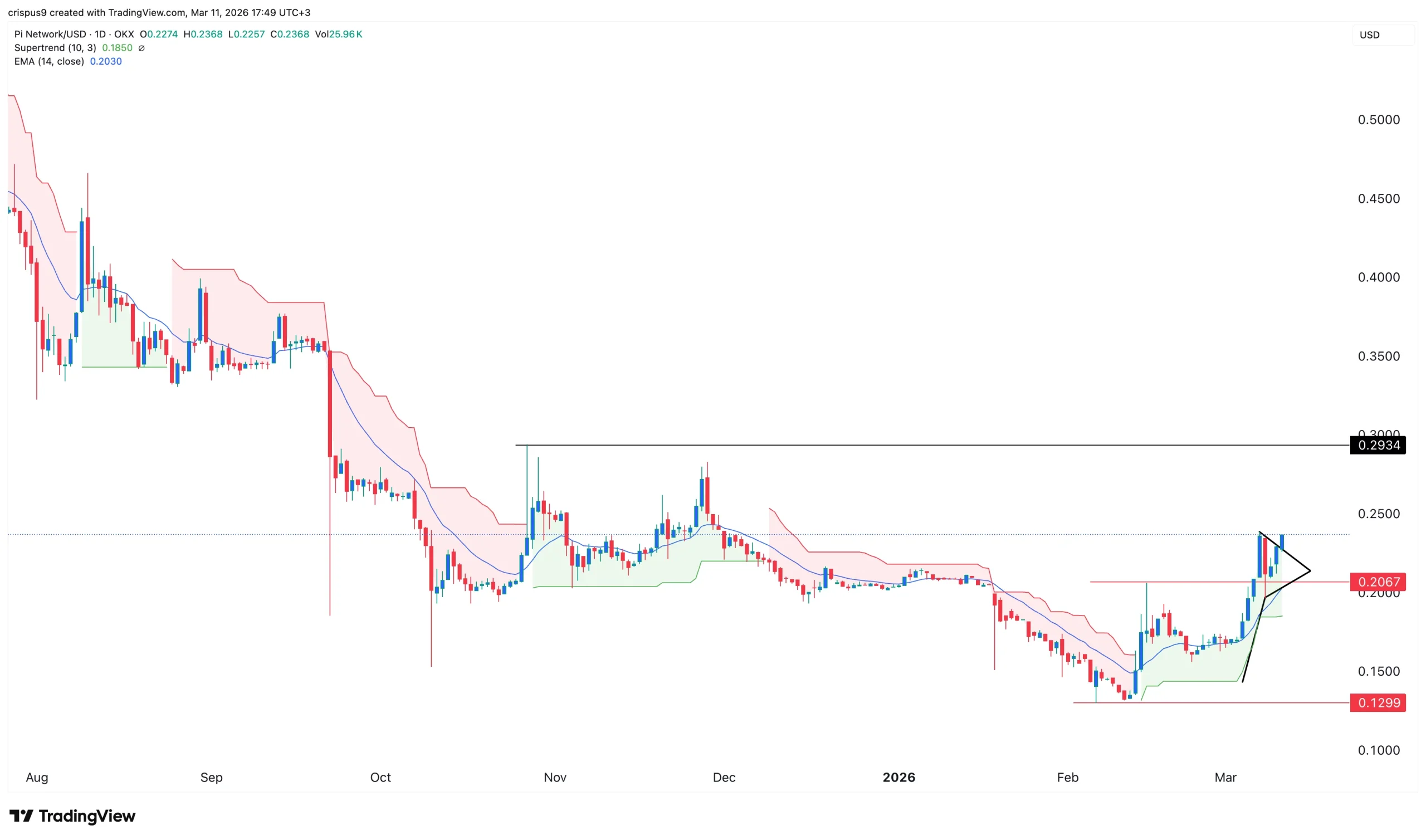
Pi Coin price rose for three consecutive days and is slowly nearing its highest point this year as demand from investors continues rising ahead of the Pi Day event.
Summary
- Pi Network price has formed a bullish pennant pattern on the daily chart.
- The coin’s volume has jumped to over $40 million.
- The rally may continue this week, potentially to the key resistance level at $0.2935.
Pi Network (PI) token rose to $0.2325 today, March 11, a few points below the year-to-date high of $0.2363. It has jumped by double digits from its lowest level this year.
Data compiled by CoinMarketCap and CoinGecko shows the coin’s volume continues rising, a sign that investors expect the price to continue rising in the near term.
CMC data shows that the 24-hour volume jumped to $42 million, while another one by CoinGecko puts the figure at $46 million. Its daily volume was less than $10 million a few weeks ago.
In most cases, a surge in daily volume is a sign that investors are buying. It is also a sign that investors are starting to embrace the Fear of Missing Out (FOMO) now that the coin is beating popular coins like Bitcoin and Ethereum.
The ongoing rally is being driven by the hype surrounding the upcoming Pi Day event on Saturday this week. Investors are buying as they wait for what the team will announce on this day.
Additionally, the buying is happening as the ongoing core upgrade advances. The ongoing upgrade phase will have a deadline tomorrow, March 12). If the trend continues, the final upgrade will likely conclude in either April or May this year.
Additionally, the volume is rising as investors continue to wait for the potential Kraken listing, which is expected to happen any day this year. This listing will be a major milestone for the coin as no major exchange has listed it since its mainnet launch.
Pi Coin price prediction and analysis
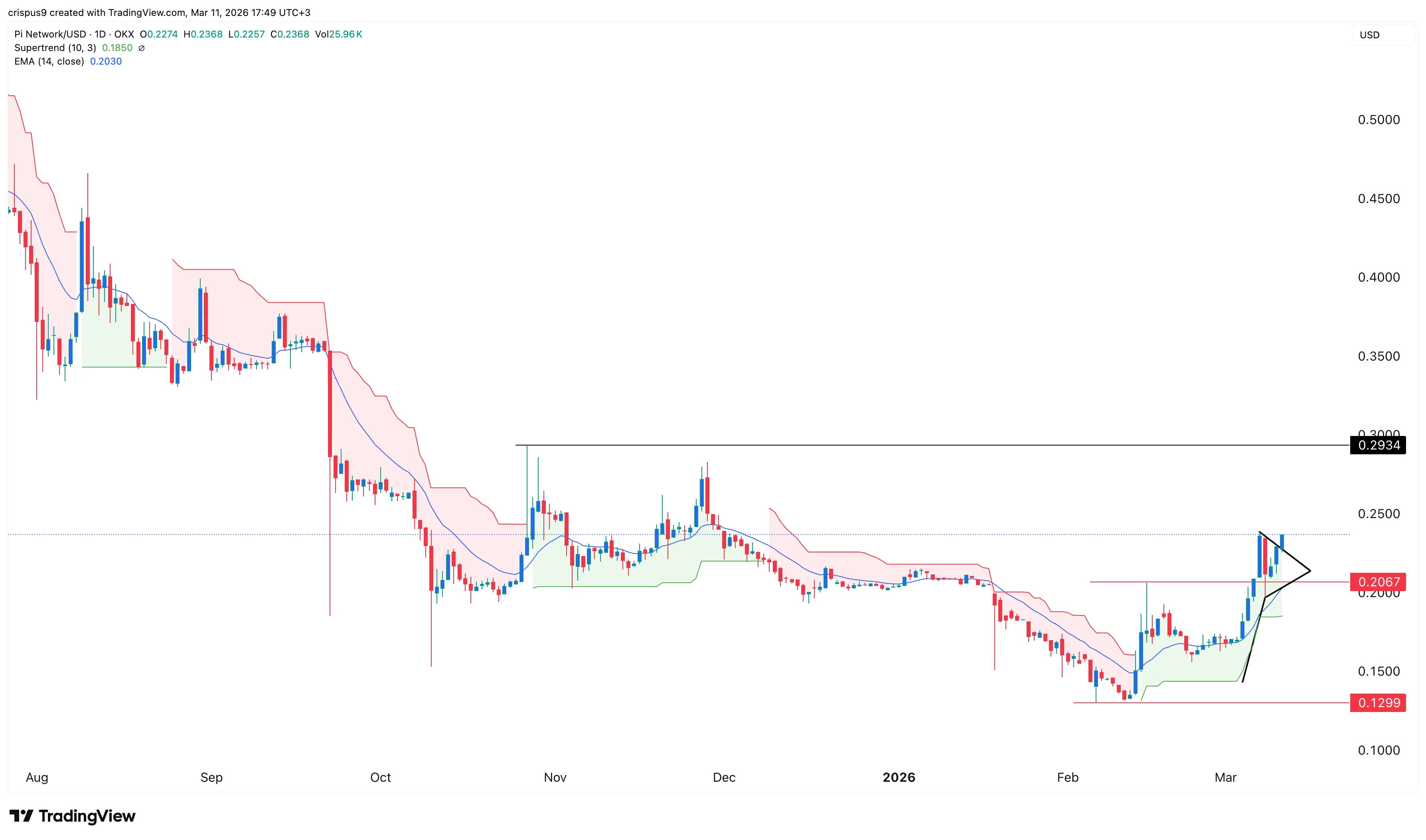
The daily chart shows that the Pi Network price has surged in the past few weeks. A closer look shows that it has formed a bullish pennant pattern, which is made up of a vertical line and a symmetrical triangle. It has already moved above the upper side of the triangle, meaning that the bull run may continue rising.
The coin has also formed an inverted head-and-shoulders-like pattern, which often leads to a bullish reversal. It has moved above the 50-day Exponential Moving Average and the Supertrend indicator.
Therefore, the coin will continue rising as bulls target the next important target at $0.30. This outlook will be confirmed if it moves above the year-to-date high of $0.2380.

Your Android phone might be handing over your crypto wallet in under 60 seconds.
Ledger’s own security team just exposed a hardware flaw in MediaTek chips that lets anyone with physical access to your phone pull your PIN and seed phrase before your phone even boots. USB cable, done. No software patch can fix it either. It is baked into the chip.
The Dimensity 7300 is the chip in question. It affects roughly 25% of all Android devices. Even the Solana Seeker phone is on the list.
INTEL: Ledger exposes a MediaTek Dimensity 7300 flaw that lets attackers with physical access steal Android hot-wallet seed phrases in minutes pic.twitter.com/gBTb2QBXMO
— Solid Intel
 (@solidintel_x) March 11, 2026
MediaTek was told about this back in May 2025. The fix? There is not one. If you have the chip, you have the vulnerability.
For anyone storing real money on a mobile wallet, this one hurts.
How the Boot ROM Exploit Bypasses Android Security
The flaw lives in the boot ROM. That is the code burned into the chip at the factory. It cannot be updated. Ever.
Ledger’s team used electromagnetic pulses to mess with the chip mid-startup. Perfectly timed voltage glitches that force the processor to skip its own security checks. Once that happens, the attacker hits EL3 privilege.
That is the highest level of control possible on ARM architecture. Full access. Game over.
In testing, they pulled it off in about 1 second per attempt.
— SolanaFloor (@SolanaFloor) March 11, 2026
 BREAKING: @Ledger researchers have identified a vulnerability in Android phones using MediaTek processors that could allow an attacker with physical access to extract a device’s PIN and crypto wallet seed phrases in under a minute.
In a proof of concept test, Ledger’s Donjon… pic.twitter.com/ooetcAhZXx
From there, the entire data partition gets decrypted offline. Private keys, PINs, everything your trusted execution environment was supposed to protect. Gone.
No app-level security saves you here. The foundation itself is broken.
Millions of Devices Exposed, Including Solana Seeker
Millions of mid-range Android phones are affected. And there is no patch coming for devices already in the field.
MediaTek’s response was basically “physical attacks are not really our problem.” But when people are storing serious money on these phones, that answer no longer cuts it.
The numbers back that up. Crypto theft hit $3.41 billion in 2024. Personal wallets now account for 44% of all stolen value. In 2022, that number was 7.3%.

Ledger’s own CTO said it. Phones were never designed to be vaults. If you have real money in a mobile wallet, move it to a hardware wallet now.
A software workaround will be included in the March 2026 Android Security Bulletin.
The real question now is whether mobile-first crypto projects can survive a hardware trust problem. If the foundation keeps cracking, the whole pitch of storing crypto on your phone starts falling apart.
Discover: The best new crypto in the world
The post Ledger Researchers Expose Android Flaw Enabling Wallet Seed Theft appeared first on Cryptonews.
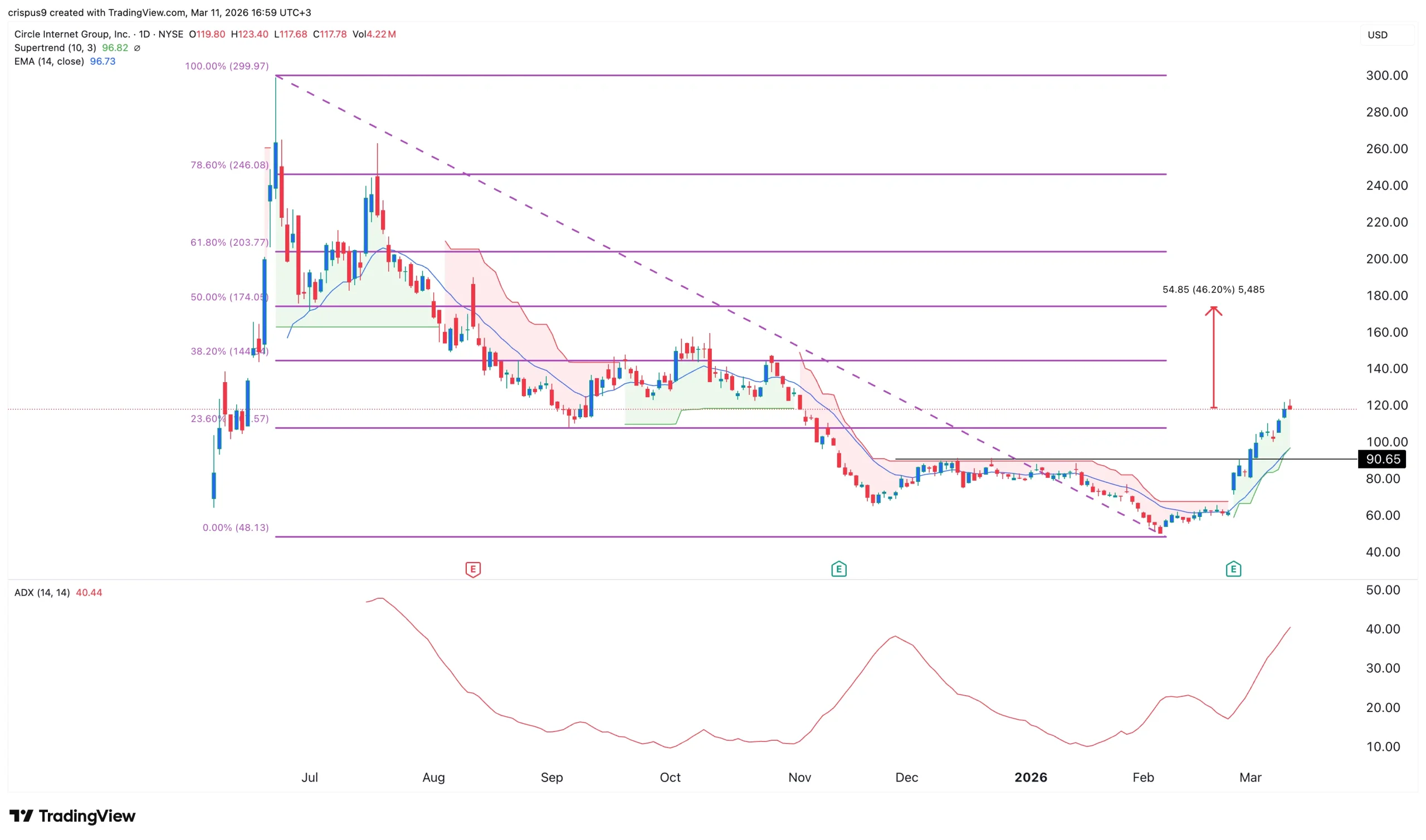
Circle stock price is in a strong bull run this month, reaching its highest level since November last year, and this trend may continue as the market capitalization of the USDC stablecoin nears an $80 billion milestone.
Summary
- Circle stock price continued its strong bull run this week.
- The USDC market capitalization is nearing the important $80 billion milestone.
- Technical analysis points to a surge to $174.8, up by 45% from the current level.
CRCL stock jumped to $122.55, up by 147% from its lowest point this year, with its market capitalization jumping to over $30 billion.
There are signs that Circle’s business is thriving as demand for its stablecoin jumps. The supply of all USD Coin (USDC) tokens has jumped to over $79.8 billion, a $10 billion increase from the lowest point last month.
More data shows that USDC has become the most used stablecoin in the industry. Its volume jumped to nearly $6 trillion in the last 30 days, much higher than USDT’s $1.1 trillion.
Soaring USDC supply is important for Circle because of its business model. It makes most of its revenue by investing its USDC holdings into short-term government bonds, which are now yielding about 3.5%.
Government bond yields will likely remain elevated for a while as the Federal Reserve is unlikely to cut interest rates several times this year because of the ongoing Iran war. This war will push inflation much higher than where they are today as energy and transport prices soar.
The most recent numbers showed that Circle’s business continued thriving in the last quarter of last year, with its revenue rising by 77% to $770 million and its EBITDA moving to $167 million.
In addition to this, Circle Payment Network is seeing more user adoption as it has gained 55 partners, and more are coming up. This solution has the ability to disrupt the Swift Network, which moves trillions of dollars annually. It leverages the USDC stablecoin to save money and ensure instant payouts.
Circle stock price prediction: Technical analysis
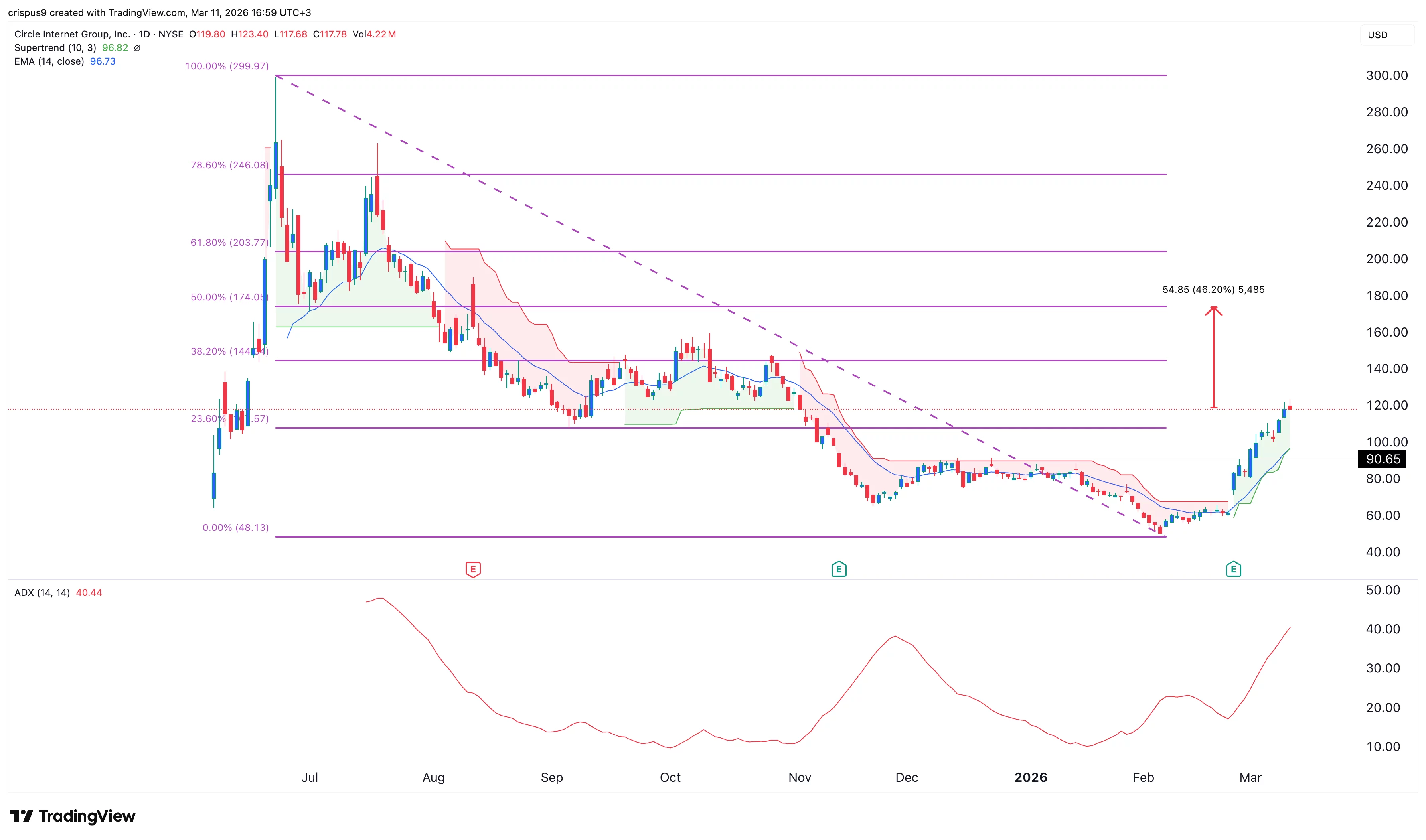
The daily chart shows that the CRCL stock price has rebounded this month. It has already jumped above the 23.6%Fibonacci Retracement level, which is drawn by connecting its highest and lowest levels on record.
The stock has jumped above the 50-day Exponential Moving Average, while the Supertrend indicator has turned green. The Average Directional Index has moved to 40, a sign that the upward momentum is accelerating.
Therefore, the stock will likely continue rising as bulls target the 50% Fibonacci Retracement level at $174, which is about 45% above the current level.
Crypto World
Cardano’s Charles Hoskinson Outlines Strategic Funding Roadmap for 2026: Here’s What’s New


Charles Hoskinson speaks about the 2026 funding agenda and how the Cardano ecosystem should evolve going forward.
In a recently released hour-long video, Charles Hoskinson provided considerable insights into how funding for Cardano’s ecosystem will function in 2026. He also pointed out a few pressure points and how the team plans to tackle them.
There’s nothing here that, with the money that we have, Cardano can’t fix. – Said Hoskinson, while outlining critical flaws in existing models.
The Existing Pillars in Cardano’s Funding Focus
Starting off, Hoskinson said that the ecosystem funding model is generally broken down into three layers: infrastructure, utility, and experience. He outlined that historically, Cardano’s funding has been overrepresented within the infrastructure module and underrepresented within the utility and experience modules.
Infrastructure includes nodes like Ouroboros Leios, Plutus, and Aiken, while utility is what users can do with that infrastructure. This includes building decentralized applications within the broader DeFi ecosystem. Experience, on the other hand, is how users interact with the entire system – through wallets, account abstraction, and on/off ramps.
Hoskinson pointed out that the cost to run and build a node team is about $1 to $5 million per year, requiring between 10 and 40 full-time engineers. He said that the recommended infrastructure to fund includes three already mature node projects – Haskell, Rust, and Go, unified by Project Bluepring plus Hydra, and languages such as Aiken and Plutus.
Funding Utility and Strategic Goals in 2026
Acknowledging that the current state of the Cardano ecosystem is unfavorable (low MAU, TVL, and transaction volume), Hoskinson proposes funding the Utility layer. But this comes with certain conditions, including oversight, OPEX reduction, salary cuts, and alignment with strategic goals.
The idea is to create a weighted index of project tokens, and for the treasury to purchase 10-30% of each project’s total supply in the index.
Strategic goals for the dApps included in the investment rounds should include Bitcoin DeFi, specifically by using the Pogan protocol, as well as upgrading to be hybrid dApps with Midnight for increased privacy.
You may also like:
Moreover, a portion of the protocol revenue (example given with 10%) must be used to buy ADA and donate it back to the treasury. With that, these investments are expected to pay for themselves in one to three years as the treasury divests from the appreciating index.
The Experience Layer
Speaking about funding the Experience layer, Hoskinson said it needs funding to rebuild the ambassador and KOL layer, improve user onboarding, and support wallet providers.
He said that the ecosystem needs somewhere between 20 and 30 high-value hackathons each year to improve the developer experience.
Hoskinson pointed out that in order for the ecosystem to attract external capital, it must be willing to invest in itself. Moreover, he outlined that fragmented and competitive treasury proposals create a “race to the bottom,” while staying firm on the fact that the strategy should be unified.
Binance Free $600 (CryptoPotato Exclusive): Use this link to register a new account and receive $600 exclusive welcome offer on Binance (full details).
LIMITED OFFER for CryptoPotato readers at Bybit: Use this link to register and open a $500 FREE position on any coin!
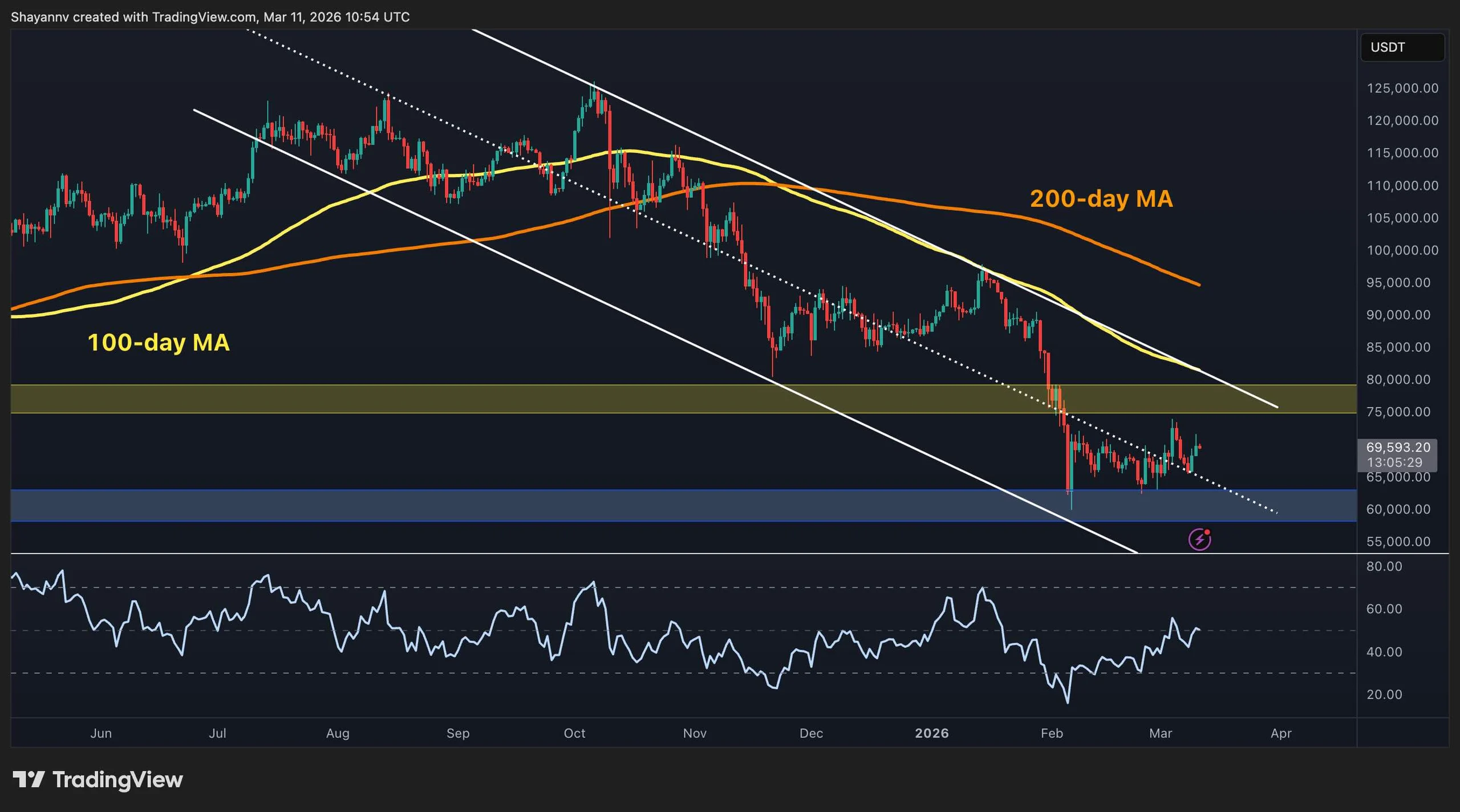
Bitcoin is still trading within a broader bearish market structure, but the recent halt at the $60,000 area shows that buyers are still defending an important support base. Although the recovery has improved short-term conditions, BTC remains below major higher timeframe resistance, which keeps the broader outlook cautious for now.
Bitcoin Price Analysis: The Daily Chart
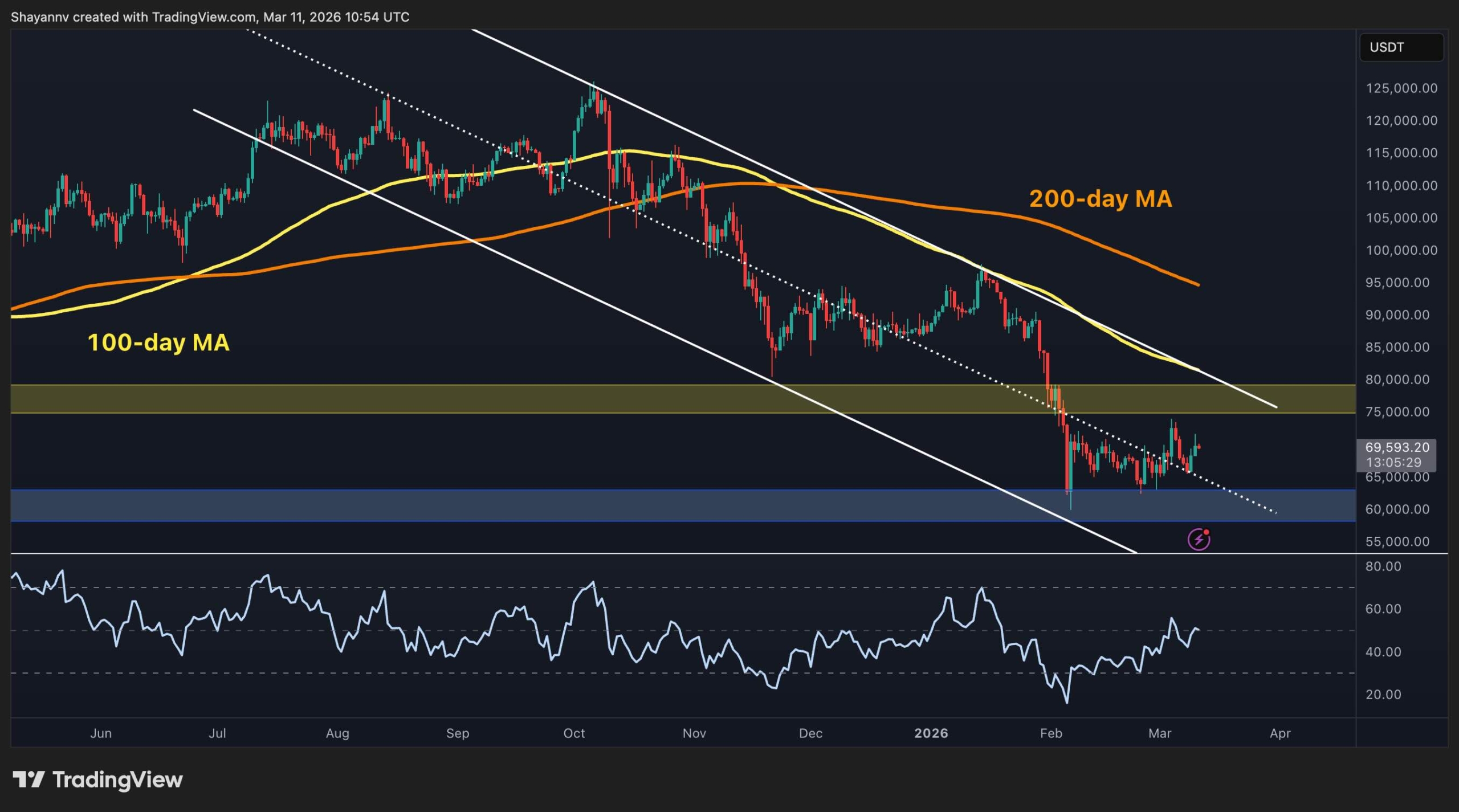
On the daily chart, BTC continues to trade below both the 100-day and 200-day moving averages, keeping the primary trend tilted to the downside. The price also remains beneath the descending channel’s higher trendline that has capped the market for months, which means the latest bounce has not yet changed the broader structure.
The key support zone remains around $60,000, where BTC already reacted well after the sharp sell-off. On the upside, the first major resistance still sits around $75,000 to $80,000, which is now acting as a supply zone. As long as the price stays below that region, rallies are likely to be treated as corrective rebounds inside a larger downtrend.
BTC/USDT 4-Hour Chart
On the 4-hour timeframe, Bitcoin is still moving inside a rising channel, showing that the recovery from the local bottom remains intact in the short term. The asset is now hovering around $69,000 after another push higher, while the lower boundary of the channel continues to provide structure for higher lows.
At the same time, bulls have not yet been able to break through the upper boundary of the formation, which comes in near the $73,000 to $75,000 area and overlaps with a broader resistance zone. The RSI has also recovered toward the upper half of its range, showing improving momentum, but not yet a breakout condition. That leaves the short-term picture constructive, but still dependent on a confirmed move above channel resistance.

Sentiment Analysis
From a sentiment perspective, funding rates have turned negative again after spending most of last year in positive territory. This suggests that derivatives traders have become more cautious and negative and that short positioning has started to increase, even while the price attempts to stabilize above the recent lows.
In practical terms, that kind of reset is not necessarily bearish by itself. In fact, cooling or slightly negative funding often reflects a healthier market backdrop than overcrowded long positioning, especially after a heavy correction. So sentiment currently points to a more balanced setup, where excessive bullish leverage has been washed out, but BTC still needs a clear breakout on the chart to turn that improving sentiment into a stronger bullish continuation.

Binance Free $600 (CryptoPotato Exclusive): Use this link to register a new account and receive $600 exclusive welcome offer on Binance (full details).
LIMITED OFFER for CryptoPotato readers at Bybit: Use this link to register and open a $500 FREE position on any coin!
Disclaimer: Information found on CryptoPotato is those of writers quoted. It does not represent the opinions of CryptoPotato on whether to buy, sell, or hold any investments. You are advised to conduct your own research before making any investment decisions. Use provided information at your own risk. See Disclaimer for more information.
Global geopolitical tensions may be rattling markets, but after some carefully calibrated prompting, DeepSeek AI suggests the three biggest cryptocurrencies could still be heading for a very bullish year.
Its data-driven outlook draws on improving technical indicators, positive industry developments, and a regulatory environment that is slowly becoming clearer.
Here’s why DeepSeek’s predictions are gaining attention.
XRP (XRP): DeepSeek AI Predicts an Explosive Move Soon
In a recent update, Ripple reiterated that XRP ($XRP) remains central to its long-term strategy to transform the XRP Ledger (XRPL) into a global payments infrastructure designed for enterprise adoption.
Ripple designed XRPLedger (XRPL) for extremely fast and low-cost transactions, while giving the network an early advantage in two rapidly expanding sectors: stablecoins and tokenized real-world assets.
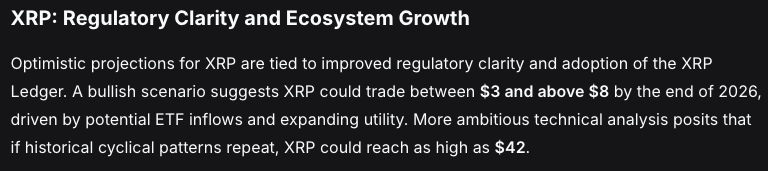
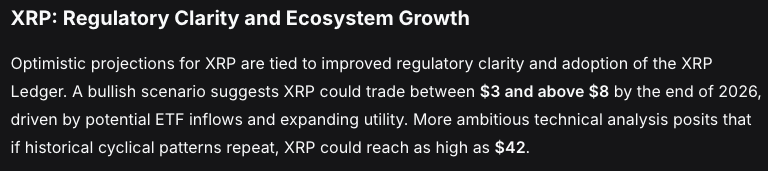
XRP is currently trading around $1.40, and DeepSeek suggests the asset could potentially rise toward $8 before year-end, producing gains of nearly 6x.
Chart patterns also support the possibility of a breakout. XRP forms a bullish flag pattern between recent support and resistance levels, often foreshadowing bullish price action.
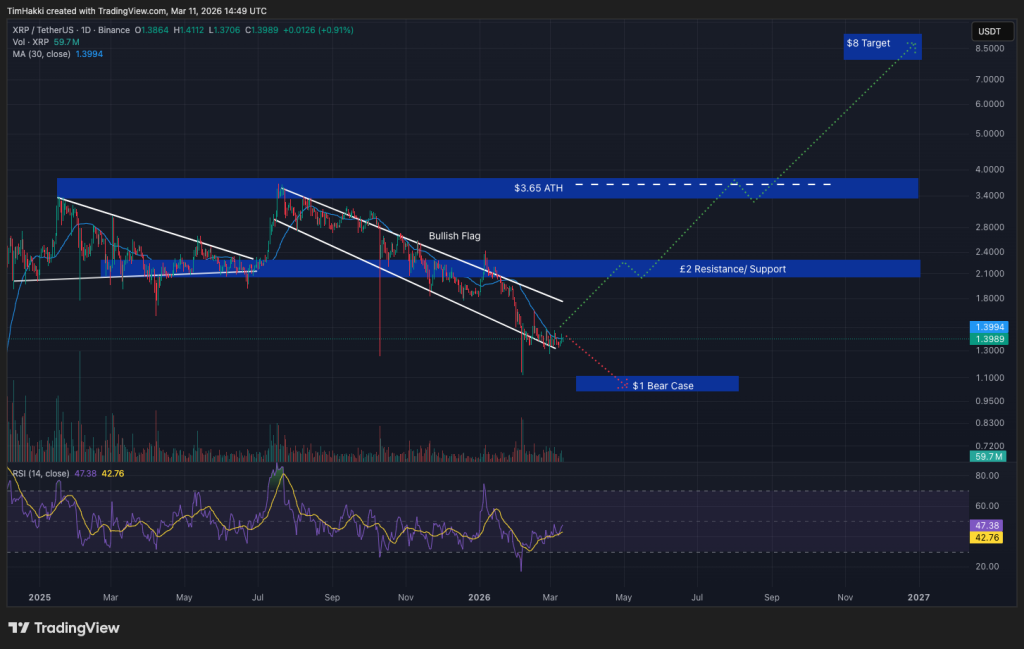
It’s mid-to-long-term narrative hinges on continued institutional inflows through recently launched U.S. XRP exchange-traded funds (ETFs), Ripple’s expanding global partnerships, and the possibility that the CLARITY Act could be approved by Congress this year.
Bitcoin (BTC): DeepSeek AI Says Bitcoin Will Be $260k By Christmas
Bitcoin ($BTC) reached an all-time high (ATH) of $126,080 on October 6 before losing nearly half its value in the following months.
Regardless, DeepSeek’s analysis indicates Bitcoin could still be on track for substantial growth, potentially peaking at $266,000 by 2027.
Often referred to as digital gold, Bitcoin continues attracting investors who view it as both a diversification tool and a hedge against inflation and global economic instability.
Bitcoin capitalizes $1.4 trillion of the $2.4 trillion cryptocurrency market. Its recent decline coincided with heightened geopolitical tensions involving the United States, Iran, and Greenland, although the subsequent armed conflict did little to spook investors.
Additionally, if Donald Trump delivers his promise to create a U.S. Strategic Bitcoin Reserve, the “Bitcoin to $1 million” scenario becomes plausible.
Ethereum (ETH): Will Ether Hit Five Digits This Year?
Ethereum ($ETH) is the dominant smart contract platform serving as the backbone of decentralized financ (DeFi).
With a market capitalization approaching $248 billion and around $55 billion TVL, Ethereum is the primary settlement layer blockchain commerce.
The network’s strong security, its leadership in stablecoins, and its growing involvement in real-world asset tokenization all support the case for broader institutional adoption.
However, regulatory clarity plays a critical role in future growth. The passage of the CLARITY Act in the United States could provide the legal framework institutions require before deploying lots of capital on chain.
ETH is currently trading slightly above $2,000. Significant resistance lies at $5,000 range, close to its previous ATH of $4,946.05 recorded last August.
If Ethereum decisively breaks through $5,000, DeepSeek sits it rising to a new high watermark of $7,500.
Maxi Doge: Enter Dogecoin’s Risk-Loving, Hard Pumping Cousin
If a new bull run emerges, meme coins could absorb the most hype, as they historically amplify market price trends.
One new meme coin attracting attention is Maxi Doge ($MAXI). It already raised $4.7 million through its ongoing presale as investors speculate it could eventually challenge BONK, Floki and even Dogecoin.
Maxi Doge introduces himself as Dogecoin’s louder, risk-on gym bro cousin, leaning into the viral “degen” internet culture that helped fuel the meme coin explosion during the 2021 bull market.
MAXI is an ERC-20 asset on Ethereum’s proof-of-stake blockchain, giving it a smaller environmental footprint compared with Dogecoin’s proof-of-work design.
Early presale investors can currently stake MAXI tokens for 67% APY, although those yields gradually decline as the staking pool grows.
MAXI currently sells for $0.0002808, with nominal increases planned through each funding round.
To participate, you can visit the official website and connect a supported wallet such as Best Wallet.
Purchases can also be made using a bank card.
Visit the Official Website Here
The post China’s DeepSeek AI Predicts the Price of XRP, Bitcoin and Ethereum by The End of 2026 appeared first on Cryptonews.
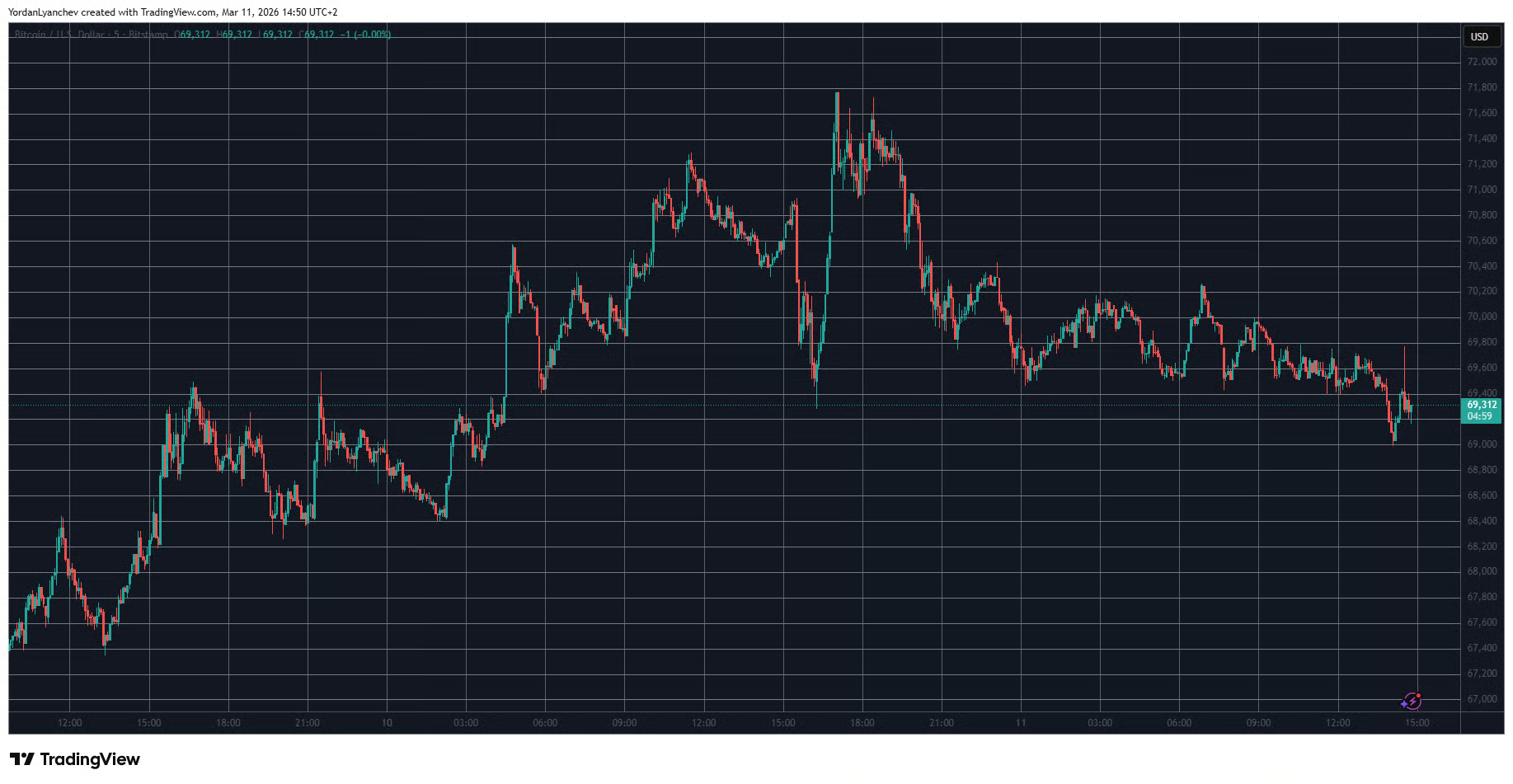
BTC experienced minor initial volatility after the numbers went out.
The United States Labor Department released the highly anticipated Consumer Price Index numbers for February, the last such data before the upcoming FOMC meeting next week.
Interestingly, experts nailed the actual numbers, with a 0.3% increase for February and a 2.4% rise year-over-year.
The increase for the previous month was slightly higher than the number for January (0.2%). Core CPI, which excludes more volatile sectors like food and energy, rose 0.2%, also matching the forecasts. In contrast, January’s increase was slightly higher MoM (0.3%).
The single-largest component of the regular CPI, shelter, jumped by 0.2% monthly and 3% annually, while rent rose by 0.1%, which is the lowest monthly increase in over five years.
Given the matched expectations, experts now believe the US Federal Reserve will keep the key interest rates unchanged during its next FOMC meeting, scheduled for the following week.
Bitcoin’s price reacted with minor volatility immediately after the Labor Department published the data for February, going from $69,000 to $69,800, where it was stopped and pushed back to around $69,300 as of press time.
It appears that the inflation data does not impact its price moves as much as it used to, as global financial markets are focused on the ongoing war between the US and Israel on one side, and Iran on the other.
You may also like:
Binance Free $600 (CryptoPotato Exclusive): Use this link to register a new account and receive $600 exclusive welcome offer on Binance (full details).
LIMITED OFFER for CryptoPotato readers at Bybit: Use this link to register and open a $500 FREE position on any coin!

Regulators in the United States are signaling a pivot from fragmented supervision toward a more coordinated approach to oversee evolving markets. In a joint memorandum released this week, the Securities and Exchange Commission and the Commodity Futures Trading Commission said it is a pivotal moment to regulate harmoniously as new technologies—especially crypto—reshape how markets function. The document emphasizes that “new trading models, digital infrastructure, and onchain, automated systems increasingly blur traditional jurisdictional lines,” creating a need for consistent, technology-neutral rules that can cover participants operating across platforms and asset classes. The joint effort aims to reduce duplication, close gaps, and accelerate the path to regulatory clarity.
Key takeaways
- The SEC and CFTC formalized a cooperative framework through a memorandum of understanding to coordinate oversight across crypto, digital assets, and related financial technology.
- The agencies commit to providing regulatory clarity and certainty grounded in technology-neutral regulations, alongside a shared data approach on issues of common regulatory interest.
- A “minimum effective dose” regulatory strategy will be pursued to foster innovation while safeguarding market integrity and competitiveness on a global stage.
- The memo references ongoing efforts to build a fit-for-purpose regulatory framework for crypto assets and lists existing initiatives such as a crypto-specific task force and an advisory committee to shepherd innovation.
- The document underscores the intent to reduce turf wars that have long tied up regulatory progress and pushed activity to other jurisdictions.
Tickers mentioned:
Market context: The move comes as the U.S. regulatory landscape weighs how to supervise a rapidly evolving crypto ecosystem amid questions about liquidity, risk management, and the integration of blockchain-based infrastructure with traditional markets. The coordination effort aligns with broader policy conversations about stabilizing the regulatory backdrop for platforms that span trading, clearing, data services, and pooled investment vehicles, while attempting to maintain U.S. competitiveness in a fast-changing global environment.
Sentiment: Neutral
Market context: The joint approach is positioned to influence how market participants operate across venues and asset classes, potentially shaping future product design and compliance pathways.
Price impact: Neutral. The memorandum outlines regulatory intent rather than immediate market actions, though clarity can influence investment planning and capital allocation over time.
Trading idea (Not Financial Advice): Hold. The framework’s emphasis on clarity and proportionate regulation may encourage cautious entry as participants await concrete guidance and implementing rules.
Market context: In the broader crypto environment, policymakers have signaled that a stable, predictable regulatory regime is conducive to attracting institutional participation while preserving safeguards against misuse and market abuses.
Why it matters
The memorandum marks a notable shift in how two principal U.S. regulators approach an industry that has long challenged traditional supervisory paradigms. By committing to a technology-neutral regulatory posture, the SEC and CFTC aim to shield investors and market participants from duplicative requirements while ensuring that new trading models—whether on centralized exchanges, cross-border platforms, or on-chain systems—operate within a coherent framework. The emphasis on harmonization is especially meaningful as market participants increasingly move assets and data across platforms, including trading venues, clearinghouses, data repositories, and other intermediaries that span both securities and derivatives landscapes.
The agencies are explicit about their intent to share information and data on issues of “common regulatory interest,” a move that could improve how authorities monitor systemic risk, detect fraud, and respond to emerging technologies such as smart-contracts and automated trading systems. In parallel, the memo signals a broader effort to craft a “fit-for-purpose regulatory framework for crypto assets,” signaling that policy makers recognize crypto-specific dynamics within the wider financial system. The move builds on prior steps, including the establishment of a crypto-focused task force and advisory bodies intended to keep pace with innovation while preserving market integrity. The tone of the document—emphasizing clarity, predictability, and collaboration—aims to reduce the jurisdictional friction that has historically complicated compliance and innovation alike.
As SEC chair Paul Atkins framed it, the legacy of misaligned rules and overlapping registrations created an environment where innovation sometimes sought refuge offshore or migrated to jurisdictions with clearer expectations. The quote underscores a long-running frustration: “For decades, regulatory turf wars, duplicative agency registrations, and different sets of regulations between the SEC and CFTC have stifled innovation and pushed market participants to other jurisdictions.” By acknowledging that friction and pledging a more coordinated approach, the agencies are signaling a potential rebound in U.S. competitiveness in the crypto arena while maintaining robust supervisory standards.
The scope of the plan extends beyond crypto alone. The memo notes that the new regulatory posture will touch a broad spectrum of market activity—from trading platforms to clearinghouses, data repositories, and even pooled investment vehicles and intermediaries that operate across securities and derivatives frameworks. In doing so, it aligns regulatory objectives with the realities of digital rails, on-chain settlement, and cross-asset trading that have increasingly blurred traditional borders. The effort also reflects ongoing efforts to ensure technology-driven innovation—across crypto and AI—remains embedded within U.S. policy while avoiding a blanket deregulation that could invite abuse. The intention is to foster a dynamic, globally competitive market environment with clear guardrails for participants at every level of the value chain.
Overall, the memorandum presents a practical, measured approach to reform. It acknowledges the importance of regulatory clarity and a transparent, consistent framework as prerequisites for sustained innovation, while preserving the safeguards that have been central to U.S. market integrity. The combined message from the SEC and CFTC is that the time is right to reduce fragmentation, adopt common standards where feasible, and accelerate the adoption of rules that reflect the realities of digital markets without stifling experimentation.
Source-linked remarks and the framing of this initiative underscore a broader policy conversation about how to balance innovation with investor protection. The collaboration signals a willingness to use data-driven insights to calibrate rules rather than relying on static templates that fail to account for rapid technological evolution. As the crypto landscape continues to evolve—with new protocols, asset classes, and onchain activity—the joint MOU could become a cornerstone of a more predictable regulatory environment for market participants and builders alike.
The memorandum notes that the agencies have already undertaken and supported various initiatives in pursuit of these goals, including a crypto-specific task force and an advisory committee designed to ensure that crypto, AI, and other emerging technologies continue to advance in the United States. This alignment of policy instruments with a forward-looking view on technology signals an intent to keep the U.S. at the cutting edge of global financial innovation while anchoring it with robust governance and risk controls. The path forward will likely involve further policy statements, guidelines, and practical implementation steps that translate the memo’s principles into day-to-day compliance and product development decisions for a wide range of market participants.
In sum, the MOU represents more than a symbolic gesture. It aims to convert long-standing aspirational goals—coherence, clarity, and competitive vitality—into a tangible regulatory posture that can accommodate a rapidly changing market landscape. By emphasizing minimum regulatory levers that deliver the desired outcomes, the agencies hope to avoid stifling innovation while ensuring that the rules stay fit for purpose as technology, markets, and participants continue to evolve.
What to watch next
- Publication of a detailed joint framework or guidance clarifying how crypto assets fit within the securities and commodities regimes.
- Updates to data-sharing protocols and information exchange between the SEC and CFTC, particularly around surveillance and enforcement coordination.
- Formation or expansion of the crypto-specific task force and advisory committees with specific governance and reporting milestones.
- Regulatory actions or policy statements that reflect the “minimum effective dose” approach and how it will be applied to new products and platforms.
Sources & verification
- Memorandum of Understanding between the U.S. Securities and Exchange Commission and the U.S. Commodity Futures Trading Commission, sec.gov/files/mou-sec-cftc-2026.pdf
- SEC/CFTC press release announcing the historic memorandum, sec.gov/newsroom/press-releases/2026-26-sec-cftc-announce-historic-memorandum-understanding-between-agencies
- Cointelegraph piece on regulatory clarity for crypto industry and related policy discussions, https://cointelegraph.com/news/crypto-industry-us-clarity-act-community-banks-stablecoin-yields
- Cointelegraph article discussing CFTC chair and blockchain/prediction markets, https://cointelegraph.com/news/cftc-chair-backs-blockchain-prediction-markets-truth-machines
- Cointelegraph Magazine feature exploring Clarity Act risks and regulatory missteps in Europe, https://cointelegraph-magazine.com/clarity-act-micas-defi-mistake-lawyer-warns/
Coordinated oversight marks a new phase for U.S. crypto policy
In a joint memorandum that frames its purpose around the need for clearer, more harmonized rules, the two agencies describe a strategic shift toward cooperation that could redefine how digital assets and related technologies are supervised in the United States. The document reinforces a commitment to provide regulatory clarity that covers the entire stack—from on-chain trading and data infrastructure to off-chain venues and the regulated products that span securities and derivatives. The stated aim is to reduce duplication, close jurisdictional gaps, and foster a regulatory environment where innovation can flourish under predictable guardrails. While the tone is cautious, the emphasis on data-sharing and mutual recognition signals a move away from legacy rigidity toward a more integrated, responsive approach to a market that has grown increasingly cross-border and technologically sophisticated.
The public rationale centers on practical governance: align enforcement expectations, avoid conflicting registrations, and harmonize how market participants across platforms operate under one ecosystem of rules. The collaboration is presented as a necessary modernization to keep pace with rapid advances in digital infrastructure, automated trading, and onchain settlement that now link traditional financial activities with decentralized technologies. It is a step toward a more coherent U.S. policy stance, one that acknowledges the gravity of cross-cutting innovations while maintaining robust protections for investors and market integrity.
Crucially, the memo does not suggest deregulation. Instead, it emphasizes a calibrated approach—what the agencies describe as a “minimum effective dose” strategy—intended to achieve policy objectives with the least intrusive regime that still deters misuse and preserves market health. If implemented effectively, this framework could reduce the fragmentation that has historically hindered cross-venue activity and could accelerate product development, while ensuring that oversight remains fit for purpose in a fast-moving landscape.

Moment lorry bursts into flames as tyres fly ’30 feet into air’ on busy Scots road

Starmer vows to crack down on 'profiteering' from fuel crisis

SEC, CFTC Handshake on Memo to Regulate Markets in Harmony


-
Business5 days ago
Form 8K Entergy Mississippi LLC For: 6 March
-

 Tech7 days ago
Bitwarden adds support for passkey login on Windows 11
-

 News Videos3 days ago
10th Algebra | Financial Planning | Question Bank Solution | Board Exam 2026
-

 Fashion5 days ago
Weekend Open Thread: Ann Taylor
-

 Crypto World2 days ago
Paradigm, a16z, Winklevoss Capital, Balaji Srinivasan among investors in ZODL
-
 Tech19 hours ago
A 1,300-Pound NASA Spacecraft To Re-Enter Earth’s Atmosphere
-
 Sports6 days ago
499 runs and 34 sixes later, India beat England to enter T20 World Cup final | Cricket News
-

 Politics6 days ago
Top Mamdani aide takes progressive project to the UK
-

 Business1 day ago
ExxonMobil seeks to move corporate registration from New Jersey to Texas
-

 Sports4 days ago
Three share 2-shot lead entering final round in Hong Kong
-

 Sports4 days ago
Braveheart Lakshya downs Lai in epic battle to enter All England Open final | Other Sports News
-

 NewsBeat7 hours ago
Residents reaction as Shildon murder probe enters second day
-

 NewsBeat6 days ago
Piccadilly Circus just unveiled ‘London’s newest tourist attraction’ and it only costs 80p to enter
-

 Entertainment5 days ago
Hailey Bieber Poses For Sexy Selfies In New Luscious Lip Thirst Traps
-

 Business3 days ago
Search for Nancy Guthrie Enters 37th Day as FBI Probes Wi-Fi Jammer Theory
-

 Business18 hours ago
Search Enters Sixth Week With New Leads in Tucson Abduction Case
-
 NewsBeat2 days ago
Pagazzi Lighting enters administration as 70 jobs lost and 11 stores close across Scotland
-

 Tech2 days ago
Despite challenges, Ireland sixth in EU for board gender diversity
-

 Tech7 days ago
ACIP To Discuss COVID ‘Vaccine Injuries’ Next Month, Despite That Not Being In Its Purview
-

 Business2 days ago
Search Enters 39th Day with FBI Tip Line Developments and No Major Breakthroughs