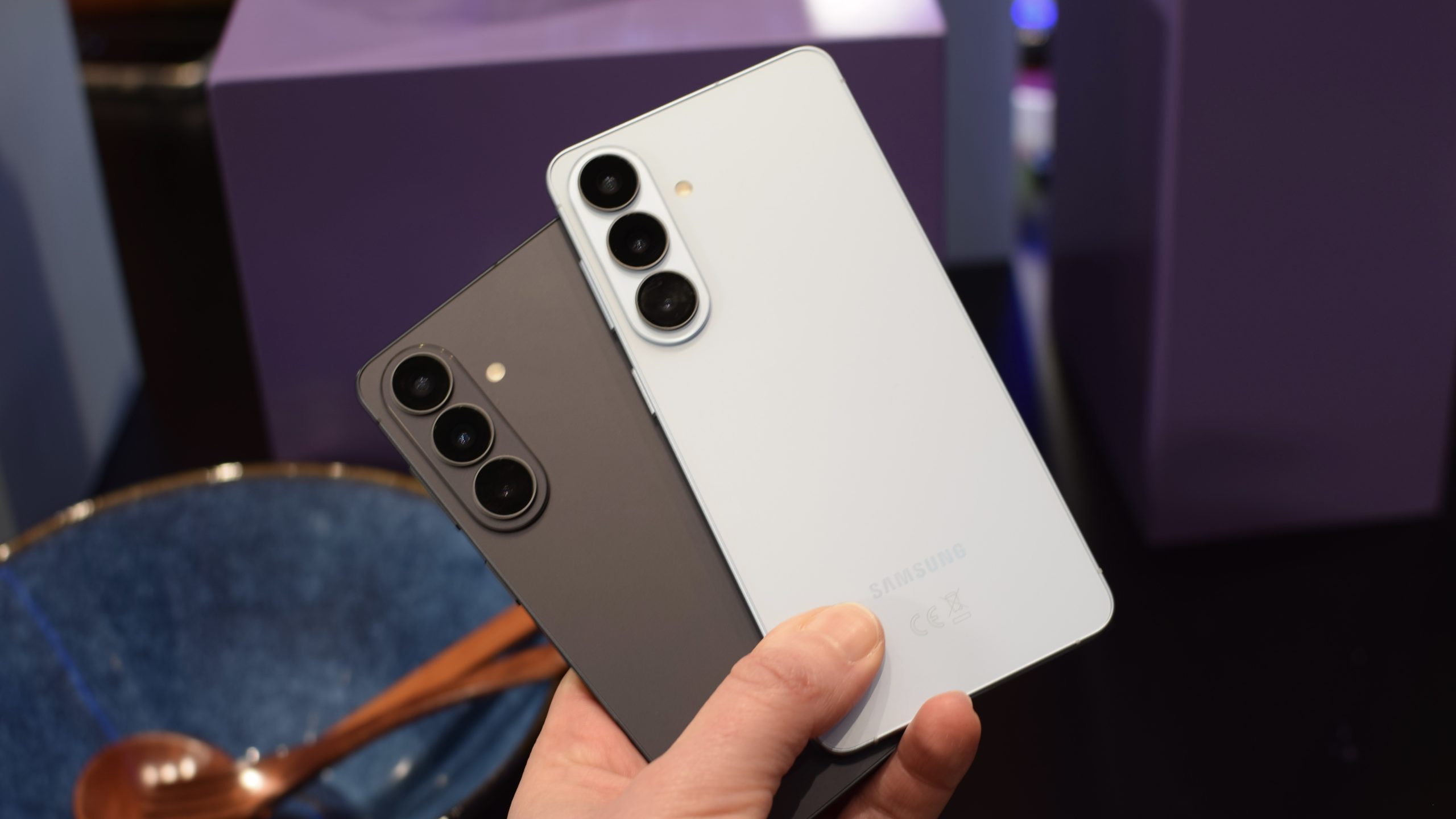
There was an ideal of convergence, a long time ago, when one device would be all you need, digitally speaking. [ETA Prime] on YouTube seems to think we’ve reached that point, and his recent video about the Samsung S26 Ultra makes a good case for it. Part of that is software: Samsung’s DeX is a huge enabler for this use case. Part of that his hardware: the S26 Ultra, as the upcoming latest-and-greatest flagship phone, has absurd stats and a price tag to match.
First, it’s got 12 GB of that unobtanium once called “RAM”. It’s got an 8-core ARM processor in its Snapdragon Elite SOC, with the two performance cores clocked at 4.74 GHz — which isn’t a world record, but it’s pretty snappy. The other six cores aren’t just doddling along at 3.62 GHz. Except for the very youngest of our readers, you probably remember a time when the world’s greatest supercomputers had as much computing power as this phone.
So it should be no suprise that when [ETA Prime] plugs it into a monitor (using USB-C, natch) he’s able to do all the usual computational tasks without trouble. A big part of that is the desktop mode Samsung phones have had for a while now; we’ve seen hackers make use of it in years gone by. It’s still Android, but Android with a desktop-and-windows interface.
What are the hard tasks? Well, there’s photo and video editing, which the hardware can handle. Though [ETA] notes that it’s held back a bit because Adobe doesn’t offer their full suite on Android. But what’s really taxing for most of us is gaming. Android gaming? Well, obviously a flagship phone can handle anything in the play store.
Advertisement
It’s PC gaming that’s pretty impressive, considering the daisy chain of compatibility needed last time we looked at gaming on ARM. Cyberpunk 2077 gets frame rates near 60, but he needs to drop down to “low” graphics and 720p to do it. You may find that ample, or you may find it unplayable; there’s really no accounting for taste.
We might not always likecarrying an everything device with us at all times, but there’s something to be said in not duplicating that functionality on your desk. Give it a couple of years when these things hit the used market at decent prices, and unless PC parts drop in price, convergence might start to seem like a great idea to those of us who aren’t big gamers and don’t need floppy drives.
The U.S. Cybersecurity and Infrastructure Security Agency (CISA) ordered government agencies on Wednesday to patch their systems against an actively exploited n8n vulnerability.
n8n is an open-source workflow automation platform widely used in AI development for automating data ingestion, with over 50,000 weekly downloads on the npm registry and over 100 million pulls on Docker Hub.
As an automation hub, n8n often stores a wide range of highly sensitive data, including API keys, database credentials, OAuth tokens, cloud storage access credentials, and CI/CD secrets, making it an extremely attractive target for threat actors.
Tracked as CVE-2025-68613, this remote code execution vulnerability allows authenticated attackers to execute arbitrary code on vulnerable servers with the privileges of the n8n process.
Advertisement
“n8n contains an improper control of dynamically managed code resources vulnerability in its workflow expression evaluation system that allows for remote code execution,” CISA said.
“Successful exploitation may lead to full compromise of the affected instance, including unauthorized access to sensitive data, modification of workflows, and execution of system-level operations,” the n8n team added.
The n8n team addressed CVE-2025-68613 in December with the release of n8n v1.122.0 and also advised IT administrators to apply the patch immediately. Admins who can’t immediately upgrade can limit workflow creation and editing permissions to fully trusted users only, and restrict operating system privileges and network access as temporary mitigation measures to reduce the impact of potential exploitation.
CISA has added the vulnerability to its Known Exploited Vulnerabilities (KEV) catalog on Wednesday and ordered Federal Civilian Executive Branch (FCEB) agencies to patch their n8n instances by March 25, as mandated by a binding operational directive (BOD 22-01) issued in November 2021.
“This type of vulnerability is a frequent attack vector for malicious cyber actors and poses significant risks to the federal enterprise,” CISA warned.
“Apply mitigations per vendor instructions, follow applicable BOD 22-01 guidance for cloud services, or discontinue use of the product if mitigations are unavailable.”
Although BOD 22-01 applies only to federal agencies, CISA has encouraged all network defenders to secure their systems against ongoing CVE-2025-68613 attacks as soon as possible.
Since the start of the year, the n8n security team has addressed several other severe vulnerabilities, including one dubbed Ni8mare that allows remote attackers without privileges to hijack unpatched n8n servers.
Advertisement
Malware is getting smarter. The Red Report 2026 reveals how new threats use math to detect sandboxes and hide in plain sight.
Download our analysis of 1.1 million malicious samples to uncover the top 10 techniques and see if your security stack is blinded.
The question comes early in Your Attention Please, a documentary premiering this week at South by Southwest in Austin, Texas. And it hit me harder than I expected. As a 27-year-old tech reporter, I realized I don’t have too many clear memories of life before smartphones. My adolescence unfolded alongside the rise of smartphones, social media, push notifications and the routine of endless scrolling. Like many people my age, I’ve spent most of my life inside the attention economy — without ever really stepping outside it.
That’s the uneasy territory the documentary explores.
Advertisement
CNET was given exclusive early access to the film’s trailer, embedded below.
Exploring how tech shapes our behavior
Director Sara Robin said she originally set out to make something smaller: a documentary about people trying to reclaim their attention by breaking unhealthy phone habits. In an interview with CNET, Robin described the idea as a personal story about focus and self-control in an age of constant distraction.
As Robin interviewed researchers, technologists and families affected by social media and cyberbullying, the film’s scope widened. What started as a question about individual habits quickly became a larger investigation into how modern technology systems are designed to shape human behavior. The story stretches from the rise of social media to the emerging influence of AI.
Along the way, Robin and her collaborators kept hearing the same observation from different corners of the digital world: Social media didn’t just change how people communicate; it quietly rewired what we value. Experiences that were once private or emotional — friendship, affection, belonging — began to acquire numerical equivalents. Followers, likes, comments, views and shares began to be how we saw our own self-worth. In the architecture of social platforms, those numbers function as a kind of social currency.
Advertisement
Trisha Prabhu, a digital-safety advocate and inventor of the anti-cyberbullying technology ReThink, argues that social platforms did more than create new online spaces. She says they fundamentally reshaped how social validation works. The metrics that define popularity often reward attention-seeking behavior and amplify conflict, while genuine connection is now harder to quantify and, therefore, easier to overlook.
Prabhu warns that the same dynamics already driving problems like cyberbullying could accelerate as automated systems become more capable. AI tools can generate abusive messages at scale, produce convincing impersonations or create deepfakes that spread rapidly online. In some cases, the technology may even blur the line between human interaction and machine-generated communication, which could deepen loneliness or encourage harmful behavior.
“There’s AI exacerbating existing harms [like automating cyberbullying], but then I also think that there’s AI creating completely new harms,” Prabhu told CNET. “There are reports of AI tools encouraging users, including minor users, to commit self-harm… Even for the everyday user who’s not experiencing the extreme outcome, I think we have to ask ourselves how much of our time and connection we want spent with an AI tool as opposed to a fellow human being.”
Bringing attention to attention
What struck Robin during filming the documentary was how universal these anxieties felt. Across conversations with families, educators and advocates around the world, the themes were remarkably consistent: overstimulated attention, declining focus in classrooms, rising anxiety among young people and a persistent sense of dread that comes from always being plugged in.
Advertisement
Your Attention Please
Those shared concerns have helped spark a coordinated moment around the film’s release.
On March 11, more than 25 organizations focused on digital well-being will simultaneously release the trailer for Your Attention Please as part of an initiative called Stand for Their Attention. What began as a small collaboration among five groups quickly grew as word spread through advocacy networks. The coalition now includes organizations such as Common Sense Media, Protect Young Eyes, Mothers Against Media Addiction, the Center for Humane Technology, Smartphone Free Childhood and Scrolling to Death.
The idea behind the synchronized launch is simple: Use the attention surrounding the documentary to highlight the growing movement that’s already working to reshape digital culture.
Many people feel overwhelmed by the scale of the problem, Robin says, but behind the scenes, a widening ecosystem of advocates is experimenting with ways to build healthier digital environments, from redesigning products to changing norms around screen use.
Advertisement
The campaign also arrives at a moment of growing scrutiny around the attention economy. Lawmakers in the US and abroad are increasingly debating how social platforms affect youth mental health and childhood development. Boycotts around AI use are taking off. Researchers are studying how these algorithms and chatbots influence behavior. Individuals are trying to figure out how much technology belongs in everyday life.
What can we do about it?
Despite the weight of those conversations, Robin says the goal of the film isn’t to leave audiences feeling powerless. In fact, the rapid rise of public awareness around AI has made her more optimistic than she was during the early days of social media. The systems shaping digital life, she argues, are built by people, which means they can also be rebuilt.
“We have more power than we think,” Robin said. “And there are a lot of different ways to get involved in this, from changing individual habits to changing the culture in your own family and in your community, designing technology differently, getting engaged in these conversations, all the way to pushing for legislative change.”
The film intentionally avoids presenting a single solution.
Advertisement
Instead, Your Attention Please asks a broader question: What happens when attention, one of the most human parts of our lives, becomes one of the most valuable commodities in the global economy? And perhaps more importantly, what kind of digital world do we want to build next?
Jueden’s experiment began by accident. While using a low-cost digital microscope to inspect electronics, he turned it toward a LaserDisc out of curiosity. Under magnification, faint but recognizable images began to emerge – proof that LaserDisc’s analog encoding could still be decoded visually without a player, just by analyzing the… Read Entire Article Source link
Samsung officially unveiled the much anticipated Galaxy S26 and S26 Plus on February 26, 2026 with some fresh upgrades over the Galaxy S25 and S25 Plus.
More of the best Samsung phone plans
While it’s fair to say the Galaxy S26 Ultra has stolen many of the headlines once again this year, there’s still much to love with the rest of the Galaxy S26 range. The base model Galaxy S26, for example, sports a slightly larger 6.3-inch screen over its predecessor (6.2 inches), and its storage options now start at 256GB, double from the 128GB that the S25 started with. The battery also gets a boost to 4,300mAh, up from 4,000mAh.
The larger-screened Galaxy S26 Plus, meanwhile, retains the 6.7-inch display and 4,900mAh battery from its predecessor, and gets Samsung’s new Exynos 2600 chipset, with the Snapdragon 8 Elite Gen 5 chip reserved for the top-tier S26 Ultra. While the battery capacity is the same, the S26 Plus can be charged wirelessly at 20W, compared to the S25 Plus’ slower 15W wireless charging.
Advertisement
If you’re looking to buy outright, the range is available at retailers like Amazon, JB Hi-Fi and The Good Guys, with the first two offering trade-in options. Buying direct from Samsung will also let you pay in instalments of up to 24 months, and trade-ins are also available (including non-Samsung products). When paired with one of our best SIM-only plans, buying outright will be the best bang-for-buck option.
These are flagship phones, so the base model Galaxy S26 and S26 Plus won’t fit in our best cheap phones list. It also doesn’t help that both handsets are more expensive than the S25 lineup, with the base model S26 starting from AU$1,549 (up from the S25’s AU$1,399) and the S26 Plus from AU$1,849 (vs the S25 Plus’s starting price of AU$1,699). This would make paying in monthly instalments an attractive option for some.
While the retailers have finished their pre-order specials, Australia’s big three telcos still have some active deals of up to AU$500 off the handset price for the Samsung Galaxy S26 and S26 Plus (as well as the Galaxy S26 Ultra), with some also coinciding with existing promotions.
With so many options available to score a brand new upgrade, fInding the best plan for these new handsets may not be the most straightforward process, so we’ve done the hard work for you. Take a look at our picks for the best phone plans for the Samsung Galaxy S26 and S26 Plus below:
Advertisement
The best Samsung Galaxy S26 plan
The best Samsung Galaxy S26 Plus plan
The best Samsung Galaxy S26 plan with a smartwatch
Advertisement
The best Samsung Galaxy S26 Plus plan with a smartwatch
Compare Samsung Galaxy S26 and S26 Plus plans
Outright Samsung Galaxy S26 and S26 Plus deals
Want to opt for a SIM-only plan and not be tied to a telco? There are plenty of options for buying the Galaxy S26 and S26 Plus outright:
Samsung: pay in instalments of up to 24 months through Samsung financing; also save up to AU$865 when you trade in your old device
JB Hi-Fi: trade in your old tech for a JB Hi-Fi gift card to be used on a Galaxy S26 series handset
The Good Guys: Galaxy S26 and S26 Plus available in 256GB and 512GB
Amazon: Same day delivery with the world’s biggest retailer
Samsung Galaxy S26 and S26 Plus: Key Information
Slightly larger 6.3-inch screen for the base Galaxy S26
Larger 4,300mAh battery for the S26
Faster wireless charging for the Galaxy S26 Plus
Samsung’s new range of S-series phones have had some modest hardware upgrades over its predecessors, but they now all start with storage options from 256GB instead of 128GB with the S25 lineup last year.
The base Galaxy S26’s main upgrades were its screen size (6.3 inches versus the S25’s 6.2 inches) and its battery capacity (4,300mAh from 4,000mAh from the S25), while the Plus gets 20W wireless charging, up from 15W for its predecessor.
Advertisement
(Image credit: Future)
Both phones retain their IP68 dust and water-resistance rating from their predecessors, Gorilla Glass Victus 2 protection, and camera arrays (50MP main, 10MP telephoto, 12MP ultrawide and 12MP front-facing).
On the software side of things, AI is at centre stage yet again with Galaxy AI features like the proactive Now Nudge notifications, predicting the next task you might need to do, as well as Bixby getting a boost through a partnership with Perplexity to answer non-phone related prompts. The phones also come with AI-powered call screening, document scanning and new AI photo editing tools.
Thanks to all our beloved AI companions, RAM prices have more than doubled in the last 6 months. As you may have guessed, the smartphone industry has been having some tough times with budget devices. To help solve this problem, HMD (remember the people who resurrected Nokia?) has announced a strategic partnership with Flipkart to bring its upcoming 2026 smartphone lineup to Indian consumers.
HMD Expanding Its Presence in India
HMD’s upcoming smartphone lineup will target multiple price segments between ₹10,000 and ₹20,000, catering to users looking for reliable devices with modern features at affordable prices. The first smartphone under the partnership is expected to launch in the coming months, followed by a phased rollout of several additional devices over the next two to four months. Specifics about the phones are not yet known, but we are due to get our hands on them. So, stay tuned.
The partnership will kick off with HMD’s first smartphone launch of 2026 in India, which will debut on Flipkart before reaching other online and retail channels. The goal is to leverage Flipkart’s extensive reach, logistics network, and consumer insights to make its smartphones more accessible nationwide.
Ravi Kunwar, CEO and VP of HMD India and APAC, said, “We are excited to collaborate with Flipkart as one of our key e-commerce partners as we gear up to launch the first HMD smartphone of 2026 in India. Flipkart’s extensive reach and strong consumer connect will play an important role in bringing our latest innovation to customers across the country.”
Commenting on the same, Ajay Veer Yadav, Senior Vice President at Flipkart, said, “Our strategic collaboration with HMD brings their upcoming smartphone portfolio to millions of consumers across the country. With our expansive distribution network and flexible affordability offerings, we are well-positioned to make cutting-edge devices more accessible and inclusive.”
New Research from WiCyS and FourOne Insights explores how skills-based cyber practices can positively impact employees and their organisations.
Women in CyberSecurity (WiCyS), the nonprofit organisation dedicated to the recruitment, retention and advancement of women in cybersecurity and FourOne Insights, a research and advisory firm, have released a new report.
The ‘ROI of Resilience: How Cybersecurity Talent Management Best Practices Improve the Bottom Line’ study explores the financial impact of skills-based talent strategies in cybersecurity. To gather information WiCyS and FourOne Insights leveraged data from an original survey, job posting data from labour market analytics provider Lightcast, and professional social profile data, also from Lightcast.
What was discovered is that skills-based, talent-friendly practices often generate the highest returns for an organisation and its workforce. Data from the report indicated that mentorship opportunities and skills-based development increased retention by up to 18pc, with skills-based promotions improving the representation of women in cyber leadership by upwards of 10pc and in some cases, as much as 20pc.
Advertisement
The report said: “These practices benefit the entire workforce and are especially valuable for women. Panels for promotion decisions, internal skills profiles and formal mentorship programmes all correlate with significantly higher representation of women in cybersecurity management roles.
“Organisations using these practices see 10pc to 20pc higher representation of women in cybersecurity leadership than firms that do not. Skills-based promotion criteria and linking incentives to demonstrated skill growth further strengthen both equity and financial performance.”
Addressing challenges
The research indicates that an awareness of skills-based and talent-conscious practices can be mutually beneficial for those operating within an organisation. In fact, they have the potential to deliver more than $125,000 in savings per employee, according to the report. But despite the merits of this system, the data also indicated that the adoption of these practices is uneven.
The report said: “Despite the mutual benefit to employers and employees, many high-impact practices are among the least utilised. None of the highest-value practices are leveraged by more than 55pc of firms.
Advertisement
“When companies do implement these practices, they often base them on unreliable, subjective data. This threatens worse talent outcomes for organisations, while limiting career development opportunities for individuals.”
But, third-party partnerships could potentially expand capacity and ease the adoption of talent and skills-focused practices. Almost 80pc of contributing respondents explained that they find access to supportive, career-based organisations such as WiCyS to be valuable, with many of the opinion that they create stronger professional networks than those created by an employer.
According to the report, the firms that offer this kind of access tend to fill roles 16pc faster, retain workers longer and avoid significant productivity losses, when compared to those who don’t. “These partnerships provide capabilities such as peer learning, industry context, and trusted communities that are difficult for employers to build internally.”
Future ready
WiCyS’ and FourOne Insight’s research suggests that the companies attracting the strongest talent and meeting business objectives have a common approach, in that they ground their strategies in skills data, leadership actions and clear employee development opportunities.
Advertisement
“High-ROI practices, such as transparent promotion processes, executive sponsorship, access to upskilling and mentorship and engagement with trusted third-party partners, can consistently reduce hiring friction and support retention,” said the report. “Over time, they open advancement pathways that have historically been narrow, especially for women.”
The framework to ensure effective practices should include the assessment of workforce pain points, the planning of targeted interventions, execution with stakeholder buy-in and continuously evaluating outcomes. This, the report states, will create a “durable, self-correcting system that strengthens workforce resilience and ensures that opportunities are genuinely accessible to all talent, not simply expanded in name only”.
As for further research, the report suggests that those collecting data should explore how these practices influence broader indicators of organisational performance, including profitability and long-term resilience.
“What remains clear is that in a tightening labour market, workforce resilience is a strategic imperative. Skills-based, talent-friendly practices, reinforced by strong third-party partnerships, offer a path to building that resilience at scale.”
Advertisement
Don’t miss out on the knowledge you need to succeed. Sign up for the Daily Brief, Silicon Republic’s digest of need-to-know sci-tech news.
An SQL injection vulnerability in Ally, a WordPress plugin from Elementor for web accessibility and usability with more than 400,000 installations, could be exploited to steal sensitive data without authentication.
The security issue, tracked as CVE-2026-2313, received a high severity score. It was discovered by Drew Webber (mcdruid), an offensive security engineer at Acquia, a software-as-a-service company that provides an enterprise-level Digital Experience Platform (DXP).
SQL injection flaws have been around for more than 25 years and continue to be a threat today, despite being well understood and technically easy to fix and avoid. This type of security issue occurs when user input is directly inserted into an SQL database query without proper sanitization or parameterization.
This allows an attacker to inject SQL commands that alter the query’s behavior to read, modify, or delete information in the database.
Advertisement
CVE-2026-2313 affects all Ally versions up to 4.0.3 and lets an unauthenticated attacker to inject SQL queries via the URL path due to improper handling of a user-supplied URL parameter in a critical function.
“This is due to insufficient escaping on the user-supplied URL parameter in the `get_global_remediations()` method, where it is directly concatenated into an SQL JOIN clause without proper sanitization for SQL context,” reads a technical analysis from WordFence.
“While `esc_url_raw()` is applied for URL safety, it does not prevent SQL metacharacters (single quotes, parentheses) from being injected.
“This makes it possible for unauthenticated attackers to append additional SQL queries into already existing queries that can be used to extract sensitive information from the database via time-based blind SQL injection techniques,” the researchers explain.
Advertisement
Wordfence notes that exploiting the vulnerability is possible only if the plugin is connected to an Elementor account and its Remediation module is active.
The security firm validated the flaw and disclosed it to the vendor on February 13. Elementor fixed the flaw in version 4.1.0 (latest), released on February 23, and an $800 bug bounty was awarded to the researcher.
Data from WordPress.org shows that only about 36% of websites using the Ally plugin have upgraded to version 4.1.0, leaving more than 250,000 sites vulnerable to CVE-2026-2313.
In addition to upgrading Ally to version 4.1.0, site owners/administrators are also recommended to install the latest security update for WordPress, released yesterday.
Advertisement
WordPress 6.9.2, addresses 10 vulnerabilities, including cross-site request (XSS), authorization bypass, and server-side request forgery (SSRF) flaws. The new version of the platform is recommended to be installed “immediately.”
Malware is getting smarter. The Red Report 2026 reveals how new threats use math to detect sandboxes and hide in plain sight.
Download our analysis of 1.1 million malicious samples to uncover the top 10 techniques and see if your security stack is blinded.
Researchers say they have uncovered a takedown-resistant botnet of 14,000 routers and other network devices—primarily made by Asus—that have been conscripted into a proxy network that anonymously carries traffic used for cybercrime.
The malware—dubbed KadNap—takes hold by exploiting vulnerabilities that have gone unpatched by their owners, Chris Formosa, a researcher at security firm Lumen’s Black Lotus Labs, told Ars. The high concentration of Asus routers is likely due to botnet operators acquiring a reliable exploit for vulnerabilities affecting those models. He said it’s unlikely that the attackers are using any zero-days in the operation.
A botnet that stands out among others
The number of infected routers averages about 14,000 per day, up from 10,000 last August, when Black Lotus discovered the botnet. Compromised devices are overwhelmingly located in the US, with smaller populations in Taiwan, Hong Kong, and Russia. One of the most salient features of KadNap is a sophisticated peer-to-peer design based on Kademlia, a network structure that uses distributed hash tables to conceal the IP addresses of command-and-control servers. The design makes the botnet resistant to detection and takedowns through traditional methods.
“The KadNap botnet stands out among others that support anonymous proxies in its use of a peer-to-peer network for decentralized control,” Formosa and fellow Black Lotus researcher Steve Rudd wrote Wednesday. “Their intention is clear: avoid detection and make it difficult for defenders to protect against.”
Advertisement
Distributed hash tables have long been used to create hardened peer-to-peer networks, most notably BitTorrent and the Inter-Planetary File System. Rather than having one or more centralized servers that directly control nodes and provide them with the IP addresses of other nodes, DHTs allow any node to poll other nodes for the device or server it’s looking for. The decentralized structure and the substitution of IP addresses with hashes give the network resilience against takedowns or denial of service attacks.
If you’ve ever scrolled TikTok, caught a snippet of a tune, and thought, “I wish I could play this song all the way through,” this is for you. TikTok and Apple Music announced on Wednesday that they have partnered on two new features, Play Full Song and Listening Party. The goal is to offer listeners a seamless music listening experience without ever leaving the social media app.
Apple Music subscribers who discover a song on their TikTok For You Page or on the Sound Detail Page will be able to click Play Full Song to open the Apple Music player and listen to the track in its entirety. From there, subscribers to the music streaming service will be able to save the song as a favorite, add it to a playlist on Apple Music and listen to a customized stream of recommended songs.
When a full-length song is played, the stream will pay artists through Apple Music.
Advertisement
TikTok and Apple Music’s Play Full Song and Listening Party features will launch this month.
TikTok
“Tapping into the music you love should feel effortless,” Ole Obermann, co-head of Apple Music, said in a statement. “With Play Full Song, Apple Music subscribers can move easily from discovering a track on TikTok to listening to it in full instantly, without breaking the flow. This integration not only makes it easier for fans to discover, listen to, and engage with the artists they love, but also creates a powerful new pathway for artists — turning moments of discovery into deeper connection and sustained engagement in one simple, seamless experience.”
Listening Party sounds somewhat like Spotify‘s feature of the same name. Fans join a shared, real-time session where they listen to the same tracks together and interact live, with the songs streamed through Apple Music inside TikTok. Musicians can also join and chat with their fans.
Advertisement
“TikTok is where music discovery and culture move at the speed of the community,” Tracy Gardner, global head of music business development at TikTok, said in a statement. “Thanks to Apple Music, Play Full Song gives fans a seamless way to go from discovery to full-length listening, and Listening Party provides a shared place to experience music together in real time. It’s all about bringing artists and fans closer, and turning shared moments into lasting connections.”
Play Full Song and Listening Party will launch globally on TikTok over the next few weeks.
Meta buying Moltbook, the developer of a social media platform designed for AI agents to talk to each other, sounds a little like a joke someone might make about how there are too many bots on Facebook and other Meta platforms. But it looks like Meta hopes to use Moltbook to fill the internet with even more digital voices.
Meta has spent two decades building platforms that connect billions of people. Facebook, Instagram, and Threads all promise some version of the same basic idea: a digital place where humans share thoughts, photos, jokes, and complaints about social media.
That vision has never been entirely pure. Bots, spam accounts, coordinated campaigns, and automated content have been woven into the social media ecosystem almost since the beginning. Meta claims to work hard on rooting them out, but maybe it just wants to ensure its own bots have a monopoly.
Advertisement
Article continues below
Moltbook’s social network is primarily populated by AI agents who interact directly, exchanging messages and ideas while humans observe from the sidelines. Visitors who stumbled onto the site found something that felt both fascinating and slightly eerie. Bots shared updates about tasks they were completing for their human users. Some exchanged bits of code. Others drifted into philosophical reflections about artificial intelligence itself.
The idea of Meta deploying Moltbook’s tools to add to the cacaphony on its platforms is a little depressing. Social media works because it feels like a window into other people’s thoughts. Even when users disagree with each other, the interaction carries a certain authenticity. Bots disrupt that illusion.
Advertisement
In some ways, it makes sense. Meta has been investing heavily in AI agents. There’s value in digital assistants that schedule appointments, organize information, and carry out tasks online, and those agents will eventually need ways to communicate with one another. This could be the infrastructure for that communication, but it mostly feels like a tone-deaf belief in the popularity of bot accounts.
Botbook
One of the reasons social media still holds such cultural power is the feeling that it connects people directly. Even when algorithms shape what users see, the content itself is usually created by other humans. That fragile sense of authenticity has already been under pressure. Spam and coordinated misinformation campaigns have made it increasingly difficult to know whether a viral post reflects genuine public sentiment.
Sign up for breaking news, reviews, opinion, top tech deals, and more.
Advertisement
Meta and other platforms routinely highlight their efforts to detect automated accounts and remove them. The promise that bots are being fought, not welcomed, has been a key part of how companies reassure users. The Moltbook acquisition complicates that narrative and paints a picture of an unavoidably bot-filled future.
“Given Meta’s longstanding history of bot users on its platforms, this seems to be a logical move to prepare for both the positive and negative repercussions of agent users, which are fast being seen as an inevitability,” Neal Riley, AI Innovation Lead at The Adaptavist Group, said in a statement.
From a technical standpoint, that preparation makes sense. AI agents are gaining new capabilities rapidly. They can read articles, analyze information, manage tasks, and generate text that resembles human conversation. Allowing these systems to interact directly could unlock new forms of automation.
Software systems already talk to each other constantly behind the scenes. Allowing AI agents to communicate directly simply expands that concept. A personal travel assistant could automatically negotiate with booking systems and price-comparison tools. A digital financial adviser might consult a network of specialized agents to analyze markets or prepare reports.
The difficulty arises when that same framework begins to appear in spaces originally designed for human interaction. A social feed populated partly by automated agents could behave very differently from one filled entirely with people. Bots can produce content endlessly. They do not sleep, lose interest, or drift away from a conversation.
If given the ability to interact with each other, they might produce vast quantities of posts, replies, and summaries. The result might look lively on the surface while feeling dull and artificial. This is not necessarily the future Meta intends to build. The company will likely argue that Moltbook is primarily a tool for research and experimentation, a way to understand how agents collaborate and share information.
At the same time, technology history is filled with examples of experimental features quietly evolving into core parts of major platforms. Even algorithmic feeds once seemed like an unusual experiment before becoming the default experience online.
Advertisement
Consumers may find themselves adapting whether they asked for it or not.