

Crypto World
Aave price holds bearish setup amid $27M liquidation error

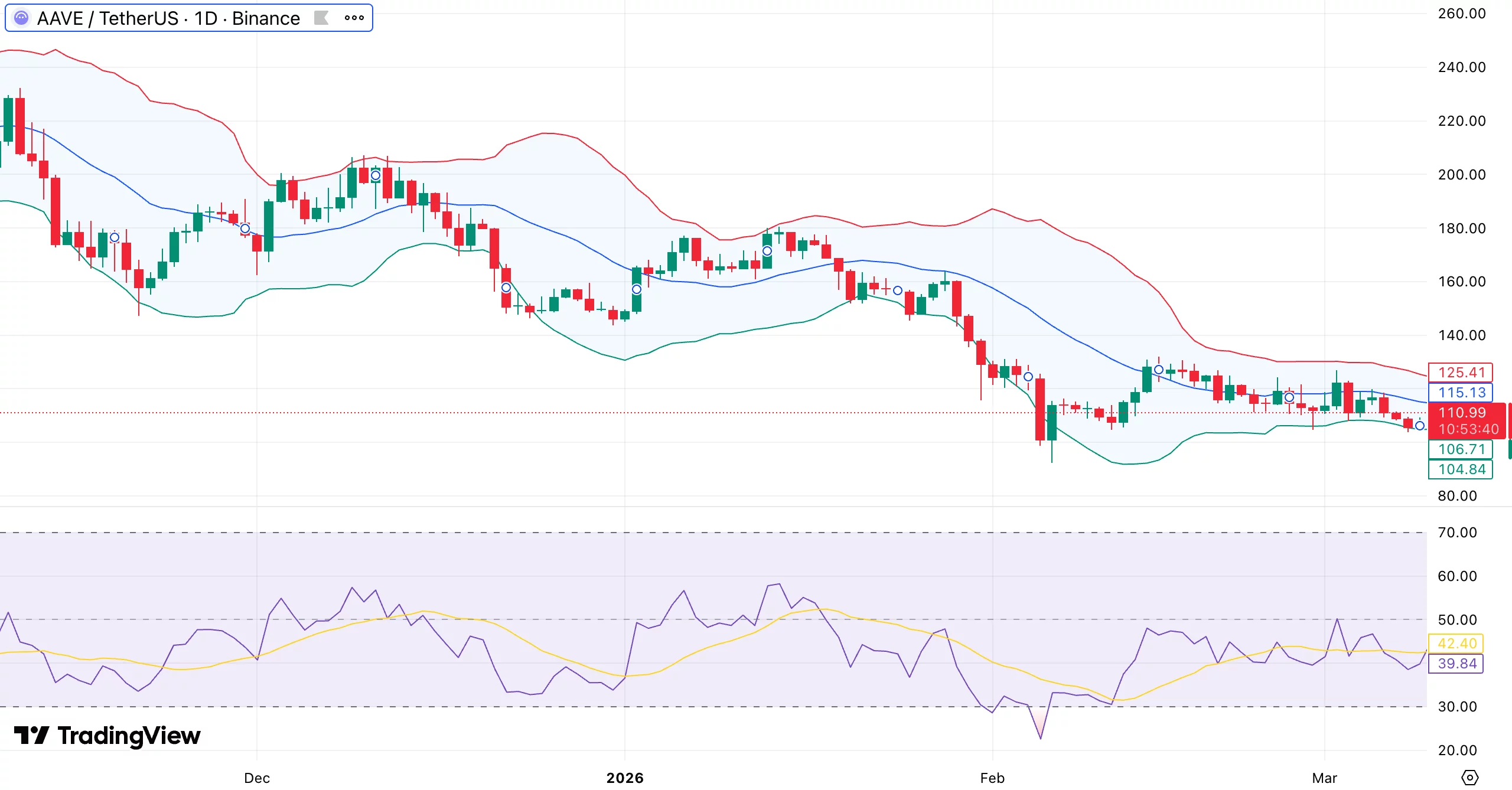
Aave price is trading near $111 as traders react to a $27 million liquidation error that briefly shook confidence in the lending protocol.
Summary
- Aave price dropped after a $27M liquidation caused by a CAPO oracle error.
- 34 accounts using wstETH were liquidated, but the protocol stayed solvent and users will be reimbursed.
- AAVE trades in a descending channel with support at $110–$115, resistance at $125–$130, and weak momentum.
Aave (AAVE) slipped on Wednesday as traders reacted to a recent liquidation incident on the protocol. At press time, AAVE was trading at $111.45, down 2.2% over the past 24 hours.
During the past week, the token moved between $105.31 and $118.70. The price has attempted to recover from the February lows, but it has repeatedly stalled. The market has not yet returned to the levels observed prior to the earlier decline, and momentum is still weak.
Trading activity has cooled slightly. Daily trading volume reached about $29 million, which is 11% lower than the previous day. CoinGlass data also shows softer activity in derivatives markets. Futures volume fell 14% to $300 million, while open interest dropped 4.97% to $190 million.
When both volume and open interest fall at the same time, it usually means traders are stepping back and closing positions.
Liquidation glitch sparks concerns among traders
The decline in sentiment follows an unusual liquidation event on March 10 that affected several users of the Aave lending platform.
The incident was not caused by a hack or a sudden market crash. Instead, it stemmed from a configuration problem in CAPO, Aave’s internal risk management oracle used to monitor collateral prices.
The issue affected positions that used wstETH, the wrapped staked ether token issued by Lido, as collateral. A mismatch between an exchange-rate snapshot and its timestamp caused the system to read the wstETH-to-ETH price incorrectly.
Because of the error, the oracle undervalued the asset by roughly 2.85%. Several accounts suddenly appeared under-collateralized even though their positions were healthy on-chain.
As a result, around 34 user accounts were liquidated, and approximately 10,938 wstETH, worth about $27 million, was sold through automated liquidation processes. Liquidation bots earned close to 499 ETH through bonuses and fees.
After the issue was identified, Chaos Labs, which helps monitor risk parameters on Aave, worked with the protocol team to correct the configuration. The protocol itself remained solvent and did not accumulate bad debt.
Aave said affected users would be compensated using recovered funds and DAO resources. The Aave DAO and Lido both signaled support for reimbursing impacted accounts.
Although the problem was quickly fixed, the event reminded traders that technical errors can still trigger liquidations in DeFi systems.
Technical analysis: Aave price stuck inside descending channel
On the chart, Aave is trading inside a descending channel, a pattern that appears when prices register lower highs and lows. The upper trendline of the channel continues to act as resistance, while the lower boundary has provided support during recent dips.
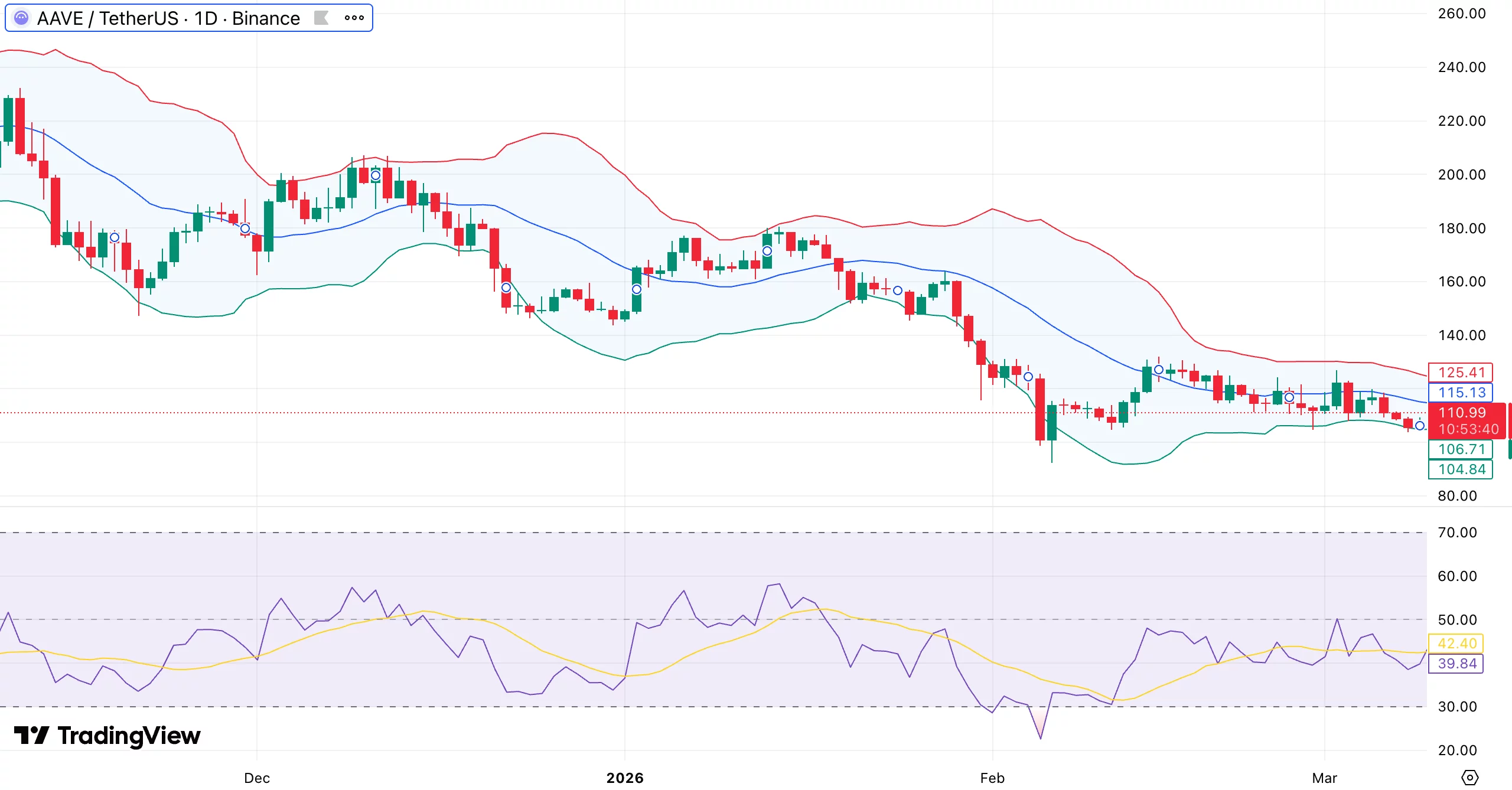
This structure often shows a bearish bias until a breakout occurs. The token is also trading below its short-term moving averages, such as the 50-day and 20-day averages, which act as overhead resistance.
Sellers will probably maintain control of the trend until the price rises above these levels. Volatility has been relatively muted. Bollinger Bands are slightly narrowing, which can happen when the market pauses before the next larger move.
Momentum indicators also lean negative. Buying strength is still restricted, as indicated by the relative strength index, which is below the 50 mark. However, the indicator is not yet in oversold territory, allowing for additional declines.
Within the channel, $110 to $115 is currently serving as a short-term support zone. If the price breaks below that range, it may move into the next demand zone.
On the upside, resistance sits around $125 to $130, where the upper channel trendline and short-term moving averages meet. A clear move above that range would be needed to shift momentum back in favor of buyers.


TLDR
- Hackers took control of Bonk.fun’s domain and deployed wallet-draining malware on the platform
- Users affected were those who approved a fraudulent terms-of-service prompt following the compromise
- Previously established connections and transactions through external terminals remained unaffected
- Originally branded as LetsBONK, the service went live in April 2025
- By late 2025, Bonk.fun’s market dominance plummeted from 84% to a mere 7%
On March 12, Bonk.fun—a Solana-powered meme coin launchpad supported by Raydium and the BONK token—issued an urgent alert advising users to steer clear of its website after cybercriminals hijacked a team member’s account and embedded wallet-draining malware into the domain.
Tom, the platform’s operator posting from the handle @SolportTom, disclosed the security incident on X and instructed users to avoid accessing the site pending resolution. The official Bonk X account echoed this warning.
According to Tom, the attack exclusively impacted users who approved a deceptive terms-of-service authorization on the compromised platform following the breach. Historical site connections and transactions executed via third-party trading interfaces remained secure.
An investigation into the incident is currently ongoing. While the team hasn’t revealed the total financial damage, Tom indicated that swift detection and rapid community notification helped contain the losses.
“We’re employing every available resource to resolve this matter,” Tom stated, emphasizing that users who’ve placed their trust in the platform over the past eight months remain the team’s top concern.
Launched in April 2025 through a collaboration between the BONK community and Raydium, Bonk.fun enables users to create tokens on Solana without any programming knowledge, utilizing dynamic logarithmic bonding curves. The platform previously operated under the name LetsBONK.
Bonk.fun’s Dramatic Market Share Collapse
In the months following its debut, the platform surpassed Pump.fun to capture 84% of Solana’s launchpad sector by mid-2025. This commanding position proved temporary.
By year-end 2025, Bonk.fun’s market control had crashed to merely 7%, based on analytics from Dune. Monthly revenue tumbled to approximately $84,000, while Pump.fun generated over $720,000 during the equivalent timeframe.
The downturn resulted from unsustainable reward systems and a deceleration in successful token deployments. Pump.fun countered by initiating substantial buyback programs, acquiring Kolscan, and enhancing its infrastructure capacity.
In early 2026, Bonk.fun eliminated creator fees entirely in an attempt to recapture users. This strategy produced a brief revenue surge toward the end of January 2026.
Platform Lost Traction Prior to Security Breach
The rebound was short-lived. Pump.fun introduced fresh incentive programs and recaptured more than 70% of the market by February 2026.
This breach fits within a wider trend affecting the cryptocurrency sector. Phishing operations that manipulate users into authorizing malicious transactions on compromised domains have been escalating. Throughout 2025, fraudulent proceeds from such schemes approached $17 billion.
The Bonk.fun team continues to advise all users against accessing the website until they can verify the platform’s security has been fully restored.
At the time of publication, no specific loss amount from the hack has been publicly disclosed.

Crypto World
Across’s acx rockets 80%, massively beating bitcoin, on plans to dump its DAO structure
A DeFi protocol just proposed going private as its stewards believe the current DAO structure is creating a hurdle to close institutional deals.
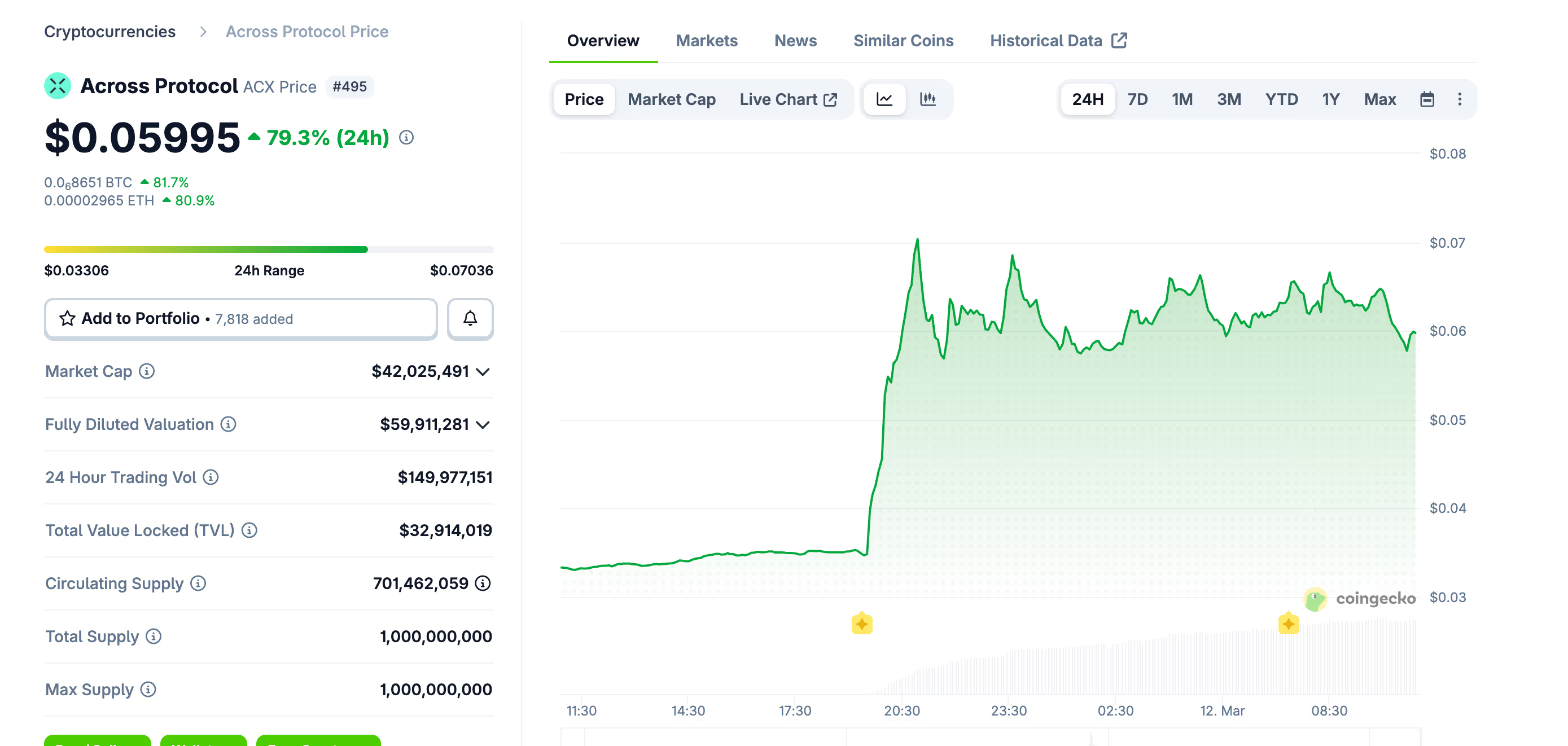
Across Protocol’s ACX token jumped 80% to $0.06 on Thursday after the team behind the cross-chain bridging platform published a ‘temp-check’ proposal to dissolve its token structure and convert into a traditional U.S. C-corporation.
“As Across deepens our work with institutional and enterprise partners, the token and DAO structure has materially impacted our ability to close partnerships and integrations,” the proposal reads. “Transitioning to a traditional legal entity would meaningfully improve our ability to enter enforceable contracts, structure revenue agreements, and deliver more value to Across stakeholders.”
“At current ACX valuations, we believe the Across Protocol is significantly undervalued. The proposed structure gives us an opportunity to explore new ways to foster growth while acting in the best interests of the broader Across community.”
A temp check in DeFi governance is essentially a non-binding poll that gauges community sentiment before a formal vote. It lets the team see whether there’s enough support to proceed as an official governance proposal, which is then voted on by token holders.
The move would give token holders two choices: exchange their ACX for equity in the new company, or sell their tokens for USDC at $0.04375, a 25% premium to the previous 30-day average trading price.
The token was trading at roughly $0.033 before the proposal went live. The immediate surge to $0.07 before settling around $0.06 reflects the market pricing in the buyout floor, though the current price already sits well above the proposed $0.04375 buyout, suggesting traders are betting on either a higher offer or that the equity option is worth more.

In comparison, BTC is currently trading flat, according to CoinDesk market data. The CoinDesk 20, which measures the performance of the largest digital assets, is also trading flat.
The mechanics are straightforward. A new entity called “AcrossCo” would hold all protocol IP and manage development. Token holders above 5 million ACX could convert to equity directly.
Smaller holders could access equity through a no-fee SPV structure with a minimum of 250,000 ACX, roughly $10,000 at current prices. Everyone gets treated equally at a 1:1 token-to-share ratio regardless of size.
Those who don’t want equity get the USDC buyout at the 25% premium. The buyout window would open within three months of the proposal passing and stay open for six months, funded by the protocol’s liquid assets.
A community call is scheduled for March 18, formal discussion runs through March 25, and a Snapshot vote would follow on March 26. If it passes, the conversion would begin in early April.
Is the DAO vision dead?
DeFi proponents spent years arguing that tokens and DAOs were superior to traditional corporate structures for building decentralized infrastructure.
Across is one of the first protocols to publicly argue the opposite, that the token structure is actively holding back growth and that a C-corp would deliver more value to the same stakeholders.
Risk Labs acknowledged the token has been “significantly undervalued” and described the proposal as a chance to “double down on Across” through a structure that institutional partners actually understand.
The 24-hour trading volume of $149 million is roughly 3.5 times the token’s market cap, reflecting the intensity of speculative interest around the proposal.
Whether that interest translates into support for the conversion or simply a trade on the buyout premium is what the next two weeks of governance discussion will determine.
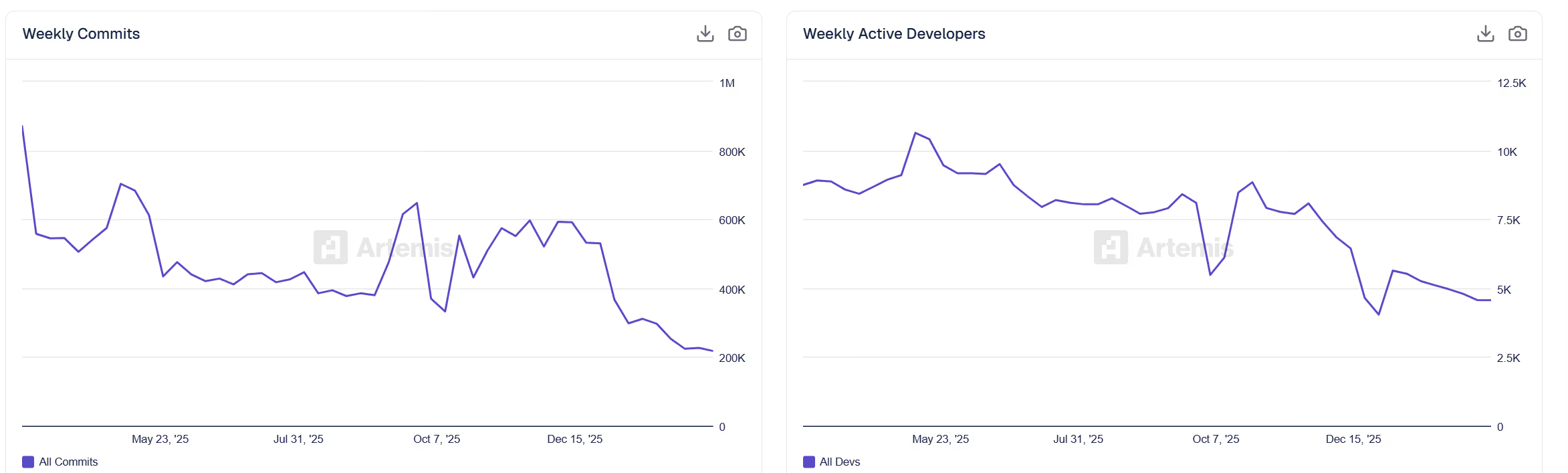
Blockchain ecosystems are losing developers across the board while artificial intelligence projects dominate growth on GitHub, the world’s largest platform for hosting and collaborating on software code.
Weekly crypto commits (publishing new code) to repositories have fallen roughly 75% since early 2025, dropping from about 850,000 to 210,000, while active developers declined 56% to around 4,600, according to data from analytics platform Artemis.
Repositories track where developers are writing code, building tools and launching new projects, they offer one of the clearest signals of where software innovation is happening.

The contraction stands in stark contrast to the broader software ecosystem. GitHub added about 36 million developers in 2025 alone, bringing its global base to more than 180 million, with platform-wide commits rising roughly 25% year over year, according to GitHub’s Octoverse report.
Much of that growth is flowing into artificial intelligence. GitHub now hosts more than 4.3 million AI-related repositories.
The number of repos importing large language model software development kits surged about 178% to more than 1.1 million over the past year, while generative AI projects now attract more than 1 million monthly contributors.
The numbers suggest developers are reallocating time toward AI infrastructure rather than blockchain.
Repositories using Jupyter Notebooks, commonly used for machine learning experimentation, grew about 75%. Dockerfile repositories used to deploy AI applications jumped roughly 120%. TypeScript, the programming language underpinning much of the modern web and many AI tools, overtook Python and JavaScript to become GitHub’s most-used language after gaining more than 1 million contributors in a single year.
Within crypto, the decline is broad but uneven.
Ethereum’s weekly active developer count fell 34% over three months to 2,811, according to Artemis. Solana shed 40% to 942 developers. Base, the Coinbase-incubated Layer 2 that was among 2024’s fastest-growing ecosystems, dropped 52% to 378 developers.
Newer chains that attracted speculative interest during last year’s bull market are faring worst. Aptos lost about 60% of its developers, BNB Chain commits plunged 85%, and Celo fell 52%.
The only category of meaningful size still growing is wallet infrastructure, which rose about 6% to 308 weekly active developers.
Still, the data suggests crypto may be consolidating rather than collapsing.
Electric Capital’s annual developer report shows the sector peaked at roughly 31,000 monthly active developers in 2022 before falling to about 23,600 in 2024, with estimates suggesting further declines to around 18,000 by mid-2025.
The composition of the remaining workforce is also changing. Developers with more than two years of tenure grew about 27% year over year and now produce roughly 70% of commits. The exodus is concentrated among part-time contributors and newcomers with less than 12 months of experience, a group that declined 58% in one tracking period.
Crypto development has historically followed market cycles, and activity could rebound if another bull market draws builders back.
But previous downturns offered fewer alternatives for displaced developers. In 2025, generative AI represents a rapidly expanding frontier with deep venture funding and immediate commercial demand, raising the question of whether this cycle’s talent drain proves harder to reverse.
Stablecoin yield providers will inject more capital into the US banking system, argues White House Council of Advisors for Digital Assets executive director Patrick Witt, amid debate over whether stablecoin yields will draw deposits away.
“Foreigners exchange local currency for stablecoins from a US-based issuer,” Witt said in an X post on Wednesday, adding that “global demand for USD is massive.”
“That is net new capital entering the American banking system,” Witt said. Most US stablecoin issuers hold US dollars or US Treasuries to back each token issued.
Banking and crypto industry clash over stablecoin yields
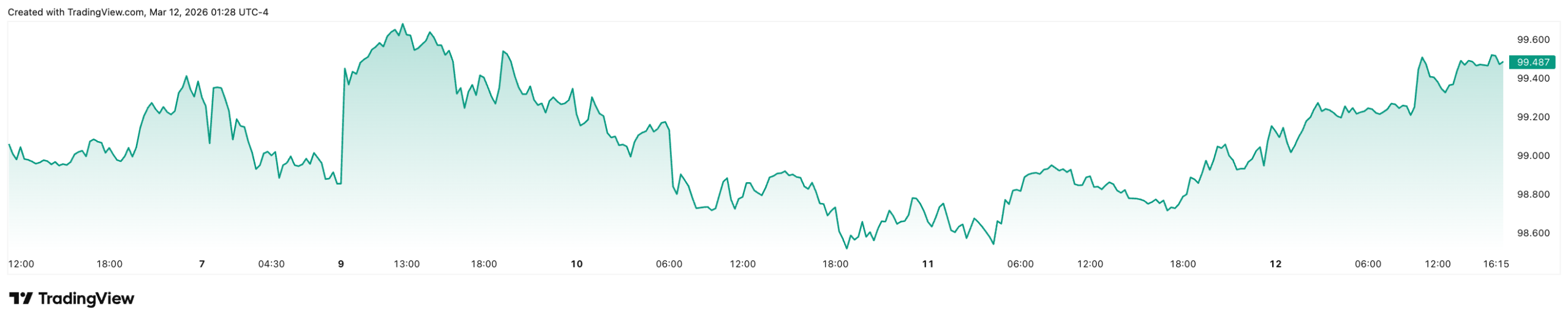
The US dollar index, which tracks the strength of the dollar against a basket of major currencies, fell to its lowest level in four years on Jan. 28, at 95.818, according to TradingView. It has since recovered 3.80% to 99.468.

It comes as the debate between crypto firms and US banks continues to heat up over the US CLARITY Act, aimed at providing the industry with clearer regulation, over whether allowing stablecoin yields will pull deposits out of traditional banks.
Major US bank Standard Chartered recently estimated in a research note that increasing stablecoin adoption could lead to US bank deposits decreasing “by one-third of stablecoin market cap.”
However, Witt argued that what’s often “lost” in the GENIUS and CLARITY Act discussions is how GENIUS-compliant stablecoins “will actually lead to deposit inflows.”
Community banking exec causes controversy in crypto industry
On Friday, the Independent Bankers Association of Texas president Christopher Williston said that making concessions in the CLARITY Act debate would risk harming local lending and economic production, prompting backlash from the crypto community.
“It’s simply impossible to roll over in the fight for liquidity that powers the economies of the places we call home,” he said.
Related: Republican opposition to CBDC could hold up housing affordability bill
Zero Knowledge Consulting founder Austin Campbell responded that “If community banks and crypto can’t find a way to work together, we already know who the winners are… It is the big banks.”
Witt also chimed in on this debate, saying it “feels like I’m watching an arsonist threaten to burn down their own home.”
Magazine: All 21 million Bitcoin is at risk from quantum computers
Payment transaction volumes among artificial intelligence agents are more than 90% lower than reports suggest, but crypto giants are pouring billions into building the infrastructure around it.
AI agents are starting to buy things, but “the numbers are inconsistent,” Andreessen Horowitz (a16z) partner Noah Levine wrote in an X post on Wednesday.
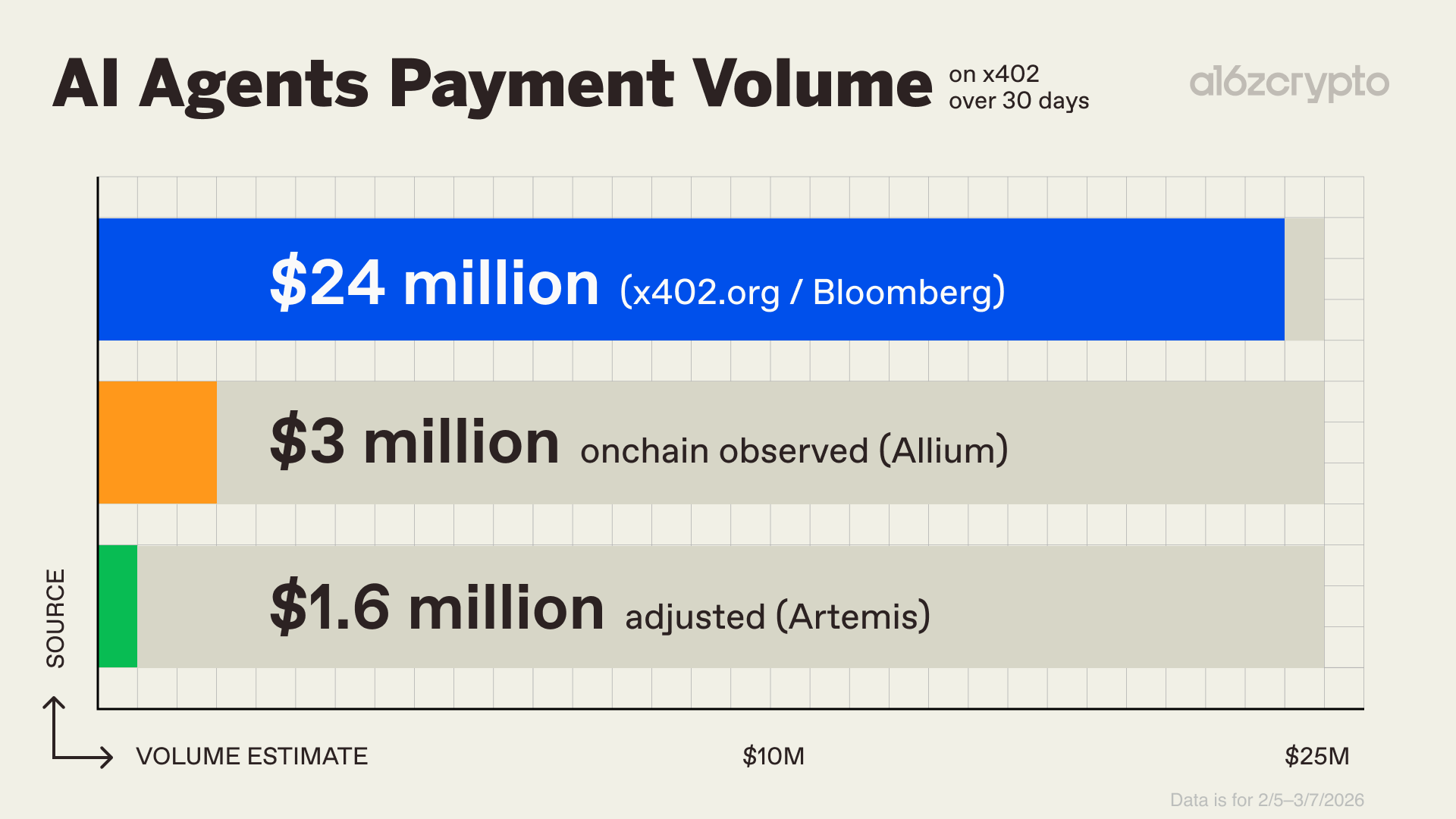
He said a Bloomberg article on Saturday reported that AI agents made $24 million in payments over a 30-day period, citing data from x402.org.
Levine said that data from Allium Labs shows there have been roughly $3 million in AI agent transactions over the same period. Filtering out wash trades shrinks the estimate to around $1.6 million, he added, adding that it is still very early days.
“The gap tells you how early-stage even the measurement infrastructure is.”
Levine said that most of the AI payment activity is around developer tools. Firecrawl, a platform that turns websites into AI-ready data, sells web scraping for 1 cent per query, Browserbase, an AI-centric web browser, sells browser sessions, while AI image platform Freepik sells image generation.
“These companies all accept cards, but x402 lets a developer or agent try the tool once without committing to a subscription,” Levine noted.
x402 is a simple payment standard developed by Coinbase that lets AI agents automatically make payments over the internet.

Agentic payments protocol adoption is growing
Levine noted that major payment and internet companies such as Stripe, Cloudflare, and Vercel have integrated x402, while Google has embedded the system into its agent payments protocol.
He added that the $1.6 million in volume “is not a big number, but the infrastructure being built around it is.”
“None of them are betting on $1.6 million a month. They are betting on what the number looks like when agents become the default buyer.”
Related: Alchemy introduces autonomous payment rails for AI agents on Base
Levine said that while humans remain involved, interactions occur through agentic platforms like Claude Code and the OpenClaw personal AI assistant, making transactions semi-autonomous.
Coinbase’s x402 Facilitator Launches on Polygon
Meanwhile, Coinbase announced on Thursday that its x402 Facilitator is adding support for the Ethereum layer-2 network Polygon, allowing developers to accept payments of the stablecoin USDC (USDC) on Polygon, Base, and Solana.
“Networks optimized for quick settlement and minimal fees are essential to make these machine-to-machine payments viable,” it stated.
“Very soon, there are going to be more AI agents than humans making transactions,” Coinbase CEO Brian Armstrong said on Monday.
Magazine: Crypto loves Clawdbot/Moltbot, Uber ratings for AI agents: AI Eye


India’s premier investigative agency, the Central Bureau of Investigation, has arrested Ayush Varshney, co-founder and chief technology officer of Darwin Labs Private Limited, in connection with the alleged GainBitcoin crypto fraud.
Summary
- The Central Bureau of Investigation arrested Ayush Varshney, co-founder of Darwin Labs, in the GainBitcoin fraud probe.
- Investigators say Darwin Labs helped build technical infrastructure linked to the alleged scheme, including the MCAP token and GBMiners platform.
- Varshney was intercepted at Mumbai airport while allegedly attempting to leave India after a Look Out Circular was issued.
CBI arrests GainBitcoin scam suspect at Mumbai airport
The case relates to the GainBitcoin scheme allegedly operated by Variabletech Pte. Ltd., which investigators say functioned as a Ponzi-style investment program that promised unusually high returns to participants who invested in cryptocurrency mining packages.
According to the CBI, funds collected from investors were later misappropriated.
Authorities are investigating the case under several provisions of the Indian Penal Code, including criminal conspiracy, criminal breach of trust and cheating, along with provisions under the Information Technology Act, 2000.
The probe stems from a December 2023 directive by the Supreme Court of India ordering that multiple complaints linked to the GainBitcoin scheme be consolidated and investigated by the CBI as the central agency.
Investigators say Darwin Labs and its co-founders — including Varshney, Sahil Baghla and Nikunj Jain — played a role in the technical development of components associated with the scheme.
These included the design and deployment of a crypto token known as MCAP and its associated ERC-20 smart contract.
Indian authorities allege the firm also built the underlying technological infrastructure used in the operation, including the Bitcoin mining platform GBMiners.com, a bitcoin payment gateway, a crypto wallet known as Coin Bank and the GainBitcoin investor portal.
Varshney had been absconding during the investigation, prompting authorities to issue a Look Out Circular against him. Immigration officials intercepted him at Mumbai airport on March 9 while he was allegedly attempting to leave the country.
He was subsequently taken into custody by the CBI and formally arrested on March 10.
The GainBitcoin case is considered one of India’s largest crypto-related fraud investigations, involving thousands of investors across multiple jurisdictions.


Wells Fargo has filed a trademark application for “WFUSD,” sparking speculation that the U.S. banking giant may be exploring a blockchain-based payment token or stablecoin.
Summary
- Wells Fargo filed a trademark for “WFUSD,” covering crypto-related payment and digital asset services.
- The move may signal exploration of a bank-issued stablecoin or blockchain-based settlement token.
- The filing comes as Wall Street banks prepare for clearer U.S. stablecoin regulation and expanding digital asset adoption.
According to the filing, the mark covers financial services tied to digital assets, including cryptocurrency-related payments and electronic financial transactions.
While Wells Fargo has not announced a product tied to the name, the application has raised the possibility that Wells Fargo could be preparing a dollar-pegged digital asset.
If launched, WFUSD would place the bank among a growing group of major financial institutions experimenting with blockchain-based settlement tools and tokenized payments. Banks have increasingly explored digital tokens as a way to move funds instantly and reduce costs in cross-border or institutional transfers.
The move would also reflect a broader trend of Wall Street firms expanding their crypto strategies. For example, JPMorgan Chase previously launched its blockchain-based payment token, JPM Coin, to facilitate institutional transactions across its internal network.
A potential stablecoin from Wells Fargo could emerge as regulatory clarity around digital dollar tokens improves in the United States. Policymakers have been working toward frameworks that would place stablecoin issuers under stricter oversight, a development that many analysts believe could favor large regulated banks entering the market.
If regulatory rules solidify, traditional financial institutions may become major issuers of dollar-backed digital assets, competing with established stablecoin providers such as Circle and Tether Limited.
For now, the WFUSD filing does not confirm a forthcoming launch, but it shows how major banks are positioning themselves for a financial system increasingly influenced by blockchain-based infrastructure.

Prediction market Kalshi has sued regulators in the US state of Iowa, claiming it did so as there was a risk of an impending enforcement action over its sports event contracts.
Kalshi sued Iowa Attorney General Brenna Bird, along with the Iowa Racing and Gaming Commission and its board, in an Iowa federal court on Wednesday, claiming there “is a substantial risk” Bird would bring enforcement action to block the company’s event contracts.
In its complaint, Kalshi said a company representative met with Bird for what was believed to be a discussion about a tax bill currently under consideration in the Iowa legislature.
“Instead, he [Kalshi’s representative] was greeted by a panel of attorneys, including Iowa’s Solicitor General, who proceeded to ask a series of pointed questions challenging whether Kalshi’s federally regulated offerings ran afoul of (preempted) Iowa state law,” Kalshi claimed.

After the meeting, Kalshi said it contacted a representative for the Attorney General on Tuesday “to seek assurances that the Iowa AG did not intend to bring an enforcement action against Kalshi.”
“The representative did not provide such assurances,” Kalshi said. “To the contrary, the official said in writing that ‘we will not give any assurances about potential future enforcement.’”
Cointelegraph contacted Bird’s office and the Iowa Racing and Gaming Commission for comment.
Prediction markets fight states over sports contracts
Kalshi’s lawsuit against Iowa is the company’s latest legal action targeted at a US state regulator over whether it can offer event contracts across the US.
In the latest lawsuit, Kalshi argued that “federal law preempts Iowa from subjecting Kalshi to state law,” and as a designated contract market, it is subject to the “exclusive jurisdiction” of the Commodity Futures Trading Commission.
The company has made a similar argument in multiple court cases with other state gambling regulators over the legality of sports event contracts.
Related: US Senate bill targets prediction markets on war and assassinations
Many state regulators have alleged that the contracts, which allow users to bet on the outcome of sporting events, are gambling, subject to separate state-level laws, and are offered without a license.
Federal courts have differed in their response to the lawsuits.
On Monday, an Ohio federal court denied Kalshi’s request to block Ohio regulators from taking action against its sports contracts, saying the company failed to show that they were subject to the CFTC’s jurisdiction.
A federal court in Massachusetts blocked Kalshi from offering event contracts in the state earlier this year, and Nevada sued the company last month after an appeals court knocked back Kalshi’s bid to stop the state from taking action.
Federal courts in New Jersey and Tennessee, in contrast, have sided with Kalshi to temporarily block state regulators from taking action over the company’s sports event contracts.
Magazine: How crypto laws changed in 2025 — and how they’ll change in 2026
Bitcoin price risks a drop back to the $65,000 zone as bearish macroeconomic forces continue to impact investor risk sentiment.
Summary
- Bitcoin price failed to hold the $70,000 support on Thursday.
- Investor demand for risk assets dropped amid surging oil prices and rising U.S. Treasury yields.
- The latest U.S. CPI print came in line with market expectations, which can force the Fed to keep interest rates elevated for a longer period.
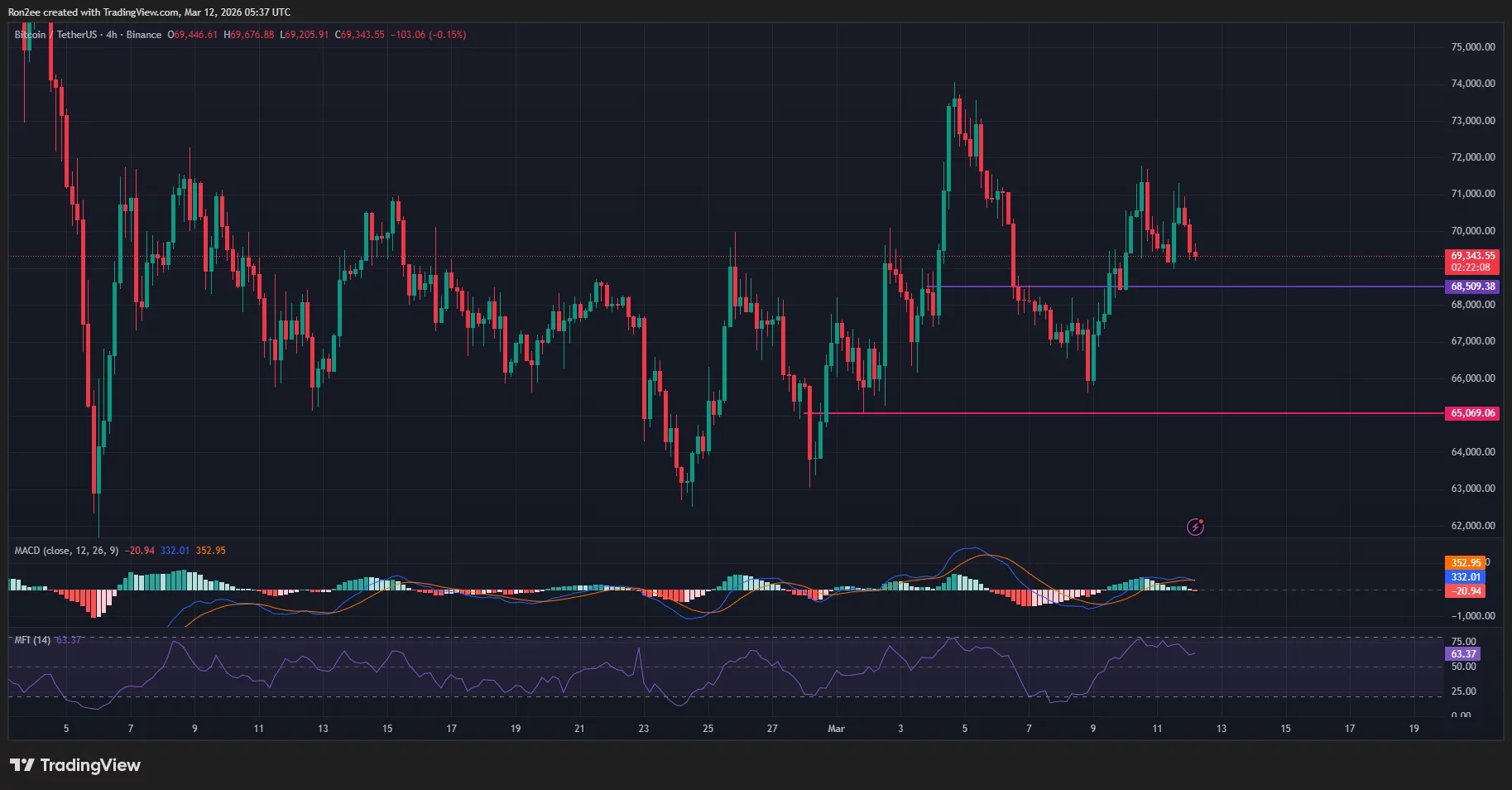
According to data from crypto.news, Bitcoin (BTC) price fell 4.8% over the past 7 days, dropping below the $70,000 support level. Trading at $69,385 at the time of writing, the bellwether was nearly 29% below its year-to-date high of around $97,500 and 45% from its all-time high.
Currently, Bitcoin faces a number of geopolitical and macroeconomic risks that could push its price towards $65,000 and subsequently the $60,000 mark.
First, Iran has announced that it would change its retaliation strategy in the Middle East from reciprocal hits to continuous strikes against the interests of its adversaries, a move intended to punish Israel and the United States.
Additionally, Tehran said that it would continue blocking all ships carrying oil to Israel and the United States from using the Strait of Hormuz, where millions of barrels of crude pass through daily.
Through these measures, Iran aims to push crude oil prices to as high as $200, a move that could ultimately lead to higher inflation throughout the world, with the greatest impact coming on the U.S., which remains sensitive to energy price shocks. This escalating tension in the Middle East has historically driven investors away from volatile assets like cryptocurrency and into traditional safe havens.
Second, Wednesday’s U.S. core CPI data for February came in line with market expectations, essentially forcing the Federal Reserve to maintain elevated interest rates for a longer period.
Meanwhile, if the war continues to drive up energy costs, it could fuel inflation further and dampen any hopes for a pivot in monetary policy this year. Higher interest rates typically sap the liquidity necessary for speculative assets to thrive.
According to the CME FedWatch data, there is a 99.3% chance that the interest rates will remain unchanged during the March FOMC meeting, with the current target rate sitting at 350 to 375 basis points. Odds of an April rate cut meanwhile stood at just 10.9% when writing, down sharply from 21% one month earlier.
It should also be noted that February inflation data came without fully accounting for the recent impact of surging oil prices and hence does not reflect the hawkish stance the Fed will be forced to adopt over the coming weeks.
Third, US yields on the 10-year Treasury have continued to go higher as bond markets react to these inflationary pressures. These yields recently rose by several basis points, making the guaranteed returns of government debt far more attractive than the risks associated with digital currencies.
Bitcoin price analysis
In terms of technicals, Bitcoin has once again fallen below the $70,000 mark. Traders are closely watching the $68,500 support level, but persistent selling pressure suggests that the path of least resistance remains to the downside with a potential retracement to the $65,000 support zone until global stability returns.
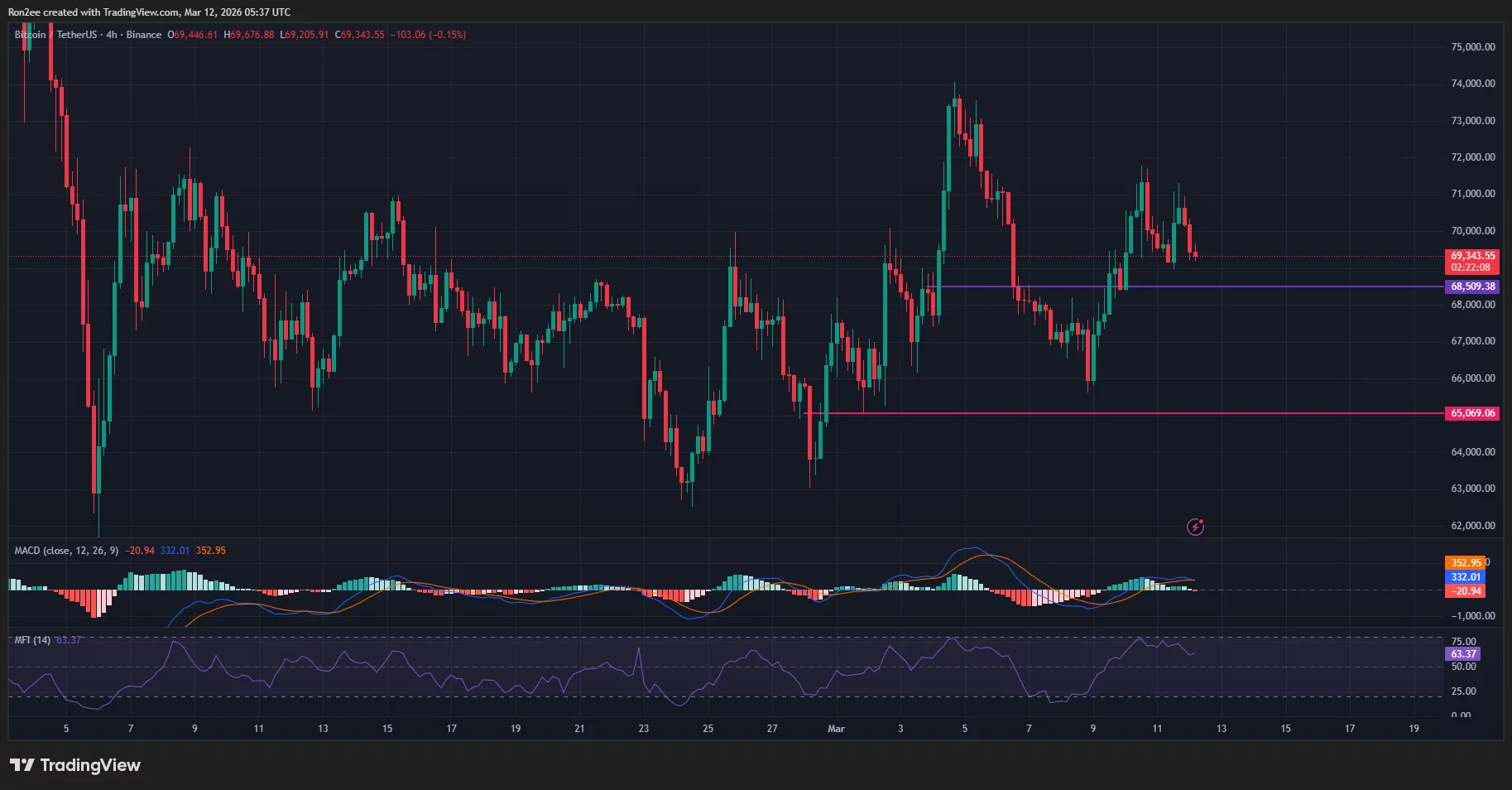
On the 4-hour chart, momentum indicators suggest that the bearish structure has already started building. The MACD lines are close to confirming a bearish crossover, while the RSI is trending downwards after hitting overbought levels.
Disclosure: This article does not represent investment advice. The content and materials featured on this page are for educational purposes only.

Decentralized finance (DeFi) has long wrestled with the tension between accessibility and risk management. Perpetual contracts, in particular, expose traders to extreme leverage and volatile markets. Traditionally, exchanges apply flat leverage caps or margin requirements, treating all users equally regardless of experience or past behavior. But what if a trader’s identity and reputation could dynamically influence how much risk they can take?
The Concept: Identity-Weighted Leverage
At its core, identity-weighted leverage personalizes risk management for perpetual contracts. Each trader is assigned a “trust score” based on verifiable on-chain data, such as:
-
Historical trading performance – e.g., consistent profits, low liquidation history.
-
Collateral behavior – how often and how responsibly they maintain margin.
-
Social governance participation – involvement in protocol voting or community contributions.
The system then adjusts leverage limits or margin requirements according to this score. A highly trusted trader might access 10x leverage safely, while a new user is throttled to 2x or 3x until they prove reliability.
Gamifying Risk Management
This approach doesn’t just manage risk—it gamifies it. Traders are incentivized to maintain a clean record, engage with governance, and demonstrate disciplined trading. The better your reputation, the more freedom you get to deploy capital. It turns risk management into a socially reinforced game, where positive behavior is rewarded with real financial flexibility.
Benefits for the Ecosystem
-
Safer Markets: Reduces systemic risk by limiting reckless leverage for unproven traders.
-
Aligned Incentives: Encourages responsible trading, increasing protocol trustworthiness.
-
Community Engagement: Integrates social reputation, making governance participation materially valuable.
-
Differentiated User Experience: Traders feel recognized and rewarded for their skill and discipline.
Challenges and Considerations
-
Privacy vs. Transparency: Reputation must be verifiable on-chain without exposing sensitive personal data.
-
Manipulation Risk: Systems must guard against fake histories or social score farming.
-
Standardization: Protocols need consistent metrics for scoring across different platforms.
Future Outlook
Identity-weighted leverage could redefine how DeFi perceives risk and trust. By combining traditional risk management with a social trust layer, perpetual trading becomes more than a numbers game—it becomes a community-powered ecosystem, where credibility and behavior are as valuable as capital.
This paradigm introduces the first real bridge between gamified social reputation and financial leverage, opening the door for more sophisticated, self-regulating DeFi markets.
REQUEST AN ARTICLE

We Just Got Our First Look Ever At The B-21 Raider Performing This Risky Maneuver

These Bitcoin Bottom Signals Are Screaming BUY

RHS Garden Harlow Carr hosting new Easter egg trail


-
Business6 days ago
Form 8K Entergy Mississippi LLC For: 6 March
-

 News Videos3 days ago
10th Algebra | Financial Planning | Question Bank Solution | Board Exam 2026
-

 Fashion6 days ago
Weekend Open Thread: Ann Taylor
-

 Crypto World3 days ago
Paradigm, a16z, Winklevoss Capital, Balaji Srinivasan among investors in ZODL
-
 Tech23 hours ago
A 1,300-Pound NASA Spacecraft To Re-Enter Earth’s Atmosphere
-
 Sports7 days ago
499 runs and 34 sixes later, India beat England to enter T20 World Cup final | Cricket News
-

 Politics6 days ago
Top Mamdani aide takes progressive project to the UK
-

 Business2 days ago
ExxonMobil seeks to move corporate registration from New Jersey to Texas
-

 Sports4 days ago
Braveheart Lakshya downs Lai in epic battle to enter All England Open final | Other Sports News
-

 Sports4 days ago
Three share 2-shot lead entering final round in Hong Kong
-

 NewsBeat12 hours ago
Residents reaction as Shildon murder probe enters second day
-

 NewsBeat7 days ago
Piccadilly Circus just unveiled ‘London’s newest tourist attraction’ and it only costs 80p to enter
-

 Entertainment5 days ago
Hailey Bieber Poses For Sexy Selfies In New Luscious Lip Thirst Traps
-

 Business4 days ago
Search for Nancy Guthrie Enters 37th Day as FBI Probes Wi-Fi Jammer Theory
-

 Business23 hours ago
Search Enters Sixth Week With New Leads in Tucson Abduction Case
-
 NewsBeat2 days ago
Pagazzi Lighting enters administration as 70 jobs lost and 11 stores close across Scotland
-

 Tech3 days ago
Despite challenges, Ireland sixth in EU for board gender diversity
-

 Tech7 days ago
ACIP To Discuss COVID ‘Vaccine Injuries’ Next Month, Despite That Not Being In Its Purview
-

 Business2 days ago
Search Enters 39th Day with FBI Tip Line Developments and No Major Breakthroughs
-

 Tech2 days ago
ChatGPT will now generate interactive visuals to help you with math and science concepts