




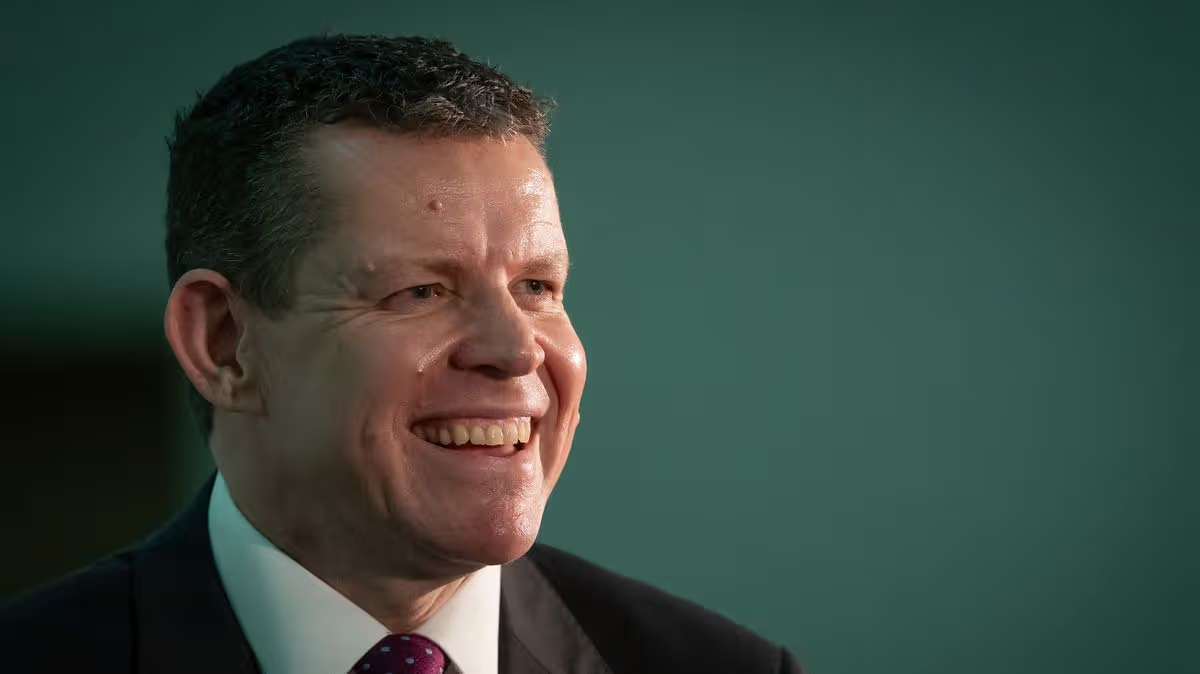
Addressing a meeting of Cardiff Business Club he gave more details on Plaid Cymru’s business and economic priorities

Rhun ap Iorwerth(Image: Getty Images)
A Plaid Cymru Welsh Government, in its first 100 days in office, would launch a Wales-wide skills audit aimed at ensuring businesses have access to a workforce that can support growth as well as establishing a new commission that would set economic targets.
Addressing a meeting of Cardiff Business Club, Plaid leader Rhun ap Iorwerth said that, if elected, Plaid would also aim to increase the level spent on procuring goods and services with Wales-based suppliers from the current 55% to at least 70% of total Welsh public procurement expenditure. A timeframe for achieving this goal has not yet been set.
He also said a wide range of business support initiative and structures, including city deals and investment zones, had created a “tangled web” which is “often riddled with either duplication or contradiction.”
Mr ap Iorweth said business rates would be repurposed to address what he described as the current regime’s bias towards out-of-town retailers over hospitality, leisure and retail businesses in town centres.
READ MORE: Wales falls in influential index on gender equality in the workplaceREAD MORE: Wales needs it own industrial strategy say Liberal Democrats
Plaid has already committed to creating a national development agency for Wales, at arm’s length from the Welsh Government, that would take over business support currently operated by the Welsh Government under its Business Wales banner.
There is currently no projected timeframe for when a new agency could become operational as well as an assessment of set up costs, what its annual budget could be, and how it would work with regional bodies such as the Cardiff Capital Region. As part of the 100 day plan Plaid is though committed to establishing a panel of business and economic experts to refine the remit, governance and operating model for the agency.
The 100 day plan can also be seen as providing a signal to Welsh Government civil servants – who will implement policy changes – that a Plaid administration wants rapid implementation.
Mr ap Iorwerth said: “If businesses in Wales are to succeed, then we need to be able to match people with skills and jobs right across our economy. That’s why a Plaid Cymru government, in its first 100 days, would launch a Wales-wide skills audit to identify future skills needs in the Welsh economy and inform our policy decisions in government.
“We’ll prepare to convene a future skills summit, to include representatives from the further education and higher education sectors, businesses and other relevant stakeholders, to create one clear vision and strategy for the future of our skills system and its funding.”
He told his business audience that an economic and fiscal commission would be created to support the collection and analysis of Welsh economic data and the setting of clear economic targets.
Mr ap Iorwerth said: “Without that kind of full picture we’re hamstrung in our ability to understand the challenges we’re facing and, critically, in identifying the steps we should be taking to overcome them.”
He also confirmed that business rates would be recalibrated to ensure improved reliefs for firms in the retail, hospitality and leisure sectors operating in town centres.
He said: “The businesses in retail, leisure and hospitality that are the backbone of our high streets and our local economies have faced a perfect storm of increased overheads and declining footfall.
“The current First Minister has of course suggested that the answer is for people to stop watching so much Netflix, but we think we need slightly more practical support for businesses than that. As a first step in a wider review of the fitness for purpose of non-domestic rates, we’ll extend a preferential multiplier to redress the imbalance that currently advantages out-of-town shopping over hospitality, leisure and retail in our town centres.”
On procurement, he said: “We want to make much better use of public procurement in Wales — currently worth as much as £8bn a year — to support our home-grown small and medium-sized businesses.”
Plaid would also seek to address what it sees as over complexity and a degree of duplication from a range of regional structures and initiatives aimed at boosting the economy, including city and growth deals, freeports and new investment zones. Although some of these initiatives are non-devolved matters or partnerships with the UK Government.
However, the party is not advocating any current changes to the statutory status joint corporate committees, but wants to ensure these bodies, such as the Cardiff Capital Region, are maximising their potential to support growth. He said Plaid would also look to speed up planning to support business investment.
He said: “A Plaid Cymru government will reform planning processes in Wales — with the aim of offering clarity and firmer consenting timelines, as well as ensuring that the rules of the game don’t suddenly change halfway through.
“We’ll also use the opportunity afforded by the forthcoming review of the National Development Framework – Future Wales – to simplify, rationalise and ultimately ensure better use of public money.
“That includes looking at all those overlapping local, regional and national frameworks and initiatives – from city and regional growth deals to enterprise zones, and from trailblazer neighbourhoods to local growth and pride-in-place programmes – some imposed from Westminster, others made up on the hoof it seems, and some showing little evidence of logic or strategy.
“The web is too tangled, and too often riddled with either duplication or contradiction, or both.
“And we need clarity and consistency so we can carry on with, and build on, really important work that is going on — work done by the Cardiff Capital Region, for example.”
He said that ultimately creating a more competitive Welsh economy has to be driven by businesses.
He added: “The future of our economy won’t somehow be written in government buildings alone. It will be shaped in offices, workshops, laboratories, shop floors and start-ups – by people like you (business audience) – willing to take risks, invest, innovate and build. And by the people you employ, through good relationships with unions, and a genuine sense of joint venture across Wales.”