

Crypto World
Cardano price tests $0.25 as Hoskinson hints at ADA buybacks

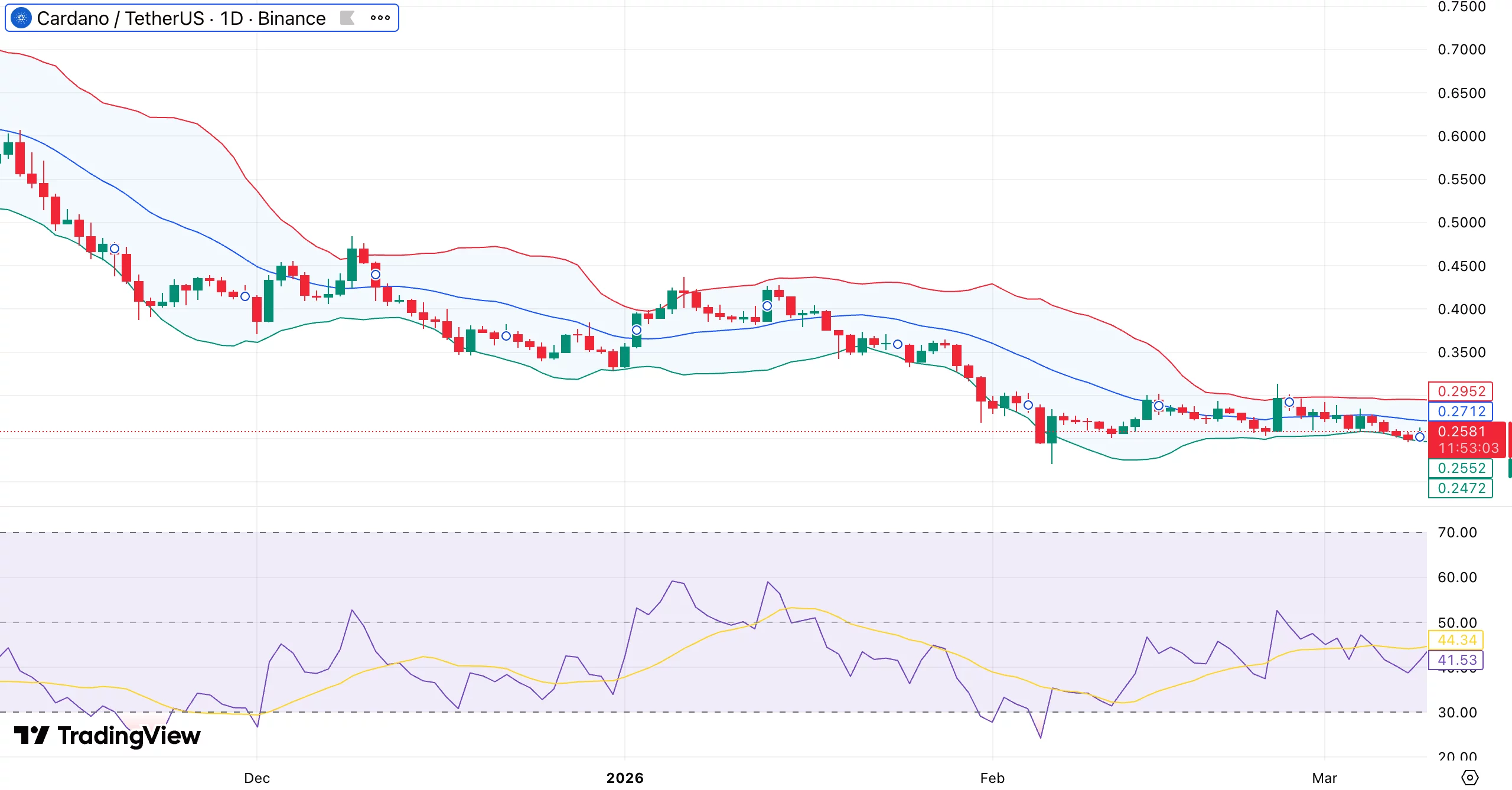
Cardano price is hovering near $0.25 support as traders watch whether ADA can hold the level while Charles Hoskinson discusses potential buybacks.
Summary
- Cardano is still under selling pressure with a continued weak trend and declining derivatives activity.
- Charles Hoskinson suggested a new funding model where the Cardano treasury invests in ecosystem projects and may use returns for ADA buybacks.
- The strategy focuses on increasing developer incentives and expanding real-world applications to strengthen the Cardano ecosystem.
Cardano (ADA) moved lower on Wednesday as sellers kept pressure on the market. At the time of writing, ADA was trading at $0.2585, down about 2% over the past 24 hours.
During the past week, the token traded between $0.2492 and $0.2828. The range has narrowed as the market cooled after earlier volatility. ADA has lost around 5% over the last seven days, and the longer trend remains weak. Since January, the token is down roughly 20% in 2026 so far.
Market activity has not changed much despite the price decline. Daily trading volume reached $799 million, only 0.22% higher than the previous session.
CoinGlass data shows some cooling in derivatives markets. Open interest slipped 3.57% to $419 million, which often happens when traders close positions during uncertain price action.
Hoskinson hints at ADA buybacks and new funding model
In a recent video update, Charles Hoskinson shared new details about how the Cardano ecosystem may be funded in the coming years.
According to Hoskinson, the network has spent years building its core infrastructure. The next step, he said, is to focus more on useful applications and better user experience. Without that shift, strong infrastructure alone will not attract users.
Developers and dApp teams could receive stronger incentives under the proposed model. One idea being discussed involves the Cardano treasury investing in a group of projects across the ecosystem, including DeFi platforms and other applications.
If the plan moves forward, returns from those investments could be used in part to buy ADA from the open market. Hoskinson described this as a possible buyback mechanism that may support the token while also funding ecosystem growth.
The proposal reflects a change in approach. Instead of relying mostly on grants, the treasury may begin making strategic investments designed to increase activity on the network.
Hoskinson has said that 2026 will be an important year for execution, with attention shifting toward real-world utility and stronger dApp ecosystems.
Technical analysis: ADA holds near key support
On the charts, Cardano is trading close to the lower Bollinger Band, which often appears when markets face short-term selling pressure.
The overall trend still points downward. Over the past several weeks, the chart has produced lower highs and lower lows, a pattern that usually marks a continuing downtrend.
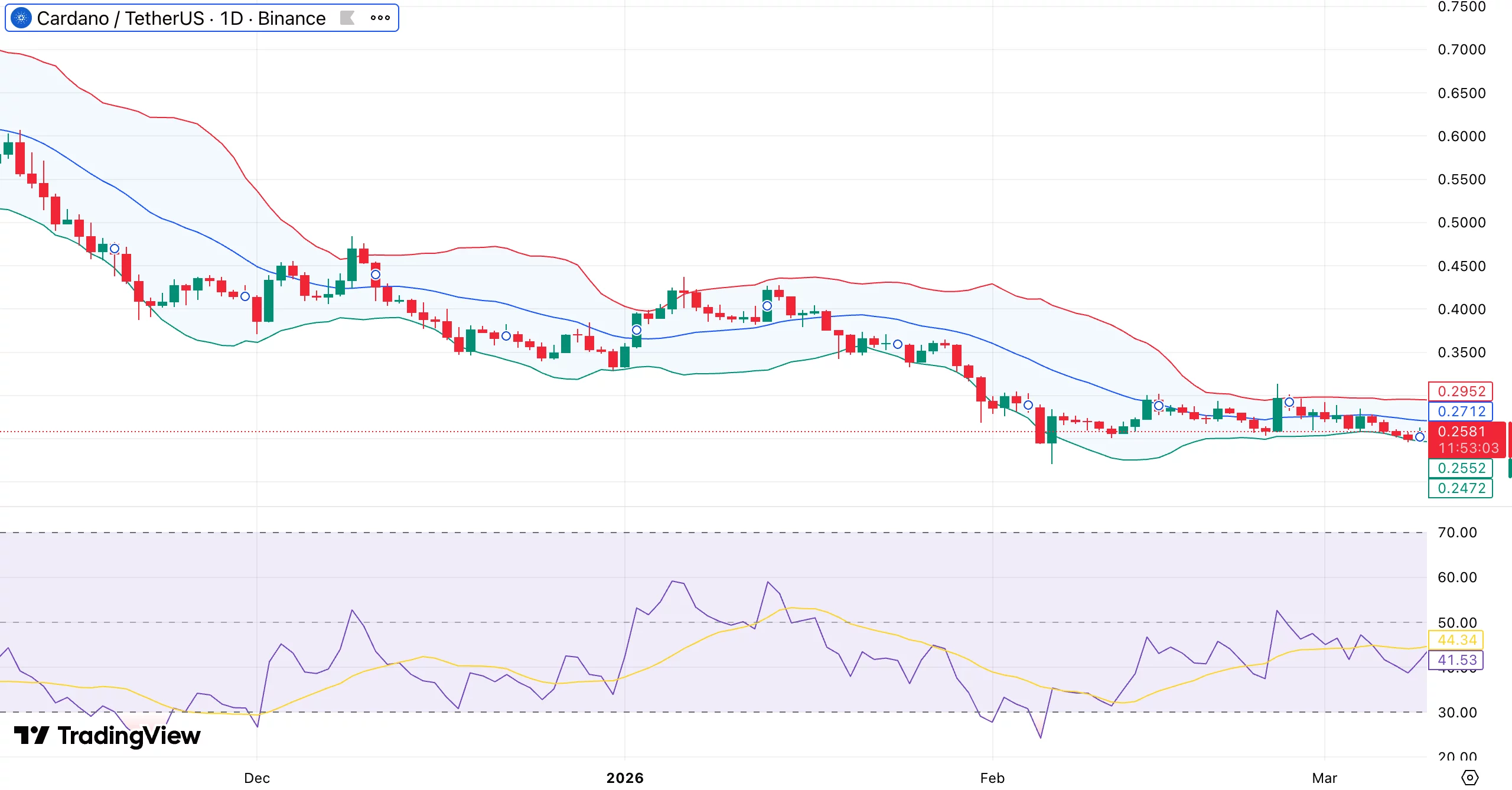
Price also remains below the Bollinger midline near $0.27, which has acted as resistance during recent attempts to recover.
Volatility has started to contract slightly as the Bollinger Bands move closer together. Periods like this often come before a stronger move once volatility returns.
Momentum indicators remain weak. The relative strength index is hovering near 40–45, a level that suggests sellers still hold the advantage, though the market is not deeply oversold.
For now, $0.25 is the key level to watch. The market has tested this support several times in recent sessions. If it breaks, price could slide toward $0.23 or even $0.22.
On the other hand, buyers would need to push ADA back above $0.27 to improve the short-term outlook. That level aligns with the Bollinger midline and has acted as a barrier during the recent downtrend.

Crypto World
Wyden Adds VALR to its Global Liquidity Network, Expanding Institutional Digital Asset Access in South Africa and Beyond
[PRESS RELEASE – Zurich/Johannesburg, Switzerland/South Africa, March 12th, 2026]
Wyden, the global leader in institutional digital asset trading technology, today announced the integration of VALR, the largest crypto exchange in Africa by trade volume, into its market-wide network of liquidity connectors.
The partnership marks a significant milestone in Wyden’s strategic growth in South Africa. Through this integration, Wyden’s institutional clients gain seamless, direct access to VALR’s deep liquidity pools, including the world’s deepest ZAR-denominated crypto markets. VALR’s extensive offering of 100+ crypto assets, including tokenized stocks and private credit as well as crypto bundles, will now be accessible through the Wyden trading platform.
By combining Wyden’s end-to-end trade lifecycle automation, Smart Order Routing (SOR), and best execution capabilities with VALR’s comprehensive range of crypto assets spanning spot margin, perpetual futures, and OTC services, financial institutions can now navigate the South African and global digital asset markets with increased efficiency and reduced operational risk.
The integration ensures that Wyden clients can execute large-scale trades with best execution while maintaining the rigorous compliance standards required by European regulators and the FSCA, under which VALR is licensed.
Commenting on the integration, Andy Flury, Wyden’s Founder and President of the Board, said: “South Africa represents a strategically vital market as we continue to expand our global institutional footprint. By integrating VALR, we are providing our clients with unparalleled access to the deepest liquidity in the region and a broad range of innovative assets. VALR’s commitment to regulatory excellence and institutional-grade infrastructure aligns perfectly with Wyden’s mission to provide banks and brokers with the most reliable and efficient trading technology available.”
Farzam Ehsani, Co-Founder and CEO at VALR, added: “This integration with Wyden represents a major step forward in bridging global institutional demand with Africa’s deepest crypto liquidity. It further solidifies VALR’s position as a leading infrastructure and liquidity provider not only across the continent but also on the international stage, empowering institutions, businesses, and individuals with seamless, compliant, and secure access to our comprehensive range of digital assets.”
As South Africa continues to establish itself as a sophisticated regional hub for digital asset regulation and trading, the partnership provides a robust gateway for global and local financial institutions.
About Wyden
Wyden is the global leader in institutional digital asset trading technology. By covering the entire trade lifecycle and supporting seamless custody, core banking, and portfolio management system integration as well as full trade lifecycle automation, the Wyden platform streamlines digital assets trading. Engineered by a team of trading system veterans and crypto asset experts, Wyden offers best-in-class integrated infrastructure solutions that meet the highest institutional needs. Headquartered in Zurich, Wyden runs several product hubs in Poland and has offices in Singapore and New York.
To learn more, visit www.wyden.io
About VALR
Founded in 2018 and headquartered in Johannesburg, VALR is backed by leading investors including Pantera Capital, Coinbase Ventures, GSR, and Fidelity’s F-Prime Capital. As a global crypto exchange, VALR offers a comprehensive suite of products—including Spot Trading, Spot Margin, Derivatives, Staking, Crypto Bundles, Borrowing & Lending, OTC services, VALR Invest, and VALR Pay. Licensed by South Africa’s FSCA and with regulatory approval in Europe, VALR serves over 1.7 million users and 1,800 corporate and institutional clients worldwide. The exchange is dedicated to advancing a just financial future that upholds human dignity and the unity of mankind.
For more information, visit valr.com.
Binance Free $600 (CryptoPotato Exclusive): Use this link to register a new account and receive $600 exclusive welcome offer on Binance (full details).
LIMITED OFFER for CryptoPotato readers at Bybit: Use this link to register and open a $500 FREE position on any coin!


Bloomberg reported Thursday that US prosecutors urged a federal judge to reject Sam Bankman-Fried’s request for a new criminal trial, arguing that the former FTX chief failed to meet the legal standard for a retrial.
According to the report citing court documents, prosecutors said Bankman-Fried’s claim that new witnesses could undermine the government’s case does not meet the legal standard required to grant a retrial.
Prosecutors reportedly argued that testimony cited by Bankman-Fried from former FTX executives Ryan Salame and Daniel Chapsky did not amount to newly discovered evidence because both men were known to the defense before the 2023 trial.
The prosecutors’ response marks the latest procedural step in Bankman-Fried’s effort to overturn his conviction tied to the collapse of FTX, the crypto exchange whose failure triggered one of the industry’s biggest scandals.
Related: SBF seeks new FTX fraud trial, citing new witness testimony
Court has yet to rule on retrial request
Bankman-Fried filed the motion for a new trial in February, arguing that testimony from former executives could challenge the prosecution’s account of FTX’s financial condition before its collapse.
The defense argued that testimony from Salame and Chapsky could weaken the government’s narrative presented to jurors during the trial. Judge Kaplan later ordered prosecutors to respond to the motion by March 11.
The judge has not yet ruled on whether the motion will proceed. Bankman-Fried separately continues to appeal his conviction in the US Court of Appeals for the Second Circuit.
Related: Hollywood star-turned-skeptic releases trailer for anti-crypto doc
A jury convicted Bankman-Fried in November 2023 on seven counts of fraud and conspiracy related to the misuse of customer funds at FTX and its sister trading firm, Alameda Research. He was later sentenced to 25 years in prison.
Pardon speculation runs alongside court challenges
Bankman-Fried’s court efforts have unfolded alongside public speculation that he may be seeking a presidential pardon.
On Feb. 1, the former FTX CEO praised US President Donald Trump’s crypto stance in social media posts, adding to scrutiny over whether he was trying to build political support while pursuing legal relief.
That speculation has so far gone nowhere publicly. On Jan. 9, Trump reportedly told The New York Times he had no intention of pardoning Bankman-Fried, leaving an appeal and retrial motion as his main avenues for overturning his conviction.
Magazine: All 21 million Bitcoin is at risk from quantum computers
The Pi Network community is buzzing with anticipation as the major cryptocurrency exchange Kraken officially announced it will list Pi coin for trading starting tomorrow, March 13.
Summary
- Kraken will list Pi Network’s PI token on March 13, triggering bullish sentiment across the crypto market.
- The listing comes a day before Pi Day, when the project typically announces major ecosystem updates.
- PI is trading near $0.2347 with strong momentum indicators, though analysts warn a short-term “sell the news” pullback remains possible after the listing.
This strategic timing puts the listing exactly one day before Pi Day (March 14), the project’s annual celebration often reserved for major ecosystem milestones.
The “Kraken effect” and Pi Day synergy
Kraken’s listing is a massive validation for the mobile-first Layer-1 blockchain. As a veteran U.S.-based exchange, Kraken’s support provides PI coin (PI) with a level of institutional-grade legitimacy and deep liquidity it has long sought.
The news serves as a powerful fundamental tailwind. With the Open Mainnet having launched exactly one year ago, the community is now looking toward Pi Day for the launch of the Pi Decentralized Exchange (PiDEX) and further smart contract utilities.
The convergence of a top-tier exchange listing and the project’s biggest annual event has created a “perfect storm” of bullish sentiment.
Breaking down PI coin’s next moves
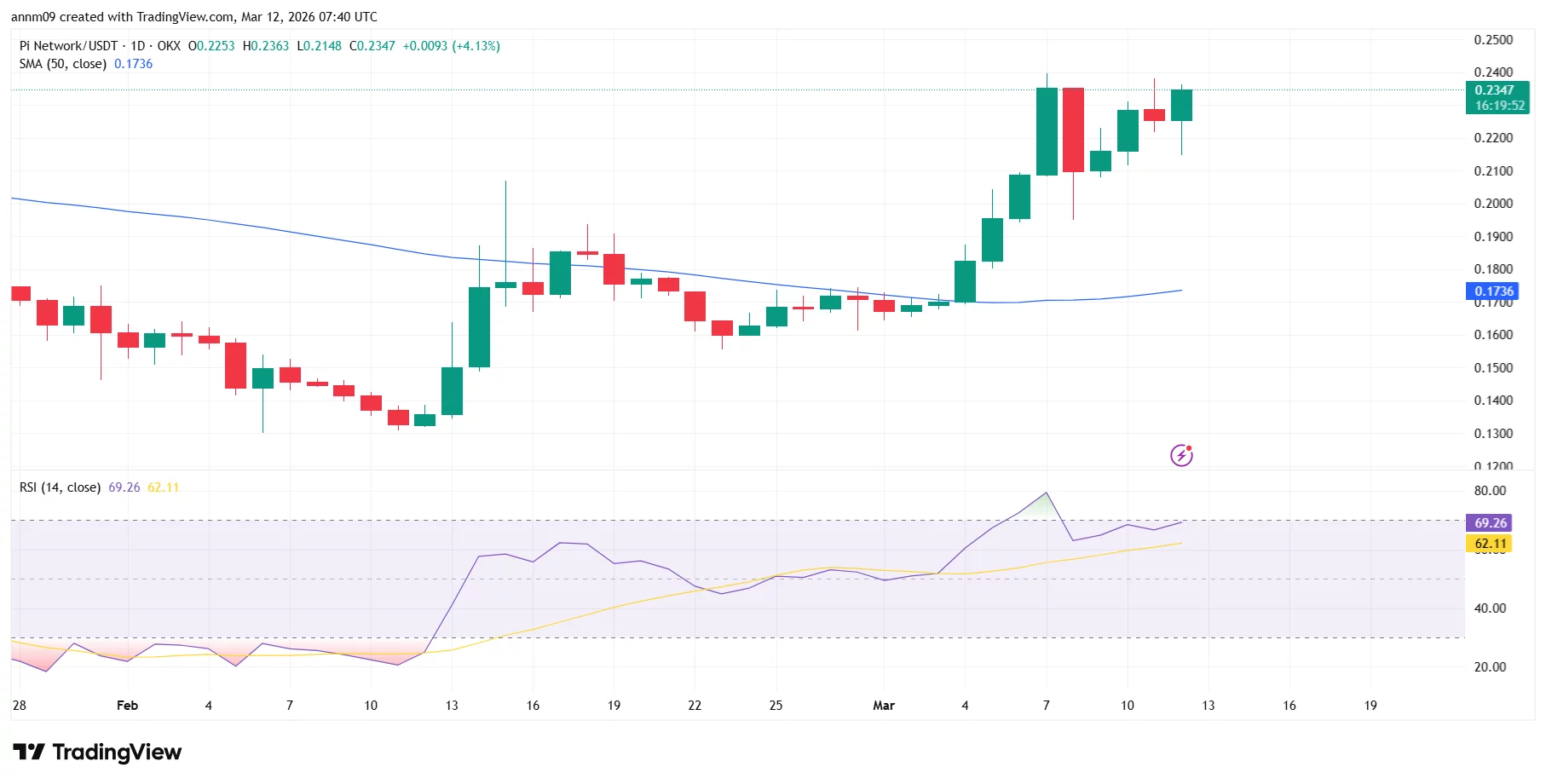
The PI/USDT daily chart reveals a highly aggressive bullish setup, confirming that the “smart money” began positioning well before the official Kraken tweet.
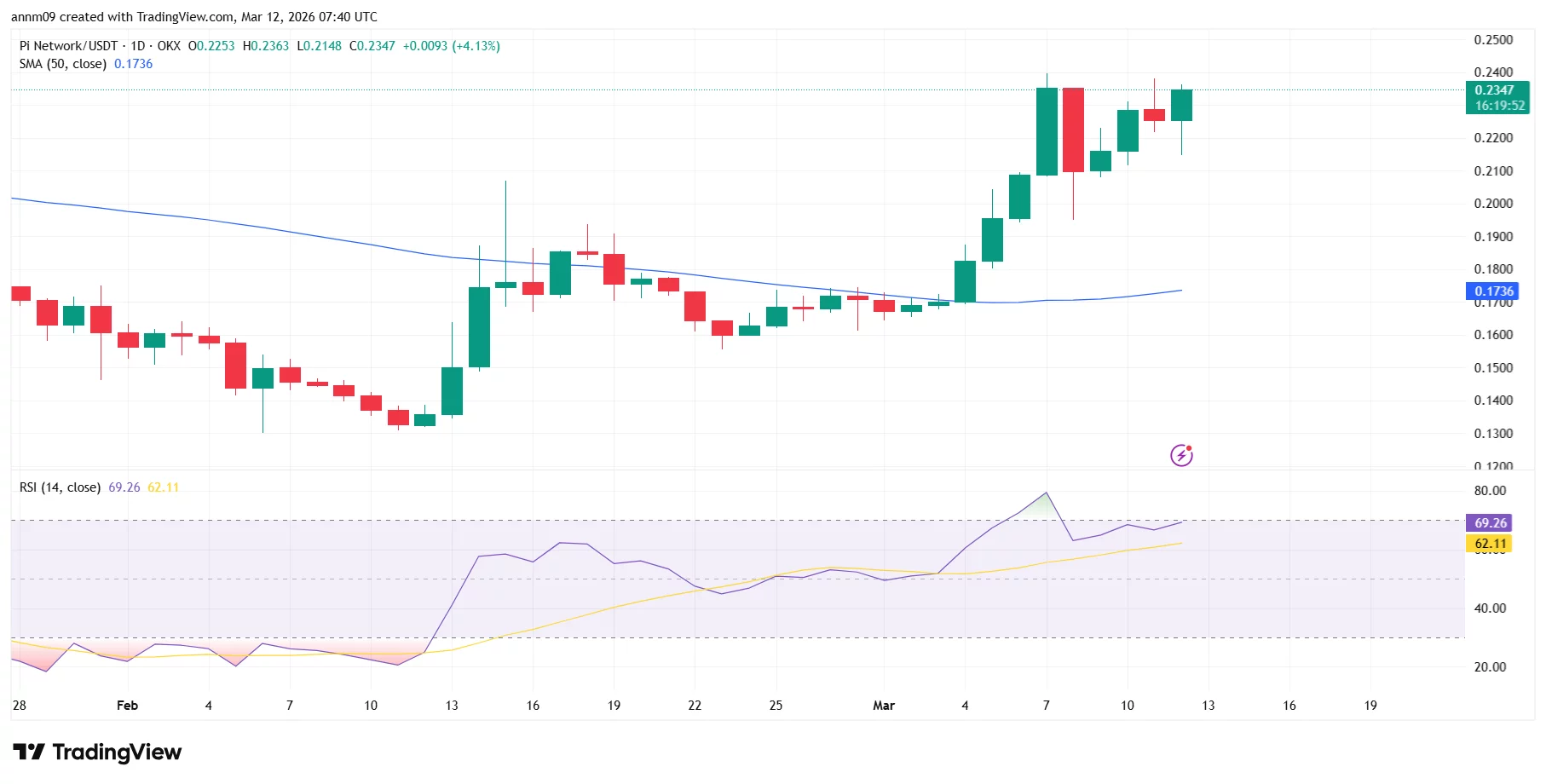
Currently, PI is trading at approximately $0.2347, showing a solid gain of +4.13% for the day. This upward trend has pushed the price well above the 50-day Simple Moving Average (SMA), which sits near $0.1736, signaling a bullish shift in market sentiment.
The SMA often acts as a key support level, and PI’s sustained trading above this line suggests buyers are firmly in control.
The Relative Strength Index (RSI), a momentum oscillator that measures overbought or oversold conditions, is near 69.26—just below the overbought threshold of 70. This indicates strong buying momentum, though traders should be cautious as RSI nearing 70 can sometimes precede a short-term pullback.
The recent price action reveals a pattern of higher highs and higher lows, confirming the bullish trend. However, the visible price wicks on recent candles imply some volatility and profit-taking at higher levels, which is typical in a strong rally.
While “sell the news” risks always exist after a listing, the proximity to Pi Day suggests the rally may have more legs than a typical exchange pump.
The spot Ripple (XRP) ETFs have seen several consecutive days of outflows.
Bloomberg’s James Seyffart praised the performance of the spot XRP ETFs as of late despite the overall market uncertainty and the underlying asset’s price calamity.
However, the ETF experts’ words come at a time when the funds have seen several days of consistent outflows.
XRP ETFs Hold Up Well
The first month after the debut in mid-November was quite impressive as Canary Capital’s XRPC, which was the first such fund to go live for trading on Wall Street, broke the 2025 trading volume record for the launch day. The first $1 billion in cumulative net inflows was gathered in about a month, but the trend has changed substantially since then.
Data from SoSoValue shows that investors poured in $666.61 million into the funds, which are now five, in November and $500 million in December. January saw nowhere near those numbers with just $15.59 million, while February picked up the pace slightly to $58.09 million.
March is shaping up to be the first red month so far, with current data showing $26.07 million in net outflows. This is because investors pulled out $6.15 million on March 5, $16.62 million on March 6, $18.11 million on March 9, and $3.88 million on March 10.
Despite this evident investor exodus, Seyffart noted that the funds have “actually held up pretty well despite the massive pullback in price.” Interestingly, his data shows that the cumulative total for the XRP ETFs is at over $1.4 billion, while SoSoValue cited a lower number, $1.21 billion.
The XRP ETFs have actually held up pretty well despite the massive pullback in price. They’ve taken in a cumulative $1.4 billion since launch. pic.twitter.com/Bjtmb0y40D
— James Seyffart (@JSeyff) March 10, 2026
You may also like:
The Price Pullback
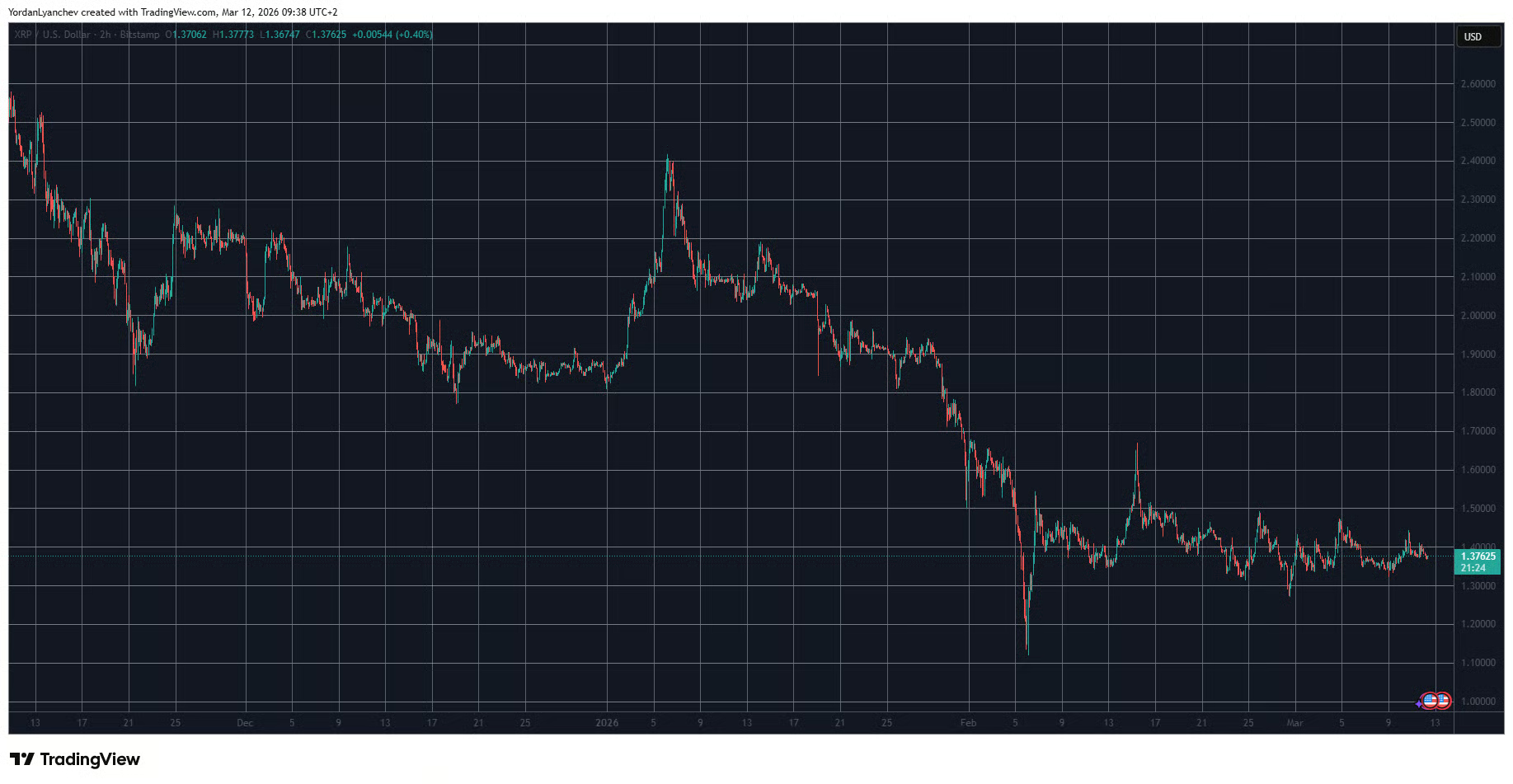
Although the exchange-traded funds have amassed well over $1 billion in their four months of existence, the underlying asset’s price has indeed pulled back as Seyffart noted. Not just in the past few weeks when global uncertainty has skyrocketed to new peaks, but even when we examine XRP’s moves since November 13, when XRPC launched.
At the time, the token traded at around $2.50 but plunged to a 15-month low of $1.11 on February 6. Despite rebounding since then, XRP still trades below $1.40 as of press time, which means a 45% decline since the ETF debut.

Binance Free $600 (CryptoPotato Exclusive): Use this link to register a new account and receive $600 exclusive welcome offer on Binance (full details).
LIMITED OFFER for CryptoPotato readers at Bybit: Use this link to register and open a $500 FREE position on any coin!
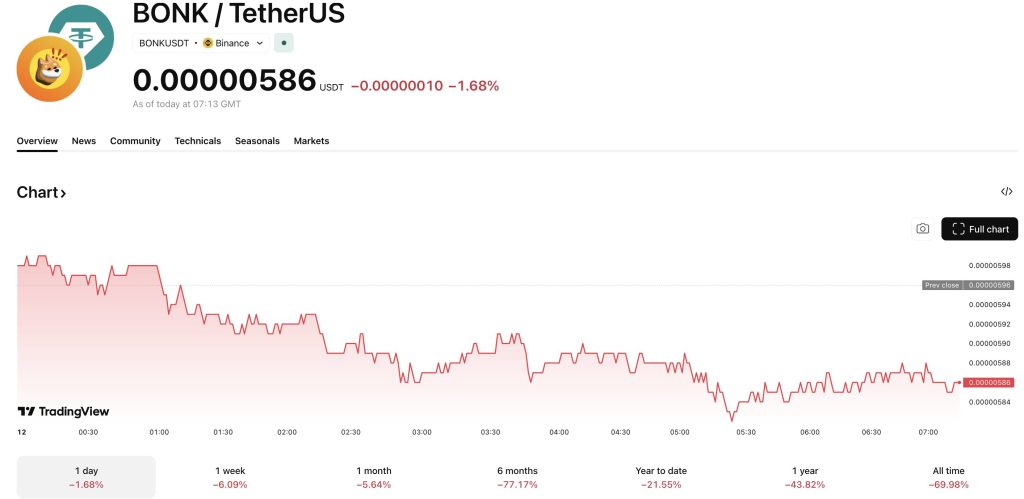
The official website for the Solana memecoin launchpad, Bonk Fun, has been hijacked. A malicious actor seized control of the domain on Wednesday (March 11), deploying a wallet drainer disguised as a standard interaction.
The platform’s team has issued an urgent warning: do not interact with the website until further notice. Users who connect their wallets and sign the current prompts face immediate theft of their assets.
As news of the BONK meme coin spreads, it has dropped nearly 1% over the past 24 hours, following a disastrous year in which the Solana meme coin lost -45% of its value.
It is a bad time for a platform hack, as the meme coin sector has enjoyed a +2.5% daily pump, taking the total market cap back above $32Bn, with tokens like DOGE, PEPE, Memecore, and SHIB all posting green candles.
How Did the Malicious Actor Breach the Bonk Fun Front-End?
The attack vector exploits user trust rather than the blockchain infrastructure itself. According to X user SolportTom, the platform’s operator, hackers hijacked a team account to force a drainer onto the domain. This is not a smart contract failure; it is a front-end takeover.
Visitors to the site are currently greeted with a fake terms-of-service message. This pop-up, which mimics standard compliance requests, is the trigger mechanism.
If you sign this request, the protocol grants the attacker permission to empty your wallet, and it will happen within seconds.
“A malicious actor has compromised the BONKfun domain,” the platform announced via its official X account. “Do not interact with the website until we have secured everything.”
How Much Has Been Drained and Who Is Affected
The Bonk.fun team hasn’t confirmed how much was lost to the hack, but has stated that losses are “minimal,” attributing the low damage to the developers’ rapid detection.
Only users who interacted with the fraudulent terms-of-service prompt during the active hijack window were affected. However, the exact dollar figure verified by on-chain analysis remains pending.
— Coin Bureau (@coinbureau) March 11, 2026
 AAVE ORACLE GLITCH TRIGGERS $26M IN WRONGFUL LIQUIDATIONS
A pricing oracle error on Aave caused about $26million in wstETH positions across 34 accounts to be unfairly liquidated after the system reported an incorrect exchange rate, with affected users set to be compensated. pic.twitter.com/qMbsAhQnnl
This incident mirrors broader risks in the sector, as an Aave oracle glitch triggered liquidations earlier this year due to interface and data anomalies.
While the mechanics differ, the result for user funds is identical: an unexpected loss due to a technical compromise.
Phishing attacks like this are becoming industrialized. According to Chainalysis, overall crypto scam losses reached approximately $17Bn in 2025.
The shift toward domain hijacking indicates attackers are bypassing protocol security to target the user interface directly.
EXPLORE: Best Crypto Presales to Buy in 2026
What Bonk.fun Users Need to Do Right Now
If you have visited Bonk.fun in the last 24 hours, assume your session security was compromised. Front-end attacks often bypass standard defenses, as the recent discovery by Ledger researchers of an Android flaw enabling wallet seed phrase theft demonstrates.
Take these steps immediately:
- Disconnect your wallet: Remove Bonk.fun from your connected sites list in your wallet settings.
- Revoke approvals: Use a tool like Revoke.cash to revoke any recent permissions granted to Bonk.fun contracts.
- Check your history: Verify that no unauthorized transfers have occurred.
“We understand a lot of people are scared and rightly so, but we’re doing everything in our power to fix the situation,” SolportTom wrote.
Users should now sit tight and wait for an official “all-clear” from the Bonk.fun X account before returning to the site.
If the site remains compromised for another 24 hours, user migration to rival launchpads like Pump.fun will likely accelerate, and Bonk.fun may struggle to regain whatever was left of its userbase.
If the team resolves the DNS hijack quickly and refunds the “minimal” losses, confidence may stabilize, but the pressure is now on the operators to prove the domain is safe.
DISCOVER: The 16 Best Meme Coins to Buy in March 2025
The post Bonk Fun Website Hijacked: Live Exploit Is Draining User Funds appeared first on Cryptonews.

TLDR
- Changpeng Zhao’s wealth is pegged at $110 billion by Forbes, securing him the 17th position globally
- This valuation positions CZ above Microsoft co-founder Bill Gates, who sits at $108 billion
- Zhao challenged the assessment publicly, noting cryptocurrency valuations collapsed more than 50% in 2026
- CZ’s fortune stems primarily from owning approximately 90% of Binance equity, rather than cryptocurrency tokens
- The exchange commands roughly 38% of worldwide crypto trading volume and pulled in an estimated $16–17 billion during 2024–2025
Changpeng Zhao, who founded the cryptocurrency exchange Binance, now ranks above Microsoft co-founder Bill Gates in wealth, according to fresh estimates from Forbes. The publication’s March 10 assessment values Zhao’s fortune at roughly $110 billion.
This valuation secures Zhao the 17th spot on Forbes’ worldwide billionaire rankings. Gates trails slightly behind at approximately $108 billion.
Zhao established Binance, which has become the dominant force in cryptocurrency trading globally. His tenure as chief executive ended in 2023 following a guilty plea to charges related to inadequate anti-money laundering compliance.
The legal settlement required Zhao to pay $50 million personally and complete a four-month sentence at a California correctional facility. Separately, Binance settled with authorities for $4.3 billion in fines.
Though no longer serving as CEO, Zhao reportedly maintains ownership of roughly 90% of Binance’s equity. This substantial stake forms the foundation of his estimated net worth.
Financial experts place Binance’s valuation near $100 billion. The platform facilitates tens of trillions in trading activity annually between spot markets and derivatives.
The exchange captures approximately 38% of worldwide cryptocurrency trading activity. Revenue projections suggest Binance pulled in $16 billion to $17 billion throughout 2024 and 2025 combined—roughly 2.5 times Coinbase’s $6.6 billion yearly intake.
Zhao responded skeptically to Forbes’ wealth calculation soon after its publication. Writing on X on March 11, he highlighted that digital asset prices had declined over 50% during 2026 and questioned the logic behind an increased net worth estimate.
“Wish they can apply some common sense and basic logic,” he wrote.
How Exchange Owners Can Gain During a Market Downturn
Cryptocurrency trading platforms generate income through transaction fees independent of price direction. Market turbulence typically drives higher trading activity, potentially boosting exchange earnings even as asset values contract.
This mechanism may account for why Binance’s valuation remained stable or expanded despite broader market contraction.
Zhao’s personal cryptocurrency portfolio hasn’t shown similar resilience. His reported holdings of approximately 1,400 Bitcoin depreciated roughly 25% over twelve months, now worth about $100 million. This represents only a minor fraction of his total estimated wealth.
Some observers on social platforms suggested Zhao profited from short positions during October 10’s crypto market collapse, which triggered massive liquidations in derivatives trading. Zhao refuted these claims directly, stating: “Never shorted.”
Where Bitcoin, Ethereum, and XRP Stand Now
When Forbes released its assessment, Bitcoin was exchanging hands near $71,000, with Ethereum hovering around $2,080 and XRP trading close to $1.40.
Binance additionally operates BNB Chain, a blockchain platform with its own native cryptocurrency. The ecosystem maintains a market capitalization approaching $88 billion.


Key Highlights
- February saw Bullish (BLSH) record $76 billion in spot volume—a 62.6% monthly increase and the highest level since October 2025.
- The exchange surpassed Coinbase (COIN) to claim the third spot among centralized crypto exchanges by spot trading volume.
- Bullish captured 5.06% of the spot market, exceeding Coinbase’s 4.59% share.
- Total centralized exchange volume declined 2.41% in February to $5.61 trillion, marking the weakest performance since October 2024.
- Binance maintains its leadership position, though its market dominance reached its lowest level since October 2020.
Bullish ($BLSH), the institutional-grade cryptocurrency exchange that debuted on the New York Stock Exchange last year, has achieved a significant milestone by breaking into the top three global exchanges ranked by spot trading volume.
This achievement materialized in February when the exchange registered $76 billion in spot transactions—representing a robust 62.6% increase compared to the previous month.
This impressive growth elevated Bullish’s market share to 5.06%, marking a 2.04 percentage point gain from January. The performance enabled the platform to overtake Coinbase ($COIN), which concluded February with a 4.59% market share.
BLSH shares advanced 1.25% following the announcement, while COIN stock increased 1.07%.
February’s trading volume represented Bullish’s strongest monthly performance since October 2025, particularly noteworthy given the subdued market conditions throughout the period.
Bitcoin remained largely confined to a $60,000-$70,000 trading range during February. Such consolidation typically suppresses speculative activity, which often results in diminished volumes industry-wide.
Aggregate spot and derivatives trading across centralized exchanges contracted 2.41% in February to $5.61 trillion—representing the weakest monthly total since October 2024.
Spot volume specifically decreased 3.01% to $1.50 trillion. Derivatives trading declined 2.41% to $4.11 trillion, accounting for 73.2% of total centralized exchange volume.
Institutional Strategy Insulates Bullish During Market Lull
Bullish’s business model centers on serving institutional participants rather than retail investors. This strategic positioning appears to have protected the exchange from broader volume declines affecting retail-focused competitors.
The platform has simultaneously been diversifying its service portfolio. Recent additions include prediction market trading capabilities, a feature some exchanges have introduced to maintain engagement during periods of reduced volatility.
Wall Street analysts maintain a Moderate Buy consensus rating on BLSH, comprising four Buy recommendations and two Hold ratings issued over the past three months. The consensus 12-month price target stands at $48.17, suggesting approximately 29.5% potential upside from present levels.
Binance Retains Leadership Despite Declining Market Share
Binance continues to dominate the exchange landscape. The platform processed $331 billion in spot trading volume during February, corresponding to approximately 22% market share.
However, this 22% figure represents Binance’s smallest monthly market share since October 2020. The trend indicates trading activity is increasingly distributed across multiple competing platforms.
February data sourced from CCData via CoinDesk’s February Exchange Review.

Bitcoin is facing resistance just above $70,000, but the bulls have kept up the pressure, increasing the possibility of a rally to $74,508.
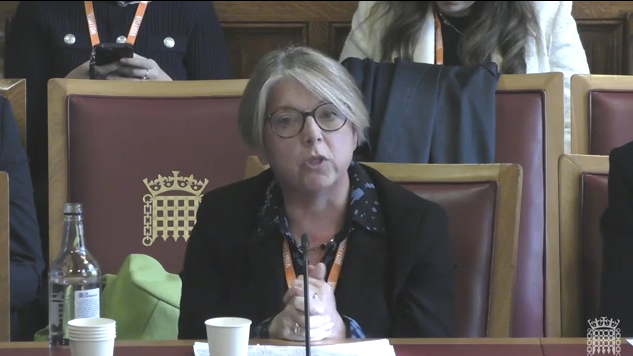
Bank of England Deputy Governor Sarah Breeden told UK lawmakers that the central bank is open to alternative ways to manage stablecoin risks other than imposing holding limits.
Speaking before the House of Lords Financial Services Regulation Committee on Wednesday, Breeden said the proposed holding limits are designed to prevent a mass migration of deposits from banks into stablecoins, arguing it could curtail lending and reduce credit availability for businesses and households.
“We are genuinely open to other ways of achieving the objective. I think you’ve heard from other people as part of your inquiry that this risk to the provision of credit is real.”
“We proposed holding limits as a way of managing that risk. We are open to feedback on other ways of achieving it. But I think you would expect us as the financial stability authority to ensure that there isn’t a precipitous drop in credit to the businesses and households in the UK,” Breeden added.
Industry groups have criticized the proposed limits, floated at between 10,000 and 20,000 British pounds ($13,368 to $26,733), arguing it would signal that the UK is hostile to crypto and drive businesses offshore, while stifling innovation and undermining economic growth.
Self-custody wallets holding stablecoins not “permissible”
Last November, the Bank of England released a consultation paper outlining its proposed regulatory framework for sterling-denominated systemic stablecoins, inviting public feedback through Feb. 10.
The central bank flagged that it would continue monitoring the risks associated with unhosted wallets, such as reduced oversight of transactions.
However, Breeden ruled out self-custody wallets holding stablecoins, telling lawmakers that users holding stablecoins in self-custody wallets outside regulated entities such as exchanges won’t be covered by the UK’s regulatory regime.
“There is this concept of an unhosted wallet, you haven’t got a wallet provider who is a regulated entity who is ensuring that AML [anti-money laundering] KYC [know your customer] criteria are complied with. Unhosted wallets will not be permissible in the UK; they are permissible in the US regime,” Breeden said.

Sterling stablecoin applications will open before end of 2026
The Financial Conduct Authority, which regulates the UK financial services industry, has established a regulatory sandbox that will allow several firms to test stablecoin products and services in Q1 2026.
Related: Stablecoin inflows rebound to $1.7B as Washington battles over yield rules
Even though the Bank of England is still consulting and finalizing rules for sterling stablecoins, companies can start applying to launch their coins before the end of 2026.
“I hear some say that the UK is behind. I simply don’t recognize that. We’ll be welcoming applications from stablecoin issuers by the end of this year,” Breeden said.
“On the substance of our regime, the guiding principle is that a stable coin used as money in the economy should be as robust as the money we use today issued by banks.”
Magazine: How crypto laws changed in 2025 — and how they’ll change in 2026


Oil is the single most vital commodity, wielding an overbearing influence on all corners of the global economy. This reality was made painfully clear by recent war-led oil price spikes above $100 a barrel and the resulting financial market jitters.
Yet, for all its immense importance, the machinery powering global oil trading largely remains archaic. It is dominated by massive legacy exchanges, extensive paperwork, and high barriers to entry that can deter all but the largest players.
Baron Lamarre, co-founder of the International Digital Exchange (INDEX) — a blockchain-based platform for tokenized oil, and identified as a former head of trading at Petronas — aims to revolutionize this.
His vision is to put oil on the blockchain, with each LITRO token representing 1 litre of real crude, targeting an early 2027 debut. The token’s value will be indexed to popular global oil benchmarks such as Brent and West Texas Intermediate.
“Litro’s testnet and product demo roll out March through May 2026, with official launch in January 2027,” Lamarre told CoinDesk in an interview, highlighting the project’s clear developmental timeline.
This project stands out for its ambition to remain strictly grounded in the real world. In contrast, much of the wider digital asset market remains flooded with speculative tokens bearing little connection to Main Street.
Even the burgeoning Real World Asset (RWA) market, which reportedly stands at over $25 billion today, is predominantly driven by the tokenization of financial instruments such as government bonds.
It is specifically designed to modernize what it describes as the $6 trillion global oil market’s outdated, paper-based systems. Traditional commodity deals often drag through long supply chains involving multiple banks and clearinghouses, frequently delaying settlements by up to 90 days and locking up billions in vital capital.
This issue is especially acute now, with conflicts in the Middle East disrupting supply chains and spiking market volatility. The current system, dominated by traditional exchanges like CME and ICE, often leaves a broad range of smaller and mid-sized investors sidelined due to high capital requirements and a lack of direct access.
Verified reserves
LITRO’s tokenization aims to resolve this by layering verified digital reserves on the blockchain, promising faster, more accessible, and more transparent trading.
Here’s how it works: Oil producers pledge their certified reserves to the INDEX platform. These reserves are then meticulously verified by independent auditors for quantity, authenticity, and ownership of the crude before any LITRO tokens are minted. While the physical oil remains securely in custody at the producer’s facility, the legal title to that oil is digitally assigned to the INDEX system.
“Only audited and verified reserves can be tokenized,” Lamarre explained, emphasizing that the tokens are minted on a strict 1:1 basis with physical oil volume. He added that the project is currently being built on Arbitrum, an Ethereum scaling solution, while maintaining compatibility with any EVM-compatible blockchain.
Physical Redemption
A key appeal for traders, Lamarre asserts, is LITRO’s 24/7 liquidity and the promise of direct redemption. Holders of the token can redeem it for cash or, in theory, for physical crude oil delivery.
“Redemption for physical oil is part of the design,” Lamarre said.
The platform boasts a sophisticated “smart logistics routing system” to facilitate this. This system is designed to match oil grades, arrange vessels and terminals, issue electronic bills of lading and certificates, and coordinate delivery.
This means that, eventually, token holders can take physical custody of the barrels they own digitally. Its intelligence layer connects digital tokens to physical delivery mechanisms, leveraging IoT sensors, AIS vessel tracking, and AI-driven optimization to automate the entire redemption-to-delivery process.
Early Stages
The project is still in its early stages. Lamarre noted that INDEX is currently in discussions with Capital Union Bank to join as a banking partner. Other investor and partner deals are expected to be finalized once the Minimum Viable Product (MVP1) is completed by the end of March 2026.
If Lamarre and his team successfully execute this ambitious vision, it could mark a significant and necessary shift in how global energy markets operate, transitioning from the closed silos of traditional finance to transparent, 24/7 blockchain rails.

MVP CEO Pitches Jake Paul vs. Conor McGregor Boxing, MMA Fights

Trump Keeps Gifting 1 Thing To Top Officials Who Are ‘Afraid Not To Wear Them’: Report

Plans for Inn Collection Group hotel on Redcar seafront in limbo


-
Business6 days ago
Form 8K Entergy Mississippi LLC For: 6 March
-

 News Videos3 days ago
10th Algebra | Financial Planning | Question Bank Solution | Board Exam 2026
-

 Fashion6 days ago
Weekend Open Thread: Ann Taylor
-

 Crypto World3 days ago
Paradigm, a16z, Winklevoss Capital, Balaji Srinivasan among investors in ZODL
-
 Tech1 day ago
A 1,300-Pound NASA Spacecraft To Re-Enter Earth’s Atmosphere
-
 Sports7 days ago
499 runs and 34 sixes later, India beat England to enter T20 World Cup final | Cricket News
-

 Politics6 days ago
Top Mamdani aide takes progressive project to the UK
-

 Business2 days ago
ExxonMobil seeks to move corporate registration from New Jersey to Texas
-

 Sports4 days ago
Braveheart Lakshya downs Lai in epic battle to enter All England Open final | Other Sports News
-

 Sports5 days ago
Three share 2-shot lead entering final round in Hong Kong
-

 NewsBeat14 hours ago
Residents reaction as Shildon murder probe enters second day
-

 NewsBeat7 days ago
Piccadilly Circus just unveiled ‘London’s newest tourist attraction’ and it only costs 80p to enter
-

 Entertainment5 days ago
Hailey Bieber Poses For Sexy Selfies In New Luscious Lip Thirst Traps
-

 Business4 days ago
Search for Nancy Guthrie Enters 37th Day as FBI Probes Wi-Fi Jammer Theory
-

 Business1 day ago
Search Enters Sixth Week With New Leads in Tucson Abduction Case
-
 NewsBeat2 days ago
Pagazzi Lighting enters administration as 70 jobs lost and 11 stores close across Scotland
-

 Tech3 days ago
Despite challenges, Ireland sixth in EU for board gender diversity
-

 Tech2 days ago
ChatGPT will now generate interactive visuals to help you with math and science concepts
-

 Business3 days ago
Search Enters 39th Day with FBI Tip Line Developments and No Major Breakthroughs
-

 NewsBeat18 hours ago
I Entered The Manosphere. Nothing Could Prepare Me For What I Found.