

Crypto World
MediaTek patches flaw that enabled crypto seed theft in 45 seconds

Security researchers have uncovered a flaw in MediaTek’s mobile chipsets that could enable attackers to harvest crypto seed phrases from vulnerable devices simply by connecting a phone to a computer via USB. The vulnerability targets the secure boot chain, a layer designed to boot devices only with authorized software, and was disclosed by Ledger’s white-hat security team, Donjon. A patch was rolled out by MediaTek on January 5, but users who have not updated their devices remain exposed to potential attacks. In practical terms, an assailant with physical access could bypass a device’s protections and access sensitive wallet data without needing to unlock the device, underscoring how far security gaps in consumer hardware can reach in the crypto era.
Ledger notes that roughly a quarter of Android devices rely on MediaTek processors paired with the Trustonic Trusted Execution Environment (TEE), a combination the research found to be particularly exploitable. Donjon demonstrated the proof-of-concept by connecting a Nothing CMF Phone 1 to a laptop and compromising the device’s security in about 45 seconds. The exploit could, in a worst‑case scenario, recover the phone’s PIN, decrypt stored data, and extract seed phrases from popular wallets such as Trust Wallet, Base, Kraken Wallet, Rabby, Tangem’s Mobile Wallet and Phantom, all without requiring the device to be actively unlocked.
Ledger emphasizes that users should apply the January patch promptly, warning that devices left unpatched remain vulnerable to USB-based attacks that bypass the Android protections designed to prevent unauthorized data access. A Ledger spokesperson suggested that the organization does not anticipate the issue to persist as a systemic vulnerability, pointing to the patch as a remedy and noting improvements in hardware and software defenses over time. The broader takeaway is that mobile devices, while increasingly central to crypto management, remain areas of elevated risk when security architectures rely on general-purpose components rather than dedicated protective elements.
As the crypto ecosystem continues to expand, the mobile surface remains a live concern. Ledger’s assessment of the landscape includes a stark reminder that a large share of users store digital assets on smartphones, with the firm citing around 36 million people managing crypto on mobile devices as of early 2025. The implication is not merely about one exploit but about a structural tension between convenience and security in everyday devices. In late 2025, Ledger also revealed testing results on the MediaTek Dimensity 7300 (MT6878) that reportedly bypassed certain security measures, achieving a level of control over a smartphone that left “no security barrier standing.” These findings echo a longer-standing view from Ledger’s chief technology officer that smartphones—whether Android or iPhone—are inherently challenging to secure for crypto use.
Charles Guillemet has repeatedly underscored the underlying architectural gap between general-purpose chips, which prize convenience, and Secure Elements, which are designed to isolate and protect keys even under duress. In a post on X that followed the December tests, he reiterated a recurring theme: the best practice for protecting seeds is to rely on hardware-backed protections rather than trusting software alone. This sentiment aligns with a broader consensus in the security community that crypto keys deserve an isolated enclave, separate from the rest of the device’s software stack. The implications for wallet developers and hardware makers alike are clear: as fraud vectors evolve, so too must the hardware and the threat models that guide wallet design and user behavior. The ongoing discourse around secure elements, trusted execution environments, and hardware-backed security will likely drive further standards and recommendations for the crypto wallet ecosystem.
In the context of rapidly evolving mobile crypto usage, the incident serves as a reminder that security is not a one-time fix but an ongoing engineering challenge. Beyond patch deployment, users must consider the broader ecosystem: keeping devices updated, enabling additional protections on wallet apps, and staying informed about hardware vulnerabilities that could undermine seed protection. The episode also raises questions for manufacturers and platform providers about the balance between performance, feature parity, and robust security, particularly as mobile devices become the primary entry point for many users into the world of decentralized finance and digital assets.
Overall, the episode reinforces the view that mobile crypto security hinges on a layered strategy: hardware-backed secrets, rigorous boot-time protections, prompt software updates, and wallet designs that minimize the risk surface for seed exposure. While patches provide a necessary remedy, the industry faces a broader imperative to harden the entire stack—from chipset design and secure enclaves to firmware and application guardrails—to ensure that the convenience of mobile crypto management does not come at the expense of fundamental security.
Key takeaways
- The vulnerability resides in MediaTek’s secure boot chain, which could allow an attacker with physical access to bypass protections via USB and access wallet seeds.
- MediaTek released a patch on January 5, but devices that have not updated remain at risk of seed extraction and other data compromise.
- About 25% of Android devices are affected due to the combination of MediaTek processors and the Trustonic TEE, increasing the potential attack surface for seed exposure.
- A proof-of-concept demonstrated on a Nothing CMF Phone 1 achieved compromise in roughly 45 seconds, illustrating how quickly seed data could be extracted from several popular wallets.
- Ledger’s stance emphasizes that smartphones are inherently challenging for crypto security and that hardware-backed protections (e.g., Secure Elements) are essential to safeguarding seeds against physical attacks.
- Beyond the January patch, Ledger disclosed ongoing tests in December 2025 on the MT6878 that reportedly bypassed some security measures, underscoring the persistent need for robust hardware protections.
Sentiment: Neutral
Market context: The incident highlights ongoing risk in mobile crypto usage and the importance of timely firmware updates as users increasingly rely on smartphones for wallets and seed storage, contributing to broader risk sentiment around consumer hardware security.
Why it matters
For users actively managing crypto on mobile devices, the incident translates into a pragmatic reminder: seed phrases are high-value targets, and the most effective defense combines hardware-backed secrecy with disciplined software hygiene. The fact that a single USB connection could bypass protective layers and extract seed data from multiple wallets makes the case for diversified security architectures more compelling. Wallet developers may respond by encouraging or mandating hardware-backed seed storage, integrating stronger attestation, and pushing for standardized, secure boot practices across chipset families. The episode also underscores the role of independent researchers and white-hat teams in disclosing vulnerabilities that could otherwise go undetected until exploited in the wild.
From a market perspective, the event does not single out a particular asset or exchange, but it does shape risk perception around mobile wallet usability. As more users store crypto on smartphones, the potential payoff for attackers grows in tandem with the number of devices deployed and the wallets installed on them. This dynamic heightens the urgency for chipset makers, device manufacturers and wallet providers to collaborate on risk mitigation—outside of mere patch cycles—through architectural safeguards, secure update mechanisms, and clear user guidance on how to defend seeds in non-ideal physical environments.
For the broader ecosystem, the episode also serves as a test case for ongoing debates about hardware security: should smartphones rely on Secure Elements that isolate keys, or should wallets shift seed management to external, user-controlled devices with their own secure channels? The balance struck in design decisions over the next few years will influence the resilience of mobile crypto infrastructure as adoption continues to grow and as regulatory and market pressures push for stronger security guarantees.
What to watch next
- How quickly OEMs and MediaTek push out and verify the January patch across devices shipping with the affected chipsets.
- Whether wallet developers adopt more hardware-backed storage or additional attestation to reduce seed exposure risk on compromised devices.
- Any official guidance from Ledger or other security researchers on best practices for users to mitigate risk while awaiting firmware updates.
- Further testing results from security researchers on MT6878 and related MediaTek platforms to assess the durability of current protections.
Sources & verification
- Ledger’s public statements describing the vulnerability and the patch rollout on January 5.
- Donjon’s demonstration using a Nothing CMF Phone 1 to compromise a device within about 45 seconds.
- Ledger’s December 2025 disclosures about testing an attack on the MediaTek Dimensity 7300 (MT6878) and bypassing security measures.
- Charles Guillemet’s public comments on smartphone security and the challenges of securing mobile crypto workflows.
Security episode: how a USB-based breach in MediaTek chips could expose seed phrases
The attack scenario centers on the media ecosystem surrounding contemporary smartphones. By exploiting the secure boot chain in MediaTek’s mobile processors, an attacker could connect a device to a PC and proceed without booting into the Android operating system in a conventional sense. The practical upshot is the potential to automatically recover device PINs, decrypt stored data, and extract seed phrases from widely used wallets—Trust Wallet, Base, Kraken Wallet, Rabby, Tangem’s Mobile Wallet, and Phantom—without requiring the user to unlock the phone or enter sensitive credentials. The proof-of-concept demonstrated on the Nothing CMF Phone 1 in roughly 45 seconds underscores how quickly such a breach could occur in a real-world scenario, particularly when users fail to apply patches in a timely manner.
MediaTek’s response to the vulnerability, which included a software patch released on January 5, aims to close the door on the attack by strengthening the integrity of the boot process and reducing the likelihood of unauthorized access to the secure storage that holds seed material. Ledger’s assessment indicates that while the patch is a necessary stopgap, the broader trajectory of mobile crypto security remains a work in progress, especially given the prevalence of devices that rely on Trustonic’s TEE in conjunction with MediaTek chips. The intersection of hardware security with consumer electronics means that even small architectural choices—how keys are isolated, how boot protections are verified, and how protected storage is accessed—can have outsized implications for user safety in the crypto domain.
Looking ahead, the crypto community will be watching whether the January patch is widely adopted across device fleets, how wallet developers respond with additional mitigations, and whether hardware manufacturers continue to push for more robust, hardware-backed protections as a standard feature. The broader message is that seed storage remains a high-value target, and as the mobile economy around digital assets grows, so too must the security controls that protect those seeds—from the moment a device boots up to the moment a user signs a transaction or unlocks a wallet.

Ripple has unveiled a $750 million buyback plan for the XRP token, sparking speculation about whether the move could trigger renewed bullish momentum for the XRP price.
Summary
- Ripple announced a $750M buyback plan that could tighten circulating supply of XRP.
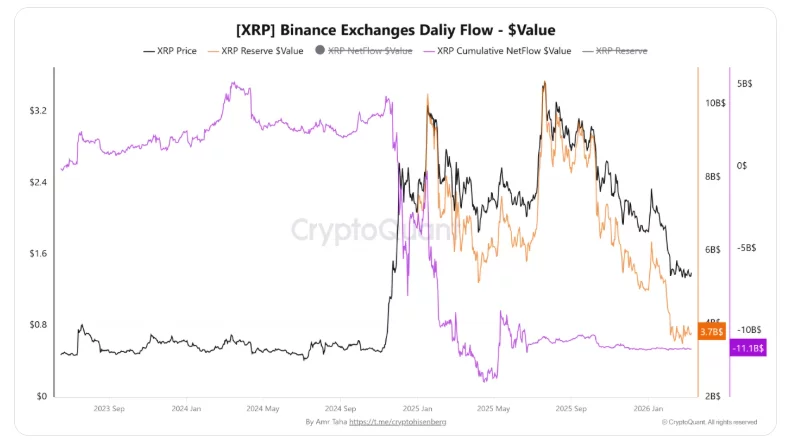
- On-chain data from CryptoQuant shows XRP reserves on Binance dropping to a 10-month low of $3.7B, signaling potential accumulation.
- XRP price remains in consolidation near $1.37, with $1.50 acting as key resistance and $1.30 as immediate support.
Corporate buybacks are often interpreted as a signal of confidence in an asset’s long-term value. In crypto markets, similar strategies can also affect liquidity by reducing circulating supply, potentially supporting prices if demand remains strong.
While the company has not disclosed the precise timeline or execution strategy, reports on the buyback has already drawn attention from traders looking for potential catalysts in a market that has been largely range-bound in recent weeks.
The move comes as XRP price continues to attract institutional interest and broader adoption across cross-border payment networks tied to Ripple’s ecosystem.
Exchange supply tightening signals potential pressure
Recent on-chain data from CryptoQuant suggests that exchange supply for XRP is already tightening.
According to the analytics firm, Binance’s XRP reserves have dropped sharply to $3.7 billion as of March 10, the lowest level recorded in 10 months. The metric tracks the total value of XRP held on the exchange and reflects both token balances and price fluctuations.
Earlier in 2025, reserves on Binance exceeded $10 billion during peaks in January and July. Those periods were followed by steep corrections that pushed XRP prices below $1.20.
The continued decline in reserves, down from roughly $3.9 billion on March 6, could indicate that traders are withdrawing XRP from exchanges, often interpreted as a signal of accumulation or long-term holding.
If the buyback initiative coincides with shrinking exchange supply, the combination could create upward pressure on prices.
XRP price analysis
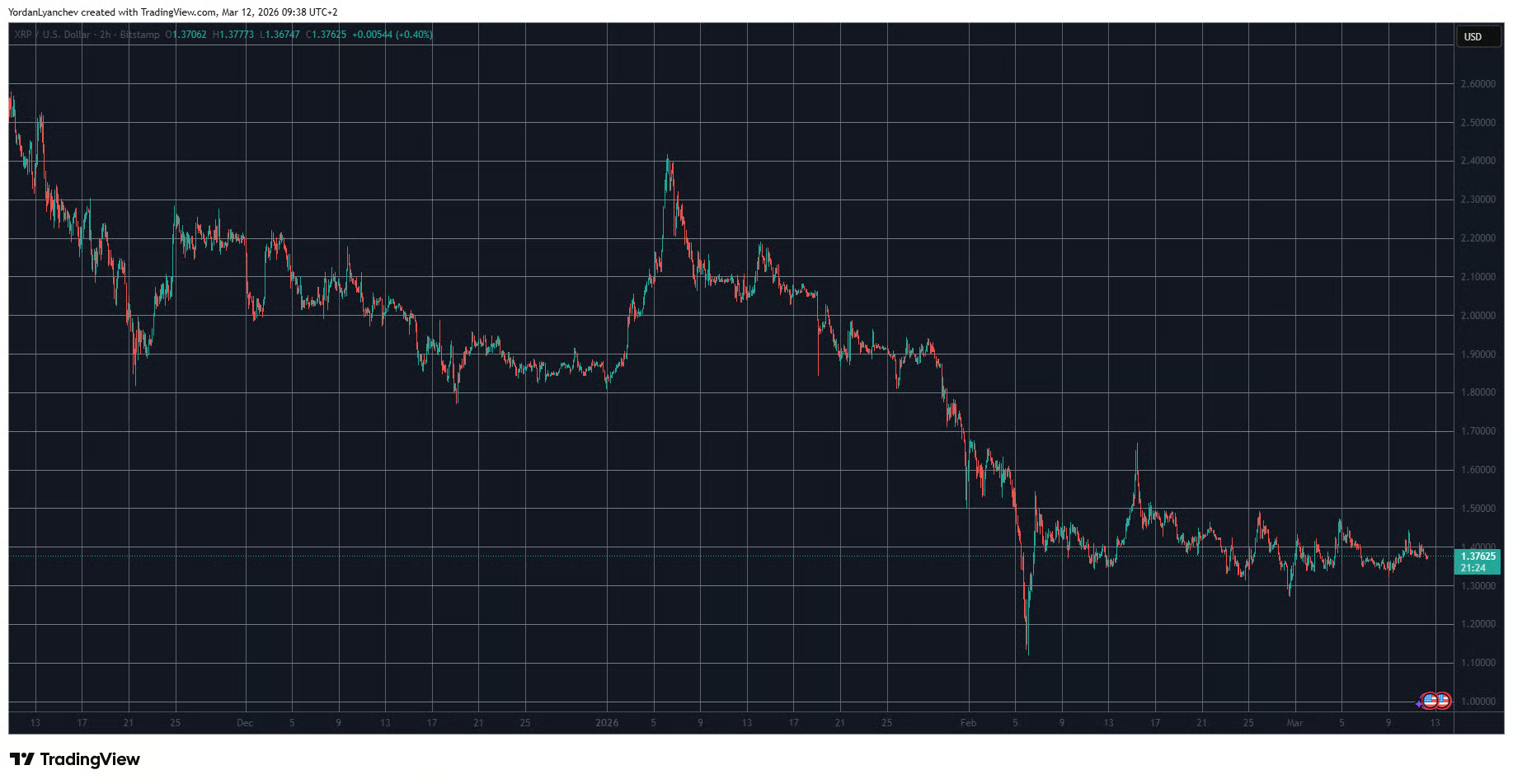
Based on the latest XRP/USDT daily chart, the token remains locked in a consolidation phase despite the broader bullish narrative.
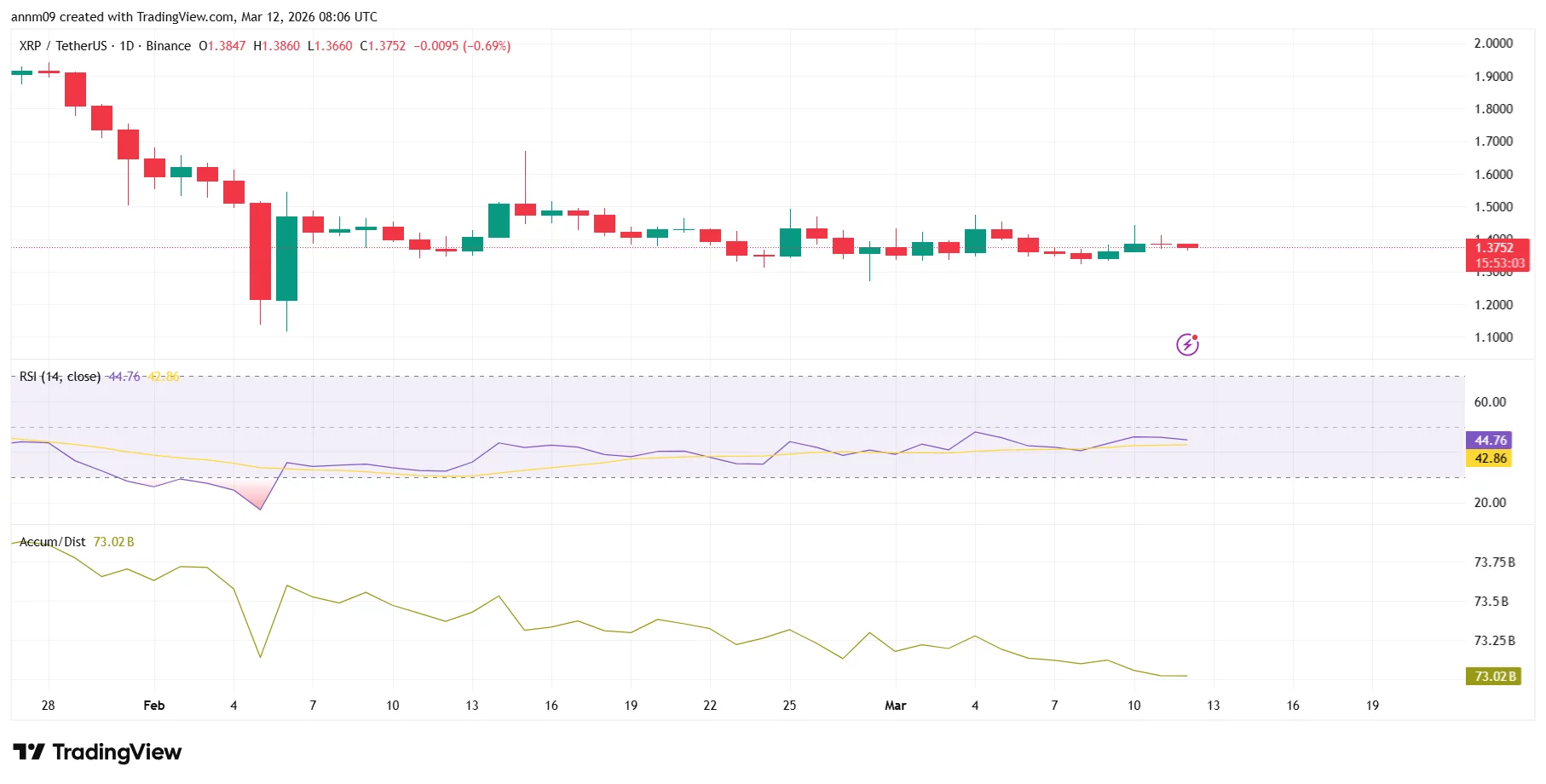
XRP is currently trading near $1.37, hovering within a relatively tight range that has formed since early February following a sharp correction from higher levels.
The $1.45–$1.50 zone remains the immediate hurdle for bulls. A decisive breakout above this region could open the door for a push toward the $1.70–$1.80 range.
The chart shows strong support around $1.30, with deeper support near $1.20 if selling pressure intensifies.
The Relative Strength Index (RSI) is currently hovering around 45, indicating neutral momentum. The reading suggests the asset is neither overbought nor oversold, leaving room for a potential move in either direction
Meanwhile, the Accumulation/Distribution indicator continues trending slightly downward, hinting that market participants remain cautious despite improving fundamentals.
For now, the market appears to be waiting for a decisive catalyst. If Ripple’s buyback plan and declining exchange reserves translate into stronger demand, XRP could attempt to break out of its current consolidation range.
Otherwise, the token may continue trading sideways as investors assess the broader crypto market environment.
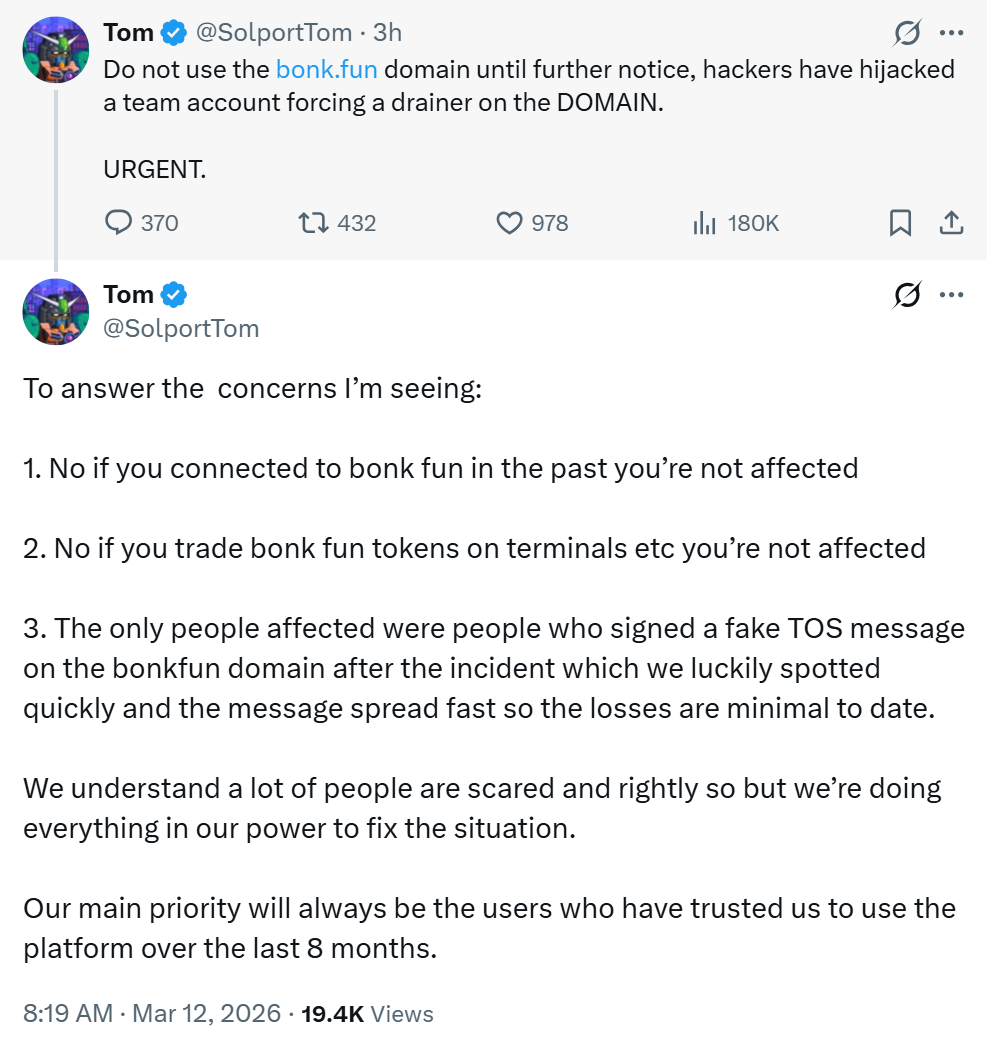
Bonk.fun warned users not to use its site after attackers hijacked the domain and pushed a fake wallet-draining prompt.
The domain of Solana-based platform memecoin launchpad Bonk.fun has been hijacked after attackers gained access to a team account and deployed a wallet-draining scheme through the site.
The Bonk.fun account on X warned users early Thursday not to interact with the website while the team worked to secure the domain. “A malicious actor has compromised the BONKfun domain, do not interact with the website until we have secured everything,” the project wrote in a post on X.
X user Tom, who is an operator behind Bonk.fun, said the attackers used the compromised access to push a fake message designed to trick visitors into signing a malicious transaction.

In a follow-up post, Tom said the exploit targeted users who signed a fraudulent terms-of-service prompt that appeared on the site during the breach. Users who had previously connected wallets to Bonk.fun were not affected, and traders interacting with Bonk-related tokens through external terminals were also safe.
Related: Trust Wallet adds real-time scam address checks for crypto users
Some users report losses
Some users reported losses in replies to the warning posts. One user claimed roughly 50 Solana (SOL) had been drained from their wallet, while another said they lost about 10 SOL. More users claimed varying amounts of losses.
Meanwhile, Tom said the incident was contained quickly and that reported losses appear limited so far. “We understand a lot of people are scared and rightly so but we’re doing everything in our power to fix the situation,” he added.
Cointelegraph reached out to Tom for comment but had not received a response by publication.
Magazine: Bitcoin may take 7 years to upgrade to post-quantum — BIP-360 co-author
[PRESS RELEASE – Singapore, Singapore, March 11th, 2026]
FinCEN-registered platform enables seamless connection between Web3 wallets and compliant USD accounts, providing global users with instant access to fiat financial services.
EvoCash has officially launched its Web3 financial services platform, offering a Web3 wallet-to-USD account bridge that connects cryptocurrency wallets directly to compliant USD accounts. Registered as a Money Services Business (MSB) with the U.S. Financial Crimes Enforcement Network (FinCEN) under the Bank Secrecy Act, the platform provides access to real-time USDT-to-USD conversion and comprehensive fiat on-ramp and off-ramp financial services for users worldwide.
The platform addresses a common challenge in the cryptocurrency ecosystem: converting digital assets into fiat efficiently. Traditional financial institutions often apply additional scrutiny to cryptocurrency-related transactions, which can lead to delays or service limitations for some users — particularly international freelancers, digital nomads, and cross-border businesses. EvoCash provides a crypto-to-fiat infrastructure designed to support these users within a compliance-focused framework.
MSB Registration and Global Compliance Framework
EvoCash’s MSB registration with FinCEN enables legal operation of money transmission and currency exchange services in the United States and internationally. The platform operates under comprehensive Anti-Money Laundering (AML) and Know Your Customer (KYC) procedures aligned with regulatory requirements, enabling global user access without geographic banking restrictions.
Web3-compliant USD accounts are provided through partnerships with financial institutions using For Benefit Of (FBO) account arrangements, keeping user funds safeguarded at the partner bank and clearly segregated from company assets, while maintaining the speed and accessibility crypto users demand — particularly valuable for international users seeking crypto-to-fiat bridge solutions. This structure provides users with access to USD accounts without the restrictions typical of traditional banking.
Key Platform Features for Global Users
EvoCash offers an integrated suite of financial services:
- Real-Time USDT-to-USD Conversion: Instant conversion between stablecoins and fiat currency without multi-day bank delays
- Fiat On-Ramp and Off-Ramp: Bidirectional flows between crypto and traditional currency
- Web3-Compliant USD Accounts: Compliant fiat accounts connected directly to Web3 wallets via partner financial institutions in the U.S.
- Trading and Exchange Services: Multi-asset crypto trading integrated within the platform
- Global Onboarding: Accessible to users worldwide without requiring local banking relationships — critical for international freelancers and digital nomads
- Multichain Support: Asset management across multiple blockchain networks
- Cross-Border USD Payments: Seamless international payment processing
- Access to Traditional Instruments: Holdings in precious metals like gold alongside crypto assets
Solving Banking Friction Globally
Cryptocurrency users worldwide regularly experience frozen bank accounts, delayed withdrawals, and sudden account closures when attempting to convert digital assets to fiat. This challenge is particularly acute for international users across multiple jurisdictions.
EvoCash eliminates these barriers by providing regulatory-compliant infrastructure specifically designed for crypto-native transactions and global operations. Traders can convert profits immediately without waiting periods. Freelancers receiving crypto payments can access USD for everyday expenses instantly — regardless of where they’re located. Digital nomads can maintain USD accounts globally without local banking requirements.
Future Expansion with Visa Integration
The platform is pursuing approval for a Visa card linked to stablecoins, currently under review with issuing partners. Once approved and launched, the card will enable users to spend crypto-backed USD balances at merchants worldwide through integrated stablecoin payments functionality, further bridging digital assets and traditional commerce globally.
EvoCash’s compliance-first approach combined with purpose-built infrastructure for cryptocurrency users positions the platform as a leading crypto-to-fiat bridge connecting Web3 and traditional financial systems.
About EvoCash
EvoCash is a Web3 financial services platform registered as a Money Services Business (MSB) with FinCEN under the Bank Secrecy Act. The platform operates as a crypto-to-fiat bridge connecting decentralized finance and traditional financial systems through Web3-compliant USD accounts, real-time USDT-to-USD conversion, fiat on-ramp and off-ramp services, trading and exchange services, and multi-asset financial tools. EvoCash provides users with access to real-time stablecoin-to-USD conversion, global onboarding, cross-border USD payments, and multichain support, all within a secure, compliance-focused infrastructure. USD‑denominated accounts are provided through partner financial institutions in the U.S. using FBO account structures, so client funds are held and safeguarded at the partner bank and kept separate from EvoCash’s own funds. For more information, users can visit evocash.org.
Binance Free $600 (CryptoPotato Exclusive): Use this link to register a new account and receive $600 exclusive welcome offer on Binance (full details).
LIMITED OFFER for CryptoPotato readers at Bybit: Use this link to register and open a $500 FREE position on any coin!
Crypto World
Wyden Adds VALR to its Global Liquidity Network, Expanding Institutional Digital Asset Access in South Africa and Beyond
[PRESS RELEASE – Zurich/Johannesburg, Switzerland/South Africa, March 12th, 2026]
Wyden, the global leader in institutional digital asset trading technology, today announced the integration of VALR, the largest crypto exchange in Africa by trade volume, into its market-wide network of liquidity connectors.
The partnership marks a significant milestone in Wyden’s strategic growth in South Africa. Through this integration, Wyden’s institutional clients gain seamless, direct access to VALR’s deep liquidity pools, including the world’s deepest ZAR-denominated crypto markets. VALR’s extensive offering of 100+ crypto assets, including tokenized stocks and private credit as well as crypto bundles, will now be accessible through the Wyden trading platform.
By combining Wyden’s end-to-end trade lifecycle automation, Smart Order Routing (SOR), and best execution capabilities with VALR’s comprehensive range of crypto assets spanning spot margin, perpetual futures, and OTC services, financial institutions can now navigate the South African and global digital asset markets with increased efficiency and reduced operational risk.
The integration ensures that Wyden clients can execute large-scale trades with best execution while maintaining the rigorous compliance standards required by European regulators and the FSCA, under which VALR is licensed.
Commenting on the integration, Andy Flury, Wyden’s Founder and President of the Board, said: “South Africa represents a strategically vital market as we continue to expand our global institutional footprint. By integrating VALR, we are providing our clients with unparalleled access to the deepest liquidity in the region and a broad range of innovative assets. VALR’s commitment to regulatory excellence and institutional-grade infrastructure aligns perfectly with Wyden’s mission to provide banks and brokers with the most reliable and efficient trading technology available.”
Farzam Ehsani, Co-Founder and CEO at VALR, added: “This integration with Wyden represents a major step forward in bridging global institutional demand with Africa’s deepest crypto liquidity. It further solidifies VALR’s position as a leading infrastructure and liquidity provider not only across the continent but also on the international stage, empowering institutions, businesses, and individuals with seamless, compliant, and secure access to our comprehensive range of digital assets.”
As South Africa continues to establish itself as a sophisticated regional hub for digital asset regulation and trading, the partnership provides a robust gateway for global and local financial institutions.
About Wyden
Wyden is the global leader in institutional digital asset trading technology. By covering the entire trade lifecycle and supporting seamless custody, core banking, and portfolio management system integration as well as full trade lifecycle automation, the Wyden platform streamlines digital assets trading. Engineered by a team of trading system veterans and crypto asset experts, Wyden offers best-in-class integrated infrastructure solutions that meet the highest institutional needs. Headquartered in Zurich, Wyden runs several product hubs in Poland and has offices in Singapore and New York.
To learn more, visit www.wyden.io
About VALR
Founded in 2018 and headquartered in Johannesburg, VALR is backed by leading investors including Pantera Capital, Coinbase Ventures, GSR, and Fidelity’s F-Prime Capital. As a global crypto exchange, VALR offers a comprehensive suite of products—including Spot Trading, Spot Margin, Derivatives, Staking, Crypto Bundles, Borrowing & Lending, OTC services, VALR Invest, and VALR Pay. Licensed by South Africa’s FSCA and with regulatory approval in Europe, VALR serves over 1.7 million users and 1,800 corporate and institutional clients worldwide. The exchange is dedicated to advancing a just financial future that upholds human dignity and the unity of mankind.
For more information, visit valr.com.
Binance Free $600 (CryptoPotato Exclusive): Use this link to register a new account and receive $600 exclusive welcome offer on Binance (full details).
LIMITED OFFER for CryptoPotato readers at Bybit: Use this link to register and open a $500 FREE position on any coin!


Bloomberg reported Thursday that US prosecutors urged a federal judge to reject Sam Bankman-Fried’s request for a new criminal trial, arguing that the former FTX chief failed to meet the legal standard for a retrial.
According to the report citing court documents, prosecutors said Bankman-Fried’s claim that new witnesses could undermine the government’s case does not meet the legal standard required to grant a retrial.
Prosecutors reportedly argued that testimony cited by Bankman-Fried from former FTX executives Ryan Salame and Daniel Chapsky did not amount to newly discovered evidence because both men were known to the defense before the 2023 trial.
The prosecutors’ response marks the latest procedural step in Bankman-Fried’s effort to overturn his conviction tied to the collapse of FTX, the crypto exchange whose failure triggered one of the industry’s biggest scandals.
Related: SBF seeks new FTX fraud trial, citing new witness testimony
Court has yet to rule on retrial request
Bankman-Fried filed the motion for a new trial in February, arguing that testimony from former executives could challenge the prosecution’s account of FTX’s financial condition before its collapse.
The defense argued that testimony from Salame and Chapsky could weaken the government’s narrative presented to jurors during the trial. Judge Kaplan later ordered prosecutors to respond to the motion by March 11.
The judge has not yet ruled on whether the motion will proceed. Bankman-Fried separately continues to appeal his conviction in the US Court of Appeals for the Second Circuit.
Related: Hollywood star-turned-skeptic releases trailer for anti-crypto doc
A jury convicted Bankman-Fried in November 2023 on seven counts of fraud and conspiracy related to the misuse of customer funds at FTX and its sister trading firm, Alameda Research. He was later sentenced to 25 years in prison.
Pardon speculation runs alongside court challenges
Bankman-Fried’s court efforts have unfolded alongside public speculation that he may be seeking a presidential pardon.
On Feb. 1, the former FTX CEO praised US President Donald Trump’s crypto stance in social media posts, adding to scrutiny over whether he was trying to build political support while pursuing legal relief.
That speculation has so far gone nowhere publicly. On Jan. 9, Trump reportedly told The New York Times he had no intention of pardoning Bankman-Fried, leaving an appeal and retrial motion as his main avenues for overturning his conviction.
Magazine: All 21 million Bitcoin is at risk from quantum computers
The Pi Network community is buzzing with anticipation as the major cryptocurrency exchange Kraken officially announced it will list Pi coin for trading starting tomorrow, March 13.
Summary
- Kraken will list Pi Network’s PI token on March 13, triggering bullish sentiment across the crypto market.
- The listing comes a day before Pi Day, when the project typically announces major ecosystem updates.
- PI is trading near $0.2347 with strong momentum indicators, though analysts warn a short-term “sell the news” pullback remains possible after the listing.
This strategic timing puts the listing exactly one day before Pi Day (March 14), the project’s annual celebration often reserved for major ecosystem milestones.
The “Kraken effect” and Pi Day synergy
Kraken’s listing is a massive validation for the mobile-first Layer-1 blockchain. As a veteran U.S.-based exchange, Kraken’s support provides PI coin (PI) with a level of institutional-grade legitimacy and deep liquidity it has long sought.
The news serves as a powerful fundamental tailwind. With the Open Mainnet having launched exactly one year ago, the community is now looking toward Pi Day for the launch of the Pi Decentralized Exchange (PiDEX) and further smart contract utilities.
The convergence of a top-tier exchange listing and the project’s biggest annual event has created a “perfect storm” of bullish sentiment.
Breaking down PI coin’s next moves
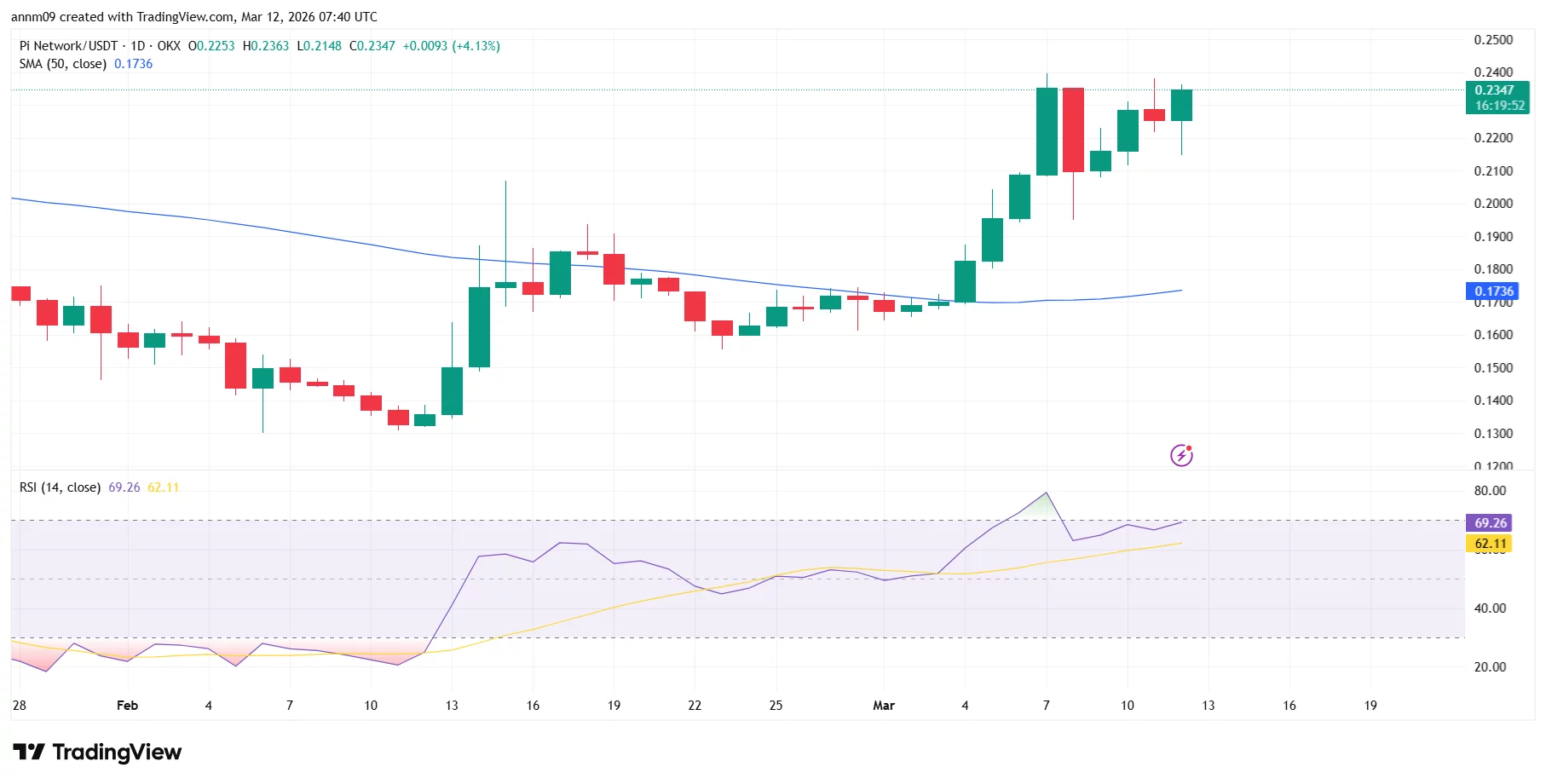
The PI/USDT daily chart reveals a highly aggressive bullish setup, confirming that the “smart money” began positioning well before the official Kraken tweet.
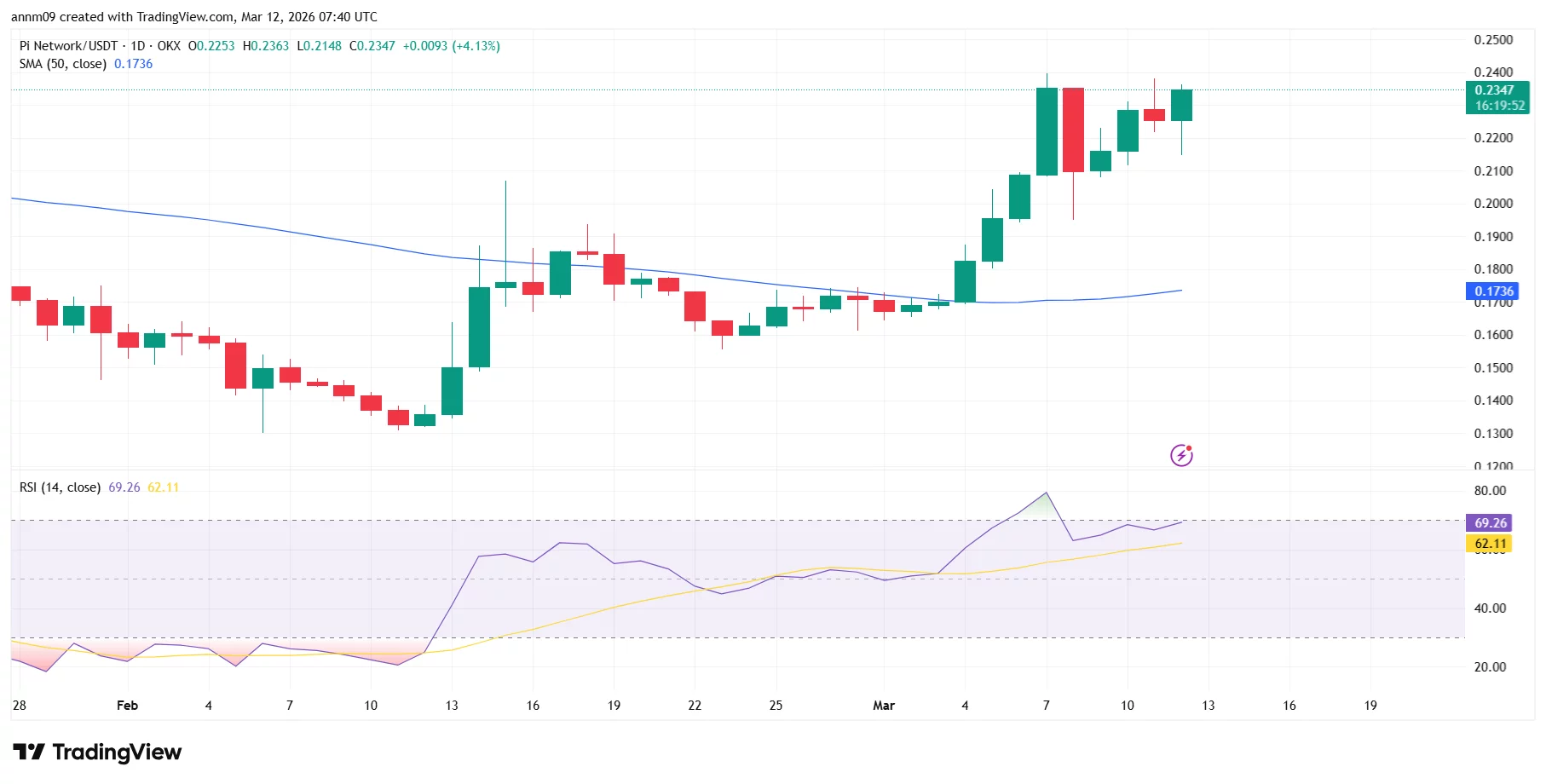
Currently, PI is trading at approximately $0.2347, showing a solid gain of +4.13% for the day. This upward trend has pushed the price well above the 50-day Simple Moving Average (SMA), which sits near $0.1736, signaling a bullish shift in market sentiment.
The SMA often acts as a key support level, and PI’s sustained trading above this line suggests buyers are firmly in control.
The Relative Strength Index (RSI), a momentum oscillator that measures overbought or oversold conditions, is near 69.26—just below the overbought threshold of 70. This indicates strong buying momentum, though traders should be cautious as RSI nearing 70 can sometimes precede a short-term pullback.
The recent price action reveals a pattern of higher highs and higher lows, confirming the bullish trend. However, the visible price wicks on recent candles imply some volatility and profit-taking at higher levels, which is typical in a strong rally.
While “sell the news” risks always exist after a listing, the proximity to Pi Day suggests the rally may have more legs than a typical exchange pump.
The spot Ripple (XRP) ETFs have seen several consecutive days of outflows.
Bloomberg’s James Seyffart praised the performance of the spot XRP ETFs as of late despite the overall market uncertainty and the underlying asset’s price calamity.
However, the ETF experts’ words come at a time when the funds have seen several days of consistent outflows.
XRP ETFs Hold Up Well
The first month after the debut in mid-November was quite impressive as Canary Capital’s XRPC, which was the first such fund to go live for trading on Wall Street, broke the 2025 trading volume record for the launch day. The first $1 billion in cumulative net inflows was gathered in about a month, but the trend has changed substantially since then.
Data from SoSoValue shows that investors poured in $666.61 million into the funds, which are now five, in November and $500 million in December. January saw nowhere near those numbers with just $15.59 million, while February picked up the pace slightly to $58.09 million.
March is shaping up to be the first red month so far, with current data showing $26.07 million in net outflows. This is because investors pulled out $6.15 million on March 5, $16.62 million on March 6, $18.11 million on March 9, and $3.88 million on March 10.
Despite this evident investor exodus, Seyffart noted that the funds have “actually held up pretty well despite the massive pullback in price.” Interestingly, his data shows that the cumulative total for the XRP ETFs is at over $1.4 billion, while SoSoValue cited a lower number, $1.21 billion.
The XRP ETFs have actually held up pretty well despite the massive pullback in price. They’ve taken in a cumulative $1.4 billion since launch. pic.twitter.com/Bjtmb0y40D
— James Seyffart (@JSeyff) March 10, 2026
You may also like:
The Price Pullback
Although the exchange-traded funds have amassed well over $1 billion in their four months of existence, the underlying asset’s price has indeed pulled back as Seyffart noted. Not just in the past few weeks when global uncertainty has skyrocketed to new peaks, but even when we examine XRP’s moves since November 13, when XRPC launched.
At the time, the token traded at around $2.50 but plunged to a 15-month low of $1.11 on February 6. Despite rebounding since then, XRP still trades below $1.40 as of press time, which means a 45% decline since the ETF debut.

Binance Free $600 (CryptoPotato Exclusive): Use this link to register a new account and receive $600 exclusive welcome offer on Binance (full details).
LIMITED OFFER for CryptoPotato readers at Bybit: Use this link to register and open a $500 FREE position on any coin!
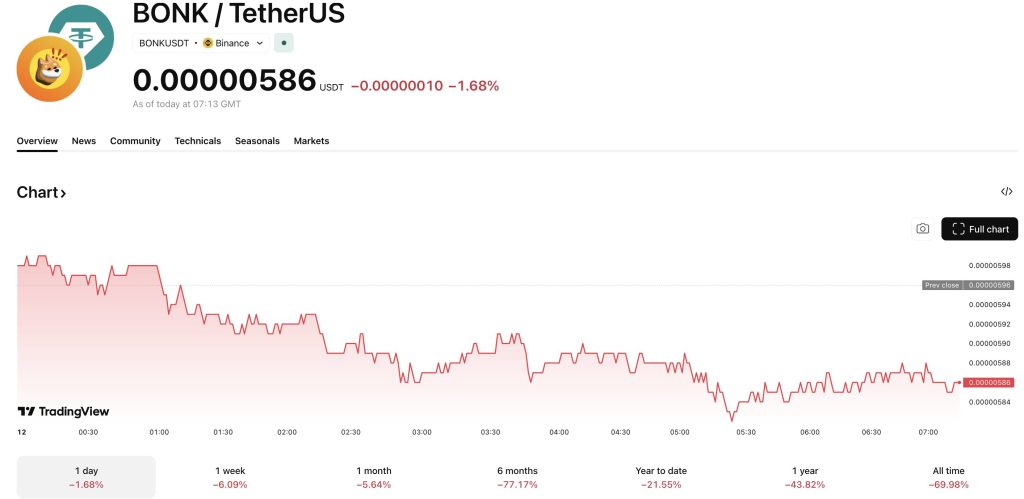
The official website for the Solana memecoin launchpad, Bonk Fun, has been hijacked. A malicious actor seized control of the domain on Wednesday (March 11), deploying a wallet drainer disguised as a standard interaction.
The platform’s team has issued an urgent warning: do not interact with the website until further notice. Users who connect their wallets and sign the current prompts face immediate theft of their assets.
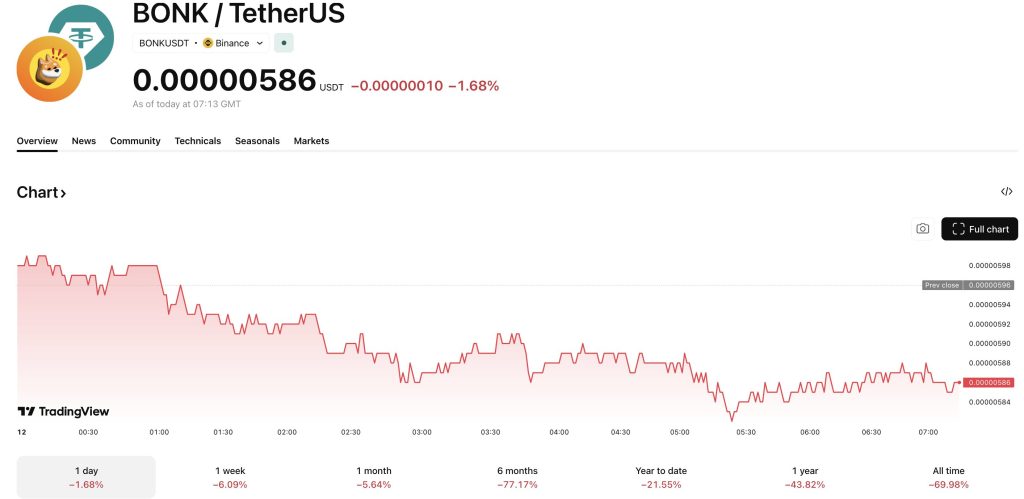
As news of the BONK meme coin spreads, it has dropped nearly 1% over the past 24 hours, following a disastrous year in which the Solana meme coin lost -45% of its value.
It is a bad time for a platform hack, as the meme coin sector has enjoyed a +2.5% daily pump, taking the total market cap back above $32Bn, with tokens like DOGE, PEPE, Memecore, and SHIB all posting green candles.
How Did the Malicious Actor Breach the Bonk Fun Front-End?
The attack vector exploits user trust rather than the blockchain infrastructure itself. According to X user SolportTom, the platform’s operator, hackers hijacked a team account to force a drainer onto the domain. This is not a smart contract failure; it is a front-end takeover.
Visitors to the site are currently greeted with a fake terms-of-service message. This pop-up, which mimics standard compliance requests, is the trigger mechanism.
If you sign this request, the protocol grants the attacker permission to empty your wallet, and it will happen within seconds.
“A malicious actor has compromised the BONKfun domain,” the platform announced via its official X account. “Do not interact with the website until we have secured everything.”
How Much Has Been Drained and Who Is Affected
The Bonk.fun team hasn’t confirmed how much was lost to the hack, but has stated that losses are “minimal,” attributing the low damage to the developers’ rapid detection.
Only users who interacted with the fraudulent terms-of-service prompt during the active hijack window were affected. However, the exact dollar figure verified by on-chain analysis remains pending.
— Coin Bureau (@coinbureau) March 11, 2026
 AAVE ORACLE GLITCH TRIGGERS $26M IN WRONGFUL LIQUIDATIONS
A pricing oracle error on Aave caused about $26million in wstETH positions across 34 accounts to be unfairly liquidated after the system reported an incorrect exchange rate, with affected users set to be compensated. pic.twitter.com/qMbsAhQnnl
This incident mirrors broader risks in the sector, as an Aave oracle glitch triggered liquidations earlier this year due to interface and data anomalies.
While the mechanics differ, the result for user funds is identical: an unexpected loss due to a technical compromise.
Phishing attacks like this are becoming industrialized. According to Chainalysis, overall crypto scam losses reached approximately $17Bn in 2025.
The shift toward domain hijacking indicates attackers are bypassing protocol security to target the user interface directly.
EXPLORE: Best Crypto Presales to Buy in 2026
What Bonk.fun Users Need to Do Right Now
If you have visited Bonk.fun in the last 24 hours, assume your session security was compromised. Front-end attacks often bypass standard defenses, as the recent discovery by Ledger researchers of an Android flaw enabling wallet seed phrase theft demonstrates.
Take these steps immediately:
- Disconnect your wallet: Remove Bonk.fun from your connected sites list in your wallet settings.
- Revoke approvals: Use a tool like Revoke.cash to revoke any recent permissions granted to Bonk.fun contracts.
- Check your history: Verify that no unauthorized transfers have occurred.
“We understand a lot of people are scared and rightly so, but we’re doing everything in our power to fix the situation,” SolportTom wrote.
Users should now sit tight and wait for an official “all-clear” from the Bonk.fun X account before returning to the site.
If the site remains compromised for another 24 hours, user migration to rival launchpads like Pump.fun will likely accelerate, and Bonk.fun may struggle to regain whatever was left of its userbase.
If the team resolves the DNS hijack quickly and refunds the “minimal” losses, confidence may stabilize, but the pressure is now on the operators to prove the domain is safe.
DISCOVER: The 16 Best Meme Coins to Buy in March 2025
The post Bonk Fun Website Hijacked: Live Exploit Is Draining User Funds appeared first on Cryptonews.

TLDR
- Changpeng Zhao’s wealth is pegged at $110 billion by Forbes, securing him the 17th position globally
- This valuation positions CZ above Microsoft co-founder Bill Gates, who sits at $108 billion
- Zhao challenged the assessment publicly, noting cryptocurrency valuations collapsed more than 50% in 2026
- CZ’s fortune stems primarily from owning approximately 90% of Binance equity, rather than cryptocurrency tokens
- The exchange commands roughly 38% of worldwide crypto trading volume and pulled in an estimated $16–17 billion during 2024–2025
Changpeng Zhao, who founded the cryptocurrency exchange Binance, now ranks above Microsoft co-founder Bill Gates in wealth, according to fresh estimates from Forbes. The publication’s March 10 assessment values Zhao’s fortune at roughly $110 billion.
This valuation secures Zhao the 17th spot on Forbes’ worldwide billionaire rankings. Gates trails slightly behind at approximately $108 billion.
Zhao established Binance, which has become the dominant force in cryptocurrency trading globally. His tenure as chief executive ended in 2023 following a guilty plea to charges related to inadequate anti-money laundering compliance.
The legal settlement required Zhao to pay $50 million personally and complete a four-month sentence at a California correctional facility. Separately, Binance settled with authorities for $4.3 billion in fines.
Though no longer serving as CEO, Zhao reportedly maintains ownership of roughly 90% of Binance’s equity. This substantial stake forms the foundation of his estimated net worth.
Financial experts place Binance’s valuation near $100 billion. The platform facilitates tens of trillions in trading activity annually between spot markets and derivatives.
The exchange captures approximately 38% of worldwide cryptocurrency trading activity. Revenue projections suggest Binance pulled in $16 billion to $17 billion throughout 2024 and 2025 combined—roughly 2.5 times Coinbase’s $6.6 billion yearly intake.
Zhao responded skeptically to Forbes’ wealth calculation soon after its publication. Writing on X on March 11, he highlighted that digital asset prices had declined over 50% during 2026 and questioned the logic behind an increased net worth estimate.
“Wish they can apply some common sense and basic logic,” he wrote.
How Exchange Owners Can Gain During a Market Downturn
Cryptocurrency trading platforms generate income through transaction fees independent of price direction. Market turbulence typically drives higher trading activity, potentially boosting exchange earnings even as asset values contract.
This mechanism may account for why Binance’s valuation remained stable or expanded despite broader market contraction.
Zhao’s personal cryptocurrency portfolio hasn’t shown similar resilience. His reported holdings of approximately 1,400 Bitcoin depreciated roughly 25% over twelve months, now worth about $100 million. This represents only a minor fraction of his total estimated wealth.
Some observers on social platforms suggested Zhao profited from short positions during October 10’s crypto market collapse, which triggered massive liquidations in derivatives trading. Zhao refuted these claims directly, stating: “Never shorted.”
Where Bitcoin, Ethereum, and XRP Stand Now
When Forbes released its assessment, Bitcoin was exchanging hands near $71,000, with Ethereum hovering around $2,080 and XRP trading close to $1.40.
Binance additionally operates BNB Chain, a blockchain platform with its own native cryptocurrency. The ecosystem maintains a market capitalization approaching $88 billion.


Key Highlights
- February saw Bullish (BLSH) record $76 billion in spot volume—a 62.6% monthly increase and the highest level since October 2025.
- The exchange surpassed Coinbase (COIN) to claim the third spot among centralized crypto exchanges by spot trading volume.
- Bullish captured 5.06% of the spot market, exceeding Coinbase’s 4.59% share.
- Total centralized exchange volume declined 2.41% in February to $5.61 trillion, marking the weakest performance since October 2024.
- Binance maintains its leadership position, though its market dominance reached its lowest level since October 2020.
Bullish ($BLSH), the institutional-grade cryptocurrency exchange that debuted on the New York Stock Exchange last year, has achieved a significant milestone by breaking into the top three global exchanges ranked by spot trading volume.
This achievement materialized in February when the exchange registered $76 billion in spot transactions—representing a robust 62.6% increase compared to the previous month.
This impressive growth elevated Bullish’s market share to 5.06%, marking a 2.04 percentage point gain from January. The performance enabled the platform to overtake Coinbase ($COIN), which concluded February with a 4.59% market share.
BLSH shares advanced 1.25% following the announcement, while COIN stock increased 1.07%.
February’s trading volume represented Bullish’s strongest monthly performance since October 2025, particularly noteworthy given the subdued market conditions throughout the period.
Bitcoin remained largely confined to a $60,000-$70,000 trading range during February. Such consolidation typically suppresses speculative activity, which often results in diminished volumes industry-wide.
Aggregate spot and derivatives trading across centralized exchanges contracted 2.41% in February to $5.61 trillion—representing the weakest monthly total since October 2024.
Spot volume specifically decreased 3.01% to $1.50 trillion. Derivatives trading declined 2.41% to $4.11 trillion, accounting for 73.2% of total centralized exchange volume.
Institutional Strategy Insulates Bullish During Market Lull
Bullish’s business model centers on serving institutional participants rather than retail investors. This strategic positioning appears to have protected the exchange from broader volume declines affecting retail-focused competitors.
The platform has simultaneously been diversifying its service portfolio. Recent additions include prediction market trading capabilities, a feature some exchanges have introduced to maintain engagement during periods of reduced volatility.
Wall Street analysts maintain a Moderate Buy consensus rating on BLSH, comprising four Buy recommendations and two Hold ratings issued over the past three months. The consensus 12-month price target stands at $48.17, suggesting approximately 29.5% potential upside from present levels.
Binance Retains Leadership Despite Declining Market Share
Binance continues to dominate the exchange landscape. The platform processed $331 billion in spot trading volume during February, corresponding to approximately 22% market share.
However, this 22% figure represents Binance’s smallest monthly market share since October 2020. The trend indicates trading activity is increasingly distributed across multiple competing platforms.
February data sourced from CCData via CoinDesk’s February Exchange Review.

Bishop Burton College apprentice voted best in country

Heating oil orders cancelled and prices hiked

Will XRP price react as Ripple launches $750M buyback plan?


-
Business6 days ago
Form 8K Entergy Mississippi LLC For: 6 March
-

 News Videos3 days ago
10th Algebra | Financial Planning | Question Bank Solution | Board Exam 2026
-

 Fashion6 days ago
Weekend Open Thread: Ann Taylor
-

 Crypto World3 days ago
Paradigm, a16z, Winklevoss Capital, Balaji Srinivasan among investors in ZODL
-
 Tech1 day ago
A 1,300-Pound NASA Spacecraft To Re-Enter Earth’s Atmosphere
-
 Sports7 days ago
499 runs and 34 sixes later, India beat England to enter T20 World Cup final | Cricket News
-

 Politics6 days ago
Top Mamdani aide takes progressive project to the UK
-

 Business2 days ago
ExxonMobil seeks to move corporate registration from New Jersey to Texas
-

 Sports4 days ago
Braveheart Lakshya downs Lai in epic battle to enter All England Open final | Other Sports News
-

 Sports5 days ago
Three share 2-shot lead entering final round in Hong Kong
-

 NewsBeat14 hours ago
Residents reaction as Shildon murder probe enters second day
-

 NewsBeat7 days ago
Piccadilly Circus just unveiled ‘London’s newest tourist attraction’ and it only costs 80p to enter
-

 Entertainment5 days ago
Hailey Bieber Poses For Sexy Selfies In New Luscious Lip Thirst Traps
-

 Business4 days ago
Search for Nancy Guthrie Enters 37th Day as FBI Probes Wi-Fi Jammer Theory
-

 Business1 day ago
Search Enters Sixth Week With New Leads in Tucson Abduction Case
-
 NewsBeat2 days ago
Pagazzi Lighting enters administration as 70 jobs lost and 11 stores close across Scotland
-

 Tech3 days ago
Despite challenges, Ireland sixth in EU for board gender diversity
-

 Tech2 days ago
ChatGPT will now generate interactive visuals to help you with math and science concepts
-

 Business3 days ago
Search Enters 39th Day with FBI Tip Line Developments and No Major Breakthroughs
-

 NewsBeat18 hours ago
I Entered The Manosphere. Nothing Could Prepare Me For What I Found.