We hope you love the products we recommend! All of them were independently selected by our editors. Just so you know, HuffPost UK may collect a share of sales or other compensation from the links on this page if you decide to shop from them. Oh, and FYI – prices are accurate and items in stock as of time of publication.
If you’re looking to give your wardrobe a spring refresh, you’re in luck, because M&S is packing some absolute doozies this season.
Now, it feels like there are buys in every new collection that have been specifically designed to sabotage my savings goals.
I’ve flirted with temptation and filtered through all the womenswear that’s just arrived to find the cream of the crop, so you don’t have to.
Advertisement
But you’d better move fast, because some of the best pieces are already starting to sell out…
The wins for Palestine activists and advocates keep stacking up. Yesterday, the Westminster Magistrates’ Court threw out an appeal by British government which, again, has failed to criminalise Kneecap rapper Mo Chara for holding a bit of cloth. A final decision on whether Óg Ó hAnnaidh – the rapper’s real name – will stand trial on 26 September has not been reached.
Three-nil to Kneecap
“Three-nil to Kneecap,” the rapper announced to a crowd of supporters outside the court. This is the latest legal victory in a series of significant rulings issued in favour of Palestine Action, six of their activists, and BDS Belfast campaigners – against the British state.
The ‘controversial’ cloth the West Belfast man allegedly unfurled at a gig in 2024 was the flag of the proscribed group Hezbollah. A judge initially threw out the case against the Kneecap rapper in September 2025, based on a technical failure of the prosecution. For ‘summary only’ offences – namely minor crimes heard before a magistrate – the Crown Prosecution Service (CPS) must authorise cases to proceed within six months of the alleged offence – a deadline which had passed in this case.
However, since Britain is a country that doesn’t understand what free speech is, waving the wrong sort of flag can get you done under anti-terror laws. In such cases the Director of Public Prosecutions (DPP) and Attorney General must give their consent to proceed. The Attorney General didn’t do this within the six month timeframe. Consequently, the case was rendered null.
That resulted in Wednesday’s High Court ruling. Lord Justice Edis and Mr Justice Linden ruled that Chief Magistrate Paul Goldspring had been correct in his initial September 2025 decision. In their judgement, as they said:
It follows that no written charge was issued within 6 months of 21 September 2025 and the judge was right to hold that he had no jurisdiction to try any summary only offence alleged to have been committed on that date.
In other words, the government was too late to hand its homework in. The justices did not investigate why the government made this cock-up. Today’s ruling represents the third occasion in which Kneecap have defeated attempts by the war criminals of the Labour party to criminalise them.
In June 2025, the Metropolitan Police dropped their plans to charge Mo Chara for 2023 comments in which he called, in jest, for people to “kill your local MP”.
There wasn’t one prosecutor or one individual in that courtroom that thinks I’m a terrorist.
He asked:
What pressure is the British government being put under. From where? Is it from America, is it from Israeli lobbyists? Why are they pursuing this so hard?
Needless to say, these are rhetorical questions.
A ‘vassal’ of the US
Britain is a vassal state of the US empire, an already pseudo-democracy made even more so by the fact that its 70 million people have their will overridden by Washington.
These are the reasons why they’ve pursuedlawfare against those repulsed by British crimes. Crimes committed using British people’s taxes, then followed up with a legal assault using the same pool of money, which could be better spent on healthcare and education.
In response, the land thieves have engaged in further mass murder in Lebanon. They have killed over 500 people since the start of the Iran assault, and displaced 100,000.
It is this horror that the British government is backing, proving they are the real terrorists, no matter how many failed prosecutions they deploy to try and invert this truth.
We now know that students mourned the killing of Iran’s supreme leader, Ali Khamenei, at a total of 27 British universities. Ahlul-Bayt Islamic societies, student groups affiliated with Iran’s Shia muslims, shared social-media posts expressing sorrow for Khamenei’s ‘martyrdom’, with some going further and organising commemorative events or directing members to join vigils.
In response, education secretary Bridget Phillipson has announced a crackdown on extremism in higher education. English universities that allow the promotion of terrorism on campus, or give a platform to speakers who engage in illegal activity, she warned, may face sanctions and even closure. Announcing the government’s new strategy, Phillipson said: ‘Free speech is a core pillar of our society and our universities, but we must also be clear about where the line is drawn. There must be no place for hate crimes, intimidation or attempts to draw students into terrorism.’
Although it is shocking to see students at British universities grieving for a regime that brutally murders its citizens, it is not obvious what Phillipson’s statement is intended to achieve. Universities already have a legal duty to comply with Prevent, the government’s counter-extremism strategy. Phillipson’s latest crackdown simply reinforces a decade-old requirement.
Advertisement
Not that this requirement has done anything to stop the spread of Islamism on campuses. Indeed, even Muslim-majority countries such as the UAE have declared that they will no longer sponsor students to study in the UK because of fears that they will be radicalised by Islamist groups, such as the Muslim Brotherhood.
In fact, Prevent’s only measurable impact of monitoring ‘extremism’ on campus has been to limit free speech. It has done this by creating a climate where lecturers and students self-censor and avoid discussing Islamist extremism in any context, including the threats it may pose. The 2008 arrest of a student at the University of Nottingham for downloading an al-Qaida training manual as part of research for a dissertation had a chilling effect on academic freedom. The backlash to this wrongful arrest led to growing concern that Prevent is fuelling ‘Islamophobia’. For many working in British universities, this is far more troubling than students demonstrating support for terrorist organisations.
Advertisement
Launching the government’s new strategy, Phillipson said: ‘Universities should be places of rigorous debate and opportunity – but never places where people feel unsafe because of who they are or what they believe.’ Jewish students who have experienced a huge spike in anti-Semitism on campus over the past two years may consider such platitudes to be too little, too late. Meanwhile, the demand that no one should feel unsafe on campus is frequently used to justify restrictions on all kinds of speakers, from gender-critical feminists to the Israeli ambassador to the UK.
A 2023 government-commissioned review of Prevent, conducted by Sir William Shawcross, found that resources were disproportionately focussed on a vaguely defined threat from ‘right-wing extremism’, while ‘not doing enough to counter non-violent Islamist extremism’. This undoubtedly holds true on campus. Staff charged with implementing Prevent policies seem far more comfortable talking about the risks posed by vanishingly small groups of far-right activists than they do the far larger and more real group of Islamist extremists. All too often, it is criticism of Islamism that is restricted, not Islamism itself.
Advertisement
This situation seems unlikely to change any time soon. Despite Phillipson’s rhetoric about the importance of free speech, new measures to challenge the promotion of terrorism have been introduced at the same time as the government finalised its definition of ‘anti-Muslim hatred’. Hatred and discrimination against Muslims are already illegal under the Equality Act of 2010; having an official definition of anti-Muslim hatred creates special protections for just one faith.
Taken together, these new measures mean that universities are being given contradictory instructions: they must protect free speech while clamping down on hate and intimidation. And they must stop Islamist extremism while not allowing expression of anti-Muslim hostility. At a time when many academics are convinced that people have a gender identity that matters more than their sex, that students need protecting from words that wound, and that knowledge itself must be ‘decolonised’, we should not be surprised when universities put more emphasis on protecting Muslim students from offence, than on defending free speech.
Bridget Phillipson’s crackdown on campus extremism is not simply too little, too late. It woefully underestimates the scale of the problem engulfing our universities. We cannot simply ban our way out of the problem of students from supporting Islamist extremist organisations (although institutions should certainly not be offering them financial support). If anything, this will do more harm than good.
Advertisement
If we’re serious about fighting back against Islamist intolerance, and for Western Enlightenment values, we will need more free speech on campus, not less. We need to ensure the rights of students who want to protest against anti-Semitism and in defence of women’s sex-based rights. Rather than making academics and students fearful of expressing ‘anti-Muslim hostility’, Islamist groups mourning the death of Ali Khamanei need to be met with the mockery and derision they deserve.
My park’s paths are lined with daffodils and primroses at the moment, and I have to watch my step by the pond because of all the fluffy little goslings.
That can only mean one thing: spring is well and truly here. But where are the bluebells? And when, exactly, can we expect them to bloom in the UK?
When do bluebells bloom in the UK?
Advertisement
The Woodland Trust runs a Wildlife Calendar, which allows people across the UK to record the dates and locations they first notice signs of seasonal change, e.g., conkers falling or blossoms growing.
And according to that calendar, the average first bluebell flowers on 9 April.
Of course, this won’t be uniform in every part of the country. If you’re in the sunnier South, you’ll likely see your first bluebell sooner than someone in Scotland.
In general, bluebells bloom from the end of March to as late as the start of May – they’re one of the last spring flowers to appear.
Advertisement
Where can I see bluebells in the UK?
Generally, bluebells appear on the floors of older woodlands, like a violet carpet. They grow in the sun or the shade.
The more ancient the ground they’re on, the better they tend to do.
For that reason, the National Trust recommends visiting “historic estates” as well as your local woods if you want to get a good gawk at the beautiful blossom.
Advertisement
Per the Wildlife Trusts, some good bluebell forests in the UK include:
I love the seaside. I’ve never lived more than a few miles away from it and I feel its pull whether I’m at home or away.
Advertisement
My home village of Great Bentley was five miles from Brightlingsea, and I spent seven years at school in Clacton. I couldn’t wait to escape… to Brighton.
A few years after leaving Sussex University, I became leader of Brighton and Hove council – a job I loved and did for 13 years. In the 70s and 80s, like most UK seaside towns, Brighton had all the feel and reality of decline. Playwright Keith Waterhouse once characterised it as having “the air of a town that is perpetually helping the police with their inquiries”.
The struggles of coastal communities are linked to their peripheral nature and the erosion of Britain’s industrial base
Advertisement
Today, Brighton is often held up as the UK’s most successful seaside city, one that others seek to copy. The sad truth is that few have succeeded in replicating its revival.
Back in 2019, I chaired a groundbreaking House of Lords inquiry, The Future of Seaside Towns. Our report found poor health outcomes, lower educational attainment, weak transport links and fragile digital connectivity. Business formation rates lagged behind national averages. Public and private investment were both thin on the ground. These communities also experienced the flight of the professional middle classes, which reduced the services of bankers, accountants, lawyers, doctors.
Advertisement
Broadly speaking, the struggles of coastal communities are linked to their peripheral nature and the erosion of Britain’s industrial base.
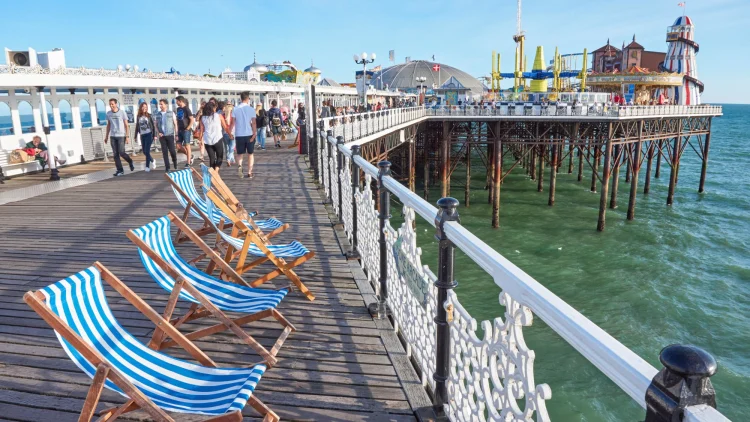
The attractiveness of the coast remains, of course, as does the love affair with seaside attractions. Nowhere in Britain is further than 70 miles away from the coast, and 36 per cent of us live within five kilometres of the sea.
So, what does a successful seaside look like? How do we restore pride and identity to these wonderful, quirky communities?
Brighton offers some pointers. In the 50s, it was a semi-industrial town with specialist engineering, a major locomotive works and a large factory-based workforce. Alongside that sat a thriving holiday trade: B&Bs, prestigious hotels and a reputation for the salty and saucy.
Advertisement
By the 1970s the factories had closed, the loco works were gone, and the holiday trade was shrinking. Brighton had the look of the seedy and rundown about it. Its recovery in the 80s and 90s was built around the knowledge economy, conferencing, the arts and latterly the digital economy. Today, its universities and colleges are home to 35,000 students, and the arts, cultural and digital economy has led to it having one of the highest business start-up rates outside London. Brighton now has the highest disposable income growth rate in the UK.
As a prescription, Brighton’s route to regeneration cannot be universal, but some of the elements are transferable. Margate, Bournemouth, Folkestone and parts of Cornwall have used this formula to renew and reinvent. Coastal communities should improve transport and digital connections, seek a mix of public and private investment, and put money into the arts. They should develop a learning culture, a knowledge economy (HE and FE) and make sure clear and decisive political leadership is built around a strong vision for place.
Our 2019 Lords report argued that government has a decisive role in shaping successful coastal futures. But we found a bewildering patchwork of funding streams and too little capital for long-term infrastructure renewal. When we revisited the issue in 2022, little had changed.
We argued then for a voice in government – a seaside or coastal minister – to focus Westminster’s thinking and produce a more coherent strategy for regeneration. That need has not gone away. Coupled with a strong devolution settlement, this would enable the left-behind places to tend the constant garden that is regeneration and renewal.
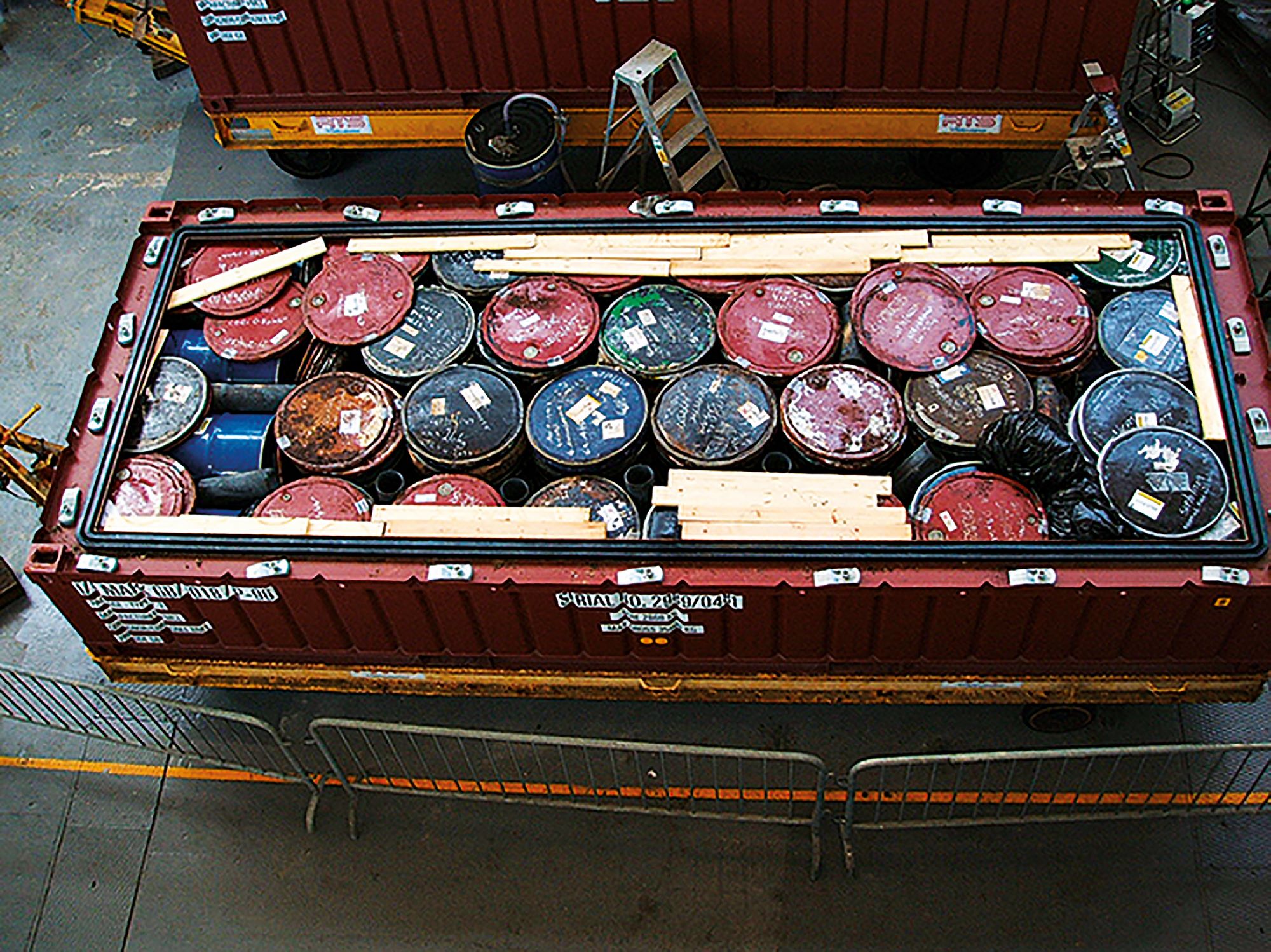
A drum ready to be disposed of at the Low Level Waste Repository
From decommissioning to enabling new-build, we are bringing together the UK’s expertise in radioactive waste management – reducing and recycling waste to save costs while protecting people and the environment
Advertisement
The UK has benefited from nuclear technologies for decades. Powering homes, supporting industry and enabling life‑saving medical and research applications. With those benefits comes a responsibility that Parliament rightly scrutinises: radioactive waste must be managed safely and securely, and in a way that represents value for the public purse over the long term.
That is the core purpose of Nuclear Waste Services (NWS). Created to bring together the UK’s leading radioactive waste management capabilities into a single organisation, NWS supports the safe treatment, transport and disposal of radioactive waste and helps ensure the UK has a credible, permanent “end point” for the most hazardous materials
NWS – providing solutions
NWS specialises in the management, treatment and disposal of radioactive waste produced by nuclear technologies in the UK. We are part of the Nuclear Decommissioning Authority (NDA) group, the public body responsible for cleaning up the UK’s historical nuclear sites.
Advertisement
Our goal is simple: to ensure all categories of the UK’s radioactive waste are managed safely, securely and sustainably.
We provide practical waste solutions – assessing, packaging, transporting and managing radioactive waste using innovative approaches that prioritise sustainable outcomes.
Our solutions include disposal through operating the existing Low Level Waste Repository in Cumbria to planning for a Geological Disposal Facility (GDF) for the most hazardous radioactive waste.
Advertisement
Since the mid-1980s we have worked with organisations across the UK that produce radioactive waste to help ensure that the waste being produced now is suitable for geological disposal
Supercompacted waste destined for disposal
From design to disposal
With new nuclear recognised by Government as essential to the UK’s low-carbon energy mix and energy security, the ability to manage radioactive waste safely – today and for future generations – has never been more important.
It is vital that new build reactor design consider decommissioning from the very outset. An assessment process has been put in place to scrutinise new nuclear power plant designs and assess their acceptability for use in Great Britain.
NWS – with a remit extending well beyond managing legacy waste – is playing a pivotal role ensuring that during plant design, construction and beyond, developers have clear and credible plans for the safe and permanent disposal of the waste their facilities will produce.
Advertisement
In addition to receiving the most hazardous legacy waste, the GDF will accept waste arising from new plants, so at NWS we must ensure it is compatible with final disposal in the facility.
Diverting waste from disposal
Our role spans the full waste lifecycle. We assess waste, advise on the most sustainable management route, and apply innovative treatments to reduce its volume or radioactivity wherever possible. Our partnership with the Chartered Institute of Waste Management increases trust and credibility of the solutions we provide.
Around 15 years ago, the default approach for low level waste was disposal at the Repository on the West Cumbrian coast. Waste was placed in expensive steel containers and permanently disposed of.
Advertisement
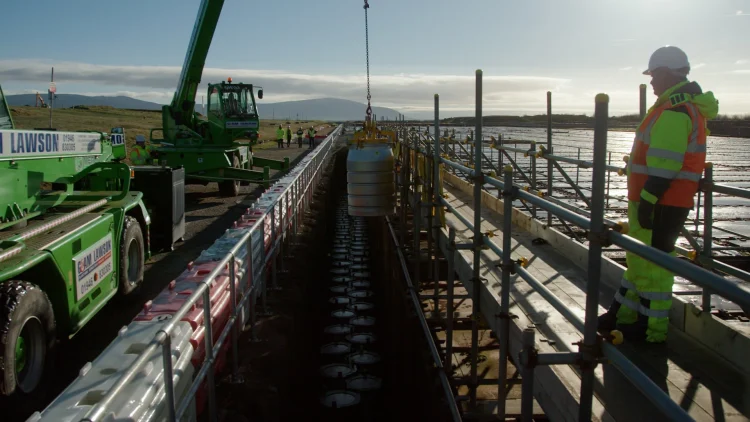
A view of the Low Level Waste Repository vaults
If that approach had continued, the UK would have needed a new low level waste repository at significant cost.
Instead, the NDA introduced a new strategy based on the waste hierarchy: avoid, reduce, reuse, recycle and only dispose as a last resort, delivered by a new centralised waste services capability.This work has been making significant savings to the taxpayer, made great efficiencies in our waste disposal management, avoided the unnecessary use of higher‑cost disposal facilities and helped speed up decommissioning.
A step change in how waste is managed across the nuclear sector now exists. Over the past decade, we have increasingly adopted alternative treatment routes such as incineration, permitted landfill for lower-activity waste, super-compaction, and metal decontamination for recycling.
These approaches deliver both environmental and economic benefits. Diversion is typically more cost-effective than disposal, and techniques such as surface treatment allow contaminated metals to be cleaned and safely reused.
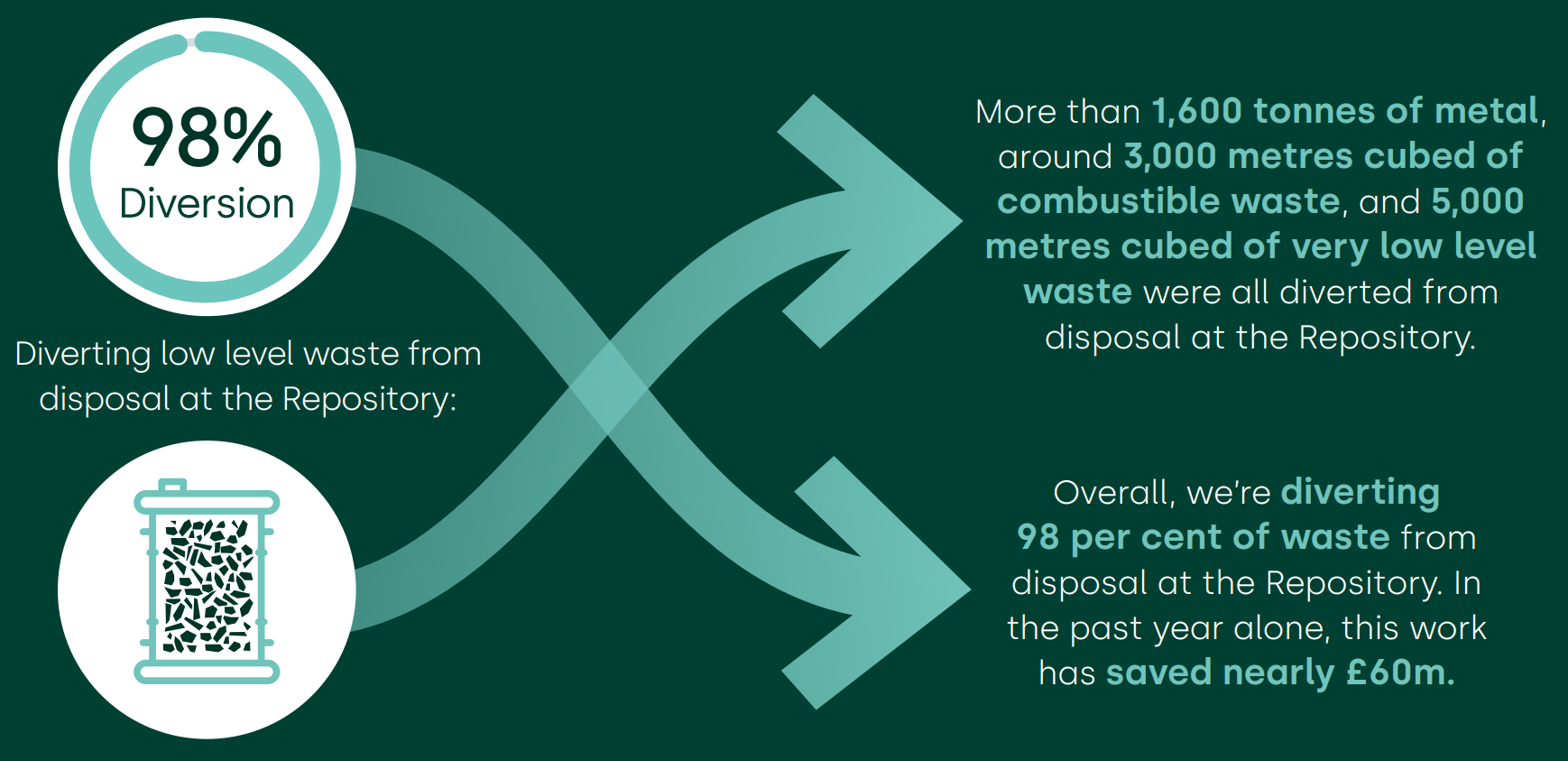
In practice, that means expanding the range of treatment routes used across the UK, so that suitable waste can be diverted away from disposal. By re‑using or recycling where possible, we now divert 98% of waste away from disposal at the Repository site. In the past year alone, this approach has saved nearly £60 million and more than £900 million over the past decade; money that can be redirected to hazard reduction and decommissioning priorities. Waste management is a lever that can accelerate clean‑up and reduce long‑term liabilities. When we avoid unnecessary disposal, we protect constrained national capacity, improve efficiency across the system and help ensure public money is spent once and spent well.
Advertisement
Going further
Building on our success in diverting lower activity waste from disposal, we are now exploring whether similar principles can be applied to some wastes currently in storage and destined for deep geological disposal in a GDF.
Through research and trials, we are examining whether innovative treatment methods could reduce the volume of certain lower activity wastes that would otherwise require disposal underground. These trials will inform decisions on the most sustainable techniques to apply in the future.
This work does not remove the need for a GDF. A GDF remains the safe, secure and long-term solution for the UK’s most hazardous radioactive waste. However, by reducing volumes where it is safe and appropriate to do so, we can maximise value and support delivery of the NDA mission.
Our work accelerates decommissioning while ensuring waste is managed in the most sustainable and cost-effective way possible.
Advertisement
Through collaboration with customers and the supply chain, and with a clear focus on innovation and delivery, we are making nuclear waste permanently safe, sooner.
Israel’s Minister of National Security, Itamar Ben Gvir has authorised residents of Jewish neighbourhoods in Jerusalem (Al-Quds) and Kfar Saba (Kafr Saba) to carry firearms. Meanwhile, the illegal terrorist state is calling for the disarmament of Hezbollah and Hamas. The hypocrisy is astounding.
Israel is making it easier for Israeli Jews to kill Palestinians and any non-Jewish person they want to. A nation of bigoted sociopaths. https://t.co/UcmOtTHA1J
— Carolyn Hinds 🇧🇧 #FreePalestine #CongoInCrisis (@CarrieCnh12) March 11, 2026
Israel furthering apartheid
Residents of 41 Jewish neighbourhoods in the city can now apply for a licence to carry a gun.
Of course, Muslim residents of Jerusalem are not able to carry guns. There’s a word for that.
Advertisement
If you live in a Jewish neighborhood of Jerusalem, you are now eligible to receive a gun permit.
If you live in a Palestinian neighborhood of Jerusalem, you are not eligible.
Terrorist Ben Gvir claimed that during the war and Ramadan, Jerusalem residents have a “basic right to defend themselves”
Advertisement
But the existing gun holders already cannot tell the difference between a legitimate military target and a toddler.
300,000 extra guns in the hands of genocidal maniacs (who dont know how to shoot) …. The existing gun holders cant tell the difference between a baby and a uniform https://t.co/AwMGWJflwz
Previously, Israeli police investigated Ben Gvir’s office for illegally approving gun licenses.
Effectively, 300,000 illegal Israeli settlers will now be walking around armed. Obviously, the announcement is raising concerns about safety and domestic violence.
Advertisement
But importantly, Israel has regularly called for the disarmament of Hamas, Iran, and Hezbollah.
But why should they, when Israel is actively arming its illegal settlers?
In recent weeks, Israeli settlers backed by the IDF have terrorised Palestinians in the West Bank. This included settlers murdering a Palestinian-American man.
You can have a gun in Jerusalem.
But you have to be Jewish.
Advertisement
Read that again.
Yep – guns based on religion. And this is as Jewish terrorist gangs are murdering families every day.
In total, Israeli settlers have murdered six Palestinians across the West Bank over the past 11 days, according to the United Nations.
But even before Israel’s unprovoked attacks on Iran, settlers were already terrorising Palestinians. In 2025, illegal settlers injured more than 830 Palestinians.
You know why they weren’t allowed guns before, because they’d just loot and shoot each other too. He knew his people are lunatics, but now he wants to unleash that hell onto already suffering Palestinians https://t.co/jcDesm4MSV
But all of this is incredibly two-faced – seeing as though Palestinians, Iranians, and Lebanese people are not allowed to defend themselves. And, if they dare do so, the West labels them as terrorists.
Most of the West has labelled Hamas and Hezbollah as “terrorists”. And Israel has repeatedly called for both to disarm and disband.
But both literally only exist because of Israel’s repeated invasions of sovereign nations.
Hezbollah was formed in 1982 after Israel illegally invaded Lebanon.
Advertisement
Hezbollah’s main foundational goal was to fight the Israeli occupation of southern Lebanon. The group’s resistance to Israeli occupation was instrumental in the IDF leaving Lebanon in 2000, after 18 years.
Similarly, Hamas’s goal is to:
liberate Palestine and confront the Zionist project.
Hamas was founded in Gaza in 1987 shortly after the start of the first Intifada, an uprising against Israel’s occupation of Palestine.
The group holds armed resistance to occupation as one of its founding principles, with its 2017 Document stating:
Advertisement
Resisting the occupation with all means and methods is a legitimate right guaranteed by divine laws and by international norms and laws.
And Hamas is correct in its interpretation of international law.
Armed resistance is not illegal under international law. A United Nations General Assembly resolution states:
The General Assembly,
Reaffirms the legitimacy of the struggle of peoples for independence, territorial integrity, national unity and liberation from colonial domination, apartheid and foreign occupation by all available means, including armed struggle;
Israel and the West have labelled both Hezbollah and Hamas as ‘terrorist groups’ and called for their disarmament – when they’re only defending the land they are native to.
Advertisement
Meanwhile, the same entities don’t question Israeli settlers carrying guns to terrorise indigenous people. The same people who have no historical ties to the land are mainly allergic to olive tree pollen, and whose government has banned them from taking DNA tests to prove their ancestry.
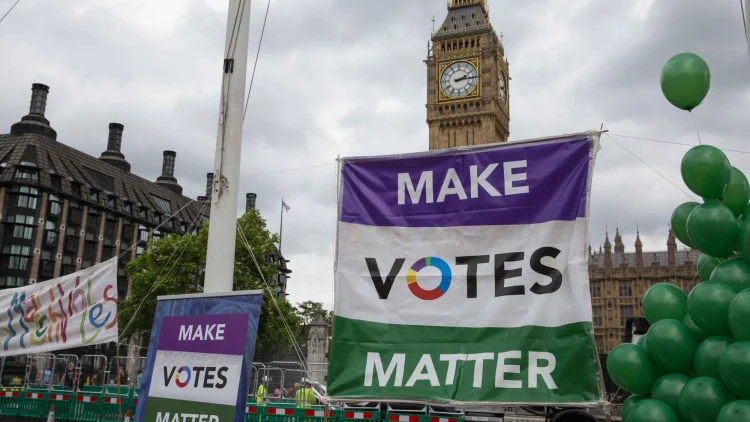
Save Our Democracy rally in Parliament Square | Image by: Mark Kerrison/Alamy Live News
4 min read
A fairer voting method, where parliamentary representation is broadly in line with votes cast, can be introduced with minimal change to our current electoral system
Advertisement
As both Houses are preparing to discuss election issues at national level, a fairer system for election to the House of Commons should be a priority.
I left behind my support for pure first-past-the-post (FPTP) in 1988 – and am seeking to obtain party representation broadly in line with votes cast. It can be done with minimal change to the current electoral system.
In principle we should make use of one vote for individual party candidates for two purposes: once for the election of a candidate on a constituency basis and again for the political party on a regional basis. A Mixed-Member Proportional System created from one vote with two values.
Advertisement
The ballot paper would be exactly the same as at present. The voter would mark an ‘X’ against a single candidate for a constituency Member. The votes for parties would be aggregated on a regional basis so that regional Members would be designated from the highest runners up. Direct constituency Members would dominate the parliament in the order of about five to one compared to regional Members.
Such a process requires every Member of the Commons to stand for election in a constituency. No need for party lists. By-elections can easily be accommodated.
It allows maximum voter control. All Members would carry out constituency duties no different to the variety of work as at present.
Advertisement
It removes the temptation for tactical voting and the use of quotas or thresholds.
Tiny parties or splinter groups from main parties do not get a look in.
Maintaining devolution, the UK would be divided into single seat parliamentary constituencies as at present. If, say, the Commons remains around 650 Members then a split of 500 for constituency seats and 150 for regional seats could allow for a broad connection between votes cast for political parties.
Using the one ballot obviates the need for long essays explaining changes to voting.
Advertisement
Such a process requires every Member of the Commons to stand for election in a constituency. No need for party lists
Yes, the 500 constituencies would be a bit larger than at present. The remaining 150 would be the highest runners-up candidates on a regional basis.
Assuming the UK would be split into (say) 10 regions to contain 50 constituencies, there would then be an additional 15 regional Members.
Advertisement
Obtaining the regional Member from the same ballot paper has many advantages. All Members have to be on a ballot paper. The highest runners-up would form the regional Members. If one party won all the constituencies in a region then the highest runners-up would all come from other parties.
All Commons Members will have faced the electorate. Some of the regional runners-up could well have higher votes than constituency Members elsewhere. Today there are many existing Commons Members sitting in Parliament with less votes than runner-up candidates in other constituencies.
While no threshold is needed it would be a requirement that no runner up candidate would qualify unless their registered party had won at least one direct constituency. This elevates the role of representation of communities.
Tactical voting as of today would deny a party the chance of regional Members. So the electorate are for the first time encouraged to vote for what they want as a first priority.
Advertisement
One vote with two values dilutes pure FPTP.
A practical diluted FPTP is far better than an impractical pure proportional representation (PR) system.
Some years ago I put such a plan to Labour’s Plant Commission into electoral reform. After some discussion and ironing out of detailed issues it almost obtained a majority.
I do believe it can accommodate the world we live in today with different numbers of registered parties and a different number of candidates.
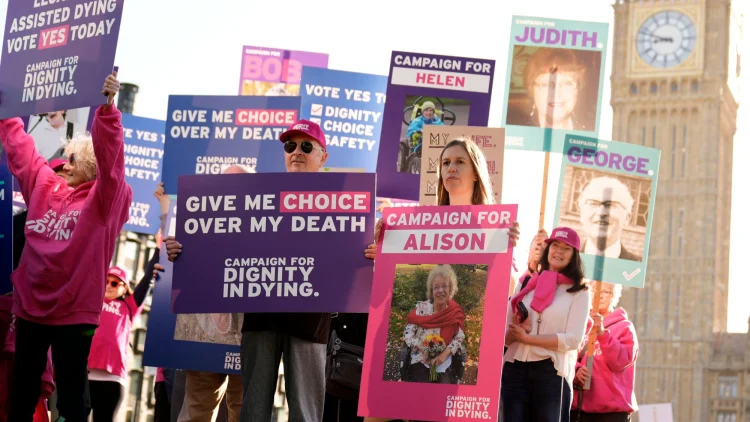
Pro-assisted dying campaigners outside the Houses of Parliament, September 2025 (PA Images / Alamy Live News)
4 min read
Few issues could be as emotive as assisted dying.
Advertisement
Views are often shaped by personal experience, such as the death of a loved one, or by religious belief. It was the former which led me to confess in the Lords Chamber that, if the proposals in the assisted dying bill amounted to the ‘loaded gun’ with which it was equated by Baroness Finlay of Llandaff, I would have been prepared to fire it at my mother, so great was her agony as she begged for help in the final hours of her protracted death.
I was a strong supporter of the bill but my speech was followed by one from Baroness Grey-Thompson, who opined that “the bill that the noble and learned Lord, Lord Falconer, is proposing is simply not fit for purpose”.
This could have been one of several recent Fridays in Westminster – but it was actually July 2014, and that bill was stymied by the general election the following year. Since then, many other countries have embraced the concept of assisted dying, yet the UK is about to flunk another attempt to change the law on this subject. This time, with some of the same peers participating and deploying the same arguments, the ultimate victim could be the House of Lords itself.
Advertisement
Respect for politics and politicians, already meagre, has been further eroded by the continuing fallout from the Epstein saga. An Upper Chamber stuffed with people born into a tiny sub-stratum of society, chosen by the Church of England or anointed by the leaders of political parties, was never easy to justify in a modern democracy. Finally ditching the hereditary element might once have been enough to temporarily appease those demanding change but the controversy over its handling of the assisted dying bill has put the institution in real jeopardy.
Since 2014, public opinion has moved steadily in favour of offering dying people a chance to end their lives in the way they choose. The Terminally Ill Adults (End of Life) Bill improves on previous efforts in this area and has been passed by the elected House of Commons. The role of the Lords, as its members keep saying, is to scrutinise and improve legislation, employing the extensive and hugely varied expertise its members can bring to bear. But it stretches the bounds of credibility to argue that this is all that has happened when a short bill has been subject to 1,253 amendments.
The protracted and repetitive speeches these have produced, rendering it impossible for the bill to come close to meeting a workable timetable, have raised doubts as to whether self-regulation is any longer workable. If it looks like a filibuster, sounds like a filibuster and has the same effect as an intentional filibuster, then people will conclude that it is just that. And a House that cannot prevent such behaviour killing a bill that has the support of the elected members and the public is simply not fit for purpose. Rather than be an effective scrutineer, the Lords has allowed the personal prejudices of a few to thwart the wishes of the many.
Advertisement
The bill is not perfect: such legislation could never cater for all eventualities, and some opponents have proved hugely imaginative in positing extraordinary situations with which any new ‘assisted dying regime’ might have to contend. Others have sought to impose such conditions and demands that it would be impossible for any really sick person to comply, let alone the terminally ill. Cries for yet more ‘safeguards’ ignore that, currently, there are no real protections to stop grasping relations from encouraging a trip to Dignitas or suggesting that the patient should forgo further life-preserving treatment.
Meanwhile, people who are close to death and desperate to have some control over the manner and the timing of their exit continue to be deprived of even that option.
Jack and Aree are already parents to a three-year-old daughter, Maple. He also has three more daughters, Pearl, Andy and Minnie, with his first wife, Lisa Stelly.
Back in December, Jack told The Sun On Sunday that his late father had learned he would be a grandfather once more before he died last July, and admitted the pregnancy had been a welcome distraction for the grieving family.
Advertisement
“It’s been partly a healthy distraction, partly healing – probably in that kind of ‘full cycle’ category, in a weird way,” Jack explained. “It’s very much taken energy out of the grieving side of things and parked in a bit more hopefulness.”
“We’re super-excited. It was sort of planned, I should say,” he added, before sharing that he and his new arrival was coming a little earlier than they had previously expected.
“It’s definitely something that we were wanting to pursue and somehow it happened, miraculously,” Jack said.
BBC presenter Emma Barnett tore into the government’s “boys’ club” culture in a tense interview with a Labour minister over the Peter Mandelson files.
The government has just released the first tranche of documents related to the vetting of the former Labour peer before he was appointed as the UK’s ambassador to Washington.
The files show Keir Starmer’s national security adviser Jonathan Powell warned about the reputational risk of hiring Mandelson over his close friendship with the late paedophile Jeffrey Epstein.
Powell also noted the appointment was “weirdly rushed”, while officials told The Times that the security adviser privately said that “Peter is always a disaster and we always end up firing him”.
Advertisement
Former permanent secretary at the Foreign Office Sir Philip Barton raised concerns about the appointment, too.
Formal advice to the prime minister pointed out that Mandelson remained friends with Epstein until at least 2014, long after his conviction of soliciting a minor for prostitution in 2009.
Starmer still hired Mandelson in December 2024 though he has since claimed the peer lied to him.
On BBC Radio 4′s Today programme, Barnett asked cabinet minister Nick Thomas-Symonds why Powell thought this appointment “weirdly rushed” and “unusual”.
Advertisement
The paymaster general said: “Obviously this was, by its nature, an unusual appointment.
“It was a political appointment, they’re not unheard of, they do happen.”
He added “there are questions that need to be asked” about the speed of the appointment and the security vetting.
But Barnett said the UK has a right to understand how sound Starmer’s judgement is, considering he still hired Mandelson despite warnings of “reputational risk”.
Advertisement
“He ignored not only Jonathan Powell, but Sir Philip Barton,” she said.
“Why did he ignore top individuals and rush through a weirdly unusual process to put Lord Mandelson as our man in Washington?”
The minister said Starmer had asked the ex-ambassador his own questions but that document is not yet in the public domain.
That item will be released at a later date, when the police probe into Mandelson concludes.
Advertisement
Barnett pressed: “Do you accept the reputational damage this has done to Sir Keir Starmer?”
She continued: “The suffering of women was ignored. The abuse of underage girls was not as a barrier to friendship to Lord Mandelson.
“And nor was that seen as a problem by all the men advising the prime minister. You want to talk about boys’ clubs, you want to talk about women?”
Barnett pointed out that chief secretary to the prime minister, Darren Jones, had extended his sympathies to Epstein’s victims during his statement to the Commons – but she added: “It’s too little, too late isn’t it?”
Advertisement
Thomas-Symonds said: “I acknowledge entirely, not just in politics, in society, in business, issues – you’re right, men in power abusing their position.
“I’m not running away from that, that’s something we need to tackle.”
But he claimed Starmer has given an “absolute priority” across his career to halve violence against women and girls.
“Two things can be true,” she insisted, noting that the minister had still avoided questions over what this means for Starmer’s reputation.
Advertisement
The presenter said: “He’s a man of legal training, why wasn’t the sceptical, analytical part of his brain switched on enough, as prime minister, to say, ‘no, there must be someone better’?”
Thomas-Symonds insisted Starmer has asked questions to Mandelson in private and regrets that appointment.
Mandelson denies all allegations of wrongdoing, including alleged misconduct in public office.












 Going further