Kush Bristol will be located in the former home of The Mint Room on Clifton Road
Birmingham chef Aktar Islam is expanding into Bristol
A Michelin-starred chef is poised to launch a new Indian restaurant in Bristol. Aktar Islam, the holder of two Michelin Stars, is preparing to officially unveil his latest venture, Kush Bristol, in Clifton, though an exact opening date has yet to be announced.
The announcement follows a special supper club series that was promoted on OpenTable in January, and now the shopfront on Clifton Road appears primed for an imminent launch. The new eatery will occupy the former premises of The Mint Room, another Indian restaurant which shut its doors in 2024 after nearly a decade, reports Bristol Live.
The renowned chef, who has featured on programmes such as Saturday Morning Kitchen and Great British Menu, already operates a two Michelin star restaurant in Birmingham, named Opheem. Before the supper club series in January, Aktar and his team said: “Bristol is all about community, and these evenings are rooted in the way Indian meals are meant to be enjoyed: communally, with shared plates, shared stories, and the kind of warmth that turns fellow epicureans into friends.
“Growing up, food was never just food – it was ritual. It was laughter around the table, debates over spice levels, and the comfort of dishes that tasted like home. That’s the spirit we’re bringing to Kush and to these intimate evenings, before we officially launch.
Advertisement
“Each night will showcase a generous feast inspired by recipes from across the Indian subcontinent. Some dishes will feel familiar, others will be rare gems – regional delicacies carrying the soul of a place, a people, a memory.”
The Kush by Aktar Islam Instagram account published its inaugural post back in September 2024, mere months following The Mint Room’s closure, with the simple message: “Something exciting coming soon…”
A post on the Curry Society UK Instagram page revealed The Mint Room receiving fresh signage displaying ‘Kush by Aktar Islam’ on the window. The Curry Society, who dubbed Aktar Islam the ‘enfant terrible’ of the Indian culinary world, added: “This is big news and all our friends in the restaurants game in and around Bristol are all so excited, without exception. Welcome to Bristol, Chef Islam!”.
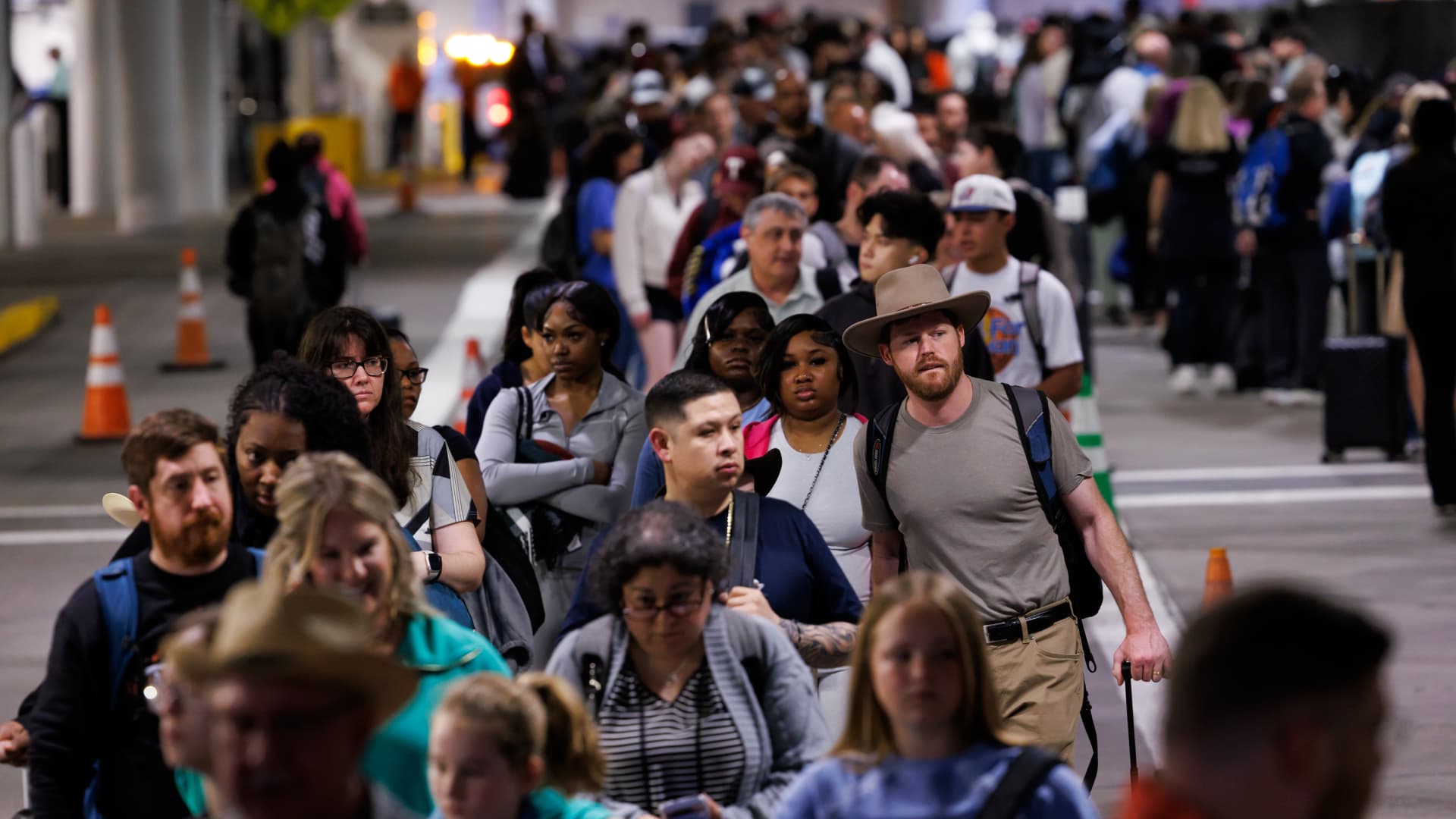
Travelers wait in line at a Transportation Security Administration (TSA) checkpoint at William P. Hobby Airport in Houston, Texas, US, on Monday, March 9, 2026.
Mark Felix | Bloomberg | Getty Images
The surge in fuel prices since the U.S. and Israel attacked Iran nearly two weeks ago is already driving up airfare. Consumers’ appetite for travel this year will dictate just how much.
Advertisement
Cathay Pacific on Thursday said it would roughly double fuel surcharges on tickets starting March 18.
Earlier this week, Australia’s Qantas said it israising fares to help cover its costs, Scandinavian Airlines said the “unusually rapid and substantial increase” in fuel prompted it to raise prices, and Air New Zealand pulled its financial outlook “until fuel markets and operating conditions stabilise,” adding that it has made “initial fare adjustments.”
“If the conflict leads to continued elevated jet fuel costs, the airline may need to take further pricing action and adjust its network and schedule as required,” Air New Zealand said.
U.S. airline CEOs and other executives will update investors on Tuesday at the J.P. Morgan Industrials Conference in Washington, D.C.
Advertisement
Analysts expect an earnings hit at least in the first quarter if not the first half of the year, though the impact will depend on how long higher fuel prices last.
“We think a hit to 1Q EPS appears almost certain at this point,” UBS airline analysts Atul Maheswari and Thomas Wadewitz wrote in a note last week.
United Airlines CEO Scott Kirby said last week on the sidelines of an event at Harvard University that higher fares were likely on the way because of the surge in fuel prices.
Kirby said travel demand is still strong, however. Two other senior airline executives at U.S. carriers, speaking on the condition of anonymity because they weren’t authorized to speak to media, also said travel demand has held up. If those trends persist, it could give airlines more pricing power, but that will depend on the war’s duration.
Advertisement
“Airlines never met a higher fare they didn’t want,” said Scott Keyes, the founder of flight-deal company Going, previously known as Scott’s Cheap Flights.
So what should consumers do?
Keyes said travelers can’t lose by booking early, as long as they’re not buying restrictive basic economy tickets. That way, customers can try to exchange or cancel their tickets and buy cheaper ones if airfare ends up falling.
“If you book a $500 summer flight today, and two weeks from now the price drops to $350, you can call up the airline and get the $150 difference back as a credit. Heads you win; tails the airlines lose,” he said.
Advertisement
Read more about the Middle East conflict’s travel impact
Fuel costs
Jet fuel is airlines’ biggest cost after labor, accounting for about a fifth or more of expenses, depending on the airline.
United alone spent $11.4 billion last year on fuel, at an average price of $2.44 a gallon, according to its annual report securities filing. U.S. jet fuel on Wednesday was going for $3.78 a gallon, according to Platts.
Jefferies airline analyst Sheila Kahyaoglu said in a note Thursday that she expects “the most acute financial impact to airlines from surging oil prices to be in the next 30-90 days as airlines have been booking yields for close-in flights assuming a much lower fuel price and carriers cannot retroactively raise fares.”
She said Delta Air Lines and United, which produce most U.S. airline profits, are better positioned than other carriers because of their high-end demand. Risks to demand, particularly for more price-sensitive customers, include the recent jump in gasoline prices.
Advertisement
Jet-fuel have more than doubled in some regions since the first U.S.–Israel attacks on Iran on Feb. 28.
Line Service Technician Austin Beadles refuels a plane using a Federal Aviation Administration approved unleaded aviation fuel at Sheltair at Rocky Mountain Metropolitan Airport in Broomfield on Tuesday, Feb. 17, 2026. Sheltair, a fixed-base operator, will offer the Swift UL94 unleaded aviation alternative gas to pilots. (Photo by Matthew Jonas/MediaNews Group/Boulder Daily Camera via Getty Images)
Matthew Jonas | Boulder Daily Camera | MediaNews Group | Getty Images
Oil prices surged to roughly four-year highs after the initial attacks. Energy prices have since swung wildly since then as traders assess just how long the war — and all the logistics headaches — could last.
Advertisement
U.S. jet fuel prices were up more than 60% from before the attacks to a peak last week, according to pricing data assessed by Platts. Jet fuel can rise by a greater degree than crude because it includes the price of processing and ever-more difficult and costly transportation from oil fields to refineries to airplane fuel tanks.
On Feb. 27, the day before the before the attacks, the cost to fill the fuel tanks of a Boeing 737-800 would have would have been about $17,000 based on average prices in New York, Houston, Chicago and Los Angeles, compiled by Argus. Less than a week later, on March 5, it would have cost more than $27,000, based on Argus prices. On Tuesday, after oil prices fell following President Donald Trump‘s comment that the Iran war could end “very soon,” it would have cost around $23,000.
After prior fuel price surges, airlines started making customers pay for bags — or charging them more. Even seemingly minor changes in weight can save airlines hundreds of thousands, if not millions of dollars, a year in fuel. United in 2018 changed to a lighter paper stock for its in-flight magazine. In 2014, American Airlines said it would switch to digital manuals for flight attendants, following changes for pilots. It said at the time that it would save $650,000 in fuel a year.
All about capacity
High fuel prices don’t automatically mean higher fares. The ongoing strong demand for travel is a key factor and so is capacity, or the amount that carriers fly.
Advertisement
If airlines raise fares and passengers balk, then capacity will likely go down in the form of fewer frequencies on a route or broader cuts, in more severe cases.
“Airlines love to say fuel is expensive so you have to pay more. What they’re doing is they’re setting the expectation,” said Courtney Miller, founder of Visual Approach Analytics, an airline-industry advisory firm. “They price to prevent empty seats.”
If fuel prices come down, “they’re not suddenly saying ‘We’re making too much money,’” Miller added. “But they are likely to add another flight.”
Capacity, especially to and from the Middle East, is constrained because of airspace closures and other stop-and-start flights. More than 46,000 flights have been canceled to and from the region since the Feb. 28 attacks began, aviation-data firm Cirium said.
Advertisement
Those constraints are driving up fares as well as demand, as United’s Kirby said, from regions where customers are looking for alterative routes.
Airspace closures are also requiring airlines to take longer, more fuel-guzzling routes, but many have strong demand, too.
Qantas, for example, told CNBC that its flight from Perth, Australia, to London is temporarily stopping in Singapore to refuel, allowing it to pick up another 60 customers, and that its Perth-London and Perth-Paris routes are more than 90% full this month, 15 percentage points higher than normal for this time of year.
Finnair said the increased demand for travel to Asia from Helsinki, Finland, has pushed up its prices by 15% on average.
“The impact of higher fuel prices will be reflected in market fares with a delay, as airlines typically hedge at least part of their fuel purchases,” it said.
Advertisement
Airlines have been grappling with airspace closures for years, including from on-and-off conflict in the Middle East and since Russia’s 2022 invasion of Ukraine, that have left a large swath of airspace out of use for many carriers.
‘You can’t dry up an airport’
Most U.S. airlines no longer hedge fuel costs, or lock in prices using futures and other securities. Southwest Airlines was one of the last holdouts, and it quit last year. A spokesman for the Dallas-based airline told CNBC that Southwest currently has “no plans” to resume hedging.
That leaves U.S. carriers more susceptible to price swings.
Travelers at William P. Hobby Airport in Houston, Texas, US, on Monday, March 9, 2026.
Advertisement
Mark Felix | Bloomberg | Getty Images
Kirby said there would likely be an impact to United’s first-quarter results and to the second quarter if the war — and blockage of the Strait of Hormuz, a key shipping channel — persists. However, he said demand was increasing sharply from regions that have been affected by the thousands of flight cancellations and airspace closures in the Middle East.
Because of airlines’ upbeat outlooks on demand to start the year, “the environment is conducive for passing along fare increases. Further, should jet fuel stay higher for longer, it should help push off-peak capacity lower,” supporting unit revenues, UBS analysts said.
Rick Joswick, who heads of near-term oil research and analytics at S&P Global Energy, told CNBC that “demand for jet fuel is inelastic. You cannot shortchange an airport. If the cost of jet fuel goes up, it’s not like the plane will choose not to fly that day.
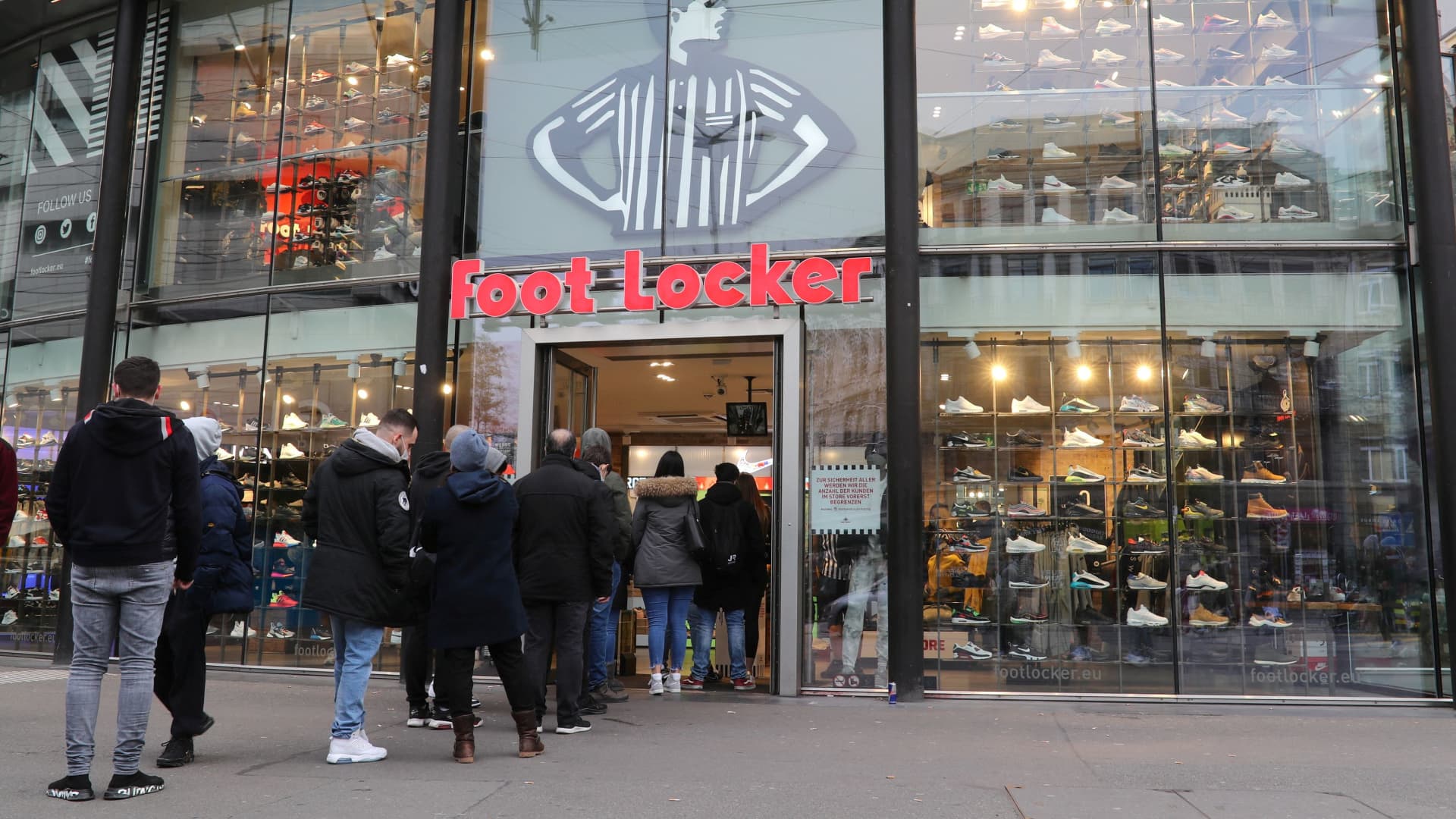
FILE PHOTO: People queue during Black Friday sales in front of a Foot Locker shoe store, in Zurich, Switzerland November 27, 2020.
Arnd Wiegmann | Reuters
Dick’s Sporting Goods said Thursday it saw a better-than-expected holiday quarter, but the retailer issued weak profit guidance for the year ahead as its acquisition of Foot Locker continues to weigh on its bottom line.
Advertisement
The company is expecting fiscal 2026 adjusted earnings per share to be between $13.50 and $14.50, weaker than the $14.67 analysts had expected, according to LSEG.
Dick’s said it expects Foot Locker to get back to both profit and sales growth during the year, but it’s still doing the costly work of clearing through stale inventory and closing unproductive stores that it acquired during the merger last year.
The company expects those efforts, along with other expenses associated with the deal, to cost between $500 million and $750 million. It said around $390 million of those costs were recorded in fiscal 2025, with more expected in the current fiscal year.
In an interview with CNBC’s Sara Eisen, executive chairman Ed Stack said the company is “basically done” with its efforts to rightsize the Foot Locker business.
Advertisement
“In retail you’re never really done cleaning out the garage,” said Stack. “Anything else going forward is normal course of business.”
Dick’s beat Wall Street’s expectations on the top and bottom lines for the three months ended Jan. 31. Here’s how the company did in its fourth fiscal quarter compared with what Wall Street was anticipating, based on a survey of analysts by LSEG:
Earnings per share: $3.45 adjusted vs. $2.87 expected
Revenue: $6.23 billion vs. $6.07 billion expected
Dick’s posted a net income of $128.3 million, or $1.41 per share, a 57% decline from $299.97 million, or $3.62 per share, a year earlier.
Sales rose to $6.23 billion, up from $3.89 billion a year earlier, when the business didn’t include Foot Locker.
Six months ago, Dick’s acquired Foot Locker in a $2.5 billion deal, and the combined entity is now one of the largest distributors of products from key athletic brands like Nike, Adidas and New Balance. The merger gave Dick’s an in with a new type of customer, allowed it to expand its international presence and gave it more negotiating power with brands at a time when athleticwear companies are less reliant on wholesalers.
Advertisement
While the acquisition led to a 60% increase in sales during the fiscal fourth quarter, it also saddled Dick’s with a business that’s underperformed for years and earns most of its revenue from a sprawling store footprint heavily concentrated in malls.
Since acquiring the business, Dick’s has worked to clcose poor performing stores. In fisal 2025, it shuttered 57 stores globally across Foot Locker, Champs, Kids Foot Locker and WSS.
It’s started a pilot program with 11 Foot Locker stores dubbed “Fast Break” that’ll test changes in products and the in-store presentation. So far, Dick’s said the pilot has delivered “standout performance” through improved storytelling and presentation and a streamlined assortment. The retailer plans to expand the model later this year.
Prior to the acquisition, Foot Locker’s former CEO Mary Dillon had been leading an aggressive store transformation strategy that sought to move shops to off-mall locations and renovate existing doors with a refreshed concept. It’s unclear if Fast Break will be different from the strategy Foot Locker already had underway.
Advertisement
Dick’s said it expects to see an inflection in Foot Locker’s comparable sales and profitability beginning with the back-to-school shopping season. For the full year, it expects Foot Locker comparable sales to grow between 1% and 3%.
The online travel agent has scrapped its profit guidance for the forthcoming year after warning that conflict has sparked a sharp slowdown in bookings to Turkey, Greece, Cyprus and Egypt
Simon Hunt www.cityam.com
10:16, 12 Mar 2026Updated 10:16, 12 Mar 2026
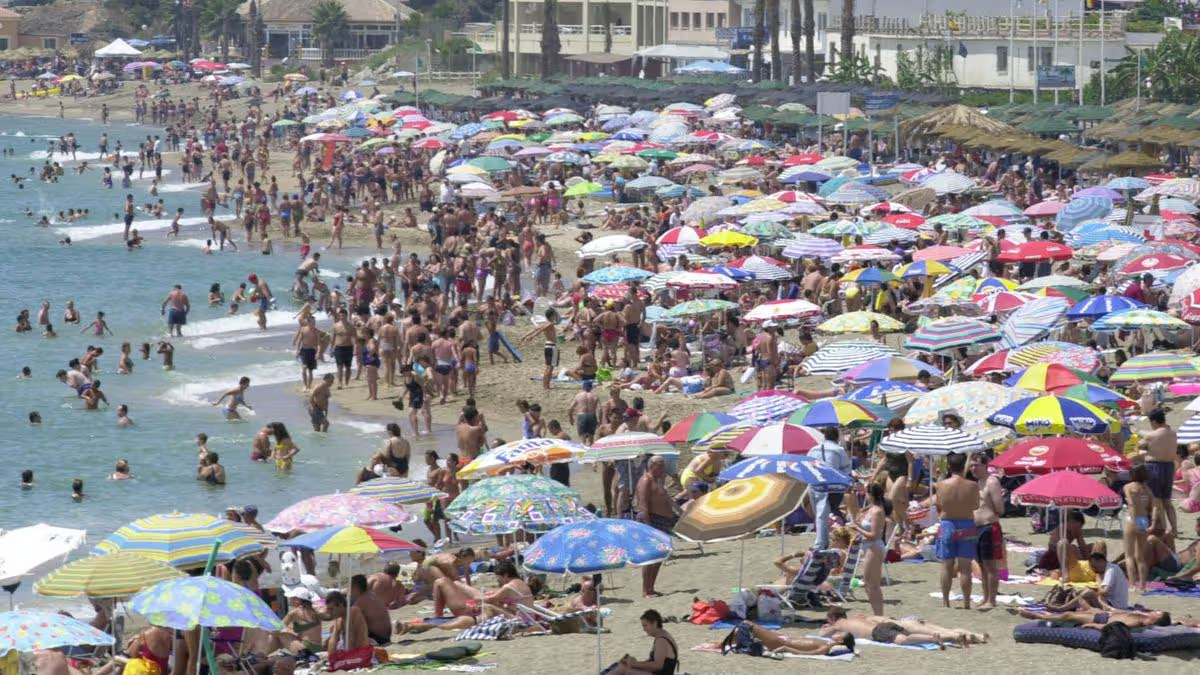
On the Beach says bookings to countries including Turkey and Cyprus have fallen(Image: PA)
On the Beach has scrapped its guidance for the coming year after cautioning that Middle Eastern tensions have triggered a marked decline in bookings.
Advertisement
The online travel agent had previously projected pre-tax profit of between £39m and £43m.
“Whilst the group has limited exposure to destinations in the Middle East, it has experienced a significant slowdown in demand following the onset of conflict in the region, particularly to destinations such as Turkey, Greece, Cyprus and Egypt,” the Manchester-based firm said.
“The timing of when the conflict will end and the shape of recovery in demand to these destinations are unknown.”
On the Beach has been “working round the clock to support directly impacted customers in resort and to enable a return home as soon as possible,” chief executive Shaun Morton said.
Advertisement
Shares in On the Beach plummeted as much as 14.5 per cent to 165p on Thursday morning, though recovered a little later. The stock has dropped by more than a quarter since the beginning of the year, as reported by City AM.
The development adds On the Beach to an expanding roster of London-listed travel firms that have endured steep share price falls following the eruption of conflict in Iran.
Budget carrier Easyjet has witnessed its shares tumble by a fifth over the past month, whilst package tour operator Jet2 has declined by 11 per cent.
Oil prices surged back above triple figures on Thursday morning, climbing as much as nine per cent in Asian markets following reports that two tankers were hit in the Gulf. An Iraqi news agency reported that 38 crew members have been rescued from the vessels whilst one person has perished.
Advertisement
This follows Iran’s pledge to block “one litre of oil” from leaving the region until the strikes from the US and Israel cease. The Israeli military confirmed it had conducted an “extensive” wave of air strikes targeting Tehran overnight.
The International Energy Agency (IEA) intervened on Wednesday to stabilise oil prices through the release of a record 400 million barrels from emergency oil reserves in an attempt to contain surging prices on Wednesday – though market response remained subdued.
The IEA’s executive director Faith Birol stated on Wednesday the market “challenges we are facing are unprecedented in scale”.
Yet Brent crude – the international benchmark for oil – scarcely responded to the measure, remaining steady above the $90 threshold. Meanwhile, the FTSE 100 reversed to a decline, dropping 0.5 per cent during the day’s trading.
Advertisement
Analysts at investment bank Macquarie have suggested the continuing tensions surrounding the Strait of Hormuz could drive the price of Brent crude to “$150 or higher”.
“The timeline for an extremely large oil price move is very short,” they stated, noting that several weeks of closure for the strait – through which approximately a fifth of the world’s oil supply passes – would trigger a “domino effect”.
Bookings on the up Prior to the latest upheaval, On the Beach recorded a 10 per cent rise in bookings during the six months ending February, with reservations from returning customers climbing 19 per cent.
The firm noted that an increasing number of users are arranging holidays via their mobile devices, with a 58 per cent surge in bookings made directly through the app.
Advertisement
On the Beach is also anticipating revenue from AI chat tools, having recently submitted its app to ChatGPT.
Australian shares have nosedived on reports Iran has attacked two oil tankers in Iraqi waters, snuffing de-escalation hopes and slingshotting crude prices skyward.
The South Tyneside-based firm says it remains to be seen how the cost of living crisis will continue to impact its market
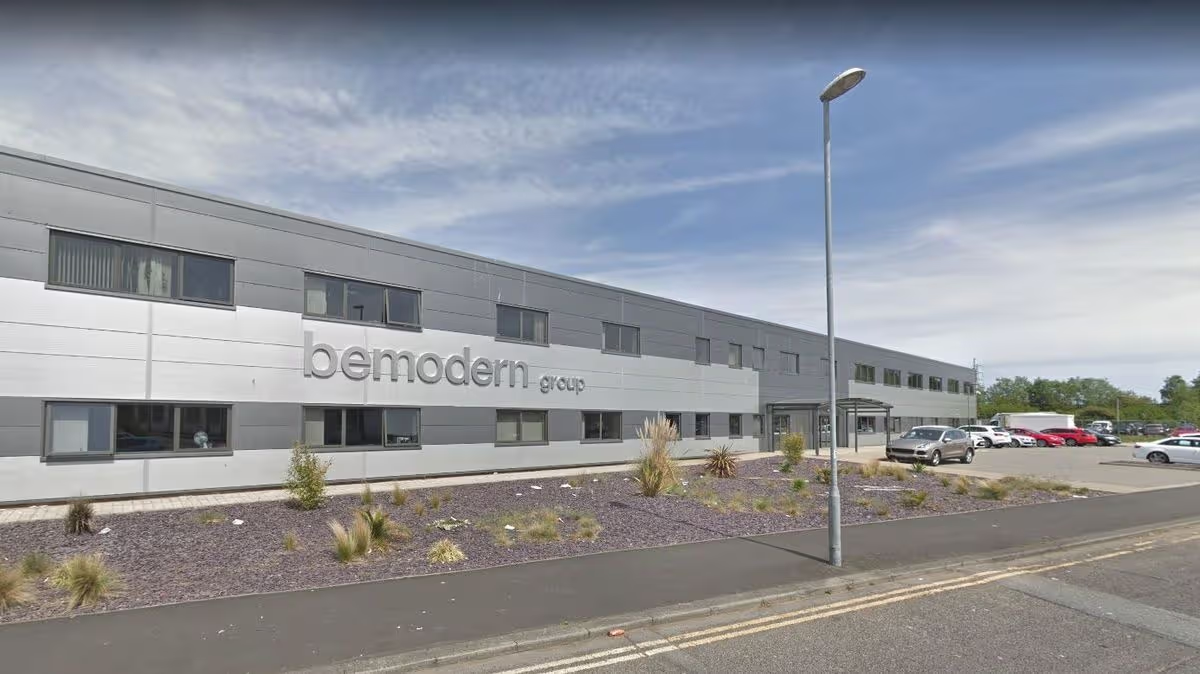
Be Modern’s site in Jarrow(Image: Google Maps)
Losses have widened at South Tyneside furniture maker BeModern amid cost pressures, though bosses say cost reductions and new products are helping.
The Jarrow firm, which has been trading for more than 60 years, produces a number of brands including Diamond Luxury Fireplaces, Atlanta Bathrooms, Elgin & Hall and Prysm for the UK market. The fireplace, stoves and bathroom furniture specialist operates from 250,000 sqft production and warehouse space employing about 236 staff.
Newly published accounts for Be Modern Limited show it sustained operating losses of more than £1m in the year to May 10 2025, up from £940,359 the year before. Gross profit fell from £10.8m to £9.8m as turnover also slid from £20.8m to £19.2m.
Bosses said that despite a slight fall in gross margin, they were pleased with efficiency improvements which meant it was less than expected. That came amid rises in labour and materials costs, as headcount was reduced from 254 to 236.
Advertisement
Writing in the accounts, director Stephen Grimes said: “It remains to be seen how the continuing cost of living crisis caused by an unprecedented increase in the cost of power, fuel, interest rates and basic foodstuffs will impact on the demand for the company’s products over the coming year should customers reign in their discretionary expenditure in response to these cost pressures.
“The company itself is not immune to such cost pressures within the supply chain in terms of the cost and supply of labour across all sectors and continued significant increases in the cost of raw materials means that unavoidably the company may have to pass these on to customers over the 12 months ahead if margins are to be maintained.
“The lowering of the threshold at which employers National Insurance contributions becomes payable and the increase in the percentage, along with the rise in minimum wage in the 2024 Budget had a significant impact upon the company overheads and manufacturing costs.”
Mr Grimes said directors were aware of the challenges and that Be Modern continued to invest in new product ranges and ways to grow, as well as boosting service levels for existing customers.
Advertisement
He added: “The measures taken by the directors to reduce the company’s cost base in the latter part of the 2025 financial year and the introduction of new products appear to have had a positive impact on the current year as the half year results indicate a significant improvement on the previous year. Whilst this gives cause for optimism the directors will continue to explore further cost saving and commercial opportunities going forward.”
To find all the planning applications, traffic diversions, road layout changes, alcohol licence applications and more in your community, visit the Public Notices Portal.
Stock-market indexes end mostly flat, with the Dow Jones industrials and the S&P 500 down slightly. The Nasdaq composite edges higher. Boeing shares slide after the company announces delivery delays for its 737 Max aircraft. And Exxon Mobile stock slips after the company says it is moving its corporate headquarters to Texas from New Jersey.
Medical technology giant Stryker Corporation suffered a major cyberattack on March 11, 2026, that crippled its global IT systems, wiped data from thousands of employee devices and idled tens of thousands of workers worldwide, according to company statements, employee reports and cybersecurity analysts.
Stryker Corporation
The breach, which began overnight and affected operations across the United States, Europe and Asia, has been linked to the pro-Palestinian hacktivist group Handala, widely believed to have ties to Iran. Handala claimed responsibility on social media, describing the incident as retaliation for a recent U.S. military strike on a school in Minab, Iran, that reportedly killed around 160 people amid escalating U.S.-Iran tensions.
Stryker, headquartered in Portage, Michigan, and a leading manufacturer of medical devices including orthopedic implants, surgical equipment and hospital beds, employs approximately 56,000 people globally. The company has a significant presence in Ireland, where its Cork headquarters and facilities employ up to 5,000 workers, making the Emerald Isle one of its largest operational bases outside the U.S.
A Stryker spokesperson confirmed the incident in a statement to customers and media: “We are currently experiencing a global network disruption affecting the Windows environment.” The company emphasized it had “no indication of ransomware or malware” in initial assessments but acknowledged the widespread outage. Stryker said it was working urgently to restore systems, with assistance from external cybersecurity experts including Microsoft engineers.
Reports from affected employees and sources familiar with the matter indicate the attack deployed destructive “wiper” malware. Unlike traditional ransomware, which encrypts files and demands payment for decryption, wiper malware permanently erases data, rendering it irrecoverable. Devices connected to Stryker’s network—including laptops, cellphones and other Windows-based systems managed through Microsoft Intune—were reportedly wiped remotely. Login screens on compromised systems displayed the Handala logo, a symbol associated with the group.
Advertisement
The Wall Street Journal first reported the suspected Iran-linked nature of the attack, citing people familiar with the situation. Shares of Stryker (NYSE: SYK) fell about 3% to 3.4% in trading following the news, reflecting investor concerns over potential long-term impacts on operations and reputation.
Handala’s claim posted on X (formerly Twitter) boasted of wiping over 200,000 systems, servers and mobile devices while extracting 50 terabytes of critical data. The group framed the operation as part of broader retaliation against perceived aggressions by the U.S. and its allies in the ongoing Middle East conflict, including cyber operations targeting the “Axis of Resistance.”
Cybersecurity experts noted that while Handala has conducted previous disruptive attacks, often aligned with Iranian geopolitical interests, attribution remains challenging in the fluid world of state-sponsored and hacktivist operations. The use of wiper malware marks a particularly aggressive tactic, more commonly associated with nation-state actors seeking destruction rather than financial gain.
This incident comes amid heightened U.S.-Iran cyber tensions. Recent military actions, including joint U.S.-Israeli strikes inside Iran, have raised fears of retaliatory cyberattacks on American infrastructure and companies. Stryker’s selection as a target may stem from its global footprint, its role in healthcare—a critical sector—and any perceived ties to Israel through business dealings or supply chains.
Advertisement
The attack disrupted normal business functions, forcing employees to stay offline and halting access to internal software, email and communications tools. In Ireland, where Stryker’s Cork operations focus on manufacturing and research, thousands of workers were unable to perform duties, prompting local media to describe the incident as crippling one of the country’s key multinational employers.
No immediate evidence suggests patient data or medical devices themselves were directly compromised, as the attack targeted corporate IT networks rather than product systems. Stryker maintains separate security protocols for connected medical devices, and the company has a history of issuing advisories for vulnerabilities in products like its Vocera communication systems and hospital beds.
Stryker reported the breach to Ireland’s National Cyber Security Centre and is cooperating with authorities. The company has not disclosed the full scope of data loss or any potential exposure of sensitive information, though a separate data breach notification filed in late 2024—unrelated to this incident—involved unauthorized access between May and June of that year.
Analysts warn that recovery from a wiper attack could take weeks or months, as wiped systems require rebuilding from backups or clean installations. The incident highlights vulnerabilities in global supply chains and corporate networks, particularly for companies in strategic sectors like healthcare.
Advertisement
As investigations continue, the Stryker cyberattack serves as a stark reminder of the intersection between geopolitical conflict and cyberspace. With U.S.-Iran hostilities showing no signs of abating, experts anticipate further escalation in the digital domain.
Stryker officials have urged patience as restoration efforts proceed, assuring stakeholders that patient care and product supply remain priorities. The company has not released a timeline for full recovery.
Disclosure: This post contains affiliate links. We may receive a commission for purchases made through these links at no additional cost to you.