

Crypto World
Metaplanet stock drops despite new Bitcoin venture and asset management push

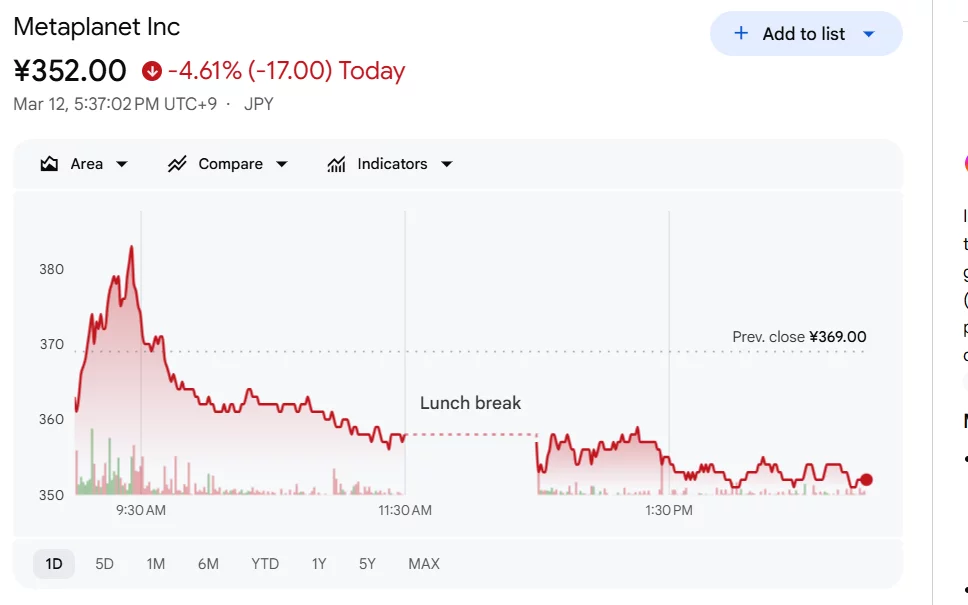
Shares of Japanese investment firm Metaplanet Inc declined Thursday despite the company unveiling a major expansion of its digital asset strategy, including a ¥4 billion venture initiative focused on the Bitcoin ecosystem.
Summary
- Metaplanet Inc shares fell about 4.6% despite announcing two new crypto-focused subsidiaries.
- The company will invest ¥4 billion through Metaplanet Ventures to support the Bitcoin ecosystem in Japan.
- Its first venture investment includes up to ¥400 million in JPYC, Japan’s licensed yen stablecoin project.
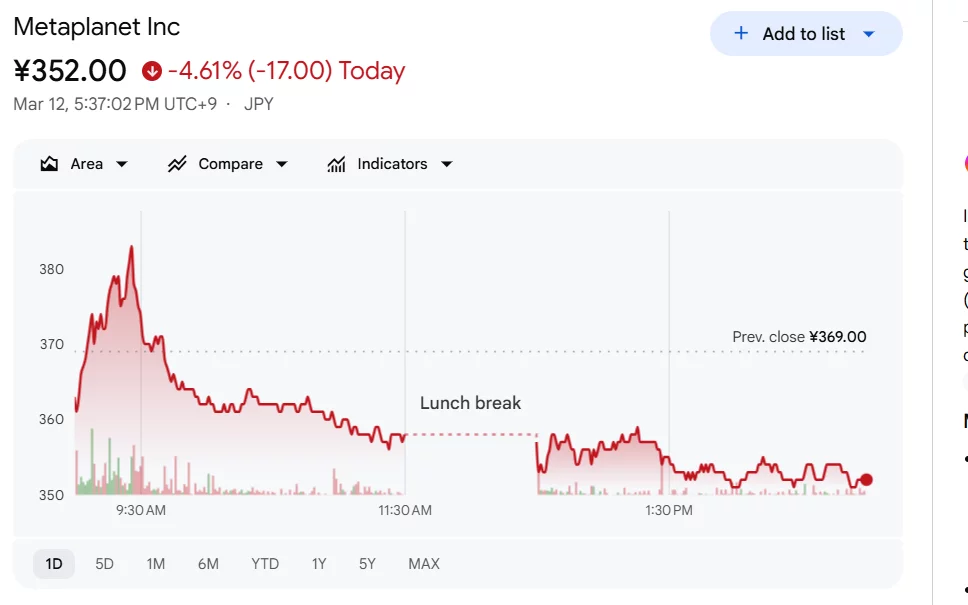
The company’s stock closed around ¥352, down roughly 4.6% on the day, according to market data, even as management outlined plans to deepen its involvement in crypto infrastructure and financial services.
In a statement posted by CEO Simon Gerovich on social media, Metaplanet said its board approved the creation of two wholly owned subsidiaries: Metaplanet Ventures and Metaplanet Asset Management.
Metaplanet Ventures will focus on investing in companies building financial infrastructure around Bitcoin in Japan. The firm plans to deploy ¥4 billion over the next several years across sectors such as lending, payments, custody, derivatives, compliance tools and stablecoin infrastructure.
“Metaplanet Ventures is our commitment to Japan’s Bitcoin ecosystem. We’ll be investing ¥4 billion over the next few years into companies building Bitcoin financial infrastructure in Japan,” the post said.
The venture arm will also launch an incubator for early-stage founders and provide grants for open-source developers and researchers working on Bitcoin-related technologies.
Gerovich said Japan already has one of the world’s strongest regulatory frameworks for digital assets but still needs more companies building the infrastructure required for institutional adoption.
The first investment from the new venture unit will be up to ¥400 million into JPYC, which operates Japan’s first licensed yen-denominated stablecoin.
The company is also launching Metaplanet Asset Management, a Miami-based platform designed to connect Asian and Western capital markets through digital credit and Bitcoin-linked investment strategies.
According to the CEO, the new unit will focus on products tied to yield, equity, credit and volatility strategies within digital asset markets.
The expansion reflects Metaplanet’s broader ambition to position itself as a bridge between traditional finance and the emerging Bitcoin capital markets ecosystem.
Metaplanet stock market reaction remains cautious
Despite the strategic announcement, the market reaction appeared muted. The company’s shares fell during the trading session after initially rising earlier in the day.
The decline suggests investors may be waiting for clearer details about the revenue potential of the new initiatives or how quickly the venture investments could translate into returns.
Metaplanet has increasingly positioned itself as a corporate advocate for Bitcoin adoption in Japan, mirroring strategies seen in other publicly traded companies that integrate digital assets into their broader financial strategy.



After the first wave of spot ether (ETH) exchange-traded funds launched without staking, BlackRock’s iShares Staked Ethereum Trust ETF (ETHB), one of the industry’s most anticipated versions, begins trading on Nasdaq on Thursday.
The fund marks the asset manager’s third crypto ETF and the first from BlackRock to incorporate staking. ETHB will hold spot ether and stake a portion of those holdings on the Ethereum network, allowing investors to potentially earn rewards while benefiting from price movements.
The new vehicle expands BlackRock’s existing digital asset lineup, which includes the iShares Bitcoin Trust (IBIT) and the iShares Ethereum Trust (ETHA). Those funds have grown rapidly since their launches, with IBIT today managing more than $55 billion in assets and ETHA about $6.5 billion.
“This is really about investor choice,” Jay Jacobs, BlackRock’s U.S. head of equity ETFs, told CoinDesk in an interview. “While ETHA has developed liquidity and a growing derivatives market, some investors are focused on maximizing total returns by combining ether price exposure with staking rewards, he added.”
Ethereum uses a proof-of-stake system that allows holders of its native token to lock up coins to help validate transactions and secure the network. In return, participants receive rewards, which many investors view as a yield-like feature of the asset.
Until now, most ether ETFs have offered only price exposure without staking, although some asset managers, including Grayscale, have recently launched ETFs with staking capabilities. Jacobs said that gap may have discouraged some crypto-native investors from moving assets into exchange-traded funds.
“Some investors who already hold ether directly were staking it and weren’t ready to move into an exchange-traded product because they would lose that feature,” he said. “By incorporating staking, the ETF allows investors to keep the benefits of staking while gaining the operational advantages of an ETF structure.”
Those advantages include institutional-grade custody, the ability to trade through traditional brokerage accounts and integration with standard portfolio allocations alongside stocks and bonds.
The product may also appeal to certain institutional investors who prefer assets that generate income or cash flow.
“For some institutions, when they evaluate an investment, they want to think about it from a cash flow perspective,” Jacobs said. Staking rewards may help make ether more comparable to other assets in portfolio models.
Read more: Crypto ETFs with staking can supercharge returns but they may not be for everyone
BlackRock expects interest in the product to come from a wide range of investors, including individual traders, financial advisors and institutional allocators such as hedge funds and family offices.
The fund carries a 0.25% sponsor fee, though BlackRock is waiving part of the cost for the first year, reducing it to 0.12% on the first $2.5 billion in assets. Jacobs said the temporary discount is intended to help the product gain traction in its early months.
Despite the growth of crypto investment products, allocations to digital assets remain relatively small in traditional portfolios. Institutions are typically allocating in the “low single digits,” often around 1% to 2%, according to Jacobs. At those levels, he said, the risk contribution of bitcoin or other digital assets can be comparable to the exposure investors already accept from large technology stocks within diversified portfolios.
BlackRock has rapidly become one of the largest players in crypto investment products. The firm oversees roughly $130 billion across crypto-related exchange-traded products, tokenized liquidity funds and stablecoin reserve management. According to the company, iShares captured about 95% of flows into digital asset ETPs in 2025.
For now, Jacobs said the firm remains focused on expanding adoption of its existing crypto products, particularly bitcoin and ether, as many investors are still learning about the asset class.
“We’re still in the early days of digital asset ETF adoption,” he said. “For many investors, this is the first step.”

Key Takeaways
- Ofgem has approved Tesla Energy Ventures’ application for a UK electricity supply license, now in effect.
- The licensing procedure spanned from July 2025 through March 2026 before final authorization.
- Tesla is now authorized to retail electricity to residential and commercial properties throughout Great Britain.
- The company enters competition with major British energy providers including Octopus Energy, British Gas, and EDF.
- A different Tesla entity, Tesla Motors Limited, previously obtained an electricity generation license in the UK.
Tesla Energy Ventures Limited has received authorization from Ofgem to retail electricity throughout Great Britain. The regulatory approval became effective Wednesday following a review process that commenced in July 2025.
The authorization encompasses both residential and commercial customer segments, enabling Tesla to distribute electricity directly to British households and enterprises.
This positions Tesla as a new competitor against Britain’s established energy retailers, including Octopus Energy, British Gas, and EDF.
Tesla has existing operations within the UK energy sector. Through Tesla Motors Limited, the company maintains an electricity generation license, and customers with Powerwall batteries can already monetize surplus solar generation through grid feed-in.
The newly granted supply license represents a logical progression — enabling Tesla to manage the entire cycle and distribute electricity directly as a retail provider.
Market Entry During Price Volatility
The authorization arrives during a challenging period for British consumers. Energy costs across Britain have increased following conflict in Iran, creating widespread concern about escalating utility expenses.
Most British households currently enjoy temporary protection from volatile gas prices through July under regulated pricing structures. However, this safeguard is temporary.
Tesla’s entrance into the market provides consumers with an additional choice among retail energy providers, although competitive pricing details have not been disclosed.
The automaker brings international energy market experience. Tesla Energy currently maintains operations in Australian and American energy markets.
Tesla’s British Market Standing
Tesla’s automotive sales in the UK have faced headwinds. Vehicle deliveries declined 8.9% year-over-year during 2025, impacted by competitive pressure from budget-friendly Chinese electric vehicle manufacturers.
Additionally, some markets have experienced consumer resistance connected to Elon Musk’s involvement in political discourse.
The energy sector provides Tesla an alternative growth channel in Britain — one independent of automotive performance.
Tesla has yet to reveal pricing structures, rate plans, or an official launch timeline for its electricity retail services in Great Britain.
Ofgem confirmed the license approval through an official regulatory announcement released this week.

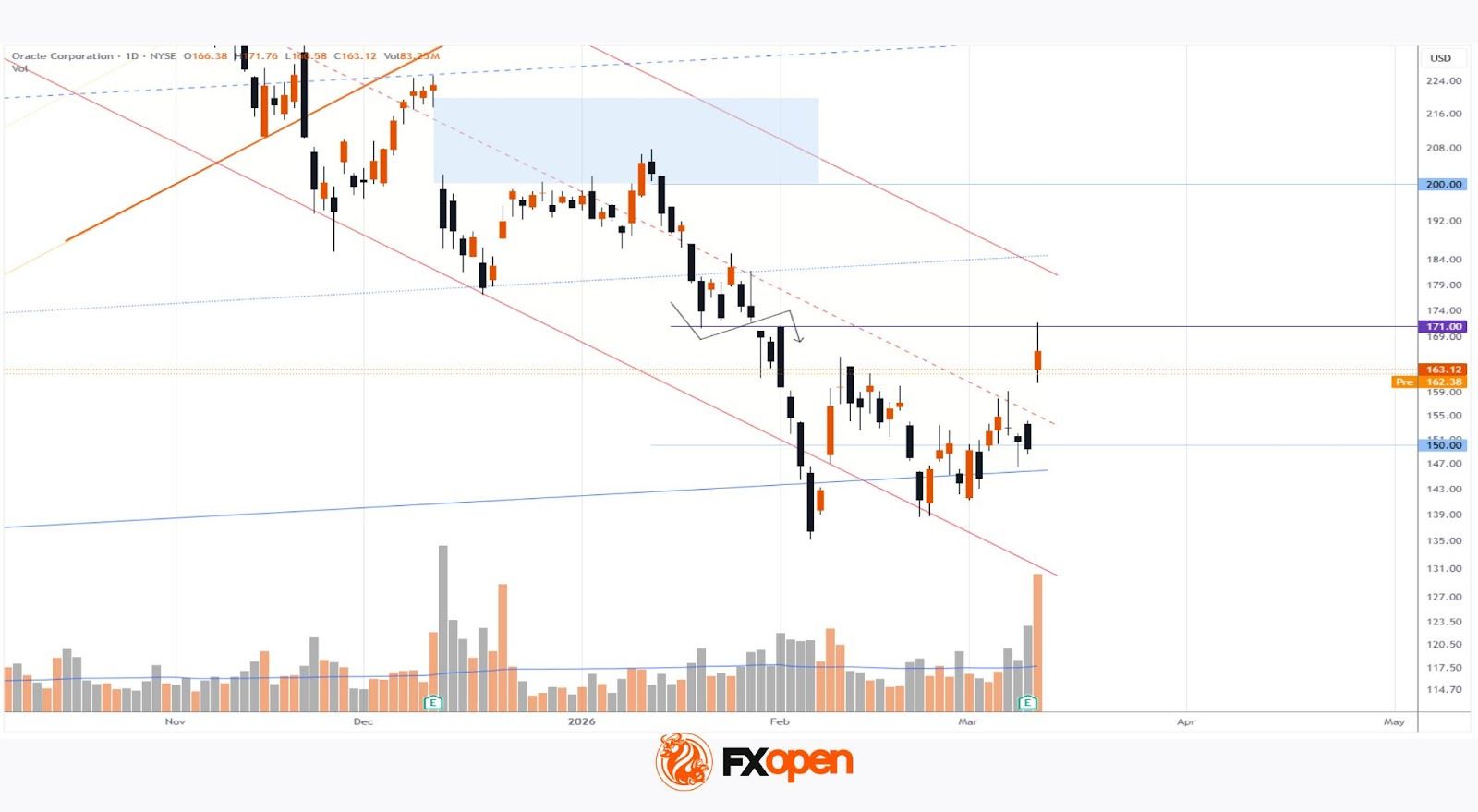
Following a strong earnings report, Oracle shares surged above $160, marking roughly a 1.5-month high:
→ Earnings per share: expected $1.70, actual $1.79;
→ Revenue: expected $16.7bn, actual $17.2bn.
This is the first quarter in 15 years in which both revenue and earnings rose by more than 20%. Additional optimism came from:
→ Cloud infrastructure revenue, which jumped 84% to $4.9bn;
→ Oracle confirming a five-year, $300bn deal with OpenAI (Project Stargate);
→ Total backlog (future revenue) surpassing $553bn.
These developments have the potential to significantly ease downward pressure on ORCL shares, which had been in a downtrend following a record high last autumn.
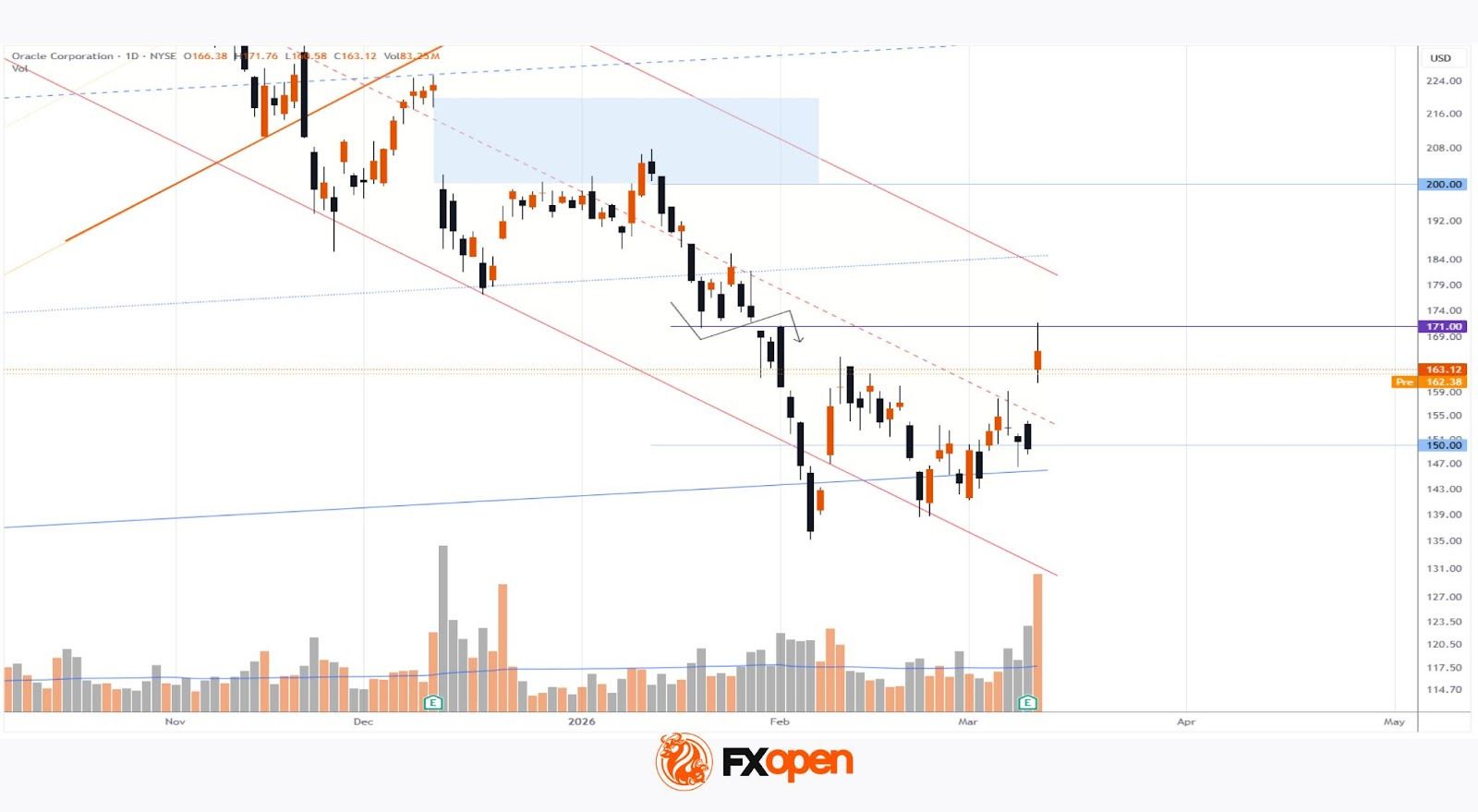
In our technical note of 5 February, the stock fell below $150, and we:
→ highlighted support levels that could halt further declines;
→ suggested that “smart money” might view prices below $150 as attractive.
That same day, ORCL shares formed a low from which they did not fall further.
Recent price action, including a bullish gap above $160, indicates that buyers are regaining control. However, they may need to exert substantial effort to confirm their strength, given that:
→ the $170 level, formerly support, now acts as resistance (indicated by an arrow);
→ the descending channel (shown in red) remains relevant.
Buy and sell stocks of the world’s biggest publicly-listed companies with CFDs on FXOpen’s trading platform. Open your FXOpen account now or learn more about trading share CFDs with FXOpen.
This article represents the opinion of the Companies operating under the FXOpen brand only. It is not to be construed as an offer, solicitation, or recommendation with respect to products and services provided by the Companies operating under the FXOpen brand, nor is it to be considered financial advice.
The global financial markets saw a notable shift as President Donald Trump declared the U.S. has effectively “won” the conflict with Iran, signaling a potential end to the 10-day military engagement known as Operation Epic Fury.
Summary
- The crypto market rebounded after President Donald Trump declared the U.S. had effectively “won” the conflict with Iran.
- Bitcoin surged over 5% to reclaim the $70,000 level as investors rotated back into risk assets.
- Analysts say a break above $72,500 could signal a broader crypto market rally if geopolitical tensions continue to cool.
The Geopolitical pivot: From “excursion” to victory
In a series of rapid-fire statements from Kentucky and Florida, President Trump characterized the war as a “short-term excursion” that achieved its primary objectives within the “first hour.” He claimed that roughly 80% of Iran’s missile launchers and much of its naval power have been neutralized.
For crypto markets, the rhetoric marks a critical transition.
While the President noted that forces would remain to ensure stability, the shift from active escalation to a “victory” narrative has triggered a classic “risk-on” rally.
Investors, who had previously fled to safe havens like gold and the U.S. Dollar, are now rotating back into high-growth assets as the threat of a prolonged energy chokepoint in the Strait of Hormuz appears to recede.
Crypto market rebounds “Peace Trade”
The crypto market acted as a primary barometer for this shifting sentiment. After sliding into the mid-$60,000 range earlier in the week due to war-induced panic, Bitcoin (BTC) staged a powerful recovery, jumping over 5% to reclaim the $70,000 psychological barrier.
Ethereum and major altcoins followed suit, with total crypto market capitalization rebounding to $2.45 trillion.
If the de-escalation holds, the “uncertainty overhang” that has suppressed prices since late February could vanish, potentially setting the stage for a run toward new all-time highs.
What the BTC chart says next
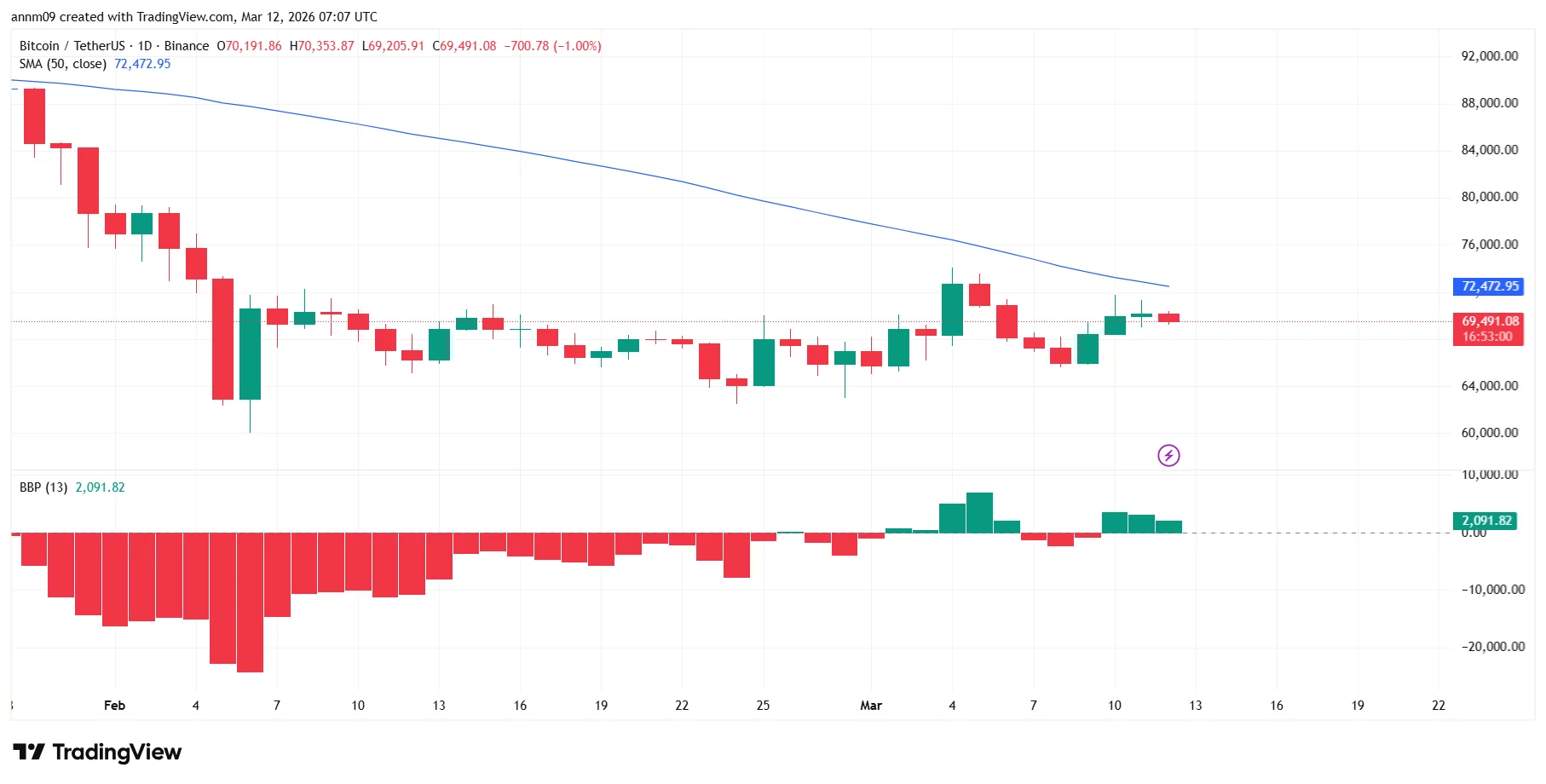
The BTC/USDT 1D chart highlights a significant technical tug-of-war. Despite the recent bounce, Bitcoin remains in a consolidation phase following its February peak.
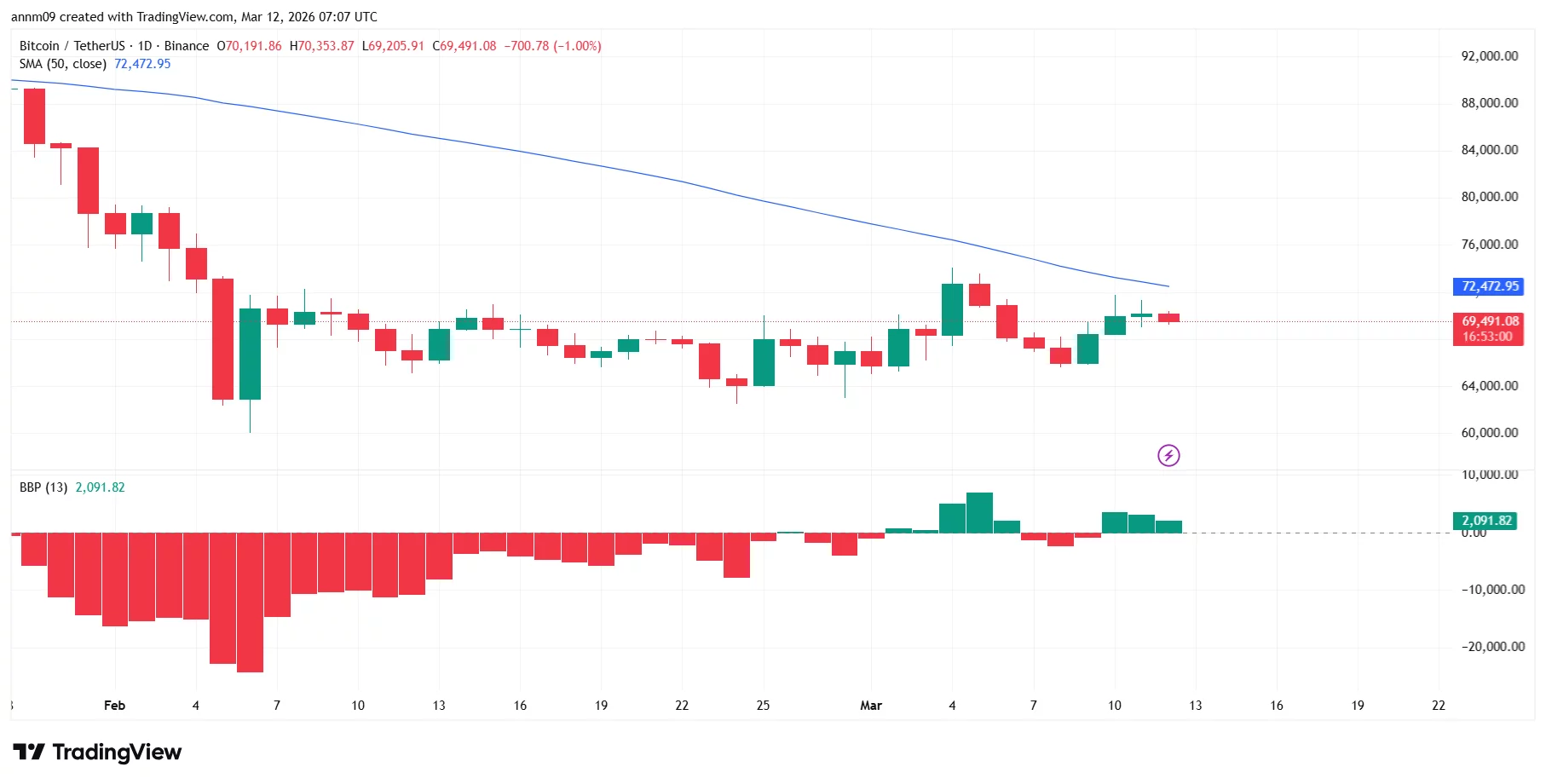
Immediate Resistance: The $72,500 level remains the “boss” of this range. A daily candle close above this mark, supported by high volume, would confirm a breakout.
Support Zones: The $67,500 to $68,000 zone has proven resilient. As long as BTC stays above this floor, the bullish structure remains intact.
The BBP Indicator: A close look at the BBP indicator at the bottom of the chart shows that the histogram has already flipped into green territory. This is a significant bullish signal, indicating that the “Bulls” have successfully overpowered the “Bears” for the time being.
While Trump’s declaration has provided the spark, the sustainability of this rally depends on whether the “victory” translates into a formal ceasefire and stabilized oil prices. If geopolitical tensions continue to cool, the “Trump Peace Trade” could be the catalyst that finally pushes Bitcoin into the elusive six-figure territory.
Analysis found that Bitcoin fell about 56% during midterm years on average, while moving closely with declines in US equities.
US midterm election cycles have historically been associated with increased volatility across financial markets, with the S&P 500 experiencing average peak-to-trough drawdowns of about 16%, according to a new report published by Binance Research.
It stated that midterm years have typically produced the weakest performance within the four-year US presidential cycle, as political uncertainty surrounding elections weighs on investor sentiment. In seven of the past ten midterm cycles, equity markets recorded corrections of more than 10% as political risk continued to influence market behavior.
Political Uncertainty Shakes Markets
Digital assets have shown a similar pattern during these periods. According to the analysis, Bitcoin has historically moved in close correlation with equities during midterm cycles. Since 2014, which the report considers the first meaningful cycle due to earlier liquidity limitations in crypto markets, BTC has recorded an average decline of about 56% during midterm election years across the three completed cycles.
Despite this historical weakness during such years, the research revealed that there is a consistent pattern of strong market performance once political uncertainty clears. Data cited in the report show that the 12 months following US midterm elections have produced positive returns for the S&P 500 in every instance since 1939. Over that period, the index has delivered an average gain of about 19% in the year following the vote.
Bitcoin has also recorded gains in all three post-midterm years on record, and the cryptocurrency delivered an average return of roughly 54% during those periods. The findings reveal that markets often recover once election outcomes become clear and investors gain greater visibility into the political and policy landscape.
The report frames the pattern as a recurring cycle in which election-year volatility is followed by a period of stronger performance for risk assets as uncertainty fades and capital returns to the market.
The analysis comes at a time when global markets are already facing major volatility driven by geopolitical tensions and macroeconomic concerns. Escalating developments in the Middle East, including disruptions linked to the Strait of Hormuz, have raised fears of supply shocks in global energy markets and contributed to sharp swings in oil prices.
You may also like:
Next Catalyst
At the same time, all eyes are on the upcoming US inflation indicators, including Consumer Price Index and Personal Consumption Expenditures data, which could influence expectations around future monetary policy decisions.
Binance Research said that the current market conditions are also shaped by elevated leverage among investors and negative gamma positioning among market makers in both equity and cryptocurrency markets. These factors can amplify price movements when markets react to geopolitical or macroeconomic developments.
While the near-term risks remain, periods of heightened political and macro uncertainty have often been followed by stronger performance once major sources of uncertainty are resolved.
Binance Free $600 (CryptoPotato Exclusive): Use this link to register a new account and receive $600 exclusive welcome offer on Binance (full details).
LIMITED OFFER for CryptoPotato readers at Bybit: Use this link to register and open a $500 FREE position on any coin!

Victims of a Chinese investment fraud are challenging a United Kingdom proposal to compensate them through a Chinese redress scheme, arguing the plan could leave British authorities holding much of the upside from roughly 61,000 Bitcoin seized in a money-laundering investigation.
According to the Financial Times, citing court documents, the dispute has moved into the UK High Court as groups representing victims seek to recover funds linked to the cryptocurrency seized by police in London. The Bitcoin (BTC) haul is now worth about 3.2 billion pounds ($4.3 billion) after rising sharply in value since the assets were confiscated.
Law firm Candey, which represents about 5,700 victims, said the proposed compensation arrangement may not guarantee fair restitution. The fraud scheme itself reportedly affected more than 128,000 investors in China, according to court documents cited by the FT.
The case highlights growing legal questions around crypto seizures, where digital assets can appreciate significantly between confiscation and restitution. The dispute stems from a Chinese investment fraud scheme that ran between 2014 and 2017 and defrauded investors before proceeds were converted into BTC and moved abroad.
Prosecutors say claims could exceed losses
Prosecutors reportedly argued that some of the legal claims could allow a subset of victims and litigation funders to recover sums exceeding their actual losses.
Martin Evans KC, representing the Director of Public Prosecutions, said in court submissions that the claims risk benefiting “a small subset of victims and their litigation funders” while excluding other victims and the Crown, according to the FT.
Related: UK elections: How crypto donation risks are dividing MPs
Candey defended the legal action, saying court proceedings give victims the best chance of securing proper compensation and noting that its legal fees are capped at 18% of any recovered funds.
A preliminary hearing is scheduled for July to determine whether English or Chinese law should govern the claims to the seized Bitcoin. The High Court has also set a May 22 deadline for claimants seeking recovery under Section 281.
Bitcoin seizure linked to London mansion purchase attempt
British authorities seized more than 61,000 BTC during a 2018 raid on a London property linked to Jian Wen, who was later convicted of money laundering, and Zhimin Qian, the mastermind of the scheme, who was sentenced by a UK court to over 11 years in prison in November 2025.
Wen attracted attention after attempting to buy a luxury London mansion using Bitcoin and failing to explain the origin of the funds.

In 2024, victims of the scheme sought assistance from Chinese authorities to recover the seized Bitcoin.
The seized Bitcoin has also drawn policy attention in Britain, with reports in 2025 that officials were exploring how and when such holdings could be sold.
Magazine: UK’s Orwellian AI murder prediction system, will AI take your job? AI Eye
Crypto World
BTC price looks resilient, but don’t ignore those $20,000 put options: Crypto Daybook Americas
By Omkar Godbole (All times ET unless indicated otherwise)
Ultra-bearish forecasts are getting no love from industry observers, and rightly so, with bitcoin holding resilient amid global market chaos. Yet options flows hint there may be merit to the bears’ dire warnings.
Bloomberg reiterated its prediction for the largest cryptocurrency to plunge to $10,000 — a level last seen in mid-2020. Industry observers dismissed it as silly.
Yet on Deribit, the biggest crypto options exchange, nearly $800 million in open interest is piled into the $20,000 put, a wager that the price will slide to below that level. It’s the fourth-most popular bearish bet on the platform.
It signals some traders are preparing for a meltdown. That said, not all are outright bets on a price crash, Deribit said.
“The majority of that positioning appears to be short puts rather than directional long hedges, said Sidrah Fariq, Deribit’s global head of retail sales. “Traders often sell very far OTM puts because the probability of hitting those levels is low.”
In the meantime, though, bitcoin is showing uncanny resilience, holding steady around $70,000 even as a renewed oil rally pushed crude benchmarks toward $100 early today and rattled traditional markets. Ether (ETH), XRP, and solana (SOL) are similarly firm, while Hyperliquid’s HYPE token steals the spotlight with gains of around 10% over 24 hours.
Analysts say excess leverage is flushing out of BTC, paving the way for upside.
“From a market structure perspective, this type of consolidation can be constructive because reducing leveraged positioning tends to create a more stable foundation for the next move once a clearer macro catalyst emerges,” Diana Pires, VP of sales at crypto platform sFOX, said in an email.
In traditional markets, oil volatility looks to be spilling over into bonds. The MOVE index, measuring the 30-day expected volatility in U.S. Treasury notes, which underpin global finance, has surged to 76 from under 60 in late February. This could lead to financial tightening worldwide, putting pressure on risk assets. Stay alert!
Read more: For analysis of today’s activity in altcoins and derivatives, see Crypto Markets Today
What to Watch
For a more comprehensive list of events this week, see CoinDesk’s “Crypto Week Ahead“.
- Crypto
- March 12: Polakdot’s economic upgrade to start rolling out, featuring a DOT supply cap, an emissions cut and unbonding reduction.
- March 12, 1 p.m.: MARA to host an X Spaces session with its CEO, CFO, and Chief Growth & Strategy Officer.
- March 12: BOB mainnet to undergo its Jovian hardfork.
- Macro
- March 12, 8:30 a.m.: U.S. initial jobless claims for week ending March 7 Est. 215K (Prev. 213K)
- March 12, 8:30 a.m.: U.S. balance of trade for January Est. -$66.6B (Prev. -$70.3B)
- March 12, 4:30 p.m.: Fed balance sheet for period ending March 11 (Prev. $6.63T)
- Earnings (Estimates based on FactSet data)
- March 12: Cango (CANG), post-market, -$0.34
Token Events
For a more comprehensive list of events this week, see CoinDesk’s “Crypto Week Ahead“.
- Governance votes & calls
- Arbitrum DAO is voting to establish an operational directive that automatically consolidates idle and surplus non-ARB funds from DAO initiatives directly into the Arbitrum Treasury Management Company (ATMC) portfolio. Voting ends March 12.
- Arbitrum DAO is voting to implement a delegated voting power (DVP) quorum model, update its constitution, and enable onchain proposal cancellation. Voting ends March 12.
- CoW DAO is voting on a swap affiliate program to reward affiliates who refer new retail traders and traders who reach qualifying volume milestones, with up to 500,000 USDC allocated over a six-month pilot. Voting ends March 12.
- World Liberty Financial DAO is voting to introduce a WLFI governance staking system requiring unlocked token holders to stake (minimum 180-day lock) to participate in governance. Voting ends March 12.
- Unlocks
- Token Launches
- March 12: ForU AI’s (FORU) token generation event occurs.
Conferences
For a more comprehensive list of events this week, see CoinDesk’s “Crypto Week Ahead“.
Market Movements
- BTC is up 0.12% from 4 p.m. ET Wednesday at $70,400.41. (24hrs: +1.11%)
- ETH is unchanged at $2,071.35 (24hrs: +2.21%)
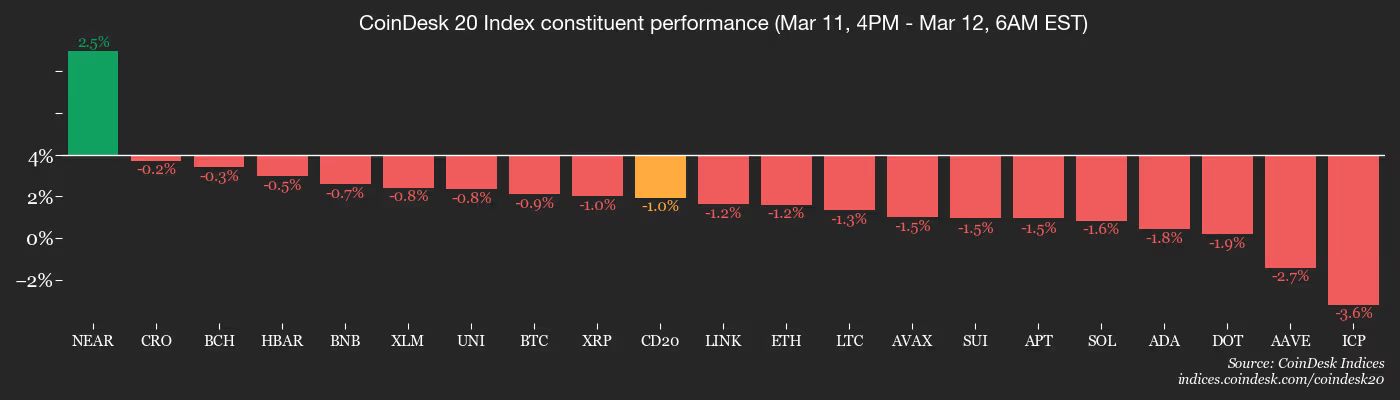
- CoinDesk 20 is down 0.4% at 2,008.02 (24hrs: +1.32%)
- Ether CESR Composite Staking Rate is down 1 bps at 2.79%
- BTC funding rate is at -0.0048% (-5.2188% annualized) on Binance

- DXY is unchanged at 99.36
- Gold futures are up 0.43% at $5,189.60
- Silver futures are up 2.38% at $87.09
- Nikkei 225 closed down 1.04% at 54,452.96
- Hang Seng closed down 0.70% at 25,716.76
- FTSE 100 is down 0.33% at 10,320.02
- Euro Stoxx 50 is down 0.43% at 5,769.83
- DJIA closed on Wednesday down 0.61% at 47,417.27
- S&P 500 closed unchanged at 6,775.80
- Nasdaq Composite closed unchanged at 22,716.13
- S&P/TSX Composite closed down 0.45% at 33,119.80
- S&P 40 Latin America closed unchanged at 7,501.64
- U.S. 10-Year Treasury rate is up 7 bps at 4.21%
- E-mini S&P 500 futures are down 0.38% at 6,753.75
- E-mini Nasdaq-100 futures are down 0.35% at 24,896.00
- E-mini Dow Jones Industrial Average futures are down 0.48% at 47,221.00
Bitcoin Stats
- BTC Dominance: 59.23% (-0.08%)
- Ether-bitcoin ratio: 0.02929 (0.2%)
- Hashrate (seven-day moving average): 1,020 EH/s
- Hashprice (spot): $30.46
- Total fees: 2.8 BTC / $196,480
- CME Futures Open Interest: 108,220 BTC
- BTC priced in gold: 13.5 oz.
- BTC vs gold market cap: 4.67%
Technical Analysis

- The chart shows XRP’s daily price swings in candlestick format with Bollinger bands, which are volatility bands placed two standard deviations above and below the 20-day average of price.
- The gap between Bollinger bands is now narrowest since early November 2024.
- The tighter the bands, the more explosive the eventual breakout. In other words, a big move (volatility) could be brewing in XRP.
Crypto Equities
- Coinbase Global (COIN): closed on Wednesday at $198.63 (+1.07%), –1.28% at $196.08 in pre-market
- Galaxy Digital (GLXY): closed at $21.46 (–1.69%), –0.75% at $21.30
- MARA Holdings (MARA): closed at $8.55 (–0.23%), –1.40% at $8.43
- Riot Platforms (RIOT): closed at $14.81 (+1.16%), –0.74% at $14.70
- Core Scientific (CORZ): closed at $16.54 (+6.99%), –1.45% at $16.30
- CleanSpark (CLSK): closed at $9.81 (+1.87%), –1.22% at $9.69
- Exodus Movement (EXOD): closed at $10.91 (–0.18%), +14.48% at $12.49
- CoinShares Bitcoin Mining ETF (WGMI): closed at $38.92 (+4.18%), –2.29% at $38.03
- Circle Internet Group (CRCL): closed at $112.81 (–4.47%), +0.30% at $113.15
- Bullish (BLSH): closed at $37.19 (+1.25%), –1.05% at $36.80
Crypto Treasury Companies
- Strategy (MSTR): closed at $138.33 (–0.09%), –0.56% at $137.55
- Strive Asset Management (ASST): closed at $9.23 (+2.78%)
- SharpLink (SBET): closed at $7.59 (+2.71%), –1.45% at $7.48
- Upexi (UPXI): closed at $1.03 (+9.46%), –1.94% at $1.01
- Lite Strategy (LITS): closed at $1.17 (+0.00%), –1.71% at $1.15
ETF Flows
Spot BTC ETFs
- Daily net flows: $115.2 million
- Cumulative net flows: $55.88 billion
- Total BTC holdings ~ 1.28 million
Spot ETH ETFs
- Daily net flows: $57 million
Cumulative net flows: $11.68 billion
Total ETH holdings ~ 5.65 million
Source: Farside Investors
While You Were Sleeping
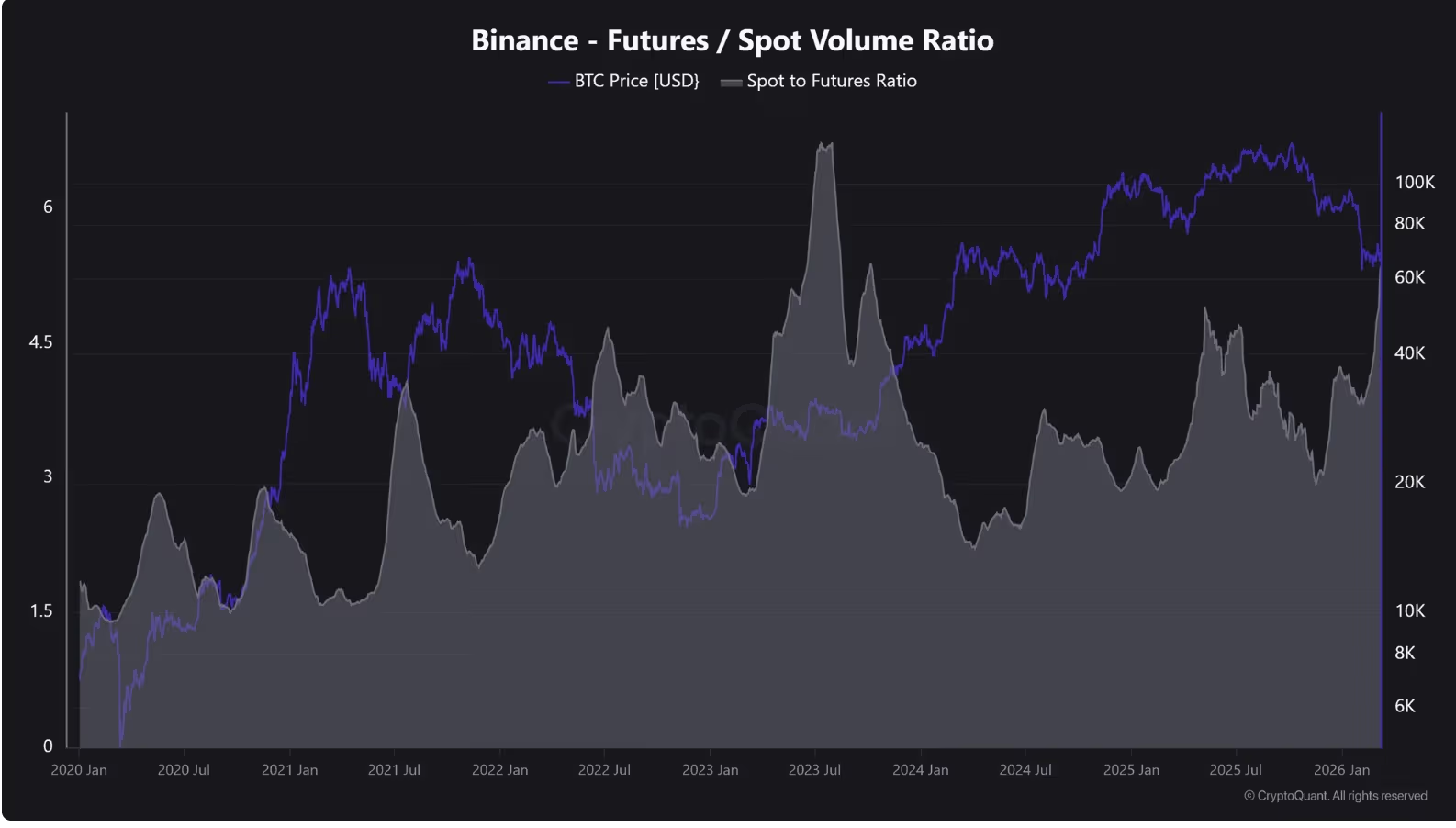
The derivatives market on leading digital assets exchange Binance is doing more than five times the business of spot, hinting at volatile market conditions.
The futures-to-spot volume ratio on the exchange has risen to approximately 5.1, its highest level since mid-2023, CryptoQuant data shows.
The ratio is an indicator of the type of market participants are trading in. When derivatives dominate at this scale, price discovery is increasingly driven by leveraged positioning rather than outright buying and selling. That doesn’t make the moves less real, but it does make them more reactive.
The result is a market that can see outsized volatility, often swinging wildly to end up exactly where it started, which is roughly what bitcoin has done for the past month.
Derivatives growth on Binance reflects broader industry maturation as more participants use perpetuals for hedging, basis trading, and directional exposure. But when the derivatives layer grows 20% while spot stays flat, the market’s sensitivity to liquidation events increases, which helps explain why recent moves have been large in size but short in duration.

The broader on-chain picture adds context. CryptoQuant data shows apparent demand remains negative at -30,800 BTC on a 30-day basis. Supply in loss is climbing toward levels that have historically preceded extended downturns rather than marking bottoms.
Data from earlier this month tracked by Santiment showed whales sold 66% of their war-week accumulation into the $74,000 rally while retail bought the dip below $70,000.
Bitcoin was trading at $69,400 on Thursday, down 0.7% over the past 24 hours and 4.3% on the week.
Bitcoin ($BTC) is banging against the $70,000 door, but the surging cost of oil in the macro environment just changed the locks.
With oil prices reaching dangerously close to $100 per barrel amidst escalating geopolitical tensions, the asset’s recovery rally is stalling out as risk assets feel the heat of renewed inflation fears.
While bulls are defending the lower bounds of the range, the path to a new all-time high has suddenly become steeper.
The correlation between energy markets and crypto risk appetite is tightening, creating a standoff between spot demand and macro anxiety. But one level keeps getting in the way.
Discover: The best pre-launch crypto sales
How Oil at $100 Is Changing the Risk Equation for Bitcoin
The mechanism choking the Bitcoin price recovery is straightforward but brutal. Rising crude oil prices feed directly into consumer costs, keeping inflation sticky.
When energy costs spiked this week, they effectively tied the hands of the Federal Reserve. Markets that were pricing in rate cuts are now forced to reconsider the FOMC stance for the upcoming March meeting, sending tremors through risk-on assets.
This macro friction is palpable across trading desks. As analysts noted regarding recent inflation reports, any sign of persistent CPI pressure gives the Fed license to keep rates higher for longer, a scenario that historically drains liquidity from crypto markets.
The fear isn’t just theoretical; it’s visible in the immediate “risk-off” rotation occurring in futures markets.
Traders are reacting in real-time. Recent data shows that Hyperliquid saw a jump in activity following an oil trading surge, highlighting how crypto natives are increasingly hedging their exposure to real-world commodities.
If oil breaches the psychological $100/bbl barrier, the resulting volatility could strip away the leverage needed to push BTC through overhead BTC resistance.
On-Chain Metrics Tell a Different Story
While macro economics paint a grim picture, on-chain data suggests a supply shock is silently building.
Long-term holder supply has ticked up to 14.58 million BTC, or approximately 73% of the circulating supply.
This indicates that while feeble hands are panic-selling the oil news, veterans are digging in.
More telling is the formation of a massive support cluster: about 8% of the circulating supply, or 1.558 million BTC, was acquired between $60,000 and $70,000, creating a concrete floor that makes a deep correction less likely than in previous cycles.
Institutional flows further complicate the bear case. Even as oil jitters rattled the S&P 500, Bitcoin has outperformed gold and stocks since the US/Iran war, signalling a potential decoupling where BTC is viewed as a distinct hedge rather than just a high-beta tech stock.
This aligns with Arthur Hayes’ strategy on net liquidity, suggesting that savvy capital is looking past the immediate volatility toward the inevitable monetary expansion that follows supply shocks.
The sell-side pressure is also thinning. Exchange reserves have hit multi-year lows, meaning there are fewer coins available for dumping if panic sets in. The weak hands have largely exited; what remains constitutes the conviction trade.
Discover: The very best meme coins
Bitcoin Price Prediction: Can BTC Break $71,600 With Oil This High?
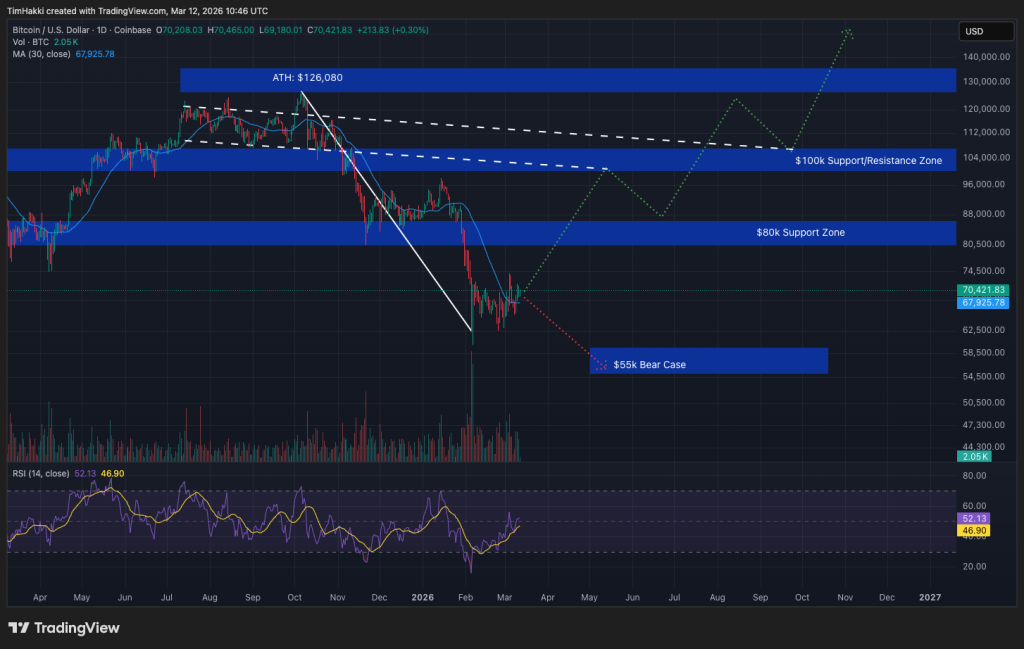
The chart structure for Bitcoin is currently a battle of attrition within a tightening range. BTC is oscillating around the $70,000 psychological level, but the real line in the sand is slightly higher.
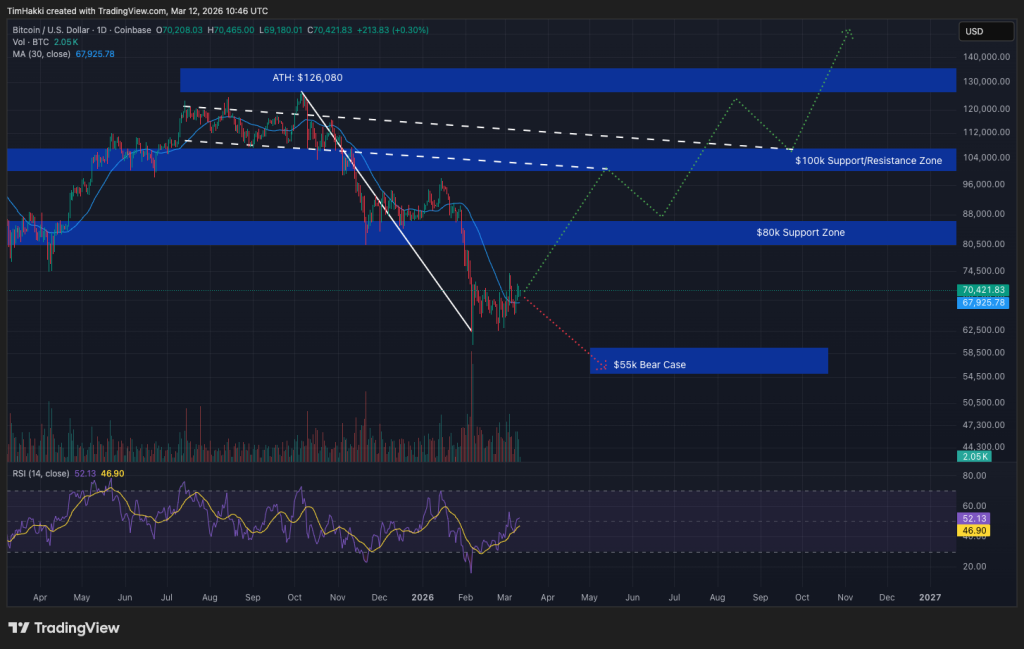
Bull Scenario: The key BTC resistance to watch is $71,600. If bulls can force a daily close above this level, it invalidates the short-term bearish divergence caused by the oil shock.
Bear Scenario: Conversely, if the macro headwinds prove too strong, failure to hold the $68,500 local support could be disastrous.
Losing this level would likely trigger a cascade of long liquidations, dragging the price down to $60,000 and seriously challenging the final local frontier for immediate support.
The post Oil Surges Near $100 Stalling Bitcoin Breakout appeared first on Cryptonews.
Market analysts say Bitcoin (BTC) is in a relief rally after its 17% recovery from multi-year lows below $60,000, but the $78,000 level is key to reversing the broader downtrend.
Key takeaways:
-
Bitcoin price is up 17% from sub-$60,000 lows as onchain data shows signs of returning demand.
-
BTC price resistance around $78,000 must be broken to end the downtrend.
Bitcoin buyers are returning
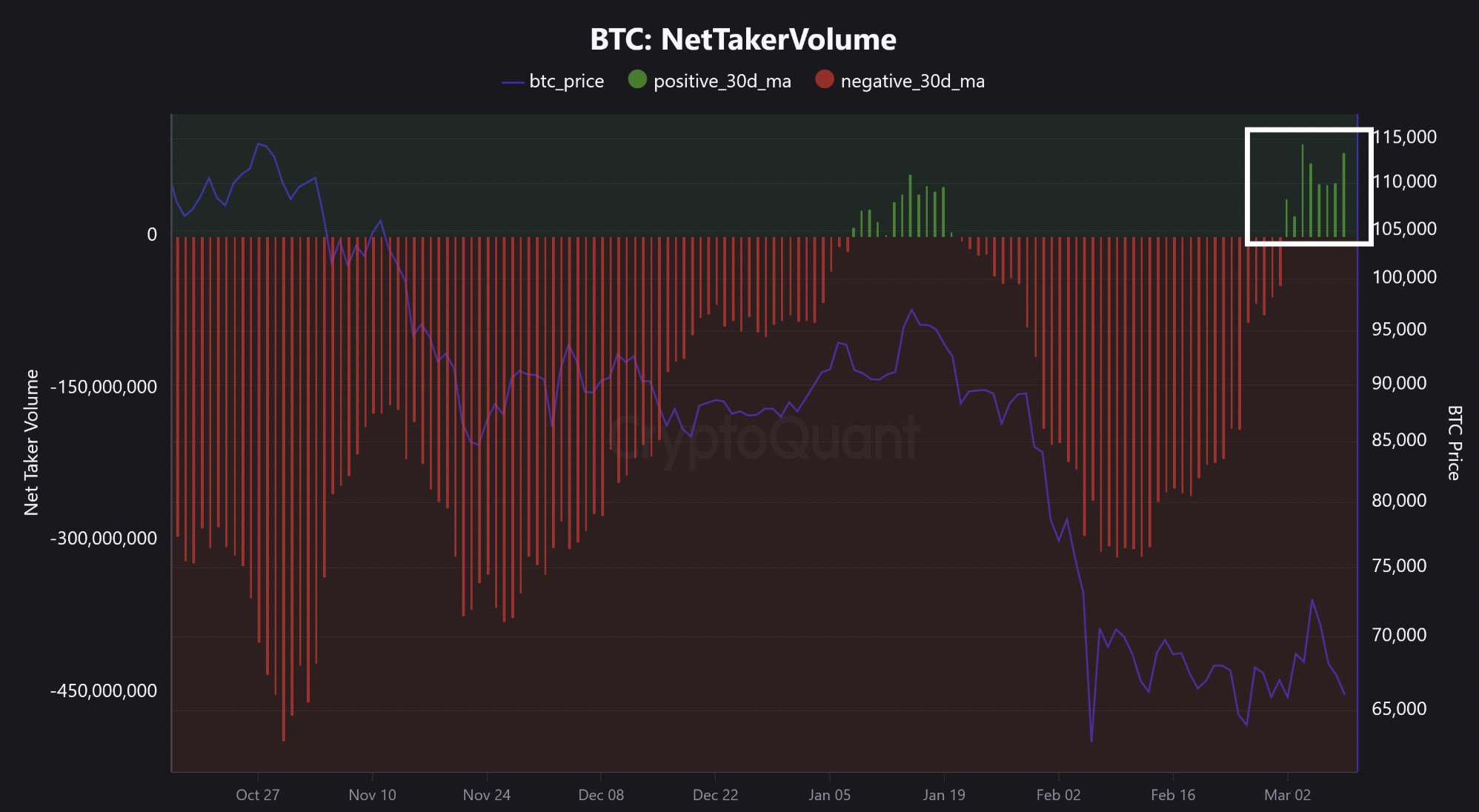
Bitcoin’s net taker volume suggests buyers are stepping in as demand for BTC derivatives returned, data from CryptoQuant shows.
Net taker volume, a metric that measures the imbalance between aggressive buyers and sellers in derivatives markets, has remained positive since the US and Israel-Iran war began.
Related: Three Bitcoin Binance charts reveal the setup behind the next big move
“Since the conflict broke out, net taker volume as measured by the 30-day moving average has been positive,” CEO at Coinbureau Nic Puckrin said in an X post on Wednesday.
This positive regime coincided with the recent BTC price recovery to $74,000, indicating that demand has returned across derivatives markets.
“This shows taker buy volume has outpaced sell volume,” Puckrin said, adding:
“Bitcoin buyers are in control.”

The bull score index, a metric that measures Bitcoin’s overall market health using a combination of fundamental and technical metrics, further reinforces this picture.
The metric has increased to 30 from 10 on March 6, the highest since late October 2025.
The bull score index phase has “switched from ‘extra bearish’ to ‘bearish,’” said CryptoQuant head of research Julio Moreno, adding:
“We are still in a bear market, but in a relief rally.”

Meanwhile, demand for spot Bitcoin exchange-traded funds (ETFs) continues, with these investment products recording three straight days of inflows, totalling $529.2 million.

BTC price must break $78,000 to end downtrend
Data from TradingView shows that Bitcoin has spent more than four weeks consolidating within a $62,000–$72,000 range, with multiple failed attempts to sustain a strong footing above $70,000.
Zooming out, the price remains sandwiched between the realized price (average acquisition cost of all circulating supply) at $54,400 and true market mean (the cost basis of actively transacted coins) at $78,000, Glassnode said in its latest Week On-chain newsletter, adding:
“In the absence of broader macro headwinds, this range could plausibly support a bear market relief rally capped by the true market mean.”

The chart above shows that the BTC price was within these two cost-basis levels for most of 2023, with relief rallies being repeatedly rejected at the true market mean. Ultimately, the price broke out in October 2023, with the announcement of US spot Bitcoin ETF approvals as the main catalyst.
Trader and analyst Titan of Crypto said a break above $78,000-$80,000 could signal a long-term trend change.

Yesterday, Cointelegraph reported that Bitcoin’s upside could be capped at $78,000, with derivatives traders pricing low odds for a BTC price breakout past this level in the near term.
In the meantime, Glassnode said repeated failures to hold above $70,000 “tilts the mid-term return distribution toward the downside,” with the realized price at $54,000 serving as the primary support level to watch.
Other areas of interest include the 200-week exponential moving average at $68,300, the $60,000-65,500 demand zone and the 200-week simple moving average at $58,800, which has historically provided the last line of defense in macro drawdowns.
This article does not contain investment advice or recommendations. Every investment and trading move involves risk, and readers should conduct their own research when making a decision. While we strive to provide accurate and timely information, Cointelegraph does not guarantee the accuracy, completeness, or reliability of any information in this article. This article may contain forward-looking statements that are subject to risks and uncertainties. Cointelegraph will not be liable for any loss or damage arising from your reliance on this information.

Inside a cannabis farm uncovered by police amid major Rochdale operation

Why Authenticity Is Becoming the Most Valuable Asset in Digital Marketing

BlackRock debuts staked ether ETF as demand grows for yield in crypto funds


-
Business6 days ago
Form 8K Entergy Mississippi LLC For: 6 March
-

 News Videos3 days ago
10th Algebra | Financial Planning | Question Bank Solution | Board Exam 2026
-

 Fashion6 days ago
Weekend Open Thread: Ann Taylor
-

 Crypto World3 days ago
Paradigm, a16z, Winklevoss Capital, Balaji Srinivasan among investors in ZODL
-
 Tech1 day ago
A 1,300-Pound NASA Spacecraft To Re-Enter Earth’s Atmosphere
-
 Sports7 days ago
499 runs and 34 sixes later, India beat England to enter T20 World Cup final | Cricket News
-

 Politics6 days ago
Top Mamdani aide takes progressive project to the UK
-

 Business2 days ago
ExxonMobil seeks to move corporate registration from New Jersey to Texas
-

 Sports5 days ago
Three share 2-shot lead entering final round in Hong Kong
-

 Sports4 days ago
Braveheart Lakshya downs Lai in epic battle to enter All England Open final | Other Sports News
-

 Tech2 days ago
ChatGPT will now generate interactive visuals to help you with math and science concepts
-

 NewsBeat18 hours ago
Residents reaction as Shildon murder probe enters second day
-

 NewsBeat7 days ago
Piccadilly Circus just unveiled ‘London’s newest tourist attraction’ and it only costs 80p to enter
-

 Entertainment5 days ago
Hailey Bieber Poses For Sexy Selfies In New Luscious Lip Thirst Traps
-

 Business4 days ago
Search for Nancy Guthrie Enters 37th Day as FBI Probes Wi-Fi Jammer Theory
-

 Business1 day ago
Search Enters Sixth Week With New Leads in Tucson Abduction Case
-
 NewsBeat2 days ago
Pagazzi Lighting enters administration as 70 jobs lost and 11 stores close across Scotland
-

 Tech3 days ago
Despite challenges, Ireland sixth in EU for board gender diversity
-

 Business3 days ago
Search Enters 39th Day with FBI Tip Line Developments and No Major Breakthroughs
-

 NewsBeat22 hours ago
I Entered The Manosphere. Nothing Could Prepare Me For What I Found.