

Crypto World
Utah Moves to Block Prediction Markets as State-Federal Tensions Rise

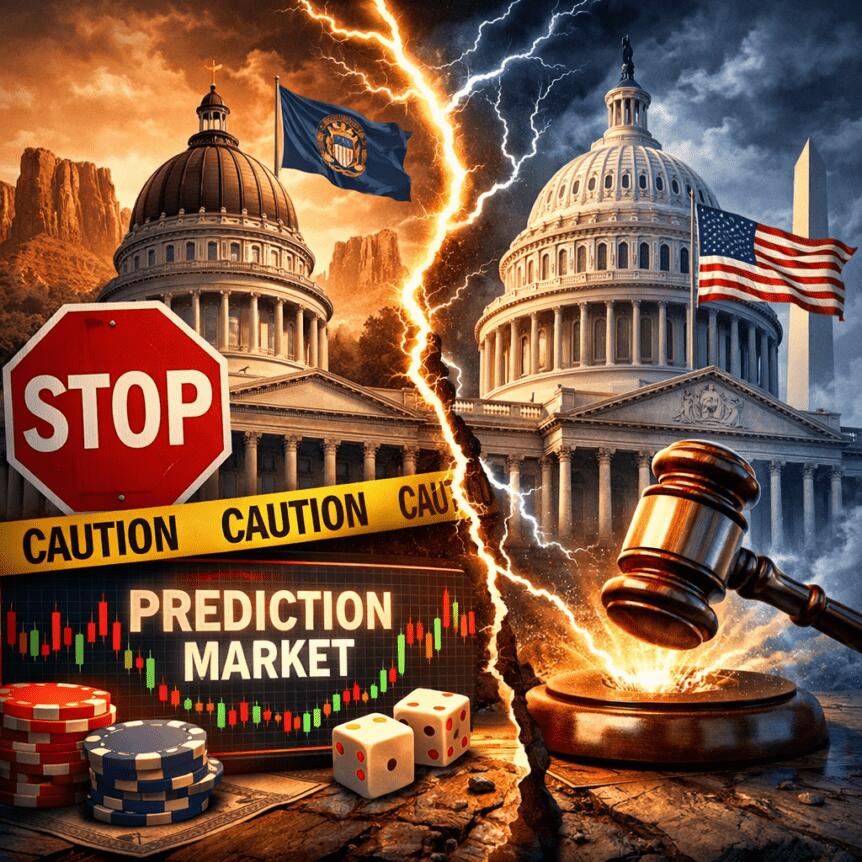
The state of Utah is moving to shut down prediction market platforms like Kalshi and Polymarket as part of a broader clash over how this evolving sector should be regulated. The legislative push, marked by HB243 (Gambling Revisions), would redefine “proposition betting” as gambling, aiming to bar platforms that host event-based bets—whether framed as prediction markets or sportsbooks—from operating in the state. The Utah House cleared the bill on February 10, followed by Senate approval on February 27, setting the stage for a gubernatorial signature. Governor Spencer Cox signaled his support, framing the move as a shield against what he described as risky, youth-targeting gaming products. The episode adds to a growing patchwork of state actions that intersect with federal authority over derivatives and fintech platforms.
Key takeaways
- Utah advances HB243, redefining proposition betting as gambling and barring platforms offering prediction-like services within the state.
- Kalshi has filed suit against Utah, contending its event contracts are federally regulated derivatives under the Commodity Exchange Act, not gambling.
- The Commodity Futures Trading Commission maintains that it has exclusive authority over prediction markets, framing them as potential conduits for information discovery, and indicating readiness to defend this stance in court.
- Similar clashes are unfolding in other states, including Iowa, and a series of federal court cases in Ohio have shaped the legal landscape around enforcement and jurisdiction.
- The regulatory tension highlights how crypto-adjacent markets—where prediction and derivatives intersect—could be affected by evolving governance and enforcement priorities.
Tickers mentioned:
Sentiment: Neutral
Market context: Regulatory scrutiny of prediction markets sits at the intersection of consumer protection, gambling law, and financial-market oversight, with federal authorities signaling a willingness to assert jurisdiction while states pursue their own legislative fixes.
Why it matters
Utah’s move crystallizes a broader narrative about how governments will treat platforms that blend prediction, gambling-style mechanics, and financial exposure. While proponents view prediction markets as tools for aggregating information—potentially offering more transparent signals than traditional polls—the regulatory approach in Utah treats these markets as gambling products subject to state-law restrictions. The dispute foregrounds a central question for the crypto and blockchain-adjacent economy: who should police event-based contracts that rely on real-money wagers and futures-style pricing? The CFTC’s stance that it retains exclusive federal oversight over such markets adds a layer of complexity for operators seeking a national framework that could preempt state bans or carveouts.
Kalshi’s legal strategy underscores the federal-versus-state tension at the heart of this debate. By insisting that its event contracts fall under federal derivatives regulation rather than gambling restrictions, the company is leveraging the Commodity Exchange Act to push back against Utah’s restrictions. That position aligns with prior CFTC positions that see these markets as subject to federal oversight, rather than states’ patchwork prohibitions. The unfolding cases, including Kalshi’s actions in Iowa and Ohio, illustrate how a chain of judicial decisions could shape not only the fate of prediction-market platforms but also broader efforts to innovate within the crypto and fintech ecosystems.
Beyond this particular dispute, observers are watching the implications for similar products—especially those that seek to tokenize or automate event-based bets with digital infrastructure. If courts uphold federal preemption for these contracts, it could unlock a more uniform regulatory path for platforms exploring cross-border and cross-state operations. Conversely, if states prevail, a mosaic of prohibitions could emerge, potentially dampening investment in related technologies and complicating compliance for operators seeking to scale. The debate is not just about Utah or Kalshi; it concerns the regulatory architecture that will govern the next wave of financial experimentation in the digital era.
In public remarks at a Florida industry conference, CFTC Chairman Michael Selig reminded attendees that the agency regards prediction markets as instruments with potential informational value, even calling them “truth machines” when priced and funded by participants who put real stake behind their views. He stressed that the CFTC would defend its authority in court if challenged, signaling that attempts to clamp down on such markets at the state level may be met with federal countermeasures. This framing dovetails with ongoing debates about how to regulate innovative financial products without stifling legitimate experimentation. The tone from Washington, D.C., and state capitals alike suggests a transitional period as policymakers weigh consumer protection, market integrity, and the demand for novel market signals.
What to watch next
- Governor Cox’s formal signature on HB243 and any subsequent regulatory guidance from Utah authorities.
- Federal court developments in Kalshi’s Utah and Iowa lawsuits, including any rulings on whether the CFTC’s authority can foreclose state bans.
- The Ohio federal court ruling on Kalshi’s attempt to block enforcement—whether it sets a precedent for other states’ actions against similar platforms.
- Additional state-level proposals targeting prediction markets or similar event-based contracts, and how courts interpret their scope vis-à-vis federal law.
- Responses from other market participants and lawmakers that could chart a broader regulatory framework for crypto-adjacent prediction markets.
Sources & verification
- Utah HB243 (Gambling Revisions) text and legislative history: https://le.utah.gov/~2026/bills/static/HB0243.html
- Associated Press report on Cox’s stance and the signing intent: https://apnews.com/article/utah-kalshi-polymarket-spencer-cox-mormon-gambling-c3fecd3e120b4d5be103bc9e1f4a5587
- Kalshi v. Utah: Kalshi’s lawsuit filing (Utah News Dispatch PDF): https://utahnewsdispatch.com/wp-content/uploads/2026/02/Kalshi_V_Utah.pdf
- Kalshi’s Iowa action (report reference): https://cointelegraph.com/news/kalshi-preemptively-sues-iowa-claiming-risk-of-enforcement-action
- Ohio court action on Kalshi’s sports-betting case: https://cointelegraph.com/news/kalshi-court-ohio-sports-betting-lawsuit
- CFTC Chair comments on prediction markets and enforcement stance: https://x.com/ChairmanSelig/status/2023744651216240966?s=20
- Related coverage on Kalshi’s Ohio case and broader regulatory actions: https://cointelegraph.com/news/kalshi-sued-khamenei-trade-carveout
Regulatory clash reshapes the landscape for prediction markets
Utah’s HB243 embodies a strategic attempt by a state to reframe the legal perimeter around prediction-based platforms, extending beyond traditional sports betting to what officials view as speculative markets that could attract vulnerable users. The bill would reclassify proposition betting—where wagers hinge on individual events within a game, rather than the final outcome—as gambling. In practical terms, that shift empowers Utah’s regulators to block operators from offering those services in the state, regardless of how the platforms label themselves. The legislature’s passage through both chambers, followed by the governor’s stated intent to sign, signals a strong intent to create a production-ready barrier against these services at the state level.
Kalshi’s legal response underscores a core proposition: federal law governs the structure and operation of event contracts. By contending that these are derivatives within the CFTC’s purview under the Commodity Exchange Act, Kalshi argues that Utah cannot selectively ban the contracts simply because they are framed as prediction markets. This argument hinges on questions of preemption and the reach of federal securities and commodities law into digital and financial-innovation spaces. The case mirrors a broader pattern in which states test the limits of their regulatory reach while federal agencies assert a uniform framework intended to maintain market integrity and protect participants.
As the federal regulator’s position gains resonance, Kalshi has pursued multi-front litigation. The company’s Utah suit targets the state’s enforcement actions, while an accompanying Iowa filing signals a broader strategy to secure a federal preemption shield. Meanwhile, a separate Ohio decision denying Kalshi’s bid to halt state enforcement actions demonstrates how courts are weighing the balance between state consumer protections and federal authority. Taken together, these movements sketch a regulatory arc: a fight over jurisdiction that could determine how prediction markets, crypto-linked or otherwise, can operate across the United States.
For market participants and observers, the outcome could influence investment, product development, and international competitiveness. If federal oversight becomes the default, operators may gain the ability to launch across multiple states with a consistent, preemptive framework. If, on the other hand, state restrictions proliferate, founders may face a fragmented landscape characterized by varying compliance costs and heightened legal risk. The CFTC’s characterization of prediction markets as “truth machines”—contingent on active participation and risk-bearing—adds a qualitative element to the regulatory debate: markets that are price-discovered and transparent can offer valuable signals, but only if designed and governed with appropriate safeguards.
What to watch next
- Fiscal and regulatory status of HB243 after gubernatorial action, including any rulemaking or enforcement guidelines from Utah’s gambling regulators.
- Upcoming court decisions in Kalshi’s Utah and Iowa cases that could clarify federal preemption in the context of state gambling prohibitions.
- Rulings in Ohio and other jurisdictions that could set precedent for how prediction-market operators navigate enforcement actions.
- Public statements from the CFTC and related federal agencies about the regulatory approach to crypto-adjacent prediction markets and their potential scope beyond traditional derivatives.

Crypto World
Eightco shares jump $125 million funding commitment from Btmine, ARK, Kraken parent Payward

Eightco Holdings’ (ORBS) shares rose as much as 25% in early trading after the firm said it secured $125 million in new institutional funding commitments and made $75 million in AI and crypto investments.
The commitments include $75 million from Bitmine Immersion Technologies (BMNR), an ether (ETH) treasury asset company that holds a near 7% stake in the firm, according to MarketScreener data. Bitmine Chairman Tom Lee will join the board.
ARK Invest, whose chief futurist, Brett Winton, becomes an adviser, and Payward, the parent company of crypto exchange Kraken, each committed to $25 million. Several other firms, including Coinfund, Pantera and FalconX, also agreed to support the company.
Alongside the funding, Eightco said it has already deployed capital into two high-profile investments. These include $50 million into OpenAI, the company behind ChatGPT, and $25 million into Beast Industries, the business arm of YouTube creator MrBeast.
The company, formerly known as Cryptyde and active in packaging and logistics, also maintains a large treasury position in , a cryptocurrency tied to the World identity network co-founded by OpenAI CEO Sam Altman.
The project uses biometric verification through specialized devices known as “Orbs” to create a digital identity that confirms a user is a real person rather than an automated bot.
That system aims to address a growing problem on the internet: distinguishing human activity from content produced by AI systems.
Eightco has accumulated roughly 277 million WLD tokens, close to 10% of the token’s circulating supply, along with 11,000 ether and $82 million in cash reserves, according to a company update.
Dan Ives, who chaired the company during its 2025 strategic shift, will step down.
Bitmine’s Lee said the strategy connects several major technology trends.
“To me, there is tremendous synergy between Proof of Human (Worldcoin), the OpenAI foundational models, and connectivity to the greatest content creator in the world, MrBeast,” he said in a statement.
Bitmine invested $200 million in Beast Industries in January.
WLD’s price rose more than 2% on the announcement to now trade at $0.362 per token. ORBS were recently trading at $1.00.

TLDR
- Nomura initiated a Buy rating on NIO with a $6.60 price objective, suggesting approximately 34% potential gains from current trading levels
- Macquarie increased its price objective to $6.50 while maintaining an Outperform stance following fourth-quarter 2025 earnings
- Fourth-quarter revenue climbed 76% annually and 59% sequentially to reach RMB34.7 billion
- Vehicle gross margin expanded to 18.1% during Q4, compared to 13.1% in the prior-year period
- NIO projected Q1 2026 vehicle deliveries between 80,000 and 83,000 units, with revenue expectations exceeding analyst estimates
The Chinese electric vehicle manufacturer Nio has experienced an eventful week. Following the release of impressive fourth-quarter 2025 financial results, the company secured multiple analyst upgrades and elevated price objectives from prominent Wall Street firms.
The standout metric proved difficult to overlook. Fourth-quarter total revenue reached RMB34.7 billion, representing a 76% increase compared to the same quarter last year and a 59% jump from the previous quarter. Such robust expansion typically captures market attention.
Nomura made the boldest move, elevating NIO from a Neutral stance to Buy. The investment bank established a $6.60 price objective, reduced from its earlier $8.40 forecast, yet still suggesting roughly 34% upside potential from the stock’s recent trading level around $4.94.
The brokerage highlighted two consecutive quarters of operational improvements, emphasizing increased vehicle deliveries and enhanced expense management as catalysts for stronger profitability. Nomura now anticipates NIO will achieve non-GAAP operating profit breakeven during 2026.
Despite reducing delivery projections for 2026 and 2027 — acknowledging intensified competition within the EV sector — Nomura still forecasts vehicle deliveries will expand at approximately 25% compounded annual growth between 2025 and 2028. Revenue expansion is anticipated at roughly 21% during the identical timeframe.
Gross margin projections for 2026 and 2027 received upward revisions, while operating margin estimates were boosted by over 3 percentage points for both fiscal years. This represents a substantial reassessment of the company’s cost efficiency.
Enhanced Profitability Fuels Positive Analyst Sentiment
Macquarie similarly elevated its price objective, advancing to $6.50 from $6.10, while preserving its Outperform recommendation. The firm identified vehicle margin expansion as the primary narrative.
Vehicle margin reached 18.1% during Q4 2025, climbing significantly from 13.1% during the comparable quarter one year prior. The recently launched ES8 model received credit for contributing substantially to that improvement. Additional sales margin widened to 11.9% from merely 1.1% in Q4 2024.
NIO also reduced R&D expenditures through workforce optimization and intends to maintain quarterly R&D costs within the RMB2.0 billion to RMB2.5 billion range. The manufacturer generated positive operating cash flow during the quarter, which Macquarie noted reduces future capital-raising requirements.
Macquarie did reduce its fiscal 2026 volume projection by 8%, acknowledging subdued near-term demand and escalating competition within the EV SUV category from rivals including Li Auto, XPeng, Xiaomi, and Seres. However, it narrowed its 2026 net loss forecast to RMB1.8 billion from RMB4.5 billion, reflecting decreased operating costs and an improved product portfolio.
Additional Financial Institutions Provide Analysis
BofA Securities increased its price objective to $6.70 while maintaining a Neutral recommendation, observing that Q4 performance largely aligned with projections. Morgan Stanley reaffirmed its Overweight rating with a $7.00 price target following optimistic delivery growth commentary from NIO’s founder.
For Q1 2026, NIO provided delivery guidance of 80,000 to 83,000 vehicles. The midpoint sits approximately 8% below Bloomberg consensus figures but 2% above Macquarie’s projection. Revenue guidance ranging from RMB24.5 billion to RMB25.2 billion exceeded both Macquarie’s estimate and broader consensus expectations.
NIO has three additional mid- to large-size SUV models under development, with two variants scheduled to debut during Q2 2026.
The stock had appreciated 17.77% during the preceding week through Wednesday’s trading session, with a market capitalization standing at $14.41 billion.

Crypto World
Marathon Petroleum (MPC) Stock Surges After Blowout Q4 Earnings and Strong Cash Returns

Key Highlights
- Marathon Petroleum reported Q4 2025 adjusted EPS of $4.07, surpassing analyst consensus of $3.01 by more than 35%
- Annual 2025 adjusted EBITDA reached approximately $12 billion
- Shareholders received $1.3 billion in Q4 distributions, contributing to $4.5 billion total for the year
- Marathon closed 2025 with $3.7 billion cash position and zero utilization of its $5 billion revolving credit line
- Wall Street analysts set price targets between $210 and $225, maintaining predominantly bullish ratings
Marathon Petroleum (MPC) delivered an exceptional fourth quarter in 2025, capturing Wall Street’s attention with results that significantly exceeded expectations. The refining giant reported adjusted earnings reaching $4.07 per diluted share, obliterating the consensus forecast of $3.01 by over 35%. Quarterly revenue totaled $33.4 billion, marginally topping analyst projections.
Marathon Petroleum Corporation, MPC
Quarterly net income reached $1.5 billion, translating to $5.12 per diluted share. This represented a dramatic improvement from the $371 million recorded in the year-ago quarter. Adjusted EBITDA for the period climbed to $3.5 billion versus $2.1 billion in Q4 2024.
The Refining & Marketing business unit emerged as the primary catalyst behind the earnings outperformance. This segment generated EBITDA of $1.997 billion while maintaining crude capacity utilization at 95%. The R&M margin expanded to $18.65 per barrel.
Operational refining costs increased to $5.70 per barrel, yet the margin growth easily absorbed this headwind. Capture rates exceeding 100% played a critical role in the quarter’s success.
The midstream operations added meaningful value, producing EBITDA of $1.7 billion. Enhanced throughput volumes and contributions from newly acquired assets drove this performance, though some asset sales provided a partial offset.
The Renewable Diesel business unit contributed $7 million in EBITDA. While not the primary growth driver, it remains a developing component of the portfolio.
Marathon concluded the year holding $3.7 billion in cash. The company maintained a pristine balance sheet with zero outstanding borrowings against its $5 billion revolving credit facility entering 2026.
Shareholder Returns Remain a Strategic Priority
The refiner distributed $1.3 billion to investors during Q4. Throughout 2025, total distributions reached $4.5 billion. Since 2017, Marathon has allocated over $45 billion toward share repurchases, meaningfully reducing outstanding shares and enhancing per-share financial metrics.
Operating cash flow for 2025 approached $8.3 billion. Management continues executing a balanced capital allocation strategy combining regular dividends with aggressive share buybacks, which forms a cornerstone of the investment thesis.
Analyst price objectives have moved upward recently. Wall Street firms have published targets of $210, $217, and $225 during February. The consensus 12-month price target across coverage sits slightly above $204, with most analysts maintaining Buy-equivalent ratings.
Shares have been changing hands near the high-$190s range, marking substantial year-to-date appreciation. The stock advanced approximately 3% on March 11 and continued extending gains throughout the week.
Favorable Market Conditions Supporting Performance
Escalating geopolitical instability across the Middle East has driven oil prices upward and improved investor sentiment toward domestic refiners. Market participants are anticipating tighter product supply-demand dynamics and more robust refining crack spreads.
Elevated crude prices present both challenges and opportunities for Marathon. While input costs increase, refining margins can expand when finished product pricing outpaces crude appreciation. Current market conditions suggest investors are betting on this favorable scenario.
Institutional ownership patterns show continued strong interest from large asset managers. Some major shareholders reduced holdings during late 2025, while others increased positions — representing normal portfolio rebalancing activity for a large-cap energy name.
For full-year 2025, Marathon recorded adjusted EBITDA approaching $12 billion, with the refining and marketing segment achieving $7.15 per barrel in Q4 compared to a $5.63 full-year average.
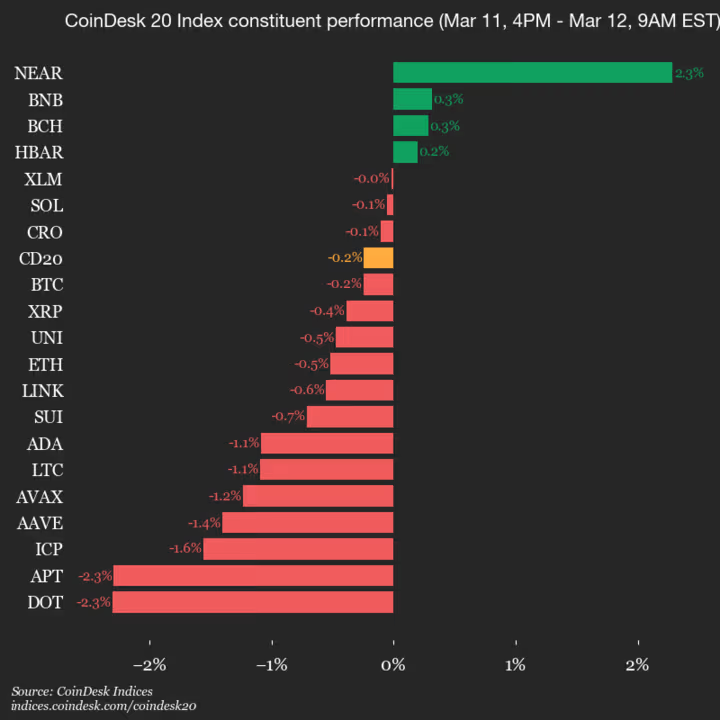
CoinDesk Indices presents its daily market update, highlighting the performance of leaders and laggards in the CoinDesk 20 Index.
The CoinDesk 20 is currently trading at 2012.94, down 0.2% (-4.89) since 4 p.m. ET on Wednesday.
Four of 20 assets are trading higher.

Leaders: NEAR (+2.3%) and BNB (+0.3%).
Laggards: DOT (-2.3%) and APT (-2.3%).
The CoinDesk 20 is a broad-based index traded on multiple platforms in several regions globally.
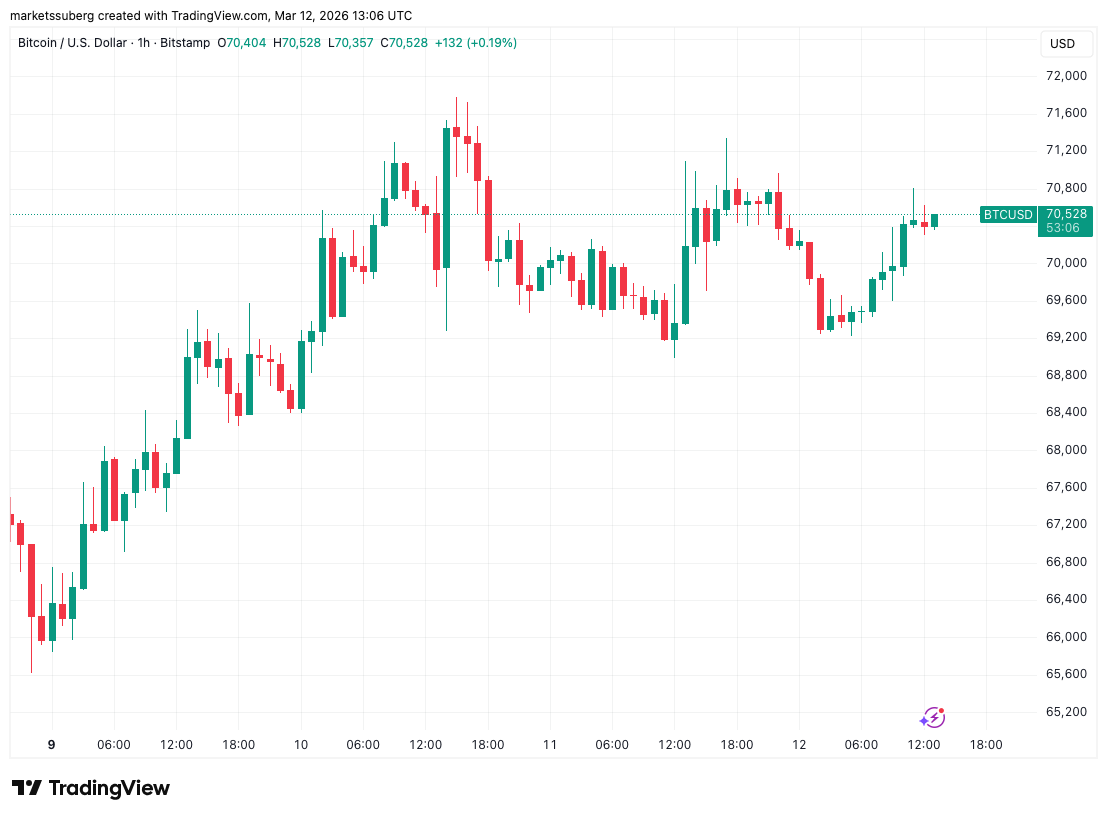
Bitcoin (BTC) circled $70,000 into Thursday’s Wall Street open after US jobs data matched expectations.
Key points:
-
Bitcoin shrugs off more US macro data as jobless claims copy flat CPI numbers.
-
Oil stays volatile, while markets ignore almost any chance of a March interest-rate cut.
-
BTC price action stays indecisive around the $70,000 mark.
Bitcoin surfs new US jobless claims release
Data from TradingView showed ongoing BTC price compression on the day, with BTC/USD acting in an increasingly narrow range.

US initial jobless claims were 213,000 for the week through March 7, just 1,000 below the previous week’s print and 2,000 below market consensus.
The numbers furthered relief over the US economy after Wednesday’s Consumer Price Index (CPI) release also avoided major deviations from its expected values.
Volatility, however, remained in oil, which was up by more than 5% on the day at the time of writing after initially rising above $95. News of a coordinated release of 400 million barrels from reserves to counteract the Strait of Hormuz impasse thus failed to alter the price trend.

Analyzing the situation, trading resource The Kobeissi Letter suggested that a lack of clarity from US President Donald Trump over how long the Middle East conflict would last was fueling oil’s ongoing surge.
“The reason behind this rally was largely that President Trump was not signaling how long the Iran war would last,” it wrote on X.
“Since then, the ONLY factor that has changed is that President Trump has said the war will be over ‘pretty quickly.’ However, this also implies that military action will likely continue until at least the end of March.”

The latest inflation prints, meanwhile, did nothing to alter the market’s views of future Federal Reserve policy.
The latest data from CME Group’s FedWatch Tool showed the odds of an interest-rate cut at the Fed’s March 18 meeting — a key potential crypto tailwind — at less than 1%.
BTC price breakout can take “several more weeks”
Key Bitcoin price levels remained in place as traders waited for directional cues.
Related: Bitcoin braces for oil shock and death crosses: 5 things to know this week
Trader Daan Crypto Trades flagged $72,000 and $62,000 as lines in the sand around spot price, with the Point of Control (PoC) at around $68,000.
“Anything in between will just chop you up as we have been seeing already. Ranges like these can easily take several more weeks before resolving,” he told X followers on Wednesday.

As Cointelegraph reported, consensus stayed bearish on the mid-term outlook, favoring a drop to new macro lows to come.
Trader and analyst Rekt Capital noted that by historical standards, Bitcoin’s bear market should continue from here.
“Time-wise, Bitcoin will soon be halfway through its Bear Market,” he summarized in one of several recent X updates.
“Retracement-wise however, Bitcoin has already performed 75% of the downside in its Bear Market correction.”

This article does not contain investment advice or recommendations. Every investment and trading move involves risk, and readers should conduct their own research when making a decision. While we strive to provide accurate and timely information, Cointelegraph does not guarantee the accuracy, completeness, or reliability of any information in this article. This article may contain forward-looking statements that are subject to risks and uncertainties. Cointelegraph will not be liable for any loss or damage arising from your reliance on this information.
Tether, the crypto firm behind the most popular stablecoin USDT, said Thursday it has invested in Ark Labs to bring programmable payments to the Bitcoin network.
The backing formed part of a $5.2 million funding round for the startup. Ark Labs develops Arkade, a system that aims to allow faster transactions and application building on top of Bitcoin. With the new funding, the start-up said it has raised about $7.7 million in total.
The project focuses on making Bitcoin usable for payments and financial tools that often require faster settlement and automation. Arkade acts as an execution layer that developers can use to build services such as payment networks, lending tools and digital asset platforms.
“Bitcoin is the most liquid digital asset in the world, but it has lacked the programmable infrastructure that financial applications require,” said Marco Argentieri, CEO of Ark Labs. “Arkade aims to change that,” he added.
Tether said the funding will help expand infrastructure that could support stablecoins on Bitcoin. Stablecoins are digital tokens pegged to fiat currencies such as the U.S. dollar and often move across other blockchains like Ethereum or Tron.
“Stablecoins were born on Bitcoin, and expanding access on the Bitcoin network remains a priority for us,” Tether CEO Paolo Ardoino said in a statement.
The investment is part of Tether’s effort to expand beyond its stablecoin issuance roots and enhance the use of its $185 billion digital dollar token USDT. Last month, the firm invested in online marketplace Whop and cross-chain protocol LayerZero.

Key Takeaways
- AAL declined approximately 3% to $11.11 during pre-market hours on March 11, continuing a steep slide from mid-February highs
- Crude oil-linked jet fuel has jumped from $85–90 per barrel to a range of $150–200 per barrel amid escalating Middle East conflict
- Unlike competitors, American maintains zero fuel hedging exposure, leaving it vulnerable to a $50M annual cost increase per penny of fuel price rise
- Wall Street consensus has shifted toward caution, with TD Cowen and Rothschild slashing forecasts and lowering ratings
- Internal pressure mounts as the flight attendants’ union delivered an unprecedented no-confidence declaration targeting CEO Robert Isom
American Airlines (AAL) delivered an adjusted pre-tax profit of merely $352 million for 2025. Meanwhile, Delta achieved $5 billion and United reached $4.6 billion during the same period. This performance disparity has become increasingly critical.
American Airlines Group Inc., AAL
Brent crude currently hovers near $91 per barrel, with industry analysts projecting sustained levels above $95 through the next eight weeks should Middle Eastern supply chain disruptions persist. Jet fuel costs have rocketed from their previous $85–90 baseline to peaks approaching $200 per barrel, based on Air New Zealand’s reporting.
While most global carriers employ fuel hedging strategies to mitigate risk, American has chosen a different path. Without hedging contracts, the carrier faces complete vulnerability to volatile spot market pricing — and current conditions are proving particularly harsh.
AAL stock plummeted over 5% on March 5 following both a downgrade announcement and a crude price surge connected to intensifying geopolitical tensions surrounding the Strait of Hormuz. Shares recently traded near $11.04, representing a significant retreat from mid-February valuations.
During March 11 pre-market activity, AAL extended losses with another ~3% decline to $11.11. Delta experienced a 2.2% drop while United fell 3.6% in parallel trading, yet American’s unhedged position amplifies its vulnerability considerably.
Company disclosures reveal that each additional penny per gallon translates to approximately $50 million in added annual fuel expenses for American. By comparison, Delta faces $40 million per penny, while Southwest’s exposure stands at just $22 million.
Financial Outlook Faces Headwinds
Executive leadership has projected a Q1 2026 loss ranging from $0.10 to $0.50 per share, with full-year earnings estimated between $1.70 and $2.70 per share. These full-year projections rest on the assumption that fuel prices stabilize — an increasingly questionable premise.
The carrier’s most recent quarterly results disappointed expectations. Actual EPS registered approximately $0.16 against consensus estimates of $0.38. Operating margins compressed to roughly 0.2%.
On March 9, American took steps to strengthen its financial position, expanding revolving credit facilities from $3.0 billion to $3.11 billion while pushing maturity dates to March 2031.
The airline closed 2025 carrying $36.5 billion in total debt obligations, with management targeting a reduction below $35 billion before 2026 concludes. Sustained elevated fuel costs threaten this deleveraging objective.
Wall Street Sentiment Deteriorates
Investment firms have grown increasingly cautious. TD Cowen reduced its price objective from $17 to $13 while maintaining a Buy rating with diminished enthusiasm. Rothschild & Co downgraded AAL from Buy to Neutral while slashing its target from $17 to $12.50, pointing to “constrained financial maneuverability amid rising cost pressures.”
Among 17 analysts monitored by MarketBeat, current ratings show 9 Hold recommendations, 6 Buy ratings, and 2 Sell ratings. The consensus 12-month price target stands at $16.22 — suggesting potential upside exceeding 40% from present levels, though achieving this outcome faces mounting obstacles.
Compounding financial challenges, the flight attendants’ union delivered an unprecedented no-confidence resolution against CEO Robert Isom, highlighting operational shortcomings and competitive underperformance.
Industry observers are focused on American’s upcoming appearance at the J.P. Morgan Industrials Conference scheduled for March 17, where Isom is anticipated to detail the carrier’s strategy for managing escalating costs while pursuing debt reduction commitments.


Bitcoin remains pinned around $70,000, showing impressive price stability even as market sentiment remains deeply pessimistic amid the Iran war and oil price volatility.
Crypto’s fear and greed index, a widely tracked sentiment indicator, has persistently signaled extreme fear in recent weeks, suggesting traders remain cautious despite the lack of a major price breakdown.
Market positioning also paints a dour picture. Annualized funding rates for bitcoin perpetual futures have been negative since early March, reflecting a growing bias for bearish short bets. The current stretch marks the longest period of negative funding since April 2025, when bitcoin ultimately formed a market bottom, around $76,000.
This is consistent with fear on Wall Street, where the VIX index jumped to 25 this week, its highest in over a year.
Yet bitcoin’s price action has been notably resilient. Since the escalation of the Middle East conflict on Feb. 28, the largest cryptocurrency has gained roughly 7%. That compares favorably with other major assets over the same period. The Nasdaq 100 has been largely steady while the S&P 500 has dropped about 1%, gold has slipped roughly 3% and silver has fallen nearly 9%.
This is in addition, to brent crude briefly pushing back above $100 per barrel earlier today amid ongoing tensions in the region.
The contrast was also visible during Wednesday’s U.S. trading session. BlackRock’s iShares Bitcoin Trust (IBIT) traded 1% higher. While major equity benchmarks were in the red, including the S&P 500 (SPX), the Nasdaq 100 (QQQ), the Russell 2000 (IWM) and the Dow Jones Industrial Average (DJI), highlighting bitcoin’s relative resilience during U.S. market hours.
The outperformance likely stems from big traders and institutions snapping up coins in privately negotiated transactions, keeping demand steady.
For now, bitcoin appears to be performing better than the market mood surrounding it, holding steady despite persistent fear across the broader financial landscape.
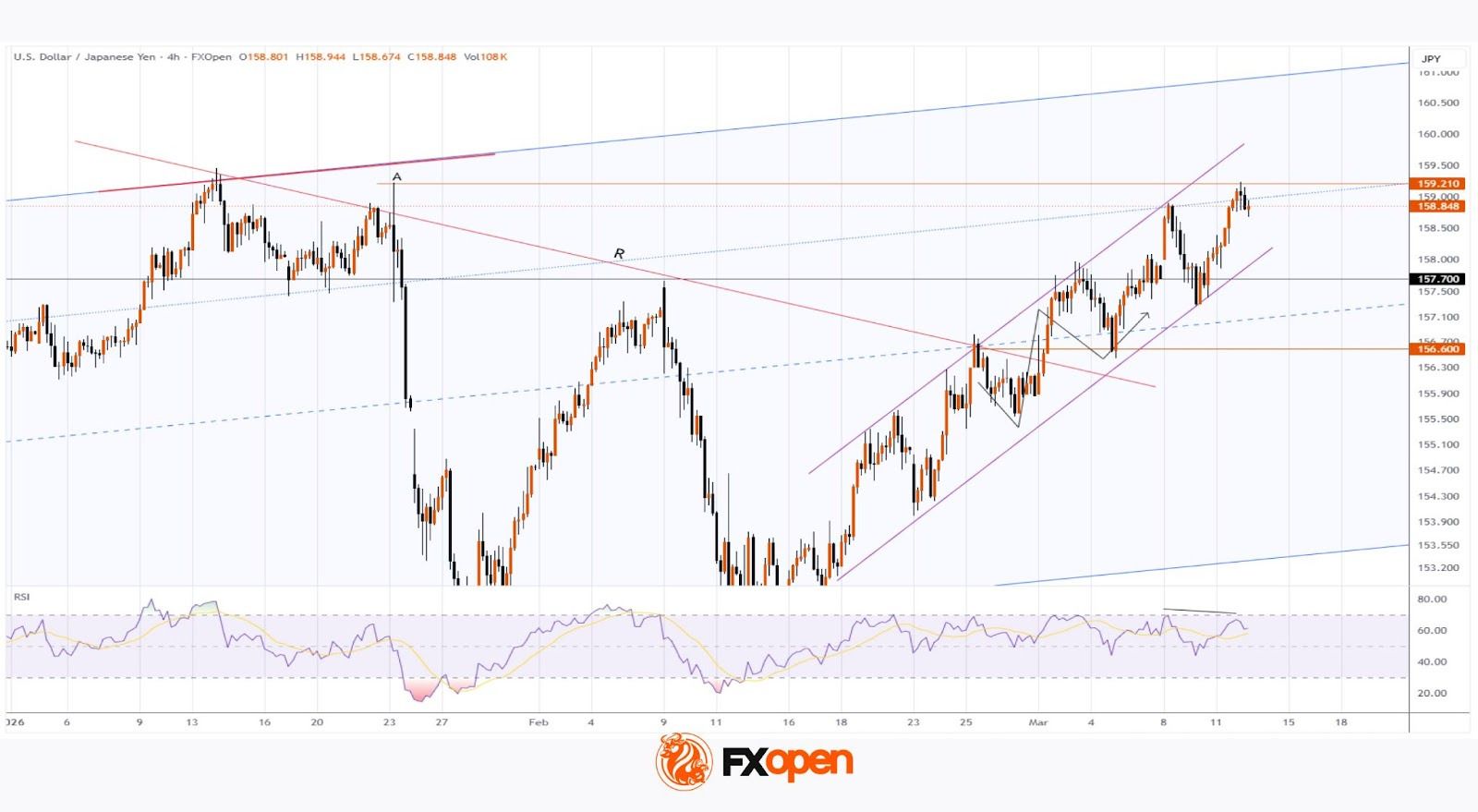
The USD/JPY chart shows a bullish trend at the start of March, influenced by the escalation of military activity in the Middle East.
On one hand, the US dollar is strengthening due to increased demand for safe-haven assets. On the other, the Japanese economy is under pressure because of its heavy reliance on oil imports from the Middle East.
These factors have pushed the pair above 159.20 JPY per USD this week, surpassing the January high (point A). The 2026 peak lies nearby; however, technical analysis suggests that bullish momentum may be fading.
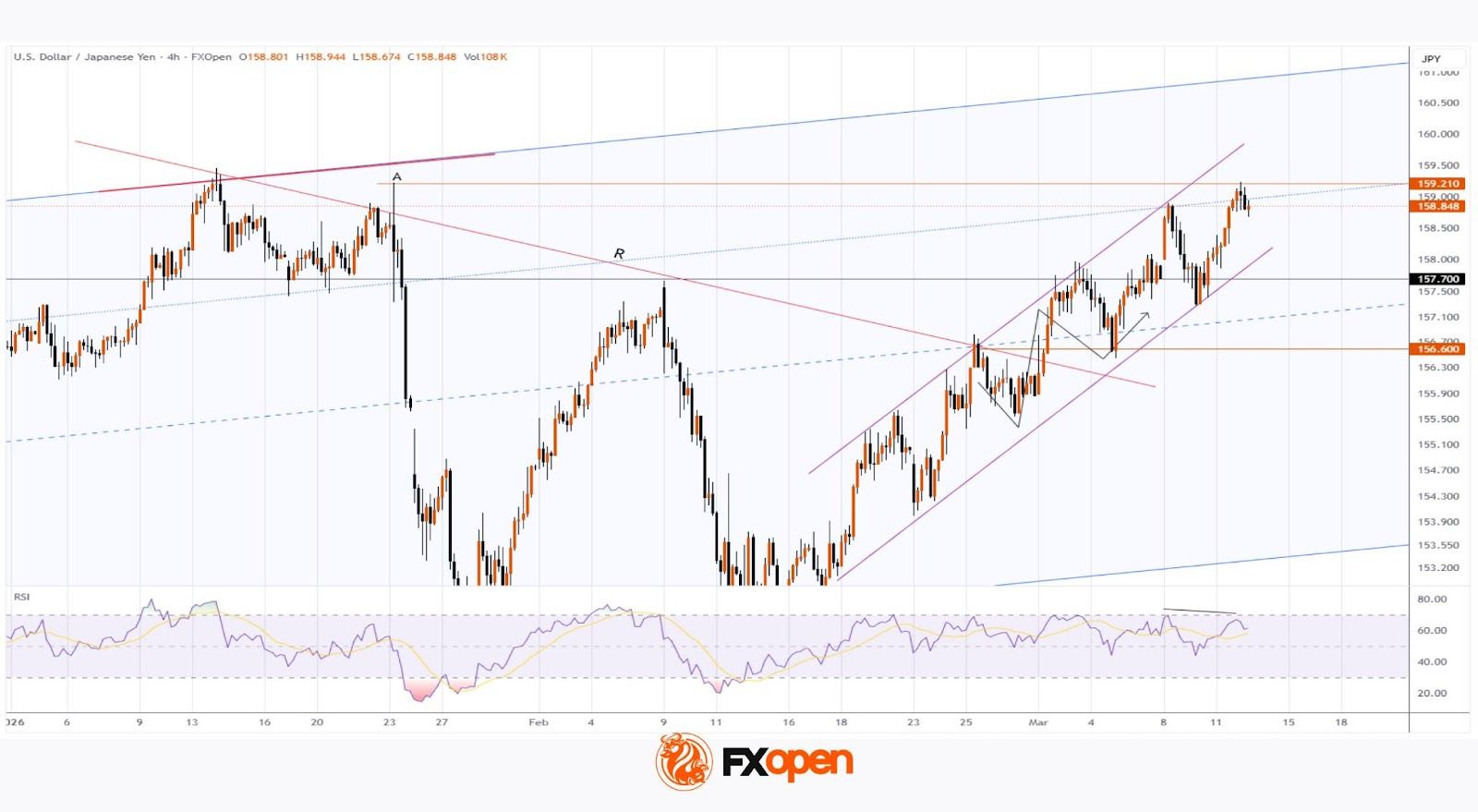
In our note of 26 February, we:
→ updated the wide ascending channel along with the intermediate growth trajectory (shown in purple);
→ highlighted signs of seller activity near 156.600.
As indicated by the arrow on the USD/JPY chart, after a small pullback to the lower purple line, buyers resumed their efforts, with the 156.600 level now acting as support.
Currently, we can observe that:
→ the RSI indicator is forming a bearish divergence;
→ it is becoming increasingly difficult for the price to reach the upper boundary of the purple channel;
→ the brief breach of point A resembles a bearish Liquidity Grab.
Additional bearish factors include:
→ the line dividing the upper half of the long-term channel into two parts;
→ proximity to the psychological 160 JPY per USD level.
It is worth recalling that in 2024, 1 USD briefly exceeded 160 JPY, but this level did not hold, as the Bank of Japan intervened. This context adds significance to the upcoming BOJ announcements, scheduled for next Thursday. Ahead of this event, USD/JPY may consolidate around current levels.
Trade over 50 forex markets 24 hours a day with FXOpen. Take advantage of low commissions, deep liquidity, and spreads from 0.0 pips (additional fees may apply). Open your FXOpen account now or learn more about trading forex with FXOpen.
This article represents the opinion of the Companies operating under the FXOpen brand only. It is not to be construed as an offer, solicitation, or recommendation with respect to products and services provided by the Companies operating under the FXOpen brand, nor is it to be considered financial advice.
Geopolitical frictions and a shifting macro backdrop are sharpening focus on what could emerge as a tipping point for crypto and broader risk assets: the US midterm elections. In a March 11, 2026 market commentary, Binance Research surveys how election cycles historically fed rebounds in equities and Bitcoin, suggesting the upcoming vote might unlock a constructive window for risk-on assets. The report flags that the 12 months after past midterms have seen the S&P 500 rise by about 19% on average, while Bitcoin delivered roughly a 54% gain across the three post-midterm years on record. With the midterms slated for November 3, 2026, the study frames the coming year as a potentially pivotal phase for markets trading around political uncertainty.
Key takeaways
- Historical post-midterm performance shows a potential upside for risk assets, with the S&P 500 up ~19% on average and Bitcoin up ~54% over the three post-midterm years in prior cycles.
- Bitcoin has experienced negative returns during several midterm years (example declines: 2014, 2018, 2022), but the pattern in subsequent years has generally been a rebound.
- The near-term direction hinges on geopolitics, notably US-Israel-Iran tensions, with oil prices a potential pressure point if energy supply is disrupted.
- The energy market narrative was reinforced by an emergency energy stock release of 400 million barrels, the largest coordinated drawdown on record.
- Market participants appear to be in a wait-and-see phase, awaiting clearer directional signals once election outcomes are known.
Tickers mentioned: $BTC
Sentiment: Neutral
Price impact: Positive. The historical pattern of post-midterm rebounds in both equities and Bitcoin suggests a potential uplift in risk assets once political uncertainty subsides.
Trading idea (Not Financial Advice): Hold. Investors may want to wait for clearer post-election directional cues and macro signals before taking sizable new positions.
Market context: The narrative arcs around the midterms intersect with macro risk sentiment, regulatory discourse, and energy-market dynamics, all of which can shape liquidity and appetite for crypto assets in the near term.
Why it matters
The Binance Research framework emphasizes that the political risk hurdle commonly cleared after election outcomes has historically unlocked a more robust risk-on regime. In practical terms, if the 2026 midterms resolve with a clearer policy outlook, traders could see renewed bid activity across both traditional markets and crypto. The historical lens does not guarantee future moves, but it provides a reference for how sentiment has tended to shift when political ambiguity diminishes.
From a trader’s vantage point, the divergence between headline risk and market mechanics is notable. Even as Bitcoin (CRYPTO: BTC) has flirted with key levels and traded within ranges shaped by liquidity flows, the broader message of the Binance analysis is that the cycle often accelerates once electoral uncertainty recedes. In prior midterm years, Bitcoin’s trajectory has been punctuated by sharp corrections during the year itself, followed by significant recoveries in the ensuing periods. That pattern could inform risk budgeting and timing considerations for funds that aim to participate in the rebound without overexposure to interim volatility.
Oil and energy markets add another layer of complexity. As geopolitical tensions intensify, crude prices have shown sensitivity to supply expectations. Recent data suggest the market could spike further if disruptions endure, a scenario that tends to weigh on risk assets in the short run even as longer-term cycles remain dependent on policy clarity and liquidity dynamics. A one-day spike to the vicinity of $95 per barrel framed the current stress, underscoring how energy risk can spill over into equities and crypto markets.
In parallel, market infrastructure signals have pointed to a broader risk-off posture in the near term. The energy-release maneuver by international authorities, described as the largest-ever coordinated drawdown, adds a layer of supply-side management that could temper volatility in the energy complex—but it does not eliminate the risk of further macro shocks. Analysts cautioned that continued geopolitical escalation could keep risk assets under pressure, at least until a clearer post-election framework emerges. For readers interested in the on-the-ground links to these developments, recent reporting from Reuters outlined the energy dynamics and the rhetoric around price stability amid the conflict.
Despite the near-term headwinds, the longer historical arc highlighted by Binance Research remains relevant: the period after the election and the associated resolution of political uncertainty has historically produced meaningful rallies. The message is not to extrapolate a foolproof blueprint, but to recognize that policy clarity can reframe risk appetite. Bitcoin’s own history of midterm-year drawdowns, followed by rebounds, adds a layer of complexity but also a potential pathway for investors who can weather the interim noise. To see a related compilation of market context including the energy shock and its ripple effects, readers can review the linked analyses and the energy market data sources cited in the coverage, including the market commentary that anchors these observations.
For a quick snapshot of the broader narrative in motion, a concise explainer video on market dynamics related to this cycle can be found here: Video discussion.
The analysis arrives as markets enter a period of heightened attention ahead of the November 3, 2026 vote, when the 120th Congress will take shape and set the tone for policy and regulatory signals in the year ahead. While the near term may ride a roller-coaster of headlines, the data from prior cycles provides a reference point for investors assessing whether a recovery window could be opening for equities and digital assets alike. The key takeaway: the post-election horizon could be the most constructive phase of the cycle, provided geopolitical tensions do not diverge into a sustained risk-off regime before the dust settles.
The crosscurrents at play—geopolitics, energy stability, and the timing of policy clarification—mean that market moves could be as much about risk sentiment and liquidity flows as about fundamentals. In the coming months, traders will be watching for progress in diplomatic channels, oil market signals, and any regulatory developments that could influence market structure or capital flows into crypto. The interplay of these factors will help determine whether the long-hoped-for recovery accelerates or remains restrained by ongoing uncertainty.
As with all such analyses, the caveat remains: past performance is not a guarantee of future results. However, the framework outlined by Binance Research provides a structured lens to interpret how the upcoming midterms might align with broader macro and crypto-market rhythms. The next few quarters will be telling as investors weigh the odds of a meaningful reset against continued geopolitical volatility and policy debates that will shape the market landscape for the remainder of the year.
What to watch next
- November 3, 2026 — US midterm elections determine the composition of the 120th Congress and influence policy signals for the year ahead.
- Post-election period — watch for any substantive shifts in regulatory discourse that could affect crypto market structure and liquidity.
- Geopolitical developments in the Middle East — escalation or de-escalation can impact energy prices and risk sentiment.
- Official energy-market actions — monitor further commentary on energy security and any additional emergency stock management outcomes.
- Market commentary updates — ongoing analyses that correlate election outcomes with volatility and liquidity in crypto markets.
Sources & verification
- Binance Research, Weekly Market Commentary (March 11, 2026) — historical post-midterm performance data and interpretation.
- Reuters reporting on energy disruptions and price implications related to Middle East tensions.
- Trading Economics data on crude oil price movements and daily price spikes.
- International Energy Agency announcements on emergency stock releases (largest coordinated drawdown).
- Election date and political timeline for the November 3, 2026 midterms.
Post-midterm dynamics could reshape crypto and risk assets
The central premise is that the political fog surrounding election outcomes has historically been a wind at the back of risk assets once it lifts. Binance Research’s synthesis shows a pattern of strength following periods of uncertainty, with the S&P 500 and Bitcoin delivering memorable advances in the year or years after midterm cycles. That pattern does not imply a guaranteed rally, but it offers a framework for considering how a calmer political horizon might influence price action across markets that have become increasingly interlinked in recent years.
In practice, the near-term trajectory will be colored by geopolitics and macro data arrivals. The immediate risk premiums tied to the US-Israel-Iran dynamic could push energy prices higher, which tends to compress risk appetite in the short run. Yet if the election outcomes resolve in a way that reduces political risk, liquidity could improve and traders may reallocate toward risk assets, including digital currencies. Bitcoin’s own history in midterm years—marked by episodic declines followed by longer-term recoveries—adds nuance to how investors should position themselves during this transition window. The historical signal is not a guarantee, but it is a lens for weighing potential outcomes as the cycle evolves.
Market participants will also be watching for any policy shifts or legislative milestones that could affect the crypto market structure, such as regulatory proposals or framework updates that impact market access and capital flows. The energy-market backdrop, with its flashpoints and emergency stock actions, will continue to feed volatility but also to shape the tempo of risk-taking. In a landscape where liquidity and risk sentiment are closely tethered to macro and geopolitical developments, the post-midterm period could offer a clearer directional signal for traders, investors, and builders navigating the crypto ecosystem.

No.10 Rejects Accusations Of A ‘Cover-Up’ In Mandelson Files

Eightco shares jump $125 million funding commitment from Btmine, ARK, Kraken parent Payward

BITCOIN: Forgotten Line From 2019 Reveals The TRAP!


-
Business6 days ago
Form 8K Entergy Mississippi LLC For: 6 March
-

 News Videos3 days ago
10th Algebra | Financial Planning | Question Bank Solution | Board Exam 2026
-

 Fashion6 days ago
Weekend Open Thread: Ann Taylor
-

 Crypto World3 days ago
Paradigm, a16z, Winklevoss Capital, Balaji Srinivasan among investors in ZODL
-
 Tech1 day ago
A 1,300-Pound NASA Spacecraft To Re-Enter Earth’s Atmosphere
-
 Sports7 days ago
499 runs and 34 sixes later, India beat England to enter T20 World Cup final | Cricket News
-

 Politics6 days ago
Top Mamdani aide takes progressive project to the UK
-

 Business2 days ago
ExxonMobil seeks to move corporate registration from New Jersey to Texas
-

 Tech2 days ago
ChatGPT will now generate interactive visuals to help you with math and science concepts
-

 Sports5 days ago
Three share 2-shot lead entering final round in Hong Kong
-

 Sports4 days ago
Braveheart Lakshya downs Lai in epic battle to enter All England Open final | Other Sports News
-

 NewsBeat20 hours ago
Residents reaction as Shildon murder probe enters second day
-

 NewsBeat7 days ago
Piccadilly Circus just unveiled ‘London’s newest tourist attraction’ and it only costs 80p to enter
-

 Entertainment5 days ago
Hailey Bieber Poses For Sexy Selfies In New Luscious Lip Thirst Traps
-

 Business4 days ago
Search for Nancy Guthrie Enters 37th Day as FBI Probes Wi-Fi Jammer Theory
-

 Business1 day ago
Search Enters Sixth Week With New Leads in Tucson Abduction Case
-
 NewsBeat3 days ago
Pagazzi Lighting enters administration as 70 jobs lost and 11 stores close across Scotland
-

 Tech3 days ago
Despite challenges, Ireland sixth in EU for board gender diversity
-

 Business3 days ago
Search Enters 39th Day with FBI Tip Line Developments and No Major Breakthroughs
-

 NewsBeat23 hours ago
I Entered The Manosphere. Nothing Could Prepare Me For What I Found.