

Crypto World
DeFi Disaster: How Ignoring Slippage Warnings Cost One Trader $50 Million on Aave


TLDR
- Extreme slippage on Aave led to a devastating loss of nearly $50 million for one cryptocurrency trader in a single swap transaction.
- The transaction converted $50.4 million into approximately 327 AAVE tokens valued at just $36,000.
- The trader acknowledged and bypassed several explicit slippage warnings on mobile before executing the trade.
- An MEV bot executed a sandwich attack on the same transaction, extracting close to $10 million in profits.
- The Aave protocol announced plans to refund approximately $600,000 in protocol fees to the impacted trader.
On Thursday, March 12, 2026, a cryptocurrency trader experienced one of the most devastating losses in DeFi history, losing approximately $50 million in just one transaction. The incident occurred while executing a token swap on Aave, a prominent decentralized finance platform.
The wallet in question, freshly funded via Binance, contained $50,432,688 worth of aEthUSDT. These interest-bearing tokens represent Tether’s USDT stablecoin deposited within the Aave lending ecosystem operating on Ethereum.
The trader initiated a swap to exchange the entire balance for aEthAAVE, the tokenized version of Aave’s governance token. This transaction was processed through CoW Protocol and executed on the SushiSwap decentralized exchange.
Due to the massive size of the order relative to available pool liquidity, the swap suffered catastrophic slippage exceeding 99%. The final result was a mere 327 AAVE tokens worth roughly $36,000.
Effectively, the trader paid approximately $154,000 for each AAVE token when the prevailing market rate stood at around $114.
What the Warnings Said
Stani Kulechov, founder of Aave, verified that the platform’s user interface had displayed prominent warnings before execution. In a post on X, he explained that the system alerted the user about “extraordinary slippage” resulting from the “unusually large size of the single order.”
The platform mandated that users check a confirmation box acknowledging the risk. The trader completed this step on a mobile device and moved forward with the transaction.
“The transaction could not be moved forward without the user explicitly accepting the risk,” Kulechov stated. He emphasized that the CoW Swap routing system functioned exactly as designed.
CoW DAO released its own statement, explaining that “no DEX, DEX aggregator, public liquidity pool, or private liquidity pool would have been able to fill this trade at anywhere near a reasonable price.”
The MEV Bot Attack
Compounding the slippage disaster, an MEV bot launched a sophisticated “sandwich attack” targeting this transaction.
MEV bots constantly scan pending blockchain transactions for profitable opportunities. This particular bot identified the massive incoming AAVE purchase and positioned itself to exploit it.
The bot secured a flash loan of $29 million in wrapped Ether from Morpho, deployed it to purchase AAVE on Bancor (artificially inflating the price), then sold directly into the trader’s order on SushiSwap. This strategy generated approximately $9.9 million in profits for the bot operator.
The manipulation drove AAVE’s price significantly higher immediately before the trader’s order executed, amplifying an already catastrophic outcome.
This incident followed closely after approximately $27 million in liquidations on Aave, which some observers suggested might have been connected to a temporary pricing anomaly affecting the wstETH token.
Kulechov expressed sympathy for the affected trader. The Aave protocol intends to contact the user and reimburse approximately $600,000 in fees collected during the transaction.
CoW DAO similarly committed to refunding any protocol fees associated with the trade.


The price of Bitcoin climbed to a weekly high on March 13, defying geopolitical concerns tied to rising tensions between the United States and Iran.
Summary
- Bitcoin price reached a weekly high near $72,000, holding above the $70K level.
- Negative funding rates on Binance suggest many traders are still shorting the rally.
- A potential short squeeze could push BTC toward $75K if the rebound continues.
Bitcoin (BTC) was trading around $71,400, up about 1.2% on the day, according to the chart data, after briefly touching an intraday high near $72,000. The move pushed the world’s largest cryptocurrency back above the key $70,000 psychological level.
The rebound comes despite a fragile macro environment. Ongoing geopolitical tensions and concerns surrounding global oil markets have weighed on broader risk sentiment, conditions that typically make it difficult for speculative assets like Bitcoin to outperform.
However, on-chain data suggests that many traders remain skeptical about the rally.
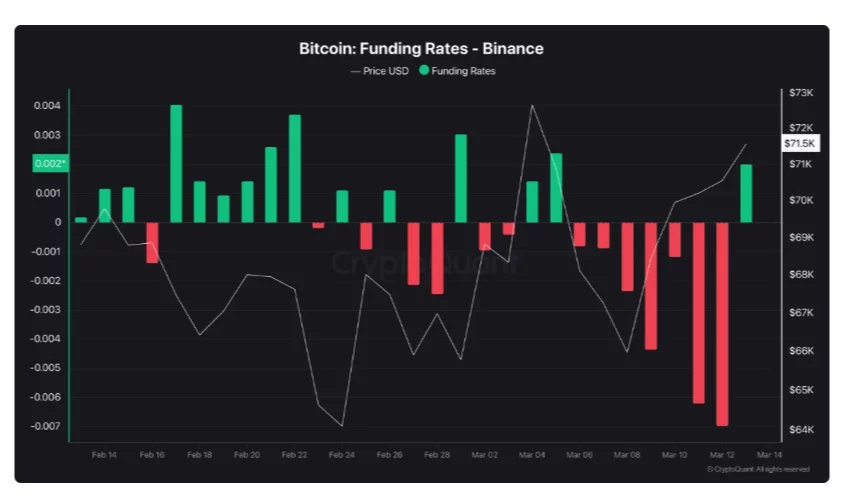
According to market insights from CryptoQuant, derivatives market positioning shows a growing bearish bias among investors. Funding rates on Binance have remained negative for roughly a week, indicating that a majority of leveraged traders are betting against further price gains.
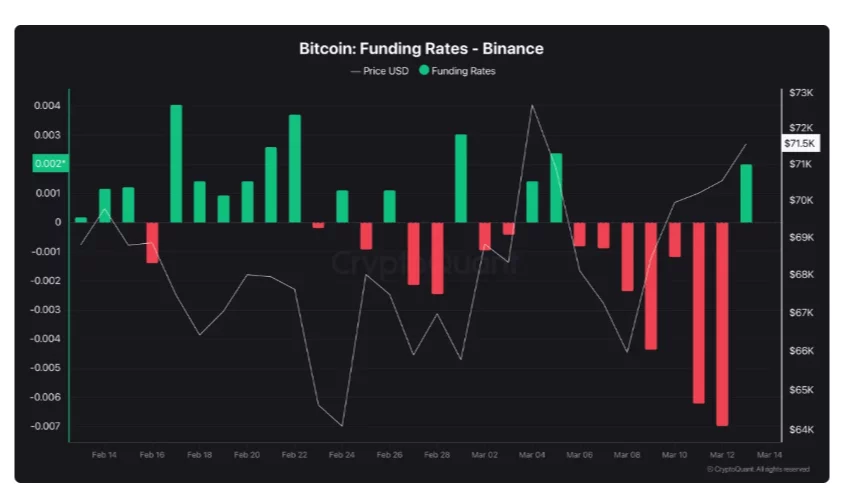
On March 10 and March 11, funding rates on Binance reportedly dropped below −0.006, an unusually negative level that signals strong short positioning in the market.
This dynamic could paradoxically support further upside for Bitcoin.
Historically, when funding rates reach extreme levels and a strong consensus forms around a bearish outlook, markets sometimes move in the opposite direction. If Bitcoin continues to push higher, short sellers may be forced to close positions, triggering a short squeeze that could accelerate the rally.
Bitcoin price analysis
The attached chart shows BTC gradually recovering from its February lows near $63,000, forming a sequence of higher lows in recent weeks.
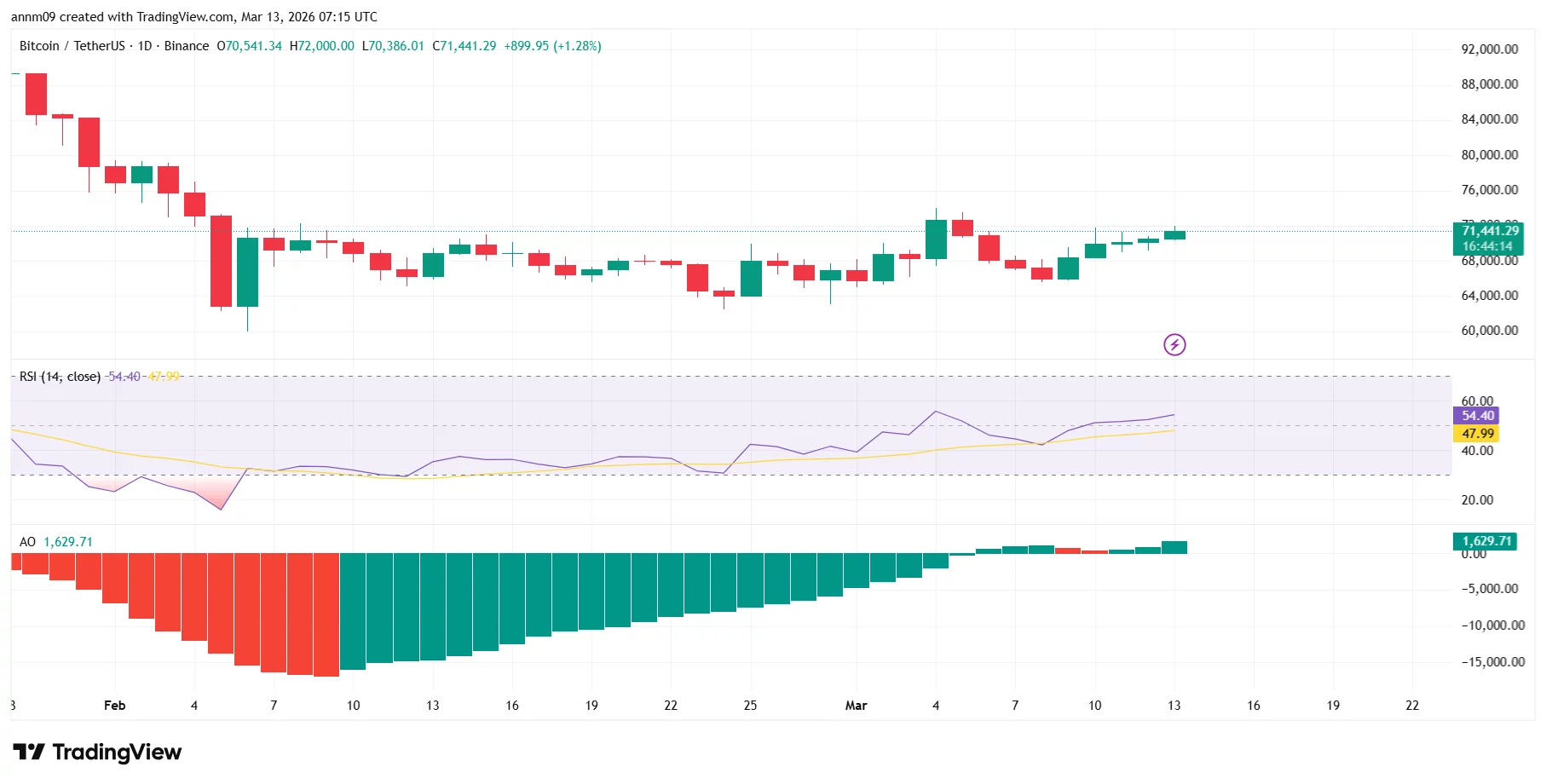
Momentum indicators are also improving. The relative strength index (RSI) is around 54, suggesting bullish momentum is building while still remaining far from overbought territory.
Meanwhile, the Awesome Oscillator (AO) has shifted from deep negative territory in February to positive green bars above the zero line. The steady transition from red to green histogram bars indicates that bearish momentum has faded and bullish momentum is strengthening.
Importantly, the AO shows increasing positive bars in recent sessions, which typically signals growing upside momentum as short-term market strength begins to outpace the longer-term trend.
From a technical perspective, $72,000 represents the immediate resistance level. A confirmed breakout above that area could open the door for a move toward $75,000.
On the downside, $68,000–$69,000 acts as key support, while the $70,000 level remains a critical psychological threshold for maintaining bullish momentum.
Crypto World
Vitalik Buterin explains $500M SHIB donation, distances himself from AI safety lobbying


Ethereum co-founder Vitalik Buterin has clarified the circumstances surrounding his massive 2021 crypto donation to the Future of Life Institute, while distancing himself from some of the group’s more recent policy approaches toward artificial intelligence.
Summary
- Vitalik Buterin clarified that his massive donation to the Future of Life Institute came from SHIB tokens sent to him during the 2021 memecoin boom.
- The institute reportedly converted roughly $500 million worth of SHIB despite Buterin expecting only a small portion could be sold.
- Buterin warned that centralized AI safety policies and large-scale lobbying efforts could create geopolitical tensions and unintended consequences.
Vitalik Buterin: AI safety risks losing trust if it becomes geopolitical power play
In a detailed post on X, Buterin explained that the funds originated from large quantities of dog-themed tokens, including Shiba Inu, which had been sent to his wallet by developers hoping to use his holdings as a marketing tactic.
According to Buterin, the tokens surged in value during the 2021 memecoin boom, with their peak “book value” exceeding $1 billion. Believing the rally was likely a bubble, he moved quickly to access the funds from cold storage, sold part of the holdings for Ether, and donated to several causes.
Buterin said he contributed roughly half of the remaining SHIB to India’s COVID-19 relief effort through CryptoRelief, while the other half went to the Future of Life Institute, an organization focused on existential risks such as artificial intelligence, nuclear threats and biotechnology.
He initially assumed the institute would only be able to liquidate between $10 million and $25 million worth of the tokens due to limited market liquidity. Instead, both CryptoRelief and the institute managed to convert around $500 million worth of SHIB.
However, Buterin said the organization later shifted its strategy toward cultural and political advocacy aimed at accelerating AI regulation in response to the perceived rapid arrival of artificial general intelligence.
While acknowledging their concerns, Buterin warned that large-scale coordinated political campaigns backed by substantial funding could produce unintended consequences and backlash.
“My worry is that large-scale coordinated political action with big money pools can easily lead to unintended outcomes,” he said.
Instead, Buterin said his preferred approach focuses on developing open-source technologies that improve resilience to high-risk scenarios, including stronger cybersecurity systems, secure hardware and pandemic detection tools.
He also cautioned that AI safety efforts could lose credibility globally if they become associated with attempts by specific companies or countries to dominate the technology.
The US dollar continues to strengthen against major counterparts as markets await important macroeconomic data scheduled for release in the coming hours. Investors are focusing on US GDP figures, the Personal Consumption Expenditures (PCE) price index, and Canada’s labour market statistics. These releases could significantly influence expectations regarding the future policy path of the Federal Reserve and set the tone for currency market movements.
The strengthening of the US currency has also been supported by rising geopolitical tensions in the Middle East. Over the past 24 hours, the conflict involving Iran, the US, and Israel has intensified, leading to a sharp rise in oil prices and increased demand for safe-haven assets. Reports indicate strikes on tankers in the region, along with conflicting information about the potential closure of the Strait of Hormuz. Rising energy prices and heightened geopolitical risks are supporting the dollar as demand for liquid defensive assets increases. At the same time, market participants remain cautious ahead of key data releases that could alter expectations for interest rates.
USD/JPY
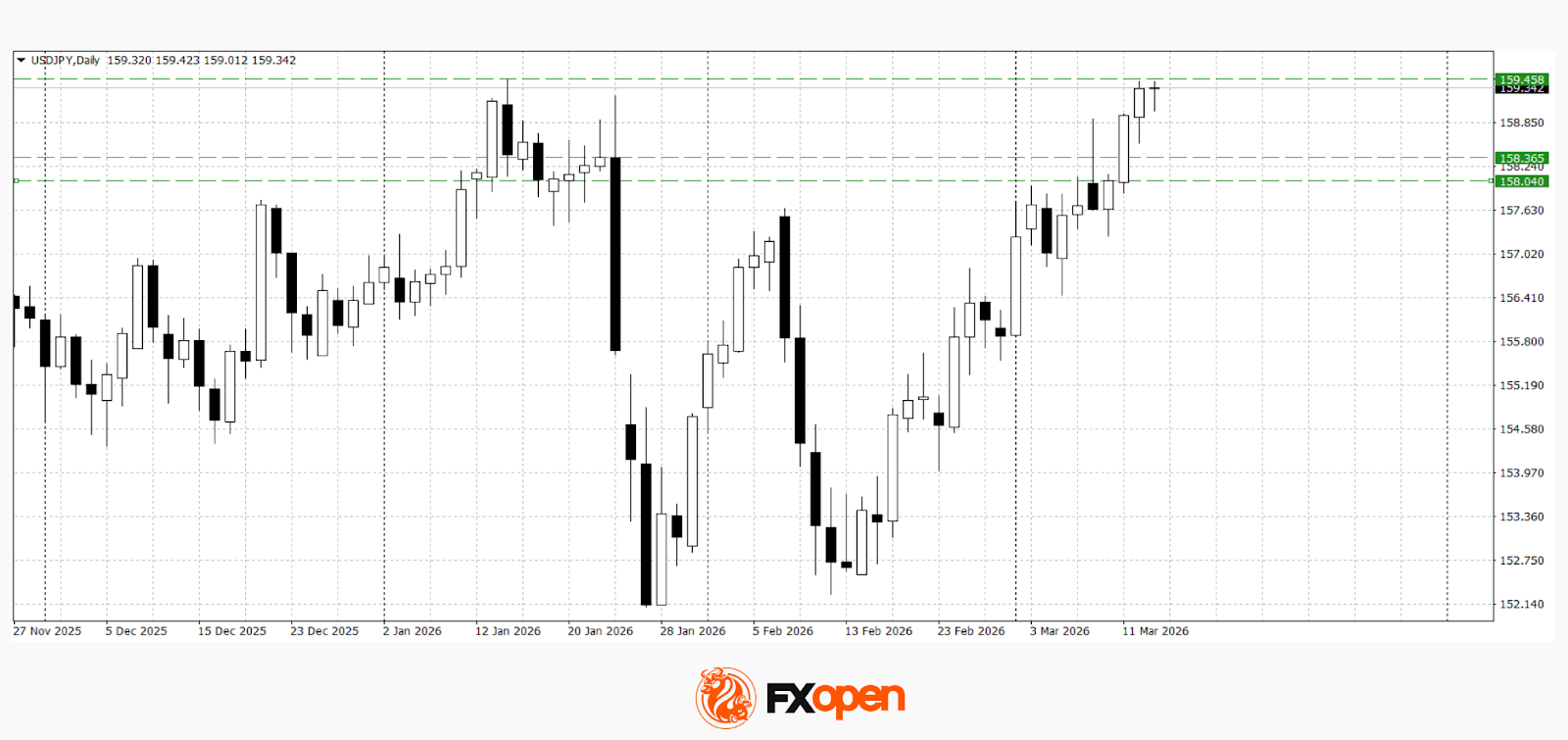
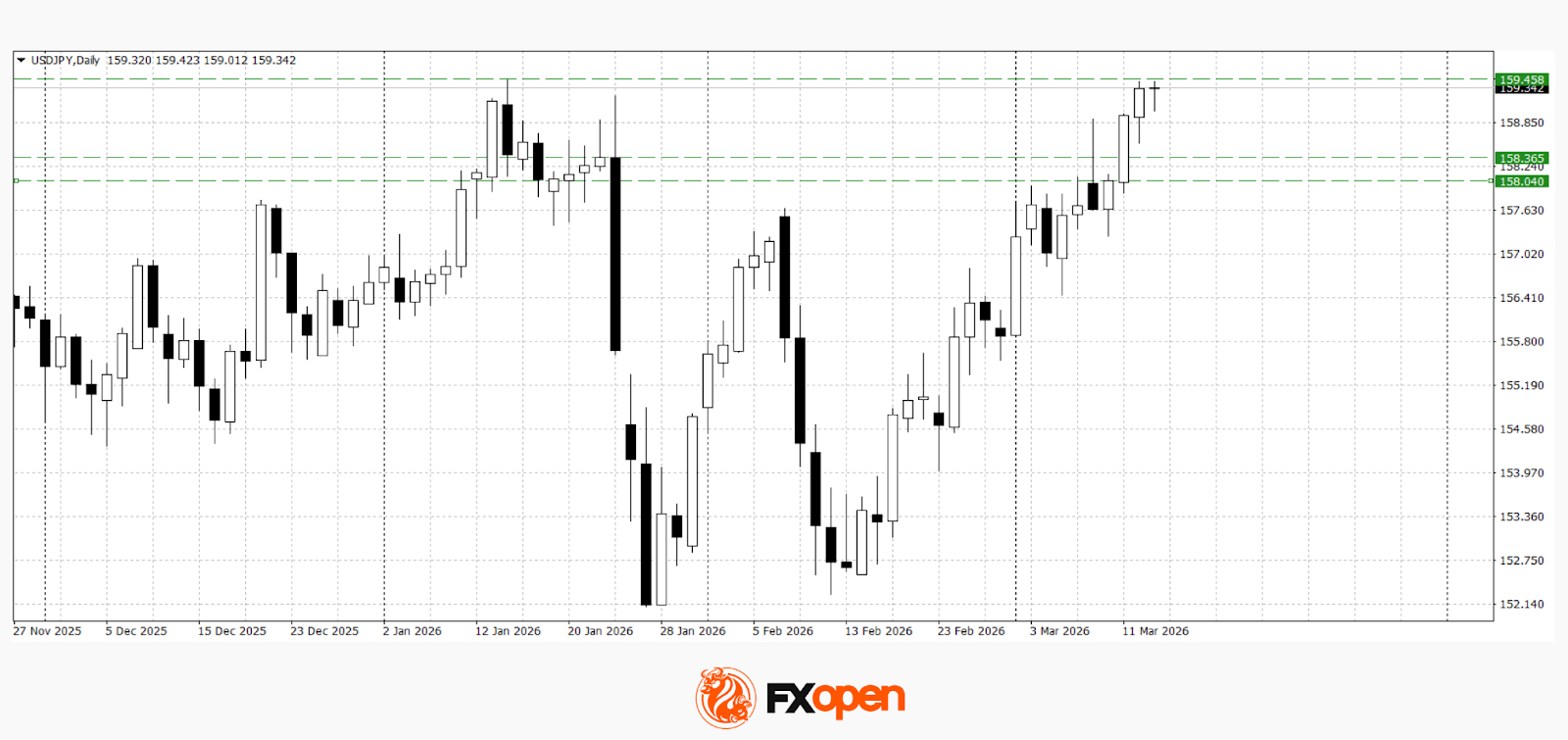
The USD/JPY pair continues to move higher and is trading near its annual highs. Technical analysis suggests the possibility of a downward pullback if the 159.45 level holds as resistance. However, if buyers manage to establish a firm break above this level, the pair could advance towards the 160.20–161.00 range.
Key events for USD/JPY:
- today at 14:30 (GMT+2): US GDP
- today at 14:30 (GMT+2): US Core PCE Price Index
- today at 16:00 (GMT+2): US Job Openings (JOLTS)
USD/CAD
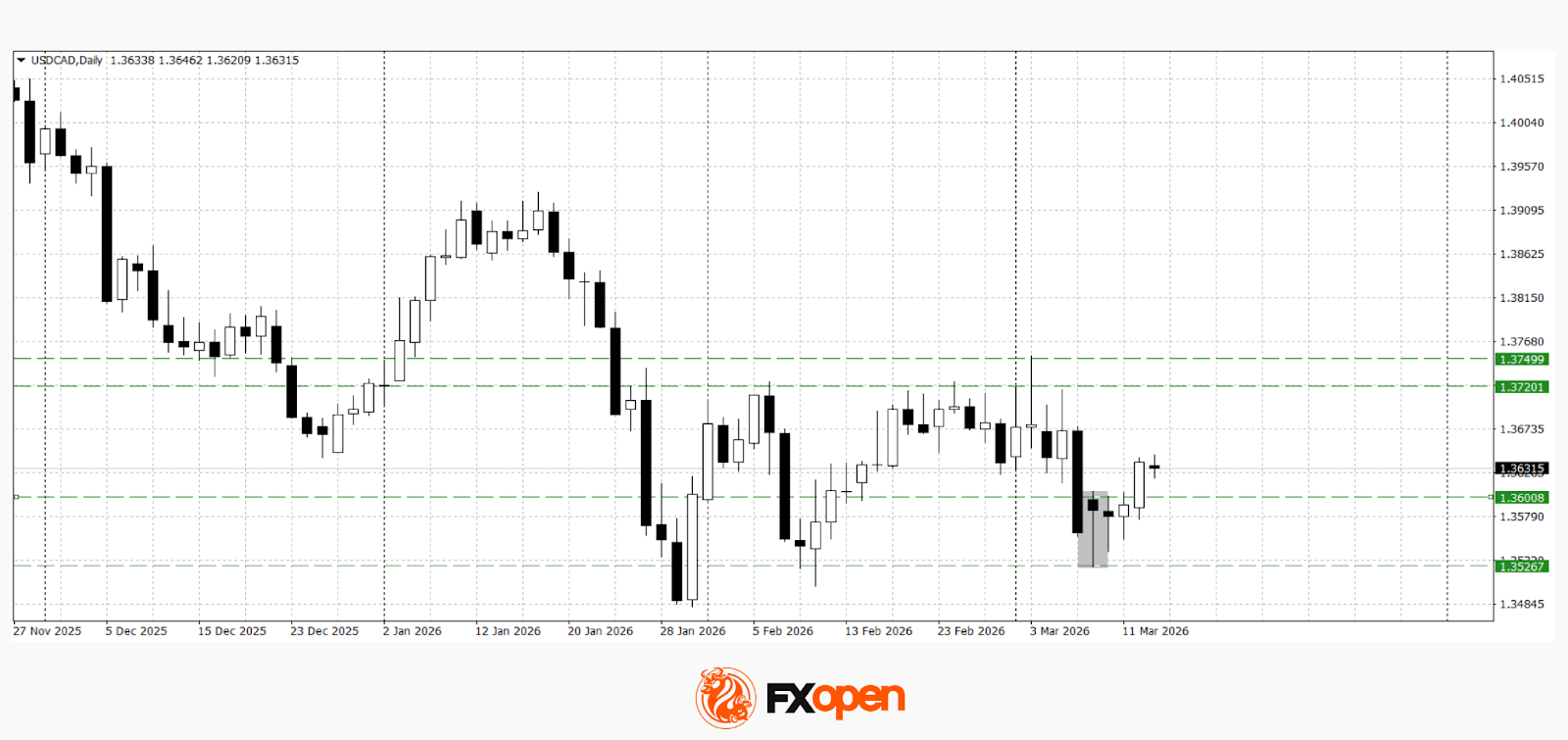
The USD/CAD pair is also moving higher, although it remains significantly below its yearly highs compared with USD/JPY. Last week, the price found support near 1.3520, where a doji candlestick pattern formed, signalling a potential reversal. The pair is currently consolidating above 1.3600, and if the upward momentum continues, a test of recent highs in the 1.3720–1.3750 range may follow.
Key events for USD/CAD:
- today at 14:30 (GMT+2): Canada Employment Change
- today at 14:30 (GMT+2): Canada Unemployment Rate
- today at 14:30 (GMT+2): Canada Labour Force Participation Rate
Trade over 50 forex markets 24 hours a day with FXOpen. Take advantage of low commissions, deep liquidity, and spreads from 0.0 pips (additional fees may apply). Open your FXOpen account now or learn more about trading forex with FXOpen.
This article represents the opinion of the Companies operating under the FXOpen brand only. It is not to be construed as an offer, solicitation, or recommendation with respect to products and services provided by the Companies operating under the FXOpen brand, nor is it to be considered financial advice.
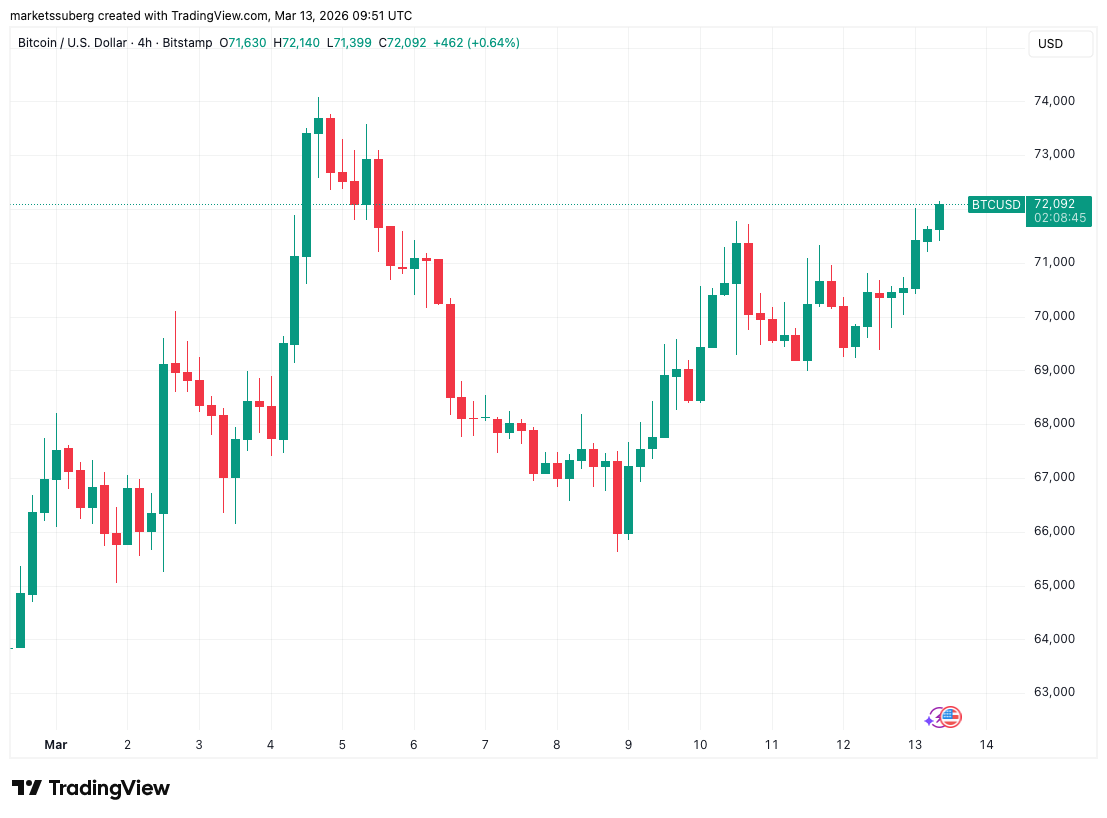
Bitcoin (BTC) hit eight-day highs into Friday’s Wall Street open as markets awaited key US inflation cues.
Key points:
-
Bitcoin shows resilience despite macro market uncertainty with another push beyond $72,000.
-
Key US inflation data increased the chances of risk-asset volatility to come.
-
BTC price gains outperform macro assets since the start of the Iran conflict.
Trump demands Fed rate cut ahead of PCE print
Data from TradingView showed BTC/USD climbing past $72,000 on Bitstamp for the first time since March 5.

Bitcoin avoided a sell-off despite global uncertainty over the Middle East conflict and its impact on oil supplies. The week’s macro data prints from the US further conformed to expectations, decreasing the risk of excess market volatility.
Friday was due to see the Personal Consumption Expenditures (PCE) Index release for January — an important gauge known as the Federal Reserve’s “preferred” inflation measure.
The previous PCE print beat anticipated levels to hit its highest since late 2023.

Despite the oil crisis threatening a surge in inflationary forces, US President Donald Trump renewed demands for Fed Chair Jerome Powell to loosen policy.
“Where is the Federal Reserve Chairman, Jerome ‘Too Late’ Powell, today? He should be dropping Interest Rates, IMMEDIATELY, not waiting for the next meeting,” he wrote in a post on Truth Social.
As Cointelegraph reported, odds of a rate cut at the Fed’s March 18 meeting fell below 1% this week.

”Conviction is building” for Bitcoin bullish breakout
Among Bitcoin market participants, the focus was on price strength amid the macro chaos.
Related: Bitcoin’s ‘extremely precise’ macro signal puts $100K target back in play
“Bitcoin has remained surprisingly resilient following the recent geopolitical shock,” onchain analytics platform Glassnode summarized in the latest edition of its regular newsletter, “The Week Onchain.”
Glassnode flagged options-market activity showing that traders were less concerned about short-term risk.
“An accumulation cluster is forming in the $62k–$72k range. However, its intensity is modest relative to prior phases that preceded sustained expansions,” it continued in an X post on Thursday while analyzing the cost basis of investors hodling BTC for six months or less.
“Conviction is building, but the foundation for a mid-term breakout remains thin so far.”

Others noted that BTC/USD had outperformed other macro assets since the start of the events in Iran.
“Passing the geopolitical stress test,” Joe Consorti, head of growth at Bitcoin equity company Horizon, commented.
Bitcoin is the best-performing major asset since last month’s strikes on Iran.
BTC is up 7.3%, the S&P 500 and Nasdaq are down 1-2%, gold is down 3.7%, and silver is down over 10%.
Passing the geopolitical stress test. pic.twitter.com/vg2RvEh9OM
— Joe Consorti (@JoeConsorti) March 12, 2026
This article does not contain investment advice or recommendations. Every investment and trading move involves risk, and readers should conduct their own research when making a decision. While we strive to provide accurate and timely information, Cointelegraph does not guarantee the accuracy, completeness, or reliability of any information in this article. This article may contain forward-looking statements that are subject to risks and uncertainties. Cointelegraph will not be liable for any loss or damage arising from your reliance on this information.
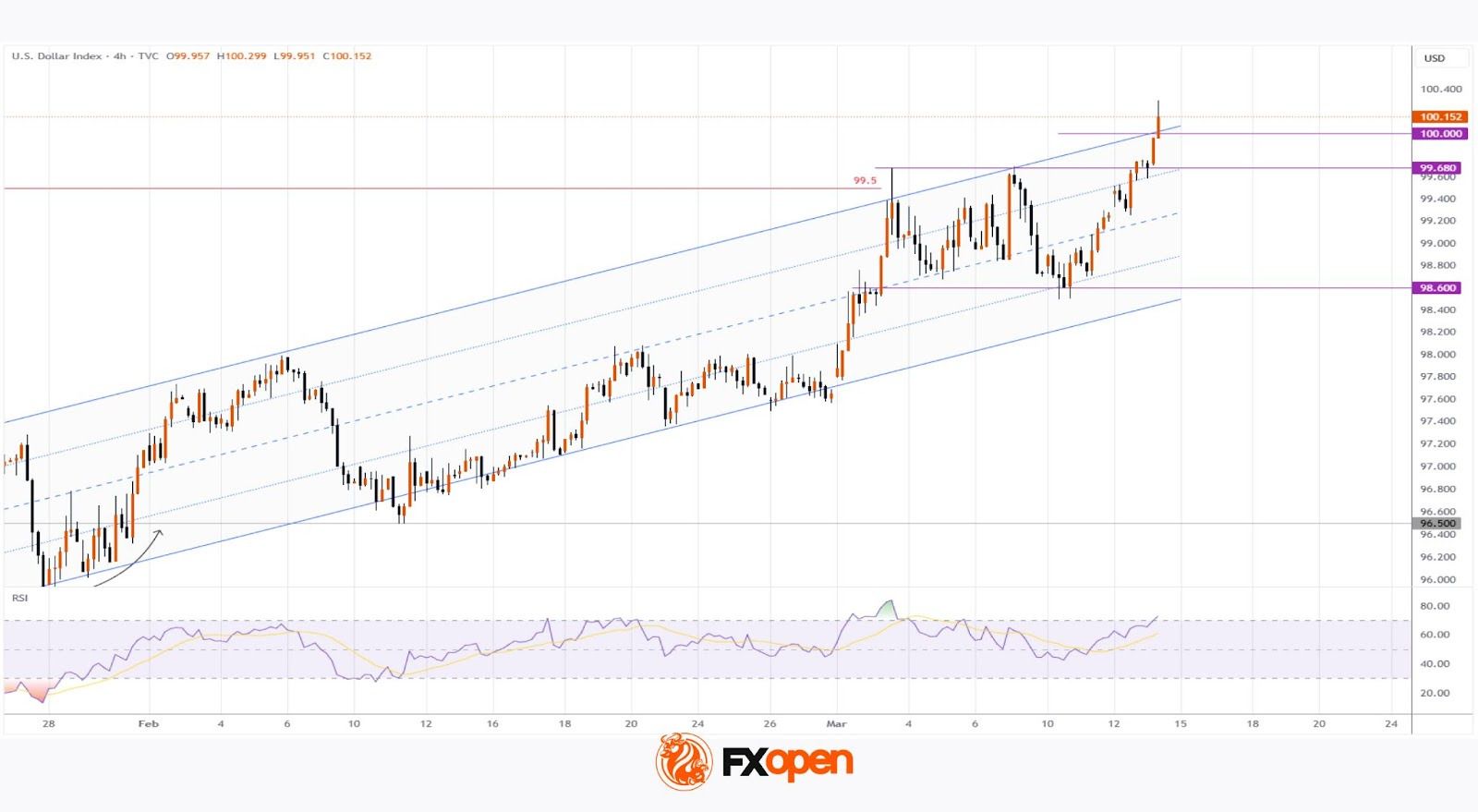
Today the US Dollar Index (DXY) climbed above the psychological 100 mark for the first time in 2026, supported by a tense fundamental backdrop, with the military conflict in the Middle East acting as the main driver.
→ Financial market participants are selling riskier assets (such as equities and emerging market currencies) and reallocating funds into the US dollar, which is traditionally viewed as a safe haven during periods of war.
→ Iran’s statements about potentially closing the Strait of Hormuz, along with strikes on fuel infrastructure, are driving oil prices higher and increasing global inflation risks.
→ The strength of the US economy is also supporting the dollar. Yesterday’s labour market data showed no increase in unemployment.
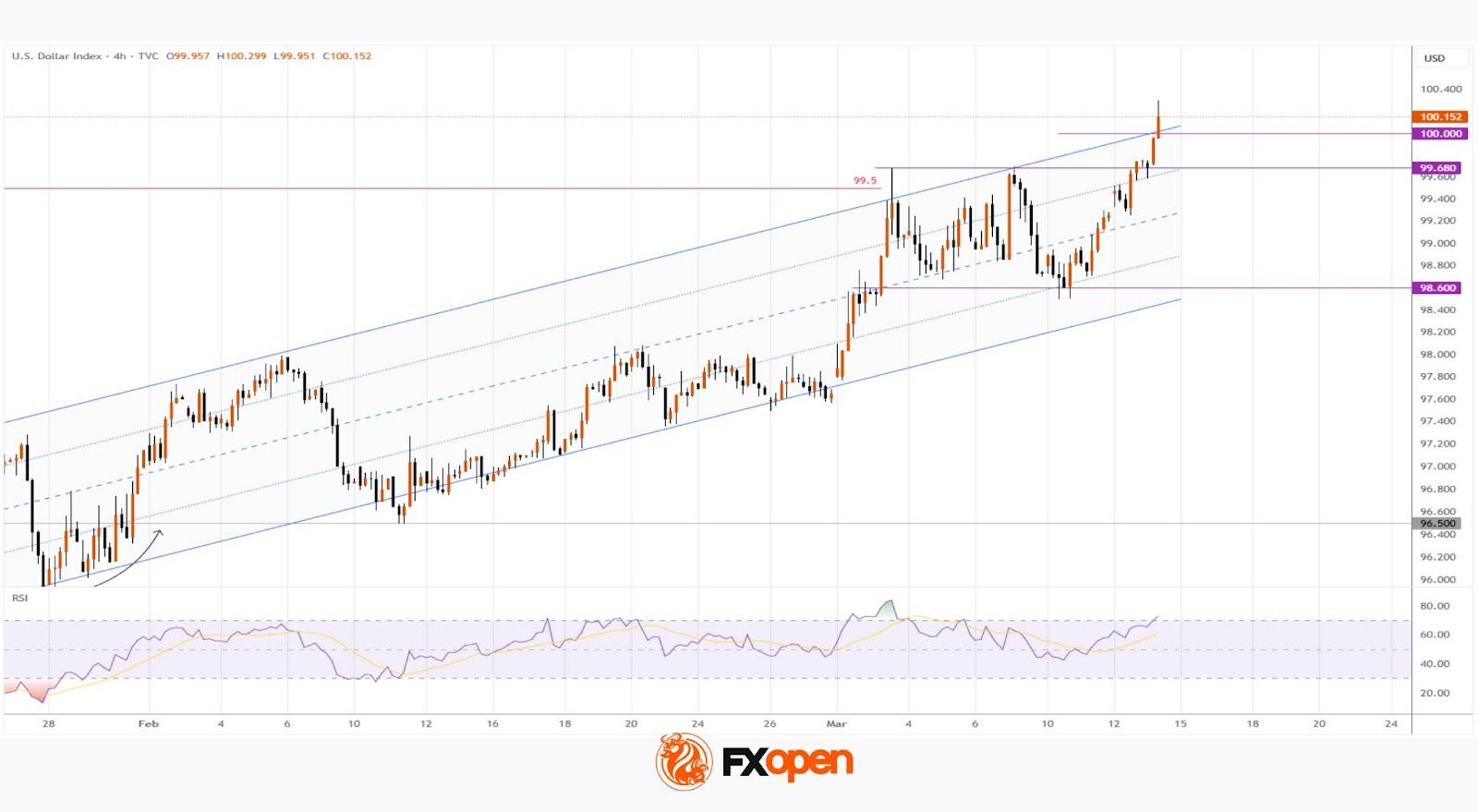
Technical Analysis of the DXY Chart
On the morning of 9 March, while analysing the US Dollar Index (DXY) chart, we:
→ updated the ascending channel (marked in blue), within which the index had set its yearly high at that time;
→ suggested that DXY price movements might begin to stabilise.
Between 9 and 12 March, the DXY chart showed a pullback followed by a renewed upward move, which remained within the range defined by last week’s levels:
→ support at 98.60;
→ resistance at 99.68.
However, the developments mentioned above allowed bulls to regain momentum and extend the rally within the blue channel. In other words, if the earlier fluctuations between these levels reflected a balance between supply and demand, then today, 13 March, buyers appear to be taking the initiative, showing a willingness to pay more for the US dollar.
At present, the market looks overbought, as:
→ the RSI indicator has moved above the 70 level;
→ the price is trading above the upper boundary of the channel that had contained it since late January.
In the short term, a modest pullback cannot be ruled out, although it is unlikely to significantly alter the current market picture.
Trade global index CFDs with zero commission and tight spreads (additional fees may apply). Open your FXOpen account now or learn more about trading index CFDs with FXOpen.
This article represents the opinion of the Companies operating under the FXOpen brand only. It is not to be construed as an offer, solicitation, or recommendation with respect to products and services provided by the Companies operating under the FXOpen brand, nor is it to be considered financial advice.

Disclosure: The views and opinions expressed here belong solely to the author and do not represent the views and opinions of crypto.news’ editorial.
Every smart contract platform has a fee asset baked in. For example, Ethereum (ETH) has ETH, Solana (SOL) has SOL, but with Bitcoin (BTC), however, things get messy. If you want expressive apps, you usually end up adopting a second network’s economics.
Summary
- Bitcoin doesn’t price computation, only block space. Unlike Ethereum or Solana, BTC’s fee market is built around sat/vB for transaction inclusion, not metering smart contract execution.
- Execution can move off-chain while settlement stays on Bitcoin. Systems like OpNet run contract logic in a Wasm VM while anchoring payments and final state changes through normal BTC transactions.
- BTC can function as the gas asset without a new token. By pricing execution costs in satoshis and settling interactions through Bitcoin transactions, apps avoid creating a second fee economy.
On Stacks, for example, you pay fees in STX. On EVM-style Bitcoin layers, you might be told that BTC is the gas token, but it’s typically an L2-native representation with EVM-like conventions (including 18 decimals), and you’re still operating inside that L2 environment. Bitcoin itself, meanwhile, already has a clean fee market, where users bid for block space in sat/vB, and miners prioritize higher fee rates.
With this in mind, what if a smart contract interaction could be initiated and paid for as a normal Bitcoin transaction, with fees in BTC terms (no extra gas token or fork) while the smart part runs elsewhere and stays provably tied back to Bitcoin? OpNet is setting out to provide an answer.
Bitcoin doesn’t meter compute (that’s a problem)
Bitcoin’s fee market is excellent at one thing: pricing block space. You compete in sat/vB, miners pick the highest fee rates, and the network stays simple and adversarially robust. What Bitcoin does not do is run a general-purpose execution environment where the chain can measure and charge for arbitrary computation. Bitcoin Script is deliberately stateless and not Turing-complete, specifically lacking loops or gotos, so every node can validate scripts predictably without opening the door to unbounded computation.
That’s why most Bitcoin smart contract approaches end up placing execution on a separate system that can meter compute and run a fee market of its own. Once you have that separate execution layer, it usually comes with a separate fee asset (Stacks, for instance, charges fees in STX).
This isn’t ideal, and a system where you could keep payment within Bitcoin’s native fee market while moving execution elsewhere would be preferable.
Execution isn’t what Bitcoin needs to do
Once you accept that Bitcoin Script is intentionally limited (stateless and not designed for unbounded computation), you start thinking about how to make Bitcoin settle the results and the payments.
Indeed, execution can happen in a dedicated virtual machine that’s built to run smart contract logic deterministically, while Bitcoin remains the base layer that timestamps, orders, and prices the interactions through its existing fee market. In OpNet’s design, contract logic is evaluated by a Wasm-oriented VM (OP-VM), while the broader node stack is explicitly built to manage and execute smart contracts using Bitcoin’s existing transaction and UTXO mechanics.
Crucially, this isn’t paired with a new fee asset. Bitcoin doesn’t need to meter computation to be the gas currency. It needs to be the final settlement layer that everything ultimately pays into and anchors to.
What a BTC-paid contract call looks like
Our interaction model follows a simulate-then-spend flow rather than a conventional smart contract execution pattern, with the final execution step taking place as an actual Bitcoin transaction. First, your app calls a contract method in simulation mode. That request goes through a provider to an OPNet node, which executes the contract in its VM and returns a CallResult (including gas/fee estimates) without broadcasting anything to Bitcoin.
If the call is state-changing, you take that CallResult and send it as an execution. At this point, the library builds a Bitcoin transaction, signs it, and broadcasts it to the Bitcoin network. Two points are worth remembering:
- Miner fees are Bitcoin-native. You choose a feeRate in sat/vB, optionally add a priorityFee in sats, and set a hard cap on fee spending via maximumAllowedSatToSpend (the parameter is literally named maximumAllowedSatToSpend).
- The contract target is expressed as a P2OP-style contract address. The contract instance exposes its p2op address format, and transactions reference a “p2op contract address” as the contract destination.
Meanwhile, OpNet’s own compute metering still exists. But it’s priced in satoshis (estimated SATS Gas, refunds in SATS, etc.), so the unit never drifts into a separate token economy.
Less friction, cleaner incentives
Users no longer have to adopt a second fee economy just to interact with apps. On Bitcoin, fees are already an auction for block space, priced per byte and paid to miners. When contract calls are just Bitcoin transactions, you’re back on familiar ground (with sat/vB fees, mempool churn, and miner incentives), without having to learn a separate gas token market.
Also, the tooling leans into standard Bitcoin workflows such as UTXO handling, provider connections, and even offline/cold signing. Contracts live in a Wasm runtime and are written in AssemblyScript, aiming for Solidity-like expressiveness without pretending Bitcoin Script suddenly became a VM.
Bitcoin as gas, without a second token
The claim that BTC cannot function as gas usually rests on the assumption that the base layer must meter computation to price it. Bitcoin does not meter computation; it meters block space and settles value.
The solution is to let a virtual machine handle execution deterministically, and then route every state-changing interaction through a standard Bitcoin transaction, where fees are expressed in familiar terms such as sat/vB and capped in satoshis. In our case, this is implemented at the client level through parameters like feeRate and maximumAllowedSatToSpend.
So maybe BTC-as-gas is truly plausible. Fees stay BTC-native from end to end, while the contract runtime stays WebAssembly-based (AssemblyScript → Wasm), which keeps the logic expressive without changing the fee currency.

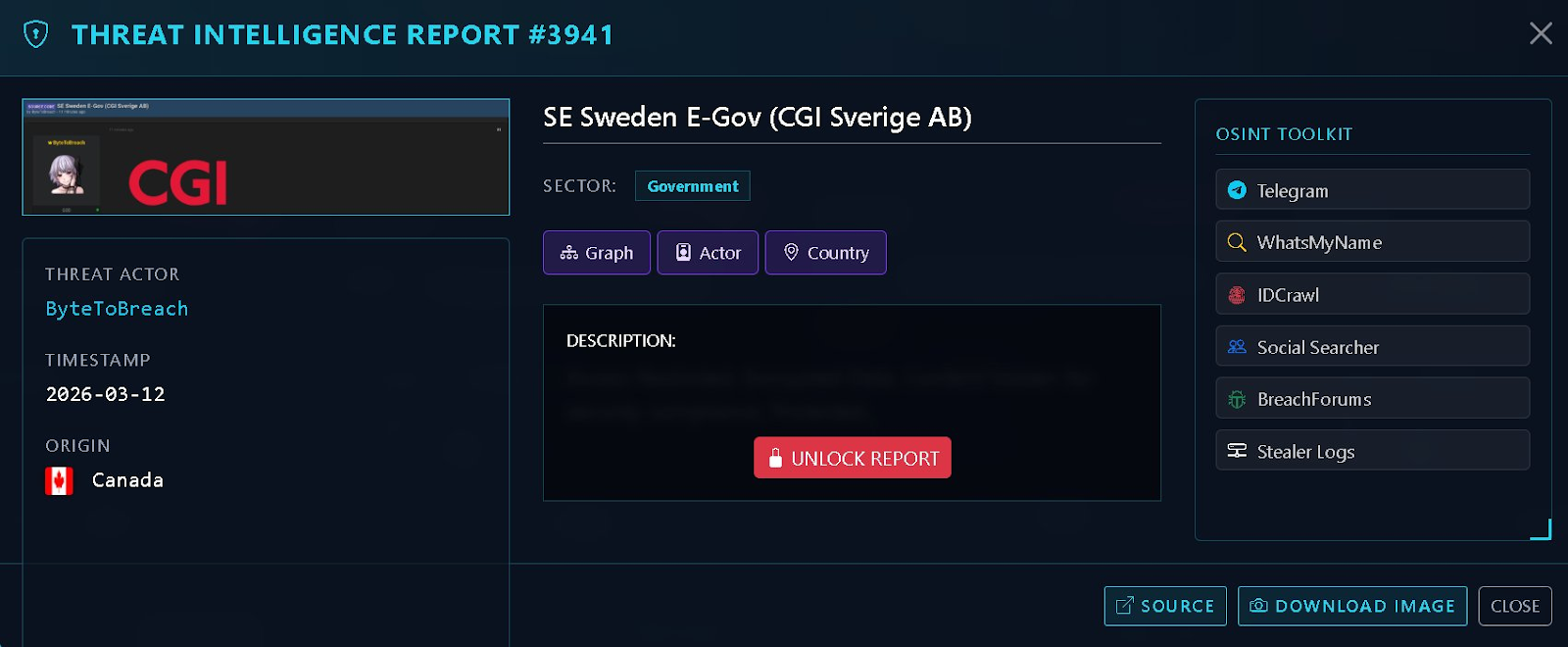
A threat actor has claimed to have leaked source code and other sensitive material tied to Sweden’s e-government platform, prompting an investigation by Swedish authorities and an incident response by CGI Sverige.
Cybersecurity accounts on X and local media reported Thursday that a threat actor calling itself ByteToBreach had published material it said came from CGI Sverige, the Swedish subsidiary of global IT giant CGI Group, and Sweden’s e-government infrastructure, according to local news outlet Aftonbladet.
CGI told Aftonbladet its cybersecurity team discovered an incident involving two internal test servers in Sweden that were not used in production. The company said an older application version and its source code were accessible, but that there was no indication that customer production data or operational services were affected. CGI press secretary Agneta Hansson confirmed to the news outlet that authorities are investigating the leak.
About 95% of Sweden’s 10.7 million population used e-government services in 2024, according to Eurostat data.
The leaked files could include the platform’s source code and configuration files, internal staff database, citizens’ personally identifiable information databases, electronic signing documents and other sensitive data.

Cointelegraph contacted CGI Group and Sweden’s national IT incident center, CERT-SE, for comment on the reported leak.
Swedish civil defense minister confirms cybersecurity incident
However, Carl-Oskar Bohlin, Sweden’s minister of civil defense, confirmed the data leak and said the government is working with CERT-SE and the National Cyber Security Center to identify the culprits.
IT security expert Anders Nilsson confirmed that the hacked resources seemed authentic. “Source code for several programs seems to exist, and from what I can see, the hack looks genuine,” Nilsson wrote in an email to media outlet SVT.
Related: SlowMist introduces Web3 security stack for autonomous AI agents
Hackers target Swedish and European infrastructure
Hackers are increasingly targeting public-facing cyber infrastructure throughout Sweden and Europe, warned threat intelligence platform Threat Landscape.
“This is not an isolated incident,” the platform said in a Thursday report.
“ByteToBreach is the same actor responsible for the Viking Line breach posted just one day prior, suggesting an ongoing campaign targeting Swedish and European infrastructure via CGI’s managed services footprint.”
Related: French couple robbed of $1M in Bitcoin by criminals posing as police
The threat actor claimed to have leaked the full source code of the e-government platform, sharing multiple supporting materials.

Threat-intelligence researchers said the exposure could still carry follow-on risk if attackers use the leaked code or documentation to identify weaknesses in public-facing systems, though the full contents of the dump have not been independently verified.
Magazine: Meet the onchain crypto detectives fighting crime better than the cops
TLDR
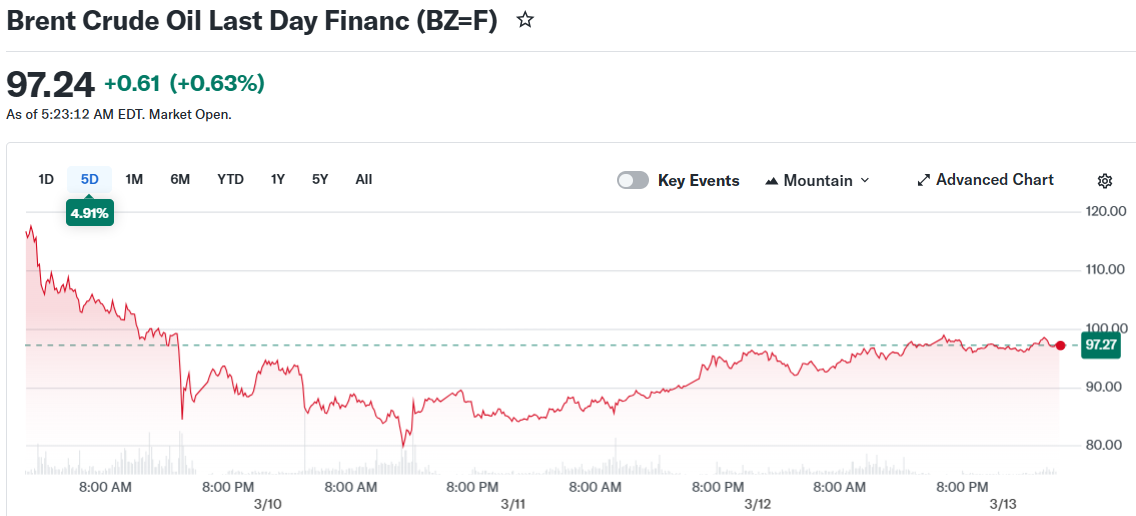
- Oil prices have surged past $100 per barrel for Brent crude following Iran’s commitment to maintain its blockade of the Strait of Hormuz.
- In response to what the IEA labels as the most severe supply disruption ever recorded, member nations agreed to deploy 400 million barrels from strategic reserves.
- A temporary exemption from the US Treasury permits certain nations to purchase Russian oil through April 11.
- Intelligence reports indicate Iran has started deploying mines throughout the strait, significantly increasing risks for maritime traffic.
- Plans for US Naval convoy operations through the strait could begin late March, though analysts remain skeptical about their effectiveness in resolving the situation.
Global energy markets experienced severe turbulence this week as Brent crude oil climbed beyond the $100 per barrel threshold, driven by Iran’s promise to maintain its blockade of the Strait of Hormuz.
The dramatic price increase comes amid extraordinary market volatility not witnessed in recent years. West Texas Intermediate approached $97, with both major benchmarks experiencing wild price fluctuations reminiscent of pandemic-era chaos.
In his inaugural public remarks following his father’s succession, Iran’s new supreme leader Mojtaba Khamenei declared his government’s determination to maintain the shipping blockade.
The Strait of Hormuz represents a critical chokepoint situated between Iran and Oman. Approximately 20% of global petroleum supplies transit this narrow passage. Maritime traffic has nearly ceased since hostilities between the US-Israel alliance and Iran commenced on February 28.
The International Energy Agency characterized this as an unprecedented supply crisis in petroleum market history. Member states committed to deploying a historic 400 million barrels from strategic petroleum reserves.
According to New York Times reporting citing American intelligence sources, Iran has initiated mine-laying operations within the strait. This development dramatically escalates hazards for commercial vessels attempting passage.
Energy Secretary Chris Wright indicated that Naval escort operations for commercial tankers could commence before March concludes. However, earlier White House communications suggesting successful escort missions had already occurred were subsequently retracted.
US Eases Russia Oil Sanctions
Seeking to alleviate market pressures, the Treasury Department authorized a limited exemption permitting select countries to accept Russian petroleum shipments that departed before March 12. This temporary measure expires April 11.
Treasury Secretary Scott Bessent characterized the decision as necessary for global energy market stability. Russian officials estimated approximately 100 million barrels of their oil currently remains in maritime transit.
British authorities announced they would not mirror the American sanctions relaxation. UK Energy Minister Michael Shanks warned such measures could provide Moscow with resources to sustain its military operations.
French President Emmanuel Macron expressed opposition, arguing the Hormuz crisis doesn’t warrant Russian sanctions relief. Ukrainian President Zelensky characterized the American decision as a “serious blow” to Ukraine’s position.
Markets and Prices
Stock markets declined throughout the week as petroleum prices climbed. Volatility has been amplified by derivatives trading and exchange-traded fund positioning.
WTI crude fluctuated across approximately $43 this week, marking the widest trading band since prices briefly turned negative during pandemic lockdowns. Brent experienced roughly $38 in range variation.
Asian economies, particularly dependent on Persian Gulf petroleum, implemented emergency measures. Japan, South Korea, and Thailand announced fuel price controls. The Philippines, importing roughly 95% of its crude from Middle Eastern sources, mandated four-day work weeks for government employees to reduce consumption.
Market analysts predict a trading range between $85 and $105 while the confrontation continues. While the IEA reserve deployment may provide temporary relief, experts caution it won’t independently stabilize markets.
President Trump stated via social media that preventing Iranian nuclear weapons development remained his priority over oil price considerations.
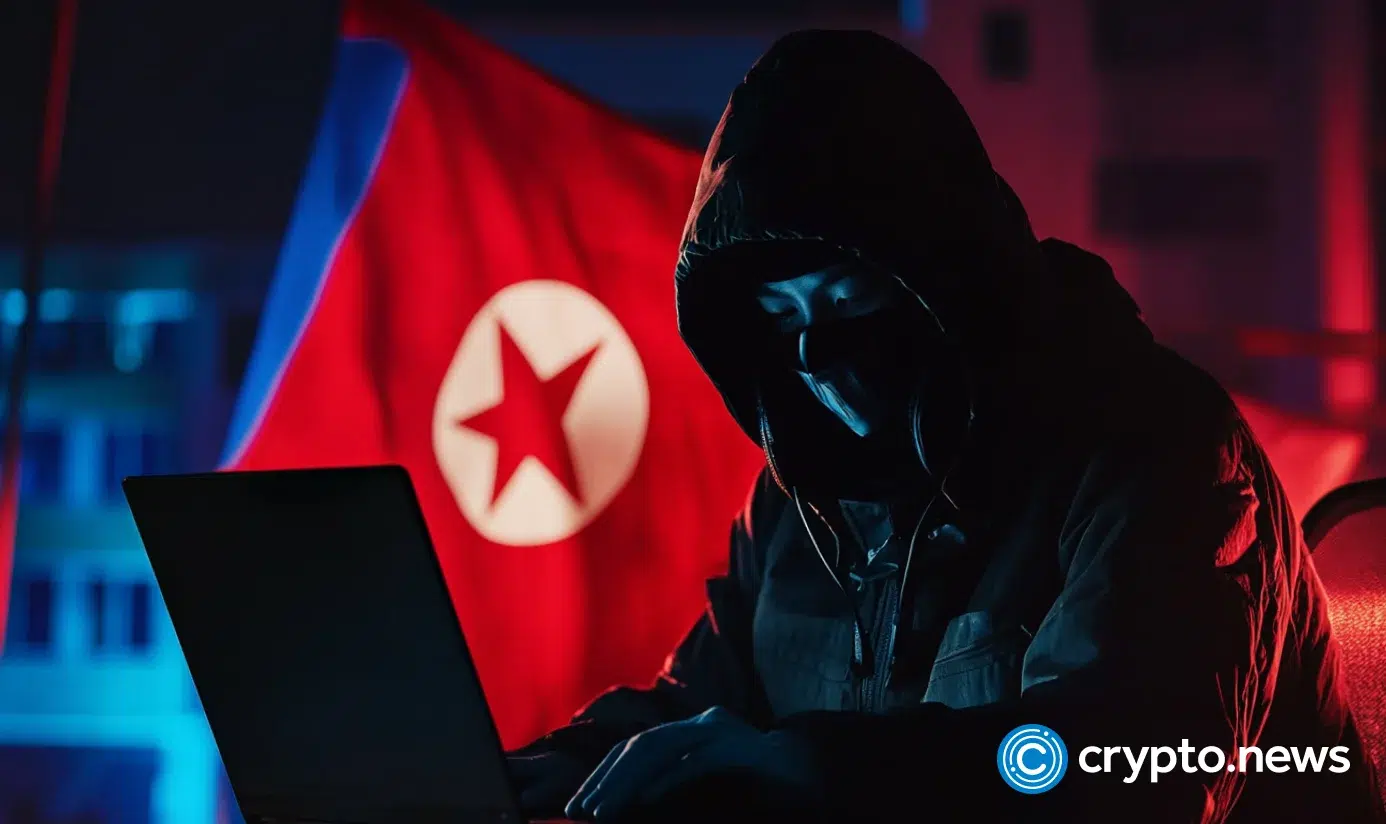
The U.S. Department of the Treasury has imposed sanctions on a network accused of helping North Korea generate illicit revenue through overseas information technology workers and cryptocurrency transactions.
Summary
- The U.S. Treasury sanctioned individuals and entities tied to a North Korean IT worker fraud network.
- The scheme allegedly used stolen identities and remote IT jobs to generate funds.
- Officials say cryptocurrency was used to launder and transfer proceeds linked to Pyongyang’s weapons programs.
U.S. blacklists facilitators of DPRK scheme that used crypto to move illicit earnings
In a statement, the Treasury’s Office of Foreign Assets Control (OFAC) said the targeted individuals and entities facilitated a scheme in which North Korean IT workers obtained remote jobs using stolen identities and false personas, allowing them to earn income from companies around the world.
Officials say the wages from these jobs were often funneled back to the North Korean government, helping finance the country’s weapons of mass destruction and ballistic missile programs.
The regime has relied on such overseas workers to generate hundreds of millions of dollars annually.
According to the Treasury, the network also relied on cryptocurrency to move and disguise the proceeds. Facilitators allegedly converted digital assets into cash or used crypto transactions to obscure the origin of funds before transferring them to accounts linked to the regime.
The scheme typically involved North Korean developers posing as freelance programmers or software engineers on global contracting platforms. Using fabricated identities and stolen personal information, they secured jobs at unsuspecting firms in the United States and other countries.
In some cases, authorities say these operatives introduced malware into company networks or exfiltrated sensitive data once they gained access to corporate systems.
Treasury officials said the action forms part of a broader U.S. effort to cut off revenue streams that North Korea uses to evade international sanctions and finance its military programs.
The department added that the sanctions freeze any U.S.-based assets belonging to the designated individuals and entities and generally prohibit U.S. persons from engaging in transactions with them.
Washington has repeatedly warned that North Korea increasingly uses cybercrime, cryptocurrency theft and fraudulent IT work schemes to fund its weapons development, posing growing risks to global businesses and the digital asset ecosystem.


Bitcoin rose above $71,500 on Friday, outperforming U.S. equities even as the dollar strengthened and oil prices remained elevated as the war with Iran was set to enter its third week.
A stronger dollar can tighten global financial conditions and often weighs on risk assets such as equities and cryptocurrencies. Higher oil prices — both Brent crude and West Texas Intermediate are hovering around $100 per barrel — reinforce inflation concerns and heighten expectations of interest-rate increases. Higher rates also detract from the attraction of such investments.
Despite these macro and geopolitical pressures, including the Middle East conflict, bitcoin has remained resilient and is among the best-performing macro assets since the war began on March 1. Historically, Fridays during this period have seen the largest cryptocurrency fall some 3%, a pattern that has not repeated so far today.
The Dollar Index (DXY), which measures the strength of the U.S. currency against a basket of major global currencies, topped 100 for the first time since late November. U.S. Treasury yields are also rising, with the benchmark 10-year bond yield climbing above 4.2%, reflecting tighter financial conditions and higher borrowing costs.
The Invesco QQQ Trust (QQQ), an exchange-traded fund that tracks the Nasdaq 100 index, meanwhile, was recently little changed.
In crypto-linked equities, Strategy (MSTR), the largest publicly traded corporate holder of bitcoin, added 1% before the start of official trading. The company has acquired roughly 11,000 BTC this week using proceeds from its perpetual preferred security Stretch (STRC).
Today marks the ex-dividend date for STRC, which means it has slipped slightly below its $100 par value to around $99.50.
Meanwhile, AI repurposed bitcoin miners such as IREN (IREN) and Cipher Digital (CIFR) opened slightly lower, while crypto exchange Coinbase (COIN) added about 2%.

From Scalloped Plates To Ribbed Glassware: 11 Elegant Homeware Buys For Your 2026 Dinner Parties

Europa League: French club Olympique Lyonnais grab late draw against Celta Vigo – Sports

Manna’s new Dublin drone trial to test deliveries between hospitals


-
Business7 days ago
Form 8K Entergy Mississippi LLC For: 6 March
-

 News Videos4 days ago
10th Algebra | Financial Planning | Question Bank Solution | Board Exam 2026
-

 Fashion7 days ago
Weekend Open Thread: Ann Taylor
-

 Crypto World4 days ago
Paradigm, a16z, Winklevoss Capital, Balaji Srinivasan among investors in ZODL
-
 Tech2 days ago
A 1,300-Pound NASA Spacecraft To Re-Enter Earth’s Atmosphere
-

 Tech3 days ago
ChatGPT will now generate interactive visuals to help you with math and science concepts
-

 Politics7 days ago
Top Mamdani aide takes progressive project to the UK
-

 Business3 days ago
ExxonMobil seeks to move corporate registration from New Jersey to Texas
-

 Sports6 days ago
Three share 2-shot lead entering final round in Hong Kong
-

 Sports5 days ago
Braveheart Lakshya downs Lai in epic battle to enter All England Open final | Other Sports News
-

 NewsBeat2 days ago
Residents reaction as Shildon murder probe enters second day
-

 Entertainment6 days ago
Hailey Bieber Poses For Sexy Selfies In New Luscious Lip Thirst Traps
-

 Business5 days ago
Search for Nancy Guthrie Enters 37th Day as FBI Probes Wi-Fi Jammer Theory
-

 Business2 days ago
Search Enters Sixth Week With New Leads in Tucson Abduction Case
-
 NewsBeat3 days ago
Pagazzi Lighting enters administration as 70 jobs lost and 11 stores close across Scotland
-

 Tech4 days ago
Despite challenges, Ireland sixth in EU for board gender diversity
-

 Business4 days ago
Search Enters 39th Day with FBI Tip Line Developments and No Major Breakthroughs
-

 NewsBeat2 days ago
I Entered The Manosphere. Nothing Could Prepare Me For What I Found.
-
 Business6 days ago
Iran war enters second week as Trump demands ’unconditional surrender’
-

 Sports4 days ago
Skateboarding World Championships: Britain’s Sky Brown wins park gold