

Crypto World
Alibaba joins MetaComp’s $35M stablecoin fundraise


Singapore-based fintech MetaComp has closed a Pre-A+ funding round backed by Alibaba, lifting its cumulative total to US$35 million across two rounds in just three months, according to the company’s announcement. The latest round also brought in European early-stage investor Spark Venture, with Beijing-based 100Summit Partners serving as exclusive financial adviser. The capital infusion is aimed at accelerating MetaComp’s StableX Network, a cross-border payments platform designed to weave together fiat rails and stablecoin infrastructure for regulated institutions and high-net-worth clients. MetaComp previously disclosed a US$22 million Pre-A round in December 2025, signaling robust early-stage interest in regulated web2.5 payments infrastructure across Asia.
Key takeaways
- MetaComp’s Pre-A+ round, anchored by Alibaba, raises the company’s total funding to US$35 million in three months, underscoring strong demand for regulated cross-border stablecoin infrastructure.
- The round introduces Spark Venture from Europe as an investor and names 100Summit Partners (Beijing) as exclusive financial adviser, highlighting cross-regional interest.
- MetaComp previously closed a US$22 million Pre-A round in December 2025 with investors including Eastern Bell Capital, Noah, Sky9 Capital, Freshwave Fund and Beingboom Capital, illustrating sustained backing for hybrid fiat-stablecoin payments.
- The company intends to scale the StableX Network to connect regulated financial institutions, stablecoin issuers and partners across Asia, the Middle East, Africa and Latin America for real-time cross-border settlement.
- Industry context points to ongoing investor appetite for regulated stablecoin infrastructure in Asia, with forecasts suggesting the stablecoin market could reach around US$2 trillion by 2028.
Sentiment: Neutral
Market context: The funding activity aligns with a broader push to build regulated stablecoin rails that complement traditional banking systems. While regulators in some jurisdictions pursue stricter issuance controls, the Alibaba-backed round signals continued strategic interest in cross-border settlement infrastructure. The market backdrop includes forecasts that place stablecoins on a trajectory toward multi-trillion-dollar scales in the coming years, underscoring a shift toward institutional-grade crypto rails alongside established fiat systems.
Why it matters
MetaComp’s expansion of the StableX Network sits at the intersection of conventional finance and tokenized wealth management. By offering a hybrid model that merges fiat rails with stablecoin networks, the platform aims to provide faster, auditable cross-border settlements for banks, wealth managers and corporate clients. The vision is to enable real-time settlement that adheres to regulatory standards, a critical requirement for institutions seeking to incorporate digital assets into traditional portfolios without sacrificing compliance or risk controls.
The leadership’s explicit framing of a “Web2.5” architecture — where fiat rails and stablecoins operate as a single, interoperable ecosystem — underscores a broader sector trend toward hybrid solutions that deliver both speed and governance. If MetaComp can successfully onboard a network of banks, regulators and stablecoin issuers across multiple regions, the company could help accelerate the adoption of regulated stablecoins for international payments and cross-border trade. The mix of investors—Alibaba alongside European and Asian advisers—signals confidence in MetaComp’s ability to navigate the regulatory and operational complexities inherent in multi-jurisdiction collaborations.
Alibaba’s involvement comes at a sensitive juncture for stablecoins issued outside mainland China. The company has previously explored deposit-token technology for overseas transactions even as authorities tighten issuance rules within the country. The contrast between policy posture and private-sector experimentation highlights a nuanced landscape where international collaborations may unlock regulated cross-border flows, even as domestic issuance remains constrained. The broader market context, including forecasts of substantial growth for stablecoins, suggests a potential win for platforms that can demonstrate robust compliance, interoperability and measurable settlement improvements.
MetaComp’s strategic direction also rests on a global expansion blueprint. By extending the StableX Network to Asia, the Middle East, Africa and Latin America, the company aims to capture markets with rising demand for compliant, real-time settlement services. The model envisions a hub-and-spoke arrangement, linking financial institutions with stablecoin issuers and technology partners to streamline remittances, supplier payments and institutional treasury operations. Such an approach could address persistent inefficiencies in traditional cross-border rails while offering a path for asset managers and financial institutions to participate more directly in tokenized wealth solutions.
What to watch next
- Regulatory updates in target regions as MetaComp expands the StableX Network and pilots cross-border settlement solutions.
- New partnerships with banks, stablecoin issuers and wealth-management platforms to demonstrate live use cases and scale pilots.
- Possible follow-on funding rounds or strategic investments, including potential continued support from Alibaba and additional strategic investors.
- Public milestones on onboarding institutions and the rollout timeline for expansion into Asia, the Middle East, Africa and Latin America.
Sources & verification
- MetaComp press release: Alibaba-backed Pre-A+ round, total US$35 million in three months (PR Newswire)
- MetaComp press release: December 2025 Pre-A round totaling US$22 million, with investors including Eastern Bell Capital, Noah, Sky9 Capital, Freshwave Fund and Beingboom Capital (PR Newswire)
- Summary of MetaComp’s expansion and regional focus (MetaComp page) (MetaComp)
- Stablecoin market projections and regulatory context cited by industry coverage (Standard Chartered projection; referenced via Cointelegraph) (Cointelegraph — Stablecoin forecast)
- Regulatory stance on stablecoins and issuance (China crackdown context referenced in coverage) (Cointelegraph — Alibaba and stablecoins in China)
MetaComp expands StableX Network to accelerate cross-border finance
Singapore-based MetaComp announced a new Pre-A+ funding round led by Alibaba, raising the cumulative total to US$35 million across two rounds in three months. The round also features Spark Venture, a European early-stage investor, with 100Summit Partners (Beijing) acting as exclusive financial adviser. The capital infusion follows MetaComp’s earlier December 2025 disclosure of a US$22 million Pre-A round, which included a roster of notable investors such as Eastern Bell Capital, Noah, Sky9 Capital, Freshwave Fund and Beingboom Capital. The company said the funds will be directed at expanding the StableX Network, a platform designed to harmonize regulated financial institutions, stablecoin issuers and other partners through blockchain-based infrastructure.
At the heart of MetaComp’s strategy is a belief in a Web2.5 architecture where traditional fiat rails and stablecoin networks function together as a single, interoperable system. Tin Pei Ling, MetaComp’s co-president, underscored this vision, saying, “MetaComp was built on a single conviction: that the future of cross-border finance is neither purely traditional nor purely digital — it’s the integrated Web2.5 architecture where fiat rails and stablecoin networks operate as one.” The capital infusion is expected to accelerate the scaling of StableX Network beyond its current footprint into new markets and partnerships that can support real-time settlement with compliance at the forefront.
MetaComp’s expansion plan targets Asia, the Middle East, Africa and Latin America, areas where regulators are increasingly receptive to cross-border settlement innovations that preserve safety and oversight while delivering faster settlement times. The network aims to create a bridge between regulated financial institutions and stablecoin issuers, enabling institutions to access tokenized wealth products and stablecoin-based liquidity tools within a compliant framework. The move aligns with a broader industry trend toward building scalable, regulator-friendly infrastructure that can support institutional participation in the digital asset ecosystem.
The partnership profile around this round—Alibaba alongside European and Chinese advisers—reflects a cross-border approach to building out the infrastructure that could underpin more efficient remittances, cross-border corporate payments and wealth-management solutions in the years ahead. While regulatory policies differ across jurisdictions, the strategic emphasis on compliance and interoperability suggests that MetaComp intends to pursue a steady, institution-focused growth path rather than a rapid, consumer-facing rollout.

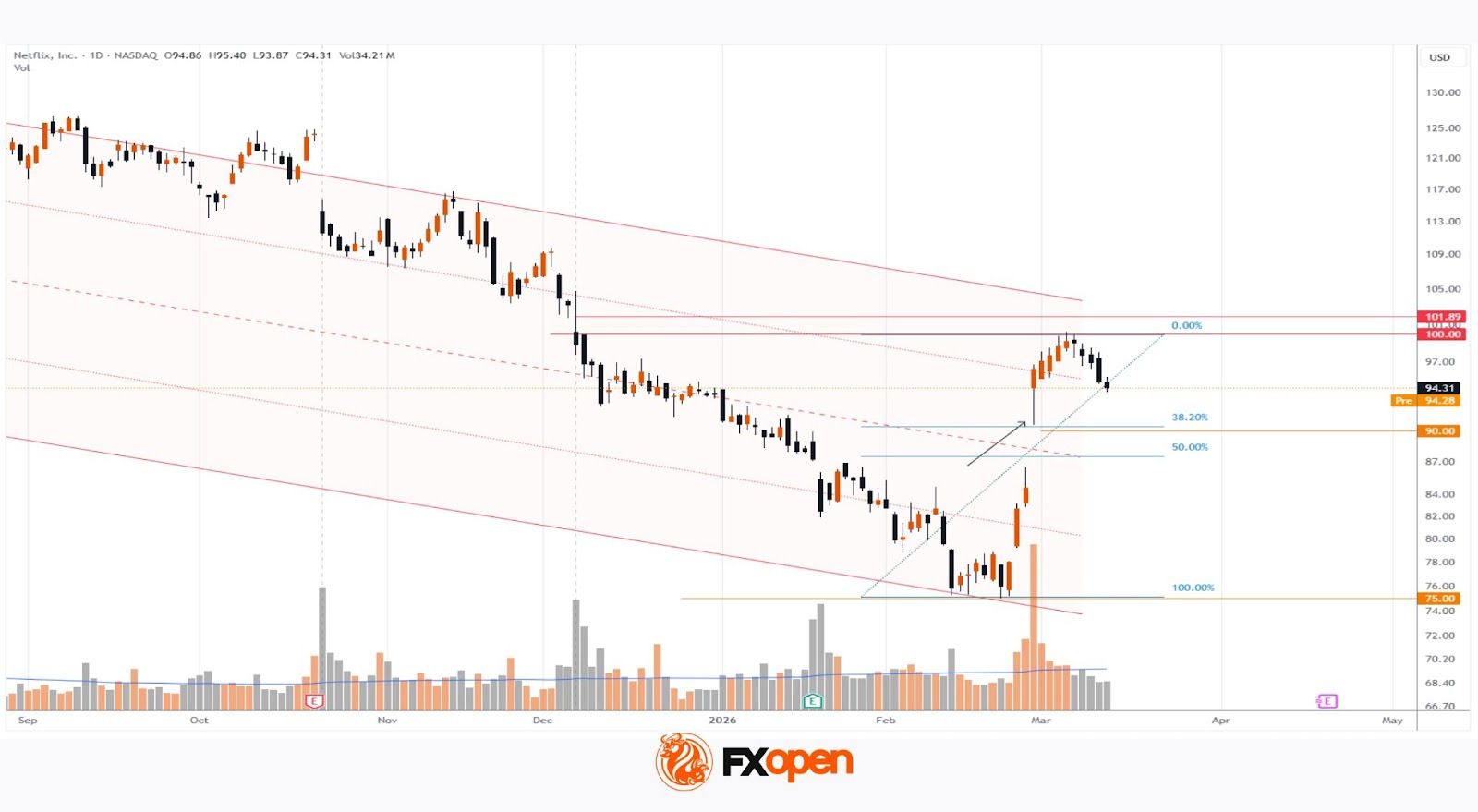
On 21 January, while analysing the NFLX chart, we:
→ identified a descending channel and a resistance zone around the $100 level;
→ noted that Netflix shares were showing a sustained downtrend. Selling pressure had been triggered primarily by reports of a potential acquisition of Warner Bros. Discovery assets, with the market concerned that Netflix might take on multi‑billion-dollar debt and face intense antitrust scrutiny.
Since then, the situation has shifted markedly. After reaching the lower boundary of the channel near $75, the stock reversed higher, following Netflix’s official announcement that it was walking away from the deal, opting to preserve capital rather than pursue a risky expansion. This sparked a strong relief rally: NFLX shares gapped up significantly and moved into the upper half of the channel.
Further bullish momentum was driven by analyst upgrades, with target prices revised upwards, suggesting a potential transition into a new uptrend.
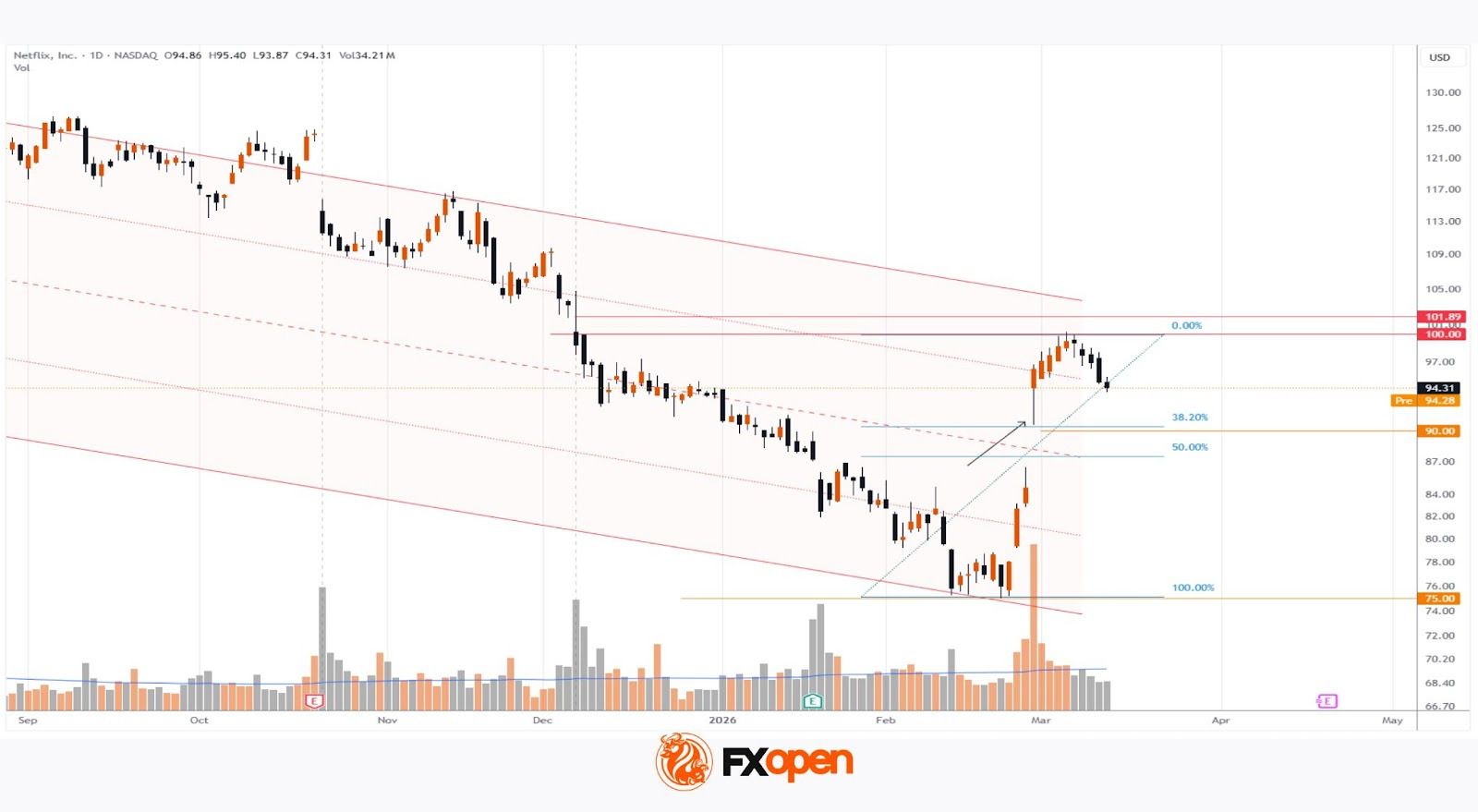
Technical Analysis of NFLX
It should be noted that the previously drawn descending channel remains relevant, with the psychological $100 area acting as resistance on the way toward the upper boundary.
However, after a roughly 30% rally from the February low, a pullback is natural. The current decline from the 5 March peak can therefore be interpreted as a moderate correction, driven by profit-taking and sales by investors who had previously held through losses and chose to exit.
Attention should be paid to the trading volume on 27 February, which was substantial. The candle following the bullish gap featured a lower shadow, signalling strong buying pressure. Consequently, the $90 level—also near the 38.2% Fibonacci retracement—may serve as support if bulls attempt to return NFLX shares to a sustainable upward trajectory.
Buy and sell stocks of the world’s biggest publicly-listed companies with CFDs on FXOpen’s trading platform. Open your FXOpen account now or learn more about trading share CFDs with FXOpen.
This article represents the opinion of the Companies operating under the FXOpen brand only. It is not to be construed as an offer, solicitation, or recommendation with respect to products and services provided by the Companies operating under the FXOpen brand, nor is it to be considered financial advice.

Key Takeaways
- Token2049 Dubai event moved from April 2026 to April 2027 over safety concerns.
- Middle East conflicts disrupt air travel and create challenges for UAE-based events.
- TON blockchain conference in Dubai called off as regional tensions escalate.
- Dubai’s position as international financial center tested by event cancellations.
- Conference organizers emphasize safety over proceeding with original timeline.
One of the cryptocurrency industry’s premier conferences, Token2049, has announced a significant delay for its Dubai edition. Originally planned for April 29-30, 2026, the event will now convene on April 21-22, 2027. The decision stems from mounting concerns over regional security and complications with international travel logistics.
Advance planning for the 2026 conference had progressed smoothly, with registration numbers suggesting strong attendance. Despite this momentum, organizers determined that pushing the event back would better serve the community. This approach allows the conference to maintain its reputation for excellence while prioritizing attendee wellbeing.
Organizers have remained relatively quiet about specific programming changes resulting from the delay. As a prominent destination for cryptocurrency and financial technology innovation, Dubai was poised to welcome thousands of international visitors. The postponement highlights the substantial impact geopolitical volatility can have on major industry gatherings.
Airspace Restrictions Create Travel Complications
The United Arab Emirates has experienced substantial travel interruptions due to regional airspace limitations. These complications intensified after military actions involving the United States, Israel, and Iran commenced on February 28. Airlines such as Emirates, Etihad, flydubai, and Air Arabia have implemented reduced schedules or route modifications.
Travelers have been urged by officials to verify their reservations in advance, as numerous flight paths remain affected. The situation has created significant obstacles for corporate travel and international conferences throughout the Emirates. Events of Token2049’s magnitude must now contend with operational hurdles that cannot be overlooked.
Dubai has experienced direct security threats, including missile and drone attacks on key infrastructure during the ongoing conflict. Security experts point to the UAE’s extensive defense cooperation with Western allies as a contributing factor. These circumstances have generated a challenging landscape for hosting international business conferences.
Blockchain Industry Events Reconsider Middle East Venues
The planned TON blockchain ecosystem conference scheduled for May 1-2, 2026, in Dubai has been completely called off. Organizers cited safety considerations and indicated they would investigate alternative event structures for later in the year. This cancellation demonstrates increasing hesitation about conducting large-scale events in potentially vulnerable locations.
Token2049 maintains its status as a critical gathering for the crypto industry, drawing thousands of developers, investors, and thought leaders from around the globe. Rescheduling to 2027 provides organizers the necessary time to guarantee robust participation without sacrificing security. This strategy mirrors a wider pattern of event postponements linked to Middle Eastern instability.
Dubai’s standing as an international financial center encounters obstacles as travel limitations persist. Industry conferences like Token2049 serve essential functions for professional networking and knowledge exchange. Event planners are now reconsidering their approaches to protect participation levels while sustaining global connections.
Token2049 is anticipated to resume its position as a flagship cryptocurrency conference when it reconvenes in April 2027, offering a vital forum for blockchain advancement. The delay acknowledges both practical constraints and continuing geopolitical challenges. Industry participants expect the conference will preserve its influence and scope once circumstances improve.

Crypto World
Cointelegraph’s regional editions return to Google after the main site’s 76% collapse in crypto news visibility
Cointelegraph Brasil has reappeared in Google’s index after a period of disappearance, highlighting the fragile control crypto publishers have over search-driven visibility amid global algorithm updates.
After spotting Cointelegraph Brasil content in Top Stories and reviewing the site’s technical setup, we found signs that the Brazilian edition is once again interacting normally with Google’s crawlers. Monitoring soon showed other language editions returning as well.
When we at Outset PR first started digging into Cointelegraph’s disappearance from Google, the story was simple enough: the collapse itself. One of the biggest crypto news publishers had suddenly slipped out of the search results that usually drive readers to industry coverage.
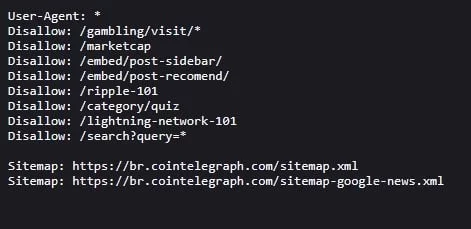
Recently we noticed something different. Cointelegraph Brasil suddenly reappeared in Google’s index. Its robots.txt file now lets Googlebot reach the core editorial pages. Only a handful of technical paths (embedded search queries or certain guide sections) are blocked.
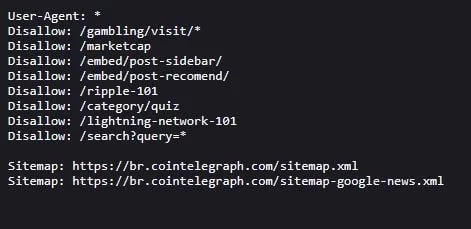
Source: Cointelegraph Brasil robots.txt configurations
At the same time, the Brazilian edition has moved away from a subdomain and switched to a country-level domain. What previously lived at br.cointelegraph.com now redirects to cointelegraph.com.br.
What’s even more interesting is that shortly after Cointelegraph Brasil returned, other local versions began appearing again as well, with similar changes applied to their URLs and technical setup.
But the main Cointelegraph properties remain far less visible in search. Moreover, our monitoring shows the robots.txt file has grown significantly in size, expanding to the point where it no longer even fits on a single screen. This suggests that the site’s crawl directives are currently being actively modified as part of the broader restructuring.
Changes inside Cointelegraph and its language editions appear to be happening almost daily. We’re continuing to follow what happens next and whether these adjustments will lead to a broader recovery, including the return of Cointelegraph news pages to Google.
Taking a step back, Cointelegraph’s U.S. visits peaked at 8 million in July 2025 and fell to 1.43 million by year-end, which is a roughly 83% decline.
A collapse that outran the market
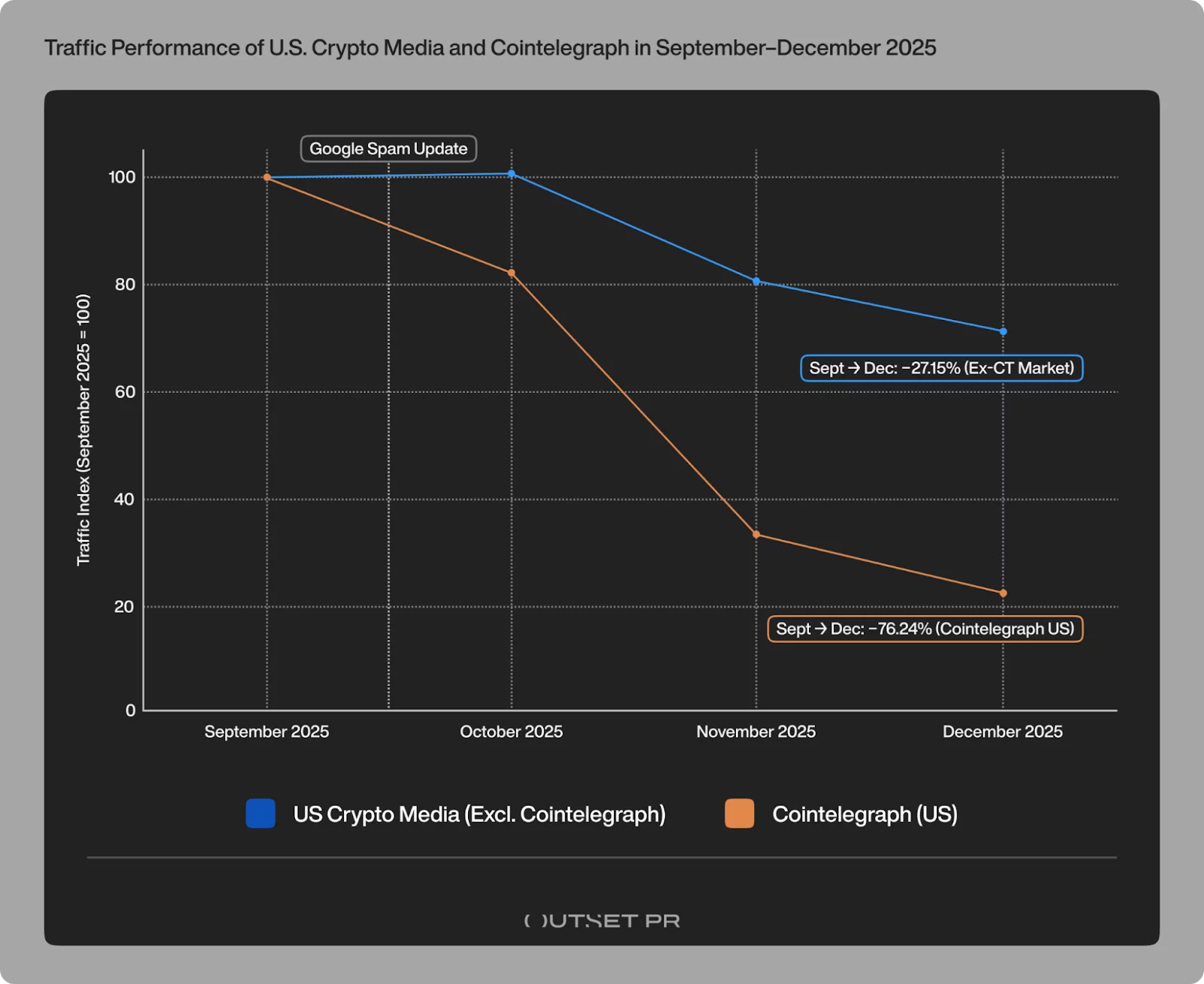
Per our latest Outset Data Pulse report, the U.S. crypto media environment as a whole clearly contracted, but not even close to Cointelegraph’s pace. Between September and December 2025 (the window the report treats as the spam update propagation period), total crypto media traffic fell from 44 million to 29 million visits, or almost 34%.
Excluding Cointelegraph’s metrics from this data, the broader U.S. crypto media market dropped from 38 million to 27 million over the same time period, representing a 27% decline.
Cointelegraph’s U.S. edition, over the exact same period, fell 76% from 6 million visits to somewhat under 1.5 million. This “76 versus 27” comparison is the whole story in one metric.
Source: Outset PR
If this were just a normal drop in interest, we would expect broad-ish softness or broad-ish strength. Instead, we get a market drawdown. Inside it, one publisher is falling nearly three times deeper than the sector contraction.
The synchronised fall across languages
Cointelegraph runs several language editions, each aimed at a different market and audience. That alone shows how differently crypto media works across regions, which is something we saw earlier when looking at how fragmented the landscape is across Asia.
Normally their search traffic moves differently. Brazil might rise while Japan slows down, or Europe might react to a local news cycle. That’s why the recent change stands out. Even though Cointelegraph Brasil has just started appearing in Google’s index again, the earlier collapse didn’t happen in isolation.
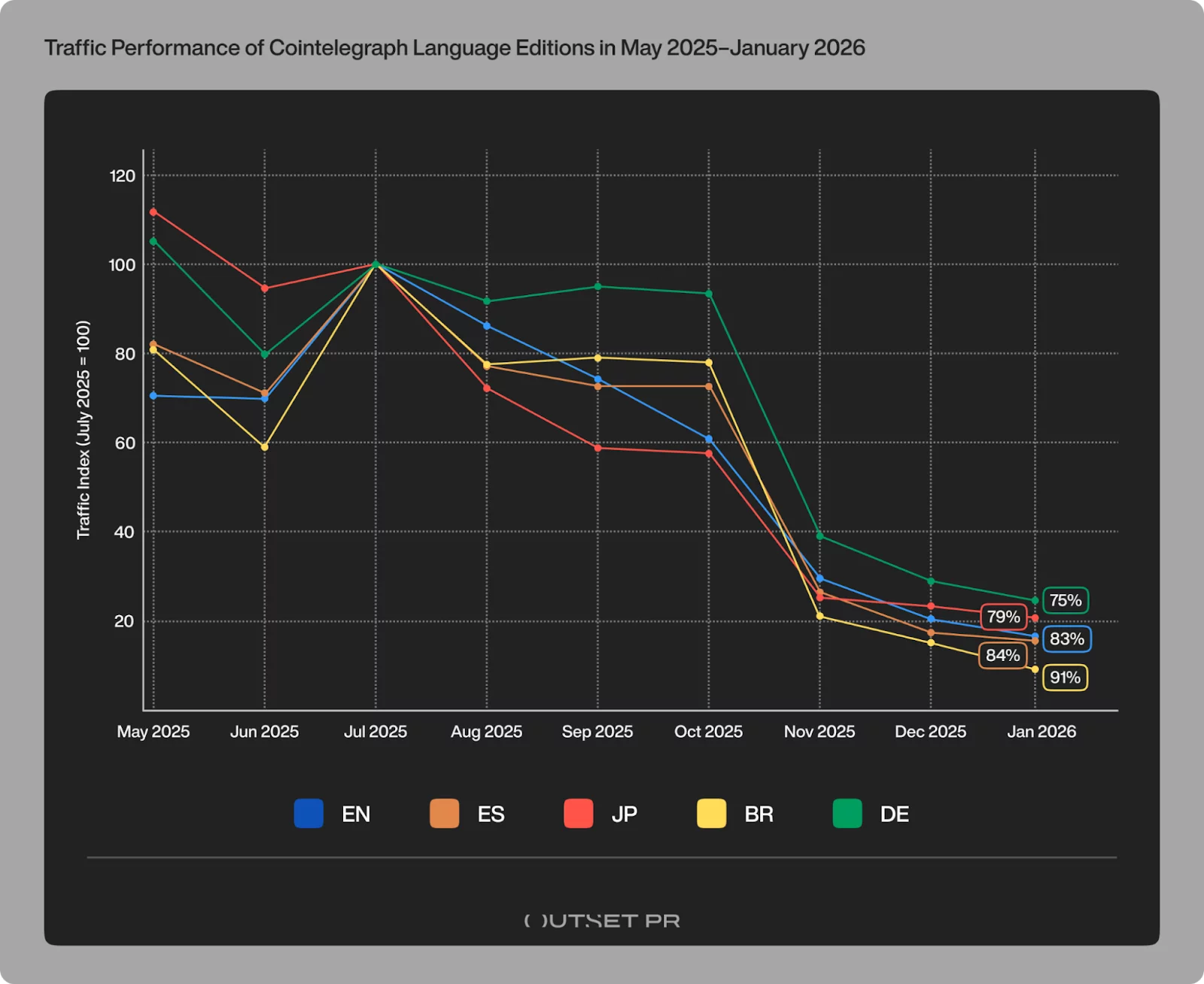
When we mapped the traffic data from the July 2025 peak, the pattern looked almost identical across editions. Traffic began slipping in September and then dropped sharply between October and November.
Source: Outset PR
By January 2026, the declines from the July peak were about:
- 83% for the English site,
- 84% for Spanish,
- 79% for Japanese,
- 91% for Brazilian,
- and 75% for German.
That timing lines up with Google’s August 2025 spam update, which rolled out globally and across all languages.
When teams in completely different regions all see traffic fall at the same time, it’s unlikely to be a coincidence. Something higher up in the discovery system seems to have changed.
Around the same time, archived technical records show that Cointelegraph reduced the number of sitemap entries from 115 to 69. Several commercial sections that had previously been part of the site’s search structure disappeared from the sitemap during that window.
That alone doesn’t prove causation, but it does show Cointelegpagh’s search structure was changing at the same time visibility collapsed.
Non-branded search is where the power imbalance hides
Cointelegraph’s traffic trends in the fourth quarter show its traffic mix was about 57% direct and 27% organic. The broader U.S. crypto media market (excluding Cointelegraph) was about 42% direct and 40% organic.
This means Cointelegraph was less exposed to search traffic than most crypto outlets but still experienced the sharpest drop in visibility. Our research found that within the outlet’s organic traffic, 82% was non-branded search and only 18% was branded.
Non-branded queries occur when a user isn’t looking for a specific publisher, but rather the answer to a question like “why is crypto down” or “Ethereum ETF flows.” They are essentially trusting their understanding of events to a ranking system. A publisher can build a brand, but it cannot own non-branded discovery.
In practice, that means the ranking system (not the publisher) decides which explanation people see first when they search for answers.
This is essentially rented land. When a major crypto publisher loses non-branded visibility, the effect isn’t just fewer pageviews; it’s a re-rating of what information investors are most likely to consume at the exact moment they are searching for an explanation.
The real risk is market interpretation controlled by discovery
Cointelegraph Brasil appearing in Google again – followed by other language editions – might look like a small recovery. But one regional return doesn’t really change the bigger picture.
What this episode shows is how little visibility publishers actually have into the systems that decide what appears in search. Pages can disappear, traffic can collapse, and then parts of a site can quietly return, all without any clear explanation.
For readers, that matters more than the fate of any single outlet. When people search for explanations during market moves, the sources that appear first shape how events are understood.
And right now, the platforms controlling discovery know far more about how that process works than the publishers producing the reporting.
Crypto World
Vitalik Buterin Withdraws Support From Future of Life Institute Following $500M SHIB Donation Controversy
Key Points
- Buterin withdraws support from FLI following shift toward AI policy lobbying
- 2021 SHIB donation unexpectedly surged beyond $1B during memecoin rally
- FLI and CryptoRelief successfully liquidated approximately $500M despite market constraints
- Buterin cautions that heavy-handed AI policy approaches could backfire
- Advocates for technological solutions including cybersecurity and biosurveillance systems
The co-creator of Ethereum has publicly clarified his stance on the Future of Life Institute following strategic changes that emerged after his substantial 2021 cryptocurrency donation. The gift consisted of massive quantities of Shiba Inu tokens that experienced dramatic value appreciation. Buterin currently maintains that the organization’s trajectory has diverged from the initial vision that informed his philanthropic decision.
Ethereum Founder Challenges Path of SHIB-Backed Organization
Buterin transferred substantial volumes of Shiba Inu tokens to the Future of Life Institute amid the 2021 memecoin frenzy. During that period, Buterin endorsed a comprehensive research framework addressing catastrophic global risks. This framework encompassed concerns about advanced artificial intelligence, biotechnology hazards, and nuclear threat awareness.
Buterin currently asserts that the institute progressively pivoted its focus toward legislative advocacy centered on artificial intelligence regulation. In Buterin’s assessment, this transformation represents a departure from the original science-based and educational blueprint outlined when the donation occurred. Buterin clarified that this strategic evolution has generated a disconnect between his initial intentions and the institute’s current operations.
Buterin additionally voiced apprehension regarding massively funded, coordinated advocacy initiatives. He cautioned that forceful policy interventions might produce counterproductive results and public resistance. Consequently, Buterin stressed that technology-driven resilience strategies could deliver more durable protection against existential dangers.
Shiba Inu Gift Exceeds Anticipated Value
The contribution stemmed from enormous quantities of canine-themed cryptocurrencies delivered to Buterin by token creators throughout the 2021 memecoin explosion. Numerous developers deposited tokens directly into Buterin’s publicly visible wallet as a marketing strategy. Consequently, Buterin found himself holding substantial reserves of Shiba Inu tokens.
Throughout the price surge, the aggregate valuation of these holdings climbed past $1 billion at market peak. Buterin acted swiftly to retrieve assets from secure storage and transformed portions of the holdings into Ethereum. Following this conversion, Buterin allocated the resources to charitable causes and scientific research entities.
Buterin anticipated constrained liquidity conditions within the Shiba Inu marketplace during that timeframe. He projected organizations would successfully convert merely ten to twenty-five million dollars. Contrary to these expectations, both the Future of Life Institute and India’s CryptoRelief successfully liquidated approximately $500 million worth of tokens.
Ethereum Creator Champions Tech-Centric AI Safety Approach
Buterin maintains acknowledgment of the institute’s objective to confront severe technological hazards. The organization advances policies designed to ensure artificial intelligence advancement serves collective human interests. Nevertheless, Buterin expresses disagreement with certain proposals restricting AI capabilities and biosynthesis equipment.
The institute has deployed protective measures preventing dangerous outputs from sophisticated models and research apparatus. Buterin contends that these restrictions prove insufficient because determined adversaries can circumvent them. Buterin maintains that depending exclusively on stringent output limitations cannot deliver enduring security.
Alternatively, Buterin champions accessible technological interventions that bolster defenses against existential threats. Such interventions encompass improved cybersecurity frameworks, trustworthy computing infrastructure, and sophisticated pandemic-surveillance mechanisms. Utilizing this methodology, Buterin contends societies can minimize catastrophic vulnerabilities without depending on intensive political mobilization.
Buterin further cautioned that artificial intelligence safety discourse risks losing legitimacy if perceived as connected to geopolitical rivalry. Per Buterin’s assessment, worldwide confidence remains crucial for productive coordination on breakthrough technologies. Accordingly, Buterin encouraged decision-makers and scientists to emphasize transparent and cooperative methodologies.
Crypto World
BTC price is building steam, a $3 billion trigger could set it off: Crypto Daybook Americas
By Omkar Godbole (All times ET unless indicated otherwise)
Bitcoin looks to be gathering bullish momentum, with volatility expected to increase as prices near a $3 billion trigger point.
The leading cryptocurrency by market value climbed through $72,100 during European hours, the widely tracked average price over the past 50 days. According to analysts, a firm move above this level would confirm bullish momentum, potentially drawing in more buyers.
Volatility is likely to pick up should prices near $75,000. That’s where options market makers, who provide order-book liquidity and ensure a seamless trading experience, are holding net “short gamma” positions worth $3 billion, according to Markus Thielen, the founder of 10x Research.
It means that as prices climb toward that level, these entities are likely to buy to rebalance their net exposure to neutral even as prices rise. This so-called dealer hedging could boost market volatility, potentially accelerating any rally. Note that market makers make money through the bid-ask spread, not price direction.
“The options market shows roughly $3 billion of negative gamma exposure at the $75,000 strike, meaning dealers are likely short gamma around this level. As Bitcoin moves higher toward this region, dealer hedging flows can begin to play a more important role in shaping price dynamics,” Thielen said in a note to clients.
That’s not, however, a set-in-concrete scenario. Alex Kuptsikevich, the chief market analyst at FxPro, worries that macro headwinds will arrest gains in bitcoin.
“External factors are acting as a headwind, including rising oil and dollar prices, as well as the Nasdaq 100 and S&P 500 indices falling to their 200-day lows. We doubt Bitcoin will have the strength to withstand the wind for long, and internal resistance may soon become a significant obstacle to growth,” he said in an email.
Traditional markets are indeed sending risk-off signals. The strongest hint comes from the U.S. Treasury market, which underpins global finance. The MOVE index, which measures the 30-day expected price turbulence in Treasury notes, surged over 21% to 95 points Thursday, the biggest single-day rise since October 2024, according to data source TradingView.
Sharp spikes in Treasury volatility often tighten money worldwide, choking credit flows and sparking broad selling across markets. Stay alert!
Read more: For analysis of today’s activity in altcoins and derivatives, see Crypto Markets Today
What to Watch
For a more comprehensive list of events this week, see CoinDesk’s “Crypto Week Ahead“.
- Crypto
- Macro
- March 13, 8:30 a.m.: U.S. GDP growth rate QoQ second estimate for Q4 Est. 1.4% (Prev. 1.4%;)
- March 13, 8:30 a.m.: U.S. core PCE price index MoM for January Est. 0.4% (Prev. 0.4%)
- March 13, 8:30 a.m.: U.S. personal spending MoM for January Est. 0.3% (Prev. 0.4%)
- March 13, 10:00 a.m.: U.S. JOLTS job openings for January Est. 6.7M (Prev. 6.542M)
- March 13, 10:00 a.m.: U.S. Michigan consumer sentiment preliminary for March (Prev. 56.6)
- Earnings (Estimates based on FactSet data)
- March 13: Bit Digital (BTBT), pre-market, -$0.01
Token Events
For a more comprehensive list of events this week, see CoinDesk’s “Crypto Week Ahead“.
- Governance votes & calls
- No major calls scheduled.
- Unlocks
- March 13: WhiteBit Coin (WBT) to unlock 27.77% of its circulating supply worth $4.59 billion.
- Token Launches
- March 13: Ether.fi KAT token rewards to be distributed.
Conferences
For a more comprehensive list of events this week, see CoinDesk’s “Crypto Week Ahead“.
Market Movements
- BTC is up 2.95% from 4 p.m. ET Thursday at $72,457.14 (24hrs: +3.14%)
- ETH is up 2.92% at $2,128.69 (24hrs: +3%)
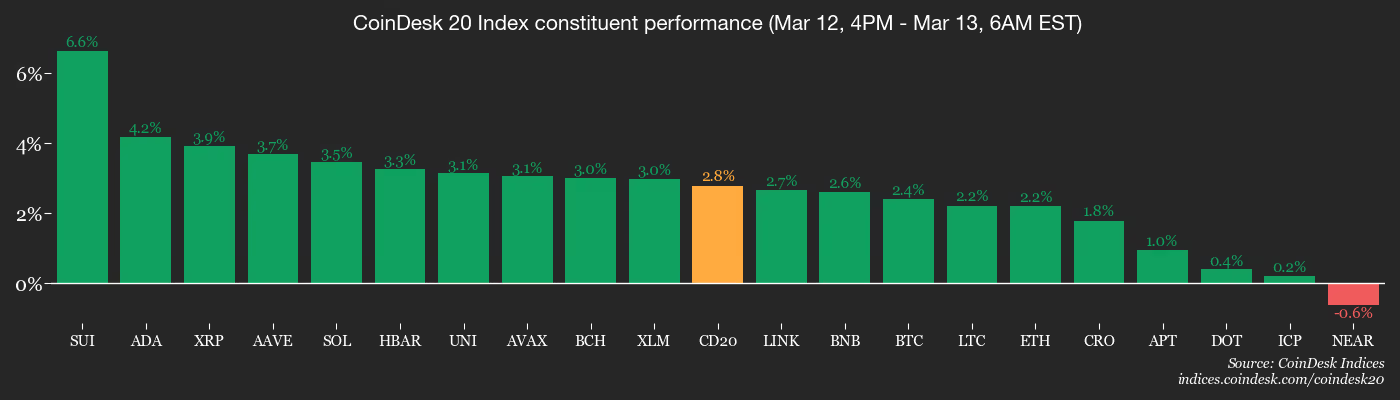
- CoinDesk 20 is up 3.14% at 2,068.83 (24hrs: +3.01%)
- Ether CESR Composite Staking Rate is up 1 bps at 2.79%
- BTC funding rate is at 0.0015% (1.6688% annualized) on Binance

- DXY is up 0.42% at 100.16.
- Gold futures are down 0.44% at $5,093.40
- Silver futures are down 2.11% at $82.89
- Nikkei 225 closed down 1.16% at 53,819.61
- Hang Seng closed down 0.98% at 25,465.60
- FTSE 100 is down 0.43% at 10,260.60
- Euro Stoxx 50 is down 0.71% at 5,708.34
- DJIA closed on Thursday down 1.56% at 46,677.85.
- S&P 500 closed down 1.52% at 6,672.62
- Nasdaq Composite closed down 1.78% at 22,311.98
- S&P/TSX Composite closed down 0.84% at 32,840.60
- S&P 40 Latin America closed up 1.43% at 3,611.39.
- U.S. 10-Year Treasury rate is up 6 bps at 4.27%
- E-mini S&P 500 futures are up 0.30% at 6,697.75
- E-mini Nasdaq-100 futures are up 0.29% at 24,631.50
- E-mini Dow Jones Industrial Average Index are up 0.34% at 46,881.00
Bitcoin Stats
- BTC Dominance: 59.44% (0.24%)
- Ether-bitcoin ratio: 0.0294 (0.01%)
- Hashrate (seven-day moving average): 984 EH/s
- Hashprice (spot): $31.34
- Total fees: 2.69 BTC / $188,598
- CME Futures Open Interest: 110,290 BTC
- BTC priced in gold: 14.2 oz.
- BTC vs gold market cap: 4.82%
Technical Analysis

- The chart shows bitcoin’s daily price swings in candlestick format since late 2025. It also plots the Fibonacci retracements of the January-February selloff and the 50-day simple moving average of bitcoin’s price.
- BTC’s price is looking to top the 50-day SMA line. That would shift the focus to next resistance level at $74,564, which is the 38.2% Fibonacci retracement of the selloff.
- On the other hand, a failure to penetrate the 50-day SMA could embolden sellers, potentially leading to a drop below $70,000.
Crypto Equities
- Coinbase Global (COIN): closed on Thursday at $193.23 (–2.72%), +1.96% at $197.02 in pre-market
- Circle Internet Group (CRCL): closed at $114.18 (+1.21%), +0.58% at $114.84
- Galaxy Digital (GLXY): closed at $20.63 (–3.87%), +1.89% at $21.02
- MARA Holdings (MARA): closed at $8.76 (+2.46%), +1.60% at $8.90
- Riot Platforms (RIOT): closed at $14.50 (–2.09%), +1.59% at $14.73
- Core Scientific (CORZ): closed at $16.24 (–1.81%)
- CleanSpark (CLSK): closed at $9.55 (–2.65%), +1.57% at $9.70
- Exodus Movement (EXOD): closed at $9.96 (–8.71%), unchanged in pre-market
- CoinShares Bitcoin Mining ETF (WGMI): closed at $37.96 (–2.47%)
- Bullish (BLSH): closed at $36.24 (–2.55%), +0.44% at $36.40
Crypto Treasury Companies
- Strategy (MSTR): closed at $137.34 (–0.72%), +2.49% at $140.76
- Strive Asset Management (ASST): closed at $8.83 (–4.33%), +1.59% at $8.97
- SharpLink (SBET): closed at $7.48 (–1.45%), +2.54% at $7.67
- Upexi (UPXI): closed at $0.93 (–9.71%), +4.61% at $0.97
- Lite Strategy (LITS): closed at $1.15 (–1.71%)
ETF Flows
Spot BTC ETFs
- Daily net flows: $53.8 million
- Cumulative net flows: $55.93 billion
- Total BTC holdings ~ 1.29 million
Spot ETH ETFs
- Daily net flows: $72.4 million
- Cumulative net flows: $11.75 billion
- Total ETH holdings ~ 5.71 million
Source: Farside Investors
While You Were Sleeping
The new staked Ethereum ETF (ETHB) from BlackRock recorded about $15.5M in trading volume on its first day.
Yesterday, BlackRock launched its iShares Staked Ethereum Trust ETF, trading under the ticker ETHB.
According to Bloomberg ETF analyst James Seyffart, it recorded a trading volume of about $15.5 million on its first day.
A New Structure for Crypto Income
In a series of posts on X, Seyffart explained that the fund opened with just over $100 million in assets and had raked in more than $11 million in trading volume by 2 p.m. Eastern time. However, by day’s end, it had added another $4 million to close at $15.5 million. The analyst described the performance as “very, very solid for a day 1 ETF launch.”
He also looked at the numbers next to BlackRock’s existing spot Ethereum ETF, ETHA. During the same period, ETHA had about $264 million in trading volume, well above ETHB’s numbers. But the gap is largely a reflection of the difference in assets, with ETHA holding nearly $6.6 billion per SoSoValue and the staked Ethereum ETF launching at $100 million.
According to the analyst, ETHB carries a management fee of 0.25%, although in the first year, BlackRock is offering a reduced fee of 0.12% until the fund hits $2.5 billion in assets.
Documents released at the same time as yesterday’s launch show that Coinbase will be the custodian and staking provider. The ETF’s ETH will be delegated to a small number of approved validators, such as Figment, Galaxy Blockchain Infrastructure, and Attestant. Bitwise bought Attestant and is now rebranding it as Bitwise Onchain Solutions.
Rather than add staking rewards to the fund’s net asset value, BlackRock will pay them out as dividends, and according to Seyffart, the distribution will probably be paid out every month. Still, he urged investors to read the prospectus for the final details.
You may also like:
Some Analysts Think This Could Move ETH’s Price
Following ETHB’s announcement, analyst Ash Crypto said on X that the product was more important than it might appear. According to them, the 3% yield gives Ethereum a new reason for institutional capital allocation. They also pointed to how it could affect the basic supply and demand dynamic, which could help push up ETH’s price.
“Every dollar flowing into $ETHB removes ETH from circulation and locks it into staking,” the market watcher posted. “Less supply. Same or growing demand. Price goes up by basic math.”
The new product is part of a bigger change in how institutions are using Ethereum. Per data shared by the network earlier in the year, more than 35 financial and tech companies, including BlackRock, JPMorgan, and Fidelity, have released products that are built directly on the blockchain. These offerings include tokenized funds, on-chain deposits, and stablecoin services.
At the time of writing, ETH was trading around $2,100, which was about 3% more than it was 24 hours ago and about 6% higher than a month ago. The asset has also gone up almost 12% in the last year but is still well below its all-time high of nearly $4,950, which it hit in August 2025.
Binance Free $600 (CryptoPotato Exclusive): Use this link to register a new account and receive $600 exclusive welcome offer on Binance (full details).
LIMITED OFFER for CryptoPotato readers at Bybit: Use this link to register and open a $500 FREE position on any coin!
The Dubai edition of Token2049, one of the crypto industry’s largest gatherings, has been postponed to 2027 amid ongoing regional uncertainties that complicate international travel and large-scale event planning. The conference, originally slated for April 29-30 in Dubai, will now take place on April 21-22, 2027. Organizers said tickets will remain valid for the new dates, and holders can also transfer attendance to Token2049’s Singapore edition. Preparations for the 2026 event had been advancing, but organizers concluded a postponement would preserve the event’s scale and quality and help the industry convene safely. A spokesperson told Fortune that registrations were tracking toward a sold-out turnout prior to the postponement. Token2049.
Key takeaways
- Token2049 Dubai is rescheduled to April 21-22, 2027, with existing tickets honored for the new dates and transferable to the Singapore edition.
- The Dubai plan historically progressed toward a sold-out event, according to a Fortune citation referencing a Token2049 spokesperson.
- Regional travel disruptions in the UAE, linked to broader tensions in the Middle East, prompted organizers to re-evaluate logistics and attendee safety considerations.
- Despite the postponement, preparations for the 2026 edition were described as ongoing before the decision was made to push the conference back.
- The shift illustrates how geopolitical and logistical headwinds continue to shape the calendar for major crypto conferences and investor gatherings.
Market context: The postponement underscores how macro and regional travel headwinds influence crypto event planning, potentially affecting attendee inflows, sponsor interest, and information exchange in the months ahead. In a market where in-person gatherings are still integral to deal-making and networking, such delays can impact momentum for project launches and fundraising activities as liquidity and risk sentiment evolve.
Why it matters
For attendees, the decision means adjusting travel itineraries and accommodation plans, but it also preserves the opportunity to hear from industry leaders at a time when crypto markets are navigating regulatory scrutiny and evolving macro conditions. The transfer option to Singapore offers a practical path for participants who had earmarked Dubai as a focal point for 2026 activity, ensuring continuity of networking opportunities, product demos, and investor briefings that typically accompany Token2049’s marquee events.
From the organizers’ perspective, the postponement is a calculated step to safeguard the event’s quality and integrity. By extending the timeline, Token2049 can align speaker lineups, vendor showcases, and security protocols with the scale expected of a flagship crypto conference while mitigating risk from travel disruptions and safety concerns. The decision also signals a broader trend in the industry toward deliberate pacing of major gatherings as travel and visa processes remain uneven across regions.
For the broader market, the move highlights how event calendars can mirror the fragility and resilience of the crypto ecosystem. Conference attendance often serves as a barometer for sentiment, sponsorship commitments, and potential fundraising activity for early-stage projects. When a leading venue delays, it can compress timelines for announcements and partnerships around related events elsewhere, influencing momentum and information flow within the community.
What to watch next
- Official confirmation of the new Dubai dates and the ticket-transfer process, with any deadlines for transferring to the Singapore edition.
- Updates on the Singapore edition’s schedule, venue, and registration status to gauge how many Dubai attendees opt to move their plans.
- Developments in 2026 event preparations and whether organizers reaffirm or adjust expectations for that edition.
- Continuing travel advisories or regional regulatory developments that could affect attendance and logistics at Token2049-related events.
Sources & verification
- Token2049 Dubai announcement detailing the new dates and ticket policy.
- Fortune report citing a Token2049 spokesperson about early Dubai preparations and indications of a sold-out trajectory.
- Gulf News coverage noting disrupted UAE travel schedules and airline adjustments impacting regional mobility.
Dubai edition reimagined: Token2049 postpones to 2027 and expands ticket-transfer options
The decision to push Token2049 Dubai into 2027 represents a measured response to a confluence of logistical hurdles and geopolitical risk that has influenced travel into the United Arab Emirates. In the official notice, organizers emphasized that the 2027 dates—April 21-22—will host a gathering designed to maintain the event’s global reach, speaker depth, and sponsor reach. They stressed that the postponement is intended to preserve the “scale and quality” attendees expect from Token2049’s most prominent regional installment, while ensuring participants can convene in a safer, more predictable environment.
Importantly for ticket holders, the policy remains flexible: existing passes will remain valid for the Dubai edition in 2027, and the option to transfer attendance to Token2049’s Singapore event is available. This approach acknowledges the logistical realities that often accompany large-scale tech and crypto conferences—from visa timelines to flight availability—while keeping the opportunity to engage with industry leaders and peers intact. The Singapore leg, long considered a complementary hub for Token2049’s broader Asia-Pacific footprint, stands to benefit from a potential concentration of regional participants who might otherwise have attended Dubai in a typical year.
The timeline shift follows a period during which organizers had signaled progress toward a sold-out Dubai event, a trend referenced by Fortune in reporting on a Token2049 spokesperson’s comments. While the public communication emphasized momentum behind the Dubai edition, the same week also brought cautionary notes about the broader travel environment and regional tensions that could complicate international gatherings. By opting to defer rather than compress the schedule, Token2049 aims to balance the appetite for in-person engagement with the practicalities of air travel, venue logistics, and on-the-ground safety concerns.
Beyond the conference mechanics, the news intersects with real-world travel conditions in the Gulf region. UAE airspace restrictions and evolving flight schedules have created a context in which even well-planned events can be exposed to disruptions. As reported by Gulf News, carriers such as Emirates, Etihad, flydubai, and Air Arabia have operated limited or adjusted schedules, with travelers advised to confirm bookings before making arrangements. The ripple effects extend to international attendees who must align visa processes, hotel bookings, and onward travel to and from Dubai, Singapore, and any connected hubs. In this environment, postponements are a practical step to safeguard attendee experience, sponsor engagement, and the overall integrity of such a high-profile industry gathering.
While Token2049’s Dubai postponement marks a notable shift, it also underscores the industry’s broader resilience. Crypto conferences have become more deliberate in their planning, integrating contingency options for attendees and sponsors who navigate evolving regulatory and logistical landscapes. The Singapore edition’s potential to absorb some attendance and sponsorship momentum mirrors a strategic diversification that could help sustain the event cycle even as geopolitical tensions and travel headwinds persist. In sum, the move is less about retreat and more about recalibration—preserving a premier platform for project updates, fundraising discourse, and community exchange at a moment when information exchange remains as critical as ever for market participants.
Update March 13, 10:56 am UTC: This article has been updated to add more information about the regional situation and additional details from the announcement.
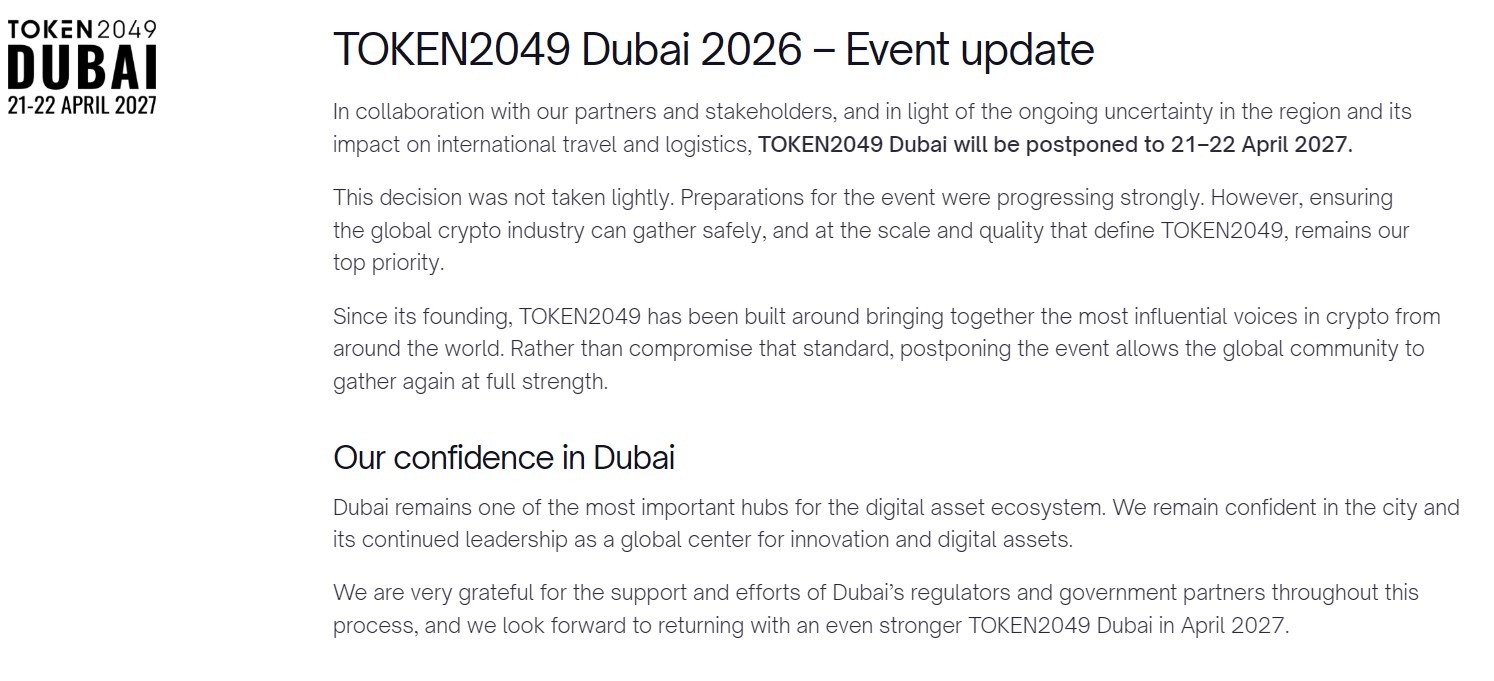
The Dubai edition of Token2049, one of the crypto industry’s largest global gatherings, has been postponed until 2027 due to regional uncertainty affecting international travel and event logistics.
The organizers said on Friday that the conference, originally scheduled for April 29-30, in Dubai, will instead take place on April 21-22, 2027.
In the announcement, the organizers said preparations for the 2026 event had been progressing, but concluded that postponing the conference would help maintain the scale and quality expected from the gathering and ensure the industry could meet safely.
The move marks a reversal from earlier this week, when a Token2049 spokesperson told Fortune that preparations for the Dubai conference were continuing and that registrations were tracking toward a sold-out event.

Organizers said Dubai remains a key hub for the digital asset industry and thanked the city’s regulators and government partners for their support, adding that they look forward to returning with a “stronger TOKEN2049 Dubai” in April 2027.
Related: Oil retreats from 25% surge as G7 weighs emergency reserve release
The United Arab Emirates is home to more than 1,800 crypto companies employing over 8,600 people, including more than 600 Web3 firms located in Dubai’s DMCC free zone. According to Token2049, over 15,000 attendees have participated in the event.
Regional tensions disrupt travel across the Middle East
Travel across the UAE has remained disrupted by regional airspace restrictions following the outbreak of the US-Israel war on Iran on Feb. 28.
Gulf News reported Friday that Emirates, Etihad, flydubai and Air Arabia were operating limited or adjusted schedules, with passengers urged to travel only if they had confirmed bookings.
Tensions further escalated after Iranian drone and missile attacks targeted the UAE and neighboring countries since the outbreak of the conflict, according to an Associated Press report.
Debris from intercepted missiles has caused fires and damage in Dubai, including infrastructure around Dubai International Airport.
Despite the attacks, the Central Bank of the UAE assured residents that financial institutions and insurers continue to operate with full efficiency and stability.
Magazine: China’s ‘50x’ blockchain boost, Alibaba-linked AI mines Bitcoin: Asia Express
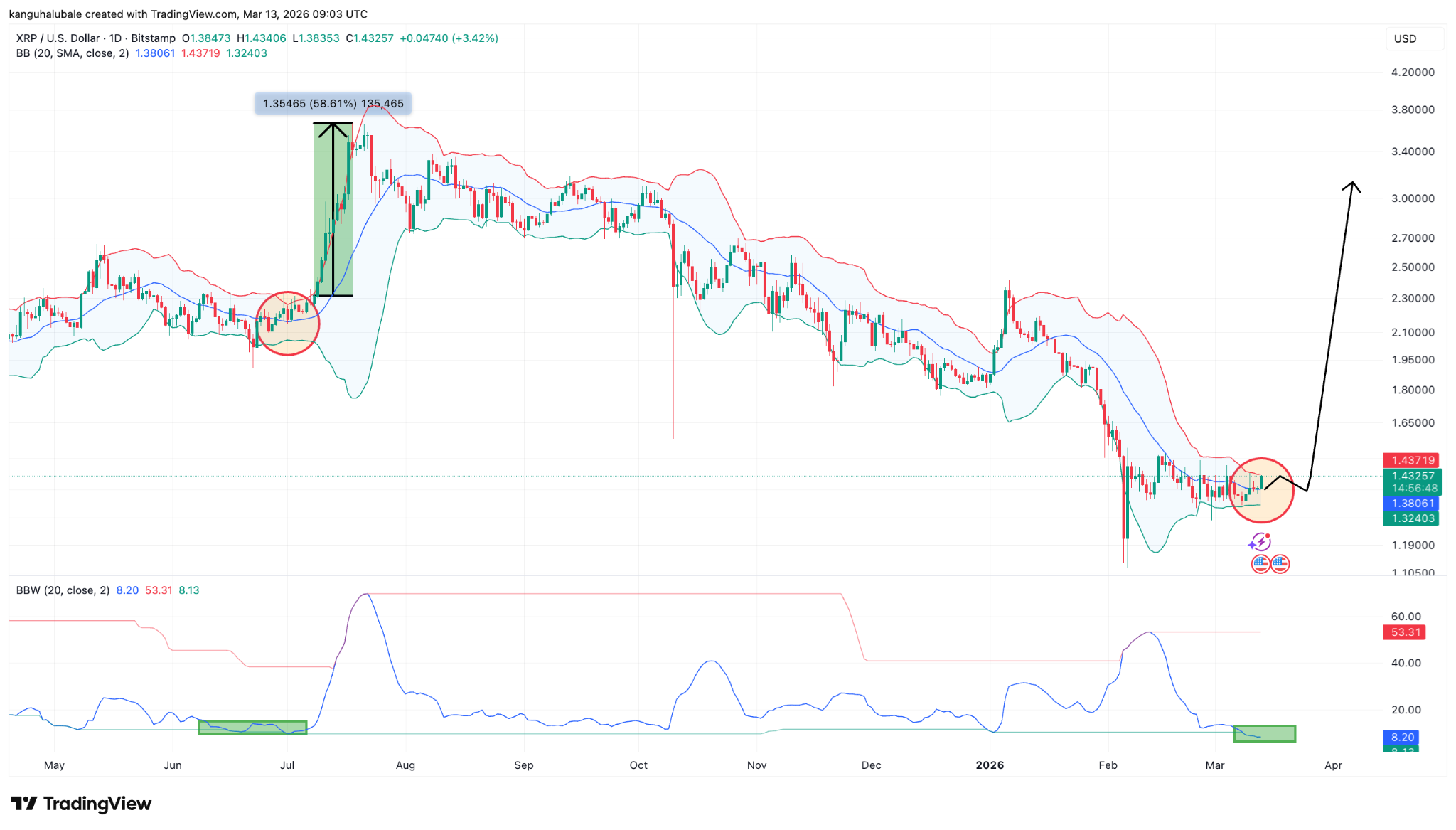
XRP’s (XRP) price was up 3% on Friday to trade above $1.40 as several technical and onchain indicators suggested it was due for a “significant” upward breakout.
Key takeaways:
-
XRP’s Bollinger Bands indicator now sees the potential for a massive price breakout.
-
XRP’s falling wedge pattern targets $2.55.
-
Declining exchange balances and persistent outflows indicate XRP accumulation.
XRP Bollinger Bands point at “significant” breakout
Bollinger Bands, a technical indicator used by traders to assess price momentum and volatility within a certain range, have reached their tightest point in eight months, signalling that volatility should be expected soon.
Related: Ripple to buy back $750M in shares through April: Report
The “daily XRP Bollinger Bands have slipped to their tightest level since July 2025,” analyst The Crypto Basic said in an X post on Thursday.
The XRP/USD pair surged about 60% in July 2025 to its multi-year high at $3.66, after breaking above the upper boundary of the Bollinger Bands.
“Tight Bollinger Bands often indicate lower volatility, and the breakout that follows could lead to an explosive run,” The Crypto Basic added.

Another analyst called this a preparation for a “significant breakout.”
XRP’s price continues to “consolidate within a symmetrical triangle structure with tightening Bollinger Bands and a stabilizing RSI,” fellow analyst XRP Update said, adding:
“This volatility compression suggests the market may be preparing for a significant breakout.”
XRP analyst Arthur said, with the Bollinger Bands tightening, a daily candlestick close above $1.50 “would confirm momentum.”

XRP falling wedge pattern targets $2.55
XRP price action is forming a falling wedge pattern on the weekly chart, a structure typically associated with bullish reversals after a prolonged downtrend.
The price has been compressing between two descending trendlines since July 2025, with the lower boundary now acting as key support near the $1.30 psychological level.

Meanwhile, the relative strength index (RSI), on the weekly chart, is rebounding from oversold territory, indicating fading selling momentum.
Historically, similar RSI conditions have preceded strong rebounds in XRP. For example, XRP rallied as much as 85% between July and September 2022 following the RSI’s recovery from oversold conditions.
A confirmed breakout above the wedge’s upper trendline could open the way for a run toward the bullish target of the prevailing chart pattern at $2.55, 78.5% above the current price.
As Cointelegraph reported, bulls must break and sustain the XRP price above $1.73-$2 supplier to signal a long-term trend shift.
Declining supply on exchanges backs XRP’s upside
XRP supply on exchanges, or the total amount of coins held on exchange addresses, continues to fall, reflecting accumulation and long-term investor confidence.
The XRP balance on exchanges dropped to 12.8 billion on Friday, levels last seen in May 2021.

A reducing balance means fewer XRP tokens are available for sale, reducing sell-side pressure.
Such outflows typically indicate strong accumulation by large holders, who move funds to cold storage, reducing immediate sell-side pressure and increasing the chances of XRP’s short-term rebound.
However, XRP’s recovery could be delayed by continued redemption from spot XRP exchange-traded funds (ETFs), which have recorded outflows for five consecutive days, totalling $50.8 million.

This article does not contain investment advice or recommendations. Every investment and trading move involves risk, and readers should conduct their own research when making a decision. While we strive to provide accurate and timely information, Cointelegraph does not guarantee the accuracy, completeness, or reliability of any information in this article. This article may contain forward-looking statements that are subject to risks and uncertainties. Cointelegraph will not be liable for any loss or damage arising from your reliance on this information.

The correlation between Bitcoin (BTC) and gold has snapped under the pressure of the Iran conflict, according to a note to investors by JPMorgan.
While geopolitical instability usually drives a unified bid for safe havens, the two assets are currently moving in opposite directions.
This decoupling reveals a significant shift in how capital is treating “digital gold” versus the real thing.
Instead of moving in tandem as crisis hedges, investors are aggressively rotating capital, creating a clear winner in the ETF market since late February.
Discover: The best crypto to buy now
What the JPMorgan ETF Flow Data Actually Shows About Bitcoin
Since the conflict escalated on Feb. 27, JPMorgan analysts report a stark divergence in capital flows. The largest gold ETF, SPDR Gold Shares (GLD), has bled outflows totaling roughly 2.7% of its assets under management.
Bitcoin vs gold ETF flows diverge — Yogita Khatri (@Yogita_Khatri5) March 12, 2026
 @jpmorgan analysts say since the Iran war:
• Largest gold ETF GLD saw 2.7% of AUM outflows
• Largest bitcoin ETF IBIT saw 1.5% of AUM inflows
The analysts also noted signs of bitcoin volatility compressing as institutional ownership… pic.twitter.com/oLvxrT83PK
In contrast, BlackRock’s iShares Bitcoin Trust (IBIT) absorbed inflows equaling roughly 1.5% of its assets during the same window.
JPMorgan analysts, led by Managing Director Nikolaos Panigirtzoglou, highlighted in their recent note to investors that this reverses the trend seen earlier in the year when gold funds held the advantage.
The data is unambiguous. While gold has traditionally been the default safety trade during Middle East tensions, capital is currently voting for Bitcoin exposure.
Institutional positioning generally reflects a shift away from bullion in favor of the spot Bitcoin ETFs, despite the higher volatility inherent in crypto assets.
Interestingly, IBIT inflows since the start of 2024 are now roughly double the total accumulation seen by GLD, further cementing the shift in dominance among exchange-traded products.
Is Bitcoin Replacing Gold as the Crisis Hedge?
The divergence goes deeper than headline flows. JPMorgan notes that while spot Bitcoin ETFs are seeing inflows, institutional derivatives markets paint a more cautious picture. Hedge funds appear to be reducing direct Bitcoin exposure even as ETF buyers step up.
Short interest in IBIT has actually increased since the conflict began, while GLD short interest declined. This narrows the gap between the two, suggesting that hedge funds are hedging their crypto bets while favoring gold for pure defensive positioning.
BlackRock's spot Bitcoin ETF, IBIT, is now being accepted as collateral for loans at JPMorgan.
Here we gohttps://t.co/Xif0FRby1B pic.twitter.com/aEgyZujN4T
— Joe Consorti (@JoeConsorti) June 4, 2025
This creates a complex market structure. Retail and registered investment advisors (RIAs) are likely driving the ETF bid, treating Bitcoin as a risk-off asset alongside the dollar. Meanwhile, sophisticated desks are hedging downside risk as oil surges past $100, a macro factor that typically pressures risk assets.
Options activity supports this cautious institutional stance. The demand for downside protection in Bitcoin has risen, contrasting with the relentless buying pressure in the spot ETF market. However, the sheer magnitude of the rotation, selling gold to buy Bitcoin, suggests the “digital gold” narrative is holding up under fire better than skeptics anticipated.
Bitcoin Price Prediction: Can BTC Hold the $70,000 Level?
Price action remains resilient despite the mixed signals from derivatives markets. Even with war-driven inflation fears dominating the headlines, Bitcoin is trading above $70,000, showing strength where legacy assets have faltered.
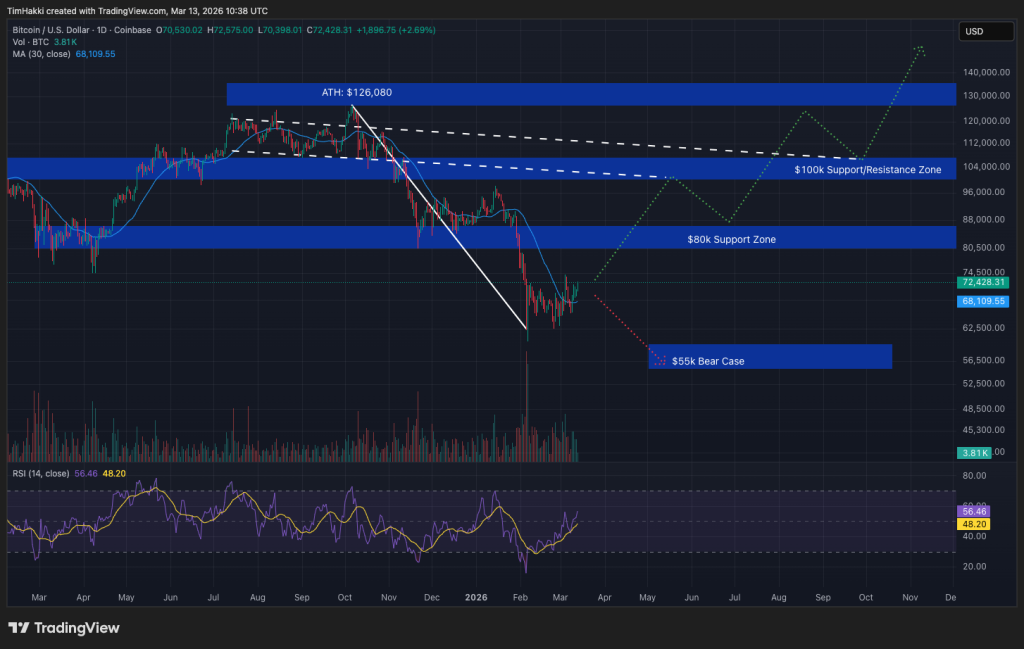
Bull Scenario: If ETF inflows persist at this 1.5% pace, Bitcoin targets the $80,000 resistance band. Clearing that level opens the path to retest all-time highs. JPMorgan’s own valuation models have previously flagged Bitcoin as undervalued relative to gold regarding volatility-adjusted capital, suggesting room for an upside squeeze.
Bear Scenario: Should macro liquidity tighten further, support sits firm at $64,000. A break below this level would validate the rising short interest and likely force a flush of the recent leverage. Traders must watch the $70,000 midpoint closely; losing it would signal that the safe-haven bid has exhausted itself.
The next major catalyst isn’t just on the chart; it’s at the Federal Reserve. If oil prices stay high, inflationary pressure could force central banks to keep rates elevated longer, testing the resilience of both gold and Bitcoin.
Discover: The next crypto to explode
The post JPMorgan Flags Sharp Divergence Between Bitcoin and Gold ETF Flows Since Iran War appeared first on Cryptonews.

Netflix (NFLX) Shares Pull Back After a 30% Surge
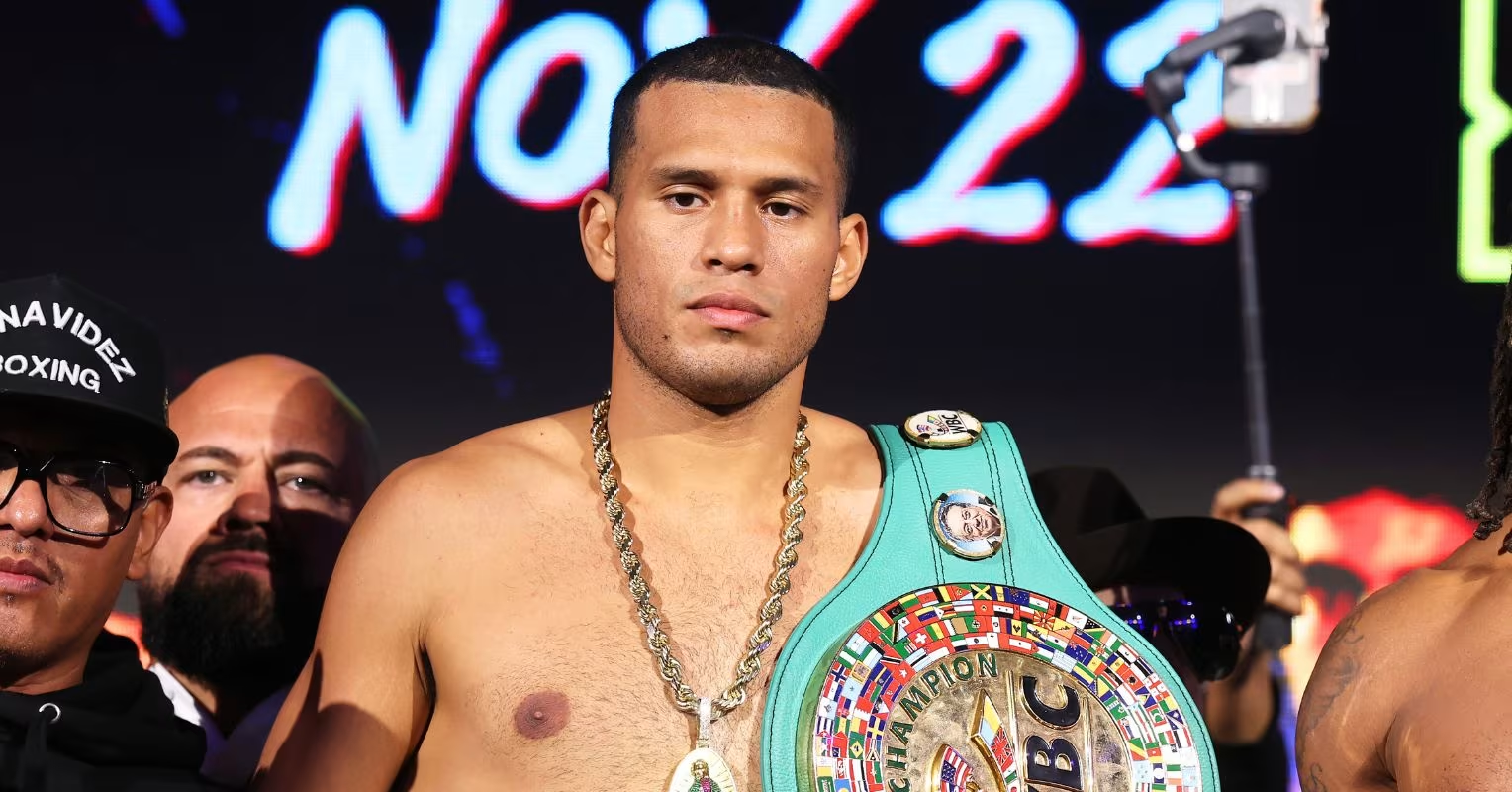
David Benavidez at risk of losing world title shot due to WBC decision

This Mechanical Fruit Bowl Refuses to Stay One Size


-
Business7 days ago
Form 8K Entergy Mississippi LLC For: 6 March
-

 News Videos4 days ago
10th Algebra | Financial Planning | Question Bank Solution | Board Exam 2026
-

 Fashion7 days ago
Weekend Open Thread: Ann Taylor
-
 Tech2 days ago
A 1,300-Pound NASA Spacecraft To Re-Enter Earth’s Atmosphere
-

 Crypto World4 days ago
Paradigm, a16z, Winklevoss Capital, Balaji Srinivasan among investors in ZODL
-

 Tech3 days ago
ChatGPT will now generate interactive visuals to help you with math and science concepts
-

 Business3 days ago
ExxonMobil seeks to move corporate registration from New Jersey to Texas
-

 Sports6 days ago
Three share 2-shot lead entering final round in Hong Kong
-

 Sports5 days ago
Braveheart Lakshya downs Lai in epic battle to enter All England Open final | Other Sports News
-

 NewsBeat2 days ago
Residents reaction as Shildon murder probe enters second day
-

 Entertainment6 days ago
Hailey Bieber Poses For Sexy Selfies In New Luscious Lip Thirst Traps
-

 Business5 days ago
Search for Nancy Guthrie Enters 37th Day as FBI Probes Wi-Fi Jammer Theory
-

 Business2 days ago
Search Enters Sixth Week With New Leads in Tucson Abduction Case
-
 NewsBeat3 days ago
Pagazzi Lighting enters administration as 70 jobs lost and 11 stores close across Scotland
-

 Tech4 days ago
Despite challenges, Ireland sixth in EU for board gender diversity
-

 Business4 days ago
Search Enters 39th Day with FBI Tip Line Developments and No Major Breakthroughs
-

 NewsBeat2 days ago
I Entered The Manosphere. Nothing Could Prepare Me For What I Found.
-

 Business6 days ago
Iran war enters second week as Trump demands ’unconditional surrender’
-

 Sports4 days ago
Skateboarding World Championships: Britain’s Sky Brown wins park gold
-
 Crypto World3 days ago
Will Chainlink price reclaim $10 amid volatility squeeze?