

Business
Government launches gigabit broadband postcode checker to track Project Gigabit rollout


The UK government has unveiled a new online tool designed to help households and businesses track the rollout of gigabit-capable broadband across the country, offering greater transparency over when faster connectivity will reach local communities.
The new address checker allows users to enter their postcode and see whether their property is scheduled to receive an upgrade through the government’s Project Gigabit programme or through separate commercial full-fibre deployments. Officials say the tool is intended to provide rural communities and businesses with clearer visibility of broadband infrastructure plans, particularly in areas where connectivity improvements have historically been slow.
The launch forms part of the government’s wider effort to accelerate the delivery of high-speed broadband across the UK, with particular emphasis on rural and hard-to-reach regions that have traditionally struggled with poor digital infrastructure.
According to the Department for Science, Innovation and Technology, more than 750 homes and businesses are now gaining access to gigabit-capable broadband every day through Project Gigabit. The programme is designed to deliver full-fibre connectivity to areas that are unlikely to be served by commercial investment alone.
Officials estimate that more than one million additional premises will benefit from live government contracts currently being rolled out across rural England and Wales. These include major infrastructure agreements with broadband providers aimed at expanding fibre networks into remote towns, villages and agricultural communities.
The government argues that improving digital connectivity is critical to supporting economic development outside major cities. Faster broadband access is expected to enable remote working, improve access to digital public services and strengthen sectors such as agriculture, tourism and rural small businesses.
However, campaigners warn that improving infrastructure alone will not eliminate the UK’s digital divide.
Elizabeth Anderson, chief executive of the Digital Poverty Alliance, said that while expanding gigabit broadband coverage is an important milestone, affordability remains a major barrier for millions of people.
“The continued rollout of gigabit-capable broadband and improved mobile coverage in rural communities is a welcome step towards closing long-standing connectivity gaps across the UK,” she said.
“However, infrastructure alone will not solve digital poverty. Around 19 million people in the UK experience some form of digital exclusion, and government figures show that around 1.6 million people are still living entirely offline.”
She added that the cost of broadband services and suitable devices continues to prevent many households from accessing digital services.
“We estimate around two million people lack connectivity because of affordability, and gigabit broadband is frequently out of reach due to higher costs,” Anderson said.
“While faster networks are important, they only make a difference if people can afford to use them. Connectivity must be not only available, but affordable and accessible for everyone.”
Alongside fibre expansion, the government is also investing in improved mobile connectivity through the Shared Rural Network, a joint initiative between government and the UK’s major mobile network operators.
The programme aims to extend 4G coverage into rural “not-spots”, areas where reliable mobile signals have historically been unavailable. Recent upgrades have already expanded coverage significantly across parts of the UK countryside.
Industry leaders say these improvements are essential as demand for digital services continues to grow rapidly across both consumer and business sectors.
Jennifer Holmes, chief executive of the London Internet Exchange (LINX), said the continued expansion of gigabit broadband and mobile coverage represents a key step in strengthening the UK’s digital infrastructure.
“As demand for online services continues to grow, the networks that underpin the internet must be resilient, efficient and capable of supporting increasing volumes of data,” she said.
“Strong infrastructure is essential not only for everyday connectivity, but also for supporting innovation, economic growth and the UK’s wider digital ambitions.”
Holmes added that modern digital networks now underpin almost every part of the economy, from cloud computing and artificial intelligence to e-commerce and public services.
“Investment in faster and more reliable connectivity will help ensure that businesses, public services and communities can fully participate in an increasingly digital economy,” she said.
The new postcode tool is intended to give consumers and businesses clearer information about when gigabit broadband will reach their homes or workplaces, particularly in areas where rollout timelines have previously been unclear.
By providing greater transparency over rollout plans, ministers hope the tool will help local communities better plan for the future and encourage businesses to invest in rural areas with improved connectivity.
Project Gigabit remains one of the UK government’s flagship infrastructure initiatives, aimed at ensuring that the vast majority of UK premises have access to gigabit-capable broadband by the end of the decade.
But as rollout accelerates, policymakers and campaigners alike warn that bridging the digital divide will require more than infrastructure alone. Ensuring that connectivity is affordable, accessible and supported by digital skills programmes will be crucial if the benefits of the UK’s digital transformation are to be shared across every community.

Jamie Young
Jamie is Senior Reporter at Business Matters, bringing over a decade of experience in UK SME business reporting.
Jamie holds a degree in Business Administration and regularly participates in industry conferences and workshops.
When not reporting on the latest business developments, Jamie is passionate about mentoring up-and-coming journalists and entrepreneurs to inspire the next generation of business leaders.


Strait Of Hormuz: Buy The Fear Before This Waterway Clears

Seema Misra calls for accountability as a report by MPs raises concerns about ongoing delays.


‘Making Money’ panelists Michelle Girard and Chris Low break down the February Jobs report, the impact on the energy prices from the Middle East crisis and the outlook for the Fed.
This is a developing story about the second reading of fourth-quarter gross domestic product growth. Please check back for updates.
The U.S. economy grew at a slower rate than previously thought in the fourth quarter after the Commerce Department released its first revision of real gross domestic product (GDP) growth for the latest quarter.
The Bureau of Economic Analysis (BEA) released its second estimate of fourth-quarter GDP, which showed the economy grew at a 0.7% rate. That figure was slower than the 1.4% estimate of economists polled by LSEG, and above the Commerce Department’s initial fourth-quarter GDP estimate of 1.4%.

BDC Tailwinds Are Building, Not Breaking

Form 8K Hexcel Corp For: 13 March
Business
Sun and Thousands of Solar Twins Rode Massive Galactic Migration Wave to Milky Way’s Suburbs, New Studies Find

Our sun, born 4.6 billion years ago near the crowded, chaotic heart of the Milky Way, did not make its journey to the galaxy’s calmer outer suburbs alone. A pair of new studies published March 12, 2026, in Astronomy and Astrophysics reveal that thousands of “solar twin” stars — stars with nearly identical mass, age and chemical composition to the sun — migrated outward alongside it in a coordinated stellar exodus spanning roughly 10,000 light-years.

Image credit: NAOJ
Led by Daisuke Taniguchi of Tokyo Metropolitan University and Takuji Tsujimoto of the National Astronomical Observatory of Japan, the research draws on data from the European Space Agency’s Gaia space telescope, which has mapped positions, motions and compositions for billions of stars with unprecedented precision.
The team identified 6,594 solar twins in Gaia’s latest release, focusing on those matching the sun’s metallicity (a measure of elements heavier than helium) and age. Their orbital paths and chemical signatures point to a shared origin closer to the galactic center, followed by a synchronized outward drift that placed them in the sun’s current neighborhood — about 26,000 light-years from the Milky Way’s core.
Computer simulations had long suggested such a trek would be rare. Stars born in the dense inner regions face formidable barriers: intense radiation, frequent supernovae explosions and gravitational perturbations from the galaxy’s central bar and spiral arms. Models predicted only about 1 percent of stars from the sun’s presumed birthplace could reach the outer disk within 4.6 billion years without being destroyed or scattered.
Yet the Gaia data show thousands succeeded — far more than chance alone would allow. The researchers propose the explanation lies in a massive, galaxy-wide migration wave triggered by the formation and evolution of the Milky Way’s central bar roughly 4 to 6 billion years ago.
As the bar strengthened, it boosted star formation in the inner disk and launched large-scale radial migrations. Gravitational resonances — regions where orbital periods align with the bar’s rotation or spiral arms — funneled stars outward in groups rather than individually. The sun and its twins caught this wave, riding it to safer, less hazardous suburbs where cosmic rays and supernova blasts are less frequent.
This migration may help explain why Earth became habitable. The galactic center teems with dangers: gamma-ray bursts, black-hole activity and dense stellar crowds that could strip planetary atmospheres or trigger mass extinctions. By migrating outward just in time — before the solar system fully formed its planets — the sun escaped the worst risks, providing a stable environment for life to emerge.
Taniguchi told Live Science the pattern suggests “many solar twins of the same age migrated through the Milky Way around the same time as the sun, giving us new clues about when and how the sun moved from its birthplace to its current location.”
The studies build on decades of debate about the sun’s origins. Earlier work proposed the sun formed farther out or migrated via spiral-arm resonances, but the new evidence ties the movement to a specific galactic event: bar-driven migration.
Gaia’s third data release in 2022 and ongoing fourth-release updates have revolutionized stellar archaeology, allowing astronomers to rewind stellar orbits billions of years. By tracing chemical abundances — especially iron-peak elements forged in supernovae — researchers can fingerprint stars born in the same era and region.
The solar twins cluster in both kinematics (motion) and metallicity, supporting group migration over random drift. The wave likely peaked 4 to 6 billion years ago, coinciding with the sun’s youth and the Milky Way’s transition to a more stable barred-spiral structure.
Implications extend beyond our solar system. If many sun-like stars share this history, habitable zones may correlate with migration paths. Regions swept by such waves could host more life-friendly systems, as they escape inner-galaxy perils.
The findings also refine models of galactic evolution. The Milky Way’s bar, a peanut-shaped structure of older stars, drives radial mixing that reshapes the disk over cosmic time. Similar processes occur in other barred spirals, suggesting coordinated migrations are common.
No direct evidence links the migration to Earth’s habitability, but the timing aligns intriguingly. Planet formation took hundreds of millions of years after the sun’s birth; the outward journey may have positioned the nascent system in a quieter galactic suburb just as rocky worlds and oceans stabilized.
Future Gaia releases and upcoming telescopes like the Vera C. Rubin Observatory will test the hypothesis by mapping even fainter twins and refining orbital reconstructions.
For now, the studies paint a dynamic picture: the sun was not a solitary wanderer but part of a vast stellar caravan, carried by galactic forces to the peaceful outskirts where life could take root.
Astronomers say the work underscores how interconnected stellar lives are with their galaxy’s architecture — and how a timely migration may have been key to our existence.

Just Eat Takeaway.com is expanding its push towards sustainable food delivery packaging by introducing a new range of plastic-free takeaway boxes across ten European markets, using a plant-based coating designed to replace conventional plastic linings.
The food delivery giant confirmed that the packaging will be rolled out across Austria, Belgium, Bulgaria, Switzerland, Germany, Italy, the Netherlands, Poland, Slovakia and Spain, following earlier launches with its German brand Lieferando in Germany and Austria.
The initiative is part of a partnership with sustainable packaging manufacturer Huhtamaki and UK materials technology company Xampla, whose Morro Coating technology provides a plastic-free alternative to the thin polymer layers traditionally used to make takeaway containers resistant to grease and moisture.
Unlike conventional takeaway boxes, which rely on plastic coatings to prevent leaks and maintain structural integrity, the new packaging uses a coating derived from natural plant proteins that has not undergone chemical modification. The coating provides the same barrier performance required for takeaway food packaging while remaining fully recyclable within standard paper recycling systems.
The rollout reflects growing pressure on the food delivery and hospitality sectors to reduce reliance on single-use plastics, particularly as regulations tighten across Europe under measures such as the EU’s Single Use Plastics Directive (SUPD).
According to the companies involved, the Morro-coated boxes have been verified as plastic-free by the UK’s National Physical Laboratory, making them one of the first takeaway packaging solutions capable of delivering high-performance food protection without plastic barriers.
The packaging is made from sustainably sourced corrugated paperboard, designed to retain heat and maintain rigidity even when used with greasy or moisture-heavy dishes that traditionally require plastic-lined containers.
Industry experts say solving this challenge is key to reducing plastic waste across the food delivery sector, where millions of takeaway boxes are used daily and often end up in landfill because plastic coatings prevent recycling.
Alexandra French, chief executive of Xampla, said the European expansion demonstrates that natural materials are increasingly capable of replacing plastic in high-volume commercial applications.
“Europe is moving fast on packaging regulation, and the demand for materials that can genuinely replace plastic has never been stronger,” she said.
“There is strong environmental ambition across these markets and a willingness to adopt new materials when they work. For us, this rollout is about scale. We’ve proven Morro Coating works and now we’re bringing it to millions of takeaway meals across Europe.”
French added that large-scale adoption in sectors such as food delivery is critical if sustainable materials are to meaningfully replace plastic packaging.
“If we want to replace plastic, we need to do it in the most demanding environments, where packaging needs to perform under heat, grease and moisture. This expansion shows that natural materials can compete in exactly those conditions.”
Huhtamaki, which manufactures the packaging, said the technology integrates seamlessly with existing foodservice supply chains and recycling infrastructure, enabling restaurants to transition to more sustainable packaging without requiring changes to waste management processes.
Because the coating is free from plastic, the containers can be processed through established paper recycling streams without needing separation of materials, addressing one of the major barriers to recycling takeaway packaging.
The rollout also supports businesses navigating evolving environmental regulations, including extended producer responsibility (EPR) rules that are increasingly placing financial responsibility on companies for the environmental impact of their packaging.
For Just Eat Takeaway.com, the expansion is part of a broader sustainability strategy aimed at reducing plastic waste across the fast-growing food delivery industry.
A spokesperson for the company said the move would allow thousands of restaurant partners across Europe to adopt packaging that meets both environmental and regulatory expectations.
“We’re excited to work with innovative partners who share our vision of reducing single-use plastic waste and creating more responsible packaging solutions,” the company said.
“Expanding our collaboration with Xampla represents a significant milestone in accelerating the adoption of plastic-free packaging across the on-demand delivery industry.”
The announcement comes as food delivery platforms face increasing scrutiny over the environmental impact of takeaway packaging, which contributes significantly to urban waste streams across Europe.
By introducing recyclable, plant-based coatings capable of replacing plastic in food containers, the companies involved hope to demonstrate that large-scale alternatives to plastic packaging are both commercially viable and operationally practical.
With millions of takeaway orders processed across its European markets every week, Just Eat Takeaway.com’s adoption of plastic-free containers could represent one of the most significant real-world deployments of plant-based packaging technologies in the food delivery sector to date.

Amy Ingham
Amy is a newly qualified journalist specialising in business journalism at Business Matters with responsibility for news content for what is now the UK’s largest print and online source of current business news.


Former JP Morgan Chase chief economist Anthony Chan breaks down the run up in oil prices on Varney & Co.
This story on the January 2026 PCE inflation report is developing and will be updated with more details.
The Federal Reserve’s preferred inflation gauge remained stubbornly high in January as consumers continued to face elevated price growth.
The Commerce Department on Friday reported that the personal consumption expenditures (PCE) index rose 0.3% on a monthly basis in January and is up 2.8% from a year ago. The monthly figure was in-line with the expectations of economists polled by LSEG, while the annual figure was slightly lower than the 2.9% estimate.
Core PCE, which excludes volatile measurements of food and energy prices, was up 0.4% from a month ago and increased 3.1% year over year. Both figures were in line with economists’ expectations from the LSEG poll.
Federal Reserve policymakers are focusing on the PCE headline figure as they try to bring inflation back to their long-run target of 2%, though they view core data as a better indicator of inflation. Compared with December’s readings, headline PCE inflation declined slightly from 2.9% while core PCE rose from 3%.
FED OFFICIALS CLOSELY MONITOR IRAN CONFLICT FOR POTENTIAL INFLATION IMPACT
Prices for goods were up 1.3% in January on an annual basis, down from 1.7% in December. Goods prices increases were even lower last summer, when the index posted annual gains of 0.6% in June and July and 0.9% in August.
Durable goods prices increased 2.2% in January from a year ago, up from a 2.1% reading in December. The index was close to 1% from June through November. Nondurable goods prices rose just 0.8% in January, a decline from the 1.6% annual rate recorded in December and the lowest reading since August.
What experts are saying
What does it mean for the Fed?

Tiptree CFO McKinney buys shares worth $61,682

Costco Wholesale COST 1.12%increase; green up pointing triangle is being sued by a shopper looking to get his tariff costs back.
A lawsuit filed Wednesday in an Illinois federal court alleges that Costco owes its customers refunds related to tariffs deemed unlawful by the Supreme Court last month. The suit is seeking class-action status on behalf of Costco shoppers nationwide.
Costco increased product prices to offset the cost of tariffs, but it hasn’t promised shoppers a refund, said the lawsuit filed on behalf of Matthew Stockov, a Costco member who lives in Illinois. Shoppers won’t get a government refund directly, because they aren’t the importer of record, said the lawsuit. “The truly injured parties possess no direct avenue for redress,” alleged the lawsuit, which asks Costco for a refund on price increases related to tariffs, plus interest.
A Costco spokesman said the company had no comment on the lawsuit. “Our commitment will be to find the best way to return this value to our members through lower prices and better values,” if the company receives tariff refunds, said Chief Executive Ron Vachris on an earnings call last week. It has taken a similar approach with past legal winnings, he said.
Copyright ©2026 Dow Jones & Company, Inc. All Rights Reserved. 87990cbe856818d5eddac44c7b1cdeb8
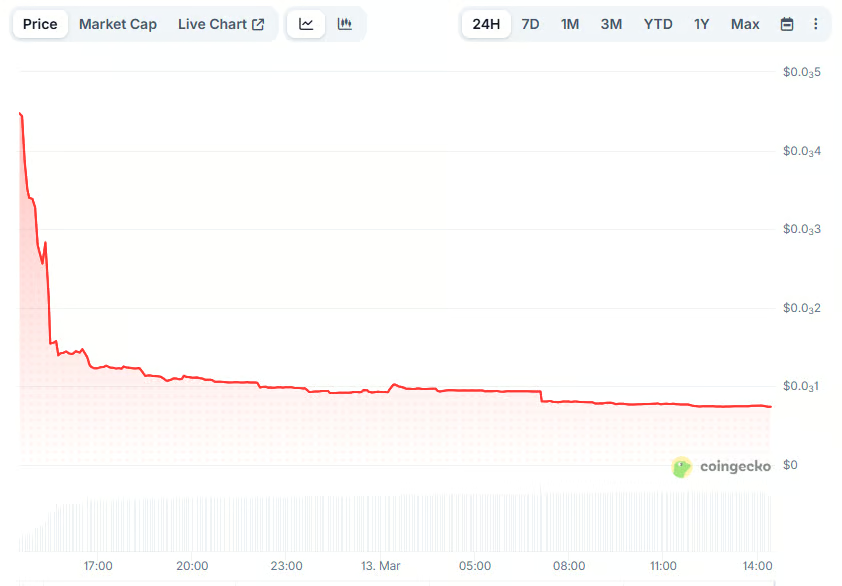
Binance Causes Brutal Crash for Numerous Altcoins After a Single Major Announcement

Meagan Good Spills On Married Life And Baby Plans

Bitcoin Just Flashed a Signal Nobody Is Ready For – Arthur Hayes

Smart energy pays enters the US market, targeting scalable financial infrastructure

Why Israel is blocking foreign journalists from entering

Bitcoin: We’re Entering The Most Dangerous Phase
Bitcoin Just Flashed a Signal Nobody Is Ready For – Arthur Hayes

Nick Cannon and Mariah Carey: Love tested by financial pressures #nickcannon #mariahcarey

URGENT ANOTHER 2008 BANKING COLLAPSE HAPPENING NOW?! #crypto #cryptocurrency #xrp #bitcoin #finance
-
Business7 days ago
Form 8K Entergy Mississippi LLC For: 6 March
-

 News Videos4 days ago
10th Algebra | Financial Planning | Question Bank Solution | Board Exam 2026
-

 Fashion7 days ago
Weekend Open Thread: Ann Taylor
-
 Tech2 days ago
A 1,300-Pound NASA Spacecraft To Re-Enter Earth’s Atmosphere
-

 Crypto World4 days ago
Paradigm, a16z, Winklevoss Capital, Balaji Srinivasan among investors in ZODL
-

 Tech3 days ago
ChatGPT will now generate interactive visuals to help you with math and science concepts
-

 Business3 days ago
ExxonMobil seeks to move corporate registration from New Jersey to Texas
-

 Sports6 days ago
Three share 2-shot lead entering final round in Hong Kong
-

 Sports5 days ago
Braveheart Lakshya downs Lai in epic battle to enter All England Open final | Other Sports News
-

 NewsBeat2 days ago
Residents reaction as Shildon murder probe enters second day
-

 Entertainment6 days ago
Hailey Bieber Poses For Sexy Selfies In New Luscious Lip Thirst Traps
-

 Business5 days ago
Search for Nancy Guthrie Enters 37th Day as FBI Probes Wi-Fi Jammer Theory
-

 Business2 days ago
Search Enters Sixth Week With New Leads in Tucson Abduction Case
-
 NewsBeat4 days ago
Pagazzi Lighting enters administration as 70 jobs lost and 11 stores close across Scotland
-

 Tech4 days ago
Despite challenges, Ireland sixth in EU for board gender diversity
-

 NewsBeat2 days ago
I Entered The Manosphere. Nothing Could Prepare Me For What I Found.
-

 Business4 days ago
Search Enters 39th Day with FBI Tip Line Developments and No Major Breakthroughs
-

 Business6 days ago
Iran war enters second week as Trump demands ’unconditional surrender’
-

 Sports4 days ago
Skateboarding World Championships: Britain’s Sky Brown wins park gold
-

 Crypto World3 days ago
Will Chainlink price reclaim $10 amid volatility squeeze?