

Crypto World
Fed Faces Sticky Inflation as January PCE Exceeds Target Ahead of Policy Meeting


Key Takeaways
- Year-over-year core PCE inflation registered 3.1% in January, exceeding the Federal Reserve’s 2% objective
- On a monthly basis, core PCE increased 0.4%, matching analyst forecasts
- Overall PCE recorded 2.8% annual growth, marginally lower than the anticipated 2.9%
- Financial markets broadly anticipate the Federal Reserve will maintain interest rates between 3.5%–3.75% during the upcoming policy meeting
- These figures predate the Iran military engagement, which has elevated crude oil costs and introduces uncertainty to future inflation trends
On March 13, 2026, the Bureau of Economic Analysis published its personal consumption expenditures (PCE) report for January. This metric serves as the Federal Reserve’s primary gauge for measuring inflationary pressures.
The core PCE measure, which excludes volatile food and energy components, climbed 3.1% on an annual basis in January. This figure aligned with expert predictions but represented an acceleration from December’s 3.0% reading. Monthly core PCE advanced 0.4%, consistent with projections.
The overall PCE measurement — encompassing all consumer goods and services — expanded 2.8% annually. This result fell marginally short of the 2.9% consensus estimate and represented a deceleration from the previous month’s velocity.
On a month-to-month basis, overall PCE increased 0.3%, in line with market expectations.
The Federal Reserve maintains an inflation target of 2%. With core PCE currently positioned at 3.1%, consumer prices continue running significantly above the central bank’s desired threshold.
Markets are pricing in that the Fed will maintain its current rate range of 3.5% to 3.75% during next week’s policy deliberations. Given the stubborn inflation readings, interest rate reductions appear unlikely in the near term.
The PCE measure has been registering higher readings compared to the Labor Department’s Consumer Price Index. This divergence primarily stems from varying methodologies for weighing housing and healthcare expenditures. PCE assigns reduced importance to shelter expenses, which have been moderating, while giving greater emphasis to medical costs, which have been climbing.
February’s CPI registered 2.4% year-over-year — a considerably more subdued figure.
What These Numbers Miss
The January data captures economic circumstances from over a month in the past. It fails to incorporate consequences from the Iran military conflict, which commenced following U.S. and Israeli aerial operations in late February.
Oil prices have surged substantially since hostilities began. Elevated crude costs typically translate to higher inflation in subsequent months.
The economic landscape faces additional complexity from broad-based tariff implementations and substantial corporate capital allocation toward artificial intelligence initiatives. Both factors are already influencing economic conditions but remain challenging to measure accurately in real time.
Paul Ashworth, Chief North America Economist at Capital Economics, observed that America’s status as a net petroleum exporter may cushion the impact of rising oil valuations. He acknowledged that while increased energy expenses could initially diminish consumer purchasing capacity, any corresponding investment gains would require time to materialize throughout the economy.
Personal consumption expenditures rose 0.4% in January compared to the previous month, surpassing forecasts. Personal income expansion, conversely, experienced modest deceleration.
Looking Forward
Fourth-quarter 2025 GDP expansion underwent substantial downward revision to merely 0.7%.
Ashworth anticipates economic recovery during the first quarter of 2026, attributable in part to diminishing headwinds from a government shutdown that occurred in late 2025.
The Federal Reserve’s upcoming interest rate determination will follow a two-day policy meeting next week. Current market indicators suggest rates will remain unchanged.


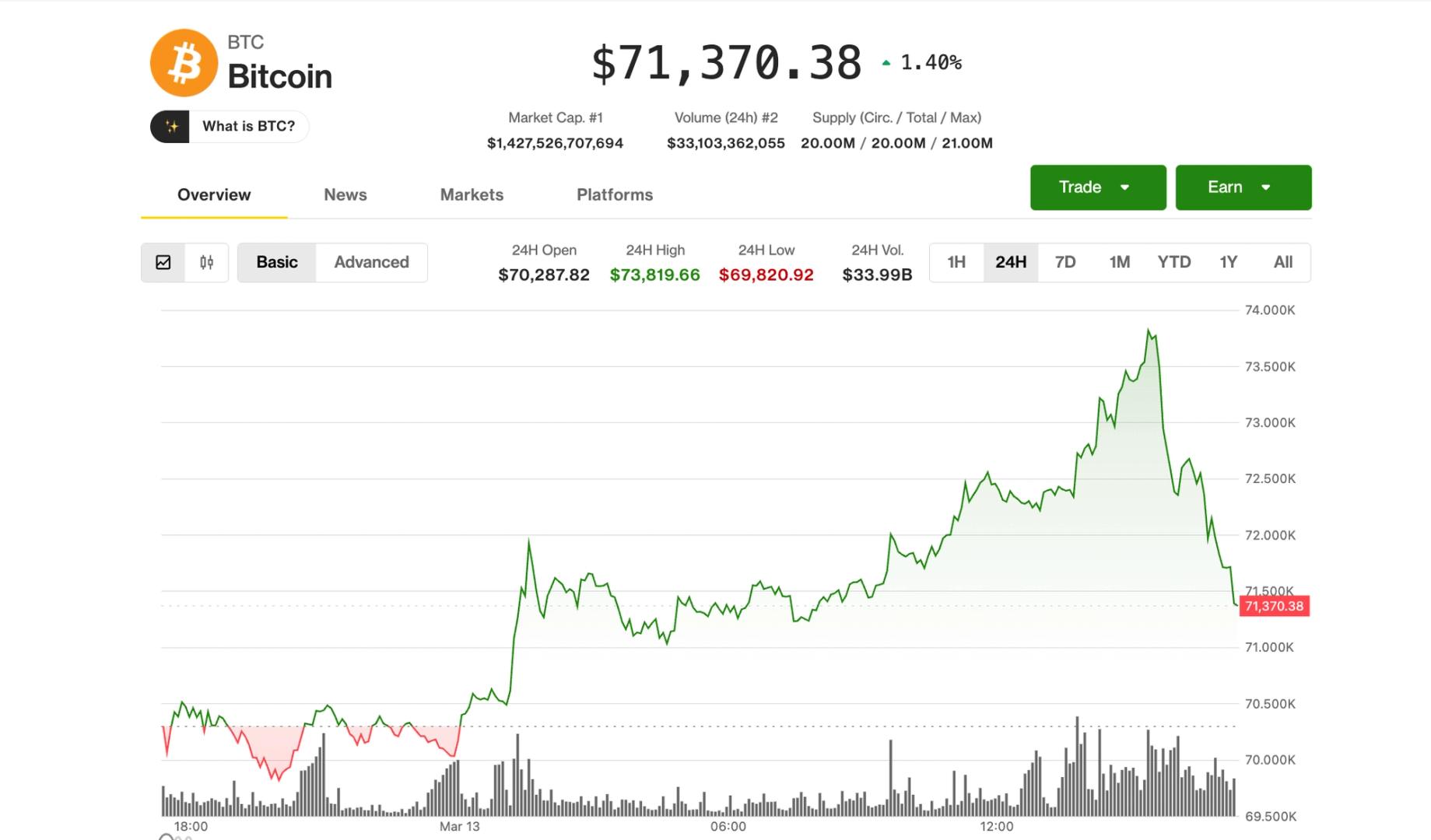
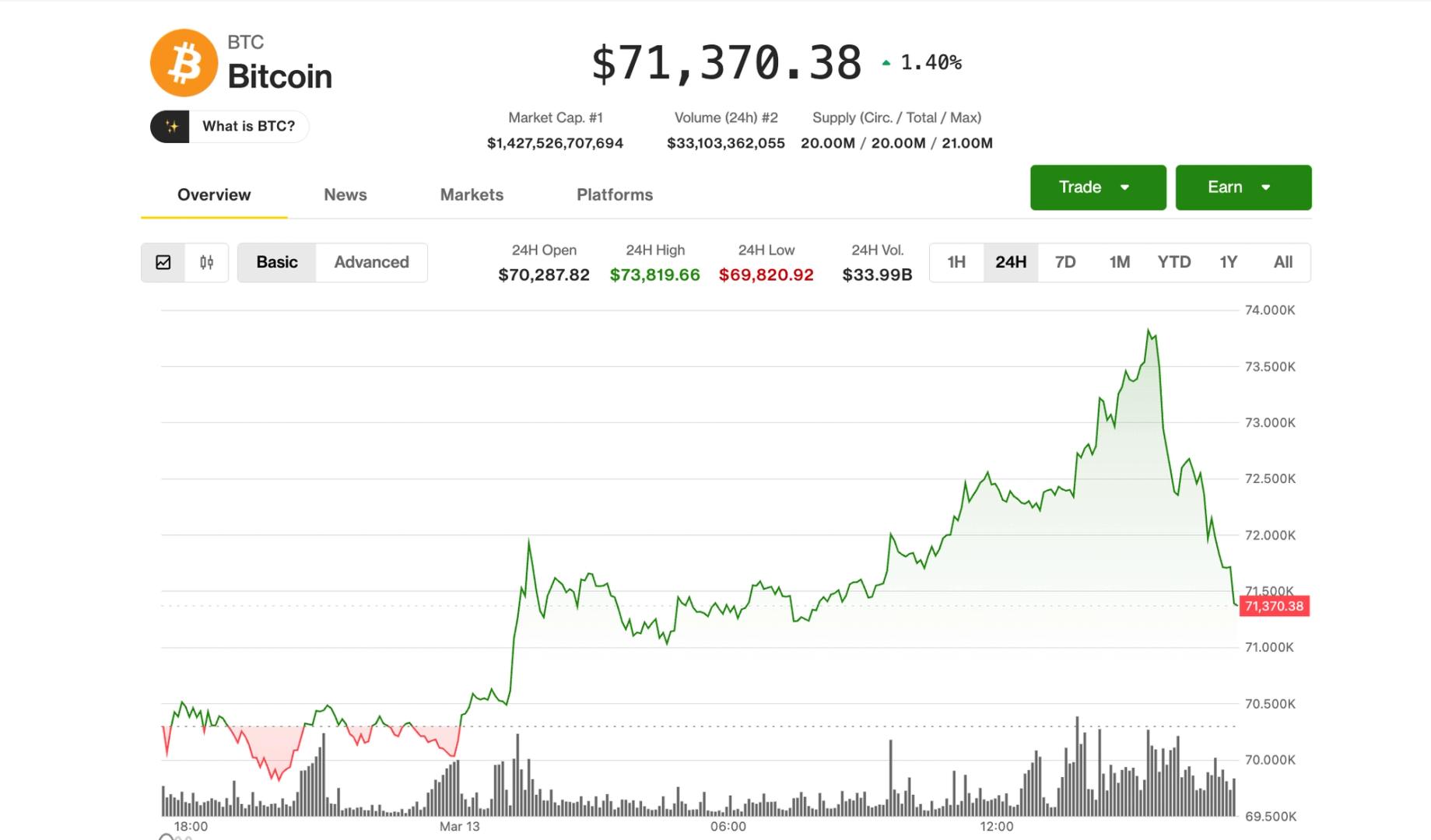
The crypto rally ran into a wall on Friday as fresh headlines of potential escalation in the Iran conflict abruptly cooled risk appetite across markets.
Among the developments, the U.S. Central Command confirmed that all six crew members aboard a refueling aircraft that crashed in Iraq on Thursday had died.
Meanwhile, the Wall Street Journal reported that the Pentagon is deploying a Marine expeditionary unit (thought to be 2,500 troops) to the Middle East, including forces attached to the USS Tripoli, as Iran steps up attacks around the Strait of Hormuz.
Bitcoin, after rallying to near $74,000 earlier in the session, reversed sharply to $71,200 following the news, still holding onto 1.9% gain over the past 24 hours. Ethereum’s ether (ETH), Solana’s SOL (SOL) and were 3% higher during the same period, though also retreating from their session highs.
U.S. equities surrendered early gains, with the S&P 500 and Nasdaq flipping to 0.4%-0.5% declines. Gold, which often benefits from geopolitical turmoil, extended its recent pullback by another 1%, Oil, on the other hand, climbed more than $5 per barrel from its lowest levels of the day, now higher by nearly 2% for the session at $97.30.
“Optimism over geopolitical events, including Russian sanction relief, has been a driver” behind the price action, said Paul Howard, director at trading firm Wincent. “These headlines tend to have a short half-life, so [we] would expect this to be short-lived till we see concrete follow-up action.”
Crypto-linked equities continue to be mostly posting gains for the day. Bitcoin miner Marathon Digital (MARA) led the advance with a 10% jump, while Galaxy Digital (GLXY), Ethereum treasury firm Bitmine (BMNR) and AI data-center focused miner Cipher Mining (CIFR) all climbed 5%-7%.
Crypto World
A dormant crypto whale just scooped up $7 million in Trump tokens after a new gala was announced


A crypto wallet that sat dormant for five months woke up Thursday to accumulate more than $7 million worth of TRUMP tokens as the U.S. president-linked memecoin’s official team announced a second gala event for top holders — sending the token surging more than 60% from its all-time low.
Onchain data from Arkham Intelligence shows the wallet began buying the tokens from Binance’s hot wallet starting at 01:49 UTC on March 13, hours after the gala was announced. The wallet accumulated roughly 2.2 million TRUMP across four transactions: an initial single-token test buy, followed by two purchases of about 1 million tokens each, worth a combined $6.23 million, and a further 200,000-token buy worth $742,000.
The TrumpMeme account on X announced a conference and gala luncheon at Mar-a-Lago on April 25. The event is open to the top 297 TRUMP holders by time-weighted average balance between the announcement date of March 12 and April 10.
TRUMP dropped to a record low near $2.71 earlier Thursday before spiking to $4.50, then pulling back to around $3.90 — still a gain of roughly 44% from the trough. The wallet was up approximately $2.47 million on its position at the time of publication, with total holdings valued at $9.44 million, per Arkham data.
The new event echoes the dinner held at Trump National Golf Club in May 2025, which drew criticism from lawmakers and ethics watchdogs over presidential access as a token-holding incentive. A disclaimer on the new event’s website states Donald Trump will appear in a personal capacity with no private meetings.
TRUMP has fallen roughly 96% from its all-time high of around $74, set just before Trump’s inauguration in January 2025.
Crypto World
Stanley Druckenmiller Predicts Stablecoins Will Transform Global Payments Within 15 Years
Key Takeaways
- Legendary investor predicts stablecoins will control global payments within 10-15 years.
- Blockchain technology offers superior speed and cost efficiency for international transfers.
- USDT and USDC lead the market in transaction volume and adoption.
- Financial institutions actively test stablecoins for payments and treasury operations.
- Bitcoin maintains its position as a digital store of value.
The global financial system stands at a potential inflection point as digital payment technology challenges conventional infrastructure. Renowned billionaire investor Stanley Druckenmiller projects that stablecoins will emerge as the dominant force in global payments over the next 10 to 15 years. His forecast underscores growing institutional recognition of blockchain-based payment networks that deliver enhanced speed and reduced transaction costs for international settlements.
Blockchain-Based Payment Systems Attract Institutional Interest
During a conversation with Morgan Stanley released Thursday, Stanley Druckenmiller shared his perspective on the evolution of payment infrastructure. He projected that stablecoin networks could supplant significant segments of existing financial systems. According to Druckenmiller, blockchain architecture delivers superior efficiency while cutting expenses associated with worldwide payment processing.
He characterized the technology as delivering faster execution and lower costs compared to traditional settlement frameworks operated by financial institutions and payment processors. This value proposition has prompted numerous financial organizations to experiment with stablecoin implementations for fund transfers and liquidity operations. The dual benefits of transaction velocity and operational cost reduction continue attracting attention from both institutions and infrastructure providers.
A stablecoin typically preserves stable value through backing assets denominated in conventional currencies like the U.S. dollar. This structure enables stablecoin transactions to eliminate price fluctuation concerns while leveraging blockchain settlement benefits. Financial organizations are therefore examining stablecoin infrastructure for applications including international remittances, e-commerce transactions, and corporate treasury functions.
Market Leaders USDT and USDC Drive Stablecoin Adoption
The worldwide stablecoin landscape currently centers around two primary digital assets. Tether (USDT) alongside USD Coin (USDC) represent the overwhelming majority of stablecoin trading and transfer activity throughout cryptocurrency markets. These instruments enable merchants, corporations, and payment service providers to transmit digital dollar equivalents instantaneously via blockchain infrastructure.
Circle Internet Financial creates and distributes USDC while marketing the token toward financial infrastructure applications. Simultaneously, Tether sustains USDT availability throughout numerous blockchain platforms and trading venues. Both networks facilitate substantial transaction throughput and progressively function as cross-border settlement solutions.
Financial institutions and banking enterprises currently examine stablecoin architectures for prospective incorporation into payment workflows. Analysis from Australian financial institution Macquarie similarly indicates broadening stablecoin infrastructure throughout financial service sectors. Market observers highlight that stablecoin utilization has extended beyond trading activities to encompass payments, transfers, and corporate treasury applications.
Bitcoin Preserves Store-of-Value Status Amid Broader Crypto Criticism
While endorsing stablecoin payment prospects, Druckenmiller reiterated skepticism toward numerous cryptocurrencies. He has maintained for years that multiple digital tokens lack compelling economic applications. From his perspective, many blockchain projects represent solutions seeking real-world problems to address.
He recognized Bitcoin’s enduring status as a value preservation instrument. He observed that the cryptocurrency established powerful brand awareness and sustained adoption throughout market participants. This recognition, he indicated, reinforced bitcoin’s continued relevance within broader financial discourse.
Druckenmiller additionally questioned the sustainability of the U.S. dollar’s position as the preeminent global reserve currency. He has previously cautioned that mounting fiscal challenges could erode the dollar’s international standing over extended timeframes. Though uncertain regarding potential alternatives, he proposed that digital assets or stablecoin frameworks might ultimately reshape global monetary arrangements.


Crypto payments firm MoonPay added Ledger hardware wallet signing to its command-line interface (CLI) wallet for MoonPay Agents, a move the company says addresses a security challenge introduced by autonomous crypto trading tools.
The new feature allows users to verify and sign every transaction generated by an AI agent using a Ledger hardware device, ensuring private keys never leave the hardware signer. MoonPay said the integration makes the CLI wallet the first agent-focused wallet to support Ledger’s secure signing through the company’s Device Management Kit.
Autonomous crypto agents are a growing category of tools designed to execute trading strategies, rebalance portfolios and move assets across chains without constant human input. But security concerns have slowed adoption, because many implementations require users to hand over direct access to wallet keys.
“Autonomous agents will manage trillions in digital assets,” said Ivan Soto-Wright, CEO and founder of MoonPay. “But autonomy without security is reckless. We built MoonPay Agents with Ledger so intelligence can scale without surrendering control. The agent executes. The human stays in the loop.”
Ledger’s chief experience officer, Ian Rogers, said the integration reflects the growing number of developer-focused wallets and AI-driven tools entering crypto.
“There is a new wave of CLI and agent-centric wallets emerging, and these will need Ledger security as a feature, too,” Rogers said.
Read more: Your AI is getting a bank account: MoonPay just gave bots the power to spend money

Belgian-born crypto millionaire, Olivier Janssens, reportedly offered to pay Nevis residents $100 per month if the government approves his development plans for a tech-friendly libertarian community on the Caribbean island.
Jannsens’ Destiny, a project aiming to buy and restructure about 2,400 acres of land on the Caribbean island, said it will begin paying residents $100 per month, “immediately once the final agreement with the government is approved,” according to an email seen by the Financial Times.
The monthly $100 figure is an increase from the initial 30 East Caribbean dollars (US$11) announced by the project in November 2025.
The offer drew sharp criticism from opponents of the project, who said it amounted to an attempt to influence public opinion and government approval.
Kelvin Daly, a member of the Nevis Reformation Party (NRP), condemned the move for allegedly pressuring authorities into accepting the development plans. “Janssens and De Primer have upped their bribe from US$30/month to US$100/month,” wrote Daly in a Facebook post on Monday.
“This is influence buying, a clear attempt by a private developer to interfere in the domestic socioeconomic and political affairs of our country.”
Daly urged authorities to investigate the initiative for breaches under the Anti-Corruption Act.

Destiny is seeking approval under St. Kitts and Nevis’ Special Sustainability Zones framework, a legal regime passed in 2025 that enables projects of this kind.
The initiative plans to invest $50 million into Nevis’ infrastructure to fund hospitals, health centers, villas, and create more jobs, while sharing 10% of the profit with citizens and 10% with Nevis’ sovereign wealth fund.
Cointelegraph has approached Destiny for comment on the approval timeline of the project.
Related: Trump Organization to tokenize Maldives resort development for early investors
Crypto founders building their own cities in “ultimate exit” plan
Janssens was an early Bitcoin investor and briefly served on the Bitcoin Foundation’s board in 2015, when he publicly said the organization was “effectively bankrupt.”
Former Coinbase exchange chief technical officer, Balaji Srinivasan, announced a similar initiative at the Network State Conference in Singapore in October 2025.
During his speech, he urged crypto and tech enthusiasts to collectively buy land and create more tech-friendly communities, positioning it as Silicon Valley’s “ultimate exit” from “failing” US institutions.
Srinivasan also shared a document that showed a total of 120 “start-up societies” in development worldwide.
Magazine: Move to Portugal to become a crypto digital nomad — Everybody else is
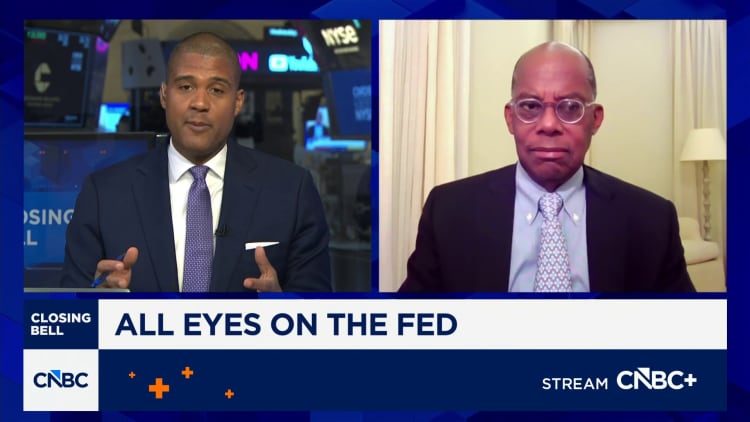
U.S. Federal Reserve Chair Jerome Powell reacts during a press conference following a two-day meeting of the Federal Open Market Committee (FOMC) on interest rate policy, in Washington, D.C., U.S., Jan. 28, 2026.
Jonathan Ernst | Reuters
As both energy prices and inflation fears pop, expectations for Federal Reserve interest rate cuts are sliding.
Traders in recent days have abandoned hopes of an early summer easing from the central bank, a change in thinking that coincided with the U.S.-Israel attacks on Iran and a burst in oil prices to around $100 a barrel.
Prior to the conflict, the market anticipation had been for a quarter percentage point rate reduction in June, likely another one in September, and an outside chance of even three depending on how the economics played out, according to the CME Group’s FedWatch calculations.
Much of the thinking behind that approach was that a softening labor market, moderating inflation and a new dovish chair coming on board in May would push the Fed into an easing posture. But at least as long as the Iran drama plays out, the expectations now are that fighting inflation will remain paramount.
“A higher inflation path will make it harder for the Fed to start cutting soon,” Goldman Sachs economists said in a Wednesday note.

The firm officially adjusted its rate forecast pushing back the next cut to September from June. However, Goldman’s economists still think the Fed could lower once more before the end of 2026.
“If the labor market weakens sooner and more substantially than we expect, we do not think that concern about the impact of higher oil prices on inflation and inflation expectations would be an obstacle to earlier rate cuts,” they wrote.
An elusive second cut
Other market players aren’t so sure.
Traders in the fed funds futures market have taken even a September cut off the table and now see only one coming, in December, according to the CME gauge.
There are no additional cuts priced in until well into 2027 or even into the early part of 2028, despite the presence of presumptive new Chair Kevin Warsh, picked by President Donald Trump ostensibly for a willingness to ease aggressively. Current Chair Jerome Powell leaves the position in May.
Whether that outlook holds up likely will depend on how things play out in the Middle East. Should the situation improve, it could reinstall a sense of normalcy to the markets and renew hopes for more easing.
Even with Brent crude settling above $100, Trump again called on Powell to cut.
“Where is the Federal Reserve Chairman, Jerome “Too Late” Powell, today? He should be dropping Interest Rates, IMMEDIATELY, not waiting for the next meeting!” Trump posted on Truth Social.
The Fed will get another look at inflation data Friday morning when the Commerce Department releases the personal consumption expenditures price index data for January. Economists surveyed by Dow Jones expect core PCE, a key focus for Fed officials, to show an increase to 3.1% on the annual inflation rate.
A reading like that would represent a 0.1 percentage point gain from December as well as a step further away from the Fed’s 2% goal. It also would indicate that inflation pressures were percolating well ahead of the Iran strike and might well give officials even further pause about the prospects for lower rates.
Bank of America economist Stephen Juneau said in a note that while some important components — housing, in particular — are showing signs of stabilizing or receding, inflation otherwise “has been rangebound and remains above levels consistent with 2% core PCE.”
“The upshot is that the Fed should not be in a rush to ease rates further,” Juneau said.
The rate-setting Federal Open Market Committee issues its next rate decision March 18. Traders are assigning a nearly 100% probability to the committee staying on hold.

In this video, we’ll explore the key economic events and market trends, shaping the financial landscape. Get ready for insights into financial markets to help you navigate the week ahead. Let’s dive in!
In this episode of Market Insights, Gary Thomson looks at the key themes traders may monitor in the coming days. Recent developments in energy markets and rising volatility across global equity indices may play an important role in shaping market sentiment in the week ahead.
👉 Key topics covered in this episode:
✔️ Energy Markets
Energy markets remain highly sensitive to the US–Iran conflict, as disruptions in the Strait of Hormuz push oil prices higher and raise concerns about global supply. Even after the IEA’s record oil release, traders remain skeptical that it will fully offset potential supply shortages. Natural gas markets in Europe and Asia have also surged due to fears over LNG flows from the Gulf region. If disruptions in the Strait of Hormuz persist, could energy prices rise further?
✔️ Global Stock Indices
Global equity markets have become highly volatile after the escalation of the US–Iran conflict, as investors moved away from risk assets. Major indices such as the KOSPI, Nikkei 225, and Euro Stoxx 50 posted sharp declines, reflecting rising geopolitical uncertainty and concerns about higher energy prices. Will geopolitical tensions and rising energy costs continue to pressure global stock markets in the coming days?
In summary, traders will focus on two main themes during the week ahead: developments in oil and natural gas markets and volatility across global equity indices.
Gain insights to strengthen your trading knowledge.
💬 Don’t forget to like, comment, and subscribe for more market insights every week.
Watch it now and stay updated with FXOpen.
This article represents the opinion of the Companies operating under the FXOpen brand only. It is not to be construed as an offer, solicitation, or recommendation with respect to products and services provided by the Companies operating under the FXOpen brand, nor is it to be considered financial advice.


- Solana, Cardano, and BNB prices rose as Bitcoin surged past $73,000.
- Altcoins surge as SOL passes $92, ADA hits $0.28 and BNB nears $675.
- Price gain caught leveraged traders off guard, with over $370 million liquidated across crypto.
Cryptocurrency prices climbed on Friday as risk assets attempted a rebound amid easing oil prices, with Solana (SOL), Cardano (ADA), and Binance Coin (BNB) among the tokens posting notable gains.
As these altcoins approached key price levels, bearish traders were caught off guard by the sharp move higher.
The spike wiped out many short positions, pushing total 24-hour liquidations beyond $370 million.
Most of the liquidations involved BTC and ETH shorts, though Solana also experienced a significant wave of forced exits.
SOL, ADA, and BNB surge to key levels
As US stocks posted modest gains alongside a pullback in oil prices, sentiment across the crypto market turned sharply positive.
The broader rebound pushed Solana (SOL) above $92, marking a 24-hour gain of more than 6% as renewed investor confidence returned to the market.
Cardano (ADA) also moved higher, reaching $0.28 after rising about 5% over the past 24 hours. The rally helped ADA reclaim its place among the top 10 cryptocurrencies by market capitalization, ahead of Hyperliquid.
Among other leading altcoins, BNB advanced to around $675, gaining roughly 3% during the same period.
These moves came alongside Bitcoin’s sharp rally above $73,000, with BTC reaching intraday highs of $73,758 at the time of writing.
The surge also lifted Ethereum (ETH), which climbed above $2,200 during the session.
CRYPTO MARKET UPDATE:
• BTC: $73,452
• ETH: $2,191
• BNB: $675
• SOL: $92 pic.twitter.com/OPTgNVWhuj— SolanaFloor (@SolanaFloor) March 13, 2026
Liquidations jump 120% as shorts feel the pressure
According to data from CoinGlass, more than 93,680 traders were liquidated over the past 24 hours, with total liquidations exceeding $370 million.
Bitcoin accounted for more than $154 million in liquidations, while leveraged Ethereum traders saw more than $115 million in positions wiped out as ETH moved above $2,150.
On the global exchanges, the single largest liquidation occurred on Hyperliquid in the BTC-USD pair, with a trade valued at $4.24 million.
Meanwhile, more than $20 million in liquidations were tied to Solana positions, with long positions accounting for only about $2.4 million of that total.
Short sellers took the biggest hit, with more than $18 million in SOL short positions wiped out as Solana’s price volatility exceeded 8%. CoinGlass data also showed that more than 3,500 traders were liquidated as SOL crossed the $91 mark.
Elsewhere, BNB recorded roughly $820,000 in liquidations, while ADA saw about $985,000 in positions wiped out.
Such liquidation cascades can accelerate price rallies, as forced buying from margin calls injects additional liquidity into rising assets. Analysts say this dynamic often appears at the early stages of stronger market uptrends.
However, with macroeconomic and geopolitical risks still present, prices could remain volatile as traders continue to reposition.
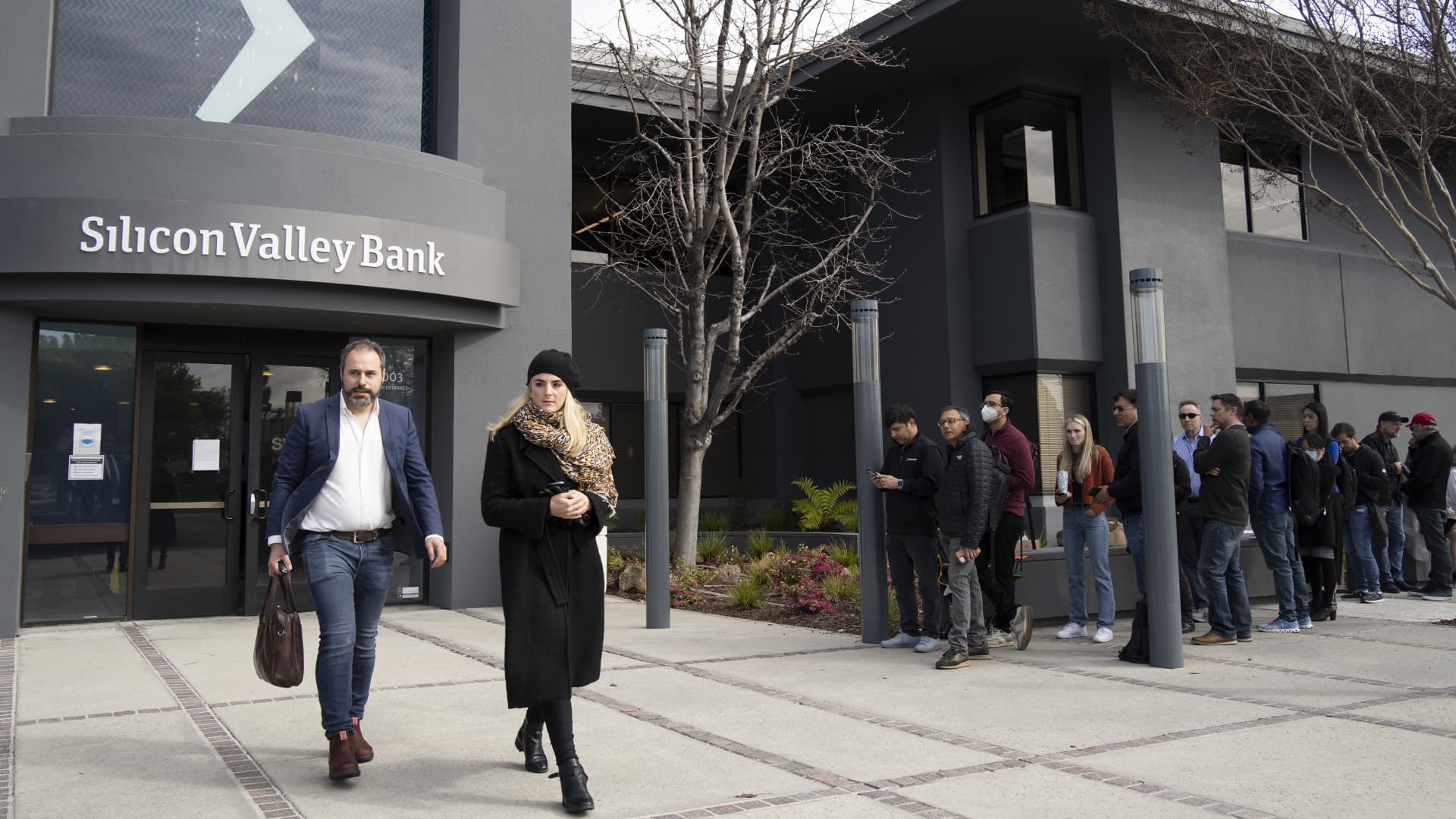
People line up outside of the shuttered Silicon Valley Bank (SVB) headquarters on March 10, 2023 in Santa Clara, California.
Justin Sullivan | Getty Images
Three years ago, JPMorgan Chase executive Doug Petno was at a New York City party celebrating a colleague’s retirement when his boss, Jamie Dimon, called Petno over.
It was March 9, 2023, and the customers of a West Coast lender known for catering to startups had been withdrawing deposits in droves.
“Jamie looks at me and says, ‘Get on this call,’” Petno told CNBC this week in an exclusive interview.
On the line were regulators with an urgent question: Was JPMorgan interested in buying Silicon Valley Bank?
California’s finance regulators seized SVB the next day, completing the sudden collapse of an institution at the heart of the American startup community. Over that weekend, Dimon, Petno and other JPMorgan leaders repeatedly weighed whether they should purchase the bank, which had just lost $42 billion in deposits. They decided against it, in part because thousands of SVB clients were signing up for JPMorgan accounts, anyway, in a flight to safety.
“We had three years’ worth of incoming clients in a weekend,” said Petno, who is co-head of JPMorgan’s commercial and investment bank. “Onboarding teams were opening up accounts around the clock.”
Emboldened by what they were seeing, Petno had an idea: What if JPMorgan could build a true competitor to SVB — as well as startups Brex, Ramp and Mercury — all of whom had carved a profitable niche serving founders and venture capital investors?
“We went to our board and said, there’s a vacuum in the market,” Petno told CNBC. “At that very moment, everybody saw the opportunity.”
Keeping tabs
For JPMorgan, already a giant in Main Street and Wall Street finance, winning the more specific niche of startup banking from West Coast rivals is about more than gaining deposits. It’s both a key element of the growth strategy for a bank with more than $180 billion in revenue last year, and also a means to help the New York-based lender stay close to technology developments for itself.
JPMorgan, with a tech budget of nearly $20 billion this year, is aiming to not only serve startup clients and VC investors better, but to learn from them. The firm keeps a close eye on Silicon Valley startups for solutions to problems the bank itself faces, from cybersecurity to quantum computing.
In fact, when a JPMorgan client announces a round of AI-related cutbacks to jobs and expenses, the firm will often send a team of bankers to investigate how the client is doing it, said Petno.
Typically, the bankers find that implementing new AI agents is only a fraction of the reason for layoffs, while other factors like over-hiring and inefficient processes account for the rest, he said.
Co-CEOs of Commercial & Investment Bank at JPMorganChase, Troy Rohrbaugh and Douglas Petno.
Courtesy: JPMorganChase
JPMorgan began its startup banking business in 2016 as it became aware of its tech-focused rivals during its Westward expansion. In the beginning, it only served bigger, more mature startups.
That’s in part because the bank didn’t yet have a digital banking solution that younger founders in particular craved, Petno said. It also didn’t have enough investment bankers at the time to target smaller, riskier startups.
For years, the view on JPMorgan from some in the VC community was that it took too long to open an account, or that resolving issues around payments involved dealing with time-consuming visits to a branch, investors told CNBC.
“They want to go to the website to open an account, and if it’s more than 15 minutes, they’re done,” says Petno.
But in the weeks that followed the SVB collapse, Petno and his team moved quickly, hiring a few key players from SVB, including then-SVB Capital President John China, who today leads JPMorgan’s innovation economy business along with Andrew Kresse.
By late April of 2023, JPMorgan found itself looking at buying another wounded California-based bank. This time, it made the winning bid for First Republic, which also catered to the tech community.
With fresh learnings from SVB and the banking operations of First Republic, JPMorgan doubled its revenue from startup banking in 2023, according to the company.
Despite the digital banking focus, a startup founder will still sometimes walk into a Chase branch to deposit a huge funding check into a regular account. Now, when that happens, JPMorgan’s systems immediately gets that client moved to the startup team, Petno says.
Killer app?
JPMorgan has now quadrupled the number of total clients it has in the business to nearly 12,000, served by 550 bankers on both coasts, according to the lender, all of whom draw resources from different parts of the company.
Founders and VC investors are clients of the private bank, while the startups are covered by the commercial bank and VC funds are separate clients in a business largely acquired from First Republic.
While JPMorgan declined to give specific revenue figures, Petno said the startup business had a “dramatically higher” growth rate than the bank’s main business lines.
And yet, Petno still isn’t satisfied with the firm’s digital banking offerings for startups, describing a project underway that will help them leapfrog competitors.
Besides SVB, which is now owned by First Citizens Bank, and the startups Mercury and Ramp, competitors in the space include Stifel and Customers Bank. In January, Capital One acquired Brex for $5.15 billion.
Since most startups fail, JPMorgan identifies companies that they expect to be winning bets, seeking to develop relationships with them earlier in their life cycle, like SVB did.
That way, they can provide not only core bank accounts, but lucrative investment banking advice along the way.
JPMorgan’s ultimate vision is to become the one-stop shop for founders, serving all their needs, including international expansion, from the seed round to IPO and beyond.
“Once you’re onboarded, you can never outgrow JPMorgan, from unicorn all the way to a Magnificent 7,” Petno said.
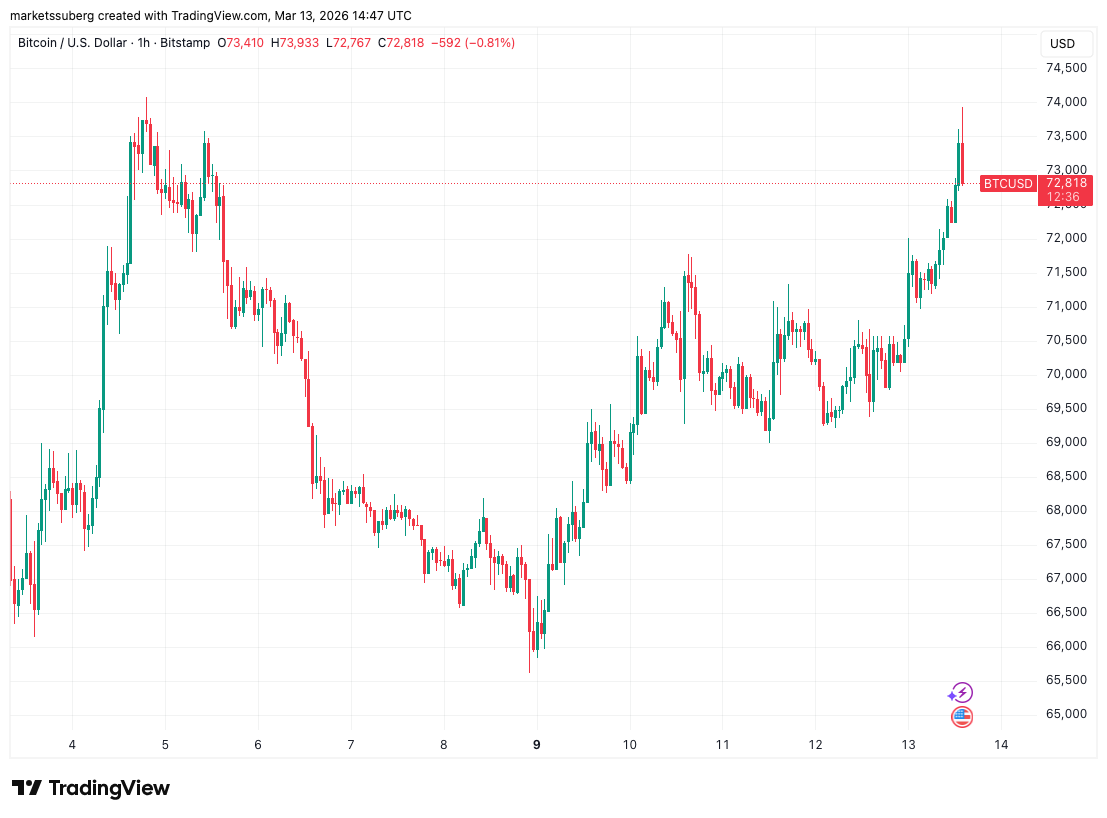
Bitcoin (BTC) aimed for five-week highs at Thursday’s Wall Street open as US inflation trends stayed on track.
Key points:
-
US inflation data keeps crypto and stocks higher as BTC price action tests $74,000 again.
-
Bitcoin traders diverge over the future of the move, with a “bearish retest” risking a new price collapse.
-
BTC/USD finally recrosses its 50-day moving average trend line.
PCE inflation emboldens Bitcoin bulls
Data from TradingView confirmed new local BTC price highs near $74,000 following the January print of the Personal Consumption Expenditures (PCE) Index.

Known as the Federal Reserve’s “preferred” inflation gauge, January PCE matched market expectations, coming in at 0.3% month-on-month and 3.1% year-on-year, per data from the Bureau of Economic Analysis.

While still at its highest levels since late 2023, the result appeared to soothe risk assets, with US stocks up around 0.5% at the time of writing.
In doing so, both risk assets and crypto began to diverge from a positive correlation to oil seen over the week. WTI crude was down 2% on the day at around $95 per barrel.

BTC price forecast: $79,000 or “bearish retest?”
Commenting on Bitcoin, crypto trader Michaël van de Poppe was cautiously upbeat on the outlook.
Related: Bitcoin’s ‘narrative vacuum,’ Ethereum now inevitable: Trade Secrets
“Resistance zone for me is between $76-79K for Bitcoin. I don’t expect a fast breakout in one-go, but I would assume that we’re going to see some extra momentum occur on the altcoin markets in that window,” he wrote in a post on X.
“In the meantime; if Bitcoin gets there, it provides a monthly engulfing candle and therefore, it erases the entire correction of February.”

Others stayed on edge, with trader Daan Crypto Trades warning of a “large drop” if the current trading zone collapsed.
$BTC If this level breaks, it’s time for a large drop. pic.twitter.com/9A6DaICCs3
— Daan Crypto Trades (@DaanCrypto) March 13, 2026
Trader Roman, already bearish, described the ongoing shift higher on BTC/USD as a “bearish retest.”
“RSI bear divs, bear price action (volume down + price up), & complete reset of MACD,” he summarized, referring to the relative strength index (RSI) and moving average convergence/divergence (MACD) price indicators on daily time frames.

In fresh updates on his Telegram channel on the day, meanwhile, independent analyst Filbfilb focused on open interest (OI).
Market observers, he said, should watch for OI to “ditch” — an event that would precede the end of the push higher.

“No sign yet,” he acknowledged, noting that price was now interacting with its 50-day simple moving average (SMA).
As Cointelegraph reported, this was a key overhead resistance zone of interest during previous breakout attempts.

This article does not contain investment advice or recommendations. Every investment and trading move involves risk, and readers should conduct their own research when making a decision. While we strive to provide accurate and timely information, Cointelegraph does not guarantee the accuracy, completeness, or reliability of any information in this article. This article may contain forward-looking statements that are subject to risks and uncertainties. Cointelegraph will not be liable for any loss or damage arising from your reliance on this information.

Demi Lovato Shares The Inspiration Behind Her New Cookbook

Trump will exploit American deaths

Cardiff could become first part of Wales to introduce a visitor levy


-

 News Videos4 days ago
10th Algebra | Financial Planning | Question Bank Solution | Board Exam 2026
-

 Fashion7 days ago
Weekend Open Thread: Ann Taylor
-
 Tech2 days ago
A 1,300-Pound NASA Spacecraft To Re-Enter Earth’s Atmosphere
-

 Crypto World4 days ago
Paradigm, a16z, Winklevoss Capital, Balaji Srinivasan among investors in ZODL
-

 Tech3 days ago
ChatGPT will now generate interactive visuals to help you with math and science concepts
-

 Business3 days ago
ExxonMobil seeks to move corporate registration from New Jersey to Texas
-

 Sports6 days ago
Three share 2-shot lead entering final round in Hong Kong
-

 Sports5 days ago
Braveheart Lakshya downs Lai in epic battle to enter All England Open final | Other Sports News
-

 NewsBeat2 days ago
Residents reaction as Shildon murder probe enters second day
-

 Entertainment7 days ago
Hailey Bieber Poses For Sexy Selfies In New Luscious Lip Thirst Traps
-

 Business5 days ago
Search for Nancy Guthrie Enters 37th Day as FBI Probes Wi-Fi Jammer Theory
-

 Business2 days ago
Search Enters Sixth Week With New Leads in Tucson Abduction Case
-
 NewsBeat4 days ago
Pagazzi Lighting enters administration as 70 jobs lost and 11 stores close across Scotland
-

 Tech4 days ago
Despite challenges, Ireland sixth in EU for board gender diversity
-

 Business4 days ago
Search Enters 39th Day with FBI Tip Line Developments and No Major Breakthroughs
-

 NewsBeat2 days ago
I Entered The Manosphere. Nothing Could Prepare Me For What I Found.
-

 Business7 days ago
Iran war enters second week as Trump demands ’unconditional surrender’
-

 Sports4 days ago
Skateboarding World Championships: Britain’s Sky Brown wins park gold
-
 Crypto World3 days ago
Will Chainlink price reclaim $10 amid volatility squeeze?
-

 Sports5 days ago
Tomorrow’s Top 25 Today: Florida jumps to No. 4; Louisville, Wisconsin enter projected rankings