Connect with us

NewsBeat

Russia’s relentless interference since start of Ukraine war has failed to break Moldova

Published

on

Russia’s relentless interference since start of Ukraine war has failed to break Moldova

When Russia launched its full-scale invasion of Ukraine in February 2022, the prospects for Moldova did not look good. But four years have now passed and, despite a relentless Russian campaign to destabilise the country, Moldova has survived and made significant progress.

It has, for example, progressed on its path to EU membership. Moldova transitioned from applicant to candidate status several months after the outbreak of the war and formally opened accession negotiations two years later. The government is now carrying out reforms to align with EU standards.

Such progress was not a foregone conclusion given the many challenges Moldova has faced as a result of the war in Ukraine. The country was an early destination for Ukrainian refugees, which put significant pressure on already stretched public services and resources.

With a decades-old foothold in Transnistria, a breakaway region in eastern Moldova, Russia also seemed to have a springboard for conflict escalation in Ukraine’s rear. This foothold gave Moscow a possible destination to push westwards along the Black Sea coast, too.

Advertisement

Russian false-flag operations in April 2022 seemingly provided further evidence that Moscow planned to destabilise Moldova. And one year later, the so-called soccer plot underscored Moscow’s intention to continue its efforts against Moldova. This was a Russian-planned and sponsored attempt to infiltrate Moldova with saboteurs from Russia, Montenegro, Belarus and Serbia.

Transnistria, which is home to around 450,000 people, declared its independence from Moldova in 1990.
Peter Hermes Furian / Shutterstock

Perhaps the most serious challenge for Moldova came in January 2025, when Ukraine stopped the transit of Russian gas through its territory. Transnistria, which had for decades been kept completely dependent by Moscow on Russian gas supplies, was plunged into an immediate crisis.

The authorities there cut off central heating and hot water to all residential buildings. They also ordered the closure of industrial enterprises not involved in making critical food products. The impending humanitarian disaster and ensuing information war between Russia, Moldova, Transnistria and the EU over who was to blame posed a serious threat to stability in Moldova yet again.

Advertisement

In addition, two Moldovan elections in recent years presented the Kremlin with an opportunity for interference. Yet, despite Russian meddling, Moldova’s incumbent pro-Europe president, Maia Sandu, secured a second term in 2024. Her party then won another absolute majority in parliamentary elections the following year.

So, how has a small country wedged between Ukraine and Romania with a decades-old conflict of its own managed to withstand Russian pressure?

Countering Russian destabilisation

Early in the war, the most serious danger for Moldova was an escalation of the conflict in Transnistria. While this may have served Moscow’s interests, politicians in Moldova and Transnistria were keen to preserve stability in their relations.

On the Transnistrian side, this was mainly driven by economic interests. The region has been part of the deep and comprehensive free trade area between Moldova and the EU since 2016, and 80% of all exports from Transnistria now go to EU countries.

Advertisement

Economic stability also helps ensure the continuation of the ruling Transnistrian regime. Business and political interests there are often one and the same, embodied in the all-dominant Sheriff conglomerate.

Sheriff dominates Transnistria’s economy, operating a network of supermarkets, gas stations, construction companies, hotels, radio and TV stations and a mobile phone network. It also controls the Obnovlenie political party that runs the government in the regional capital, Tiraspol.

At the same time, stability reduces the risk of a humanitarian crisis and a refugee wave that could destabilise Moldova. Maintaining the relatively substantial levels of confidence that has been built between the two sides was therefore high on the agenda of politicians in Chișinău and Tiraspol.

The ability of Moldovan and Transnistrian politicians (helped by EU assistance) to avoid a major escalation of the energy crisis in 2025, as well as keeping relations generally stable and predictable over the past four years despite Russian disruption efforts, bodes well for the future.

Advertisement

The Moldovan state budget continues to earmark resources for joint projects involving communities on both banks of the Nistru River, which separates Moldova and Transnistria. This included €1.5 million (£1.3 million) for 30 projects in 2025, bringing the total investment to over €11 million across more than 600 projects since 2011.
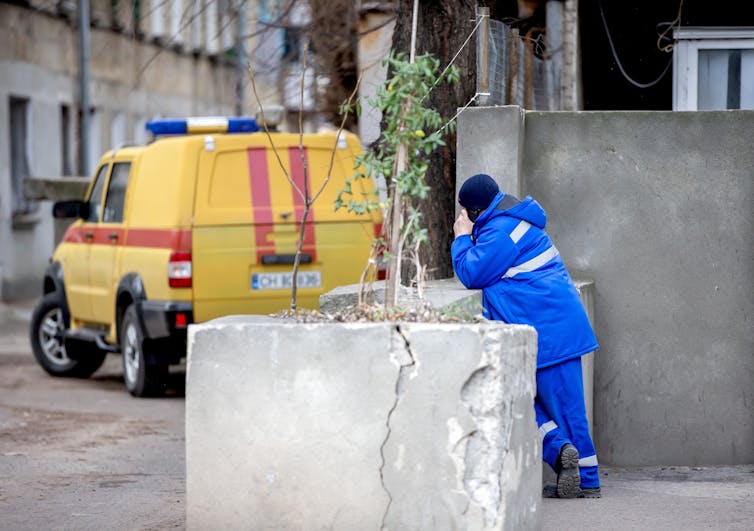
A gas worker in Chișinău, Moldova, stands next to his van on his phone.
A gas worker on duty in Chișinău during the January 2025 energy crisis.
Dumitru Doru / EPA

However, while Moldova has weathered storms over recent years effectively, there are still threats to its stability. For example, challenges to the reintegration of Transnistria into Moldova remain. After more than three decades of separation, there are significant social, political, economic and legal hurdles to overcome.

On the one hand, the fact that chief negotiators from both sides met again face-to-face in late February after a 15-month hiatus indicates their commitment to making progress and resolving their differences peacefully and through dialogue. But, on the other hand, there are some signs that trust between the two sides remains fragile.

On the eve of the meeting, Sandu signed a decree revoking the Moldovan citizenship of nine people who serve in the governmental structures of Transnistria. Two of them had also fought against Moldova during the brief civil war in 1992 that created Transnistria. The timing of the decree was condemned by the Transnistrian side as putting undue pressure on Tiraspol.

As Sandu acknowledged recently on the anniversary of Russia’s full-scale invasion of Ukraine, her country’s survival is due to the heroism of Ukrainians in defending their country and thereby keeping Russia away from Moldova. But beyond simple survival, Moldova seems to have emerged stronger from the challenges it has faced.

Advertisement

At a time when the narrative of inevitable Russian victory against Ukraine is beginning to crumble, it is important to remember the limits of the Kremlin’s power. Russia’s neighbours, through their own efforts and with support from their European partners, are not the helpless pawns that Moscow wishes them to be.

Source link

Advertisement
Continue Reading
Click to comment

Leave a Reply

Your email address will not be published. Required fields are marked *

NewsBeat

Ministers warn petrol retailers against ‘unfair practices’

Published

on

Ministers warn petrol retailers against ‘unfair practices’

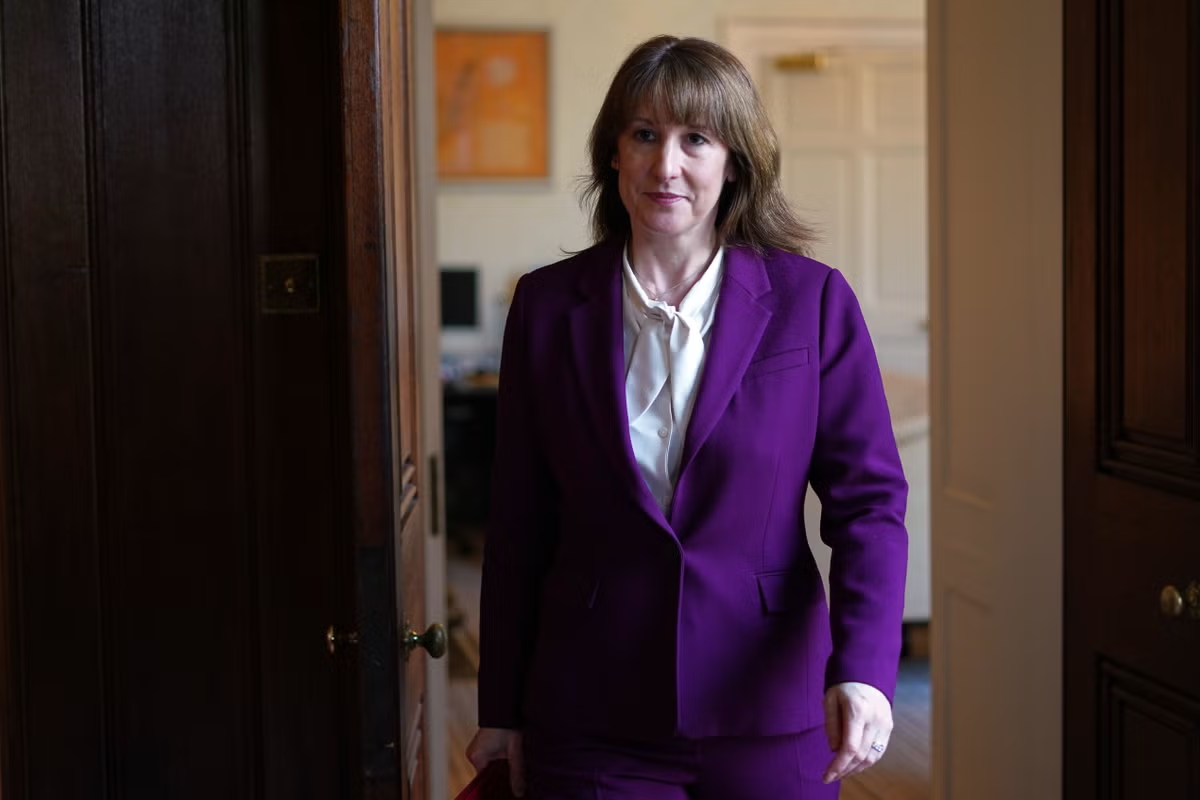
Chancellor Rachel Reeves told petrol retailers they had a “shared obligation” to keep prices down for motorists.

The Petrol Retailers Association (PRA) had threatened to pull out of the Downing Street meeting with Ms Reeves and Energy Secretary Ed Miliband after claiming the Government’s “inflammatory language” over rising fuel prices led to abuse against forecourt workers.

At the Downing Street meeting, Mr Miliband warned executives from the forecourt operators and firms including Shell that the Government would not tolerate “unfair practices” in the industry.

The RAC said the average price for a litre of unleaded had risen by 8p since the start of the crisis, with the cost now its highest for 18 months.

Advertisement

The Chancellor hosted industry chiefs in 11 Downing Street on Friday in response to rising concern about the impact of the Middle East crisis on household finances.

Ms Reeves thanked the petrol bosses for their co-operation, but told them she wanted an “open and frank conversation” with them.

She said: “We have concerns around the high prices and we do have a shared obligation.”

Mr Miliband told them: “We have said so clearly that we won’t tolerate unfair practices either here or anywhere else in the industry. It is out obligation as the Government to ensure the consumers are treated fairly in this crisis.”

Advertisement

Before the meeting, Gordon Balmer of the PRA raised concerns that recent language from the Government was driving abuse against fuel retail staff by members of the public “following several days in which ministers have suggested that forecourts may be ‘price gouging’ and ‘ripping off’ the motorist”.

The PRA later said it would take part in the meeting after assurances from the Treasury that it would be held largely in private, which the group said would “allow a conversation to explain how the fuel market works”.

Mr Balmer said: “Recently, I have heard of incidents from some of our members of retail staff being abused by members of the public, who may have been provoked by the incorrect and inflammatory language emanating from some commentators, for example, the use of the terms ‘rip-offs’ and ‘profiteering’.

“Our members are working hard in difficult circumstances, making sure that motorists and businesses are getting the fuel they need, at prices that are very competitive, on razor-thin or in some cases negative margins, which means they are losing money.

Advertisement

“Our job is to serve the public, keeping motorists and businesses on the road.”

He added: “There is clearly still a lot of work to do to help politicians and commentators to understand how the fuel market works and our door is always open for constructive dialogue.”

Ms Reeves has asked the competition watchdog to “crack down” on “rip-off” fuel prices to guard against profiteering over the high oil prices due to the Iran war.

The Government has already promised to intervene if companies engage in “unfair” practices that would hit customers facing a rise in the price of home heating oil, which is not covered by Ofgem’s energy price cap.

Advertisement

However, the AA warned that motorists “will be stung” with inevitable rising costs because of a global hike in prices, and called on Ms Reeves to delay a planned increase in fuel duty.

The Chancellor has faced opposition pressure to abandon her decision to gradually phase out a 5p cut to the levy, starting with a 1p increase from September this year.

The RAC said the average litre of unleaded had risen from 132.83p to 140.60p.

The motoring organisation’s head of policy, Simon Williams, said: “Households, especially those that depend on the car, are under increasing financial pressure as a result of the conflict in the Gulf.

Advertisement

“The average price of a litre of unleaded has now risen by 6%, or nearly 8p, to 140.6p since the start of the conflict and is it at its highest in 18 months. Diesel has rocketed by 12% – or almost 17p – to 159.2p a litre, a price we’ve not seen since November 2023. Filling a family car is now £4 and £9 more than it was less than two weeks ago.

“The fact the cost of a barrel of oil has exceeded 100 US dollars and wholesale fuel prices continue to rise is concerning, but it’s the speed at which drivers are feeling the effects which is under the spotlight now.

“Drivers deserve – and should expect – to be treated fairly when it comes to filling up, especially with pump prices still heading north. We therefore hope the meeting between the fuel industry and government on this important issue is productive.”

Prime Minister Sir Keir Starmer has since said the Government will keep the situation “under review” in light of the Middle East conflict.

Advertisement

On Thursday, the Competition and Markets Authority warned it was putting fuel retailers “on notice” of plans to step up monitoring of petrol and diesel prices in light of the Middle East uncertainty.

The Government has said drivers can compare prices at different petrol stations across the UK through its Fuel Finder service.

Source link

Advertisement
Continue Reading

NewsBeat

Major link road scheme work to disrupt traffic over next two weekends

Published

on

Manchester Evening News

The scheme has been more than half a century in the making

Motorists can expect delays through Mottram Moor over the next two weekends as work continues on a major bypass scheme ‘60 years in the making’.

Work on the new A57 link road scheme began last year, The Mottram bypass has been an ongoing saga in Tameside for decades, but now it is close to becoming a reality.

The £228m project aimed at tackling congestion between Manchester and Sheffield.

Advertisement

Get MEN Premium now for just £1 HERE – or get involved in our WhatsApp group by clicking HERE. And don’t miss out on our brilliant selection of newsletters HERE.

There will be disruption between 7pm today (March 13) until 6am on Monday, March 16 and between the same times the following weekend (March 20 to 23).

According to National Highways, the work involves installing utility services and building a new plant crossing. This will allow construction materials to be moved safely and efficiently across the A57 as part of the major scheme.

Following extensive preparation and site clearance works, the project is now moving into the main construction phase. Three key milestones mark this progress: the start of piling works for a new underpass in Mottram; construction of a new through road across Hattersley roundabout; and the building of a temporary plant crossing at Mottram Moor.

Advertisement

Andrew Scatchard, National Highways senior project manager, said: “This is an exciting time as we reach these three major milestones in our work to build the two new link roads, which will help address the long-standing issue of congestion in Mottram-in-Longdendale and improve journeys between Manchester and Sheffield.”

Underpass piling

The first milestone is the start of piling works for the new underpass that will carry the A57 Link Road beneath Roe Cross Road and Old Hall Lane in Mottram, connecting to the A57 at Mottram Moor.

Advertisement

To enable construction, a temporary relief road has been built to carry traffic along Roe Cross Road, with vehicles successfully transferred onto this new route. This has created the space needed to position the large piling rig required to construct the underpass.

Hattersley roundabout

The second milestone can be seen at junction 4 of the M67 motorway, also known as Hattersley roundabout.

Groundworks are underway to create a new through road across the roundabout. Once complete, this will allow westbound traffic travelling from the new dual carriageway link road to access the motorway more directly, improving traffic flow and making journeys quicker and smoother.

Advertisement

Mottram Moor plant crossing

The third milestone is the construction of a temporary plant crossing over the A57 road at Mottram Moor, starting this week.

The crossing will allow construction vehicles to safely transport excavated material from the underpass works across Mottram Moor for use along the ‘Glossop Spur’ link road, reducing the need to transport material off site.

Andrew Scatchard added: “At the same time as we construct the crossing, our utility partners will also complete important utility works. We always strive to minimise disruption where possible, but delays to journeys are expected over the next two weekends and the week in between.

Advertisement

“We therefore advise people to plan before they travel and allow extra time to complete their journeys. We would again like to thank the local community, including road users, for their support and patience while we carry out this work.”

The A57 link roads project includes the creation of two new link roads. One is Mottram Moor link road – a new dual carriageway from the M67 junction 4 roundabout to a new junction on the A57 at Mottram Moor.

The other is the A57 link road – a new single carriageway link from the A57 at Mottram Moor to a new junction on the A57 in Woolley Bridge.

Once installed, the plant crossing is expected to come into use from mid-April. When in operation, traffic will be held for short periods only, with traffic lights in place and regularly monitored, while construction vehicles transport materials across Mottram Moor.

Advertisement

The A57 link roads scheme is estimated to be up and running by 2028, but a full completion date could be as late as 2031, according to the National Highways website.

Source link

Continue Reading

NewsBeat

Iran’s energy lifeline that has so far escaped attack

Published

on

Iran’s energy lifeline that has so far escaped attack

As the US and Israel’s assault on Iran grinds on, the Trump administration has issued increasingly bellicose claims that American and Israeli forces are delivering ferocious blows to the Iranian regime.

The US secretary of defense, Pete Hegseth, warned of the “most intense” day of strikes yet on March 10. And Donald Trump followed with a claim that the war will end soon because there is “practically nothing left” in Iran for the US military to target.

This is all part of a campaign that the White House has declared is aimed at “systematically dismantling the Iranian regime’s ability to ever again threaten America, our allies, and global security.”

So far, this campaign has largely targeted Iran’s military and nuclear facilities. But some critical non-military infrastructure has also come under attack. Israel struck two oil refineries and two oil storage facilities near Tehran on March 8, with Iran accusing the US of attacking a desalination plant the same day.

Advertisement

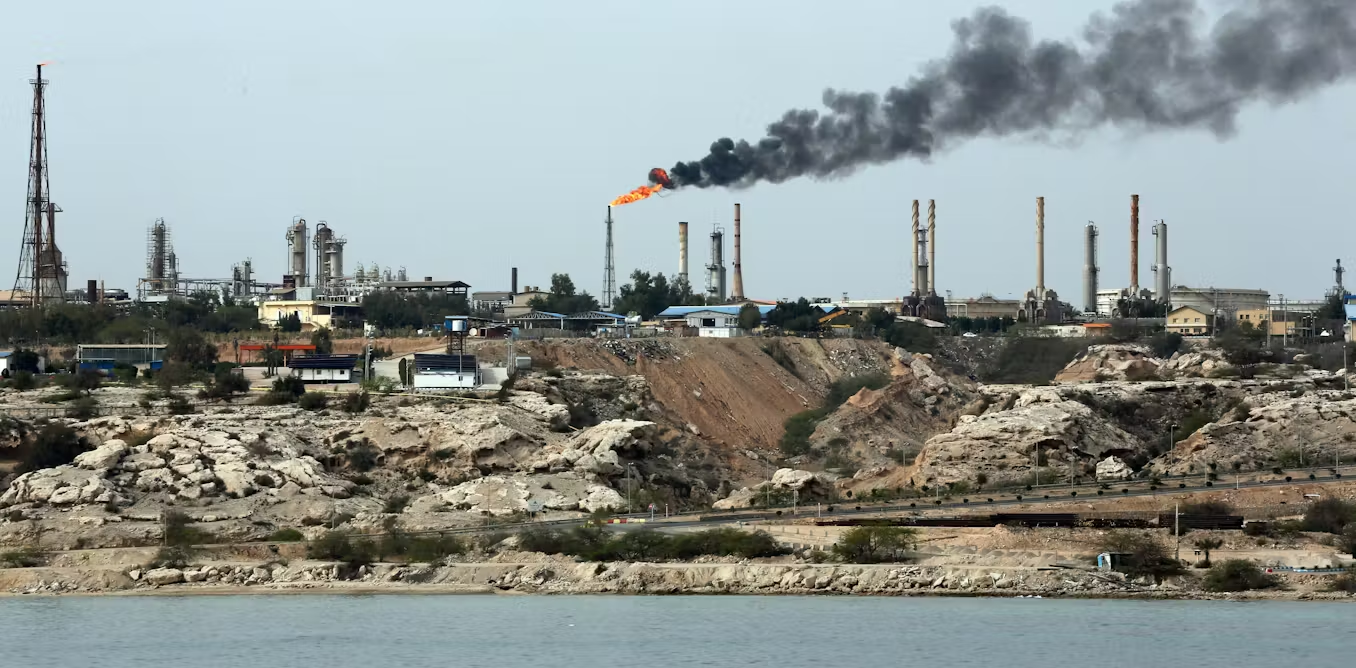
Yet one target vital to Iran’s economic survival, its largest export terminal for sending oil to international markets, remains unscathed. That terminal sits on Kharg, a small coral island off Iran’s south-western coast. This is where oil pumped across Iranian oil fields arrives via subsea pipelines to be loaded on to tankers, mostly bound for China.

At peak capacity, the terminal’s vast storage facilities and multiple jetties can handle millions of barrels of oil per day. Kharg accounts for an extraordinary 90% of Iranian crude exports and tens of billions of US dollars of annual government revenue.

No other major oil-producing country is so reliant on just one facility. Saudi Arabia, Kuwait and the United Arab Emirates in the Gulf, and massive producers elsewhere such as Russia, Mexico and Venezuela, do not concentrate almost all their export capacity in a single location.

Advertisement

Kharg is a five mile long island located off the south-west coast of Iran.
Uwe Dedering / Wikimedia Commons, CC BY-SA

Iran’s energy lifeline

Kharg Island became the linchpin of Iran’s oil industry due to a convergence of history and geography. Nowadays, Kharg is widely known among Iranians as the “forbidden island” because of the tight military restrictions and secrecy that surround it.

Yet behind its modern geoeconomic significance lies an ancient history, from early human settlements dating back more than 4,000 years to occupation by various empires that understood its strategic maritime importance as a trading post. The island also housed political prisoners in the mid-20th century, before the construction of Kharg’s modern terminal began in 1958.

The island quickly became Iran’s dominant export port for two reasons. First, it could be connected by pipeline to the major oil fields in south-western Iran. And second, its deep water location made it one of the only places on Iran’s western coast that could accommodate the new supertankers that were at the time dramatically reducing the cost of transporting oil.

Once the gigantic storage facilities, jetties and subsea pipelines feeding the terminal had been constructed, centralising exports there created significant efficiencies. Oil from multiple fields could share the same storage and loading infrastructure, thereby reducing overall operating costs.

Advertisement

Kharg’s dominance in the national oil export system was further reinforced after the Islamic revolution in 1979. This was because regional tensions and Iran’s emphasis on self-reliance discouraged it from using pipelines that pass through neighbouring countries.

A Thai cargo ship on fire after being struck by missiles in the strait of Hormuz.
A Thai cargo ship was struck by missiles in the strait of Hormuz of March 11.
Royal Thai Navy / EPA

At first glance, Iran’s reliance on one terminal for nearly all its oil exports seems like a major strategic vulnerability. There are also no significant operational challenges preventing the US and Israel from destroying it. Yet, paradoxically, this is precisely why it has not been targeted thus far.

Crippling Iran’s entire oil industry for months – if not years – would shatter the already fragile confidence in financial markets that Trump can achieve his vague war aims without long-term disruption to the global economy. Some analysts predict that oil prices could soar to US$150 (£112) a barrel if Kharg is hit.

To put that figure into context, Russia’s 2022 full-scale invasion of Ukraine caused Brent crude to rise to well over US$100 a barrel for four months. This was not the only cause of the roughly 9% surge in inflation seen at the time, but it was an important factor in the ensuing cost of living crisis.

Launching an attack on Kharg would likely expose Trump’s gamble in launching a war against Iran while simultaneously promising US consumers that virtually everything would become more affordable as a catastrophic error. American voters are indicating that inflation and the cost of living are their biggest concerns ahead of the upcoming midterm elections in November.

Advertisement

Of course, Trump’s intervention in Iran may lead to rising prices even if the US does not attack Kharg Island. The wider disruption to Gulf shipping in the strait of Hormuz has already caused oil prices to rise to around US$100 per barrel. And in his first statement since becoming Iran’s supreme leader, Mojtaba Khamenei vowed to keep blocking the waterway.

But at least for the moment, Trump seems to realise that Kharg Island needs to be left intact if he is to preserve the already shaky notion that he can end this war in a manner he can present as a success – which increasingly looks like degrading Iran but not forcing it to capitulate – without causing long-term economic pain for Americans.

One other factor preventing the US from destroying Kharg is that it would cause long-lasting damage to the Iranian economy. This would undermine any pretence that Trump is acting in the interests of the Iranian people, as he has claimed, since any new government would be financially crippled if the regime did collapse.

So Kharg Island survives intact for now. This is, in large part, due to the fundamental contradiction between Trump’s objectives in Iran and the political and economic costs he is willing to incur in pursuit of them.

Advertisement

Source link

Continue Reading

NewsBeat

This deadly disease had been eliminated in the UK – now it’s back spreading in every region

Published

on

Manchester Evening News

You can check vaccination rates in your area and see how many cases have been confirmed using our interactive map

Advertisement

A disease that had been eliminated in the UK is returning. The Victorian illness had been eradicated thanks to a vaccination programme by public health leaders, but it has now reappeared in 50 council areas.

A new map has highlighted the low vaccine-rate areas where it is spreading quickly. Measles infections have now been confirmed by lab tests in every region of England, the UK Health Security Agency (UKHSA) has confirmed, mainly among children under 10.

The figures come as one health chief has warned: “Measles is a serious disease that can cause pneumonia, meningitis, blindness, seizures and, tragically, death… Measles is one of the most infectious diseases known, and it will find those who are unvaccinated.”

Get MEN Premium now for just £1 HERE – or get involved in our WhatsApp group by clicking HERE. And don’t miss out on our brilliant selection of newsletters HERE.

Advertisement

It comes after the WHO stripped the UK of its measles elimination status in January, following sustained circulation of the disease for more than a year. The UK was first declared measles-free in 2017, but lost its status two years later, only to regain it in 2021. However, that was mainly thanks to social distancing during the pandemic.

Outbreaks began in 2023 and intensified throughout 2024. In England alone, there were 2,911 laboratory-confirmed cases of measles in 2024. That was the highest number since 2012.

On that basis, WHO and the UK Health Security Agency said that the virus had re-established endemic transmission, costing the UK its measles elimination status.

The most recent figures show that measles cases have fallen since the 2024 peak. However, cases remain high. Last year, there were 957 laboratory-confirmed cases of measles. As of March 9, this year, there have been 235 cases.

Most of these infections have been in unvaccinated children under the age of 10.

Enfield, in London, appears to be the epicentre of the current outbreak, with 80 confirmed measles cases so far this year. That includes 35 new cases since the last update in February.

Enfield also has one of the lowest vaccination rates in the country, with around one in three children unprotected by the MMR (measles, mumps and rubella) vaccine. The latest data shows only 64.3% of children in Enfield had received both MMR jabs needed for full protection by their fifth birthday.

Advertisement

The target vaccine coverage rate is 95%. Although the UKHSA has confirmed that 50 separate council areas have had at least one confirmed infection, it only publishes case numbers for areas with at least 10 cases.

So far, three council areas have met that threshold – all with low vaccine coverage rates. Apart from Enfield, there have been 43 cases so far in Birmingham, including 19 since February, and 15 in the London borough of Haringey, which neighbours Enfield.

In Birmingham, 75.5% of five-year-olds have received both MMR jabs, and in Haringey, just 65.0% of under-fives are fully protected.

The UKHSA has blamed the resurgence of measles on falling vaccination rates, after uptake of the MMR jab slumped to its lowest in a decade. As of last summer, 91.8% of five-year-olds in England had received one dose of the MMR jab, and 83.7% were protected by both doses.

Advertisement

In many areas, such as Enfield, Birmingham and Haringey, vaccine uptake is much lower. WHO says a vaccine coverage rate of 95% is needed to achieve “herd immunity”, which prevents transmissible diseases like measles from circulating.

From this year, the MMR jab has been replaced by the MMRV vaccine, which offers the same protection as MMR but also covers chickenpox.

You can check the vaccination rates in your area and see how many measles cases have been confirmed since 2024, using our interactive map.

Advertisement

Dr Yimmy Chow, UK Health Security Agency’s London Region Deputy Director said: “We continue to see measles cases in north London, and while children remain unvaccinated, the risk of further spread is very real.

“Measles is a serious disease that can cause pneumonia, meningitis, blindness, seizures and, tragically, death. Children and adults who get measles can end up in hospital suffering needlessly, sometimes with long-term consequences that stay with them for life.

“Measles is one of the most infectious diseases known, and it will find those who are unvaccinated. Two doses of the MMR vaccine provide vital protection. If your child has missed any vaccinations, or you are unsure whether they are up to date, please contact your GP surgery as soon as possible — it is never too late to catch up.”

The key symptoms of measles include a high fever, coughing, sneezing, red and sore watery eyes, and a rash that usually appears after the initial symptoms.

Advertisement

Measles usually starts to get better after a week. However, it can lead to serious problems if it spreads to other parts of the body, such as the lungs or brain. Babies and people with weakened immune systems are more at risk from measles.

Source link

Continue Reading

NewsBeat

Harry Redknapp upbeat despite Gold Cup disappointment with The Jukebox Man

Published

on

Harry Redknapp upbeat despite Gold Cup disappointment with The Jukebox Man

Harry Redknapp says there were no excues after his horse The Jukebox Man fell away in the Cheltenham Gold Cup and that winning the race would have been like winning the Champions League.

Redknapp’s lifelong love of horseracing reached its zenith on a sunny afternoon at Prestbury Park as he, along with wife Sandra and son Jamie, cheered on the eight-year-old who was well placed heading to home.

The Jukebox Man then ran out of steam having kept up with the leader, Haiti Couleurs, before being passed by eventual winner Gaelic Warrior with two fences to jump.

“Yeah, absolutely [it would have been like winning the Champions League] if we had won here today, but Gaelic Warrior was fantastic. My God, didn’t he win? Really impressive,” said Redknapp after the race.

Advertisement

“Yeah, he traveled great until two out, and then he just seemed to just fall in a bit of a hole, but overall he jumped great, run great and he’s come back, hopefully safe and sound, which is the main thing.”

The 79-year-old then explained that his horse had missed a week of work before coming to the Festival but refused to use that as an excuse for his loss.

“He missed a week’s work and I’m not blaming it, I’m not making excuses,” Redknapp explained, “The winner won, different class but he did miss a week’s work. He simply just ran out of steam today.”

Redknapp went on to explain what his week at Cheltenham has been like and how he has revelled in then build-up to having a Gold Cup running horse.

Advertisement

He said: “I’ve loved it. It’s been a great week. The build up and the dream and everything. I’ve loved it. To have a runner here with a chance was fantastic for me.

“I’m not saying he would have won. The winner was amazing. That was absolute Gaelic warrior today. He absolutely bolted up, didn’t it? But we’ve had another great run for him again today. Yeah, he’s jumped, well, run well. So, yeah, that’s how it goes.”

Harry Redknapp and wife Sandra watched on as The Jukebox Man raced in the Gold Cup

Harry Redknapp and wife Sandra watched on as The Jukebox Man raced in the Gold Cup (Joe Giddens/PA Wire)

In spite of the obvious disappointment, Redknapp remained positive and praised how his horse had captured the hearts of the nation.

Advertisement

He ended by saying “that’s why it would have been great today if he could have won it. He didn’t but he came and give his best shot.”

Redknapp’s only previous success at the Cheltenham Festival came in 2024 when Shakem Up’Arry won the Plate Handicap Chase but the step up to the Gold Cup brings him into the upper echelon of successful owners.

Source link

Advertisement
Continue Reading

NewsBeat

Jessie Buckley "brutalised" by reality TV show

Published

on

Jessie Buckley "brutalised" by reality TV show

!function(n){if(!window.cnx){window.cnx={},window.cnx.cmd=[];var t=n.createElement(‘iframe’);t.display=’none’,t.onload=function(){var n=t.contentWindow.document,c=n.createElement(‘script’);c.src=”//cd.connatix.com/connatix.player.js”,c.setAttribute(‘async’,’1′),c.setAttribute(‘type’,’text/javascript’),n.body.appendChild(c)},n.head.appendChild(t)}}(document);(new Image()).src=”https://capi.connatix.com/tr/si?token=19654b65-409c-4b38-90db-80cbdea02cf4″;cnx.cmd.push(function(){cnx({“playerId”:”19654b65-409c-4b38-90db-80cbdea02cf4″,”mediaId”:”2f2b6000-e3e5-4a31-994a-d7029f526d96″}).render(“69b42c6ee4b0676e64bf3935”);});

Source link

Continue Reading

NewsBeat

Why do the Irish drink on St Patricks day? The saints last words may hold the answer

Published

on

Why do the Irish drink on St Patricks day? The saints last words may hold the answer

In 1997, my students and I traveled to Croagh Patrick, a mountain in County Mayo, as part of a study abroad program course on Irish literature I was teaching for the University of Dayton. I wanted my students to visit the place where, each July, thousands of pilgrims pay homage to St. Patrick, who, according to lore, fasted and prayed on the summit for 40 days.

While there, our tour guide relayed the story of how St. Patrick, as he lay on his death bed on March 17 in A.D. 461, supposedly asked those gathered around him to toast his heavenly journey with a “wee drop of whiskey” to ease their pain.

The mention of whiskey left me wondering if St. Patrick may have unintentionally influenced the way most of the world celebrates the holiday today: by drinking.

It wasn’t always this way. The Festival of St. Patrick began in the 17th century as a religious and cultural commemoration of the bishop who brought Christianity to Ireland. In Ireland, there’s still an important religious and cultural component to the holiday, even as it has simply become an excuse to wear green and heavily drink in the rest of the world.

Advertisement

The legend of St. Patrick

Because historical details about St. Patrick’s life remain shrouded in speculation, scholars are often stymied in their attempts to separate fact from legend.

In his spiritual memoir, “Confessio,” St. Patrick describes how he was brought to Ireland as a slave. He eventually escaped, rejoining his family in Britain, probably Scotland. But while there, he had a recurring dream, in which the “Voice of the Irish” called to him to return to Ireland in order to baptize and minister to them. So he did.

The Irish revere the account of this dream described in the “Confessio”; they accept the simplicity and fervor of his words and feel a debt of gratitude for his unselfish commitment to their spiritual well-being.

Advertisement

St. Patrick’s efforts to convert the Irish to Catholicism were never easy. Viewing him as a challenge to their power and authority, the high kings of Ireland and the pagan high priests, called Druids, resisted his efforts to make inroads with the population.

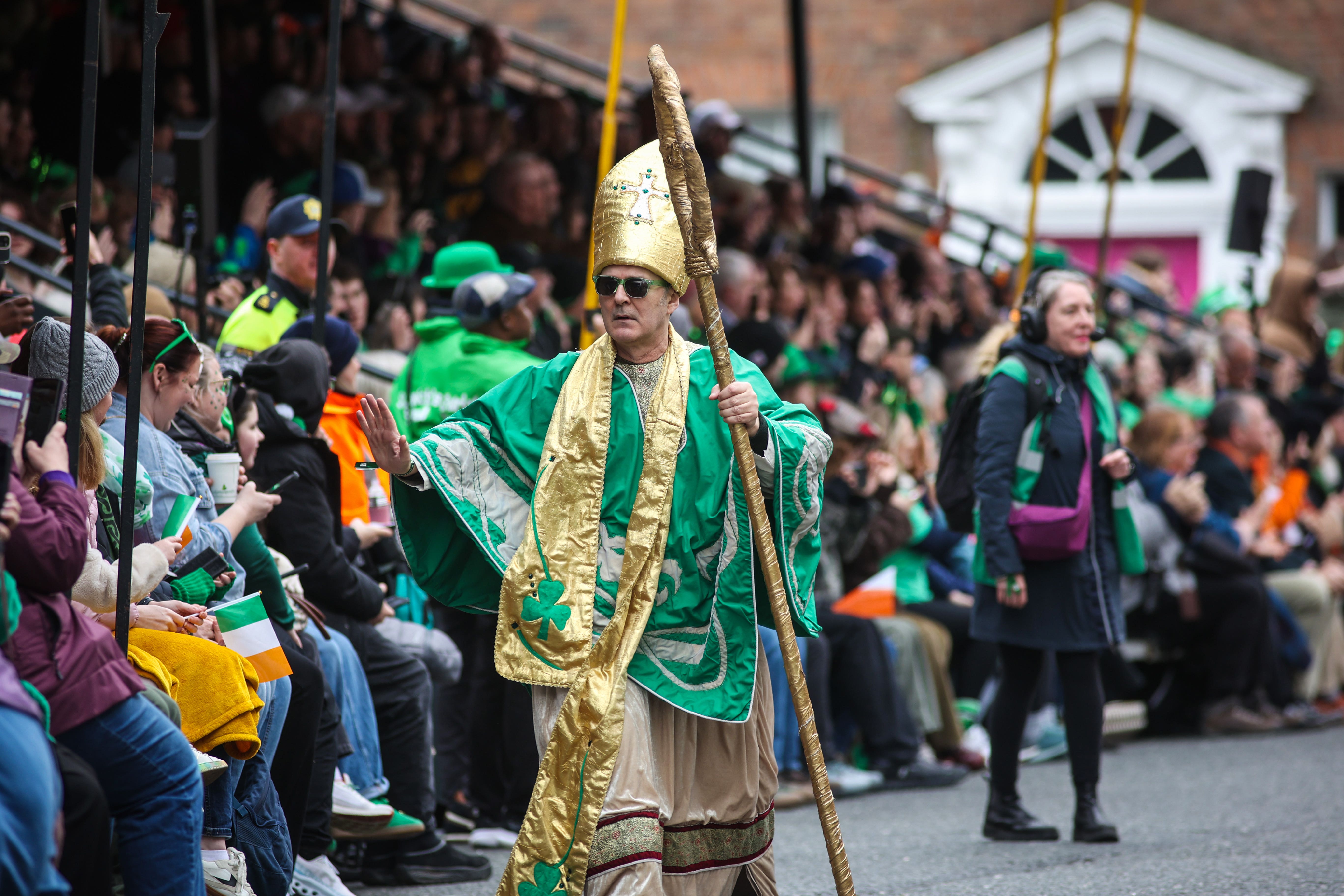
Performers take part in the St Patrick’s Day Parade in Dublin

Performers take part in the St Patrick’s Day Parade in Dublin ((Evan Treacy/PA))

But through his missionary zeal, he was able to fuse Irish culture into Christianity, whether it was through the introduction of the Celtic Cross or the use of bonfires to celebrate feasts like Easter.

Again, many of these stories could amount to no more than myth. Nonetheless, centuries after his death, the Irish continue to show their gratitude for their patron saint by wearing a spray of shamrocks on March 17. They start the day with mass, followed by a daylong feast, and prayer and reflection at night.

Advertisement

St. Paddy’s Day goes global

From 1820 to 1860, almost 2 million people left Ireland, many due to the potato famine in the 1840s and 1850s. More followed in the 20th century to reunite with relatives and escape poverty and joblessness back home.

Once settled, they found new ways to celebrate St. Patrick’s Day and their Irish identity in their new homes.

Irish-Americans, especially, were quick to transform March 17 into a commercial enterprise. The mandatory “wearin’ of the green” in all its garishness is a far cry from the original tradition of wearing a spray of shamrocks to honor St. Patrick’s death and celebrate Irish solidarity. Parades famously sprung up – especially in New York and Boston – revelry ensued and, sure enough, even the beer became green.

Advertisement
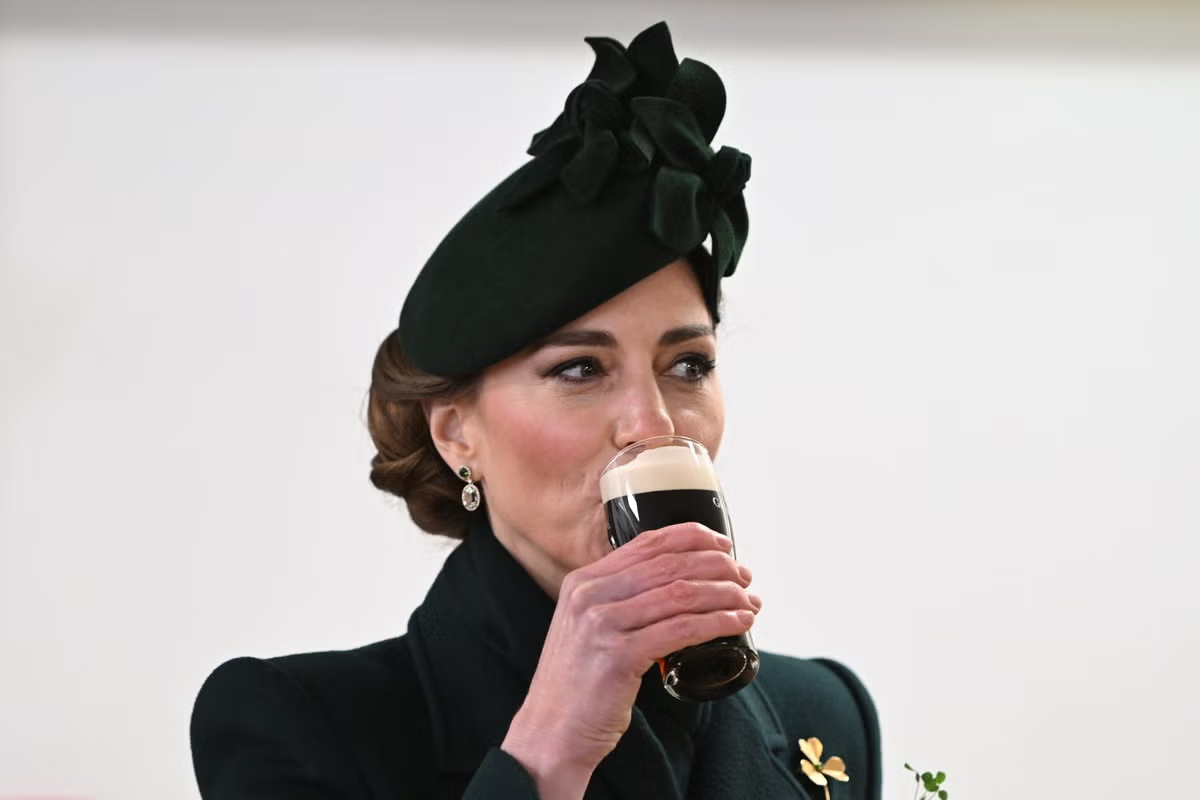
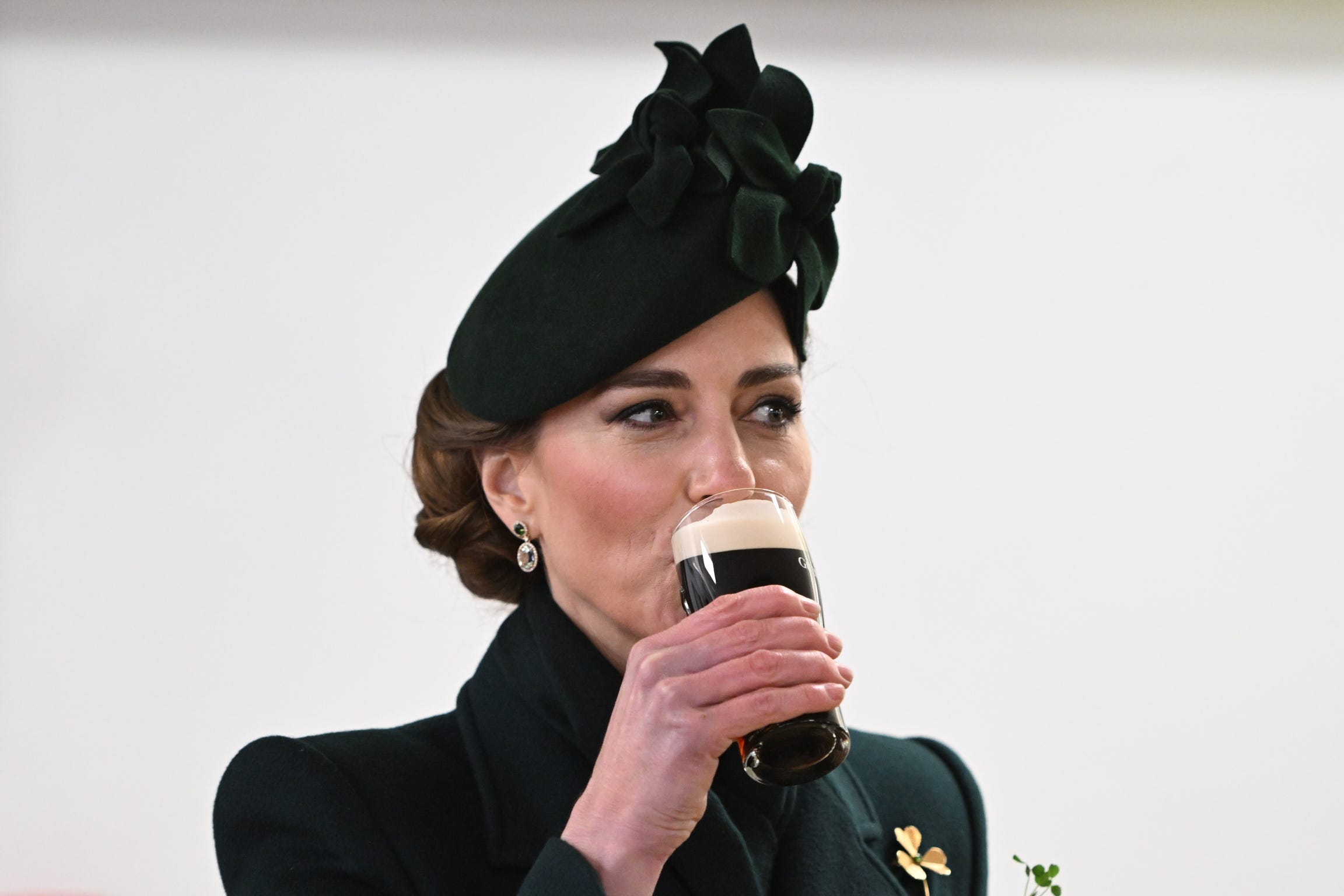
The Princess of Wales enjoys a glass of Guinness during a visit to the Irish Guards for their St Patrick’s Day parade at Wellington Barracks

The Princess of Wales enjoys a glass of Guinness during a visit to the Irish Guards for their St Patrick’s Day parade at Wellington Barracks ((Eddie Mulholland/Daily Telegraph/PA))

Children of Irish-Americans in the United States have absorbed Irish culture at a distance. Many probably know that St. Patrick is Ireland’s patron saint. But they might not fully appreciate his mythic stature for kids growing up on the emerald isle.

Ask children of any age in Ireland what they know about St. Patrick, and they will regale you with stories of his magical abilities, from his power to drive the snakes out of Ireland to his use of the three leaves and one stem of the shamrock to demystify the Trinity doctrine of the Catholic Church.

They see St. Patrick as a miracle worker, and as adults, they keep the legends alive in their own ways. Some follow St. Patrick’s footsteps all around Ireland – from well to hill to altar to chapel – seeking his blessing and bounty wherever their journeys take them.

Advertisement

Raising a glass

Of course, in America, the holy day is really a party, above all else.

About the author

James Farrelly is a Professor of English at University of Dayton. This article is republished from The Conversation under a Creative Commons license. Read the original article.

Americans have in some years spent US$6.16 billion celebrating, with 13 million pints of Guinness consumed. Some parts of the country have even held a pre-celebration on Sept. 17 – or, as they call it, “Halfway to St. Patrick’s Day.”

Advertisement

Where all of this leads is anyone’s guess. But beginning in the 1990s, Ireland seemed to grasp the earning potential of the Americanized version. March 17 remains a holy day for the natives and a holiday for tourists from around the world, with pubs raking in the euros on St. Patrick’s Day.

But I’ve always wondered: What if St. Patrick had requested a silent prayer instead of “a wee drop of whiskey” to toast his passing? Would his celebration have stayed more sacred than profane?

This is an updated version of an article originally published on March 16, 2021

Source link

Advertisement
Continue Reading

NewsBeat

Campaigner Flick Williams gives evidence in Parliament

Published

on

Campaigner Flick Williams gives evidence in Parliament

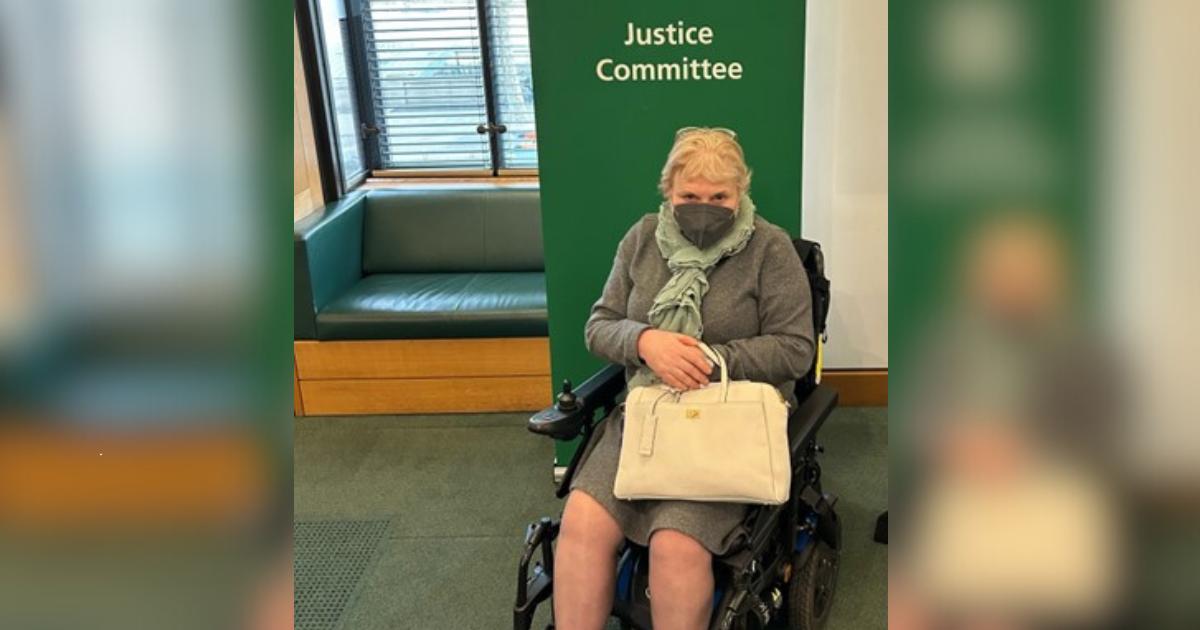
Flick Williams said “change is needed” to ensure disabled people who feel they have been discriminated against “have easier access to legal help” to “enforce our rights”.

Ms Williams, a visually impaired wheelchair user, has previously won legal battles over alleged discrimination against City of York Council, First York and Marks and Spencer.

The campaigner said she was “honoured” to be invited to give evidence to the Parliamentary Justice Committee, which is undertaking an inquiry into barriers to accessing justice for several groups.

Advertisement

Ms Williams said currently “too much of the burden of enforcing disability rights falls to us as disabled people”, and she was “confident that the changes that are needed are understood” by the committee.

“Change is needed so that we have easier access to legal help and representation to assist us to enforce our rights,” she added.

Ms Williams said the “core issue” is that there are “very few solicitors who will take disability discrimination cases because the compensation awards are so low it simply doesn’t pay to take them”.

She said it means people have been left with few options but to take discrimination cases on themselves. “This can be very daunting and many disabled people simply don’t have the confidence, the energy or capacity to do this.”

Advertisement

Ms Williams added: “I’ve always had a burning sense of injustice which has spurred me on to pursue blatant discrimination to the bitter end.

“I have now taken more cases than I can count, but always choose which cases to take on the basis of their wider impact for other disabled people.”


Recommended reading:


Ms Williams said she was “most proud” of the case she won against City of York Council over its licensing of pavement cafes, which followed the campaigner becoming trapped on a footpath while out shopping in York city centre in May 2022.

Advertisement

On leaving a shop, Ms Williams found café furniture had been put out while she was inside, blocking the dropped kerbs on either side – effectively creating an island on which she was trapped.

At the time, a council spokesperson apologised, saying “we got it wrong” and “will continue to listen and learn from the lived experiences of disabled people”.

Ms Williams said the case “certainly had the greatest impact forcing the council to change its policy thereby enabling all disabled people to get around the city with fewer obstacles on pavements”.

The Parliamentary committee was told about many barriers faced by disabled people trying to access justice including inaccessible court buildings and a failure to make reasonable adjustments for court hearings.

Advertisement

“It’s bitterly ironic that disabled people going to court for failures by service providers to make reasonable adjustments as they are required to do by law, then face more reasonable adjustments failures by the court system itself,” Ms Williams said.

The Justice Committee is compiling a report with recommendations for the government.

Source link

Advertisement
Continue Reading

NewsBeat

Gaelic Warrior blitzes Gold Cup field with dominant win as Jukebox Man falls short

Published

on

Gaelic Warrior blitzes Gold Cup field with dominant win as Jukebox Man falls short

It is a disappointing result for Redknapp and his stable. The former Tottenham boss, whose week at Cheltenham has been overshadowed somewhat by links to the Spurs job, had enthusiastically backed his horse in the build-up to the race after he won December’s King George Chase, but his wait will continue for a first Gold Cup win.

Source link

Continue Reading

NewsBeat

Bridgend sees major rise in people on waiting list for somewhere to live

Published

on

Wales Online

Councillors heard the significant demand was driven by the cost of living crisis and the challenging private rent sector

Demand for temporary accommodation and homelessness services across Bridgend have continued to rise “significantly” despite a number of measures taken to reduce costs by the council.

Advertisement

The discussions were held at a council cabinet meeting where members heard how the number of households in temporary accommodation across the borough had consistently gone up since 2019.

The figures were presented to council bosses as part of an update on the service where they also gave approval for officers to enter into further agreements with private accommodation providers to enable the “continuation of short-term arrangements”.

Data given at the meeting showed the number of households in temporary accommodation in Bridgend in 2019 was 83 though by January 2026 this had climbed to 296. Make sure you never miss Wales’ biggest updates by getting our daily newsletter.

It also showed consistent increases in the number of individuals in temporary accommodation with single-person households shown to make up 75% of all those temporary accommodation.

Advertisement

Additionally the report noted a major rise in the number of applicants on the Bridgend Common Housing Register since the 2019-20 financial year which it said was driven by the cost-of-living crisis and a challenging private rented sector.

The report said: “The demand for homelessness and temporary accommodation services has been compounded by a wider increase in demand for social housing.

“The total number of applicants on the Bridgend Common Housing Register at the end of each year has increased substantially. In 2019-20 there were 816 households on the Common Housing Register.

“At the end of January 2026 there were around 3,500 households on the Common Housing Register.

Advertisement

“A combination of the impact of the cost-of-living crisis and a challenging private rented sector are key drivers behind this demand.”

Speaking at the meeting council leader John Spanswick praised the work of officers and said despite the rise in demand for services they had driven down the cost of delivering them by around 21% or £1m.

This came after the council purchased three of their own properties to be used as temporary accommodation along with a capital programme to “increase affordable housing options”.

Cllr Neelo Farr said the three properties purchased for HMOs were reducing their costs “tremendously” with funding now in place to buy three more over the next 12 months.

Advertisement

The report also noted that upscaling this positive work was still considered medium-to-long-term with agreements needed with accommodation providers such as guesthouses, holiday lets, and other properties to address the immediate pressures seen.

Cabinet members in attendance approved plans to temporarily suspend contract procedure rules for agreements to be made directly with providers for up to 12 months or three years where there is value for money.

Cllr Farr said: “This approach ensures that vulnerable people continue to have safe suitable accommodation while longer-term solutions such as increasing affordable housing and supported accommodation are developed to reduce reliance on temporary accommodations.”

Source link

Advertisement
Continue Reading

Trending

Copyright © 2025