

Crypto World
Circle Stock Surges as Stablecoins Expand; Canaan Boosts Bitcoin Holdings

A selloff in both Wall Street and crypto markets hasn’t slowed Circle’s relentless rise. The stablecoin issuer’s stock has more than doubled since early February, with Bernstein analysts expecting further gains as stablecoins continue expanding beyond crypto’s more speculative use cases.
The technology is already moving deeper into traditional finance. UK insurance giant Aon recently piloted stablecoin payments for insurance premiums with Coinbase and Paxos, a move that could make cross-border premium payments faster and more efficient.
Elsewhere, Bitcoin (BTC) miner Canaan is taking a contrarian approach to treasury management, increasing its BTC holdings even as many competitors sell. And in traditional finance, Wells Fargo has filed a trademark for crypto-related services, suggesting large banks are still quietly preparing for deeper involvement in digital assets.
Circle stock surges on stablecoin tailwinds
Shares of stablecoin issuer Circle are rallying sharply in 2026 as Wall Street warms to the long-term growth story behind digital dollars. Analysts at Bernstein recently reiterated an “Outperform” rating on the stock, setting a $190 price target — roughly 60% above current levels.
Circle’s stock price has already more than doubled since early February and is up roughly 49% year-to-date, outperforming both the S&P 500 index and Nasdaq 100 index during the same period.
Bernstein’s bullish outlook hinges on accelerating stablecoin adoption across payments, financial infrastructure and onchain settlement. As the issuer of USDC (USDC), the world’s second-largest US dollar-pegged stablecoin, Circle is increasingly viewed as a key beneficiary of the industry’s push into mainstream finance.

Canaan boosts Bitcoin reserves while other miners sell
Bitcoin miner Canaan is expanding its BTC treasury amid a market downturn, while many rival public mining companies are reducing their holdings.
The company mined 86 BTC in February, increasing its total Bitcoin holdings to 1,793 BTC. Canaan also reported holding 3,952 Ether (ETH), bringing its total crypto reserves to record levels.
The accumulation trend stands in contrast to much of the mining sector. Several publicly traded miners have sold significant portions of their Bitcoin reserves over the past several months as tighter margins and post-halving economics put pressure on balance sheets.
Canaan, meanwhile, continues to expand its mining footprint, including operations in Texas — one of the largest mining hubs in the United States.

Aon pilots stablecoin payments for insurance premiums
Global insurance broker Aon is exploring the use of stablecoins to settle insurance premiums, working with crypto companies Paxos and Coinbase on the initiative.
The goal is to streamline cross-border payments, which often involve multiple banks, currency conversions and settlement delays. Stablecoins could allow insurers and clients to move funds more quickly while reducing costs and processing time.
For the insurance industry, faster settlement could simplify premium collection, improve cash flow management and reduce the administrative work tied to international payments. It may also make it easier to handle large cross-border policies and reinsurance transactions.
The pilot reflects a broader trend of stablecoins use expanding beyond crypto trading into real-world financial use cases, particularly in areas where global payments remain slow and expensive.
Wells Fargo files trademark for crypto services
US banking giant Wells Fargo has filed a US trademark application for “WFUSD,” signaling potential plans to expand deeper into crypto services.
The filing covers a range of blockchain-related offerings, including crypto trading, payments, digital wallet services and software for staking and custody. It also references financial services built on distributed ledger technology.
The trademark is significant because Wells Fargo is the fourth-largest US bank, with about $1.95 trillion in assets as of Q3 2025, according to S&P Global Market Intelligence.
Trademark filings don’t necessarily guarantee a product launch, but they often indicate areas companies are exploring. In this case, the scope suggests Wells Fargo may be evaluating crypto-based payments or a tokenized dollar product under the WFUSD name.

Crypto Biz is your weekly pulse on the business behind blockchain and crypto, delivered directly to your inbox every Thursday.

After reaching a monthly high of $2,209 on Friday, Ether (ETH) price fell back below a key monthly resistance, which has been tested five times since February.
While onchain data highlights a large cluster of investors near $2,800, Ether’s futures market data shows traders are scaling back positions after this week’s rally.
Investors’ $2,800 cost basis highlights a major accumulation zone
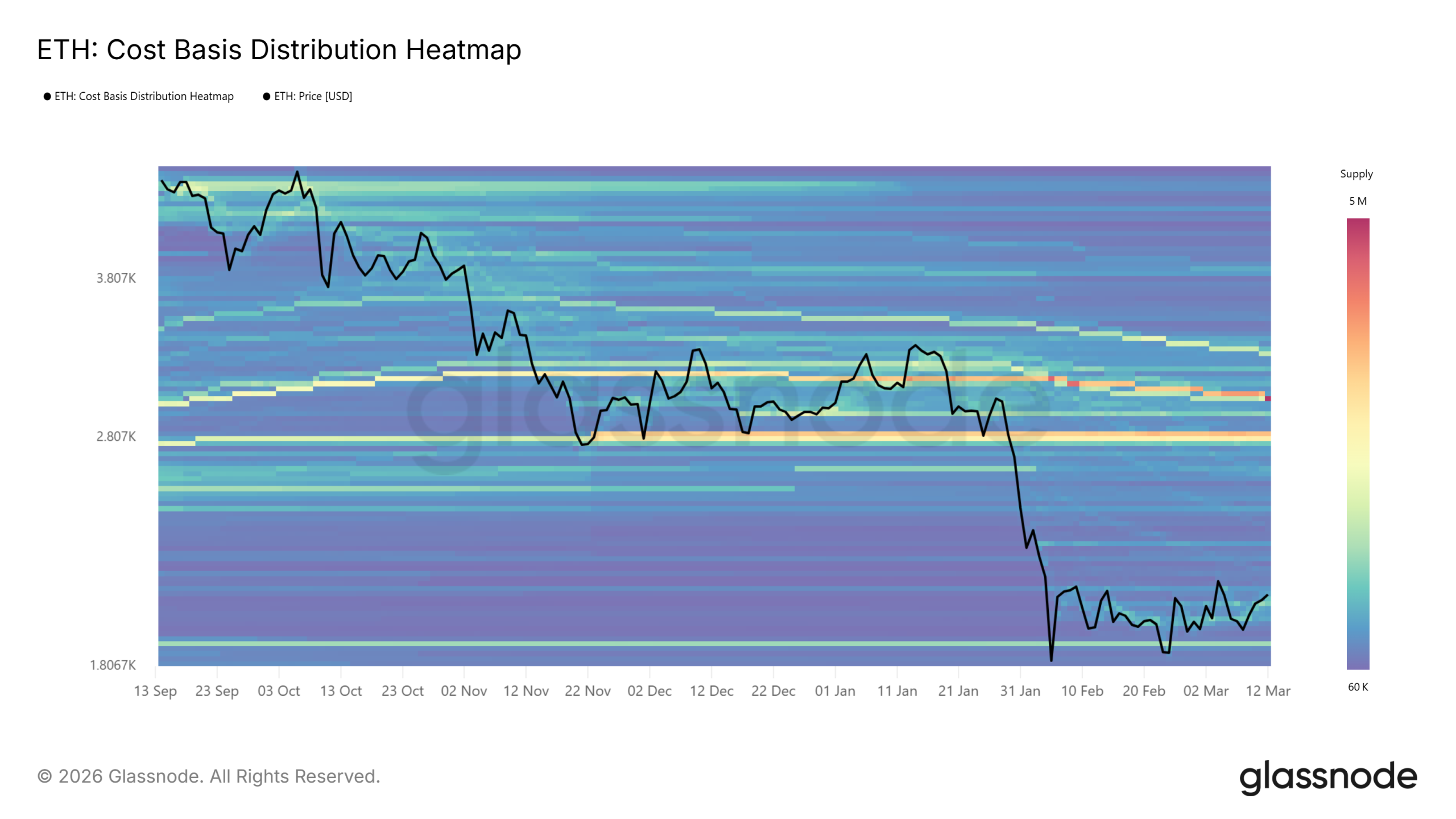
Data from Glassnode indicated that ETH’s cost-basis distribution heatmap shows a heavy accumulation near $2,800, where more than 3 million ETH were previously purchased.
The cost-basis clusters identify the price zones where large groups of investors established positions, often acting as magnets during upward moves as investors defend entry levels or add exposure.

The data suggests a potential pathway toward $2,800. Notably, there is a relatively limited historical supply concentration between $2,200 and the $2,800 cost-basis cluster, meaning a break above the current range may allow the price to move more freely into that range.

From a technical standpoint, the 200-day simple moving average (SMA) also intersects near the $2,800 level on the daily chart, a key indicator ETH has not approached since early January.
However, derivatives data suggest traders remain cautious near the present price range.
Related: Ethereum Foundation publishes mandate clarifying role and goals
Ether futures activity fades after $2,200 test
Ether’s futures market activity expanded during this week’s rally, with open interest rising 21% to $10.9 billion from $9 billion this week as the price pushed toward $2,200. The increase suggests traders were opening new leveraged positions as Ether moved higher.

However, the positioning shifted once ETH tested the upper range. Open interest fell roughly 6% after the $2,200 test, indicating some traders began closing positions rather than adding new exposure.
The pullback suggests long traders likely took profit or reduced risk near the upper boundary of the range, slowing the rally’s momentum.
Spot market activity showed improving demand during the move. Spot volume cumulative delta (CVD), which tracks aggressive buying versus selling, rose sharply to $87 million from -$150 million on March 8, indicating buyers stepped in as Ether rebounded from the $2,000 region.

However, order-flow data reflected a fading bullish sentiment. The bid–ask ratio remained strongly positive while Ether consolidated near $2,000, showing buyers dominated trading during the range phase.
That strength faded as the price approached $2,150, signaling reduced buying pressure near the top of the move.
Hyblock data offered additional clarity in the derivatives markets. The futures positioning remains relatively balanced, with long traders accounting for about 59.4% of Ether futures exposure on Binance.
Such a balanced outlook often leads to choppy price action as the market struggles to decisively break through nearby resistance levels.

The data shows a divergence forming, while past ETH accumulation points toward a rally to $2,800. With this in mind, it is clear that Ether futures traders remain cautious near ETH’s current range.
Related: Ethereum accumulation wallets jump 30%: Will ETH price follow?
This article does not contain investment advice or recommendations. Every investment and trading move involves risk, and readers should conduct their own research when making a decision. While we strive to provide accurate and timely information, Cointelegraph does not guarantee the accuracy, completeness, or reliability of any information in this article. This article may contain forward-looking statements that are subject to risks and uncertainties. Cointelegraph will not be liable for any loss or damage arising from your reliance on this information.
Global market volatility persists, yet when Alibaba’s AI models are fed a carefully engineered prompt, they reveal strikingly optimistic forecasts for XRP, Bitcoin, and Ethereum heading into the latter part of 2026.
Bolstering the broader crypto outlook, a recent agreement between the SEC and CFTC to align their regulatory strategies signals that comprehensive U.S. cryptocurrency legislation could soon take shape.
If that regulatory framework emerges, Alibaba’s bullish AI projections could begin to look far more realistic.
Let’s take a look at the charts…
XRP (XRP): Alibaba AI Forecast: XRP to $8 by Christmas
Ripple recently emphasized that XRP ($XRP) serves as the foundational asset in its vision to evolve the XRP Ledger into a worldwide enterprise-grade payment infrastructure.
Designed for swift, low-cost settlements, the XRPL now positions Ripple advantageously in booming areas like stablecoins and tokenized real-world assets.
XRP trades near $1.45 today, with Alibaba AI predicting a surge as high as $8 by year-end, delivering 5.5x returns for those holding positions if it plays out.
The chart displays a sustained bullish flag pattern, typically preceding strong upward moves. XRP’s current position is also strengthened by its neutral relative strength index (RSI) reading of 53.
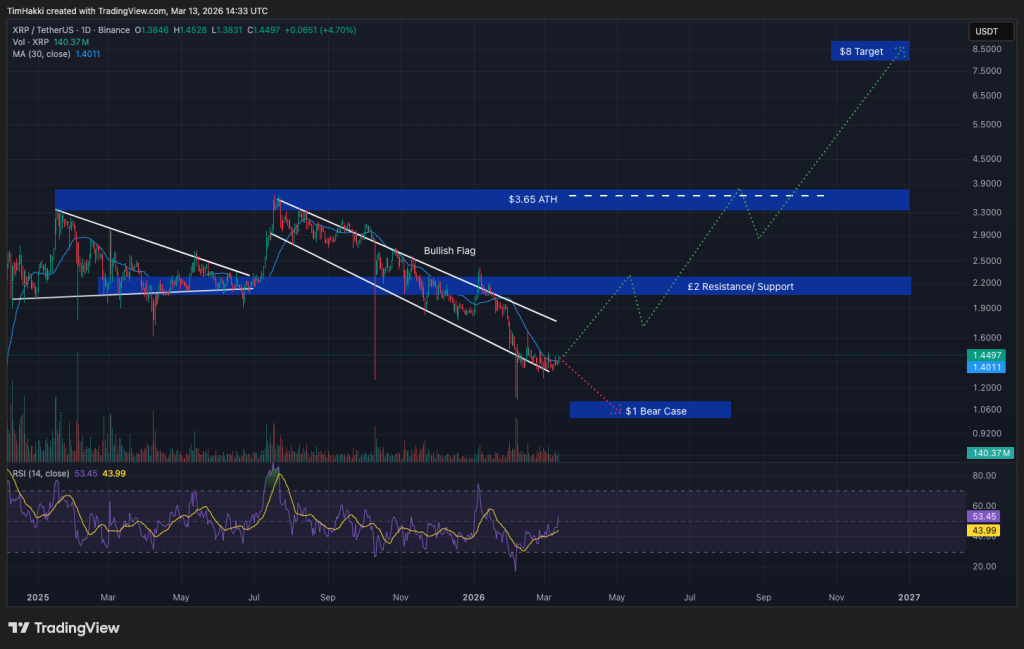
Watch for catalysts such as inflows via newly launched U.S. XRP ETFs, Ripple’s growing international partnerships, and the likely passage of the CLARITY Act through Congress soon.
Bitcoin (BTC): Alibaba AI Sees Bitcoin Hitting $250,000 by Year-End
Bitcoin ($BTC) hit a peak of $126,080 in early October before experiencing a sharp correction, shedding roughly half its value amid broader pressures.
Even so, AI evaluations suggest Bitcoin remains positioned for major upside, possibly rising from today’s price of $73,500 all the way up to $250,000 by 2027.
Viewed as “digital gold,” BTC draws capital seeking portfolio diversification and protection from inflation plus geopolitical risks.
With a $1.4 trillion market cap within the $2.4 trillion total crypto space, Bitcoin’s dip aligned with rising tensions between US and Iran and Greenland, yet after all-out war between Iran and US on February 28, Bitcoin appears to be doing better, a sign that the volatility was likely priced in beforehand.
If President Trump follows through on establishing a national Strategic Bitcoin Reserve, Bitcoin could go even further, potentially hitting $1 million in the years to come.
Ethereum (ETH): Could Ether Reach Five Figures in 2026?
Ethereum ($ETH) stands as the leading smart contract blockchain, powering much of decentralized finance activity.
Boasting a market cap of $264 billion and a substantial $57 billion TVL, it functions as the core layer for on-chain commerce.
Robust network security, dominance in stablecoins, and increasing real-world asset tokenization strengthen arguments for wider institutional participation.
Regulatory progress remains pivotal; the passing of the CLARITY Act would deliver the certainty needed for institutions to deploy large amounts of capital on the network.
ETH hovers just below $2,200 currently, facing sticky resistance at $3,000, $4,000 and $5,000, as seen en route to its ATH of $4,946 last summer.
A firm breakout could propel Ethereum to a new ATH just above its last, around $5,041, according to Alibaba AI.
Maxi Doge: Emerging Meme Coin Aims for Major Upside
In a crypto bull market, meme coins frequently deliver outsized performance by magnifying overall price trends.
Maxi Doge ($MAXI) stands out as an intriguing fresh meme coin, having secured $4.7 million in its ongoing presale amid expectations it might challenge leaders like BONK or Floki.
Touted as a bold, hard-pumping, distant degen cousin to Dogecoin, it channels the viral comic memes and high-risk-high-reward marketing of the 2021 meme coin boom.
Built as an ERC-20 token on Ethereum’s proof-of-stake chain, MAXI offers a greener alternative to Dogecoin’s proof-of-work mechanism.
Presale participants can stake $MAXI for yields reaching up to 67% APY, though rates taper as more people stake.
Currently priced at $0.0002808 in this stage, the token sees nominal fixed price rises as it moves through funding rounds.
Prospective buyers should visit the official website and connect a supported wallet such as Best Wallet.
Card payments are also supported.
Visit the Official Website Here
The post China’s Alibaba AI Predicts the Price of XRP, Bitcoin and Ethereum by The End of 2026 appeared first on Cryptonews.


Analysts at the investment company said the change was significant because the stablecoin “winner” will be the one people use for everyday transactions.
Japanese investment bank Mizuho reported that stablecoin issuer Circle’s USDC overtook Tether’s USDt in transaction volume for the first time since 2019.
In a research note released on Friday, Mizuho said it had raised its price target for Circle stock from $100 to $120 after comparing transaction volumes between the two major stablecoins. According to Mizuho, USDC (USDC) had about $2.2 trillion in adjusted transaction volume for the year to date, compared with USDt (USDT) at $1.3 trillion.
“The data shows USDC vs. USDT volumes at 64% market share,” said Mizuho. This is a reversal in a long-term trend of USDT volumes surpassing USDC in 2019-2025.”
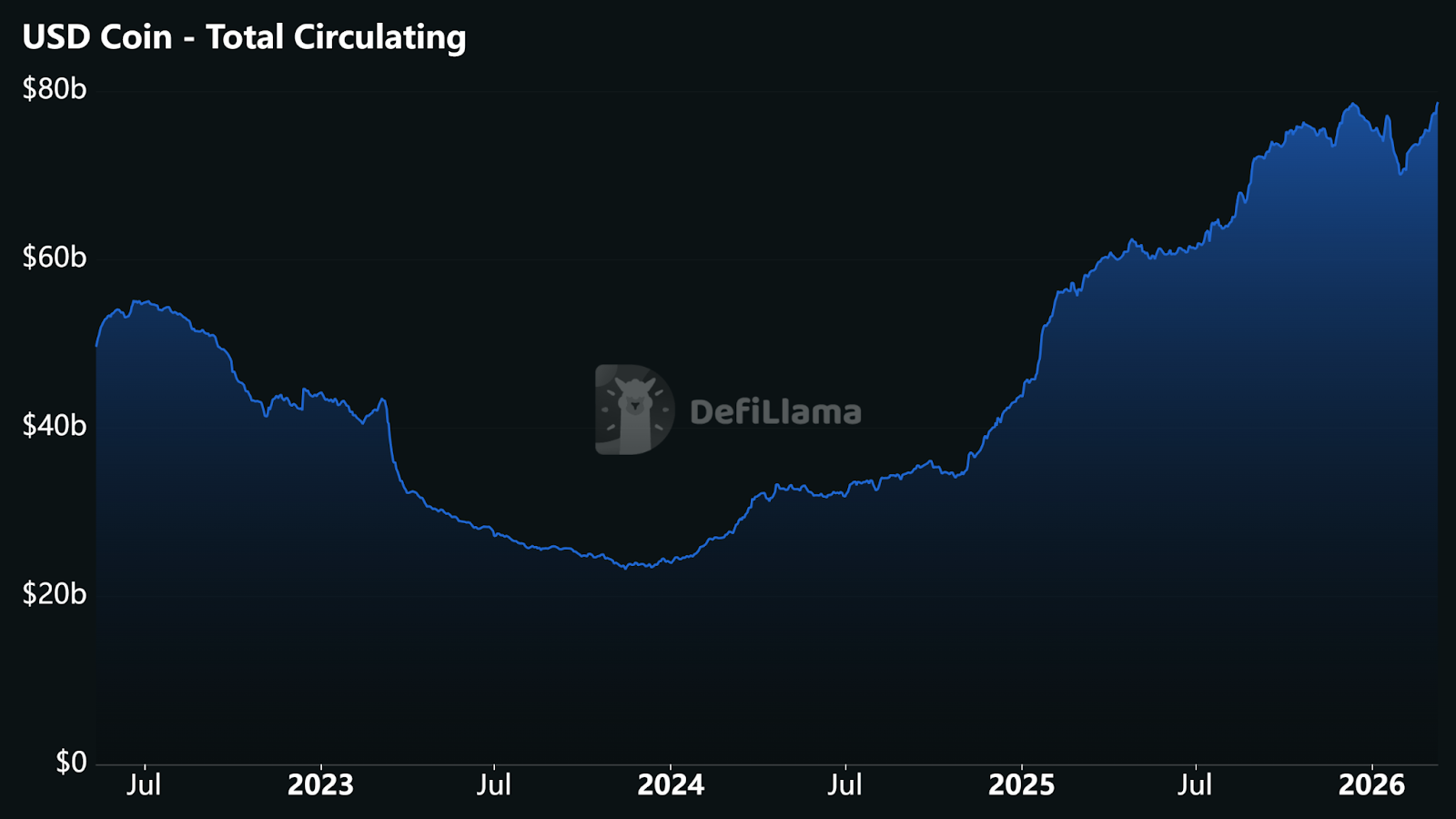
The stock price for Circle, which went public on the NYSE in June 2025, was little changed following the Mizuho report’s release. While the investment bank reported that USDC had overtaken USDT in transaction volume, Tether’s stablecoin remained the largest by market capitalization, at about $184 billion, compared with USDC’s $79 billion.
Related: DOJ and Europol take down SocksEscort network tied to crypto fraud
According to Mizuho analysts, volume data is significant because the stablecoin “winner” will be the one people use for everyday transactions, not just market capitalization.
Fight over stablecoin yield continues in US government
In Washington, DC, it’s unclear whether lawmakers and policymakers will reach an agreement that would allow a digital asset market structure bill to move forward in Congress.
The legislation, called the CLARITY Act when it passed the House of Representatives, has been stalled in the Senate amid debates over stablecoin yield, ethics, and tokenized equities.
Senate Majority Leader John Thune reportedly said on Thursday that the chamber would prioritize a bill on voting requirements rather than market structure, which he didn’t anticipate passing before April.
Magazine: Bitcoin’s ‘narrative vacuum,’ Ethereum now inevitable: Trade Secrets


Trend Research is again moving size through Binance, pulling 27,000 ETH off‑exchange while wiring in about $150m USDC, signaling fresh positioning after its brutal ETH unwind.
Summary
- An address tied to Trend Research withdrew 27,000 ETH from Binance, then sent roughly $150.47m in USDC back to the exchange in recent hours.
- Earlier this year the same firm dumped over 700m worth of ETH to Binance to repay Aave loans, realizing an estimated $700m‑plus loss on a looped long.
- The new pattern of ETH out and USDC in suggests Trend Research is rotating into fresh ETH strategies rather than simply de‑risking, making its flows a key ETH liquidity signal.
Trend Research is back moving size through Binance, this time cycling Ethereum (ETH) out and USDC in, in a way that looks like renewed ammo for directional ETH positioning rather than simple de‑risking.
Trend Research pulls ETH, then pushes USDC to Binance
On‑chain monitoring shows an address linked to Trend Research withdrawing 27,000 ETH from Binance in recent hours, before later transferring approximately $150.47 million in USDC back to the exchange. At current prices, the ETH withdrawal represents tens of millions of dollars in value, while the subsequent USDC inflow reloads the firm’s on‑exchange stablecoin balance. The sequence — assets out, stables in — fits a pattern seen before with Trend Research, where it actively rotates between ETH spot, derivatives exposure, and loan repayment.
This latest move comes against the backdrop of Trend Research’s highly publicized ETH strategy over the past months. The firm, associated with LD Capital, previously built a position of around 600,000–650,000 ETH using large Aave loans, then repeatedly transferred six‑figure ETH amounts to Binance to cut risk as prices moved against it, crystalizing hundreds of millions of dollars in realized losses.
Context: from forced selling to fresh firepower
Earlier this year on‑chain analysts tracked Trend Research sending 216,000 ETH — roughly $411 million — to Binance in a single day, having sold a total of 404,600 ETH at an average price of about $2,071 to avoid liquidation. In another episode, the firm was reported to have effectively “almost sold all of its ETH,” depositing 772,865 ETH back to Binance at around $2,326 after originally buying 792,532 ETH near $3,267, locking in an estimated $747 million loss. Those flows were clearly defensive, aimed at repayment and survival of a heavily leveraged book.
By contrast, the current pattern of withdrawing ETH while sending a fresh nine‑figure USDC tranche into Binance suggests Trend Research is again actively positioning rather than just unwinding. One plausible read is that ETH is being moved to self‑custody or DeFi while USDC sits on Binance as dry powder for new derivatives or spot entries, consistent with prior behavior where the firm borrowed stablecoins from Aave, sent them to Binance, and ran a large ETH carry and directional strategy.
What it signals for ETH traders
For market participants, Trend Research’s renewed activity matters because of sheer size. When a player that has moved hundreds of thousands of ETH and billions of dollars through Binance starts rotating again in 20,000–30,000 ETH clips and nine‑figure USDC transfers, it can affect short‑term liquidity, funding, and sentiment around key levels.
Traders watching ETH should monitor follow‑through: if on‑exchange ETH balances fall while USDC balances associated with Trend Research rise, that tilts toward accumulation or DeFi deployment; if the reverse happens and ETH deposits spike with spot selling, it points back to forced de‑risking. Either way, Trend Research’s flows remain a live barometer of how an over‑levered institutional whale is trying to navigate this phase of the cycle, and ignoring them is a luxury only small accounts can afford.


Summary
- French Hill said the CLARITY Act could resolve issues left open by the GENIUS Act.
- Hill noted the House passed the CLARITY Act with bipartisan backing, including 78 Democratic votes.
- Lawmakers aim to ensure equal rules for bank and nonbank stablecoin issuers, Hill said.
French Hill, chair of the U.S. House Financial Services Committee, said the CLARITY Act could help address unresolved issues in the GENIUS Act.
French Hill remarks on CLARITY and GENIUS Acts
Hill discussed concerns raised by banks about how crypto firms may be regulated under the proposed framework, according to a Fox Business interview. The lawmaker pointed out that the House had already passed the CLARITY Act with bipartisan support.
“In the House last summer, we created the act, and we passed CLARITY Act in the House, with 78 Democratic votes,” Hill said. The legislation is part of broader efforts in Washington to define how stablecoins and other digital assets should operate within U.S. financial markets. Policymakers are also debating whether crypto firms should face the same oversight as banks.
Hill said lawmakers from both parties have already agreed on one key principle. “On a bipartisan basis we said stablecoin should not pay yield,” he said. The issue has become central to discussions around the GENIUS Act. That bill focuses on the regulatory framework for stablecoin issuers.
Hill suggested that some remaining concerns could be addressed through the CLARITY Act. “In my view this independent issue can be resolved in the CLARITY Act,” he said.
He also indicated that certain questions may be handled through regulatory rulemaking rather than new legislation. In particular, he pointed to potential rules on rewards or incentives tied to stablecoin transactions.
“I think all the issues about paying rewards should be dealt with in the regulatory proposal that Treasury has to come up with,” Hill said. “I think that’s best resolved in the GENIUS Act,” he added.
Banks Oppose CLARITY Act
Major banks have argued that crypto companies could gain a competitive advantage if they operate under lighter regulation. Executives from traditional finance have called for equal standards across the industry.
Hill said parity between different issuers is a key objective. “We want equal treatment between bank and nonbank issuers of stablecoins,” he said. The debate has drawn comments from banking leaders such as Jamie Dimon of JPMorgan Chase & Co.
Some executives have questioned whether the proposed legislation gives crypto firms too much flexibility. Hill said lawmakers want to avoid regulatory imbalance as the market evolves. “All issuers should be treated the same way,” he said. “You don’t want to have an imbalance between people using a dollar-backed stablecoin on their platform,” Hill remarked.
Crypto World
DeepSnitch AI Price Prediction 2026: Investors Rush In After $14 Targets As March 31 Launch Approaches, Can This New AI Coin Replace Bonk After Bonk.Fun Hack?

Solana will be joining the Mastercard Crypto Partner Program with an aim to bring digital payments into everyday use. As confirmed in a post on X by Solana Payments, the firm has joined more than 85 crypto firms focusing on bringing clear payment solutions.
Despite this development, the price of Solana (SOL) remained red on March 12. However, market participants are now rotating into DeepSnitch AI (DSNT) as the DeepSnitch AI price prediction for 2026 points to a breakout towards $14.
DeepSnitch AI is a market analytics and prediction platform capitalizing on AI to provide retail investors with actionable insights. This crypto, now in presale, is priced at $0.04399. DeepSnitch AI has accumulated more than $2.1 million, as interest continues to grow day-by-day.
Solana joins Mastercard’s crypto partner program in a bid to boost payments
The Mastercard Crypto Partner Program brings together top crypto entities looking to work together to bring effective payment solutions. By joining the program, Solana will be a part of a shared platform where expertise flows both ways, bridging on-chain solutions with everyday commerce.
Currently, Solana can process up to 65,000 transactions per second. However, the network aims to continue building sustainable growth for digital asset use cases. Other notable firms on the program include the likes of Binance, Ripple, and PayPal.
DeepSnitch AI price prediction for 2026 as Bonk gets hacked
1. DeepSnitch AI prediction 2026: Is DSNT set for a rally to $14?
Artificial intelligence is here to stay, especially in crypto. AI agents introduce speed and accuracy in a sector where they matter the most. As you know, one moment a coin may be up, the next, it’s crashing.
DeepSnitch AI understands that fully, and that’s why SnitchFeed, SnitchCast, SnitchGPT, SnitchScan, and AuditSnitch were developed to offer you a helping hand. These tools flag sentiment shifts, potential risks, gems, and FUD changes. Interestingly, these tools are all found under one roof.
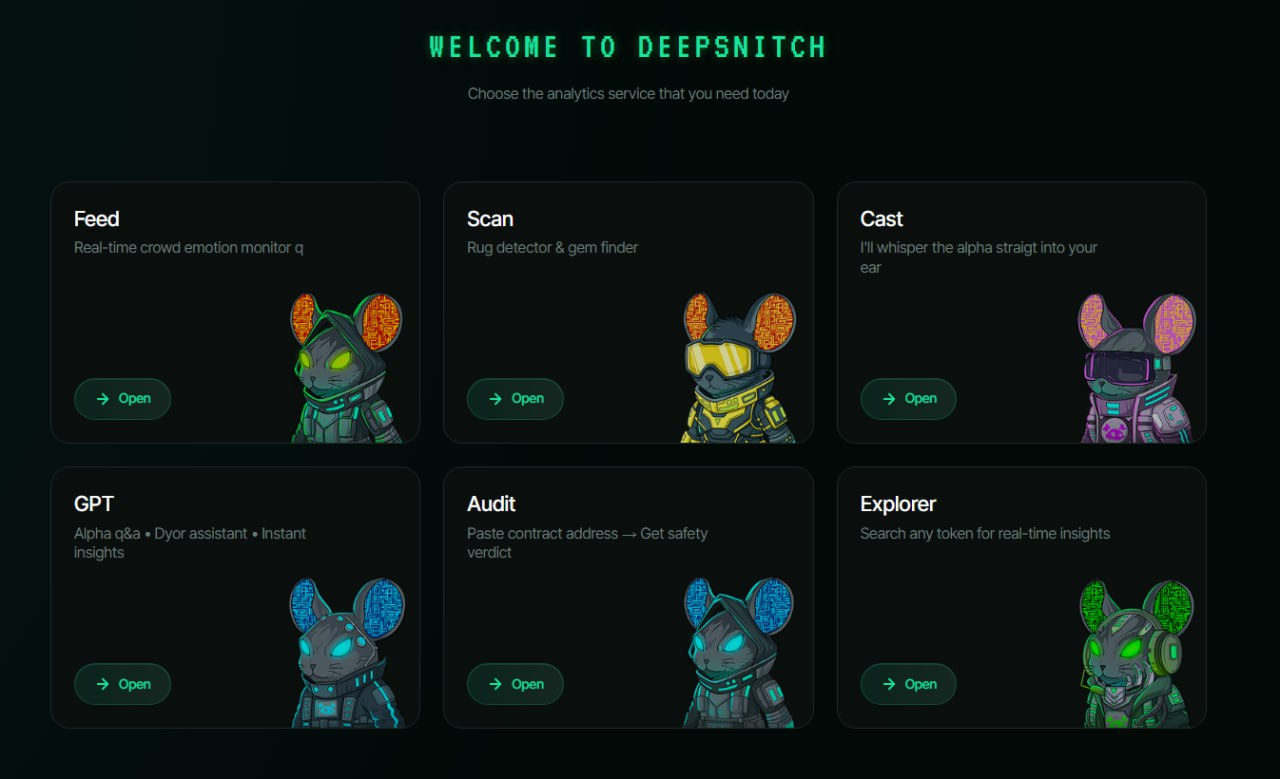
However, DeepSnitch AI is not a one-size-fits-all. Instead, each tool has a distinct purpose. But together, the tools combine to make DYOR easier, turning crypto trading into a lucrative venture.
Because of its clear value, DeepSnitch AI is experiencing significant bullish sentiment, with a bullish DeepSnitch AI price prediction. The forecasts suggest that a 300x rally could materialize.
According to the DeepSnitch AI token outlook, DSNT is now priced at $0.04399. A 300x rally could push the DeepSnitch AI future price to $14. This could turn even $1,000 into a huge portfolio.
2. Midnight price prediction for 2026
Midnight (NIGHT) traded at $0.04739 on March 12, following a 1.9% surge on the day. However, NIGHT is down by 21% over the past 7 days, signaling this crypto could be fading out.
According to the daily chart on TradingView, Midnight is plummeting towards a key support zone around $0.04382. If this level breaks, NIGHT could slide further. However, a surge past $0.06215 could invalidate the bearish Midnight price prediction.
3. Bonk price prediction as Bonk.fun gets hacked
Bonk.fun, a community-driven Solana token issuance platform backed by Raydium and the BONK, was hacked on Thursday as malicious individuals installed wallet drainers on the official website. While the team moved swiftly to warn users, the news spread across the market.
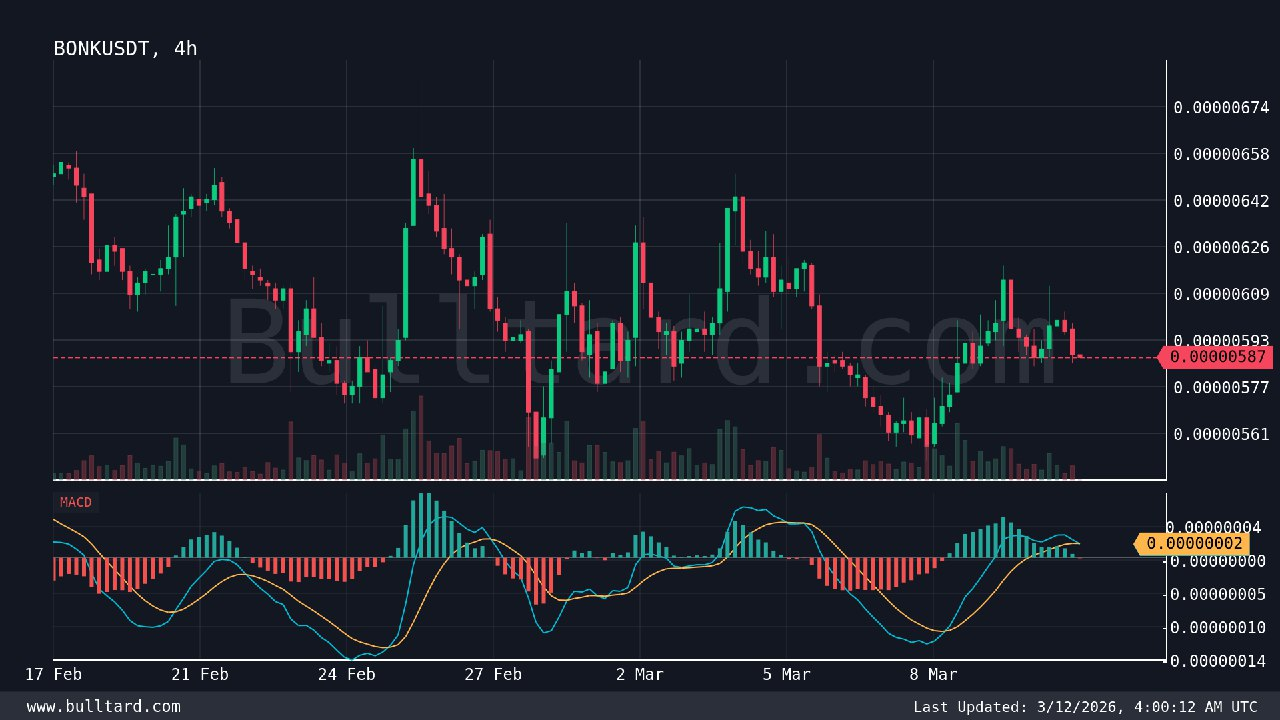
However, the incident did not have much impact on the BONK token. Bonk traded at $0.000005977, down by 1.1% on the weekly timeframe and 0.7% over the past 24 hours. The latest Bonk price prediction shows that Bonk could continue to face bearish pressure as the MACD remains bearish.
Final verdict
The DeepSnitch AI price prediction for 2026 is bullish, while Bonk and Midnight face bearish pressure. Stemming from the bullish sentiment, the DeepSnitch AI future price may reach $14.
Such a move would mean actualization of the 300x rally, as rumors swirl. DeepSnitch AI could launch soon, hence now is the right time to buy this 2026 runner.
Visit the official website for more information, and join X and Telegram for community updates.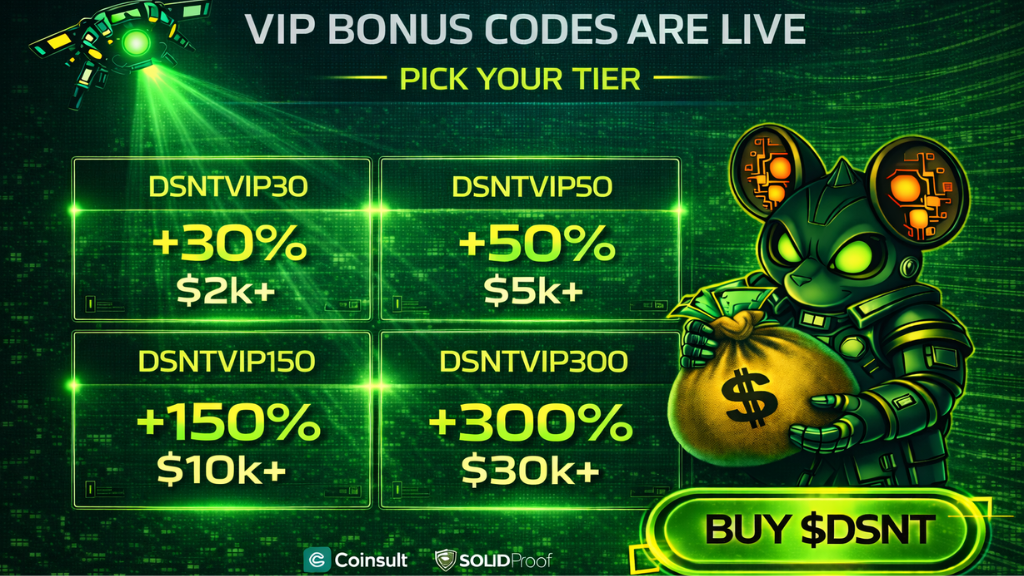
FAQs
1. How high will DeepSnitch AI go in 2026?
The DeepSnitch AI token outlook shows that DeepSnitch AI is very bullish. Once launched, this crypto is expected to rally to $14 this year, as indicated by the ‘DeepSnitch AI prediction 2026’.
2. Is DeepSnitch AI legit?
Yes, DeepSnitch AI is a legit crypto, audited by SOLIDProof and Coinsult. This year, the DeepSnitch AI price prediction highlights a potential 300x rally.
3. Is DeepSnitch AI a good investment?
The DeepSnitch AI future price is expected to reach above $14. This positions DSNT as the best crypto presale to purchase if you are chasing substantial returns.
Disclaimer: This is a Press Release provided by a third party who is responsible for the content. Please conduct your own research before taking any action based on the content.

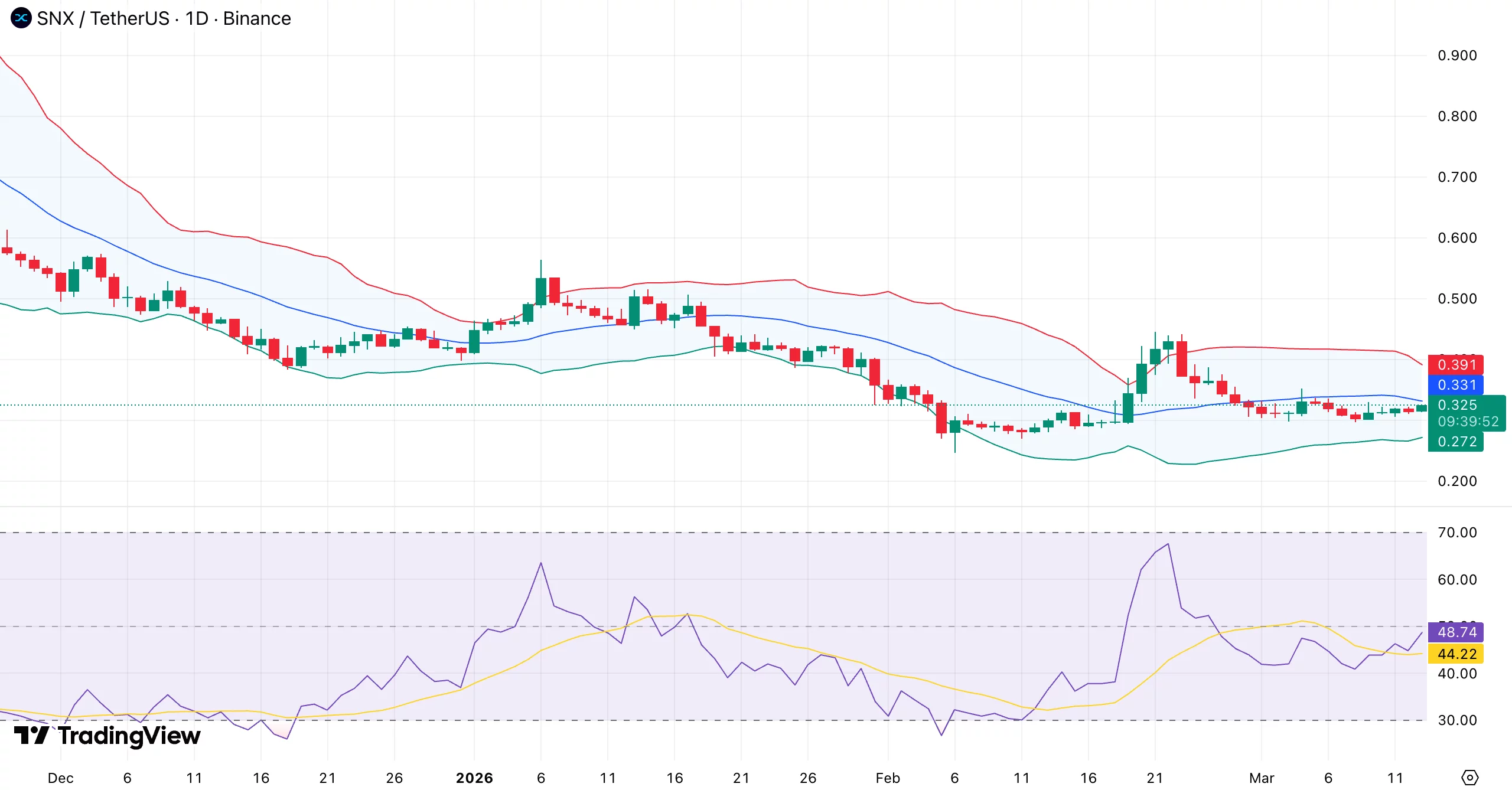
Synthetix price moved slightly higher as the project published its roadmap for 2026, which includes token buybacks and new trading products.
Summary
- Synthetix price rose slightly after the protocol published its roadmap for 2026.
- The plan includes SNX buybacks, multi-collateral trading, and new markets on Ethereum.
- On the chart, Synthetix price is forming a compression pattern near the $0.32 level.
At press time, Synthetix (SNX) token traded at $0.3251, up about 2.9% in the last 24 hours. The token has stayed inside a narrow weekly range between $0.3008 and $0.3262.
Price movement has been slow but steady in recent weeks. SNX is up around 2% over the past seven days and roughly 20% over the past month as the market attempts to recover from earlier losses.
Trading activity has also increased slightly. 24-hour volume reached about $13.4 million, which is 11% higher than the previous day. Derivatives data from CoinGlass shows futures volume rising 10% to $41 million, while open interest climbed 6% to $16.39 million.
2026 roadmap included SNX buybacks
The move comes after the Synthetix team published a long update outlining how the protocol plans to grow during 2026.
According to the roadmap, trading revenue from Synthetix Perps will initially be used to buy back both SNX and the protocol’s stablecoin sUSD. Once the sUSD peg is fully restored, buybacks are expected to focus entirely on SNX.
The plan also includes a major expansion of trading features. In April, users will be able to deposit assets like ETH and cbBTC directly as margin on Synthetix Perps, rather than converting everything into a single collateral asset.
The change could bring more liquidity into the platform by allowing traders to use idle assets already held on Ethereum.
Other updates are scheduled later in the year. The protocol plans to introduce basis trade vaults, launch a public liquidity pool vault, and expand markets beyond crypto to include commodities and forex trading.
Developers also outlined a longer-term plan to transform sUSD into a fully decentralized stablecoin backed by delta-hedged crypto collateral.
The roadmap marks another step in the protocol’s restructuring. Over the past year, the project moved away from multiple Layer-2 deployments and shifted its focus back to Ethereum mainnet, where it now runs a centralized limit order book-style perpetual futures exchange.
Technical analysis: SNX forms tight compression
On the chart, SNX is moving inside a tight consolidation zone near $0.32–$0.33 after months of decline.
Volatility has dropped during the past several weeks. The Bollinger Bands have started to narrow, which often appears before a stronger price move once the range breaks.
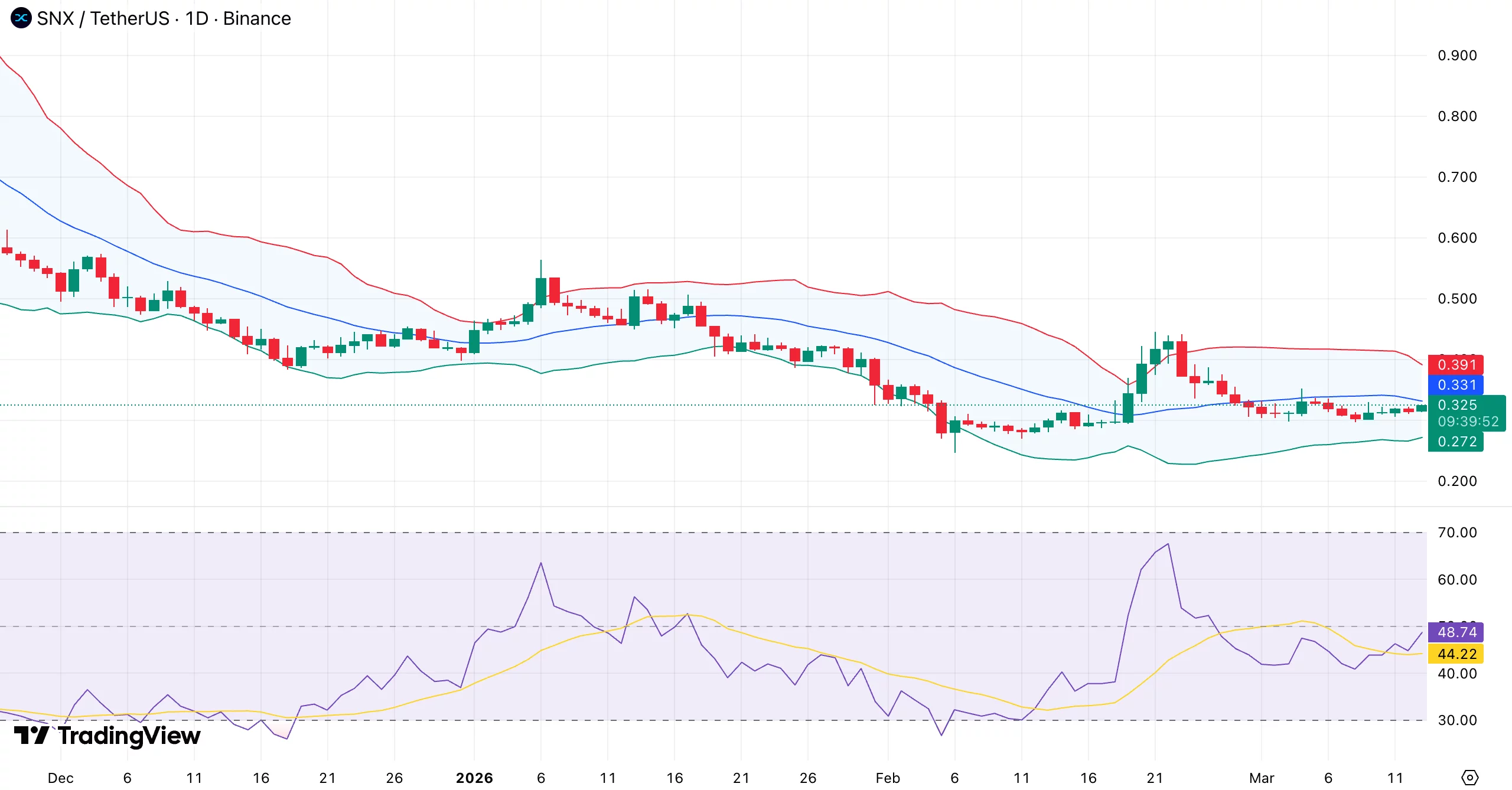
Resistance is now seen around $0.39–$0.40, a level where price was rejected during earlier rallies. Support remains lower, around $0.27–$0.30, where buyers stepped in during the February decline.
Momentum indicators show that selling pressure has eased. The relative strength index has climbed back toward the 50 level, moving away from the oversold zone that appeared earlier in the downtrend.
If SNX pushes above $0.39, the move could open the door toward the $0.45–$0.50 range. That would confirm a breakout from the compression pattern.
On the downside, a drop below $0.30 could weaken the structure and expose the $0.27 area again, which has acted as a key support level in recent months.
Binance spot flows show a late‑cycle alt pattern: oversold names like GTC and OGN mean‑revert, QTUM and RUNE lead thin breakouts, while SCR, THETA and TRX bleed as liquidity exits.
Summary
- Binance spot data flag GTC, OGN and BANANA in “bottoming rebound” mode, with 5–8% bounces off oversold levels rather than fresh trend breaks.
- QTUM, RUNE and MOVE are printing intraday highs with 5–7% gains, showing where real short‑term momentum and order‑book slippage now sit.
- SCR, THETA and TRX are sliding to new lows, a classic distribution tape where liquidity leaves and anyone still “investing” without stops is just donating.
Binance spot is doing what it always does in late‑stage moves: rewarding early degenerates in illiquid names and punishing anyone chasing laggards without a plan.
Altcoins in “bottoming rebound” mode
Binance spot data show several small and mid‑cap altcoins staging what the feed calls a “bottoming rebound.” GTC is up 7.52% over the past 24 hours, OGN has gained 5.84%, and BANANA is higher by 5.03%, all bouncing off depressed levels rather than breaking into new trend regimes. For anyone trading these, understand the context: this is classic mean‑reversion from oversold, not some structural rotation into fundamentals.
In parallel, QTUM, RUNE and MOVE have pushed to intraday highs, with gains of 5.34%, 7.22% and 6.28% respectively. That’s where real momentum lives right now: coins with just enough liquidity to move, just illiquid enough to blow through order books when a few desks lean the same way.
Bleeders: SCR, THETA, TRX
On the other side of the tape, a trio of names is getting clubbed. SCR is down 8.38% from intraday high to low, THETA has dropped 9.06% to a new weekly low, and TRX printed a new daily low, off 5.29%. This is what distribution looks like: previously‑bid names running out of greater fools while the rest of the market celebrates elsewhere.
If you are still long these without a defined stop, you are not “investing,” you are donating. The market is telling you liquidity is leaving the room; your job is to listen, not argue.
How to actually trade this
Treat the “bottoming rebound” names as short‑horizon vehicles: tight risk, fast profit‑taking, no diamond‑hands fantasy. When you see low‑liquidity coins flying 5–8% in a day after being left for dead, that’s order‑flow, not structural demand — size accordingly.
For the winners making intraday highs (QTUM, RUNE, MOVE), only two strategies are acceptable: buy early and cut fast if momentum dies, or fade parabolic spikes with defined invalidation once funding and spot volumes go stupid. For the losers (SCR, THETA, TRX), either you cut and move capital to where the tape is paying, or you write the position to zero and stop pretending you’re a trader.
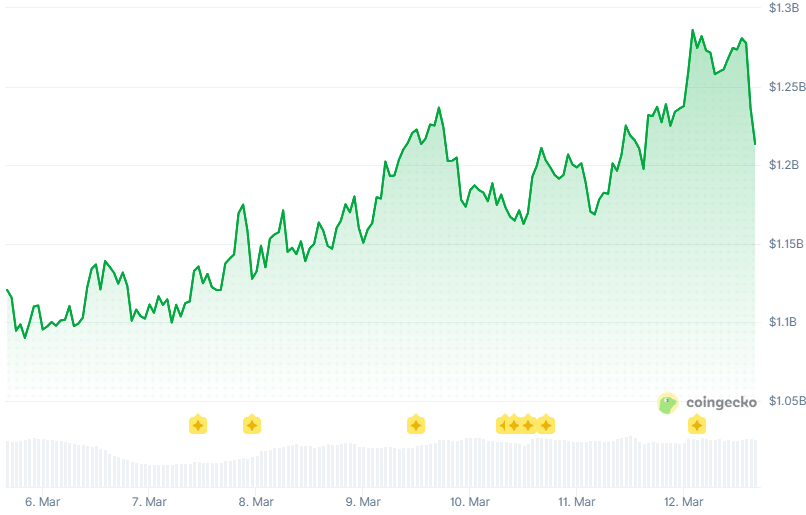
The feature lets tokenized agents direct onchain revenue toward buying back and burning their own tokens.
Solana-based memecoin launchpad pumpfun has rolled out a new feature that connects AI agents to tokenonomics, allowing projects to automatically funnel agent-generated revenue into token buybacks and burns.
The tool, called Tokenized Agents, targets what pumpfun describes as a core problem in the growing “agentic economy” – a lack of value alignment between successful AI agent projects and the communities that form around them.
How It Works
Under the new system, developers launch a token on the platform, set a revenue buyback percentage, and integrate their agent using a provided configuration file. When the agent earns revenue, whether from SaaS products, trading, or other sources, a portion is automatically used to buy back and burn the token.
Buybacks are executed by a centralized buyback authority and instantly burned. Only revenue denominated in SOL and USDC is eligible, and a minimum threshold of $10 in accumulated revenue is required before a buyback is triggered.
It’s worth noting that the agents themselves are not deployed on pumpfun, whose role is limited to enabling the onchain buyback-and-burn mechanism tied to the token.
Existing Tokens Can Opt In
The feature is not limited to new launches. Existing tokens on the bonding curve or migrated to PumpSwap can activate the Tokenized Agent toggle from their coin page. Multiple unrelated agents can also contribute revenue toward buybacks for the same token.
Token creators retain the ability to adjust buyback percentages at any time. Revenue not allocated to buybacks remains claimable by the creator. Creator fees, which are rewards generated from trading volume, are enabled by default, though creators can opt to redirect them as cashback for traders instead, a feature the platform introduced in February.
The launchpad’s native PUMP token is up 8% over the past week amid a broad market rebound.

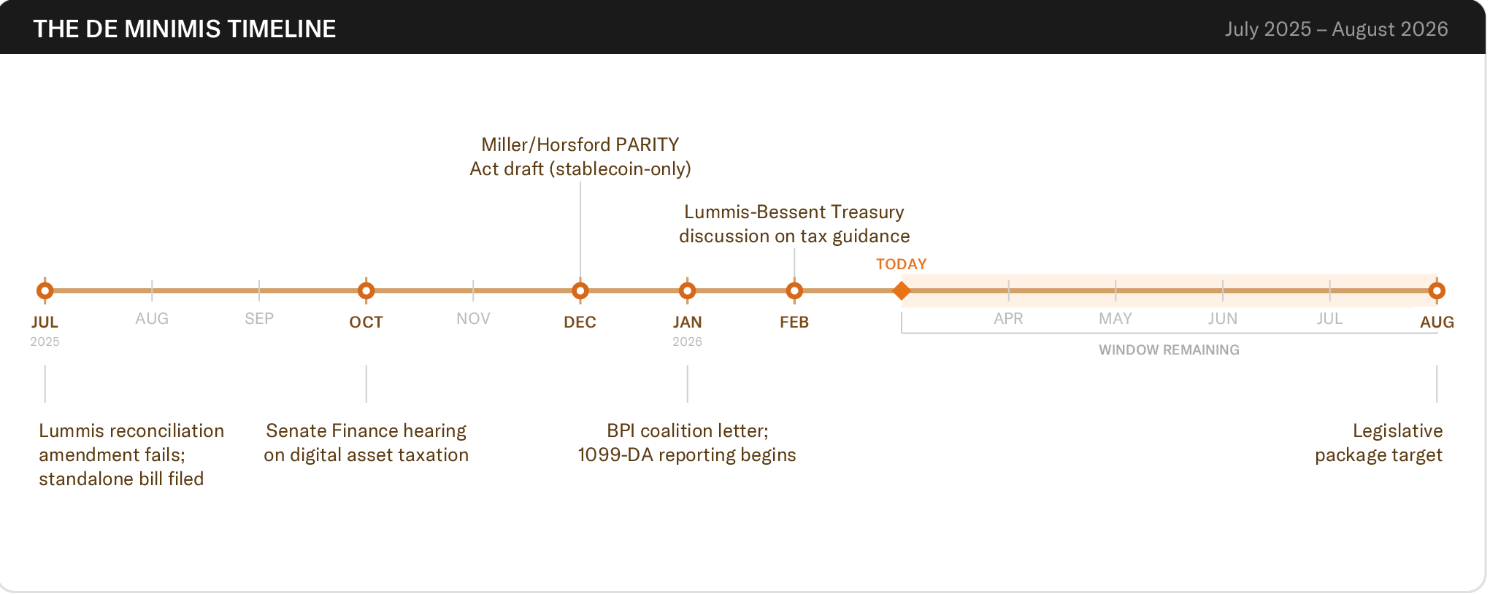
The Bitcoin Policy Institute (BPI), an industry advocacy group, is eyeing a target window between March and August 2026 to pass a de minimis tax exemption for Bitcoin through Congress, warning that time to pass meaningful legislation is running out.
BPI said it has engaged with 19 Congressional offices in both the House and Senate over the last three months to pitch US lawmakers on a tax exemption for Bitcoin (BTC) transactions below a certain threshold.
Expanding the de minimis tax exemptions beyond dollar-pegged stablecoins has bipartisan support, but the BPI warned that the “window is narrowing” for Bitcoin tax legislation. The BPI said:
“Congress will be increasingly consumed by midterm dynamics as summer approaches, and the bandwidth for complex tax legislation shrinks with every passing week. Senator Lummis, the issue’s most forceful champion, departs the Senate in January 2027.
If a package does not come together in the next few months, the opportunity may not return for years,” the BPI continued.

Under current US tax rules, using BTC to pay for goods and services triggers a taxable event and tax reporting to the Internal Revenue Service (IRS), preventing the use of Bitcoin as a medium of exchange.
A de minimis exemption would allow small crypto transactions, typically below a set dollar threshold, to be excluded from capital gains reporting, allowing users to spend Bitcoin without calculating gains or losses on minor purchases.
Related: Bitcoin advocate group to fight Basel’s ‘toxic’ treatment of cryptocurrency
Tax policy has kept Bitcoin as an investment and out of commerce
Wyoming Senator Cynthia Lummis introduced a bill in July 2025 proposing a de minimis tax exemption for cryptocurrency transactions of $300 or less, capped at $5,000 annually.
However, the bill failed to gain traction in the Senate, and a competing bill focused entirely on tax exemptions for stablecoins was introduced to the House of Representatives by Congresspersons Max Miller and Steven Horsford in 2025.

Bitcoin payments are held back by the digital asset’s current treatment under the US tax code, according to Pierre Rochard, a board member for BTC treasury company Strive.
“The number one impediment to Bitcoin payments adoption is tax policy, not scaling technology,” Rochard said on X.
Magazine: Big questions: Should you sell your Bitcoin for nickels for a 43% profit?

3 &4 Bhk flats for sale in Financial District Hyderabad #hyderabadrealestate

Emmerdale spoilers: The police come for Bear as the nightmare escalates | Soaps
Domestic Metals completes geophysical survey at Montana project


-

 News Videos4 days ago
10th Algebra | Financial Planning | Question Bank Solution | Board Exam 2026
-
 Tech3 days ago
A 1,300-Pound NASA Spacecraft To Re-Enter Earth’s Atmosphere
-

 Crypto World4 days ago
Paradigm, a16z, Winklevoss Capital, Balaji Srinivasan among investors in ZODL
-

 Business3 days ago
ExxonMobil seeks to move corporate registration from New Jersey to Texas
-
 Tech3 days ago
ChatGPT will now generate interactive visuals to help you with math and science concepts
-

 Sports6 days ago
Three share 2-shot lead entering final round in Hong Kong
-

 Sports6 days ago
Braveheart Lakshya downs Lai in epic battle to enter All England Open final | Other Sports News
-

 NewsBeat2 days ago
Residents reaction as Shildon murder probe enters second day
-

 Fashion6 hours ago
Weekend Open Thread: Addict Lip Glow
-

 Entertainment7 days ago
Hailey Bieber Poses For Sexy Selfies In New Luscious Lip Thirst Traps
-

 Business5 days ago
Search for Nancy Guthrie Enters 37th Day as FBI Probes Wi-Fi Jammer Theory
-

 Business3 days ago
Search Enters Sixth Week With New Leads in Tucson Abduction Case
-
 NewsBeat4 days ago
Pagazzi Lighting enters administration as 70 jobs lost and 11 stores close across Scotland
-

 Tech4 days ago
Despite challenges, Ireland sixth in EU for board gender diversity
-

 Business4 days ago
Search Enters 39th Day with FBI Tip Line Developments and No Major Breakthroughs
-

 NewsBeat2 days ago
I Entered The Manosphere. Nothing Could Prepare Me For What I Found.
-

 Business7 days ago
Iran war enters second week as Trump demands ’unconditional surrender’
-

 Sports5 days ago
Skateboarding World Championships: Britain’s Sky Brown wins park gold
-
 Crypto World3 days ago
Will Chainlink price reclaim $10 amid volatility squeeze?
-

 Sports5 days ago
Tomorrow’s Top 25 Today: Florida jumps to No. 4; Louisville, Wisconsin enter projected rankings