

Crypto World
US appeals court denies Custodia Bank rehearing in Fed case



The U.S. Court of Appeals for the Tenth Circuit has rejected an effort by Custodia Bank to revive its legal challenge against the Federal Reserve over access to the U.S. banking system. In a March 13 decision, the appellate court voted 7–3 against rehearing the case en banc, leaving intact an earlier ruling issued in October.
Court decision in Custodia Bank vs. Federal Reserve case
That decision held that regional Federal Reserve banks have the authority to decide whether financial institutions receive a so-called “master account,” which provides direct access to the central bank’s payment infrastructure. Master accounts allow banks to send and settle payments through Federal Reserve systems without relying on intermediary institutions.
Without such access, banks must route transactions through a partner bank that already holds an account with the central bank. Custodia, a Wyoming-chartered bank focused on digital assets, has been seeking a master account since 2020. The institution has argued that direct access would allow it to offer payment and settlement services to Web3 companies while avoiding dependence on traditional banking partners. The Federal Reserve rejected the application in 2023.
Custodia Bank faces rejection in 10th circuit
Regulators cited concerns related to the bank’s crypto-focused business model, saying the activities could pose risks to safety, soundness, and financial stability. Following that decision, Custodia filed a lawsuit claiming the Federal Reserve was obligated under federal law to grant master accounts to legally chartered banks.
The bank argued that the central bank does not have unlimited discretion to deny access once an institution is properly licensed. Courts have so far sided with the Federal Reserve. The previous ruling from the Tenth Circuit determined that the law does not compel the central bank to approve every application and that Reserve Banks retain judgment in deciding whether to grant the accounts.
By declining to rehear the case, the appeals court left that interpretation unchanged. The decision also reflects ongoing tension between crypto-focused financial institutions and U.S. regulators over how digital asset businesses should integrate with the traditional banking system.
Custodia has positioned itself as a regulated bank designed to serve crypto companies, offering custody and payment services tied to blockchain assets. Access to a master account would allow the bank to settle transactions directly through Federal Reserve payment rails rather than relying on correspondent banks.
The ruling was not unanimous. In a dissent, judges Timothy Tymkovich and Allison Eid argued that the majority’s approach grants too much unchecked authority to Federal Reserve banks. The dissent warned that allowing Reserve Banks broad discretion could enable them to effectively block state-chartered institutions from accessing the core infrastructure of the U.S. financial system.

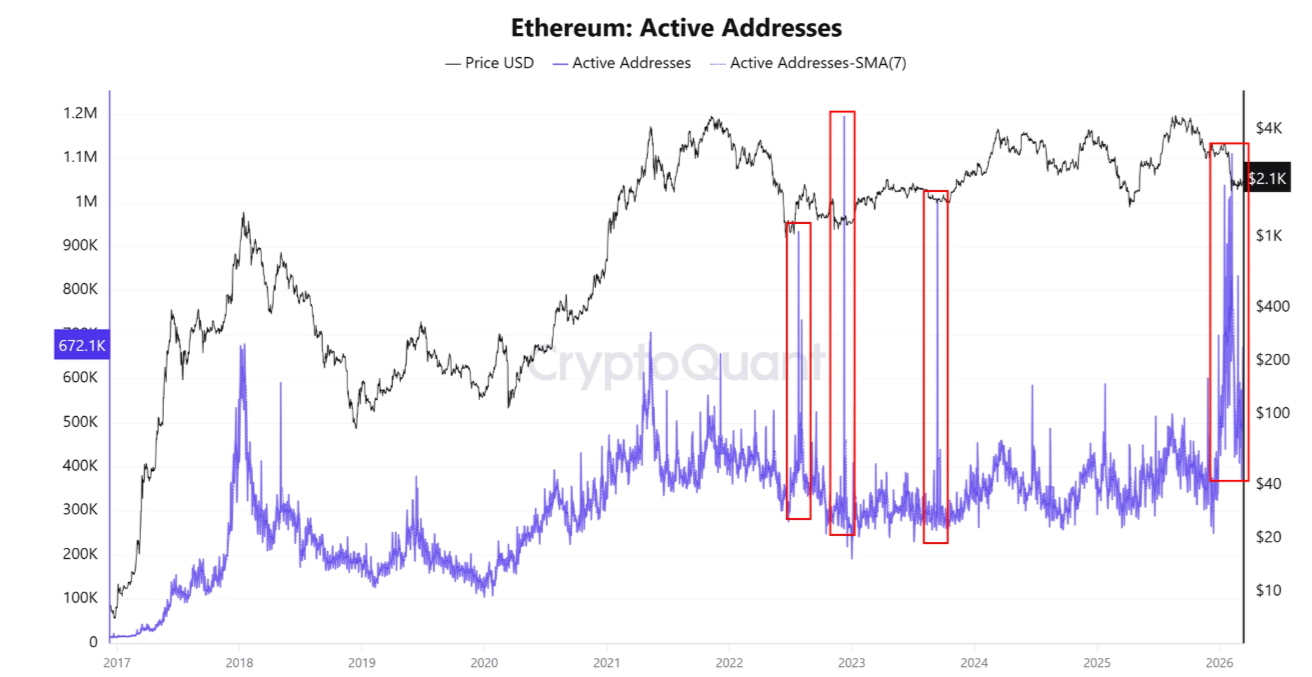
Ether (ETH) traded about 30% below its yearly open of $2,990, as traders grow increasingly risk-averse amid a global conflict and macroeconomic uncertainties.
Still, stronger network usage and increasing inflows into ETH accumulation addresses could provide a spark that may see the price finally break $2,200 resistance.
Key takeaways:
-
ETH held in accumulation wallets has risen 32% since January, showing strong long-term confidence.
-
Staked ETH reaches a record 37.85 million, representing over 30% of supply.
-
Analysts say Ether bulls must reclaim $2,200 as support
6.5 million ETH increase in accumulation addresses
Although Ether’s price has fallen in 2026, network activity increased, with daily active addresses (DAA) rising to 1.1 million in February, the highest level since December 2022. The DAAs jumped by 80% to 672,170 from 370,390 in the past seven days.
“The increase in ETH active addresses indicates bullish market movements,” CryptoQuant analyst CW8900 said in a QuickTake note on Friday.
The chart below shows that activity increased most significantly after Ether’s recent drop below $2,000.
“This implies that accumulation activity was at its most active,” the analyst added.

Similar activity has been consistently observed near macro bottoms since 2022, preceding significant ETH price rallies.
Additionally, daily inflows into accumulation addresses have increased steadily since mid-2025, reaching a record high of 1.14 million ETH in November 2025. The inflows have continued to climb in 2026, averaging 200,000 ETH per day, with a spike to over 350,000 on Thursday.
As a result, the amount of ETH held in accumulation wallets, or holders with no history of selling, has increased by 6.5 million to 26.55 million from 20.1 million on Jan. 1, representing a 32% increase.
The ETH supply held in accumulation addresses is an important indicator for traders and market participants, as it reflects overall confidence in Ether’s long-term outlook.

The total value of ETH staked further reinforces this outlook. The supply of staked Ether reached an all-time high of 37.85 million this week, signaling growing investor confidence and a squeeze on the liquid supply. This represents over 30% of the total ETH supply.

A growing staked supply also indicates that a large percentage of investors are preparing to hold their ETH for longer.
As Cointelegraph reported, Ether supply held on exchanges fell to a new multi-year low of 3.46 million ETH, further tightening the available liquidity on the order books.
Ether price needs to flip $2,200 into support
Data from TradingView shows ETH attempting to breach the $2,100-$2,200 resistance that has suppressed its price over the last month.
“This has been an important price area over the past couple of years of price action for Ethereum,” analyst Daan Crypto Trades said in a recent X post.
The last time the ETH/USD pair reclaimed this level was in May 2025. It rallied 24% in less than a week. In June 2025, it served as a launchpad for a 126% ETH price rally to the current all-time high of $4,950 reached in August 2025.

A key area to watch on the downside is $1,750-$1,850, which, if lost, could extend the downtrend to as low as $1,000.
“I assume that when this breaks either side of the range, we will see a large move occur,“ Daan Crypto Trades added.
This support area coincides with an ascending trend line that has upheld the price on the weekly chart since 2022.
Technical analyst Prof said holding this support would then trigger a retest of the 21-week exponential moving average at $2,700, 22% above the current price.

As Cointelegraph reported, a decisive break above the $2,100 resistance and the 50-day EMA at $2,200 will have the bulls target $2,600 next.
This article does not contain investment advice or recommendations. Every investment and trading move involves risk, and readers should conduct their own research when making a decision. While we strive to provide accurate and timely information, Cointelegraph does not guarantee the accuracy, completeness, or reliability of any information in this article. This article may contain forward-looking statements that are subject to risks and uncertainties. Cointelegraph will not be liable for any loss or damage arising from your reliance on this information.
Crypto World
BTC Rejected at $74K Amid Rising Middle East Tensions, BlackRock’s ETHB Debuts: Weekly Recap
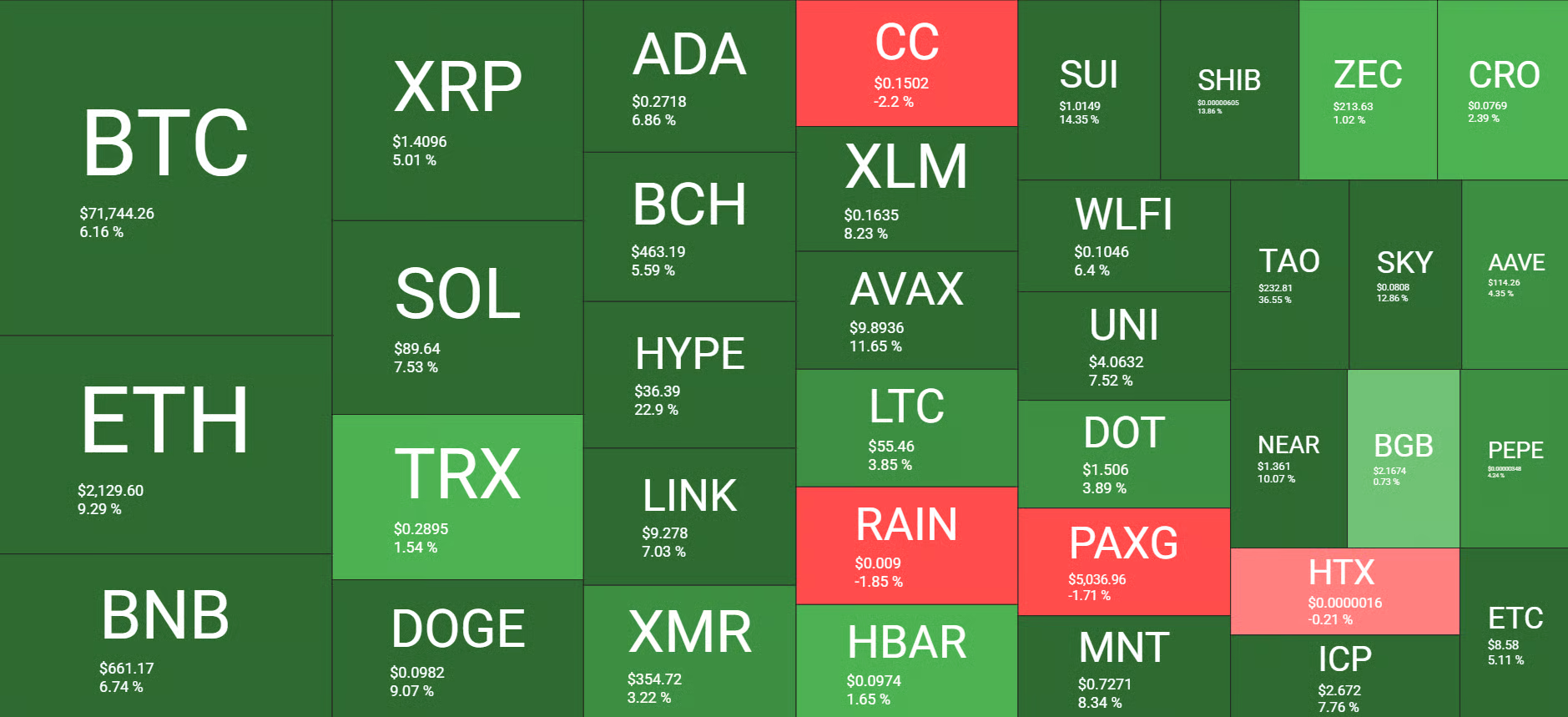
BTC experienced some intense volatility on Friday after the release of the US PCE data. However, its rally was quickly halted.
It was another eventful week, with the headlines strongly focused on the quickly developing (and, in most cases, worsening) situation in the Middle East as both sides continue to hit each other, or allies.
In the meantime, the ever-volatile cryptocurrency industry responds to almost all new developments. Bitcoin, for example, started the week on the wrong foot, slipping from $68,000 on Sunday to a multi-day low of $65,600 when almost all financial markets opened for trading after the strikes and statements during the weekend.
However, the bulls were quick to intervene and didn’t allow further decline. Instead, BTC began its gradual recovery, which saw it near $70,000 by Wednesday. After the initial rejection, the bulls stepped up and pushed the asset to almost $72,000. It faced more resistance at this level and returned to $69,000 when the US CPI numbers came out later that day.
Although expectations and reality met, BTC remained relatively calm at first, but jumped by nearly two grand later on after Trump said there’s “practically nothing left to target” in Iran. Following another volatile session around $70,000, the cryptocurrency went on the offensive on Friday after the release of the US PCE data for January. which showed a 0.3% MoM increase, and a 2.8% YoY rise.
Bitcoin tapped $74,000 for the second time in the past 10 days, but it was stopped once again and driven south by over two grand. Nevertheless, it’s still 6% up weekly, similar to BNB, XRP, and SOL. Ethereum has added almost 10% in the past seven days, while HYPE has exploded by 23%.
Market Data
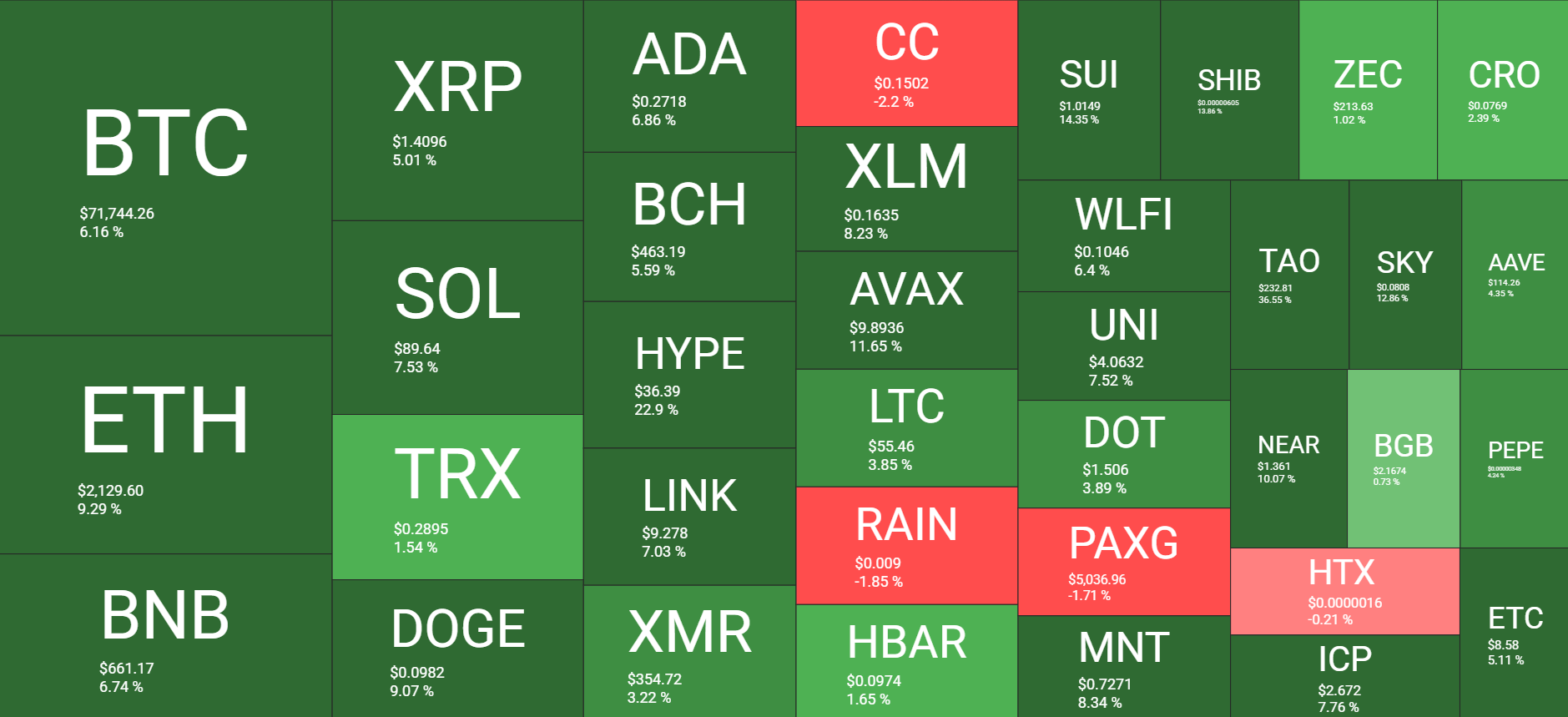
Market Cap: $2.52T | 24H Vol: $138B | BTC Dominance: 56.9%
BTC: $71,700 (+6.1%) | ETH: $2,130 (+9.3%) | XRP: $1.4 (+5%)
You may also like:
This Week’s Crypto Headlines You Can’t Miss
BlackRock Staked Ethereum ETF Sees $15.5M First-Day Volume. Perhaps the most significant piece of industry news this week came from the world’s largest asset manager. BlackRock debuted a new sort of Ethereum ETF that allows investors to take advantage of the network’s staking function. The launch day saw $15.5 million in daily volume.
Ripple Targets $50B Valuation With $750M Buyback Amid Major Partnerships. A recent report indicated that Ripple has launched a share buyback program that puts it at a whopping valuation of $50 billion. Its plan is to repurchase up to $750 million in shares from employees and investors.
POTUS to Headline Gala for Top TRUMP Holders as Price Soars 50% After ATL. Following a consistent and painful decline for the meme coin TRUMP, the US President stepped up to headline a gala for the top asset holders in several weeks. The token reacted immediately with a massive 50% surge.
Here’s When Arthur Hayes Will Buy Bitcoin Again. The co-founder of BitMEX remains a bitcoin bull, but he believes the asset is likely to retrace again amid the ongoing conflict between the US and Israel on one side, and Iran on the other. As such, he said he might look for a new bottom below $60,000 before he starts accumulating again.
Binance Under DOJ Investigation for Possible Iran Sanctions Violations: WSJ. The Wall Street Journal reported that the US Department of Justice has begun an investigation into whether Binance was used in any form to help Iranian-linked wallets bypass American sanctions. Meanwhile, the exchange has sued the publication for defamation over an article from February 24.
Elon Musk Confirms Early Public Access Launch of X Money Next Month. Musk continues with his attempts to transform the social media platform, and indicated that users will receive public access to X Money in April.
Charts
This week, we have a chart analysis of Ethereum, Ripple, Cardano, Binance Coin, and Hyperliquid – click here for the complete price analysis.
Binance Free $600 (CryptoPotato Exclusive): Use this link to register a new account and receive $600 exclusive welcome offer on Binance (full details).
LIMITED OFFER for CryptoPotato readers at Bybit: Use this link to register and open a $500 FREE position on any coin!


Ethereum co-founder Vitalik Buterin says large political efforts to regulate artificial intelligence could backfire.
Vitalik Buterin has said that his previous donation to the Future of Life Institute (FLI) does not mean that he agrees with the group’s current political stance on AI.
According to him, big political campaigns about AI safety could lead to authoritarian outcomes or a global backlash if governments and corporations fight for control of the technology.
Buterin Clarifies Link to FLI
The Ethereum co-founder explained in a lengthy post on X that he got involved with FLI after Shiba Inu’s (SHIB) creators sent him half of their supply to help promote the meme coin. Shortly after, the tokens’ paper value skyrocketed, even flying past $1 billion.
Buterin said he thought the bubble would burst quickly and so rushed to swap some of the SHIB for ETH, donating the funds to a number of causes. He also gave half of the remaining SHIB to CryptoRelief, an India-focused medical relief effort, and the other half to FLI.
The institute ultimately cashed out around $500 million from the donated SHIB holding, far more than Buterin had thought possible, given the token’s thin trading volume at the time. The developer claims he got sold on FLI based on their roadmap, which covered existential risks across biosafety, nuclear, and AI, as well as what he called their “pro-peace and pro-epistemics initiatives.”
However, according to him, the organization has since pivoted, focusing instead on cultural and political action. They justified the shift, saying the situation was no longer the same as it had been in 2021, with the proliferation of artificial general intelligence demanding the change to better counter the lobbying warchests of large AI companies.
Concerns About Political Approaches
Buterin insisted that concentrating on regulatory or political campaigns to control AI development could produce fragile systems or centralized power structures.
You may also like:
“My worry is that large-scale coordinated political action with big money pools is a thing that can easily lead to unintended outcomes, cause backlashes, and solve problems in a way that is both authoritarian and fragile, even if it was not originally intended that way,” he wrote.
The 32-year-old said that limiting biosynthesis tools or AI models by imposing guardrails “so that they refuse to create bad stuff” was a weak solution that could be easily worked around. He added that such strategies could also lead to governments banning open-source systems or backing one “approved” company to take over the development of AI.
“Approaches like this VERY EASILY backfire,” said Buterin. “They make the rest of the world your enemy.”
His proposal is a technological approach focused on developing defensive tools to help society stay safe in a world with powerful technology. He pointed out that his most recent funding decisions include approximately $40 million for research to build secure hardware and systems that could improve digital privacy and cybersecurity.
Binance Free $600 (CryptoPotato Exclusive): Use this link to register a new account and receive $600 exclusive welcome offer on Binance (full details).
LIMITED OFFER for CryptoPotato readers at Bybit: Use this link to register and open a $500 FREE position on any coin!
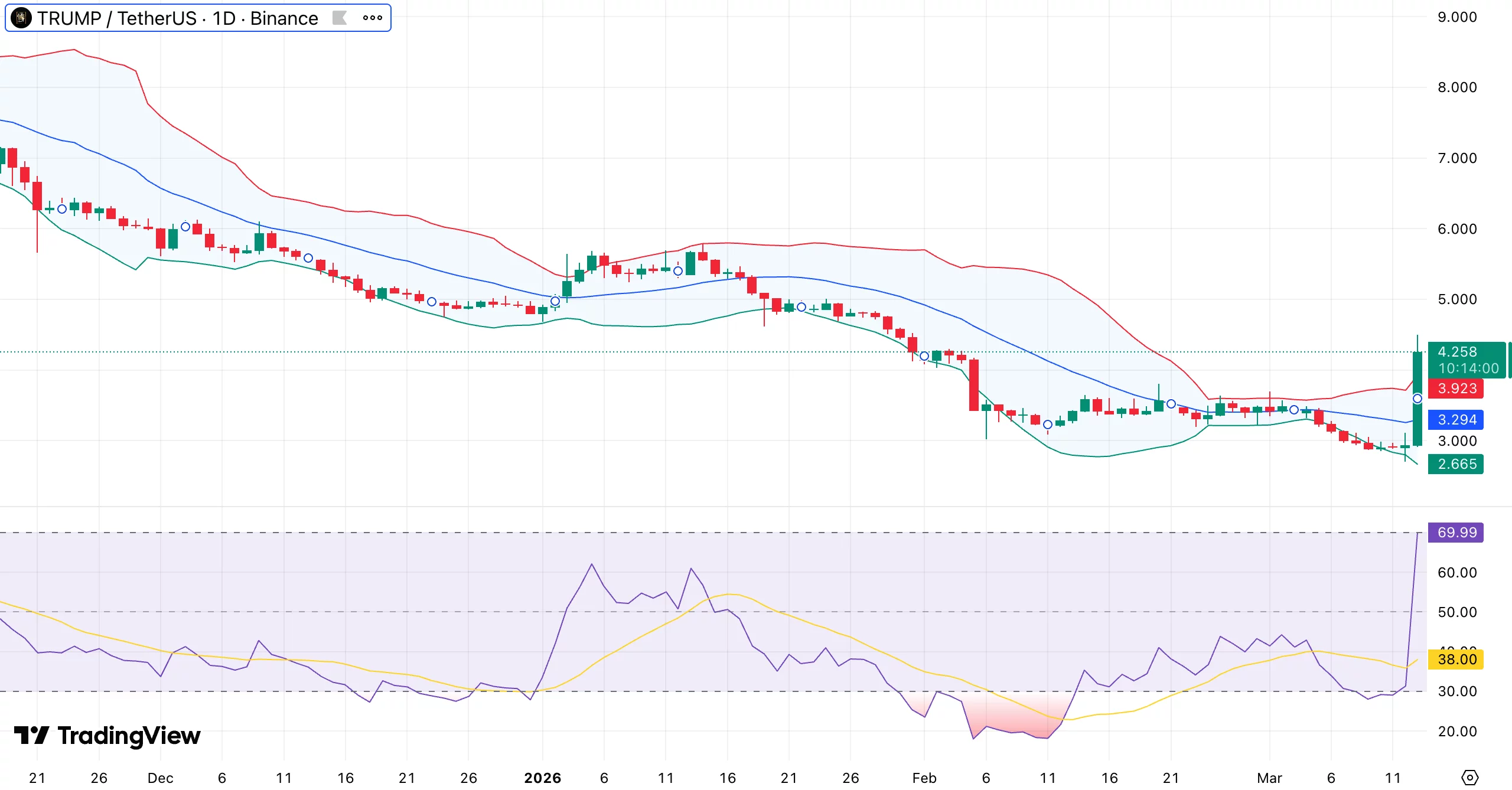
The Official Trump token surged on heavy trading after news spread that large holders could receive invitations to a private event at Mar-a-Lago.
Summary
- TRUMP price jumped more than 50% after the project announced a Mar-a-Lago luncheon for top token holders.
- Trading volume and derivatives activity spiked as traders rushed into the market.
- On the chart, the token broke above key resistance levels after months of decline.
At press time, The Official Trump (TRUMP) traded at $4.28, up about 52% in the past 24 hours. The token is now close to the top of its weekly range, which sits between $2.74 and $4.35.
Momentum has been building over the past several weeks. TRUMP has gained around 34% over the last seven daysand about 40% over the past month. Despite the recent rally, the token still sits roughly 94% below its January 2024 all-time high, after a long slide through 2025.
Trading activity exploded alongside the price jump. 24-hour spot volume reached about $1.4 billion, a 1,498% increase from the previous day.
Derivatives data from CoinGlass shows futures activity climbing even faster. Futures volume rose nearly 1,971% to $2.94 billion, while open interest jumped 154% to $253 million.
Such sharp increases often appear when traders rush to open new positions after a strong news catalyst.
Luncheon invitation drives attention
The latest rally follows an announcement tied to Donald Trump and an upcoming event at Mar-a-Lago.
According to details shared with the community, the top 297 holders of the TRUMP token may receive invitations to a crypto and business conference along with a gala luncheon scheduled for April 25, 2026.
Eligibility will be determined through a time-weighted points system based on token holdings between March 12 and April 10. Investors who hold larger amounts for longer periods rank higher on the leaderboard.
Extra benefits are reserved for the top 29 holders, who may attend a smaller VIP reception with Trump and other guests. Reports mention a private gathering and champagne toast, though organizers say there will be no personal meetings or gifts.
Participants must also pass security checks and maintain their token holdings through the event date.
The luncheon follows a similar promotion held in 2025, when top holders were invited to a dinner event. That earlier gathering drew criticism from some observers who argued that the model blends politics with speculative crypto marketing.
Supporters see the idea differently. For many traders, the token acts as a form of “token-gated access,” where ownership provides entry to exclusive events connected to the political figure.
Technical analysis: breakout follows news catalyst
The price chart shows a sharp reaction after the announcement.
A large bullish candle pushed the token from roughly $2.8–$3.0 to above $4.2 in a single session. That move represents a gain of more than 50% in one day, confirming strong demand following the news.
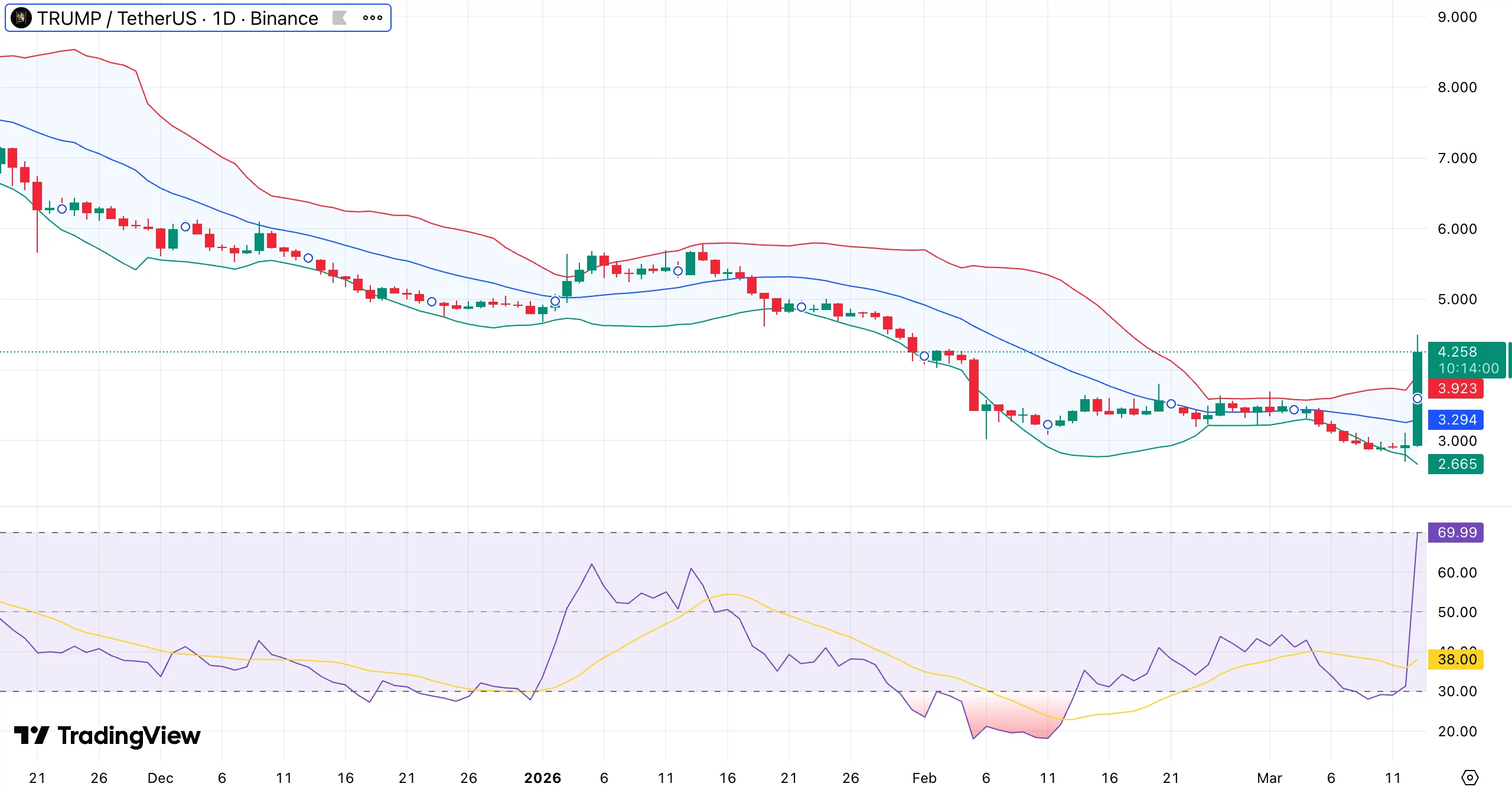
The rally also pushed price above several short-term moving averages near $3.29, levels that had acted as resistance during the previous downtrend. Once those levels broke, buying accelerated.
Volatility has started to increase as well. Bollinger Bands widened after the breakout, which often happens when price leaves a tight trading range.
Momentum indicators climbed quickly. The relative strength index moved close to 70, a level that shows strong buying pressure. When RSI approaches this zone, markets sometimes pause or pull back before deciding the next direction.
The chart also shows that a descending structure that formed over several months has been broken, marking the first strong bullish signal since the prolonged decline from earlier highs.
For now, traders are watching $4.50 and $5.00 as the next resistance zones. If the rally cools, $3.90 could act as support, followed by the $3.30 area, where several moving averages sit.


A US federal court has rejected Custodia Bank’s final attempt to challenge the Federal Reserve’s authority over granting master accounts — effectively ending the crypto-focused bank’s five-year-long battle for direct access to the central bank’s payment system.
The US Court of Appeals for the Tenth Circuit said in a filing on Friday that it wouldn’t hear Custodia’s final appeal on that point in a 7-3 vote.
Custodia first applied for a master account in October 2020, which allows financial institutions to hold reserves directly at the Federal Reserve and access its payment rails, enabling them to settle transactions without relying on intermediary banks.
After the Fed rejected its master account application, Custodia turned to the courts, arguing the Monetary Control Act entitles state-chartered banks to access Fed services and therefore a master account.
However, the multiple courts have now ruled that the Fed retains discretion over whether to grant master accounts.
Custodia’s blow comes as Kraken became the first crypto platform to receive a master account from the Federal Reserve Bank of Kansas City on March 4.
Kraken’s master account enables it to connect to the Fedwire payments system, though it does not include the full range of services available to traditional banks.
The move raised hopes that US regulators could offer “skinny” or limited master accounts to crypto firms.
Banks not given master accounts akin to “death sentence”
While only three judges sided with Custodia, one of them, Judge Timothy Tymkovich, wrote a strong dissenting opinion, stating that “a master account is ‘indispensable’ for a bank’s operations” and being denied one is “akin to a death sentence.”
Related: Democrats say they will oversee reported DOJ probe into Binance
He noted that three months after Custodia’s application in October 2020, the Fed said Custodia was eligible and told it there were “no showstoppers” with its application.
He added, “I do not agree that Reserve Banks have discretion over account applications and would have allowed the mandamus claim to go forward.”
Magazine: Clarity Act risks repeat of Europe’s mistakes, crypto lawyer warns


Michael Saylor has responded sharply after former UK Prime Minister Boris Johnson criticized Bitcoin (BTC) and suggested that it resembles a Ponzi scheme.
Former UK Prime Minister Boris Johnson criticizes Bitcoin
Johnson described a conversation with a church acquaintance who lost money after being lured into a supposed crypto investment opportunity. According to Johnson, the man initially handed over £500 to someone who promised to double his money through Bitcoin.
“After three and a half years of muddle… he was down £20,000,” Johnson wrote in a report. He also described how the individual paid repeated fees in an attempt to recover the funds. The former prime minister used the story to question the value and structure of cryptocurrencies.
He contrasted BTC with traditional assets and collectibles.“I can see the intrinsic value of gold,” Johnson wrote. “I can even understand why Pokemon cards have kept their value.”
He then questioned the foundations of digital assets, arguing that Bitcoin lacks an identifiable authority or issuer. “But Bitcoin? What is it? It’s just a string of numbers stored in a series of computers,” he wrote.
Johnson also referenced the mysterious origins of the BTC’s creator, Satoshi Nakamoto, adding that the system depends heavily on collective belief. “The whole thing depends completely on the collective belief… of the Bitcoin holders,” Johnson said.
He warned that increasing cases of fraud linked to crypto investments could weaken confidence in the sector. “I have always suspected from the outset that all cryptocurrencies were basically a Ponzi scheme,” Johnson wrote. He argued that the ecosystem relies on a continuous flow of new investors.
Michael Saylor claps back at Johnson
Saylor rejected that characterization in a post on the social platform X. “Bitcoin is not a Ponzi scheme,” Saylor wrote. “A Ponzi requires a central operator promising returns and paying early investors with funds from later ones.”
He argued that Bitcoin’s structure makes it fundamentally different from such schemes. “Bitcoin has no issuer, no promoter, and no guaranteed return—just an open, decentralized monetary network driven by code and market demand,” Saylor said.
The executive has long been one of the most prominent corporate advocates for Bitcoin. His company, MicroStrategy, holds billions of dollars worth of the crypto on its balance sheet. Johnson’s comments also revisited broader debates about monetary systems.
In his remarks, he referenced historical currency models backed by government authority, pointing to Roman coins bearing the image of emperors as an example of trust in state-backed money. Crypto supporters, however, often argue that Bitcoin’s decentralized structure is precisely what protects it from political influence and inflation tied to government spending.
The XRP Ledger has never been busier, but traders are yet to catch up.
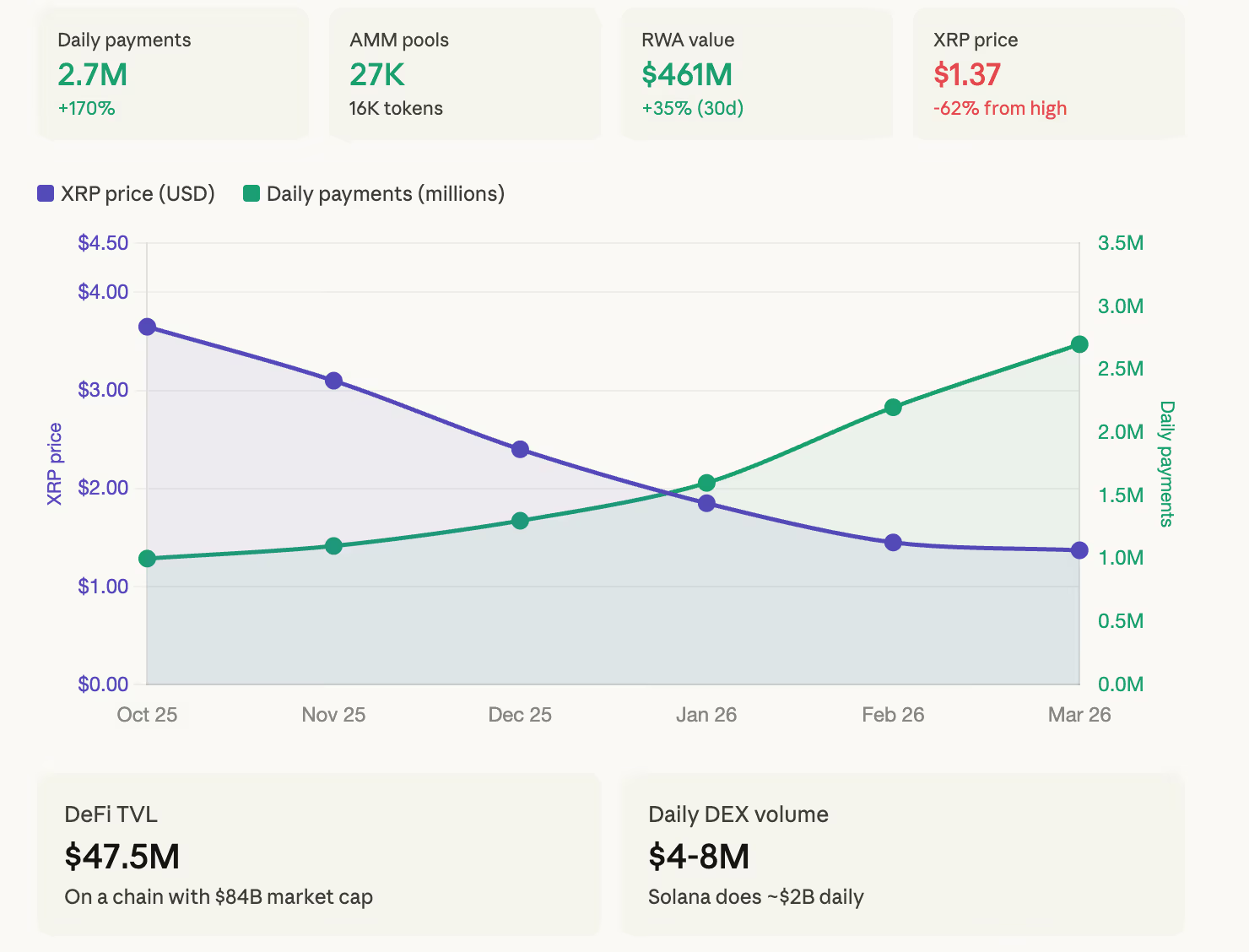
Daily successful payments on XRPL recently hit a 12 month high of over 2.7 million, up from roughly 1 million in late 2025, according to XRPSCAN data. The network is processing between 2 and 2.8 million transactions per day at 20 to 26 transactions per second.

Automated market maker pools have exploded to nearly 27,000 active pools supporting more than 16,000 unique tokens. Tokenized real-world asset value on the ledger climbed to $461 million, up 35% in the past 30 days, per RWA.xyz. Stablecoin transfer volume over the same period hit $1.19 billion.
XRP is trading at $1.37 and is down 26% year-to-date. It’s 62% below its late-2025 high of $3.65.
That gap between what the ledger is doing and what the token is doing is the most important thing happening in XRP right now, and it’s a question the market hasn’t answered yet.
The standard crypto thesis is that network activity drives token value. More usage means more demand for the native asset, which pushes price higher. It’s the framework that worked for Ethereum during DeFi summer and for Solana during the meme coin boom.
But XRP is breaking the pattern. Every metric that should matter for a utility token is up, but the price is down.
The most likely explanation is structural. XRPL’s growing activity is increasingly driven by RLUSD, Ripple’s stablecoin, and tokenized assets that flow through XRP as a bridge currency but don’t create sustained demand for the token.
A payment that uses XRP for three seconds to settle a cross-border transaction between fiat currencies doesn’t generate the same kind of buy pressure as someone staking ETH for months or locking SOL in a DeFi protocol. The network gets busier, but the token stays liquid and transient. Activity goes up but scarcity doesn’t.
The DeFi numbers make this stark. DeFiLlama shows XRPL’s total value locked at $47.54 million. That’s the entire DeFi ecosystem on a chain whose native token has an $84 billion market cap.

For comparison, Solana carries roughly $4 billion in TVL. Ethereum has over $40 billion. XRP’s DeFi layer is a rounding error relative to its valuation, which means the market cap is still overwhelmingly driven by speculative positioning and ETF expectations rather than capital locked into productive on-chain activity.
The native DEX tells a similar story. Daily volume runs between $4 million and $8 million on recent data, modest for any Layer 1 and especially small for one ranked fifth by market cap.
The AMM pool growth is real, with 27,000 pools and 12 million XRP deposited, but the dollar value of that liquidity remains thin relative to the scale of the token’s market.
The RWA picture is the one area where the data genuinely supports the bull case. $461 million in distributed asset value and $1.5 billion in represented asset value puts XRPL ahead of several larger chains in specific tokenization categories.
Stablecoin market cap on the ledger sits at $339 million with 35,800 holders. The 30-day RWA transfer volume of $149 million, up over 1,300%, suggests real institutional activity rather than wash trading. If the tokenization thesis plays out over the next few years, XRPL has a foothold that most competitors don’t.
As such, March historically averages an 18% return for XRP, and the $1.27 to $1.30 support zone has held through multiple tests. If macro conditions stabilize and the Iran conflict moves toward resolution, a relief bounce to $1.60 or higher is plausible.
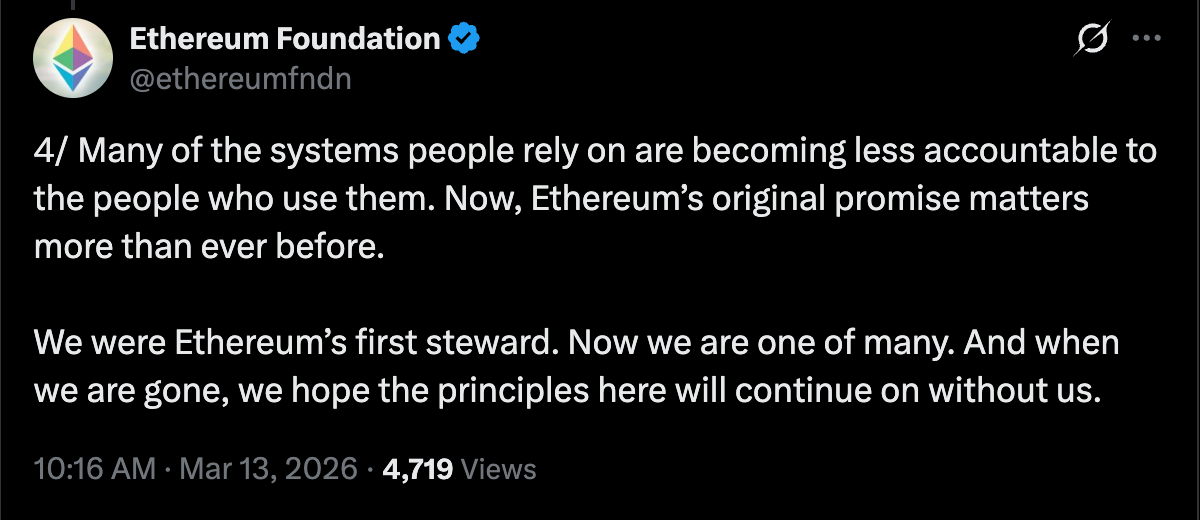
The Ethereum Foundation, the non-profit organization that stewards the development of the Ethereum ecosystem, published its mandate on Friday, reaffirming its role and the core pillars of Ethereum.
The Ethereum Foundation’s two stated goals are that Ethereum remains decentralized and that users have a “final say” over their onchain assets and data, while the protocol achieves mass scale, according to the mandate.
Censorship resistance, open source code, privacy, security, and freedom-preserving technology are the core properties of Ethereum that will be upheld, the mandate, the document said.

The Ethereum Foundation said it will continue to focus on core protocol upgrades, “long-horizon research,” cybersecurity, and providing tooling for Ethereum’s developers, while minimizing its role as much as possible. The mandate said:
“Our ultimate goal is for Ethereum to pass the walkaway test: its protocol and core application layers become robust and trustless enough that they would continue to reliably function and evolve even if the Foundation and today’s core developers disappeared tomorrow.”
The Ethereum Foundation said it aims to focus on tasks that become less necessary over time through a process of subtraction.
The mandate follows a challenging year for the protocol, with Ethereum co-founder Vitalik Buterin saying that Ethereum’s approach to scaling through layer-2 networks “no longer makes sense,” and that many L2s are centralized projects.
Related: AI ‘vibe coding’ could put Ethereum roadmap ahead of schedule: Vitalik Buterin
Buterin says a drastic change in how Ethereum scales is needed
Buteirn said that many layer-2 networks feature centralized points of control, including private trusted networks and centralized sequencers, and have no plans to transition to a fully decentralized model.
“The original vision of L2s and their role in Ethereum no longer makes sense, and we need a new path,” Buterin said in February.
Buterin argued that a layer-2 project that boasts a throughput of 10,000 transactions per second (TPS) but relies on a multi-signature bridge to interact with the layer-1 protocol is not scaling the Ethereum ecosystem in a decentralized way.
Instead of acting as scaling layers for Ethereum, the ecosystem’s many layer-2 networks should specialize in a niche such as privacy, identity solutions, finance platforms and social media applications, Buterin said, which drew mixed reactions from L2 projects.
Magazine: Ethereum’s roadmap to 10,000 TPS using ZK tech: Dummies’ guide

The Bitcoin Policy Institute (BPI), an industry advocacy group, is eyeing a target window between March and August 2026 to pass a de minimis tax exemption for Bitcoin through Congress, warning that time to pass meaningful legislation is running out.
BPI said it has engaged with 19 Congressional offices in both the House and Senate over the last three months to pitch US lawmakers on a tax exemption for Bitcoin (BTC) transactions below a certain threshold.
Expanding the de minimis tax exemptions beyond dollar-pegged stablecoins has bipartisan support, but the BPI warned that the “window is narrowing” for Bitcoin tax legislation. The BPI said:
“Congress will be increasingly consumed by midterm dynamics as summer approaches, and the bandwidth for complex tax legislation shrinks with every passing week. Senator Lummis, the issue’s most forceful champion, departs the Senate in January 2027.
If a package does not come together in the next few months, the opportunity may not return for years,” the BPI continued.
Under current US tax rules, using BTC to pay for goods and services triggers a taxable event and tax reporting to the Internal Revenue Service (IRS), preventing the use of Bitcoin as a medium of exchange.
A de minimis exemption would allow small crypto transactions, typically below a set dollar threshold, to be excluded from capital gains reporting, allowing users to spend Bitcoin without calculating gains or losses on minor purchases.
Related: Bitcoin advocate group to fight Basel’s ‘toxic’ treatment of cryptocurrency
Tax policy has kept Bitcoin as an investment and out of commerce
Wyoming Senator Cynthia Lummis introduced a bill in July 2025 proposing a de minimis tax exemptionfor cryptocurrency transactions of $300 or less, capped at $5,000 annually.
However, the bill failed to gain traction in the Senate, and a competing bill focused entirely on tax exemptions for stablecoins was introduced to the House of Representatives by Congresspersons Max Miller and Steven Horsford in 2025.
A comparison of the Lummis standalone crypto tax bill and the stablecoin de minimis tax bill.
Bitcoin payments are held back by the digital asset’s current treatment under the US tax code, according to Pierre Rochard, a board member for BTC treasury company Strive. “The number one impediment to Bitcoin payments adoption is tax policy, not scaling technology,” Rochard @said on X.
Magazine: Big questions: Should you sell your Bitcoin for nickels for a 43% profit?
1) Introduction
The Bitcoin Policy Institute is pushing for a de minimis tax exemption for Bitcoin transactions, targeting a window from March to August 2026 to move a measure through Congress. The group highlights that time is running short as lawmakers grapple with competing priorities ahead of midterm dynamics. In the past three months, BPI says it has engaged with 19 offices across the House and Senate to advocate for a carve-out allowing BTC transfers below a defined threshold to avoid capital gains reporting. While there is bipartisan interest in extending de minimis relief beyond dollar-pegged stablecoins, observers warn that the window to legislate could close swiftly, especially with Senator Lummis set to depart the Senate in January 2027. The push centers on changing how small Bitcoin transactions are treated for tax purposes, potentially unlocking greater everyday use without tax accounting for minor expenditures.
2)
Key takeaways
- The stated legislative window for a Bitcoin de minimis tax exemption runs March through August 2026, a period proponents describe as the last best chance to pass meaningful tax relief before midterms shift congressional priorities.
- nineteen congressional offices across the House and Senate report engagement by the Bitcoin Policy Institute over a three‑month period, underscoring active lobbying for a BTC-focused exemption and broader expansion beyond stablecoins.
- Senate sponsor Senator Cynthia Lummis pushed a standalone crypto tax bill in July 2025 proposing a de minimis threshold of $300 per transaction, capped at $5,000 annually, but the measure stalled in the Senate.
- In parallel, a House-friendly proposal by Max Miller and Steven Horsford in 2025 aimed to deliver de minimis relief specifically for stablecoins, reflecting a split focus within crypto tax policy debates.
- The central argument stresses that current tax treatment has effectively kept Bitcoin as an investment vehicle rather than a practical medium of exchange, with advocates positioning tax policy as the primary bottleneck to broader adoption.
3)
Tickers mentioned: $BTC
4)
Market context: The push for a Bitcoin de minimis exemption sits within a broader regulatory and policy environment where tax treatment shapes crypto payments and consumer spending. If Congress acts, small BTC transactions could flow more freely in everyday commerce, while inaction risks maintaining a framework that treats Bitcoin primarily as an asset rather than an everyday currency.
5)
Why it matters
The ongoing debate over de minimis tax treatment matters because it shapes how readily individuals can use Bitcoin for routine purchases. A successful exemption would reduce the administrative burden for ordinary consumers who transact in small amounts, potentially expanding merchant acceptance and consumer spending in the crypto space. Advocates argue that tax policy, not technology, has been the primary obstacle to widespread BTC payments adoption, a claim echoed by industry voices who emphasize the upside of aligning tax rules with the realities of digital asset use.
Yet lawmakers face a crowded legislative calendar. The BPI’s warning that the window could close as summer approaches reflects a structural challenge: tax policy is entangled with midterm dynamics, budget considerations, and broader regulatory debates. The political calculus is further complicated by aging leadership in the crypto policy arena; Senator Lummis, a leading proponent, will exit the Senate in early 2027, potentially narrowing the coalition that has championed a de minimis approach to crypto taxation.
Supporters argue that a targeted exemption for small BTC transactions would not only ease everyday spending but also set a clearer precedent for how digital assets should be treated when used as currency rather than solely as investments. The tension remains: should policy favor incremental relief that could unlock practical use cases, or push for comprehensive tax reform that addresses all digital assets at once? The next several months are likely to reveal how aggressively Congress will pursue a path forward and which constituencies—consumer advocates, merchants, or financial policy wonks—will shape the outcome.
6)
What to watch next
- March–August 2026: Legislative activity window for Bitcoin de minimis tax exemption moves through committees and potentially a full vote.
- Ongoing congressional engagement: The Bitcoin Policy Institute’s continued outreach to 19 offices to secure support and build a bipartisan coalition.
- Senator Lummis’s departure in January 2027: Assess how the leadership changes might affect the likelihood of enacting any BTC-specific tax relief.
- Comparison of bills: The trajectory of Miller–Horsford’s stablecoins-focused exemption versus the Lummis standalone crypto tax bill will influence the final framework if a package advances.
- Public-facing tax policy messaging: Watch for statements from tax authorities and industry groups clarifying how a de minimis exemption would interact with existing reporting requirements for small BTC transactions.
7)
Sources & verification
- Bitcoin Policy Institute article outlining the de minimis exemption for Bitcoin and the policy window.
- Cointelegraph reporting on the Bitcoin Policy Institute’s de minimis tax exemption push and related legislative activity.
- July 2025 Lummis proposal for a standalone crypto tax exemption with a $300 threshold and $5,000 annual cap.
- 2025 Miller and Horsford House proposal extending de minimis relief to stablecoins.
- Statements from Pierre Rochard about tax policy as the principal barrier to Bitcoin payments adoption.
7)
Why it matters
This policy debate matters because it could redefine how everyday users interact with Bitcoin, moving it from a speculative asset toward a practical currency for small purchases. If enacted, the de minimis exemption would reduce tax complexity for minor BTC transactions, potentially spurring broader acceptance by merchants and consumers alike. The timing of any agreement is critical, given midterm dynamics and the leadership shift anticipated in early 2027, which could alter legislative momentum for crypto tax reform.
At stake is whether policymakers view Bitcoin as a financial instrument warranting strict capital gains considerations or as a platform for everyday commerce needing pragmatic, policy-aligned rules. The discourse reflects broader questions about how the U.S. tax code should treat digital assets as their use cases evolve—from store of value to medium of exchange—and how to balance investor protection with practical adoption. The coming months will test whether a narrowly tailored exemption can bridge these aims without creating new loopholes or regulatory gaps.
9)
What to watch next
- March–August 2026: Legislative activity window for Bitcoin de minimis tax exemption moves through committees and potentially a full vote.
- Ongoing congressional engagement: The Bitcoin Policy Institute’s continued outreach to 19 offices to secure support and build a bipartisan coalition.
- Senator Lummis’s departure in January 2027: Assess how the leadership changes might affect the likelihood of enacting any BTC-specific tax relief.
- Comparison of bills: The trajectory of Miller–Horsford’s stablecoins-focused exemption versus the Lummis standalone crypto tax bill will influence the final framework if a package advances.
- Public-facing tax policy messaging: Watch for statements from tax authorities and industry groups clarifying how a de minimis exemption would interact with existing reporting requirements for small BTC transactions.
9)
Sources & verification
- Bitcoin Policy Institute article outlining the de minimis exemption for Bitcoin and the policy window.
- Cointelegraph reporting on the Bitcoin Policy Institute’s de minimis tax exemption push and related legislative activity.
- July 2025 Lummis proposal for a standalone crypto tax exemption with a $300 threshold and $5,000 annual cap.
- 2025 Miller and Horsford House proposal extending de minimis relief to stablecoins.
- Statements from Pierre Rochard about tax policy as the principal barrier to Bitcoin payments adoption.
After reaching a monthly high of $2,209 on Friday, Ether (ETH) price fell back below a key monthly resistance, which has been tested five times since February.
While onchain data highlights a large cluster of investors near $2,800, Ether’s futures market data shows traders are scaling back positions after this week’s rally.
Investors’ $2,800 cost basis highlights a major accumulation zone
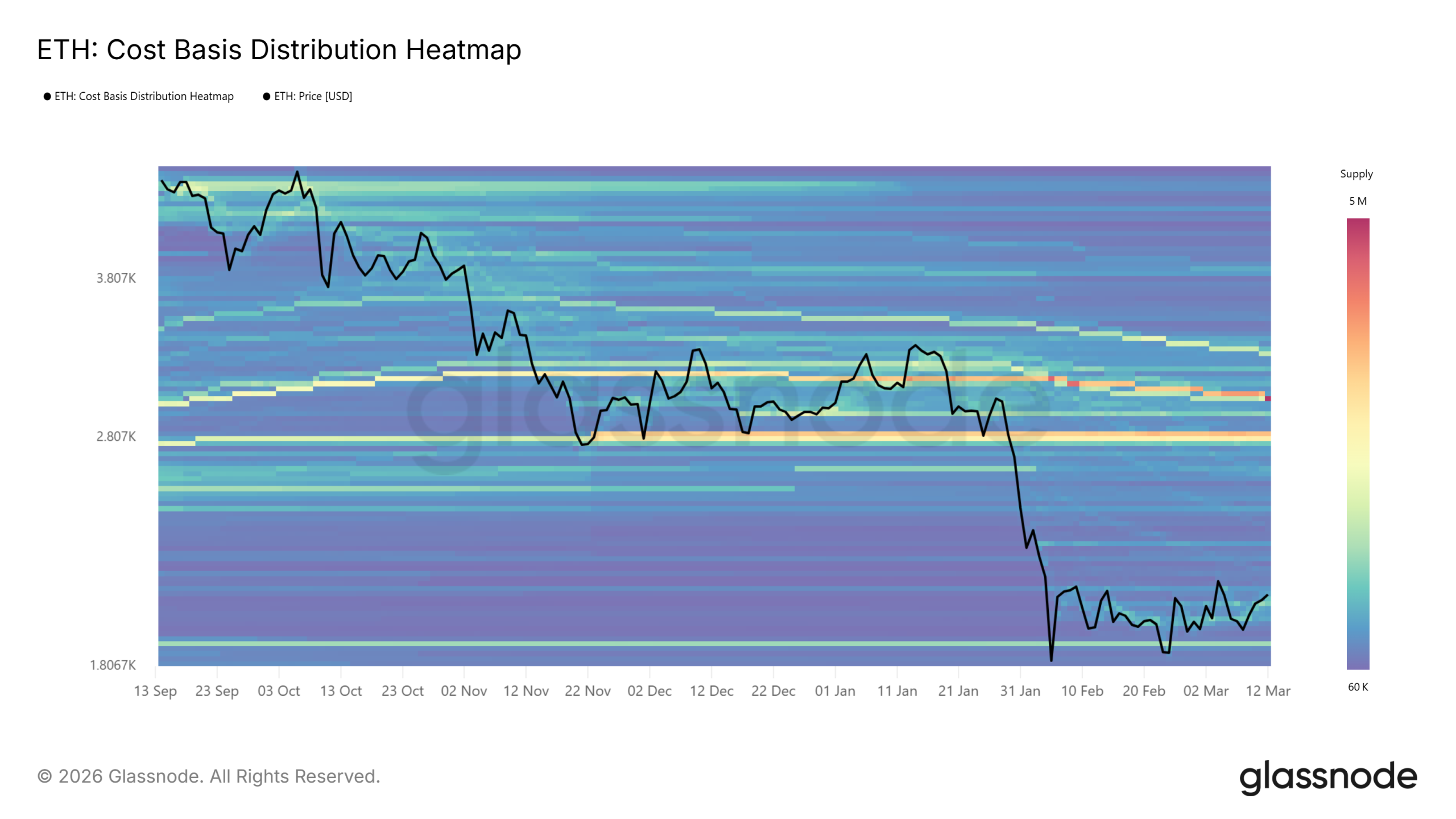
Data from Glassnode indicated that ETH’s cost-basis distribution heatmap shows a heavy accumulation near $2,800, where more than 3 million ETH were previously purchased.
The cost-basis clusters identify the price zones where large groups of investors established positions, often acting as magnets during upward moves as investors defend entry levels or add exposure.

The data suggests a potential pathway toward $2,800. Notably, there is a relatively limited historical supply concentration between $2,200 and the $2,800 cost-basis cluster, meaning a break above the current range may allow the price to move more freely into that range.

From a technical standpoint, the 200-day simple moving average (SMA) also intersects near the $2,800 level on the daily chart, a key indicator ETH has not approached since early January.
However, derivatives data suggest traders remain cautious near the present price range.
Related: Ethereum Foundation publishes mandate clarifying role and goals
Ether futures activity fades after $2,200 test
Ether’s futures market activity expanded during this week’s rally, with open interest rising 21% to $10.9 billion from $9 billion this week as the price pushed toward $2,200. The increase suggests traders were opening new leveraged positions as Ether moved higher.

However, the positioning shifted once ETH tested the upper range. Open interest fell roughly 6% after the $2,200 test, indicating some traders began closing positions rather than adding new exposure.
The pullback suggests long traders likely took profit or reduced risk near the upper boundary of the range, slowing the rally’s momentum.
Spot market activity showed improving demand during the move. Spot volume cumulative delta (CVD), which tracks aggressive buying versus selling, rose sharply to $87 million from -$150 million on March 8, indicating buyers stepped in as Ether rebounded from the $2,000 region.

However, order-flow data reflected a fading bullish sentiment. The bid–ask ratio remained strongly positive while Ether consolidated near $2,000, showing buyers dominated trading during the range phase.
That strength faded as the price approached $2,150, signaling reduced buying pressure near the top of the move.
Hyblock data offered additional clarity in the derivatives markets. The futures positioning remains relatively balanced, with long traders accounting for about 59.4% of Ether futures exposure on Binance.
Such a balanced outlook often leads to choppy price action as the market struggles to decisively break through nearby resistance levels.

The data shows a divergence forming, while past ETH accumulation points toward a rally to $2,800. With this in mind, it is clear that Ether futures traders remain cautious near ETH’s current range.
Related: Ethereum accumulation wallets jump 30%: Will ETH price follow?
This article does not contain investment advice or recommendations. Every investment and trading move involves risk, and readers should conduct their own research when making a decision. While we strive to provide accurate and timely information, Cointelegraph does not guarantee the accuracy, completeness, or reliability of any information in this article. This article may contain forward-looking statements that are subject to risks and uncertainties. Cointelegraph will not be liable for any loss or damage arising from your reliance on this information.

Watch These ETH Price Levels Next

Bold and the Beautiful: Ivy’s Rage Spirals Out of Control – Sabotages Dylan Leading to Major Forrester Creations Firing?!?

Alternative market at Impossible bar in York in April


-

 News Videos5 days ago
10th Algebra | Financial Planning | Question Bank Solution | Board Exam 2026
-
 Tech3 days ago
A 1,300-Pound NASA Spacecraft To Re-Enter Earth’s Atmosphere
-

 Crypto World4 days ago
Paradigm, a16z, Winklevoss Capital, Balaji Srinivasan among investors in ZODL
-

 Business3 days ago
ExxonMobil seeks to move corporate registration from New Jersey to Texas
-

 Tech3 days ago
ChatGPT will now generate interactive visuals to help you with math and science concepts
-

 Sports6 days ago
Three share 2-shot lead entering final round in Hong Kong
-

 Sports6 days ago
Braveheart Lakshya downs Lai in epic battle to enter All England Open final | Other Sports News
-

 Fashion7 hours ago
Weekend Open Thread: Addict Lip Glow
-

 NewsBeat2 days ago
Residents reaction as Shildon murder probe enters second day
-

 Entertainment7 days ago
Hailey Bieber Poses For Sexy Selfies In New Luscious Lip Thirst Traps
-

 Business5 days ago
Search for Nancy Guthrie Enters 37th Day as FBI Probes Wi-Fi Jammer Theory
-

 Business3 days ago
Search Enters Sixth Week With New Leads in Tucson Abduction Case
-
 NewsBeat4 days ago
Pagazzi Lighting enters administration as 70 jobs lost and 11 stores close across Scotland
-

 Tech4 days ago
Despite challenges, Ireland sixth in EU for board gender diversity
-

 Business4 days ago
Search Enters 39th Day with FBI Tip Line Developments and No Major Breakthroughs
-

 NewsBeat2 days ago
I Entered The Manosphere. Nothing Could Prepare Me For What I Found.
-

 Business7 days ago
Iran war enters second week as Trump demands ’unconditional surrender’
-

 Sports5 days ago
Skateboarding World Championships: Britain’s Sky Brown wins park gold
-
 Crypto World3 days ago
Will Chainlink price reclaim $10 amid volatility squeeze?
-

 Sports5 days ago
Tomorrow’s Top 25 Today: Florida jumps to No. 4; Louisville, Wisconsin enter projected rankings