

Tech
Your ROG Xbox Ally X is about to get a free performance upgrade soon

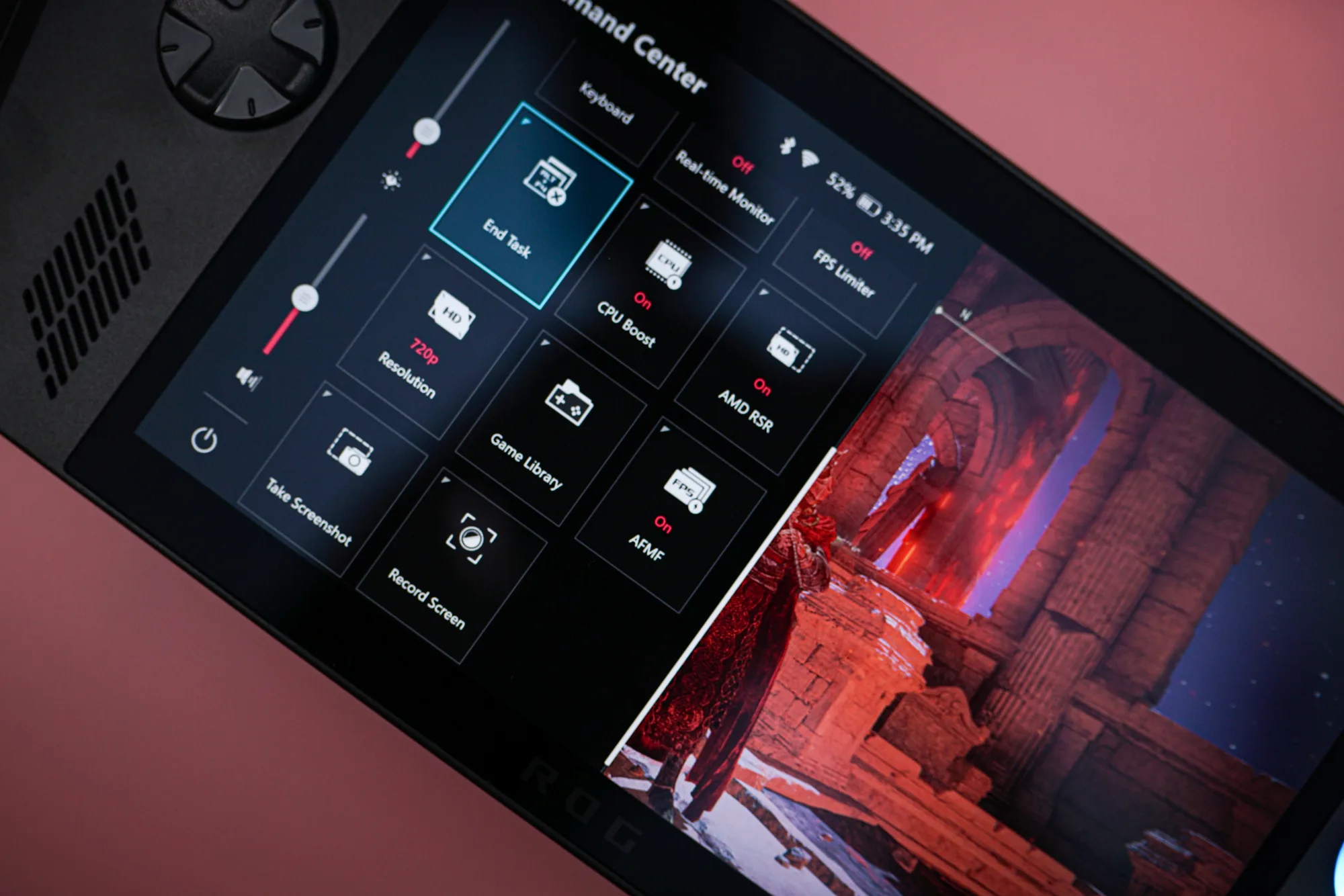
If you’ve ever squinted at your ROG Xbox Ally X’s screen and thought that it could be a little sharper, Xbox (and Microsoft) heard you, loud and clear. In April 2026, the handheld gaming PC will get a free software update that will make your games look better. No hardware updates or additional costs included.
Xbox will release a feature called Automatic Super Resolution or Auto SR — Microsoft’s AI-powered answer to Nvidia’s DLSS and AMD’s FSR — which upscales video games from 720p up to 1080p or more (via Windows Central).

What does the Auto SR feature do?
The feature forces your Ally X to work smarter, not harder, delivering a performance boost of up to 30%. Unlike DLSS and FSR, Auto SR works at the operating system level, implying that developers won’t need to integrate it on a per-game basis. However, the feature still trails Nvidia’s DLSS in outright image quality.
No matter who the developer is or what the game is, Auto SR will simply work, well, mostly. For now, the feature supports DirectX 11 and DirectX 12 games only. But why is it only available on the Xbox Ally X, and not the Xbox Ally?

So, why is it only coming to Ally X?
Well, the Ally X features AMD’s Ryzen AI Z2 Extreme chipset, which, like the modern smartphones or CPUs, also includes a Neural Processing Unit, specifically designed for AI and machine learning workloads.
The feature seems to be relying on Ally X’s NPU to upscale the video games in real-time, without increasing the CPU’s load. Unfortunately, the base model doesn’t have one, which is why the feature is exclusive to the X variant.
One thing that worth pointing out — the April release is technically a preview, not a final, polished rollout. So while the 30% performance figure is exciting, real-world results may vary as Microsoft continues to refine it.

Tech
NanoClaw and Docker partner to make sandboxes the safest way for enterprises to deploy AI agents

NanoClaw, the open-source AI agent platform created by Gavriel Cohen, is partnering with the containerized development platform Docker to let teams run agents inside Docker Sandboxes, a move aimed at one of the biggest obstacles to enterprise adoption: how to give agents room to act without giving them room to damage the systems around them.
The announcement matters because the market for AI agents is shifting from novelty to deployment. It is no longer enough for an agent to write code, answer questions or automate a task.
For CIOs, CTOs and platform leaders, the harder question is whether that agent can safely connect to live data, modify files, install packages and operate across business systems without exposing the host machine, adjacent workloads or other agents.
That is the problem NanoClaw and Docker say they are solving together.

A security argument, not just a packaging update
NanoClaw launched as a security-first alternative in the rapidly growing “claw” ecosystem, where agent frameworks promise broad autonomy across local and cloud environments. The project’s core argument has been that many agent systems rely too heavily on software-level guardrails while running too close to the host machine.
This Docker integration pushes that argument down into infrastructure.
“The partnership with Docker is integrating NanoClaw with Docker Sandboxes,” Cohen said in an interview. “The initial version of NanoClaw used Docker containers for isolating each agent, but Docker Sandboxes is the proper enterprise-ready solution for rolling out agents securely.”
That progression matters because the central issue in enterprise agent deployment is isolation. Agents do not behave like traditional applications. They mutate their environments, install dependencies, create files, launch processes and connect to outside systems. That breaks many of the assumptions underlying ordinary container workflows.
Cohen framed the issue in direct terms: “You want to unlock the full potential of these highly capable agents, but you don’t want security to be based on trust. You have to have isolated environments and hard boundaries.”
That line gets at the broader challenge facing enterprises now experimenting with agents in production-like settings. The more useful agents become, the more access they need. They need tools, memory, external connections and the freedom to take actions on behalf of users and teams. But each gain in capability raises the stakes around containment. A compromised or badly behaving agent cannot be allowed to spill into the host environment, expose credentials or access another agent’s state.
Why agents strain conventional infrastructure
Docker president and COO Mark Cavage said that reality forced the company to rethink some of the assumptions built into standard developer infrastructure.
“Fundamentally, we had to change the isolation and security model to work in the world of agents,” Cavage said. “It feels like normal Docker, but it’s not.”
He explained why the old model no longer holds. “Agents break effectively every model we’ve ever known,” Cavage said. “Containers assume immutability, but agents break that on the very first call. The first thing they want to do is install packages, modify files, spin up processes, spin up databases — they want full mutability and a full machine to run in.”
That is a useful framing for enterprise technical decision-makers. The promise of agents is not that they behave like static software with a chatbot front end. The promise is that they can perform open-ended work. But open-ended work is exactly what creates new security and governance problems. An agent that can install a package, rewrite a file tree, start a database process or access credentials is more operationally useful than a static assistant. It is also more dangerous if it is running in the wrong environment.
Docker’s answer is Docker Sandboxes, which use MicroVM-based isolation while preserving familiar Docker packaging and workflows. According to the companies, NanoClaw can now run inside that infrastructure with a single command, giving teams a more secure execution layer without forcing them to redesign their agent stack from scratch.
Cavage put the value proposition plainly: “What that gets you is a much stronger security boundary. When something breaks out — because agents do bad things — it’s truly bounded in something provably secure.”
That emphasis on containment rather than trust lines up closely with NanoClaw’s original thesis. In earlier coverage of the project, NanoClaw was positioned as a leaner, more auditable alternative to broader and more permissive frameworks. The argument was not just that it was open source, but that its simplicity made it easier to reason about, secure and customize for production use.
Cavage extended that argument beyond any single product. “Security is defense in depth,” he said. “You need every layer of the stack: a secure foundation, a secure framework to run in, and secure things users build on top.”
That is likely to resonate with enterprise infrastructure teams that are less interested in model novelty than in blast radius, auditability and layered control. Agents may still rely on the intelligence of frontier models, but what matters operationally is whether the surrounding system can absorb mistakes, misfires or adversarial behavior without turning one compromised process into a wider incident.
The enterprise case for many agents, not one
The NanoClaw-Docker partnership also reflects a broader shift in how vendors are beginning to think about agent deployment at scale. Instead of one central AI system doing everything, the model emerging here is many bounded agents operating across teams, channels and tasks.
“What OpenClaw and the claws have shown is how to get tremendous value from coding agents and general-purpose agents that are available today,” Cohen said. “Every team is going to be managing a team of agents.”
He pushed that idea further in the interview, sketching a future closer to organizational systems design than to the consumer assistant model that still dominates much of the AI conversation. “In businesses, every employee is going to have their personal assistant agent, but teams will manage a team of agents, and a high-performing team will manage hundreds or thousands of agents,” Cohen said.
That is a more useful enterprise lens than the usual consumer framing. In a real organization, agents are likely to be attached to distinct workflows, data stores and communication surfaces. Finance, support, sales engineering, developer productivity and internal operations may all have different automations, different memory and different access rights. A secure multi-agent future depends less on generalized intelligence than on boundaries: who can see what, which process can touch which file system, and what happens when one agent fails or is compromised.
NanoClaw’s product design is built around that kind of orchestration. The platform sits on top of Claude Code and adds persistent memory, scheduled tasks, messaging integrations and routing logic so agents can be assigned work across channels such as WhatsApp, Telegram, Slack and Discord. The release says this can all be configured from a phone, without writing custom agent code, while each agent remains isolated inside its own container runtime.
Cohen said one practical goal of the Docker integration is to make that deployment model easier to adopt. “People will be able to go to the NanoClaw GitHub, clone the repository, and run a single command,” he said. “That will get their Docker Sandbox set up running NanoClaw.”
That ease of setup matters because many enterprise AI deployments still fail at the point where promising demos have to become stable systems. Security features that are too hard to deploy or maintain often end up bypassed. A packaging model that lowers friction without weakening boundaries is more likely to survive internal adoption.
An open-source partnership with strategic weight
The partnership is also notable for what it is not. It is not being positioned as an exclusive commercial alliance or a financially engineered enterprise bundle.
“There’s no money involved,” Cavage said. “We found this through the foundation developer community. NanoClaw is open source, and Docker has a long history in open source.”
That may strengthen the announcement rather than weaken it. In infrastructure, the most credible integrations often emerge because two systems fit technically before they fit commercially. Cohen said the relationship began when a Docker developer advocate got NanoClaw running in Docker Sandboxes and demonstrated that the combination worked.
“We were able to put NanoClaw into Docker Sandboxes without making any architecture changes to NanoClaw,” Cohen said. “It just works, because we had a vision of how agents should be deployed and isolated, and Docker was thinking about the same security concerns and arrived at the same design.”
For enterprise buyers, that origin story signals that the integration was not forced into existence by a go-to-market arrangement. It suggests genuine architectural compatibility.
Docker is also careful not to cast NanoClaw as the only framework it will support. Cavage said the company plans to work broadly across the ecosystem, even as NanoClaw appears to be the first “claw” included in Docker’s official packaging. The implication is that Docker sees a wider market opportunity around secure agent runtime infrastructure, while NanoClaw gains a more recognizable enterprise foundation for its security posture.
The bigger story: infrastructure catching up to agents
The deeper significance of this announcement is that it shifts attention from model capability to runtime design. That may be where the real enterprise competition is heading.
The AI industry has spent the last two years proving that models can reason, code and orchestrate tasks with growing sophistication. The next phase is proving that these systems can be deployed in ways security teams, infrastructure leaders and compliance owners can live with.
NanoClaw has argued from the start that agent security cannot be bolted on at the application layer. Docker is now making a parallel argument from the runtime side. “The world is going to need a different set of infrastructure to catch up to what agents and AI demand,” Cavage said. “They’re clearly going to get more and more autonomous.”
That could turn out to be the central story here. Enterprises do not just need more capable agents. They need better boxes to put them in.
For organizations experimenting with AI agents today, the NanoClaw-Docker integration offers a concrete picture of what that box might look like: open-source orchestration on top, MicroVM-backed isolation underneath, and a deployment model designed around containment rather than trust.
In that sense, this is more than a product integration. It is an early blueprint for how enterprise agent infrastructure may evolve: less emphasis on unconstrained autonomy, more emphasis on bounded autonomy that can survive contact with real production systems.
Tech
These Legged Robots Can Rearrange Their Parts to Sprint Outdoors and Keep Going After Every Break


Modules snap into position and leap forward with a bounce over gravel or mud. Each robot is a stand-alone entity, a half-meter chunk made up of two stiff links connected by a central ball. Everything this machine needs to run on its own is inside that ball, including a small circuit board for decision-making, a battery for electricity, and a motor for movement. On its own, one of these little modules can just roll along, perform a sharp turn, or leap into the air, but when three or five are combined, you create bodies with legs that can switch positions at any time. Some of them serve as supports, while others push or strive to balance things out.
Northwestern University researchers got things started by running evolutionary software on a computer. They supplied it these basic modules as raw material and then let it run wild, mixing and matching connections thousands of times to explore how different body shapes would travel through a simulated environment. Who moved the fastest and had the best balance? They went with that shape. They repeatedly made minor changes and chose new victors, none of whom they had come up with themselves. Once they got the best virtual competitors lined up, they assembled the real modules in the same way and conducted some real-world testing.

Unitree G1 Humanoid Robot(No Secondary Development)
- Sleek & Durable Design: Standing at 132cm tall and weighing only approx. 35kg, the G1 is constructed with aerospace-grade aluminum alloy and carbon…
- High Flexibility & Safe Movement: Boasting 23 joint degrees of freedom (6 per leg, 5 per arm), it offers an extensive range of motion. For safety, it…
- Smart Interaction & Connectivity: Powered by an 8-core high-performance CPU and equipped with a depth camera and 3D LiDAR. It supports Wi-Fi 6 and…
These modules can link up almost anywhere, so a leg on one body can transform into a spine or tail on another; they can basically reorganize themselves on the fly. This indicates that these items can work together and solve problems on their own without the need for outside assistance. When they are first released in an open area, they begin moving immediately and can easily navigate uneven terrain such as tree roots or sand patches. One of them will wriggle barely above the ground, another will take small leaps, and a third will spring up with each stride. All of this is accomplished only via the use of sensors within their own joints and bodies to steer and maintain stability.
Once trained, they can perform gymnastics with ease, such as flipping one of the modules onto its back and rolling or twisting until it is upright again. When they jump, they can even spin around in the air before landing and continuing their journey. And when put to the test in real-world outdoor settings, they perform admirably, outperforming fixed robots that typically stall or flip over.

Damage them slightly and they just keep going; you can even cut off a leg (or however many) and the beast will simply redistribute the effort and keep trucking. The severed piece will just roll away by itself, rejoin the group, and snap back into place. If you break the whole thing into separate pieces, each of those little modules can continue to function on its own, rolling or hopping around as if it was never a part of anything larger in the first place.
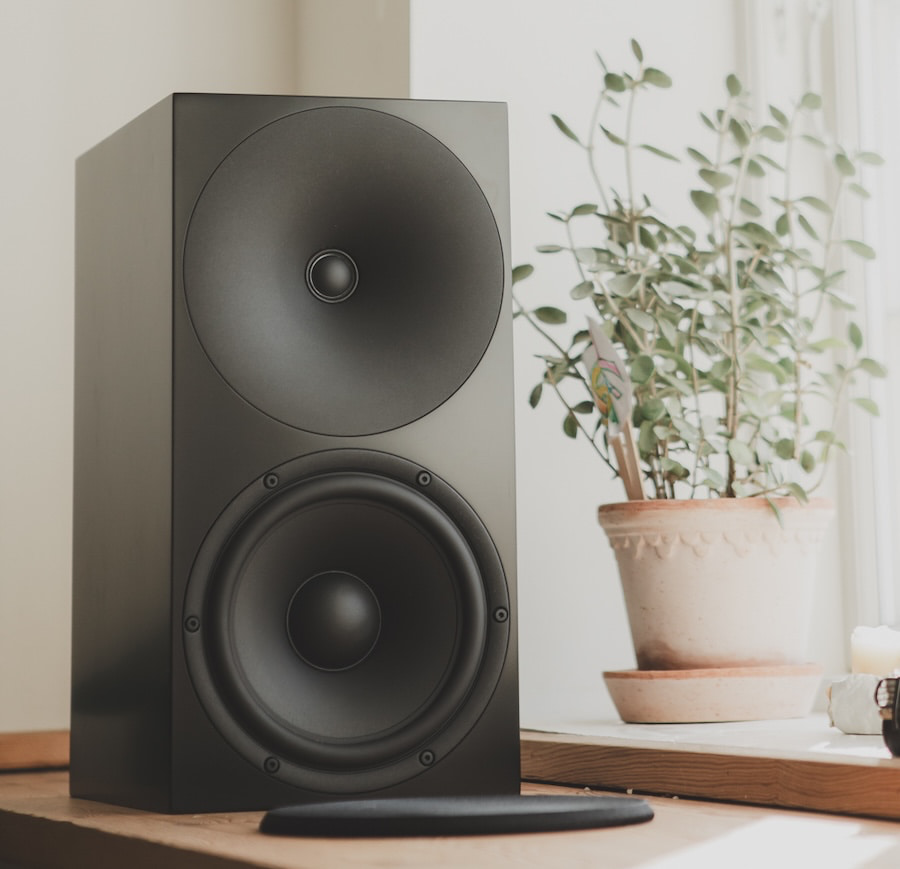
Great loudspeakers come from all corners of the world, and Denmark has produced more than its fair share of them. Buchardt Audio may not have the century long legacy of some of its Nordic neighbors, but the company has built a loyal following over the past decade with a simple formula: compact loudspeakers that deliver a far bigger, fuller sound than their modest size might suggest.
That approach was cemented with the original S400, which we reviewed in 2021 and quickly became one of the most recommended standmount speakers in its class. Buchardt refined the concept shortly thereafter with the S400 MKII, introducing a revised crossover and higher quality internal components, followed by the S400 MKII Signature with further tuning refinements. For 2026, the Danish brand is pushing the platform forward once again with the announcement of the S400 MK3, the next chapter in a design that has been evolving since its first prototype appeared in 2016.
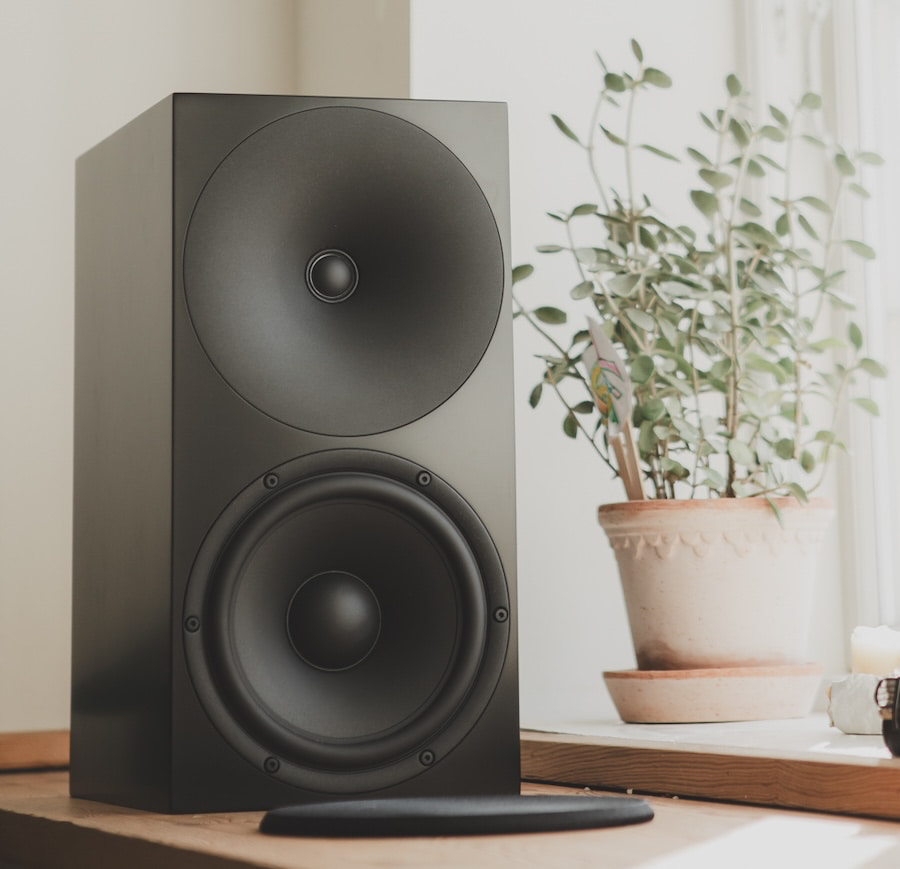
Buchardt Audio S400 MK3: Larger Cabinet, New Drivers, and a Ground Up Redesign
The S400 MK3 represents a significant redesign of Buchardt’s most recognizable loudspeaker platform. The new model introduces a larger cabinet, newly developed drivers, improved treble resolution, and greater dynamic capability, while aiming to preserve the balanced and natural presentation that helped define the earlier S400 models. According to Buchardt, almost nothing from the previous S400 generation carries over to the MK3, with the exception of the speaker binding posts.
One of the most visible changes with the S400 MK3 is the increase in cabinet size. Buchardt has expanded the internal volume by roughly 18 percent, giving the designers more room to extend low frequency performance and increase overall dynamic headroom. Despite the added volume, the company says the cabinet retains the clean proportions and minimalist aesthetic that made the original S400 such a recognizable design.
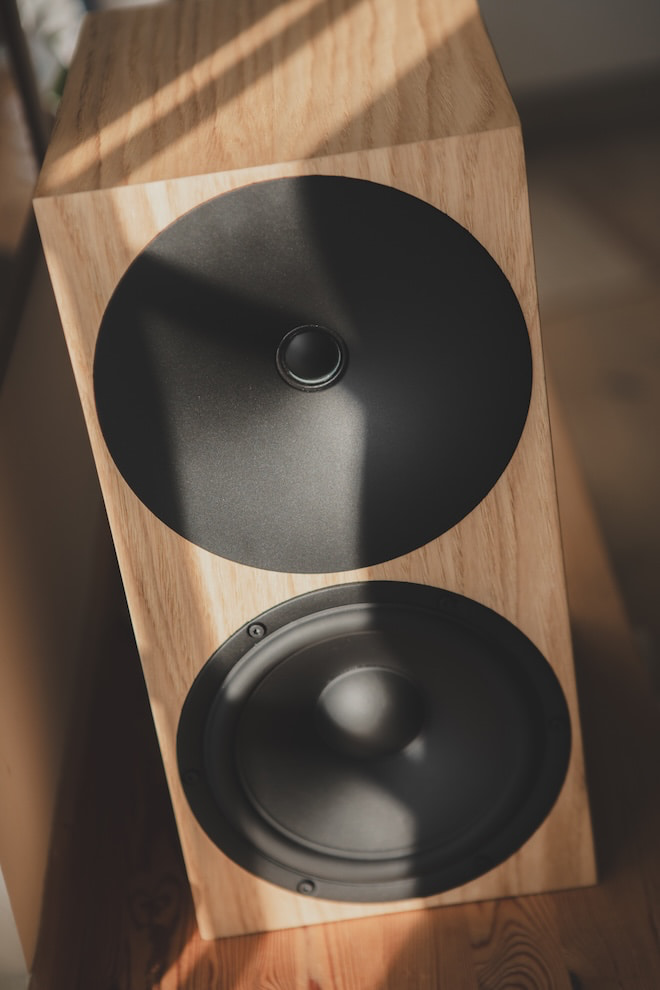
S400 MK3 Tweeter: New 26 mm Aluminum Dome with Custom Waveguide
The S400 MK3 features a newly developed 26 mm (1.02-inch) aluminum dome tweeter paired with a redesigned waveguide. Rather than chasing extra brightness or exaggerated top end energy, Buchardt focused on improving refinement and perceived resolution.
The goal was greater clarity and treble detail while maintaining the smooth, natural presentation that has defined the S400 series. According to the company, the new tweeter and waveguide combination helps deliver more precise high frequency dispersion and improved integration with the midbass driver, without introducing listening fatigue.
S400 MK3 Woofer: 7.5-Inch SB Acoustics Driver with Satori PAPYRUS Cone
At the core of the S400 MK3 is a 7.5-inch woofer sourced from SB Acoustics, built around the company’s Satori PAPYRUS paper cone technology. Compared with the driver used in the S400 MKII, the new unit offers 65.5 percent greater displacement headroom, giving the MK3 significantly more room to move air.
The result is increased dynamic capability, stronger bass authority, and more physical impact from a standmount speaker that still maintains relatively compact proportions. Combined with the 18 percent increase in cabinet volume, the new woofer gives the S400 MK3 greater low frequency extension and overall scale than previous versions of the design.
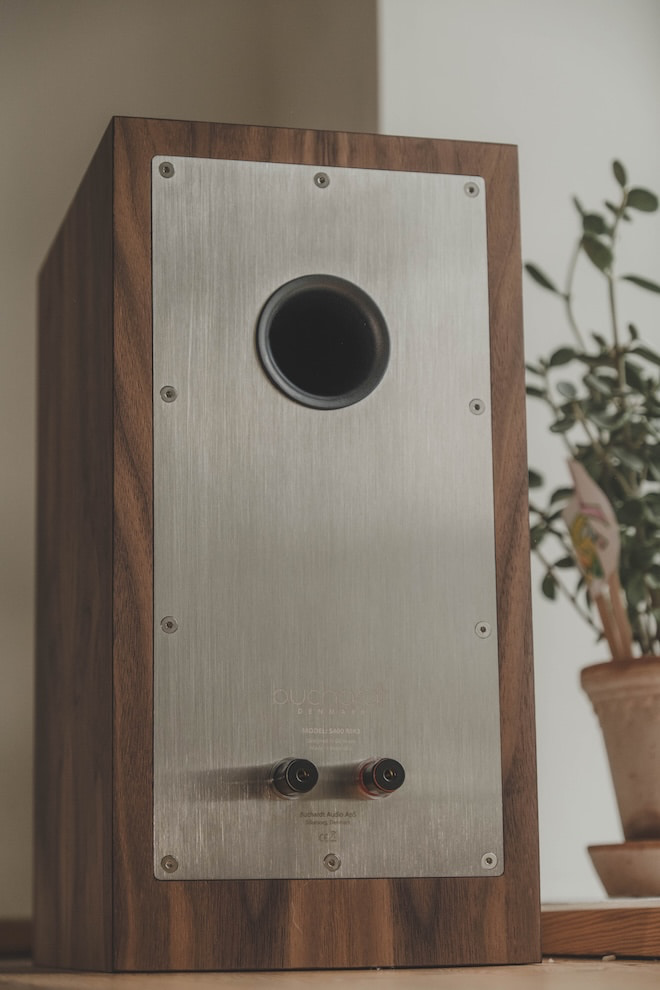
S400 MK3 Bass System: Rear Port Replaces the Passive Radiator
Rather than continuing with the passive radiator used in earlier S400 models, the S400 MK3 adopts a rear mounted portand a traditional bass reflex design. The change allows Buchardt to deliver bass that remains tight, extended, and powerful while taking advantage of the larger cabinet and higher displacement woofer.
The trade off with any ported design is the possibility of minimal port noise under very specific conditions, but in normal listening this should remain largely inaudible. Placement remains relatively flexible for a rear ported speaker; Buchardt recommends leaving at least 5 cm (2 inches) of space between the port and the rear wall to ensure proper airflow and consistent low frequency performance.
S400 MK3 Crossover: Simplified Network with Premium Jantzen Components
Buchardt continues its partnership with Jantzen Audio for the S400 MK3’s crossover network. The updated design uses premium components throughout the signal path but adopts a somewhat simpler topology than the network used in the previous S400 MKII.
The new crossover employs first order filters, a design choice often associated with improved phase coherence and a more natural integration between drivers. While simpler in layout, the network still relies on high quality components to maintain the tonal balance and musical flow that have defined the S400 platform.
Comparison
| S400 MK3 (2026) |
S400 MKII Signature Edition (2023) |
S400 MKII (2021) |
S400 (2019) |
|
| Product Type | Bookshelf Speaker | Bookshelf Speaker | Bookshelf Speaker | Bookshelf Speaker |
| Price (Pair) | $2400 | $2,850 | $2,400 | $1,833 |
| Operating Principle | 2-way passive bass reflex system | 2-way passive radiator system | 2-way passive radiator system | 2-way passive radiator system |
| Tweeter | 1″ Waveguided custom aluminum dome with neodymium matrix motor | 0.74″ Custom fine weave soft fabric textile with CDC aluminum waveguide | 0.74″ Custom fine weave soft fabric textile with CDC aluminum waveguide | 0.74″ Custom fine weave soft fabric textile with CDC aluminum waveguide |
| Mid / woofer | 7.5” SB Acoustics Satori PAPYRUS™ paper cone with | 6″ Linear long stroke paper cone | 6″ Linear long stroke paper cone | 6″ Aluminum cone with break-up optimization |
| Passive Radiator | – | 5×8″ Long stroke passive radiator | 5×8″ Long stroke passive radiator | 5×8″ Long throw passive radiator with very low mass added |
| Port | Yes | – | – | – |
| Impedance | 4 ohms | 4 ohms | 4 ohms | 4 ohms |
| Sensitivity | 88 dB | 87 dB | 87 dB | 87 dB |
| Frequency response +/- 3dB (in-room) | 33 – 20,000 Hz | 33 – 40,000 Hz | 33 – 40,000 Hz | 33 – 40,000 Hz |
| Crossover Point | 2400hz | 1800hz | 1800hz | 2000hz |
| Power Recommendation | From 30 watts – Upper limit depends on use case, please contact Budchart for recommendations. | 40 – 200 W | 40 – 200 W | 40 – 200 W |
| Dimensions (HWD) | 392 x 198 x 280 mm (15.4” x 7.8” x 11”) |
365 x 180 x 280 mm (14.4” x 7” x 11”) |
365 x 180 x 280 mm (14.4” x 7” x 11”) |
365 x 180 x 240 mm (14.4” x 7” x 9.4”) |
| Weight (each) | 8.5 kg | 7.5 kg | 7.5 kg | 9 kg |
| Speaker Grilles | 4 x 7.5″ Included Black acoustical optimized fabric grilles | Included | Included | Included |
| Cabinet | 15mm Fiberboard HMR.E2 Moisture-proof with internal bracing. Either painted or real wood veneered. | 15mm HDF with internal bracing. | 15mm Fiberboard HMR.E2 Moisture-proof with internal bracing. Either painted or real wood veneered. |
15mm Fiberboard HMR (Moisture-proof) with internal bracing |
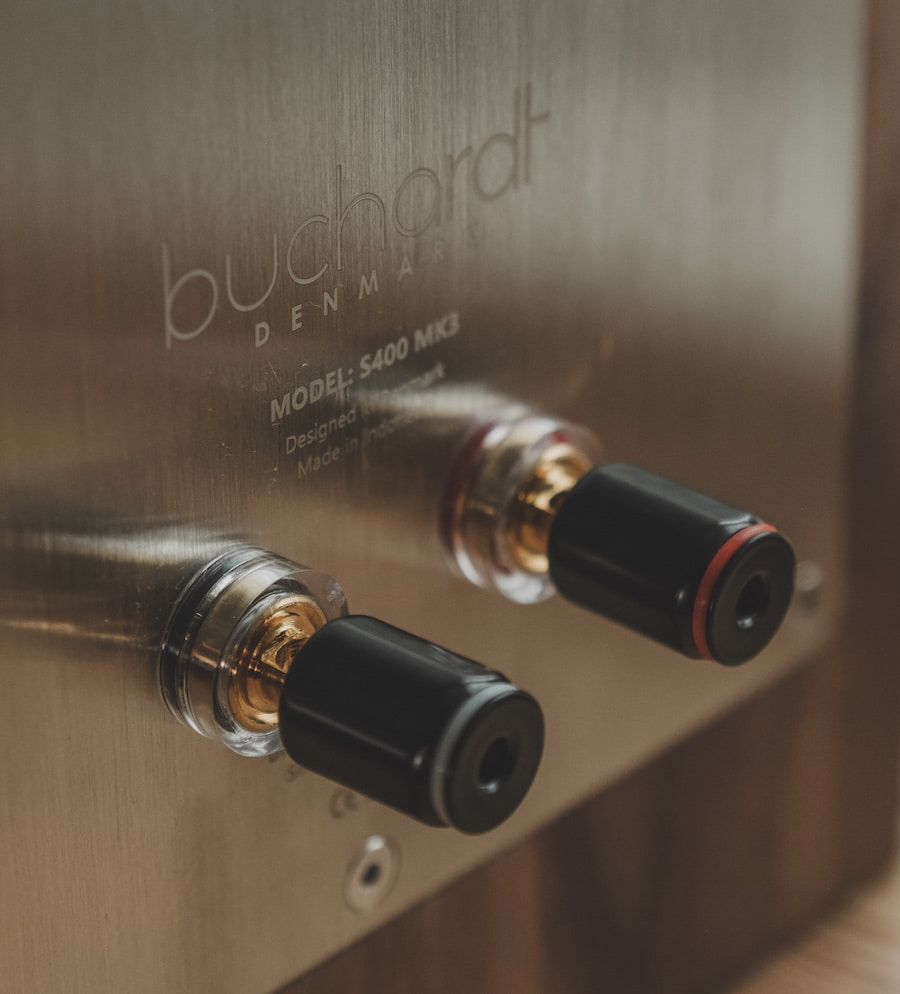
The Bottom Line
The Buchardt Audio S400 MK3 continues a design philosophy that Buchardt clearly believes in: compact standmount speakers engineered to deliver the scale, bass authority, and dynamics normally associated with much larger loudspeakers. With its larger cabinet, higher displacement woofer, new waveguided tweeter, and simplified crossover, the MK3 looks like a meaningful evolution of a platform that has been steadily refined since 2016.
At $2,400 USD per pair, the S400 MK3 enters one of the most competitive segments in the loudspeaker market. Models from KEF, Wharfedale, Paradigm, Acoustic Energy, and Chesky Audio are all fighting for the same buyers looking for high performance from relatively compact cabinets. The S400 MK3’s appeal will likely come down to its reputation for delivering big, room filling sound and strong bass output from a standmount design, making it a compelling option for listeners who want serious scale without moving to floorstanding speakers.
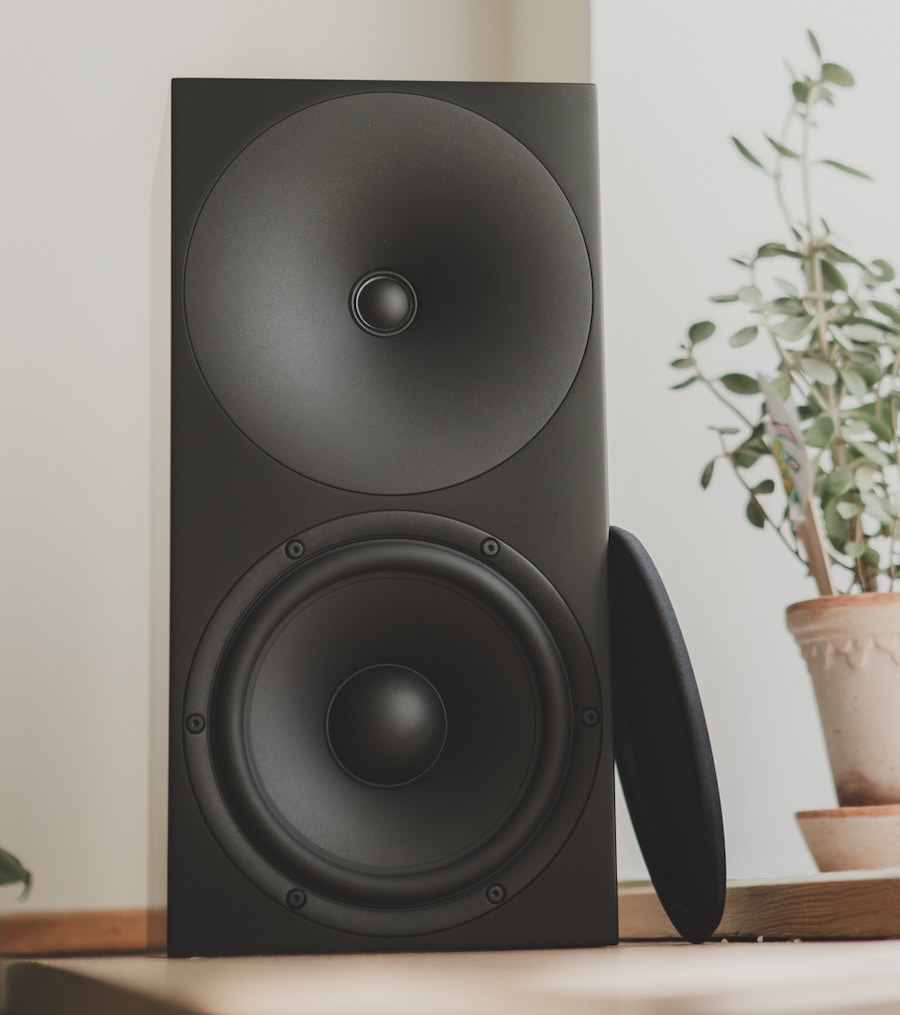
Pricing and Availability
The S400 MK3 is available through Buchardt’s website for pre-order, with 75 pairs offered per finish at the introductory price (see below). Estimated delivery is expected to start by late Summer 2026.
- S400 – $2,400 in black/white or $2,574 in real wood veneer (US)
- S400 – €2,300 in black/white or €2,450 in real wood veneer (EU)
Pre-order now at buchardtaudio.com and save €200.
Related Reading:

Smartphone enthusiasts like me will never forget the time when modular phones were about to change everything. Whether it was Google’s canceled Project Ara or the more popular Moto Z series, nothing really panned out as well as the Fairphone, but even it isn’t as mainstream as some other brands.
So, most users just live with their non-modular smartphones on a day-to-day basis, having already grieved about the idea that once raised plenty of hopes. Well, about that, an upcoming foldable could change that conversation entirely.

What exactly is Xiaomi cooking?
I’m talking about the Xiaomi Mix Fold 5. Early leaks about it suggest that the company is developing a magnetic modular camera system, wherein users should be able to swap, adjust, or upgrade the magnetic camera modules by attaching a better one, or the one that the user wants (via Gizchina).
Essentially, the Mix Fold 5’s magnetic camera module would mimic the interchangeable lenses on professional cameras. If the interchangeable interface actually ships, it could be the most exciting camera hardware on a smartphone in years, or one of the most exciting after Xiaomi’s physical zoom ring on the Xiaomi 17 Ultra.
However, I have a rather hot take about it: shipping a modular camera system (with interchangeable lenses) with a foldable could either be a very smart idea, or a rather complicated idea that would keep the exciting tech from the hands of masses.

Smart idea or a complicated one?
Foldables already come with slightly toned-down camera systems compared to their brand’s conventional flagship (see the differences on the Fold 7 and S26 Ultra). A modular system that sidesteps that limitation entirely could be a clever solution to this problem. On the other hand, foldables don’t sell as much as regular smartphones, and the brand might not get as much attention as the tech deserves.
The silver lining here is that the Chinese smartphone manufacturer isn’t partnering with a third-party lens or camera equipment manufacturing company. The leaks focus on self-developed modular lenses throughout.
However, that is the extent of information we have about the purported smartphone. No confirmed specs, pricing, or launch date yet.
We may receive a commission on purchases made from links.
Few tool brands have managed to build up the same reputation as Milwaukee. Offering a selection of tools for every role on the jobsite, Milwaukee stands out from the pack for a few key reasons, with reliability and overall usability often being strong points. At the moment, power tools are what gets Milwaukee most of the attention, and rightly so. Just about every element is refined in these tools, but there’s one downside: they’re pretty expensive.
Luckily, Milwaukee’s current line of tools spans from end to end, allowing users to enjoy high-quality gear on a budget. Selling primarily at Home Depot, Milwaukee offers a lot of deals, and some of its tools even come in at well below $50. Still, despite being much cheaper than the brand’s power tools, these simple handheld items come with some unique features, making them a better option than some alternatives by rival brands. Here’s a closer look at 12 Milwaukee products under $50 that are worth adding to your tool collection, all of which are targeted at tackling different jobs.
FastBack 6-in-1 Folding Utility Knife
It’s often the case that the most useful tools are the smallest ones in the box, even more so when you can use them in just about every job, which is what makes this first Milwaukee product so valuable. For overall practicality, the FastBack Six-in-One Folding Knife offers incredible value for how little it costs.
From official retailers such as Home Depot, the knife is priced at about $22 at the time of writing. Amazon also sells the product for $22.99, but as the retailer isn’t an official seller of Milwaukee’s products, you’ll struggle to make use of the manufacturer lifetime warranty if you buy it from here. This goes for all Milwaukee products, which is crucial to know before choosing where to buy from.
Alongside the three-inch blade, this tool also includes a screwdriver with Phillips #2 and slotted 1/4-inch bits, a bottle opener, a wire stripper, and a blade holder, to make scoring more accurate. A few more helpful additions include a wire belt clip and a lanyard hole for a little extra portability.
27-in-1 Security Precision Multi-Bit Screwdriver
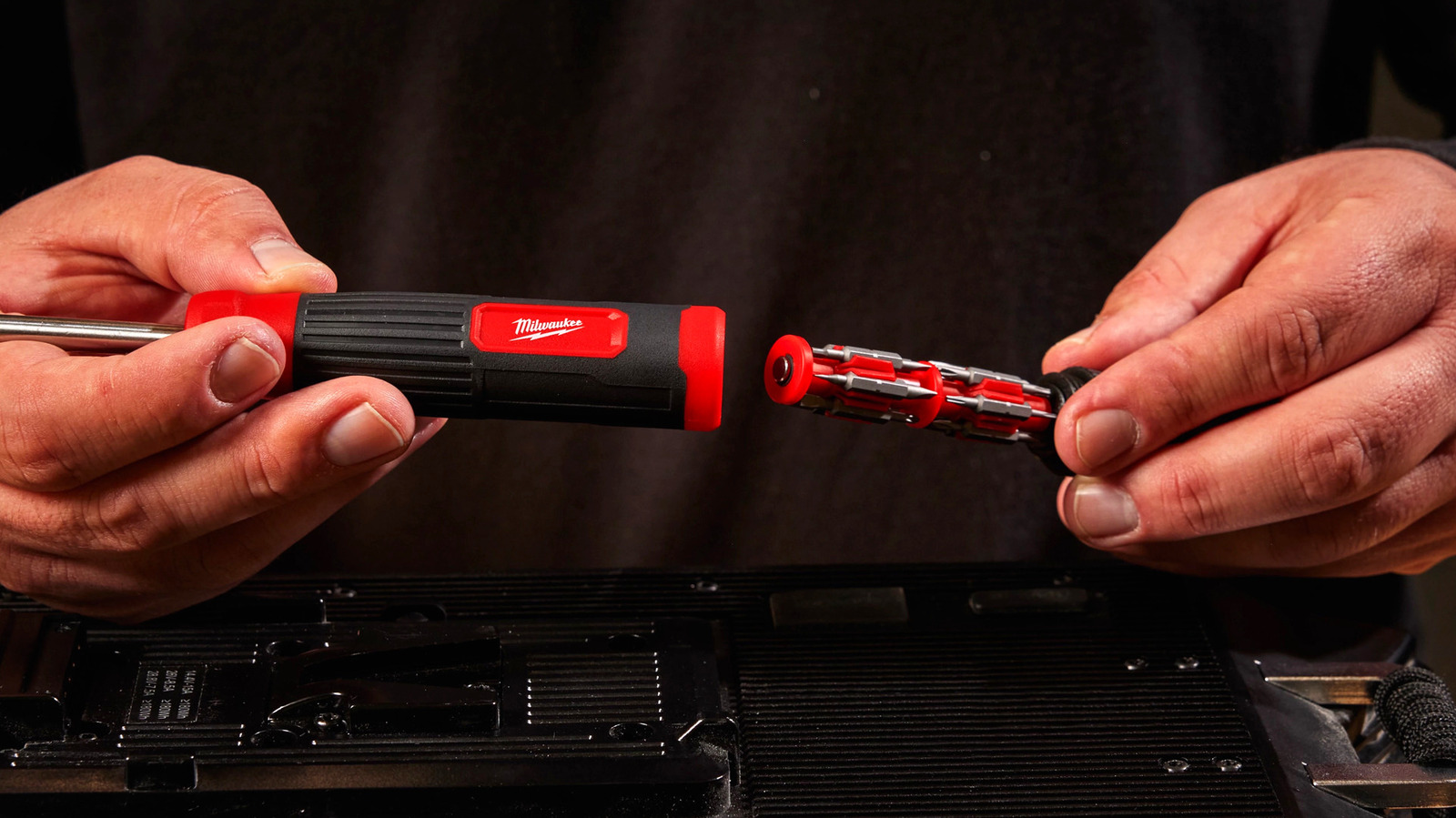
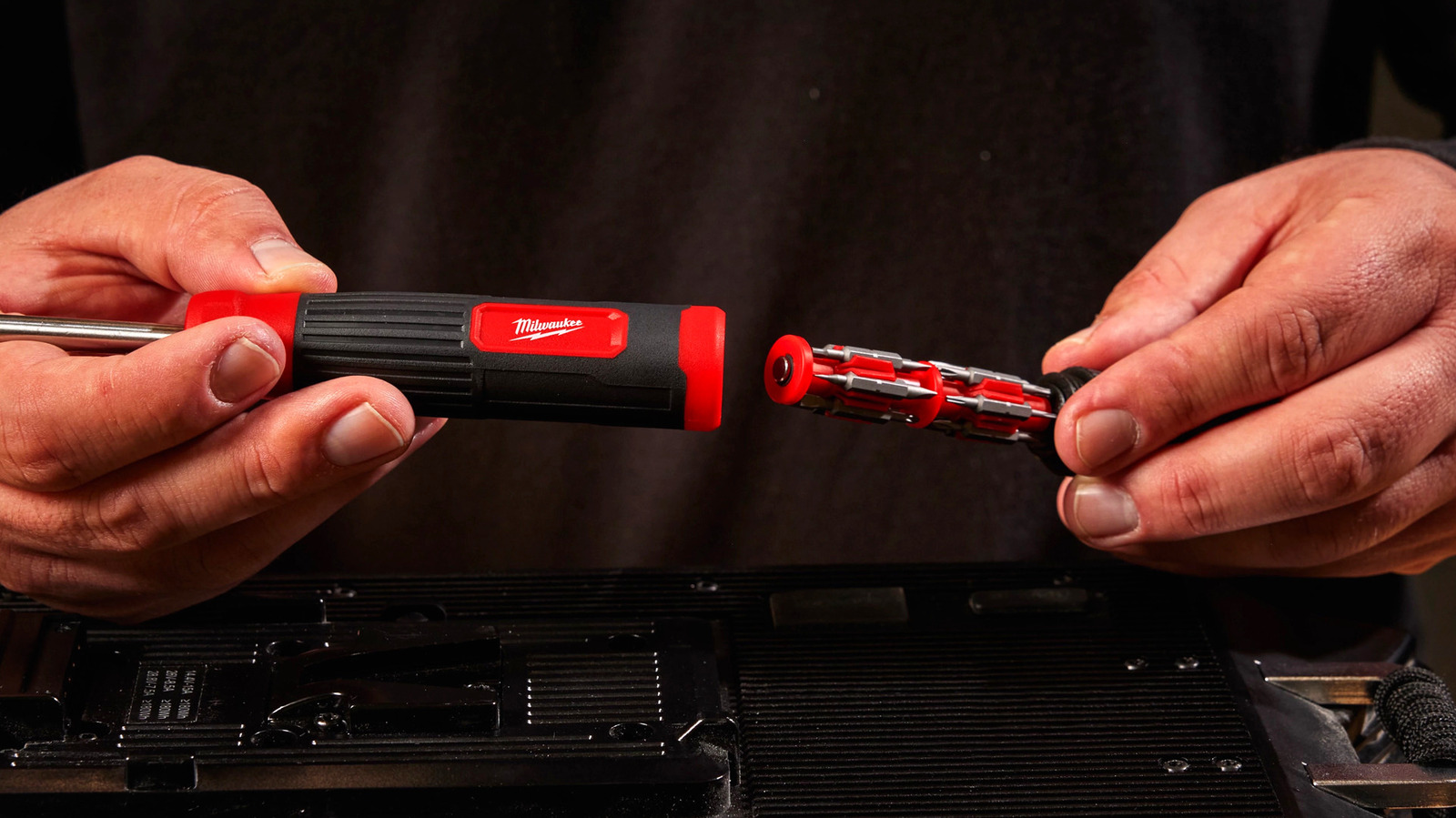
Many of Milwaukee’s hand tools feature a multi-use design, but one of the brand’s products brings it to the next level. The Milwaukee’s 27-in-1 Precision Multi-bit Screwdriver is, ultimately, just a screwdriver, but that doesn’t make that “27” any less practical overall. Whether you’re a full-time tradesperson or take on DIY and repair projects on the side, a high-quality screwdriver is a must-have for a home-focused toolkit.
As is the case with the majority of Milwaukee’s tools, the 27-in-1 security precision screwdriver can be purchased at Home Depot, one of the brand’s official retailers. The bits include a variety of Phillips, slotted, hex, and torx bits, as well as a 3.5mm nut driver to cover larger hex screws. Reviews are generally great for this screwdriver, sitting at an average of 4.3 out of five stars from 162 reviews. Owners frequently praise the versatility offered, specifically for tackling tiny screws in smaller tech gadgets.
Long Needle Nose Pliers
This next product can go hand-in-hand with the precision tools on a variety of projects. If you often find yourself needing a tool for electrical work to grab wires and cables that are impossible to reach by hand, purchasing Milwaukee’s Long Needle Nose Pliers can streamline so many different types of builds and fixes for not much money at all. Out of the needle-nose pliers Milwaukee sells, the eight-inch pair offers great value-for-money, as it’s currently priced at around $23 from Home Depot.
These are, essentially, standard needle-nose pliers, but they also come with a wire cutter and a fish tape puller above the grip. This specific model has a textured grip, which allows for a better grasp. It also has reaming heads on the edge of the cutters for extra versatility, which removes the need for a dedicated conduit reamer. This is one of the simplest handheld tools featured on the list, but it can prove to be one of the most important, if electronics are your focus.
Magnetic I-Beam Level
Ensuring things are level can be one of the most irksome aspects of any task. Eyeballing it can’t give you a guarantee, even if you’re confident you’ve nailed it on the first try. A magnetic level isn’t a tool that’ll help you directly with fixing, fitting, and everything in between, but knowing the components are exactly where they’re supposed to be will give you much-needed peace of mind for any project.
Different projects require levels varying in size, and in particular, full-length levels can be too big for smaller jobs. Luckily, Milwaukee has a wide range of magnetic I-Beam levels available, many of which are priced under the $50 mark. Some of the largest ones, like the 78-inch, cross the line, as does the higher-quality RedStick line of levels. However, Home Depot has 24-inch and 48-inch I-Beams for $33 and $43, respectively. Milwaukee says that these levels can provide an accuracy of 0.0005 inches and are built specifically for site work, thanks to their aluminum frame. It’s safe to say it’ll get the job done at home as well.
Smooth Face Hammer
The hammer is another tool that goes into the must-have category for any household, but not all hammers can be used for the same tasks. With dozens of types available, it’s crucial to use the correct hammer, both to remove the risk of damage to certain materials and to ensure you’re actually getting the job done. Milwaukee’s Smooth Face Hammer is one of the most well-reviewed on Home Depot, with over 1,000 reviews averaging out at 4.7 out of five stars for the different sizes.
One of the main uses of smooth-faced hammer is in woodworking, since other types of hammer can ruin delicate woods. Unsurprisingly, many of the reviews for the smooth-faced version of the hammer praise its delicacy when driving nails, preventing damage. Weights for this hammer range from 16 ounces to 22 ounces, then a jump to 28 ounces as the heaviest option. All of them come with neat features like the magnetic nail holder for even more accuracy, as well as the anti-ring claw on the back of the head. Pricing comes in at $28 for the lightest hammer.
4-1/2 Inch Metal Trim Square
Another tool that can streamline the woodworking process is Milwaukee’s metal square trim. While it can be used to gather simple measurements throughout the home, its main strengths are in making precise markings for woodworking projects, making it yet another Milwaukee tool to fast-track your work without sacrificing quality.
We especially like the smaller 4.5-inch trim square. Milwaukee markets this tool as an everyday carry item, since it’s an ideal size to have on a tool belt for on-the-go measurements. If you don’t often require a belt, though, Milwaukee says it should fit in your pocket pretty easily. Despite being smaller than other squares in Milwaukee, you still get laser-etched markings, precision scribe notches, and a dual reference heel to make sure you can still use it on projects of varying dimensions. Home Depot sells the tool for approximately $15, and 92 percent of the 1,400 reviewers would recommend it, often citing versatility as their favorite feature.
Compact Hack Saw
A common theme you may have noticed with these Milwaukee products is that many are smaller versions of already-popular tools that can be used throughout the home. The next of these on this list is the compact hack saw. Despite the tool being so simple, it comes with a few key features that separate it from others in the segment. It’s also another budget product from Milwaukee that’s as useful for home improvement as it is affordable.
Retailer Home Depot has this tool available for around $18 for the smaller 10-inch saw. The blade itself is constructed with bi-metal, making it effective at cutting different plastics and woods, both of which you’ll find just about everywhere in home interiors. The highlight feature for this specific saw, however, is Milwaukee’s claim that you can change blades ten times faster than a standard hacksaw, being able to use any standard 10-inch blade. If you need a slightly bigger one, Home Depot also sells a 12-inch blade that follows a more traditional design style, but loses out on the fast-changing blade ability.
Torque Lock Locking C-Clamp
This next tool was already massively popular before getting some much-welcomed features courtesy of Milwaukee, to make it even more effective in its role. This time, we turn to the brand’s very well-reviewed 11-inch Torque Lock Locking C-Clamp, which comes with Milwaukee’s torque lock thumb screw design, allowing for a much stronger overall grip from the alloy steel jaws. To ensure it’s secure, you can use a secondary tool, such as a screwdriver, to rotate the thumb screw with more strength.
Priced at $27 when buying through Home Depot, this locking C-clamp is more than enough useful to earn its price tag if you spend a lot of time working with wood or metal. Milwaukee made sure to allow the jaws to grip over surfaces 4 inches wide. The regular jaws will be the best option for flat pieces of material, but if you’ll be working with angles, Milwaukee also offers its locking C-clamp with swivel jaws, which also have a slightly wider width of four inches. They’re a little more expensive, at about $30, but well worth it for a solid hold on tapered materials.
Compact 25-Foot SAE Tape Measure
Back to Milwaukee’s measuring tools, it’s no surprise to see the brand offer one of the most well-equipped, sturdy tape measures on the market. The Compact 25-feet Tape Measure version should allow you to get most measurements with pinpoint accuracy without spending much money at all. Home Depot sells two versions of this tape, a 16-foot one and a larger 25-foot model. When it’s in stock, the smaller tape measure usually sits at around $10, whereas the larger version is priced at around $17.
As is often the case with its tools, Milwaukee reinforced this tape measure to make it a good choice for jobsites, all without taking up too much space in the bag. The steel belt clip also helps a ton with that. Both models have a reach (not to be confused with full size) of 12 feet, which is ideal for gathering accurate measurements for hard-to-reach places. The blade uses fractional SAE measurements and is finished with a lacquer coating to protect it from the elements. For as little as $10, Milwaukee does its best to ensure you get your money’s worth here.
Electrician’s SAE Folding Hex Key Set
Diving further into a specific trade for this next product, Milwaukee’s folding hex key set is a must-have tool for electricians. So many different gadgets and appliances require a hex key to unscrew and re-tighten the socket head caps and perform similar jobs, making hex keys essential. Milwaukee solves the problem of misplacing or losing the single hex key sizes in your kit by offering sets with 8, 9, 11, 16, 17, and 25 different keys available.
The Electrician’s SAE Folding Hex Key Set is designed for quick access, and the keys are extra long, for added ease of use. You’ll also be able to rotate them by up to 270 degrees. The handle of the tool is not overlooked, being designed to be as comfortable as possible when using force, while keeping the keys secure. More subtle features that are equally helpful include the chamfered key ends for smoother insertion, helping the tool to earn its exceptional rating of 4.8 stars. Going for the larger options means getting your keys in more than one holder, but even the 25-piece, three-kit set comes in at around $45 at Home Depot.
Adjustable wrench
While there’s a strong chance that you already have and adjustable wrench lying around, Milwaukee yet again adds a few key features to separate its version from the rest of the market. Home Depot has five different sizes available for this tool, with the smallest coming in at six inches and the largest at 15 inches. The latter may be found for at or just below $50, depending on your location.
The main selling point for Milwaukee’s adjustable wrench is no doubt the proprietary adjustment screw, meant to ensure that the jaws remain firmly gripped. You can also use the laser-etched ruler to find the best position for the jaws. The handle is specifically designed for comfort, meaning extended use of the wrench shouldn’t cause lots of strain. Customer reviews answer whether it’s worth it, with 97% being the lowest recommendation average for the five options.
Drive Ratchet
To finish off this list, we’ve chosen another widely used tool that can make a huge difference when adding to your collection. Screwdrivers and nut drivers can often get the job done with easy-to-reach fasteners, but a fair few jobs require you to get into incredibly tight spaces that standard tools simply can’t reach. This is where a tool like Milwaukee’s Drive Ratchet comes in. For a mechanic’s tool kit, having a solid connection to hidden bolts and retaining a strong grasp at all times is paramount. Milwaukee doesn’t break the mold with this tool as much as others, but that doesn’t make it any less effective.
Milwaukee’s drive ratchet has a few different variations available, with 1/4-inch, 3/8-inch, and 1/2-inch drive sizes available. There’s also a selection of handle lengths to pair them with, but combining larger sizes can push the price well above $50. To stay under that limit, the 3/8-inch drive with the 8.5-inch handle will be the largest you can go. No matter which one you go for, you’ll get the 90-tooth design with a four-degree arc swing, with a slim build for maximum usability.
Methodology
To select the tools on this list, we looked at various outlets such as Home Depot to ensure you can actually buy these tools for under $50. Then, we made sure that the chosen tools had plenty of great user reviews, with each reaching at least a four stars average. Each tool featured here had at least 100 reviews overall on Home Depot.


Raquel Urtasun has spent 16 years in the self-driving space, long enough to navigate every metaphorical glorious hill and plunging valley. She took the trip from the early “pipe dream” dismissals, to the “we’re this close” certainty, and back again.
The industry is now riding a new wave of optimism and investment, including at Waabi Innovation Inc., the autonomous trucking company that Urtasun founded in 2021. The Spanish-Canadian professor at the University of Toronto, and former chief scientist of Uber’s Advanced Technologies Group, has helped make Waabi a key player. Beginning in fall 2023, theToronto-based startup has been running geofenced cargo routes from Dallas to Houston in a fleet of retrofitted Peterbilt semis, navigating even residential streets in loaded, 36,000-kilogram (80,000-pound) behemoths with a human “safety observer” on board.
In October, the company reached a milestone by integrating its “Waabi Driver” physical-AI system in Volvo’s new VNL Autonomous truck, which the Swedish automaker is building in Virginia. That self-driving solution uses Nvidia’s Drive AGX Thor, an AI-based platform for autonomous and software-defined vehicles.
In January, the Toronto-based startup raised $750 million in its latest funding round to accelerate commercial development in autonomous trucking, and expand its system into the fiercely competitive robotaxi space. Backers include Khosla Ventures, Nvidia, and Volvo.
Urtasun says the Waabi Driver can scale across a full range of vehicles, geographies and environments—although snowstorms can still create a no-go zone for now. It’s powered by what Urtasun calls the industry’s most advanced neural simulator. The verifiable, end-to-end AI model will be a “shared brain” that partners can transplant into cars, trucks, and pretty much anything on wheels. The idea is to grab a chunk of a global autonomous trucking business that McKinsey estimates could be worth more than $600 billion a year by 2035; with autonomous haulers responsible for 15 percent of total U.S. trucking miles as early as 2030.
Backed by an additional $250 million from Uber, Waabi plans to deploy at least 25,000 autonomous taxis through Uber’s ride-hailing service, whose world-dominating reach encompasses 70 countries, about 15,000 cities and more than 200 million monthly users.
Urtasun spoke with IEEE Spectrum about how Waabi is counting on sensors and simulation to prove real-world safety; and why the move to autonomy is a moral imperative that outweighs the disruption for human drivers—whether they’re driving trucks or family sedans. Our conversation was edited for length and clarity.
IEEE Spectrum: Until quite recently, autonomous tech seemed to have hit a wall, at least in the public’s mind. Now investors are flooding the zone again, and companies are all-in. What happened?
Raquel Urtasun: There were a lot of empty promises, or [people] not realizing the complexity of the problem. There was a realization that actually, this problem is harder than people anticipated. It’s also because of the type of technology that was developed at the time, what we call “AV 1.0”. These are hand-engineered systems that need to be brute-forced by humans. You need lots of capital and a massive amount of miles on the road just to get to the first deployment.
What you see with the next generation—AV 2.0 and systems that can reason—is that you finally have a solution that scales. When we started the company, this was a very contrarian view. But today, the breakthroughs in AI have made it clear that this is the next big revolution. It’s not just about more compute; it’s about building a brain that can generalize. That is the “aha moment” the industry is having now.
Even for someone who believes in the tech, seeing a driverless semi-trailer in your rear-view mirror might be unsettling. Now you’ve integrated your tech into the aerodynamic, diesel-powered Volvo VNL Autonomous truck. How do you convince regulators and the public that these trucks belong on the street?
Urtasun: Safety, when you think about carrying 80,000 pounds on this massive rig, is definitely top of mind. We believe the only way to do this safely is with a redundant platform that is fully developed and validated by the OEM, not with a retrofit. The OEM does a special type of truck that has all the redundant steering, power, and braking, so that no matter what happens, there is always a way we can interface and activate that truck in a safe manner. Then we are responsible for the sensors, the compute, and obviously the brain that drives those trucks.
AI’s Impact on Trucking Jobs
One of the biggest points of contention is the displacement of human drivers. As AI disrupts a range of workplaces, how do respond to people who say this will eliminate good-paying, blue-collar jobs?
Urtasun: The way we see this is that everybody who’s a truck driver today, and wants to retire as a truck driver, will be able to do so. This is physical AI; this is not like the digital world where suddenly you can switch immediately to this technology. That adoption and scaling is going to take time. There will also be many jobs created with this technology; remote operations, terminal operations, and other things. You have time to change the form of labor of being on the road, which is for weeks at a time—and it’s a really difficult and dehumanized job, let’s be honest—to something you can do locally. There was an interesting [U.S.] Department of Transportation study that showed because of this gradual adoption, there will be more jobs created than actually removed.
You’ve spoken about a personal motivation behind this. Why do you believe the advantages of autonomy outweigh any growing pains, including the potential for unexpected accidents or even deaths?
Urtasun: There are 2 million deaths on the road globally per year, and nobody’s questioning that. That’s the status quo. If you think the machines have to be perfect to deploy, you are actually sacrificing many humans along the way that you could have saved. Human error in accidents is between 90 percent and 96 percent. Those could be preventable accidents. Some accidents will always be unavoidable; a tire could blow for a machine the same as it could for a human. But the important comparison is how much safer we are. This technology is the answer to many, many things.
Most of the industry is focused on “hub-to-hub” highway driving. But you’ve argued that Waabi’s AI can handle the complexity of local streets.
Urtasun: The rest of the industry has gone with this business model where you need hubs next to the highway. This adds a lot of friction and cost. Thanks to our verifiable end-to-end AI system, we can drive in surface [local] streets. We can do unprotected lefts, traffic lights, and tight turns. These core capabilities enable us to drive all the way to the end customer. We are already hauling commercial loads for customers like Samsung through our Uber Freight partnership.
You’ve mentioned that Waabi doesn’t like to talk about “number of miles” driven as a metric. For an engineering audience, that sounds counterintuitive. How does your “simulation-first” approach replace the need for real-world road time?
Urtasun: In the industry, miles have been used as a proxy for advancement. How many miles does Tesla need to drive to see any of these situations? But we are a simulation-first company. Waabi World can simulate all the sensors, the behaviors of humans, everything. It is the only simulator where you can mathematically prove that testing and driving in simulation is the same as driving in the real world. You can expose the system to billions of simulations in the cloud. This is what allows us to be so capital efficient and fast.
Verifiable AI vs. Black Box Systems
What is the difference between your “interpretable” AI and the “black box” systems we see elsewhere?
Urtasun: We’ve seen an evolution on passenger cars for level– 2+ systems to end-to-end, black box architectures. But those are not verifiable. You cannot validate and verify those systems, which is a massive problem when you think about regulators and OEMs trusting that technology.
What Waabi has built is end-to-end, but fully verifiable. The system is forced to interpret what it is perceiving and use those interpretations for reasoning, so that it can understand the consequences of every action. It is much more akin to how our brain actually works; your “Type 2” thinking, where you start thinking about cause and effect and consequences, and then you typically do a much better choice in your maneuver.
Tesla is famously, and controversially, relying on camera data almost exclusively to run and improve its self-driving systems. You’re not a fan of that approach?
Urtasun: We use multiple sensors: lidar, camera, and radar. That’s very important because failure modes of those sensors are very different and they’re very complementary. We don’t compromise safety to reduce the bill- of- materials cost today.
Those (passenger car) level-2+ systems are not architected for level 4, where there’s no human on board. People don’t necessarily realize there is a huge difference in terms of the bar when there is no human to rely on. It’s not, “Well, if I don’t have a lot of system interventions, I’m almost there.” That’s not a metric. We are native level 4. We decide which areas the system can drive in, and in what conditions. We are building technology that can drive different form factors—trucks or robotaxis—with the same brain.
Editor’s note: This article was updated on 13 March to correct an error in the original post. Contrary to what was stated in the original post, the trucks being driven from Dallas to Houston do have a human observer on board.
From Your Site Articles
Related Articles Around the Web


In October 2025, Atlassian co-founder and CEO Mike Cannon-Brookes appeared on the 20VC podcast and said something that now reads rather differently. Technology creation, he argued, is ‘not output-bound.’ Atlassian would employ more engineers in five years, not fewer. They would just be more efficient.
On 11 March 2026, Mike Cannon-Brookes sent a memo to staff announcing 1,600 redundancies, approximately 10% of the company’s global workforce, framed as a necessary adaptation to the AI era.
The same week, the company’s shares had lost more than half their value since January, swept up in a sector-wide rout that traders have been calling the ‘SaaSpocalypse’: a sustained selloff in enterprise software stocks driven by investor fears that AI agents could make conventional SaaS tools obsolete.
The stated rationale in the memo was future-facing. Atlassian said the cuts would allow it to ‘self-fund further investment in AI and enterprise sales, while strengthening our financial profile.’ Cannon-Brookes was careful in his framing.
“Our approach is not ‘AI replaces people.’ But it would be disingenuous to pretend AI doesn’t change the mix of skills we need or the number of roles required in certain areas. It does. This is primarily about adaptation. We are reshaping our skill mix and changing how we work to build for the future.”
More than 900 of the affected roles are in software research and development, according to reporting from Implicator.ai.
By geography, North America bears the largest share, 40% of cuts, or around 640 people, followed by Australia at 30% (roughly 480), and India at 16% (around 250). The remainder is spread across Japan, the Philippines, and offices across Europe, the Middle East, and Africa. Atlassian filed a WARN notice in Washington state showing 63 affected workers, the majority of them remote employees in engineering and data science roles.
Departing employees will receive a minimum 16-week separation package, with one additional week per year of service, a pro-rated FY26 bonus, a $1,000 technology payment, and six months of extended healthcare coverage.
The restructuring is expected to cost between $225 million and $236 million in total charges, split between severance ($169–174 million) and office space reductions ($56–62 million), with most costs landing in the company’s third fiscal quarter. Atlassian said the cuts should be largely complete by the end of June 2026.
Alongside the layoffs, Atlassian confirmed that Rajeev Rajan will step down as chief technology officer on 31 March, after nearly four years in the role. Rajan, previously a VP of engineering at Meta and a two-decade veteran of Microsoft, has not publicly commented on the departure.
The company described it as a generational transition: two executives, Taroon Mandhana and Vikram Rao, will split the CTO responsibilities going forward. Mandhana, formerly Atlassian’s head of engineering for AI and products, takes the title of CTO Teamwork; Rao, previously chief trust officer, becomes CTO Enterprise and Chief Trust Officer. Atlassian described both as ‘next generation AI talent.’
The restructuring sits in some tension with Atlassian’s underlying trading performance. The company reported cloud revenue of approximately $1.067 billion in its most recent quarter, up 26% year on year. Remaining performance obligations, a forward indicator of contracted future revenue, stood at roughly $3.814 billion, up 44%.
Its Rovo AI assistant crossed five million monthly active users in February, and the company now counts more than 600 customers generating over $1 million in annual recurring revenue.
Atlassian reaffirmed its full-year financial guidance for the fiscal year ending June 2026 in the same SEC filing that disclosed the cuts.
That combination, strong operational metrics, healthy forward revenue, and 1,600 redundancies, has sharpened scrutiny of what is actually driving these decisions across the industry.
OpenAI CEO Sam Altman described the practice of using AI as justification for cuts made for other reasons as ‘AI washing’ in February, noting that fewer than 1% of 2025 job losses could be directly attributed to artificial intelligence.
Atlassian is not alone in the pattern.
Block cut roughly 4,000 employees last month as Jack Dorsey declared a shift to an ‘intelligence-native’ model, and the stock jumped the day after the announcement. WiseTech Global, another Sydney-based software firm, announced 2,000 cuts over two years. Oracle said AI was enabling it to shrink some development teams.
By early March 2026, tech layoffs globally had surpassed 45,000, according to RationalFX, with AI among the most frequently cited justifications. Whether the technology is genuinely driving workforce changes or serving as a convenient explanation for restructuring decisions shaped primarily by investor pressure is a question that has no clean industry-wide answer, and that Atlassian’s own numbers make harder, not easier, to resolve.
Atlassian has been unprofitable since 2017. Its shares were down around 33% for 2025 before the SaaSpocalypse selloff, and have fallen more than 84% from the peak they reached in 2021 during the pandemic-era surge in cloud-based collaboration tools.
The stock rose around 2% in after-hours trading following the restructuring announcement, the same market logic that rewarded Block, and that Cannon-Brookes might have had in mind when he wrote, with notable precision, about the bar for what ‘great’ looks like for software companies having gone up.

Google is rolling out one of the biggest updates to Google Maps in years, powered by its Gemini AI models.
The changes introduce a new conversational feature called Ask Maps. There is also a redesigned navigation experience that Google says is its largest driving upgrade in more than a decade.
Ask Maps turns the app into something closer to a travel assistant than a traditional map. Instead of searching for individual places, users can ask natural questions such as where to charge a phone nearby without waiting in line. Or, for genuine convenience, users can ask where to find a public tennis court with lights at night. Maps then responds conversationally, showing recommendations directly on the map.
The system pulls information from more than 300 million places and reviews from a community of over 500 million contributors. Google says responses are also personalised using past searches and saved locations. This helps surface more relevant suggestions when planning meetups, trips, or spontaneous outings.
Once a destination is chosen, the app makes it easy to turn suggestions into plans. Users can save locations, share them with friends, or jump straight into directions and reservations from within the same interface.
Alongside the conversational features, Google is also introducing Immersive Navigation, a major visual overhaul designed to make driving easier to follow. Routes now appear in a more detailed 3D view and they highlight buildings, overpasses, lanes, crosswalks, traffic lights and stop signs. As a result, drivers can better understand what’s coming up ahead.
The update also improves how Maps handles route changes. Drivers will now see clearer explanations for alternative routes, such as choosing between a faster toll road or a slower route with less traffic. In addition, real-time alerts for disruptions like crashes and roadworks will continue to be powered by millions of daily contributions from the Maps community.
Google is also refining the final stage of navigation. As you approach your destination, Maps can highlight building entrances, nearby parking spots and the correct side of the street to approach from. This helps drivers avoid that last-minute confusion when arriving somewhere new.
Ask Maps is rolling out now in the US and India on Android and iOS, with desktop support arriving later. Meanwhile, Immersive Navigation is launching across the US first and will expand to more regions and platforms. This will include CarPlay, Android Auto and cars with Google built-in — over the coming months.
Ever had one of those mornings where your hair simply refuses to cooperate, leaving you wrestling with frizz or uneven strands while the clock keeps ticking before work, school, or a night out?
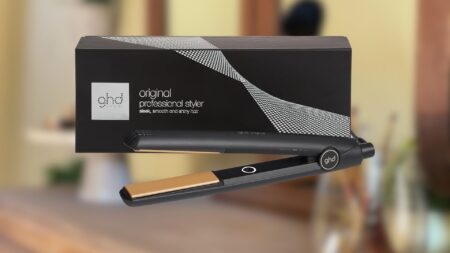
That is why this current deal is worth noticing, with the ghd original hair straightener & styler now £103.97 instead of its usual £149 retail price, bringing a well-known salon styling tool into far more approachable territory in the Spring Deal event.
The ghd Original is now over $45 off, ideal for shoppers who want salon‑quality styling without overspending.

The ghd Original drops 30%, making it an easy deal-of-the-day pick
The ghd original hair straightener & styler focuses on consistent styling performance rather than extreme heat, something many people appreciate after dealing with cheaper straighteners that either struggle to smooth hair or damage it.
Instead of pushing temperatures higher, the tool uses single-zone ceramic technology that maintains a steady styling temperature of 185°C across both plates, widely considered the sweet spot for styling hair effectively without unnecessary heat stress.
Its smooth ceramic floating plates glide easily through sections of hair without snagging, which becomes especially helpful when styling quickly before heading out or preparing for an event.
The ceramic coating also helps leave hair looking smoother with a subtle glossy finish, creating the kind of polished appearance many people associate with freshly styled salon hair.

Get Updates Straight to Your WhatsApp
Although many people buy this ghd primarily to straighten hair, its rounded barrel design also allows the straightener to twist slightly while styling, making it easy to create soft curls or loose waves.
This versatility can simplify everyday routines considerably, especially for people who prefer keeping their beauty tools minimal rather than juggling several devices.
The straightener heats up in just thirty seconds, which is particularly helpful during rushed mornings, while an automatic sleep mode switches the device off after thirty minutes of inactivity for added peace of mind.
With the price currently reduced to £103.97 with over £45 off, the ghd original hair straightener & styler becomes a particularly appealing option for anyone wanting dependable styling results without stepping into extremely expensive salon tools.
SQUIRREL_PLAYLIST_10148964

A dependable television does not have to cost a fortune, and this latest Spring Sale discount on a popular Hisense model shows how affordable a full-size living room screen can be.
The Hisense 40-inch 40E4QTUK FHD LED TV is now £151.05, down from its usual £209 retail price, making this 40-inch smart television a much more accessible upgrade for everyday viewing in the Spring Deal Days event.
Now at its best price ever in Amazon’s Spring Sale, Hisense’s 40‑inch LED TV delivers impressive value on a dependable everyday screen.

Hisense’s 40-inch LED TV just dropped to its best price yet in Amazon’s Spring Sale
This Hisense LED TV focuses on delivering solid picture quality and easy streaming access without pushing buyers toward the much higher prices usually attached to modern smart televisions.
Its 40-inch Full HD display also offers a 1080p resolution that works particularly well for everyday streaming, regular broadcast channels, and casual gaming where crisp detail still matters even without a 4K panel.
Direct Lit LED technology places a grid of LEDs behind the display panel, helping produce more consistent brightness and deeper blacks across the screen rather than relying on edge lighting alone.
That approach helps maintain clear contrast, whether you are watching films in the evening or daytime television in a bright living room where weaker panels can sometimes look washed out.
Get Updates Straight to Your WhatsApp
Where the 40E4QTUK TV becomes especially practical is in its built-in Freely platform, which lets you browse live television channels and on-demand content through one simple interface.
Instead of switching between separate devices or inputs, you can access streaming services like Disney+, Netflix, and YouTube directly from the television while also browsing traditional channels.
Dolby Audio support helps round out the experience by delivering clearer dialogue and more balanced sound from the built-in speakers, which can make films and sports broadcasts feel more immersive.
For £151.05, the Hisense 40-inch 40E4QTUK FHD LED TV makes a compelling pick for anyone who wants a dependable smart television with strong everyday performance without stepping into the much higher prices of larger premium models.
If you are weighing up other options before committing, our best budget TV buying guide rounds up the standout models across every price range, helping you see how this deal compares with the strongest televisions available right now in this category.
SQUIRREL_PLAYLIST_10148964

World’s biggest ship is longer than the Eiffel Tower and Empire State Building

Flights resume at Washington airports after chemical odor disruption

Challenge Cup highlights: Wakefield Trinity beat Leeds Rhinos to reach quarter-finals


-

 News Videos5 days ago
10th Algebra | Financial Planning | Question Bank Solution | Board Exam 2026
-
 Tech3 days ago
A 1,300-Pound NASA Spacecraft To Re-Enter Earth’s Atmosphere
-

 Crypto World4 days ago
Paradigm, a16z, Winklevoss Capital, Balaji Srinivasan among investors in ZODL
-

 Business3 days ago
ExxonMobil seeks to move corporate registration from New Jersey to Texas
-

 Tech3 days ago
ChatGPT will now generate interactive visuals to help you with math and science concepts
-

 Fashion8 hours ago
Weekend Open Thread: Addict Lip Glow
-

 Sports6 days ago
Three share 2-shot lead entering final round in Hong Kong
-

 Sports6 days ago
Braveheart Lakshya downs Lai in epic battle to enter All England Open final | Other Sports News
-

 NewsBeat2 days ago
Residents reaction as Shildon murder probe enters second day
-

 Entertainment7 days ago
Hailey Bieber Poses For Sexy Selfies In New Luscious Lip Thirst Traps
-

 Business5 days ago
Search for Nancy Guthrie Enters 37th Day as FBI Probes Wi-Fi Jammer Theory
-

 Business3 days ago
Search Enters Sixth Week With New Leads in Tucson Abduction Case
-
 NewsBeat4 days ago
Pagazzi Lighting enters administration as 70 jobs lost and 11 stores close across Scotland
-

 Tech4 days ago
Despite challenges, Ireland sixth in EU for board gender diversity
-

 Business4 days ago
Search Enters 39th Day with FBI Tip Line Developments and No Major Breakthroughs
-

 NewsBeat2 days ago
I Entered The Manosphere. Nothing Could Prepare Me For What I Found.
-

 Business7 days ago
Iran war enters second week as Trump demands ’unconditional surrender’
-

 Sports5 days ago
Skateboarding World Championships: Britain’s Sky Brown wins park gold
-

 Crypto World3 days ago
Will Chainlink price reclaim $10 amid volatility squeeze?
-

 Sports5 days ago
Tomorrow’s Top 25 Today: Florida jumps to No. 4; Louisville, Wisconsin enter projected rankings