When you’re buying a new car, there are a lot of hidden costs to think about. Alongside the purchase price, you’ll need to consider maintenance, fuel, taxes, and insurance. Out of all those costs, insurance can give unprepared drivers a particularly nasty surprise, since some cars command outrageous insurance premiums. However, at the other end of the spectrum, some cars are consistently among the cheapest to insure. The Honda CR-V is one of those, with multiple studies confirming that it has some of the lowest average premiums of any new car.
Studies are split over whether or not it’s the absolute cheapest car to insure, but it’s consistently ranked within the top one or two models. According to Insure.com’s 2026 insurance premium study, the CR-V has the cheapest insurance premiums of any car on the market, with an average monthly cost of $161, or $1,932 annually. Meanwhile, CarEdge crowned the Mazda CX-5 the cheapest overall, with an annual cost of $1,947. However, it still ranked the CR-V in a close second place, with an average of $1,951.
Advertisement
A 2026 study by Bankrate that assessed the cost of full coverage claimed that the cheapest premiums were found with the Subaru Outback. The Subaru reportedly costs an average of $2,242 annually, while the CR-V again took the second-place spot with an average of $2,270. Regardless of whether or not it’s the absolute cheapest to insure, buyers will find the CR-V one of the safest bets overall for affordable insurance.
Advertisement
The Honda CR-V offers a lot more than cheap insurance
While budget-conscious buyers will undoubtedly appreciate the cheap premiums, it’s far from the only reason to buy a Honda CR-V. Both new and used models are appealing options thanks to their efficiency, practicality, and strong value retention, with the latter meaning buyers should get more of their original investment back when it comes time to upgrade. Many examples of the CR-V are also built in America, with the Indiana Auto Plant and the East Liberty Auto Plant in Ohio having produced the latest generation of the car since 2022.
The CR-V is available with a choice of either a gas or hybrid powertrain, and the CR-V Hybrid has a few key advantages over its pure-combustion counterpart. It offers superior low-end torque that can make a big difference when taking off, and it’s more efficient than the non-hybrid to boot. However, our reviewer found that the all-wheel drive car’s EPA-estimated rating of 37 mpg combined was very optimistic, with our real-world testing returning an average of 31 mpg. The front-wheel drive version should return slightly better figures, but drivers should still expect a real-world mpg figure that’s lower than the EPA’s 40 mpg combined estimate.
And then there were two: Of the original 11 co-founders who kickstarted xAI with Elon Musk three years ago, only two remain as the deep learning lab continues a personnel overhaul to compete with Anthropic and OpenAI. That rebuilding, insists Musk, is by design.
“xAI was not built right first time around, so is being rebuilt from the foundations up,” Musk said Thursday on his social media platform, X. By most measures, it isn’t going all that smoothly.
The most immediate pressure is competitive. This week, xAI co-founders Zihang Dai and Guodong Zhang left the outfit after Musk complained that the company’s AI coding tools were not effectively competing with Claude Code or Codex, rival programming assistants made by Anthropic and OpenAI, respectively. Musk said the company held an all-hands meeting on Wednesday that focused on how to catch up, which he predicted would be possible by the middle of this year.
Coding tools matter so much because they’re where the money is. While an early-year surge of users was powered by xAI’s lax regulation of Grok’s ability to produce sexual and even abusive imagery, coding tools are seen as the key revenue-generating tech for AI labs. That makes xAI’s current lag in this area more than a perception issue; it’s a business problem.
Advertisement
The personnel overhaul extends well beyond this week. A month ago, 11 senior engineers at xAI, including two co-founders, left the company following changes Musk described as a reorganization to suit a larger business. That effort was apparently insufficient: The Financial Times reported that SpaceX and Tesla executives have parachuted into the company to evaluate employees and fire those who don’t make the grade.
The two remaining co-founders, Manuel Kroiss and Ross Nordeen, along with Musk, have their work cut out for them.
Musk is now casting a wider net for talent. On Thursday, he said on X that he and another colleage, Baris Akis, are currently reviewing rejected employment applications in the company, with an eye toward reaching out to promising candidates who should have had a chance to interview. “My apologies,” Musk added, addressing the pile of strangers he’d ghosted.
Techcrunch event
Advertisement
San Francisco, CA | October 13-15, 2026
For the sake of comparison, LinkedIn reports that xAI has just over 5,000 employees, compared to more than 7,500 at OpenAI and more than 4,700 at Anthropic.
Advertisement
On the hiring front, there’s at least one encouraging sign. Andrew Milich and Jason Ginsberg are joining xAI from the AI coding tool company Cursor, where the two held joint responsibility for product engineering. Unlike xAI, Cursor depends on frontier labs for access to the AI models it runs on. Their decision to join xAI may signal the importance of direct access to LLM and computing resources to run them — and suggest that xAI’s core asset, its own frontier model, is still an attractive draw.
Either way, the pressure to show results is as much external as it is internal. Now that xAI is part of SpaceX, and with a public offering of SpaceX shares anticipated, the cash-burning unit is under pressure to demonstrate real uptake on Grok, its LLM. (A stumbling AI division is not the story Musk needs investors to be reading.)
Longer term, Musk is betting on something bigger than coding tools. xAI’s Macrohard project — Musk is convinced the name is “a funny reference to Microsoft” — aims to create an AI agent capable of doing anything a white-collar worker can do on a computer. Toby Pohlen, chosen to lead the project in February, left within weeks, and this week, Business Insider reported that Macrohard was on pause.
Musk’s response has been to draft another of his companies into the project. He revealed for the first time that Macrohard is a joint effort with Tesla, which is also developing a complementary agent dubbed “Digital Optimus” — a reference to Tesla’s Optimus humanoid robot. In Musk’s description, the xAI language model would direct the Tesla agent as it performs tasks.
Advertisement
It’s ambitious; it’s also not unique. Instead, the vision is not far off from what Perplexity — an AI-powered search engine — is doing with its new “Everything is Computer” offering, which aims to offer enterprise users a dedicated “digital proxy” that can orchestrate their digital tasks. It also echoes what entrepreneur Peter Steinberger is now working on at OpenAI, after creating OpenClaw’s popular personal agents.
The ReSHAPE platform, using AI, enables professionals to retrain, upskill and ‘future-proof’ their careers.
The Technological University of Shannon (TUS) in Athlone has launched the Regional Skills Horizon and Pathways to Employment (ReSHAPE) platform, which is an AI-powered digital platform developed to support professionals based in Ireland’s midlands region, supporting economic development in regions such as Laois, Offaly, Longford and Westmeath.
ReSHAPE is a collaboration between Munster Technological University (MTU), TUS and the University of Limerick (UL) and is part of a strategic initiative aiming to deliver education, training and skills development opportunities.
Users of the platform will be able to undertake a skills audit, identify transferable skills and access funded training opportunities. Employers can use the platform to identify organisational skills gaps and create workforce development strategies. Reportedly, the programme is designed to support thousands of learners across the midlands.
Advertisement
Commenting on the launch, Prof Vincent Cunnane, the president of TUS, said: “The platform represents a transformative opportunity for workers and employers across the region. ReSHAPE provides a powerful new tool to help individuals understand their capabilities and connect with education pathways that support sustainable careers in a rapidly evolving economy.
“The midlands is entering a new phase of economic transformation and ensuring people have access to the right skills at the right time is critical.”
Prof Maggie Cusack, the president of MTU added: “The collaboration between universities and industry partners was key to ensuring the platform delivers meaningful impact. ReSHAPE brings together education providers, industry and communities to ensure skills development is aligned with real workforce needs.
“By combining data-driven insights with accessible training pathways, the platform will help thousands of people across the midlands build the skills needed for the jobs of the future. ReSHAPE is also demonstrating that collaboration across higher education, industry and government can support better, evidence-based skills planning at a national level.”
Advertisement
Also in the midlands, Danish drug-maker Novo Nordisk recently announced a €432m investment at its Athlone-based plant to advance its manufacturing capacity for GLP-1 drugs. The Minister for Enterprise, Tourism and Employment Peter Burke, TD called the news, “a vote of confidence in Athlone, the midlands and the skilled workforce we have worked hard to develop”.
He said: “It will help drive innovation, create highly skilled jobs and further strengthen Ireland’s pharmaceutical ecosystem.”
Don’t miss out on the knowledge you need to succeed. Sign up for the Daily Brief, Silicon Republic’s digest of need-to-know sci-tech news.
Whovians, rejoice. The BBC is about to unlock a piece of Doctor Who history that even the TARDIS might have forgotten. Two lost episodes of Doctor Who, the iconic sci-fi series, will broadcast in April, the showrunner for the current season confirmed.
The two 1965 episodes, The Nightmare Begins and Devil’s Planet, were donated to the charitable trust Film Is Fabulous by the estate of an anonymous collector.
“The collector did recognize what he had, but how he acquired them has been lost to time,” Professor Justin Smith Leicester of De Montfort University, who led the recovery effort, told the broadcaster.
Advertisement
The researchers said that while most of the donor’s private collection was destroyed by water damage, the Doctor Who episodes were intact.
Doctor Who showrunner, Russell T Davies, celebrated the news on Instagram and said the episodes would air in the UK in April, though no US air date has been announced yet.
“Lost for 61 years! Best of all, these will be made available for FREE on the BBC iPlayer in April,” Davies wrote.
Advertisement
He expressed gratitude to Film Is Fabulous for finding the lost episodes and encouraged people to donate to the registered charity. “Maybe they’ll find more! As the Doctor says… ‘Daleks!’”
The episodes feature the first incarnation of the Doctor, played by William Hartnell, and a typical Dalek plot to take over Earth and the galaxy.
In the 1960s and 1970s, the BBC had a policy of destroying film or reusing videotapes, leading to dozens of episodes of Doctor Who and other popular UK shows like Dad’s Army and Top of the Pops going missing.
Old Doctor Who episodes do surface occasionally, and in 2016, the newly discovered soundtrack for one storyline was turned into an animated series called The Power of the Daleks.
Advertisement
Meanwhile, Disney ended its working relationship with the BBC last year, and star Ncuti Gatwa left the show. However, the UK broadcaster says that Doctor Who will continue, and Russell T Davies is working on a new Christmas special.
Meta plans to remove end-to-end encryption (E2EE) from Instagram direct messages by May 8, 2026. “Very few people were opting in to end-to-end encrypted messaging in DMs, so we’re removing this option from Instagram in the coming months,” says Meta. “Anyone who wants to keep messaging with end-to-end encryption can easily do that on WhatsApp.” The Hacker News reports: The American company first began testing E2EE for Instagram direct messages in 2021 as part of CEO Mark Zuckerberg’s “privacy-focused vision for social networking.” The feature is currently “only available in some areas” and is not enabled by default. Weeks into the Russo-Ukrainian war in February 2022, the company made encrypted direct messaging available to all adult users in both countries. Last week, TikTok said it would not introduce E2EE, arguing it makes users less safe by preventing police and safety teams from being able to read direct messages if needed.
Microsoft is investigating a new issue affecting some Samsung laptops running Windows 11 after installing the February 2026 security updates, in which users lose access to their C:\ drive and are unable to launch applications.
The company says it is working with Samsung to determine whether the problem is related to the Windows updates or Samsung software installed on affected devices.
“Users might encounter the error, ‘C:\ is not accessible – Access denied’, which prevents access to files and blocks the launch of some applications including Outlook, Office apps, web browsers, system utilities and Quick Assist,” explains Microsoft.
Microsoft says these errors can appear during normal Windows usage on a Samsung device, such as when accessing files, launching applications, or performing administrative tasks. In some cases, the permission problems can prevent users from elevating privileges, uninstalling updates, or accessing logs.
Advertisement
The problem has been reported mostly in Brazil, Portugal, South Korea, and India, and is primarily impacting Samsung Galaxy Book 4 and other Samsung consumer devices.
Microsoft says its latest investigation suggests the issue may be related to the Samsung Share application, though the exact root cause has not yet been confirmed.
At this time, the issue only impacts systems running Windows 11 version 25H2 and 24H2.
While Microsoft has not shared a temporary solution, a Reddit user claiming to be a Samsung technician in Brazil has posted a workaround that some affected users say restores access to the C:\ drive.
Advertisement
However, the workaround requires changing the ownership of the entire C:\ drive and all subfolders to the “Everyone” group, including system directories and files that are normally owned by TrustedInstaller or SYSTEM.
Changing ownership of system files in this way weakens Windows’ built-in security protections. Therefore, users should avoid applying the workaround unless absolutely necessary and instead wait for a fix from Microsoft.
Malware is getting smarter. The Red Report 2026 reveals how new threats use math to detect sandboxes and hide in plain sight.
Download our analysis of 1.1 million malicious samples to uncover the top 10 techniques and see if your security stack is blinded.
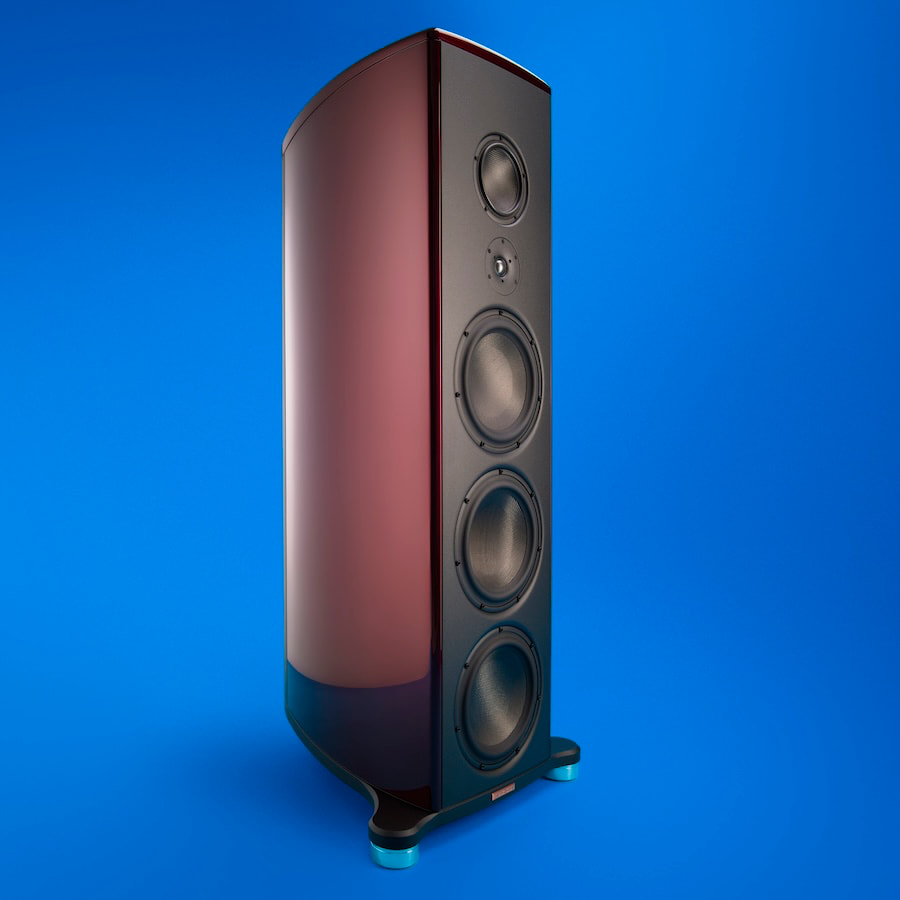
Magico, the California-based loudspeaker manufacturer known for its obsessive focus on enclosure rigidity, advanced driver materials, and extremely tight build tolerances, will preview its new S7 2026 floorstanding loudspeaker at AXPONA (Audio Expo North America), taking place April 10 to 12, 2026 in Schaumburg, Illinois. The S7 enters a segment of the ultra high-end loudspeaker market that has become increasingly competitive, with companies such as Børresen, Estelon, and Wilson Audio all taking different approaches to cabinet construction, driver technology, and system tuning in the race to build reference level loudspeakers that now regularly push past the six figure mark.
Magico’s S Series has traditionally served as the company’s bridge between its flagship statement products and the rest of its lineup, and the S7 appears positioned to continue that role. Debuting the speaker at AXPONA places it in front of one of the largest gatherings of dealers, media, and serious audiophiles in North America, where comparisons to some of the most ambitious loudspeakers currently on the market are inevitable.
Magico S7 2026 Loudspeaker
A New Reference in the Company’s S Series Lineup
The S7 2026 is a 384 pound, five driver, three-way floorstanding loudspeaker designed as the flagship of Magico’s S-Series lineup.
The current generation of the S Series began with the introduction of the S3 in 2023, a model that set a new performance benchmark for the line. It was followed by the larger and more ambitious S5 in 2024, which expanded the series with greater scale and output capability. Later that same year, Magico introduced the more compactS2, bringing much of the series’ core technology to a smaller form factor while maintaining the company’s focus on rigidity, driver control, and low coloration.
Advertisement
S7 Development: Advanced Measurement and Engineering from the M Series
The Magico S7 is the result of an extensive research and development program that incorporates engineering tools and methodologies first introduced in the company’s flagship Magico M Series loudspeakers.
During development, Magico used a Near Field Scanner (NFS) robotic measurement system to perform detailed acoustic analysis of the loudspeaker across the full three dimensional space surrounding it. This system allows engineers to capture both on axis and off axis behavior, generating a comprehensive acoustic map of the speaker’s performance.
According to Magico, the data gathered from these measurements was used to refine the S7’s driver integration, crossover behavior, and overall acoustic balance. The company states that the goal was to move the design closer to the theoretical ideal for a multi way loudspeaker while maintaining the accuracy, coherence, and low coloration that define the S-Series.
Enclosure
The S7’s aluminum enclosure features a curved, sculpted form refined through extensive 3D modeling and simulation to reduce internal resonances and improve overall structural rigidity. The cabinet design also allows Magico’s proprietary damping techniques to operate more effectively, while the curved front baffle helps minimize diffraction and improve acoustic consistency.
Advertisement
Magico engineers also employed a Laser Vibrometer to measure extremely small cabinet vibrations and the sound pressure they generated. This level of analysis made it possible to identify and address unwanted resonances early in the development process, with the goal of creating a cabinet that adds no audible coloration to the signal.
As part of the redesign, the S7’s internal volume has been increased from 135 liters to 180 liters compared to the previous S Series flagship. According to Magico, the larger enclosure extends bass response by approximately 5 Hz while maintaining the same overall speaker sensitivity, allowing the S7 to deliver deeper low frequency extension without sacrificing efficiency.
Driver Technology
Driver technology remains central to every Magico loudspeaker design, and the S7 incorporates the company’s latest work in materials and driver architecture.
Advertisement. Scroll to continue reading.
Advertisement
At the core of the S7 is Magico’s eighth generation Nano-Tec cone, which uses an aluminum honeycomb core sandwiched between graphene reinforced carbon fiber skins. The structure is designed to combine low mass with high rigidity and effective damping, allowing the driver to maintain control across a wide operating range while reducing distortion.
The cone is mounted in an all new third generation driver chassis developed over three years of research and refinement. The redesigned platform improves force distribution and suspension geometry, and uses a dual post architecture intended to balance dynamic wire tension. According to Magico, the design increases structural stiffness while reducing resonance and improving airflow around the motor structure.
The S7 also incorporates three vertically aligned woofers — a configuration derived from technology first used in the Magico M Project loudspeaker. This layout is intended to reduce floor bounce effects and help smooth in room frequency response contributing to more consistent midbass performance in typical listening environments.
Tweeter
For high frequency reproduction, the S7 uses a tweeter derived from those found in Magico’s M Series loudspeakers. Its 28 mm diamond coated pure beryllium diaphragm offers an extremely high stiffness to weight ratio and is driven by a powerful neodymium motor system designed to reduce distortion and improve power handling.
Advertisement
Magico also used extensive FEA modeling to optimize the tweeter’s rear chamber and acoustic loading. According to the company, this approach helps refine high frequency behavior while maintaining the level of detail, control, and transparency expected from its reference level designs.
Midrange
The S7 features a 6-inch midrange driver built around a 3-inch titanium voice coil housed in Magico’s third generation driver chassis. The driver uses the company’s Nano Tec Gen 8 cone along with a full copper cap and oversized neodymium magnet system designed to improve control and reduce distortion.
According to Magico, the combination is intended to deliver highly accurate midrange performance in both frequency response and time domain behavior, with the goal of preserving clarity and tonal realism across vocals and acoustic instruments.
Woofer
For low frequencies, the S7 incorporates three 10-inch woofers built around a 5-inch titanium voice coil and Magico’s Nano Tec-Gen 8 cone. Each woofer also employs a large copper cap and offers approximately half an inch of linear excursion to maintain control at higher output levels.
Advertisement
According to Magico, the design is intended to deliver deep and controlled bass response while maintaining low distortion and consistent performance across a wide dynamic range.
Crossover Design
The S7’s five drivers are integrated through Magico’s Elliptical Symmetry Crossover (ESXO), a three way network that uses acoustical target 24 dB Linkwitz-Riley slopes. This design approach is intended to maintain phase and frequency linearity while reducing intermodulation distortion, allowing the drivers to operate as a more cohesive system.
The ESXO crossover also incorporates high grade components from Mundorf in Germany. For the first time in an S-Series loudspeaker, the S7 also includes CAST PP Radial capacitors from Duelund Coherent Audio in Denmark, which Magico says contributes to improved coherence and stability across the audible frequency range.
Finish Options
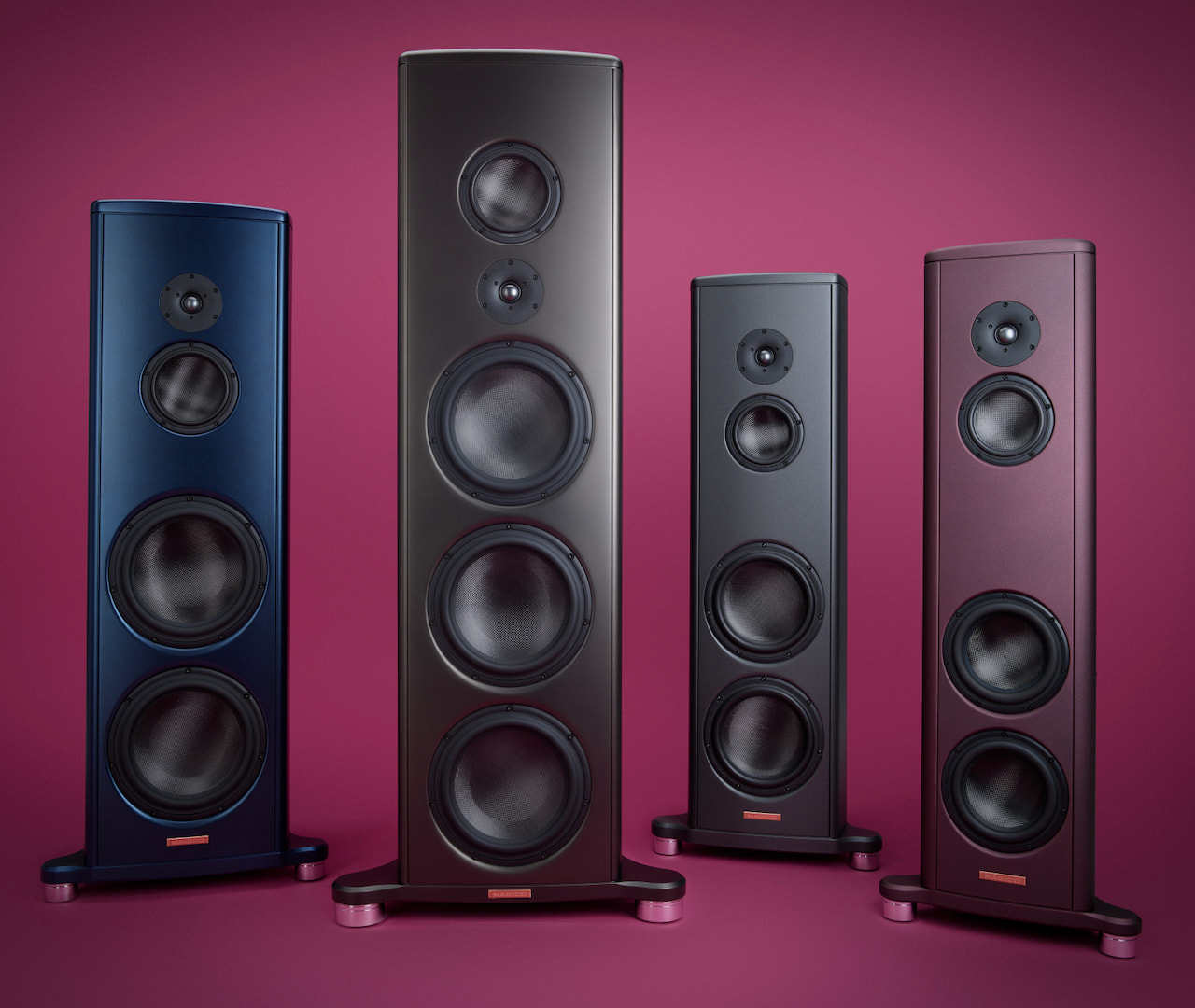
The S7 will be offered in a range of premium finishes, including six Softec powder coat options designed to provide deep color, a smooth texture, and long term durability. Buyers will also be able to choose from six High Gloss automotive paint finishes that are polished to a mirror like surface and sealed with a protective clear coat.
Advertisement
Advertisement. Scroll to continue reading.
Support System
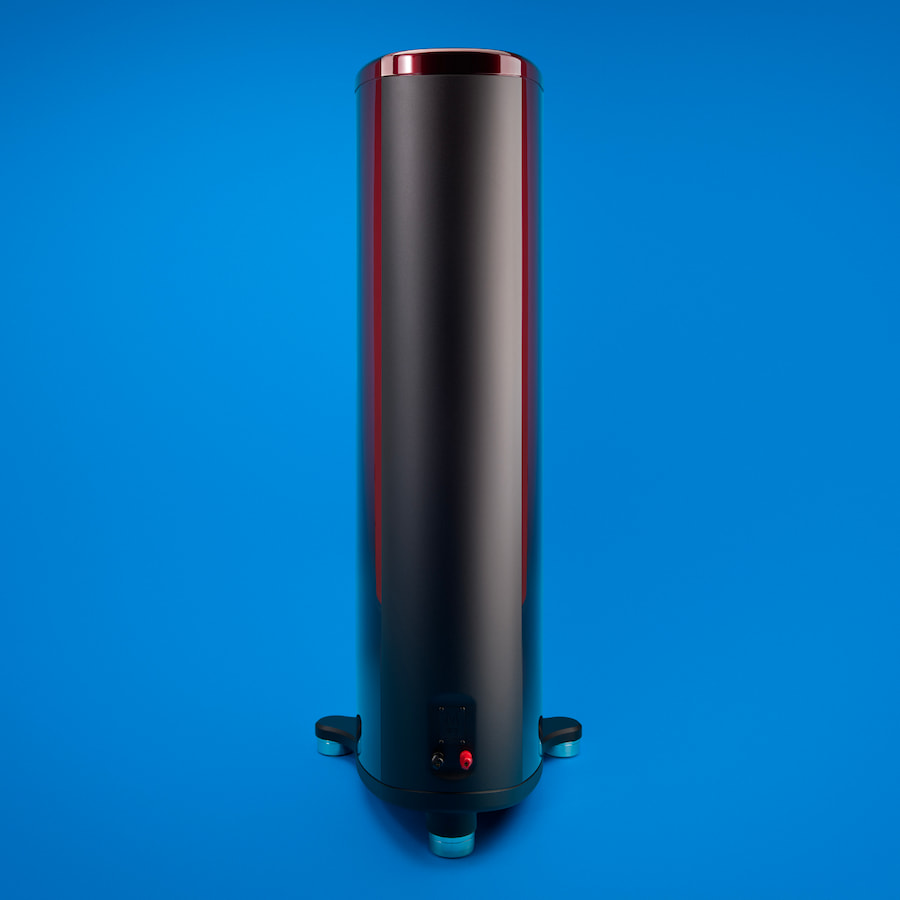
The S7 speaker enclosure incorporates a precision-engineered three-foot support system with constrained-layer damping, further enhancing mechanical stability and sonic performance.
Left to right: S5, S7,
Comparison
Magico Model
S7 (2026)
S5 (2024)
S3 (2023)
S2 (2024)
Product Type
Floorstanding Speaker
Floorstanding Speaker
Floorstanding Speaker
Floorstanding Speaker
Price (pair) matte finish
$211,000
$74,500
$45,500
$34,000-$37,400
Price (pair) high gloss
$237,000
$83,000
$52,500
$39,100-$43,000
Speaker Type
3-way, 5-driver
3-way, 4-driver
3-way, 4-driver
3-way, 4-driver
Tweeter
1 x 1.1” (28mm) Diamond-Coated pure-beryllium diaphragm
1 x 1 x 1.1″ (28mm) Diamond Coated Beryllium Dome
1 x 1.1″ MB5FP Diamond Coated Beryllium Dome (x1)
1 x 1.1” (28mm) pure-beryllium, diamond-coated diaphragm
Midrange
1 x 6” Nano-Tec Gen 8 driver
1 x 6″ (15.24cm) Graphene Nano-Tec Gen 8 Cone Midrange
5″ Gen 8 Midrange driver (x1)
1 x 5” midrange driver
Woofers
3 x 10” Nano-Tec Gen 8 bass drivers
2 x 10″ (25.4cm) Graphene Nano-Tec Gen 8 Cone
9″ Gen 8 Bass driver (x2)
2 x 7” bass driver
Impedance
4 ohms
4 ohms
4 ohms
4 ohms
Sensitivity
89dB
88dB
88dB
86.5dB
Frequency Response
20Hz – 50kHz
20Hz-50kHz (in-room)
24Hz – 50kHz
26Hz – 50kHz
Recommended Power
50W – 1000W
50W – 1000W
50W+
50W – 300W
Dimensions (WDH)
22.9 x 24.1 x 55.9 inches
58.17 x 61.21 x 141.99 cm
Advertisement
19 x 19.3 x 48 inches
49 x 48.5 x 122cm
12 (17″ outrigger) x 17 x 44 inches
30 x 43 x 112cm
Advertisement
15.56 (with outriggers) x 13.59 x 43.48 inches
39.5 x 34.5 x 110.4cm
Weight
384 lbs (174 kg)
262 lbs (118 kg)
222 lbs (101 kg)
132 lbs (60 kg)
The Bottom Line
The Magico S7 represents the most ambitious loudspeaker yet in the company’s S- Series, combining the enclosure engineering, driver technology, and crossover refinement developed over the past several product cycles. With a large aluminum cabinet, three woofer configuration, updated midrange and tweeter implementation, and Magico’s latest Elliptical Symmetry Crossover, the S7 is designed to deliver greater scale, deeper bass extension, and improved driver integration than previous models in the line.
At more than $200,000 per pair depending on finish, the S7 clearly sits in the ultra high end category. Loudspeakers at this level also demand serious supporting gear, and prospective owners will almost certainly need to invest well into six figures for amplification, source components, and cabling to extract their full potential.
Advertisement
Before anyone gets too dizzy looking at the price tag, it’s worth remembering that the top of the loudspeaker market has moved even further up the ladder. Compared to statement models like the Børresen M8 Gold Signature loudspeakers, which stretch past the one million dollar mark per pair, the Magico S7 almost starts to look…reasonable. Almost.
Price & Availability
The new 2026 Magico S7 floorstanding speakers are priced starting at approximately $211,000 per pair for the Softec finish and around $237,000 for the High Gloss finish, with shipping expected in Q3 2026.
NanoClaw, the open-source AI agent platform created by Gavriel Cohen, is partnering with the containerized development platform Docker to let teams run agents inside Docker Sandboxes, a move aimed at one of the biggest obstacles to enterprise adoption: how to give agents room to act without giving them room to damage the systems around them.
The announcement matters because the market for AI agents is shifting from novelty to deployment. It is no longer enough for an agent to write code, answer questions or automate a task.
For CIOs, CTOs and platform leaders, the harder question is whether that agent can safely connect to live data, modify files, install packages and operate across business systems without exposing the host machine, adjacent workloads or other agents.
That is the problem NanoClaw and Docker say they are solving together.
Advertisement
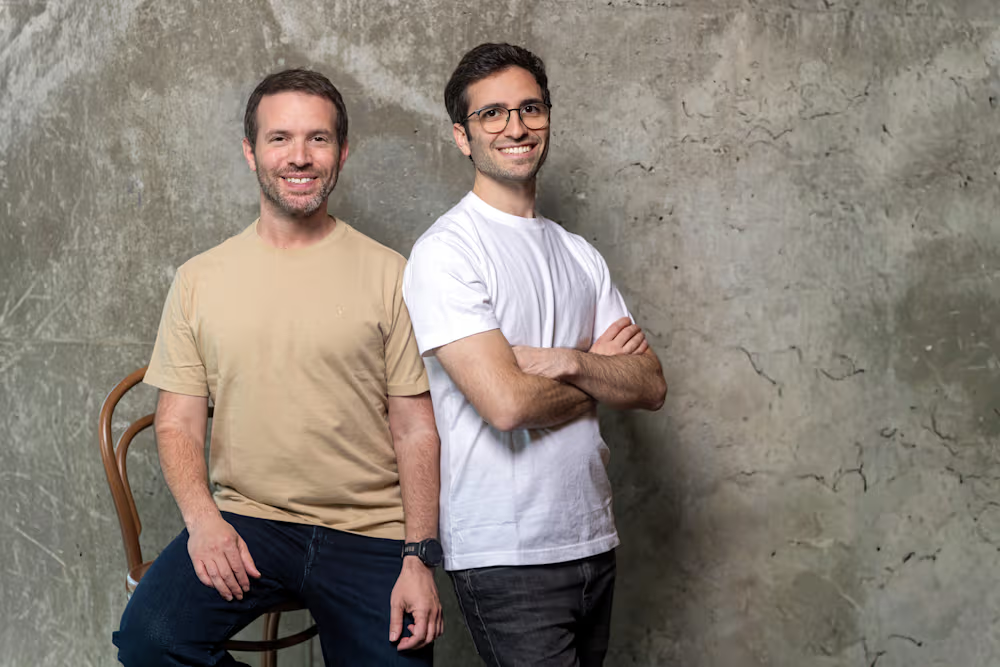
Lazer Cohen and Gavriel Cohen, co-founders of NanoClaw.dev. Credit: NanoClaw.dev
A security argument, not just a packaging update
NanoClaw launched as a security-first alternative in the rapidly growing “claw” ecosystem, where agent frameworks promise broad autonomy across local and cloud environments. The project’s core argument has been that many agent systems rely too heavily on software-level guardrails while running too close to the host machine.
This Docker integration pushes that argument down into infrastructure.
“The partnership with Docker is integrating NanoClaw with Docker Sandboxes,” Cohen said in an interview. “The initial version of NanoClaw used Docker containers for isolating each agent, but Docker Sandboxes is the proper enterprise-ready solution for rolling out agents securely.”
Advertisement
That progression matters because the central issue in enterprise agent deployment is isolation. Agents do not behave like traditional applications. They mutate their environments, install dependencies, create files, launch processes and connect to outside systems. That breaks many of the assumptions underlying ordinary container workflows.
Cohen framed the issue in direct terms: “You want to unlock the full potential of these highly capable agents, but you don’t want security to be based on trust. You have to have isolated environments and hard boundaries.”
That line gets at the broader challenge facing enterprises now experimenting with agents in production-like settings. The more useful agents become, the more access they need. They need tools, memory, external connections and the freedom to take actions on behalf of users and teams. But each gain in capability raises the stakes around containment. A compromised or badly behaving agent cannot be allowed to spill into the host environment, expose credentials or access another agent’s state.
Why agents strain conventional infrastructure
Docker president and COO Mark Cavage said that reality forced the company to rethink some of the assumptions built into standard developer infrastructure.
Advertisement
“Fundamentally, we had to change the isolation and security model to work in the world of agents,” Cavage said. “It feels like normal Docker, but it’s not.”
He explained why the old model no longer holds. “Agents break effectively every model we’ve ever known,” Cavage said. “Containers assume immutability, but agents break that on the very first call. The first thing they want to do is install packages, modify files, spin up processes, spin up databases — they want full mutability and a full machine to run in.”
That is a useful framing for enterprise technical decision-makers. The promise of agents is not that they behave like static software with a chatbot front end. The promise is that they can perform open-ended work. But open-ended work is exactly what creates new security and governance problems. An agent that can install a package, rewrite a file tree, start a database process or access credentials is more operationally useful than a static assistant. It is also more dangerous if it is running in the wrong environment.
Docker’s answer is Docker Sandboxes, which use MicroVM-based isolation while preserving familiar Docker packaging and workflows. According to the companies, NanoClaw can now run inside that infrastructure with a single command, giving teams a more secure execution layer without forcing them to redesign their agent stack from scratch.
Advertisement
Cavage put the value proposition plainly: “What that gets you is a much stronger security boundary. When something breaks out — because agents do bad things — it’s truly bounded in something provably secure.”
That emphasis on containment rather than trust lines up closely with NanoClaw’s original thesis. In earlier coverage of the project, NanoClaw was positioned as a leaner, more auditable alternative to broader and more permissive frameworks. The argument was not just that it was open source, but that its simplicity made it easier to reason about, secure and customize for production use.
Cavage extended that argument beyond any single product. “Security is defense in depth,” he said. “You need every layer of the stack: a secure foundation, a secure framework to run in, and secure things users build on top.”
That is likely to resonate with enterprise infrastructure teams that are less interested in model novelty than in blast radius, auditability and layered control. Agents may still rely on the intelligence of frontier models, but what matters operationally is whether the surrounding system can absorb mistakes, misfires or adversarial behavior without turning one compromised process into a wider incident.
Advertisement
The enterprise case for many agents, not one
The NanoClaw-Docker partnership also reflects a broader shift in how vendors are beginning to think about agent deployment at scale. Instead of one central AI system doing everything, the model emerging here is many bounded agents operating across teams, channels and tasks.
“What OpenClaw and the claws have shown is how to get tremendous value from coding agents and general-purpose agents that are available today,” Cohen said. “Every team is going to be managing a team of agents.”
He pushed that idea further in the interview, sketching a future closer to organizational systems design than to the consumer assistant model that still dominates much of the AI conversation. “In businesses, every employee is going to have their personal assistant agent, but teams will manage a team of agents, and a high-performing team will manage hundreds or thousands of agents,” Cohen said.
That is a more useful enterprise lens than the usual consumer framing. In a real organization, agents are likely to be attached to distinct workflows, data stores and communication surfaces. Finance, support, sales engineering, developer productivity and internal operations may all have different automations, different memory and different access rights. A secure multi-agent future depends less on generalized intelligence than on boundaries: who can see what, which process can touch which file system, and what happens when one agent fails or is compromised.
Advertisement
NanoClaw’s product design is built around that kind of orchestration. The platform sits on top of Claude Code and adds persistent memory, scheduled tasks, messaging integrations and routing logic so agents can be assigned work across channels such as WhatsApp, Telegram, Slack and Discord. The release says this can all be configured from a phone, without writing custom agent code, while each agent remains isolated inside its own container runtime.
Cohen said one practical goal of the Docker integration is to make that deployment model easier to adopt. “People will be able to go to the NanoClaw GitHub, clone the repository, and run a single command,” he said. “That will get their Docker Sandbox set up running NanoClaw.”
That ease of setup matters because many enterprise AI deployments still fail at the point where promising demos have to become stable systems. Security features that are too hard to deploy or maintain often end up bypassed. A packaging model that lowers friction without weakening boundaries is more likely to survive internal adoption.
An open-source partnership with strategic weight
The partnership is also notable for what it is not. It is not being positioned as an exclusive commercial alliance or a financially engineered enterprise bundle.
Advertisement
“There’s no money involved,” Cavage said. “We found this through the foundation developer community. NanoClaw is open source, and Docker has a long history in open source.”
That may strengthen the announcement rather than weaken it. In infrastructure, the most credible integrations often emerge because two systems fit technically before they fit commercially. Cohen said the relationship began when a Docker developer advocate got NanoClaw running in Docker Sandboxes and demonstrated that the combination worked.
“We were able to put NanoClaw into Docker Sandboxes without making any architecture changes to NanoClaw,” Cohen said. “It just works, because we had a vision of how agents should be deployed and isolated, and Docker was thinking about the same security concerns and arrived at the same design.”
For enterprise buyers, that origin story signals that the integration was not forced into existence by a go-to-market arrangement. It suggests genuine architectural compatibility.
Advertisement
Docker is also careful not to cast NanoClaw as the only framework it will support. Cavage said the company plans to work broadly across the ecosystem, even as NanoClaw appears to be the first “claw” included in Docker’s official packaging. The implication is that Docker sees a wider market opportunity around secure agent runtime infrastructure, while NanoClaw gains a more recognizable enterprise foundation for its security posture.
The bigger story: infrastructure catching up to agents
The deeper significance of this announcement is that it shifts attention from model capability to runtime design. That may be where the real enterprise competition is heading.
The AI industry has spent the last two years proving that models can reason, code and orchestrate tasks with growing sophistication. The next phase is proving that these systems can be deployed in ways security teams, infrastructure leaders and compliance owners can live with.
NanoClaw has argued from the start that agent security cannot be bolted on at the application layer. Docker is now making a parallel argument from the runtime side. “The world is going to need a different set of infrastructure to catch up to what agents and AI demand,” Cavage said. “They’re clearly going to get more and more autonomous.”
Advertisement
That could turn out to be the central story here. Enterprises do not just need more capable agents. They need better boxes to put them in.
For organizations experimenting with AI agents today, the NanoClaw-Docker integration offers a concrete picture of what that box might look like: open-source orchestration on top, MicroVM-backed isolation underneath, and a deployment model designed around containment rather than trust.
In that sense, this is more than a product integration. It is an early blueprint for how enterprise agent infrastructure may evolve: less emphasis on unconstrained autonomy, more emphasis on bounded autonomy that can survive contact with real production systems.
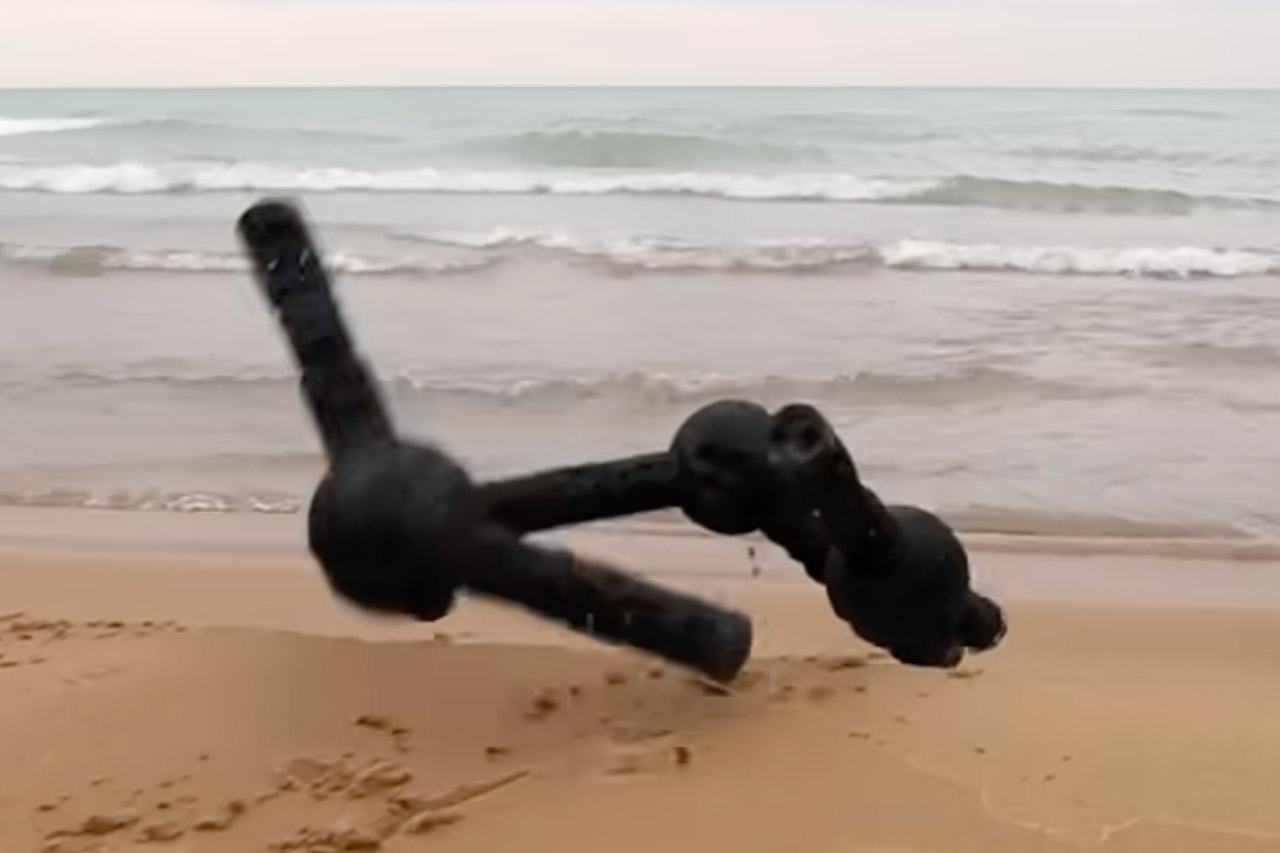
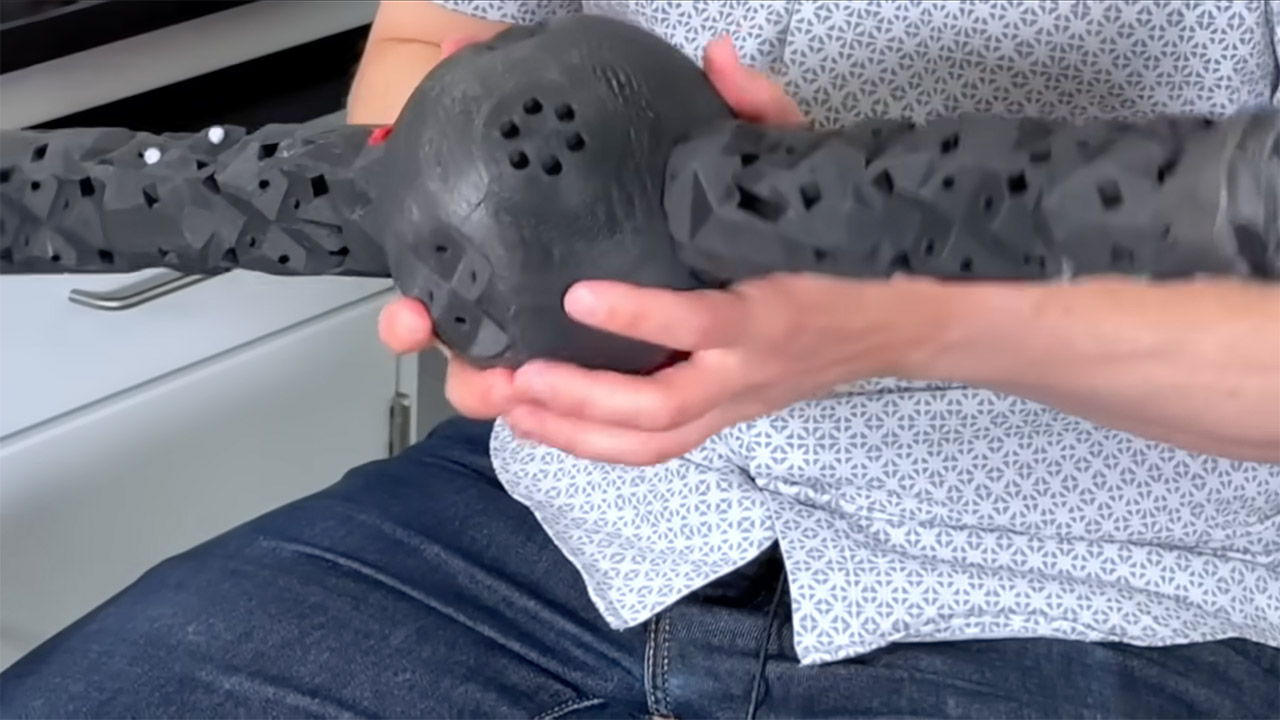
Modules snap into position and leap forward with a bounce over gravel or mud. Each robot is a stand-alone entity, a half-meter chunk made up of two stiff links connected by a central ball. Everything this machine needs to run on its own is inside that ball, including a small circuit board for decision-making, a battery for electricity, and a motor for movement. On its own, one of these little modules can just roll along, perform a sharp turn, or leap into the air, but when three or five are combined, you create bodies with legs that can switch positions at any time. Some of them serve as supports, while others push or strive to balance things out.
Northwestern University researchers got things started by running evolutionary software on a computer. They supplied it these basic modules as raw material and then let it run wild, mixing and matching connections thousands of times to explore how different body shapes would travel through a simulated environment. Who moved the fastest and had the best balance? They went with that shape. They repeatedly made minor changes and chose new victors, none of whom they had come up with themselves. Once they got the best virtual competitors lined up, they assembled the real modules in the same way and conducted some real-world testing.
Sleek & Durable Design: Standing at 132cm tall and weighing only approx. 35kg, the G1 is constructed with aerospace-grade aluminum alloy and carbon…
High Flexibility & Safe Movement: Boasting 23 joint degrees of freedom (6 per leg, 5 per arm), it offers an extensive range of motion. For safety, it…
Smart Interaction & Connectivity: Powered by an 8-core high-performance CPU and equipped with a depth camera and 3D LiDAR. It supports Wi-Fi 6 and…
These modules can link up almost anywhere, so a leg on one body can transform into a spine or tail on another; they can basically reorganize themselves on the fly. This indicates that these items can work together and solve problems on their own without the need for outside assistance. When they are first released in an open area, they begin moving immediately and can easily navigate uneven terrain such as tree roots or sand patches. One of them will wriggle barely above the ground, another will take small leaps, and a third will spring up with each stride. All of this is accomplished only via the use of sensors within their own joints and bodies to steer and maintain stability.
Once trained, they can perform gymnastics with ease, such as flipping one of the modules onto its back and rolling or twisting until it is upright again. When they jump, they can even spin around in the air before landing and continuing their journey. And when put to the test in real-world outdoor settings, they perform admirably, outperforming fixed robots that typically stall or flip over.
Advertisement
Damage them slightly and they just keep going; you can even cut off a leg (or however many) and the beast will simply redistribute the effort and keep trucking. The severed piece will just roll away by itself, rejoin the group, and snap back into place. If you break the whole thing into separate pieces, each of those little modules can continue to function on its own, rolling or hopping around as if it was never a part of anything larger in the first place.
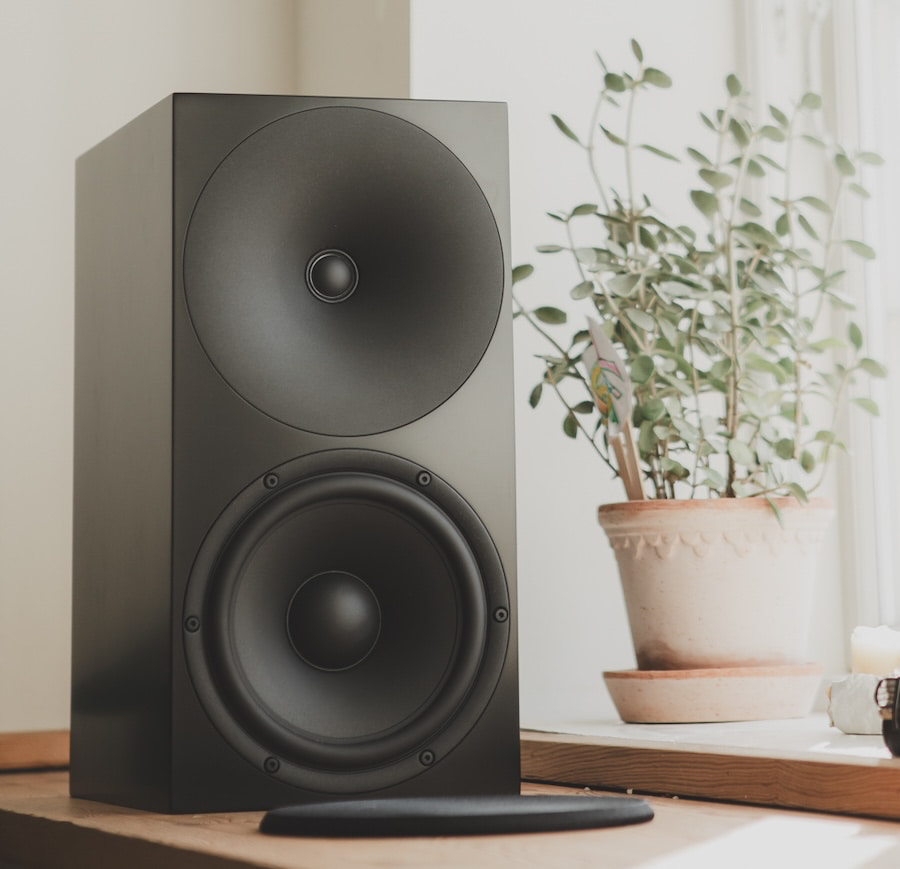
Great loudspeakers come from all corners of the world, and Denmark has produced more than its fair share of them. Buchardt Audio may not have the century long legacy of some of its Nordic neighbors, but the company has built a loyal following over the past decade with a simple formula: compact loudspeakers that deliver a far bigger, fuller sound than their modest size might suggest.
That approach was cemented with the original S400, which we reviewed in 2021 and quickly became one of the most recommended standmount speakers in its class. Buchardt refined the concept shortly thereafter with the S400 MKII, introducing a revised crossover and higher quality internal components, followed by the S400 MKII Signature with further tuning refinements. For 2026, the Danish brand is pushing the platform forward once again with the announcement of the S400 MK3, the next chapter in a design that has been evolving since its first prototype appeared in 2016.
Buchardt S400 MK3
Buchardt Audio S400 MK3: Larger Cabinet, New Drivers, and a Ground Up Redesign
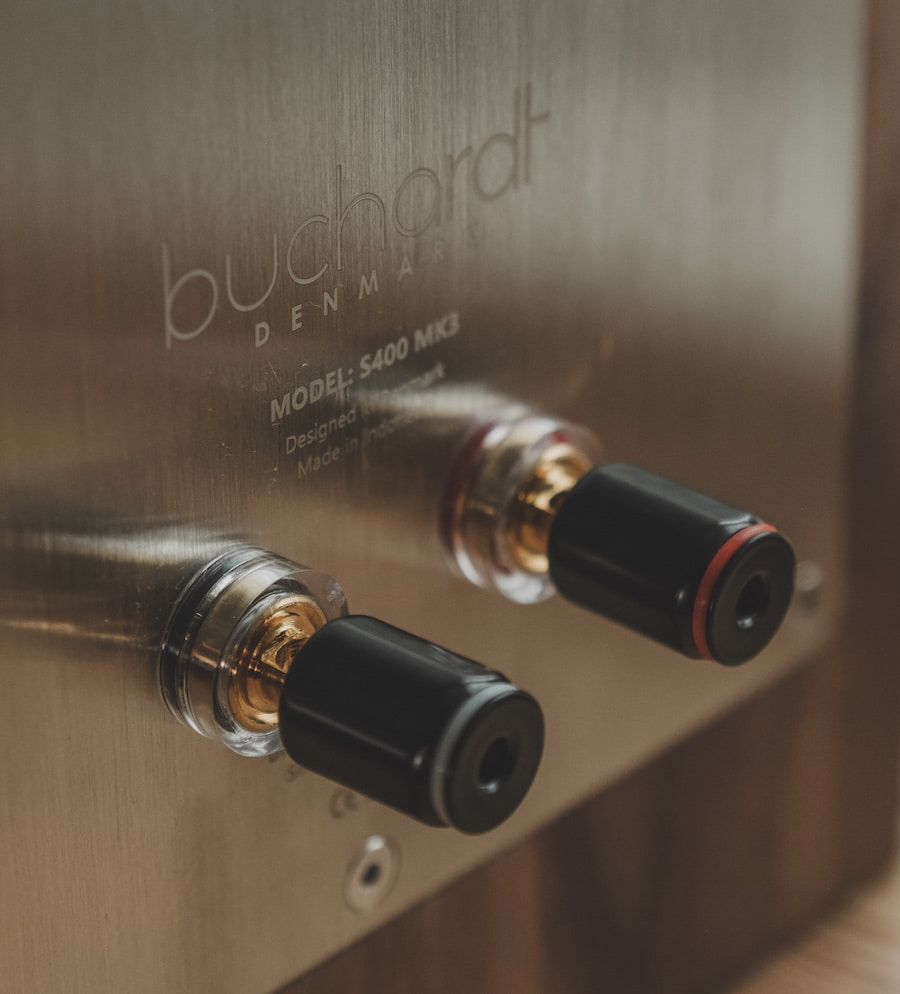
The S400 MK3 represents a significant redesign of Buchardt’s most recognizable loudspeaker platform. The new model introduces a larger cabinet, newly developed drivers, improved treble resolution, and greater dynamic capability, while aiming to preserve the balanced and natural presentation that helped define the earlier S400 models. According to Buchardt, almost nothing from the previous S400 generation carries over to the MK3, with the exception of the speaker binding posts.
One of the most visible changes with the S400 MK3 is the increase in cabinet size. Buchardt has expanded the internal volume by roughly 18 percent, giving the designers more room to extend low frequency performance and increase overall dynamic headroom. Despite the added volume, the company says the cabinet retains the clean proportions and minimalist aesthetic that made the original S400 such a recognizable design.
S400 MK3 Tweeter: New 26 mm Aluminum Dome with Custom Waveguide
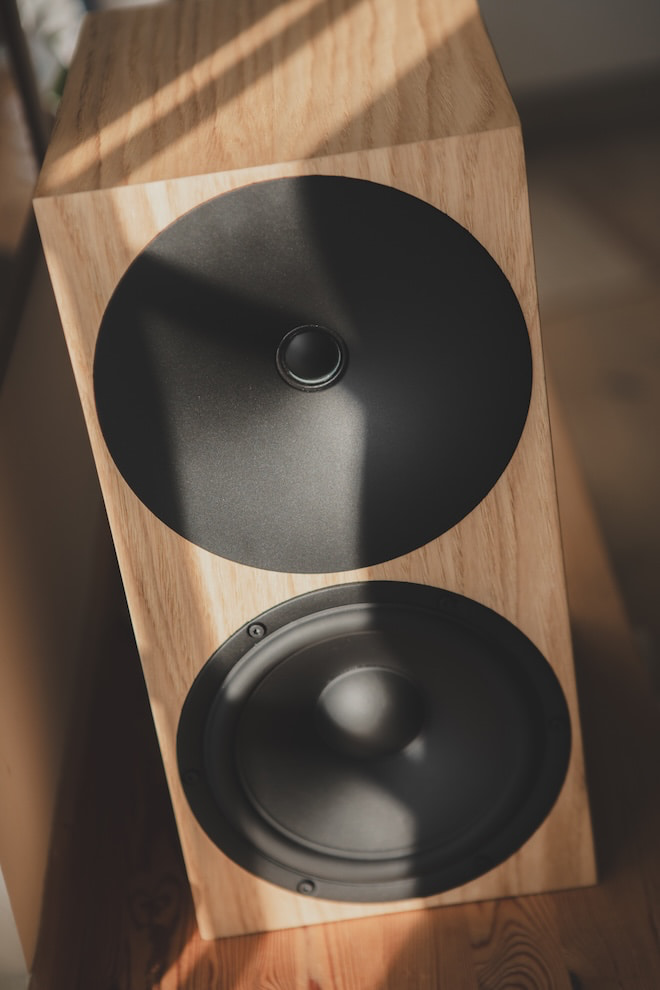
The S400 MK3 features a newly developed 26 mm (1.02-inch) aluminum dome tweeter paired with a redesigned waveguide. Rather than chasing extra brightness or exaggerated top end energy, Buchardt focused on improving refinement and perceived resolution.
The goal was greater clarity and treble detail while maintaining the smooth, natural presentation that has defined the S400 series. According to the company, the new tweeter and waveguide combination helps deliver more precise high frequency dispersion and improved integration with the midbass driver, without introducing listening fatigue.
At the core of the S400 MK3 is a 7.5-inch woofer sourced from SB Acoustics, built around the company’s Satori PAPYRUS paper cone technology. Compared with the driver used in the S400 MKII, the new unit offers 65.5 percent greater displacement headroom, giving the MK3 significantly more room to move air.
The result is increased dynamic capability, stronger bass authority, and more physical impact from a standmount speaker that still maintains relatively compact proportions. Combined with the 18 percent increase in cabinet volume, the new woofer gives the S400 MK3 greater low frequency extension and overall scale than previous versions of the design.
S400 MK3 Bass System: Rear Port Replaces the Passive Radiator
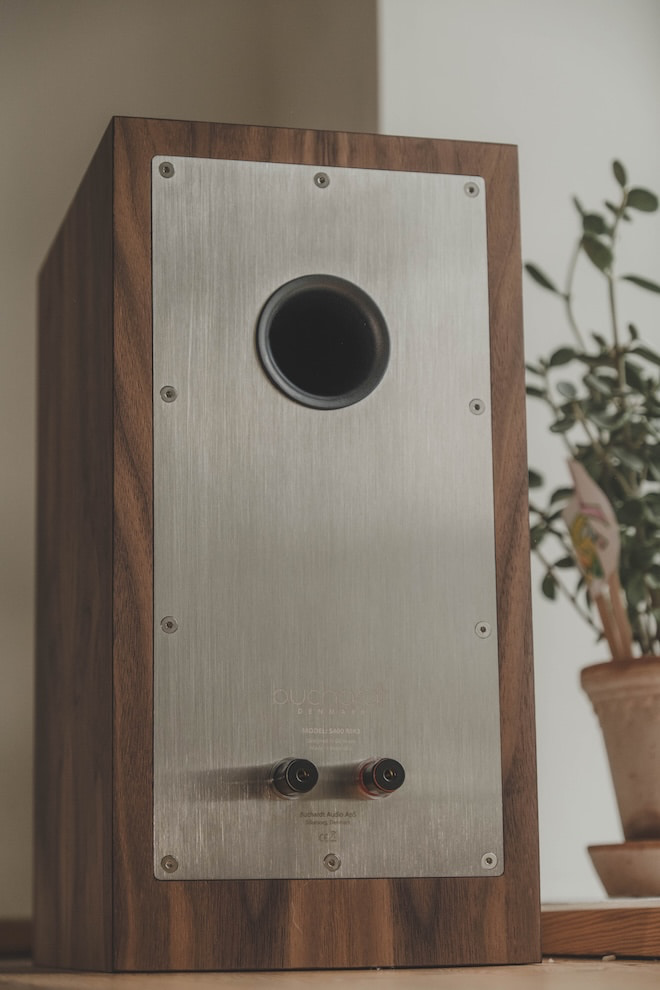
Rather than continuing with the passive radiator used in earlier S400 models, the S400 MK3 adopts a rear mounted portand a traditional bass reflex design. The change allows Buchardt to deliver bass that remains tight, extended, and powerful while taking advantage of the larger cabinet and higher displacement woofer.
The trade off with any ported design is the possibility of minimal port noise under very specific conditions, but in normal listening this should remain largely inaudible. Placement remains relatively flexible for a rear ported speaker; Buchardt recommends leaving at least 5 cm (2 inches) of space between the port and the rear wall to ensure proper airflow and consistent low frequency performance.
S400 MK3 Crossover: Simplified Network with Premium Jantzen Components
Buchardt continues its partnership with Jantzen Audio for the S400 MK3’s crossover network. The updated design uses premium components throughout the signal path but adopts a somewhat simpler topology than the network used in the previous S400 MKII.
Advertisement
Advertisement. Scroll to continue reading.
The new crossover employs first order filters, a design choice often associated with improved phase coherence and a more natural integration between drivers. While simpler in layout, the network still relies on high quality components to maintain the tonal balance and musical flow that have defined the S400 platform.
Comparison
S400 MK3 (2026)
S400 MKII Signature Edition (2023)
S400 MKII (2021)
S400 (2019)
Product Type
Bookshelf Speaker
Bookshelf Speaker
Bookshelf Speaker
Bookshelf Speaker
Price (Pair)
$2400
$2,850
$2,400
$1,833
Operating Principle
2-way passive bass reflex system
2-way passive radiator system
2-way passive radiator system
2-way passive radiator system
Tweeter
1″ Waveguided custom aluminum dome with neodymium matrix motor
0.74″ Custom fine weave soft fabric textile with CDC aluminum waveguide
0.74″ Custom fine weave soft fabric textile with CDC aluminum waveguide
0.74″ Custom fine weave soft fabric textile with CDC aluminum waveguide
Mid / woofer
7.5” SB Acoustics Satori PAPYRUS™ paper cone with
6″ Linear long stroke paper cone
6″ Linear long stroke paper cone
6″ Aluminum cone with break-up optimization
Passive Radiator
–
5×8″ Long stroke passive radiator
5×8″ Long stroke passive radiator
5×8″ Long throw passive radiator with very low mass added
Port
Yes
–
–
–
Impedance
4 ohms
4 ohms
4 ohms
4 ohms
Sensitivity
88 dB
87 dB
87 dB
87 dB
Frequency response +/- 3dB (in-room)
33 – 20,000 Hz
33 – 40,000 Hz
33 – 40,000 Hz
33 – 40,000 Hz
Crossover Point
2400hz
1800hz
1800hz
2000hz
Power Recommendation
From 30 watts – Upper limit depends on use case, please contact Budchart for recommendations.
40 – 200 W
40 – 200 W
40 – 200 W
Dimensions (HWD)
392 x 198 x 280 mm (15.4” x 7.8” x 11”)
365 x 180 x 280 mm (14.4” x 7” x 11”)
365 x 180 x 280 mm (14.4” x 7” x 11”)
365 x 180 x 240 mm (14.4” x 7” x 9.4”)
Weight (each)
8.5 kg
7.5 kg
7.5 kg
9 kg
Speaker Grilles
4 x 7.5″ Included Black acoustical optimized fabric grilles
Included
Included
Included
Cabinet
15mm Fiberboard HMR.E2 Moisture-proof with internal bracing. Either painted or real wood veneered.
15mm HDF with internal bracing.
15mm Fiberboard HMR.E2 Moisture-proof with internal bracing. Either painted or real wood veneered.
15mm Fiberboard HMR (Moisture-proof) with internal bracing
The Bottom Line
The Buchardt Audio S400 MK3 continues a design philosophy that Buchardt clearly believes in: compact standmount speakers engineered to deliver the scale, bass authority, and dynamics normally associated with much larger loudspeakers. With its larger cabinet, higher displacement woofer, new waveguided tweeter, and simplified crossover, the MK3 looks like a meaningful evolution of a platform that has been steadily refined since 2016.
At $2,400 USD per pair, the S400 MK3 enters one of the most competitive segments in the loudspeaker market. Models from KEF, Wharfedale, Paradigm, Acoustic Energy, and Chesky Audio are all fighting for the same buyers looking for high performance from relatively compact cabinets. The S400 MK3’s appeal will likely come down to its reputation for delivering big, room filling sound and strong bass output from a standmount design, making it a compelling option for listeners who want serious scale without moving to floorstanding speakers.
Pricing and Availability
The S400 MK3 is available through Buchardt’s website for pre-order, with 75 pairs offered per finish at the introductory price (see below). Estimated delivery is expected to start by late Summer 2026.
S400 – $2,400 in black/white or $2,574 in real wood veneer (US)
S400 – €2,300 in black/white or €2,450 in real wood veneer (EU)
Smartphone enthusiasts like me will never forget the time when modular phones were about to change everything. Whether it was Google’s canceled Project Ara or the more popular Moto Z series, nothing really panned out as well as the Fairphone, but even it isn’t as mainstream as some other brands.
So, most users just live with their non-modular smartphones on a day-to-day basis, having already grieved about the idea that once raised plenty of hopes. Well, about that, an upcoming foldable could change that conversation entirely.
Xiaomi
What exactly is Xiaomi cooking?
I’m talking about the Xiaomi Mix Fold 5. Early leaks about it suggest that the company is developing a magnetic modular camera system, wherein users should be able to swap, adjust, or upgrade the magnetic camera modules by attaching a better one, or the one that the user wants (via Gizchina).
Essentially, the Mix Fold 5’s magnetic camera module would mimic the interchangeable lenses on professional cameras. If the interchangeable interface actually ships, it could be the most exciting camera hardware on a smartphone in years, or one of the most exciting after Xiaomi’s physical zoom ring on the Xiaomi 17 Ultra.
However, I have a rather hot take about it: shipping a modular camera system (with interchangeable lenses) with a foldable could either be a very smart idea, or a rather complicated idea that would keep the exciting tech from the hands of masses.
Advertisement
Xiaomi
Smart idea or a complicated one?
Foldables already come with slightly toned-down camera systems compared to their brand’s conventional flagship (see the differences on the Fold 7 and S26 Ultra). A modular system that sidesteps that limitation entirely could be a clever solution to this problem. On the other hand, foldables don’t sell as much as regular smartphones, and the brand might not get as much attention as the tech deserves.
The silver lining here is that the Chinese smartphone manufacturer isn’t partnering with a third-party lens or camera equipment manufacturing company. The leaks focus on self-developed modular lenses throughout.
However, that is the extent of information we have about the purported smartphone. No confirmed specs, pricing, or launch date yet.