This makes Northern Ireland the sole region in the UK where the gender pay gap has consistently shifted in the wrong direction.
As families throughout Northern Ireland gear up to celebrate Mother’s Day, fresh figures from PwC’s Women in Work Index 2026 reveal the reality of working life for women – particularly working mothers across the region.
Advertisement
Northern Ireland has dropped one position to third place in the UK in PwC’s regional rankings, following a 2.7-point fall in its overall Index score. The region is now experiencing a growing divide between the opportunities accessible to women locally and those available elsewhere in the UK.
Central to this challenge is participation. Northern Ireland records the lowest female labour force participation rate of any UK region, standing at just 71.3% – nearly three percentage points beneath the regional average.
The region also experienced the largest rise in its participation rate gap, the difference between male and female participation, climbing by 1.88 percentage points, whilst regions across the UK on average witnessed that gap reduce by 0.67%.
The gender pay gap in Northern Ireland has widened every year since 2020, rising from 7.5% to 7.9% this year, driven by a greater proportion of women in part-time positions and longer working hours for men. This makes Northern Ireland the sole region in the UK where the gender pay gap has consistently shifted in the wrong direction.
Advertisement
There is, nonetheless, one positive development: Northern Ireland maintains its leading position for the lowest female unemployment rate in the UK, at just 1.4% compared to the regional average of 3.4%. Whilst this is encouraging, it highlights a paradox – women within Northern Ireland remain in employment, yet far too many women are being excluded from the workforce entirely or restricted to lower-paid, part-time positions.
On a national level, the UK rose one spot to 17th in the worldwide Index, reclaiming its status as the highest-ranking G7 nation. However, underlying advancement has plateaued, hindered by increasing female unemployment and declining full-time employment rates amongst women.
Cara Haffey, Partner at PwC Northern Ireland, commented:. “This Mother’s Day is a moment to celebrate everything that working mums contribute to their families, their workplaces and the Northern Ireland economy. But it should also be a wake-up call. The data shows that women here face the steepest barriers to participation of anywhere in the UK, and the gender pay gap continues to move in the wrong direction.”
“If we want Northern Ireland to thrive, we need to make it easier for women to fully participate in the workforce. That means investing in affordable childcare, creating more flexible working opportunities, and ensuring that the pipeline of talent into well-paid roles is open to everyone.
Advertisement
“The fact that we have the lowest female unemployment rate in the UK shows that when women here can access work, they do – and they stay. The challenge now is to remove the barriers that are keeping too many on the sidelines.”
We all know cats represent a major threat to native animals and birds. Australia’s 5.3 million domestic cats kill a total of 546 million animals each year in Australia. What’s less well known is that allowing your domestic cat to roam outside exposes them to considerable danger – and the risk of a short life.
About two-thirds of all Australian cat owners have had a cat die while out roaming. The top risks are road traffic accidents, fighting and falls.
Our recent research review found keeping your cat at home at all times isn’t just good for wildlife – it’s much safer for your cat.
Losing a cat is tragic. But there are other risks too. Many owners rack up large veterinary bills while their cats are left with lifelong health conditions. Our review also found this situation is not unique to Australia, but reflects the global risk faced by free-roaming cats.
Advertisement
What are the risks?
Cameras mounted on collars provide a cat’s-eye view of the hazards roaming cats face. In one study of 55 free-roaming felines in the United States, 25% risked poisoning by eating or drinking while away from home – any substance could be hazardous. Nearly half (45%) crossed roads, 25% encountered other cats, 20% crawled under houses and 20% explored storm drains.
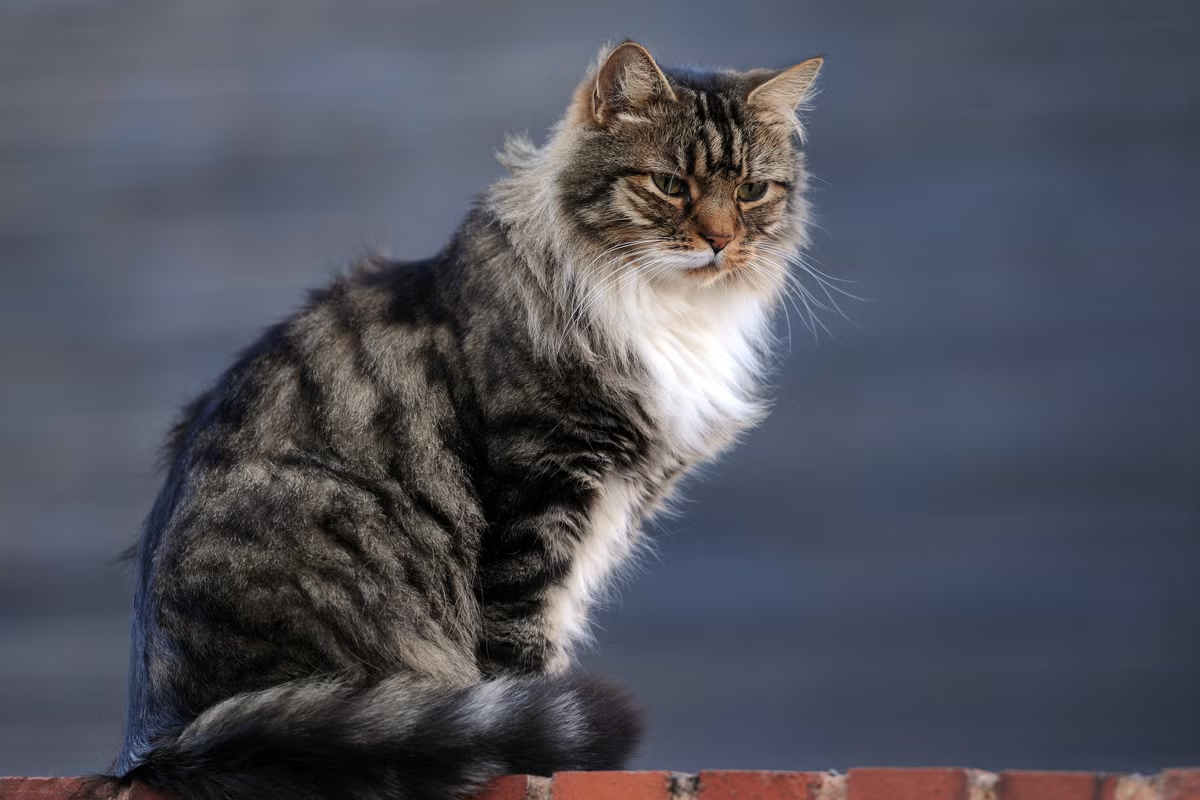
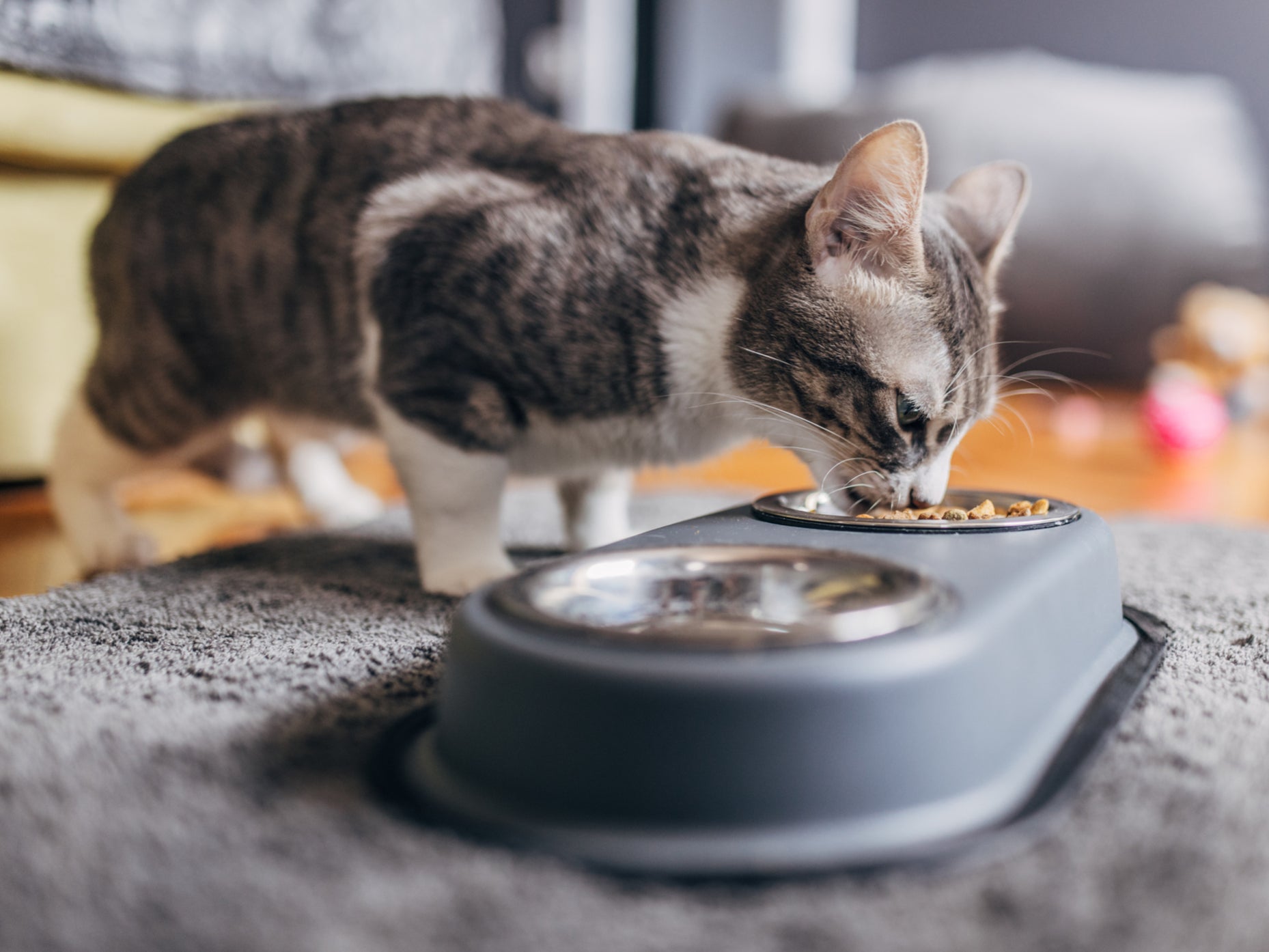
A research review found that keeping your cat at home is much safer for your cat (Getty)
This isn’t just American feline bravado. When cameras were fitted to 37 cats in New Zealand, 59% drank away from home, 40% ate away from home, 32% crossed roads and 21% risked falling by climbing onto roofs.
Advertisement
Australian cats are no exception. In one study, 428 radio-tracked cats averaged 4.8 road crossings per day.
What are the outcomes?
If you’re a fan of The Simpsons you might recall the fate of their family cats: Snowball I and Snowball II died on the road, Snowball III drowned, Coltrane (AKA Snowball IV) fell to his death, and Snowball V is still with us. The reality is uncomfortably similar. Our review found that trauma – mainly road traffic accidents, fighting and falls – kills or injures many free-roaming cats globally.
In a recent UK study, road traffic accidents were the leading cause of death for cats aged less than one year old all the way to eight-year-old cats.
Advertisement
This aligns with European estimates, which suggest 18–24% of cats are struck by a car during their lifetime, with around 70% of those incidents proving fatal. Victims are often under five years old and predominantly male. Risks are higher for those not desexed, as they tend to roam wider and more frequently.
Love and status offer no protection. Former New Zealand Prime Minister Jacinda Ardern’s cat, Paddles, colloquially known as New Zealand’s first cat, died after being hit by a car in 2017.
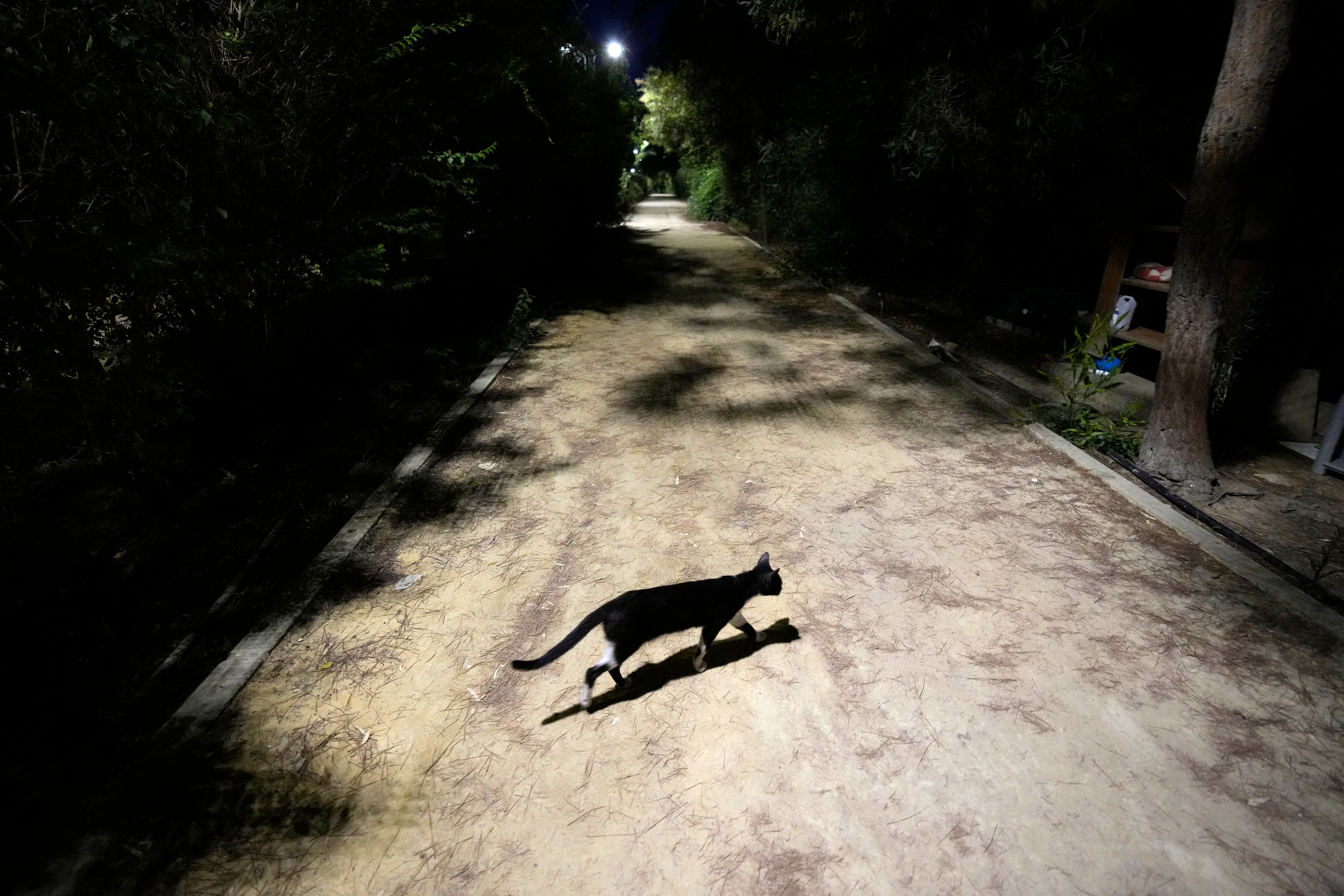
In a recent UK study, road traffic accidents were the leading cause of death for cats aged less than one year old (AP)
The dangers extend well beyond road accidents. Roaming pet cats face serious infectious diseases, such as Feline Immunodeficiency Virus (FIV), and frequently engage in fights, often developing abscesses that can kill and require expensive veterinary treatment.
Advertisement
While it’s hard to quantify the instances of deliberate human cruelty to cats, there is global evidence for deliberate poisoning and injury to roaming cats, many of which die before receiving medical intervention.
In one study tracking 55 roaming cats in Western Australia over just eight months, two were poisoned, one lost a front leg in a traffic accident, one fractured two canine teeth in a fall, and two required veterinary treatment for fight-related injuries.
Drawing all these factors together, we estimated outdoor pet cats have lives at least 2–3 years shorter than the population of contained pet cats. Those that survive accidents or disease may have lifelong disabilities.
How can you reduce the risks?
Advertisement
The simplest way to protect your cats is to contain them on your property, just as Australians do with other domestic animals. Extensive advice is available on how to keep cats happy and healthy while contained.
Importantly, containment doesn’t mean keeping your cat indoors at all times. Backyards can be modified with fence-top rollers to prevent escape. Some owners enclose part of the yard to create a “catio” – an outdoor cat enclosure – allowing their cats to enjoy fresh air and sunshine while remaining secure.
About the authors
Mike Calver is an Associate Professor in Biological Sciences at Murdoch University. Heather M. Crawford is an assistant researcher at Murdoch University and Trish Fleming is a Professor at Murdoch University.
Many cats can also be trained to walk on a harness or leash, making it possible to take them for supervised outings. A recent report from Norway found providing controlled outdoor access is often important for maintaining cat wellbeing.
Cats need to be entertained when in the house. They enjoy outside views, toys, scratching surfaces, above-ground climbing and sitting spaces, and opportunities for play. They are naturally solitary animals, so places to hide are useful.
If cats can’t go outside to toilet, they will need two indoor litter trays. Because cats are fastidious, trays must be cleaned frequently. In multi-cat households, provide one litter tray per cat, plus an extra. Place the trays in separate, quiet locations, and never beside the food bowl.
Responsible cat ownership
Advertisement
Australians love their cats. In 2019, roughly a quarter of Australian households owned a cat. By 2025, that figure had risen to a third. Over the same period, households reporting they kept their cats indoors rose from 36% to 48%.
Perhaps we are finally valuing our cats as we do our dogs and listening to Aussie songwriter and singer Eric Bogle’s sage advice: “Oh you who love your pussy be sure to keep him in. Don’t let him argue with a truck, the truck is bound to win. And upon the busy road don’t let him play or frolic. If you do I’m warning you it could be CAT-astrophic.”
Britain’s Got Talent has been dropped this weekend to make away for Six Nations Live rugby coverage
Dan Laurie Deputy Editor of Screen Time
07:29, 14 Mar 2026Updated 07:30, 14 Mar 2026
Britain’s Got Talent has been pulled off air this weekend.
Fans of the ITV competition will be disappointed at the change to the television schedule as the channel makes way for the Six Nations Live coverage.
Advertisement
The rugby tournament will instead air from at 7.20pm on Saturday (March 14) on ITV1 with the clash between France and England set to kick off at 8.10pm.
This time slot usually airs Britain’s Got Talent which returned for its 19th series back in February with the pre-recorded audition rounds have been airing since then.
However, viewers will have to wait and extra week to watch the next bunch of hopefuls take to the stage in front of judges KSI, Alesha Dixon, Amanda Holden and Simon Cowell.
Para-athlete Paul Nunnari – who stunned with an impressive aerial silk routine – received the first Golden Buzzer of the series with Simon hitting the coveted button, securing his place in the semi-finals.
It was reported earlier this week that bosses have signed a £120million deal to stay on ITV for another two years.
There is also another Champions Special lined up that will see the best global acts compete next year.
BGT, which last year expanded to run over three months, has had huge success, including being watched 27 billion times online since starting in 2007.
This current run has already had 317 million views in various forms across multiple platforms and has 51 million followers online.
A TV insider told The Sun: “This is a huge vote of confidence in the show, which celebrated the best week of overnight ratings for this series at the weekend.
“It also proved TV execs are looking beyond traditional viewing figures when making strategic decisions.”
Advertisement
Britain’s Got Talent: The Champions has not been staged since 2019, when acts from various Got Talent shows around the world came together to compete.
The event in front of 10,000 people at Wembley Arena, which was won by dance act Twist and Pulse, is expected to be matched when it returns.
Fans will know London-based street dance duo Twist and Pulse, Ashley Glazebrook and Glen Murphy, were the runners-up of the fourth series of Britain’s Got Talent in 2010, coming second to Spelbound in the live final.
Advertisement
Britain’s Got Talent returns 6.45pm on Saturday, March 21 on ITV1 and ITVX
For the latest showbiz, TV, movie and streaming news, go to the new **Everything Gossip** website
US President Donald Trump threatened to strike the oil infrastructure of Iran’s Kharg Island hub unless Tehran stopped attacking vessels in the Strait of Hormuz (Picture: realDonaldTrump/Truth Social)
Donald Trump has said US forces have ‘totally obliterated’ military targets on Iran’s Kharg Island.
Posting on Truth Social, the US president hailed American troops who ‘executed one of the most powerful bombing raids in the History of the Middle East’.
Kharg Island, located 16 miles off the coast of Iran and around 300 miles from the Strait of Hormuz, handles around 90% of its oil exports.
Dubbed the ‘Forbidden Island’, it is heavily guarded by the Islamic Revolutionary Guard Corps (IRGC).
Advertisement
Announcing the bombing raid, Trump wrote: ‘Moments ago, at my direction, the United States Central Command executed one of the most powerful bombing raids in the History of the Middle East, and totally obliterated every MILITARY target in Iran’s crown jewel, Kharg Island.
‘For reasons of decency, I have chosen NOT to wipe out the Oil Infrastructure on the Island. However, should Iran, or anyone else, do anything to interfere with the Free and Safe Passage of Ships through the Strait of Hormuz, I will immediately reconsider this decision.’
In a later post, Trump said: ‘Iran had plans of taking over the entire Middle East, and completely obliterating Israel. JUST LIKE IRAN ITSELF, THOSE PLANS ARE NOW DEAD!’
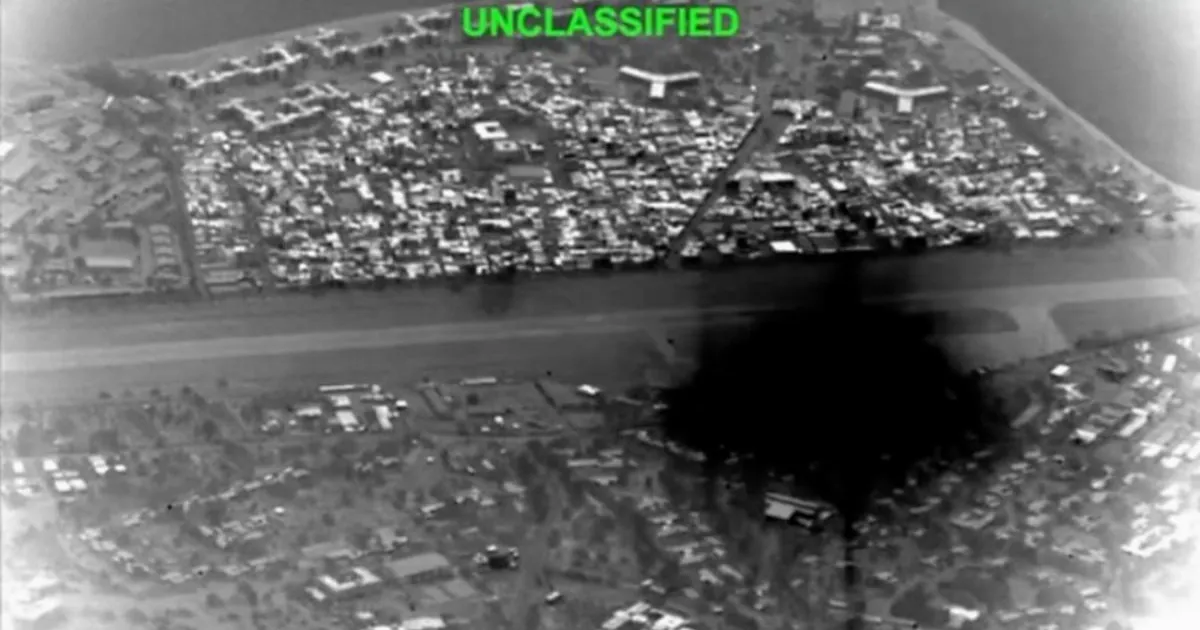
Satellite image hows a view of Iran’s Kharg Island, which hosts the country’s main crude export terminal (Picture: Planet Labs PBC/AFP via Getty Images)
The president had earlier threatened to strike oil infrastructure on Kharg Island unless attacks on vessels on the Strait of Hormuz ceased.
Advertisement
The IRGC warned the energy infrastructure of US allies in the Middle East will be ‘reduced to ashes’ if Iranian energy assets were attacked.
It said oil and energy assets of any countries cooperating with the US would be ‘immediately destroyed’ in the event of more attacks on the country’s energy sites.
In a social media post, Mohammad Bagher Qalibaf said the regime ‘will abandon all restraint’ if the islands come under attack and said Trump will be responsible for ‘the blood of American soldiers’.
An oil tanker burns after being hit by an Iranian strike in the ship-to-ship transfer zone at Khor al-Zubair port near Basra, Iraq (Picture: AP)
Markets were watching for any sign that US strikes had damaged the island’s intricate network of pipelines, terminals and storage tanks.
Even minor disruptions could further tighten global supply, adding pressure to a volatile market.
Advertisement
Oil prices have swung sharply on Trump’s changing comments about the likely duration of the war, which began on February 28 with massive US and Israeli bombardments of Iran and quickly spread into a regional conflict with broad consequences for worldwide energy and stock markets.
Iranian Foreign Minister Abbas Araghchi participates in the traditional Quds Day rally in the capital Tehran (Picture: Anadolu via Getty Images)
Smoke rises after airstrikes in Tehran, Iran (Picture: Anadolu via Getty Images)
The US embassy in the Iraqi capital Baghdad was hit in a missile attack on Saturday, causing smoke to rise from the building, Iraqi security sources said.
They did not have further details on the strike.
In other attacks across the region, Iran’s Revolutionary Guards said they had carried out additional attacks on Israel with Lebanon’s Hezbollah militia, Iran’s Tasnim news agency reported.
Lebanon has become an escalating flashpoint in the war with Israel’s military and Hezbollah forces exchanging strikes in and around Beirut.
Advertisement
On Friday, the Israeli military said its air force had struck more than 200 targets in western and central Iran over the past day, including ballistic missile launchers, air-defence systems and weapons production sites.
Doctor Amir Khan has shared five surprising factors that could spike your blood sugar levels that don’t include food
Fiona Callingham Lifestyle writer
05:14, 14 Mar 2026
A doctor has revealed five “surprising” factors that could cause your blood sugar to rise – and none of them involves eating. In certain situations, this might not necessarily be a “bad thing”, he explained.
Blood sugar, or glucose, serves as the body’s main energy source, derived from food and controlled by insulin. Having excessively high or low blood sugar levels can pose different health dangers.
In a video uploaded to his Instagram page, Doctor Amir Khan highlighted some “surprising” causes behind blood sugar spikes. Dr Amir, widely recognised from his ITV appearances, explained: “Did you know your blood sugar can spike even if you haven’t had a single bite to eat?
“Let me share five surprising things that can raise your blood sugar and why it might not always be a bad thing.”
Stress
Many people don’t appreciate the physical toll stress takes on the body. Dr Amir said: “Number one, stress. When you’re stressed, your body releases cortisol, the fight or flight hormone. That tells your liver to release stored glucose to give you energy.
“Great if you’re running from a tiger, less helpful if you’re just stuck in traffic. Remember, chronic stress equals chronic glucose spikes, and that is not good for long-term health. “
Content cannot be displayed without consent
Poor sleep
Difficulty sleeping can trigger additional problems too. Dr Amir explained: “Number two, poor sleep.
“One bad night, your body becomes more insulin-resistant. That means glucose hangs around in the blood for longer.”
Advertisement
He cautioned that over time, inadequate sleep might even raise your chances of developing type 2 diabetes.
Exercise
This isn’t necessarily harmful, Dr Amir noted. “Certain types of exercises, especially intense or resistance training, can temporarily raise your blood sugars,” he explained.
“Why? Well again, it’s your body releasing glucose for fuel, but really importantly, long-term exercise improves insulin sensitivity, meaning lower blood sugars overall. So this is not a bad spike.”
Infections or illness
Again, this can be the body’s way of trying to stay healthy. Dr Amir said: “When you’re fighting off a bug, your immune system has to ramp up and that comes with a glucose surge. It’s your body’s way of fuelling the immune response.
“People living with diabetes often notice higher blood sugar levels when they’re unwell. That’s totally normal and they may have to adjust their medication accordingly.”
Hormones
His concluding piece of guidance was directed at women. Dr Amir said: “Ladies, this one’s for you because it’s maybe around your periods or the menopause. In the second half of your menstrual cycle, that’s the luteal phase, progesterone levels rise.
“This can make your cells more insulin resistant, meaning higher blood sugars, and of course, the perimenopause and the menopause oestrogen levels decline and that comes with insulin sensitivity dropping.
Advertisement
“So you become more resistant to insulin, leading to more frequent spikes in blood sugar. That’s why women in their 40s and 50s may notice weight gain, fatigue or brain fog, which can be linked to blood sugar shifts. “
He continued: “So remember, not all blood sugar spikes are bad, context matters. But if you’re seeing high readings and you’re not sure why it’s always worth talking to your doctor and not always about what you’re eating, knowledge is power.”
If you’re worried about your blood sugar levels, contact your GP for advice.
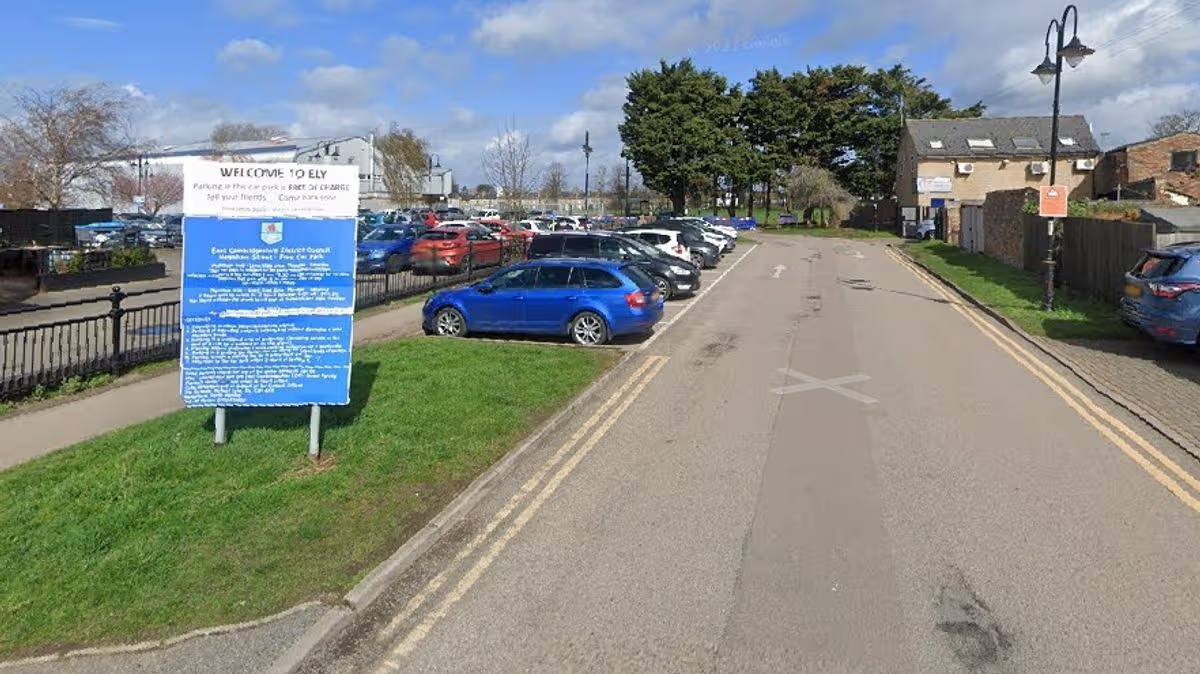
A car park in Ely city centre will be partially closed for resurfacing. Works are scheduled to start at Newnham Street car park on Monday, March 16, and are expected to last for two weeks.
Advertisement
The free car park will remain open during the works. Sections will be closed off so that contractors can carry out the resurfacing works.
East Cambridgeshire District Council has said that the early morning restrictions still apply. Other restrictions such as the short and long stay times will not be enforced while the work is completed.
The car park with be completely closed on Monday, March 30, while the entrance to Nuthold Lane by the Highflyer pub is resurfaced.
Bill Hunt, district councillor with responsibility for infrastructure, said: “We appreciate this may not be convenient for residents and we apologise, however, the resurfacing work ensures the car park will operate at its best for all users.
Advertisement
“We feel it is vital we provide easily accessible free parking in our city centre to help boost our local economy and ongoing maintenance ensures this can continue.”
Businesses and residents who are directly affected have been contacted by the contractors to ensure everyone is fully informed in advance of the work. The work is scheduled to be completed by April 1, ahead of the Easter holidays.
Andy Farrell’s side have not tasted defeat in the competition since being dispatched by France on matchday one, beating Italy, England and Wales since.
Scotland, meanwhile, were also beaten in their opener, losing to Rome, but have won three since – including a shock defeat of then-Grand Slam candidates France last time out.
That defeat left the Tartan Army second in the table and level on points with France, who sit first thanks to a considerable points-difference advantage.
Advertisement
Ireland, meanwhile, come into Super Saturday in third, just two points adrift of their title rivals.
As he looks to get an against-the-odds Six Nations win over the line, Farrell has made four changes, reintroducing Joe McCarthy, Dan Sheehan, Josh van der Fleir and Tommy O’Brien to the side.
Scotland, meanwhile, are shouldering a range of injury concerns, with lock pair Gregor Brown and Scott Cummings both sidelined.
They are replaced by Max Williamson and Grant Gilchrist, while Zander Fagerson comes into the front row in place of D’Arcy Rae.
Advertisement
How to watch Ireland vs Scotland
TV channel: In the UK, Ireland vs Scotland is being shown live and free to air on ITV1, with coverage beginning at 1pm GMT.
Live stream: Fans can watch the game live online via the ITVX website and app.
Live blog: You can also follow all the action on matchday via Standard Sport’s live blog.
Zhao Tong Li also modified a fake firearm to try and make it appear genuine, intending to cause fear of violence.
The 23-year-old, of Claypath in Durham, admitted a string of charges from custody at a plea hearing at the city’s crown court, on Thursday (March 12).
He pleaded guilty to charges of attempted kidnap, threatening a person with a knife in a private place, at ‘Student Castle’, in Claypath, possessing an imitation firearm to cause a fear of violence and modifying an imitation firearm, by painting it black, all said to have been committed in February this year.
Advertisement
Li also faces a charge of stalking the same woman, involving him allegedly making threats and the use of a tracker device, between September 1, 2023, and February 9 this year.
But his counsel, Laura Miller, said he would, instead, offer to plead guilty to a charge of controlling and coercive behaviour in a relationship, if considered acceptable by the prosecution.
John Crawford, prosecuting, said he would consult the reviewing Crown lawyer in the case to see if that would be considered a suitable alternative.
But he said that may be acceptable, given the other pleas made by the defendant.
Advertisement
Mr Crawford said he would confirm the Crown’s views on that charge within a fortnight.
Miss Miller said the defendant has had “ongoing mental health issues” and asked for psychiatric assessment to be prepared on him for the court before he is sentenced.
Judge Jo Kidd agreed and said a background report on the defendant by the Probation Service would also be required prior to a sentencing hearing.
Adjourning the case, she told Li: “You will be spoken to by a psychiatrist to look at issues as to why you committed these offences.
Advertisement
“The reports will assist as to the background of the case.”
She remanded the defendant back to custody to appear on April 30.
Australian chef Curtis Stone is among the guests on ITV’s James Martin’s Saturday Morning
Curtis Stone is one of the biggest stars of the culinary world and has made a huge name for himself though his Michelin star restaurants, kitchen ranges, cookery books and appearances on popular TV shows.
Advertisement
While he is a household name in his native Australia, the 50-year-old from Melbourne will also be familiar to UK audiences for his appearances on MasterChef Australia, which is available on streaming channels.
He will be one of the guests on James Martin‘s Saturday Morning on ITV on March 14 alongside Jane McDonald and mixologist Merlin Griffiths. But what do we know about Curtis?
Here we look at his hugely successful career, family life and why he faced backlash from MasterChef Australia viewers.
Cooking career
Curtis began cooking with his grandmother, Maude, (his dad’s mum) when he was just four years old and clearly got the bug as he went on to study for a commercial cookery apprenticeship.
He worked in Australian restaurants before leaving to work in London, where he debuted his cooking career at age 18 at the Savoy Hotel. He later cooked under the legendary Marco Pierre White (who was also Gordon Ramsay’s mentor) at the Café Royal and Mirabelle, before becoming head chef at White’s Quo Vadis
Curtis’ first restaurant wasn’t in London or Australia but in Beverley Hills. He opened it in 2014 and named it Maude after the grandmother who inspired him to cook. It was awarded a Michelin star in 2019. His second restaurant Gwen (after his maternal grandmother) was launched in Hollywood in 2016 and won a Michelin star six years later.
TV star
Curtis has appeared in a wealth of TV shows in Australia, the US and the UK, including Dinner in a Box, Good Food Live and Saturday Kitchen. He also hosted the first season of My Restaurant Rules in Australia and has become a famiar face on MasterChef Australia.
But despite his popularity, he’s also gained some criticism from viewers of the latter. Following one of his most recent stints as guest judge, he was called out by fans for being “too harsh” and “unpleasant” with the contestants, reported the Daily Mail.
However, Curtis defended his tactics and told how his tough love was designed to push the competitors to showcase their talents.
Curtis told Yahoo Lifestyle how his judging style changed as they got closer to the final and insisted the contestants appreciated his “tough” criticism.
Advertisement
“So I always think as the chef, you have to be a good mentor, and you have to feel out your team, you have to understand where they’re at and know how much pressure, how much to push,” he said.
“And last season, I had a group of guys that were really wanting it, really wanting it a lot. So I gave it to them, and I pushed them, and I made them extend themselves, and I think that, you know, they were really grateful for it at the end of it, and it was really, really fun.”
Marriage and family life
The chef began dating American actress Lindsay Price in 2009 after meeting on a blind date. They got engaged three years later and married in June 2013. They have two sons, Hudson and Emerson, and Curtis regularly shares photos and updates with fans on his official Instagram account.
Advertisement
On Lindsay’s birthday, he shared a photo of them celebrating in Mexico saying: “Happy birthday to my beautiful baby @lindsayjprice so glad we can celebrate you in your favorite place, Mexico!”
James Martin’s Saturday Morning is on ITV on Saturdays at 9.30am and ITVX
For the latest showbiz, TV, movie and streaming news, go to the new **Everything Gossip** website.
The resident has been issued with six parking fines, totalling between £360 or £600, depending on when they are paid
A woman who has been issued with six fines for parking on her housing estate says she is considering selling her car because of the “unfair” fines.
Advertisement
Nadia Mullins-Hills, 37, lives in Trumpington on the Aura Development in the Long Road area of Cambridge. She has lived here since June 2024 but didn’t start receiving parking fines until January this year. She’s been issued with six parking fines so far.
Nadia said that she was either parked in one of the designated parking spots, or ‘laybys’ next to the pavement. She claims that there are no obvious signs prohibiting parking in these areas. She was later told that she had to park within a visitor marked spot when she receieved the fines.
Nadia said: “There are 37 houses just in our postcode, and we have four visitor’s parking spots.”
One of her six fines, she said was likely to have been when an event or club was taking place at the nearby school. She said parking is “severely impacted while there are visitors to the school”.
Advertisement
Nadia added: “It is impossible to see clearly as the images are so dark, and I expect my car was actually parked in the correct bay.”
A spokesperson for Bridge Parking & Asset Management (BPAM) which is the parking company who issued the fines said: “PCN’s may be issued to a vehicle for parking not in accordance with the displayed terms and parked in the same location every 24 hours. If that vehicle has been in breach of these terms, then a PCN could be issued everyday if seen at the time of event of a patrol staff member.”
In one week, Nadia said that she received three fines at once, two of which were on consecutive days. She has now been issued with six parking fines, totalling between £360 or £600, depending on when they are paid.
Nadia has appealed and made complaints about the fines, as she believes them to be unfair. She has found the situation “extremely stressful”, and said that she is anxious to travel by car to and from her own home because she is concerned about receiving another fine when she returns.
She has reached out to MP Daniel Zeichner about her situation. MP Zeichner said: “After Ms Mullins‑Hills approached me about her situation, I contacted the parking company in question to raise the concerns she highlighted and to ask that they review the circumstances in full. I recognise the worry this has caused her, and I will continue to stay in touch with her while the issue remains unresolved.”
A spokesperson for BPAM added: “PCN’s would only be issued to vehicles parking outside of the displayed terms and conditions.”
Nadia said: “I am actually considering selling my car, because I haven’t got an option.”
Advertisement
Nadia said she left her car in a designated spot for a week because she “can’t run the risk of coming back and not being able to park anywhere”.
In response to these claims, BPAM added: “Bridge Parking & Asset Management (BPAM) only operate on private land and under the current code of practice issued by the BPA. We are audited to ensure compliance is maintained and only issue PCN’s in a fair and precise manner.”
Nadia is now unsure as to when the fine needs to be paid as her appeal has been rejected, but the PCN still showing as being in appeal status.
BPAM explained that when an appeal is logged, the case will be on hold until the appeal has been read and reacted to. From this point forward if the appeal is rejected, the company offers a further discounted period offering a further 14 days to pay the reduced fee of £60.
Advertisement
Alternatively, the appellant can choose to log an appeal with the parking ombudsmen POPLA.
There may be many more people who are suffering in silence.
Professionals working in the field estimate the extent of domestic and sexual abuse is widely under-reported, with victims often unwilling to reveal to relatives, friends, agencies or the authorities what is happening to them.
The current domestic abuse strategy plan for York and North Yorkshire, estimates there are 32,500 adults suffering domestic abuse in its area alone.
Advertisement
As well as its Yorkshire-wide domestic abuse service, IDAS provides an independent sexual violence advisor service in North Yorkshire, which in 2025 supported 507 adults and 198 children and young people, with 27 per cent being aged between 16 and 20. Two per cent were aged 65 or over.
Its chief executive officer Sarah Hill said: “We know that long-term change can only be achieved when communities are equipped to recognise the causes and impacts of abuse and so we have strengthened our whole-community approach, embedding specialist support in everyday settings and building partnerships that extend far beyond traditional service boundaries.
“We believe that everyone has the right to live a fulfilled life, free from abuse and violence and we want to ensure that this is a reality for those we support today and for future generations.”
In 2025, the charity worked with the Mayor of York and North Yorkshire and survivors of domestic abuse in rural areas to run campaigns, train volunteer coordinators to act as champions in their areas and attend rural roadshows to bring support closer to where domestic abuse occurs.
Advertisement
It also started initiatives to help those in military families or surroundings.
IDAS (Independent Domestic Abuse Service) provides help for those suffering from violent, emotional, coercive and other domestic abuse across Yorkshire.
In 2025, in addition to 29,513 calls to its helpline, IDAS also managed 20,762 referrals and responded to 1,952 online chats on its website, its 2025 impact report reveals.
It trained 12,805 professionals and champions of survivors of domestic and sexual abuse, supported 8,014 adults and children and provided accommodation for 318 adults and children.