

Crypto World
Why Bitcoin Just Bounced Back to $70K: Key Factors Behind the Move


TLDR:
- Bitcoin saw macro relief as the PCE inflation print came in at ~2.8% YoY, matching expectations and easing pressure on risk assets.
- A U.S. 30-day oil sanction waiver cooled energy markets, reducing inflation fears and boosting investor risk appetite.
- Spot Bitcoin ETFs recorded multiple consecutive inflow days, with BlackRock’s IBIT leading institutional demand signals.
- Dealer hedging near the $75K options strike amplified BTC’s upward move, accelerating the return to the $70K level.
Why Bitcoin just bounced back to $70,000 is a question many market watchers are asking this week. The recovery did not happen by chance, as several converging factors drove the price higher.
Easing inflation data, cooling energy prices, consistent ETF inflows, and strategic derivatives positioning all played a role.
Understanding each of these elements helps explain the mechanics behind this notable price recovery in the cryptocurrency market.
Cooling Macro Pressures Gave Bitcoin Room to Recover
The most immediate reason why Bitcoin bounced back traces directly to the latest inflation data. The Personal Consumption
Expenditures report printed at approximately 2.8% year-over-year, closely matching market expectations. A higher-than-expected reading would have pressured risk assets across the board.
Instead, the in-line result removed a key obstacle that had been weighing on investor sentiment toward Bitcoin.
Energy markets also shifted in a constructive direction around the same time. The U.S. government issued a 30-day waiver permitting select countries to purchase sanctioned Russian oil stranded at sea.
Coordinated global measures, including potential strategic reserve releases, helped stabilize oil prices further. Calmer energy markets reduced broader inflationary fears and encouraged investors to re-enter risk assets.
When both inflation data and energy prices ease simultaneously, risk appetite tends to return quickly. Bitcoin, being a highly sentiment-driven asset, responded swiftly to this improved macro backdrop.
Fewer macro headwinds meant investors faced less resistance in adding exposure to the asset. That clearing of obstacles was a direct catalyst for the move back toward $70,000.
Institutional Demand and Derivatives Positioning Accelerated the Bounce
Beyond macro factors, consistent ETF inflows helped explain why Bitcoin bounced back with such force. Spot Bitcoin exchange-traded funds recorded multiple consecutive days of positive inflows during this period.
BlackRock’s IBIT led the way, reflecting persistent institutional demand through regulated investment vehicles. This steady buying created a reliable floor of support beneath the asset’s price.
Crypto analyst CryptosRus pointed directly to this institutional trend as a driving force. The analyst noted on social media that sustained IBIT inflows signal steady and growing institutional confidence in Bitcoin.
Unlike retail-driven rallies, institutional flows tend to be more deliberate and measured in nature. That consistency adds a layer of structural support that amplifies price recoveries when macro conditions also align.
The derivatives market then added fuel to an already improving situation. Dealer hedging around major options strike prices near $75,000 created additional buying pressure as BTC climbed.
CryptosRus described the overall setup clearly, stating that macro pressure eased while institutional flows stayed strong. Derivatives positioning then accelerated the upward move from there.
The analyst called this combination a classic recipe for Bitcoin momentum to restart. Market participants are now monitoring closely whether Bitcoin can sustain its position above the $70,000 level.


Crypto World
Oil Markets Surge Past $100 as U.S. Military Strikes Hit Iran’s Kharg Island Facilities
TLDR
- American military forces eliminated all defense installations on Kharg Island, Iran’s primary oil export facility responsible for approximately 90% of the nation’s crude shipments
- President Trump deliberately avoided targeting petroleum infrastructure but issued warnings that terminals face destruction if Iran continues Hormuz blockade
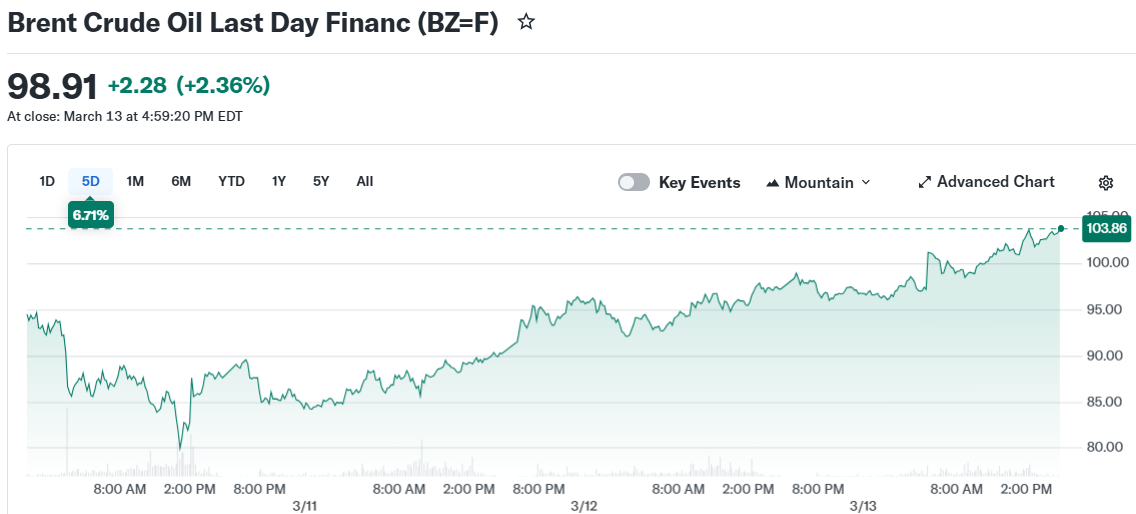
- Brent crude surged past the $100 threshold in the aftermath of the military operation
- Vessel traffic navigating the Strait of Hormuz has plummeted from 84 daily transits to under 10 ships
- Operation Epic Fury has claimed the lives of 13 American military personnel; Saudi-based refueling aircraft sustained damage in retaliatory action
In a Friday announcement, President Trump confirmed that American military forces successfully neutralized all defense positions stationed on Kharg Island, Iran’s critical petroleum export terminal.
The President utilized his Truth Social platform to disclose that U.S. Central Command executed the operation specifically to eliminate Iranian military defenses protecting the strategic island. In his statement, Trump emphasized his decision to preserve the petroleum facilities “for reasons of decency,” while simultaneously cautioning that such restraint hinges on Tehran permitting unobstructed maritime navigation through the Strait of Hormuz.
Tehran issued a swift response, declaring that any assault on its energy sector would trigger immediate retaliatory destruction of energy infrastructure belonging to nations providing assistance to Washington.
Vice President JD Vance revealed that Mojtaba Khamenei, Iran’s newly appointed supreme leader, sustained injuries during the military strikes. “We don’t know exactly how bad,” Vance said.
Operation Epic Fury has resulted in thirteen American military casualties to date.
At Prince Sultan air base located in Saudi Arabia, five refueling aircraft belonging to the U.S. Air Force were struck and suffered damage while grounded. Two defense officials verified the attack occurred, though no fatalities were reported.
The Defense Department is deploying a Marine expeditionary unit alongside additional naval vessels to the Middle Eastern theater. Trump further announced that the U.S. Navy will shortly commence escort operations for oil tankers traversing the Strait of Hormuz.
Oil Prices and Supply Disruptions
Brent crude has been hovering around the $100 per barrel threshold. The Kharg Island military operation propelled prices decisively above that psychological barrier.
Since March 2, the Strait of Hormuz has experienced near-complete maritime paralysis. Vessel traffic has crashed from a 2026 average of 84 daily transits to fewer than 10 ships, based on ACLED tracking data.
Kharg Island functions as the export point for approximately 90% of Iranian crude oil shipments. Energy analysts from SEB had previously highlighted significant global supply vulnerabilities should the island’s export terminals face military action, projecting potential price spikes far exceeding current conflict-driven levels.
The International Energy Agency orchestrated an unprecedented coordinated release of 400 million barrels from strategic petroleum reserves worldwide in an effort to stabilize energy markets.
Federal Reserve and Inflation Concerns
ING analysts suggest the Federal Reserve may be compelled to maintain elevated interest rates for an extended period. The primary concern centers on surging energy expenses driving inflation metrics further from the central bank’s 2% objective.
The Gulf region crisis has triggered cost increases for fertilizer and plastic feedstock materials, creating ripple effects throughout consumer pricing structures.
Market participants are closely monitoring potential counterattacks from Iran’s Revolutionary Guard forces. The Pentagon’s deployment of a Marine expeditionary unit to the region indicates preparations for potential conflict escalation.
Oil prices remain elevated above $100 per barrel while daily vessel movements through the Strait of Hormuz persist at fewer than 10 ships according to the most recent available information.
Crypto World
Meta (META) Stock Drops as Company Plans Major Layoffs to Finance Massive AI Investment

Key Highlights
- Meta may eliminate approximately 20% of its total workforce — potentially affecting 16,000 workers
- The workforce reduction aims to finance a massive $600 billion AI infrastructure investment extending to 2028
- Mark Zuckerberg has directed top executives to develop headcount reduction strategies
- The company recently purchased AI agent platform Moltbook and invested $2 billion in Chinese AI firm Manus
- Meta’s “Avocado” AI system has underperformed against internal benchmarks
Meta Platforms appears poised to execute its largest workforce reduction since 2022, with internal discussions pointing toward eliminating 20% or more of current staff. Given Meta’s December employee count of approximately 79,000, this translates to around 16,000 positions potentially being eliminated.
The information surfaced Thursday via Reuters, which spoke with three individuals with direct knowledge of the discussions. However, neither timing nor precise figures have been finalized. When contacted, a Meta representative characterized the reporting as “speculative” and focused on “theoretical approaches.”
These potential reductions stem from Meta’s ambitious artificial intelligence strategy. The social media giant has pledged to invest $600 billion in data center construction and AI infrastructure through 2028 — an expenditure requiring significant cost reductions in other areas.
Zuckerberg’s vision has become increasingly apparent. Speaking in January, he noted witnessing “projects that used to require big teams now be accomplished by a single very talented person.” This efficiency narrative underpins Meta’s current trajectory.
According to two Reuters sources, senior executives have already instructed department heads to develop workforce reduction plans. While still in preliminary phases, the strategic direction appears firmly established.
Aggressive AI Investment Strategy
These workforce changes coincide with Meta’s aggressive AI spending. Meta recently completed the acquisition of Moltbook, an AI agent-focused social platform. Additionally, the company is committing at least $2 billion toward Chinese AI startup Manus.
To attract elite AI researchers, Meta has extended compensation packages valued at hundreds of millions of dollars spanning four years to scientists joining its superintelligence division.
The paradox is striking: the very AI investments necessitating specialized hires may simultaneously trigger widespread job eliminations. The astronomical costs of constructing AI infrastructure are pushing the company toward operational streamlining across other divisions.
Should the 20% reduction materialize, it would represent Meta’s most significant downsizing since its “Year of Efficiency” initiative. That restructuring eliminated 11,000 positions in November 2022, with an additional 10,000 cuts following in early 2023.
Meta follows an industry-wide trend. Amazon announced 16,000 job eliminations earlier this year. Block reduced its workforce by nearly 50%, with CEO Jack Dorsey explicitly attributing the cuts to AI capabilities reducing staffing requirements.
Challenges with Avocado AI Model
Meta’s substantial AI investments haven’t guaranteed smooth execution. The company’s Llama 4 models faced scrutiny following questionable performance on initial benchmarks. Behemoth, the flagship variant, was ultimately canceled ahead of its anticipated summer launch.
Meta’s superintelligence division is currently developing Avocado, a new model designed to rebuild credibility in the company’s AI efforts. However, early results have reportedly disappointed internal stakeholders.
Bernstein analysts have identified a “trough of disillusionment” affecting consumer AI adoption — an apt description of Meta’s current AI product positioning.
META stock declined 3.83% during regular trading following the news, though shares recovered modestly in after-hours activity as market participants evaluated the potential margin benefits of reduced headcount.
Current figures show Meta employed 78,900 people as of its December regulatory filing. A 20% workforce reduction would decrease that total to approximately 63,000 employees.
TLDR
- The XRP Ledger recorded 2.7 million daily payments, marking a 12-month peak, even as XRP’s value dropped 26% since January
- Automated market maker pools expanded to nearly 27,000 while tokenized real-world assets on the platform climbed 35% over 30 days to $461 million
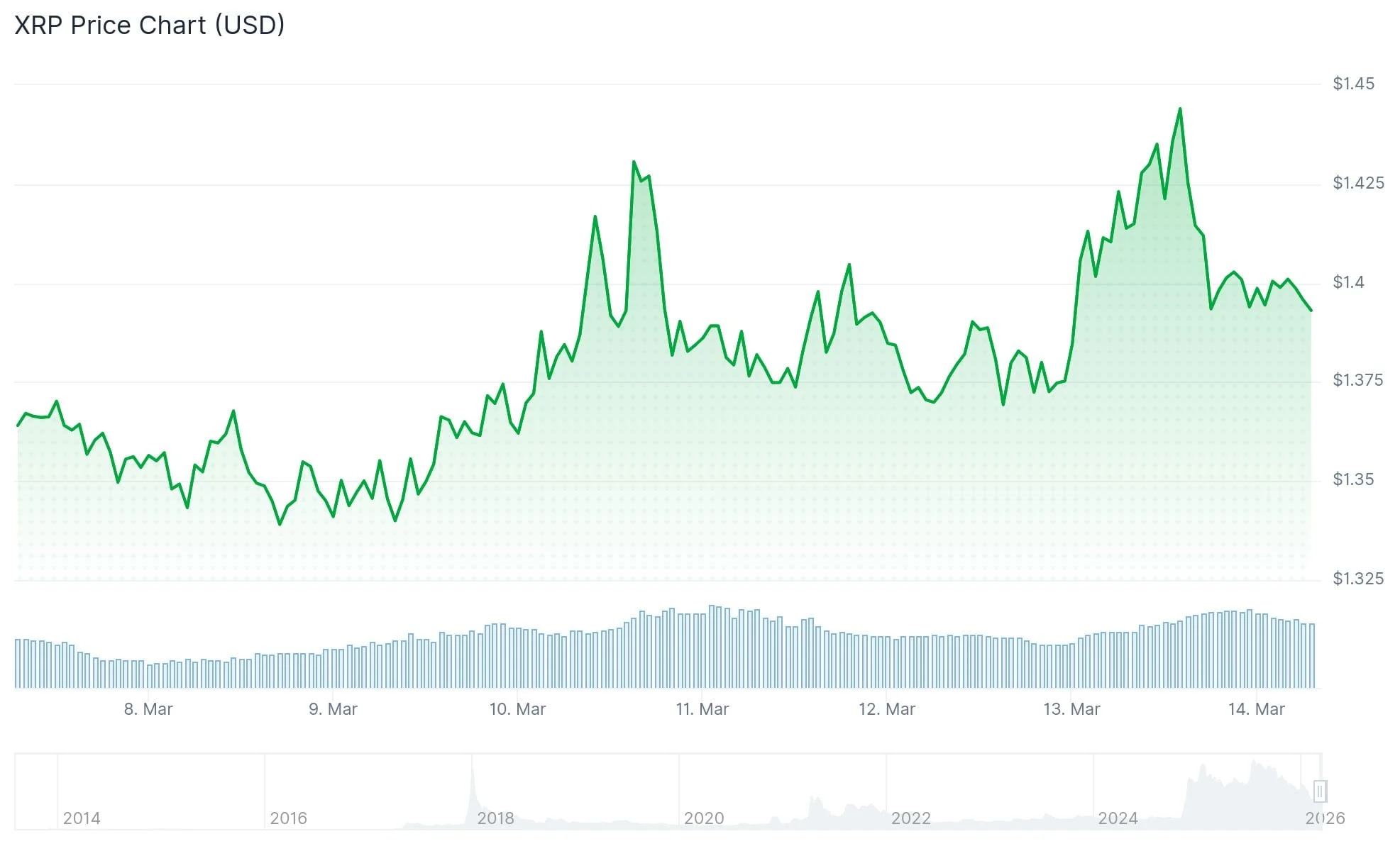
- The token currently hovers near $1.42, representing a 62% decline from its December 2025 high of $3.65
- Technical analysts highlight critical support between $0.80–$0.95, while a surge past $3.32 could unlock targets ranging from $27–$48
- Despite XRP’s $84 billion market capitalization, XRPL’s total value locked remains at a modest $47.54 million
The XRP Ledger is experiencing unprecedented network utilization, yet the token’s market performance tells a contrasting story. Currently valued at approximately $1.42, XRP has shed 26% of its value year-to-date and sits 62% beneath its late-2025 zenith of $3.65.
Successful payment transactions on the XRP Ledger recently climbed above 2.7 million daily, establishing a new 12-month benchmark. This represents a substantial increase from approximately 1 million recorded in late 2025, with the blockchain consistently handling 20 to 26 transactions every second.
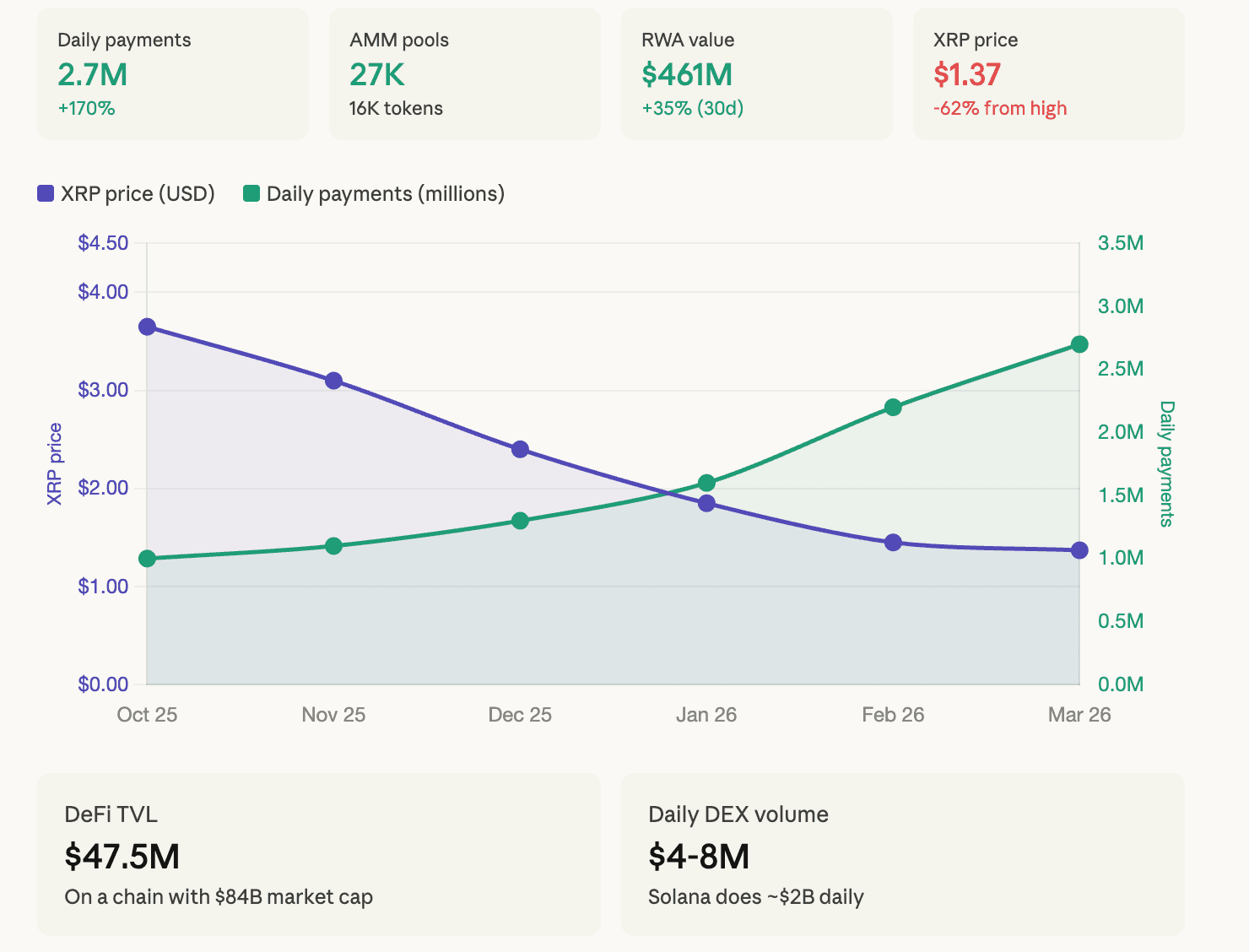
The platform’s automated market maker infrastructure has expanded to encompass nearly 27,000 pools, facilitating trading for more than 16,000 distinct tokens. Currently, twelve million XRP sits deposited within these liquidity pools.
The value of tokenized real-world assets on the ledger climbed to $461 million, representing a 35% expansion over the preceding 30 days. During this same timeframe, stablecoin transfer volume reached $1.19 billion, with the total stablecoin market cap on XRPL standing at $339 million distributed among 35,800 holders.
A significant portion of this network utilization connects to Ripple’s RLUSD stablecoin and tokenized instruments that employ XRP temporarily as a bridge asset. These operations don’t generate enduring demand for holding the token long-term.
Why Activity Isn’t Lifting XRP’s Price
When XRP facilitates a cross-border transaction for mere seconds to connect two fiat currencies, it doesn’t create persistent buying pressure. The blockchain processes more volume, but the token functions as a fleeting intermediary.
According to DeFiLlama, the XRP Ledger’s total value locked reaches only $47.54 million. By comparison, Solana maintains approximately $4 billion in TVL. Ethereum commands over $40 billion.
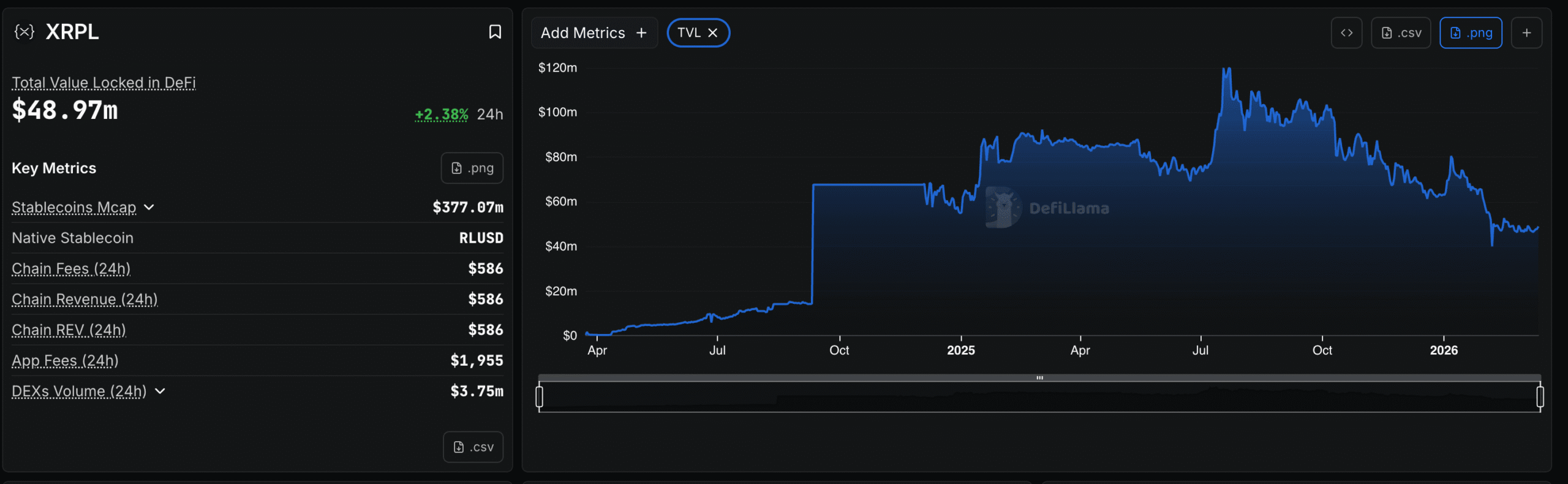
Daily decentralized exchange volume on XRPL fluctuates between $4 million and $8 million. For a Layer 1 blockchain carrying an $84 billion market valuation, these figures remain relatively modest.
The 30-day RWA transfer volume of $149 million — representing an increase exceeding 1,300% — does suggest genuine institutional participation in the asset tokenization sector.
What Analysts Are Watching
Analyst EGRAG CRYPTO highlights a critical accumulation zone spanning $0.80 to $0.95, where several technical signals align, including convergence of the 21, 50, and 100 exponential moving averages alongside a sustained ascending trendline.
Should XRP recapture the 21 EMA and escape its present corrective formation, the subsequent price objective would land near $2.20. The base-building phase could extend through Q2–Q3 2026.
Analyst Ali Martinez recognizes a long-term ascending triangle configuration with horizontal resistance positioned around $3.32. A decisive move above this threshold projects macro objectives spanning $27 to $48.
Analyst Crypto Patel observes a validated multi-year triangle breakout, with a projected bull-market target approaching $50.
The $1.27–$1.30 support region has withstood numerous retests. Historically, XRP delivers an average 18% gain during March.
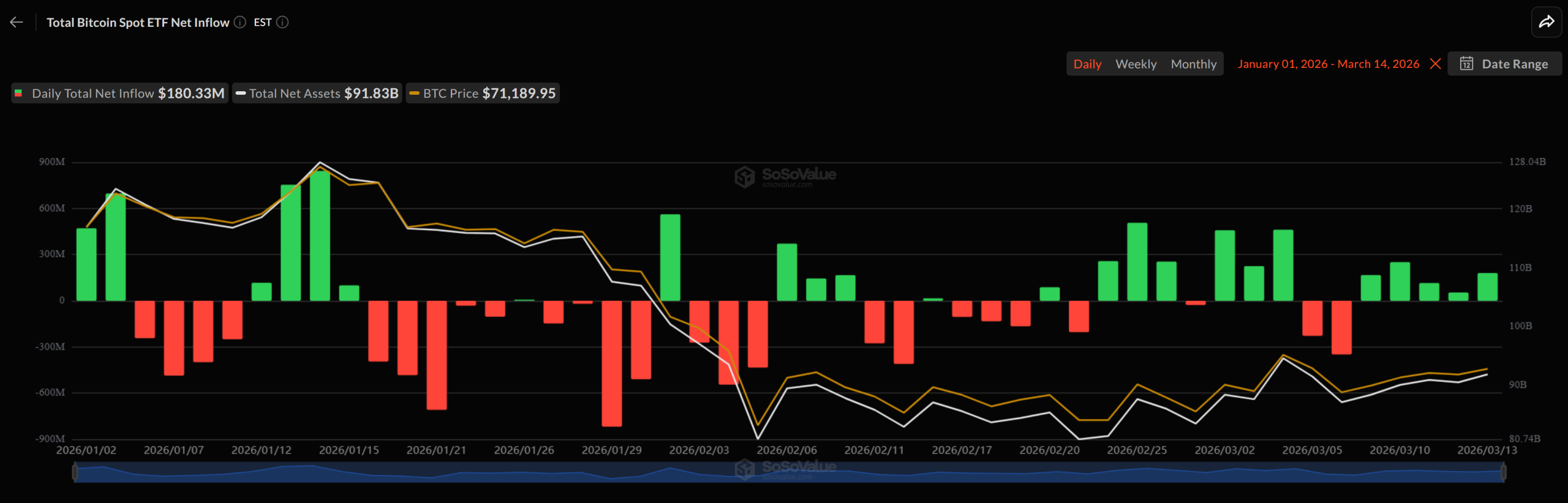
US spot Bitcoin exchange-traded funds (ETFs) logged their first five-day inflow streak of 2026, bringing in roughly $767.32 million this week.
The funds recorded $180.33 million in net inflows on Friday, extending the run of positive flows that began earlier in the week. The strongest day of the streak came on Tuesday, when spot Bitcoin (BTC) ETFs attracted $250.92 million, according to data from SoSoValue.
The last time the funds saw a comparable streak was in late November 2025, when spot Bitcoin ETFs logged five consecutive days of net inflows from Nov. 25 to Dec. 2, bringing in a combined $284.61 million.

Overall, the ETFs now hold $91.83 billion in net assets, with cumulative net inflows reaching $56.14 billion and roughly $4.93 billion in total value traded on the day.
Related: BlackRock says ‘exotic’ crypto ETFs not part of its strategy
Ether ETFs see 4-day inflow streak
Meanwhile, US spot Ether (ETH) ETFs recorded $26.69 million in net inflows on Friday, extending a four-day run of positive flows. The streak began on Tuesday, when the funds added $12.59 million, followed by $57.01 million on Wednesday and a stronger $115.85 million on Thursday, the largest inflow during the period.
The four-day stretch has brought roughly $212.14 million into spot Ether ETFs, reversing the outflows seen earlier in March. As of today, cumulative net inflows into US spot Ether ETFs stands at $11.79 billion, while total net assets across the funds reached $12.26 billion, with about $1.30 billion in value traded on the day.
The recent stretch marks the first sustained inflow run for spot Bitcoin and Ether ETFs this year after a volatile start to 2026 that saw several days of heavy outflows across the products.
Related: Bitcoin ETFs add $251M as Goldman Sachs tops XRP ETF holders
Bitcoin range-bound as Middle East tensions rise
Rising tensions in the Middle East and volatility in energy markets are weighing on global risk sentiment. According to Bitunix analysts, escalating conflict around the Strait of Hormuz and elevated oil prices have increased macro uncertainty and reduced expectations for aggressive Federal Reserve rate cuts, prompting investors to focus on short-term liquidity rather than long-term risk exposure.
Against this backdrop, Bitcoin remains range-bound. Bitunix said derivatives liquidation heatmaps show a key short-liquidity cluster near $71,300, which is acting as near-term resistance, with a larger concentration between $72,000 and $73,500.
On the downside, liquidity support sits around $69,000, with deeper long liquidation levels near $68,800, suggesting BTC may continue consolidating unless macro catalysts trigger a breakout.
Magazine: Bitcoin’s ‘narrative vacuum,’ Ethereum now inevitable: Trade Secrets
Crypto World
Stanley Druckenmiller Forecasts Stablecoin Dominance in Global Payment Systems Within a Decade
TLDR
- Renowned investor Stanley Druckenmiller forecasts stablecoins will become the foundation of worldwide payment systems in 10–15 years
- He emphasizes that stablecoins offer superior speed, reduced costs, and enhanced efficiency compared to legacy banking systems
- Stablecoin market valuation has reached an unprecedented peak of approximately $300 billion
- Despite his optimism on stablecoins, Druckenmiller views cryptocurrency as “a solution looking for a problem” when it comes to storing value
- Major payment platforms including Western Union, MoneyGram, and Zelle have revealed stablecoin integration strategies following the GENIUS Act
Legendary hedge fund manager Stanley Druckenmiller has projected that stablecoins will become the fundamental infrastructure for worldwide payment networks within the next 10 to 15 years, despite maintaining reservations about cryptocurrencies like Bitcoin functioning as reliable stores of value.
The billionaire investor shared these insights during a Morgan Stanley interview conducted between January 30 and 31, which was published this week. His remarks came during a rapid-fire word association exercise focused on blockchain technology and digital currencies.
“Blockchain and the use of stablecoins — if you want to throw crypto into that — tokens, incredibly useful in terms of productivity,” he said.
“I assume our whole payment systems will be stablecoins in 10 or 15 years — efficient, quicker, cheaper,” he added.
Druckenmiller established Duquesne Capital Management in 1981 and shuttered the fund in 2010. Throughout that remarkable 29-year span, he maintained an impressive 30% average annual return without experiencing a single losing year.
This perspective on stablecoins isn’t a recent development for Druckenmiller. During a May 2021 CNBC appearance, he suggested blockchain technology could supplant current US dollar payment infrastructure, citing diminishing confidence in central banking institutions.
“It’s Jerome Powell and the rest of the world, central bankers. There’s a lack of trust,” he said at the time.
The stablecoin sector has experienced explosive expansion. Data compiled by The Block reveals the aggregate stablecoin market capitalization has climbed to approximately $300 billion — representing a staggering 440% increase from roughly $55 billion recorded five years earlier.
Major Payment Companies Embrace Stablecoin Technology
Numerous established payment processors have begun integrating stablecoin capabilities. Industry giants Western Union, MoneyGram, and Zelle each unveiled initiatives to implement stablecoin-based settlement infrastructure throughout last year.
These strategic pivots emerged after the GENIUS Act became law in July, establishing comprehensive regulatory guidelines for payment companies seeking to incorporate digital asset offerings.
Administration representatives have also voiced support. Patrick Witt, who serves as executive director of the President’s Council of Advisors for Digital Assets, suggested this week that stablecoins complying with GENIUS Act standards could channel fresh deposits into American financial institutions by capturing worldwide appetite for dollar-backed instruments.
Bitcoin and Crypto Remain Questionable Store of Value, Says Druckenmiller
While championing stablecoins, Druckenmiller has consistently expressed doubts about the wider cryptocurrency ecosystem.
“Crypto? It’s a solution looking for a problem,” he said in the Morgan Stanley interview.
He conceded, however, that established cryptocurrencies such as Bitcoin have cultivated sufficient brand recognition that certain investors will persist in viewing them as value repositories.
In October 2023, Druckenmiller compared Bitcoin to gold and said he preferred gold because it was a “5,000-year-old brand.”
He disclosed that he currently holds no Bitcoin position, though he acknowledged he likely should consider acquiring some.
The stablecoin sector achieving a fresh all-time high market capitalization approaching $300 billion represents the most recent milestone in its accelerated evolution.


A meme coin linked to US President Donald Trump surged as much as 60% over the past 24 hours after promoters touted an exclusive gala at the president’s Mar-a-Lago resort, though the White House has not confirmed whether Trump will attend the event.
Key Takeaways:
- The TRUMP meme coin jumped as much as 60% after promoters advertised a Mar-a-Lago gala linked to the president.
- Trading activity surged, with daily volume topping $1.6 billion and derivatives open interest rising over 20%.
- Despite the rally, the token remains more than 90% below its peak price from early 2025.
The rally pushed the token, commonly referred to as the TRUMP meme coin, as high as $4.43 before easing to around $3.88, according to data from CoinMarketCap.
At the time of writing, the token is trading at around $4.07, up by 14.32% over the past day.
Trump Meme Coin Volume Tops $1.6B as Derivatives Interest Jumps
Trading activity spiked sharply following the announcement, with 24-hour volume surpassing $1.6 billion.
Derivatives markets also reacted to the surge, with open interest climbing more than 20%, data from Coinglass shows.
Despite the sharp rebound, the token remains far below its earlier highs. The TRUMP coin has lost more than 90% of its value since peaking near $44 shortly after launching in January 2025.
The event at the center of the latest surge is the Fight Fight Fight conference, scheduled for April 25, which organizers say will include a gala luncheon with the president at Mar-a-Lago.
However, Trump’s attendance has not been confirmed by the White House. A White House official, speaking anonymously, told Bloomberg that the president was not currently listed as attending the gathering.
The uncertainty is reflected in the event’s own terms. The conference website notes that Trump “may not be able to attend” and that the event itself could be canceled.
If that happens, qualified participants could instead receive a limited-edition TRUMP NFT, according to the terms.
Organizers have nonetheless insisted the president will appear. In an email statement, Fight Fight Fight reportedly told Bloomberg that Trump’s attendance had been confirmed, adding that the announcement would not have been posted on the official TRUMP token website otherwise.
Participation in the conference is tied directly to token ownership. According to the event rules, the top 297 TRUMP token holders who connect their wallets to a leaderboard, or verify holdings through brokerage Robinhood, will qualify to attend.
The top 29 holders will receive invitations to a smaller reception featuring Trump.
Eligibility is determined by time-weighted token holdings during the qualifying period, along with certain merchandise purchases tied to the project.
Mar-a-Lago Emerges as Hub for Trump-Linked Crypto Events
Mar-a-Lago has increasingly become a gathering place for crypto-related initiatives seeking proximity to Trump.
Earlier this year, the Trump family’s crypto venture World Liberty Financial hosted an event at the resort.
The meme coin itself traces back to promoter Bill Zanker, who helped organize a similar dinner with Trump for token holders last year.
That event briefly boosted the coin’s price before the rally faded. Attendees reportedlyincluded crypto entrepreneur Justin Sun.
As reported, Bitcoin has shed roughly 25,000 millionaire addresses in the year since Donald Trump returned to the White House, even as US policy shifted toward a more crypto-friendly stance.
Blockchain data shows the number of addresses holding at least $1 million in BTC fell about 16% year over year, suggesting regulatory optimism has not translated into sustained on-chain wealth growth.
The pullback was less severe among the largest holders. Addresses with more than $10 million in Bitcoin declined by about 12.5%, indicating that top-tier investors were better able to withstand price volatility, while wallets near the millionaire threshold were more exposed to market swings.
The post Trump Meme Coin Jumps 60% After Promoters Advertise Mar-a-Lago Gala appeared first on Cryptonews.
TLDR
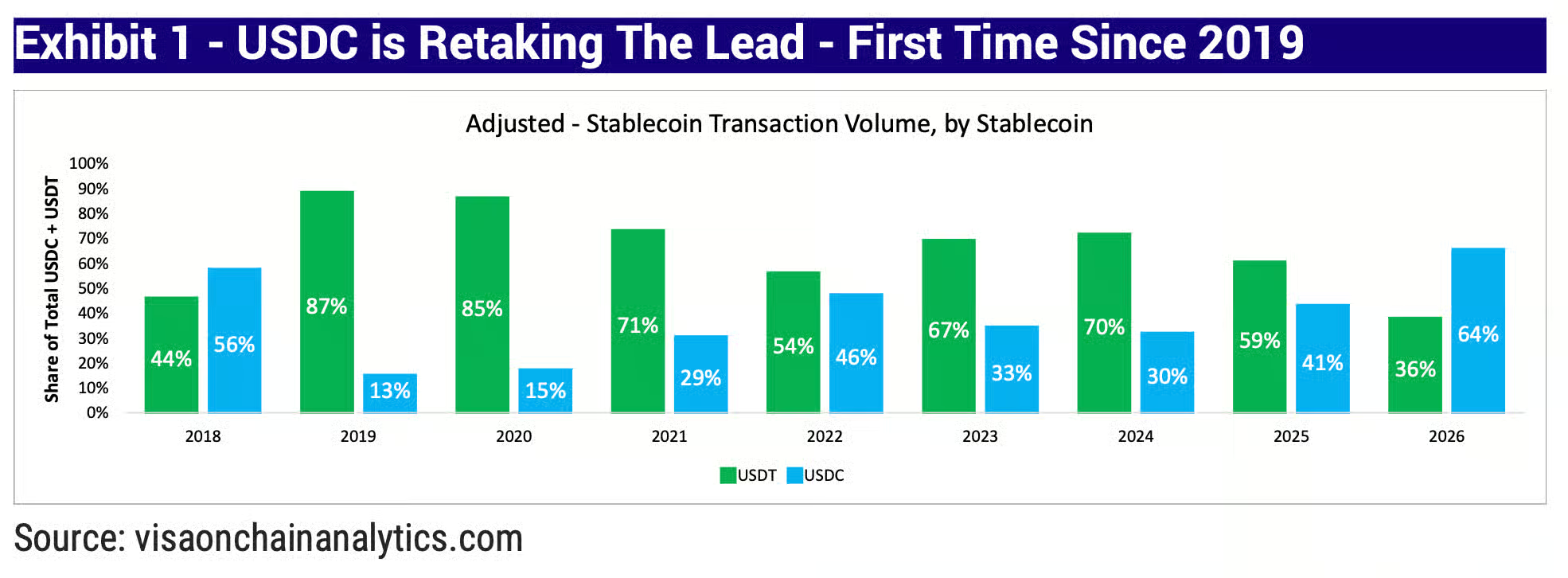
- USDC commands 64% of adjusted transaction volume market share, surpassing USDT in year-to-date metrics per Mizuho analysis
- First instance of USDC volume leadership since 2019
- USDT maintains market capitalization dominance with $184 billion versus USDC’s $79 billion
- Mizuho elevates Circle stock price target from $100 to $120
- According to Mizuho analysts, transaction volume rather than market cap will determine the ultimate stablecoin leader
Tether’s USDT has been surpassed by Circle’s USDC in adjusted transaction volume on a year-to-date basis, based on research findings published by Mizuho, a Japanese investment bank, on Friday, March 13.
This development represents USDC’s first volume leadership position since 2019, bringing an end to USDT’s extended reign in this metric.
According to Mizuho’s data, USDC processed approximately $2.2 trillion in adjusted transaction volume year-to-date, while USDT recorded $1.3 trillion during the identical timeframe.
These figures translate to USDC controlling 64% of the adjusted volume when comparing the two leading stablecoins, per Mizuho’s calculations.
Mizuho’s methodology defines “adjusted volume” as transactions involving centralized exchanges, decentralized exchanges, and other identified entities — or participants who haven’t exceeded specific activity benchmarks. Essentially, transactions that appear to represent genuine person-to-person or institutional value transfers.
The analysts cited examples such as corporate supplier payments, user wagers on platforms like Polymarket, and capital flows between centralized exchanges and DeFi protocols.
What the Volume Shift Means
According to Mizuho analysts, transaction volume provides superior predictive value compared to market capitalization when forecasting long-term stablecoin dominance.
“We believe that longer term, the stablecoin winner will be the one mostly used in everyday economic activity, rather than just the highest market cap,” Mizuho wrote.
Market capitalization leadership remains with USDT. Tether’s stablecoin maintains approximately $184 billion in total value, substantially ahead of USDC’s $79 billion.
Circle completed its public listing on the New York Stock Exchange in June 2025. The company’s stock price exhibited minimal reaction to the Mizuho research release.
The investment bank upgraded its Circle price target from $100 to $120 within the same research publication.
Circle Stock and the Regulatory Backdrop
In the nation’s capital, proposed legislation affecting the stablecoin sector continues to face obstacles.
The CLARITY Act successfully cleared the House of Representatives but has encountered delays in the Senate. Discussions surrounding stablecoin yield distribution, ethics guidelines, and tokenized securities have impeded legislative advancement.
Senate Majority Leader John Thune indicated on Thursday that the Senate would focus on voting requirement legislation ahead of digital asset market structure bills. He projected that the market structure legislation would not advance before April.
The legislative gridlock contributes additional uncertainty to the comprehensive stablecoin regulatory environment as Circle’s shares maintain NYSE trading activity.
Based on Mizuho’s research published March 13, 2026, USDC controls 64% of adjusted volume among the two dominant stablecoins, marking its first leadership position since 2019.
Crypto World
Bitcoin (BTC) Price: Stabilizes at $70K Following Iran Strike as ETF Inflows Surge Past $1.9B
Key Takeaways
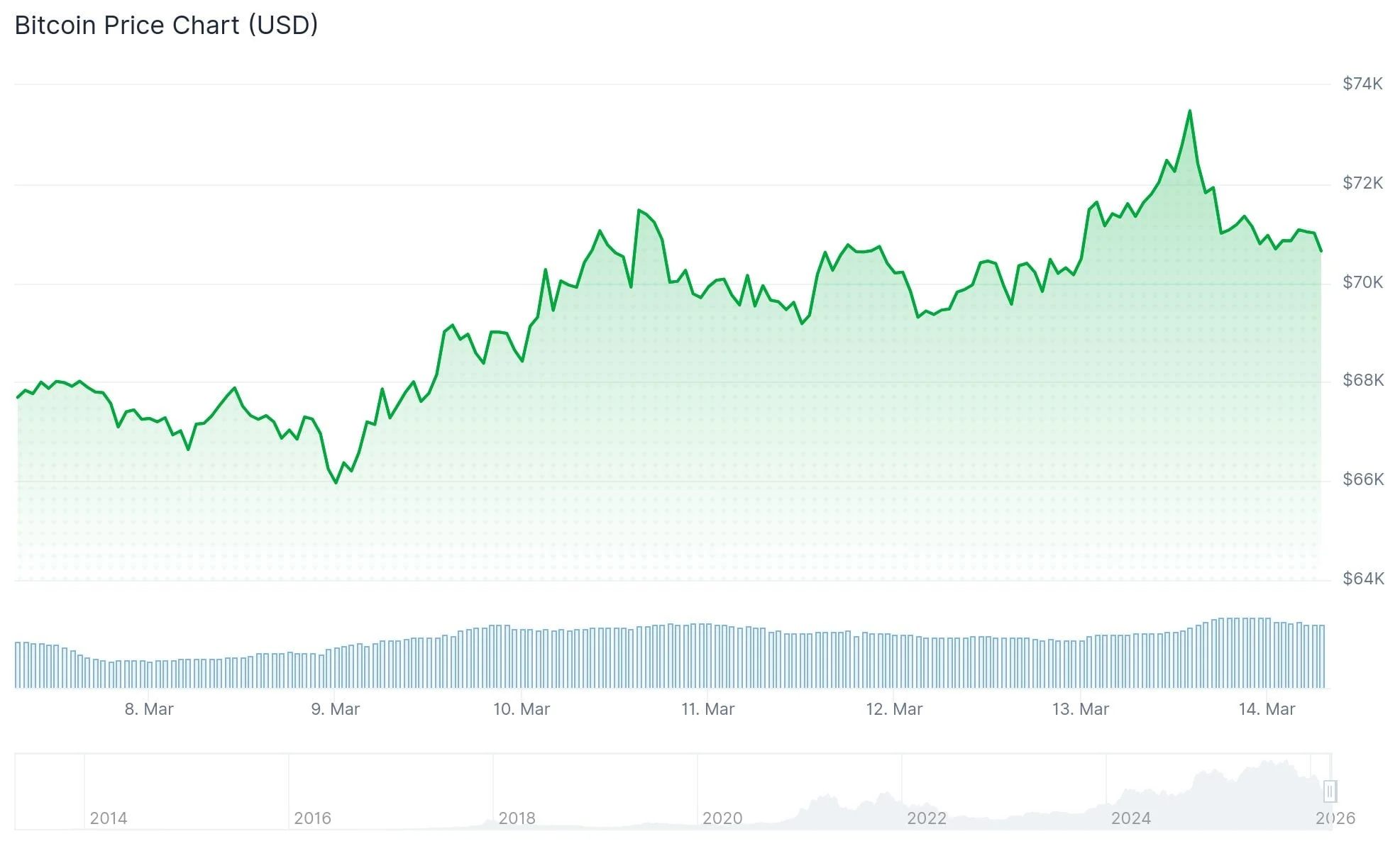
- Bitcoin maintains support near $70,000, experiencing a 0.7% decline over 24 hours following U.S. military action on Iran’s Kharg Island
- Weekly performance shows a 4.2% increase — marking BTC’s most substantial seven-day rally since September 2025
- The critical resistance zone between $73,000–$74,000 has turned back Bitcoin on four separate occasions within a two-week period
- Bitcoin ETF inflows have surged to $1.9 billion across a three-week span, with March accounting for $1.34 billion of that total
- Federal Reserve’s upcoming March 17–18 meeting has market participants analyzing potential shifts in monetary policy direction
Bitcoin continues to maintain its position around the $70,000 threshold this Saturday, March 14, showing resilience despite escalating geopolitical tensions triggered by U.S. airstrikes targeting Kharg Island, Iran’s crucial oil export hub.
Following the military action, BTC experienced a 3.5% decline from Friday’s peak of $73,838. While the downturn was notable, it remained relatively controlled within the broader market context.
Remarkably, Bitcoin’s current valuation exceeds its price point from when Middle East hostilities initially commenced two weeks ago.
Weekly performance metrics reveal BTC climbing 4.2%. Ethereum advanced 5.5% to reach $2,090. Dogecoin registered a 5% increase. Solana moved 4.2% higher to $88. BNB appreciated 4.5% to $655. Major cryptocurrencies across the board posted positive weekly returns.
During the conflict’s initial phase, cryptocurrency markets reacted sharply to each development. Currently, market participants have seemingly developed a predictable response pattern: military strikes occur, crude oil prices surge, Bitcoin experiences temporary weakness — followed by subsequent recovery.
This cyclical behavior has occurred with sufficient frequency that immediate panic-selling has diminished considerably.
Resistance at the $73,000–$74,000 Zone Persists
Bitcoin has encountered rejection within the $73,000–$74,000 price band on four distinct occasions during the past two weeks. This level continues representing the critical resistance threshold commanding trader attention.
Should BTC establish firm support above $74,000, liquidation analytics indicate approximately $1.9 billion in leveraged long positions concentrated immediately above $75,000 — creating a potential price magnet.
Beyond that threshold, the $76,000 to $80,000 range contains roughly $2 billion in sell-side liquidity distributed across the $4,000 span.
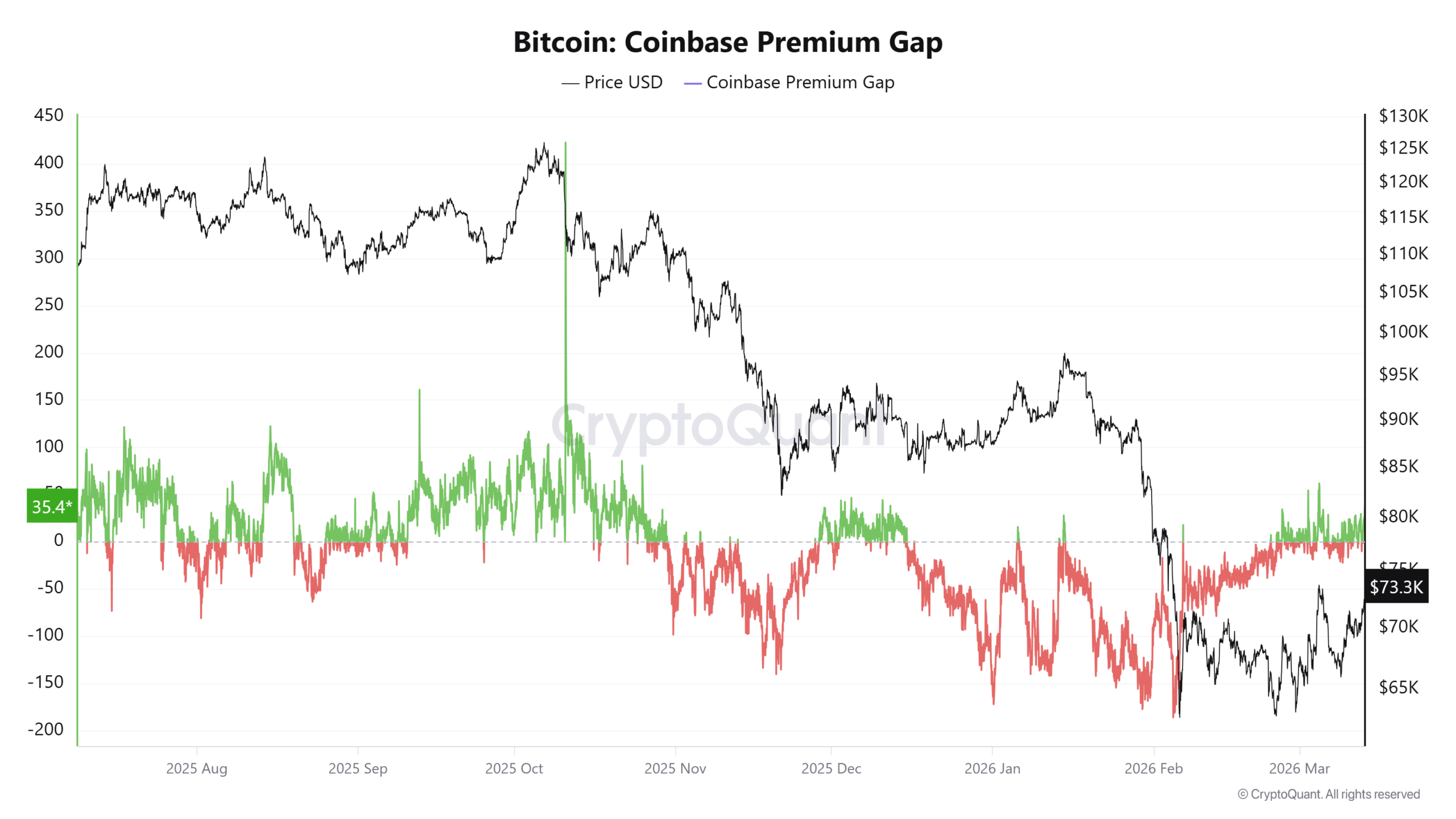
The Coinbase premium indicator has shifted positive for the first time in approximately ten weeks, registering +35.4. This development indicates strengthening buying activity from U.S.-based spot market participants, marking a reversal from the extended selling pressure observed throughout much of 2026.
Exchange-Traded Fund Demand and Institutional Accumulation Drive Support
Spot Bitcoin ETF net capital inflows have surpassed $1.9 billion during the previous three-week period. March independently has attracted $1.34 billion, positioning ETFs for their first monthly net positive performance since October.
Strategy expanded its holdings by 11,042 BTC this week utilizing its STRC financing mechanism, contributing sustained market demand.
Total liquidations reaching $371 million during the past 24 hours demonstrated activity across both trading directions. Short position liquidations dominated at $207 million compared to $163 million from long positions.
Trump communicated via Truth Social that he deliberately avoided targeting Iran’s oil infrastructure “for reasons of decency” while warning he would “immediately reconsider” should Iran persist in obstructing the Strait of Hormuz.
Iranian officials responded that any assault on energy installations would provoke retaliatory strikes against U.S.-affiliated facilities throughout the region.
The Federal Reserve convenes March 17–18. CME FedWatch tool indicates a 95%+ probability of maintaining current rates at 3.5%–3.75%, though market participants will scrutinize the dot plot projections and Chair Powell’s press conference remarks for any indication of evolving rate trajectory.
Crypto World
Ethereum (ETH) Price: Strong On-Chain Signals Emerge as Whales Accumulate and Staking Reaches New Heights
Key Takeaways
- Accumulation wallets now hold 6.5 million more ETH than in January, representing a 32% increase
- Total staked ETH reached an unprecedented 37.85 million, accounting for over 30% of circulating supply
- Major whale address deployed $152.81 million into ETH purchases during a three-day window
- Spot Ethereum ETFs in the United States saw $185.4 million in consecutive net inflows over three sessions
- Breaking above $2,200 resistance could trigger a rally toward $2,600 and beyond
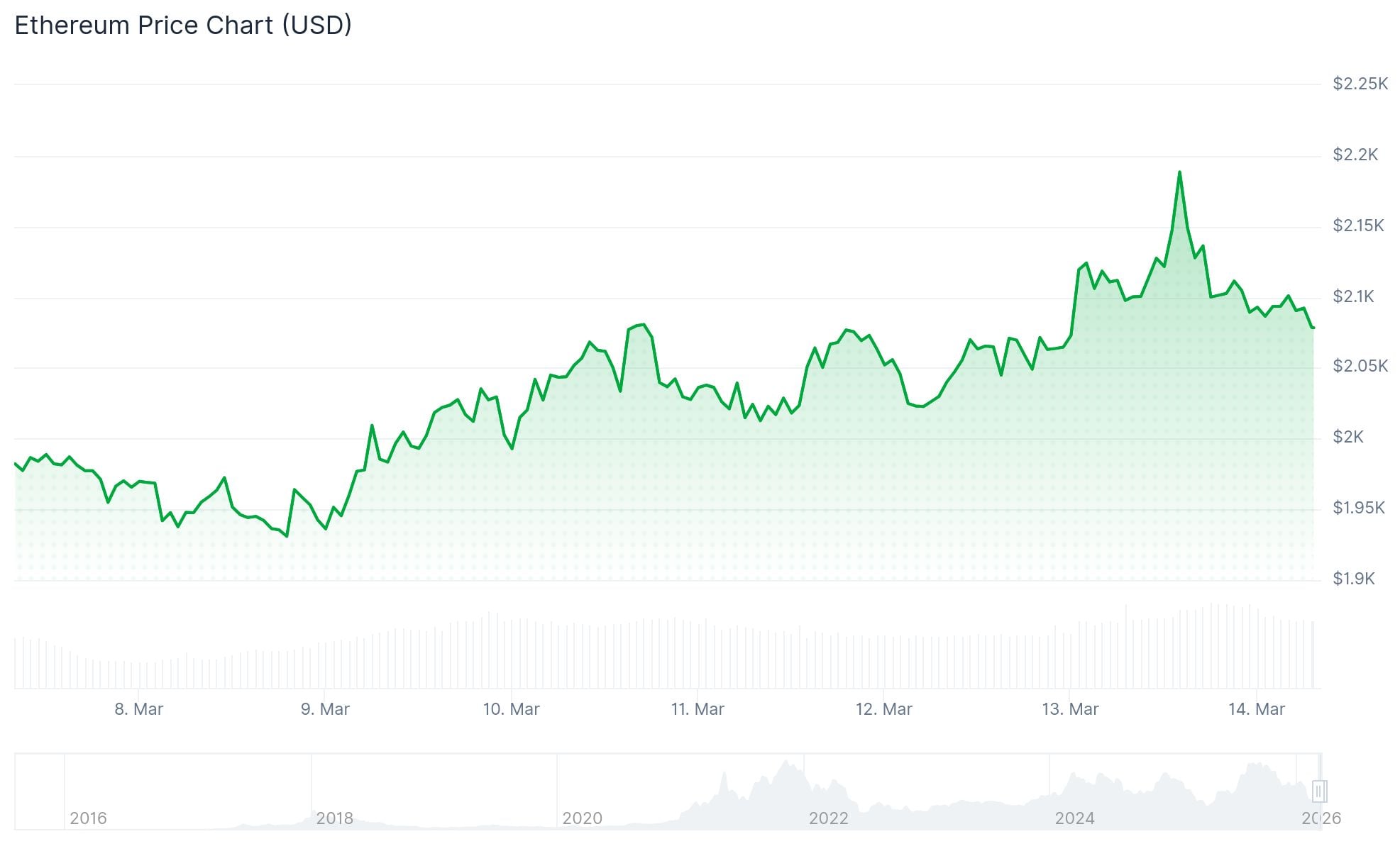
Ethereum currently trades in the $2,078–$2,090 range, representing a roughly 30% decline from its yearly opening price of $2,990. The current trading zone sits immediately beneath a critical resistance area spanning $2,100 to $2,200 that has prevented upward momentum throughout the past month.
While price action appears bearish on the surface, blockchain metrics reveal a contrasting narrative beneath.
ETH balance in accumulation wallets — defined as addresses with zero selling history — has surged from 20.1 million to 26.55 million ETH since the start of January. This represents an addition of 6.5 million ETH, marking a 32% expansion.
Daily additions to these non-selling addresses peaked at 1.14 million ETH in November 2025. Throughout 2026, the average daily inflow has maintained at 200,000 ETH, with Thursday witnessing a notable surge exceeding 350,000 ETH.
Staking Milestone and Large-Scale Accumulation
The amount of staked ETH hit an unprecedented peak of 37.85 million this week. This milestone represents more than 30% of Ethereum’s total circulating supply. Increasing staked supply withdraws tokens from active circulation and demonstrates conviction in long-term holding strategies.
ETH balances on centralized exchanges dropped to a multi-year bottom of 3.46 million, creating additional pressure on available liquidity.
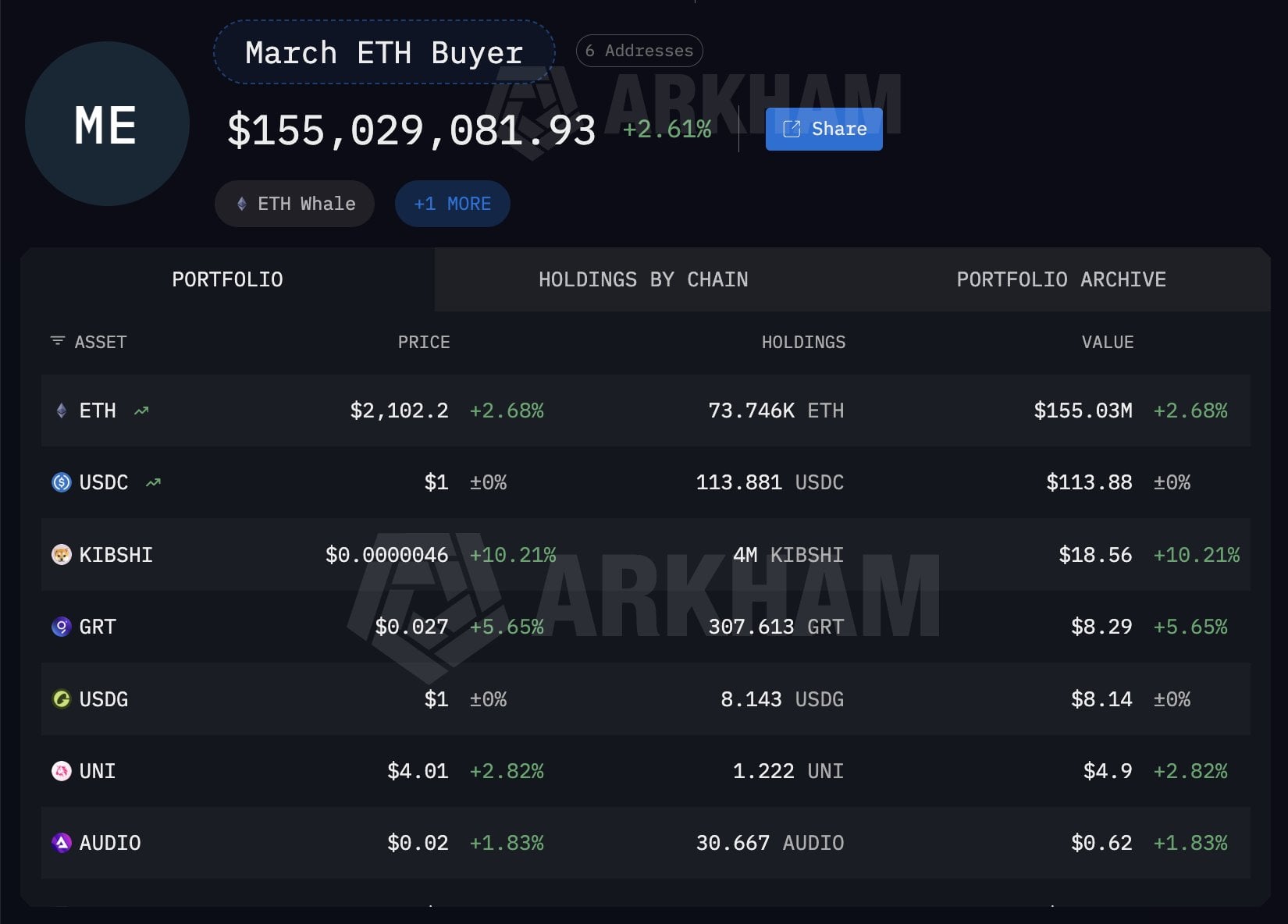
A substantial wallet address, labeled “0x8E3” on Arkham’s blockchain tracking platform, accumulated roughly $152.81 million worth of ETH during a three-day period. The entity controlling this wallet remains unidentified. Possibilities include a high-net-worth individual, institutional trading desk, or corporate treasury.
Large holder addresses controlling between 10,000 and 100,000 ETH increased their collective holdings by 540,000 ETH throughout the previous five trading sessions, based on CryptoQuant’s tracking data.
Spot Ethereum ETFs in the United States registered $185.4 million in cumulative net inflows spanning three consecutive trading days from Tuesday through Thursday, according to SoSoValue metrics. The ETH Coinbase Premium Index simultaneously climbed to levels not observed since early December.
Critical Resistance and Support Zones
Ethereum’s open interest expanded to 13.67 million ETH on Friday, marking the highest reading since January 30. Funding rates have oscillated between positive and negative territory throughout this timeframe.
ETH momentarily pushed above $2,166 before encountering rejection at the 50-day exponential moving average. Bulls must decisively breach that barrier and subsequently target $2,370, with $2,750 as the next objective.
Trading analyst Daan Crypto Trades highlighted that the $2,100–$2,200 zone has functioned as a pivotal price region throughout the past two years. When ETH successfully reclaimed this territory in May 2025, it surged 24% within a week. The June 2025 breakout catalyzed a massive 126% rally culminating at $4,950.
On the bearish side, the $1,750–$1,850 range represents crucial support that must hold. A decisive breakdown below this zone could potentially drive ETH toward $1,000, based on technical analyst projections. The Relative Strength Index currently registers at 52 with an ascending Stochastic Oscillator positioned in the mid-60s.
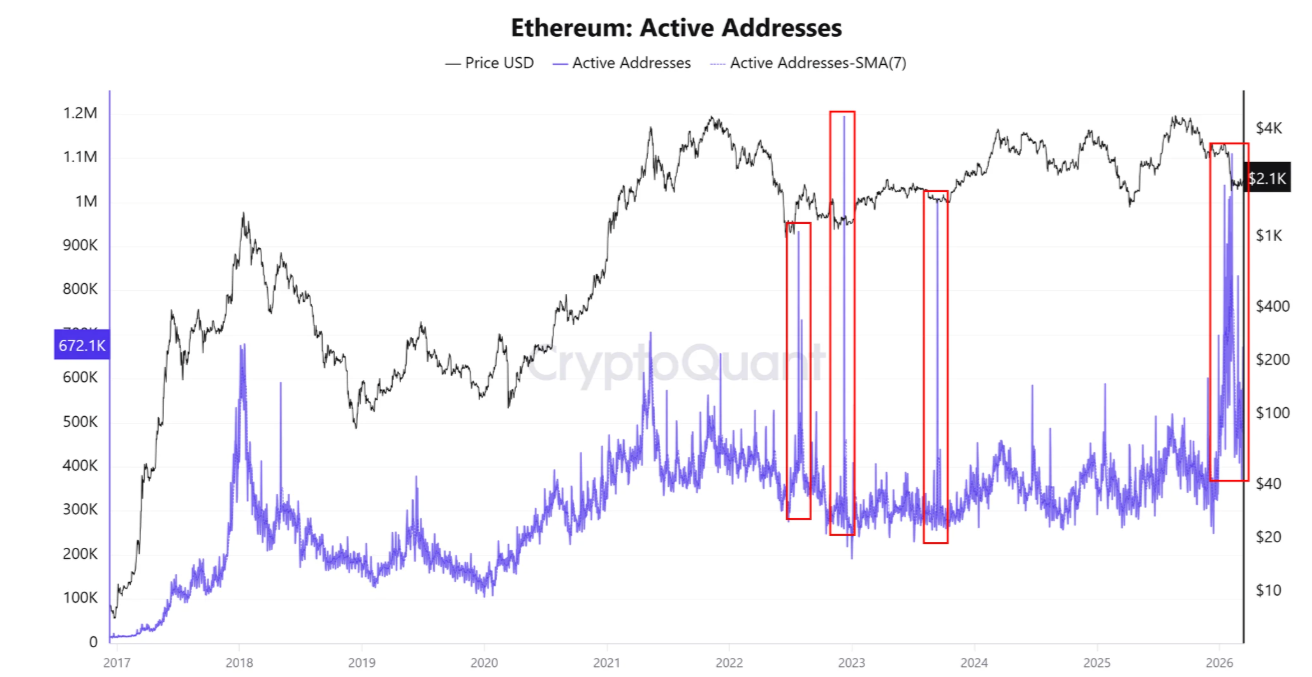
Daily active addresses climbed to 1.1 million during February, the highest reading since December 2022, featuring a dramatic 7-day surge of 80% to reach 672,170.
TLDR:
- Altcoin dominance breakout nears confirmation after five years of downtrend compression and strengthening higher-low structure across the macro chart.
- A bullish MACD crossover on the higher timeframe reflects improving momentum conditions previously seen before major altcoin expansion cycles.
- ALTS token price jumped to $0.00001147 after a sudden spike, stabilizing above earlier consolidation near $0.00001002.
- Altcoin dominance approaching long-term resistance with bullish MACD crossover suggests growing momentum, potentially signaling the start of a new altcoin market expansion phase.
Altcoin dominance breakout signals are forming as long-term market compression approaches a critical resistance area.
Analysts tracking macro charts note improving momentum while altcoin liquidity conditions gradually shift across the broader cryptocurrency market.
Five-Year Downtrend Structure Approaches Critical Resistance
The macro chart shows altcoin dominance trending lower since the previous market peak. A descending resistance line connects several lower highs across multiple years. This pattern has defined the extended consolidation period within the broader crypto market.
Recent price movement now compresses directly beneath that long-term resistance line. The structure also shows gradually forming higher lows. Such compression patterns often appear before major volatility expansions.
The tightening range suggests weakening selling pressure across the altcoin market. Liquidity conditions appear to be stabilizing after several years of contraction. Market participants are closely monitoring the resistance level for potential breakout signals.
A post shared by Crypto Patel on X described the setup. The analyst noted that a five-year downtrend on altcoin dominance approaches structural breakout conditions. The message also referenced improving higher-timeframe momentum indicators.
Momentum Indicators Reflect Possible Market Cycle Transition
The chart includes a momentum indicator panel positioned below the dominance structure. The MACD line currently approaches a bullish crossover on the higher timeframe. Such signals often precede broader shifts in market momentum.
Historical observations show similar crossover patterns during earlier altcoin expansion phases. When those signals were confirmed, altcoins produced large valuation increases. Liquidity rotated away from larger assets into smaller digital tokens.
The chart also marks a previous phase labeled “Altseason Start.” That period coincided with expanding altcoin market share.
Traders commonly associate those phases with strong performance across alternative cryptocurrencies.
The current MACD configuration suggests improving market conditions once again. Momentum appears to be gradually strengthening after prolonged consolidation. Market confirmation, however, still depends on a clear breakout above resistance.
ALTS Token Price Surges After Intraday Liquidity Spike
Short-term market activity also reflects volatility within smaller tokens. The ALTS token traded near $0.00001147 following a sharp intraday surge. Data displayed through CoinMarketCap recorded a 24-hour increase near 14.5%.
Earlier trading activity showed the token consolidating near $0.00001002. Price remained largely unchanged during most of the session. Such behavior often indicates limited liquidity and subdued participation.
Later in the session, a sudden vertical price movement occurred. The token briefly approached levels near $0.000016 before retracing part of the move. Rapid spikes like this typically emerge within thin order books.
After the surge, the price stabilized above the earlier consolidation range. Maintaining levels above $0.000010 now forms a short-term reference zone. Future sessions will determine whether the movement represents sustained demand or temporary volatility.

Meta reportedly weighs layoffs affecting 20% of workforce over AI costs

Oil Markets Surge Past $100 as U.S. Military Strikes Hit Iran’s Kharg Island Facilities
Sebastian Bach reacts to Christina Applegate revealing she ditched her date Brad Pitt for him in the '80s


-
 Tech3 days ago
A 1,300-Pound NASA Spacecraft To Re-Enter Earth’s Atmosphere
-

 News Videos5 days ago
10th Algebra | Financial Planning | Question Bank Solution | Board Exam 2026
-

 Crypto World5 days ago
Paradigm, a16z, Winklevoss Capital, Balaji Srinivasan among investors in ZODL
-

 Business4 days ago
ExxonMobil seeks to move corporate registration from New Jersey to Texas
-
Crypto World4 hours ago
HYPE Token Enters Net Deflation as HyperCore Buybacks Outpace Staking Rewards
-

 Fashion15 hours ago
Weekend Open Thread: Addict Lip Glow
-

 Tech4 days ago
ChatGPT will now generate interactive visuals to help you with math and science concepts
-

 Sports7 days ago
Three share 2-shot lead entering final round in Hong Kong
-

 Sports6 days ago
Braveheart Lakshya downs Lai in epic battle to enter All England Open final | Other Sports News
-

 NewsBeat3 days ago
Residents reaction as Shildon murder probe enters second day
-

 Business6 days ago
Search for Nancy Guthrie Enters 37th Day as FBI Probes Wi-Fi Jammer Theory
-

 Business3 days ago
Search Enters Sixth Week With New Leads in Tucson Abduction Case
-
 NewsBeat4 days ago
Pagazzi Lighting enters administration as 70 jobs lost and 11 stores close across Scotland
-

 Tech5 days ago
Despite challenges, Ireland sixth in EU for board gender diversity
-

 NewsBeat3 days ago
I Entered The Manosphere. Nothing Could Prepare Me For What I Found.
-

 Business5 days ago
Search Enters 39th Day with FBI Tip Line Developments and No Major Breakthroughs
-

 Sports5 days ago
Skateboarding World Championships: Britain’s Sky Brown wins park gold
-

 Crypto World4 days ago
Will Chainlink price reclaim $10 amid volatility squeeze?
-

 Sports5 days ago
Tomorrow’s Top 25 Today: Florida jumps to No. 4; Louisville, Wisconsin enter projected rankings
-

 Sports3 days ago
PWHL, Senators discussing plan to keep Charge in Ottawa