

Crypto World
Bitcoin Nears $74K as Data Signals Bear Market Isn’t Over


Bitcoin extended gains above $73,000 on Friday, stabilizing near a long-standing floor around $70,000 as macro data and geopolitical tensions shape risk appetite. The move followed a US GDP release showing the economy grew just 0.7% in the fourth quarter of 2025, keeping recession fears on the radar into 2026 and complicating the Federal Reserve’s policy path. A surge in energy markets, with oil hovering near $119.50 a barrel amid ongoing Middle East tensions, added to the backdrop of inflation concerns. Against that backdrop, institutional appetite for crypto exposure remained evident as spot BTC ETFs registered ongoing inflows, signaling a persistent but cautious demand from a risk-off to risk-on rotation.
Key takeaways
- Bitcoin clears the $73,000 level and holds the 70,000 area as weak US data and geopolitical tensions weigh on risk assets.
- The 50-day correlation with the Nasdaq 100 sits near 84%, complicating BTC’s role as a hedge in a slowing economy.
- Spot Bitcoin ETF inflows persisted for four consecutive days, totaling about $583 million, but price action cooled as flows reversed in the following days.
- Oil prices surge to around $119.50, adding inflationary pressure and potentially constraining retail crypto investment amid higher energy costs.
- Corporate exposure remains a factor, with MicroStrategy (MSTR) reported to have accumulated substantial exposure via a yield-bearing STRC instrument, underscoring continued institutional nuance in crypto demand.
Tickers mentioned: $BTC, $MSTR, $STRC
Sentiment: Neutral
Price impact: Neutral. The move higher reflects continued demand in a risk-off to risk-on rotation, but broader macro headwinds keep the path forward uncertain.
Market context: The latest price action sits within a broader environment of rising yields, stickier inflation concerns, and mixed liquidity signals. Traders are weighing softening domestic growth against geopolitical frictions that keep energy prices elevated and risk sentiment bifurcated across traditional equities and crypto assets.
Why it matters
The ongoing tension between weak macro growth and available liquidity underscores a delicate balance for crypto markets. Bitcoin’s recent momentum suggests that investors remain willing to allocate capital to scarce assets even as the macro picture remains unsettled. Yet the backdrop of a 0.7% expansion in US Q4 2025 and a 4.26% yield on the 10-year Treasury signals a high-stakes environment where risk assets can swing on every new data point. The observed correlation with major equity indices, particularly the Nasdaq, indicates that BTC is not operating in a vacuum and that cross-asset risk considerations continue to mold price action.
Institutional demand also remains a central theme. The presence of spot BTC ETF inflows points to a structural interest in crypto exposure among larger investors, even as price-driven dynamics can erode or amplify those inflows in the short term. The anecdote about MicroStrategy’s exposure via a yield-bearing instrument further highlights how corporate balance sheets are increasingly intersecting with digital-asset dynamics. For market participants, this blend of macro headwinds, policy moves, and institutional involvement means crypto markets could remain sensitive to shifts in liquidity and regulatory signals while pursuing longer-term diversification goals.
Finally, energy markets and inflationary pressures cannot be ignored. With oil costs holding at elevated levels, consumer spending and risk appetite are mutually influenced by energy prices, which can indirectly affect asset classes including crypto. The convergence of these forces—macro data, geopolitical risk, and institutional activity—helps explain why BTC has shown resilience yet remains encased in a broader trend that favors caution rather than a straightforward breakout.
What to watch next
- Whether BTC can sustain a move above $70,000 and test higher levels, or if price action prints new tests around earlier consolidation ranges such as $64,000.
- Upcoming macro releases, including quarterly GDP updates and inflation data, that could recalibrate bets on rate paths and risk appetite across assets.
- Trends in spot BTC ETF inflows to determine whether fresh liquidity returns or remains episodic, and how that interacts with price action.
- Energy-market developments and geopolitical headlines that could further influence energy prices and the macro backdrop for crypto investments.
Sources & verification
- US Commerce Department GDP release for Q4 2025 and subsequent revisions.
- TradingView charts showing US 10-year Treasury yields and BTC/USD price movements.
- CoinGlass data on US-listed spot Bitcoin ETF net inflows.
- Public policy announcements related to energy purchases (e.g., Russian oil) and related market reactions.
- Market commentary mentioning MicroStrategy (MSTR) and the yield-bearing STRC instrument.
Market reaction and key details
Bitcoin (CRYPTO: BTC) traded with renewed vigor after crossing the $73,000 mark, a milestone that reinforced a weekly floor just above $70,000. The move occurred in a backdrop of softer-than-expected US growth, with the Commerce Department’s fourth-quarter figures showing a 0.7% expansion, a pace that traders interpreted as a potential prelude to a longer horizon of accommodative or selective tightening by policymakers. Alongside the growth data, the benchmark 10-year yield rose to 4.26%, signaling that investors demanded higher compensation for risk as liquidity conditions evolved. The combination of weaker growth signals and higher yields often tilts capital toward scarce assets, a dynamic that has historically supported non-yielding stores of value like BTC in times of macro uncertainty.
Oil markets moved in tandem with these macro shifts, with West Texas Intermediate futures touching levels near $119.50 per barrel as the market digested policy moves and regional tensions. A notable development cited by policymakers involved the temporary authorization of purchasing Russian oil stranded at sea—a move that briefly tempered risk-on impulses but also underscored the fragility of energy markets in an age of geopolitical risk. Against this backdrop, equities fluctuated, with the S&P 500 futures retreating to updated lows as energy prices spiked, only to rebound in subsequent sessions as risk sentiment stabilized to some degree.
From an institutional standpoint, the appetite for Bitcoin exposure remained evident through ETF flows. Reports indicate four consecutive days of net inflows into spot BTC ETFs, totaling approximately $583 million, highlighting ongoing demand from regulated investment vehicles. Yet, the price reaction in the following days suggested that such inflows may be more reflective of price-driven positioning rather than a deterministic signal for sustained upside. In parallel, attention to corporate crypto bets persisted, with MicroStrategy (MSTR) reportedly accumulating substantial exposure via a yield-bearing_STR_C instrument, illustrating how large corporate entities are integrating digital assets into their treasury strategies—even amid a broader market backdrop that remains cautious and data-dependent.
The price action also reaffirmed a relatively high correlation with tech equities, with Bitcoin’s 50-day correlation to the Nasdaq 100 hovering in the upper-80s. This linkage implies that BTC is not entirely insulated from broader equity dynamics, especially when macro risk remains elevated and investors reassess cyclicality within risk assets. The net effect is a market that’s simultaneously buoyed by liquidity-driven inflows and girded by structural headwinds—an environment where a breakout, if it occurs, will likely require a sustained shift in risk sentiment and macro clarity rather than a single positive data point.
Looking ahead, market participants will be watching how the macro narrative evolves: GDP revisions, inflation prints, and policy signals from central banks around the globe. While the recent activity hints at a cautious bullish tilt for Bitcoin, observers stress that the bear market’s structure—characterized by consolidation and tests of major supports—remains a dominant frame for pricing. Investors should calibrate expectations to the possibility that near-term gains could be scrappy and contingent on a broader realignment of liquidity, growth expectations, and geopolitical risk factors.


Billionaire investor Stanley Druckenmiller says blockchain-based tokens, and in particular stablecoins, could power the next wave of global payments within the next decade. Speaking in an interview with Morgan Stanley recorded Jan. 30 and released last week, Druckenmiller framed stablecoins as a productivity boost for merchants and consumers alike, arguing they are faster, cheaper and more scalable than traditional rails. He envisions a future in which much of the payments ecosystem runs on tokenized rails, while reserving skepticism about crypto as a universal store of value. Bitcoin (CRYPTO: BTC) remains his skeptical exception, though he acknowledges some niche use cases. Western Union (EXCHANGE: WU) and MoneyGram (EXCHANGE: MGI) have signaled interest in stablecoin settlements as part of their digitization efforts, and the GENIUS Act has provided a regulatory scaffolding for such initiatives.
Druckenmiller—who founded Duquesne Capital Management in 1981 and later closed the fund in 2010 after a career that delivered an average annual return around 30% with no down years—frames the technology as a productivity lever rather than a reform of money itself. In the Morgan Stanley discussion, he highlighted how tokenized payments could streamline processes that currently rely on legacy rails. The argument rests on a simple premise: stablecoins, as blockchain-based representations of fiat, can cut settlement times, reduce reconciliation complexity and lower fees, especially in cross-border transactions. The discussion aligns with a broader industry push toward on-chain settlement experiments by traditional payments incumbents following the GENIUS Act, which established a regulatory pathway for digital asset services in payments and remittance environments.
Druckenmiller’s case for blockchain-enabled payments hinges on why stablecoins might be preferable to existing mechanisms. He contends that even the most efficient card networks and banks face frictions—intermediaries, FX costs, and delays—that stablecoins can help mitigate. When transactions settle on a blockchain-backed token, the same value can move almost instantaneously and at a fraction of the cost, enabling businesses to optimize cash cycles and consumer experiences. The argument is not that every payment should be tokenized, but that a growing portion of the payment mix could ride on tokenized rails where appropriate, with stablecoins serving as the most practical bridge between fiat currencies and digital settlement layers.
In the same breath, Druckenmiller’s remarks acknowledge the political and regulatory uncertainties that still surround digital assets. The GENIUS Act, which was advanced in July and later shaped the regulatory framework for stablecoin-related services, has provided a degree of clarity for firms seeking to offer digital-asset services in the payment space. The interview notes that legacy players—some already broadening their digital-payments playbooks—are testing stablecoin-based settlement mechanisms to improve efficiency in cross-border flows. In this context, Western Union and MoneyGram have signaled their interest in building out stablecoin settlement capabilities, while Zelle and other traditional rails have also been cited as potential participants in future cross-border and domestic tokenized settlements. The broader implication is that the payments landscape could increasingly mix traditional rails with tokenized alternatives as banks and remittance firms explore these options under regulatory guardrails.
Despite the optimism around stablecoins as a payments catalyst, Druckenmiller remains wary of crypto assets’ role as a store of value. He described Bitcoin as “a solution looking for a problem” and asserted that the asset class does not, in his view, perform the traditional role of a stable store of value. The Morgan Stanley remarks echo a long-running stance: he has previously noted that Bitcoin, despite its narrative appeal, has not found him to be a compelling long-term hold. In a separate 2023 reflection, he compared Bitcoin to gold, but he still argued gold’s longer historical track record and brand strength give it a different standing in his framework. He has also stated he does not own Bitcoin, though he acknowledged that the narrative around crypto can generate broader adoption and speculative demand among audiences that value the technology’s promise.
In the broader arc of Druckenmiller’s commentary, the interview underscores a tension within the crypto discourse: utility and efficiency versus the store-of-value narrative. The truth, as many market observers suggest, may lie in a hybrid reality where stablecoins enable faster, cheaper, and more scalable payments for everyday use while a limited set of assets—like Bitcoin—occupies a niche role in portfolios or as a brand-driven store of value for some investors. The discussion also reflects the ongoing experimentation by traditional finance firms with tokenized settlements and the growing regulatory clarity that could accelerate credible use cases in the near term. While the era of universal crypto-backed money remains contested, the stream of high-profile endorsements and pilots indicates a gradual mainstreaming of tokenized payments as a complement to existing systems.
Why it matters
The conversation signals a practical, near-term shift in how institutions view crypto-enabled payments. If large incumbents pursue stablecoin settlements and tokenized rails, the friction points that dog traditional cross-border payments—latency, settlement risk and FX costs—could be mitigated in meaningful ways for merchants and consumers alike. This matters not just for traders and fintechs but for users who rely on international transfers, remittances and merchant payments. It also frames a more nuanced crypto narrative: utility and efficiency can coexist with skepticism about store-of-value properties, potentially diluting pure hype in favor of tangible improvements in payments infrastructure.
For builders and policymakers, the takeaways are clear. Stablecoins are likely to remain central to pilots and pilots-to-scale pathways, particularly where regulatory clarity is present. The GENIUS Act’s framework appears to have provided a foundation for compliant digital-asset services in payments, which could accelerate institutional experimentation and customer adoption. Regulators, meanwhile, are watching carefully to balance consumer protection with innovation, ensuring that tokenized payments deliver on reliability and security without inviting undue risk to financial systems.
From an investment perspective, the emphasis on productivity gains rather than a universal replacement of fiat money suggests a measured approach: a subset of payments-related assets and networks could benefit from tokenized settlement, while traditional assets may persist in parallel. Druckenmiller’s stance reinforces the view that any significant financial-system overhaul would occur incrementally, with stablecoins bridging the efficiencies of digital technology and the stability of established currencies.
What to watch next
- Regulatory developments on stablecoins and digital-asset service providers in major jurisdictions within the next 6–12 months.
- Announcements from Western Union or MoneyGram related to pilot programs or commercial deployments of stablecoin settlements in emerging markets.
- Progress on the GENIUS Act’s provisions and how financial institutions translate them into operational pilots.
- Ongoing discussions on the role of Bitcoin in portfolios and possible shifts in retail or institutional sentiment toward crypto stores of value.
Sources & verification
- Morgan Stanley interview with Iliana Bouzali from Jan. 30, discussing Druckenmiller’s views on blockchain and stablecoins. https://www.youtube.com/watch?v=FJwBpWSSgSg
- Stablecoin yields and the U.S. banking clarity act article. https://cointelegraph.com/news/stablecoin-yields-united-states-banking-clarity-act-white-house
- Discussion of a ledger-based system potentially replacing USD rails. https://cointelegraph.com/news/billionaire-druckenmiller-says-ledger-based-system-could-replace-usd-worldwide
- Bitcoin versus gold comparison and Druckenmiller’s stance on BTC. https://cointelegraph.com/news/bitcoin-gold-outperform-prediction-macroeconomist-lyn-alden
- Druckenmiller’s comments on Bitcoin and related coverage. https://cointelegraph.com/news/legendary-investor-stanley-druckenmiller-wants-bitcoin
Market reaction and key details
Note: The above narrative draws from public discussions and published interviews that frame blockchain technology and stablecoins as potential accelerants for payments infrastructure. While Druckenmiller remains skeptical about Bitcoin as a store of value, the broader narrative around tokenized settlement continues to unfold through enterprise pilots, regulatory clarifications, and ongoing industry experimentation. For readers seeking a deeper dive, the cited sources provide additional context and primary-source materials surrounding these discussions.
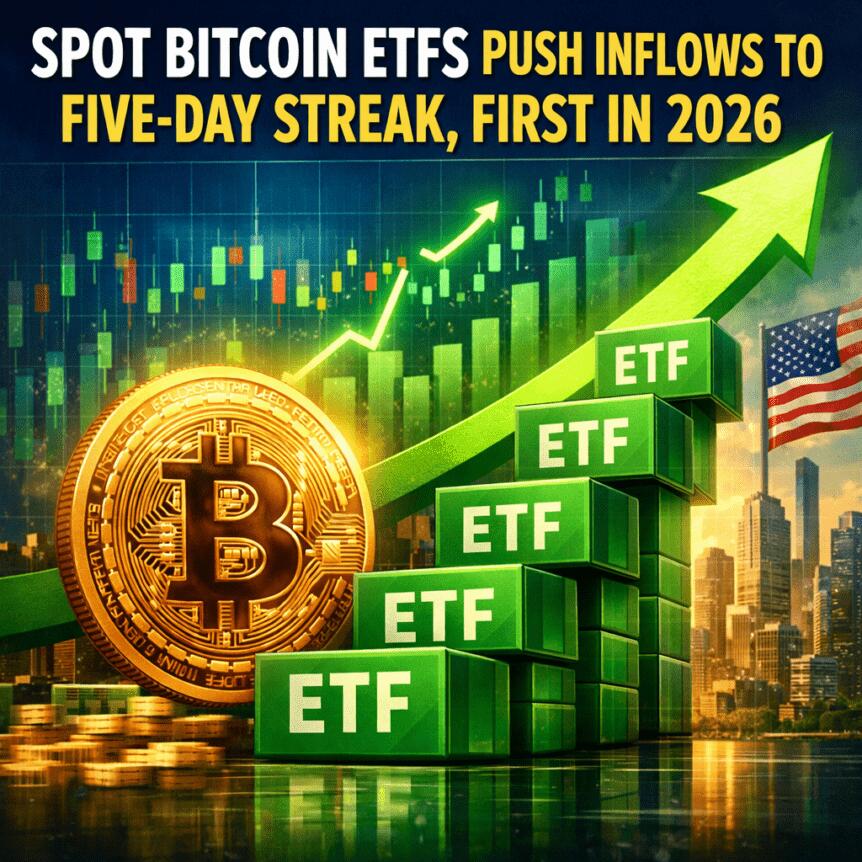
US spot Bitcoin ETFs posted their first five-day inflow streak of 2026, tallying roughly $767.32 million for the week and signaling renewed investor appetite for physical-exposure products amid a volatile macro backdrop. Net inflows on Friday reached $180.33 million, extending a trend that began earlier in the week. The strongest day fell on Tuesday, when spot Bitcoin ETFs drew $250.92 million, according to data from SoSoValue. The run mirrors a late-2025 period when five consecutive days of inflows between November 25 and December 2 delivered about $284.61 million in total. Overall, US spot BTC ETFs now hold about $91.83 billion in net assets, with cumulative net inflows reaching $56.14 billion and roughly $4.93 billion in total value traded on the day. Ether-centered funds have joined the move, underscoring a broad shift toward spot exposure even as macro headwinds persist.
Key takeaways
- US spot Bitcoin ETFs logged their first five-day inflow streak of 2026, totaling approximately $767.32 million for the week.
- Tuesday marked the peak with spot BTC ETFs attracting about $250.92 million in net inflows, the strongest single-day figure of the period.
- Ether ETFs posted a four-day inflow streak, contributing roughly $212.14 million in new liquidity and reversing earlier March outflows.
- Cumulative inflows into US spot Ether ETFs stand at about $11.79 billion, with total net assets near $12.26 billion and around $1.30 billion traded on the day.
- Bitcoin remained range-bound as macro tensions influenced risk sentiment, with short-liquidity clusters near $71,300 and resistance between $72,000 and $73,500.
- ETF assets globally have grown to roughly $91.83 billion in net assets, reflecting sustained demand for spot exposure amid ongoing volatility.
Tickers mentioned: $BTC, $ETH
Sentiment: Neutral
Price impact: Neutral. Persistent inflows have yet to translate into a decisive breakout in price, given macro uncertainty.
Trading idea (Not Financial Advice): Hold. Market participants may wait for clearer macro signals before expanding exposure to spot coin ETFs.
Market context: The week unfolded against a backdrop of heightened geopolitical risk and energy-price volatility, factors that have historically weighed on risk appetite. Analysts note that tensions in the Middle East and pressure on oil markets can dampen aggressive rate-cut expectations, pushing traders toward liquidity and near-term catalysts rather than long-horizon bets. In this environment, Bitcoin and Ether ETFs have shown resilience through inflows that suggest ongoing demand for regulated, transparent access to spot crypto markets.
Why it matters
The resurgence of inflows into US spot Bitcoin and Ether ETFs signals a maturation in the market for regulated crypto exposure. Institutional and retail investors alike have sought regulated vehicles to gain direct crypto exposure without taking on the operational complexities of self-custody, and the latest weekly totals reinforce that demand. The breadth of the inflows—across BTC and ETH—also points to a broader appetite for the two largest by market cap assets, suggesting that current price action may reflect a shift toward accumulation rather than mere tactical trading.
From a price-discovery perspective, sustained ETF liquidity contributes to transparent flows and on-chain price signaling, potentially narrowing the gap between futures dynamics and spot realities. Yet the macro environment—characterized by geopolitical tensions, oil-price volatility, and a wary risk sentiment—continues to cap upside momentum. Traders appear to be prioritizing liquidity and risk management over bold directional bets, keeping BTC in a defined range while Ether fans out similar patterns of activity. The balance between inflows and macro headwinds will likely dictate whether the current pattern of consolidation evolves into a more pronounced move in the coming weeks.
As the data indicate, the market is moving with a preference for regulated, auditable exposure. The ongoing inflows into spot ETFs reduce the opacity of price discovery and may attract a broader pool of buyers who previously steered clear of crypto markets due to custody or regulatory concerns. The broader implications are not limited to price; potential implications for product development, ETF approvals, and the regulatory narrative around crypto exposure could shape investor behavior in the months ahead.
Additionally, observers note that the market is watching liquidity dynamics closely. On the risk-off side, the macro environment has created a structure where support levels and liquidity zones matter as much as absolute price levels. The trading community is digesting the possibility that macro catalysts—such as inflation data or central-bank commentary—could trigger a shift from the current consolidation toward a new regime of volatility or trend direction.
For readers looking for broader context, references to market-related analyses such as Bitcoin’s price catalysts and Ethereum momentum are explored in industry discussions, including pieces like “Bitcoin’s ‘narrative vacuum,’ Ethereum now inevitable: Trade Secrets.”
What to watch next
- Next week’s BTC and ETH ETF inflows, and whether the five-day BTC streak extends or reverses.
- Key resistance around $71,300 and the $72,000–$73,500 zone, and whether a break above or below these levels alters risk sentiment.
- Changes in daily liquidity and trading volumes for spot ETFs as macro indicators (inflation, jobs, geopolitical updates) evolve.
- Continued net asset growth in BTC and ETH ETFs, and the potential impact on custody and regulatory discussions.
Sources & verification
- SoSoValue data on weekly inflows to US spot BTC ETFs, including the $250.92 million Tuesday figure and the $767.32 million weekly total.
- Ether ETF inflow data showing a four-day streak totaling about $212.14 million and related cumulative inflows.
- Metrics on total ETF assets (BTC and ETH) under management, including $91.83 billion in net assets and $56.14 billion in cumulative inflows for BTC ETFs, plus $12.26 billion in Ether ETF net assets and $11.79 billion in cumulative Ether inflows.
- Market analysis on Bitcoin price action and liquidity clusters around $71,300, with resistance in the $72,000–$73,500 range and support near $69,000.
- Historical reference to late November 2025 inflows totaling $284.61 million during a similar five-day stretch.
US spot ETFs extend inflows and Ether momentum amid macro pressure
US spot Bitcoin ETFs posted their first five-day inflow streak of 2026, highlighting sustained demand for regulated exposure in a period of elevated macro risk. The week culminated with a Friday print of $180.33 million in net inflows, adding to a Tuesday surge of $250.92 million—the strongest single-day reading in the period—which underscores persistent appetite for direct BTC exposure even as broader market conditions remain unsettled. In parallel, Ether ETFs captured a parallel narrative of renewed interest, with a four-day inflow sequence contributing to a total of roughly $212.14 million in new liquidity for the week. The combined momentum helped push the assets toward multi-billion-dollar baselines, reinforcing the attraction of regulated avenues for on-chain price discovery.
From the numbers, Bitcoin ETFs now command about $91.83 billion in net assets, with cumulative inflows reaching $56.14 billion and roughly $4.93 billion traded on the day. Ether ETFs, by contrast, have amassed around $11.79 billion in cumulative inflows, with total net assets near $12.26 billion and approximately $1.30 billion traded on the day. This dual strength marks a notable shift from earlier in the year, when inflows were more volatile, and it aligns with a broader pattern of institutions and retail buyers seeking regulated access to crypto markets as liquidity conditions evolve.
The market backdrop remains a critical driver of price action. Heightened tensions in the Middle East and volatility in energy markets have led to cautious risk sentiment, which tends to favor liquidity and short-term positioning over aggressive, long-horizon bets. In this context, Bitcoin has traded within a defined range, with derivatives liquidity heatmaps identifying a key short-liquidity cluster near $71,300—acting as a near-term resistance—while a broader concentration sits between $72,000 and $73,500. On the downside, liquidity support sits around $69,000, with more pronounced long-liquidation risks near $68,800. These dynamics suggest that BTC could continue to consolidate absent a macro catalyst capable of triggering a decisive breakout.
Within industry coverage and market literature, some pieces discuss broader crypto price catalysts and the evolving narrative around Ethereum’s momentum, while others examine the potential impact of evolving ETF product strategies on the asset class. For readers exploring deeper analysis, related stories include discussions about Bitcoin price catalysts, Ethereum momentum, and trade secrets in the crypto space.

TLDR
- Executive VP Paul Darren Grasby offloaded 7,500 shares of AMD at approximately $204.87 per share on March 11, totaling $1.54M and reducing his holdings by 5.47%.
- Shares declined 2.2% on Friday, reaching an intraday low of $192.27 with trading volume 30% below average.
- Recent quarterly earnings exceeded expectations: EPS of $1.53 (vs. $1.32 estimate) with revenue of $10.27B, representing 34.1% year-over-year growth.
- Wall Street maintains a “Moderate Buy” consensus with an average price objective of $290.53; price targets span from $240 (Goldman Sachs) to $358 (Evercore).
- Challenges include emerging Chinese GPU competition, Meta’s internal chip development efforts, and macroeconomic pressures affecting the semiconductor industry.
Shares of Advanced Micro Devices tumbled 2.2% on Friday following news that a top executive had divested $1.54 million in company stock days earlier. Paul Darren Grasby, who serves as Executive Vice President and Chief Strategy Officer, sold 7,500 shares at an average price of approximately $204.87 on March 11.
Advanced Micro Devices, Inc., AMD
The chipmaker’s shares touched an intraday bottom of $192.27 during Friday’s trading session before settling at $193.39. This represented a decline from the prior session’s closing price of $197.74.
Approximately 27.4 million shares changed hands on Friday — about 30% lighter than AMD’s typical daily volume of 39 million shares. The reduced trading activity indicates the price movement wasn’t fueled by widespread selling pressure.
Following the transaction, Grasby maintains ownership of 129,598 AMD shares, worth approximately $26.5 million based on the sale price. The 5.47% stake reduction was disclosed to the SEC through a mandatory Form 4 filing required for corporate insiders.
While insider transactions don’t necessarily indicate negative sentiment — executives divest shares for various personal reasons including portfolio diversification and tax strategies — the timing caught market attention amid AMD’s roughly 7.7% year-to-date decline.
Recent Quarterly Performance Exceeded Expectations
AMD’s latest quarterly earnings, unveiled on February 3, delivered impressive results that surpassed Wall Street forecasts. The semiconductor manufacturer reported earnings per share of $1.53, exceeding the analyst consensus of $1.32 by $0.21.
Quarterly revenue reached $10.27 billion — representing a 34.1% increase compared to the year-ago period and topping analyst projections of $9.65 billion. The company’s EPS showed significant improvement from the prior year’s $1.09.
Wall Street expects the company to deliver $3.87 in full-year earnings per share.
The company’s financial position appears robust. Its debt-to-equity ratio stands at a modest 0.04, while maintaining a current ratio of 2.85 and quick ratio of 2.01. The price-to-earnings multiple of approximately 73 appears elevated, though the price-to-earnings-growth ratio of 0.77 indicates reasonable valuation when accounting for growth prospects.
Recent strategic developments include a multi-year patent licensing agreement with Adeia and the introduction of new AI-focused products at MWC 2026, featuring Ryzen AI Embedded processors and telecommunications AI solutions.
Wall Street Price Targets Show Wide Dispersion
Analyst sentiment on AMD remains predominantly constructive, though price target expectations vary considerably. Goldman Sachs maintains a neutral stance with a $240 price objective. UBS projects a $310 target. Evercore shows greater optimism with an outperform rating and $358 target.
According to MarketBeat data, the collective analyst consensus stands at “Moderate Buy” with an average price target of $290.53 — representing substantial upside from current levels.
Among analysts tracking AMD, 29 rate it a Buy, one assigns a Strong Buy, and 10 recommend Hold. No analysts currently rate the stock as a Sell.
Multiple challenges loom on the horizon. Chinese semiconductor firm Lisuan Technology recently unveiled GPU products that sparked concern across AMD and Nvidia investor bases. Meta’s initiative to design proprietary AI chips threatens to diminish demand from major third-party customers.
Broader macroeconomic factors — including elevated oil prices, geopolitical instability, and export restrictions on AI chips — have created additional pressure across the semiconductor sector.
AMD currently trades below both its 50-day moving average of $216.76 and its 200-day moving average of $209.62.
As of Friday’s market close, AMD’s market capitalization stood at roughly $315 billion.

Crypto World
Pi Network’s PI Token Erases Recent Gains, Bitcoin (BTC) Slips Toward $70K: Weekend Watch
Pi has plunged by over 30% in the past 24 hours. The gains charted after the Kraken listing have been pretty much erased.
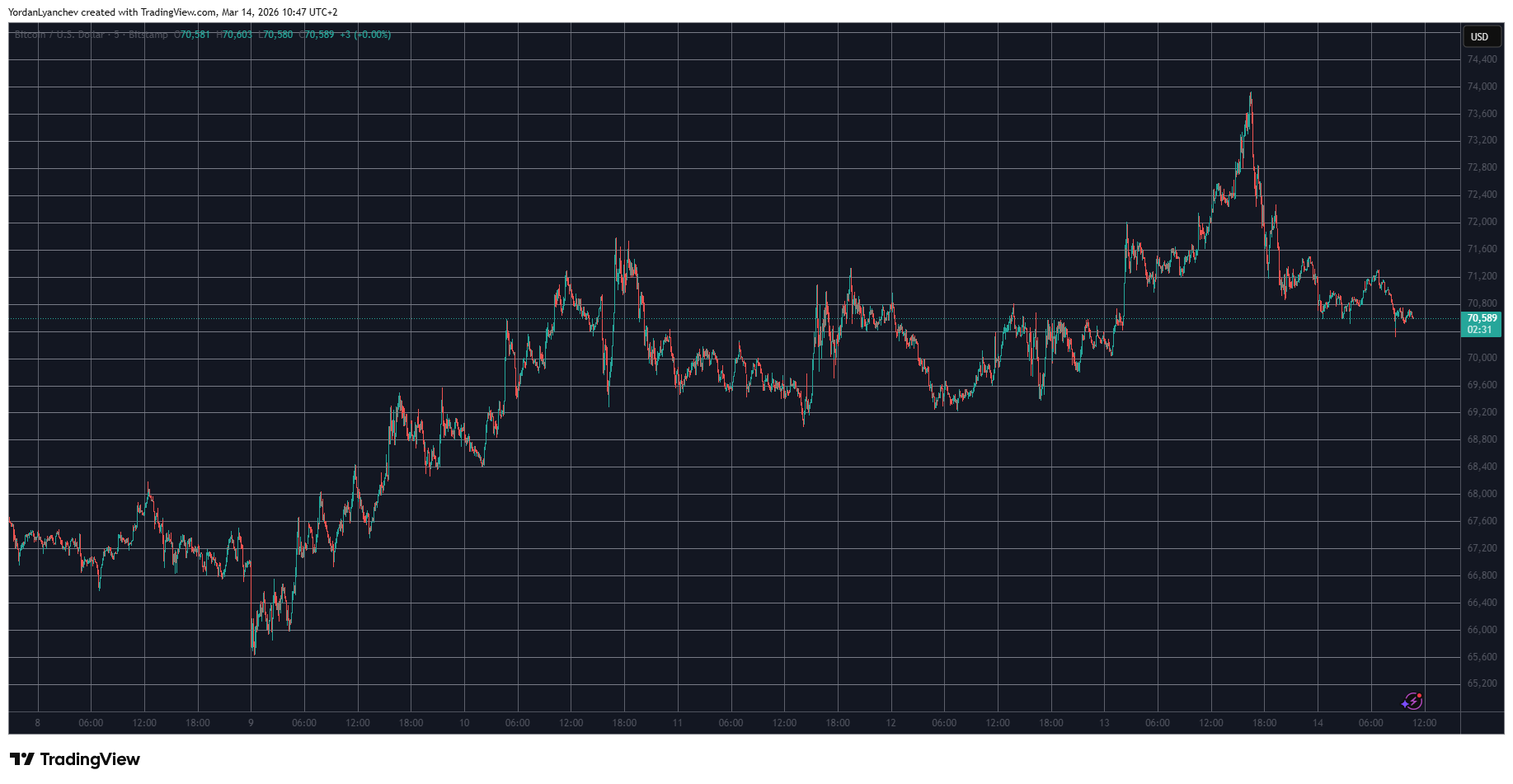
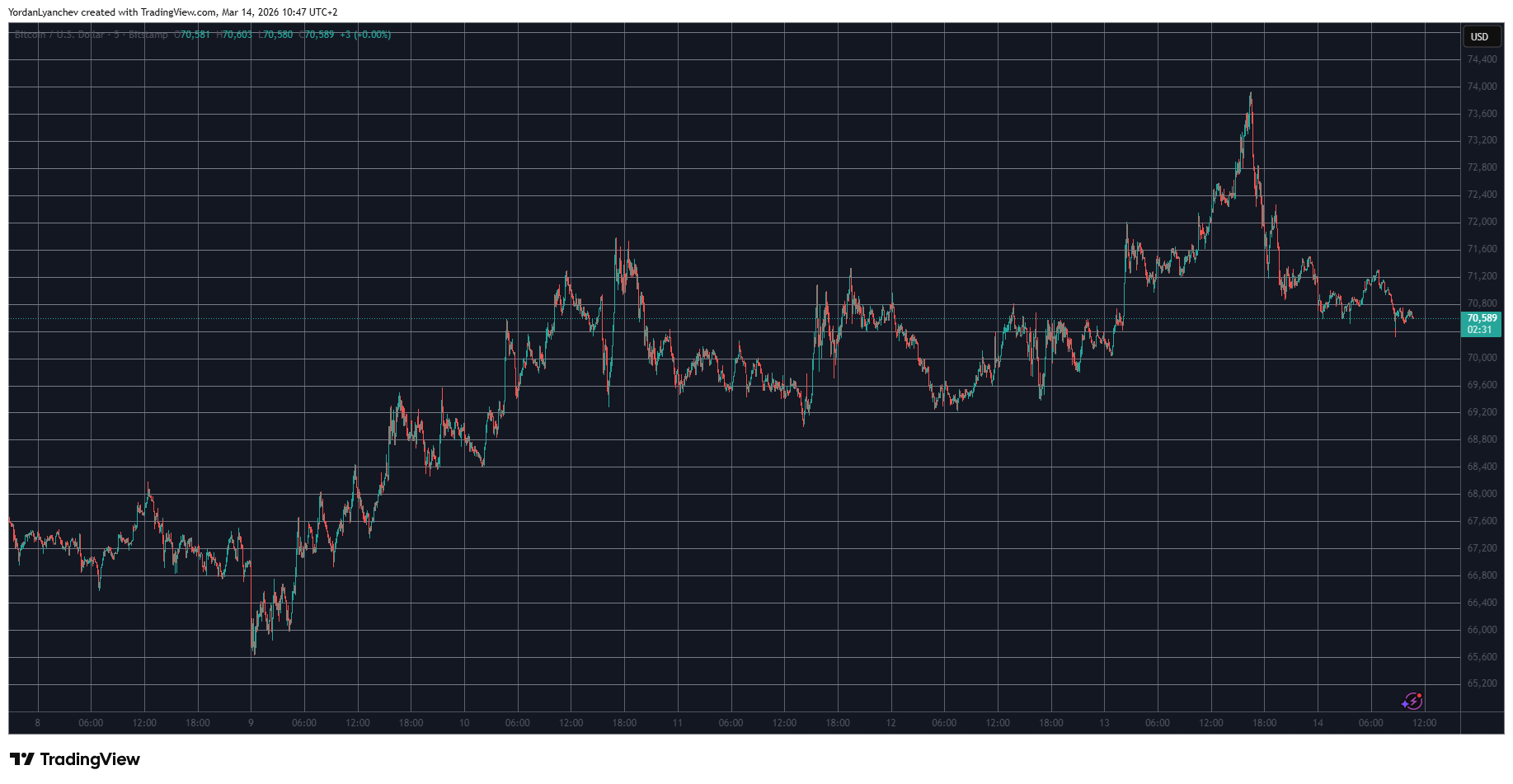
Bitcoin’s price rally to $74,000 came to a quick halt, as it did during the previous attempt, and BTC is close to breaking below $70,000 after the latest massive attacks against Iran.
Most altcoins are in the red as well, with ETH slipping below $2,100, and ADA dropping by over 4% daily. CC is among the few exceptions today.
BTC Slides Toward $74K
The quickly escalating situation in the Middle East continues to impact most of bitcoin’s price moves. The asset dipped to $65,600 last Monday morning when most legacy financial markets opened for trading after the second weekend of the conflict. However, it rebounded quickly and challenged $70,000 on Wednesday.
Although it failed at first, the rather positive CPI numbers for February and Trump’s somewhat promising remarks about the war sent it flying to $71,800. It was stopped there at first and dropped to $69,000, but went hard on the offensive on Friday.
In less than a whole trading day, bitcoin shot up to a 10-day peak of $74,000. However, it was rejected immediately after it touched that line and fell to under $71,000. The latest attacks, which were described as some of the most devastating in the Middle East region, pushed it toward $70,000, a level that the bulls are currently trying to defend.
Its market cap has declined to $1.410 trillion, while its dominance over the alts is slightly below 57% on CG.
PI Plummets
Pi Network’s native token has been the most volatile in the crypto industry lately, and the past 24 hours have solidified this trend. However, it’s in the opposite direction now. After rocketing to $0.30 yesterday on the hype of the big listing on Kraken, the token has plummeted by over 31% as of now, and it’s struggling to remain above $0.20 as of press time.
Meanwhile, most larger-cap alts are also in the red, but in a significantly less violent manner. ETH is beneath $2,100 after a 1.3% daily drop, and BNB is down to $650 after a 2% decline. XRP struggles at $1.40, SOL is down to $87, while ADA has dumped by over 4%. CC has defied the market-wide correction, with a 5% increase to $0.155.
The total crypto market cap has erased roughly $100 billion since yesterday’s peak and is down to $2.480 trillion on CG.

Binance Free $600 (CryptoPotato Exclusive): Use this link to register a new account and receive $600 exclusive welcome offer on Binance (full details).
LIMITED OFFER for CryptoPotato readers at Bybit: Use this link to register and open a $500 FREE position on any coin!
Disclaimer: Information found on CryptoPotato is those of writers quoted. It does not represent the opinions of CryptoPotato on whether to buy, sell, or hold any investments. You are advised to conduct your own research before making any investment decisions. Use provided information at your own risk. See Disclaimer for more information.
Buying access to a sitting U.S. President Trump usually requires a maxed-out Super PAC donation, not a wallet full of meme coins. Yet here we are, with on-chain holdings effectively acting as tickets to Mar-a-Lago.
Fight Fight Fight LLC, a company affiliated with the viral $TRUMP memecoin, is planning to host its top 297 investors at Donald Trump’s Florida club next month.
The event, slated for April 25, is advertised as “The Most Exclusive Crypto & Business Conference in the World” and promises a luncheon with Trump as the keynote speaker.
Furthermore, the top 29 holders get an invite to an even more exclusive reception and champagne toast with the President himself.
There is a significant scheduling conflict, however. April 25 is the same night as the White House Correspondents’ Association dinner in Washington, D.C., an event Trump is expected to attend for the first time.
Administration officials have stated the Mar-a-Lago event is not currently on the President’s schedule, raising questions about whether he’ll actually turn up at Mar-a-Lago.
The organizers have included a disclaimer noting that if Trump cannot attend the “all-day event,” they will reschedule it, or attendees will receive a limited edition NFT instead. This uncertainty introduces a layer of risk for crypto investors who have held onto their bags specifically for this purpose.
TRUMP Price Action: Buy the Rumor, Sell the Meme Coin?
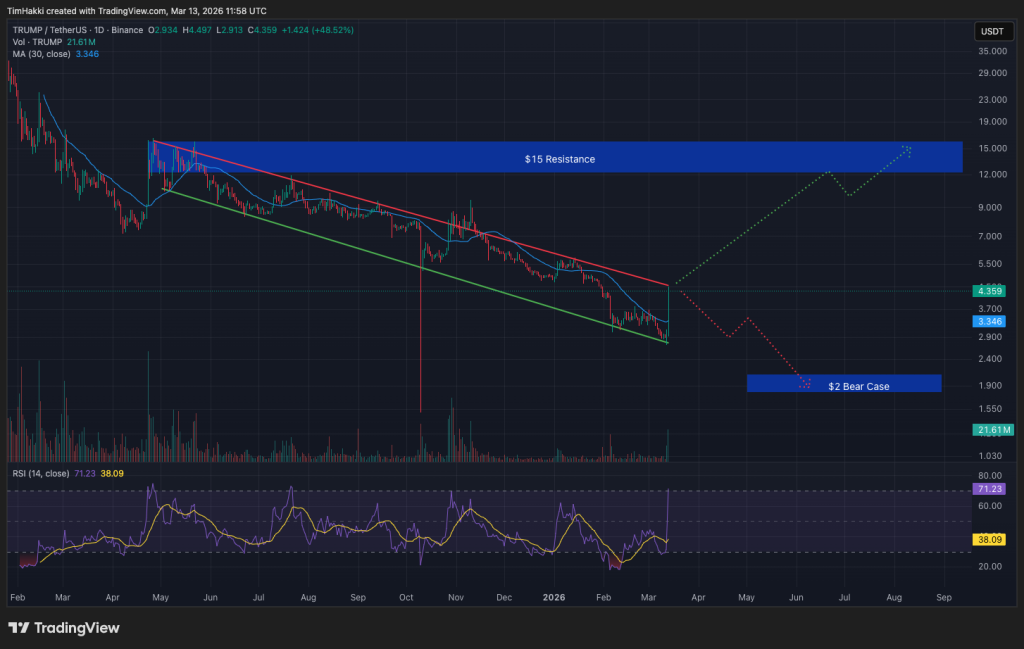
The announcement triggered immediate volatility for the $TRUMP token. The price rallied 53% on the news to hit $4.37, a level not seen since January 31.
This behavior is typical of the high-stakes PolitiFi sector, where headlines often drive price action more than fundamental tokenomics.
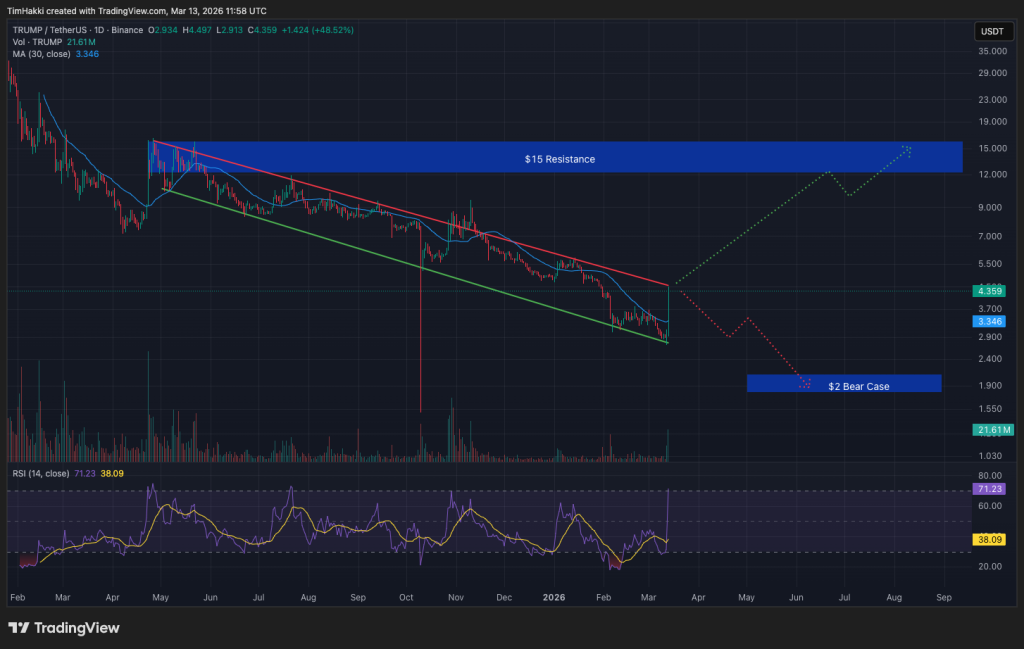
The token’s top holders are a mix of pseudonymous whales and known industry figures, with previous events attracting major international players.
While the broader meme market has seen massive volume on platforms like Solana, where revenues for launchpads like Pump.fun have hit the billions, $TRUMP remains unique because its utility stems from giving holders direct physical access to political power.
If the meeting occurs, it validates the thesis that digital assets can serve as modern political donor tiers. If it fails or results in an NFT consolation prize, the resulting sell-off could be severe.
The token is currently trading at a market cap of approximately $2.7 billion, making it a heavyweight asset that can move significantly on logistical updates alone.
The Crypto President’s TRUMP Coin Draws Scrutiny and Praise Alike
This event underscores the blurred lines between the current administration and the crypto industry.
Trump has ushered in a drastically friendlier regulatory environment, but direct commercial engagements with token holders continue to draw scrutiny from ethics watchdogs.
Regulators are already in a complex position. With agencies moving toward clearer frameworks, like the recent coordination deals between the SEC and CFTC, the existence of a Trump-affiliated meme coin creates a unique compliance paradox.
Any forthcoming official comments from the White House that confirm his attendance will likely be the primary catalyst for the token’s price action leading up to April 25.
The post TRUMP Memecoin Investors Offered Mar-a-Lago Presidential Meeting appeared first on Cryptonews.
Crypto World
Microsoft (MSFT) Leads Cloud Race as First to Validate Nvidia’s Vera Rubin NVL72 AI System

Key Highlights
- Azure claims first-mover status by validating Nvidia’s advanced Vera Rubin NVL72 infrastructure
- Satya Nadella shared the announcement via X on Friday afternoon
- The NVL72 rack configuration provides 3.6 exaflops of computational power — a five-fold improvement over GB200 architecture
- Each rack houses 72 Rubin GPUs paired with 36 custom Vera CPUs, interconnected through sixth-generation NVLink at 260TB/s
- Competitors including AWS, Google Cloud, CoreWeave, Nebius, and Oracle plan Rubin deployments throughout 2026
In a significant move that positions it ahead of competitors, Microsoft Azure has achieved a milestone as the inaugural cloud platform to validate Nvidia’s cutting-edge Vera Rubin NVL72 infrastructure. The announcement came Friday afternoon through a social media post by CEO Satya Nadella on X, who described it as “another big step in building the next generation of AI infrastructure.”
We’re the first cloud to bring up an NVIDIA Vera Rubin NVL72 system for validation, another big step in building the next generation of AI infrastructure with NVIDIA. pic.twitter.com/apPyKh0HRK
— Satya Nadella (@satyanadella) March 13, 2026
Nvidia’s Vera Rubin NVL72 represents a complete rack-scale solution, integrating 72 Rubin graphics processors alongside 36 specially designed Arm-based Vera central processing units. These components are interconnected through sixth-generation NVLink technology, enabling data transfer speeds reaching 260 terabytes per second.
The performance gains are substantial. Every NVL72 configuration can achieve computational speeds up to 3.6 exaflops — approximately five times greater than the GB200-based infrastructure it’s designed to succeed.
Rani Borkar, who serves as President of Azure Hardware Systems at Microsoft, emphasized the extensive preparation involved. “Microsoft has years of market-proven experience in designing and deploying scalable AI infrastructure that evolves with every major advancement of AI technology,” Borkar stated.
The concept of “co-design” is central to this deployment. Microsoft has maintained a collaborative partnership with Nvidia spanning multiple years, jointly developing solutions across interconnect technologies, memory architectures, thermal management, packaging solutions, and rack-level design. This collaboration ensures seamless integration of Rubin systems into Azure’s current infrastructure without requiring architectural overhauls.
Strategic Infrastructure Planning Pays Off
Azure’s data center locations, including major facilities in Wisconsin and Atlanta, were purpose-built with the capacity to support NVL72 racks’ demanding power requirements and liquid-cooling specifications. Such forward-looking infrastructure development requires years of strategic planning.
Borkar highlighted that Azure’s advanced “superfactories” were engineered from the ground up to accommodate these powerful systems. “Rubin integrates directly into Azure’s platform without rework,” she explained, underscoring the extensive groundwork that enabled this seamless first-mover deployment.
The technology giant undertook comprehensive redesigns of electrical distribution and liquid-cooling infrastructure across numerous locations to manage the elevated power densities these advanced racks demand. This substantial capital investment is now delivering tangible competitive advantages with operational hardware while competitors continue their validation processes.
In related infrastructure developments, a BlackRock-managed investment group, with participation from Microsoft and Nvidia, recently pursued the acquisition of Aligned Data Centers in a transaction valued at $40 billion, strategically positioning for expanded worldwide capacity ahead of this next-generation hardware rollout.
Competition Preparing for Later Deployment
While Microsoft holds the early advantage, rival platforms aren’t far behind. Amazon Web Services, Google Cloud, CoreWeave, Nebius, and Oracle have all committed to deploying Vera Rubin infrastructure — with most targeting the latter half of 2026 for implementation.
Financial analysts at Bernstein have highlighted Microsoft’s first-to-validate achievement as indicative of its broader operational efficiency across cloud computing and SaaS offerings, quantifying this advantage through what they term a “Rule of 37.3%” performance benchmark.
On the trading day of the announcement, MSFT shares declined 1.57% while NVDA dropped 1.58%, movements attributed to general market weakness rather than negative sentiment regarding the validation news.
Looking ahead, Rubin Ultra, representing the subsequent evolution of this platform architecture, is anticipated to launch in 2027.

TLDR:
- Covenant-72B scored 67.1 on MMLU zero-shot, beating LLaMA-2-70B’s 65.6 under identical test conditions.
- SparseLoCo reduced communication overhead by 146x using sparsification, 2-bit quantization, and error feedback across nodes.
- Gauntlet scored every node’s contribution via loss evaluation and OpenSkill ranking, all recorded on the blockchain.
- $TAO rose 14% to $236 post-announcement, with Grayscale expanding its TAO trust for institutional investor access.
Bittensor’s Subnet 3 has trained a 72-billion-parameter AI model without a central data center. The model, named Covenant-72B, was built across more than 70 global participants.
All nodes are connected through a standard home internet. Covenant-72B outperformed Meta’s LLaMA-2-70B on the MMLU benchmark, scoring 67.1 against 65.6.
The test ran under identical zero-shot conditions. This outcome challenges long-standing assumptions about what decentralized compute can achieve.
Two Technical Innovations Drove the Decentralized Training
For years, AI crypto projects claimed decentralized compute could match centralized labs. Bittensor’s Subnet 3 now backs that claim with measurable results.
The training covered 1.1 trillion tokens across more than 70 nodes worldwide. Every node ran on 500 Mb/s commodity internet connections.
Two core innovations made this scale of training possible. SparseLoCo cut communication overhead by 146 times throughout the process.
It combined top-k sparsification, 2-bit quantization, and error feedback to keep all nodes in sync. No central server was needed to manage coordination across the network.
The second innovation, Gauntlet, handled trust and contribution scoring during training. It assessed each node through loss evaluation and OpenSkill ranking.
All scores were logged on the blockchain for full transparency. This gave every participant a verifiable record of their contribution.
Milk Road reported on the outcome via social media, noting that distributed networks can now train large models competitively. The model weights are available on Hugging Face under an Apache License.
Anyone can access, use, or build on Covenant-72B at no cost. That open approach separates it from many restricted, proprietary AI models available today.
$TAO Climbs as Market Responds to Covenant-72B Results
The market moved quickly after news of the Covenant-72B training spread publicly. $TAO, Bittensor’s native token, rose 14% to reach $236 following the announcement.
The token had also gained 36% over the prior 30-day period. Trading volume grew 167% across the past six months.
Grayscale expanded its TAO trust during the same week as the announcement. That move opened up broader institutional access to the token directly.
It came as investor interest in AI-linked crypto assets continued to grow. The timing added further upward pressure to the token’s price movement.
The combination of a technical result and institutional interest drew wide market attention. Covenant-72B’s MMLU score gives decentralized compute a credible, testable benchmark.
The result is measurable and can be reproduced under standard conditions. That distinguishes it clearly from many earlier unverified claims in the AI crypto space.
The Apache-licensed weights on Hugging Face allow any developer to verify the work independently. Bittensor’s approach shows a functioning framework for community-driven AI model training.
The network ran across 70-plus participants with no central coordination at any point. This sets a working precedent for distributed large-model training going forward.
Crypto World
Market Turmoil: How $100 Oil, Inflation Concerns, and Earnings Shaped This Week’s Trading
TLDR
- Major U.S. equity indexes recorded their third consecutive weekly decline, pressured by crude oil surpassing $100 per barrel and renewed inflation concerns.
- Oil prices jumped approximately 9% following Middle Eastern geopolitical tensions that disrupted critical shipping routes through the Strait of Hormuz.
- Oracle exceeded earnings projections with revenue growth exceeding 20%, driven by robust AI infrastructure and cloud computing demand.
- Gold prices retreated roughly 1% despite heightened geopolitical uncertainty, constrained by U.S. dollar strength that dampened safe-haven appeal.
- Energy sector equities led weekly gains, while consumer staples and healthcare sectors tumbled 4–5%.
American equity markets extended their losing streak to three consecutive weeks as crude oil prices breached the $100-per-barrel threshold and escalating Middle Eastern conflicts unnerved market participants. The three primary benchmarks all concluded the week ending March 13, 2026, in negative territory.
The S&P 500 declined approximately 1.6%, the Dow Jones Industrial Average retreated around 2%, and the Nasdaq Composite dropped roughly 1.3%. Smaller-capitalization stocks mirrored this weakness, with the Russell 2000 shedding about 1.8%.
Energy markets dominated headlines. Crude oil prices skyrocketed approximately 9% after military tensions involving the United States, Israel, and Iran created significant disruptions to maritime traffic through the strategically vital Strait of Hormuz. Market observers characterized the move as one of the most dramatic weekly spikes in oil futures witnessed since the 1980s.
Just 2 hours after markets closed:
President Trump is now threatening to strike oil infrastructure on Iran’s Kharg Island, which accounts for 2% of global supply, if Iran doesn’t open the Strait of Hormuz.
In fact, last month, production coming from Kharg Island hit 3 million… https://t.co/pzI2GuoCoz
— The Kobeissi Letter (@KobeissiLetter) March 14, 2026
The surge in energy costs reignited inflation anxieties across financial markets. Producer price index readings exceeded forecasts marginally, stoking fears that elevated costs might cascade to end consumers in coming weeks.
This development places the Federal Reserve in a challenging position. While market participants continue anticipating interest rate reductions later in 2026, the timeline has grown increasingly uncertain as energy-fueled inflation muddles the monetary policy landscape.
Oracle Shines During Earnings Season
Oracle emerged as the week’s most impressive earnings performer. The technology giant delivered fiscal third-quarter results that surpassed analyst estimates, with consolidated revenue expanding beyond 20% and artificial intelligence infrastructure sales exhibiting triple-digit percentage gains.
Company executives provided optimistic forward guidance, forecasting high-teens revenue expansion continuing through fiscal year 2027. Shares surged during extended trading sessions but concluded the week essentially unchanged as market participants balanced the positive outlook against a stock price still trading more than 50% beneath prior-year peaks.
Campbell Soup presented a contrasting narrative. While the packaged food manufacturer marginally exceeded adjusted earnings expectations, management issued conservative 2026 projections that disappointed Wall Street, triggering share price declines.
Energy and industrial companies defied the broader market weakness, with numerous mid-capitalization firms delivering solid quarterly reports supported by improving demand fundamentals and expanding export markets.
Precious Metals Retreat While Energy Equities Surge
Gold momentarily reclaimed the $5,100-per-ounce level Friday morning but ultimately closed the week approximately 1% lower. U.S. dollar strength combined with diminishing rate-cut expectations counterbalanced traditional safe-haven buying interest.
Energy stocks emerged as unambiguous weekly leaders. Leading U.S. energy-focused exchange-traded funds advanced 2–3% over the five-day period. Marathon Petroleum and competing refining companies climbed high-single-digit percentages as investors anticipated enhanced profit margins stemming from elevated crude prices.
Consumer staples and healthcare represented the weakest performing sectors, each surrendering 4–5%. Market participants rotated capital away from these defensive categories as input cost pressures mounted and earnings vulnerability increased.
Financial stocks also underperformed, weighed down by emerging concerns regarding private-credit exposures at systemically important institutions. Technology ended modestly lower overall, although mega-cap technology names demonstrated greater resilience compared to smaller software enterprises.
The Cboe Volatility Index climbed from late-February readings as market participants increased spending on downside hedging strategies, signaling heightened caution entering the following week’s trading sessions.
Key Takeaways
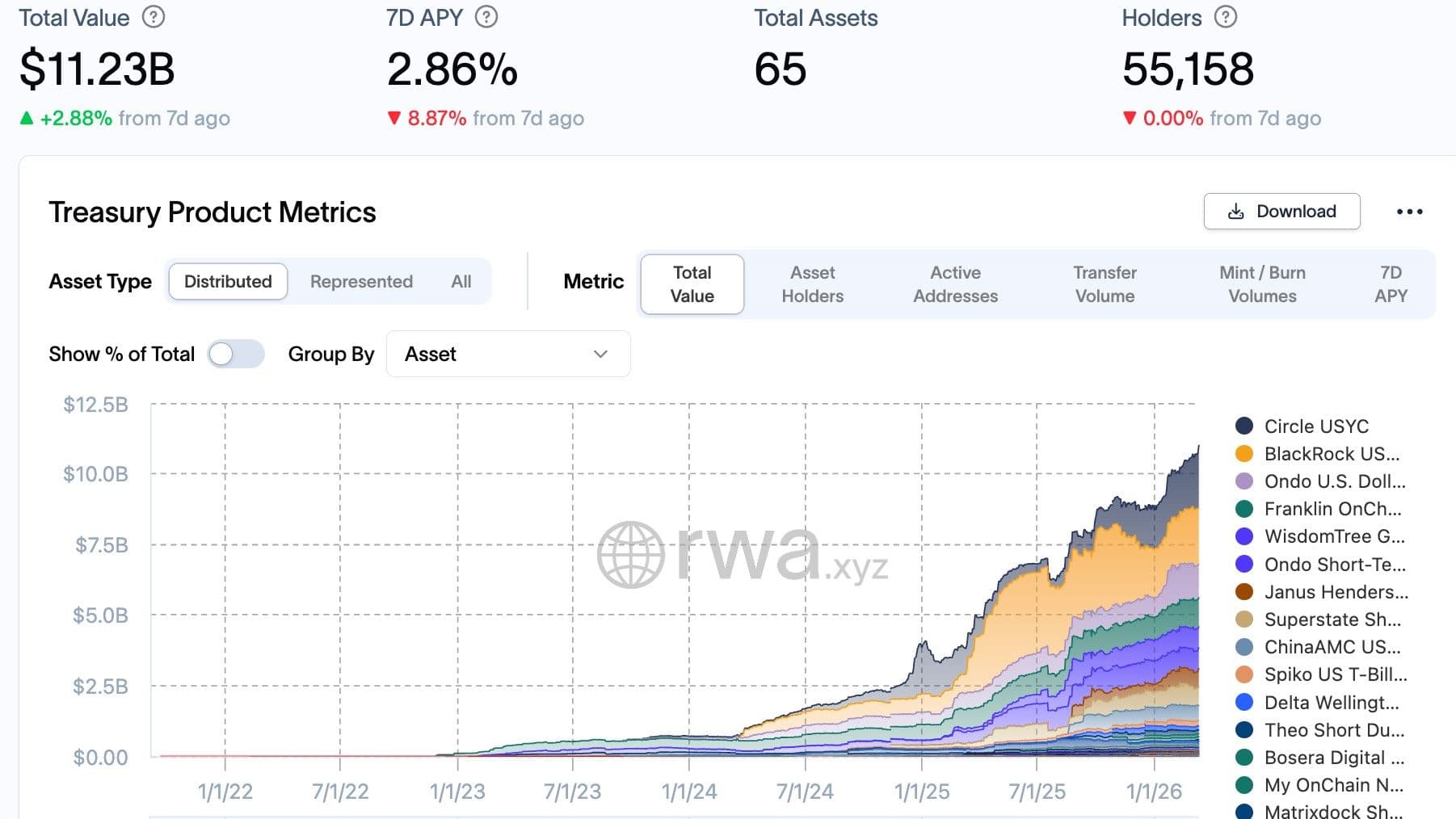
- USYC, Circle’s tokenized Treasury product, has expanded to $2.2 billion in supply, surpassing BlackRock’s BUIDL fund
- BUIDL’s dominance has declined significantly, with market share dropping from 46% at its height to approximately 18%
- A partnership with Binance enabled USYC to serve as off-exchange collateral on BNB Chain, resulting in $1.84 billion deployed on that blockchain
- Tokenized U.S. Treasury products have reached an all-time high of $11 billion in total value, climbing 27% year-to-date
- Market expansion intensified throughout January’s crypto market correction as traders sought yield-generating blockchain-based instruments
In a significant milestone for blockchain-based financial products, Circle’s USYC token has claimed the top position among tokenized U.S. Treasury offerings, displacing BlackRock’s BUIDL fund from its leading role. This development signals an evolution in the rapidly expanding sector focused on bridging traditional finance with distributed ledger technology.
USYC’s total supply has reached approximately $2.2 billion, based on analytics from RWA.xyz. This volume exceeds BlackRock’s USD Institutional Digital Liquidity Fund, which currently maintains around $2 billion in assets under management.
The USYC product came under Circle’s control in early 2025 following the company’s acquisition of Hashnote, which originally created the token. This investment vehicle provides holders with access to yields from U.S. Treasury securities while maintaining the benefits of blockchain-based asset management.
BlackRock introduced BUIDL to the market in early 2024 through a collaboration with Securitize, a specialized tokenization platform. During its strongest period in May 2024, BUIDL commanded 46% of the entire tokenized Treasury sector. However, increased competition has reduced that figure to roughly 18% today.
These tokenized Treasury products function by converting U.S. government debt instruments into digital tokens deployed on blockchain infrastructure. This structure enables investors to generate returns while simultaneously leveraging these tokens as collateral for trading activities — a capability that traditional Treasury investments cannot easily provide.
Binance Partnership Drives USYC Expansion
Much of USYC’s impressive recent expansion stems from its integration with Binance. The cryptocurrency exchange incorporated USYC as eligible off-exchange collateral for institutional derivative products on BNB Chain starting in July 2024.
This arrangement permits USYC to be maintained either through Binance Banking Triparty services or through Ceffu, the exchange’s institutional custody solution. Following this integration, USYC’s presence on BNB Chain has surged to $1.84 billion.
In a Friday post on X, Circle CEO Jeremy Allaire described the utilization of tokenized Treasury products as collateral as “a major emerging use case.”
The dual benefit of generating yield while simultaneously deploying an asset as trading collateral represents a substantial advantage compared to maintaining stablecoins or fiat currency, which generally produce no returns.
Market Reaches New Heights
According to data from RWA.xyz, the aggregate tokenized U.S. Treasury sector has achieved an unprecedented valuation exceeding $11 billion. This milestone represents approximately 27% growth, translating to roughly $2.5 billion in additional value, since the beginning of 2026.
Expansion accelerated notably during January’s cryptocurrency market volatility. This trend indicates that certain market participants redirected funds into tokenized Treasury products to secure consistent yields while awaiting more favorable conditions for crypto market re-entry.
Compared to conventional financial systems, blockchain-based tokens deliver near-instantaneous settlement, complete reserve transparency, and continuous availability — characteristics that continue to attract institutional capital.
Securitize, which co-manages the BUIDL fund, had not provided commentary by publication deadline.
As of mid-March 2026, USYC maintains its leadership position within a sector that has now surpassed $11 billion in aggregate holdings.
TLDR
- Investors acquiring TikTok’s U.S. operations will pay approximately $10 billion to the Trump administration
- Major investors include Oracle, Silver Lake, and Abu Dhabi’s MGX fund
- Initial payment of $2.5 billion has been transferred to Treasury, with additional installments scheduled
- The U.S. TikTok entity carries a valuation of approximately $14 billion, though experts debate whether this is accurate
- The transaction stems from legislation mandating ByteDance divest its stake in TikTok’s American business
The Trump administration negotiated an agreement that allowed TikTok to continue operating across the United States. Under the terms of this arrangement, the investors who assumed control of TikTok’s American operations committed to paying approximately $10 billion to the federal government.
This substantial fee comes in addition to the capital invested to establish a new domestically-based entity operating the popular social media platform. Key investors such as Oracle, Silver Lake, and MGX from Abu Dhabi transferred approximately $2.5 billion to the U.S. Treasury upon completion of the transaction in January. Additional payments are scheduled until the full $10 billion amount is satisfied.
ByteDance, TikTok’s parent company based in China, completed the transaction in January. The deal established a joint venture with majority American ownership called TikTok USDS Joint Venture LLC. This newly formed entity oversees U.S. user information, mobile applications, and proprietary algorithms.
ByteDance retains close to 20% ownership in the restructured entity and has licensed its algorithmic technology to the venture. The American entity must also distribute profits back to ByteDance.
Vice President JD Vance stated the restructured U.S. TikTok entity holds a valuation near $14 billion. Technology industry analysts have challenged this figure, suggesting it significantly underestimates the company’s true worth.
How the Fee Compares to Typical Deal-Making
The $10 billion government fee represents an almost unparalleled arrangement for a government facilitating a private sector transaction, according to business historians. To put this in perspective, investment banking fees on standard deals typically amount to less than 1% of total transaction value. Bank of America expects to collect approximately $130 million for its advisory services on Norfolk Southern’s $71.5 billion acquisition — representing one of the largest individual banking fees ever recorded.
Administration representatives defend the fee structure as appropriate. They emphasize Trump’s critical role in preserving TikTok’s presence in America and navigating complex negotiations with Chinese authorities while satisfying national security requirements from Congress.
The transaction was mandated by legislation enacted during Trump’s initial presidential term. That statute compelled ByteDance to significantly reduce its ownership position in TikTok’s American operations or face a complete shutdown. Congressional leaders had expressed significant concerns about a Chinese-owned corporation maintaining access to personal information of more than 200 million American citizens.
Earlier this month, Trump and Attorney General Pam Bondi faced legal action from retail shareholders of competing social media platforms. These investors are attempting to overturn the government’s approval of the ByteDance joint venture transaction.
The Broader Pattern of Government Stakes in Private Companies
The TikTok deal represents one element of a larger trend. The Trump administration has similarly secured nearly 10% ownership in Intel. It negotiated to receive a portion of chip sales to China from Nvidia as consideration for granting export authorization. The administration has also acquired equity positions in additional corporations and maintains a “golden share” in U.S. Steel after Nippon Steel’s acquisition.
The Wall Street Journal initially disclosed the $10 billion fee amount on March 13, 2026.

Bitcoin hovers near $71,000 as crypto investors track macro and liquidity signals

Kimi Antonelli Creates History In Chinese GP, Becomes Youngest-Ever To Take Pole In F1 History

Therapy Topics ‘Otroverts’ Discuss Most, According to Therapists

Smart energy pays enters the US market, targeting scalable financial infrastructure

Why Israel is blocking foreign journalists from entering

Bitcoin: We’re Entering The Most Dangerous Phase

TAZAMA: GIGY MONEY ALIVYOINGIA UKUMBINI KWENYE HARUSI YAKE…

Divorce Financial Mistakes to Avoid | Advice from a CFP & Divorce Financial Analyst

Bitcoin Live Trading || Crypto Live Trading || 13 MAR || Vivek Yadav #bitcoin #crypto #gold
-
 Tech3 days ago
A 1,300-Pound NASA Spacecraft To Re-Enter Earth’s Atmosphere
-

 News Videos5 days ago
10th Algebra | Financial Planning | Question Bank Solution | Board Exam 2026
-

 Crypto World5 days ago
Paradigm, a16z, Winklevoss Capital, Balaji Srinivasan among investors in ZODL
-

 Business4 days ago
ExxonMobil seeks to move corporate registration from New Jersey to Texas
-
Crypto World6 hours ago
HYPE Token Enters Net Deflation as HyperCore Buybacks Outpace Staking Rewards
-

 Fashion16 hours ago
Weekend Open Thread: Addict Lip Glow
-

 Tech4 days ago
ChatGPT will now generate interactive visuals to help you with math and science concepts
-

 Sports7 days ago
Three share 2-shot lead entering final round in Hong Kong
-

 Sports6 days ago
Braveheart Lakshya downs Lai in epic battle to enter All England Open final | Other Sports News
-

 NewsBeat3 days ago
Residents reaction as Shildon murder probe enters second day
-

 Business6 days ago
Search for Nancy Guthrie Enters 37th Day as FBI Probes Wi-Fi Jammer Theory
-

 Business3 days ago
Search Enters Sixth Week With New Leads in Tucson Abduction Case
-
 NewsBeat4 days ago
Pagazzi Lighting enters administration as 70 jobs lost and 11 stores close across Scotland
-

 Tech5 days ago
Despite challenges, Ireland sixth in EU for board gender diversity
-

 NewsBeat3 days ago
I Entered The Manosphere. Nothing Could Prepare Me For What I Found.
-

 Business5 days ago
Search Enters 39th Day with FBI Tip Line Developments and No Major Breakthroughs
-

 Sports5 days ago
Skateboarding World Championships: Britain’s Sky Brown wins park gold
-
 Crypto World4 days ago
Will Chainlink price reclaim $10 amid volatility squeeze?
-

 Sports5 days ago
Tomorrow’s Top 25 Today: Florida jumps to No. 4; Louisville, Wisconsin enter projected rankings
-

 Politics3 days ago
Trump Says Middle East Is ‘Very Lucky’ That He’s President