


Connect with us

Tech

Digg lays off staff and shuts down app as company retools

Published

on

Digg — Kevin Rose’s reboot of his once-popular link-sharing site — is laying off a sizable portion of its staff, the company announced on Friday. The startup is not closing, however, Digg CEO Justin Mezzell said. Instead, Rose will return to work on Digg full-time as the company tries to find its footing.

Rose will continue to work as an advisor at investing firm True Ventures, but will make Digg his primary focus from here on out.

The startup had set out to offer an alternative to existing community forums, where people could post and share links, media, and text, and engage in topical discussions. But while Digg had clever ideas on how to better moderate content and verify that users were who they claimed to be, the company admits it was overwhelmed by bots even in its earliest days.

Nodding to the “dead internet theory,” which claims today’s web is more bots than people, Mezzell describes the problem of combating bot spam in a post on the Digg website.

Advertisement

“When the Digg beta launched, we immediately noticed posts from SEO spammers noting that Digg still carried meaningful Google link authority,” the blog post about the layoffs states. “Within hours, we got a taste of what we’d only heard rumors about. The internet is now populated, in meaningful part, by sophisticated AI agents and automated accounts. We knew bots were part of the landscape, but we didn’t appreciate the scale, sophistication, or speed at which they’d find us.”

The company said it banned tens of thousands of accounts, deployed internal tooling, and worked with external vendors, but it wasn’t enough. For a site that relied on user votes to rank content, an uncontrollable bot problem meant those votes couldn’t be trusted.

“This isn’t just a Digg problem. It’s an internet problem,” Mezzell notes.

Mezzell also said that taking on established rivals (likely a reference to Reddit) was too hard, calling the competition not just a moat but a wall.

Advertisement

The company didn’t share how many people were affected by the layoffs, but said that a small team will continue to rebuild Digg as something “genuinely different.” The Digg app has been pulled from the App Store, and the layoff post is currently the only content on Digg’s website. The Diggnation podcast — a video show Rose hosts — will continue, however.

For context, Rose and Reddit co-founder Alexis Ohanian acquired what remained of the old Digg earlier last year, intending to build up a site where communities had more moderator and admin control and ownership. The deal was a leveraged buyout involving True Ventures, Ohanian’s firm Seven Seven Six, Rose and Ohanian personally, and the venture firm S32. Funding details weren’t made public.

Digg was not immediately available for comment.

Source link

Advertisement
Continue Reading
Click to comment

Leave a Reply

Your email address will not be published. Required fields are marked *

Tech

Proof over promises: a new doctrine for cybersecurity

Published

on

For years, third-party cybersecurity relationships between vendors and customers have relied on contracts and trust. That model is now showing its age. In the past year alone, 51% of UK organizations have reported a third party-related breach, while vendors have become ideal attack vectors for hostile actors.

Sam Kirkman

Director of EMEA Services at NetSPI.

Advertisement

Source link

Continue Reading

Tech

Peter Gabriel “Taking the Pulse” Blu-ray Review: Symphonic Concert in a Roman Amphitheater with DTS-HD Master Audio

Published

on

I’ll admit that when I first started watching the recently released Blu-ray Disc of Peter Gabriel’s Taking the Pulse, it all felt very familiar. If you saw his orchestral tour around the time of Scratch My Back, or already own New Blood: Live in London on Blu-ray, a sense of déjà vu might set in. Look a little closer, however, and the differences start to emerge. What initially feels like a continuation of the same orchestral concept reveals a number of subtle but meaningful changes that aren’t immediately obvious.

In fact, the Blu-ray Disc packaging and frankly most of the press materials I had read, don’t offer much reason why fans should rush to add this show to their Peter Gabriel collection. Fortunately, I found more clues on Mr. Gabriel’s website, where his daughter Anna, who directed the film, offers some insight into her approach:

eter Gabriel's Taking The Pulse concert video on Blu-ray Disc

“When I spoke to my dad about shooting one of his shows I jumped at the chance of shooting at the Roman amphitheatre in Verona, Italy. Italians have always been very enthusiastic audience and give a lot back to the performer and to the camera. I made this film with my friend Andrew Gaston who was truly my collaborator throughout the process. It is always fun for me to shoot my father as I know the material and his performances so well I feel that I can capture a side to him that feels more personal. I also wanted to shoot the orchestra in an exciting way and along with Andrew’s editing I think we really captured the energy of the entire performance. I look forward to sharing this film.”

Indeed, Taking the Pulse offers a fresh visual perspective on this remarkable music when compared to New Blood: Live in London. Happily, it also delivers a different sonic experience, with a more immersive 5.1 surround sound presentation that better envelops the listener.

Advertisement

Presented in 24-bit/48 kHz resolution, the DTS-HD Master Audio soundtrack is generally quite rich. But my appreciation grew once I realized that the surround channels were being used for more than just crowd noise and venue ambience. One of my recurring complaints about many concert videos is that the surround mixes often feel lazy, failing to take full advantage of what the technology can actually deliver.

peter-gabriel-taking-pulse-blu-ray-screenshot

While most of the action resides in the front channels, the audio for Taking The Pulse nearly wraps around the listener.  I imagine this perspective is bit more like what I’d like to think the orchestra conductor was hearing on stage or — perhaps better still — Peter Gabriel himself!

The sometimes dark, moody lighting looks great (expect lots of blues and reds as well as bursts of light and sparkle). In general, I think I preferred the intercuts and perspective offered in Taking The Pulse over New Blood Live In London (which, mind you, I’ve long enjoyed!). 

All in all, Taking The Pulse is a winner Blu-ray video and for $18.29 on Amazon it seems to be an easy decision to pick this up if you are a fan.


Mark Smotroff is a deep music enthusiast / collector who has also worked in entertainment oriented marketing communications for decades supporting the likes of DTS, Sega and many others. He reviews vinyl for Analog Planet and has written for Audiophile Review, Sound+Vision, Mix, EQ, etc.  You can learn more about him at LinkedIn.

Advertisement
Advertisement. Scroll to continue reading.

Source link

Advertisement
Continue Reading

Tech

Ball x Pit on mobile, Piece by Piece x2 and other new indie games worth checking out

Published

on

Welcome to our latest roundup of what’s going on in the indie game space. A bunch of intriguing games arrived this week, including a mobile port of one of the most absorbing things I’ve played in years and two completely different titles with the same name. Let’s get things started with a look at a few projects that were featured in the latest edition of the Future Games Show.

Hyperwired (from SidralGames and publisher SelectaPlay) is a 2D roguelike shooter with an interesting resource-management twist. To recharge your weapons and systems, you have to plug a cable that trails behind your spaceship into a socket. While you’re plugged in, your movement is restricted by the length of the tether, but you gain more firepower.

There are a whole bunch of upgrades and bullet modifiers to play around with here, including a slow-motion system you can activate at almost any time. Hyperwired is slated to hit Steam, PS4, PS5, Xbox One, Xbox Series X/S and Nintendo Switch this summer.

In Clean Up Earth, you and other players can work together to restore polluted environments. You can play solo if you like, but on the larger maps you’ll need to team up with others to handle large bits of junk. One particularly neat aspect of Clean Up Earth is that in-game actions will automatically trigger micro-donations from developer Magic Pockets and its partners to environmental organizations.

Advertisement

Clean Up Earth is coming to Steam, Epic Games Store, PS5, and Xbox Series X/S on April 2. A Nintendo Switch 2 version is on the way in the future. There’s a demo available on Steam as well.

Mr. Magpie’s Harmless Card Game is a minesweeper-style riff on the likes of Inscryption and Buckshot Roulette. As with some other roguelike deckbuilders, you’re trapped in a creepy situation and the only way to escape alive is to gamble and earn enough money in time to meet quotas. To do that, you’ll need to twist the odds in your favor by building multipliers and synergies. You can boost your deck with powerful cards you can buy from a shop.

However, there are dangerous JERRY cards on the board that could spell doom if you flip them over. You can use hints and strategies to try to figure out where those cards are and avoid them.

There’s no release date as yet for Mr. Magpie’s Harmless Card Game, which is from Giant Light Studios. However, you can request access to a playtest on Steam.

Advertisement

A press release described Herdles as “Spyro meets Breath of the Wild, with a dog.” I’m immediately sold.

Playing as a magical version of creative director Christian Hübel’s own dog, Snoopy, you’ll “restore balance to a fracturing world” in this open-world platformer. On your journey, you’ll rescue Herdles, or corrupted creatures. Doing so will unlock new powers, such as being able to glide, bust through walls and swim up waterfalls.

There’s no combat or death in this game, which seems to be largely about solving puzzles, experimenting with physics-based abilities and exploring. It’s said to have “deep accessibility and customization options” too. Fire Sword Studios and One More Journey are behind Herdles, which does not have a release window, though the Steam page is live.

New releases

I took an earlier-than-usual lunch break on Thursday to check out the mobile version of Ball x Pit (from Kenny Sun and friends and publisher Devolver Digital) as soon as it was released. I adore this game. I’m happy it runs smoothly on my iPhone 16, because that should give me more reason to avoid doomscrolling.

Advertisement

It’s the same Ball x Pit. It’s still fantastic. The touchscreen dual-stick controls work well enough, especially when the auto-fire option is enabled. Still, a mobile controller like OhSnap’s MCON or the Backbone Pro works better for me.

A bunch more people will be able to enjoy Ball x Pit now that it’s on iOS and Android. You can play the first level for free and it costs $10 to unlock the full game.

It’s a pretty good week for folks who are into brick-breaking roguelites, because here’s another one. ITER-8 (from fluckyMachine and publisher Fireshine Games) blends mining and tower defense. It’s a bit like Dome Keeper.

You’re tasked with acquiring resources from an enormous monolith that’s above your base. You’ll need to drag these items back to your base so you can upgrade your character, ship, shield and weapon. There are relics to find and you can swap these for installations like lasers, barriers and cannons. There are also puzzle-based sections that sees your character leave their ship for some in-person mining and upgrade collecting, temporarily switching from 2D to 3D action.

Advertisement

After a while, the monolith starts to thrum with an ominous sound. That means it’s time to race back to base (with the help of a fast-travel system) to fend off waves of alien enemies.

The two sides of ITER-8 work fairly well together and I’ve enjoyed my time with it so far. I actually find it pretty relaxing overall, though the tower-defense aspect could have been designed a bit more elegantly. Switching aim from one side of the base to the other doesn’t feel snappy enough. ITER-8 is available on Steam for $13. There’s a 25 percent launch discount available until March 23.

Piece by Piece is billed as a cozy repair shop game from Gamkat and publisher No More Robots. It looks cute!

You can decorate your shop and make it homely by cleaning, keeping the log fire burning and making sure the cookie jar is full. Of course, you’ll be fixing up heirlooms and antiques for customers too. It’s out now on Steam for $12, with a 20 percent discount until March 25.

Advertisement

Piece by Piece is a puzzle platformer in the most literal sense. You manipulate levels by moving puzzle pieces around. It’s a great idea from Neon Polygons and I’m keen to check this one out on Steam. It typically costs $13, but there’s a 15 percent discount until March 27.

Wait a second here… Two games called Piece by Piece that were released in the same week? That’s a heck of a coincidence. Thankfully, the teams behind both games saw the funny side. They’ve even created a bundle of both games so you can buy them both for an extra 10 percent off.

Here’s another puzzle-forward game, albeit one that’s more of an adventure. In Rhell: Warped Worlds & Troubled Times, you’ll discover and combine spells in creative ways to solve riddles in similar fashion to games like Baba Is You. There are said to be more than a million ways to combine the magical keywords. Since every spell works on any object in the game, there are more than 102 million possible configurations. Neat!

Solo developer Alice Jarratt from SlugGlove spent three years making Rhell: Warped Worlds & Troubled Times and drew more than 10,000 frames of animation for it. The game is available on Steam for $15, with a 20 percent launch discount until March 26. A demo is available too.

Advertisement

Upcoming

I’ve had Hoa on my wishlist for forever, so it’s probably time for me to check out that puzzle platformer before the sequel arrives later this year. Hoa 2 (from Skrollcat Studio and publisher PM Studios) sticks with the hand-painted art of the original game but it’s a 3D game this time.

It begins a long, long time after the end of Hoa, with the eponymous fairy returning to a world that’s been transformed by time. But many of her old friends have passed away, so Hoa seeks a new purpose.

Along with platforming and spatial puzzles, Hoa 2 features secrets and mini-games. It’s coming to Steam, PS5, Xbox Series X/S and Nintendo Switch 2.

I dig what I’ve seen of MotorSlice, which seems to have Mirror’s Edge-style parkour action but in a much grittier-looking world. The developers also took inspiration from the Prince of Persia series and Shadow of the Colossus here — perhaps not too surprising in the latter case given that you’ll be scaling huge bosses. This action adventure sees you on a mission to destroy every piece of machinery inside a ruined megastructure.

Advertisement

MotorSlice is coming to Steam this spring. A demo for this game from Regular Studio and publisher Top Hat Studios is available now.

Being a lifelong soccer fan is a curse that’s punctuated with infrequent moments of the most intense joy you’ll ever feel. Plus, every few years, I lose about a month of my life to the most recent version of Football Manager (I gave up on the last one after winning every possible trophy with Borussia Mönchengladbach for three seasons in a row). So, it’s safe to say that a game focused on perhaps the least glamourous job in soccer is up my alley.

Kitman — a job you might know of as “equipment manager” — is a sports management game with co-op for up to four people in which you take care of things behind the scenes of a soccer team. You’ll clean locker rooms, polish boots, make sure players have the right uniforms and so on, while taking care of details on the fly on match days.

There’s a fun twist here in that you can secretly take on some of the manager’s duties, such as scouting players and adjusting formations. Maybe that explains what’s been happening with Tottenham Hotspur lately.

Advertisement

Kitman, from Outlier, is coming to Steam later this year. In the meantime, you can sign up to take part in a playtest.

If, like me, you adore Astro Bot, here’s something to keep an eye on. Astrolander is a 2.5D platformer with lovely-looking 3D environments. As a robot named Feedback, you set out on a journey with a rocket-powered sidekick named Haptic (heh) to save bots known as the Most Valuable Programs, or MVPs. A second player can join in and help take control of Feedback.

Astrolander is from 16-year-old Max Trest of Lost Cartridge Creations. The PlayStation team (including its then-head of indie games Shuhei Yoshida) tried Astrolander at an event a few years back and offered Trest the chance to bring his game to PS5. Astrolander is also coming to Steam. It’s set to arrive later this year.

Source link

Advertisement
Continue Reading

Tech

Adobe begrudgingly admits defeat, agrees to pay $150m over confusing cancellation fees

Published

on

Adobe has issued a statement agreeing to pay a hefty fine after years of customers complaining about a lack of transparency in its billing agreements — but it still doesn’t think it did anything wrong.

Adobe Creative Cloud logo on a gradient background
Adobe Creative Cloud logo

Adobe has announced that it has finalized a settlement agreement with the U.S. Department of Justice. It officially marks the end of the more than two-year long saga surrounding its much maligned cancellation practices.
Of the $150 million Adobe has agreed to pay, $75 million will go directly to affected customers in the form of complimentary services. The remaining $75 will go directly to the Department of Justice to settle the lawsuit.
Continue Reading on AppleInsider | Discuss on our Forums

Source link

Continue Reading

Tech

The ‘Tesla exemption’ no more: Rivian and Lucid break through Washington state’s dealership wall

Published

on

Rivian has a space at Seattle’s University Village where shoppers can look at, sit in, but not drive its electric vehicles. That will change Jan. 1, 2027 when Rivian and Lucid Motors are expected to gain permission in Washington to sell directly to consumers. (GeekWire Photo / Brent Roraback)

In three months, Washington state shoppers will for the first time be able to visit showrooms for Rivian and Lucid Motors, take a test drive, discuss financing, and walk out with keys to their new electric vehicle.

State lawmakers this week passed Senate Bill 6354, allowing the two EV makers to join Tesla in selling their vehicles directly to consumers, bypassing auto dealers that sell every other make of car. SB 6354 passed with overwhelming support in the Senate and House, and proponents are confident Gov. Bob Ferguson will sign the measure.

“This bill is a big step forward in making EVs more accessible in Washington,” said Leah Missik, Washington legislative director for the nonprofit Climate Solutions.

Rivian and Lucid have repeatedly tried to win this path to EV sales, but dealerships in the past have lobbied hard against expanding the exemption. They said manufacturers’ stores are more likely to be limited in number and located in urban settings, offering less access to repairs and recall fixes. The direct sales route eliminates the competition between auto dealerships, opponents argued.

The dynamic shifted when Rivian recently launched an effort to put the issue before voters in November. The initiative campaign pledged to raise more than $20 million and had contributions of nearly $4.7 million so far.

Advertisement

Unlike the ballot route, the legislative process gave dealers a formal role in shaping the final rules and the result shows it: The bill narrowly limits the exemption and blocks smaller and emerging automakers from direct sales. Washington dealers this year testified in favor of SB 6354, with Greg Rairdon, whose family owns 13 franchise dealerships, calling it a “fair compromise.”

Manufacturers, however, including Honda, Ford, General Motors and a national automaker trade association argued against the bill.

The legislation’s other key features:

  • Creates a $10,000 penalty for each vehicle sales or lease by manufacturers not approved for direct sales.
  • Increases vehicle title fees from $15 to $40 through 2036, with the extra funds earmarked for support of EV purchase/lease by low-income and environmentally impacted populations, and for transit and pedestrian initiatives.

Oregon, California and many other states already allow all EV manufacturers to offer direct sales, while Washington lawmakers gave Tesla alone a direct sales exemption in 2014. Rivian and Lucid shoppers have had to purchase the cars out of state or online.

Washington’s leaders are looking for additional strategies to boost EV sales. The state is among those that joined California in requiring all new vehicles sold to be zero-carbon emissions by 2035. It’s an ambitious target and the Trump administration has challenged these efforts, cutting EV tax credits and working to nix California’s stronger pollution rules.

Advertisement

The state needs “to use every tool in our toolbox to cut climate pollution,” Missik said. “And expanding direct sales for EV manufacturers is one of them.”

Editor’s note: Story updated to correct that the direct sales will become legally available in 90 days after passage the of the bill, which was March 12.

Source link

Advertisement
Continue Reading

Tech

Builder Turns LEGO Bricks and Printed Discs Into a Generator Powered by Compressed Air Alone

Published

on

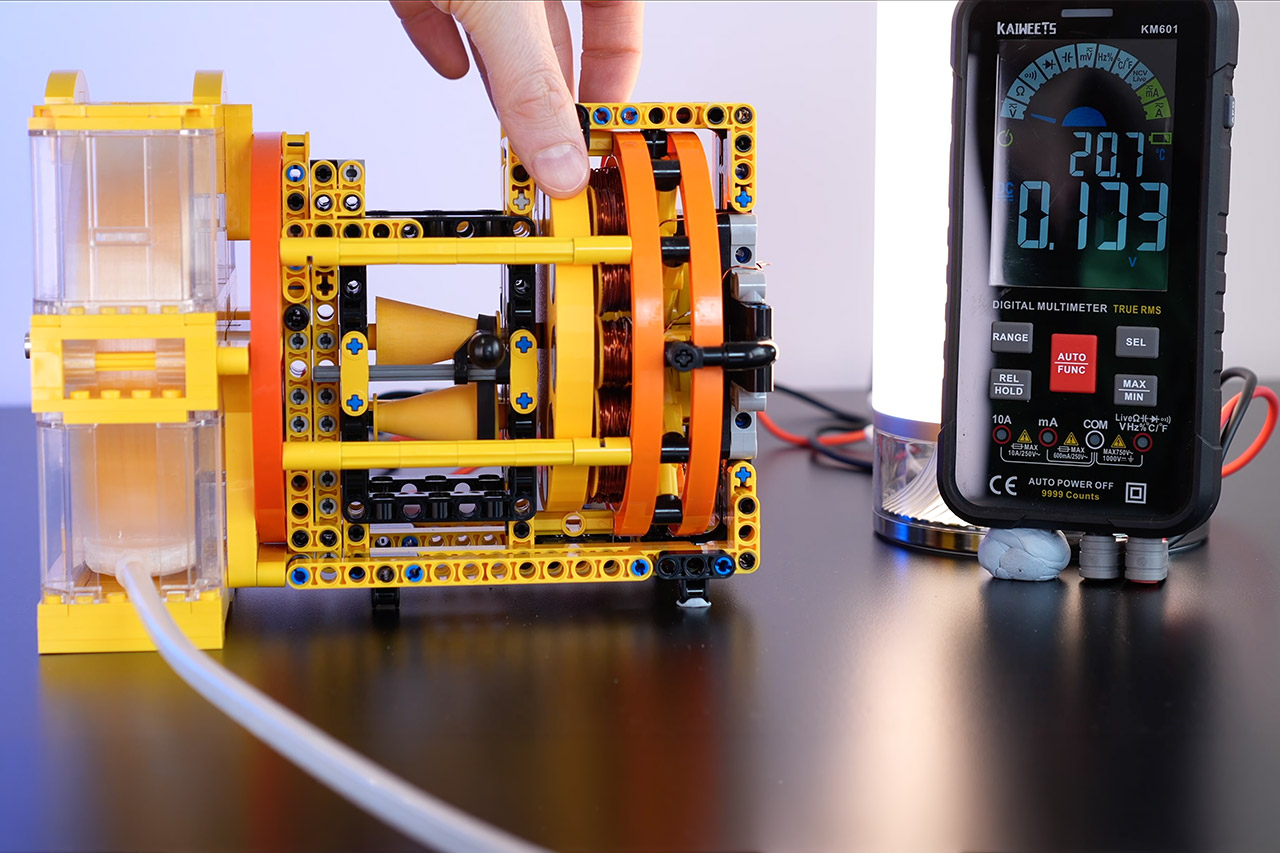
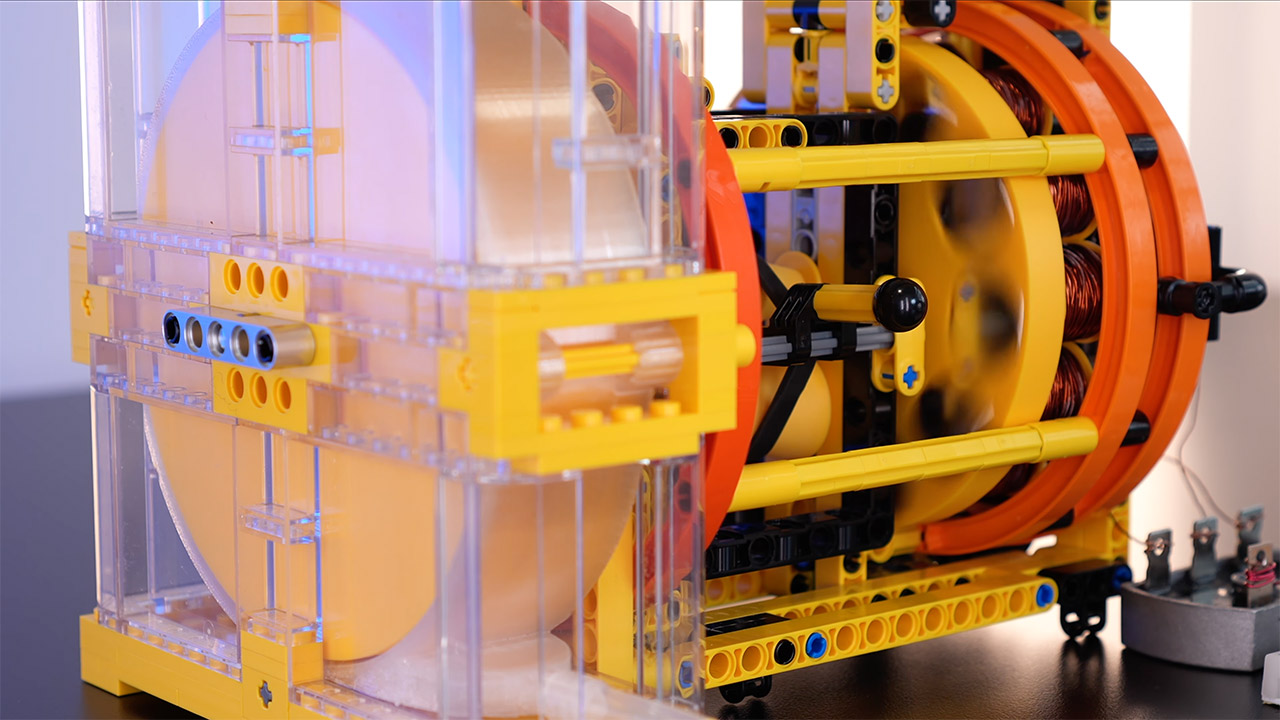
LEGO Bladeless Turbine Generator Build
Jamie’s Brick Jams decided to take an old Nikola Tesla idea and turn it into something completely new, utilizing LEGO parts to construct a working generator. Jamie decided to utilize stacked discs rather than the standard spinning blades. Air enters at an angle through small holes and spirals in towards the closely spaced surfaces, and the friction from the moving air is what causes the discs to spin, without the need for any direct pushing force.


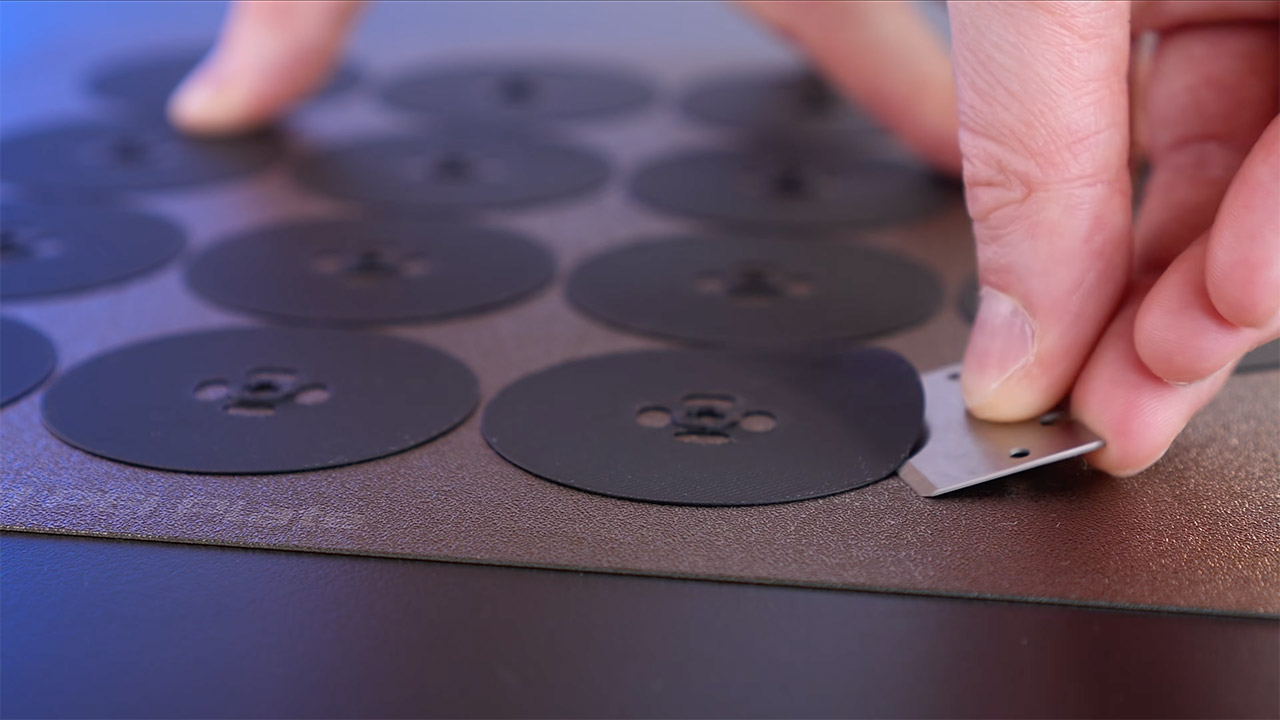
His first attempts employed basic LEGO Technic wheels and beams to construct a basic rotor stack, but compressed air at sixty pounds per square inch was insufficient, as the assembly was only spinning at eighteen thousand revs per minute and lacked thrust. It was speedy, yet it struggled to move a little walking robot, let alone huge objects. Then Jamie had the bright idea to use printed discs. The thin little circles that came out of the 3D printer at one millimeter thick were a huge game changer. Eleven of them stacked on a central shaft increased the surface area and provided the entire contraption a massive speed boost, by more than 70%. The airflow improved dramatically, and the rotor became quite steady.


Bambu Lab A1 Combo, A1 3D Printer and AMS lite, Support Multi-Color 3D Printing, High Speed & Precision…
  • High-Speed Precision: Experience unparalleled speed and precision with the Bambu Lab A1 3D Printer. With an impressive acceleration of 10,000 mm/s…
  • Multi-Color Printing with AMS lite: Unlock your creativity with vibrant and multi-colored 3D prints. The Bambu Lab A1 3D printers make multi-color…
  • Full-Auto Calibration: Say goodbye to manual calibration hassles. The A1 3D printer takes care of all the calibration processes automatically…

Next came the enclosure, which Jamie designed to control the entering air so that it flowed perfectly over each disc. Printed housings had eight small holes spaced equally around the outside edge, and LEGO bricks sealed the edges to maintain air flowing smoothly in and prevent leaks. The outcome was a 50% increase in speed and a significant reduction in vibrations.

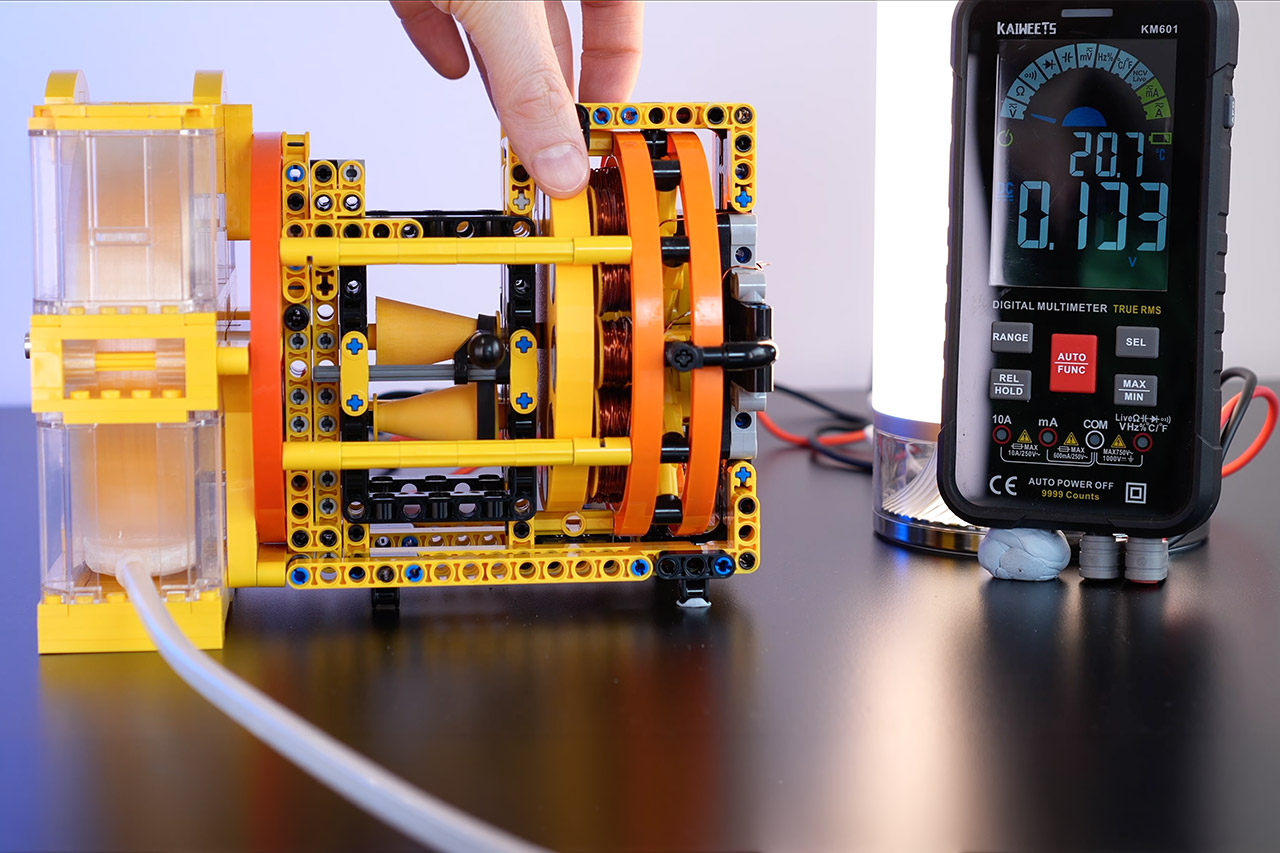
LEGO Bladeless Turbine Generator Build
Jamie also conducted tests to determine which materials were the best, including normal PLA, a more durable variety, PETG, polycarbonate, and even flexible TPU. It turns out that a tougher version of PLA is the way to go, as it reached 27,000 revolutions per minute at the same air pressure. If you print the discs at a narrower three tenths of a millimeter, you can put more of them into the stack without it being too heavy.

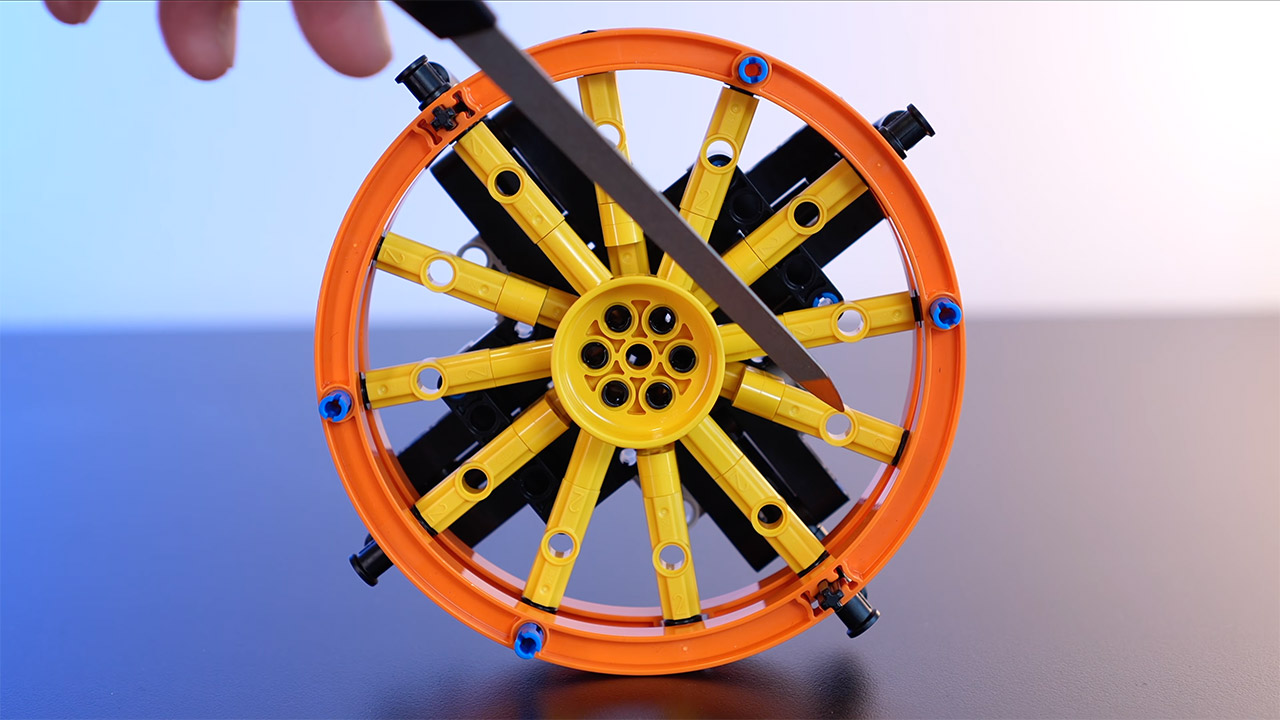
LEGO Bladeless Turbine Generator Build
The finished design consisted of thirty discs stacked inside a reinforced LEGO Technic frame with metal axles and bearings for maximum durability. The centrifugal force of spinning keeps the flexible discs flat, and there are exhaust holes near the center shaft to evacuate the clean air once it’s finished. Getting the high speeds to generate useful electricity was the actual challenge. Jamie initially tried a cone pulley system with a rubber belt, but it did not last very long. So they moved to metal gears with a set reduction ratio, which made all the difference since it allowed them to achieve smooth power transmission without constantly fiddling with modifications.

LEGO Bladeless Turbine Generator Build
Coils and magnets served as the generator’s electrical core. It was a really clever setup, with a twelve-pole stator made from real LEGO bricks that contained coils of 20 gauge wire wrapped in three phases. Ten powerful neodymium magnets were used to generate the magnetic field on the spinning rotor. As the rotor spun, it generated a fluctuating magnetic field that the stator picked up. Next thing you know, rectification kicks in and converts that AC to steady DC, ready for the real world.

On the final runs, pushing the turbine hard with air at a whopping 85 pounds per square inch yielded impressively consistent results. Even under a strong load it held a steady 13,500 revolutions per minute, and as the pressure climbed the output followed, peaking at thirty volts with occasional bursts of up to one amp of current. The end result was fourteen watts of usable power, which is enough to charge a smartphone or keep a 100 watt LED panel running at full brightness for hours
[Source]

Advertisement

Source link

Continue Reading

Tech

Poland’s nuclear research centre targeted by cyberattack

Published

on

Poland's nuclear research centre targeted by cyberattack

Poland’s National Centre for Nuclear Research (NCBJ) says hackers targeted its IT infrastructure, but the attack was detected and blocked before causing any impact.

In a statement this week, the organization announced that its security systems and internal procedures, designed to detect threats early, prevented the compromise and allowed its IT staff to quickly secure targeted systems.

“Thanks to the rapid and effective actions of security systems and procedures in the event of such an incident, as well as the quick response of our teams, the attack was thwarted, and the integrity of the systems was not compromised,” the NCBJ says.

NCBJ is Poland’s main government nuclear research institute specializing in nuclear physics, reactor technology, particle physics, and radiation applications. It provides technical and scientific support for the country’s nuclear power program.

Advertisement

The institute also operates the MARIA, Poland’s only nuclear reactor used for scientific experiments, neutron research, and medical isotope production. MARIA is not used for generating electricity.

NCBJ’s Director, Professor Jakub Kupecki, stated that the cybersecurity incident did not impact the operation of the MARIA reactor, which continues to function safely at full power.

The institute has informed the relevant authorities in the country and started an investigation. Additionally, internal security teams have been placed on high alert to respond to any new threats.

Although the agency did not attribute the attack to any specific threat groups or nations, Reuters reported that Polish authorities found indicators that Iran may be behind the cyberattack. However, investigators are also cautious, as these signs may be false flags.

Advertisement

Earlier this month, the country’s Defense Minister, Wladyslaw Kosiniak-Kamysz, stated that Poland is not participating in the conflict in the Middle East.

Earlier this year, in January, it was revealed that Poland’s power grid, specifically, multiple distributed energy resource (DER) sites, heat and power (CHP) facilities, wind, and solar dispatch systems, had been attacked by the Russian threat group APT44 (“Sandworm”).

In late February, an ICCT report placed Poland high in the target list of Russian cyber-actors, with 31 confirmed incidents attributed to them between mid-2025 and early-2026.

Malware is getting smarter. The Red Report 2026 reveals how new threats use math to detect sandboxes and hide in plain sight.

Download our analysis of 1.1 million malicious samples to uncover the top 10 techniques and see if your security stack is blinded.

Advertisement

Source link

Continue Reading

Tech

Top-tier trackers for sports and running

Published

on

From Apple to Coros, Polar and Samsung, there is no shortage of companies putting out amazing wearables for quick access to key apps, tracking your workouts and more. Garmin has been on the scene for a lot longer than most of the competition, and in that time it’s built up an impressive array of products and a sizeable fanbase to go with it. If you want to see what all the fuss is about, or maybe you’re tempted to upgrade from your old wearable, here are the best Garmin watches you can buy right now.

There are plenty of reasons as to why Garmin has established itself as one of the go-to brands in the smartwatch sector, but chief among them are fitness tracking and battery life. Garmin’s software is easily some of the best in the business when it comes to keeping tabs on your workout performance and body recovery, which is why they regularly feature amongst the best running watches to buy.

Most Garmin watches tend to last for at least a week on a single charge, but there are some (like those in the Enduro range) that can last for months. Compared to the day-long battery life of some smartwatches, this is a game-changer, particularly for anyone engaging in intensive workouts like ultramarathons where running into a dead battery can be a nightmare.

The one area where Garmin watches don’t quite match with the competition is in app access. Sure, you can tap into a few key apps like Spotify and Google Maps, but the ecosystem isn’t anywhere near as expansive as what you’ll find on watchOS or Wear OS, so if that’s the type of experience you’re after then our list of the best smartwatches is meant for you.

Advertisement

For sports and fitness tracking however, Garmin is almost unbeaten, but with so many options available within the company’s wares, our in-depth testing is exactly how we’re able to pinpoint which ones are actually worth buying. This involves monitoring GPS and heart rate performance, battery drain and general ease of use – all of which is then filtered into this very list so you can know which Garmin watches excel at what tasks.

Which is the best Garmin Watch?

Advertisement

How we test

Find out more about how we test Garmin watches

Every Garmin watch we test is used by the reviewer for at least a week – or longer, if the battery life lasts beyond that point or we need more time to trial its features. During testing we evaluate key metrics including usability, battery life, and the accuracy of fitness and distance tracking.

Advertisement

For distance tracking, we assess how accurately the device records outdoor runs on tracks we know the length of. We also evaluate the level of battery life lost per hour using features such as built-in or connected GPS. To check heart rate accuracy, we compare the results from the wearable to a dedicated HRM strap.

Next we combine the data recorded with our general experience of using the wearable day-to-day, revealing whether the device proved comfortable to wear, alongside any issues we may have encountered with unexpected bugs over the review period.

Advertisement

  • Welcome addition of LTE connectivity

  • MicroLED brings sharper, brighter display technology

  • Same great Fenix sports and outdoor features

  • Big jump in cost

  • You need to pay for an inReach subscription

  • New sensors equal a thicker case

  • MicroLED battery drain

Although it won’t be for everyone, the Garmin Fenix range is king when it comes to buying at the super high-end sector of the market, so if you’re an avid runner of marathons or ultramarathons then this is the one to go for. Although you can absolutely find previous-gen options at a now discounted rate, if you are planning on going all in with true no-holds-barred tracking then the latest Garmin Fenix 8 Pro is well worth the investment.

The big new addition which separates the watch from its predecessors is the inclusion of a MicroLED display, which is still quite a rarity in the tech world, and in smartwatches it’s practically unheard of. With this technology to hand however, the screen is so much brighter than anything we’ve seen before, making it very easy to read in darker environments and when looking at the watch from a side-on perspective.

While not exactly the first Garmin watch to toy around with LTE features, the Fenix 8 Pro is the one to really capitalise on the concept by introducing cellular calls and messaging into the mix. This is great for times when you don’t have your phone to hand as you’ll be able to call for help in emergency situations via the watch itself, either via a network or satellite connection.

Advertisement

All of this sits on top of the real reason as to why you’d want to buy a Fenix watch in the first place, and that’s unparalleled fitness and GPS tracking. There are preloaded topographic maps on the Fenix 8 Pro for helping you to navigate new routes on wilderness trails, and with a built-in ECG sensor you can keep better tabs on your heart health outside of workouts.

There’s the built-in LED torch that Fenix watches are known for, and although the feature is now available on cheaper watches like the Venu 4, it’s still as helpful as ever, especially when trying to get in a run when the sun is down. It is a shame that the MicroLED technology isn’t quite as battery efficient as the AMOLED displays that have come before it, as you’ll get up to 10 days between charges, but that’s still leagues ahead of the Apple Watch Ultra 3.

Advertisement

  • Screen is nice and bright

  • Sapphire glass for added screen protection

  • Some useful new running metrics

  • Battery drop from the the 965

  • The price has increased massively

  • Garmin heart rate monitor needed for new metrics

Although Garmin’s range as a whole is designed with runners in mind, with plenty of options to serve those at varying skill levels, anyone who’s interested in running as their sole workout should have their sights set primarily on the Garmin Forerunner 970. As the most premium offering within the brand’s Forerunner series, the 970 provides the most comprehensive tracking experience for those constantly chasing the runner’s high.

The big upgrade here over the Forerunner 965 is that the 970’s AMOLED display is much brighter than before, making it a great deal easier to read when out on the track, or in a dimly lit room. That display is better protected from the elements too thanks to a sapphire crystal coating. Although this is a tricky thing to quantify, we didn’t pick up on a single dent or scratch appearing during the time we spent with the review unit.

In terms of the tracking experience, there are three new metrics on the 970 in the form of step speed loss, running economy and running tolerance, giving enthusiasts even more data to pore over post-run. For those who just want simple navigation on their wrist, you can upload a race course and the watch will set up lap splits automatically at certain parts throughout the track.

The newer Garmin Gen 5 optical sensor also brings some fairly sizeable gains in terms of heart rate tracking, including the ability to conduct an on-device ECG test. Given how much of a game-changer ECG tracking has been elsewhere, especially on the Apple Watch, it’s great to see Garmin embrace the tech on the Forerunner 970.

Advertisement

As you’d expect from a Garmin watch, the 970 doesn’t have quite as many smart features as something like the Apple Watch Ultra 3, but there is now Bluetooth calling onboard which makes it much easier to take/make a quick call during a run. The evening report also gives you a great idea of how much energy you can expect to have in the tank the following day so you can plan accordingly.


  • 12-day battery life is anxiety-relieving

  • Superb fitness and health tracking capabilities

  • Design is more refined than previous generations

  • Garmin Connect app can be complicated for first-timers

  • Only has two buttons for non-touchscreen control

  • Quite expensive

The Garmin Venu range has long been the go-to pick for any fitness fans who want a tracker that also looks great when worn throughout the day. Unlike a lot of the sport-focused picks from Garmin which can look a bit technical and less like a fashion accessory, the Venu watches have always had a sense of style at their forefront, and that reaches new heights with the Garmin Venu 4.

Advertisement

Unlike with the Venu 3 which took a slight step back in terms of variety, the Venu 4 now has a great range of styles available in both its 45mm and 41mm options, so you won’t be penalised for wanting a smaller watch. Our review unit which shipped with a brown leather watch strap is particularly striking, and is designed to catch your attention like any good timepiece should.

Don’t be fooled into thinking that the Venu 4 has swapped function for form – far from it. In fact, on top of Garmin’s stellar fitness tracking tech, the watch now comes with 80 preloaded workouts to track, including more scope for sports activities. It’s now made the Venu range far more competitive in this arena, to the point where most people could pick this up and feel perfectly catered to.

Adding a cherry on top is the inclusion of a built-in LED torch, a first for the circular Venu range and something that used to be reserved for Garmin’s most expensive watches. Having the torch available means that you can enjoy early morning or evening runs in the dark and still be able to see where the path is and any obstacles up ahead. It’s also just helpful for navigating your way to a light switch in a darkened room.

Even though battery life is slightly less than what the Garmin Venu 3 was able to achieve, you can still get up to 12-days of use from a single charge which is ideal if you’re wearing the watch 24/7 for health monitoring. Bear in mind that the Venu 4 does come with a significant price bump, now going for £469.99/$549.99, but it’s worth the added expense for all that you get here.

Advertisement

  • Exceptional battery life

  • Best of Garmin’s sport tracking

  • Better integration of solar charging

  • Just the one look and size

  • Doesn’t get new leak-proof buttons

  • Lacks new voice features on Fenix 8

If you’re a frequent marathon runner or even part of the elite ultra-marathon crowd then you’ll know better than anyone that battery life for your wearables is key, and in that regard there is nothing within Garmin’s range that outlasts the Enduro 3.

This beast of a smartwatch uses a combination of wired charging and solar charging to operate for up to 90-days at a time which leaves almost every competing watch in this arena in the dust.

Advertisement

While the Enduro 3’s high £769.99/$899.99 asking price prevents it from being an immediate must-buy for owners of the Garmin Enduro 2, it does at least pack improved mapping support, a new heart rate sensor and more robust tracking for strength training.

The two things to bear in mind with the Enduro 3 is that unlike the Fenix 8, you don’t get the option of an AMOLED or a more old school transflective display (you’d immediately lumped with the latter), nor are there any size options available aside from the 51mm default. If you’d rather have a more compact watch with plenty of the latest trappings then the Garmin Fenix 8 will be the better buy of the two.

Advertisement

  • Most of that good Garmin sports tracking

  • Useful big screen for viewing maps

  • It’s really light to wear

  • Misses out on Garmin dual-band GPS and ECG

  • Square design isn’t all that eye-grabbing

  • Battery life in always-on display mode

The Garmin Venu range is typically known for being the fashion-first watch within Garmin’s wares, but the Venu X1 charters a new path, one that straddles the line between the Venu series and the more expensive Garmin Fenix wearables. The Venu X1 pulls off this lofty ambition by having a design unlike anything we’ve seen before, yet also ready to withstand the elements.

At just 7.9mm thin, the Garmin Venu X1 makes almost all other smartwatches feel chunky by comparison, and you won’t ever have to worry about it catching on your clothing. Because of how slim it is, the watch also clocks in at a seriously lightweight 40g, making it very comfortable to wear both throughout the day and to bed for full 24/7 fitness and health tracking.

The phone’s chassis is even made with titanium around the case, giving it more protection from the elements than the majority of watches out there, but what really stuns from the moment you turn it on is the bright two-inch display. A screen of this size on a wearable is a rare thing, but it means that there’s plenty of space to cram in key metrics whilst you’re out on a run to keep you better informed.

The added space also makes interacting with the watch outside of workouts feel a great deal easier. You’re far less likely to encounter accidental touches here, and the upside of that is that you can peruse your health data on the watch without feeling drawn to opening up the smartphone app instead.

Advertisement

What’s quite surprising given the size of the Venu X1 is the inclusion of an LED torch which, just like its implementation on a handful of other Garmin watches, can be a huge boon when you’re running in the dark or even just taking the bins out at night. Fitness enthusiasts may lament the exclusion of dual-band GPS tracking, and the smaller battery life of up to eight-days is a direct result of the watch’s slimline build, but there’s so much to like about the Venu X1 that these factors don’t detract from everything that makes it great.


  • Good overall fitness and sports tracking

  • Improved user interface

  • Slimmer than the Vivoactive 5

  • Largely the same design as Vivoactive 5

  • Doesn’t include the latest sensor technology

  • Just one case size option

Of all the watches currently available in Garmin’s wares, it’s the Vivoactive 6 that sits as the best option for most people. The wearable hits that perfect blend of affordability and having a wide array of fitness tracking features to help it stand out against the competition. If you just want a competent Garmin watch that does all of the essentials well then this is the one to go for.

Advertisement

The Garmin Vivoactive 6 is ever so slightly slimmer than the Vivoactive 5, and while that might not be immediately obvious when seeing the watch at first glance, this does allow it to sit more comfortably on your wrist, making it less likely to cause irritation over time. There’s just one 42.2mm size option available so it’s more of a one-size-fits-all scenario, but with a bright 1.2-inch AMOLED display, the Vivoactive 6 finds that balance of not feeling too small, nor too cumbersome.

In terms of fitness tracking, you’re getting a great look at what Garmin does best with quick-to-connect GPS, reliable heart rate data and easy-to-understand advice about how to prioritise your rest and recovery. This sits on top of the revamped Garmin UI that’s designed to make day-to-day use of the Vivoactive 6 a bit simpler, and more in line with modern smartwatches.

There’s 5ATM waterproofing so if swimming is your workout of choice, you won’t have any issues with taking the Vivoactive 6 down to your local pool. When you’re out on a run, offline music playback means that you can leave your phone at home and just bring a pair of headphones or earbuds as you lock in.

The final cherry on top is the 11-day battery life which just destroys other smartwatches around the same price point as the Garmin Vivoactive 6, including the Apple Watch SE 3 and the OnePlus 2R. The only thing standing in the Vivoactive’s way is the more stylish Garmin Venu range, but those looks come at a higher cost so if you’re not too fussed about having a fashion-first wearable then there’s nothing to worry about.

Advertisement

  • Garmin’s brightest AMOLED display

  • Solid all-round sports tracking

  • Some of Garmin’s voice-based features added

  • Feels expensive for the feature set

  • Battery drain due to brighter display

  • Lacks full mapping

As much as we love the Forerunner 970, that watch is far better suited for ultramarathon runners or triathletes who need heavy-duty tracking to keep tabs on their performance. For enthusiasts who just love a good park run and staying active at the gym, you’re far better off with the Garmin Forerunner 570 which is available for much less but still includes a good amount of tracking features to help you on your fitness journey.

There are two size options available, 42mm and 47mm, so if you do have smaller wrists then fear not, there’s a version of the 570 made specifically for you. Regardless of which one you get, you’ll be looking at a gorgeous AMOLED display that can really elevate the colour in the many watch faces available, not to mention Garmin’s revamped UI.

Advertisement

Although it is a lot cheaper than some of Garmin’s high-end watches, you’re still getting the new Gen 5 optical sensor which promises better accuracy when it comes to monitoring your heart rate and overall exertion throughout the day. All of this information is then fed into Garmin’s Body Battery software so you can better understand what kind of workout your body is ready to tackle next, or if you need to prioritise getting some rest.

There’s dual-band GPS tracking too, providing more accurate positioning when out on a run. This is great for any post-run analysis as you can get a better insight into which parts of the route had you struggling. You can enjoy up to 10-days of use between charges, and while that might not be groundbreaking compared to other Garmin wearables, it’s a huge win against something like the Apple Watch Series 11 which can only last for two days at a time.

In terms of smart features, the offering is a bit more expanded than in previous iterations with the inclusion of Bluetooth calling and the ability to interact with the watch via voice commands. This feature isn’t quite as expansive as Google Gemini access on the Samsung Galaxy Watch 8 or the Pixel Watch 4, but it gets the job done for small tasks like setting timers or starting a workout.

Advertisement

  • Great look

  • Well integrated digital display

  • Impressive array of fitness and wellness features

  • Handy wireless charging

  • Fiddly to get to some sub-menus

  • Not your typical big Garmin battery life

  • Higher quality displays on other Vivomove watches

  • Not much cheaper than Vivomove Style

While they’re known for their sports and fitness prowess, Garmin wearables aren’t particularly favoured for their aesthetic which tends to be more functional than fashionable. If you’ve been hoping for a more fashion-conscious wearable that also includes Garmin’s tracking features then look no further than the Garmin Vivomove Trend.

This hybrid smartwatch combines the watch dials of a traditional timepiece with the digital functionality of a modern wearable thanks to the touchscreen that lies beneath the aforementioned dials. When you want to scroll through the Vivomove Trend’s menus, the watch dials will simply move out of the way to give you an unobstructed view of the onboard apps.

The only major letdown here is that the amount of fitness tracking features can’t quite compete with Garmin’s high-end wearables, but the Trend does excel in the realm of wellness tracking which is just the ticket to help you keep an eye out on your stress levels throughout the day and to better pinpoint the main causes of stress.

Advertisement

You also get access to Garmin’s detailed sleep tracking data via the Garmin Connect app, which can go a long way towards helping you to establish better sleeping patterns and improving your recovery period after intense workouts.

As an added cherry on top, the Vivomove Trend is one of the few Garmin watches (and few smarwatches in general) to boast wireless charging, so if you have a Qi wireless charger then it’ll be compatible with the Trend right out of the box. If you’re sick of proprietary cables then this is an absolute Godsend.

It is worth mentioning that the more feature-packed Garmin Vivomove Sport is actually cheaper than the Trend and arguably a better option when it comes to fitness tracking. Still, the Trend’s unique design and wireless charging give it enough to set it apart from the crowd.

Advertisement

  • Superb AMOLED display and UI

  • Reliable GPS and HR tracking

  • Battery life is excellent

  • Separate edition for music support

  • GPS lock-on is slow

  • Rival watches are cheaper

For the sheer amount of choice in the world of Garmin smartwatches, it can seem pretty daunting to anyone just starting out who wants a simple wearable that does the basics well and doesn’t cost a fortune in return. To that end, the Garmin Forerunner 165 is your best bet.

This entry-level watch takes everything that makes Garmin great and condenses it into one easy to use device that’s ideal for helping those who are just hitting their local park run for the first time and want a bit more insight into their progress.

As you might expect, the Forerunner 165 provides top notch heart rate tracking that largely managed to keep up with a dedicated chest-strap monitor in our testing. This information is then funnelled into your VO2 max score which lets you know how equipped your body is at tackling cardiovascular activity.

Advertisement

The watch can connect to GPS independently of a smartphone, so if you want to keep tabs on your route and see which areas are giving you the most trouble then you can do exactly that, all while your phone is on charge at home.

Unlike Garmin’s affordable watches of old, the Forerunner 165 features more modern tech in the display area, opting for an AMOLED panel. Not only does this make watch faces and bits of information pop on-screen, but it’s all incredibly easy to read both indoors and outdoors, so you won’t have to worry about squinting.

As a final cherry on top, the Forerunner 165 doesn’t skimp on the battery life, with the ability to get up to 11-days of use on a single charge. That’s not bad for a device that, at £249.99/$249.99, is much cheaper than the majority of Garmin watches.

The only major annoyance is that if you want to enjoy music playback offline, you’ll need to plump up for the pricier ‘Music’ version which sits at £289.99/$299.99. Still, while it’s bested by similarly priced Apple Watches and Galaxy Watches where smart features are concerned, the Forerunner 165 still dominates in battery life and fitness tracking accuracy.

Advertisement

  • Fun, rugged look

  • New multi-band GPS support

  • Bright LED flashlight

  • Loses sub-display from solar model

  • No touchscreen support

  • Misses out on full mapping

If you’re the type of person who much prefers escaping to the great outdoors over a long weekend than sitting in front of the TV then the Garmin Instinct range is made with you in mind. These outdoor-ready watches are designed specifically to face the elements with ease, and now the tech onboard feels more refined than ever in the seriously impressive Garmin Instinct 3.

Immediately recognisable by its raised bezels, the Garmin Instinct 3 goes out of its way to protect its 1.2-inch display, which in itself uses a chemically strengthened glass to withstand scratches and dents as you go about your adventures. It’s as tough as Garmin watches come, and with a 10ATM rating, the watch can withstand depths of water at up to 100 metres, so avid swimmers won’t have a thing to worry about here.

Advertisement

What separates the Instinct 3 from its predecessor is the inclusion of AMOLED technology in the display, which is far more colourful and goes a long way towards making the watch faces and menus pop. Sure, it’s not quite as battery efficient as what came before, but it’s definitely more pleasing on the eyes and makes the Instinct 3 feel like a modern watch.

The Instinct 3 hasn’t lost its core identity though as there’s no touchscreen functionality, but rather five tactile physical buttons that let you navigate through the watch’s menus. This might sound odd in 2026 but when your hands are sweaty or covered in dirt from the train, having physical buttons to hand is far more ergonomic, and it saves the screen from being obscured.

Even with the more battery intensive AMOLED display, you’re still getting about 18-days of use between charges which is long enough for you to comfortably leave your charging cable at home when you go away for a quick camping trip. Admittedly, without Bluetooth calling and the lack of full onboard maps, you’ll find a far more robust experience on pricier options like the Garmin Fenix 8 Pro, but for the price the Garmin Instinct 3 is set at, it’s the ideal pick for outdoor enthusiasts with a modest budget to spend.

Advertisement

Test Data

  Garmin Fenix 8 Pro Garmin Forerunner 970 Garmin Venu 4 Garmin Enduro 3 Garmin Venu X1 Garmin Vivoactive 6 Garmin Forerunner 570 Garmin Vivomove Trend Garmin Forerunner 165 Garmin Instinct 3

Full Specs

  Garmin Fenix 8 Pro Review Garmin Forerunner 970 Review Garmin Venu 4 Review Garmin Enduro 3 Review Garmin Venu X1 Review Garmin Vivoactive 6 Review Garmin Forerunner 570 Review Garmin Vivomove Trend Review Garmin Forerunner 165 Review Garmin Instinct 3 Review
UK RRP £469.99 £769.99 £279.99 £279.99 £249.99 £389.99
USA RRP $549.99 $899.99 $299.99 $269.99 $249.99 $449.99
EU RRP €329.99
CA RRP CA$369.99
AUD RRP AU$449
Manufacturer Garmin Garmin Garmin Garmin Garmin Garmin Garmin Garmin Garmin Garmin
Screen Size 1.4 inches 1.2 mm 1.4 inches 2 inches 1.2 inches 1.4 inches 1.1 inches 1.2 inches 1.2 inches
IP rating IP68 Not Disclosed IP68 Not Disclosed Not Disclosed IP68 IP68 Not Disclosed Not Disclosed IP68
Waterproof 10ATM 5ATM 5ATM 10ATM 5ATM 5ATM 5ATM 5ATM 5ATM 10ATM
Size (Dimensions) 47 x 16 x 47 MM 47 x 12.9 x 47 MM 45 x 12.5 x 45 MM x x INCHES 46 x 7.9 x 41 MM 42.2 x 10.9 x 42.2 MM 47 x 12.9 x 47 MM 40.4 x 40.4 x 11.9 MM x x INCHES 45 x 14.9 x 45 MM
Weight 73 G 56 G 38 G 37 G 36 G 50 G 43.3 G 53 G
ASIN B0F8QZ7233 B0F38GK1QZ B0F8QYXTXH B0BMQPP6XW B0DSC8JF59
Operating System Garmin OS Garmin GarminOS
Release Date 2025 2025 2025 2024 2025 2025 2025 2023 2024 2025
First Reviewed Date 06/10/2025 03/07/2025 20/10/2025 15/10/2024 02/07/2025 14/05/2025 13/06/2025 20/02/2024 12/02/2025
Colours Black, Green, Purple Black Lunar Gold, Slate, Metallic Jasper, Metallic Pink Dawn Black, Slate Grey, Cloud Blue, Raspberry, Amp Yellow, Indigo Cream Gold, Slate, Peach Gold, Silver Black, Grey Black, Neotropic
GPS Yes Yes Yes Yes Yes Yes Yes Yes Yes

Advertisement

What activities do Garmin watches track?

This varies between different Garmin watches. The top end Fenix devices are multi-sport focussed and can track everything from running to specialist extreme sports. More basic trackers in the firm’s Vivo-lines tend to focus on essentials and can only track standard activities like cardio, running, cycling and swimming.

Advertisement
Do all Garmin watches have GPS?

Garmin is one of the best companies for accurate location and distance tracking, but many of its more affordable wearables do not have built-in GPS functionality. Instead, the cheaper wearables tend to have “connected GPS” which lets them offer GPS tracking using a paired smartphone.

Advertisement
Are Garmin devices smartwatches?

Garmin wearables tend to have an overt fitness tracking focus and use the firm’s proprietary operating system. This means they do offer some smartwatch functionality, like alerts, music controls and weather reports, but don’t have the same app support as Apple’s watchOS or Google’s Wear OS devices.

Advertisement

Source link

Continue Reading

Tech

Meta Plans Sweeping Layoffs As AI Costs Mount

Published

on

An anonymous reader quotes a report from Reuters: Meta is planning sweeping layoffs that could affect 20% or more of the company, three sources familiar with the matter told Reuters, as Meta seeks to offset costly artificial intelligence infrastructure bets and prepare for greater efficiency brought about by AI-assisted workers. No date has been set for the cuts and the magnitude has not been finalized, the people said. Top executives have recently signaled the plans to other senior leaders at Meta and told them to begin planning how to pare back, two of the people said. If Meta settles on the 20% figure, the layoffs will be the company’s most significant since a restructuring in late 2022 and early 2023 that it dubbed the “year of efficiency.” It employed nearly 79,000 people as of December 31, according to its latest filing. The speculation follows a recent report from The New York Times claiming that Meta has delayed the release of its next major AI model after falling behind competing systems from Google, OpenAI, and Anthropic.

Source link

Continue Reading

Tech

The IRS’s Verification System for Sharing Taxpayer Data With ICE Would Have Accepted ‘Don’t Care 12345’ as a Valid Address

Published

on

from the what-a-mess dept

We’re a couple weeks late to this one, but it deserves more attention than it received. As the Washington Post first reported, a federal judge has found that the IRS violated federal law 42,695 times when it handed over confidential taxpayer addresses to ICE last summer. But the raw number, staggering as it is, undersells how absurd this whole thing was. The details of how it happened are so much worse.

Federal law has a pretty basic safeguard built in: before the IRS can hand over a taxpayer’s home address to another agency, the requesting agency has to provide the name and address of the person they’re looking for — specifically to prevent the government from using tax records as a fishing expedition against people it hasn’t already identified.

Can you guess how the Trump IRS’s actual verification process worked when ICE wanted addresses? I’m betting you absolutely can.

The judge, U.S. District Judge Colleen Kollar-Kotelly, laid it out in devastating detail. When ICE sent over its massive datafile of 1.28 million records, the IRS ran two different matching processes. For requests where ICE included a Social Security number, the IRS used something called “TIN Matching” — which checked that the name and SSN matched IRS records. What TIN Matching did not do was verify that ICE had actually provided a real address. The only address-related check was an automated filter that looked for whether the address field contained something resembling a zip code — meaning, any five-digit or nine-digit number.

Advertisement

That was it. That was the safeguard.

As Judge Kollar-Kotelly pointedly observed:

A zip code is not an address, and a zip code proxy, as the IRS would define it, might as well be a set of random numbers. For instance, ICE could have submitted a request with an “address” like, “Don’t Care 12345,” or, “00000,” and still received a taxpayer’s address through the IRS’s TIN Matching process.

And this was the process used for the overwhelming majority of the disclosures. Of the 47,289 taxpayer addresses the IRS shared with ICE, 90.3% — those 42,695 — went through TIN Matching, the process that never actually checked the address. Only 9.7% went through a process that bothered to verify ICE had provided a matching address.

So when the IRS’s own Chief Risk and Control Officer, Dottie Romo, filed a supplemental declaration with the court admitting the agency “may have supplied last known addresses to ICE” in cases where the data was “either incomplete or insufficiently populated,” that was putting it generously. The judge’s opinion catalogs what ICE actually submitted as “addresses” in many of these cases:

Advertisement

In other words, the IRS not only failed to ensure that ICE’s request for confidential taxpayer address information met the statutory requirements, but this failure led the IRS to disclose confidential taxpayer addresses to ICE in situations where ICE’s request for that information was patently deficient. The IRS, for example, disclosed to ICE the last known addresses for taxpayers in situations where ICE supplied an “address of the taxpayer” in its request that contained “language indicating that the address was not complete, such as ‘Failed to Provide,’ ‘Unknown Address,’ or ‘NA NA.’” ….The IRS also disclosed to ICE the last known addresses of taxpayers where the ICE-supplied address was missing essential information, such as “a street name or street number.” … Still more, the IRS disclosed to ICE the last known addresses of taxpayers where the ICE-supplied address “referred to, described, or named specific locations”—examples of which are “jails, detention facilities, or prisons”—and “the corresponding city, state, and zip code” for those locations, but did not include “the street names and street numbers where the buildings or facilities are located.”

“Failed to Provide.” “Unknown Address.” “NA NA.” The system was designed not to catch these deficient requests. The TIN Matching process, as the judge noted, “was not designed to identify the additional types of data insufficiencies.” Of course it wasn’t. Because the process never looked at the address field in any meaningful way to begin with.

Nina Olson, founder of the Center for Taxpayer Rights (which brought the suit), told the Washington Post there was no precedent for anything like this:

“I don’t know of any opinion about the IRS like this. The kinds of mass requests that are coming in are unprecedented.”

And then there’s the timeline of what happened after the government figured out what it had done, which is deeply disturbing as well. The Department of Treasury identified the problems on January 23, 2026. That very same day, it notified DHS. Also on that very same day, the sole ICE official who had access to the illegally disclosed taxpayer data gave two additional ICE officials access to it. The stated reason was “for the purpose of allowing [them] to create an adequate system of safeguards for the data.”

So on the day they found out the data was obtained in violation of federal law, the first move was to give more people access to the illegally obtained data.

Advertisement

And when did the government get around to telling the court and the plaintiffs about these 42,695 violations of federal law? Nearly three weeks later, on February 11. As the judge noted, Defendants “informed DHS right away, but they waited nearly three weeks to inform Plaintiffs and the Court.” The opinion goes on to observe that this, along with the broader pattern, “undercut many representations made by Defendants during this litigation” and reflects, “at the very least, a disconnect between the agency clients and counsel, which leads to some concern regarding the completeness of the administrative record.”

“Some concern.” That’s judicial restraint doing a lot of heavy lifting.

The case is now before the DC Circuit, where the government is appealing Judge Kollar-Kotelly’s earlier order blocking the data-sharing arrangement. In the meantime, DHS has been defending the program as essential to immigration enforcement, with a spokesperson offering the standard line to the Washington Post about how “information sharing across agencies is essential to identify who is in our country, including violent criminals.” Which might be more compelling if the agency’s actual implementation hadn’t involved waving through requests with “NA NA” where the address was supposed to go.

A judge has now formally documented that the IRS broke federal taxpayer confidentiality law tens of thousands of times in a single data dump, using a verification process so hollow that literal gibberish would have passed muster — and when the government discovered this, its first move was to expand access to the illegally obtained data and wait three weeks before telling the court. And yet the government is still fighting to keep the underlying program alive.

Advertisement

Filed Under: dhs, ice, irs, taxpayer info

Source link

Advertisement
Continue Reading

Trending

Copyright © 2025