

Crypto World
Is XRP Basically a Bank Wearing a Hoodie? Analysts Clash Over Ripple’s True Role



Meanwhile, the other community member believes the patience of XRP investors is “genuinely a psychological phenomenon.”
Ripple and its native non-stablecoin have a substantial community, but also a fair share of critics due to some of the core implementations. Its growth in popularity over the past several years has been quite astonishing, which sometimes even surpasses its market rise.
As such, whenever someone, especially a high-profile figure within the crypto industry, speaks against XRP in some form, there’s usually backlash.
A Bank Wearing a Hoodie?
Davinci Jeremie is among the OG crypto influencers and analysts, famously advising people to buy BTC when it was worth $1. In a recent post on X, he criticized XRP for several of its key features that could actually be making it a “bank wearing a hoodie.”
He outlined that these factors could be hidden leverage, fake decentralization, pausable exits, insider advantages, and users locked in wrapped IOUs. Instead, he commented that bitcoin does not have any of these.
Your favorite crypto project is just a bank wearing a hoodie.
*cough* $XRP
Hidden leverage ✓
Fake decentralization ✓
Pausable exits ✓
Insider advantages ✓
Users locked in wrapped IOUs ✓#Bitcoin has none of these.Name one other project that doesn’t. I’ll wait. 👇
— Davinci Jeremie (@Davincij15) March 11, 2026
Somewhat expectedly, most comments below the posts lashed out at Jeremie, with one saying, “That’s the dumbest thing I’ve ever read from you. XRP is everything that they wanted Bitcoin to be. That’s a fact.” Naturally, Jeremie disagreed. Others, though, agreed with his initial comments, saying that “XRP is a s**t and not a match” to bitcoin.
Finally, XRP’s Moment?
In contrast to the aforementioned statement, XRP Bags, among the vocal members of the XRP community on X, outlined what it feels like to be a holder of the cross-border token. They believe every year so far has begun with big promises but seemingly have failed to deliver, or at least until 2023, when it was the first big break in the lawsuit against the SEC.
You may also like:
More promisingly, though, the user noted that 2025 was an “I told you so” year for XRP, while 2026 shows that they are “just getting started.”
the XRP holder experience:
2017 — “this is going to change banking forever”
2018 — “just wait”
2019 — “keep stacking”
2020 — “SEC who?”
2021 — “SEC lawsuit, this is actually bullish”
2022 — “just wait”
2023 — “WE WON (partially)”
2024 — “Keep accumulating”
2025 — “told you”
2026…— XRP Bags💰👨🏽🚀 BagMan (@XRPBags) March 13, 2026
Binance Free $600 (CryptoPotato Exclusive): Use this link to register a new account and receive $600 exclusive welcome offer on Binance (full details).
LIMITED OFFER for CryptoPotato readers at Bybit: Use this link to register and open a $500 FREE position on any coin!


In a broad reassessment of anti-money-laundering (AML) in crypto, Ana Carolina Oliveira, chief compliance officer at Venga, argues that crypto is not uniquely to blame for illicit flows—yet it cannot escape accountability. Traditional finance still experiences illicit activity at a rate that is at least twice as high, with estimates suggesting that more than 90% of such cases go undetected. Blockchain’s immutable ledger offers a potential advantage: when wrongdoing occurs, the trail is visible from end to end. The challenge, Oliveira argues, is not to demonize crypto but to evolve the AML system so it covers both CeFi and DeFi, across borders and regulatory regimes. The EU’s AML Regulation 2024/1624 is a meaningful step, but it is not a substitute for robust, practical guardrails across the industry.
Key takeaways
- Traditional finance still generates illicit flows at a higher rate than crypto, with estimates indicating AML activity is at least twice as prevalent in fiat systems and a sizable portion goes undetected.
- AML frameworks for crypto must move beyond checkbox compliance and toward ongoing, enforceable safeguards that cover both centralized and decentralized finance ecosystems.
- The Travel Rule envisions a SWIFT/IBAN-style identification regime, but implementation remains industry-led and costly due to multi-jurisdictional compliance requirements.
- Blockchain’s pseudonymity presents enforcement challenges, particularly when self-hosted wallets and mixers obscure origins; data-sharing across platforms and regions is crucial.
- Progress hinges on a balance: regulators and industry must collaborate to establish global standards and guardrails that preserve innovation while closing loopholes that criminals exploit.
Tickers mentioned:
Market context: The ongoing regulatory push in the EU and other jurisdictions continues to shape the crypto landscape, with institutions seeking clearer risk-management frameworks and more predictable compliance pathways. As liquidity and risk sentiment shift, robust AML infrastructure could accelerate mainstream adoption by reducing friction and boosting user trust. At the same time, the debate over privacy versus transparency intensifies as onchain analytics mature and cross-border data-sharing norms emerge, influencing how firms design their compliance tools and workflows.
Why it matters
For users, coherent AML rules that are consistently enforced across borders reduce the friction associated with moving value between wallets, exchanges, and custodians. When compliance is predictable, consumers gain confidence that legitimate activity won’t be stymied by opaque processes or inconsistent regional rules. For builders and exchanges, the message is clear: interoperable, standards-based tools that can operate across CeFi and DeFi guardrails will be essential. Fragmented systems create choke points, raise costs, and invite circumvention as firms juggle divergent requirements from different regulators.
From a market perspective, credible AML measures can enhance the legitimacy of digital assets in the eyes of traditional financial institutions, insurers, and corporate treasuries. They also raise the bar for risk management, potentially attracting capital that was previously wary of regulatory ambiguity. Regulators, meanwhile, face the dual challenge of safeguarding the financial system while avoiding stifling innovation. The EU Regulation 2024/1624 offers a framework, but practical, cross-border enforcement will require continued dialogue and shared technical standards across jurisdictions.
Ultimately, the aim is to recast crypto compliance as a global, cooperative endeavor rather than a patchwork of national rules. By aligning on information sharing, screening, and verification standards—without eroding the permissionless and borderless nature of blockchain—regulators and industry players can reduce illicit activity without hamstringing legitimate activity. As the discourse evolves, the emphasis shifts from “doing something” to doing the right things consistently, everywhere, every time.
What to watch next
- Regulatory milestones around the EU AML Regulation 2024/1624, including guidance and enforcement timelines, expected in 2025–2026.
- Wider industry adoption of a crypto SWIFT-style information exchange as referenced in regulatory and industry discussions.
- Developments toward global AML standards for cross-border digital assets and increased inter-regulator cooperation to close jurisdictional gaps.
- Advances in onchain analytics, wallet screening, and real-time transaction monitoring that can be scaled across exchanges and custodians.
Sources & verification
- Regulation EU 2024/1624 — EU legal text and official summary.
- Travel Rule advisory — Financial Crimes Enforcement Network (FinCEN) advisory on cross-border crypto transfers.
- Crypto SWIFT system — discussion of a SWIFT-like data exchange for digital asset transfers.
- Universal blockchains buckling under real-world demands — Cointelegraph article on blockchain interoperability challenges.
- a16z to Senate drop the ancillary asset loophole — Cointelegraph article examining regulatory gaps and potential fixes.
Toward a global AML framework for crypto: aligning guardrails with the onchain reality
Crypto does not exist in a legal vacuum, and the AML challenge is not simply a matter of deploying sophisticated screening tools. It is about building a shared operating environment where information travels with the same speed and reliability as value. Oliveira highlights that while the Travel Rule provides a SWIFT/IBAN-style identification framework, its practical implementation has been left to industry participants navigating a maze of national and regional laws. The result is a fragmented approach that can create safety gaps. The EU’s Regulation 2024/1624 adds momentum, but it also underscores a larger truth: one-off regulations cannot by themselves close the door to illicit finance. Real progress will require disciplined, cross-border collaboration on data standards, technology interfaces, and governance protocols that tie together exchanges, wallet providers, and financial institutions alike.
At the core of the argument is the recognition that blockchain’s immutability can be a tool for uncovering illicit activity, not a justification for lax controls. Pseudonymity on-chain is a feature that complicates identity verifications, particularly when funds pass through self-hosted wallets or mixers designed to obfuscate provenance. The path forward, therefore, is not to dismantle privacy but to implement scalable, privacy-preserving analytics and screening that preserve legitimate user privacy while revealing illicit patterns. In this sense, the crypto sector’s AML posture must evolve from a narrow checklist to a holistic system—one that integrates continuous feedback loops, clearer typology mapping, and robust information sharing across exchanges and geographies.
Two recurring themes run through Oliveira’s analysis. First, the public sector cannot delegate all responsibility to private actors. While the industry must bear a large portion of implementation cost and technical work, regulators must set enforceable standards and provide clear guidance on how to achieve them. Second, a global, minimum-standard framework—implemented across jurisdictions—could reduce the cost of compliance and improve the effectiveness of anti-money-laundering efforts. The industry’s experience with multi-jurisdiction compliance will be a bellwether for whether such a framework can be realized in a way that respects the speed and openness that define digital assets. The discussion is no longer about whether crypto requires AML safeguards, but how to design safeguards that are comprehensive, interoperable, and enforceable worldwide without undermining innovation.
As the dialogue continues, industry participants must demonstrate the willingness to share information that proves problematic activity and to adopt best practices that reduce criminal adaptability. The overarching goal is to create a crypto space where legitimate users enjoy faster, cheaper, and more transparent transactions while criminals lose access to the same networks. In short, AML for crypto should be about clarity, cooperation, and consistency—an architecture that scales with global finance rather than one that fragmentizes it. If these principles are adopted, the market can move toward greater resilience and trust, enabling broader participation without compromising security.
https://example.com/placeholder.js
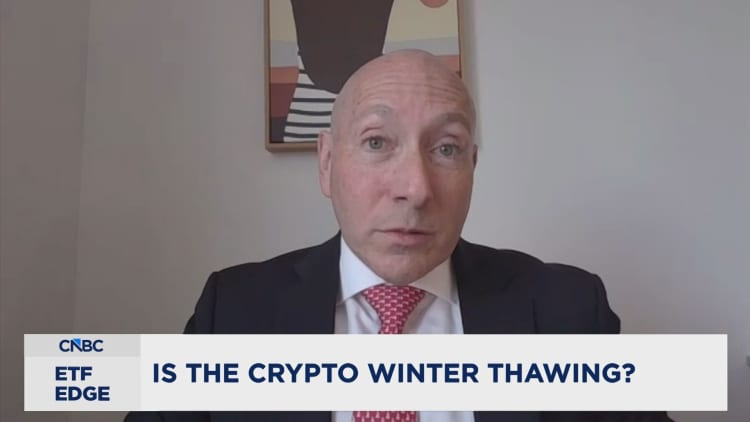

A bitcoin comeback may be underway.
Just as the cryptocurrency was kicking off its latest winning week, ProShares’ Simeon Hyman was emphasizing a bullish bitcoin trend on CNBC’s “ETF Edge.”
“If you look at bitcoin, it’s up a little bit and equities are down [since the Iran war began,]” the firm’s global investment strategist said on Monday.” “So, I think the diversification story really holds in in this current environment.”
As of Friday’s market close, bitcoin gained 5% this week — with most of the gains coming over a 24-hour period. Plus, it’s up roughly 8% since the Iran war started on Feb. 28.
Meanwhile, the S&P 500 and gold are down more 3% since the war with Iran began, and the tech-heavy Nasdaq is off more than 2%.
ProShares is active in the cryptocurrency space — operating more than a dozen cryptocurrency ETFs. It launched the ProShares CoinDesk 20 Crypto ETF (KRYP) last month. It’s up nearly 5% since the Iran war began, but the fund is off about 7% since its early February debut.
Despite bitcoin’s recent strength, it’s still down more than 40% from its record high of $126,198 reached last October.

Bitcoin’s volatile year
Main Management founding partner and CEO Kim Arthur thinks bitcoin is in a classic crypto winter — a so-called phenomenon that tends to happen every four years. According to Arthur, it’s in the bottoming stage.
“Bitcoin was trading at $125,000 five months ago. So, it was down 50-plus percent when this conflict erupted,” he said in the same interview. “I do like the fact that it’s outperformed a lot of other asset classes [since the war,] but… you have to widen the lens a little bit on that.”
Arthur, who has exposure to bitcoin, indicates he’s taking a passive investing approach to the cryptocurrency right now.
“For myself as an asset allocator and a portfolio manager… I look at bitcoin as my benchmark, and then I bench everything else against that,” said Arthur, who added bitcoin has been an extremely difficult master to beat particularly since 2021.
The digital currency has gained about 15% over the past five years.
Crypto World
Bitcoin Hits 20 Million Mined Milestone, Leaving Only 1 Million Coins Left: Mining Industry


Bitcoin has surpassed 20 million coins mined—over 95% of its 21 million total supply—but most current miners may not survive to see the final 1 million coins extracted by 2140.
Bitcoin has crossed a historic threshold: 20 million of its 21 million total supply has now been mined. The milestone leaves fewer than 1 million coins remaining to be extracted over the next 114 years, according to available data. The achievement underscores how close Bitcoin is to its absolute supply cap.
The extended timeline to extract the final 1 million BTC poses a critical challenge for miners. After the last halving around 2140, miners will depend entirely on transaction fees rather than block rewards to sustain operations—a fundamental shift that may force many current participants out of the industry before the network reaches completion.
Sources: Decrypt | Bitcoin Magazine | Yahoo Finance
This article was generated automatically by The Defiant’s AI news system from publicly available sources.
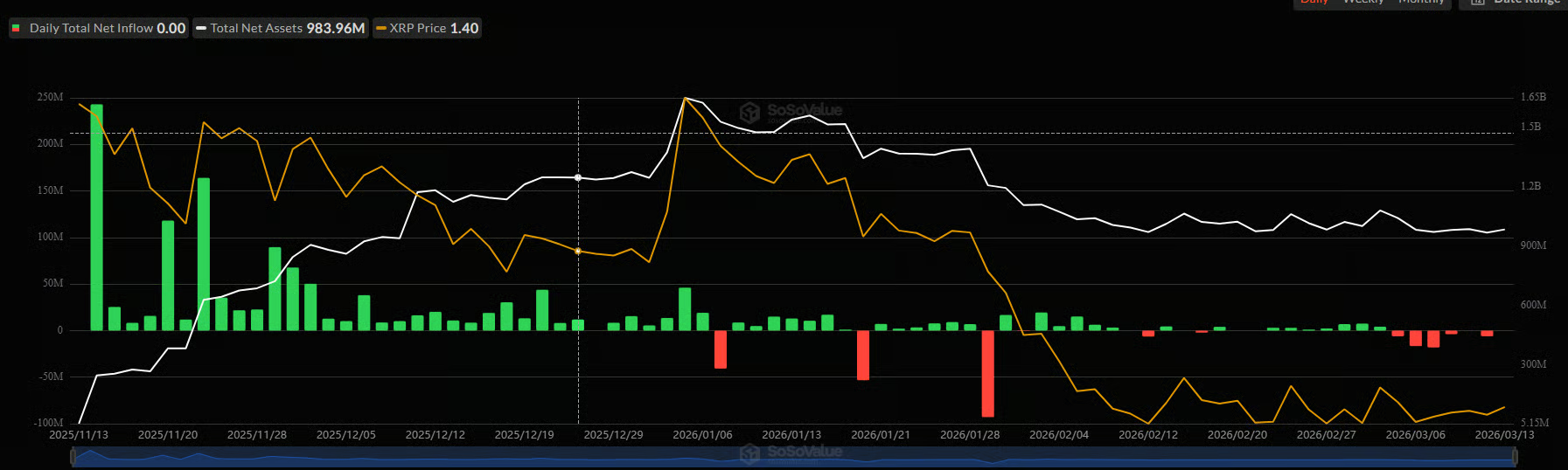
Moreover, the overall negative streak stretches out to March 5.
The demand for the spot XRP ETFs in the United States has seemingly evaporated as the funds have not seen a single day of net inflows for over one whole week.
Nevertheless, the underlying token managed to post some gains over the past week before it was halted at $1.45.
XRP ETFs See Investor Exodus
The exchange-traded funds tracking the performance of the cross-border token enjoyed their initial honeymoon period that lasted roughly a month, in which they attracted over $1 billion in cumulative net flows. However, they began to slowly disappear from investors’ radar. The first two warning signs were observed on January 7 and 20 when $40.80 million and $53.32 million were pulled out of the funds.
January ended with another mass withdrawal of $92.92 million on January 29, and the overall month was just slightly in the green – $15.59 million; a figure significantly lower than the $666.61 million seen in November and $500 million in December.
February picked up the pace, as the total monthly inflows stood at $58.09 million. However, more warning shots were seen as there were days with zero net inflows. Such trading days returned in the previous week – SoSoValue shows $0.00 reportable inflow data for March 11 and March 13. Moreover, the other three trading days were in the red, with $18.11 million leaving the funds on Monday, $3.88 million on Tuesday, and $6.08 million on Thursday.
This negative streak extends to the previous business week. In fact, the funds have not seen a green day since March 4.
XRP Price Ascent Halted
Despite the investor exodus, XRP’s price fared rather well in the past week, jumping from a Monday low of $1.34 to a multi-week peak of just over $1.45. However, it was stopped there and now struggles below $1.40.
You may also like:
Its most recent price moves have been contained in a relatively tight trading range, which has prompted many analysts to suggest that there’s a big move in the making. Ali Martinez, for example, noted a few days ago that XRP’s Bollinger Bands have been squeezing, hinting at a major breakout soon.
He doubled down earlier today, saying that XRP’s current triangular consolidation is approaching its tipping point, with a 30% price move brewing.
$XRP is consolidating in a triangle, hinting at a 30% price move. pic.twitter.com/lgjOWKUBHU
— Ali Charts (@alicharts) March 14, 2026
Binance Free $600 (CryptoPotato Exclusive): Use this link to register a new account and receive $600 exclusive welcome offer on Binance (full details).
LIMITED OFFER for CryptoPotato readers at Bybit: Use this link to register and open a $500 FREE position on any coin!
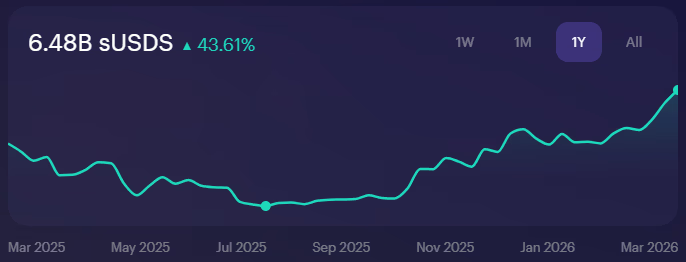
Sky is now the fourth-largest DeFi protocol as RWA-backed yields drive inflows.
Sky, the successor to MakerDAO, is off to a strong start this month, with its total value locked (TVL) climbing to $7.52 billion, a 38% increase since March 1, according to DefiLlama.
This makes Sky the fourth-largest decentralized finance (DeFi) protocol by TVL, trailing Aave, Lido, and EigenCloud. The sUSDS savings pool alone accounts for approximately $6.5 billion in deposits and has attracted nearly $1.3 billion since the start of the month.

As DeFi yields have dried up in the wake of the market downturn, Sky’s fixed 3.75% savings rate is higher than stablecoin supply rates on major protocols like Aave and Morpho. For example, supplying USDT or USDC on Aave’s Ethereum markets currently yields less than 2%.
“Yield is definitely the main factor, but it’s also one of the lowest risk, liquid yield sources in DeFi,” Sam MacPherson, CEO of Phoenix Labs, told The Defiant.
Sky founder Rune Christensen also emphasized that users are prioritizing safety amid the market turbulence.
“Honestly, it’s the classic story of how Sky, just like Maker used to, always does better in bear markets because it’s just focused on a solid product that can be trusted to be stable and deliver good returns,” Christensen told The Defiant.
The SKY token has rallied alongside the surge in TVL. The token is up approximately 4% over the past seven days and 12% over the past month, according to CoinGecko.

The token remains about 26% below its all-time high, per CoinGecko, with a market capitalization of roughly $1.7 billion.


Brazil’s leading cryptocurrency and fintech industry groups have warned that expanding a financial transaction tax to stablecoin operations could harm innovation and violate existing law.
In a joint statement shared with CoinDesk, industry associations ABcripto, ABFintechs, Abracam, ABToken and Zetta said recent discussions about extending a tax on financial operations (locally known as Imposto sobre Operações Financeiras, or IOF) to stablecoin transactions raise legal and economic concerns.
The organizations represent more than 850 companies across Brazil’s financial technology, virtual asset and market infrastructure sectors, the statement reads.
The debate centers on a levy applied to certain financial transactions, including foreign exchange operations. According to the associations, applying the tax to stablecoin transactions would conflict with Brazil’s current legal framework and harm the country’s crypto industry.
They argue that the Constitution defines the IOF as applying only to the settlement of currency exchange transactions involving the delivery of national or foreign fiat currency. Stablecoins, they said, do not meet that definition.
Brazil’s Virtual Assets Law, enacted as Law No. 14,478 in 2022, explicitly states that virtual assets are not considered national or foreign fiat currency, the statement says. The industry groups say this distinction means stablecoins cannot legally be treated as instruments representing foreign currency under the IOF rules.
As a result, the organizations say any attempt to extend the tax through a decree or an administrative rule would be unlawful. Under Brazil’s constitutional framework, new taxes or expanded tax triggers must be approved through the legislative process.
“In this context, any expansion of tax incidence on operations with stablecoins through a decree or administrative rule is illegal, since acts of this nature cannot create or expand a tax triggering event,” the document reads.
The groups also cautioned against conflating monitoring rules from Brazil’s central bank with taxation policy. They said oversight of digital asset transactions does not automatically justify applying the IOF tax to those activities.
Industry representatives argue that policy missteps could damage a rapidly expanding sector. Brazil has emerged as one of the world’s largest crypto markets, with an estimated 25 million people participating in the ecosystem.
Brazil’s stablecoin adoption
The associations said the country’s crypto sector has grown alongside a broader wave of financial innovation, including fintech platforms, digital payments, and blockchain infrastructure. They also noted that similar taxes on stablecoin transactions are not widely used in other major economies.
Stablecoin usage in Brazil has surged dramatically in recent years, turning the country into one of the largest markets for the assets in Latin America and globally.
Dollar-pegged tokens like Tether’s USDT and Circle’s USDC now dominate crypto activity as Brazilians use them to hedge volatility in their fiat currency, the real (BRL), move money across borders at lower cost, and provide liquidity for trading.
Brazil’s crypto market, according to an auditor at Brazil’s tax authority, Receita Federal, is moving between $6 and $8 billion per month, with 90% of that being stablecoin flows.
Not all of them are U.S. dollar stablecoins, as BRL-pegged stablecoins are gaining traction. Trading in tokens linked to the Brazilian real reached about $906 million in the first half of 2025, according to Dune data.


It’s not out of the realm of possibility that Strategy (MSTR) could be the owner of 1 million bitcoin — or nearly 5% of the 21 million bitcoin that will ever be created — by the end of 2022.
The company currently holds 738,731 BTC, meaning it would need to acquire another 261,269 BTC to reach the milestone. With roughly 297 days, about 42 weeks, remaining in 2026, that implies an average purchase pace of around 6,158 BTC per week.
Assuming an average bitcoin price of $85,000, Strategy would need to deploy roughly $523 million per week, or about $22.2 billion in total, to reach the 1 million BTC mark by year’s end.
Led by Executive Chairman Michael Saylor, the company’s recent purchases suggest that pace may be achievable. Just last week, Strategy added 17,994 bitcoin. This week’s acquisitions (likely to be disclosed on Monday) are likely to also be deep into the thousands. The company’s STRC preferred stock issuance alone from Monday to Thursday suggested as much as 11,000 BTC purchases. And this doesn’t account for common stock issuance, which may have facilitated thousands more in bitcoin buys.
Longer-term, since launching its bitcoin treasury strategy in August 2020, Strategy has purchased an average of about 10,700 BTC per month, equivalent to roughly 128,000 BTC per year.
So far in 2026, the company has already acquired about 64,948 BTC, putting it well ahead of its historical annual average pace of accumulation.
Crypto World
Kraken’s SPAC KRAKacquisition Targets Stablecoin and DeFi Firms Worth Up to $10 Billion

TLDR:
- KRAKacquisition raised $345M in January, launching a two-year hunt for a crypto acquisition target.
- The SPAC is evaluating firms valued between $2 billion and $10 billion across crypto sectors.
- Target sectors include stablecoins, DeFi, asset tokenization, and payments-related crypto firms.
- Kraken filed a confidential SEC registration statement as it pursues its own IPO this year.
KRAKacquisition Corp., a SPAC tied to crypto exchange Kraken, is searching for an acquisition target. The firm is evaluating companies with valuations ranging from $2 billion to $10 billion.
KRAKacquisition raised approximately $345 million through its IPO in January, starting a two-year search window. The SPAC is targeting crypto-native firms in stablecoins, DeFi, tokenization, and payments. This search runs parallel to Kraken’s own plans for a public offering later this year.
KRAKacquisition Targets Small- and Mid-Cap Crypto Firms
Director Ravi Tanuku confirmed to Decrypt that KRAKacquisition is evaluating companies valued up to $10 billion. However, he noted that the final valuation could land closer to $2 billion.
The range shows the firm’s openness to companies of varying sizes. Ultimately, KRAKacquisition is focused on helping smaller firms access public markets.
Taking smaller companies public has become increasingly difficult, according to Tanuku. “It’s not easy to take a company in that smaller market cap range public anymore,” he told Decrypt.
The SPAC structure offers these firms an alternative route to public markets. This makes KRAKacquisition a practical vehicle for smaller companies exploring Wall Street.
Wall Street’s appetite for stablecoin and tokenization companies grew considerably last year. Tanuku pointed to this trend as a strong market signal.
“The market is clearly paying up for those and starting to realize there’s big changes afoot,” he said. He added that this was a good signal for the firm to keep in mind.
Beyond stablecoins, KRAKacquisition is also open to companies in DeFi and payments. “We’re looking at things related to crypto, but also stablecoins, DeFi, and all kinds of areas in payments,” Tanuku said.
The firm is casting a wide net across multiple crypto-related sectors. Tanuku described the SPAC as a strategic investment tool for Kraken.
Kraken Moves Toward Its Own IPO Amid SPAC Search
The SPAC search comes as Kraken also prepares to go public through its own IPO. In November, the exchange confidentially filed a registration statement with the SEC.
This filing followed an $800 million fundraising round completed earlier. That round valued Kraken at $20 billion.
Kraken’s decision to lend its brand to KRAKacquisition reflects genuine commitment to the venture. The exchange expects to hold a reasonably meaningful stake in any company the SPAC acquires.
This would create a direct economic link between Kraken and the acquired firm. Any acquisition would also strengthen Kraken’s broader market presence.
Billionaire investor Stanley Druckenmiller has also weighed in on the stablecoin opportunity. “I assume our whole payments systems will be stablecoins in 10 or 15 years,” he said in an interview with Morgan Stanley.
His comments reinforce the growing institutional confidence in stablecoin infrastructure. This sentiment aligns closely with KRAKacquisition’s sector focus.
With a two-year clock running, KRAKacquisition must act within its timeframe. The firm continues to evaluate a range of crypto-native companies across multiple sectors.
Tanuku noted that Wall Street interest in these areas remains strong. The SPAC’s flexible target range gives it room to pursue the right deal.

Crypto World
AI developers may not be keen on crypto, but stablecoins are the secret to agentic finance, crypto insiders say


To get an idea of how big a deal AI-based commerce could be for crypto, ask entrepreneurs and developers involved in digital assets, particularly stablecoins. They’ll happily tell you blockchain-based money is the natural fit, an essential element in the mix and so forth.
Their logic is simple. Over the past few years, stablecoins — mostly digital versions of the dollar on public blockchains like Ethereum — have begun eating into the global payments industry. And while they’ve proven to be faster and cheaper than traditional bank transfers, it’s in the new world of autonomous, micro-transacting AI agents that they will shine.
That, at least, is the view of companies like Circle Internet (CRCL), the creator of the second-largest stablecoin, and technicians at crypto exchange Coinbase (COIN), which has led engineering on x402, a payments protocol designed for use by autonomous AI agents in a field becoming known as agentic finance.
Just as 24/7, frictionless, cross-border payment has been a growth area for stablecoins, agentic commerce has particular requirements that the dollar-pegged tokens meet, according to Dante Disparte, Circle’s chief strategy officer and head of global policy. Those include the ability to program the coins so they transfer only when particular conditions are met and to daisy chain, or compose, a set of actions that occur on receipt of a token.
“Firstly, you have to be able to exploit the otherwise really innocuous features of stablecoins, which is programmability and composability,” Disparate said in an interview. “Number two, where the stablecoin lives, the physical blockchain ledgers themselves, are the common reference point the agents will turn to.”
The crypto industry, however, is viewed with, if not suspicion, then at least circumspection, among some AI developers. For example, Peter Steinberger, the creator of AI agent OpenClaw, is publicly opposed to crypto, so much so that he refuses to engage in any further commentary on the subject and declined to comment for this article.
While crypto’s bullishness on AI is one end of the spectrum, consider the other side, said Sean Neville, co-founder of Catana Labs, a builder of agentic finance infrastructure that last year raised $18 million in seed funding led by a16z.
“I’ve worked with people who are more in the AI developer and engineering community that have a very low opinion of crypto,” said Neville, who is also a co-founder of Circle, in an interview. “I think stablecoins have achieved some escape velocity, but the AI developer community in particular has a negative view of crypto, because of things like memecoins and Ponzi schemes and whatnot.”
Untouched by human hands
A key feature of agentic finance is that it involves micro-transactions, or nano-payments, some of which take place between AI agents with humans somewhere in the background.
This is quite different from using Chat GTP as a front-end for a shopping cart and plugging a credit card into it, though, in the near term, agentic systems will access both crypto and cards, Neville said. Agentic payments are likely to be high-frequency transactions in the fractions-of-a cent range that credit card networks will struggle to handle.
“Over time, I do think that there are significant advantages in stablecoins and blockchain rails that are much more natural fits for agentic flows beyond just the retail commerce use case,” Neville said. “If AI is doing things like leveraging 24/7, programmable rails to stream different kinds of money around the world, across borders, it’s just difficult to do that with anything other than stablecoins.”
With clear regulatory guidance for stablecoins finally coming in the U.S., there are potentially more pressing questions for AI agents around fragmentation and conflicting protocols jockeying for position, Neville said.
“There’s a bunch of different ways for agents to pay each other, but if they can’t all agree on how payments should work, then it’s difficult to bootstrap marketplaces, whether they’re using micro payments or not,” he said. “I would love to see something like an SSL equivalent emerge for agents, and it would be great to see a standard that nobody owns, so that we could all kind of build on the same interoperable standard.”
SSL, or Secure Sockets Layer, is a standard technology that encrypts the connection between a web server and a browser.
Stablecoin-friendly option x402, which is often cited in the debate, has caused some people to get hung up on the protocol’s transaction volume from one month to another, said Erik Reppel, head of engineering for Coinbase Developer Platform and an x402 founder. He said his focus is firmly on looking ahead at a whole category of commerce that will hugely disrupt the internet’s existing advertising marketplace.
“I think the thing people haven’t quite realized is that we’re going to break the fundamental economic model of the internet, moving from browsers and you visiting the website of the person who’s publishing content, to consuming things through your agents and your chat interface,” Reppel said in an interview.
The few cents paid by an agent crawling a website, equivalent to the value of an advert flashed before a human’s eyes, could in theory be accomplished by spinning up lots of virtual cards, if a developer has a relationship with, for example, Visa, Rappel said.
“But anyone can program stablecoins,” he said. “Anyone in the world can spin up as many wallets as they want, and then just use wallets as the way to fully isolate funds for an agent. What we want is agents to have isolated, programmable funds, where your agent can’t spend into your credit card limit and can’t access your credit card.”
Catena’s Neville said the company is grappling with squaring regulated money transmission with a sea of agents and bots that have no financial identity. The goal is to keep the bad bots out, he said, while identifying and allowing the ones you want, while giving them specific guidelines and policies they can’t escape.
“The way to handle that is programmable money, because we can leverage cryptography to ensure verifiability and auditability and so on,” Neville said. “It’s effectively identity and policy controls so agents can operate within the rules, regardless of which protocol or which wallet or account infrastructure they happen to be using.”
Crypto World
Bitcoin’s Price Is Running the Same Playbook That Led to a 400% Surge But There’s a Catch


If history repeats, bitcoin could easily go above $300,000.
Popular analyst Merlijn The Trader outlined in a recent post on X that bitcoin’s current setup resembles, to a large extent, its market behavior in late 2022 when the asset actually skyrocketed by triple digits from bottom to top.
To even have the theoretical chance of doing so, though, Merlijn outlined the key level BTC has to hold.
385% Surge in the Making?
His analysis noted that bitcoin had already run this playbook over three years ago, which is evident from the descending compression and sweep buy liquidity. He believes this setup will trap late sellers and BTC’s price will eventually reverse upon its conclusion.
Merlijn explained that the last time this happened, BTC’s price skyrocketed from $15,000 to $73,000. A similar price surge of 385% would send the cryptocurrency flying to well over $300,000.
Obviously, such a scenario is hard to envision now and might sound like a stretch, but Merlijn indicated that BTC could reignite a highly impressive rally as long as it holds the key $65,000 level. If it doesn’t, then it would continue the liquidity sweep phase.
BITCOIN RAN THE SAME PLAYBOOK AS NOVEMBER 2022.
Descending compression. Sweep buy liquidity.
Trap late sellers. Then reverse.Last time this resolved: BTC went from $15K to $73K.
Hold $65K: base is complete.
Lose it: liquidity sweep continues.The market hunts liquidity… pic.twitter.com/BDPICGhWYS
— Merlijn The Trader (@MerlijnTrader) March 14, 2026
He doubled down in a subsequent post that every major BTC cycle had started with a bear trap. In previous examples, such as the massive runs in 2013, 2016, and 2020, the price gains were quite spectacular – 24,000%, 6,300%, and 842%, respectively.
You may also like:
The analyst noted that the pattern doesn’t change as fear is always the first phase of the rally. And, as reported recently, fear has dominated the crypto market for a few consecutive months.
Still Bear Cycle
In the meantime, Doctor Profit, among the most well-known crypto analysts who have been calling for this correction for months, acknowledged BTC’s recent pump to $74,000. However, he argued that this is likely to be a short-term upside move, before “we see another downturn” to new lows.
The cryptocurrency was indeed rejected at $74,000 for the second time in the past 10 days or so, and now struggles to remain above $70,000.
#Bitcoin is rising fast and strong, exactly as predicted. Expect more upside move before we see another downturn move to new lows. In the meantime, let’s enjoy the fake pump together that will last for some weeks!
— Doctor Profit 🇨🇭 (@DrProfitCrypto) March 13, 2026
Binance Free $600 (CryptoPotato Exclusive): Use this link to register a new account and receive $600 exclusive welcome offer on Binance (full details).
LIMITED OFFER for CryptoPotato readers at Bybit: Use this link to register and open a $500 FREE position on any coin!

‘We’re honouring the memory of twin baby boys who will always be part of our family’

Hedge Your Portfolio With These Two 11%+ Yield Covered Call ETFs

Crypto Curbs Money Laundering Without Stifling Financial Freedom

Smart energy pays enters the US market, targeting scalable financial infrastructure

Why Israel is blocking foreign journalists from entering

Bitcoin: We’re Entering The Most Dangerous Phase

From TV Executive to Finance Coach | How Tamar Built Wealth on Her Own Terms

Ep. 2 The first step to financial freedom #financialfreedom! #financialliteracy #wealthbuilding

investment through asset management companies#learningwithease.make financial literacy easy to all
-
 Tech3 days ago
A 1,300-Pound NASA Spacecraft To Re-Enter Earth’s Atmosphere
-

 News Videos5 days ago
10th Algebra | Financial Planning | Question Bank Solution | Board Exam 2026
-
Crypto World11 hours ago
HYPE Token Enters Net Deflation as HyperCore Buybacks Outpace Staking Rewards
-

 Business4 days ago
ExxonMobil seeks to move corporate registration from New Jersey to Texas
-

 Crypto World5 days ago
Paradigm, a16z, Winklevoss Capital, Balaji Srinivasan among investors in ZODL
-

 Fashion22 hours ago
Weekend Open Thread: Addict Lip Glow
-

 Tech4 days ago
ChatGPT will now generate interactive visuals to help you with math and science concepts
-

 Sports7 days ago
Three share 2-shot lead entering final round in Hong Kong
-

 Sports6 days ago
Braveheart Lakshya downs Lai in epic battle to enter All England Open final | Other Sports News
-

 NewsBeat3 days ago
Residents reaction as Shildon murder probe enters second day
-

 Business6 days ago
Search for Nancy Guthrie Enters 37th Day as FBI Probes Wi-Fi Jammer Theory
-

 Business3 days ago
Search Enters Sixth Week With New Leads in Tucson Abduction Case
-
 NewsBeat5 days ago
Pagazzi Lighting enters administration as 70 jobs lost and 11 stores close across Scotland
-

 Tech5 days ago
Despite challenges, Ireland sixth in EU for board gender diversity
-

 Business5 days ago
Search Enters 39th Day with FBI Tip Line Developments and No Major Breakthroughs
-

 NewsBeat3 days ago
I Entered The Manosphere. Nothing Could Prepare Me For What I Found.
-

 Business2 hours ago
US Airports Launch Donation Drives for Unpaid TSA Workers as Partial Government Shutdown Enters Fifth Week
-

 Sports5 days ago
Skateboarding World Championships: Britain’s Sky Brown wins park gold
-
 Crypto World4 days ago
Will Chainlink price reclaim $10 amid volatility squeeze?
-

 Business3 hours ago
Country star Brantley Gilbert enters growing non-alcoholic beer market