

Crypto World
U.S. expansion, regulation-ready messaging, and AI upgrades are giving cloud mining a new narrative in 2026



Disclosure: This article does not represent investment advice. The content and materials featured on this page are for educational purposes only.
Cloud mining narrative shifts toward AI infrastructure as platforms like NOW DeFi attract renewed investor interest.
Summary
- NOW DeFi introduces a simplified cloud mining model for hardware-free participation.
- NOW DeFi integrates AI optimization, automated processes, and data-center infrastructure to improve mining efficiency.
- The platform targets long-term crypto holders seeking additional income through accessible cloud mining services.
The narrative around crypto mining is shifting. Expansion into the U.S., stronger compliance messaging, and the integration of AI into mining infrastructure are pushing cloud mining platforms away from the old “high-return marketing” narrative toward one focused on infrastructure, automation, and accessibility.
For cryptocurrency investors, this shift is becoming increasingly relevant. While many participants previously relied on a buy-and-hold strategy, more investors are now asking whether digital assets can generate additional income opportunities beyond price appreciation.
Against this backdrop, NOW DeFi is gaining attention among investors. By combining AI optimization, automated operations, and infrastructure resources, the platform provides a simplified way to participate in mining and is helping bring cloud mining back into market discussions.
Cloud mining is moving from a “marketing narrative” to an “infrastructure narrative”
Cloud mining previously faced criticism due to aggressive marketing and exaggerated return claims. By 2026, however, industry competition is shifting toward infrastructure and operational capability.
Many platforms are now focusing on:
- Expansion into mature markets such as the United States
- Greater emphasis on compliance and transparency
- AI-driven hashpower optimization
- Integration with renewable energy and data-center infrastructure
This shift reflects a move from simply promoting returns to offering infrastructure access to mining participation.
Investors begin looking for a second path beyond holding
As the crypto market matures, investor behavior is evolving.
Long-term holding strategies for Bitcoin, Ethereum, and other digital assets remain common. At the same time, more investors are exploring ways to make their assets more productive, including participation in mining infrastructure as a potential income strategy.
Cloud mining is attracting attention because it lowers the technical and hardware barriers traditionally associated with mining.
Traditional mining still has high barriers
For most individual investors, traditional mining remains costly and complex. Hardware purchases, electricity expenses, and operational management make direct participation difficult.
Cloud mining platforms offer a simpler alternative. By accessing mining infrastructure through cloud-based hashpower services, users can participate without purchasing or managing equipment, making it a practical option for those seeking opportunities beyond holding assets.
NOW DeFi: Lowering the barrier through AI and infrastructure
Within this evolving landscape, NOW DeFi aims to redefine cloud mining participation through a simplified model.
The platform provides cloud-based hashpower services that allow users to engage in mining without operating hardware. NOW DeFi emphasizes efficiency, automation, and accessibility.
Key features include:
- AI-based optimization systems that improve mining efficiency
- Integration with data-center and energy infrastructure
- Automated processes designed for new users
- A simplified interface for monitoring mining activity
This approach is suited for long-term digital asset holders seeking additional income strategies as well as investors interested in mining without managing hardware.
From idle holding to active participation
For many investors, digital assets often remain idle in wallets or exchange accounts, relying mainly on market price movements.
As the market evolves, more investors are considering whether allocating part of their assets to infrastructure-based activities such as mining could provide additional flexibility and potential income.
In this context, NOW DeFi aims to offer an accessible way for users to explore cloud mining and determine how it fits into their digital asset strategies.
How to get started with NOW DeFi
For users interested in cloud mining, NOW DeFi offers a simple onboarding process:
Step 1: Create an account
Visit the nowdefi.com platform and complete the registration process.
Step 2: Choose a suitable mining plan
Select a hashpower plan based on preferred duration and budget.
Step 3: Start and monitor operations
Once activated, mining runs automatically, and users can track activity through the platform dashboard.
This streamlined process allows even users without mining experience to access the cloud mining ecosystem.
In 2026, cloud mining is about accessibility
From an industry perspective, the key shift in 2026 is that successful platforms are no longer defined only by promised returns. Investors increasingly evaluate infrastructure capability, transparency, technological development, and global expansion strategies.
Platforms gaining attention are those able to answer several questions:
- Why is now the right time to participate?
- What can investors do beyond holding assets?
- Is participation simple and accessible?
- Are the platform’s operations reliable and transparent?
In this evolving narrative, NOW DeFi seeks to address these questions through AI optimization, infrastructure integration, and simplified participation.
About NOW DeFi
NOW DeFi is a digital asset technology platform focused on cloud mining services. By integrating AI optimization, automated operations, and infrastructure resources, the platform aims to provide a transparent and accessible way to participate in cryptocurrency mining.
Users can register by visiting the NOW DeFi official website or downloading the mobile application. After registration, new users can receive the platform’s free hashpower reward, allowing them to participate in cloud mining without purchasing mining hardware.
Disclosure: This content is provided by a third party. Neither crypto.news nor the author of this article endorses any product mentioned on this page. Users should conduct their own research before taking any action related to the company.


Bitcoin (CRYPTO: BTC) edged higher across the week, bucking a cautious, risk-off mood that has dominated broader financial markets amid ongoing geopolitical tensions in the Middle East and regional frictions. By Saturday, BTC had advanced more than 7% over the past week, trading near $70,625, according to price tracking data. The contrast with the broader market was notable: the S&P 500 was down about 1.6% in the same period, underscoring a divergence between equities and the leading digital asset. The week’s rally comes as two distinct drivers align: a funding mechanism that could channel fresh demand into Bitcoin and a sustained wave of inflows into US spot Bitcoin exchange-traded funds (ETFs).
Key takeaways
- STRC.LIVE data indicate Strategy may have raised enough cash via at-the-market sales to buy more than 11,000 BTC this week, equating to roughly $776 million at current prices.
- US spot Bitcoin ETFs registered $767 million in net inflows over five consecutive trading days, underscoring ongoing institutional demand for BTC.
- BTC/USD rose约7% over the week to about $70,625 as the S&P 500 fell, highlighting a notable decoupling from traditional equities.
- Last week, STRC purchased 17,994 BTC, valued at roughly $1.28 billion at that time, with about 30% funded by STRC sale proceeds.
- Historical patterns show Bitcoin often strengthens during geopolitical stress, though near-term risks remain if chart patterns tip into bear-flag territory.
Tickers mentioned: $BTC
Sentiment: Bullish
Price impact: Positive
Trading idea (Not Financial Advice): Hold. The setup points to upside potential supported by robust ETF demand and STRC-driven buying, but technical caveats and external risk factors warrant caution.
Market context: The week’s strength in Bitcoin sits within a broader pattern of ETF-driven liquidity and institutional appetite, even as macro uncertainty and geopolitical headlines persist. Macro models have suggested a possible path toward higher levels, including targets around $100,000, though those projections depend on continued liquidity and risk sentiment shifts.
Why it matters
Bitcoin’s performance this week highlights how new forms of market liquidity can influence the bid for BTC even amid a risk-off environment. The STRC instrument, designed to raise investment cash for Bitcoin purchases, appears to have generated substantial buying power this week. If STRC proceeds materialize as estimated—more than 11,000 BTC could be purchased—the impact would be meaningful in terms of immediate demand, especially given the size of the BTC market already in play. As STRC notes, the instrument trades above its nominal value when demand drives new capital into BTC purchases, enabling fresh BTC-buying capital that can feed price momentum.
Concurrently, US spot BTC ETFs have been quietly pacing a multi-day inflow streak, with roughly $767 million pulled into the sector over five trading sessions. The persistence of ETF inflows signals that traditional market participants are increasingly comfortable rotating capital into BTC through regulated vehicles, even as geopolitical headlines swirl. The combination of on-market financing for BTC purchases and the ETF-driven bid presents a coherent narrative: BTC remains a port of liquidity for certain investors, even when risk assets elsewhere are under pressure.
From a chart perspective, the backdrop is mixed. While the weekly move above the $70,000 level reflects strength, a bear-flag interpretation on BTC’s recent rally warns of potential downside if buying momentum stalls. The pattern would typically play out if BTC fails to sustain the impulse and breaks below the lower boundary of the flag, with a measured objective that could pull prices back toward the lower end of the range. The immediate technical crossroads sit near the 50-day exponential moving average, close to $72,750, where traders will be eyeing whether price action can maintain an uptrend or roll over into a correction.
Beyond the immediate price action, macro narratives remain influential. Some analysts point to macro models that hint at a longer-term trajectory toward $100,000, suggesting that the current liquidity environment could act as a bridge toward more ambitious targets if conditions stay supportive. These projections, while not guarantees, reflect a broader consensus that BTC’s upside potential remains tethered to a balance of liquidity growth, risk appetite, and macro flows. The rhetoric around a higher target exists alongside the caveat that market dynamics can shift quickly in response to global risk events and policy developments.
Geopolitics also continues to color BTC’s behavior. Historical episodes illustrate that Bitcoin has sometimes rallied after initial declines during conflicts or crises, underscoring its potential as a non-sovereign store of value that can attract capital when headline risk spikes. Notable instances include the 2022 reaction to Russia’s invasion of Ukraine, where BTC delivered a substantial rally after an initial sell-off, and the 2020–early-2021 period during heightened U.S.–Iran tensions when BTC rose decisively despite volatility. These patterns are not guarantees, but they underscore a broader narrative in which Bitcoin can participate in risk-off and risk-on cycles depending on the sequence of liquidity, sentiment, and macro triggers.
Looking ahead, traders will be watching whether STRC’s weekly updates confirm continued BTC-buying flow and whether ETF inflows maintain their pace. The next developments in macro indicators and geopolitical headlines could either reinforce the current bid or introduce a new vector of volatility. The fact that Bitcoin has managed to hold ground amid tension underscores a growing maturity in the market where regulated products and structured financing schemes play an increasingly central role in price discovery, even as the asset class remains sensitive to external shocks.
In sum, Bitcoin’s recent trajectory demonstrates a confluence of financing-driven demand and institutional participation through ETFs, with indicators pointing to upside potential while technical and geopolitical risks keep a lid on exuberance. The market will likely react to fresh STRC data, the next tranche of ETF inflows, and any shifts in macro momentum or policy developments, all of which could alter the path toward or away from the higher targets that some macro models have floated.
For readers tracking the ongoing narrative, a few anchor points remain critical: the exact size and timing of STRC purchases, the persistence of ETF inflows, price action around key moving averages, and any new regulatory or macro announcements that could alter risk sentiment. As always, the interplay between regulated products, on-market financing, and macro risk will shape BTC’s near-term trajectory in ways that are hard to predict with precision but increasingly observable through the data that traders monitor daily.
What to watch next
- Next STRC weekly update (covering the current period) to confirm new BTC buys beyond the 11,000 BTC threshold.
- Continued US spot BTC ETF inflows over the coming five trading days and any new ETF launches or changes in structure.
- BTC price movement relative to the 50-day EMA near $72,750 and any break above or below that threshold.
- Macro signals or models suggesting renewed momentum toward higher targets, including the potential $100,000 milestone.
- Geopolitical developments that could reframe risk sentiment and liquidity dynamics in crypto markets.
Sources & verification
- STRC weekly data (March 9–13) via STRC.LIVE, which analyzed the potential BTC buying power from STRC financing.
- STRC ticker page and related STRC.LIVE data: https://strc.live/ticker/strc
- Cointelegraph: STRC may help Strategy hit 1m Bitcoin before BlackRock (markets coverage of STRC-driven buying)
- Cointelegraph: Bitcoin ETFs five-day inflow streak geopolitical tensions (US spot BTC ETF inflows)
- Cointelegraph: Bitcoin passing geopolitical stress test as BTC price spikes above $72K
- Cointelegraph: Bitcoin extremely precise macro signal 100k target back in play
Bitcoin momentum and the role of STRC-funded buys and ETF demand
Bitcoin (CRYPTO: BTC) has enjoyed a week of resilience that traders hope can extend into a sustained ascent. The immediate catalyst appears to be two parallel streams: STRC-driven buying capacity and recurring inflows into US spot BTC ETFs. The STRC instrument, which converts investor cash into BTC exposure, appears to have accumulated enough capital this week to purchase more than 11,000 BTC at prevailing levels, a move that could inject roughly $776 million into the market. If realized, it would mark a sizable step up in on-chain demand and likely support further price gains as the market absorbs fresh supply from this instrument. The STRC figure is grounded in data that show ongoing activity around the instrument, suggesting that the fund-raising mechanism remains a meaningful lever for BTC exposure.
Compounding this potential buying power, ETF liquidity has stayed robust. Over five trading days, US spot Bitcoin ETFs drew net inflows of about $767 million, a signal that institutional participants continue to allocate capital to a regulated exposure vehicle for BTC even in a time of geopolitical tension. This inflow pattern, combined with STRC’s disclosed activity, creates a backdrop in which BTC price action can diverge from wider risk-off moves in equities, at least in the short term. Investors should note that the ETF inflows come alongside other institutional narratives around crypto adoption, custody, and governance that have gained traction over the past year.
From a technical viewpoint, Bitcoin appears to be negotiating a critical crossroads. The price has moved toward the upper end of a near-term range, but a classic bear-flag pattern raises the possibility of a pullback if buyers fail to sustain the move. The upper boundary of that pattern coincides with the 50-day EMA near $72,750, a level that could attract fresh sell-side pressure if tested. In a scenario where the price breaks below the lower boundary of the flag, a downside target could emerge, underscoring the importance of risk controls for participants who are long the market. This is not a forecast but a reminder that price structures can flip quickly if momentum reverses.
Beyond the immediate price action, macro commentary has continued to surface suggesting a path toward higher levels. Some analysts point to macro signals that imagine BTC tracking toward $100,000 in the coming months, a target that hinges on sustained liquidity and favorable risk sentiment. While not a certainty, the notion underscores the evolving narrative around BTC as a potentially high-beta asset within a diversified risk framework. The current environment—comprising STRC’s funding-enabled demand and persistent ETF inflows—could be a catalyst for further upside if macro conditions cooperate and the market digests geopolitical headlines in a constructive light.
Historically, Bitcoin has shown resilience in the face of geopolitical stress. For example, during major conflicts such as Russia’s invasion of Ukraine in early 2022, BTC briefly sold off but soon recouped and posted a substantial rally, illustrating its potential to rebound after initial volatility. A similar dynamic occurred during the 2020–2021 period around the U.S.–Iran tension, when BTC advanced despite early disruptions. While past performance is not a guide to future results, these episodes help explain why BTC remains a focal point for traders looking to diversify risk and explore non-traditional liquidity channels during periods of uncertainty. The current blend of STRC-driven buying and ETF demand fits into this longer-running pattern, even as market participants weigh potential upside against the possibility of a near-term pullback.
As the week closes and traders assess the balance of on-chain buying, ETF activity, and macro indicators, the central question remains: will STRC’s funds translate into a sustained acceleration in BTC price, or will the market test the upper boundaries and pause to digest the influx? The answer will likely hinge on the convergence of liquidity flow, macro sentiment, and the evolving geopolitical backdrop—factors that have repeatedly shaped Bitcoin’s price path over the past several years.


Crypto losses fell to $49M in February, but attackers are shifting toward phishing and user manipulation, says Nominis.
A report by blockchain security firm Nominis shows that in February, total losses from crypto attacks fell by 87%, going from $385 million in January to $49.3 million last month.
However, while the drop in total value stolen suggests improved protocol security, Nominis claims that a closer examination of the month’s events shows that attackers are moving their focus away from exploiting code and toward manipulating the people who use it.
The Anatomy of February’s Crypto Attacks
According to the Nominis report, an attack on Step Finance, a Solana-based decentralized finance (DeFi) platform, caused more than 60% of February’s total losses.
In that case, attackers are said to have hacked devices belonging to the project’s executive team, which may have exposed private keys or allowed unauthorized transaction approvals. After that, they unstaked and moved 261,854 SOL worth up to $40 million from wallets that the project owned.
The damage was so severe that Step Finance was forced to shut down its core platform and affiliated projects, including SolanaFloor and Remora Markets.
The remaining losses came from a scattered mix of attacks, including $3 million lost by CrossCurve, a cross-chain protocol bridge, when an attacker exploited flawed validation logic in the contract responsible for processing incoming messages from the Axelar network.
Elsewhere, YieldBlox, a DeFi lending platform, lost about $10.2 million after a bad actor changed its collateral pricing logic so that it could borrow more than it was allowed to.
You may also like:
There were also several address poisoning scams targeting individuals, with their losses ranging from about $100,000 to nearly $600,000. Others were drained after unknowingly signing malicious token approval transactions. This is a method in which a fake prompt tricks people into giving criminals permission to take money from their wallets.
A Broader Pattern is Emerging
Apart from the direct attacks, there were also several notable findings made in February by investigators and law enforcement. For instance, SlowMist published a technical breakdown of a phishing campaign that specifically targeted administrators of crypto projects.
In that campaign, attackers made fake versions of real token vesting tools to trick operators into giving them access to contracts.
Meanwhile, authorities in South Korea are investigating a case in which a seed phrase was accidentally exposed in a publicly shared photograph, which allowed attackers to reconstruct the wallet and steal nearly $5 million worth of crypto.
As far as enforcement was concerned, the U.S. Department of Justice reported that it had seized more than $61 million in cryptocurrency connected to a pig butchering investment fraud scheme. The investigators were able to trace the money through blockchain analysis and obtain a legal forfeiture of the funds.
Based on the February incidents, the loss of funds is not primarily through exploiting unknown vulnerabilities in the underlying code. The Nominis study found that most losses now come from compromised user accounts, misleading transactional requests, and users copying the wrong wallet address. According to the firm, the most vulnerable aspects of the cryptocurrency ecosystem are not the blockchains themselves, but rather, they are the human behaviors and operational practices that surround them.
Binance Free $600 (CryptoPotato Exclusive): Use this link to register a new account and receive $600 exclusive welcome offer on Binance (full details).
LIMITED OFFER for CryptoPotato readers at Bybit: Use this link to register and open a $500 FREE position on any coin!

Former UK prime minister Boris Johnson sparked a fresh volley of criticism around Bitcoin by labeling it a Ponzi scheme in a Daily Mail op-ed. He recounts a personal anecdote: a friend who handed over 500 pounds, or about $661, to a promoter who promised to “double his money” via BTC, only to be drawn into a years-long cycle of fees and delays. Over three and a half years, the friend’s losses mounted to roughly 20,000 pounds, around $26,474, leaving him unable to recover his capital and facing financial hardship. The column amplifies a broader distrust of crypto assets, contrasting them with more traditional forms of collecting and trading. Johnson also suggests that collectible Pokémon cards — with a decades-long fan base and a fungible market — are more tradable than Bitcoin. He writes that Pikachu and its peers have sustained appeal across generations, which, in his view, makes them more reliably tradable than the volatile, permissionless network he critiques.
Key takeaways
- A prominent UK political figure frames Bitcoin as a Ponzi scheme, anchoring the debate in a real-world investment loss narrative.
- Proponents of Bitcoin push back by outlining fundamental network properties, including the absence of a central issuer and a lack of guaranteed returns.
- Public commentary highlights a tension between decades-long collectibles markets and the newer, complex dynamics of decentralized digital assets.
- The exchange of views references specific milestones, such as Bitcoin’s mining progress and ongoing discourse about the asset’s role in financial systems.
Tickers mentioned: $BTC
Sentiment: Neutral
Market context: The exchange underscores a continuing public debate about crypto’s legitimacy while markets navigate macro risk sentiment and evolving regulatory discussions that influence investor perception.
Why it matters
The exchange illustrates how public figures, policymakers, and crypto advocates frame Bitcoin in moral, economic, and regulatory terms. When high-profile voices compare a highly decentralized asset to traditional, widely traded collectibles, the narrative risk is a false equivalence: tangible collectibles have long-established markets and price psychology shaped by collectors, whereas decentralized networks derive value from utility, scarce supply, and network effects. This distinction matters for both retail investors and institutions attempting to evaluate risk, duration, and custody considerations in crypto exposure.
From a market-structure perspective, the episode reinforces the central tension around Bitcoin’s identity: is it a currency in the conventional sense, a store of value, or a speculative asset tethered to sentiment and narratives? The backlash from Bitcoiners highlights a sharper claim — that Bitcoin’s coded rules, lack of an issuer, and open-market dynamics constitute a fundamental departure from traditional Ponzi-like constructs where returns depend on new participants. That debate touches regulatory narratives, risk assessment, and how financial products built on BTC are described to investors, including BTC-backed instruments and on-chain monetization strategies.
The discussion also arrives as the crypto industry continues to point to milestones such as the network’s ongoing issuance and scaling achievements. Debates about value, legitimacy, and investor protection persist even as the blockchain network nears notable supply milestones and the ecosystem expands with new products and narrative catalysts. The back-and-forth underscores how societal perception, media framing, and official policy interact to shape the appetite for crypto exposure, particularly among traditionally risk-averse audiences.
“Bitcoin is not a Ponzi scheme. A Ponzi requires a central operator promising returns and paying early investors with funds from later ones,” said Michael Saylor, a leading voice in corporate Bitcoin strategy. “Bitcoin has no issuer, no promoter, and no guaranteed return, just an open, decentralized monetary network driven by code and market demand.”
Another industry perspective came from Pierre Rochard, who leads a BTC-backed financial product issuer. He argued that the United Kingdom’s financial framework effectively finances itself through debt, a view that casts the Johnson-backed critique as part of a broader dispute over how fiat and crypto should interact within public policy. The back-and-forth reflects broader disagreements about how value is created, transmitted, and safeguarded in a modern financial system that increasingly sits at the intersection of traditional banking and decentralized networks.
As the discussion unfolded online, supporters referenced Bitcoin’s continued development milestones, including the network’s ability to reach new levels of on-chain activity and security. They also cited examples from recent coverage about Bitcoin’s role in mainstream discourse, such as the ongoing interest in how digital assets are described to the public and regulated by authorities. The exchange of ideas demonstrates that the crypto space remains a live laboratory for questions about trust, safeguards, and the potential for new financial instruments to emerge around BTC.
Viewed in this light, Johnson’s critique serves as a catalyst for a wider conversation about what Bitcoin is and what it is not — a debate that will likely persist as policymakers, investors, and developers navigate the evolving landscape of digital money and decentralized finance.
What to watch next
- Response from policymakers and financial regulators in the UK and abroad regarding crypto classification and consumer protections.
- Continued commentary from crypto executives and thought leaders about Bitcoin’s role in value storage, payments, and macro hedging.
- Monitoring milestones like Bitcoin’s network expansion and on-chain activity, including references to the network’s historical supply milestones.
- Public and media discussions comparing traditional assets and collectibles with decentralized digital assets to gauge shifts in narrative and investor sentiment.
Sources & verification
- Johnson, Boris. Daily Mail op-ed on Bitcoin and Ponzi narratives: https://www.dailymail.co.uk/debate/article-15643681/BORIS-JOHNSON-bitcoin-ponzi-scheme.html
- Bitcoin’s fundamental properties explained: https://cointelegraph.com/learn/articles/what-is-bitcoin-a-beginners-guide-to-the-worlds-first-cryptocurrency
- Bitcoin price reference and market context: https://cointelegraph.com/bitcoin-price
- Bitcoin’s 20 millionth coin milestone coverage: https://cointelegraph.com/news/bitcoin-mined-20-million-executives-speculate-1-million-left
- Logan Paul’s Pokémon card record article: https://cointelegraph.com/news/logan-paul-sells-pokemon-card-record-16-million
Bitcoin’s battle of narratives: Johnson vs. the proponents
Crypto World
XRP Price Prediction Points to $8.6 Rally as Ripple Expands Stablecoin Stack, but Pepeto’s Listing Math Could Erase These Returns Before XRP Even Moves

Ripple just expanded its stablecoin payment infrastructure for banks and fintech companies across the globe, and the XRP price prediction is getting louder. Historical data shows XRP trading in a descending channel from its $3.6 peak, and analysts project a potential rally to $8.6 by Q4 2026 if the pattern breaks.
That sounds impressive until you compare it to listing math. An XRP move from $1.39 to $8.6 delivers roughly a 6x. The presale entry about to list delivers multiples that make 6x look like a savings account. This article covers the XRP outlook and the presale where the listing erases this price forever.
Ripple expanded its stablecoin based payment platform to help banks and fintech companies move money faster reducing foreign reserve requirements according to Coinedition. The upgrade adds stablecoin collection, custody, conversion, and payout across Ripple’s global network.
Separately, historical data reveals XRP’s descending channel from the $3.6 July peak could resolve in a rally to $8.6 between September and December 2026. The XRP forecast benefits from expanding infrastructure, but the listing math at presale pricing makes even a 6x XRP rally look modest.
XRP Price Prediction Targets $8.6, but This Presale Listing Makes Those Returns Look Ordinary
Pepeto: The Listing Erases This Entry Forever and the Clock Is Running Out
The timing on this presale is closing faster than most people realize. While the XRP forecast debates $8.6 by December, Pepeto sits at a fraction of a cent with a listing approaching that will erase this entry permanently. The moment trading begins, this price ceases to exist and the open market decides what an exchange token backed by real infrastructure is actually worth.
That’s how every exchange token listing in crypto history has worked. The presale price is the entry. The listing is the repricing. The gap between those numbers is where wealth gets created, and Pepeto’s gap shrinks with every round that fills.
The cofounder who built Pepe to $7 billion is building the exchange underneath. PepetoSwap handles cross chain swaps with zero fees, a bridge moves assets between networks that normally can’t communicate, and risk scoring checks every token’s safety before you buy. These tools generate the volume that makes exchange tokens valuable after listing, and the Binance listing approaches with every stage that closes.
Staking at 199% APY compounds positions for the wallets already inside, and the listing itself transforms presale entries into open market positions at whatever price the volume demands. Right now, two types of people are reading this. The ones who’ll get into Pepeto before the listing erases this entry, and the ones who’ll look back at this article and wish they’d acted when the math was still in their favor.
XRP Price Prediction: $1.39 in Descending Channel With $8.6 Target if Pattern Breaks
XRP trades near $1.39 according to CoinMarketCap within a descending channel from the $3.6 July 2025 peak, down 23.8% year to date. Historical data suggests a potential rally to $8.6 between September and December 2026 if the channel resolves bullishly.
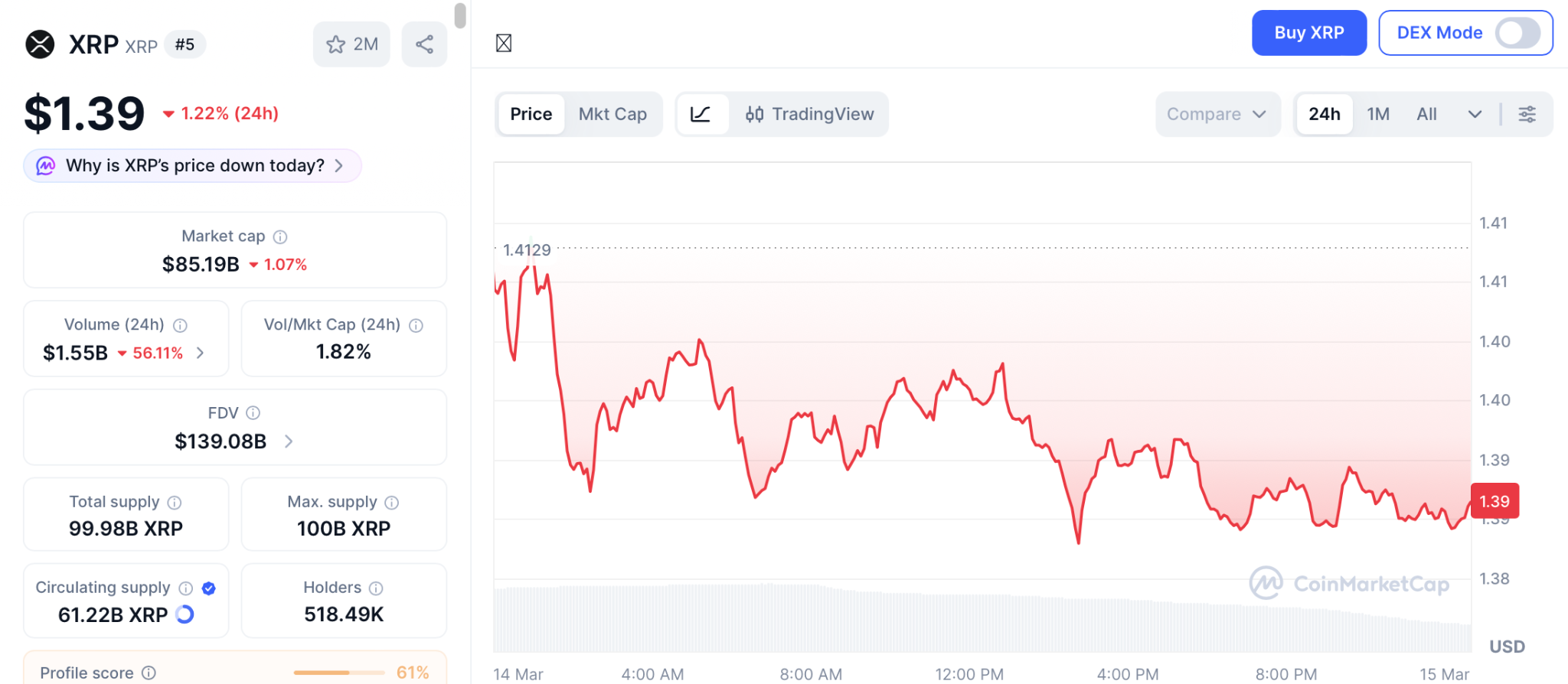
Seven spot XRP ETFs hold $1.06 billion in total assets, and institutional access continues expanding. But even the most bullish XRP forecast delivers a 6x from here, respectable for a large cap but not the kind of return that changes financial trajectories.
BNB: $656 Exchange Token King but Ground Floor Entry Disappeared Years Ago
BNB trades near $656, proving exchange tokens outperform every cycle. Binance’s ecosystem keeps expanding with over $130 billion in BlackRock crypto products flowing through according to Fintechweekly.
But the ground floor that created BNB millionaires vanished at $0.15. The next BNB sits at presale pricing right now.
XRP Price Prediction Requires Months of Waiting, but This Listing Changes Everything Now
Here’s what regret looks like in crypto: reading about an opportunity, understanding the math, and choosing to wait while others act. XRP’s channel could take months to resolve. The Pepeto listing won’t wait that long.
The cofounder who built $7 billion in demand is building again, the community keeps growing, and the moment trading goes live this price disappears permanently. Visit the Pepeto official website and act while the entry that the listing erases is still available.
Click To Visit Pepeto Website To Enter The Presale

FAQs
What is the XRP forecast for Q4 2026?
The xrp price prediction targets $8.6 by Q4 2026 based on historical channel data, a 6x from current levels, while presale listings like Pepeto offer listing math that operates on a different scale.
How does Ripple’s stablecoin expansion affect the XRP forecast?
Ripple’s stablecoin expansion supports institutional adoption and the bullish XRP forecast, but returns remain limited by XRP’s large cap structure.
Where can I find presale entries with better returns than XRP?
Pepeto offers exchange infrastructure at presale pricing with listing math that dwarfs large cap returns. Visit the Pepeto official website before the listing erases this entry.
Disclaimer: This is a Press Release provided by a third party who is responsible for the content. Please conduct your own research before taking any action based on the content.

TLDR:
- Over 240,000 ETH worth approximately $480M has been accumulated by whales since early March 2025.
- BlackRock’s ETHB ETF on Nasdaq lets institutions earn yield by staking 70–95% of their ETH holdings.
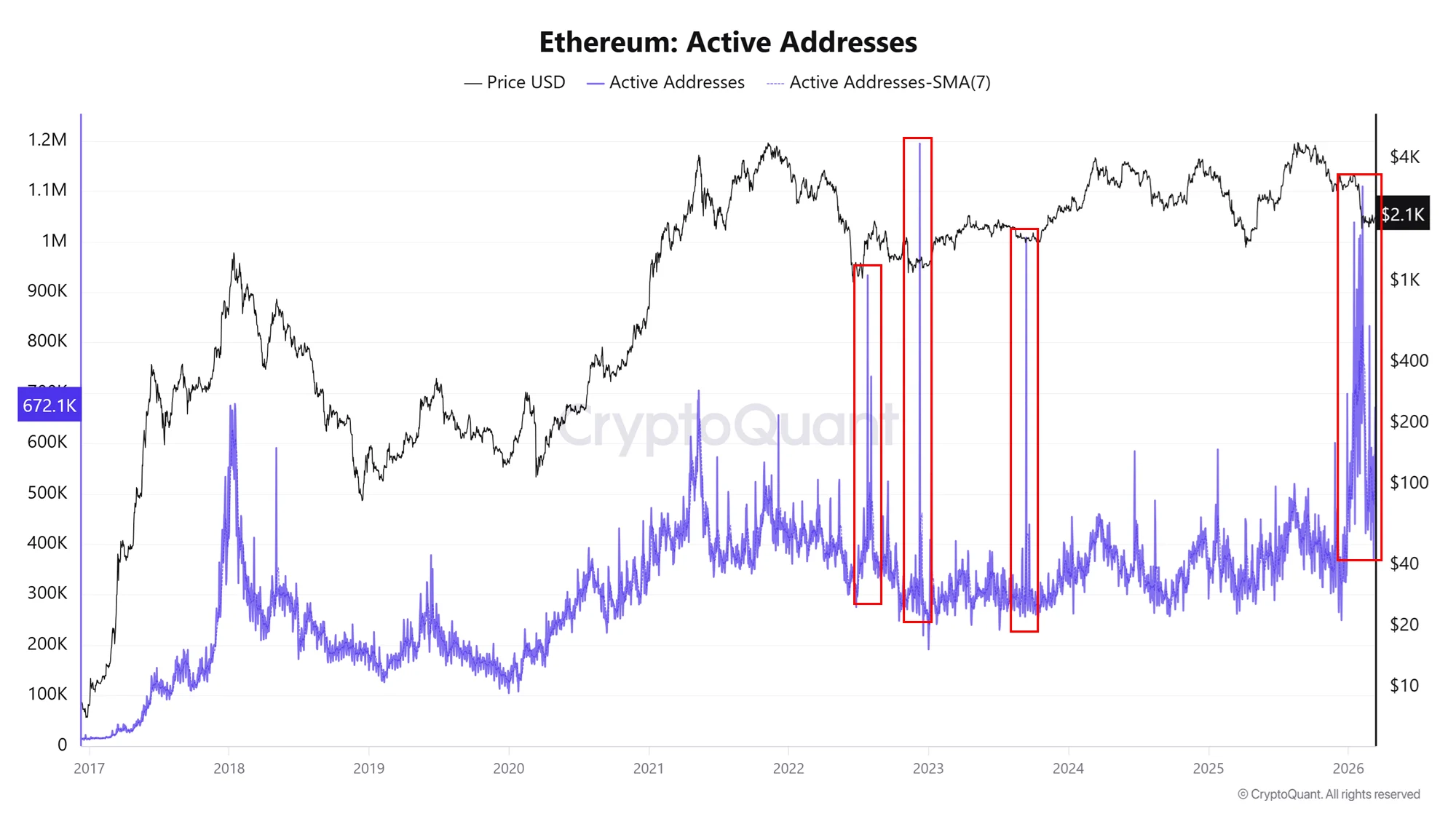
- Rising Ethereum active addresses during a price decline mirror historical accumulation patterns seen since 2022.
- Shrinking ETH exchange supply combined with whale buying could trigger a supply squeeze in the coming weeks.
ETH whale accumulation has reached unprecedented levels as BlackRock’s iShares Staked Ethereum Trust ETF begins trading on Nasdaq.
Over 240,000 ETH, worth approximately $480 million, has been stacked since early March. The price of ETH remains range-bound between $1,900 and $2,150.
Network activity data also points to growing bullish momentum. Active addresses on the Ethereum network have risen sharply.
This signals that accumulation is actively driving on-chain engagement amid the current price stagnation.
Whales and Institutions Drive ETH Demand
Crypto analyst CryptosRus flagged the trend on social media, noting that whales are stacking ETH at a remarkable rate.
The accumulation of over 240,000 ETH since early March has drawn broad market attention. Despite this sustained buying pressure, the ETH price has not yet broken out of its current range.
BlackRock’s iShares Staked Ethereum Trust ETF now trades under the ticker ETHB on Nasdaq. This product has introduced a fresh layer of institutional demand into the ETH market.
The ETF allows institutions to gain direct exposure to ETH while staking between 70% and 95% of holdings for yield. It gives institutional participants both price exposure and a passive income stream at once.
In the early days of trading, approximately $2.2 million flowed into the ETF. While that figure remains modest, the product’s structure could attract larger capital allocations over time.
The yield component makes this product more attractive than a standard spot ETF. Institutional participation in new instruments like this typically accelerates after an initial quiet period.
Shrinking exchange supply is another factor that warrants close attention. As more ETH moves off exchanges into staking or cold storage, available selling pressure decreases.
Combined with ongoing whale activity, this dynamic could produce a supply squeeze if demand continues to build at its current pace.
On-Chain Data Supports the Accumulation Thesis
Crypto analyst CW8900 noted that active Ethereum addresses have risen sharply despite the recent price decline. This trend of rising network activity during a price dip has been consistently observed near Ethereum market bottoms since 2022. The data indicates that participants are using the low-price window to accumulate ETH.
Moreover, the analyst pointed out that activity increased most sharply immediately after the latest price decline. This timing closely mirrors behavior seen during prior Ethereum accumulation phases.
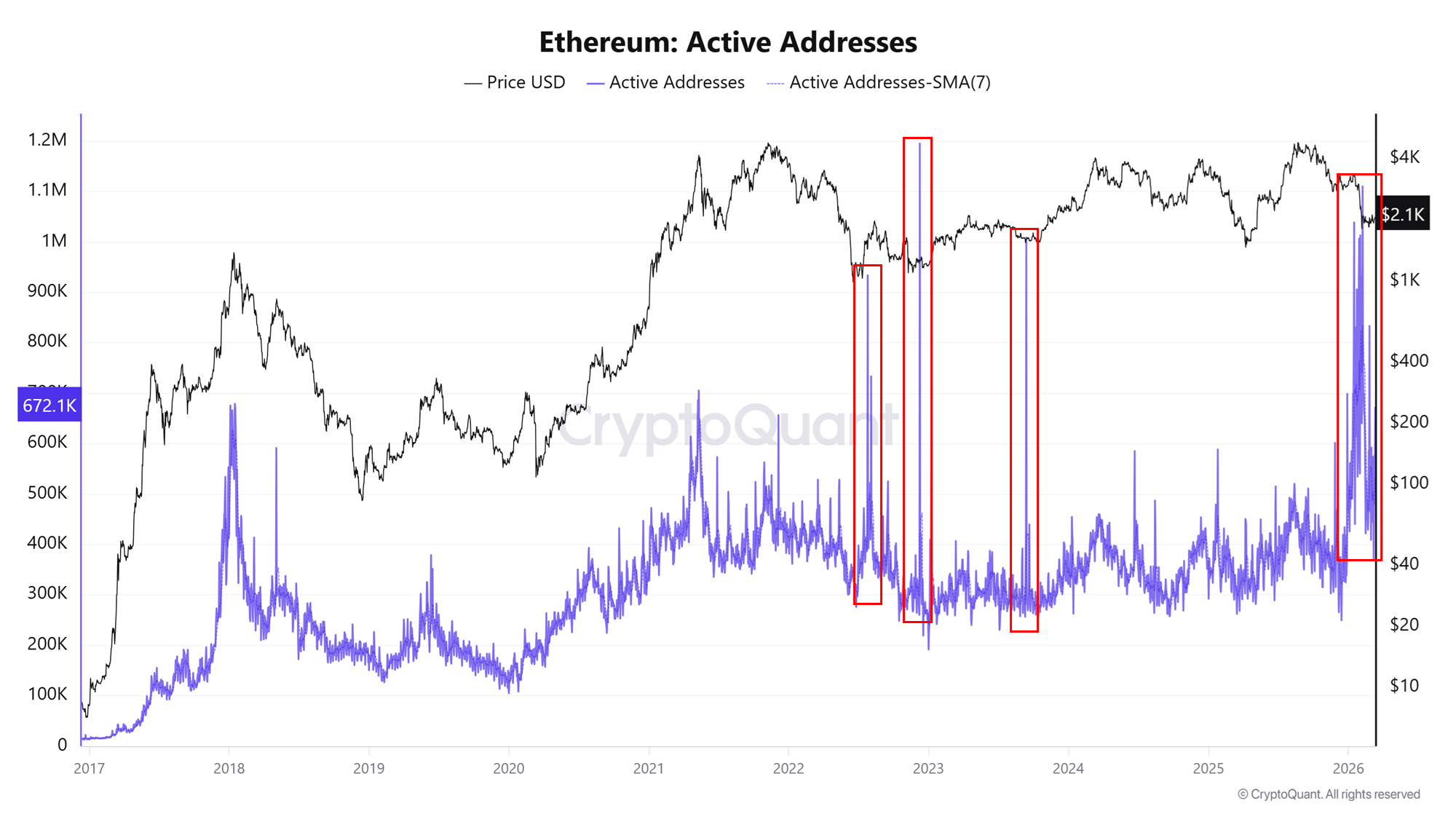
Source: Cryptoquant
It adds weight to the view that experienced market participants are actively positioning at current price levels.
The divergence between price action and network activity is a well-tracked indicator in on-chain analysis. When prices decline while active addresses rise, it often reflects growing engagement from new or returning market participants. This behavior has historically preceded broader market recoveries across past Ethereum market cycles.
That said, price confirmation has not yet arrived. ETH continues to trade within the established range, and no breakout has materialized.
Market participants are closely watching whether this accumulation trend will eventually translate into a sustained price move higher.

TLDR:
- The 2Y SMA/2 is derived by halving the two-year simple moving average and has marked bottoms across BTC, ETH, BNB, and XRP.
- Solana, Dogecoin, and Cardano have already reached the 2Y SMA/2, placing them in historically deep discount territory this cycle.
- Chainlink tested the 2Y SMA/2 with precision and posted a bounce, reinforcing its role as a reliable long-term support zone.
- TRON remains nearly 50% above the 2Y SMA/2, standing out as one of the most resilient altcoins in the current bear market.
The 2Y SMA/2 is gaining renewed attention as crypto markets continue their downward trend. Derived by halving the two-year simple moving average, the indicator has consistently marked price bottoms across major cryptocurrencies.
Analyst Joao Wedson recently stated that all crypto bear markets eventually reach this level. His observation has sparked discussion among traders tracking long-term technical levels across the market.
A Simple Calculation With a Consistent Track Record
The two-year simple moving average is already a widely followed tool among crypto analysts globally. It smooths out short-term volatility by averaging price data over a 24-month period.
However, Wedson’s thread introduced a variation that carries even more historical weight. Dividing that average by two produces a level that has repeatedly aligned with major price bottoms.
This pattern has been observed across some of the largest cryptocurrencies by market cap. Bitcoin, Ethereum, BNB, and XRP have all respected the 2Y SMA/2 during past bear cycles.
Each of these assets eventually gravitated toward this level before staging meaningful recoveries. The consistency across different assets is what makes the indicator difficult to dismiss.
The calculation itself is straightforward, yet its market behavior is notable. A simple mathematical adjustment to a well-known moving average produces a reliable long-term floor.
This kind of simplicity often resonates with analysts who prefer tools grounded in price history. It requires no complex parameters, only a long enough dataset to derive meaningful readings.
Wedson’s post has drawn considerable attention within crypto analysis circles. The idea that bear markets follow a predictable path toward this level challenges the notion that bottoms are impossible to anticipate.
While no indicator offers certainty, the historical alignment between the 2Y SMA/2 and price floors is hard to overlook. Traders are now applying this framework across a broader set of altcoins.
How the 2Y SMA/2 Has Played Out Across Major Altcoins
Several altcoins have already reached the 2Y SMA/2 in the current bear cycle. Solana touched this level after spending nearly two years in sideways consolidation following a massive rally.
Dogecoin also arrived at the 2Y SMA/2, reflecting reduced memecoin interest compared to the 2021 cycle. Cardano has traded below it for weeks, hovering near its 2022 bear market lows.
Chainlink provided one of the cleaner technical reactions to this level recently. It tested the 2Y SMA/2 with precision and posted a modest bounce shortly after contact.
This type of price behavior reinforces the idea that the indicator functions as a meaningful support zone. Such reactions are consistent with how long-term moving averages have historically behaved.
Bitcoin Cash is currently sitting directly on the 2Y SMA, one step above the 2Y SMA/2. Whether it drops further to the lower level remains an open question for analysts.
Wedson suggested patience before drawing conclusions on BCH’s next directional move. The asset’s behavior over coming weeks may offer clearer signals.
TRON stands out as an exception in the current environment. It remains well above both the 2Y SMA and the 2Y SMA/2, requiring roughly a 50% decline to reach either level.
Its resilience sets it apart from the broader altcoin market. Hyperliquid, despite being a newer project, is also showing relative strength and gaining traction while others consolidate.
Why Traders Are Watching the 2Y SMA/2 Closely Right Now
The broader crypto market is in a phase where long-term indicators carry more relevance than short-term signals. Many assets are trading near multi-year lows, making historical support levels increasingly important.
The 2Y SMA/2 offers a reference point grounded in two full years of price data. That depth gives it more credibility than shorter-term moving averages in bear market analysis.
Wedson’s observation is not based on a single asset or isolated event. The pattern has repeated across BTC, ETH, and a growing list of altcoins over multiple market cycles.
Each confirmation adds to the indicator’s standing as a reliable long-term floor. Analysts are now expanding its application to assess where other assets stand relative to this benchmark.
For traders with longer time horizons, assets trading at or below the 2Y SMA/2 represent zones of historical interest. The indicator does not predict the timing of a recovery, but it identifies price regions that have preceded past rebounds.
Understanding where an asset sits relative to this level provides useful context. It helps separate assets at deep discount from those still carrying elevated downside risk.
The current cycle is testing the 2Y SMA/2 across more assets simultaneously than in previous bear markets. That broad convergence reflects the depth of the current correction.
As more cryptocurrencies reach this level, the indicator’s relevance grows across the market. Wedson’s framework gives analysts a consistent lens through which to measure how far the bear market has progressed.


CZ goes after Etherscan for displaying spam transactions from address poisoning scams, stating block explorers should filter out the malicious transfers completely.
Summary
- CZ says block explorers should filter address-poisoning spam.
- A user received 89 poisoning alerts in 30 minutes after two transfers.
- Attackers use lookalike addresses and zero-value transfers to trick users.
The former Binance CEO posted on X that TrustWallet already implements this filtering, while Etherscan continues showing zero-value poisoning transactions that flood user wallets.
The criticism follows an incident where a user identified as Nima received 89 address-poisoning emails in under 30 minutes after making just two stablecoin transfers on Ethereum.
Etherscan issued a warning about the attack, which aims to trick users into copying lookalike addresses from transaction history when sending funds.
“So many will fall victim to this,” Nima warned after the automated attack campaign targeted his wallet.
CZ goes after Etherscan for displaying spam transactions
Xeift clarified that Etherscan hides zero-value transfers by default, but BscScan and Basescan require users to click a “hide 0 amount tx” button explicitly to remove address poisoning attack transactions.
The difference in default settings leaves some users exposed to viewing spam that could lead to sending funds to attacker-controlled addresses.
CZ noted the filtering may affect micro transactions between AI agents in the future, suggesting AI could be used to distinguish legitimate zero-value transfers from spam.
Dr. Favezy pointed out that swaps create additional risks beyond address poisoning. A swap from the 0x98 wallet that turned $50 million into $36,000 yesterday raised concerns about routing and liquidity source selection.
“I really hope AI agents will be able to route through the right routers and best liquidity sources to avoid situations like this,” Favezy wrote.
Address poisoning floods wallets with lookalike addresses
The attack works by initiating zero-value token transfers using the transferFrom function. Attackers send 0-value tokens to create transfer events that appear in victim transaction histories. Every address defaults to 0 value approval, allowing the event emission.
Attackers then combine this with address spoofing to increase the likelihood victims copy the wrong transfer address.
The spoofed addresses match the first and last characters of legitimate addresses.
Nima’s case shows the scale these attacks can reach, with 89 poisoning attempts in 30 minutes from just two legitimate transfers. The automated nature means attackers can target thousands of addresses simultaneously whenever they detect stablecoin or token movements on-chain.
Crypto World
F1’s Multi-Million Crypto Sponsorships at Risk as Middle East Conflict Forces Race Cancellations: FIA


Two Formula One races in the Middle East face cancellation due to ongoing regional conflict, threatening major cryptocurrency sponsorship deals with F1 teams.
Two Formula One races in the Middle East are set to be canceled because of ongoing war in the region, according to multiple reports. The FIA is maintaining contact with local authorities as it evaluates the situation regarding upcoming F1 races in Bahrain and Saudi Arabia.
The cancellations threaten crypto’s multi-million dollar F1 sponsorship investments. Other major business events across the UAE, including Middle East Energy Dubai and the Dubai International Boat Show, have also been postponed or delayed. This comes as crypto brands already face headwinds on F1 vehicles, with the sector reeling from high-profile collapses like FTX, which sponsored Mercedes AMG F1.
Sources: CoinDesk | Yahoo Sports | Road and Track
This article was generated automatically by The Defiant’s AI news system from publicly available sources.


The blockchain trilemma reared its head once more at Consensus in Hong Kong in February, to some extent, putting Charles Hoskinson, the founder of Cardano, on the back foot – having to reassure attendees that hyperscalers like Google Cloud and Microsoft Azure are not a risk to decentralisation.
The point was made that major blockchain projects need hyperscalers, and that one shouldn’t be concerned about a single point of failure because:
- Advanced cryptography neutralizes the risk
- Multi-party computation distributes key material
- Confidential computing shields data in use
The argument rested on the idea that ‘if the cloud cannot see the data, the cloud cannot control the system,’ and it was left there due to time constraints.
But there’s an alternative to Hoskinson’s argument in favor of hyperscalers that deserves more attention.
MPC and Confidential Computing Reduce Exposure
This was somewhat of a strategic bastion in Charles’ argument – that technologies like multi-party computation (MPC) and confidential computing ensure that hardware providers wouldn’t have access to the underlying data.
They are powerful tools. But they do not dissolve the underlying risk.
MPC distributes key material across multiple parties so that no single participant can reconstruct a secret. That meaningfully reduces the risk of a single compromised node. However, the security surface expands in other directions. The coordination layer, the communication channels and the governance of participating nodes all become critical.
Instead of trusting a single key holder, the system now depends on a distributed set of actors behaving correctly and on the protocol being implemented correctly. The single point of failure does not disappear. In fact, it simply becomes a distributed trust surface.
Confidential computing, particularly trusted execution environments, introduces a different trade-off. Data is encrypted during execution, which limits exposure to the hosting provider.
But Trusted Execution Environments (TEEs) rely on hardware assumptions. They depend on microarchitectural isolation, firmware integrity and correct implementation. Academic literature, for example, here and here, has repeatedly demonstrated that side-channel and architectural vulnerabilities continue to emerge across enclave technologies. The security boundary is narrower than traditional cloud, but it is not absolute.
More importantly, both MPC and TEEs often operate on top of hyperscaler infrastructure. The physical hardware, virtualization layer and supply chain remain concentrated. If an infrastructure provider controls access to machines, bandwidth or geographic regions, it retains operational leverage. Cryptography may prevent data inspection, but it does not prevent throughput restrictions, shutdowns, or policy interventions.
Advanced cryptographic tools make specific attacks harder, but they still do not remove infrastructure-level failure risk. They simply replace a visible concentration with a more complex one.
The ‘No L1 Can Handle Global Compute’ Argument
Hoskinson made the point that hyperscalers are necessary because no single Layer 1 can handle the computational demands of global systems, referencing the trillions of dollars that have helped to build such data centres.
Of course, Layer 1 networks were not built to run AI training loops, high-frequency trading engines, or enterprise analytics pipelines. They exist to maintain consensus, verify state transitions and provide durable data availability.
He is correct on what Layer 1 is for. But global systems mainly need results that anyone can verify, even if the computation happens elsewhere.
In modern crypto infrastructure, heavy computation increasingly happens off-chain. What matters is that results can be proven and verified onchain. This is the foundation of rollups, zero-knowledge systems and verifiable compute networks.
Focusing on whether an L1 can run global compute misses the core issue of who controls the execution and storage infrastructure behind verification.
If computation happens offchain but relies on centralized infrastructure, the system inherits centralized failure modes. Settlement remains decentralized in theory, but the pathway to producing valid state transitions is concentrated in practice.
The issue should be about dependency at the infrastructure layer, not computational capacity inside Layer 1.
Cryptographic Neutrality Is Not the Same as Participation Neutrality
Cryptographic neutrality is a powerful idea and something Hoskinson used in his argument. It means rules cannot be arbitrarily changed, hidden backdoors cannot be introduced and the protocol remains fair.
But cryptography runs on hardware.
That physical layer determines who can participate, who can afford to do so and who ends up excluded, because throughput and latency are ultimately constrained by real machines and the infrastructure they run on. If hardware production, distribution, and hosting remain centralized, participation becomes economically gated even when the protocol itself is mathematically neutral.
In high-compute systems, hardware is the game-changer. It determines cost structure, who can scale, and resilience under censorship pressure. A neutral protocol running on concentrated infrastructure is neutral in theory but constrained in practice.
The priority should shift toward cryptography combined with diversified hardware ownership.
Without infrastructure diversity, neutrality becomes fragile under stress. If a small set of providers can rate-limit workloads, restrict regions, or impose compliance gates, the system inherits their leverage. Rule fairness alone does not guarantee participation fairness.
Specialization Beats Generalization in Compute Markets
Competing with AWS is often framed as a question of scale, but this too is misleading.
Hyperscalers optimize for flexibility. Their infrastructure is designed to serve thousands of workloads simultaneously. Virtualization layers, orchestration systems, enterprise compliance tooling and elasticity guarantees – these features are strengths for general-purpose compute, but they are also cost layers.
Zero-knowledge proving and verifiable compute are deterministic, compute-dense, memory-bandwidth constrained, and pipeline-sensitive. In other words, they reward specialization.
A purpose-built proving network competes on proof per dollar, proof per watt and proof per latency. When hardware, prover software, circuit design, and aggregation logic are vertically integrated, efficiency compounds. Removing unnecessary abstraction layers reduces overhead. Sustained throughput on persistent clusters outperforms elastic scaling for narrow, constant workloads.
In compute markets, specialization consistently outperforms generalization for steady, high-volume tasks. AWS optimizes for optionality. A dedicated proving network optimizes for one class of work.
The economic structure differs as well. Hyperscalers’ price for enterprise margins and broad demand variability. A network aligned around protocol incentives can amortize hardware differently and tune performance around sustained utilization rather than short-term rental models.
The competition becomes about structural efficiency for a defined workload.
Use Hyperscalers, But Do Not Be Dependent on Them
Hyperscalers are not the enemy. They are efficient, reliable, and globally distributed infrastructure providers. The problem is dependence.
A resilient architecture uses major vendors for burst capacity, geographic redundancy, and edge distribution, but it does not anchor core functions to a single provider or a small cluster of providers.
Settlement, final verification and the availability of critical artifacts should remain intact even if a cloud region fails, a vendor exits a market, or policy constraints tighten.
This is where decentralized storage and compute infrastructure become a viable alternative. Proof artifacts, historical records and verification inputs should not be withdrawable at a provider’s discretion. Instead, they should live on infrastructure that is economically aligned with the protocol and structurally difficult to turn off.
Hypescalers should be used as an optional accelerator rather than something foundational to the product. Cloud can still be useful for reach and bursts, but the system’s ability to produce proofs and persist what verification depends on is not gated by a single vendor.
In such a system, if a hyperscaler disappears tomorrow, the network would only slow down, because the parts that matter most are owned and operated by a broader network rather than rented from a big-brand chokepoint.
This is how to fortify crypto’s ethos of decentralization.
Crypto World
IOTA Tests Securitization Infrastructure That Could Reshape Real-World Asset Finance on Blockchain
TLDR:
- IOTA’s code reveals a three-tier securitization model mirroring traditional structured finance architecture.
- The infrastructure could support invoice factoring, SME lending, and energy project financing on-chain.
- Analysts link the testing to SALUS and ADAPT platforms operating within the AfCFTA trade framework.
- No IOTA Foundation statement confirms the purpose, but the architecture suits digital capital markets.
IOTA is currently testing a full securitization infrastructure on its blockchain, based on early code analysis. The architecture mirrors traditional structured finance models, dividing pooled assets into senior, mezzanine, and junior tranches.
This points toward a broader financial layer being constructed on the IOTA network. Community observers are connecting this work to platforms like SALUS, ADAPT, and TWIN. All three platforms operate within the African Continental Free Trade Area framework.
IOTA Code Points to a Foundational Structured Finance Layer
Securitization involves pooling real assets, like loans or invoices, and converting them into tradeable instruments. On IOTA, the code being tested applies this same principle across the network.
This structure points to a foundational layer for managing and structuring real-world assets on-chain.
The architecture reflects the three-tier model widely used in traditional structured finance. Senior tranches carry the lowest risk and hold first priority on repayment.
Mezzanine tranches occupy the middle ground, balancing risk and return. Junior tranches carry the highest risk but offer the greatest potential return.
Community analyst Salima flagged this on X, noting the architecture fits platforms like SALUS and ADAPT. She pointed out that the code does not appear to be a standalone product.
Rather, it resembles the base layer for managing digital real-world assets at scale. Any direct link to AfCFTA trade platforms remains unconfirmed at this stage.
What stands out is that this process could run entirely on IOTA without external financial rails. No third-party intermediaries or legacy systems would be required.
Portfolios of real-world assets could become programmable digital financial structures on-chain. Investors could then participate based on their individual risk profiles.
Trade Finance to Capital Markets: IOTA’s Potential Use Cases
The infrastructure on IOTA could support several practical financial applications. Invoice factoring and trade finance are among the most immediate potential use cases.
SME lending and productive financing also fit within this securitization model. Equipment leasing and energy projects are additional sectors where this architecture could apply.
Digital capital markets for real-world assets represent a wider area of interest. Tokenized portfolios could open participation to a broader global investor base.
This removes the geographic barriers that traditionally limit access to structured finance. IOTA’s feeless and scalable design makes it technically suited for this type of infrastructure.
The timing of these tests aligns with growing global interest in real-world asset tokenization. Traditional finance is increasingly exploring blockchain alternatives to legacy securitization models.
If IOTA’s architecture develops further, it could serve as a foundational layer for this shift. No official statement has come from the IOTA Foundation as of this writing.
As the code evolves, observers are watching for further technical developments and announcements. The current architecture does not confirm any specific platform or official partnership.
What is clear is that IOTA is building technical groundwork for real-world asset finance. The full scope and intent of this infrastructure is yet to be publicly confirmed.

Chelsea vs Newcastle LIVE: Premier League result, latest updates and fan reaction

Ari Fletcher & DreamDoll Shock Fans After Seemingly Reuniting

Homeowners warned over hidden danger found in UK homes

Smart energy pays enters the US market, targeting scalable financial infrastructure

Why Israel is blocking foreign journalists from entering

Bitcoin: We’re Entering The Most Dangerous Phase

$200K Bitcoin: Michael Saylor Explains the Lagging Price and How We Will Get There

Iran Declares Financial War on the Dollar! 52-Year Rule Is Breaking

The MASSIVE Financial Effects of the Iran War on the American People, with Saagar Enjeti
-
 Tech4 days ago
A 1,300-Pound NASA Spacecraft To Re-Enter Earth’s Atmosphere
-

 News Videos5 days ago
10th Algebra | Financial Planning | Question Bank Solution | Board Exam 2026
-
Crypto World17 hours ago
HYPE Token Enters Net Deflation as HyperCore Buybacks Outpace Staking Rewards
-

 Business4 days ago
ExxonMobil seeks to move corporate registration from New Jersey to Texas
-

 Crypto World5 days ago
Paradigm, a16z, Winklevoss Capital, Balaji Srinivasan among investors in ZODL
-

 Fashion1 day ago
Weekend Open Thread: Addict Lip Glow
-

 Tech4 days ago
ChatGPT will now generate interactive visuals to help you with math and science concepts
-
Sports7 hours ago
Why Duke and Michigan Are Dead Even Entering Selection Sunday
-

 Sports7 days ago
Braveheart Lakshya downs Lai in epic battle to enter All England Open final | Other Sports News
-

 NewsBeat3 days ago
Residents reaction as Shildon murder probe enters second day
-

 Business6 days ago
Search for Nancy Guthrie Enters 37th Day as FBI Probes Wi-Fi Jammer Theory
-

 Business4 days ago
Search Enters Sixth Week With New Leads in Tucson Abduction Case
-
 NewsBeat5 days ago
Pagazzi Lighting enters administration as 70 jobs lost and 11 stores close across Scotland
-

 Tech5 days ago
Despite challenges, Ireland sixth in EU for board gender diversity
-

 NewsBeat3 days ago
I Entered The Manosphere. Nothing Could Prepare Me For What I Found.
-

 Business9 hours ago
US Airports Launch Donation Drives for Unpaid TSA Workers as Partial Government Shutdown Enters Fifth Week
-

 Business5 days ago
Search Enters 39th Day with FBI Tip Line Developments and No Major Breakthroughs
-
Crypto World4 hours ago
Coinbase and Bybit in Investment Talks: Could Bybit Finally Enter the US Crypto Market?
-

 Sports5 days ago
Skateboarding World Championships: Britain’s Sky Brown wins park gold
-

 Business10 hours ago
Country star Brantley Gilbert enters growing non-alcoholic beer market

