

Crypto World
Key Bitcoin Price Levels to Watch as BTC Nears New Monthly Highs

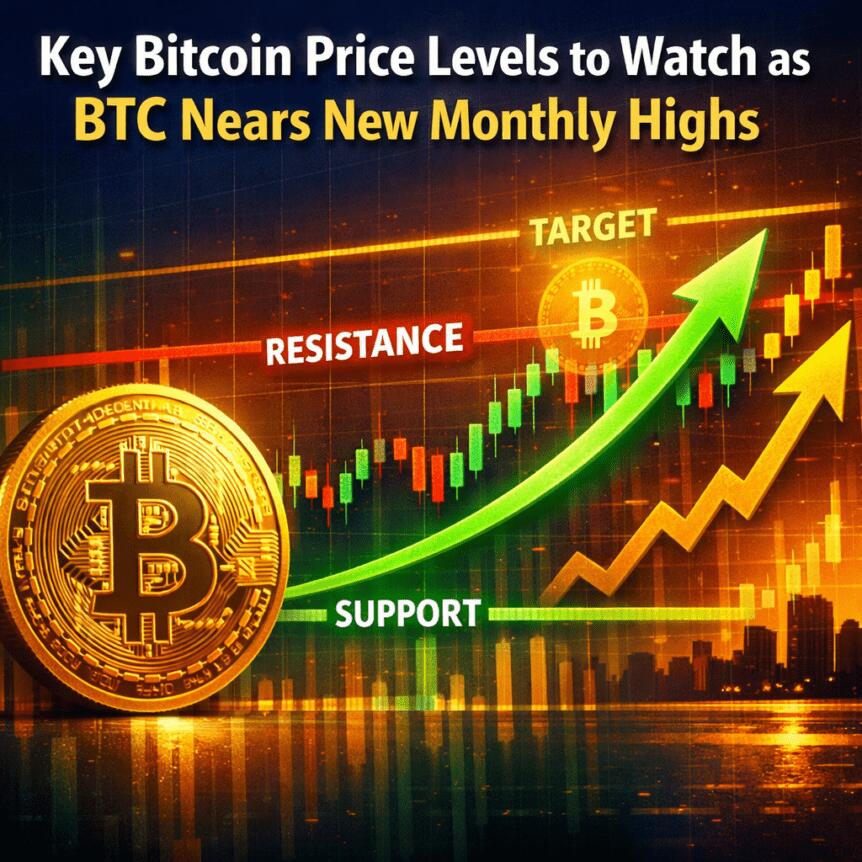
Bitcoin is edging toward the upper-$70,000 zone as fresh demand signals emerge from spot markets, ETFs, and corporate accumulation. The asset traded close to $74,000 while posting a 10.42% weekly gain—the strongest seven-day performance since September 2025. Analysts point to a confluence of factors underpinning the move, including improving spot ETF flows, shifting dynamics in the Coinbase premium, and a build-up of bids from institutional players. As traders weigh liquidity pockets and key technical levels, market participants are watching whether the renewed appetite can sustain a broader rally or fade into a retest of nearby supports. The takeaway: demand trends appear to be re-accelerating after a prolonged period of consolidation.
Key takeaways
- Bitcoin traded near $74,000 after a 10.42% weekly gain, the strongest weekly move since September 2025.
- The Coinbase premium gap turned positive for the first time in nearly ten weeks, at +35.4, signaling renewed buying pressure.
- Spot BTC ETF fund flows have improved over the last three weeks, with net inflows surpassing $1.9 billion.
- Corporate accumulation intensified, with STRC financing program purchases totaling 11,042 BTC in the current week.
- Liquidity clusters around $75,000 and above suggest a potential acceleration if price decisively clears resistance zones and fills nearby value gaps.
Tickers mentioned: $BTC
Sentiment: Bullish
Price impact: Positive. The combination of an improving Coinbase premium and rising ETF inflows points to stronger buying interest and potential upside momentum.
Trading idea (Not Financial Advice): Hold. If BTC remains above key supports and liquidity pockets, the path of least resistance could tilt higher, provided macro conditions and funding rates stay supportive.
Market context: The recent uptick in spot ETF flows, coupled with renewed corporate demand, is aligning with a broader recovery in crypto liquidity and risk appetite. Traders are evaluating how this environment interacts with on-chain activity and macro liquidity, including potential regulatory developments affecting ETF structures and institutional participation.
Why it matters
The converging signals around Bitcoin’s price action matter because they reflect a shift in the demand landscape after months of volatility and a drawn-out corrective phase. A positive Coinbase premium gap indicates that demand on U.S. exchanges is outpacing global price discovery, which often accompanies sustained upside momentum. In the interim, spot ETF inflows act as a barometer for institutional interest; surpassing $1.9 billion in net inflows over three weeks implies that larger players are increasing exposure, potentially providing a stabilizing bid during pullbacks.
Corporate accumulation adds another layer of conviction. The STRC financing program’s purchase of 11,042 BTC this week demonstrates that strategic buyers are deploying capital in a disciplined manner, supporting a bid backdrop that can help Blackburne-style risk management and longer-term positioning. While these developments do not guarantee a continuation of gains, they contribute to a market environment where price action can be propelled by sustained demand rather than sporadic, speculative bursts.
From a technical standpoint, traders are paying close attention to whether Bitcoin can reclaim the 100-day moving average and solidify above local liquidity clusters. If the price stabilizes above roughly $74,000 and begins to fill soft zones above $75,000, the market could migrate into a higher-liquidity regime where leveraged longs cluster around the $75k–$80k area. In such a scenario, a break through the $76,000–$80,000 band could accelerate toward the next objective range near $79,400–$81,400, where previous imbalances between buyers and sellers formed into a fair value gap (FVG).
Analysts highlight that a sustained move above these levels would require broad-based demand, as well as continued compliance with risk-management signals from market participants. Some traders argue that the current price action constitutes a potential HTF trend reversal if a monthly bullish engulfing pattern solidifies on the charts, suggesting an established uptrend rather than a mere short-term rally. In this context, price action around major liquidity pockets and categorical technical signals will be pivotal in determining whether BTC can transition into a new trading regime.
Market observers also note the role of on-chain and off-chain data in shaping sentiment. The narrative around Coinbase’s premium and ETF inflows aligns with a broader theme: liquidity is gradually reconfiguring, and the market appears to be transitioning from a period dominated by sell-side pressure to one where buyers can reassert control. If this trajectory continues, the broader crypto market could begin to price in the possibility of higher macro-driven risk tolerance, with Bitcoin acting as a leading indicator for sector-wide flows.
Looking ahead, traders remain cautious about the pace of upward movement given the potential for volatility driven by macro headlines, regulatory developments, and the evolving ETF landscape. However, the current mix of improving ETF flows, renewed corporate demand, and a positive shift in the Coinbase premium underscores a more constructive frame for Bitcoin as it tests key resistance and liquidity thresholds.
What to watch next
- Bitcoin holding above $74,000 and reclaiming the 100-day moving average on a sustained basis.
- Continued improvement in spot BTC ETF inflows, with weekly net inflows approaching or exceeding the $1.5–$2.0 billion range.
- STRC financing program activity and additional corporate buys confirming a durable bid.
- Price trading through the $75,000–$80,000 zone, followed by a test of the $79,400–$81,400 region where a historical FVG sits.
- Liquidity maps showing a shift in leverage exposure and new clusters forming above the $75,000 mark.
Sources & verification
- CryptoQuant QuickTake: Coinbase Premium just flipped positive after 10 weeks of US sellers dominating the market.
- SOSOVALUE Total Crypto Spot ETF Fund Flow: Net inflows data over the last three weeks showing improving demand.
- STRC live data: Strategy’s financing program and weekly BTC accumulation (11,042 BTC reported this week).
- CoinGlass: Bitcoin liquidation map indicating near-term leverage positions around $75k and liquidity pockets above $76k–$80k.
- Ardi’s X post on BTC price targets and momentum dynamics; Michaël van de Poppe’s analysis of resistance bands and quarterly patterns.
Bitcoin market reaction and key details
Bitcoin (CRYPTO: BTC) has moved into a renewed phase of demand, with the price hovering near $74,000 as weekly gains outstrip those of recent months. The rebound comes after a period where the Coinbase premium gap sat in negative territory for most of 2026, signaling a tilt in selling pressure from US spot traders. A positive premium suggests that buying interest on Coinbase is pushing the global reference price higher, a dynamic that often coincides with stronger spot demand coinciding with ETF inflows.
ETF flows have been a consistent driver behind the current reticence-to-growth narrative, as institutional participants seek more transparent exposure vehicles. In the latest reading, net inflows into spot BTC ETFs exceeded $1.9 billion over the preceding three weeks, a signal that investor confidence has started to take root after a protracted correction. The pace of inflows is not uniform, but the trend points toward a broader acceptance of spot exposure as a core component of crypto portfolios.
Corporate action has also contributed to the current mood. Strategy’s STRC financing program added 11,042 BTC to its balance sheet this week, underscoring a willingness among large buyers to deploy capital into the market during a rebound. Such activity adds a layer of credibility to the rally, suggesting that large pools of capital are differentiating between short-term price moves and longer-term exposure to a rising BTC price trajectory. As these actors accumulate, the market benefits from a more robust bid that can cushion prices against rapid downside moves.
From a technical perspective, Bitcoin appears poised to retake the 100-day moving average, a move that could lead to a broader re-accumulation phase. If the recovery sustains above $74,000, traders anticipate a shift into a zone rich with liquidity—an area where leveraged long exposure clusters around the $75,000 threshold. In this scenario, the next critical hurdle lies in the $79,400–$81,400 range, where a previous imbalance between buyers and sellers—an hourly fair value gap—could act as a magnet for price discovery. Depending on where the price settles in this vicinity, traders may see a continuation pattern, with buyers attempting to extend gains beyond the immediate liquidity backdrop.
Market participants are also weighing macro considerations and regulatory signals that could influence ETF structures and investor appetite for crypto exposures. While the current data points to a constructive setup, the market remains sensitive to headlines that could reshape liquidity conditions or alter the risk-on/risk-off calculus among large-cap investors. In this environment, Bitcoin’s behavior tends to reflect both on-chain fundamentals and off-chain flow dynamics, making the next few sessions a crucial test of whether the recent demand resurgence can endure in the face of potential pullbacks or shifts in macro sentiment.

Crypto World
Solana (SOL) Flashes First Bullish Signal in Two Months While Grayscale Eyes Opportunity

TLDR
- The SuperTrend indicator for Solana turned bullish on March 13, marking the first positive signal since early January.
- The asset has declined approximately 67% from its September 2025 all-time high, currently trading around $88–89.
- Broader weekly technical metrics remain negative, with 15 out of 17 indicators showing sell signals.
- Grayscale’s research division highlighted SOL as an attractive opportunity at current valuation levels.
- Total cumulative inflows into Solana Spot ETFs have reached $961–$968 million, though weekly momentum has decelerated significantly.
Solana (SOL) has generated its first positive technical indicator reading in approximately two months, despite the overall chart structure continuing to show bearish characteristics. This development has captured the interest of both market analysts and institutional observers.
Following a peak above $240 in late 2025, SOL commenced a prolonged downward trajectory. The cryptocurrency breached successive support zones before establishing a base in the $67–$80 zone during early 2026.
Throughout the last four weeks, Solana has consolidated within a $76 to $90 range. The token briefly exceeded $90 on two occasions in March, with the most recent push aligning with the SuperTrend buy signal appearing on the daily timeframe.
Understanding the SuperTrend Signal
The SuperTrend is a momentum-based technical indicator that determines trend direction by analyzing price action and volatility metrics. Crypto analyst Ali Martinez identified the bullish crossover on March 13 through X.
For the first time since early January, the SuperTrend indicator has turned bullish on Solana $SOL. pic.twitter.com/oCv8A6R93r
— Ali Charts (@alicharts) March 13, 2026
This marks the first time the indicator has shown a bullish configuration since the beginning of January. A bearish signal emerged in early February, coinciding with SOL’s descent to $67.
While the signal suggests potential near-term upward momentum, it doesn’t necessarily confirm a long-term trend reversal. The indicator is susceptible to false readings, and the overall technical landscape presents a more complex scenario.
$SOL/monthly
Textbook Cup and Handle pattern on #Solana 📈
Nothing complicated here — just follow basic TA. The pattern is clear, the setup is bullish.
The only question is whether you have the faith to act on it 💭 pic.twitter.com/vnNEAp1bzy
— Trader Tardigrade (@TATrader_Alan) March 13, 2026
Weekly chart analysis on TradingView reveals 15 indicators generating sell signals versus only 2 buy signals. All significant moving averages remain positioned above current price levels. The EMA10 stands at $98.47, the SMA200 at $103.70, and the EMA200 at $119.62 — each indicating downward pressure.
The Relative Strength Index reads 32.34, nearing but not yet entering oversold conditions. The MACD displays a negative reading of -23.70.
Technical experts suggest SOL would need to recover above the SMA200 level of $103.70 at minimum to signal a meaningful structural change.
Institutional Perspective from Grayscale
On March 13, Grayscale’s Head of Research Zach Pandl released a comprehensive six-point analysis supporting investment in SOL, highlighting the approximately 67% decline from September 2025 peaks as an attractive accumulation zone.
Grayscale has more than a few reasons why we’re so optimistic about @solana‘s future.
1️⃣ Leader in users, transactions & fees
2️⃣ Positioned for growth amid regulatory clarity
3️⃣ Staking rewards for network participation
4️⃣ ~67% below Sept 2025 highs
5️⃣ Strong network effects
6️⃣… pic.twitter.com/TAO08npACg— Grayscale (@Grayscale) March 13, 2026
Pandl emphasized Solana’s dominant position in user activity, transaction volume, and fee generation among smart contract platforms throughout the previous year. He also noted evolving regulatory frameworks for stablecoins and asset tokenization as favorable catalysts.
Daily inflows into Solana Spot ETFs reached $7.60 million on March 13, entirely attributable to Bitwise’s BSOL product. Aggregate net inflows across all listed Solana ETF products currently range between $961 and $968 million, with combined net assets totaling approximately $824–$855 million.
However, weekly ETF inflow momentum has experienced a substantial decline. Total weekly inflows registered just $3.10 million — representing an 83% decrease compared to the previous week.
SOL currently changes hands at approximately $88.95, showing a 2.8% increase over the last 24 hours and an 11.15% gain across the past 30 days. The cryptocurrency maintains a total market capitalization of roughly $54.74 billion, securing the seventh position among all digital assets.

TLDR:
- Pi Network launched its Token Launchpad MVP on Testnet, requiring projects to have working apps before issuing tokens.
- Protocol 20 upgrade gives the Pi blockchain the technical foundation needed to support smart contract functionality.
- The first KYC validator reward round distributed Pi at 0.0504 Pi per validation, 21 times the base mining rate.
- Kraken has officially integrated Pi Network after passing the platform’s required KYB verification process for exchanges.
Pi Network celebrated its seventh official anniversary on Pi Day 2026 with a broad set of ecosystem releases. The announcements covered infrastructure upgrades, token launch capabilities, exchange listings, and validator rewards.
These updates expand how Pioneers and developers can contribute to and participate in the network. The releases also introduced a Pi Day Utility Challenge, encouraging community engagement across newly available features.
Together, they mark continued progress toward a utility-driven and widely accessible cryptocurrency platform.
Token Launchpad and Protocol Upgrades Advance the Ecosystem
The Pi Launchpad MVP has launched on Testnet, introducing a structured mechanism for ecosystem token issuance.
Projects using the platform must have working applications before launching tokens, ensuring immediate utility at launch.
Pi proceeds from each token launch flow into liquidity pools rather than going to the issuing project directly. This approach supports healthy decentralized exchange activity within the Pi ecosystem.
All major Pi nodes have been upgraded to version 20.2, now supporting protocol 20. This upgrade provides the technical foundation required to enable smart contract capabilities on the blockchain.
Smart contract categories, including subscriptions, escrow, and NFT-related contracts, will be prioritized based on utility-driven product needs. Several contracts are currently undergoing external audits before progressing to Testnet deployment.
PiCoreTeam announced: “Happy Pi Day 2026, Pi Network’s 7th official anniversary! Today’s releases introduce new ecosystem capabilities and expand how Pioneers can build, participate, and engage with Pi.”
Updates to the Pi Wallet and Pi SDK will also follow to support the new smart contract functionality. These changes aim to ensure seamless integration between on-chain logic and user-facing applications.
Mainnet deployment of smart contracts will occur after successful Testnet testing and community review. The pace of rollout will reflect real utility needs arising from the ecosystem.
Second Migrations, Validator Rewards, and Kraken Listing Expand Participation
Second migrations have begun, allowing previously migrated Pioneers to bring additional Pi balances to Mainnet. Before migrating, Pioneers must complete two-factor authentication through Step 5 of the Mainnet Checklist.
This requirement exists because blockchain transactions are permanent and cannot be reversed. Referral mining bonuses tied to KYC-verified team members will also be included in second migrations.
Pi distributed the first round of KYC validator rewards, covering contributions recorded through March 5, 2026. The reward pool contained 16,568,774 Pi from migrated Pioneers, later supplemented by 10 million Pi from the Pi Foundation.
Dividing the total pool across 526,970,631 successful validations produced a price of approximately 0.0504 Pi per validation. That rate is 21 times the current base mining rate, reflecting the scale of the validation work done.
Over 1,094,680 human validators contributed to the KYC process, completing more than half a billion tasks collectively.
The Pi Foundation supplemented this round to account for early validations used to train the validator workforce.
Future reward rounds may incorporate additional criteria around validator accuracy and consistency. New Pi entering the pool and new validations will be factored into subsequent distributions.
Centralized exchange Kraken has integrated support for Pi following the network’s KYB verification process for external services.
This listing broadens access to Pi and connects the network with a wider segment of the crypto market. Third-party platforms that pass Pi’s verification requirements may also integrate in the future. This external connectivity supports the network’s goal of broader adoption.
Pi App Studio Reaches Mainnet and Launches Utility Challenge
Pi App Studio now supports Mainnet apps and live Pi payment integration for select qualifying applications. Four apps have been invited to transition from Testnet to Mainnet based on quality, utility, and ecosystem compliance.
Creators whose apps meet eligibility criteria can now receive real Pi payments directly through the blockchain. This shift moves App Studio from experimentation toward generating sustainable creator income.
Persistent payment integration is also now available within App Studio on both Testnet and Mainnet. Previously, in-app purchases applied only during a single active session and expired when the user exited.
Now, purchases such as premium access or feature unlocks carry over across multiple future sessions. This enables creators to build longer-lasting, more engaging application experiences for Pioneers.
The Pi Day Utility Challenge launched alongside these releases, offering Pioneers a structured way to explore new features. The checklist guides users through ecosystem tools, newly released products, and Pi utility applications.
Completing all tasks earns a Pi Day badge visible on Pi Chats and Pi Social Profiles. This gamified approach encourages hands-on discovery of the ecosystem’s growing range of utilities.
The Open Network Anniversary raffle, which began with the community badge initiative, concluded on March 14. A total of 150 winners will be selected randomly and contacted through the official Pi support email.
Pioneers are advised to verify sender addresses carefully and consult the Pi Safety Center to avoid scams. Official communications will come only through verified Pi Network channels.

Key Takeaways
- Reports suggest Coinbase may be pursuing a significant investment stake in Bybit, a leading offshore cryptocurrency exchange.
- No official confirmation has been issued by Coinbase or Bybit regarding the potential transaction.
- Market analysts estimate Bybit’s valuation at approximately $25 billion, drawing parallels to the recent ICE-OKX transaction.
- COIN shares finished trading at $195.53, marking a 1.18% increase, with monthly gains approaching 20%.
- A potential partnership could provide Bybit with regulatory access to operate within the United States market.
According to a social media post from Wu Blockchain on X, Coinbase is allegedly engaged in investment discussions with Dubai-headquartered Bybit. Both parties have remained silent on confirming or denying these reports.
Should this transaction materialize, it would potentially offer Bybit a compliant entry point into the US cryptocurrency market, where regulatory hurdles have previously limited its operations.
Bybit ranks among the world’s top cryptocurrency trading platforms by volume. Breaking into the American market independently would require navigating complex compliance frameworks, making Coinbase’s regulatory expertise particularly valuable.
Early reports indicate Bybit carries an estimated valuation near $25 billion. This assessment draws from recent market comparisons, particularly the ICE backing of OKX at comparable valuations.
Last year, Coinbase demonstrated its appetite for substantial acquisitions by purchasing Deribit for $2.9 billion, signaling continued expansion ambitions.
It’s worth highlighting that Coinbase maintains strong credentials in US regulatory compliance, including proper licensing and adherence to consumer protection protocols.
COIN Shares Rise on Unconfirmed Reports
COIN stock concluded the trading session at $195.53 when speculation first emerged, representing a 1.18% uptick. The monthly performance shows impressive gains approaching 20%.
This monthly momentum deserves attention, particularly since certain market analysts had previously projected the stock could decline toward $100.
The positive movement wasn’t isolated to Coinbase — cryptocurrency-related equities like MSTR, MARA, and CRCL similarly posted increases during the same trading period, despite broader market weakness.
Star Xu, founder of OKX, shared his perspective on the rumored transaction via X: “If it’s true, good for the industry. Higher standards, less regulatory arbitrage.”
Potential Implications of a Coinbase-Bybit Partnership
The United States is currently navigating an evolving regulatory landscape for cryptocurrency assets. Although the CLARITY Act has experienced repeated postponements, progress continues toward establishing comprehensive digital asset guidelines.
With improved regulatory clarity, Bybit could legitimately expand its US operations — though this would require appropriate partnerships or compliance infrastructure.
Both the SEC and CFTC have collaborated on developing this framework, establishing clearer requirements for international exchanges seeking US market access.
A Bybit operation facilitated through Coinbase would circumvent numerous regulatory obstacles by utilizing Coinbase’s pre-existing relationships with US authorities.
Currently, neither organization has provided a projected timeline or disclosed official deal terms.

TLDR
- BitMine Immersion Technologies (BMNR) acquired 5,000 ETH from the Ethereum Foundation through an over-the-counter transaction valued at approximately $10.2 million, with ETH priced at $2,042.96.
- This marks the Foundation’s second direct corporate ETH sale, after completing a $25.7M transaction with SharpLink Gaming in July 2025.
- BitMine, led by Chairman Tom Lee from Fundstrat, has become the world’s largest publicly listed Ether treasury company with holdings exceeding 4.5 million ETH valued at approximately $9.3 billion.
- Funds generated from the transaction will support the Foundation’s essential operations, including protocol research and development, ecosystem expansion, and grant programs for the community.
- The transaction follows the EF’s treasury management strategy, which allocates roughly 15% of treasury assets annually for operating expenses while maintaining reserves for multiple years.
BitMine Immersion Technologies (BMNR) has acquired 5,000 ETH directly from the Ethereum Foundation through an over-the-counter deal valued at approximately $10.2 million. The transaction executed at an average rate of $2,042.96 for each ETH token.
The Foundation disclosed the transaction on Saturday through an announcement posted on X. The on-chain movement will be executed from an Ethereum Foundation Safe multisig wallet.
Trading on the NYSE American exchange under ticker BMNR, BitMine operates under the leadership of Chairman Tom Lee, Fundstrat’s co-founder, who has publicly advocated for Ethereum as a strategic corporate treasury holding.
Bitmine Immersion Technologies, Inc., BMNR
With a current treasury exceeding 4.5 million ETH valued at approximately $9.3 billion, BitMine stands as the world’s largest publicly listed company holding Ether in its reserves.
BitMine’s investment strategy heavily emphasizes ETH. Beyond its primary Ether holdings, the firm maintains approximately 195 BTC, cash reserves surpassing $1 billion, and equity investments across multiple ventures.
These investments encompass ownership in Beast Industries — the entity associated with popular YouTube content creator MrBeast — secured through a $200 million capital injection. Additionally, BitMine maintains a 7% ownership position in Eightco, a treasury firm focused on Worldcoin.
Since the middle of 2025, the company has been consistently expanding its ETH position, employing a strategy reminiscent of Strategy’s approach to Bitcoin accumulation.
EF’s Second Corporate OTC Deal
This transaction represents the Ethereum Foundation’s second instance of selling ETH directly to a corporate entity for treasury purposes. Previously, in July 2025, the Foundation transferred 10,000 ETH to SharpLink Gaming at $2,572.37 per token, generating approximately $25.7 million.
These transactions align with the EF’s treasury governance model established in June 2025. This framework mandates periodic conversions of ETH holdings into traditional currency to sustain operational liquidity.
The Foundation maintains a spending target of approximately 15% of total treasury value annually. Additionally, it preserves a 2.5-year operational reserve, which determines the timing and volume of ETH liquidations.
Revenue from the BMNR transaction will finance protocol research activities, network ecosystem development projects, and grant distributions to community initiatives.
EF Staking and New Mandate
This sale follows the Foundation’s recent announcement regarding plans to stake as many as 70,000 ETH utilizing open-source validator systems. This initiative aims to generate network rewards while strengthening the Foundation’s active involvement in Ethereum operations.
Earlier in the week, the EF released an updated mandate document clarifying its responsibilities in guiding the Ethereum ecosystem. The framework prioritizes decentralization, resistance to censorship, open-source collaboration, and user autonomy.
According to the Foundation, focus areas include fundamental protocol enhancements, forward-looking research initiatives, network security measures, and developer infrastructure. The document also indicates intentions to progressively diminish its centralized influence across the ecosystem.
According to industry treasury monitoring platforms, BitMine’s current Ether holdings surpass 4.5 million ETH.
TLDR
- Ex-UK Prime Minister Boris Johnson labeled Bitcoin a “giant Ponzi scheme” in his Daily Mail editorial.
- Johnson recounted a tale of a local resident who lost approximately £20,000 (~$26,450) in what he characterized as a Bitcoin-related scam.
- He raised doubts about trusting a monetary system developed by the anonymous Satoshi Nakamoto.
- Michael Saylor, Strategy’s chairman, countered by highlighting that Bitcoin lacks an issuer, promoter, or return guarantees.
- Social media users emphasized Bitcoin’s capped supply and transparent code as proof it doesn’t match Ponzi scheme characteristics.
The cryptocurrency community found itself in heated debate this week following former UK Prime Minister Boris Johnson’s characterization of Bitcoin as a “giant Ponzi scheme” in his newspaper commentary. Digital asset supporters wasted no time mounting their defense.
Johnson’s controversial opinion appeared in the Daily Mail on Friday, March 14, 2026. The article began by recounting an anecdote involving an Oxfordshire villager who gave £500 (~$661) to a pub acquaintance promising to double his investment through Bitcoin.
According to Johnson, this individual spent three and a half years attempting to recover his funds while paying various fees. The effort proved futile. Ultimately, the man lost approximately £20,000 (~$26,450), leaving him “struggling to pay his bills,” Johnson claimed.
The former PM leveraged this narrative to contend that Bitcoin lacks intrinsic value. He drew unfavorable contrasts with gold and even Pokémon trading cards, asserting these possess tangible or cultural worth.
“These curious little Japanese cartoon beasties seem to exercise the same fascination over the five-year-old mind as they did 30 years ago,” Johnson penned, implying Pokémon cards hold more tradability than Bitcoin.
Johnson further challenged the credibility of a monetary framework established by Satoshi Nakamoto, whose true identity remains one of cryptocurrency’s greatest mysteries.
“Who do we talk to if they decrypt the crypto?” the former Prime Minister posed in his commentary.
Michael Saylor Responds
The digital currency sector mounted an immediate counteroffensive. Michael Saylor, Executive Chairman of Strategy — which maintains the largest corporate Bitcoin holdings — directly challenged Johnson’s assertions.
Saylor explained that authentic Ponzi schemes necessitate a “central operator promising returns and paying early investors with funds from later ones.” He emphasized Bitcoin fails to satisfy these criteria.
“Bitcoin has no issuer, no promoter, and no guaranteed return — just an open, decentralized monetary network driven by code and market demand,” Saylor posted on X.
Pierre Rochard, CEO of The Bitcoin Bond Company, joined the conversation, provocatively suggesting that the UK government itself operates as “a giant Ponzi scheme” sustained through debt financing.
Community Notes and Social Media Pushback
On X, a community note appeared beneath Johnson’s post clarifying that Ponzi schemes typically promise artificially inflated returns with minimal risk. The annotation stated: “Bitcoin has no issuer and its value is purely determined by the free market. The code is totally public and opt-in.”
Numerous commentators highlighted Bitcoin’s predetermined supply ceiling and its transparent, open-source architecture as fundamental distinctions from conventional Ponzi operations.
BitMEX Research addressed Johnson’s inquiry about Bitcoin’s leadership with a straightforward response: “Nobody is in charge.”
Several users deployed memes while criticizing traditional central banks for monetary expansion policies implemented during the pandemic period.
Johnson’s editorial and the ensuing responses coincided with the Bitcoin network’s achievement of mining its 20 millionth coin, a significant milestone that underscored Bitcoin’s immutable 21 million coin maximum supply.
Crypto World
Middle East Conflict Forces F1 Race Cancellations and Crypto Conference Delays in Dubai
TLDR
- The TOKEN2049 Dubai conference has been rescheduled to April 2027, while TON Gateway Dubai was completely scrapped due to escalating Middle East tensions
- Formula 1 has officially removed both the Bahrain Grand Prix (April 12) and Saudi Arabian Grand Prix (April 19) from its 2026 schedule
- The motorsport league stands to lose approximately $200 million in revenue and $80 million in EBITDA from these two canceled events
- Leading cryptocurrency platforms OKX, Crypto.com, and Bybit, all major F1 sponsors with multi-million dollar agreements, face impact from race cancellations
- Several additional business conferences and trade shows in the United Arab Emirates have been rescheduled or indefinitely postponed, including Middle East Energy Dubai
Escalating military tensions across the Middle East have compelled Formula 1 to abandon two major Grand Prix events while forcing prominent cryptocurrency conferences to relocate entirely from the region.
Formula 1 has made the official announcement canceling both the Bahrain Grand Prix, originally scheduled for April 12, and the Saudi Arabian Grand Prix, planned for April 19. This decision came after sustained uncertainty as restricted airspace, ongoing military operations, and travel complications rendered the venues too dangerous for international events.
Both Bahrain and Saudi Arabia experienced Iranian missile and drone strikes in response to coordinated U.S. and Israeli military operations against Iran that commenced on February 28. The armed conflict has now entered its third week with no clear resolution in sight.
F1 president Stefano Domenicali stated: “While this was a difficult decision to take, it is unfortunately the right one at this stage considering the current situation in the Middle East.”
Internal conversations explored the possibility of substituting these races with alternative circuits at Imola and Portimão, but the compressed preparation window made such arrangements unfeasible. The revised 2026 racing calendar now comprises 22 events, creating a substantial five-week interval between the Japanese Grand Prix on March 29 and the Miami Grand Prix on May 3.
Saudi Arabia and Bahrain rank among the highest-paying host nations in Formula 1, with combined hosting fees estimated at approximately $115 million. Financial analysts at Guggenheim Partners project that F1’s financial losses could reach $200 million in total revenue and $80 million in EBITDA from these two canceled races alone.
Crypto Sponsorships Take a Hit
These race cancellations present immediate challenges for cryptocurrency firms that have committed substantial resources to Formula 1 marketing partnerships.
OKX, currently valued at $25 billion, has maintained its position as McLaren’s primary partner since establishing the relationship in 2022. Crypto.com secured a comprehensive global F1 partnership agreement extending through 2030. Bybit previously finalized a sponsorship arrangement with Red Bull Racing valued at up to $150 million.
Kraken, Coinbase, and Binance have also established motorsport sponsorship programs that could experience ripple effects. Representatives from both OKX and Crypto.com did not provide responses to inquiries regarding the impact.
Formula 1 race broadcasts attract more than one billion viewers each year worldwide. For cryptocurrency exchanges with regional operations, the Bahrain and Saudi Arabian races represented particularly strategic opportunities for engaging with the Gulf region’s vibrant and growing crypto community.
Dubai Crypto Events Also Canceled
The disruption extended well beyond the racing circuit. TOKEN2049 Dubai, recognized as one of the planet’s premier cryptocurrency conferences typically drawing over 15,000 participants, was postponed from its late April date to April 21–22, 2027. Event organizers pointed to safety considerations, unpredictable travel conditions, and logistical complications.
TON Gateway Dubai, a conference dedicated to The Open Network blockchain platform, was canceled completely. All ticketholders have been issued full refunds.
Numerous other regional business gatherings faced similar disruptions. Middle East Energy Dubai shifted its event to September. Affiliate World Global postponed its Dubai conference to 2027. The Dubai International Boat Show delayed its upcoming edition without announcing replacement dates.
Subsequent Formula 1 events scheduled for the region, including the Qatar Grand Prix and the Abu Dhabi Grand Prix in December, continue to appear on the official calendar at this time. Event organizers have indicated they are actively tracking the evolving situation.
TLDR:
- Bitcoin MVRV Z-Score at −0.262 historically marks cycle bottoms and accumulation zones.
- Current Z-Score recovery to 0.469 indicates early-to-mid phase of potential bull market.
- Whale vs Retail Delta shows large holders reducing exposure while retail remains bullish.
- Historical patterns suggest deep undervaluation often precedes multi-year Bitcoin price rallies.
Bitcoin MVRV Z-Score measures market value versus realized value, highlighting extremes in price. Recent readings show recovery from deep undervaluation, suggesting early stages of a potential bull market while whales and retail traders display divergent behaviors.
Historical Significance of the MVRV Z-Score
Bitcoin MVRV Z-Score tracks how market prices deviate from the network’s “fair value.” Deep negative readings indicate extreme undervaluation, often coinciding with market pessimism and maximum investor losses.
The last three bull cycles followed the same pattern. In 2015, the Z-Score hit roughly −0.262, signaling accumulation after a prolonged bear market.
This preceded the 2017 bull market when BTC rose to nearly $20,000. After the 2018–2019 bear phase, the metric again reached −0.262.
Long-term investors accumulated coins, leading to the 2021 cycle and all-time highs exceeding $60,000. A similar pattern appeared in 2022 during the crypto market collapse, marking the beginning of the current recovery.
The repeated interaction at −0.262 demonstrates its function as a cycle reset. At this level, weak hands have capitulated, and long-term investors dominate.
Historically, this creates conditions for multi-year price expansion and structural market recovery.
Whale vs Retail Dynamics and Current Market Outlook
The Whale vs Retail Delta measures the positioning of large holders versus retail traders. Recent readings show whales reducing long exposure while retail remains bullish, creating a divergence that signals caution.
Historically, red bars in the delta indicated either price corrections or local market bottoms. When selling pressure peaks and overshoots, the market stabilizes, forming a foundation for further upward movement.
Currently, Bitcoin’s MVRV Z-Score has recovered to approximately 0.469, suggesting early-to-mid bull cycle conditions. The combination of a recovering Z-Score and cautious whale positioning points to a balanced market.
If accumulation by long-term holders continues, the path may lead to sustained price growth. These on-chain indicators collectively highlight potential opportunities for investors.
Deep negative MVRV readings align with historical bottoms, while the whale-retail divergence offers insight into market sentiment and positioning for the weeks ahead.
Crypto World
World Liberty Financial Offers “Guaranteed Direct Access” to Executives for $5 Million Token Lock
TLDR:
- World Liberty Financial’s Super Node program requires investors to stake $5M in WLFI tokens for 6 months.
- Spokesman David Wachsman clarified access is “preferential,” contradicting the original “guaranteed” language.
- The Trump family earned over $460M from World Liberty in the first half of 2025, per a Reuters analysis.
- White House Counsel confirmed Trump has no involvement in deals implicating his constitutional responsibilities.
World Liberty Financial, the crypto venture co-founded by President Donald Trump and his sons, has rolled out a new staking program.
Under this arrangement, investors who lock up $5 million worth of WLFI tokens for six months gain access to certain company executives. The proposal, published February 25, was approved by 99% of voting token holders.
It creates a clear divide between regular holders and high-value investors, raising questions about the firm’s earlier commitment to democratizing finance for everyday people.
Super Node Program Grants Tiered Access to High-Value Investors
World Liberty Financial refers to its top-tier investors as “Super Nodes.” These are holders who stake 50 million WLFI tokens, currently valued at around $5 million, per CoinGecko data.
In exchange, they receive access to the firm’s business development and executive teams. The company says the arrangement is meant to “incentivize more significant participation in governance.”
Staked tokens are locked from trading for a 180-day period before holders can vote on firm governance matters.
The vote on the proposal closed Thursday, with 99% of ballots favoring the measure. A total of 1,786 votes were cast, according to the World Liberty website.
Reuters, however, could not independently verify these figures. The outlet also could not confirm how many individual token holders took part. Participants who vote in at least two governance rounds earn a 2% yield, paid in WLFI tokens.
World Liberty’s spokesman, David Wachsman, described the access as preferential rather than guaranteed. He stated that “among the privileges for Super Nodes is preferential access to the World Liberty Financial business development team and executives—not to specific founders—to discuss partnership opportunities.”
Yet the original February proposal explicitly used the word “guaranteed” to describe this arrangement. When Reuters pressed Wachsman on the distinction, he did not address it directly. He said only that “Super Nodes grant access to World Liberty Financial’s business development team.”
A section of the World Liberty website titled “Meet Our Team” previously listed Eric Trump, Donald Trump Jr., and Barron Trump. After Reuters submitted questions about the proposal, that section was removed from the site entirely.
Wachsman said the website was “always being upgraded” and that recent changes had nothing to do with Reuters’ inquiry.
The company also confirmed that Trump family members would not be part of the direct access arrangement. Access, Wachsman said, is managed strictly by the business development and compliance teams.
Wachsman further clarified in a separate statement that “WLFI does not arrange or facilitate access to any individuals outside of those teams as part of the Super Node program.”
He added that “being a Super Node doesn’t guarantee a partnership — it means being taken seriously in a process with rigorous standards behind it.”
Under World Liberty’s current token sale terms, 75% of all proceeds go to the Trump family. That means a $5 million Super Node investment effectively channels $3.75 million to the Trumps. Wachsman also confirmed the Super Node program does not grant access to Witkoff family members either.
Ethics Questions Surround the Trump Family’s Growing Crypto Earnings
Congressional critics and ethics experts have raised concerns about the Trump family’s crypto earnings. The family earned more than $460 million from World Liberty in the first half of 2025, according to a Reuters analysis.
This came as the administration eased regulatory scrutiny on crypto firms broadly. World Liberty is also currently seeking a U.S. banking license from the Trump-led administration. Critics argue this creates a direct overlap between presidential authority and private financial interests.
White House Counsel David Warrington responded to these concerns in a statement to Reuters. He said that “the President has no involvement in business deals that would implicate his constitutional responsibilities.”
Warrington added that Trump “performs his constitutional duties in an ethically sound manner,” and that suggesting otherwise is “either ill-informed or malicious.”
He also addressed Witkoff’s position, confirming he had divested from World Liberty Financial. Warrington stated that Witkoff “has not and does not participate in any official matters that could impact his financial interests.”
The Super Node program marks a clear shift from World Liberty’s original public messaging. When the project launched a month before the 2024 presidential election, it targeted everyday users.
Executives spoke about bringing crypto access to teachers, dentists, and firefighters through a mobile app. The new program, however, is built around investors holding at least $5 million in WLFI tokens. This move effectively redirects focus from retail participants toward institutional-level stakeholders.
Previously, all WLFI token holders could vote on governance matters, with each token carrying one vote. According to World Liberty’s so-called Gold Paper, holders could also voice approval or disapproval of the venture’s “directions and plans.”
The new rules, however, restrict voting rights strictly to holders who have staked their tokens. Smaller investors can no longer participate in governance without locking up funds for six months.
This structural change stands in contrast to the company’s stated goal of open, community-driven financial access.
At press time, WLFI is trading at $0.1079, posting nearly 6% gains over the past 24 hours. This rise came alongside a broader recovery across the cryptocurrency market toward the end of the week.
Crypto World
Vitalik Buterin Pushes for Simpler Ethereum Node Architecture to Boost Self-Sovereign Access
TLDR:
- Vitalik Buterin says running two Ethereum daemons adds needless complexity for self-sovereign node operators.
- Docker-based standardized wrappers could offer a short-term fix for easier Ethereum client deployment.
- The Nimbus unified node project already merges both client types into one streamlined, manageable daemon.
- Lean Ethereum consensus maturity may eventually enable a full architectural redesign of the node structure.
Ethereum co-founder Vitalik Buterin has publicly called for a review of the network’s current two-client node architecture.
He argued that the existing separation between beacon and execution clients creates unnecessary complexity for everyday users.
Buterin outlined short-term fixes and longer-term solutions to make running a personal node easier and more accessible.
His remarks add momentum to growing community discussions about improving how self-sovereign participation on the Ethereum network functions in practice.
Running Two Daemons Creates Friction for Node Operators
The current Ethereum setup requires node operators to run two separate client daemons simultaneously. These clients, covering the beacon and execution layers, must also be configured to communicate with each other properly.
For many users, managing and coordinating both daemons is technically demanding and time-consuming. That added friction discourages people from opting to run their own independent nodes. Fewer everyday users follow this path, even when they have the hardware needed to do so.
Buterin laid out his position directly in a post shared on social media. He wrote that running two daemons and getting them to work together is far more difficult than managing one.
Buterin noted that making the self-sovereign way of using Ethereum genuinely easy is a core priority for the ecosystem. He further added that running a personal node is central to delivering that experience for users across the network.
As a near-term measure, Buterin proposed introducing standardized deployment wrappers for client installation. These tools would allow users to install Docker-based clients more easily and without requiring deep technical expertise.
The wrappers would also automate client-to-client communication, eliminating the need for manual configuration. This type of solution could substantially reduce the entry barrier for independent node operators network-wide.
Lean Ethereum Consensus and the Path to Architectural Change
Looking further ahead, Buterin raised the possibility of reconsidering the full beacon and execution client separation altogether. He tied this longer-term discussion directly to the maturity of the Lean Ethereum consensus model.
The Lean Ethereum initiative targets a simplified, more streamlined version of the core protocol. Its progress could open a viable path toward fundamentally restructuring how Ethereum nodes are designed and operated.
Buterin also acknowledged an existing project already advancing in the right direction. He pointed to the Nimbus unified node project from the Status-im team as a practical, real-world example.
Nimbus combines both client types into a single, easier-to-manage daemon for node operators. This integrated design is closely aligned with the architectural direction Buterin is now openly advocating for.
The broader discussion around Ethereum node complexity has been circulating in developer communities for some time now. Buterin’s direct public statement has given the topic renewed focus and a clearer sense of urgency.
Developers are now more actively exploring what a leaner, single-daemon node setup could realistically involve. The overarching aim remains reducing technical barriers for independent participants while preserving network decentralization and security throughout.

The proposed US CLARITY Act, a bill intended to establish clearer rules for digital asset markets, may struggle to pass this year unless it advances quickly through Congress, according to a senior executive at Galaxy Digital.
Key Takeaways:
- The US CLARITY Act may fail to pass in 2026 if it does not clear a Senate committee by the end of April.
- Debate over stablecoin yield and broader regulatory authority remains a major obstacle for the bill.
- Competing legislative priorities in Congress are narrowing the window for crypto market structure reform.
Alex Thorn, head of firmwide research at Galaxy Digital, warned that the legislation faces a narrowing window for progress in 2026.
In a post on X on Saturday, Thorn said the bill must clear a Senate committee by the end of April to remain viable.
CLARITY Act Must Clear Committee by April to Stay Alive in 2026: Exec
“If CLARITY doesn’t pass committee by the end of April, odds of passage in 2026 become extremely low,” Thorn wrote, adding that the measure would need to reach the Senate floor by early May to maintain momentum.
The timeline challenge stems partly from competing priorities in Washington. Senate Majority Leader John Thune recently indicated that the chamber is unlikely to address digital asset market structure legislation before April, as lawmakers first focus on the SAVE America Act.
The proposed measure would require individuals to present proof of US citizenship in person when registering to vote.
While scheduling constraints present one obstacle, Thorn said policy disagreements could create additional complications for the bill.
One of the most debated provisions concerns whether stablecoin issuers should be allowed to distribute yield or rewards to users.
Traditional banking groups have warned that such incentives could draw deposits away from banks, while crypto companies argue the feature would expand the usefulness of stablecoins in payments and finance.
Thorn suggested the stablecoin rewards debate may not be the final barrier.
Other unresolved questions surrounding decentralized finance, protections for blockchain developers and the division of regulatory authority between agencies could emerge once the current dispute is resolved.
Lawmakers themselves acknowledge that compromise will likely be necessary. Angela Alsobrooks, a member of the Senate Banking Committee, recently said both crypto advocates and banking interests may need to accept concessions to move legislation forward.
Crypto Market Structure Law May Not Take Effect Until 2029: TD Cowen
Despite earlier optimism from some lawmakers that the CLARITY Act could reach Congress this spring, outside analysts remain cautious.
Investment bank TD Cowen warned earlier this year that comprehensive crypto market structure legislation could face delays until 2027 and may not take effect until 2029 if political gridlock continues.
Under that scenario, the crypto industry would need to accept that presidential election results could shape final rules, while Democrats might have to concede that conflict provisions would not apply retroactively to Trump.
Coinbase’s institutional strategy chief has also said that comprehensive crypto market structure legislation will take longer to finalize than stablecoin rules, but remains confident that bipartisan momentum will carry the bill across the finish line in 2026.
The debate has also drawn attention from the White House. Earlier this month, Donald Trump urged lawmakers to finalize a market structure framework quickly, criticizing banks for slowing the legislative process.
The post CLARITY Act Faces Slim Odds in 2026 Without April Committee Move: Galaxy Exec appeared first on Cryptonews.
Solana (SOL) Flashes First Bullish Signal in Two Months While Grayscale Eyes Opportunity

Can Jadon Sancho play against Manchester United for Aston Villa?

5 Of The Most Reliable 5-Seater SUVs, According To iSeeCars


-
 Tech4 days ago
A 1,300-Pound NASA Spacecraft To Re-Enter Earth’s Atmosphere
-

 News Videos6 days ago
10th Algebra | Financial Planning | Question Bank Solution | Board Exam 2026
-
Crypto World1 day ago
HYPE Token Enters Net Deflation as HyperCore Buybacks Outpace Staking Rewards
-

 Business5 days ago
ExxonMobil seeks to move corporate registration from New Jersey to Texas
-

 Crypto World6 days ago
Paradigm, a16z, Winklevoss Capital, Balaji Srinivasan among investors in ZODL
-

 Fashion2 days ago
Weekend Open Thread: Addict Lip Glow
-

 Tech5 days ago
ChatGPT will now generate interactive visuals to help you with math and science concepts
-
Sports17 hours ago
Why Duke and Michigan Are Dead Even Entering Selection Sunday
-

 NewsBeat4 days ago
Residents reaction as Shildon murder probe enters second day
-

 Business7 days ago
Search for Nancy Guthrie Enters 37th Day as FBI Probes Wi-Fi Jammer Theory
-

 Business4 days ago
Search Enters Sixth Week With New Leads in Tucson Abduction Case
-
 NewsBeat5 days ago
Pagazzi Lighting enters administration as 70 jobs lost and 11 stores close across Scotland
-

 Tech6 days ago
Despite challenges, Ireland sixth in EU for board gender diversity
-

 Business19 hours ago
US Airports Launch Donation Drives for Unpaid TSA Workers as Partial Government Shutdown Enters Fifth Week
-

 NewsBeat4 days ago
I Entered The Manosphere. Nothing Could Prepare Me For What I Found.
-
Crypto World15 hours ago
Coinbase and Bybit in Investment Talks: Could Bybit Finally Enter the US Crypto Market?
-

 Business6 days ago
Search Enters 39th Day with FBI Tip Line Developments and No Major Breakthroughs
-

 Sports6 days ago
Skateboarding World Championships: Britain’s Sky Brown wins park gold
-

 Business20 hours ago
Country star Brantley Gilbert enters growing non-alcoholic beer market
-
 Crypto World5 days ago
Will Chainlink price reclaim $10 amid volatility squeeze?

