

Crypto World
Ethereum Foundation Offloads $10.2M ETH to BitMine in OTC Deal


The Ethereum Foundation has completed a direct OTC sale of 5,000 Ether to BitMine Immersion Technologies, a move valued at about $10.2 million at the agreed price of $2,042.96 per ETH. The deal was announced in a Saturday post on X, with proceeds earmarked to support the foundation’s core operations—from protocol research and development to ecosystem growth initiatives and community grant programs. The on-chain transfer will originate from a Safe multisignature wallet, underscoring a cautious approach to treasury management. BitMine Immersion Technologies, a NYSE American-listed company trading under BMNR, has established itself as a major Ether holder, boasting more than 4.5 million ETH worth roughly $9.3 billion according to treasury-tracking services. The arrangement reflects ongoing treasury moves as the ecosystem weighs liquidity against long‑term network security and growth.
The sale represents the Ethereum Foundation’s second direct corporate ETH OTC transaction. In July 2025, the foundation sold 10,000 ETH to SharpLink Gaming at an average price around $2,572.37, a transaction valued at roughly $25.7 million. Those operations fit within a treasury framework the Foundation publicly introduced in June 2025, which aims to convert a portion of ETH holdings into fiat to fund a fiat-based operating reserve. The policy targets annual spending of roughly 15% of treasury holdings while preserving a multi-year runway for core activities.
In tandem with liquidity management, the Foundation has begun staking a portion of its treasury, with plans to deploy around 70,000 ETH into validator infrastructure using open-source tools. The staking initiative aligns with a broader push to diversify the network’s security model while encouraging community-led participation in validator infrastructure. The move follows a broader shift toward leveraging on-chain infrastructure to support long‑term network health, even as treasury activity continues to balance immediate operating needs with future protocol upgrades.
Earlier this week, the Foundation also published a mandate outlining its role in stewarding the Ethereum ecosystem, emphasizing decentralization, user sovereignty over assets and data, and the preservation of openness, censorship-resistance, and privacy. The document reiterates that Ethereum should remain open-source and resilient while scaling to support global adoption. The Foundation says its focus will center on core protocol upgrades, long-term research, cybersecurity, and developer tools, while gradually reducing direct influence over the network’s trajectory.
As part of these broader efforts, the Ethereum Foundation has highlighted the importance of maintaining a balanced treasury—between liquid assets that fund operations and longer-horizon holdings that bolster network security. The ongoing staking program, coupled with selective asset sales, signals a strategy of gradual, governance-aligned treasury management rather than rapid asset liquidation. The organization has also reinforced its stance on decentralization and user sovereignty as guiding principles for future development, a position that remains central to the community’s assessment of Ethereum’s long-term resilience.
Market participants are watching how these treasury decisions influence Ether’s price dynamics and the broader crypto landscape, particularly given the scale of corporate holdings represented by BitMine Immersion Technologies and its peers. The evolving framework could shape how other entities think about treasury diversification, liquidity management, and governance participation in a world where institutional drivers increasingly intersect with open-source protocols.
Why it matters
The Ethereum Foundation’s treasury actions underscore a pragmatic approach to sustaining core protocol work while supporting a broader ecosystem economy. By converting a portion of ETH into fiat to fund operations, the Foundation aims to ensure stable funding for research, development, and community initiatives even as the network continues to evolve through staking, upgrades, and tooling improvements. This approach also highlights how non-profit and corporate treasury strategies can align with long-term network security goals, providing a potential blueprint for other organizations balancing liquidity with stewardship responsibilities.
At the same time, the moves reinforce the role of corporate treasuries as major liquidity anchors in the crypto space. BitMine Immersion Technologies’ distinctive position as a leading Ether holder signals a continued consolidation of ownership among large institutional actors. The presence of such buyers and the timing of OTC sales can influence market depth and price discovery, particularly during periods of macro volatility or shifting risk appetite. For developers and users, the emphasis on decentralization, privacy-preserving design, and censorship resistance remains central to Ethereum’s mission, even as the funding environment evolves to support ongoing protocol work and security enhancements.
From a governance perspective, the Foundation’s renewed mandate suggests a deliberate calibration of influence: funding core work without exerting heavy-handed direction over the network’s day-to-day decisions. This approach may reassure users that the project remains committed to open governance and community-led development while recognizing the practical needs of sustaining a global-scale protocol. For investors and builders, the outlined priorities—protocol upgrades, long-horizon research, cybersecurity, and developer tooling—could translate into meaningful advances in network usability, security, and scalability over the coming quarters.
What to watch next
- Monitoring the cadence of future ETH OTC sales by the Ethereum Foundation, including any disclosures on price, volume, and counterparties.
- Progress on the 70,000 ETH staking plan, including deployment timelines, validator outreach, and integration with open-source infrastructure.
- Updates to the Foundation’s mandate and any governance signals that indicate shifts in focus or funding strategy.
- Shifts in corporate treasury activity among Ether holders, as broader market liquidity and risk sentiment evolve.
Sources & verification
- Ethereum Foundation X post announcing the OTC sale and its use of proceeds.
- July 2025 sale of 10,000 ETH to SharpLink Gaming and related coverage.
- Ethereum Treasuries page documenting large Ether holdings and treasury activity.
- Ethereum Foundation mandate outlining role, goals, and governance stance.
Ethereum Foundation’s second corporate ETH OTC sale and treasury strategy
The Ethereum Foundation announced a second corporate ETH sale in an OTC arrangement, transferring 5,000 Ether to BitMine Immersion Technologies (EXCHANGE: BMNR) for about $10.2 million at roughly $2,042.96 per ETH. The announcement, disseminated via an X post, makes clear that the proceeds will underwrite the foundation’s ongoing core operations: protocol research and development, ecosystem growth initiatives, and community grant programs. The on-chain payment is slated to come from the foundation’s Safe multisignature wallet, a custody mechanism that reflects the group’s emphasis on secure treasury management. BitMine Immersion Technologies—the NYSE American-listed company known by the ticker BMNR—has emerged as a leading corporate holder of Ether, with more than 4.5 million ETH in its treasury, valued at approximately $9.3 billion according to public trackers. This acquisition underlines a broader trend of large institutional actors participating directly in Ethereum’s long‑term funding and asset allocation strategy, complementing the foundation’s funding priorities.
The deal constitutes the federation’s second direct crypto-to-cash sale to a corporate treasury holder and follows a July 2025 transaction in which the foundation sold 10,000 ETH to SharpLink Gaming at an average price of about $2,572.37, totaling roughly $25.7 million. These OTC transactions are part of a formal treasury management framework launched in June 2025, designed to convert a portion of ETH holdings to fiat to sustain a fiat-based operating reserve. The framework sets a target of spending roughly 15% of treasury holdings annually to maintain a viable operating runway across multiple years, while preserving enough liquidity to fund ongoing protocol work and ecosystem initiatives.
The Foundation’s staking initiative also took a step forward this week, signaling a dual-pronged strategy: maintain liquidity for operations while expanding on-chain security through validator deployment. The plan calls for approximately 70,000 ETH to be staked using open‑source infrastructure to bolster the network’s validator base. This move aligns with broader efforts to diversify the treasury beyond liquidity alone, aiming to strengthen long-term security and resilience at a time when Ethereum continues to scale through upgrades and tooling improvements.
In a separate development, the Foundation published a mandate detailing its stewardship of the Ethereum ecosystem, stressing decentralization and user sovereignty as core principles. The document lays out a plan to keep Ethereum censorship-resistant, open-source, and privacy-preserving, while supporting scalable adoption on a global scale. The Foundation emphasizes a focus on core protocol upgrades, sustainable long‑term research, cybersecurity, and developer tooling, with a plan to progressively reduce direct governance influence over the network. This framing signals a deliberate shift toward more community-led governance and transparent, long-horizon funding for the network’s ongoing evolution.
Market observers continue to parse how these treasury moves interact with the broader dynamics of liquidity, risk sentiment, and regulatory developments shaping the crypto sector. By balancing periodic asset sales with strategic staking, the Ethereum Foundation aims to sustain essential operations and fund innovation, while aligning with a decentralization ethos that remains central to Ethereum’s identity. The ongoing evolution of the foundation’s treasury framework will be watched closely by developers, investors, and users who rely on Ethereum’s infrastructure for a wide range of applications.



In this week’s edition of the weekly recap, Token2049 organizers postponed the Dubai edition until 2027 citing safety concerns from escalating Iran-Israel-U.S. tensions, Robinhood reported February crypto notional volumes increased 9% to $25 billion and the Ethereum Foundation published a formal mandate establishing its role as steward of a censorship-resistant, privacy-first protocol.
Summary
- Token2049 Dubai postponed to 2027 due to Iran–Israel tensions.
- Robinhood crypto trading volume rose to $25B in February.
- Ethereum Foundation published a formal censorship-resistant mandate.
Token2049 Dubai delayed amid regional conflict
- Event organizers postponed the Dubai edition until 2027 after citing safety concerns linked to rising geopolitical tensions from the Iran-Israel-U.S. military confrontation.
- The decision follows cancellation of another major industry gathering, the TON Gateway event, which had also been scheduled for Dubai.
Robinhood shows crypto trading dominance
- February data revealed crypto notional volumes increased 9% to $25 billion while equity, options, and event contracts experienced contraction.
Ethereum Foundation establishes written doctrine
- The organization published an “EF Mandate” formalizing its role as steward of a censorship-resistant, privacy-first, open-source base layer.
- The document signals zero appetite for surveillance-chain compromises as the protocol scales to accommodate broader adoption.
Buterin explains 2021 donation circumstances
- Ethereum co-founder Vitalik Buterin clarified the massive 2021 Shiba Inu donation to the Future of Life Institute while distancing himself from the group’s recent artificial intelligence policy approaches.
- Buterin explained the tokens surged in value during the 2021 meme coin boom with peak “book value” exceeding $1 billion, prompting him to access cold storage funds, sell portions for Ether, and donate to various causes.
Hong Kong prepares banking stablecoin licenses
- Banking giants HSBC and Standard Chartered are expected to be among the first institutions receiving stablecoin issuer licenses in Hong Kong.
- The licensing approach positions Hong Kong to compete with other jurisdictions for regulated stablecoin issuance and operations.
DeFi user loses millions in slippage error
- A user attempting to swap $50 million USDT for AAVE through the protocol’s interface received only 324 AAVE after accepting a quote with extreme price impact.
- The transaction prompted Aave to review safeguards and refund a portion of transaction fees following the catastrophic slippage outcome.
Prosecutors oppose Bankman-Fried retrial request
- U.S. prosecutors asked a federal judge to deny a new trial for the disgraced crypto entrepreneur, arguing he has not shown legal basis for overturning his FTX-related conviction.
- As per the report, prosecutors told the court Bankman-Fried’s motion fails to showcase his original trial was unfair or that new evidence would meaningfully alter the verdict.
Bonk.fun warns users of domain compromise
- The Solana-based meme coin launch platform team alerted users to avoid its website after hackers reportedly compromised the domain and deployed a malicious wallet drainer.
- At least one trader claimed losses of $273,000 after connecting their wallet to the compromised interface.
Indian authorities arrest GainBitcoin fraud suspect
- The Central Bureau of Investigation arrested Ayush Varshney, co-founder and chief technology officer of Darwin Labs Private Limited, in connection with alleged GainBitcoin cryptocurrency fraud.
- Investigators allege Darwin Labs helped build technical infrastructure for the scheme including the MCAP token and GBMiners platform.
- Varshney was intercepted at Mumbai airport while allegedly attempting to leave India after a Look Out Circular was issued.
Ripple acquires Australian payments firm
- The company announced plans to secure an Australian financial services license through acquisition of BC Payments Australia Pty Ltd, a payments company linked to the European Banking Circle Group.
- The deal remains underway and is expected to close April 1 after standard closing processes finalize.
Anthropic sues government over AI blacklist
- The artificial intelligence developer filed a lawsuit against multiple U.S. government agencies, accusing federal authorities of unlawfully blacklisting its technology.
- The legal action alleges the blacklisting occurred after Anthropic refused to allow certain military uses of its AI systems.


Bitcoin was (again) called dead six years ago during the COVID-19 flash crash and it’s now lightyears ahead. Do you see any resemblance with the current landscape?
The more things change, the more they stay the same. You have probably heard that saying at some point in your life. Bitcoin’s price has certainly felt it, as it has experienced countless crashes over the years under (slightly) different circumstances, only to be called dead again.
Yet, after each such instance, it has come back stronger than before, providing substantial (paper or not) gains for those who persevere and stay away from all the noise.
6-Year Anniversary
Six years ago, it was the COVID-19 crash. The panic of an unprecedented outbreak that essentially halted the world led to a massive crash in the ever-volatile cryptocurrency sector. Bitcoin, for one, experienced arguably its worst single-day performance in terms of percentage losses, going down by almost 50% from $8,200 to under $4,700.
Its overall calamity at the time was even more profound. In the span of less than a week, it tumbled from $9,000 to a bottom of $3,720, losing roughly 60% of its value. Experts were quick to pick up this mind-blowing crash, proclaiming it dead again. Some argued that BTC had lost its safe-haven crash in those trading hours due to its intense volatility.
And, if you are looking only at those market moves, you would probably have to agree, even if you are a Maxi. However, if you zoom out and track what happened since then, it might not be such a straightforward agreement.
Not only has bitcoin never gone down to those levels in the six years that followed, but it had 10x-ed by January 2021, and kept climbing to $69,000 just a year and a half later. Fast-forward to late 2025, and it peaked at over $126,000 – or more than 3,300% higher than its COVID-induced low. Even with the current correction dragging it to $70,000, its gains since those dark times were pretty impressive, as Davinci Jeremie asserted.
Exactly 6 years ago, $BTC experienced its most brutal crash.
Everyone called #Bitcoin “dead.”
Those who bought on that day are up 1,600% today. pic.twitter.com/uZa1xmMax5
— Davinci Jeremie (@Davincij15) March 13, 2026
You may also like:
Ring Any Bells?
As mentioned above, BTC currently trades nearly 50% away from its October 2025 ATH. Naturally, people are calling it dead again or predicting that it “is going to die” soon. What else is new? … the more they stay the same, right?
Yes, bitcoin ended 2025 in the red – the first such occasion in a post-halving year. Yes, it’s on a 5-month red streak. Yes, gold and silver stole the show. Yes, even the stock markets have charted notable gains despite the ongoing uncertainty, wars, threats, tariffs, Epstein files, and everything in between.
But is bitcoin dead (again)? Is it really? How many times would it have to come back from those proclaimed deaths to earn investors’ trust? Or maybe it doesn’t matter. A few former critics have been turned, but many remain skeptical. And maybe that’s how it’s supposed to be, because bitcoin is not for everyone, at least not yet.
So, if you believe in it, your faith shouldn’t be dismantled during yet another correction. If such retracements are evident even when BTC has become a trillion-dollar asset, they would likely continue for years ahead. Don’t judge it by its worst days, but enjoy the good ones, as they usually follow the darkest hours.
Binance Free $600 (CryptoPotato Exclusive): Use this link to register a new account and receive $600 exclusive welcome offer on Binance (full details).
LIMITED OFFER for CryptoPotato readers at Bybit: Use this link to register and open a $500 FREE position on any coin!
Regulatory uncertainty around stablecoins could place traditional banks at a greater disadvantage than crypto companies, according to Colin Butler, executive vice president of capital markets at Mega Matrix.
Butler said financial institutions have already invested heavily in digital asset infrastructure but remain unable to deploy it fully while lawmakers debate how stablecoins should be classified. “Their general counsels are telling their boards that you cannot justify the capital expenditure until you know whether stablecoins will be treated as deposits, securities, or a distinct payment instrument,” he told Cointelegraph.
Several major banks have already developed parts of the infrastructure needed to support stablecoins. JPMorgan developed its Onyx blockchain payments network, BNY Mellon launched digital asset custody services, and Citigroup has tested tokenized deposits.
“The infrastructure spend is real, but regulatory ambiguity caps how far those investments can scale because risk and compliance functions will not greenlight full deployment without knowing how the product will be classified,” Butler argued.

On the other hand, crypto firms, which have operated in regulatory gray zones for years, would likely continue doing so. “Banks, by contrast, cannot operate comfortably in that gray area,” he added.
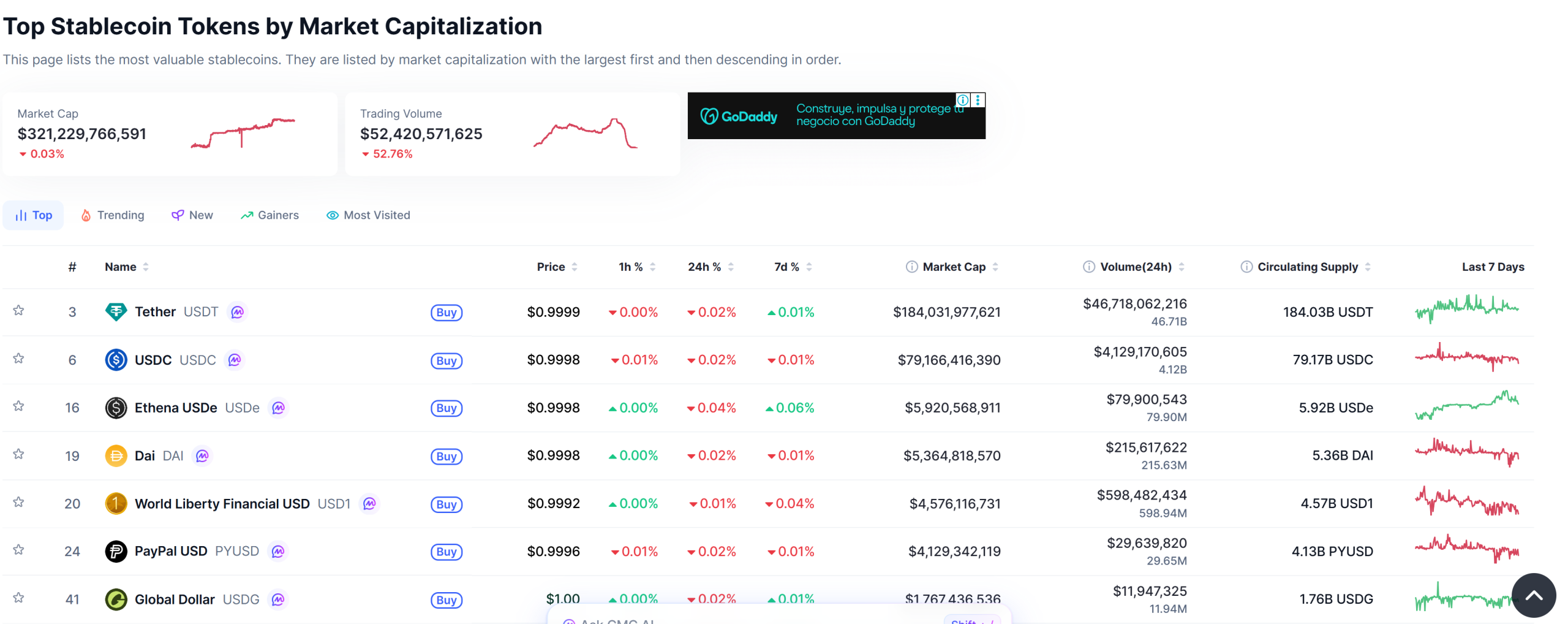
Related: USDC market cap nears record $80B amid ‘capital flight’ in UAE: Analyst
Yield gap could drive deposit migration
Another concern is the growing difference between returns available on stablecoin platforms and those offered by traditional bank accounts. Exchanges often offer between 4% and 5% on stablecoin balances, Butler said, while the average US savings account yields less than 0.5%.
He said history shows depositors move quickly when higher yields become available, pointing to the shift into money market funds in the 1970s. Today, the process could happen even faster, as transferring funds from bank accounts to stablecoins takes only minutes and the yield gap is larger.
Meanwhile, Fabian Dori, chief investment officer at Sygnum, said the competitive gap between banks and crypto platforms is meaningful but not yet critical. He said a large-scale deposit flight is unlikely in the immediate term, as institutions still prioritize trust, regulation and operational resilience.
“But the asymmetry can accelerate migration at the margin, especially among corporates, fintech users, and globally active clients already comfortable moving liquidity across platforms,” Dori said. “Once stablecoins are treated as productive digital cash rather than crypto trading tools, the competitive pressure on bank deposits becomes much more visible,” he added.
Related: Stablecoins could form backbone of global payments in 10 years: Billionaire
Restrictions on yield could push activity offshore
Butler also warned that attempts to restrict stablecoin yield could unintentionally drive activity into less regulated areas. Under current US law, stablecoin issuers are prohibited from paying yield directly to holders. However, exchanges can still offer returns through lending programs, staking or promotional rewards.
If lawmakers impose broader restrictions, capital could shift to alternative structures such as synthetic dollar tokens. Products like Ethena’s USDe generate yield through derivatives markets rather than traditional reserves. These mechanisms can offer returns even if regulated stablecoins cannot.
If that trend accelerates, regulators could face the opposite outcome of what they intend as more capital flows into opaque offshore structures with fewer consumer protections, according to Butler. “Capital doesn’t stop seeking returns,” he said.
Magazine: Bitcoin may take 7 years to upgrade to post-quantum — BIP-360 co-author

Traditional altcoin cycles, once defined by sweeping market rallies known as “altseason,” are giving way to a more concentrated, selective dynamic. Industry veterans argue that an overcrowded token universe and a tightening pool of capital have stripped altcoins of their former momentum, nudging liquidity toward benchmark assets and tokenized real-world assets. In recent discussions, Andrei Grachev, Managing Partner at DWF Labs, highlighted how the market’s attention has shifted away from a broad spectrum of smaller tokens toward a few dominating narratives. He notes that there are now far more tokens than there is money to support them, a situation amplified by exchange-traded products that trap liquidity and redraw investor flows. The upshot is a market where only certain sectors and coins are likely to attract sustained interest.
Bitcoin (CRYPTO: BTC) and Ether (CRYPTO: ETH) have emerged as the primary anchors for institutional capital, drawing funds away from the speculative segment of the market and toward larger, yield-bearing instruments and tokenized assets. Grachev cited the growing emphasis on these liquids as a hallmark of the post-altseason era, where capital allocators seek reliability and predictable upside rather than chasing broad, hype-driven rallies. The trend is supported by observable shifts in the composition of market capital: inflows into Bitcoin-focused vehicles remain robust while broader altcoin investment faces headwinds from increasingly selective investor appetites. The market’s attention has also narrowed toward tokenized RWAs, which blend traditional asset exposure with blockchain settlement, further diverting funds from a wide array of smaller tokens.
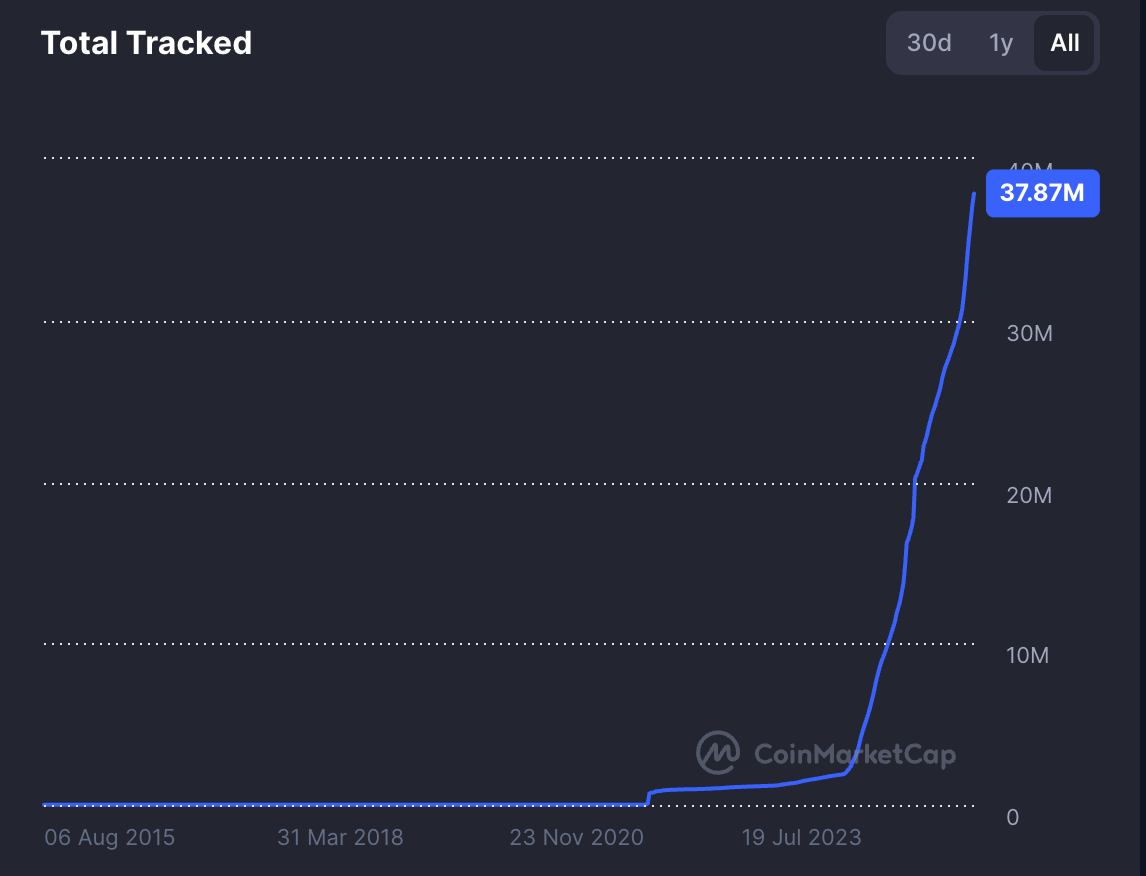
Alongside the shifting narrative, data on the token ecosystem underscored the structural change. The total number of crypto tokens tracked by CoinMarketCap has exploded since 2023, surpassing 37.8 million unique tokens, a figure that speaks to the proliferating tail of the market. Yet, this abundance has not translated into proportional capital support. Grachev warned that the long tail will continue to exist, but mostly as high-risk ventures or casino-style bets, not as a sustainable mass market. “The long tail of tokens will still exist, but will largely function as high-risk venture or casino-style plays. The capital is not going to keep expanding fast enough to support all of it,” he said. The implication is a market with shorter narrative windows, sharper rotations, and less room for projects that depend on hype alone to survive. The era of broad altcoin rallies appears to be behind us, replaced by a more discerning, sector-rotation dynamic that favors selective bets over sweeping uptrends.
Matt Hougan, chief investment officer at Bitwise, has echoed the same sentiment, noting that traditional altcoin cycles are over. In his view, institutional participants are prioritizing yield-bearing digital instruments and crypto assets that capture revenue, rather than pursuing mass altcoin rallies. This shift aligns with a broader industry move toward more tangible, revenue-linked crypto exposures, rather than speculative momentum plays. The implications extend beyond market sentiment; the shift in money flow also affects liquidity, price discovery, and the speed at which narratives can circle through the market. While the market remains capable of isolated surges, the likelihood of a renewed, broad altseason is diminished as capital coalesces around fewer, higher-conviction opportunities. A related analysis suggested that Bitcoin leads while altcoin indicators have dipped to intriguing lows, a sign that the market is rethinking risk allocations inside the crypto space.
From a market-cap perspective, the altcoin sector has faced a pronounced downshift since the October 2025 market crash. Data from market participants show that roughly 38% of altcoins are near all-time lows, a statistic highlighted by CryptoQuant analyst Darkfost. The concern is not just price; liquidity is also becoming more diluted as the number of projects multiplies. The result is a market where capital moves more quickly and more selectively, with fewer opportunities for broad-based gains across the broader altcoin universe. In the 13 months leading up to this point, more than $209 billion exited the altcoin market, underscoring how viral hype has given way to caution and risk management. The altcoin market cap briefly peaked at around $1.19 trillion in October 2025 but was pulled down to roughly $719 billion as broader market dynamics shifted—and the subsequent lull persisted as investors rotated toward BTC, ETH, and RWAs.
Against this backdrop, the flow of funds into Bitcoin exchange-traded products has remained relatively sturdy. Recent data from Farside Investors indicate five consecutive days of positive inflows into Bitcoin ETFs, signaling that institutional players continue to allocate to the flagship asset. In contrast, altcoin-focused ETFs have continued to bleed assets, highlighting the narrowing appetite for the broader altcoin cohort. The diverging flows reinforce the narrative that the market is stepping back from mass altcoin rallies and moving toward more curated exposure. For a sense of the broader conversation around altseason, readers can revisit analyses that argue traditional altcoin cycles are over and that non-traditional cycles may define the next phase of crypto market dynamics.
The altcoin market cap narrative and the new market regime
In the current regime, liquidity is not expanding in tandem with the number of available tokens. The market’s attention is anchored by Bitcoin and Ether, while the token world continues to generate substantial activity but with a much smaller marginal impact on overall market momentum. The intramarket debate now centers on whether any altcoin cohort can sustain meaningful upside absent a broader capital influx or whether the sector will rely on more isolated catalysts—such as yield opportunities, integrations with real-world assets, or sector-specific partnerships—to spark selective rallies.
As observers look ahead, the market context remains influenced by ETF flows, regulatory developments, and macro risk sentiment. The data points to a crypto market that has grown more sophisticated in its allocation choices, with capital seeking not just upside but also durability and revenue potential. The narrative shift also speaks to a broader macro-financial alignment: institutions are seeking assets that can demonstrate cash flows or language of utility, rather than chasing momentum in a crowded field of tokens with uneven liquidity and uncertain fundamentals. The overall tone is pragmatic: a market that rewards depth, credibility, and clear use-case rather than sheer breadth of exposure.
Why it matters
For traders and investors, the evolving dynamics imply a more selective approach to risk, with a premium placed on assets that deliver measurable revenue streams or tangible value. The shift away from broad altseason rallies reduces the likelihood of sudden, market-wide surges in the altcoin space and increases the importance of due diligence, sector differentiation, and liquidity depth. Builders and ecosystem participants should note that capital may flow more quickly into well-defined sectors or tokens with established use cases, while overhyped, underfunded projects may struggle to survive in a tightened funding environment. Regulators and investors alike are watching how the industry balances innovation with risk management as the market continues to mature and differentiate among asset classes.
For market makers and liquidity providers, the new regime emphasizes selectivity, risk controls, and the ability to pivot quickly between narratives as money moves in and out of different sectors. Tokenized RWAs, in particular, could attract longer-horizon capital given their connection to traditional asset performance, providing a potential counterweight to the volatility of a smaller-token ecosystem. The broader takeaway is a crypto landscape that rewards clarity of value, sustainable fundamentals, and efficient liquidity rather than breadth for breadth’s sake.
What to watch next
- Track Bitcoin ETF inflows vs. altcoin ETF outflows over the next quarter to gauge whether the capital rotation persists.
- Monitor altcoin market-cap levels and liquidity metrics, especially for coins near all-time lows, for signs of a potential acceleration or further weakness.
- Observe regulatory developments around tokenized real-world assets and their impact on institutional appetite for RWAs.
- Pay attention to narrative shifts in sector-specific communities and any unexpected catalysts (partnerships, product launches, or major listings) that could trigger selective rotations.
Sources & verification
- Interviews and market commentary on the shift away from traditional altcoin cycles and the role of token proliferation (analysts’ perspectives on oversupply and altseason disruption).
- Data and quotes related to Bitcoin ETF inflows and altcoin ETF outflows from Farside Investors.
- CryptoQuant analysis on the share of altcoins near all-time lows and liquidity considerations.
- CoinMarketCap metrics on the number of tracked tokens and the altseason index reference for Bitcoin-led markets.
Market reaction and key details
As institutions recalibrate their crypto exposure, the market is witnessing a move toward high-conviction bets within a constrained universe. The concentration of capital on BTC, ETH, and tokenized real-world assets reflects a maturation of the asset class, with participants seeking more durable value propositions. The depreciation in altcoin market cap and the outflows from altcoin ETFs underscore a shift in how capital measures risk and reward in a space that continues to evolve rapidly. The long tail of tokens remains, but it is increasingly framed as speculative exposure rather than a driver of broad market momentum. The key takeaway is a crypto market that prizes selectivity and fundamentals over breadth and hype, with liquidity and capital flows aligning to those principles.
Why it matters (cont.)
Beyond the trading desks, this shift has implications for developers, exchanges, and users who rely on a vibrant altcoin ecosystem for innovation and diversification. With fewer tokens receiving sustained funding, the emphasis shifts to projects that demonstrate real value and scalable use cases. For exchanges, the changing liquidity landscape may drive more emphasis on robust market-making, improved trading mechanics, and clearer product differentiation. For users, the evolving dynamics suggest a more curated landscape where due diligence and fundamental research become even more critical to navigate a market that rewards clarity of purpose over sheer token count.
What to watch next (continued)
- Regulatory clarity around tokenized assets and exchange-traded products could influence how institutions allocate capital in the near term.
- Any shifts in macro risk sentiment or liquidity conditions that might reopen doors for broader altseason-like activity, even on a selective basis.
- New sector-specific catalysts, such as major partnerships or integrations, that could lift compromised altcoins with strong fundamentals.
Sources & verification
- Analysts discussing oversupply and altcoin-season dynamics in dedicated Cointelegraph articles linked in the original report.
- Bitwise CIO Matt Hougan’s commentary on evolving cycles and institutional yield-driven demand, with related references.
- CryptoQuant data cited on the percentage of altcoins near all-time lows and liquidity concerns.
- Farside Investors’ data on Bitcoin ETF inflows and altcoin ETF outflows.
- CoinMarketCap metrics on the number of tokens tracked and the altcoin-season index for cross-checking market structure.
Market reaction and key details
Market participants should remain attentive to the evolving balance between liquidity, token proliferation, and the demand for durable exposures. The shift toward BTC, ETH, and RWAs suggests institutions are prioritizing assets with clearer revenue potential and regulatory relevance. In this environment, strategic players may find opportunity not in chasing broad altcoin rallies but in identifying sectors or tokens with demonstrable use cases, strong liquidity, and intrinsic value. The market’s path forward will likely hinge on how capital allocators weigh risk against reward in a landscape that rewards precision and credible narratives over sheer breadth.

Large Bitcoin holders have started accumulating again as the cryptocurrency trades near the $71,000 level, according to new data from crypto analytics firm Santiment.
Key Takeaways:
- Bitcoin whales holding 10–10,000 BTC have resumed accumulation as the price stabilizes near $71,000.
- These large wallets now control about 68.17% of Bitcoin’s total supply, signaling renewed confidence among major holders.
- Analysts warn a confirmed market bottom may depend on retail investors beginning to sell rather than continue buying.
The platform reported that wallets holding between 10 and 10,000 Bitcoin have increased their share of the total supply over the past week, signaling renewed confidence among major investors.
These wallets now control about 68.17% of Bitcoin’s circulating supply, up slightly from 68.07% seven days earlier.
Bitcoin Whale Accumulation Signals ‘Positive Reversal’: Santiment
Santiment described the shift as a “positive reversal,” suggesting that larger holders may be positioning for a potential rebound.
The accumulation trend comes as Bitcoin stabilizes near $71,000 following recent volatility in the broader crypto market.
Bitcoin was trading around $71,350 at the time of publication, up roughly 6% over the past week and more than 7% over the past 30 days, according to CoinMarketCap data.
Analysts are closely watching the behavior of both large holders and retail investors for signals about where the market could move next.
Santiment noted that Bitcoin has historically found local bottoms when coins flow from smaller retail wallets to larger long-term holders.
— Santiment (@santimentfeed) March 14, 2026
 Based on available tracked wallets, the percentage of Bitcoin on exchanges has dropped to its lowest level since November, 2017. In the over eight years since, it's fair to say that quite a bit has changed in both crypto and the world. pic.twitter.com/Sb9psThlvW
“Ideally, we want to see small wallets drop while this group rises,” Santiment said, referring to the transfer of coins from short-term traders to larger, more patient investors.
However, the firm warned that the market may still face uncertainty if retail enthusiasm continues.
Historically, Bitcoin tends to bottom when retail investors become pessimistic and start selling, not when optimism remains widespread.
Sentiment indicators reflect that mixed outlook. The Crypto Fear & Greed Index remained in the “Extreme Fear” category at 16 on Sunday, showing that many investors are still cautious despite the recent price recovery.
The latest accumulation trend follows a period of heavy selling earlier in March.
On March 6, Santiment reported that large Bitcoin holders had sold about 66% of the BTC they accumulated between Feb. 23 and March 3 as prices surged past $70,000 and briefly touched $74,000.
Bitcoin May Still Be in Bear Market Phase: Willy Woo
Some analysts remain cautious about declaring a definitive market bottom.
Onchain analyst Willy Woo recently argued that Bitcoin may still be in the middle of a longer bear-market phase when viewed through the lens of long-term liquidity cycles.
As reported, Bitcoin’s price is showing signs of stabilizing near the $70,000 level as fears of a broader conflict involving Iran begin to ease.
The recovery follows a sharp multi-week selloff that coincided with rising oil prices and worsening macro sentiment, which had pushed Bitcoin down toward the $63,000–$66,000 range during the peak of geopolitical tensions.
Markets have started to recover as energy prices cooled after comments suggesting the conflict could de-escalate. Risk assets responded quickly, with the S&P 500 gaining while Bitcoin rose about 4% on the daily chart.
Meanwhile, institutional flows appear to be strengthening. US spot Bitcoin exchange-traded funds recorded their first five-day inflow streak of 2026 this week, attracting about $767 million in fresh capital.
The post Large Bitcoin Wallets Resume Accumulation as BTC Holds $71K: Santiment appeared first on Cryptonews.
Traditional altcoin cycles, which featured broad market rallies called “altseason,” are now a relic of the past as new crypto market dynamics set in, according to Andrei Grachev, Managing Partner of DWF Labs, a crypto market maker and investment firm.
Too many tokens competing for limited capital and mindshare, a smaller number of market participants, and crypto exchange-traded funds (ETFs) altering market dynamics by trapping liquidity are driving factors of the disruption, Grachev told Cointelegraph.
An institutional focus on large-cap digital assets like Bitcoin (BTC), Ether (ETH) and tokenized real-world assets (RWAs) is also diverting capital and attention away from altcoins, he said.

“The long tail of tokens will still exist, but will largely function as high-risk venture or casino-style plays. The capital is not going to keep expanding fast enough to support all of it,” Grachev said. He added:
“That means shorter narrative windows, more violent rotations, and less room for weak projects to survive on hype alone. The market is moving away from broad altcoin rallies and toward more selective moves in specific sectors.”
Matt Hougan, the chief investment officer at investment firm Bitwise, also said traditional altcoin cycles are over, and that institutional investors are focused on yield-bearing digital instruments or crypto assets that capture revenue.
Related: Bitcoin leads, altcoin indicators drop to intriguing lows: Time for an altseason?
The altcoin market cap has taken a beating since the October 2025 market crash
38% of altcoins are near all-time lows, according to CryptoQuant analyst Darkfost, who said this is worse than the post-FTX market crash.
“Liquidity is becoming increasingly diluted by the growing number of projects and tokens entering the market,” he told Cointelegraph.

Over $209 billion has exited the altcoin market over the last 13 months. The altcoin market cap briefly tapped a high of $1.19 trillion in October 2025, before the market crash dragged it back down to about $719 billion.
Meanwhile, inflows into Bitcoin ETFs remain strong, with five days of positive inflows, according to data from fund manager Farside Investors, while altcoin ETFs continue to experience outflows.
Magazine: Altcoin season 2025 is almost here… but the rules have changed

While the DC Blockchain Summit proceeds in Washington, the premier Dubai crypto conference, Token2049, has had to reschedule, a casualty of the escalating Iran War.
The divergence is stark: while one jurisdiction debates stablecoin legislation, the other is dodging missile debris.
Dubai Collapse: What the War Did to the Middle East Crypto Circuit
It appears that crypto events in the Gulf have effectively frozen. According to reporting from the Wall Street Journal on March 13, Dubai’s flagship crypto conference, Token2049, was scrapped entirely as regional tensions spiked.
According to WSJ’s reportage, organizers cited “uninsurable physical risk” following strikes near key logistics hubs.
However, an announcement today by the organizers suggests Token2049 Dubai will be rescheduled to April 21-22. Registered ticket holders don’t need to take any further action.
For years, Dubai positioned itself as the neutral, regulation-light sanctuary for digital assets. That thesis is currently suspended.
While energy markets react to oil surging past $100, the liquidity that fuels the Gulf’s crypto ecosystem is pausing.
Venture firms are grounded. The hub status is intact in theory, but operationally paralyzed in practice.
Discover: The best crypto to diversify your portfolio with
DC Holds: The Regulatory Advocacy Machine Keeps Running
In stark contrast, the Digital Chamber is moving forward with its mid-March summit in Washington, D.C.
The event is set to feature SEC Chairman Paul Atkins and key congressional figures, focusing on the very operational clarity the Middle East currently lacks. The agenda has shifted from defensive lobbying to proactive structural design.
The summit serves as the physical staging ground for the recently signed SEC-CFTC coordination deal, a framework that requires industry feedback to function.
By maintaining the schedule, Washington is broadcasting that its regulatory apparatus is insulated from the chaos abroad. The policy machine is not just running; it is accelerating while competitors stall.
What the Postponement in Dubai Implies About the Crypto Global Map
The trade has flipped. For the last cycle, the “regulatory risk” was in the U.S. and the “growth opportunity” was in Dubai. The Iran conflict has inverted that risk premium overnight.
Institutional capital abhors physical insecurity even more than it dislikes regulatory red tape.
JPMorgan analysts noted a divergence in Bitcoin and Gold ETFs recently, where capital has been leaving gold and flowing into Bitcoin funds. If the Middle East cannot guarantee the physical safety of the dealmakers, the liquidity will route back to New York and London.
Bitcoin vs gold ETF flows diverge
@jpmorgan analysts say since the Iran war:
• Largest gold ETF GLD saw 2.7% of AUM outflows
• Largest bitcoin ETF IBIT saw 1.5% of AUM inflows
The analysts also noted signs of bitcoin volatility compressing as institutional ownership… pic.twitter.com/oLvxrT83PK— Yogita Khatri (@Yogita_Khatri5) March 12, 2026
Washington is suddenly the stable option. The DC Blockchain Summit represents a jurisdiction where the risks are legal and bureaucratic, not kinetic.
Investors are pricing in the reality that while U.S. regulation is under strenuous debate, the grid stays on and the ports remain open.
Discover: The best pre-launch token sales
What to Watch Next
Watch the legislative output from the Digital Chamber’s sessions. If specific language regarding the CLARITY Act emerges from the summit, it confirms the U.S. is using this window to cement its lead.
𝐈𝐭'𝐬 𝐜𝐨𝐦𝐢𝐧𝐠. — Chiliz – The Sports Blockchain (@Chiliz) March 12, 2026

Chiliz is the main sponsor of the @DigitalChamber Blockchain Summit in Washington, DC. https://t.co/kb7mQewE3A pic.twitter.com/EaBTxjpRK7
Monitor the Dubai organizers for rescheduling dates. A push to Q4 2026 suggests they see the conflict as a long-term disruption, further damaging Q2 capital flow.
Finally, watch for Senate sponsors joining crypto bills post-summit. If political capital aligns with the industry’s flight to safety, the U.S. regulatory moat will be wide.
The post DC Blockchain Summit Pushes On as Dubai Crypto Events Fall to Iran War appeared first on Cryptonews.

Key Takeaways
- BTC experienced an initial 8.5% decline at the onset of U.S.-Iran hostilities but has recovered approximately 11% from its nadir.
- Successive conflict escalations have prompted temporary selloffs, yet purchasing activity emerges at progressively elevated price points.
- Bitcoin’s performance has surpassed both gold and the S&P 500 during the identical fourteen-day timeframe.
- Major Bitcoin holders (whales) have resumed accumulation around the $71,000 mark, now possessing 68.17% of circulating supply.
- Blockchain analytics indicate minimal selling pressure between present levels and approximately $82,000.
Bitcoin’s current market valuation stands at $71,500.
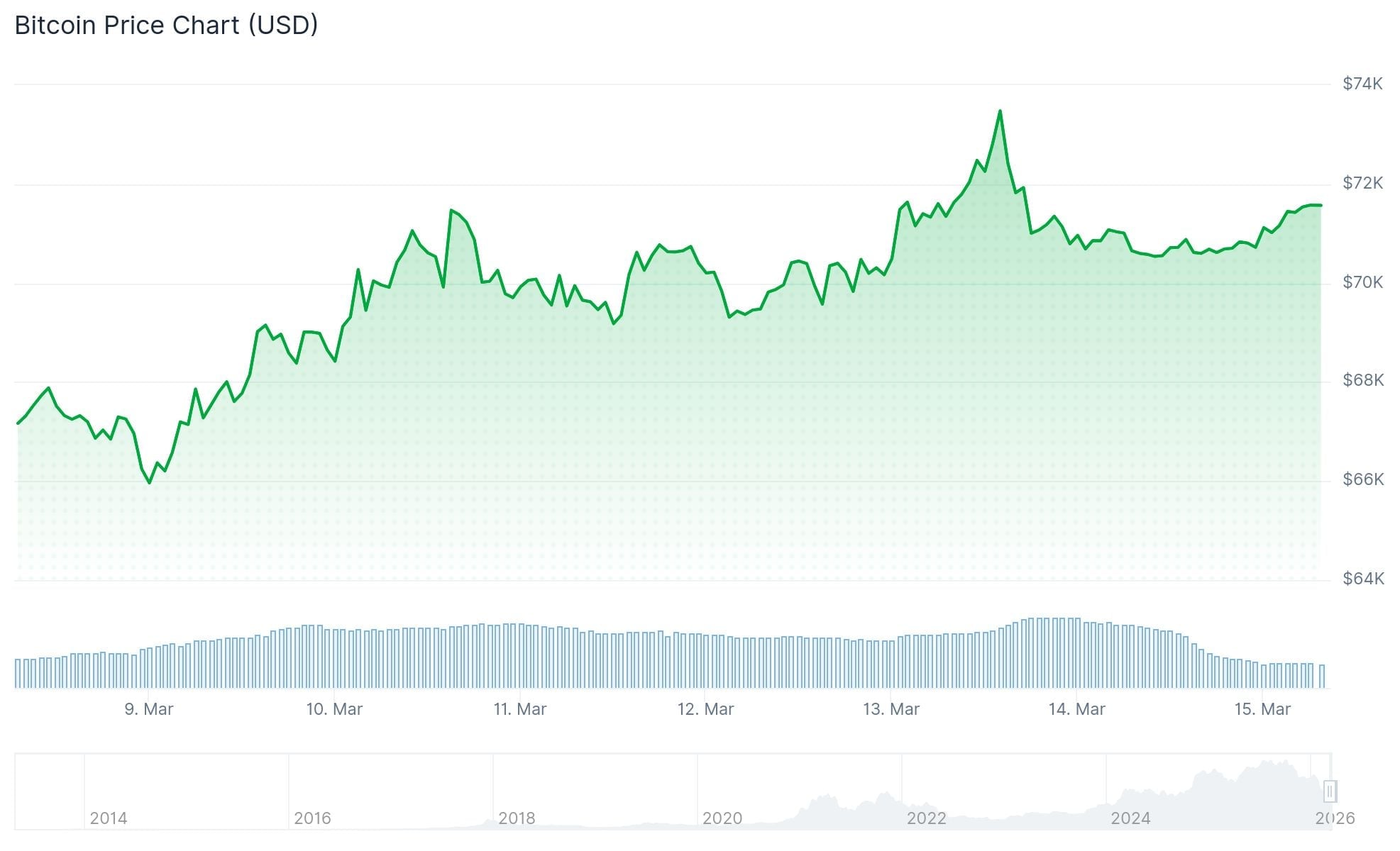
Hostilities between the U.S. and Iran commenced on Saturday, February 28. As the sole major trading market operating that day, Bitcoin experienced an 8.5% correction down to $64,000—marking its cycle bottom.
Fast forward fourteen days, and the landscape has transformed considerably.
BTC has surged approximately 11% from that trough, currently exchanging hands near $71,500. During this identical period, gold has exhibited extreme volatility, the S&P 500 has declined, and Asian stock markets endured their most severe weekly losses since 2020. Only crude oil—surging over 40%—and the greenback have exceeded Bitcoin’s gains. Both assets benefit directly from wartime conditions.

Progressive Support Levels Following Each Dip
Each military escalation since late February has initiated a Bitcoin price retreat. However, purchasing power has consistently materialized at increasingly higher thresholds.
Following Iran’s counter-strike missile barrage on March 2, BTC stabilized at $66,000. After seven consecutive days of sustained military operations on March 7, the floor elevated to $68,000. In response to commercial tanker incidents on March 12, Bitcoin maintained $69,400. Post-Kharg Island offensive on March 14, support crystallized at $70,596.
This pattern reveals ascending support increments of approximately $1,000–$2,000 following each geopolitical development.
Simultaneously, Bitcoin has encountered resistance near the $73,000–$74,000 zone on four separate occasions. This upper boundary remains intact. Market dynamics suggest an impending resolution—either BTC penetrates the $74,000 threshold, or intensified conflict finally overwhelms demand.
Earlier in 2026, a rapid liquidation cascade eliminated $2.5 billion in leveraged positions during a single weekend session, forcing Bitcoin down to $77,000. That purge appears to have eliminated excessive leverage, creating a market structure better equipped to withstand repeated conflict-related news without comparable disruption.
Whale Accumulation Pattern Emerges, Blockchain Metrics Suggest $82K Target
Analytics from cryptocurrency intelligence platform Santiment reveal substantial Bitcoin wallets—those containing 10 to 10,000 BTC—have reinitiated accumulation strategies around $71,000.
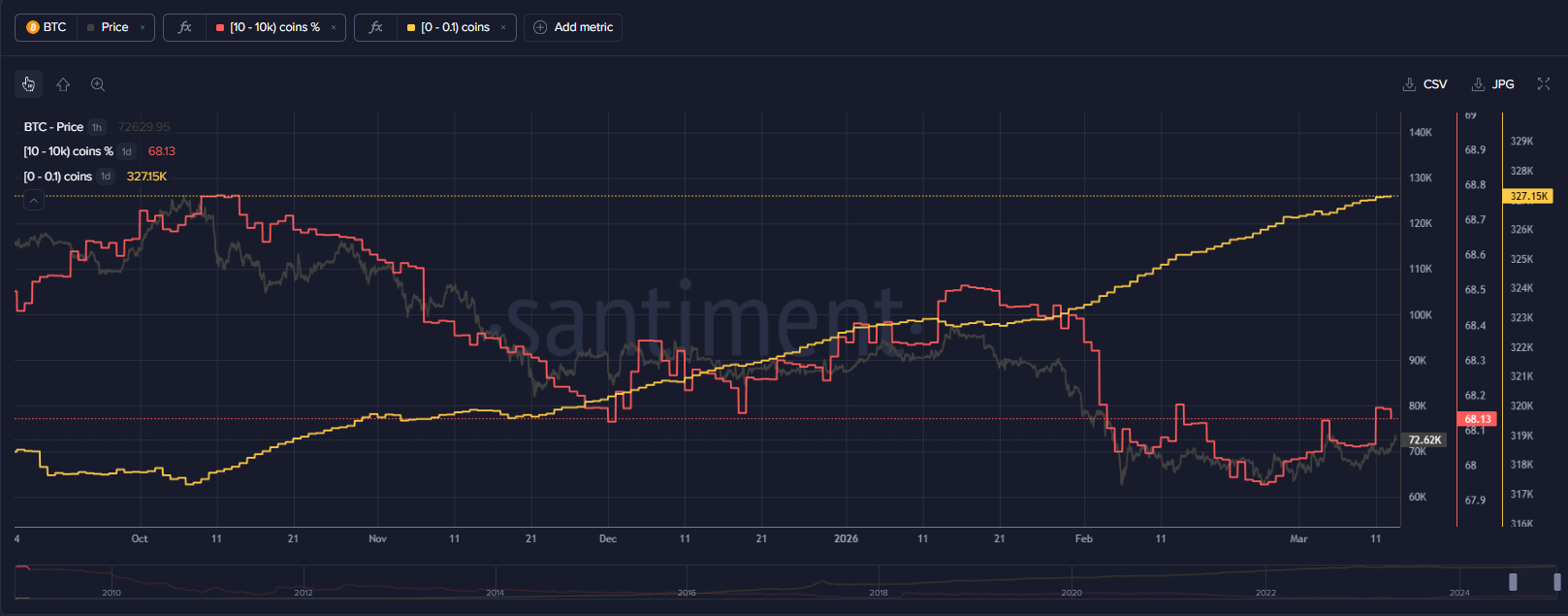
These addresses now command 68.17% of Bitcoin’s aggregate supply, increasing from 68.07% seven days prior. Santiment characterized this movement as a “positive reversal.” The analytics firm monitors retail investor behavior, as historical patterns indicate their capitulation often coincides with cyclical bottoms.
The Crypto Fear & Greed Index registered 16 on Sunday—deep within “Extreme Fear” territory.
U.S. spot Bitcoin ETFs recorded their inaugural five-consecutive-day inflow sequence of 2026 this week, attracting approximately $767 million in fresh capital.
Blockchain analyst Ali Martinez, referencing the UTXO Realized Price Distribution framework, identified minimal resistance between current valuations and approximately $82,045. The $74,000 rejection area, he observed, demonstrates sparse investor cost-basis density, implying it may prove less formidable than technical charts suggest.
The subsequent major support beneath current trading ranges appears around $66,898.
Bitcoin has appreciated 7.55% across the trailing 30-day period. BTC presently trades at $71,500.

Crypto World
Solana Foundation President Lily Liu: DeFi Is What Gives Blockchain Its True Economic Purpose

TLDR:
- Lily Liu says DeFi is the primary economic engine that gives non-Bitcoin blockchains a reason to exist.
- Liu draws on ancient and modern history to argue no vision reaches scale without a strong economic engine.
- Networks must be neutral, global, and performant to deliver open financial access to 5.5 billion users.
- Liu separates corporate blockchain infrastructure from open systems, calling the divide philosophical, not technical.
Solana Foundation President Lily Liu has made a bold case for decentralized finance as the backbone of every blockchain network.
In a recent post, Liu argued that DeFi is not a standalone application category within the crypto space. Instead, she positioned it as the primary economic engine that gives non-Bitcoin blockchains their reason to exist.
Her statement has drawn attention across the industry for its direct framing of blockchain’s core purpose and long-term direction.
Liu Ties Blockchain’s Future to Economic Strength and Open Access
Liu opened her argument by revisiting the original vision behind blockchain technology. That vision has carried several names over the years.
She wrote that terms like “open finance, decentralized finance, internet of money, tcp/ip for money” all point to the same goal. The aim has always been moving financial infrastructure from analog to digital for 5.5 billion internet users.
She anchored her position in historical patterns from both ancient and modern periods. No major vision, she argued, has reached scale without a strong economic engine driving it.
“Look around in history both ancient and modern,” Liu wrote, “and there is not a single vision that has reached scale without an economic engine underwriting it.”
Ancient empires underwrote major religions, and successful city-states built economies before extending influence outward.
Liu was direct in connecting that history to blockchain ecosystems today. She stated that “the path to self-sovereignty is based on a strong and differentiated economy.”
For her, DeFi represents that differentiated economy. It gives non-Bitcoin networks a real and defensible reason to grow beyond speculation.
For blockchain to reach 5.5 billion users, Liu added that networks must be “neutral, global, and performant.” They must also remain committed to open systems that protect self-sovereignty at every layer.
Economic strength matters, but structural openness must accompany it. Together, those qualities define what a legitimate blockchain network looks like.
Corpo Infra Versus Open Systems: A Fundamental Divide
Liu also drew a clear distinction between corporate blockchain infrastructure and genuinely open systems. She acknowledged that corporate infrastructure benefits from significant distribution at launch.
However, she argued it “ultimately serves the same ownership structures and private interests that characterize finance today.” That characteristic separates it from blockchain’s founding mission.
Liu was careful not to dismiss corporate infrastructure entirely. She noted these projects “may have their role” and can “certainly creating value for their owners.”
Still, she was firm that they should not be treated as legitimate inheritors of blockchain’s original ethos. That distinction, for her, carries real weight across the entire industry.
She described blockchain’s true ethos as “self sovereignty, open access, radically equal opportunity served to the broadest set of humanity reachable in an instant.” Those principles, she argued, are incompatible with private ownership structures.
Any infrastructure that concentrates control or restricts access contradicts that original commitment. The divide between open systems and corporate infrastructure is, in her view, philosophical rather than technical.
Her framework places DeFi at the center of how blockchain fulfills its original promise. Networks that remain neutral and open are better positioned to carry that mission forward at scale.
Those who prioritize private interests instead risk becoming mirrors of the very financial systems blockchain set out to transform.
Crypto World
Solana (SOL) Flashes First Bullish Signal in Two Months While Grayscale Eyes Opportunity
TLDR
- The SuperTrend indicator for Solana turned bullish on March 13, marking the first positive signal since early January.
- The asset has declined approximately 67% from its September 2025 all-time high, currently trading around $88–89.
- Broader weekly technical metrics remain negative, with 15 out of 17 indicators showing sell signals.
- Grayscale’s research division highlighted SOL as an attractive opportunity at current valuation levels.
- Total cumulative inflows into Solana Spot ETFs have reached $961–$968 million, though weekly momentum has decelerated significantly.
Solana (SOL) has generated its first positive technical indicator reading in approximately two months, despite the overall chart structure continuing to show bearish characteristics. This development has captured the interest of both market analysts and institutional observers.
Following a peak above $240 in late 2025, SOL commenced a prolonged downward trajectory. The cryptocurrency breached successive support zones before establishing a base in the $67–$80 zone during early 2026.
Throughout the last four weeks, Solana has consolidated within a $76 to $90 range. The token briefly exceeded $90 on two occasions in March, with the most recent push aligning with the SuperTrend buy signal appearing on the daily timeframe.
Understanding the SuperTrend Signal
The SuperTrend is a momentum-based technical indicator that determines trend direction by analyzing price action and volatility metrics. Crypto analyst Ali Martinez identified the bullish crossover on March 13 through X.
For the first time since early January, the SuperTrend indicator has turned bullish on Solana $SOL. pic.twitter.com/oCv8A6R93r
— Ali Charts (@alicharts) March 13, 2026
This marks the first time the indicator has shown a bullish configuration since the beginning of January. A bearish signal emerged in early February, coinciding with SOL’s descent to $67.
While the signal suggests potential near-term upward momentum, it doesn’t necessarily confirm a long-term trend reversal. The indicator is susceptible to false readings, and the overall technical landscape presents a more complex scenario.
$SOL/monthly
Textbook Cup and Handle pattern on #Solana 📈
Nothing complicated here — just follow basic TA. The pattern is clear, the setup is bullish.
The only question is whether you have the faith to act on it 💭 pic.twitter.com/vnNEAp1bzy
— Trader Tardigrade (@TATrader_Alan) March 13, 2026
Weekly chart analysis on TradingView reveals 15 indicators generating sell signals versus only 2 buy signals. All significant moving averages remain positioned above current price levels. The EMA10 stands at $98.47, the SMA200 at $103.70, and the EMA200 at $119.62 — each indicating downward pressure.
The Relative Strength Index reads 32.34, nearing but not yet entering oversold conditions. The MACD displays a negative reading of -23.70.
Technical experts suggest SOL would need to recover above the SMA200 level of $103.70 at minimum to signal a meaningful structural change.
Institutional Perspective from Grayscale
On March 13, Grayscale’s Head of Research Zach Pandl released a comprehensive six-point analysis supporting investment in SOL, highlighting the approximately 67% decline from September 2025 peaks as an attractive accumulation zone.
Grayscale has more than a few reasons why we’re so optimistic about @solana‘s future.
1️⃣ Leader in users, transactions & fees
2️⃣ Positioned for growth amid regulatory clarity
3️⃣ Staking rewards for network participation
4️⃣ ~67% below Sept 2025 highs
5️⃣ Strong network effects
6️⃣… pic.twitter.com/TAO08npACg— Grayscale (@Grayscale) March 13, 2026
Pandl emphasized Solana’s dominant position in user activity, transaction volume, and fee generation among smart contract platforms throughout the previous year. He also noted evolving regulatory frameworks for stablecoins and asset tokenization as favorable catalysts.
Daily inflows into Solana Spot ETFs reached $7.60 million on March 13, entirely attributable to Bitwise’s BSOL product. Aggregate net inflows across all listed Solana ETF products currently range between $961 and $968 million, with combined net assets totaling approximately $824–$855 million.
However, weekly ETF inflow momentum has experienced a substantial decline. Total weekly inflows registered just $3.10 million — representing an 83% decrease compared to the previous week.
SOL currently changes hands at approximately $88.95, showing a 2.8% increase over the last 24 hours and an 11.15% gain across the past 30 days. The cryptocurrency maintains a total market capitalization of roughly $54.74 billion, securing the seventh position among all digital assets.

“That my friend is wrong” – Jamie Redknapp can’t believe what he saw from Chelsea ace in Newcastle defeat

Parallels Desktop creators say MacBook Neo does indeed have enough muscle to run Windows apps

Dubai Financial Centre Attacked By Iranian Drones? Dramatic Visuals From Central UAE Show Smoke

Smart energy pays enters the US market, targeting scalable financial infrastructure

Why Israel is blocking foreign journalists from entering

Bitcoin: We’re Entering The Most Dangerous Phase
Dubai Financial Centre Attacked By Iranian Drones? Dramatic Visuals From Central UAE Show Smoke

Financial Planning for 25,000 Salaried Person #Shorts

Dark money group offers influencers $1,500 for posts attacking Dem candidate
-
 Tech4 days ago
A 1,300-Pound NASA Spacecraft To Re-Enter Earth’s Atmosphere
-

 News Videos6 days ago
10th Algebra | Financial Planning | Question Bank Solution | Board Exam 2026
-
Crypto World1 day ago
HYPE Token Enters Net Deflation as HyperCore Buybacks Outpace Staking Rewards
-

 Business5 days ago
ExxonMobil seeks to move corporate registration from New Jersey to Texas
-

 Crypto World6 days ago
Paradigm, a16z, Winklevoss Capital, Balaji Srinivasan among investors in ZODL
-

 Fashion2 days ago
Weekend Open Thread: Addict Lip Glow
-

 Tech5 days ago
ChatGPT will now generate interactive visuals to help you with math and science concepts
-
Sports19 hours ago
Why Duke and Michigan Are Dead Even Entering Selection Sunday
-

 NewsBeat4 days ago
Residents reaction as Shildon murder probe enters second day
-

 Business7 days ago
Search for Nancy Guthrie Enters 37th Day as FBI Probes Wi-Fi Jammer Theory
-

 Business4 days ago
Search Enters Sixth Week With New Leads in Tucson Abduction Case
-
 NewsBeat5 days ago
Pagazzi Lighting enters administration as 70 jobs lost and 11 stores close across Scotland
-

 Tech6 days ago
Despite challenges, Ireland sixth in EU for board gender diversity
-

 Business21 hours ago
US Airports Launch Donation Drives for Unpaid TSA Workers as Partial Government Shutdown Enters Fifth Week
-

 NewsBeat4 days ago
I Entered The Manosphere. Nothing Could Prepare Me For What I Found.
-
Crypto World17 hours ago
Coinbase and Bybit in Investment Talks: Could Bybit Finally Enter the US Crypto Market?
-

 Business6 days ago
Search Enters 39th Day with FBI Tip Line Developments and No Major Breakthroughs
-

 Sports6 days ago
Skateboarding World Championships: Britain’s Sky Brown wins park gold
-

 Business22 hours ago
Country star Brantley Gilbert enters growing non-alcoholic beer market
-
 Crypto World5 days ago
Will Chainlink price reclaim $10 amid volatility squeeze?

