

Crypto World
Analysts weigh in on Bitwise CIO Matt Hougan’s $1 million bitcoin call

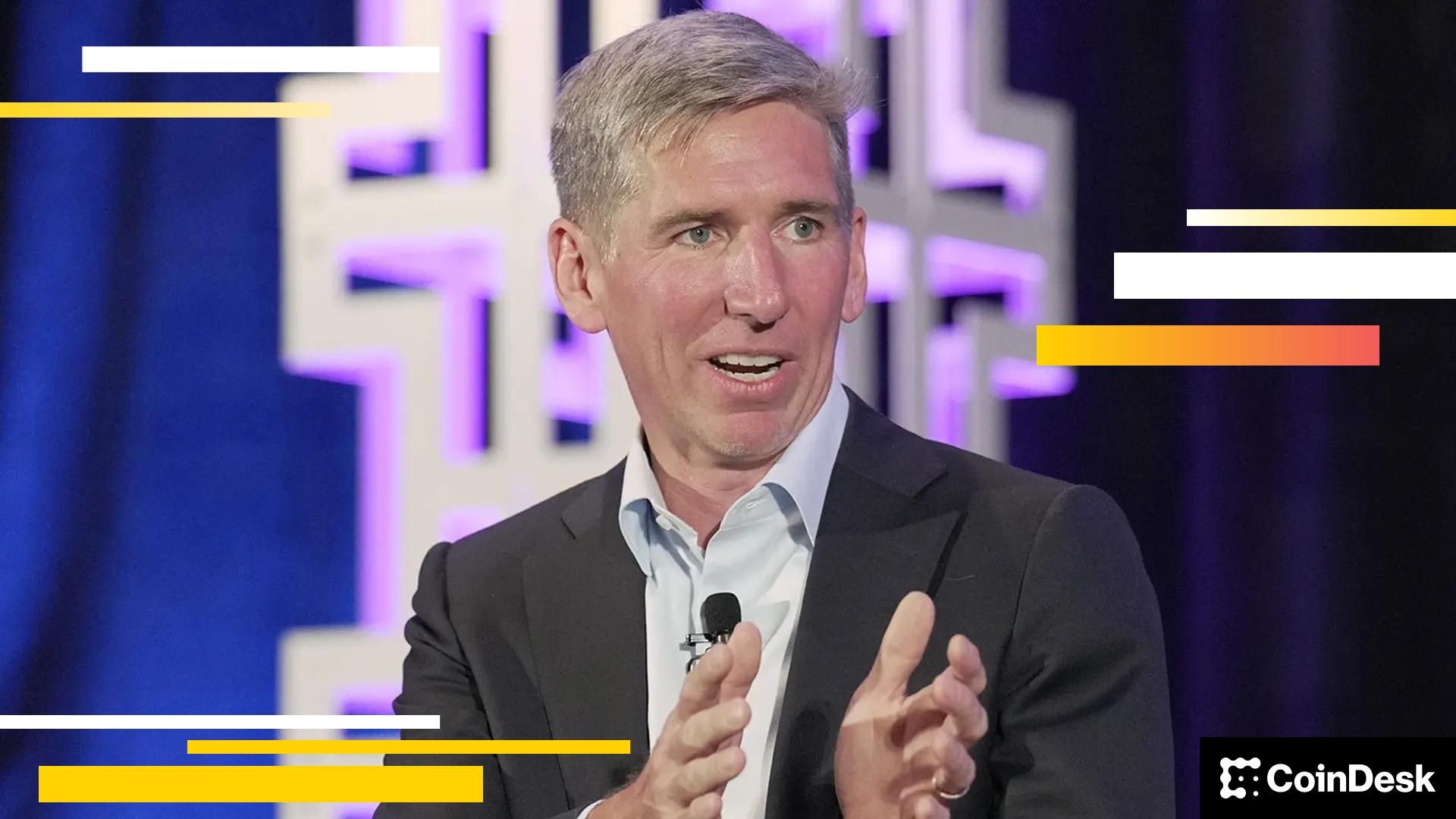
Bitcoin could eventually reach $1 million per coin if it captures a larger share of the global store-of-value market currently dominated by gold and government bonds, according to Bitwise Asset Management CIO Matt Hougan.
In a report earlier this week, Hougan said bitcoin’s long-term upside depends less on short-term market cycles and more on how much of the world’s wealth preservation market the cryptocurrency absorbs over time.
“One million sounds crazy,” said Hougan. “It implies bitcoin will rise 14x from today’s price.”
He pointed to several factors supporting that forecast, among them the rapid growth of the global store-of-value market, including gold, government bonds and other defensive assets, which has expanded from roughly $2.5 trillion in 2004 to nearly $40 trillion today. Bitcoin currently represents only about 4% of that market by value.
If the largest cryptocurrency were to capture roughly half of that market under current conditions, its price could approach that $1 million mark within roughly a decade, Hougan said. If the broader store-of-value market continues expanding, bitcoin would require a smaller share to reach that level.
The $1 million price fixation
The $1 million forecast has become a recurring theme across the crypto industry. President Donald Trump’s son Eric recently doubled down on his $1 million BTC call. In August, Coinbase CEO Brian Armstrong said bitcoin could reach that price by 2030.
Jack Dorsey, who ran X (formerly Twitter) until 2021 and co-founded payments firm Block (formerly Square), said bitcoin could reach $1 million in five years. Arthur Hayes, former BitMEX CEO, believes it could come as soon as 2028. Cathie Wood’s Ark Invest projected that bitcoin could reach $3.8 million by the end of the decade. Bernstein in 2024 forecast $1 million by 2033.
So why has the $1 million target become such a widely cited benchmark for bitcoin? CoinDesk asked several market analysts.
“It’s a clean headline and shorthand for the idea that Bitcoin could rival gold as a store of value. The exact number matters less than the share of global wealth Bitcoin captures,” said Mati Greenspan, market analyst and Quantum Economics founder.
For Jason Fernandes, also a market analyst and an AdLunam co-founder, the milestone is more psychological than a precise valuation target, reflecting the belief that bitcoin could ultimately win the store-of-value debate.
However, he also believes part of the narrative is driven by marketing dynamics. “Some of the narrative is promotional because round numbers travel well and align with holder incentives,” Fernandes said, though he added that the underlying thesis is not purely hype.
“I think many investors make a ‘static denominator’ mistake, valuing bitcoin against today’s store-of-value market instead of a much larger future one,” he said.
For Fernandes, the real question is not whether $1 million bitcoin is theoretically possible, but whether institutional adoption compounds long enough to justify that price.
Analysts agree on direction, but not the timeline
Some of the analysts who shared their comments with CoinDesk said Hougan’s projection is plausible over the long term, though most frame it as a decade-scale adoption story rather than a near-term forecast.
“Geopolitical tension strengthens the Bitcoin thesis,” said Greenspan. “In uncertain times, investors look for neutral stores of value, and Bitcoin increasingly sits in that bucket alongside gold.”
Greenspan said the milestone is possible but would likely take a decade or more, requiring continued institutional adoption and broader regulatory clarity.
Fernandes said Hougan’s argument is essentially a market-share thesis. Bitcoin does not need to replace gold outright, he said; it only needs to capture a portion of a growing global store-of-value market.
“A $1 million bitcoin assumes long-term adoption and market-share gains within the global store-of-value market,” Fernandes said. “It’s a thesis about bitcoin’s end state if it matures into a major global monetary asset.”
Institutional adoption remains the key driver
Hougan has argued that bitcoin’s fixed supply of 21 million coins and its decentralized network give it characteristics similar to those of traditional stores of value, such as gold.
Fernandes said the long-term $1 million thesis depends largely on continued institutional adoption and growth in the global store-of-value market.
“BTC doesn’t need to replace gold or fiat; it only needs to capture about 17% of a projected $121 trillion store-of-value market over the next decade to justify a $1 million price,” Fernandes said.
Greenspan said geopolitical uncertainty could further strengthen bitcoin’s appeal as a neutral asset.
“In uncertain times, investors look for neutral stores of value, and bitcoin increasingly sits in that bucket alongside gold,” he said, though he added that reaching such a valuation would likely take years of sustained adoption.
Nima Beni, founder of Bitlease, said the timeline could accelerate if confidence in traditional financial assets weakens.
“Bitcoin reaches $1 million when confidence in traditional ‘safe’ assets breaks,” he said, pointing to potential sovereign debt crises or disruptions in the gold market as possible catalysts.
Despite the bullish projections, analysts said bitcoin’s path toward such valuations would depend more on long-term adoption and macroeconomic conditions than on short-term market cycles.

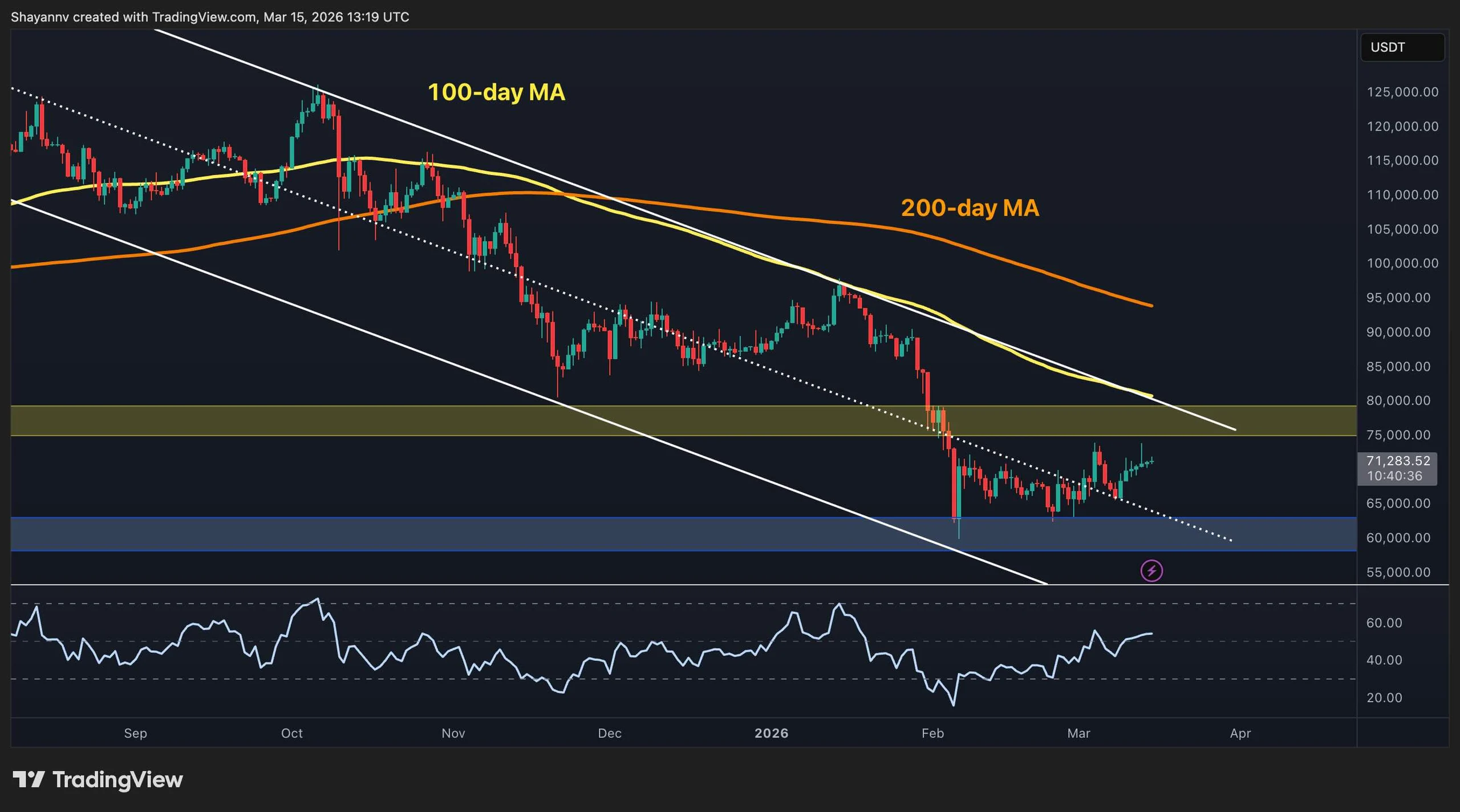
Bitcoin is extending its recovery, but the market is now approaching a more meaningful technical decision point. After holding the $60,000 region and building a series of higher lows, BTC has pushed back into the low-$70,000s, where short-term momentum is improving. Still, the broader structure has not fully flipped bullish, which means this move is best viewed as a test of resistance until proven otherwise.
Bitcoin Price Analysis: The Daily Chart
On the daily chart, Bitcoin continues to trade below both the 100-day and 200-day moving averages, keeping the higher-timeframe trend cautious. The price is also still sitting inside the broader descending structure, even though the latest rebound has clearly improved conditions compared to the panic sell-off seen near the February lows.
The key level to watch remains the $75,000 to $80,000 resistance area, which previously acted as support before turning into supply. As long as BTC stays below that zone, the broader move can still be interpreted as a rebound within a larger corrective phase. On the downside, the $60,000 to $62,000 area remains the main support base, and it is still the level buyers need to defend to preserve the current recovery structure.
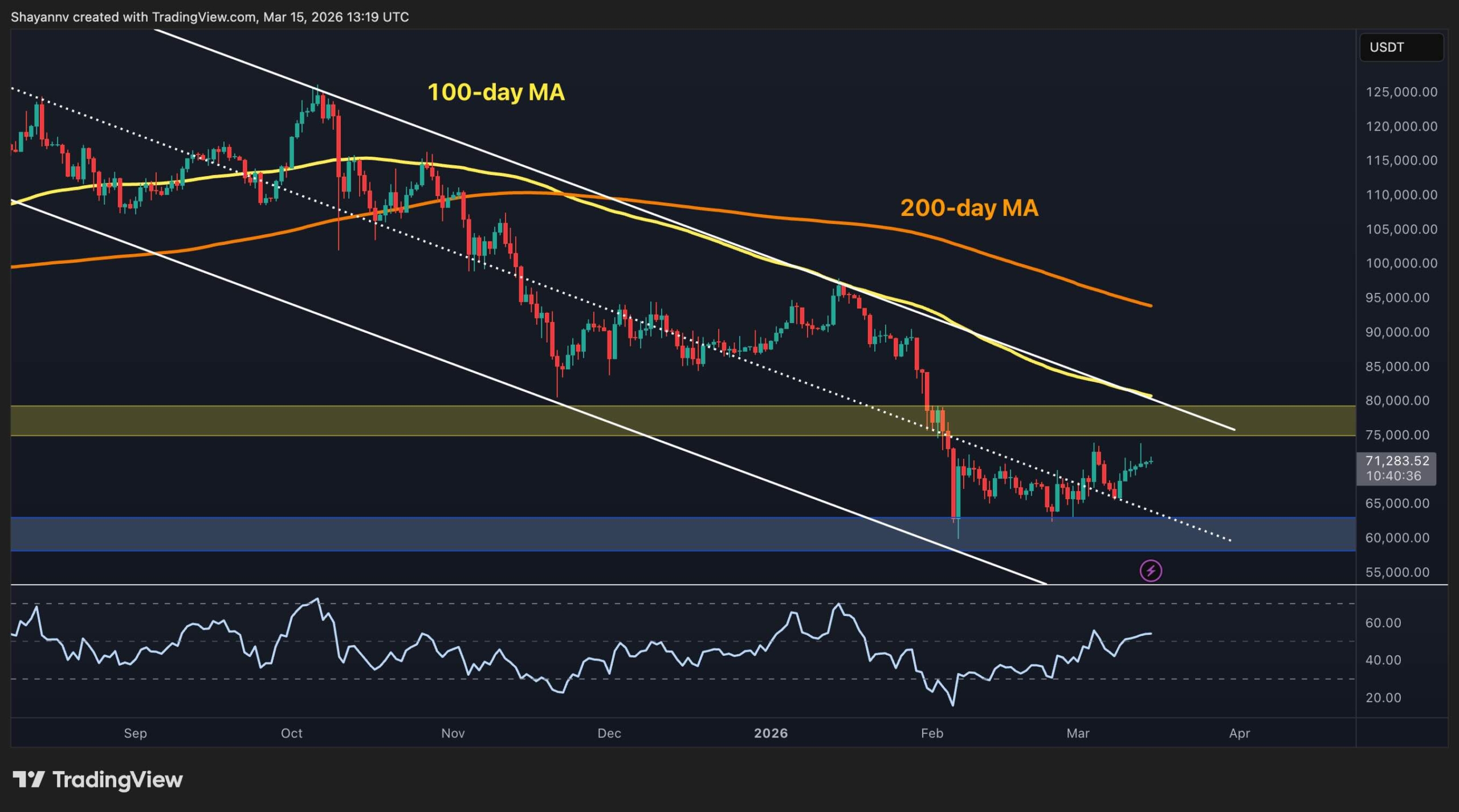
BTC/USDT 4-Hour Chart
The 4-hour chart looks stronger. Bitcoin has been climbing within a rising channel, and price is once again pressing toward the upper boundary of that formation. The market is now trading around $71,000 to $72,000, with RSI also firming near the upper half of its range, which reflects improving short-term momentum.
That said, BTC is approaching a confluence zone where channel resistance overlaps with horizontal supply around $73,000 to $75,000. This makes the current area especially important. A clean breakout above it would strengthen the case for continuation into higher resistance, while another rejection could send price back toward the middle or lower end of the channel and keep the market in consolidation mode.

On-Chain Analysis
The on-chain picture adds a more constructive undertone. The Spot Average Order Size chart shows that recent activity is still being driven more by larger participants than by aggressive retail-style behavior. Historically, that kind of backdrop tends to be healthier than a move led by euphoric small buyers, because it suggests stronger hands are still active even as price trades below the cycle highs.
At the same time, the chart does not show the kind of broad retail frenzy usually associated with late-stage blow-off conditions. In practical terms, that means the current recovery still looks relatively controlled from an on-chain participation perspective. So while Bitcoin is facing an important technical resistance zone on the charts, the order-size data suggests the market has not yet entered a fully overheated phase.

Binance Free $600 (CryptoPotato Exclusive): Use this link to register a new account and receive $600 exclusive welcome offer on Binance (full details).
LIMITED OFFER for CryptoPotato readers at Bybit: Use this link to register and open a $500 FREE position on any coin!
Disclaimer: Information found on CryptoPotato is those of writers quoted. It does not represent the opinions of CryptoPotato on whether to buy, sell, or hold any investments. You are advised to conduct your own research before making any investment decisions. Use provided information at your own risk. See Disclaimer for more information.

Ethereum co-founder Vitalik Buterin posted a proposal, or a pull request, on Saturday that would merge the backend programs used by nodes to interact with Ethereum’s Beacon Chain, which handles consensus and staking, and the protocol’s execution layer into one unified code structure to simplify node setup.
Ethereum node runners, also called validators, currently have to run two separate programs, which each require setup and synchronization to coordinate and communicate the data produced by Ethereum’s consensus and execution layers.
This raises the technical complexity of running a node or providing validation services for the Ethereum network, preventing ordinary users from running their own infrastructure and forcing reliance on third-party service providers.

“I feel like at every level, we have implicitly made this decision that running a node is this oh so scary DevOps task that it is ok to leave to professionals,” Buterin said in a post on X. He continued:
“It is not. We need to reverse this. Running your own Ethereum infrastructure should be the basic right of every individual and household. ‘The hardware requirement is high, therefore it’s okay for the DevOps skill and time requirements to also be high,’ is not an excuse.”
Even those who can afford the high-end computing hardware to set up an Ethereum node and have the technical expertise typically lack the time to set them up, Buterin said, adding that “nodes should be easy.”
The Ethereum network and other smart contract blockchains have faced criticism for the technical complexity and hardware requirements to run a node, which has also raised centralization concerns about those networks.
Related: Ethereum Foundation publishes mandate clarifying role and goals
Buterin proposes partially stateless nodes to further decentralize the network
In May 2025, Buterin proposed partially stateless nodes, which do not maintain the full block history and only keep data that the node runner requires.
This reduces the hardware costs and data storage requirements for users running nodes for personal purposes, like sending transactions and verifying the blockchain.

Disk space is usually the primary bottleneck for node operators, according to Go-Ethereum (GETH). Smart contract blockchain networks, like Ethereum, generate significant quantities of data that require ever-increasing storage space, making specialized node hardware a necessity.
“A market structure dominated by a few remote procedure call (RPC) providers is one that will face strong pressure to deplatform or censor users. Many RPC providers already exclude entire countries,” Buterin wrote.
In late January, Buterin said he had set aside 16,384 Ether, worth about $45 million, from his personal holdings to support privacy-preserving technologies, open hardware and secure, verifiable software. He added that the funds would be deployed gradually over the coming years as the Ethereum Foundation enters a period of what he described as “mild austerity,” while continuing to pursue its technical roadmap.
Magazine: Ethereum’s Fusaka fork explained for dummies: What the hell is PeerDAS?


The Ethereum Foundation has sold 5,000 ETH to publicly traded treasury firm BitMine Immersion Technologies in an over-the-counter deal worth just over $10.2 million.
Summary
- The Ethereum Foundation offloads 5,000 ETH to BitMine as price climbs above $2K
- The OTC transaction was priced at an average of $2,042.96 per coin
- ETH is up 8.2% over the past seven days and 2.6% in the past 24 hours
The Ethereum Foundation offloads 5,000 ETH to BitMine as the price climbs above $2K, with the transaction priced at an average of $2,042.96 per coin.
The foundation confirmed the sale in a post on X. Proceeds will go toward core operations across the Ethereum ecosystem, covering protocol R&D, ecosystem development, community grant funding, and developer support.
This is the second time the foundation has sold ETH directly to a corporate treasury company. In July last year, it sold 10,000 ETH, worth around $30 million at the time to SharpLink Gaming.
Selling portions of its treasury across different market cycles allows the Ethereum Foundation to fund ongoing development without relying entirely on donations or external sources.
Ethereum Foundation offloads 5,000 ETH to BitMine
BitMine Immersion Technologies has built one of the largest corporate Ethereum positions in the world.
As of early last week, the company reported owning more than 4.5 million ETH. At recent market prices, those holdings are worth approximately $9.4 billion, placing BitMine ahead of other firms that hold ETH on their balance sheets.
ETH climbs above $2,100 as weekly gains hold
ETH gained 8.2% over the past seven days and 2.6% in the past 24 hours, per available price data. The 30-day gain stands at 8.4%, with a one-year increase of 10.5%. The asset crossed back above the $2,100 level at the time of the transaction.
The Ethereum Foundation has not disclosed a specific price target for future sales. Its approach ties treasury activity to funding needs and broader market conditions.
The OTC counterparty for this deal was BitMine, which the foundation confirmed in the same X post.
With BitMine adding the foundation’s 5,000 ETH to its existing position, its total holdings could rise further above the 4.5 million ETH it reported last week.

Bitcoin and XRP maintained steady prices on Sunday as the broader cryptocurrency market posted modest gains. The recovery followed renewed buying activity and stronger market sentiment across major digital assets. Meanwhile, political debate in Washington over crypto regulation added a new layer of attention to the sector.
Key Highlights
- Bitcoin trades above $71K as crypto market records modest weekend gains.
- XRP stabilizes near $1.41 after recovery and strong institutional inflows.
- Bitcoin spot ETFs record five consecutive days of positive capital inflows.
- CLARITY Act debate in the U.S. Senate may shape long-term crypto regulation.
- Market capitalization rises to $2.43 trillion amid steady digital asset demand.
Bitcoin traded near $71,611 after gaining about 1.30% during the latest 24-hour trading session. The asset also posted a weekly increase of nearly five percent. Market capitalization across digital assets climbed to around $2.43 trillion during the same period.
The recovery followed steady capital inflows into spot Bitcoin exchange-traded funds in the United States. Data showed a five-day inflow streak totaling roughly $180 million. BlackRock’s IBIT fund led activity with about $144 million in fresh allocations.
Institutional participation has remained an important driver of Bitcoin’s recent price stability. Funds continued to accumulate exposure through regulated investment products. This pattern supported steady demand and limited downside pressure across the broader market.
Technical indicators highlighted several important price zones for the cryptocurrency. Analysts identified $71,060 as a near-term support level needed to maintain upward momentum. A sustained position above that level could open the path toward the $73,223 to $73,500 resistance area.
$BTC may be entering its final bear-market accumulation zone.
• Strong historical support in this range
• Buyers stepping in after the sell-off
• Market structure hinting at a potential bottomIf this level holds, it could mark the cycle low before the next major move up. 🚀… pic.twitter.com/fdkCmaaWwR
— Nehal (@nehalzzzz1) March 15, 2026
However, weaker demand could change the short-term outlook. A drop below the $70,340 support area may trigger additional selling pressure. Such a move could push Bitcoin toward the psychological $69,000 level.
Despite potential volatility, broader sentiment remained constructive across the digital asset market. Ethereum, Solana, and Dogecoin also posted modest gains during the same period. The collective rise reinforced the perception of renewed strength within the sector.
XRP Stabilizes Near $1.41 After Strong Capital Inflows
XRP traded near $1.41 after gaining roughly 1.05% during the latest daily trading session. The token maintained stability following a brief recovery earlier in the day. Market activity indicated steady demand across major trading platforms.
Fund flow data revealed strong institutional interest in XRP-linked investment products. Net inflows into XRP funds reached approximately $1.21 billion. These figures highlighted sustained capital movement toward large digital asset vehicles.
The inflows suggested growing confidence in XRP’s longer-term market role. Asset managers continued allocating capital into funds that track major cryptocurrencies. Such participation has increased the visibility of XRP within institutional portfolios.
Technical indicators pointed to key levels shaping the token’s short-term trajectory. Analysts highlighted $1.38 as a critical support zone for XRP. Holding above that level could support another attempt toward the $1.45 resistance.
Conversely, a breakdown below support may trigger additional selling pressure. In that scenario, XRP could slide toward the $1.30 level. Market participants therefore remain attentive to price stability around the support range.
Broader cryptocurrency performance also supported XRP’s stability. Several major assets recorded moderate increases during the same trading window. The synchronized movement reflected improving sentiment across the digital asset ecosystem.
CLARITY Act Debate Adds Regulatory Context
Regulatory developments in the United States continued shaping the conversation around digital assets. Lawmakers debated the proposed CLARITY Act, which aims to establish structured oversight for cryptocurrencies. The legislation seeks to define regulatory authority for digital assets and stablecoins.
Supporters argue that clearer rules could strengthen the foundation of the industry. Defined guidelines may encourage innovation while also protecting market participants. Advocates also believe regulatory certainty could attract additional institutional involvement.
However, the proposal faces significant legislative pressure in the Senate calendar. Analysts indicated that only a limited window remains for committee approval. Without progress soon, the bill’s chances of passage in 2026 may weaken.
Scheduling conflicts within the Senate present a major obstacle for the legislation. Leaders currently prioritize other measures, including the SAVE America Act. As a result, crypto policy discussions compete with broader legislative priorities.
Another point of debate centers on the role of stablecoins within the financial system. Some lawmakers question whether stablecoins should generate profits for holders. Others argue the assets should function mainly as blockchain payment tools.
Current estimates place the probability of the bill passing at around fifty-five percent. The uncertainty reflects ongoing political debate over the structure of crypto regulation. Even so, the outcome could influence long-term price stability for assets like Bitcoin and XRP.

Resistance Near $74,000 Remains the Key Barrier
Bitcoin repeatedly approached the $73,000 to $74,000 region but failed to break above that zone.
The market rejected the price four times near that level over recent weeks.
This resistance now forms the main barrier for the next major market move.
Earlier this year, a sharp liquidation event removed billions in leveraged crypto positions.
That episode erased roughly $2.5 billion from the derivatives market within a single weekend.
The liquidation pushed Bitcoin down sharply and cleared many aggressive leveraged traders.
Market conditions appear more stable since that large leverage reset earlier this year.
Consequently, Bitcoin has absorbed several geopolitical headlines without another massive collapse.
The absence of heavy liquidation pressure suggests healthier market positioning today.
Technical behavior now suggests a decisive breakout could occur if resistance weakens.
Either Bitcoin climbs above $74,000 soon or stronger geopolitical shocks push the price downward.
The market currently balances between these two possible outcomes.
Bitcoin Data / Datos de Bitcoin
(March 15, 2026) pic.twitter.com/S3XbQsf2mR— Oscar Laura (@oscarlau) March 15, 2026
Whale Accumulation Strengthens Market Structure
Large Bitcoin wallets have recently increased their holdings as prices stabilized near $71,000.
Data from blockchain analytics platforms shows renewed accumulation among major holders.
These wallets hold between 10 and 10,000 Bitcoin each.
The group now controls approximately 68.17% of the total Bitcoin supply.
That share increased slightly from 68.07% recorded one week earlier.
Such accumulation patterns often support market stability during uncertain economic conditions.
At the same time, the broader crypto sentiment indicator shows extreme fear across markets.
The Crypto Fear and Greed Index recently registered a reading near 16.
Low sentiment readings historically appear near market bottoms during volatile cycles.
Institutional demand also strengthened during the same period despite global tensions.
U.S. spot Bitcoin exchange-traded funds recorded their first five-day inflow streak this year.
Those products attracted approximately $767 million in net capital inflows.
Whales are quietly hoarding Bitcoin, pushing dominance past 68% as BTC lingers near $71K. Retail? Frozen in “Extreme Fear” with no signs of capitulation yet. Institutions dip toes with $767M flowing into spot ETFs. This bounce? Could be a setup for a bull run or a classic bull… pic.twitter.com/PUmn60mcKG
— Fama Crypto (@Famacrypt) March 15, 2026
On-Chain Metrics Suggest Possible Path Toward $82,000
On-chain data currently shows relatively light resistance above the present price range.
Analysts examined the UTXO Realized Price Distribution metric to identify potential market barriers.
That model highlights areas where large numbers of coins last changed ownership.
The data indicates limited investor cost-basis activity between $71,500 and roughly $82,045.
Lower transaction density often means fewer holders wait to sell near those levels.
Such conditions can allow faster price movement during strong upward momentum.
However, the market still recognizes strong support levels below the current trading range.
A major support zone appears near $66,898 based on historical transaction activity.
This area could attract buyers again if broader markets experience renewed volatility.
Bitcoin has gained approximately 7.55% during the past thirty days.
The digital asset currently trades near $71,500 as geopolitical developments continue shaping market sentiment.
Future price direction now depends on whether resistance near $74,000 finally breaks.
Crypto World
Traders Pour Tens of Thousands Into DeepSnitch AI To Boost Their Gains After March 31, PEPETO Investors Fear a Slow Fade

KuCoin launched equity-linked perpetual contracts tied to Tesla and Strategy. The products will allow traders to speculate on price movements through USDt-settled derivatives 24/7.
In the trenches, though, traders are more interested in enriching than portfolios. In addition to the Pepeto price prediction, many are exploring DeepSnitch AI after learning that the launch has been set for March 31.
Since DeepSnitch AI has been projected to go 100x-300x by the community, its launch remains one of the most interesting dates in March 2026.
KuCoin goes for perps on public companies
KuCoin listed TSLAUSDT and MSTRUSDT perpetual contracts on March 13, giving its 40 million users exposure to two of crypto’s most Bitcoin-adjacent public companies.

The contracts track underlying equity price movements using a pricing framework designed to mitigate traditional market hours and crypto’s 24-hour trading.
Positions start from 1 USDt, dropping the entry threshold when compared to traditional equity derivatives markets.
The infrastructure around crypto continues to expand, and while this is a clear bullish signal, retail traders that aren’t into perps are more interested in snagging presale coins. Hence, the interest is high in DeepSnitch AI, Pepeto price prediction, with many also inquiring about Flashpump.
Best presales in 2026
1. DeepSnitch AI: A tool that will help you find breakout projects launching on March 31
The Pepeto price prediction is interesting, sure. But imagine if you could find other coins like Pepeto before most traders even register it on their radar?
Enter DeepSnitch AI, an analytics suite powered by five AI agents.
Hidden gem scanning is one of five core functions running through the central intelligence layer. The platform continuously scans on-chain and off-chain data, flagging breakout setups before they surface in crypto discussions.

Combined with real-time sentiment tracking, instant contract audits, and rug detection, DeepSnitch AI gives traders a genuine information edge and a reason to return to the tool every day.
While the utility is the main draw here, DeepSnitch AI is also a fine investment opportunity. Over $2.1M raised at $0.04487 during a bear market, and the fact that the platform is ready to roll ahead of schedule confirms this sentiment.
DeepSnitch AI drops on March 31, and since the product has daily usability, the community’s 100x-300x projections are actually quite realistic.
2. Pepeto price prediction: Does Pepeto have solid fundamentals?
As a meme coin, Pepeto has nice vibes. A version of OG Pepe, the coin could attract plenty of meme traders who are looking for a quick flip.
However, the project attempts to break out of the mold by also promising to deliver a cross-chain bridge after launch. Will it do much for the Pepeto forecast?
While it’s impossible to tell, as the Pepeto coin prediction ultimately depends on the levels of hype, the community mentions that the Pepeto price target they expect to see is $0.00007128 – a solid upside from the current $0.000000186 price.
Sadly, the Pepeto price prediction and the initial pump are actually the biggest draws. The problem with most meme coins is that they run on attention cycles that compress faster than most holders expect. The cross-chain bridge is a nice idea, but most large traders will likely make the quick flip and exit before the chart tanks.
3. Flashpump price prediction: User-created meme tokens?
Although the meme coin space is cooling, some projects actually present interesting ideas aimed at meme traders.
Flashpump, for instance, combines AI agents with user-created meme tokens in a platform that gives all of the supply for the community.
Priced at $0.003 in presale, the AI-powered meme creation mechanic could help the project run. The community expects 10x-20x post-launch. While the meme angle may turn off some, the structure is a lot better than what’s seen with other meme projects.
Final words: All bases covered
When scouting out presales, it’s easy to get attached to possible returns (explains why the Pepeto price prediction is a popular topic). Still, that’s only a part of the equation of what marks a successful project.
DeepSnitch AI takes on a different approach as it covers all bases: It provides tools that traders actually need, has the community backing, the momentum, and last but not least, a clear launch date set for March 31.
Traders who move now and use the bonus codes will be in the best position when the Uniswap listing kicks in. DSNTVIP30 adds 30%, DSNTVIP50 adds 50%, DSNTVIP150 adds 150%, and DSNTVIP300 unlocks 300% extra tokens on $30K and above.
Considering that the community is eyeing 100x-300x gains, the returns on DSNT could be life-changing.
Join the DeepSnitch AI presale while the codes are still active and follow the community on X or Telegram.
FAQs:
1. What is the Pepeto price prediction, and does PEPETO have solid fundamentals?
Community targets $0.00007128 from $0.000000186, a potentially strong flip if hype holds through launch. Fundamentals are thin, though. A promised cross-chain bridge doesn’t change the meme coin attention cycle reality for most large holders.
2. How does DeepSnitch AI help traders find new coins?
The hidden gem scanner runs continuously on-chain and off-chain scans, flagging breakout setups before mainstream discussion picks them up. Combined with real-time sentiment tracking, it gives traders a genuine information edge that compounds daily.
3. Is Flashpump a better long-term bet than the Pepeto price prediction suggests for meme coins?
Flashpump’s zero team allocation and AI-powered meme creation mechanic make it structurally cleaner than most meme presales at $0.003.
Disclaimer: This is a Press Release provided by a third party who is responsible for the content. Please conduct your own research before taking any action based on the content.

Crypto World
Nasdaq and owner of NYSE turn to crypto exchanges to bring the $126T equity market onchain
Wall Street’s biggest exchanges are embracing digital assets by aiming to put the $126 trillion equity market on blockchains — but they are not going at it alone; rather, they are relying on crypto exchanges to get there.
Over the past week, two of the world’s most powerful exchange operators — Nasdaq and Intercontinental Exchange (ICE), the parent company of the New York Stock Exchange — teamed up with digital asset exchanges to merge equities with blockchains through tokenization.
Nasdaq is developing a framework that would allow publicly listed companies to issue blockchain-based versions of their shares while preserving traditional ownership rights and governance. To distribute those tokenized stocks globally, the exchange is working with Payward, the parent company of crypto exchange Kraken. The offering could go live as soon as the first half of 2027.
Meanwhile, just days earlier, ICE revealed a strategic investment in crypto exchange OKX at a $25 billion valuation. That deal includes plans to launch new tokenized stocks and crypto futures, allowing the exchange operator to tap into OKX’s 120 million user base.
The “everything” exchange
The flurry of deals points to a bigger transformation in how markets might function in the future.
For decades, stocks, bonds and funds traded on separate systems with limited trading hours. Blockchain technology promises a unified, always-on marketplace — one that in the industry believe could eventually host the settlement of all financial assets in the forms of tokens.
Antoine Scalia, founder and CEO of crypto accounting and compliance platform Cryptio, said the developments point to a broader shift toward what he calls the “everything exchange” – a marketplace where all asset classes trade on the same infrastructure.
“For a very long time, it was just crypto people pushing the narrative that traditional finance and crypto would merge,” Scalia said. “Now we see the major exchanges moving.”
“That’s a realization that eventually all assets will settle on blockchain rails,” he said.
This shift is being accelerated by a January SEC Staff Statement on Tokenized Securities, which finally clarified that tokenized equities carry the same legal weight as their “paper” counterparts. That gives Wall Street incumbents the legal cover to enter the market for tokenized equity trading.
‘Frenemy’
However, the key question, Scalia added, is which platforms will dominate that future market: traditional exchanges like Nasdaq or crypto-native venues such as Coinbase (COIN) and Kraken.
But that doesn’t mean the two sides are purely rivals. In many cases, they need each other.
Traditional exchanges are looking for access to crypto-native traders, while crypto platforms want the distribution and credibility that established financial infrastructure provides, Scalia said.
“Distribution works both ways,” he said. “Traditional exchanges want exposure to the crypto trading population, and there’s huge demand from crypto users to trade other types of assets. At the same time, crypto-native firms benefit from the reach of these traditional players to bring more people into crypto markets.”
The result is an unusual, “frenemy”-like relationship between potential competitors. “It’s a very interesting dynamic with frictions and complementarity,” Scalia said. “And it will be interesting to see how it plays out.”
Why tokenized stocks matter
Tokenized equities – currently $1 billion – are only a fraction of the global equity market, but the potential is massive as all kinds of assets are increasingly move towards non-stop, around-the-clock trading.
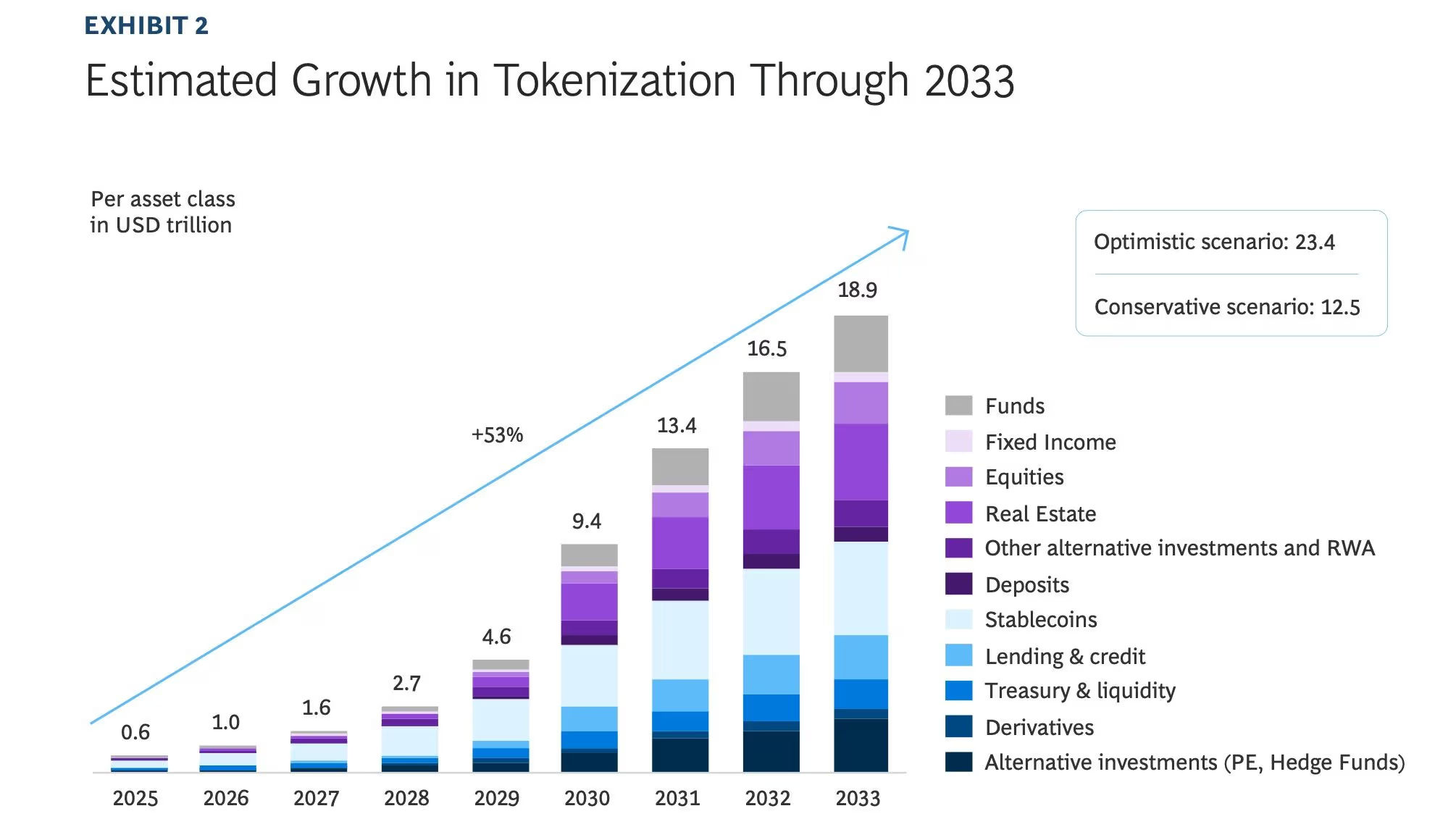
A joint report by Boston Consulting Group and Ripple forecasted that tokenized assets could grow 53% a year, reaching $18.9 trillion across all asset classes by 2033 as their base case.

The market for tokenized stocks showcased even faster growth. The market value has tripled since mid-2025, RWA.xyz data shows, as Kraken, Ondo Finance, Robinhood and a slew of other exchanges and issuers rolled out token versions of equities.
The biggest advantage of putting traditional equities on blockchains is continuous price discovery, said Yuki Yuminaga, founder of tokenization startup Tenbin Labs. Unlike traditional stock markets today, which operate on fixed trading hours, blockchain-based assets never sleep and can trade around the clock. This will likely unlock more capital, improve liquidity and reduce market volatility.
Tokenizing stocks can also unlock more efficient lending and borrowing through decentralized finance (DeFi), Yuminaga added. Tokenized shares could be used as collateral in lending markets, increasing capital efficiency and enabling new financing opportunities, he said.
Giants like Nasdaq and NYSE entering the tokenized stocks game could also solve one of the biggest current pain points: liquidity.
“Tokenized equities have struggled with liquidity because traditional markets and onchain markets are separate,” Yuminaga said. “If Nasdaq connects those two pools of liquidity, that could change the equation.”


The author’s rather controversial recent history with crypto continues, this time, he said he keeps buying.
Robert Kiyosaki, the renowned investor, financial guru, and author, has called for yet another financial crash in his latest post on X, indicating that private credit funds are panicked, with investors pulling out funds.
He outlined his strategy during such a time of distress, and doubled down on the assets he wants to continue buying.
Crash Intensifies
After rightfully predicting the major 2008 banking crisis, the author of a few New York best-selling books has been frequently forecasting even more painful crashes. In his latest warning on the matter, he noted that the “crash accelerates,” which is evident from several factors:
“Private credit funds are panicked as investors withdraw their money. Major big-name banks and brand-name financial institutions are in trouble. Jim Rickards formally declares the US in the New Depression.”
These developments could only worsen if the situation in the Middle East continues for weeks or even months. As such, he asked his over a million followers on X, “What are you going to do?”
His strategy is quite promising, as he plans on “getting richer” and refuses to be the “victim who gets poorer.” Additionally, he laid out the financial assets he plans to continue accumulating to help him achieve his goal – oil, silver, gold, Bitcoin, and Ethereum.
He added that smart money is getting richer and stupid money is running like the “proverbial chicken with its head chopped off.” Kiyosaki concluded that this is not the time to be a “headless chicken.”
Recent Bitcoin History
After bashing the crypto industry for a few years, Kiyosaki changed his tune during the COVID-19 crash and has become a vocal proponent, especially for BTC and ETH as of more recently. However, his latest remarks on the matter have stirred some controversy, especially the lack of consistency in his claims about whether he stopped buying bitcoin.
You may also like:
In one post, he noted that he hasn’t bought any BTC at prices over $6,000. In many others, though, he indicated on social media that he was purchasing more bitcoins when the asset traded well within five or even six-digit territory.
Nevertheless, he has asserted on a couple of occasions that he believes bitcoin is a better investment tool than gold.
Binance Free $600 (CryptoPotato Exclusive): Use this link to register a new account and receive $600 exclusive welcome offer on Binance (full details).
LIMITED OFFER for CryptoPotato readers at Bybit: Use this link to register and open a $500 FREE position on any coin!

Bitcoin edged toward a pivotal weekly finish, with traders watching a potential close above the $70,000 mark that would also reclaim a critical long-term indicator. The setup sits at a crossroads as macro risk remains in play and buyers test a sequence of technical levels that have defined the market for months. A close above $70,000 would not only validate a momentum shift on the weekly chart but would also put the price back above a notable trendline that has guided price action for much of this cycle. The broader backdrop remains mixed, with oil hovering near the century mark and geopolitical tensions contributing to risk-off sentiment during parts of the session.
Bitcoin (BTC) inched higher on Sunday as bulls sought to seal a weekly close above $70,000. The Sunday move followed a week of choppy action and strategic positioning by market participants who are evaluating whether this level can establish a renewed leg higher. The weekly picture matters because it encompasses a longer time horizon, and a break above the level could signal renewed confidence among buyers who have watched multiple attempts to push past the zone fail to sustain momentum. On the charts, Bitcoin was flirting with a reset of momentum after testing highs near the $72,000 area intraday before retreating, a pattern that traders described as a necessary consolidation before another move higher.
Data viewed by traders show that BTC remained on track for a seventh consecutive green daily candle, setting up the potential for the best daily finish in over a week if bidding holds into the close. The price managed to stay above two critical guardrails on the weekly timeframe: the 200-week exponential moving average (EMA) and a level associated with the 2021 all-time high around $68,300, followed by the $69,400 mark. These zones have historically served as magnets for price, attracting buyers when the market swings back toward them after excursions toward local highs. A sustained hold above these levels would be interpreted by many analysts as a sign that the long-term support structure remains intact even in the face of short-term volatility.
Analysts highlighted that recent price corrections have reflected routine risk-off behavior rather than a shift in the longer-term narrative. In a recent analysis, Michaël van de Poppe noted that the market could see a minor pullback as CME gap closure activity picks up around the weekend, but he projected a continued grind toward the next major resistances in the $75,000–$80,000 area if the momentum persists. The reflection aligns with a price action pattern in which buyers defend key levels and push the market higher on renewed demand, even as profit-taking emerges at local highs.
“Markets are turning back upwards again, probably we’ll see a slight pullback later today for CME gap closing appetite, but other than that, I would assume we’ll continue to grind upwards to the resistances at $75-80K.”
In a separate acknowledgment of the intraday dynamics, van de Poppe had previously forecast that the price would revisit Friday’s CME close around $71,325, underscoring the notion that short-term moves may oscillate within a defined corridor before the next directional breakout. As of the current update, BTC had logged a weekly gain of more than 8%, with March performance hovering near a 6.7% increase, underscoring the persistence of buyers seeking to reassert control after a period of volatility. A chart overview from CoinGlass capturing weekly returns corroborates the broader narrative of a risk-on tilt within a cautious macro environment. CoinGlass data show the week-to-date strength in the asset, even as macro risk factors remain in flux.
Macro turmoil spoils Bitcoin “relief rally”
Beyond the price action, macro and geopolitical factors continued to shape trader sentiment. While some participants hoped for a relief rally in calmer macro conditions, the backdrop remained precarious. Oil markets provided a parallel narrative, with WTI crude oil flirting with the $100-per-barrel mark as traders weighed supply shocks and demand dynamics. The persistent tension between risk-on and risk-off impulses has left Bitcoin oscillating between cautious optimism and a more defensive posture as investors digest global developments and central bank trajectories.
Market watchers such as Kyle Doops emphasized that, on a mid-term horizon, Bitcoin appears to be trading within a defined band. He highlighted a mid-term trading range defined by a longer-term market mean near $78,400 and a realized price baseline around $54,400, suggesting that price action tends to revert toward these anchors after excursions toward the upper and lower boundaries. In his assessment, whenever Bitcoin edges above $70,000, sellers re-emerge to take profits rather than trigger panic selling, reinforcing the view that the market has become comfortable with orderly, measured gains rather than sharp, outsized moves. These observations align with the broader theme of a market that has found a measure of discipline even as headlines around energy markets and global tensions continue to dominate the narrative.
Why it matters
The ongoing test of the $70,000 threshold matters for several reasons. First, a weekly close above that level would bolster the case for a renewed longer-term uptrend by reclaiming a major psychological and technical barrier that has capped upside in recent months. It would also validate the relevance of the 200-week EMA as a benchmark for long-term support, potentially reducing the probability of a rapid retrace as market participants reassess risk posture. For traders, a sustained close above the level could translate into a more constructive setup for those eyeing a move toward the upper end of the historically significant resistance corridor in the low-to-mid $80,000s, while still considering the structural dynamics shaped by macro headwinds.
Second, the price action underscores the interplay between technical patterns and macro realities. Even as Bitcoin demonstrates resilience, macro catalysts—most notably commodity markets and geopolitical risk—continue to influence risk appetite. In this context, a constructive weekly close could act as a spark for renewed liquidity and ETF considerations, though investors must remain mindful of potential overhangs from policy signals and energy prices. The evolving macro environment suggests that the market could enter a phase where patience and disciplined risk management become as important as any immediate price target.
Finally, the narrative around price discovery remains tethered to disciplined risk-control behavior among market participants. The repeated observation of profit-taking at local highs indicates a maturation in market behavior, where investors are more deliberate about entries and exits rather than chasing sensational moves. In a landscape where macro risk remains persistent, the ability to navigate the timing of entries and exits will likely be as important as predicting the next directional move.
What to watch next
- Watch for a weekly close above $70,000 and whether the price can sustain a hold above the 200-week EMA on a weekly basis.
- Monitor CME-related dynamics near the closing price around $71,325 and any subsequent gap-closing activity.
- Observe price action toward the $75,000–$80,000 resistance zone if momentum persists beyond the weekly close.
- Keep an eye on macro catalysts, particularly oil prices hovering near $100 and any geopolitical developments that could affect risk sentiment.
Sources & verification
- TradingView price data for BTCUSD, including the weekly candle count and interactions with the 200-week EMA.
- Analyses and social posts from Michaël van de Poppe discussing CME gaps and potential resistance targets around $75,000–$80,000.
- Kyle Doops’s commentary on the mid-term trading range anchored by a long-term mean near $78,400 and a realized price around $54,400.
- CoinGlass weekly return data illustrating the ~8% weekly gain and March gains of ~6.7% for Bitcoin.
- The referenced chart perspectives and historical levels, including the 200-week EMA around $68,300 and the $69,400 level tied to the 2021 all-time high.
Bitcoin price action and near-term outlook
As the week unfolds, the market’s trajectory hinges on whether Bitcoin can cement a weekly close above the $70,000 threshold and maintain a foothold above the 200-week EMA. The combination of technical support at long-standing levels and the persistence of bullish momentum on the daily chart creates a scenario in which a breakout could invite further upside toward the next major resistance bands. Yet the price action has repeatedly shown that the move higher can be met with measured profit-taking, particularly around round-number levels and at pivotal intraday highs near the $72,000 territory. The balance between demand and supply will likely define the near-term trajectory as traders weigh macro risk against the potential for a sustained look at higher targets.
In sum, Bitcoin is navigating a window of opportunity that could shape the narrative for the coming weeks. A successful close above the critical levels would reinforce the case for a renewed bullish phase, while a failure to sustain gains could bring the market back into a rangebound mode that tests patience and risk management alike. The next few sessions will be telling as the market absorbs macro cues, on-chain signals, and traders’ evolving appetite for risk.
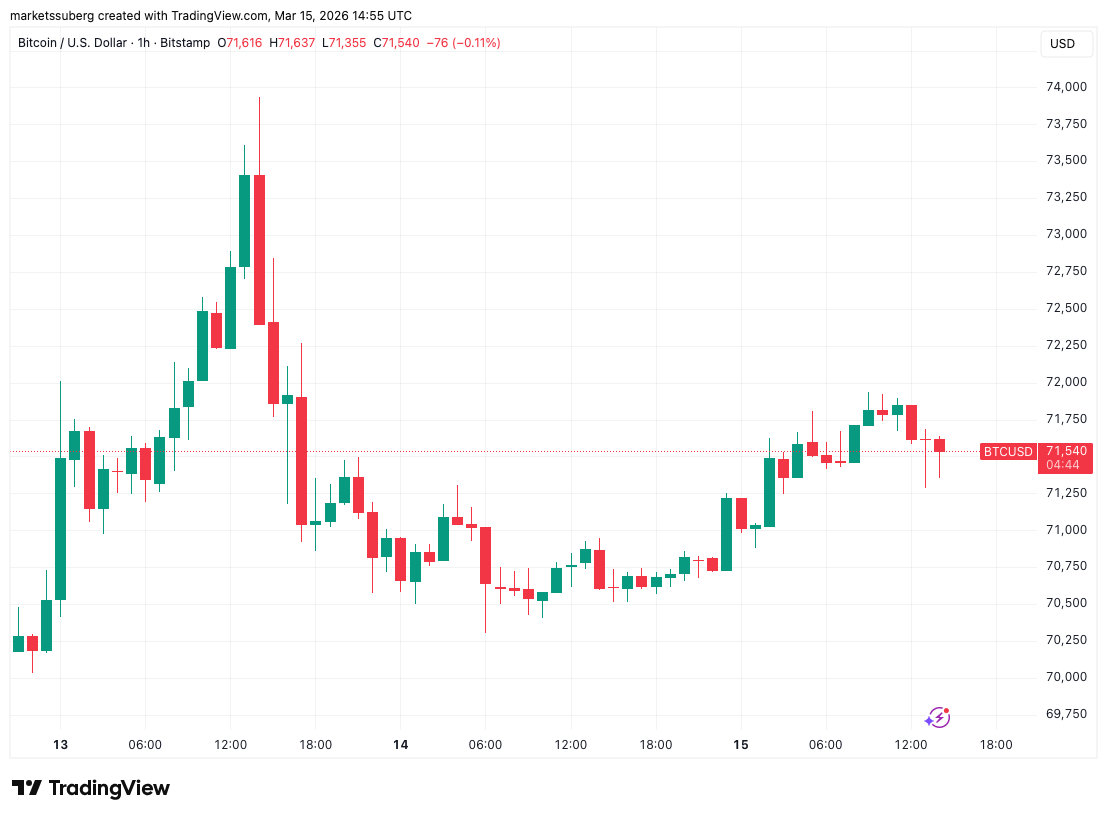
Bitcoin edged toward an important weekly close above $70,000 that would include a reclaim of an important 200-week trend line.
Bitcoin (BTC) inched higher on Sunday as bulls sought to seal a weekly close above $70,000.
Key points:
-
Bitcoin eyes its highest daily close in over a week with a fresh weekend push above $70,000.
-
Price offers a reclaim of a key support trend line on weekly time frames.
-
Sell-side pressure at local highs is “steady profit-taking,” analysis says.
BTC price attempts long-term support rescue
Data from TradingView showed out-of-hours price action topping out just below the $72,000 mark before cooling.

Now in line for its seventh consecutive green daily candle, BTC/USD eyed its highest daily close since March 4.
Along with $70,000, price also stayed above key long-term levels: the 200-week exponential moving average (EMA) and the old 2021 all-time high at $68,300 and $69,400, respectively.

“The recent correction on Friday on Bitcoin was essentially just risk-off appetite to not be having positions going into the weekend. Nothing else,” crypto trader Michaël van de Poppe wrote in his latest X analysis.
“Markets are turning back upwards again, probably we’ll see a slight pullback later today for CME gap closing appetite, but other than that, I would assume we’ll continue to grind upwards to the resistances at $75-80K.”

Van de Poppe correctly forecasted that the price would revisit Friday’s closing price of CME Group’s Bitcoin futures market at $71,325.
At the time of writing, BTC/USD was still up by more than 8% on the week, with March gains at 6.7%.

Macro turmoil spoils Bitcoin “relief rally”
Geopolitical risk, meanwhile, remained at the forefront of trader discussions.
Related: Bitcoin ‘passing geopolitical stress test’ as BTC price spikes above $72K
WTI crude oil ended the week attempting to repass $100 per barrel, with the global oil supply shock still playing out.

“If macro was calm, this sort of structure could easily turn into a relief rally. But with the current backdrop… downside risk still hasn’t really gone away,” crypto analysis host Kyle Doops commented on X last week.
Doops identified a mid-term trading range for Bitcoin that was bordered by two key boundaries: the true market mean at $78,400, and the aggregate realized price of the current supply at $54,400.
“Every time price pokes above $70K, sellers show up. Not panic selling… just steady profit-taking,” he summarized about lower time frames.

This article does not contain investment advice or recommendations. Every investment and trading move involves risk, and readers should conduct their own research when making a decision. While we strive to provide accurate and timely information, Cointelegraph does not guarantee the accuracy, completeness, or reliability of any information in this article. This article may contain forward-looking statements that are subject to risks and uncertainties. Cointelegraph will not be liable for any loss or damage arising from your reliance on this information.

Touchstone Mid Cap Fund Q4 2025 Portfolio Review

Is This BTC’s Calm Before the Major Storm?

Bryson DeChambeau wins LIV Golf Singapore


-
 Tech4 days ago
A 1,300-Pound NASA Spacecraft To Re-Enter Earth’s Atmosphere
-
 Crypto World2 days ago
HYPE Token Enters Net Deflation as HyperCore Buybacks Outpace Staking Rewards
-

 News Videos6 days ago
10th Algebra | Financial Planning | Question Bank Solution | Board Exam 2026
-

 Business5 days ago
ExxonMobil seeks to move corporate registration from New Jersey to Texas
-

 Crypto World6 days ago
Paradigm, a16z, Winklevoss Capital, Balaji Srinivasan among investors in ZODL
-

 Fashion2 days ago
Weekend Open Thread: Addict Lip Glow
-

 Tech5 days ago
ChatGPT will now generate interactive visuals to help you with math and science concepts
-
Sports1 day ago
Why Duke and Michigan Are Dead Even Entering Selection Sunday
-

 NewsBeat4 days ago
Residents reaction as Shildon murder probe enters second day
-

 Business7 days ago
Search for Nancy Guthrie Enters 37th Day as FBI Probes Wi-Fi Jammer Theory
-

 Business4 days ago
Search Enters Sixth Week With New Leads in Tucson Abduction Case
-
 NewsBeat6 days ago
Pagazzi Lighting enters administration as 70 jobs lost and 11 stores close across Scotland
-

 Tech6 days ago
Despite challenges, Ireland sixth in EU for board gender diversity
-

 Business1 day ago
US Airports Launch Donation Drives for Unpaid TSA Workers as Partial Government Shutdown Enters Fifth Week
-

 NewsBeat4 days ago
I Entered The Manosphere. Nothing Could Prepare Me For What I Found.
-
Crypto World23 hours ago
Coinbase and Bybit in Investment Talks: Could Bybit Finally Enter the US Crypto Market?
-

 Business6 days ago
Search Enters 39th Day with FBI Tip Line Developments and No Major Breakthroughs
-

 Sports6 days ago
Skateboarding World Championships: Britain’s Sky Brown wins park gold
-

 Business1 day ago
Country star Brantley Gilbert enters growing non-alcoholic beer market
-
 Crypto World5 days ago
Will Chainlink price reclaim $10 amid volatility squeeze?

