

Politics
Here's the one role Leo DiCaprio regrets turning down


!function(n){if(!window.cnx){window.cnx={},window.cnx.cmd=[];var t=n.createElement(‘iframe’);t.display=’none’,t.onload=function(){var n=t.contentWindow.document,c=n.createElement(‘script’);c.src=”//cd.connatix.com/connatix.player.js”,c.setAttribute(‘async’,’1′),c.setAttribute(‘type’,’text/javascript’),n.body.appendChild(c)},n.head.appendChild(t)}}(document);(new Image()).src=”https://capi.connatix.com/tr/si?token=19654b65-409c-4b38-90db-80cbdea02cf4″;cnx.cmd.push(function(){cnx({“playerId”:”19654b65-409c-4b38-90db-80cbdea02cf4″,”mediaId”:”87fb3dc3-97a5-4b2a-a385-3b4f5d48e0ea”}).render(“69b6d9f5e4b0e8cdfdd26cc2”);});


An experienced cinematographer’s directorial debut has been part of a campaign to declassify government blood records of nuclear test veterans. Previously held under the highest levels of security clearance, those records are now being released to veterans’ families for the first time, with the full archive scheduled to be made publicly accessible through The National Archives later this year.
Recognition for nuclear test veterans
Alan Owen is co-founder of LABRATS International and former chairman of the British Nuclear Test Veterans Association. Daniel Everitt-Lock’s film Our Planet, The People, My Blood follows Owen as he leads a landmark legal battle seeking recognition and compensation for the millions of people affected by nuclear weapons testing programs worldwide.
Check out the trailer:
Making the film took three years and 150,000km of travel by director Everitt-Lock and co-producer Rodrigo Borda. Journeying across four continents, they captured over 50 first-hand testimonies. These included people from Indigenous Marshallese communities (Marshall Islands), the Maralinga Tjarutja of Australia, the Spokane Nation of the United States and survivors of the atomic bombings of Hiroshima and Nagasaki.
Everitt-Lock says:
Nine years ago, I watched a short film about nuclear test veterans and couldn’t believe that no one was talking about it. I set out to make a documentary that offered a deeply human account of the communities forgotten by the governments that harmed them.
Owen, from LABRATS International, comments:
This documentary shows the years of denial from one of the oldest establishments in the UK and across the world. The affected communities now have a voice through this incredible piece of work. My family’s story is just one of thousands which has been suppressed, it can now be heard.
The film premiered at the Prince Charles Cinema, Leicester Square, London, on 12 March. Following the world premiere, the feature documentary will have screenings in cinemas across the UK. Venues include London, Liverpool, Manchester, Birmingham and Brighton.
Everitt-Lock, adds:
I’m thrilled to share this story with the world as we continue to change the political agenda and fight for long-deserved justice for millions of victims and their families.
Details of other screening dates and tickets across the UK will appear here.
Everitt-Lock is a London-based director and cinematographer with a decade of professional credits across film and television. As a cinematographer, his work spans productions for Amazon, HBO, and the BBC across more than a dozen feature films and multiple television series.
Our Planet, The People, My Blood is his feature documentary debut. Since completion, it’s had endorsements from Nobel Peace Prize-winning International Campaign to Abolish Nuclear Weapons (ICAN), CND and UN House Scotland. A Parliamentary screening in January 2026 secured cross-party political support. Jambika Docs has acquired Our Planet, The People, My Blood for international distribution.
Featured image via True Perspective Films

On the evening of 10 March, masked Israeli colonial settlers carried out a violent attack in the village of Hamamat al Malih, in the Northern Jordan Valley.
They came back presumably to kidnap the residents
Journalist and human rights activist Andrey Khrzhanovskiy, better known as Andrey X, arrived in the village to find 70-year-old resident Abu Raed severely beaten and struggling to stand. Two hours earlier, settlers had stormed the place and found Abu Raed alone. So they viciously attacked him, then left the area. Abu Raed, like most of the Palestinians living there, has also previously been attacked by settlers. Just two nights before this attack, they also smashed the windows of his home and completely destroyed its contents.
The settlers returned, while Andrey X was still in the village. Armed with knives, sticks and rocks, they smashed the activists’ car, slashed all four tyres, and then chased them.

Andrey X, Abu Raed, and a 70-year-old solidarity activist, barricaded themselves in a house, but the settlers broke down the door and repeatedly attacked all three of them. Andrey X says he was thrown to the ground, then beaten and kicked in the face and head. He believes the settlers had other intentions when they returned to the village.
When they broke into the house and started attacking us, they had plastic zip ties in their hands, literally ready to use. My assumption is that they were planning to kidnap the Palestinians. They saw there were no activists in the village two hours before, so they came back presumably to kidnap the residents. But I’m assuming that because we were there, they decided to just attack us instead.


Israeli occupation police claim, as always, there is no evidence the settlers have done anything wrong
The settlers then left the area, but not before taking Andrey X’s phone to ensure there would be no evidence of their attack. But shortly afterward, at around the same time as the police, they returned again, this time unmasked, and in different clothing. Unsurprisingly, the ‘Israeli’ occupation police did nothing, and said there was no evidence that the settlers carried out the attack. An Israeli ambulance also arrived, and at first refused to treat Abu Raed, saying “he is an Arab, what can we do.” Eventually it took him away, and transferred him to a Palestinian ambulance.


There is a military base next to the village and an outpost three kilometres away, to the north. According to Andrey X, that is where the settlers come from every day, to terrorise not only the residents of Hamamat al Malih, but also other nearby villages. While settlers in the Jordan Valley have historically been less physically violent towards Palestinians than in places such as Masafer Yatta, or East Ramallah, this is no longer true.
He says:
This changed instantly when the war with Iran started. There are now daily pogroms, with beatings and hospitalisation. They’ve been escalating their violence further and further, since the election of the current government. So when they see they can get away with more, then they escalate even further. Our activist colleagues who have infiltrated settler group chats say they’re openly saying to each other that now everyone’s distracted, this is their chance. They say they need to escalate and take as much as possible, while all attention is on the war with Iran.
Andrey X tells us that daily attacks occurred in Hamamat al Malih in the week leading up to this attack. And the day before, settlers had destroyed CCTV cameras, solar panels and windows in the village. He says it is no longer safe for Palestinians to stay there if there are no activists, or only a few residents present. The women, children, and livestock have already gone, because of the sustained violent attacks.
Commander of IOF Jordan Valley Brigade to Palestinians: ‘It’s better for you to leave than for us to expel you’
With their growing confidence, brought about by the inaction of the international community, attacks by these zionist colonisers have dramatically increased, and become more violent. According to a new report from 13 March, by the Colonisation and Wall Resistance Commission, settlers carried out 192 attacks during just the last two weeks of the Israel-US war on Iran. These actions are encouraged by the occupation. On 8 March, Gilad Shriki, Commander of the Jordan Valley division of the Israeli occupation forces (IOF), went to every remaining community in Area C of the Jordan Valley.
He threatened them, saying:
This is Area C, a military area, so you have to get out of here. It’s better for you to leave than for us to expel you.
More than 60 percent of the West Bank is in Area C. This means it is under complete “Israeli” control. The occupation is currently carrying out a campaign of ethnic cleansing against Palestinians living in this area. This includes those living in the Jordan Valley, 90 percent of which is in Area C.
These illegal settlers are aided and protected by the IOF, and armed by the Israeli occupation government. They work together for the benefit of the Jewish supremacist state of Israel, with the aim of ethnically cleansing the occupied Palestinian territory of all Palestinians. Not a day goes by that a Palestinian family is not displaced, a Palestinian home is not set alight or a Palestinian is not seriously injured or even killed. The forcible transfer of residents of an occupied territory is a war crime under international law. It is time the inaction of the international community came to an end, and the Israeli occupation is held to account for its countless crimes against Palestinians.


Welcome back to Canary catch-up, your weekly natter about the most talked-about TV of the week. This week in between copious amounts of TV, I’ve also been enjoying some live music. Last Sunday, I saw Lily Allen perform her full West End Girl album, which was incredible, raw, feminine rage. It was also topped off by her opener, the Dallas Minor Trio performing her hits on strings. With all that’s going on in the world, I can’t tell you how much I needed to shout along to a classical version of Fuck You.
Anyway, on with what I’ve been watching!
Can Dadtok survive this? I fucking hope not
My guilty pleasure show, The Secret Lives of Mormon Wives, is back! Make no mistake, TSLOMW is utter fucking trash, I know it, the producers know it, and Momtok knows it. There is nothing you can say that will convince me Layla isn’t a plant because that lass is just evil and not subtle. But I cannot get enough. This series, however, something gross has emerged – Dadtok.
“Oh I know what we need in this show about women breaking out of the patriarchal religious archetype, some sexist men!” said the producers, seemingly, because this series you cannot fucking get rid of these toxic men and their need for attention. Aside from this the other highlight of the series is Demi being desperate for clout but refusing to take any ownership by refusing to do interviews, so the producers decided to interview an empty chair. Which is even funnier when you realise the Wives are all executive producers now.
Louis Theroux’s ‘groundbreaking’ doc is old news for women
The internet has been abuzz this week over Louis Theroux’s new Netflix show Inside The Manosphere. The filmmaker delved into the murky world of male influencers who are all racist and massively misogynistic shitbags and exposed just how little they actually believe their own shit. But they portray themselves as wealthy with their pick of women, and young working-class boys look up to them.
The thing is, though, as bad as some of the shit in it was, it was nothing women didn’t already know. This is the shit we see and get thrown at us all the time. But it just didn’t go deep enough. As journalist Jess Davies pointed out, the show didn’t mention the patriarchy once. While much of the focus is on teenage boys, there’s also no mention of how teenage girls will have this harmful misogyny forced on them.
And that was where the show fell down for me. It didn’t do enough to address society, the media, and the government’s involvement.
The Walsh Sisters shines a light on family dynamics and addiction
I’ve been loving The Walsh Sisters on BBC iPlayer this week. The Irish family drama based on Marian Keyes’ books is a sharp look at family tensions and addiction. It’s the beauty and the brutal reality of adult sister relationships. They’re both your best friends and someone who knows exactly which button to press and when. Your co-conspirator with overbearing parents and the first one to slyly make a dig about you.
But all of this gets even more complicated when addiction is involved. When Rachel goes to rehab for her drug and alcohol addiction, some of her sisters are shocked. In particular, Claire, who questions her parents decision, mainly because she often drinks as much as Rachel, if not more. This was a common thing I got when I first got sober. Many were shocked as they drank more than me. But this really speaks to just how ingrained drinking culture is.
Good old BBC homophobia
The BBC announced this week that its flagship queer dating shows, I Kissed a Boy and I Kissed a Girl, had been axed. Hosted by Dannii Minogue, they were the first queer dating shows in the UK. but not anymore, apparently. The broadcaster said the decision was due to ‘funding challenges’:
Unfortunately, we have to make difficult choices in light of our funding challenges and there are no current plans for the show to return.
The BBC can blame funding all they want. But it’s interesting that of, all the shows they could’ve cut, they cut the only two specifically representing queer people and not Mrs Browns Boys isn’t it? After also airing racism, covering for genocide, and demonising benefit claimants recently, it looks like the BBC just got a full house.
Canary Catch Up will be taking a break next week as I’ll be flouncing about the Scottish Highlands, but join me back here on 28th for more telly talk
Featured image via the Canary

In the crass new Channel 4 show Handcuffed, hosted by Jonathan Ross, two strangers with wildly different lifestyles or views are manacled together. It invites us to wallow in the discomfort of two people who have nothing in common, and can’t get away from each other fast enough.
As political metaphors go, it’s quite brilliant. The public has found itself shackled to a Labour government it despises. Keir Starmer is the first prime minister in modern times to be met with hostile football chants. Labour now regularly polls fourth.
And the hostility is mutual: Labour holds the public in contempt, too. This is evident from small things, like the derisive messages posted in a private WhatsApp group by former MP Andrew Gwynne. ‘Dear resident, fuck your bins. I’m re-elected and without your vote. Screw you. PS: Hopefully you’ll have croaked it by the [local elections].’ Unsurprisingly, he resigned his seat after the messages were made public.
It’s even more evident in the big things, like ending inheritance tax relief for farmers, or imposing punitive expenses on pubs and small businesses, or its allergic reaction to displays of patriotism. While Labour wrapped itself in the Union Jack in the 2024 election, it now deems it a potential ‘tool of hate’ – at least according to its draft ‘social-cohesion strategy’, leaked earlier this month.
It’s most evident in all the ways Labour tries to avoid hearing from us. This week, the government finally launched a consultation into a national digital-ID scheme. This scheme entails a radical change in the relationship between the citizen and the state, and Labour’s attempt to introduce a single identifier – a plastic ID card – was scrapped in the face of huge public opposition in 2010. The fact that, this time around, Labour announced the policy first, before any consultation, is a bit of a giveaway. It doesn’t care what we think of it, as it’s going to do it anyway.
But that’s only half of it. The consultation announcement this week introduces a novel proposal. This is a ‘People’s Panel on Digital ID’, described as ‘an in-depth deliberative engagement process with a broadly UK representative sample of 100 to 120 individuals to discuss the policy in detail. Individuals will be selected through sortition (civic lottery).’
There should be no mystery about what people think about digital ID. They have already spoken: last year, almost three million signed a petition opposing it, and MPs offices have been inundated with angry emails about it. So why continue?
The reason is that Labour believes that digital ID is so self-evidently good that any opposition must be wildly irrational. In November on spiked, I called digital ID an exercise in self-deception. Labour has convinced itself that it would be easy to develop and implement the scheme and that, soon, familiarity with it would overcome long-standing principled objections. Labour imagines that, aside from some noisy conspiracy theorists, who talk about the imminent imposition of social-credit systems or the end of anonymous cash transactions, the majority will soon see how brilliant a digital identity is.
But this dismisses many profound and rationally held concerns around the state imposing a unique digital identifier. This is not some fringe concern. As critics point out, it fundamentally changes the relationship we have with the state, turning us into a ‘papers, please’ society.
All this is before we get to the well-founded security fears, also documented here on spiked, over identity theft and fraud. Questions about the One Login system, designed to help citizens access government services online, have been raised in parliament after it was revealed that parts were developed in Romania – a known hotspot for cybercrime. Nothing here inspires trust.
But back to the so-called people’s panel. The idea that a tiny, selected subset of the public should be ventriloquised to speak on our behalf is disturbing. The idea of citizens’ assemblies has been applied to another unpopular, top-down set of ideas with which we must not disagree: climate mitigation. As Ben Pile wrote in 2020 and in 2021 on spiked, these are exercises in manufacturing consent.
Incredibly, the government is seeking to go even further in distancing itself from the public to which it finds itself manacled. It is reportedly attracted to the concept of synthetic focus groups, in which opinions are generated by AI chatbots. This is an idea championed by Dominic Cummings, Boris Johnson’s former chief adviser. Indeed, Cummings’s favourite computer modeller, Ben Warner, has set up a new firm selling these machine-generated insights to marketing departments and political campaigns, called Electric Twin.
Its political appeal is tailor-made to a public that Labour finds mystifying. On its website, Electric Twin said: ‘Societies feel unknowable… leaders and teams are frequently blindsided’, although it removed the words after I drew attention to them in the Telegraph last year. Removing human feedback must be an attractive proposition for such an unpopular government.
Citizens assemblies, digital-ID workshops and synthetic focus groups are all an acknowledgement that top-down, unpopular ideas meet resistance from the public. But, such is the contempt of our elites, they want to sidestep us altogether.
‘Would it not be simpler if the government simply dissolved the people and elected another?’, asked Bertolt Brecht. Thanks to generative AI, the British government now thinks it can. But the real democratic reckoning on digital identity awaits. Labour won’t get off the hook that easily.

Starmer knew.
And now we know Peter Mandelson was fast-tracked into government despite explicit warnings that his “particularly close” friendship with prolific paedophile, Jeffrey Epstein made him a “general reputational risk”.
Keir Starmer chose to ignore red flags about a man who stayed at Epstein’s house after his conviction.
And Starmer knew.
Mandelson’s vetting was rushed; Keir Starmer ignored and overruled his own vetting team. And the sleazy peer walked away with a hefty £75,000 payoff, after asking for £547,000.
In any other walk of life both Starmer and Mandelson would be toast. But it seems running a protection racket for the predatory elite comes with very little in the way of consequences these days. This is a whole lot more than just a typical Westminster sleaze story, isn’t it? Starmer’s Labour is recycling the very worst of Blairite cronyism instead of breaking with it, once and for all.
Seriously, how can anyone take morality lectures from this deeply flawed government on violence against women and girls whilst the victims of the Epstein cult are being re-traumatised by the drip-feed of damning revelations?
A government that weaponises #MeToo rhetoric while shielding Epstein-adjacent insiders is not the progressive force that it claims to be. It is utterly contemptuous.
Starmer is forgetting that the victims deserve better
Epstein wasn’t some eccentric billionaire. He was a convicted sex offender whose island and little black book were central to one of the most horrific trafficking scandals of our lifetimes. Women and girls were abused, exploited and silenced. Victims and survivors are still fighting for justice today.
The guy that positioned himself as the anti-corruption prosecutor looked the other way because Mandelson is one of them – that toxic Blair-era network of lobbyists, multi-millionaires, and influencer-peddlers who turned Labour into a vehicle for the super-rich.
This is the same Starmer who purged socialists to the glee of the pro-Israel parliamentary Labour party, ditched public ownership, and told poor and working-class voters their demands for wealth taxes and rent controls were unrealistic.
Yet protecting a mate with extremely fucking grubby Epstein ties? That was apparently non-negotiable for Keir Starmer. It can be so very easy to mistakenly assume this is down to Starmer’s incompetence and horrific lack of judgement. But this is elite impunity baked into his DNA.
Starmer and Mandelson aren’t redeemable. They’re symptoms of a Labour party that lost its soul a long time ago.
The British people really don’t need more apologies to Epstein’s victims from the man who enabled one of Epstein’s closest friends.
What we do need is a fully independent public inquiry – not another closed-door stitch-up into how Epstein’s paedophile network infiltrated British power under successive UK governments. We must also claw back every single penny of Mandelson’s outrageous payoff. Revoke his peerage and demand full transparency on any other Epstein associates lurking in Labour circles.
Come on, you call that an apology?
Where is the accountability for the elite? Families are scraping by on food banks and charity, yet Labour hands golden parachutes to Epstein’s pals.
Britain needs public ownership, wealth taxes, council houses, green investment, social justice and an end to the revolving door between government and the super-rich. No more rehashed Blairism and no more Blairite retreads.
And for me, Keir Starmer has to go.
Starmer’s resignation is essential because his judgement is irreparably shattered, destroying trust in Labour at a time when Britain needs unity against fascism. His leadership is morally and politically bankrupt. How can he credibly fight for justice, equality or safeguarding when he’s complicit in elite protection rackets?
And what of Starmer’s mealy-mouthed regret for his “mistake”?
This isn’t contrition. It’s the classic elite dodge – admit just enough when the evidence is public, shed a crocodile tear for victims, then carry on as if nothing has happened. The victims of Epstein’s network of abusers – working-class girls groomed, trafficked, and discarded – really don’t need platitudes from the man who knowingly rehabilitated one of Epstein’s inner circle.
They need accountability and justice. Survivors deserve so much better than a prime minister who ignored glaring child-trafficking red flags. Every day Starmer clings to power he normalises this filth, erodes trust in politics and hands ammunition to Reform UK.
It’s not a one off when it’s all the time
And to every cynic who says “they’re all the same” – this isn’t just about one very bad appointment. It’s the obituary of Starmer’s fake-progressive centrism project that protects the elite whilst betraying the many. Labour was built as a weapon for workers, not a shield for paedophile-network enablers. Starmer has proven he won’t deliver progressive change, or even decency.
The Labour party may well be waiting for the outcome of the local elections in May before deciding what to do with Starmer.
Spoiler: Labour are facing an epic obliteration and will lose scores of council seats to a truly progressive force like the Green party.
Justice demands immediate and decisive accountability. Not an internal power struggle between the centre and right-wings of this broken Labour government.
Keir Starmer knew.
And now Keir Starmer has to resign.
Featured image via the Canary

A coalition of leading human rights, health groups and trade unions has urged NHS England to cancel its contract with Palantir based on serious risks to the NHS. Medact has sent its new briefing document, Concerns Regarding Palantir Technologies in NHS Data Systems, to all NHS trust and Integrated Care Board CEOs.
It urges them to exercise their local autonomy and not comply with NHS England’s instruction to adopt Palantir’s Federated Data Platform.
Palantir embedded across the NHS
Assessing the risks posed by the company’s technology to patients and the NHS, the briefing raises alarm over data protection, governance, procurement practices, state surveillance and the wider human rights implications of embedding Palantir’s systems across the health service.
The briefing warns that adopting Palantir’s Foundry platform under the NHS Federated Data Platform could cause irreparable reputational damage to NHS bodies and permanently undermine public trust.
It argues that Palantir’s links to alleged human rights abuses, the US and Israeli militaries, controversial policing practices, deportations and surveillance operations should have excluded it from NHS procurement entirely.
The Good Law Project’s Duncan McCann said:
Palantir is a direct threat to our health service that could see millions of people refuse to share their records – fatally undermining the very system it claims to improve.
At the heart of the warning is the interoperability of Palantir’s platforms. Its civil software Foundry and military software Gotham share underlying architecture. Because of this, the NHS’s adoption of the technology could indirectly contribute to the advancement of militarised tools that have been linked to alleged human rights abuses.
Defence and policing as well
With Palantir’s expansion into the Ministry of Defence and police forces across the country, groups warn of the risk of data-sharing across government departments.
Foundry software is currently enabling US Immigrations, Customs and Enforcement (ICE) to track migrants using the Department of Health and Human Services. This highlights the power of Palantir technology to drive data-driven abuses of state power.
The groups also raise concerns about procurement processes. They point to overlapping relationships between political figures, contractors and NHS leadership. This includes Peter Mandelson and his lobbying firm Global Counsel.
The Chelsea and Westminster Hospital NHS Foundation Trust has acted as a showcase site for Palantir technology. Its chair Matthew Swindells also simultaneously advised Palantir and Global Counsel.
Anna Peiris of Medact said:
For health workers, patient safety – and the security of their data – is non-negotiable. The launch of this briefing will help them to continue resisting Palantir, a company known for supporting the genocide in Gaza and mass deportations in the US, and ensure the rollout of Palantir’s data platform is stopped for good.
Cuts are driving Palantir dependence
The briefing also highlights new data privacy concerns. This is an issue which NHS leadership has repeatedly dismissed. The report reveals that, as part of the Federated Data Platform rollout, NHS data teams are reportedly receiving multiple requests each week from Palantir staff seeking access to stored patient-identifiable information.
Amid widespread staffing cuts across the NHS, analysts are increasingly reliant on Palantir personnel for implementation and system management. The groups warn this risks ‘vendor lock-in’, with Palantir retaining intellectual property and becoming entrenched as the dominant NHS data supplier.
The document also points out that, in a 2025 meeting, the health secretary Wes Streeting promised to review the governance of confidential patient information. He described this to Palantir as presenting “opportunities”.
The political context is shifting rapidly. The British Medical Association has announced its intention to explore how doctors can refuse to use Palantir’s software. Meanwhile, the Green Party has pledged to mobilise its members and councillors to oppose the rollout.
The briefing predicts further resistance from both NHS staff and patients if implementation continues, and urges local NHS bodies not to implement the technology.
A spokesperson for the United Tech and Allied Workers Union said:
Palantir’s encroachment into public services should be of utmost concern to the public and the government. The question of control is critical to maintaining both infrastructure and healthcare delivery.
Our members in the tech sector understand the importance of trust and oversight in tech, and this company has repeatedly proven itself to be untrustworthy and scruple-less.
Our NHS systems should be built and owned with public oversight and accountability. We should be leveraging and building in-house NHS technology expertise to deliver the data system we rely on, rather than giving Palantir profit and control of our private health data.
Hope Worsdale of Just Treatment said:
The trust between a patient and their doctor is paramount: it is the bedrock of the health service. Placing Palantir at the heart of our NHS – despite its immoral business practices, deadly products, anti-democratic leadership, and ineffective services – will have an irreparable, corrosive effect on that trust.
It begs the question: why have the lines of lobbyists mattered more to this government than the lives of patients?
We call on everyone with power within the NHS to heed this report’s warning, and resist at every possible point the imposition of Palantir’s control over patient data.
We call on parliamentarians to demand the government rips up its contract with Palantir, and develops a data processing system owned and controlled by our health service focused solely on the interests, needs, and rights of NHS patients.
Featured image via the Canary

The US Federal Communications Commission (FCC) has threatened the licenses of news broadcasters for reporting on the damage that Iranian strikes have done to the US military.
Broadcasters that are running hoaxes and news distortions – also known as the fake news – have a chance now to correct course before their license renewals come up.
The law is clear. Broadcasters must operate in the public interest, and they will lose their licenses if they… https://t.co/7bBgnsbalw
— Brendan Carr (@BrendanCarrFCC) March 14, 2026
The Chairman of the FCC, Brendan Carr, said:
Broadcasters that are running hoaxes and news distortions – also known as the fake news – have a chance now to correct course before their license renewals come up.
He quoted a separate X post, which included a post from Donald Trump on Truth Social. Specifically, Trump pointed to the New York Times, the Wall Street Journal, and other “lowlife papers”.
According to Trump no plane was damaged, but “one had slightly more damage” than the rest.
We can only presume that this means the US is not doing so well in the war.
The pesky news headline that got your station’s license in trouble: “Iran war not going so well, parts of US military telling other parts it’s not going so well” https://t.co/3GKbookK7F
— Thijs (@notmobydick) March 14, 2026
US — free press
A free press is more important than ever — especially when Trump and Netanyahu have waged an illegal and unprovoked war.
You have to understand a free press—especially in wartime—is very important. Trump is trying to stop that.
When you wage an illegal preemptive war that has targeted civilians and your secretary of defense says “no quarter” ( war crimes” then there needs to be documentation. https://t.co/lKu1uhDbav
— Tina Issa 🇺🇸 (@tinaissa) March 14, 2026
Even more so, when Trump is sending US troops to fight in a war which he only started because his incompetent ‘advisors’ (i.e., Trump’s son-in-law) did not have the “technical expertise” to understand the negotiations with Iran.
The US government isn’t being forthcoming with Americans. More transparency would fix this. But the war is being run by idiots in the dumbest administration in American history. https://t.co/6TUG5WB7vz
— Michael (@mikethenavyguy) March 14, 2026
Importantly, the First Amendment in the US Constitution states:
Congress shall make no law respecting an establishment of religion, or prohibiting the free exercise thereof; or abridging the freedom of speech, or of the press; or the right of the people peaceably to assemble, and to petition the Government for a redress of grievances.
Therefore, the FCC or Trump threatening media organisations is illegal.
If Trump doesn’t like your coverage of the war, his FCC will pull your broadcast license.
That is flagrantly unconstitutional. https://t.co/Jp1Mk5EEJb
— Governor Gavin Newsom (@CAgovernor) March 14, 2026
In January, 2025, the White House said:
Over the last 4 years, the previous administration trampled free speech rights by censoring Americans’ speech on online platforms, often by exerting substantial coercive pressure on third parties, such as social media companies, to moderate, deplatform, or otherwise suppress speech that the Federal Government did not approve.
Yet here Trump is, telling news broadcasters what they can and cannot publish during his illegal war.
If you’re not willing to be a propaganda machine for this admin, our FCC Chair thinks your license should be revoked
They are so terrified of the truth
It reveals their greed, hatefulness, thin-skinned egos & incompetence
👇🏻 https://t.co/akrmpjCSFS— (((psychrat))) (@psychrat) March 14, 2026
Even Brendan Carr said in December 2023:
Free speech is the counterweight—it is the check on government control.
That is why censorship is the authoritarian’s dream.
And in December 2024:
Censorship isn’t just about silencing words—it is about controlling ideas and replacing robust debate with the cement of orthodoxy.
So, how much has Trump paid him to change his tune?
Nazi Germany
It’s ‘Never forget’ World War Two, unless one of Jeffrey Epstein’s pedo-friends is telling you to.
Fascism by every definition. Fighting in WW2 to eliminate this is oddly celebrated on Nov 11 by the same tools that support this Presidency. “Never Forget” until your orange pedo cult god tells you to forget. What are we doing here? https://t.co/gQOK1ulW9L
— Ringo (@ringo1973) March 14, 2026
When Hitler came to power in Germany in 1933, his regime destroyed the country’s free press. It shut down hundreds of opposition newspapers and issued daily orders dictating what could and could not be published.
See the similarities yet?
“Give up your rights to freedom of speech and the press so we can have state-sponsored propaganda, or else” is what authoritarian countries say. https://t.co/kB3Ef6WPMB
— Melanie D’Arrigo (@DarrigoMelanie) March 14, 2026
It is straight out of the Nazi Germany propaganda playbook.
The is the federal government telling news stations to provide favorable coverage of the war or their licenses will be pulled.
A truly extraordinary moment.
We aren’t on the verge of a totalitarian takeover. WE ARE IN THE MIDDLE OF IT.
Act like it. https://t.co/3w4kpzray7
— Chris Murphy 🟧 (@ChrisMurphyCT) March 14, 2026
Freedom of the press is the backbone of society. It allows us to report on the truth and hold powerful people to account. The Committee to Protect Journalists has called state-sponsored censorship one of the “most urgent threats facing journalists worldwide”. However, it appears the US is now heading towards countries like North Korea and Burma — where independent journalists cease to exist.
Ultimately, the US government does not want the American people to know that its attacks on Iran are illegal and that they’re failing badly.
Feature image via CNN/YouTube

When your partner frustrates you or your mum is on your last nerve, it’s natural to call a friend or talk about your feelings at the next wine night. But not all emotional unloading is created equal.
“Although they seem similar on the surface, venting and complaining are actually distinct phenomena that lead to different outcomes for your mental health,” Natalie Moore, a licensed marriage and family therapist, told HuffPost.
So what exactly is the difference? And when does talking to friends about your feelings about a person or situation go from a healthy outlet to an unproductive cycle of negativity?
Below, Moore and other relationship experts break it down.
What is venting?
“I think of venting as letting off steam about the annoying habits or behaviours that are inevitable in a relationship,” said Tracy Ross, a licensed clinical social worker specialising in couples and family therapy. “And more often than not it’s helpful to have a friend who listens, validates and just understands why you feel the way you do – without judgment.”
Having a little vent session with a close friend can be a healthy way to engage with something that’s bothering you.
“Venting typically involves expressing emotions and frustrations in a way that seeks understanding or relief,” said relationship therapist Joy Berkheimer. “It allows for an honest exploration of feelings and can facilitate personal insight or clarity when approached constructively. Essentially, venting can be a form of processing, providing a necessary outlet for emotional burdens.”
It feels good to get something off your chest and discuss how it’s been affecting you.
“Venting often sounds like, ‘I just need to talk this through – I had a moment, and I need someone to hear me out,’” said Sanah Kotadia, a licensed professional counsellor with Balanced Minds Therapy. “There’s usually emotion, but also a sense of release or clarity afterward.”
Getting to hear someone else’s perspective can also help you see the situation more clearly.
“Honestly, sometimes we need to talk to our friends when we’re confused, frustrated, or even just want someone to say, ‘Yeah, that would drive me nuts too,’” said April Davis, the founder of Luma Luxury Matchmaking. “It can be a way to process what you’re feeling in a safe, supportive space.”
A little venting can give you the chance to calm down and explore why you’re feeling strongly so that you can address the issue directly with the other person later with a cooler head.

“Venting can be a healthy outlet if it’s done intentionally, with self-awareness,” said dating coach Sabrina Zohar. “It’s about releasing tension, exploring feelings, and often includes self-reflection. It sounds like, ‘I’m overwhelmed and need to talk this through so I can make sense of it.’”
Maybe you had an argument with your partner over something small, like not getting to go to the beach for a weekend because you have to go visit your in-laws.
“Sometimes, all we need is the opportunity to let off steam and we’re ready to let the situation go,” Moore said. “Other times, the venting allows us to transition into problem-solving mode. Venting primarily indicates that there is an emotional release that needs to occur to avoid a blowup, much like relieving pressure on a pressure cooker so it doesn’t explode.”
What is complaining? How does it differ?
“Complaining often carries a more negative connotation,” Berkheimer said. “It tends to focus on grievances without seeking resolution or understanding. Complaining may involve repetitive criticism that doesn’t foster growth, and it can lead to a cycle of negativity that detracts from the relationship.”
There’s a greater focus on blame in complaining, which has a critical edge to it.
“It’s more about being right than being real,” Zohar said. “It sounds like, ‘Can you believe they did this again?’ and usually doesn’t leave room for personal accountability or change.”
Rather than exploring and shifting your own thinking on the subject, you tend to circle the same frustration over and over.
“When someone engages in chronic complaining, they aren’t just releasing tension from the system – they’re actually subtly communicating that they aren’t ready to make the necessary changes to solve the problem,” Moore said.
“For example, someone who isn’t ready to face conflict head-on might complain to their friends about their partner as a way of expressing frustration without having to face their own fears.”
Ultimately, complaining feels like an attack rather than a way to blow off steam. There might even be a sense that you’re putting the weight of these issues on your loved ones and expecting them to solve the problem.
“Complaining goes more to the character of the person and can be detrimental,” Ross said. “It can be disloyal depending on the content and the intent behind sharing. It may backfire – if you have serious complaints about your partner that you want to address, the person to do that with is your partner, not your friends.”
Understanding the difference between venting and complaining can help people nurture healthier relationships.
“While both can emerge from a place of frustration, the intention behind venting is generally to seek support and empathy, whereas complaining often lacks this constructive purpose,” Berkhaimer said.
“Venting is more of an emotional release and desire to fix the issue, whereas complaining is the same story, over and over, with no real intention to fix your relationship,” Davis echoed.
Emotional expression should ideally have a positive long-term impact on your personal well-being and your connections with others.
“One way to tell the difference is by noticing how you feel afterward – do you feel clearer and more grounded, or more stuck and frustrated?” Kotadia noted.
Experts see more nuance in venting, whereas complaining often flattens complex situations into black-and-white thinking.
“One is a step toward repair. The other is a step toward emotional gridlock,” Zohar said. “And when complaining becomes habitual, it reinforces powerlessness – it makes you the victim of a relationship you’re not taking ownership in.”
How do you know if you’re engaging in healthy venting or an unhealthy complaining cycle?
“Venting is often a healthy, normal, outlet for letting off steam that is inevitable in a relationship,” Ross said. “Venting about everyday annoyances like domestic chores, messiness or being late is normal and often helpful. There are things we just have to accept about our partners, yet they still annoy us and make us angry.”
Releasing the tension by talking to friends can feel validating, particularly if they sometimes get annoyed with their partner over similar things. By venting to a group, you also give everyone else permission to do the same.
“In groups of people, it’s common for themes to emerge and for friends to feel less alone in their frustrations,” Moore said. “If the group venting sessions lead you feeling seen, heard and supported, then it’s an overall positive experience.”
You might want to reevaluate your participation in the group venting sessions if the experience leaves you feeling demoralised or hopeless, however. The goal is to process your emotions and gain perspective in a positive way.
“Ideally, venting should be approached with intention,” Berkheimer said. “It’s beneficial when it fosters constructive discussions and deeper understanding, not just about our partner, but about our own needs and patterns. When we share in a way that seeks support and growth rather than merely complaining, it can strengthen our relationships with both our partners and our friends.”
Experts emphasise that venting about someone is not inherently “good” or “bad”. Life and relationships are complex and nuanced.

“When determining whether your behavior is healthy or not, look at the big picture,” Moore said. She recommended asking yourself questions: “Am I overall fulfilled in my relationship?” “Do I feel better after venting to my friends?” “Am I willing to look at my part in problems and address them with my partner head-on most of the time?”
If the answer to all three of these questions is yes, then you probably don’t need to worry. But maybe you’ll discover these vent sessions are your only coping mechanism and just keep you stuck in repetitive negativity.
“We can easily fall into this cycle of rehashing the same issues over and over because we aren’t addressing the root of the problem,” Davis said. “That might mean you need to have difficult conversations with your partner or consider couples counseling.”
Therapy provides a safe, supportive environment to discuss your frustrations with a trained professional, and with couples or family counseling, you and the other person can go into it with the shared goal of improving the health of your relationship.
“Repeated venting can sometimes be a sign that you don’t feel equipped to bring certain things up with your partner, or that you don’t believe anything will change,” Kotadia said. “That’s when it might be worth exploring those patterns more intentionally – either through self-reflection or with support from a therapist.”
She advised looking inward and examining what you’re seeking when you vent. Is it just a little support and perspective? Or are you feeling utterly unheard, underappreciated and overwhelmed in your relationship? Maybe you’re using these conversations as an avoidance technique.
“Venting should be a release valve, not a lifestyle,” Zohar said. “If you’re constantly bringing your relationship to the group chat instead of the person you’re dating, something deeper is going on – and it’s not just about them.”
Think about the tone and level of emotion you bring to these conversations. Look for negative patterns in your communication and whether you feel comfortable having an honest, open conversation with your partner.
“There is a difference between sharing, talking it through and figuring out what you want to do about it – and revealing serious issues and disturbing behaviours that are red flags,” Ross said. “If you have serious doubts or concerns about your relationship, be clear before you start the conversation, know whether you are venting so that you can then put your head in the sand and ignore the flags, or because you aren’t sure what to do and need a friend to talk it through.”
That’s why it’s important to consider your audience, the content of what you’re discussing and your priorities. Perhaps you know you need to accept your partner will never be as neat as you are, but you cope by occasionally complaining to a trusted friend. Or maybe you’re diving into serious problems that go into a partner’s character or the viability of your relationship.
“Venting can put friends in an awkward situation,” Ross noted. “In the heat of the moment, you may be very upset about an argument, and if that’s when you complain to your friend, it can come across as more serious than it actually is.”
Understand that what you say may well change your friend’s opinion of your partner and lead them to question your choice to stay in the relationship. Consider how you would feel if your friend shared something similar about their partner.
“Remember, venting is only one person’s side of the story and may be taken out of context,” Ross added. “The thing to ask yourself is, ‘If my partner knew I was sharing this, how would they feel?’ While they may not love it in any instance, there is a difference between things you can laugh off and things that feel like a breach of loyalty and confidence.”
Basically, you should give the other person involved a chance to work on big issues directly with you before you go off about them with your friends.
“Sometimes venting is a symptom of emotional self-abandonment,” Zohar said. “You’re not a bad partner for needing support, but if you’re outsourcing all your emotional expression to friends, you’re not in a full relationship with the person you’re dating. You’re managing perception, not building connection.”
That’s why it’s worth getting curious – without judgment – about why you aren’t saying these things to the other person. Do you feel emotionally safe? Are you worried that bringing it up would cause insurmountable conflict or rejection?
“Many people aren’t venting to gain clarity – they’re avoiding direct conflict,” Zohar said. “They’re using their friends to emotionally regulate, validate their side, or make sense of dynamics that feel unsafe to bring up in the relationship. If your friends know more about your emotional needs or resentments than your partner does, that’s not communication – that’s emotional outsourcing.”

More than 100 Indigenous Ayoreo-Totobiegosode people, most of whom were forcibly contacted between 1979 and 2004, have blockaded a major Paraguayan highway in the heart of South America. They’re trying to stop the destruction of the forest where their uncontacted relatives still live.
Porai Picanerai, one of the Ayoreo leaders, said:
After forced contact, we have been abandoned by our government, which ignores our rights while allowing big companies to destroy our forest. Our uncontacted relatives depend on the forest. We also depend on the forest. But it’s being destroyed by bulldozers and fires. Others make money from our forest while we are left with nothing, and our needs and rights are ignored.
The uncontacted Ayoreo live in a rapidly shrinking island of forest surrounded by devastation. They’re the last uncontacted Indigenous people in South America outside the Amazon. Their forest is being chopped down, stolen and occupied by farms. The rate of destruction is one of the fastest in the world. And it’s leaving the Indigenous owners of the land facing drought and famine.
The contacted Ayoreo-Totobiegosode, having been forced out of the forest in recent decades, live in two communities on the forest edge. They are blockading one of the area’s major highways in protest at:
- The continuing destruction of their ancestral territory by cattle ranchers and agribusiness. Legally, the forest should have protection.
- Neglect by the state that forced them out of their nomadic and self-sufficient life in the forest. It’s left them stranded in two inaccessible, remote communities without proper healthcare or access to water or food.
- The government continuing to refuse to title the land to them. This is despite the Interamerican Commission on Human Rights ordering it to do so.
Survival International’s Director Caroline Pearce said:
The satellite photos of western Paraguay paint a harrowing picture: just a few decades ago this was a vast area of Indigenous forest – now it’s a wasteland of destruction. The uncontacted Ayoreo are trapped in a forest island that’s being destroyed by the day.
All this destruction is illegal: this is the Ayoreo’s home, which should have been recognized as Indigenous territory and titled to them. The Ayoreo who were forced out of the forest are deeply worried for their uncontacted relatives who are somehow managing to survive, but must be fleeing from one corner of the forest to another.
As Survival’s recent report on uncontacted peoples made clear, they are resisting this brutal colonization but their survival absolutely depends on their land being protected. Paraguay’s authorities must finally do the right thing, by expelling the ranchers and upholding the Ayoreo’s rights to their land.
Featured image via Survival International
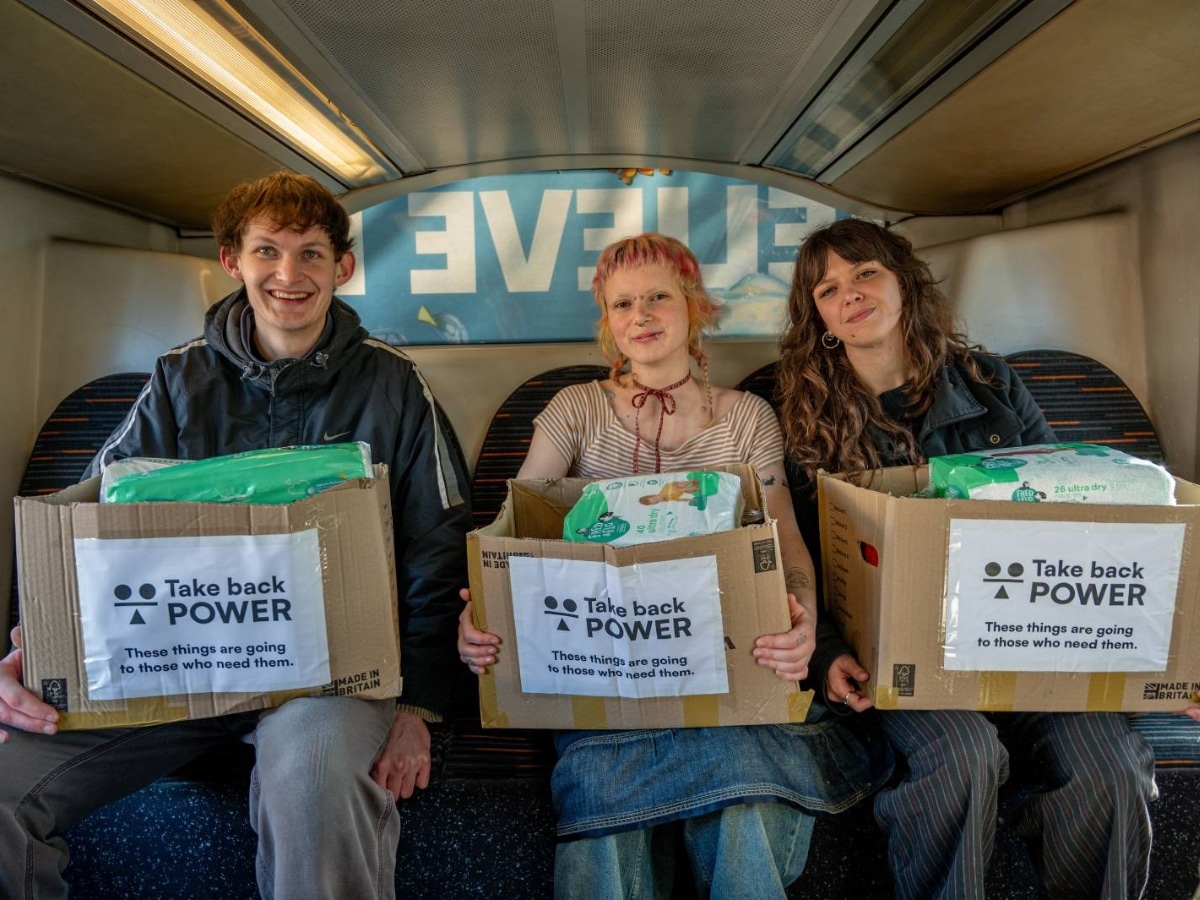
Take Back Power supporters have been redistributing food from supermarkets to local foodbanks across the country this morning. Take Back Power is a nonviolent civil-resistance group, demanding that the UK government establish a ‘House of the People’. This is a permanent citizen-led assembly with the power to tax extreme wealth.
From around 8.30am on 14 March, teams across four UK cities – Manchester, London, Exeter and Truro – entered supermarkets. They began putting food and necessities into boxes emblazoned with:
These things are going to those who need them.
The Take Back Power supporters left the shops without paying for the produce and then redistributed these items to local foodbank drop off points.
In Exeter, a team of five supporters took five boxes of produce from Morrison’s supermarket in Prince Charles Road. However security stopped them and took away two of the five boxes. The remaining three boxes were successfully liberated and taken to a local foodbank drop-off point.
From 9am, in London, on liberating boxes of food, two supporters set up a stall outside Sainsburys in the Lewisham centre, to give the food back to the local community. Security staff arrived by around 9.40 and police arrived onsite at around 9.50. There were no arrests and the supporters left at around 10am.
In Manchester, three action takers filled boxes with food from Tesco, on Pars Wood Lane in Didsbury. All three left the store without incident and redistributed the food to a foodbank drop-off point at a local Aldi.
In Truro, two supporters loaded boxes from the Sainsburys on Treyew Rd. They left the produce at the foodbank drop-off point in the same store.
6.5 million people using UK foodbanks
A spokesperson for Take Back Power said:
It is sickening that 6.5 million people in the UK are forced to turn to foodbanks every year and a third of children under five are living in homes where there is insufficient access to nutritious food.
This is because our country is in crisis, with billionaires hoarding wealth, whilst ordinary people suffer. We need to tax extreme wealth to fix Britain, and we need ordinary people to decide how.
One of those taking action was Eve Middleton 25, from Manchester, who said:
I refuse to sit by while billionaires hoard wealth and capture our democracy. We can all see the impacts of inequality on our streets, in our schools and hospitals and in our own homes.
Taxing the super rich is the first simple step to solving these crises. Yet our political system will not deliver a wealth tax, as it is rigged to benefit parasitic billionaires instead of the masses.
It’s time for ordinary people to be put at the heart of decision making, through a House of the People with powers to tax the rich and fix Britain.
Also taking action is Ruth Cook, 74, a company director from Somerset, who said:
I’m taking this action and risking arrest because we have a terrible situation in this country. Families are struggling and children are going hungry, while the profits some companies make are obscene.
The answer is to tax the super-rich. I’m taking this food and delivering it to a foodbank collection point because we need to do something about this. We need to tax the super rich and give ordinary people a say in how our taxes are spent. Join us at takebackpower.net.
Today’s action comes in the wake of the raid of a Quaker meeting house and the arrest of 15 people during a nonviolence training. Police arrested one other at their home later and raided the houses of seven supporters in connection with these actions so far.
This occurs as the UK remains in crisis. Last year, 14 million people in the UK faced the prospect of going hungry due to a lack of money. Whilst in 2024, 6.5 million people turned to foodbanks.
Take Back Power is demanding that the UK government establish a permanent House of the People. This is a citizen’s assembly chosen by democratic lottery, that has the power to tax extreme wealth and fix Britain.
Until the government makes a meaningful statement in response to its demand, the group says it will undertake nonviolent action to resist the super-rich, who are driving us towards social collapse. Donate or sign up to take action at TakeBackPower.net.
Featured image via the Canary
BENDICIONES FINANCIERAS PARA TI

Liverpool FC 1-1 Tottenham: Richarlison goal earns Spurs first point under Igor Tudor

Jessica Alba Embraces New Life After Finalizing Divorce, Steadies Romance With Danny Ramirez


-
 Tech5 days ago
A 1,300-Pound NASA Spacecraft To Re-Enter Earth’s Atmosphere
-
 Crypto World2 days ago
HYPE Token Enters Net Deflation as HyperCore Buybacks Outpace Staking Rewards
-

 News Videos6 days ago
10th Algebra | Financial Planning | Question Bank Solution | Board Exam 2026
-

 Business5 days ago
ExxonMobil seeks to move corporate registration from New Jersey to Texas
-

 Crypto World6 days ago
Paradigm, a16z, Winklevoss Capital, Balaji Srinivasan among investors in ZODL
-

 Fashion2 days ago
Weekend Open Thread: Addict Lip Glow
-

 Tech5 days ago
ChatGPT will now generate interactive visuals to help you with math and science concepts
-
Sports1 day ago
Why Duke and Michigan Are Dead Even Entering Selection Sunday
-

 NewsBeat4 days ago
Residents reaction as Shildon murder probe enters second day
-

 Business4 days ago
Search Enters Sixth Week With New Leads in Tucson Abduction Case
-
 NewsBeat6 days ago
Pagazzi Lighting enters administration as 70 jobs lost and 11 stores close across Scotland
-

 Tech6 days ago
Despite challenges, Ireland sixth in EU for board gender diversity
-

 Business1 day ago
US Airports Launch Donation Drives for Unpaid TSA Workers as Partial Government Shutdown Enters Fifth Week
-

 NewsBeat4 days ago
I Entered The Manosphere. Nothing Could Prepare Me For What I Found.
-
Crypto World1 day ago
Coinbase and Bybit in Investment Talks: Could Bybit Finally Enter the US Crypto Market?
-

 Business6 days ago
Search Enters 39th Day with FBI Tip Line Developments and No Major Breakthroughs
-

 Sports6 days ago
Skateboarding World Championships: Britain’s Sky Brown wins park gold
-

 Business1 day ago
Country star Brantley Gilbert enters growing non-alcoholic beer market
-

 Crypto World5 days ago
Will Chainlink price reclaim $10 amid volatility squeeze?
-

 Sports4 days ago
PWHL, Senators discussing plan to keep Charge in Ottawa

