

Crypto World
Is This BTC’s Calm Before the Major Storm?

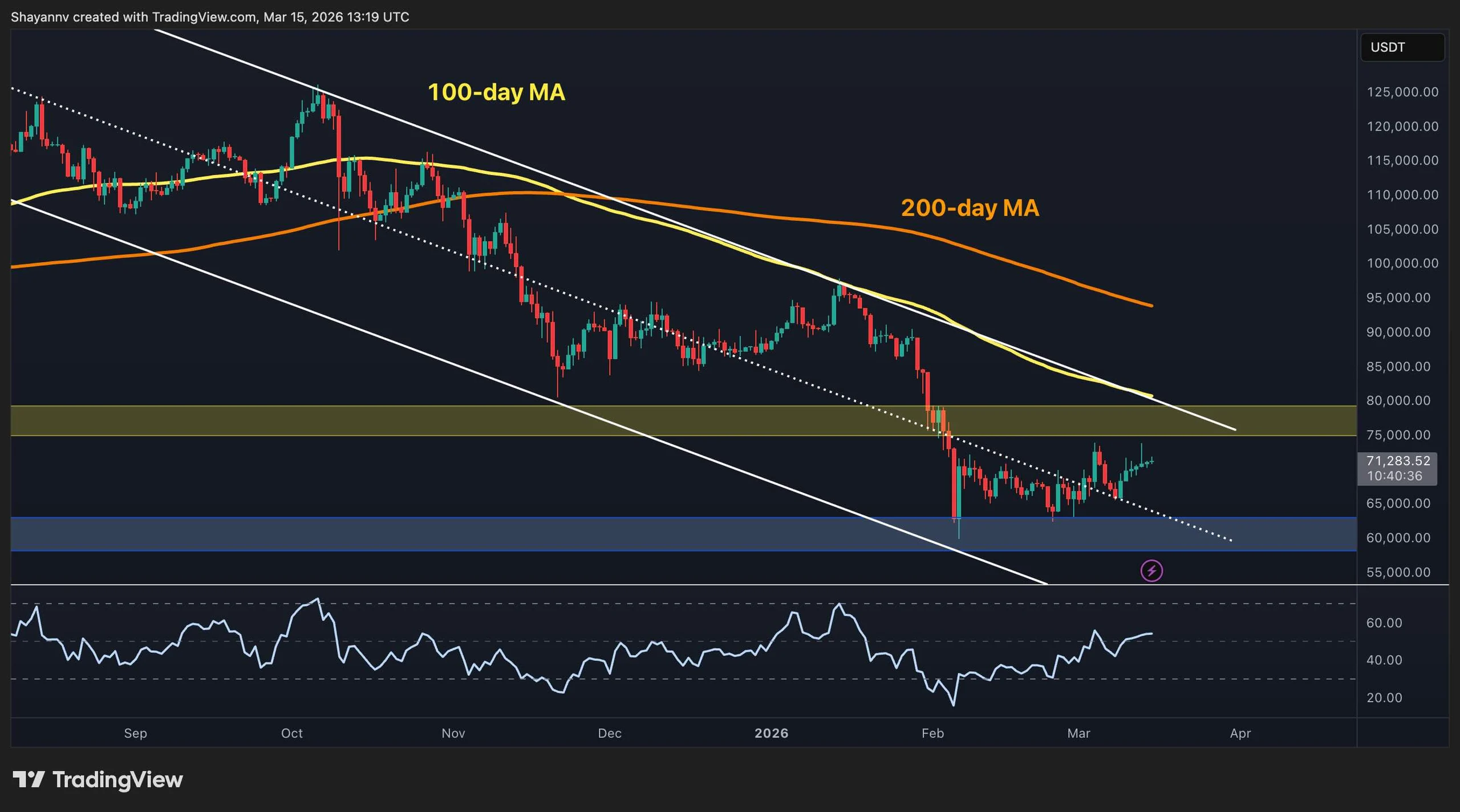
Bitcoin is extending its recovery, but the market is now approaching a more meaningful technical decision point. After holding the $60,000 region and building a series of higher lows, BTC has pushed back into the low-$70,000s, where short-term momentum is improving. Still, the broader structure has not fully flipped bullish, which means this move is best viewed as a test of resistance until proven otherwise.
Bitcoin Price Analysis: The Daily Chart
On the daily chart, Bitcoin continues to trade below both the 100-day and 200-day moving averages, keeping the higher-timeframe trend cautious. The price is also still sitting inside the broader descending structure, even though the latest rebound has clearly improved conditions compared to the panic sell-off seen near the February lows.
The key level to watch remains the $75,000 to $80,000 resistance area, which previously acted as support before turning into supply. As long as BTC stays below that zone, the broader move can still be interpreted as a rebound within a larger corrective phase. On the downside, the $60,000 to $62,000 area remains the main support base, and it is still the level buyers need to defend to preserve the current recovery structure.
BTC/USDT 4-Hour Chart
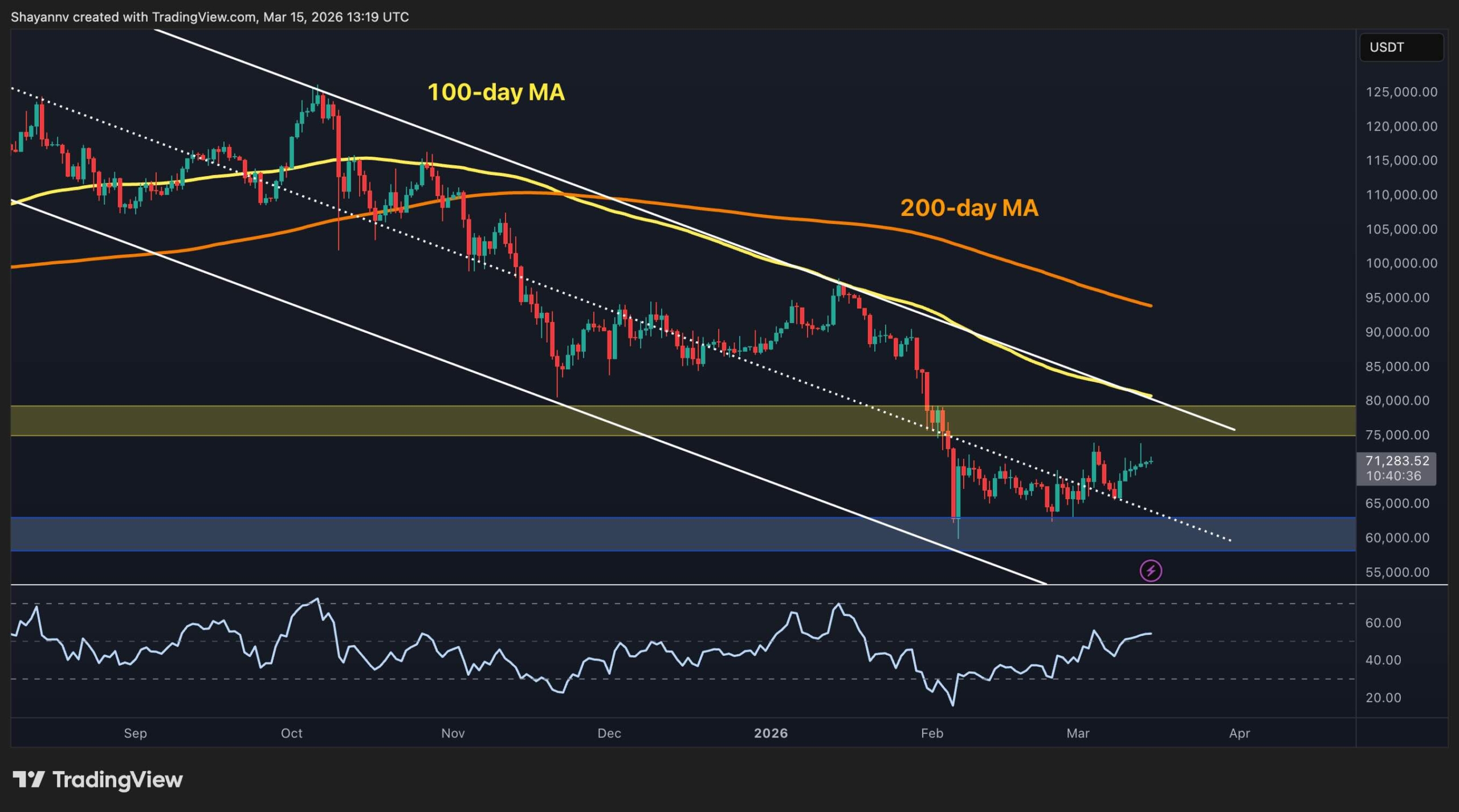
The 4-hour chart looks stronger. Bitcoin has been climbing within a rising channel, and price is once again pressing toward the upper boundary of that formation. The market is now trading around $71,000 to $72,000, with RSI also firming near the upper half of its range, which reflects improving short-term momentum.
That said, BTC is approaching a confluence zone where channel resistance overlaps with horizontal supply around $73,000 to $75,000. This makes the current area especially important. A clean breakout above it would strengthen the case for continuation into higher resistance, while another rejection could send price back toward the middle or lower end of the channel and keep the market in consolidation mode.

On-Chain Analysis
The on-chain picture adds a more constructive undertone. The Spot Average Order Size chart shows that recent activity is still being driven more by larger participants than by aggressive retail-style behavior. Historically, that kind of backdrop tends to be healthier than a move led by euphoric small buyers, because it suggests stronger hands are still active even as price trades below the cycle highs.
At the same time, the chart does not show the kind of broad retail frenzy usually associated with late-stage blow-off conditions. In practical terms, that means the current recovery still looks relatively controlled from an on-chain participation perspective. So while Bitcoin is facing an important technical resistance zone on the charts, the order-size data suggests the market has not yet entered a fully overheated phase.

Binance Free $600 (CryptoPotato Exclusive): Use this link to register a new account and receive $600 exclusive welcome offer on Binance (full details).
LIMITED OFFER for CryptoPotato readers at Bybit: Use this link to register and open a $500 FREE position on any coin!
Disclaimer: Information found on CryptoPotato is those of writers quoted. It does not represent the opinions of CryptoPotato on whether to buy, sell, or hold any investments. You are advised to conduct your own research before making any investment decisions. Use provided information at your own risk. See Disclaimer for more information.



Leah Callon-Butler recently wrote that crypto’s rock-and-roll era is over, and she’s mostly right about the arc. But I lived inside the music industry when rock and roll actually died, and there’s more to the story.
I was a product lead at Universal Music during the torrent era. I sat in the rooms where executives decided to sue grandmothers instead of building Spotify. I watched them spend more on lawyers than on artists. And eventually, I got fired for pointing out that we’d already lost.
So when someone uses rock and roll as a metaphor for what’s happening in digital assets, I know what the metaphor actually contains.
Here’s what the rock and roll era ending actually looked like from the inside. The loudest, most exciting part of the culture died while the boring infrastructure underneath it quietly became the thing that mattered. The rock stars disappeared. The streaming executives took over. And the audience grew even as the culture grew less interesting.
Callon-Butler frames this as a kind of mourning. The cypherpunk dream was diluted by ETFs and institutional custody. The laser eyes meme worn by presidents. And yeah, I understand the grief. I felt it watching Universal Music pivot from breaking artists to optimizing playlists.
But here’s where the music industry parallel actually gets useful, and nobody talks about this part.
The labels survived. They wrapped streaming and called it innovation. They went from fighting Napster to owning equity in Spotify. The same executives who wanted to destroy file sharing ended up profiting from the infrastructure file sharing forced into existence. The establishment absorbed the revolution and rebranded it.
That’s what’s happening right now with digital assets. JP Morgan is doing what Universal did with streaming. They’re wrapping the thing they fought and calling it a product. And just like with music, the audience is going to get bigger, the infrastructure is going to get better, and the culture is going to get less interesting. That part Callon-Butler nails.
But the part she misses is what happened next in music. Something the establishment couldn’t absorb.
While Universal was busy becoming a streaming company, ten thousand teenagers with blogs and bedroom studios were building something labels couldn’t wrap. The Swedish death metal kid. The Brazilian baile funk producer. The Detroit techno archaeologist. They didn’t know about each other. They didn’t even know Universal mattered. They just wanted to document what they loved.
And collectively, without any coordination, they created something institutions couldn’t replicate: infinite specificity. Every possible taste has its own ecosystem. Every microgenre has its own distribution channel. The monoculture dissolved into something so granular that no corporate structure could reassemble it.
The rock and roll era is obviously over. The question is what’s being built in the quiet spaces where the institutions aren’t looking.
Stablecoins are moving value across borders for people who’ve never heard of DeFi. Tokenized assets are creating markets in places where traditional finance never bothered to show up. Self-custody tools are getting quietly better while everyone’s distracted by ETF inflows. The boring infrastructure that makes the next wave possible.
I grew up in Argentina. I watched a government freeze bank accounts overnight and tell people their dollars were now worth a third of what they were yesterday. That experience teaches you something about money that stays with you forever. And it teaches you that the people who build the plumbing during the quiet periods are the ones who matter when things get loud again.
Callon-Butler asks whether crypto will stay weird. I’d reframe the question. The music industry stayed weird. It just stopped being weird in the places the executives were watching. The weirdness migrated to the edges, to bedroom producers, niche communities, and distribution channels that didn’t need permission.
Crypto’s rock-and-roll era ending is the most bullish thing that can happen to the industry. It means the adults showed up, and the adults bring capital that doesn’t leave when the vibes change. Crypto needs boring institutional plumbing. And that’s exactly what’s being built right now.
But somewhere out there, some kid in Lagos or Buenos Aires or Beirut is building something on these rails that nobody in a boardroom has imagined yet. They don’t even know the establishment exists. They just need the infrastructure to work.
That’s the beginning of the interesting part.

Global markets faced a real-time stress test as the 2026 Iran crisis escalated, amplifying concerns about energy flows and liquidity. Traders watched as risk sentiment swung and traditional safe-haven dynamics were tested in ways not seen for years. While gold initially benefited from demand for security, Bitcoin weathered the shock with pronounced volatility followed by a partial rebound, highlighting its evolving role in the risk-off landscape. The Strait of Hormuz, through which a substantial share of global oil moves, emerged as a pivotal flashpoint, reminding investors that energy disruption can rapidly reframe macro drivers. The episode underscored how macro forces—dollar strength, inflation expectations and bond yields—can override crisis-driven flows for both conventional assets and digital ones.
Key takeaways
- The 2026 Iran conflict produced a broad market shock, underlining how geopolitical events can reallocate capital across traditional and crypto assets as traders reassess inflation threats and supply-chain resilience.
- Gold initially climbed on safe-haven demand but later retreated as the U.S. dollar strengthened and Treasury yields rose, illustrating how macroeconomic forces can eclipse crisis-driven buying in the near term.
- Bitcoin experienced sharp intraday volatility but demonstrated resilience by rebounding after the initial drawdown, signaling a growing role as an alternative hedge amid liquidity shifts.
- The strength of the U.S. dollar acted as a dominant driver for both assets, as demand for dollar liquidity tended to suppress non-yielding instruments during periods of stress.
- The episode highlighted a structural divergence between traditional safe-haven assets and digital stores of value, inviting investors to rethink the “digital gold” narrative in the context of evolving liquidity and regulatory landscapes.
Tickers mentioned: $BTC
Market context: The episode fits within a broader framework of liquidity crunches, risk-off sentiment, and macro-driven price discovery that continue to shape both precious metals and crypto markets in times of geopolitical tension.
Why it matters
The Iran crisis offered a rare, real-world test of the long-held claim that Bitcoin can act as a safe-haven asset alongside gold. In the opening phase of the conflict, markets repriced risk across assets as traders sought liquidity and hedges amid rising energy concerns and potential supply shocks. While gold’s bid strength reflected its status as a centuries-old reserve asset, the subsequent pullback—at least in the short term—demonstrated how a strengthening dollar and higher yields can erode even the most trusted crisis hedges. This dynamic is instructive for investors who previously treated gold as an almost guaranteed ballast in crisis periods and who are now increasingly considering how digital assets might complement traditional portfolios under pressure.
Bitcoin, often described as “digital gold,” showed a more complex reaction. The asset moved with broad market liquidity and sentiment rather than reacting solely to geopolitical headlines. After a volatile start, Bitcoin (CRYPTO: BTC) staged a recovery that underscored its growing liquidity depth and investor interest as an option for diversification in stressed environments. The price path—marked by intraday declines followed by partial recoveries—illustrates how Bitcoin remains tethered to overall risk appetite and market ability to absorb shocks rather than acting as a pure hedging instrument on its own. This evolving behavior matters for institutions and retail participants weighing how digital assets fit into a risk-management toolkit during geopolitical disruptions.
The crisis also illuminated the role of macro drivers beyond geopolitics. As energy markets priced in potential disruption to flows through the Strait of Hormuz, crude prices surged and broader stock indices retreated. At the same time, the dollar’s strength emerged as the prevailing force in determining relative value across assets. When the dollar strengthens, non-yielding assets—like gold and Bitcoin—face headwinds as capital seeks dollar liquidity and yield-bearing instruments. This interplay between macroeconomics and geopolitics helps explain why neither asset delivered a unidirectional, sustained safe-haven rally in the conflict’s initial phase.
In the longer horizon, the episode emphasizes a nuanced distinction between established safe havens and newer digital instruments. Gold’s entrenched role in central banks’ portfolios and its long-standing history of crisis hedging continue to confer credibility. Bitcoin, by contrast, benefits from growing adoption and a broader, more diverse set of drivers—network usage, regulatory developments, and market structure improvements—that collectively influence its reaction to broader risk shifts. The narrative is not a binary of one asset outperforming another during crises; it is a testimony to the evolving landscape where traditional stores of value and digital assets coexist as components of diversified risk management.
To ground this analysis in verifiable facts, the crisis highlighted concrete data points: about 20% of the world’s oil moves through the Strait of Hormuz, a chokepoint that amplifies energy-price sensitivity during geopolitical tensions; the market saw gold prices rise initially but later retreat as the U.S. dollar strengthened and U.S. Treasury yields rose; Bitcoin traded a wide range before stabilizing in a mid-$70,000 vicinity in early March. Central-bank dynamics also surfaced, with gold reserves measured around 36,000 metric tons among major holders, reflecting the enduring importance of official sector demand in precious metals markets. The broader takeaway remains: while Bitcoin is carving out a legitimate, evolving role in the risk-off spectrum, it has not yet settled into a predictable safe-haven pattern like gold, and its behavior is increasingly tied to liquidity conditions and investor sentiment across asset classes.
What to watch next
- Monitor how Bitcoin (BTC) trades in response to fresh geopolitical headlines and any shifts in global risk appetite over the coming weeks.
- Track oil prices and energy-market developments tied to Hormuz-related disruption fears, as these will influence inflation expectations and macro liquidity conditions.
- Watch central-bank communications and gold reserve updates, particularly from major holders, as these can affect the relative appeal of gold as a crisis hedge.
- Observe regulatory signals and policy developments affecting cryptocurrencies in major jurisdictions, which can alter liquidity and institutional participation.
Sources & verification
- Energy data showing roughly 20% of world oil passes through the Strait of Hormuz (EIA): https://www.eia.gov/todayinenergy/detail.php?id=65504
- Oil price and market reaction coverage during the Iran-related escalation (Reuters): https://www.reuters.com/business/energy/oil-soars-25-gold-drops-iran-war-jolts-global-commodity-markets-2026-03-09/
- Euro area central-bank gold holdings and related data (ECB): https://www.ecb.europa.eu/press/other-publications/ire/html/ecb.ire202506.en.html#:~:text=Global%20holdings%20of%20gold%20by%20central%20banks%20now%20stand%20at%2036%2C000%20tonnes
- Bitcoin price commentary and milestones during late February and early March 2026 (Cointelegraph): https://cointelegraph.com/news/bitcoin-price
- “Store of value” debates and Bitcoin-led analyses cited in related Cointelegraph features (e.g., https://cointelegraph.com/features/can-bitcoin-really-be-a-store-of-value-what-pension-funds-are-starting-to-discover)
- Discussion on Bitcoin as a store of value amid policy shocks referenced in NYDIG coverage (https://cointelegraph.com/news/bitcoin-acts-store-of-value-amid-trump-policy-chaos-nydig)
What the article shows: A closer look at the crisis and crypto
Bitcoin (CRYPTO: BTC) is increasingly seen as a hedge option beyond its role as a payment network and speculative asset. Yet the Iran crisis underscores that its safe-haven credentials are not unconditional. The asset’s success in cushioning portfolios will depend on liquidity, market depth, and the trajectory of macro indicators such as dollar strength and interest rates. Gold’s steadiness as a traditional crisis hedge remains a touchstone for risk managers, while Bitcoin’s evolving dynamics suggest a more nuanced, hybrid function within diversified strategies.
As the market digests the 2026 Iran shock, investors will be watching whether BTC proves its ability to absorb shocks with less volatility than risk assets or if liquidity constraints continue to dictate its price path. The divergence between gold and Bitcoin in this episode does not diminish the potential for both to coexist as components of a resilient portfolio, but it does recalibrate expectations for how these assets respond under extreme geopolitical stress and macro uncertainty.
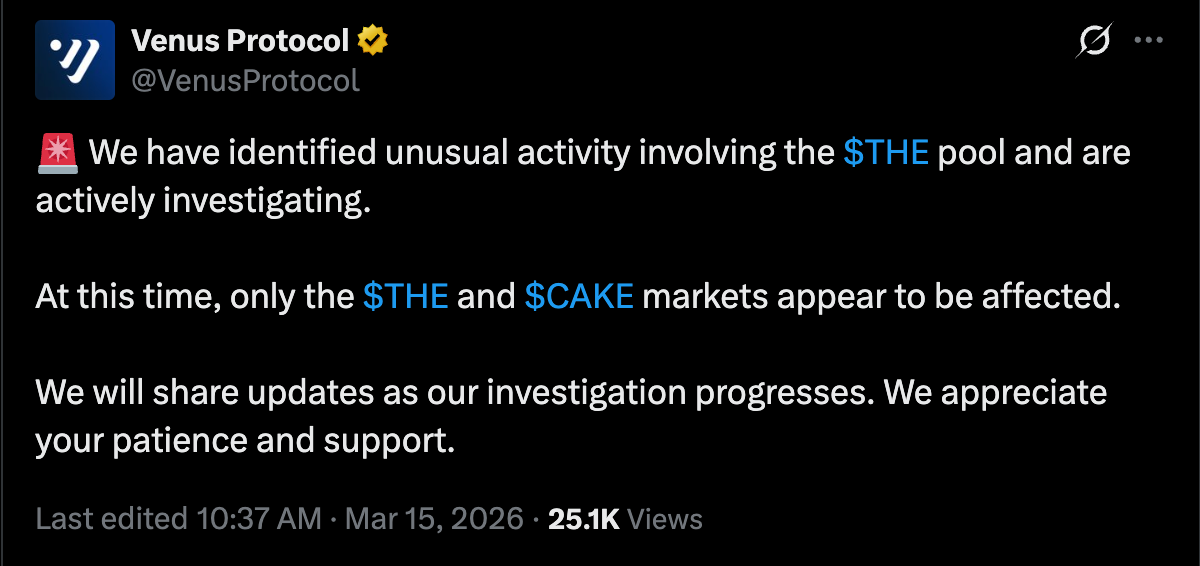
Venus Protocol, a decentralized lending and borrowing platform, said on Sunday it had detected suspicious trading activity in the liquidity pool for the Thena (THE) token, the native cryptocurrency of the Thena decentralized finance platform.
The unusual trading activity only affected pools for the Cake (CAKE) token, the native cryptocurrency of the PancakeSwap decentralized exchange, and the Thena token, according to an announcement from Venus Protocol. The Venus team said:
“As we continue to investigate the unusual activity in the THE pool, we are taking precautionary action by pausing all THE borrows and withdrawals effective immediately, to prevent any further misuse. This will remain in effect until the investigation is concluded.”

The suspicious trading activity is suspected to be a supply cap attack that was executed in two phases: a steady accumulation of about 84% of the total THE token market cap, coupled with a lending attack, according Allez Labs, which was identified by Venus Protocol as its risk manager.
The Venus exploiter used the Theta token as collateral to borrow 6.67 million CAKE tokens, 1.58 million USDC (USDC), 2,801 BNB (BNB) — the native token of the BNB chain — and 20 Bitcoin (BTC), Allez Labs said.
Out of caution, withdrawals and borrowing for other tokens, which have low liquidity on the platform, were also temporarily halted, Allez Labs said. The total amount lost in the attack is now over $3.7 million, according to Wu Blockchain.
At the time of publication, THE was trading at $0.2255 apiece, down more than 17% in the last 24 hours, according to pricing data on CoinMarketCap.com.

Cointelegraph reached out to Venus Protocol but did not obtain a response by the time of publication.
The incident highlights the cybersecurity and code exploit threats faced by crypto users and decentralized finance platforms, as the sector grows and security threats that cause financial loss become increasingly sophisticated.
Related: February crypto losses hit lowest level since March 2025, says PeckShield
Monthly crypto losses from hacks fall in February, as attackers pivot to social engineering scams
The value lost in crypto-related hacks fell to $49 million in February, the lowest level in nearly a year, according to blockchain security firm PeckShield.
Despite the reduction in total value lost to hacks and code exploits during February, there was an uptick in phishing and social engineering scams.

“The majority of individual attacks targeted private users through phishing attacks, malicious signatures, and address poisoning scams,” according to a report from blockchain intelligence platform Nominis.
Phishing scams often use fake websites, which feature addresses that are nearly identical to legitimate domain names. These fraudulent websites have malware designed to steal private keys for cryptocurrencies or other sensitive information.
Magazine: ‘SEAL 911’ team of white hats formed to fight crypto hacks in real time
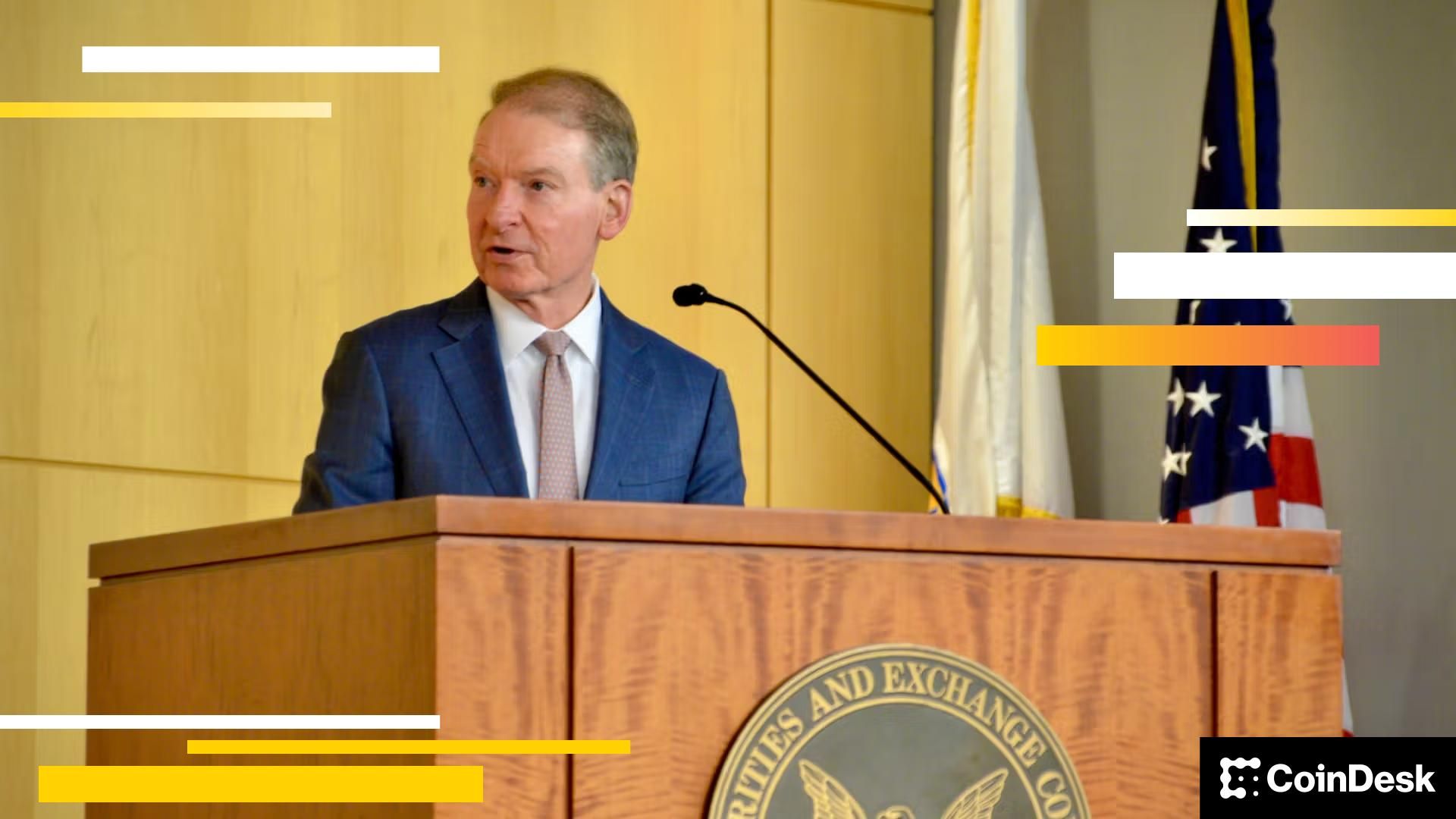
Though we’re still waiting on a lot of the formal rulemaking and proposed rulemaking from the federal securities and commodities regulators, last week’s memo is another sign that the SEC and CFTC are at least serious about signalling these efforts are coming.
You’re reading State of Crypto, a CoinDesk newsletter looking at the intersection of cryptocurrency and government. Click here to sign up for future editions.
The narrative
The U.S. Securities and Exchange Commission and the Commodity Futures Trading Commission formally agreed to work more closely together to explain how they’d oversee crypto and other issues.
Why it matters
The agencies continue to signal that their past regulatory turf war has ended, and laid out a an explanation of how they’ll jointly approach rulemaking — a welcome sign for the crypto industry.
Breaking it down
The SEC and CFTC signed a memorandum of understanding last week aimed at combining their regulatory approaches to the digital asset and other emerging technology sectors. According to the memo, the agencies will regularly hold joint meetings, share data and otherwise communicate their efforts to oversee the digital asset sector.
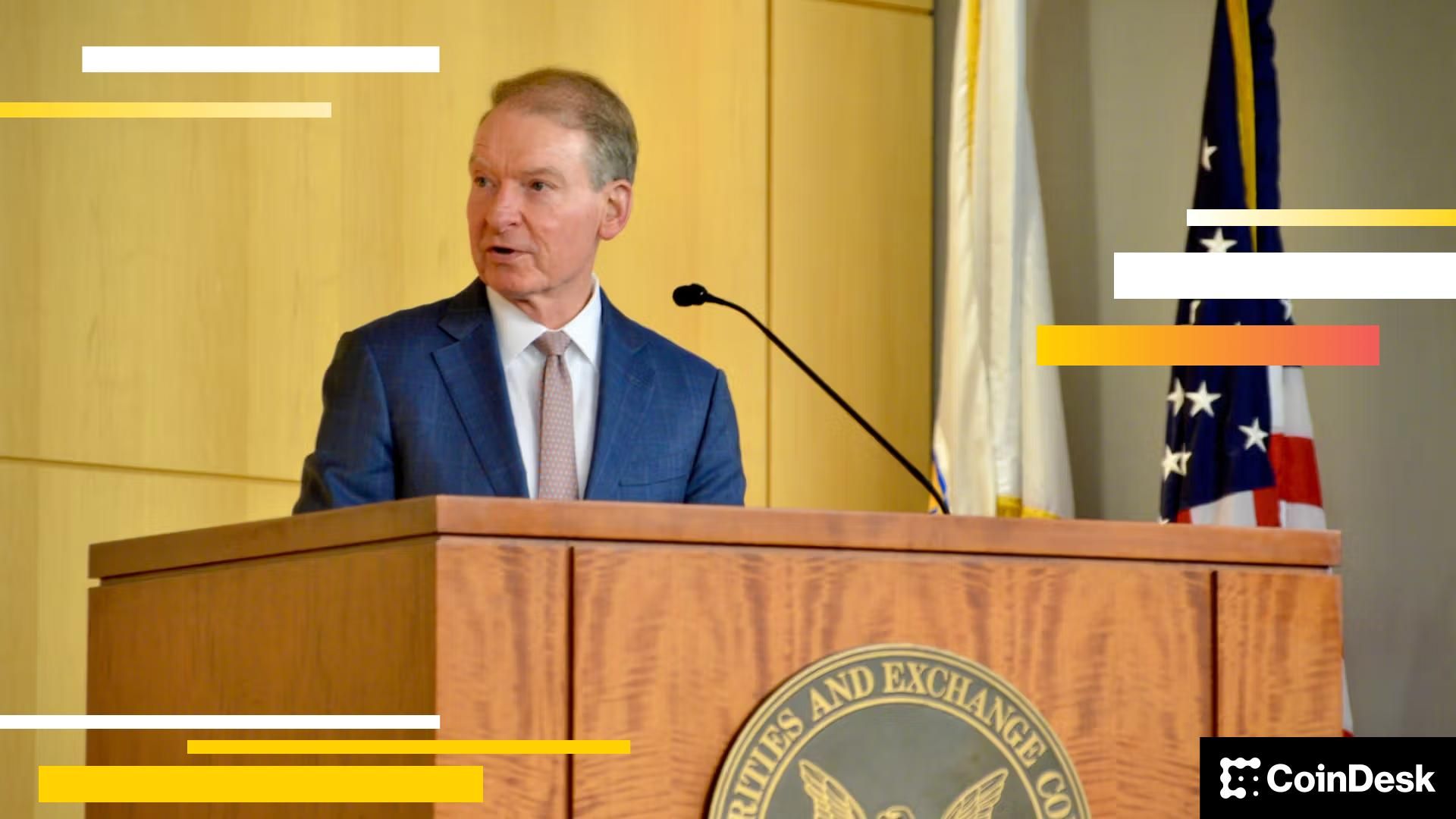
“More than aligning our rules, a harmonized framework also demands coordinating our responses to the firms that operate within it, including those that have questions of interpretation or request exemptive relief,” SEC Chair Paul Atkins said in prepared remarks earlier this week.
The chief suggestion here: That the SEC and CFTC will coordinate how they’re both defining a digital asset as a security or a not-security, in a way they didn’t two years ago.
One of the goals of the memo is for the agencies to “clarify product definitions through joint interpretations and rulemakings,” it said.
The memo also said the agencies would update their regulatory frameworks for regulated companies across a number of areas, including clearing and margin, trade data and intermediaries, among others.
This harmonization effort may extend beyond just crypto — the regulators are considering moving into one office building (the SEC’s), Bloomberg reported.
While the SEC and CFTC are making efforts to merge their approaches to the sector, the agencies and broader industry participants are still waiting to see what happens with the market structure bill currently working its way through the Senate. Senate Majority Leader John Thune told Punchbowl News that he did not expect the bill to work through the Senate before the “April time period” earlier this week.
Congress is just a week out from its two-week Easter break, meaning even if the Senate Banking Committee’s members come to an agreement to move the bill forward, sheer logistics mean the Senate is unlikely to have time to get to the bill in the immediate future. While I’m not sure how much this will affect the Senate’s work on market structure, it’s also worth noting that lawmakers are still negotiating a bill to fund the Department of Homeland Security, and President Donald Trump has said he wants Congress to pass the Safeguard American Voter Eligibility Act (SAVE Act) before he would sign any other bill. Neither of these efforts seem likely to pass immediately however, reporting suggests.
This week
- There are no hearings scheduled as of press time. My colleague Jesse Hamilton and I will be at the Digital Chamber’s conference in Washington. Come say hi!
If you’ve got thoughts or questions on what I should discuss next week or any other feedback you’d like to share, feel free to email me at [email protected] or find me on Bluesky @nikhileshde.bsky.social.
You can also join the group conversation on Telegram.
See ya’ll next week!

TLDR:
- U.S. oil companies are projected to earn $63 billion in additional cash flow in 2025 alone.
- Oil prices surged from $70 to over $100 per barrel following the U.S.-Iran conflict on Feb. 27.
- Exxon and Chevron are keeping capital spending flat, directing profits to wealthy shareholders instead.
- Economists now place the probability of a U.S. recession at 25% as energy-driven inflation rises fast.
Oil prices have surged past $100 per barrel after hostilities between the U.S. and Iran began on February 27. The spike has positioned U.S. oil companies to record some of their highest profits in years.
American consumers are absorbing sharply rising costs at the pump. The situation has drawn attention to where the financial windfall is going. Major producers like Exxon and Chevron are projected to benefit the most.
Oil Companies Hold Spending Flat While Profits Climb
Oil prices climbed from $70 to over $100 a barrel after the conflict disrupted global supply routes. The Strait of Hormuz carries around 20% of the world’s total oil. Disruptions there have created what analysts call the most severe supply shock in recent history.
Historically, higher oil prices have prompted energy companies to expand drilling and output. That process typically pushes prices lower by adding more supply to the market.
However, major producers are not following that pattern this time. Companies like Exxon and Chevron have kept capital spending flat despite record-high prices.
According to BullTheoryio, these companies are not hiring more workers or building more rigs. Every extra dollar paid at the pump is being retained as profit rather than reinvested.
This represents a break from historical industry behavior. The strategy reflects a clear preference for capital discipline over expansion.
U.S. oil companies are on track to generate $63 billion in additional cash flow this year alone. Of that, 45% is going directly back to shareholders.
Exxon alone is projected to earn between $25 billion and $30 billion in extra revenue. Chevron is expected to record an additional $12.5 billion in gains.
Consumers Face Recession Risk as Wealth Gap Widens
Gas prices rose approximately 40 cents in a single week after the conflict escalated. That jump has strained household budgets already under pressure from broader inflation.
High energy costs lift prices for groceries, rent, and electricity. Economists now place the probability of a recession at around 25%.
Since 2022, the five largest oil majors have collectively earned $467 billion in profit. That figure covers several years of elevated energy prices before this conflict began. The current surge adds to what is already the most profitable run in the industry’s recent history.
BullTheoryio noted President Trump’s remark that the U.S. “makes a lot of money” when oil prices rise. Critics argue, however, that those gains are concentrated among corporations and large investors.
The broader public sees little direct financial benefit from higher crude prices. Most returns flow to institutional shareholders.
The current situation reflects a structural shift in how energy profits are distributed. Oil companies are prioritizing shareholder returns over reinvestment, which limits any new supply from entering the market.
With less drilling activity, downward pressure on prices remains low. Consumers are therefore left with little short-term relief from rising costs.

Researchers are warning that Ethereum dust attacks have surged, with USDT and USDC transfers seeing major spikes.
Analysis of the 90 days before and after the December 3 Ethereum Fusaka upgrade indicates a steep rise in the number of address poisoning scams.
Stablecoin transactions on Ethereum are among the biggest hits with this ever-rising problem.
Dust Transfers Explode After Fee Reductions
Researcher Wise Crypto says that dust attacks went up sharply all over the Ethereum ecosystem. They wrote on X on March 13 that there had been a huge increase, especially in stablecoin movements.
The number of USDT transfers under $0.01 went up by 612%, from about 4.2 million to 29.9 million. A similar thing happened with USDC, where the number of transactions went from 2.6 million to 14.7 million, a 473% increase. Dust transfers that were mostly in ETH and DAI went up by 470% and 62%, respectively. The first one saw 65.2 million new transfers.
Address poisoning campaigns insert fake addresses whose beginning and ending characters are nearly similar to genuine ones into the victim’s trading history, hoping users will copy them when sending funds. Often, because wallet interfaces display only shortened addresses, the spoofed entries will appear genuine.
In one case, on-chain investigator Specter reported a victim losing $50 million in an address poisoning attack in late December 2025. Another blockchain enthusiast reported a case where a single wallet address lost more than $388k in those attacks while replying to Wise Crypto’s post.
Analysts at Etherscan attribute the problem to Ethereum’s Fusaka upgrade, which relatively improved the network’s scalability while reducing the fees, hence cutting the costs of sending dust transfers. As a result, attackers can run campaigns at much higher volumes than before.
You may also like:
Industrialized Scams Target High-Value Wallets
In a study of periods between July 2022 and June 2024, security researchers found there were over 17 million phishing attempts targeting about 1.3 million users of the Ethereum network. The result was over $79 million in losses.
The method relies on scale rather than precision, with analysts indicating that in some cases, dozens of poisoning transactions will occur within minutes of a single legitimate stablecoin movement. In fact, an X user known as Nima reported receiving over 89 notifications after merely two stablecoin transfers, in a show of the efficiency of automated scripts.
Only one of every ten thousand dust transfer attempts is successful, according to a study cited by Etherscan. Hence, by sending millions of such transactions, malicious actors are playing a long-term numbers game.
The block explorer explained in the post:
“A single successful attack involving a large transfer can easily cover the cost of thousands of failed attempts.”
According to Wise Crypto, the best defense remains simple: always verify the full destination address before sending funds and avoid copying wallet addresses directly from transaction history.
Binance Free $600 (CryptoPotato Exclusive): Use this link to register a new account and receive $600 exclusive welcome offer on Binance (full details).
LIMITED OFFER for CryptoPotato readers at Bybit: Use this link to register and open a $500 FREE position on any coin!
TLDR:
- Strategy holds 738,731 BTC and may be buying roughly 30,000 Bitcoin per week at its current pace.
- Saylor links 5% Bitcoin network ownership to a $1M price, a threshold now just 11 weeks away by volume.
- Acquiring 7.5% of Bitcoin’s total supply, tied to a $10M price target, could happen by late September 2026.
- If accumulation outpaces original models, Bitcoin’s repricing timeline may compress well beyond early forecasts.
Bitcoin accumulation by Strategy, formerly known as MicroStrategy, has outpaced even its own executive chairman’s expectations.
Michael Saylor’s long-term price targets are now being weighed against a timeline far shorter than originally projected.
Strategy currently holds 738,731 BTC on its balance sheet. Analysts are watching closely as the company’s weekly buying rate raises fresh questions. The key question is how soon Saylor’s supply-squeeze thesis could begin to take real shape.
Strategy Approaches Critical Bitcoin Network Ownership Thresholds
Saylor has stated that acquiring 5% of Bitcoin’s 21 million total supply would drive the price to $1 million per coin. That level equates to approximately 1.05 million BTC. He has further linked the 7.5% threshold, around 1.575 million BTC, to a Bitcoin price of $10 million per coin.
In a post on X, analyst David Lawrence noted that Strategy may have purchased roughly 30,000 BTC this week alone.
At that run rate, the company could reach the 5% ownership threshold in approximately 11 weeks. Furthermore, the 7.5% mark could arrive as early as the end of September 2026, roughly six months away.
However, most market observers agree that Bitcoin reaching $1 million within 11 weeks is not a realistic expectation.
Saylor originally framed those price predictions as long-term projections spanning 10 to 20 years. The accumulation timeline and the price appreciation timeline, therefore, are not expected to align in the near term.
Even so, the pace of Strategy’s buying campaign has caught many in the Bitcoin community off guard. Few analysts had built models where critical Bitcoin network thresholds could be approached within a single calendar year. The market is now actively adjusting those assumptions.
Bitcoin Supply Squeeze Could Compress the Repricing Timeline
Withdrawing 1.5 million BTC from active circulation places direct pressure on Bitcoin’s available supply. When tens of billions of dollars flow into the network consistently each week, the supply-demand balance begins to tighten. Over time, that tightening has historically preceded upward price moves in Bitcoin.
Saylor has additionally projected a 29% compound annual growth rate for Bitcoin over the next 21 years. That forecast was originally built around a more gradual accumulation pace.
Now that Strategy’s buying speed is outrunning those assumptions, the repricing timeline may also move faster.
The relationship between supply reduction and Bitcoin’s price response has clear precedent in market history. Previous halving cycles showed that constrained supply, combined with strong and sustained demand, consistently led to notable price appreciation.
Strategy’s institutional purchasing replicates that same pressure, though through market buying rather than protocol-level supply changes.
As a result, the next six months will serve as a live test of Bitcoin’s reaction to aggressive accumulation. If Strategy maintains this pace, some of Saylor’s long-term projections may arrive earlier than the 21-year window originally envisioned. That would mark a fundamental shift in how the market prices Bitcoin’s scarcity over time.
TLDR:
- Bitcoin rises 2.4% while the S&P 500 falls 2.2%, showing early signs of decoupling.
- Institutional ETF inflows provide steady BTC demand independent of equity markets.
- Bitcoin is increasingly viewed as a non-sovereign, safe-haven asset during volatility.
- Historical data shows that BTC correlation with equities can break during stress periods.
Bitcoin vs S&P 500 decoupling is becoming evident in March 2026 as Bitcoin rises while equities experience a decline. Data from Santiment indicates that BTC is increasingly trading independently of traditional market trends.
Divergence Between Bitcoin and Equities
Market data shows that Bitcoin gained approximately 2.4% over the past five weeks, while the S&P 500 declined by 2.2%. This emerging divergence indicates a shift in Bitcoin’s market behavior compared to traditional equities.
Historically, Bitcoin traded closely with high‑beta tech assets. From 2020 through 2023, institutional participation drove correlations between Bitcoin and equities, sometimes exceeding 0.6 or 0.8.
Large hedge funds and asset managers often treated Bitcoin as part of risk-on portfolios, making BTC sensitive to macroeconomic shifts.
The recent Santiment chart highlights three phases: initial correlation, mid-period volatility in equities with BTC stabilization, and recent divergence.
The blue S&P 500 line shows downward trends with increased volatility, while Bitcoin gradually recovered and climbed, signaling decoupling.
Market observers have noted this unusual setup on social platforms. “Bitcoin gaining while the S&P falls is rare and may indicate a correlation breakdown,” one analyst commented.
Institutional inflows, geopolitical concerns, and structural demand appear to be contributing factors in this behavior.
Institutional Support and Safe-Haven Behavior
Institutional adoption of Bitcoin through spot ETFs has introduced steady demand independent of equity market movements. Allocators increasingly view BTC as a portfolio diversification tool and digital reserve asset.
During geopolitical and macroeconomic stress, Bitcoin also exhibits safe‑haven characteristics. Its non-sovereign status, limited supply, and borderless nature allow investors to position BTC outside traditional financial systems.
The combined effect of structural demand and safe‑haven appeal explains the negative correlation with equities observed in March 2026.
Analysts note that while decoupling is historically rare, it has occurred during previous financial disruptions and crypto-specific cycles.
Recent market activity suggests Bitcoin may be transitioning from a “high-beta tech proxy” toward a macro-level digital asset.
If the trend persists, Bitcoin could increasingly serve as a hedge against systemic risk rather than moving in tandem with equities.
This evolving narrative is supported by market data and institutional flow analysis. Bitcoin’s performance during equity downturns indicates growing maturity as an independent asset class with global appeal.
TLDR
- Iran allows limited international shipping while blocking U.S. and Israeli vessels.
- The Strait of Hormuz handles 20% of global oil, influencing worldwide energy flows.
- Indian and Saudi tankers are among the first approved for safe passage.
- Oil prices remain above $100 amid cautious global market monitoring.
Iran has signaled a selective reopening of the Strait of Hormuz, allowing international vessels to transit while barring U.S. and Israeli ships. Oil prices remain above $100 per barrel as energy markets monitor the corridor closely.
Limited Access Reopens Strategic Waterway
Iran’s Foreign Minister Abbas Araghchi confirmed on March 14, 2026, that the Strait of Hormuz is open to certain international shipping. This move comes after a period of complete closure following regional tensions and previous strikes.
The strait remains closed to vessels linked to the U.S. and Israel, but other nations, including India and Turkey, have received permission to navigate the corridor.
Indian LPG tankers and a Saudi oil vessel carrying approximately one million barrels were among the first to transit safely.
This selective approach allows Iran to maintain trade with partner countries while controlling access for Western-linked vessels. Shipping analysts note that this partially stabilizes commercial activity through the route without fully reopening it.
Energy Flow and Market Reactions
The Strait of Hormuz is a critical chokepoint, handling roughly 20% of global oil shipments and a significant share of liquefied natural gas. Even with restrictions, selective access eases fears of an immediate supply disruption.
Oil prices have remained above $100 per barrel, reflecting both ongoing geopolitical tensions and continued transit for approved vessels. Iran has also continued oil exports to China using alternative methods, sustaining revenue despite broader restrictions.
Iran’s new Supreme Leader, Mojtaba Khamenei, emphasized that the strait should remain closed to U.S. and Israeli ships as leverage, while other nations consider multinational naval efforts to maintain freedom of navigation. This dynamic highlights Tehran’s strategic control over a globally vital energy corridor.
Market participants and energy analysts continue to monitor traffic closely, using reports and social media updates to track safe passages.
The partial reopening represents a measured step toward stabilizing maritime trade while maintaining geopolitical leverage over key international partners.
Crypto World
The increase in oil prices occurs because Trump does not give time when the Iran war is to be over

Oil Prices Soar as the calm of conflict is increasing
With Brent crude futures jumping to approximately 103 per barrel, it has recovered its losses that it had earlier experienced due to the Trump saga indicating that the war against Iran might last a long time.The intraday low of the Brent crude futures was about 98 per barrel. Meanwhile, the benchmark West Texas Intermediate (WTI) of the U.S. soared more than 2 percent to almost 99 closer in the session.The price increase was after Trump announced it in an interview with a host in the Fox News Radio station, Brian Kilmeade.
The statement was a change to his previous comments this week, in which Trump had indicated that the war is pretty much over.At the same time, United States Defense Secretary Pete Hegseth, himself, in a briefing, said that the U.S. has already used the largest number of strikes so far against the Iranian targets.
Bitcoin Slips Back in the Oil Rally
Market analysts observe that long-term geopolitical tensions are likely to drive investors to commodities such as oil and heighten doubtfulness in financial markets, encompassing cryptocurrencies.Analysts Warn Oil Could Surge to Historic Highs.RBC Capital Markets warns that the oil prices might rise further in case the conflict persists.Head of global commodity strategy of the firm, Helima Croft, indicated that there are a number of things that indicate that the war may run into the next few months.Croft predicts that oil prices might be even higher than the record levels between the 2022 Russia-Ukraine crisis in case the war lasts several weeks more.With an extension of three to four weeks of the war, the prices may go beyond the highs of $128 per barrel witnessed in the Russia-Ukraine War.Nevertheless, a war that might take several months would push the oil prices to an even higher mark than in 2008 of 146 per barrel and would cause a wider dislocation in the global market.
The Vikings’ First Week of Free Agency Told Us a Lot

This At-Home Hair Growth System Just Dropped in Price

US military identifies 6 crew members killed in western Iraq crash


-
 Tech5 days ago
A 1,300-Pound NASA Spacecraft To Re-Enter Earth’s Atmosphere
-
Crypto World2 days ago
HYPE Token Enters Net Deflation as HyperCore Buybacks Outpace Staking Rewards
-

 News Videos6 days ago
10th Algebra | Financial Planning | Question Bank Solution | Board Exam 2026
-

 Business5 days ago
ExxonMobil seeks to move corporate registration from New Jersey to Texas
-

 Crypto World6 days ago
Paradigm, a16z, Winklevoss Capital, Balaji Srinivasan among investors in ZODL
-

 Fashion2 days ago
Weekend Open Thread: Addict Lip Glow
-

 Tech5 days ago
ChatGPT will now generate interactive visuals to help you with math and science concepts
-
Sports1 day ago
Why Duke and Michigan Are Dead Even Entering Selection Sunday
-

 NewsBeat4 days ago
Residents reaction as Shildon murder probe enters second day
-

 Business5 days ago
Search Enters Sixth Week With New Leads in Tucson Abduction Case
-
 NewsBeat6 days ago
Pagazzi Lighting enters administration as 70 jobs lost and 11 stores close across Scotland
-

 Tech6 days ago
Despite challenges, Ireland sixth in EU for board gender diversity
-

 Business1 day ago
US Airports Launch Donation Drives for Unpaid TSA Workers as Partial Government Shutdown Enters Fifth Week
-

 NewsBeat4 days ago
I Entered The Manosphere. Nothing Could Prepare Me For What I Found.
-
Crypto World1 day ago
Coinbase and Bybit in Investment Talks: Could Bybit Finally Enter the US Crypto Market?
-

 Business6 days ago
Search Enters 39th Day with FBI Tip Line Developments and No Major Breakthroughs
-

 Sports6 days ago
Skateboarding World Championships: Britain’s Sky Brown wins park gold
-

 Business1 day ago
Country star Brantley Gilbert enters growing non-alcoholic beer market
-
 Crypto World5 days ago
Will Chainlink price reclaim $10 amid volatility squeeze?
-

 Sports4 days ago
PWHL, Senators discussing plan to keep Charge in Ottawa

