

Crypto World
BIS Warns Stablecoins Can Depeg Even with Full Reserves: Here’s Why


TLDR:
- A fully collateralized stablecoin can still depeg if its reserves cannot be accessed during a run.
- The BIS compares stablecoins to Eurodollars, noting they lack central bank settlement and repo facilities.
- Stablecoins mirror 19th-century wildcat banks, operating across fragmented jurisdictions with no shared backstop.
- Emerging stablecoin regulations follow the same path that brought lasting stability to traditional banking systems.
Stablecoins face a structural vulnerability that full collateralization alone cannot resolve. The Bank for International Settlements raised this concern in a recent paper titled “On Par: A Money View of Stablecoins.”
Crypto research firm Delphi Digital shared the findings on social media, noting reserves mean little without proper access mechanisms.
The analysis draws parallels between stablecoins and historical banking failures. It compares them to both Eurodollars and 19th-century wildcat banks, pointing to regulation as the path forward.
The Collateral Problem Stablecoins Cannot Escape
A stablecoin can hold enough reserves to cover every dollar in circulation and still depeg. The critical question is whether those reserves can be accessed when market pressure demands it.
Without that access, even fully backed stablecoins remain vulnerable to sudden redemption runs. Collateral ratios alone do not guarantee stability during a crisis.
The BIS paper compares stablecoins directly to Eurodollars — private dollar deposits held offshore outside U.S. regulatory reach. Traditional banking maintains par value through central bank settlement and primary dealer networks.
Standing repo facilities and a lender of last resort further stabilize the system under stress. Stablecoins currently have none of these tools available.
Delphi Digital stated on X that “if there’s a run, there’s no forward market, no credit facility, and no mechanism to absorb the pressure before it hits the reserves directly.”
That absence of institutional backstops creates a fragility that reserve ratios cannot address. The gap between holding reserves and deploying them quickly remains a central, unresolved problem.
This vulnerability becomes most visible during periods of sharp market stress. When redemption demand spikes, issuers must liquidate reserves quickly and under pressure.
Without any institutional buffer, that process can accelerate a depeg rather than prevent it. The result is a feedback loop that turns a manageable outflow into a broader crisis.
Wildcat Banking and the Road to Stablecoin Regulatory Stability
The BIS paper extends its comparison beyond Eurodollars, likening stablecoins to the wildcat banks of 19th-century America.
Those institutions operated across fragmented jurisdictions without uniform oversight or shared infrastructure. The parallel to today’s stablecoin market is direct and observable.
Delphi Digital noted that wildcat banking, despite its early instability, eventually gave way to federal oversight and consolidation.
That regulatory evolution made the traditional banking system functional at the national scale over time. The trajectory for stablecoins appears to follow the same historical pattern.
The current fragmentation across different blockchains and jurisdictions mirrors that earlier era of banking. Multiple issuers operate under differing rules, with no shared settlement layer or system-wide backstop in place. That inconsistency makes achieving broader, durable stability difficult without coordinated oversight.
Regulatory frameworks now taking shape across major markets aim to address these structural gaps directly. Legislation in the U.S., Europe, and Asia is beginning to impose reserve standards and licensing requirements on stablecoin issuers.
These measures closely echo the same principles that brought lasting stability to traditional banking over the past century.


TLDR:
- Bitcoin generated 685M social interactions in 24 hours, marking the highest engagement level recorded in a year.
- BTC price remains 43% below its $125,071 all-time high reached in October 2025 despite rising attention.
- Over 75,000 creators posted about Bitcoin, showing broader participation across social platforms.
- Bitcoin social dominance rose 32.58% week-over-week as discussion across the crypto sector accelerated.
Bitcoin social engagement has surged to its highest level in a year while price remains far below previous highs. The divergence between market attention and valuation has become one of the most discussed developments in the cryptocurrency sector.
Bitcoin Social Engagement Surges to 52-Week High
Bitcoin social engagement increased sharply during the past 24 hours. Data shows the asset generated 685 million interactions across social media platforms.
During the same period, engagement recorded an intraday peak of 435 million interactions. This represents the highest level of activity registered in the past 52 weeks.
Social discussion has also expanded significantly. Around 287,629 Bitcoin mentions appeared across social networks, reflecting an 81% increase month-over-month.
Participation is also rising quickly. Approximately 75,135 unique creators published Bitcoin-related posts within the same timeframe.
Creator growth stands 26% higher month-over-month and 11% higher day-over-day. This shows a broader group of users joining the conversation.
Bitcoin’s share of overall cryptocurrency discussion also climbed during the week. Social dominance increased 32.58% week-over-week, signaling stronger market attention.
Rising engagement often signals growing narrative momentum. Increased conversation frequently appears before major market movements.
Bitcoin Price Lags Despite Rising Market Attention
Bitcoin price remains below previous cycle highs despite the surge in attention. The asset currently trades near $71,384.
The market previously reached an all-time high of $125,071 on October 6, 2025. From that level, Bitcoin entered a sharp correction.
The decline pushed the asset roughly 43% below the record peak. Market volatility increased as traders adjusted positions after the rally.
During the correction, Bitcoin also recorded a 52-week low of $64,080 on February 24, 2026. Prices have since recovered modestly from that level.
Even with the recovery, Bitcoin remains within a consolidation range. Many traders describe the current phase as a post-rally adjustment period.
The divergence between price and engagement has therefore drawn attention across the market.
Rising creator participation continues to expand Bitcoin’s online presence. As discussion spreads across networks, the gap between market attention and price remains unresolved.
TLDR:
- Venus Protocol lost $3.7M in a flash loan attack using THE token as collateral.
- THE token price surged to $0.563 before collapsing to $0.22 during liquidation events.
- Six Venus markets including BCH and LTC were temporarily frozen after the exploit.
- Borrowing and withdrawals for THE token paused while investigation continues.
Venus Protocol flash loan attack on BNB Chain caused over $3.7 million in losses. THE token was exploited to manipulate collateral, enabling the attacker to borrow high-value assets before the market collapsed.
Exploit Mechanics and Borrowing Strategy
The Venus Protocol flash loan attack targeted the Core Pool on BNB Chain, using THE token as collateral. The attacker accumulated approximately 84% of THE supply over nine months to prepare for the exploit.
Instead of following the standard deposit process, the attacker directly transferred tokens to the vTHE contract. This allowed collateral positions far above the supply cap, reaching 53.2 million THE tokens, nearly 3.7 times the protocol’s limit.
Using this inflated collateral, the attacker borrowed about 20 BTC, 1.5 million CAKE, 200 BNB, and 1.58 million USDC.
The strategy repeated in a loop: deposit THE, borrow assets, purchase more THE, and wait for the TWAP oracle to adjust, inflating collateral value.
The manipulation caused THE’s price to spike from $0.263 to $0.563 before falling to $0.22 as liquidations occurred. This pattern mirrored prior DeFi exploits involving low-liquidity tokens and automated liquidations.
Venus Protocol Response and Market Measures
Following the attack, Venus froze six high-risk markets, including BCH, LTC, UNI, AAVE, FIL, and TWT. Borrowing and withdrawals of THE tokens were temporarily paused while all other markets remained operational.
Investigations suggest the attacker may have used Tornado Cash to fund operations. Venus has since tightened collateral rules and plans to review oracle mechanisms to prevent similar attacks in the future.
The estimated bad debt ranges from $1.7 million to $2.15 million, mainly from the CAKE market. The protocol confirmed the unusual activity was confined to the THE and CAKE markets and did not affect the broader ecosystem.
Security analysts continue monitoring Venus to assess the handling of low-liquidity tokens. Investors are advised to exercise caution when lending or borrowing such tokens, ensuring robust protocols are in place to minimize risk.
TLDR:
- Tron Revenue hits $947K in 24 hours, far above Base and Ethereum combined.
- Monthly revenue reaches $24.96M, surpassing Polygon, Base, and Solana together.
- Stablecoin transfers drive consistent fees and support large-volume transactions.
- TRX technicals show momentum gaining near 50-day MA, with resistance at 200-day MA.
Tron Revenue has emerged as the top-performing blockchain, surpassing Ethereum, Polygon, and Solana in daily, weekly, and monthly revenue. Stablecoin transfers and low transaction costs remain key drivers of this performance.
Revenue Performance and Network Comparison
Tron generated about $947,419 in revenue over the past 24 hours. This figure is nearly ten times higher than Base, which recorded $97,720, and far above Ethereum at $77,565.
Over seven days, Tron accumulated around $5.42 million. In comparison, Polygon recorded $632,000 and Solana $374,000.
On a 30-day scale, Tron Revenue reached approximately $24.96 million. Polygon generated $4.5 million, Base $3.72 million, and Solana $1.78 million.
Tron’s monthly earnings alone surpass the combined revenue of these networks, reflecting its dominant position in the blockchain landscape.
The network’s success is closely tied to stablecoin activity, particularly Tether (USDT). Tron has become a primary layer for USDT transfers globally, especially in markets where stablecoins are widely used for remittances, payments, and liquidity management.
This activity ensures a constant flow of network fees and reinforces Tron Revenue leadership.
Tron’s low transaction costs and high throughput allow rapid, large-volume transfers. Other networks focus on decentralization and smart contract innovation, but Tron prioritizes speed and affordability, which supports large-scale payment and exchange operations.
Technical and Market Dynamics
TRX, Tron’s native token, is trading within a descending channel, signaling that sellers have controlled the market since the previous peak near $0.35–$0.36.
Lower highs and lower lows indicate the macro trend remains bearish. Short-term momentum shows improvement.
TRX recently reclaimed the 50-day moving average, now acting as dynamic support. The token is also in a rectangular accumulation zone, where buyers and sellers are competing for control.
The 200-day moving average represents the next resistance level. A breakout above this level could indicate a trend shift.
Momentum indicators, such as the RSI forming higher lows, suggest rising buying pressure. Traders are watching these levels for potential breakout or downside scenarios near $0.253–$0.250.
TLDR:
- The Uniswap (UNI) price is consolidating within an ascending triangle between $3.80 and $4.10.
- A clean breakout above $4.10 could trigger a 30% rally toward $5.30 liquidity.
- Breakdown below $3.80 may lead to a 30% correction toward February lows near $2.80.
- Market cap shows tight consolidation near $2.55B, reflecting gradual accumulation.
Uniswap (UNI) price is compressing inside an ascending triangle on the four-hour chart. The structure forms between $3.80 support and $4.10 resistance, creating a tight range where traders expect a decisive breakout or breakdown.
Ascending Triangle Reflects Accumulation Pressure
Uniswap (UNI) price is forming a classic ascending triangle, defined by rising higher lows converging on a horizontal resistance near $4.10. This pattern often signals that buyers are absorbing supply at key levels.
The trendline support near $3.80 has proven reliable during multiple pullbacks. Each test of this level has seen buyers intervene, maintaining the upward slope of higher lows. This support is critical for the bullish setup to remain valid.
Rejections at $4.10 resistance have produced progressively shallower pullbacks, suggesting gradual accumulation. Traders monitoring this range may interpret smaller declines as a sign that selling pressure is weakening.
The tight $3.80–$4.10 range has reduced short-term volatility, creating what some traders call a “no-trade zone.” Such compression often precedes strong directional moves once the price breaks above or below the boundaries.
Momentum may build once the triangle resolves. A sustained breakout could attract new buyers, while a breakdown would likely trigger stop-loss orders and accelerate selling pressure. The structure highlights the balance between supply and demand at current levels.
Until a decisive close occurs, directional edge remains limited. Traders continue to watch both the rising support and horizontal resistance closely.
Breakout or Breakdown Could Define Next Trend
If Uniswap (UNI) closes above $4.10 on the four-hour chart, momentum buying and short covering could drive the price toward $5.00–$5.30. These levels correspond to prior liquidity clusters in which trading activity has historically increased.
On the downside, a failure of the $3.80 support would invalidate the triangle. A breakdown could prompt stop-loss cascades, exposing UNI to a correction toward February lows near $2.80. Such a move would retrace the prior recovery leg and test the broader demand zone.
The seven-day market capitalization data reinforces this tight structure. UNI’s market cap fluctuated between roughly $2.32B and $2.65B before stabilizing near $2.55B.
Early rebounds suggest buyer willingness at lower valuations, while sideways consolidation reflects a struggle between accumulation and profit-taking.
Recent spikes in market cap, such as toward $2.65B, were met with swift rejection, confirming that sellers remain active at higher levels. The current upward slope toward $2.55B indicates buyers are gradually regaining control.
With only $0.30 separating support from resistance, the Uniswap price is poised for a decisive move that may define its next major trend.
Crypto ATMs’ minimal verification and fast transactions let criminals turn cash into digital assets in minutes, often before victims notice.
A new report from blockchain security firm CertiK warns that crypto ATM scams are rising sharply across the United States (U.S.). In 2025 alone, criminals stole roughly $333.5 million, highlighting the risks tied to cash-to-crypto kiosks.
These alarming losses are partly due to the design of crypto ATMs, which makes them attractive targets for criminals. Their structure enables fast transactions with minimal identity verification. This allows cash to be converted into digital assets in under five minutes, often before victims even realize they have been targeted.
Crypto ATMs Become Key Channel for Fraud
These kiosks are often found in convenience stores, gas stations, and malls, making them easy to access for everyday users. Their ubiquity allows scammers to trick victims into making fraudulent transfers, bypassing on-screen warnings.
According to Certik, the U.S. hosts about 78% of the world’s estimated 45,000 crypto ATMs, making it the largest market for these machines. This widespread presence contributes to rising incidents. Consequently, the Federal Bureau of Investigation received over 12,000 complaints from January to November 2025, up 33% from 2024.
Many scams involve social engineering, where criminals persuade users to deposit funds under false pretenses. The technical setup of ATMs worsens the problem, as they act as front-end interfaces connecting to backend Crypto Application Servers (CAS).
Funds typically come from operator-controlled hot wallets rather than the customer directly. This design creates an “attribution gap,” meaning blockchain records show transfers from operators, not victims. As a result, tracing the stolen funds becomes much harder.
Older Adults Face Higher Risks as Criminal Networks Expand
Older adults are particularly vulnerable, accounting for roughly 86% of crypto ATM losses. In one case, the Office of the Attorney General for D.C. found 93% of deposits on some Athena Bitcoin machines were fraudulent. The median victim was 71, and limited familiarity with digital finance makes them prime targets for scammers.
Criminal groups have industrialized these scams, running organized networks for lead generation, calls, and laundering. Some Asian syndicates laundered $16.1 billion in 2025, often using Telegram to coordinate rapid transactions.
Common scams include impersonating government officials, fake tech support, romance fraud, and emergency family schemes. Scammers are increasingly using artificial intelligence, including deepfakes, to make these scams more convincing and efficient.
Binance Free $600 (CryptoPotato Exclusive): Use this link to register a new account and receive $600 exclusive welcome offer on Binance (full details).
LIMITED OFFER for CryptoPotato readers at Bybit: Use this link to register and open a $500 FREE position on any coin!
TLDR:
- $3.44B in leveraged long positions sit near $66.5K, risking forced liquidations.
- Bitcoin trades around $71,544, consolidating below resistance at $72K.
- MACD shows fading bullish momentum, RSI at 58 indicates moderate buying strength.
- Breakdown below $70K could trigger rapid liquidation of billions in longs.
Bitcoin faces a critical liquidation risk as over $3.4B in leveraged long positions sit near $66.5K. A $5,000 drop from the current $71,595 level could trigger significant forced liquidations.
Leveraged Long Positions and Market Pressure
According to Coinglass data, the largest cluster of long liquidations is concentrated around $66,500. Over $3.44 billion in cumulative leveraged positions sit below Bitcoin’s current price, spread across major exchanges such as Binance, OKX, and Bybit.
If Bitcoin drops roughly $5,000, these positions would be automatically closed. Exchanges sell Bitcoin to cover losses, creating additional downward pressure on the market.
This process can accelerate price declines and trigger a short-term cascade of forced liquidations.
Traders and institutional participants monitor these clusters closely. Large liquidation pools often act as liquidity magnets, attracting strategic buying and selling.
Price can move toward these zones before reversing sharply once excess leverage is cleared. Currently, the market is long-biased.
The dominance of long positions near the downside indicates traders are heavily leveraged on bullish bets, which may increase the potential for a rapid downward move if selling pressure accelerates.
Consolidation, Momentum, and Key Levels
The 4-hour chart shows Bitcoin consolidating just below the $72,000 resistance, trading near $71,544. Price action forms a series of higher lows since the late February drop to $65,000, signaling a short-term bullish trend.
Range-bound consolidation between $70,000 and $72,000 indicates buyers defending support and sellers limiting rallies. Momentum indicators show moderation:
MACD lines are flattening, and the histogram has begun turning negative, while RSI at 58 suggests moderate bullish sentiment.
Critical levels to watch include resistance at $72,000–$73,500 and support at $70,000. A breakdown below $70,000 could test the $68,000–$66,500 range, exposing billions in leveraged long positions.
Conversely, a break above resistance may target $74,000–$75,000, providing room for controlled upward movement.
Overall, the market remains cautiously bullish but fragile. Traders should monitor the $66,500 liquidation cluster, as forced liquidations could trigger rapid price swings in either direction.
TLDR:
- A DeFi user lost $50.4M swapping aEthUSDT for aEthAAVE after confirming a 99.9% price impact warning.
- CoW Swap’s legacy gas ceiling and solver failure forced the trade through a $73K illiquid SushiSwap pool.
- A mempool leak exposed the transaction, letting an MEV bot execute a sandwich attack for $9.9M profit.
- Titan Builder extracted ~$34M in ETH, while Aave and CoW Swap have since patched their security gaps.
A DeFi user suffered approximately $50.4 million in losses from a single swap on the Aave platform. The user exchanged aEthUSDT for aEthAAVE through a CoW Swap widget and received only $36,000 in return.
Both Aave and CoW Swap have released detailed post-mortem reports on the incident. The reports cite a combination of user error, illiquid markets, and multiple technical failures.
MEV bots also exploited the situation, extracting tens of millions in profit from the DeFi trade.
How a Series of Technical Failures Enabled the Loss
The user manually confirmed a “High price impact (99.9%)” warning before completing the DeFi swap. Aave’s report confirmed this warning was clearly visible within the interface. The trade proceeded regardless, setting the stage for what followed.
CoW Swap’s report identified multiple system-level failures that escalated the outcome. A legacy hardcoded gas ceiling rejected better quotes that could have routed the trade efficiently.
The winning solver also failed to execute the trade on-chain as intended. Together, these two failures severely limited the options available for completing the swap.
Further complicating matters, a suspected mempool leak exposed the private transaction to public view. This meant any observer, including automated MEV bots, could see the order before confirmation. The exposure proved costly, as it directly opened the door for a targeted attack.
Because better routes were blocked, the trade was pushed through a SushiSwap AAVE/WETH pool. That pool held only about $73,000 in total liquidity at the time of the swap.
Routing a $50 million order through such a thin market caused extreme price slippage. The user ultimately received a fraction of what the trade should have returned.
MEV Bots and Block Builders Extracted Millions From the Failed Swap
Once the transaction leaked to the public mempool, an MEV bot quickly identified the opportunity. The bot front-ran the trade by buying available AAVE before the user’s order confirmed. This action drove the price of AAVE sharply higher, hurting the user’s final settlement.
The bot then sold its AAVE position immediately after the user’s trade was filled. This sandwich attack netted the bot an estimated $9.9 million in profit. @CoWSwap’s report identified the mempool leak as a central factor enabling this attack on the DeFi user.
To guarantee the correct block sequence, the MEV bot paid Titan Builder directly. The block builder extracted roughly $34 million in ETH for facilitating the arrangement. This coordination between the bot and the builder was key to the attack’s execution.
In response, @CoWSwap has patched its legacy gas limits to prevent similar routing failures. @aave is deploying “Aave Shield,” which will automatically block swaps with a price impact above 25% by default. Both protocols are now working to prevent this type of loss from recurring across DeFi.
TLDR:
- Ethereum futures volume on Binance now exceeds spot trading by more than sixfold in March 2025.
- ETH open interest has dropped by 400,000 ETH since January, erasing nearly $4 billion in exposure.
- Core PCE inflation hit 3.1% YoY, reducing the Federal Reserve’s room to cut interest rates soon.
- Rising oil prices tied to U.S.-Iran tensions may worsen inflation data through March and April 2025.
Ethereum futures volume on Binance now outpaces spot trading by more than sixfold. This shift comes as U.S.-Iran tensions continue pushing oil prices higher.
Last week, core CPI came in at 2.5% year-over-year, while core PCE reached 3.1%. These numbers are adding fresh strain to an already fragile U.S. economy.
As uncertainty grows, investors are pulling back from risk assets, including crypto. The altcoin sector is feeling this pressure most sharply, with Ethereum bearing the heaviest weight.
ETH Spot Market Hits Its Weakest Level Since 2023
The spot-to-futures ratio for Ethereum on Binance has dropped to its lowest point since 2023. That period marked the tail end of the previous crypto bear market.
Open interest in ETH futures has also declined by roughly 400,000 ETH since January. That reduction represents nearly $4 billion in contracts exiting the market.
Crypto analyst Darkfost_Coc flagged this pattern, noting futures volume now exceeds spot by over six times. This means traders are not buying Ethereum aggressively through the open spot market.
Activity remains heavily concentrated in derivative products instead. That behavior points to a clear lack of conviction among spot buyers.
High futures volume alongside falling open interest suggests defensive positioning. Traders appear to be using derivatives to hedge rather than build fresh long exposure.
That makes it harder for any meaningful price recovery to take hold. A genuine rebound would require visible improvement in spot demand first.
Potential selling pressure from the Ethereum Foundation and Vitalik Buterin may also be contributing. If large holders are offloading ETH, it weighs on broader investor confidence.
Retail participants remain hesitant to step in against that kind of supply pressure. The market is waiting on clearer fundamental signals before fresh capital enters.
Rising Oil Prices Complicate the Federal Reserve’s Rate Path
Escalating U.S.-Iran tensions are keeping oil prices elevated across global markets. If oil stays high through March and April, upcoming inflation prints could worsen further.
That would make it increasingly difficult for the Federal Reserve to cut interest rates. Rate cut expectations have been among the key supports for risk assets in recent months.
A stronger U.S. dollar is forming alongside this macroeconomic backdrop. Historically, dollar strength tends to weigh on crypto asset prices.
Long-term bond yields are also climbing, redirecting capital toward safer instruments. Together, these forces make the environment particularly hostile for digital assets.
Altcoins are absorbing the sharpest end of this pressure across the board. Ethereum’s falling open interest and weak spot volumes reflect wider sector fatigue.
Fresh capital has struggled to flow into the altcoin market over recent weeks. The broader market remains in a cautious holding pattern as traders watch for direction.
Until spot volumes show a clear recovery, futures-driven price moves may prove short-lived. The next CPI and PCE readings will likely shape Ethereum’s near-term trajectory closely.
Crypto World
Bitcoin Whale Activity Hits Six-Year High as Retail Participation Stays Near Cycle Lows
TLDR:
- The Bitcoin Exchange Whale Ratio has reached its highest recorded level in six years amid a sharp BTC drawdown.
- Retail participation in Bitcoin markets remains near cycle lows even as large holders increase their exchange activity.
- Historical data shows similar whale spikes have appeared near local bottoms before the next major price move higher.
- Trader @KillaXBT notes BTC price action has been mechanical for two years, with corrections resolving within two to three weeks.
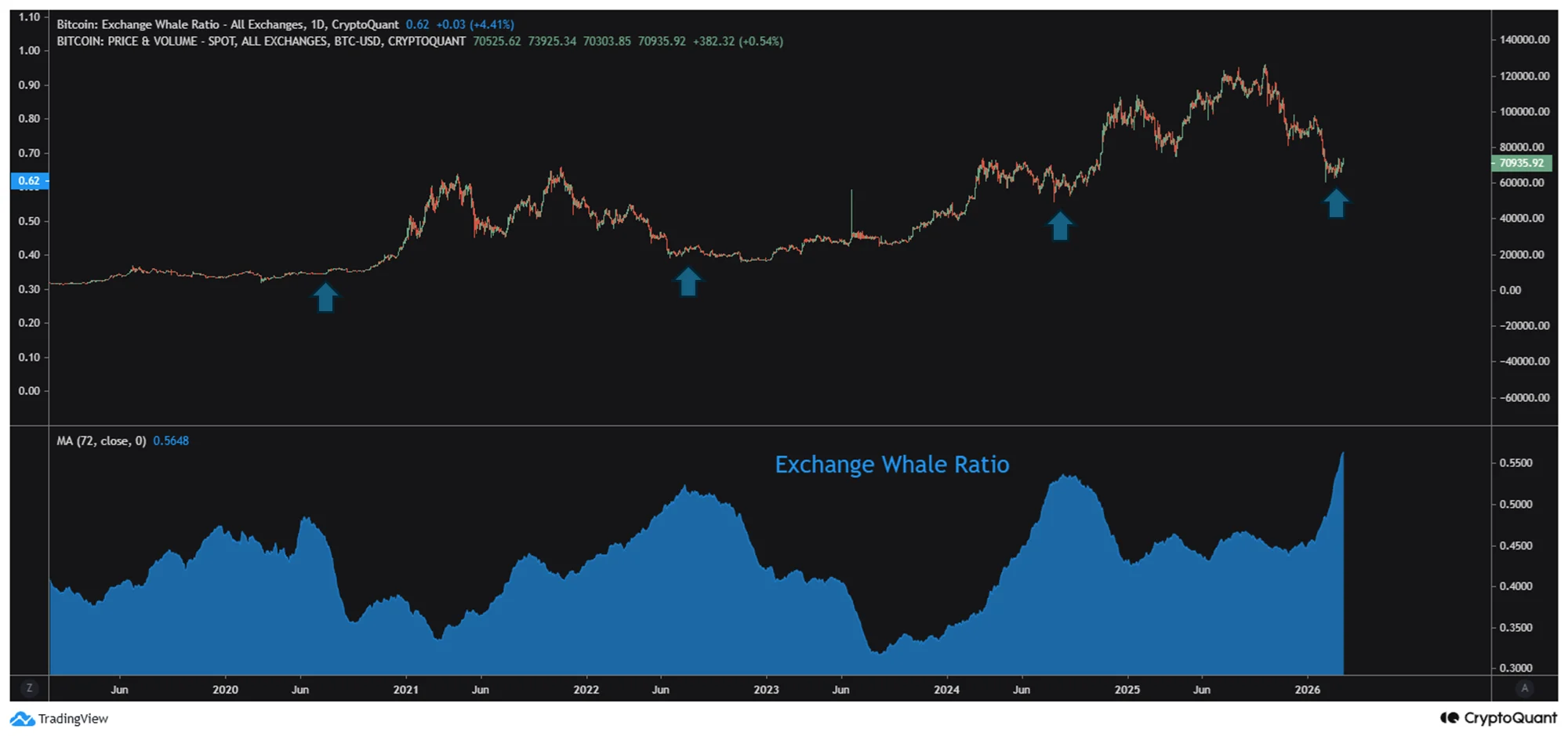
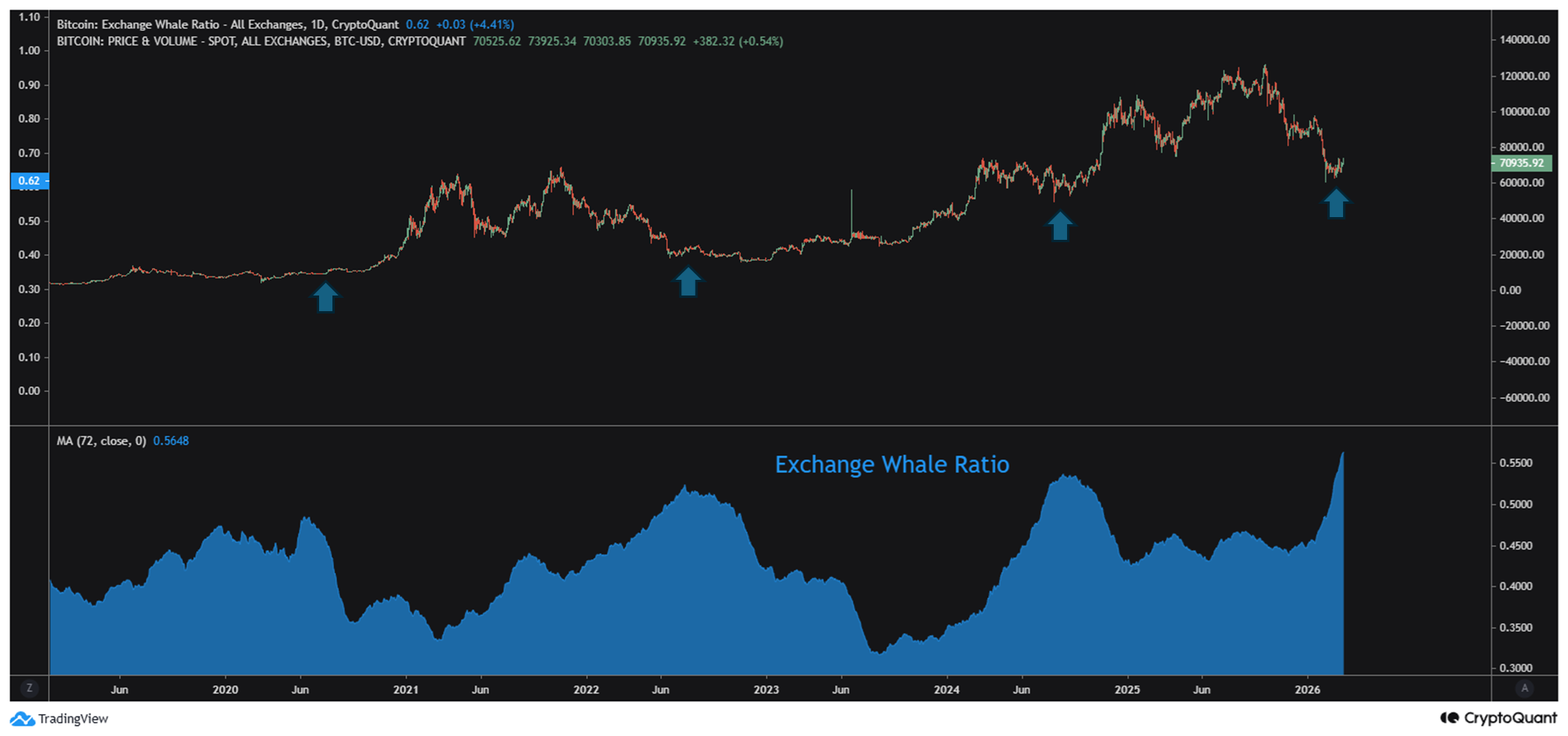
Bitcoin whale activity has reached its highest level in six years, according to on-chain data. The Exchange Whale Ratio, a metric tracking large holder contributions to exchange inflows, has spiked notably.
Meanwhile, retail participation remains near cycle lows. Bitcoin’s price sits around $70,000 following a sharp drawdown.
Historically, such conditions have appeared near local market bottoms. The data points to a possible shift in market structure, as large players appear to be moving ahead of smaller investors.
What the Exchange Whale Ratio Reveals
The Exchange Whale Ratio measures how much of the Bitcoin flowing to exchanges comes from large holders. A spike in this ratio means whales are sending more BTC to exchanges relative to retail participants.
This kind of activity often precedes major price turning points in the market. The current reading is the highest this metric has recorded in six years.
Source: Cryptoquant
At the same time, retail activity remains near its lowest levels of the current cycle. This contrast between whale aggression and retail passivity is a pattern that has appeared before.
In past cycles, similar setups tended to emerge near local bottoms before the next leg higher. Traders and analysts are now watching closely to see whether history repeats.
The combination of whale accumulation and retail caution has drawn broad attention across the crypto space. Data from exchange inflows shows large holders are actively repositioning their Bitcoin.
Whether these moves signal distribution or accumulation remains a key question. On-chain metrics alone cannot confirm the direction, but the activity level is hard to ignore.
One market observer noted that the current setup is “notable,” given that Bitcoin hovers around $70,000. The sharp drawdown preceding this spike mirrors conditions seen in prior cycles.
As a result, the Exchange Whale Ratio is being closely monitored by analysts. Many are treating it as one of several indicators pointing to a potential market inflection.
How Recent Trading Patterns Support the Data
Crypto trader @KillaXBT offered a broader perspective on Bitcoin’s recent price behavior. He described the past two years of trading as “some of the easiest ever,” citing mechanical price action.
According to him, the market has been dominated by clear ranges throughout this period. Corrections and impulsive moves have typically lasted just two to three weeks.
The consistency of these short-term cycles adds context to the current whale activity. If corrections have historically resolved within weeks, then the present drawdown may already be nearing its end.
Large holders appear to be factoring this into their positioning. Their activity on exchanges supports the idea that a move may be approaching.
Retail investors, however, have not yet responded to these signals in any meaningful way. Low retail participation during whale accumulation phases has often preceded sharp recoveries in past cycles.
This gap between institutional and retail behavior tends to close as price action becomes clearer. For now, Bitcoin’s on-chain data continues to attract close attention from market participants.
Whether this cycle follows the same historical path will depend on broader market conditions. The data, however, continues to build a case that large players are already moving.
Meanwhile, smaller investors remain on the sidelines. The coming weeks may prove whether the current setup resolves as past patterns suggest.
TLDR:
- HyperCore repurchased 16,809 HYPE on March 15, 2026, at an average price of approximately $37.41 per token.
- Staking and validator rewards totaled 26,822 HYPE on the same day, exceeding buybacks by 10,013 HYPE net.
- The buyback mechanism is price-sensitive, repurchasing more tokens when HYPE prices fall and fewer when prices rise.
- HYPE confirmed a 15.16% technical breakout after cleanly flipping a key horizontal resistance zone into new support.
HYPE, the native token of Hyperliquid, is drawing close attention from crypto market participants. On March 15, 2026, HyperCore repurchased 16,809 HYPE at an average price of approximately $37.41.
On the same day, 26,822 HYPE were distributed as staking and validator rewards. The resulting net difference came to 10,013 HYPE per day.
Separately, technical analysts confirmed a breakout, with the token gaining more than 15% during the period.
HyperCore Buyback Data Reveals Net Token Emission
According to Hyperliquid Hub, HyperCore repurchased 16,809 HYPE on March 15, 2026. Staking rewards and payments across 24 validators totaled 26,822 HYPE on the same day.
Subtracting the buyback from distributed rewards produces a net daily emission of 10,013 HYPE. Monthly, that figure equates to approximately 300,390 HYPE.
On an annual basis, the current pace projects to around 3,604,680 HYPE per year. For reference, Solana distributes roughly 25.19 million SOL annually through staking and validators.
Hyperliquid’s output is far smaller, reflecting tighter supply management. The protocol remains among the lower-emission networks when placed alongside major layer-1 chains.
The buyback mechanism carries price sensitivity within its structure. Higher HYPE prices mean each dollar of protocol revenue repurchases fewer tokens.
Conversely, lower prices enable more aggressive repurchases, creating natural supply stabilization. This counter-balance helps moderate supply pressure across different phases of the market.
Hyperliquid Hub pointed to the platform’s flywheel as a broader driver of buyback activity. Greater HIP-3 adoption leads to increased trading activity on the platform.
Higher trading volume generates more protocol revenue, which then funds larger repurchases. Over time, this cycle is expected to gradually reduce the net emission gap.
HYPE Price Action Confirms Technical Breakout Above Resistance
Alpha Crypto Signal reported that HYPE broke cleanly above a key horizontal resistance zone. The level converted to support without any fakeout wick appearing on the chart.
A retest of the former resistance followed, and price held the new support firmly. After confirming that level, the token then advanced 15.16%, with momentum remaining intact.
The breakout matched the technical setup the analyst had previously flagged. Price action during the retest period showed no signs of weakness or exhaustion.
The clean flip from resistance to support added credibility to the continuation move. Analysts observed that the next resistance levels were already coming into range.
On the broader chart, the price move connects to Hyperliquid’s growing platform activity. Higher trading volume on the network generates more protocol revenue for buybacks.
Larger buyback activity, alongside the net emission data, shapes a constructive supply picture. Both technical structure and on-chain fundamentals remain aligned for HYPE at this point.
The gap between daily distributions and repurchases provides a clear metric to follow. As platform adoption grows, this figure is expected to attract greater market attention. Analysts view the daily buyback data as a useful barometer of protocol health.

Salman Agha’s ton goes in vain as Taskin Ahmed powers Bangladesh to 11-run series win over Pakistan | Cricket News

Playdate games to check out before the Catalog’s 3-year anniversary sale ends

‘Our teenage son won’t walk again after horror accident, but he’s positive about his future’


-
 Tech5 days ago
A 1,300-Pound NASA Spacecraft To Re-Enter Earth’s Atmosphere
-
Crypto World2 days ago
HYPE Token Enters Net Deflation as HyperCore Buybacks Outpace Staking Rewards
-

 News Videos6 days ago
10th Algebra | Financial Planning | Question Bank Solution | Board Exam 2026
-

 Business5 days ago
ExxonMobil seeks to move corporate registration from New Jersey to Texas
-

 Crypto World6 days ago
Paradigm, a16z, Winklevoss Capital, Balaji Srinivasan among investors in ZODL
-

 Fashion2 days ago
Weekend Open Thread: Addict Lip Glow
-

 Tech5 days ago
ChatGPT will now generate interactive visuals to help you with math and science concepts
-
Sports1 day ago
Why Duke and Michigan Are Dead Even Entering Selection Sunday
-

 NewsBeat4 days ago
Residents reaction as Shildon murder probe enters second day
-

 Business5 days ago
Search Enters Sixth Week With New Leads in Tucson Abduction Case
-
 NewsBeat6 days ago
Pagazzi Lighting enters administration as 70 jobs lost and 11 stores close across Scotland
-

 Business4 hours ago
Search for Savannah Guthrie’s Mother Enters Seventh Week with No Arrests
-

 Tech6 days ago
Despite challenges, Ireland sixth in EU for board gender diversity
-

 Business1 day ago
US Airports Launch Donation Drives for Unpaid TSA Workers as Partial Government Shutdown Enters Fifth Week
-
Crypto World1 day ago
Coinbase and Bybit in Investment Talks: Could Bybit Finally Enter the US Crypto Market?
-

 NewsBeat4 days ago
I Entered The Manosphere. Nothing Could Prepare Me For What I Found.
-

 Business6 days ago
Search Enters 39th Day with FBI Tip Line Developments and No Major Breakthroughs
-

 Sports7 days ago
Skateboarding World Championships: Britain’s Sky Brown wins park gold
-

 Business1 day ago
Country star Brantley Gilbert enters growing non-alcoholic beer market
-
 Crypto World5 days ago
Will Chainlink price reclaim $10 amid volatility squeeze?

