

Crypto World
BTC tops $74K, ether, solana, cardano move as much as 7%



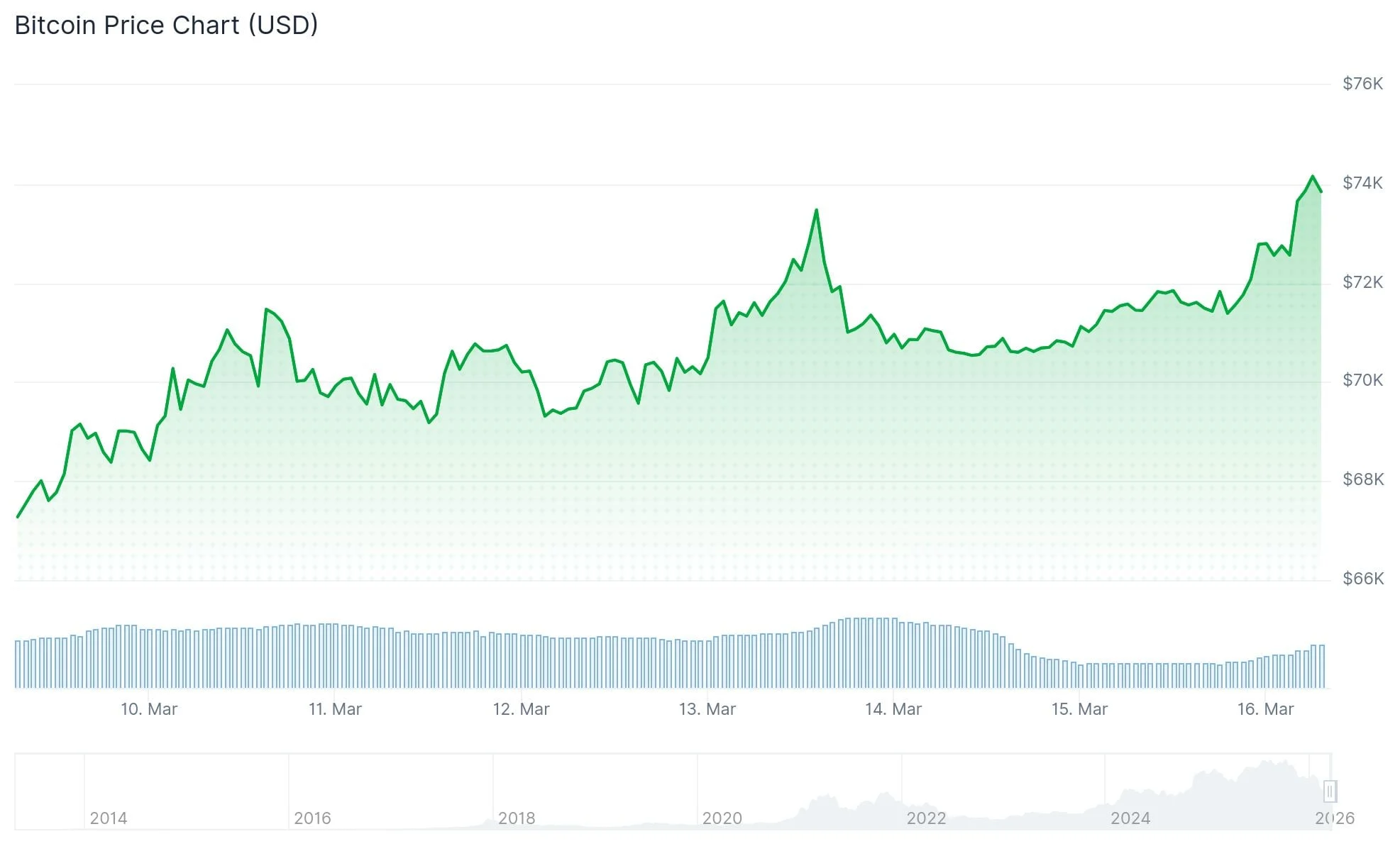
Bitcoin broke through the $74,000 resistance zone that it had rejected four times in two weeks, and this time the move has more behind it than a short squeeze.
The largest cryptocurrency was trading just above $74,000 on Monday morning, up 2.9% over the past 24 hours and 9.7% on the week. Ether surged 7.7% in 24 hours and 14.3% on the week to $2,261, its strongest weekly performance in months. Solana jumped 5.6% on the day and 12% on the week to $93.
Dogecoin hit $0.10 for the first time since early March, up 4.6% daily and 10.6% weekly. BNB gained 3.8% to $683 with a 9.5% weekly gain. XRP rose 4.2% to $1.47, up 8.9% over seven days.
The catalyst was a shift in tone from multiple directions at once. Trump said the U.S. was talking to Iran, though Tehran denied requesting talks or a ceasefire. Iranian Foreign Minister Abbas Araghchi said the Strait of Hormuz was only closed to ships from “enemies,” a notable softening from the blanket closure that had been in effect.
Two tankers carrying liquefied petroleum gas to India sailed through the strait on Sunday, the first commercial transit since the war began.
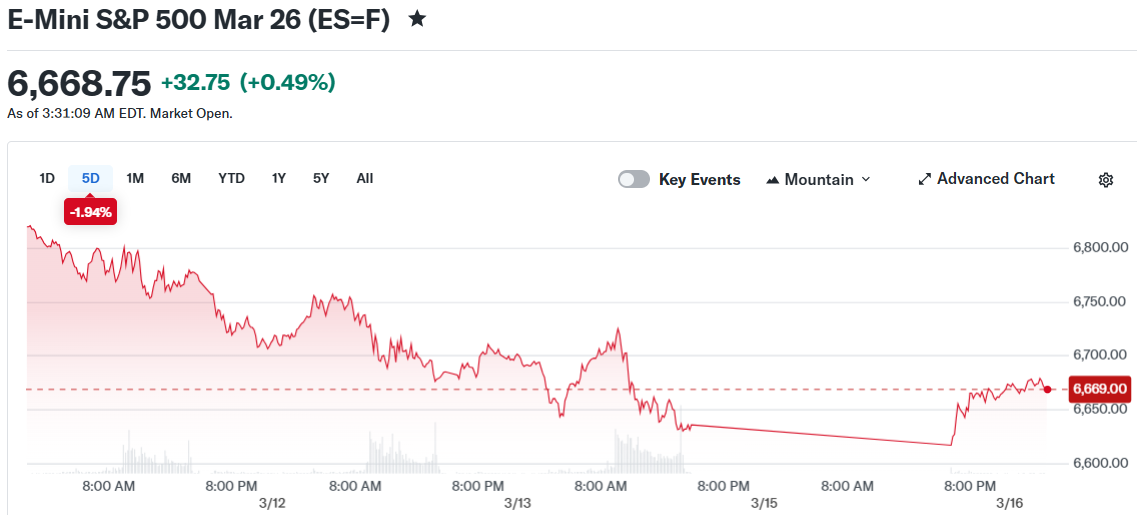
Oil reflected the change in mood. Brent traded around $104 after earlier climbing as high as $106.50 following the Kharg Island strikes, but pulled back as the Hormuz headlines hit. WTI dropped below $100. The dollar weakened 0.3%. S&P 500 futures advanced 0.5%, set for their first gain in five days. MSCI’s global equity gauge stabilized after three days of declines.
For crypto, the combination of easing oil, a weaker dollar, and even a hint of de-escalation is the exact macro cocktail that loosens the liquidity chain that has been choking risk assets since the war began.
The weekly numbers are the most impressive since before the war. Bitcoin’s 9.7% gain is strong but the altcoin outperformance is the signal that risk appetite is genuinely returning. When ether outperforms bitcoin by 4.6 percentage points and solana outperforms by 2.3 points on a weekly basis, capital is rotating down the risk curve rather than hiding in bitcoin.
The Fed meeting on March 17-18 arrives with different context than it had a week ago.
Oil is still elevated but the Strait of Hormuz showing signs of reopening changes the inflation calculus. The dot plot and Powell’s press conference on Wednesday will determine whether the market’s rate cut hopes survive or get crushed.


Australia’s Senate Economics Legislation Committee has backed a bill that would require crypto exchanges and tokenization platforms to comply with the country’s existing financial services regime, recommending that the Corporations Amendment (Digital Assets Framework) Bill 2025 be passed.
The move on March 16 brings Australia a step closer to a bespoke licensing framework for “digital asset platforms” (DAPs) and “tokenised custody platforms” (TCPs), aimed at closing gaps in oversight of platforms that hold customer assets following the collapses of high‑profile digital asset businesses, such as FTX.
The bill, first introduced by Assistant Treasurer and Financial Services Minister Daniel Mulino in November 2025, would treat DAPs and TCPs as financial products under the Corporations Act and Australian Securities and Investments Commission (ASIC) Act, pushing most centralized exchanges and tokenized custody businesses that hold client assets into the Australian Financial Services Licence regime.
Related: Ripple targets April for Australian financial license via acquisition
Licensed platforms must meet ASIC-set custody and settlement standards, comply with tailored disclosure rules for retail clients, and operate under platform‑specific conduct and governance requirements, while small providers with annual transaction thresholds under 10 million Australian dollars ($7 million) and some public blockchain infrastructure are exempt.

Industry groups warnings around terminology
Industry groups cited in the report, such as law firm Piper Alderman, warned that the broad “digital token” and “factual control” tests could inadvertently include wallet software and infrastructure providers in non-unilateral-control setups, including common multi‑party computation (MPC) configurations.
US blockchain firm Ripple Labs backed “control” as the “appropriate nexus” for the regulatory perimeter, but argued that the bill needed to better accommodate modern security architectures such as MPC wallets.
It warned that, on a strict reading of the “factual control” test, technology‑only providers holding a single key shard could be misclassified as regulated custodians, and urged lawmakers to clarify that an entity does not exercise factual control unless it can unilaterally transfer an asset without the client’s cooperation.
Related: Australia warns of AI, ‘finfluencers’ as Gen Z crypto ownership reaches 23%
The committee acknowledged these concerns, but sided with Treasury’s plan to refine the perimeter through future regulations rather than rewriting the core definitions.
Coinbase hails progress but warns on debanking risk
In an email statement to Cointelegraph, Coinbase Australia director and APAC managing director John O’Loghlen welcomed the recommendation as “an important step for Australia’s standing in the global digital economy.” He argued that the country had the capital and talent to lead in digital assets, but still needed clear rules to unlock that potential.
O’Loghlen also warned that “the anti-competitive practice of debanking is rampant despite the government endorsing measures to address it back in 2022,” and urged Canberra to prioritize implementing the Council of Financial Regulators’ recommendations.
With the committee’s backing in hand, the bill now moves to the Senate for debate and a final vote at a later date.
Magazine: 6 weirdest devices people have used to mine Bitcoin and crypto
Key Highlights
- The digital asset cleared the critical $1.426 resistance barrier for the first time since the beginning of 2026 following an extended period of sideways price action.
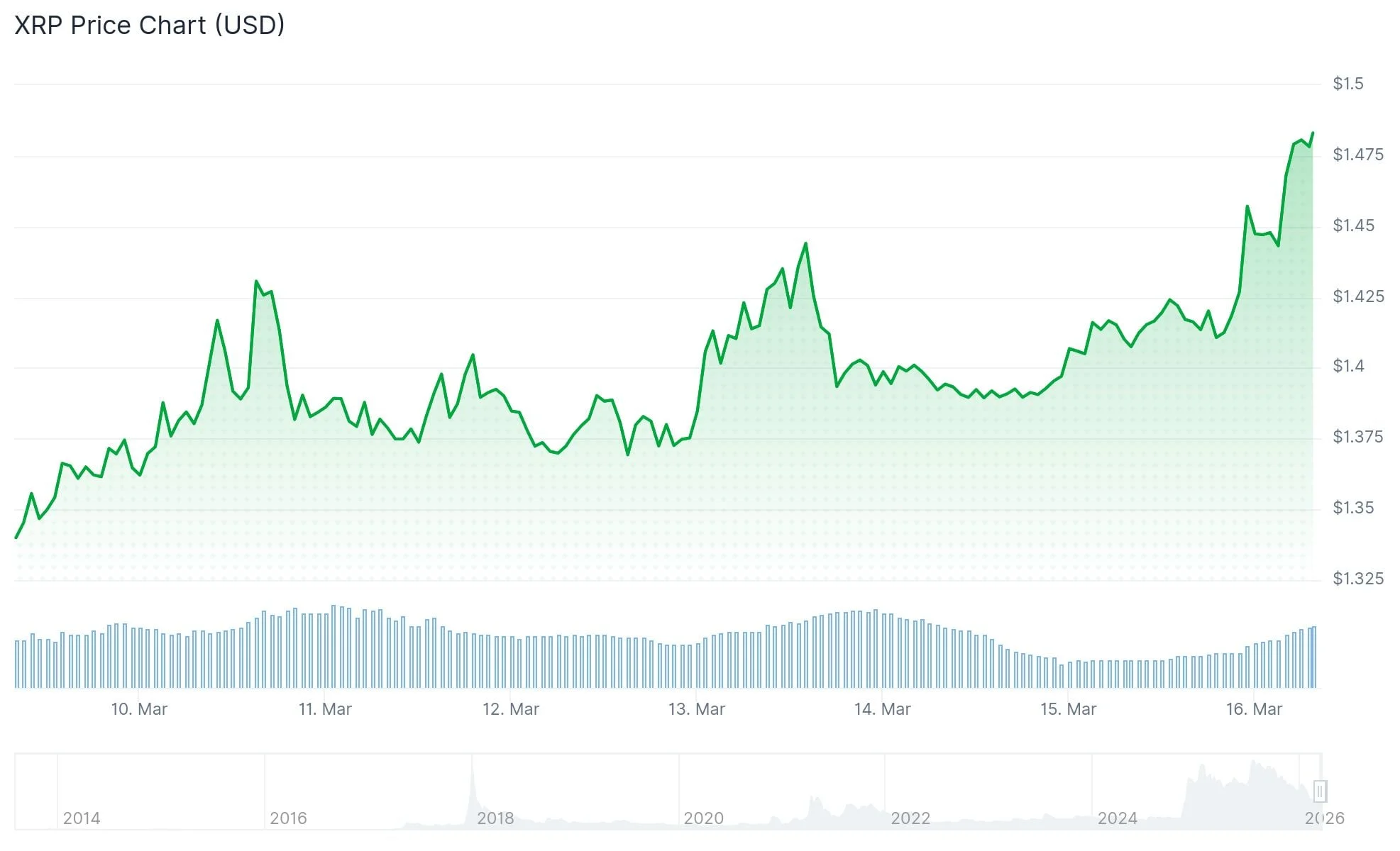
- Price surged from approximately $1.41 to $1.47 within 24 hours, accompanied by a volume increase exceeding 250%.
- The token is currently maintaining levels above $1.4550 and the 100-hour Simple Moving Average, with immediate targets identified near $1.48–$1.50.
- Real-world asset tokenization on the XRP Ledger continues expanding, with commodity tokens nearing $1.14 billion in total value.
- Maintaining support above the $1.43–$1.44 zone could open the door for further advances toward $1.50 and possibly $1.55.
On March 16, 2026, XRP finally broke free from a stubborn resistance level that had confined price action for several months during the early part of 2026.
The cryptocurrency rallied from the $1.41 region to reach an intraday peak of $1.4798 during the most recent trading session. Volume activity exploded by more than 250% as the breakout unfolded, with approximately 170 million tokens traded at peak levels.
Price action is currently stabilizing just above the $1.4550 level, maintaining its position over the 100-hour Simple Moving Average.
The pivotal barrier that finally broke was positioned at $1.426—a level that had repeatedly rejected upward momentum during multiple rally attempts in recent months. After clearing this threshold on robust volume, the asset rapidly advanced toward the $1.47 zone.
Near-term technical analysis reveals a pattern of ascending lows developing post-breakout. This formation indicates buying pressure is attempting to establish the previous resistance area as fresh support.
Rising Activity on the XRP Ledger
The price breakthrough doesn’t seem to correlate with any specific XRP-related news event. That said, on-chain activity across the XRP Ledger has been steadily increasing.
Tokenization of real-world assets on the network has shown continuous growth. Commodity-backed tokens on the XRP Ledger climbed toward $1.14 billion in valuation during 2026’s opening quarter.
Critical Price Zones Under Observation
XRP now confronts its next resistance barrier in the $1.48 to $1.50 range. Historical price action shows that rallies have encountered difficulty in this zone, making a decisive move beyond $1.50 particularly significant.
Should the asset successfully breach $1.50, market participants are eyeing subsequent targets at $1.5250 and $1.5320. Continued strength could drive price action into the $1.55 territory.
For downside protection, the essential support zone lies between $1.43 and $1.44. This represents the breakout level, and maintaining these prices is crucial for validating the current upward movement.
A decline beneath $1.4325 would mark a 50% Fibonacci retracement of the entire move from $1.3855 to $1.4798. Further weakness could find support around $1.410, with the primary demand zone located near $1.3680.
Currently, XRP is holding above $1.4550 with the 100-hour Simple Moving Average providing immediate support.

TLDR
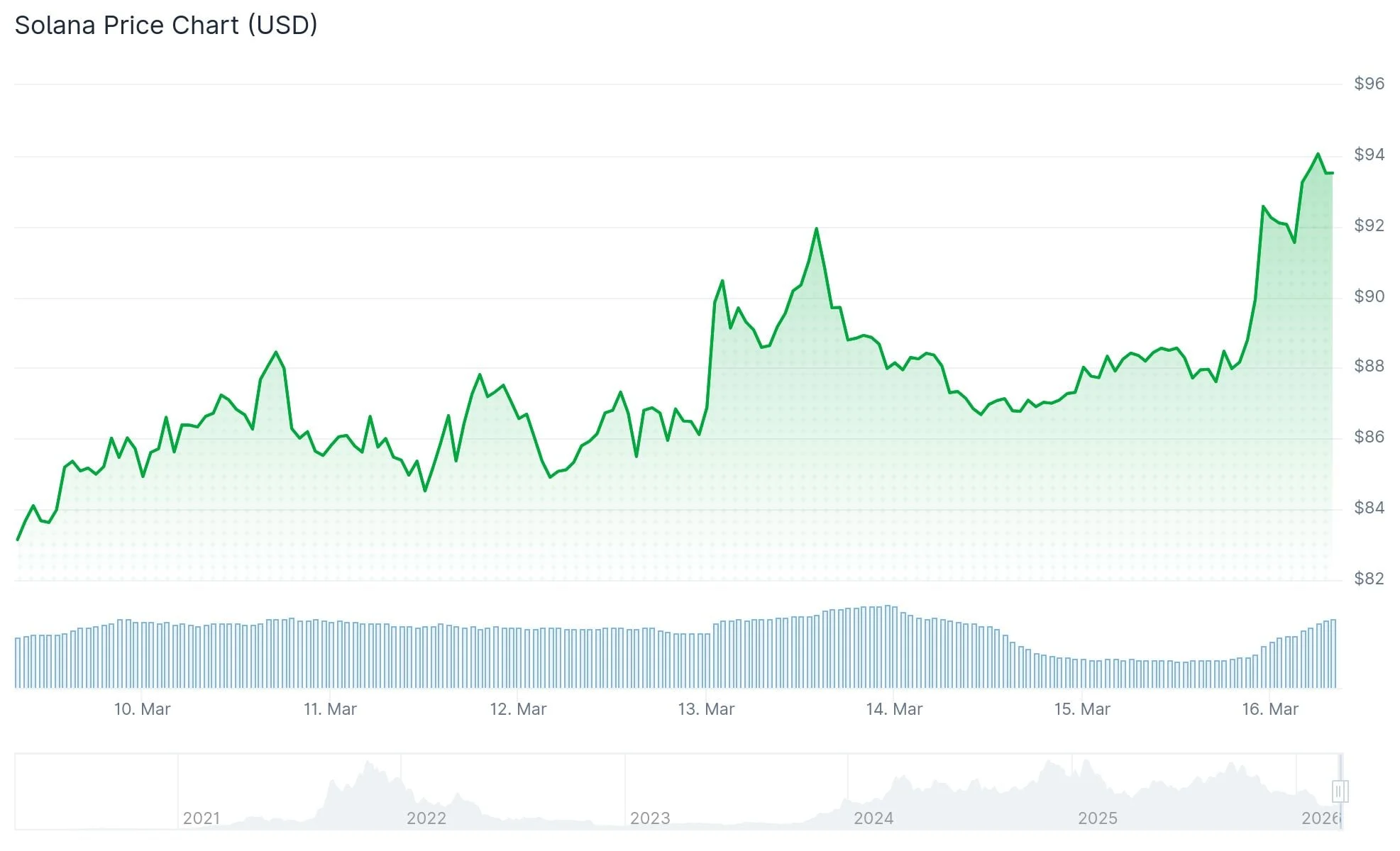
- SOL has climbed to the $92–$93 range, posting gains of approximately 4–5% daily following a 13% weekly increase.
- Institutional demand persists with SOL-focused ETFs recording $10.70 million in net weekly capital inflows.
- Futures Open Interest surged more than 7% within 24 hours to reach $5.57 billion, accompanied by $14.43 million in bear position liquidations.
- The 50-day EMA at $94.17 represents immediate technical resistance, with the 100-day EMA at $109.58 serving as the subsequent upside target.
- Real-world asset tokenization on the Solana network has expanded to approximately $873 million, based on Bitwise data.
Solana is demonstrating a notable rebound following its steep correction from the January 2026 high near $295. The digital asset has accumulated approximately 13% in gains throughout the past seven days and currently hovers within the $92–$93 price zone.
Exchange-traded funds dedicated to SOL accumulated $7.60 million in a single trading session on Friday, elevating the seven-day aggregate to $10.70 million. This sustained capital influx demonstrates persistent institutional appetite despite the recent downward pressure on prices.
Within the derivatives market, futures Open Interest experienced an upward movement exceeding 7% over a 24-hour period, reaching $5.57 billion. Bearish traders absorbed substantial losses, with short liquidations accounting for $14.43 million of the total $15.50 million in forced position closures.
The present trading level remains marginally beneath the 50-day Exponential Moving Average positioned at $94.17. Successfully closing above this threshold on a daily timeframe could establish momentum toward the 100-day EMA target of $109.58.
Technical momentum signals are exhibiting bullish tendencies. The MACD indicator has crossed into positive territory while the RSI registers at 58, positioned above neutral levels.
Real-World Asset Growth Supports Solana’s Case
Among the most compelling narratives supporting SOL’s price recovery is the expansion of tokenized real-world assets on its blockchain infrastructure. Bitwise research indicates that RWAs on Solana have reached approximately $873 million in valuation, spanning on-chain treasury products, private credit instruments, and yield-generating assets.
Spot-based Solana ETFs, which received regulatory approval in late 2025, have maintained capital attraction even throughout periods of adverse price movement. These investment vehicles provide traditional financial market participants with SOL exposure without the complexities of direct cryptocurrency custody.
Blockchain metrics corroborate this institutional interest. Active wallet addresses have exceeded the 5 million threshold while daily transaction volume approaches 87 million.
Network and Supply Context
The Solana validator network has expanded to encompass more than 2,000 validators according to certain estimates, though the count of active validators may be closer to 795. The Solana Foundation’s proportion of staked SOL tokens has declined substantially from above 40% in 2020 to below 6% by late 2025.
The network operates with an annual inflation rate of approximately 4%. Roughly 67% of SOL tokens remain staked, effectively constraining the freely circulating supply available for trading.
Funding rates across perpetual swap contracts remain relatively neutral to marginally negative at approximately −0.0095% daily. This metric indicates that leveraged long positions have not yet entered an aggressive accumulation phase.
Immediate downside support is identified within the $76–$80 range. Significant overhead resistance persists near $245–$250, corresponding to the January peak formation.
Presently, SOL exchanges hands at approximately $92–$93 with the 50-day EMA at $94.17 functioning as the immediate technical barrier.

Key Points
- Institutional crypto platform BlockFills declared Chapter 11 bankruptcy in Delaware on March 15, 2026
- Assets valued at $50M–$100M were reported against debts ranging from $100M–$500M
- Customer withdrawals were halted in February following approximately $75 million in losses
- A federal court issued an order freezing 70.6 Bitcoin connected to BlockFills after Dominion Capital filed suit
- Co-founder Nicholas Hammer resigned as CEO; Joseph Perry assumed the interim leadership position
On March 15, 2026, BlockFills—a Chicago-based institutional cryptocurrency trading and lending platform—submitted Chapter 11 bankruptcy documents to the US Bankruptcy Court for the District of Delaware.
Reliz Ltd., the platform’s primary operating entity, initiated the bankruptcy alongside three related companies. The documentation revealed assets valued between $50 million and $100 million, while liabilities ranged from $100 million to $500 million.
As an institutional service provider, BlockFills offers liquidity solutions, financing options, and risk-management tools to professional clients such as hedge funds, asset management firms, and cryptocurrency mining operations. According to company data, the platform facilitated over $60 billion in transaction volume throughout 2025—representing a 28% increase compared to the previous year.
The platform maintains a client base of approximately 2,000 institutional investors and has received backing from notable investors including Susquehanna Private Equity Investments, CME Ventures, and Nexo Inc.
In February, BlockFills announced the suspension of both customer deposits and withdrawals, attributing the decision to worsening market conditions. Company representatives stated the pause was necessary to safeguard the business and client interests while working toward restoring adequate liquidity.
According to CoinDesk’s reporting, the platform had suffered losses totaling roughly $75 million and had actively pursued acquisition offers or emergency capital injection prior to the bankruptcy declaration.
Bitcoin’s significant price decline appears to have contributed substantially to the firm’s financial difficulties. The leading cryptocurrency plummeted from above $97,000 to below $64,000 during the period spanning mid-January through early February 2026.
Court Actions Intensified Financial Strain
In early March, a US court issued an order freezing 70.6 Bitcoin associated with BlockFills operations. This action followed litigation initiated by Dominion Capital, a client alleging misappropriation of customer assets and improper commingling of funds.
Dominion Capital’s complaint asserted that BlockFills leadership had repeatedly acknowledged possessing a balance sheet deficit and improperly mixing client assets.
A federal judge additionally granted a temporary restraining order against the platform in response to Dominion Capital’s lawsuit. The court mandated a comprehensive accounting of all customer funds as part of the ongoing legal proceedings.
The Financial Times published a report on March 6 indicating that BlockFills had begun preparing for restructuring proceedings and was actively consulting with legal and advisory professionals.
Executive Transition Amid Crisis
Co-founder and chief executive Nicholas Hammer vacated his leadership position during the unfolding crisis. Joseph Perry accepted the appointment as interim chief executive officer.
In BlockFills’ official announcement, the company characterized the Chapter 11 filing as the “most responsible path forward” following extensive discussions with investors, clients, and creditors.
Management indicated the bankruptcy process would provide necessary time to stabilize operations, secure additional liquidity sources, and evaluate potential strategic alternatives or transactions.
The BlockFills bankruptcy echoes the 2022 cryptocurrency lending sector collapse, which saw major platforms including Celsius, Voyager Digital, BlockFi, and Genesis all declare bankruptcy following severe market corrections.
Joseph Perry currently oversees the company as it navigates the court-supervised restructuring proceedings.
The updates were introduced on Pi Day 2026 – March 14.
After a few consecutive days of dropping hard following a major fake-out rally, PI’s price has finally turned green in the past day, challenging the coveted $0.20 level.
The reasons behind today’s bounce could be attributed to the overall market resurgence, but also the new updates announced by the Core Team during the weekend.
PI Price Bounces
Pi Network’s native token was perhaps the most volatile altcoin in the past week, which, for the most part, was going well for the asset. At one point, it registered a massive 30% surge on Friday morning, skyrocketing to almost $0.30, which became a five-month peak. This came after the veteran US exchange Kraken said it would list PI for trading.
At the time, the token had added more than 100% since its February all-time low of $0.1312. However, the bears were quick to intervene and didn’t allow any further gains. Just the opposite; PI nosedived on Saturday morning with double-digits and plummeted toward $0.20. It slipped below that level on Sunday as most of the crypto market was retracing.
However, it has rebounded to just north of that coveted line as of now after a 4% daily increase. While this price jump could be linked to the gains registered by the broader crypto market today, it could also be a direct response to the recent ecosystem developments.
Pi Day and Updates
In the weeks leading up to PI’s big breakout attempt, the Core Team behind the project announced a few key updates that ultimately upgraded the protocol to v19.9. The next one, v20.2, was expected by March 12. More importantly for the community, perhaps, was March 14 – known as Pi Day due to its resemblance to the mathematical constant π (3,14).
With its announcement, the team outlined several key updates, including the successful migration to v20.2. The Pi Launchpad was also released on Testnet, which is still available only through the Pi Browser. It aims to introduce a new ecosystem token model focused on product utility and user acquisition.
You may also like:
The initial version of the Pi Launchpad has been released as a Pi App on the Testnet with a test token! Because the Launchpad introduces new concepts for many Pioneers and uses mechanisms that differ from typical token launches in Web3, it is being introduced on Testnet first so…
— Pi Network (@PiCoreTeam) March 16, 2026
The other developments were the start of the second Mainnet migrations, the release of the first round of KYC validator rewards, and the integration of Pi payments in the Pi App Studio.
Binance Free $600 (CryptoPotato Exclusive): Use this link to register a new account and receive $600 exclusive welcome offer on Binance (full details).
LIMITED OFFER for CryptoPotato readers at Bybit: Use this link to register and open a $500 FREE position on any coin!
Disclaimer: Information found on CryptoPotato is those of writers quoted. It does not represent the opinions of CryptoPotato on whether to buy, sell, or hold any investments. You are advised to conduct your own research before making any investment decisions. Use provided information at your own risk. See Disclaimer for more information.
Key Highlights
- Bitcoin surpassed $74,000 after multiple unsuccessful attempts at breaking this resistance level
- Altcoins showed strong performance with Ether up 14.3% weekly and Solana gaining 12%
- Short sellers suffered massive losses totaling $344 million, with $284.9 million from short positions alone
- Commercial shipping resumed through the Strait of Hormuz as US-Iran tensions showed signs of de-escalation
- Traditional markets responded positively with S&P 500 and Nasdaq futures rising approximately 0.5% each
The leading cryptocurrency finally pushed past a critical price point that had rejected advances on four separate occasions over the previous two weeks. [[LINK_START_3]]Bitcoin[[LINK_END_3]] was changing hands slightly above $74,000 during Monday morning trading, representing a 2.9% increase over 24 hours and a weekly gain of 9.7%.
The second-largest cryptocurrency by market capitalization, Ether, advanced 7.7% during the session and posted a weekly increase of 14.3%, reaching $2,261. Solana demonstrated similar strength with a 5.6% daily gain and 12% weekly advance to $93, marking its best seven-day performance in several months.
The rally extended across the broader digital asset market. Dogecoin touched the $0.10 level for the first time since early March, climbing 4.6% on the day and 10.6% for the week. BNB advanced 3.8% to reach $683, while XRP posted a 4.2% gain to $1.47.
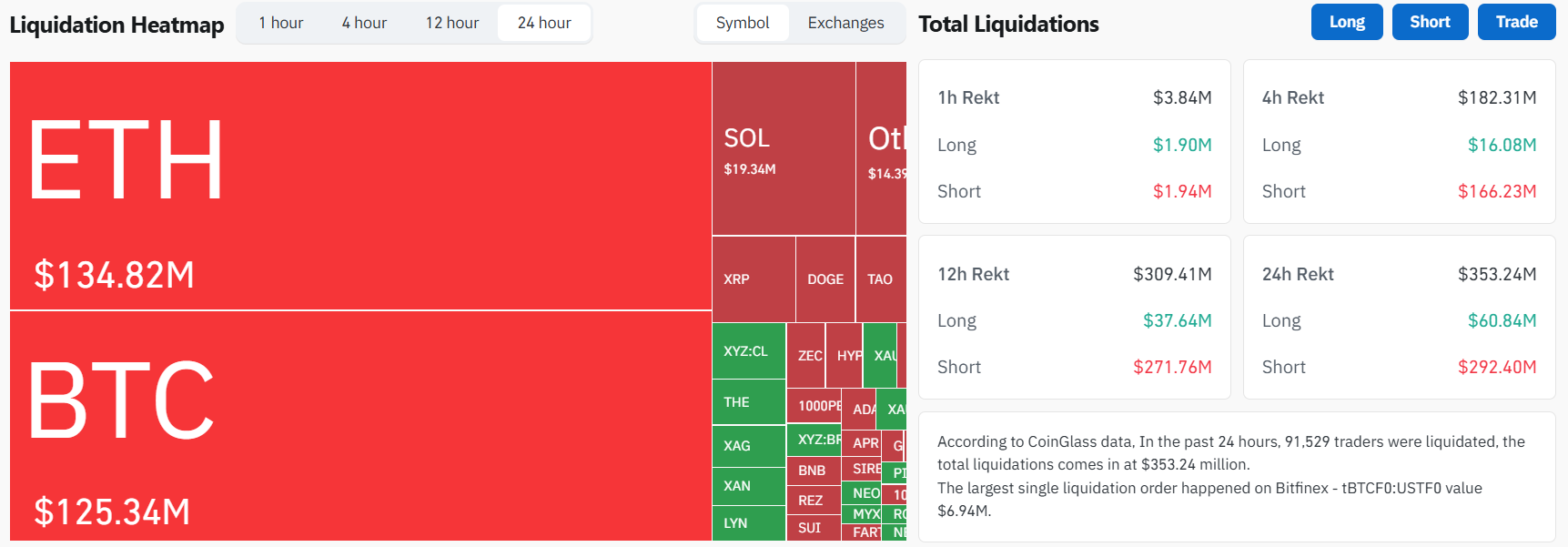
A significant factor behind the price surge was forced liquidation of bearish positions. According to CoinGlass tracking data, $344 million worth of positions were liquidated across 91,978 traders during the previous 24-hour period. Bearish bets accounted for $284.9 million of these liquidations, representing approximately 83% of the total. Ether short positions suffered the most severe losses at $127.9 million, with Bitcoin shorts losing $124.5 million and Solana shorts giving up $18.5 million. A single Bitcoin short position on Bitfinex worth $6.94 million represented the largest individual liquidation.
Hormuz Strait Situation Shows Improvement
Global economic conditions experienced a notable shift during the weekend period. President Trump announced ongoing diplomatic communications with Iran, although Iranian officials disputed any requests for ceasefire negotiations. Iranian Foreign Minister Abbas Araghchi clarified that the Strait of Hormuz remained closed exclusively to vessels from “enemies,” representing a softening from the complete blockade implemented when hostilities commenced.
Two vessels transporting liquefied petroleum gas destined for India successfully navigated through the strait on Sunday, marking the first commercial passage since the conflict’s outbreak.
Oil prices adjusted accordingly. Brent crude was trading near $104 after previously touching $106.50 following American military strikes on Kharg Island, Iran’s primary petroleum export facility. West Texas Intermediate fell beneath the $100 threshold. The US dollar index declined 0.3%.
The combination of declining oil prices and dollar weakness created favorable conditions for speculative assets. Reduced energy costs and a softer dollar typically enhance liquidity dynamics for digital currencies and similar risk-oriented investments.
Equity Markets Gain Ahead of Federal Reserve Decision
Traditional equity index futures posted gains during Monday’s session. Contracts linked to the Dow Jones Industrial Average climbed 0.4%. Both S&P 500 and Nasdaq 100 futures advanced approximately 0.5%. These gains would represent the first positive trading day following five consecutive sessions of declines. The S&P 500 concluded the previous week at levels not seen since November.
Market participants are focused on two major developments scheduled for this week. Nvidia’s yearly GTC conference commenced Monday featuring a presentation from CEO Jensen Huang. Additionally, the Federal Reserve’s March 17-18 monetary policy gathering is approaching.
Market consensus anticipates the Fed will maintain current interest rate levels. However, the updated economic projections and Fed Chair Jerome Powell’s Wednesday press briefing will be crucial in determining market expectations for potential rate reductions later this year. Persistently high oil prices could present challenges to the inflation narrative as policymakers deliberate.
The superior performance of alternative cryptocurrencies deserves attention. Historical patterns suggest that when Ether outpaces Bitcoin by more than four percentage points during a weekly period, it often indicates expanding risk appetite throughout the market rather than defensive positioning into the dominant digital asset.

A renewed debate is growing over whether a sustained pivot from Bitcoin (CRYPTO: BTC) miners toward artificial intelligence could impact the network’s security and its role as a store of value. On one side, energy and capital are increasingly chasing higher returns in AI compute, prompting fears that hash power could retreat during downturns and open the door to security concerns. On the other, supporters contend that Bitcoin’s protocol is designed to rebalance automatically: when less-efficient miners exit, difficulty adjusts downward, and profitability converges again as competition for electricity shifts. The discussion isn’t merely speculative. It sits at the intersection of energy economics, infrastructure strategy, and the long-standing premise that Bitcoin’s decentralized ledger remains secure regardless of how capital migrates between sectors.
Key takeaways
- The core economic driver is the relative value of electricity: Bitcoin mining yields roughly $57–$129 per megawatt, while AI data centers can generate $200–$500 per megawatt for the same energy, prompting capital to flow toward AI workloads.
- Major miners and financiers have already signaled a shift: Core Scientific secured up to $1 billion in credit for AI hosting, MARA Holdings signaled a BTC sale to fund AI pivot, and Hut 8 reportedly sealed a $7 billion AI infrastructure agreement with Google in December.
- Bitcoin’s hashpower has fallen since its October peak, down about 14.5% at times, raising questions about network security and the likelihood of a 51%‑style risk during cycles of energy constraint.
- Industry voices are split: some argue that difficulty adjustments will push out the least efficient miners and sustain profitability, while others warn that energy scarcity could undermine security if AI demand outbids miners for power over extended periods.
- Bitcoin’s price action adds a hinge. A single green candle could tilt sentiment toward renewed mining resilience; a prolonged price decline could accelerate the AI pivot and test the network’s energy resilience.
Tickers mentioned: $BTC
Sentiment: Neutral
Price impact: Neutral. The discussion focuses on mining economics rather than immediate price moves, though BTC has posted gains in March.
Trading idea (Not Financial Advice): Hold
Market context: The debate unfolds amid broader crypto-market conditions where energy costs, grid flexibility, and capital allocation between hash rate growth and compute workloads influence miners’ strategic choices, all within a shifting macro and regulatory backdrop.
Why it matters
The question at the heart of the discussion is simple in form but complex in consequence: does a shift of mining power away from traditional Bitcoin production toward AI compute threaten the network’s security, or does it reflect a healthy reallocation of resources toward higher‑yield compute? The answer could reshape how investors view risk, how miners optimize their fleets, and how the broader crypto ecosystem prices energy and capacity for digital assets.
On the security side, some observers warn that a sustained exodus of hash power could compress the margin of safety that underpins Bitcoin’s decentralized security model. A prominent voice in the debate argues that if AI demand exhausts cheaper electricity or drives prices higher for data-center workloads, miners might retreat from public networks, temporarily lowering the hashrate. They worry about scenarios where a handful of actors accumulate outsized control during energy crises, potentially enabling attack vectors. The counterview, however, emphasizes Bitcoin’s built‑in mechanics: when profitability drops, miners turn off, the network’s difficulty recovers downward, and miner incentives align with current energy pricing, restoring a balance that Bitcoin’s protocol has weathered across multiple cycles.
Beyond security, the energy and infrastructure story matters for the broader crypto economy. AI data centers convert electricity into compute at a rate that, in some cases, outpaces Bitcoin mining. This prospect is not purely hypothetical: several players have publicly signaled major shifts toward AI hosting and AI‑related infrastructure. The confluence of AI demand and Bitcoin’s energy footprint raises questions about grid resilience, stranded energy potential, and whether liquidity and risk appetite in the sector will adapt quickly enough to the changing capital flows. In this context, the debate mirrors a broader trend in the digital economy: compute is becoming the dominant commodity, and the allocation of that compute—whether for cryptographic security or AI workloads—will shape the price and reliability of both energy and networks.
Notable voices have framed the discussion with provocative statements and sharp contrasts. The argument that AI is siphoning away Bitcoin’s core value proposition gained traction when traders highlighted substantial revenue differentials: Bitcoin mining revenue per megawatt sits in roughly the $57–$129 range, while AI data centers have reported $200–$500 per megawatt for equivalent power. That delta is the engine driving a reallocation of capital and capacity, at least in the near term. Yet even within this frame, there are counterpoints about the resilience of Bitcoin’s economics. Veteran cryptographers and investors have stressed that a falling hash rate triggers automatic responses in difficulty and profitability, a process that has occurred repeatedly in past bear markets but may unfold differently this time given potential energy constraints and the strategic value of AI workloads.
In addition to the energy calculus, the narrative features concrete corporate moves. Core Scientific, a major data-center operator, reportedly secured up to $1 billion in credit facilities to fund AI hosting initiatives. Meanwhile, Hut 8 signed a substantial AI infrastructure agreement with a tech giant late last year, underscoring the appetite for AI-dedicated capacity in the sector. MARA Holdings, for its part, signaled intentions to monetize some BTC holdings to finance AI pivot strategies. These moves illustrate a sector-wide reallocation that could recalibrate which assets and firms are most influential in the near term. The implications extend beyond mining economics; they touch on how the crypto industry orchestrates energy resilience, investor capital, and governance around network security.
“What happens to Bitcoin is simple: tick tock, next block! Difficult adjusts downwards, the least efficient and AI switchers move out, and Bitcoin mining profitability converges to AI profitability. QED.”
Cost considerations also bleed into sentiment. Some observers argue that the market and the network will adapt as they always have, with energy markets acting as an efficient allocator of resources. Others contend that recent hash power volatility and the potential for rapid shifts in compute demand could introduce new stressors into the system. As one investor put it, when AI outbids miners for electricity, the response is predictable: miners turn off until the difficulty rebalances and profitability returns. It’s a reminder that Bitcoin’s resilience is not about perpetual abundance of hash power, but about the system’s capacity to adapt to changing energy and economic conditions.
“If AI outbids miners for electricity, miners just turn off until the difficulty adjusts and it’s profitable again, that’s literally how Bitcoin works.”
Meanwhile, other voices offer a more optimistic take on the energy dynamics. Bitcoin has historically used stranded energy and flexible loads to stabilize grids, and proponents argue that the network can continue to contribute to energy markets by providing a responsive, demand-side resource that can help balance supply, especially where renewables create intermittency. In this view, the shift toward AI is not a threat but a reallocation of the same resource—electricity—toward higher-value compute tasks, with Bitcoin retaining its role as a secure, verifiable store of value even as capital flows diversify.
Despite the disagreement, a common thread remains: Bitcoin’s price trajectory and the pace of AI‑driven capital reallocation will interact in ways that determine miners’ behavior in the months ahead. Some market participants point to the possibility of a single decisive move—one “green candle” in BTC’s price—that could reanchor miners’ incentives, drawing capital back toward the network. In the absence of that signal, the landscape could remain tense as energy prices and compute demands jockey for position, with each side framing the outcome through its own risk calculus.
As the narrative unfolds, observers keep a close eye on on-chain and market signals. Bitcoin’s price performance, hash rate, and the economics of power provision will collectively shape miners’ strategies and the security posture of the network. The discussion is not about doom; it is about understanding how a high‑stakes compute economy will influence a system designed to withstand disruption by design. The bitcoin ecosystem is a dynamic mix of hardware, software, energy, and capital, and the direction of travel—whether toward AI dominance or a renewed focus on hash power—will define the next phase of this ongoing evolution.
What to watch next
- Reported movements in miner hashrate and energy usage, especially any ongoing declines or stabilizations after the October peak.
- New AI infrastructure investments or partnerships from major miners and technology firms.
- Regulatory developments or policy signals that affect energy pricing, data-center incentives, or crypto mining operations.
- BTC price action and potential “green candle” scenarios that could shift mining economics back toward traditional Bitcoin production.
- Updates on energy-grid integration and the use of stranded energy by crypto miners or AI facilities.
Sources & verification
- Ran Neuner’s post asserting AI as Bitcoin’s primary competitor for energy, linked via https://x.com/cryptomanran/status/2033161262058889251
- Adam Back’s perspective on difficulty, profitability, and convergence via https://x.com/adam3us/status/2033278188059537602
- HashRateIndex data demonstrating bitcoin hashprice trends and network profitability
- Core Scientific credit facility coverage: https://cointelegraph.com/news/core-scientific-secures-up-to-1b-credit-facility-from-morgan-stanley-for-data-center-development
- BTC price coverage and market data: https://cointelegraph.com/bitcoin-price and CoinGlass market data
- On‑chain and market context coverage relating to AI infrastructure deals and mining pivots
AI competition and Bitcoin mining: implications for security and energy
The debate about AI’s influence on Bitcoin’s security has moved from academic conjecture to a real-world energy and capital reallocation story. The central question is whether AI demand can outpace Bitcoin’s need for secure, affordable hash power long enough to alter the network’s risk profile. Supporters of the skeptical view argue that Bitcoin’s design—automatic difficulty adjustment, competitive mining economics, and the ability of miners to turn off during downturns—will preserve security even if some participants shift toward AI workloads. The fundamental mechanism remains straightforward: when hashpower declines, difficulty adjusts, improving profitability for those who stay and those who pivot back as conditions improve. In this framing, a Bitcoin “doomsday” is unlikely, even if the near term looks unsettled.
But the counterargument points to concrete capital movements that could constrain immediate security improvements if AI demand for power remains robust. The figures are stark: Bitcoin mining revenue per MW sits in a modest range, around $57–$129, while AI compute can pull in $200–$500 per MW for the same electricity. If AI deployments scale faster than miners can reallocate, the cost of securing the network could rise relative to alternative compute opportunities, pressuring the incentive structure that has long underpinned Bitcoin’s security model. Industry participants cite both the potential for improved efficiency as the network adjusts and the risk of energy bottlenecks if AI demand remains strong and energy prices stay high. In such conditions, the network’s resilience will depend on how quickly hashpower can reconfigure, how readily energy can be redirected, and how effective automatic adjustments are in realigning profitability.
The human side of the equation is equally important. The sector has already seen miners explore AI hosting and AI infrastructure deals as a way to monetize energy resources more efficiently. Core Scientific’s substantial credit facility for AI hosting, MARA Holdings’ readiness to monetize BTC for AI pivot capital, and Hut 8’s appointment of AI-backed infrastructure arrangements illustrate a broader strategic shift toward compute-centric opportunities. These moves reflect a fundamental trade-off: the crypto mining industry seeks to optimize returns in a world where electricity is a valuable, contested resource, while Bitcoin’s security model relies on a broad and relatively diverse base of hash power. The tension between these objectives will likely shape the sector’s evolution in the months ahead, with the outcome depending on energy prices, regulatory signals, and macro risk sentiment.
In the end, the resilience of Bitcoin’s security hinges on governance by the market as much as by the protocol. A single green candle in BTC’s price could re-anchor mining economics and redirect capital back toward securing the network. Yet even in a scenario of price weakness, the network’s core design provides a built‑in corrective mechanism: as profitability falls, less efficient operators exit, the difficulty adjusts, and the remaining participants recalibrate. The broader energy landscape — still characterized by its variability and potential for using stranded resources — remains a critical backdrop. The coming quarters will reveal how efficiently miners balance the imperative of AI compute with the imperative of maintaining a robust, decentralized security posture for Bitcoin.
Crypto World
Ethereum (ETH) Surges Past $2,200 Driven by Strong ETF Demand and Corporate Accumulation
TLDR
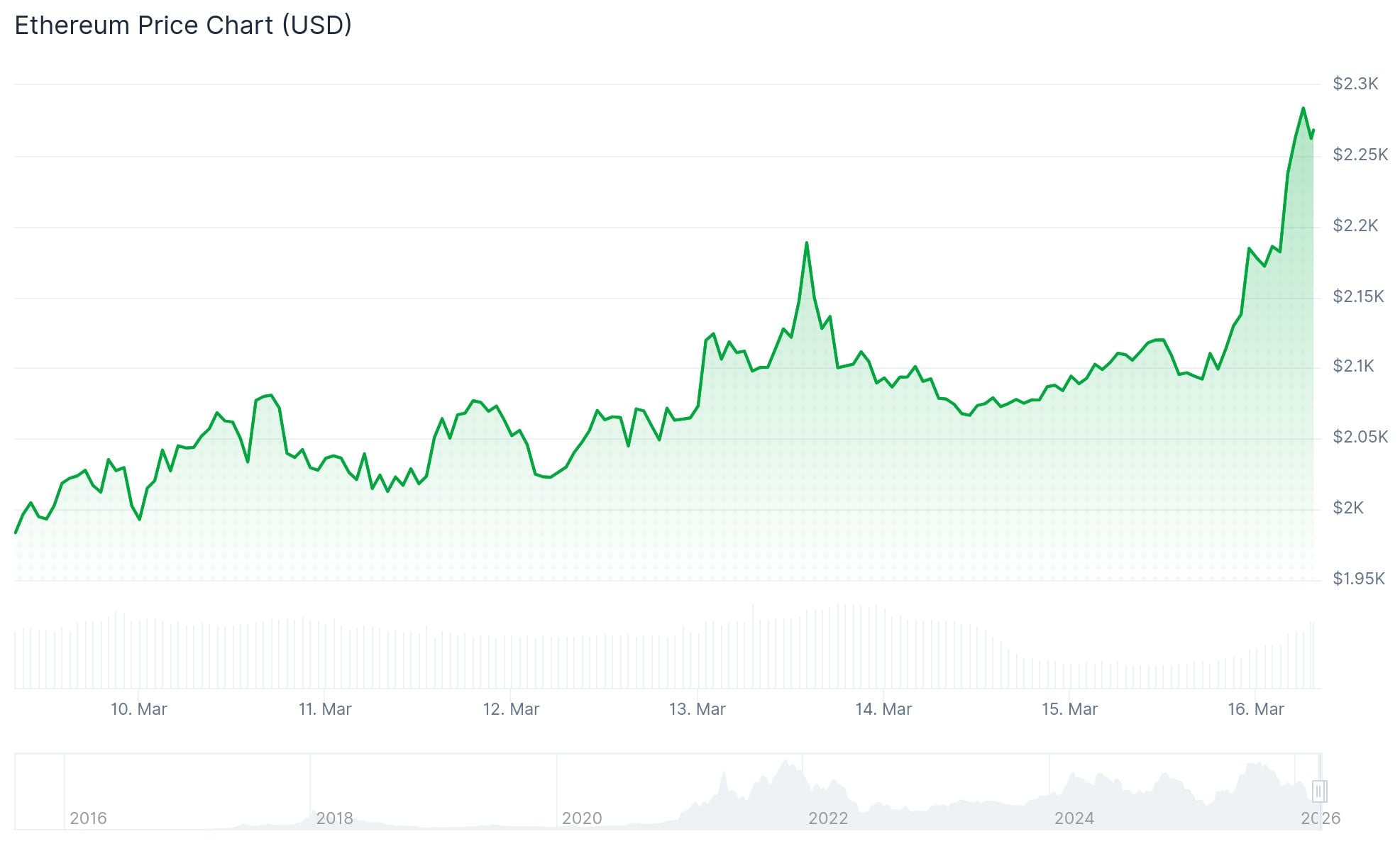
- Ethereum (ETH) surged past $2,200, reaching approximately $2,268 — marking a daily increase exceeding 4%.
- The second-largest cryptocurrency touched a session high of $2,288 while finding support at $2,165.
- Ethereum spot ETFs recorded $26.7 million in net positive flows on March 13, with BlackRock’s ETHA leading contributions.
- Corporate buyer Bitmine has accumulated approximately 833,000 ETH tokens over a 35-day period.
- The cryptocurrency is trading above its 50-day moving average, though it remains significantly below both its 200-day MA and record high of $4,955.
Ethereum experienced a notable upward move on March 16, 2026, successfully pushing beyond the psychologically important $2,200 threshold following a sustained bounce from recent bottom levels. This advance occurred as overall cryptocurrency market conditions showed signs of improvement.
The digital asset found its session floor at $2,165 before bullish momentum carried it to a peak of $2,288. As of the latest data, ETH was changing hands near $2,268, representing an approximate 4.1% increase over 24 hours.
This upward movement follows a decisive breakout above the $2,150 resistance barrier, which had proven challenging in previous trading periods. The cryptocurrency also moved above its 100-hourly Simple Moving Average, a technical indicator frequently monitored by active traders.
Growing Institutional Participation Through ETFs and Direct Purchases
U.S.-listed spot Ethereum ETFs registered $26.7 million in aggregate net inflows on March 13. BlackRock’s ETHA product dominated the activity with $32.4 million in fresh capital, complemented by ETHB’s $2.2 million contribution. An outflow of $7.9 million from FETH tempered the overall figure.
Corporate treasury activity has also become increasingly visible. Bitmine has pursued an aggressive accumulation strategy spanning 35 days, securing approximately 833,000 ETH tokens — representing roughly $2.9 billion in value based on prevailing market rates. The firm has publicly announced its ambition to control as much as 5% of Ethereum’s total circulating supply.
Daily spot market volume reached $154 million, falling short of the $418 million typical average. This indicates the price appreciation occurred without extraordinary trading activity levels.
Technical Picture and Key Price Levels
Ethereum has successfully reclaimed territory above its 50-day moving average, currently positioned at $2,138. While this represents constructive technical progress following recent weakness, the asset continues trading substantially below its 200-day moving average at $3,236.
Chart watchers are focusing on resistance zones at $2,250, followed by $2,280, with $2,320 representing the next significant barrier. Technical strategists suggest that sustained daily closes above the $2,300–$2,400 range could establish conditions for an advance toward $2,500.
Downside protection appears established near the $2,180–$2,200 zone. A decisive move below $2,150 would undermine the constructive short-term technical structure.
Blockchain analytics reveal ETH’s realized price hovering around $2,300 — a level that has functioned as an important inflection point historically. Current trading prices remain marginally below this metric.
Ethereum maintains its position as the second-largest cryptocurrency by market capitalization at $273.81 billion. The asset continues underperforming Bitcoin on a relative basis, with BTC trading nearer to recent highs while ETH trades approximately 54% below its historical peak of $4,955.
Crypto World
BlackRock Leads Institutional Crypto Inflow Surge With $600 Million Bitcoin Acquisition
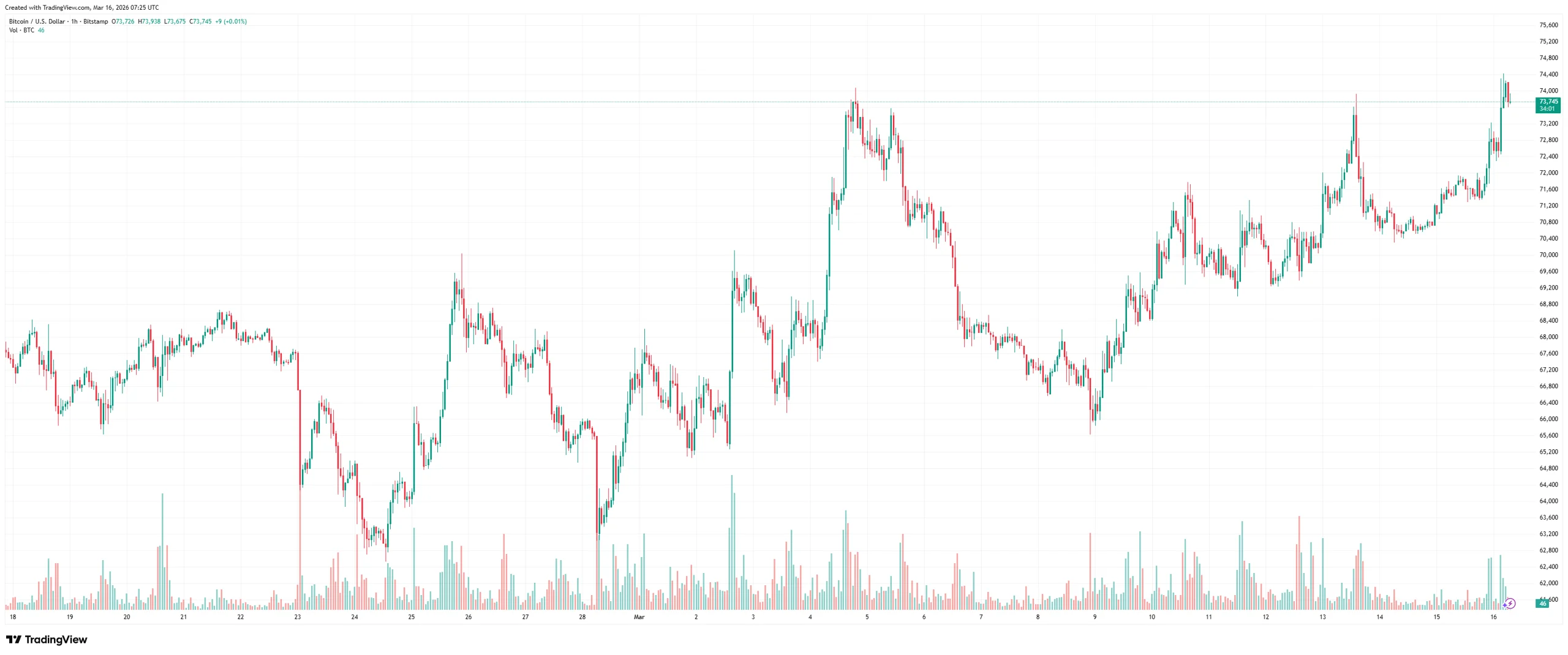
Bitcoin’s volatility is picking up on the back of considerable institutional inflows over the past week, mostly led by BlackRock.
Bitcoin’s price is approaching the $74,000 level amid ongoing international geopolitical tensions. The move comes on the back of increased institutional involvement, as witnessed by the net inflows into spot BTC ETFs.
Data shows that BlackRock has been the biggest buyer, acquiring $600.1 million worth of BTC over the past week, while Grayscale’s GBTC has been the biggest seller. The world’s largest asset manager is on a five-day streak, last selling on March 6th. The combined inflows total $763.4 million last week.
Meanwhile, ETH is also seeing positive inflows of $160.9 million for the week ending on March 13th. The biggest buyer was Fidelity’s FETH ETF, while the biuggest seller was once again Grayscale.
Bitcoin’s Price Tests $74,000
The leading cryptocurrency has consistently been making higher highs on the hourly chart since March 9th, pushing above $74,000 today and recovering by more than 13% since then.
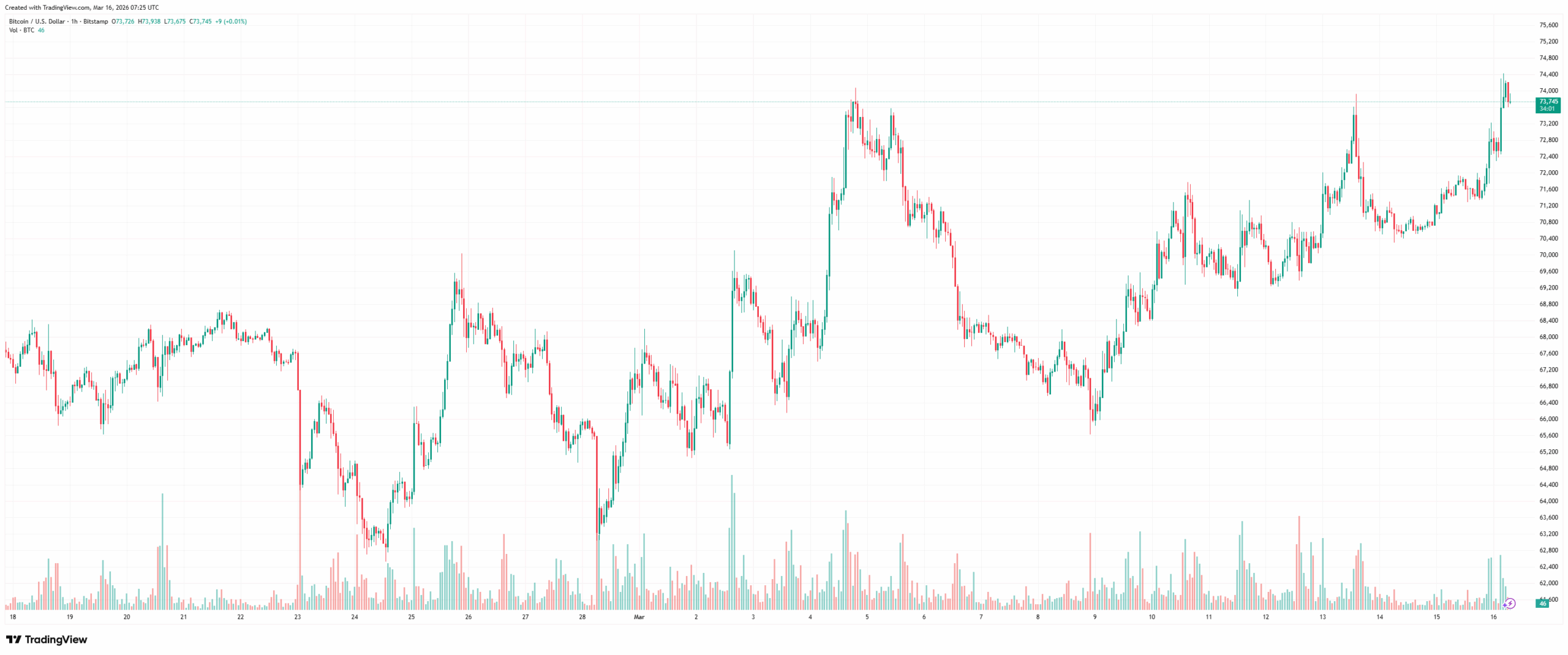
As CryptoPotato reported, the most recent increase led to the liquidation of more than $300 million across the board as the broader market also moves forward. Ethereum’s price is up 7.4% over the past 24 hours; XRP is up 5.2%; Solana is up 5.8%; and so forth.
This has resulted in a total market capitalization of close to $2.6 trillion and an improvement in the overall sentiment. The latter, however, remains in an extreme state of fear, according to the popular Fear and Greed Crypto Index.
The Week Ahead in Crypto
As volatility picks up, the week ahead might bring more of it, with important economic events scheduled over the next few days.
You may also like:
First things first, February’s PPI inflation report is coming out on Wednesday. It’s unlikely to change the Federal Reserve’s hawkish stance, but it’s important to monitor nonetheless.
Again, on Wednesday, the US Central Bank will announce its decision on interest rates. Prediction markets and CME futures predict a 99% probability of no change.
Binance Free $600 (CryptoPotato Exclusive): Use this link to register a new account and receive $600 exclusive welcome offer on Binance (full details).
LIMITED OFFER for CryptoPotato readers at Bybit: Use this link to register and open a $500 FREE position on any coin!


Another analyst indicated that there are “almost no short positions on XRP” at the moment.
With the entire cryptocurrency market rebounding in the past 12 hours or so, Ripple’s cross-border token has joined the trend, jumping 5% to almost $1.50.
Analysts have weighed in on this performance, with some suggesting that the asset has neared a key sell wall zone that could determine the next move and whether it could challenge $1.95. Others, though, have some trust issues.
$1.95 or Dead-Cat Bounce?
In the hours leading to the impressive surge, CryptoWZRD noted that XRP had closed indecisively. However, they added that if it breaks above the crucial $1.43 resistance, the asset could be primed for a more sustainable rebound, as it did shortly after their post.
The aforementioned jump drove XRP to almost $1.50, which is the highest price tag in over two weeks. Fellow analyst CW outlined a chart showing that this level is actually a major sell wall. If broken, XRP’s path should be quite clear until the next such significant obstacle, all the way at $1.95.
$XRP has reached the sell wall zone.
If it breaks through this sell wall, there is no other resistance until $1.95. pic.twitter.com/Z4olAq6ot3
— CW (@CW8900) March 16, 2026
Interestingly, Cobb, who is among the most vocal and bullish members of the XRP Army, said they “simply refuse to trust this XRP pump.” Perhaps this is because the asset has charted similar impressive gains several times for a few days, only to be rejected and pushed back to its rather tight trading range.
However, the landscape could be different now as the Bollinger Bands had squeezed to a level suggesting a big move ahead.
You may also like:
No Shorts on XRP?
Another interesting post from CW showed that “there are almost no short positions on XRP.” This has particular significance given the fact that the asset’s futures open interest had surged by 16.5% in the past week, going to over $1.6 billion, according to data from Ali Martinez.
Meaning, traders are ramping up their leveraged XRP positions but evidently expect a major move upward.
There are almost no short positions on $XRP. pic.twitter.com/rlfi7ht1XX
— CW (@CW8900) March 16, 2026
Binance Free $600 (CryptoPotato Exclusive): Use this link to register a new account and receive $600 exclusive welcome offer on Binance (full details).
LIMITED OFFER for CryptoPotato readers at Bybit: Use this link to register and open a $500 FREE position on any coin!
BofA initiates Sunbelt Rentals stock coverage with underperform rating

Australian Senate Committee Backs Digital Assets Framework Bill

Ligue 1: Lyon can’t beat Le Havre and see OM take off in race for 3rd – Sports


-
 Tech5 days ago
A 1,300-Pound NASA Spacecraft To Re-Enter Earth’s Atmosphere
-
Crypto World2 days ago
HYPE Token Enters Net Deflation as HyperCore Buybacks Outpace Staking Rewards
-

 News Videos7 days ago
10th Algebra | Financial Planning | Question Bank Solution | Board Exam 2026
-

 Business6 days ago
ExxonMobil seeks to move corporate registration from New Jersey to Texas
-

 Crypto World7 days ago
Paradigm, a16z, Winklevoss Capital, Balaji Srinivasan among investors in ZODL
-

 Fashion3 days ago
Weekend Open Thread: Addict Lip Glow
-

 Tech6 days ago
ChatGPT will now generate interactive visuals to help you with math and science concepts
-
Sports2 days ago
Why Duke and Michigan Are Dead Even Entering Selection Sunday
-

 NewsBeat5 days ago
Residents reaction as Shildon murder probe enters second day
-

 Business5 days ago
Search Enters Sixth Week With New Leads in Tucson Abduction Case
-
 NewsBeat6 days ago
Pagazzi Lighting enters administration as 70 jobs lost and 11 stores close across Scotland
-

 Business13 hours ago
Search for Savannah Guthrie’s Mother Enters Seventh Week with No Arrests
-

 Tech7 days ago
Despite challenges, Ireland sixth in EU for board gender diversity
-

 Business2 days ago
US Airports Launch Donation Drives for Unpaid TSA Workers as Partial Government Shutdown Enters Fifth Week
-
Crypto World2 days ago
Coinbase and Bybit in Investment Talks: Could Bybit Finally Enter the US Crypto Market?
-

 NewsBeat5 days ago
I Entered The Manosphere. Nothing Could Prepare Me For What I Found.
-

 Business7 days ago
Search Enters 39th Day with FBI Tip Line Developments and No Major Breakthroughs
-

 Sports7 days ago
Skateboarding World Championships: Britain’s Sky Brown wins park gold
-

 Business2 days ago
Country star Brantley Gilbert enters growing non-alcoholic beer market
-
 Crypto World6 days ago
Will Chainlink price reclaim $10 amid volatility squeeze?

