

Crypto World
AI Agents Are About to Change DeFi Trading Forever


Decentralized finance has already transformed how people trade, lend, and earn yield. But the next evolution isn’t just new protocols or better liquidity — it’s autonomous intelligence.
AI agents are emerging as a powerful layer on top of DeFi, capable of monitoring markets, executing trades, managing risk, and optimizing strategies in real time. Instead of manually chasing opportunities across dozens of protocols, traders are increasingly relying on intelligent systems that operate 24/7.
And this shift could fundamentally change how DeFi markets work.
From Manual Trading to Autonomous Strategies
Today, most DeFi trading is still highly manual.
Traders:
-
Track prices across multiple chains
-
Watch liquidity pools and funding rates
-
Execute trades manually or with basic bots
-
Constantly adjust strategies
Even experienced traders struggle to keep up with the speed of on-chain markets.
AI agents remove that bottleneck.
Instead of reacting to market changes, AI systems can continuously monitor data, detect patterns, and act instantly.
This turns trading from a manual process into an automated intelligence layer.
What Exactly Is an AI Agent in DeFi?
An AI agent is a self-operating program that analyzes information, makes decisions, and executes transactions on-chain.
In the context of DeFi trading, an AI agent can:
-
Scan multiple blockchains for opportunities
-
Monitor liquidity changes in real time
-
Execute arbitrage trades
-
Rebalance portfolios
-
Manage risk exposure
-
Adapt strategies based on market conditions
Think of it as a personal trading desk that never sleeps.
Instead of clicking buttons on dashboards, traders deploy agents that execute strategies autonomously.
Why AI Is a Perfect Fit for DeFi
DeFi markets produce enormous amounts of real-time data.
Every block includes:
-
trades
-
liquidity updates
-
lending positions
-
liquidations
-
Oracle price changes
This data-rich environment is ideal for machine learning models.
AI agents can analyze thousands of on-chain signals simultaneously, something human traders simply cannot do.
The result is faster decision-making and more efficient capital deployment.
The Rise of AI-Powered Trading Infrastructure
A new generation of platforms is emerging that allows users to deploy AI trading strategies directly on-chain.
These systems typically combine:
-
on-chain execution
-
off-chain machine learning models
-
automated risk management
-
cross-chain liquidity access
Instead of building complex bots from scratch, traders can plug into infrastructure that handles execution, monitoring, and optimization automatically.
This dramatically lowers the barrier to advanced trading strategies.
Autonomous Yield Optimization
One of the biggest advantages of AI agents is dynamic yield optimization.
In DeFi, yield opportunities constantly change:
AI agents can continuously move capital between opportunities to maximize returns.
Rather than manually repositioning funds every few hours or days, an AI system can rebalance in seconds.
Over time, this can significantly improve capital efficiency.
AI Agents and Risk Management
Risk management is one of the hardest parts of DeFi trading.
Smart contracts can fail. Liquidity can vanish. Prices can move violently.
AI agents can help mitigate these risks by:
-
monitoring volatility conditions
-
adjusting leverage dynamically
-
Closing positions when risk thresholds are reached
-
diversifying capital across protocols
Instead of relying on static rules, AI-driven systems can adapt as market conditions evolve.
Cross-Chain Trading Will Become Seamless
Another major advantage of AI agents is their ability to operate across multiple ecosystems simultaneously.
DeFi liquidity is fragmented across chains like:
-
Ethereum
-
Solana
-
Arbitrum
-
Base
-
Cosmos ecosystems
For humans, managing positions across these networks is complicated and time-consuming.
AI agents can treat the entire multi-chain landscape as one unified market.
This opens the door for sophisticated strategies such as:
The Future: Autonomous DeFi Markets
As AI agents become more widespread, DeFi markets themselves may evolve.
We could see:
-
fully autonomous trading vaults
-
AI-managed liquidity pools
-
algorithmic hedge funds running entirely on-chain
-
collaborative networks of AI agents optimizing liquidity across ecosystems
In this future, human traders set high-level strategies while AI handles the execution.
DeFi becomes less about dashboards and manual clicks, and more about deploying intelligent capital.
Final Thoughts
AI agents represent one of the most powerful upgrades DeFi has seen since automated market makers.
By combining real-time blockchain data with autonomous decision-making, these systems can dramatically improve trading efficiency, risk management, and yield generation.
The traders who thrive in the next phase of DeFi won’t necessarily be the fastest clickers or the most active on dashboards.
They’ll be the ones who know how to deploy intelligent agents to trade for them.
And that shift is only just beginning.
REQUEST AN ARTICLE

Crypto World
Advanced Micro Devices (AMD) Stock Falls Despite Strong Q4 as Executives Unload $33M in Shares

Key Takeaways
- Advanced Micro Devices delivered Q4 earnings of $1.53 per share versus analyst expectations of $1.32, while revenue hit $10.27B — representing 34.1% growth year-over-year
- Management forecasts 35% compound annual revenue growth over three years, with data center operations projected to expand at 60% CAGR
- Eminence Capital increased its AMD holdings by 5.5% to approximately $241.6M, joining Vanguard and State Street as major institutional holders
- Company executives have offloaded 154,392 shares worth approximately $33.1M over the last 90 days, with two EVPs making recent transactions
- Emerging threats include a new Chinese GPU manufacturer (Lisuan Technology) and Meta’s internal chip development efforts
AMD crushed quarterly estimates, secured a partnership with Meta, and continues developing its MI450 accelerator — yet company insiders are reducing positions while a Chinese challenger enters the arena. Here’s what investors need to know.
Advanced Micro Devices, Inc., AMD
Advanced Micro Devices posted fourth-quarter earnings of $1.53 per share, surpassing Wall Street’s $1.32 estimate by $0.21. The company generated $10.27 billion in revenue, exceeding projections of $9.65 billion and marking a 34.1% increase compared to the prior year period.
The data center division represents AMD’s primary growth driver. Management outlined expectations for 60% compound annual growth in this segment through the next three years, significantly outpacing the company-wide 35% CAGR target.
AMD’s stock started Friday’s session at $193.39. The equity currently trades beneath both its 50-day moving average of $216.16 and 200-day moving average of $210.13 — a technically bearish configuration.
Shares have traded within a broad 52-week band spanning from $76.48 to $267.08. Current pricing reflects a substantial discount from recent highs.
AMD carries a price-to-earnings ratio near 73, though the forward-looking P/E metric projects at 31 — aligning closely with the S&P 500’s 29 average. This forward valuation proves more relevant for investors conducting fundamental analysis.
The semiconductor company finalized a multi-year patent licensing deal with Adeia and unveiled AI telecommunications products at MWC 2026. While strategically important, these developments haven’t generated immediate upward momentum in share price.
AMD also announced a partnership with Meta Platforms to supply chips for Meta’s next-generation artificial intelligence infrastructure. This represents a significant customer acquisition in a market where Nvidia has maintained dominance.
Institutions Accumulate While Executives Exit
Eminence Capital expanded its position by 5.5% to 1,493,555 shares, representing approximately $241.6M in value. Vanguard maintains 155.9M shares, while State Street controls 72M shares. Institutional ownership accounts for 71.34% of outstanding shares.
Conversely, company insiders have been reducing their holdings. EVP Forrest Norrod divested 19,450 shares on February 11th at $216.81 per share. EVP Paul Darren Grasby sold 7,500 shares on March 11th at $204.87. Combined insider transactions over 90 days total 154,392 shares worth approximately $33.1M.
Wall Street analysts maintain an overall “Moderate Buy” rating with a consensus price target of $290.53. Evercore leads with the most bullish $358 target, while Goldman Sachs takes a more reserved stance at $240 with a “neutral” rating.
Emerging Competitive Challenges
Two notable headwinds have materialized. Chinese GPU manufacturer Lisuan Technology unveiled new products, contributing to selling pressure across GPU stocks and introducing competitive uncertainty for both AMD and Nvidia.
Meta’s development of proprietary AI chips represents another concern, potentially shrinking the total addressable market for external semiconductor suppliers in the long term.
AMD’s forthcoming MI450 AI accelerator positions for direct competition against Nvidia’s Vera Rubin chip. According to industry assessments, the MI450 demonstrates superior performance across multiple technical benchmarks.
AMD maintains a market capitalization of $315.3B. Company insiders collectively own just 0.06% of outstanding shares.


TLDR
- Lululemon will release Q4 fiscal 2025 results after Tuesday’s closing bell on March 17.
- Wall Street forecasts earnings per share of $4.78, representing a 22.2% year-over-year decrease, alongside revenue of $3.57 billion, down 1.1%.
- Shares have plunged approximately 24% since the start of the year and more than 50% over the trailing twelve months.
- Analysts maintain a collective Hold stance, with a mean price target of $205.53 — roughly 30% higher than the current trading price.
- Chief Executive Calvin McDonald announced his departure, with the board currently seeking his successor.
As Lululemon approaches its Tuesday earnings announcement, the athleisure giant’s shares hover near multi-year lows. The stock has tumbled roughly 24% year-to-date and lost more than half its market value during the past year. Expectations are mixed as investors await quarterly results.
Lululemon Athletica Inc., LULU
Wall Street analysts project fourth-quarter revenue will reach $3.57 billion, marking a 1.1% year-over-year contraction. This represents a stark contrast to the 12.7% revenue expansion the company delivered in the comparable period last year. Earnings per share are anticipated to land at $4.78, reflecting a 22.2% year-over-year decrease.
Management previously indicated that fourth-quarter performance could approach the upper boundary of their guidance range, citing robust holiday shopping activity, increased foot traffic at retail locations, and successful promotional campaigns including their Black Friday initiatives.
Recent earnings results across the broader apparel industry have been inconsistent. Tilly’s reported 5.3% revenue growth and exceeded analyst projections, with shares surging 46.4% following the announcement. Zumiez achieved 4.4% revenue growth but saw its stock decline 10.9% after reporting. The apparel sector broadly has retreated approximately 9.7% during the past month.
LULU has fallen short of Wall Street revenue projections on several occasions throughout the previous two years. Analyst estimates have remained relatively stable over the past 30 days, indicating expectations for in-line results rather than significant surprises.
Leadership Transition Underway
Chief Executive Calvin McDonald revealed in January his intention to depart the role he has held since 2018. He is scheduled to remain with the organization as a senior advisor until March 31 while the board conducts its search for his replacement.
Should the company unveil a new CEO appointment concurrent with earnings results, investor sentiment could improve. Major leadership transitions often provide an opportunity to recalibrate market expectations and generate renewed optimism.
Global Expansion Offers Growth Potential
While foot traffic at North American locations has decelerated and domestic growth projections have been reduced, Lululemon has aggressively expanded its international footprint — especially in China and Mexico — through strategic new store launches aimed at compensating for sluggish performance in its home market.
This international expansion initiative represents one of the company’s most promising growth catalysts in the current environment.
From a valuation perspective, LULU presently trades at a forward price-to-earnings ratio of approximately 12.1x, notably beneath the sector median of roughly 16x. This valuation discount indicates that much of the recent negative sentiment may already be reflected in the share price.
Broader economic challenges persist as potential obstacles. Tariff uncertainties, inflationary pressures, and conservative consumer spending patterns — particularly among budget-conscious shoppers — could impact quarterly performance. Additionally, competitive intensity within the athleisure category continues to escalate.
The Street’s consensus recommendation stands at Hold, derived from one Buy rating and 17 Hold ratings issued during the previous three months. The average analyst price target stands at $205.53, compared to the current market price near $158.
Lululemon is scheduled to report fourth-quarter results after Tuesday’s market close on March 17.
Crypto World
Micron (MU) Stock: AI Memory Boom Drives Massive Growth Expectations for Wednesday Earnings

TLDR
- Micron’s Q2 FY26 earnings release is scheduled for March 18, with analyst estimates calling for approximately $19.1B in revenue, marking a 137% year-over-year increase
- Earnings per share projections range from $8.60 to $8.74, reflecting approximately 460% annual growth
- The company’s HBM inventory is completely sold out through calendar year 2026, with capacity covering only 50%–66% of major customer requirements
- Micron finalized the acquisition of a Taiwan-based chip manufacturing facility, planning DRAM and HBM output starting in fiscal 2028
- Wall Street analysts from Wedbush and Wells Fargo increased their price targets to $500 and $470 respectively, while 27 analysts maintain a consensus Strong Buy rating
Micron Technology is preparing to unveil its fiscal Q2 2026 results this Wednesday, March 18, and market watchers are anticipating remarkable figures.
Wall Street consensus calls for quarterly revenue approaching $19.1 billion, representing approximately 137% growth versus the year-ago quarter. For earnings per share, projections land between $8.60 and $8.74 — more than quintupling the Q2 FY25 result.
The catalyst fueling this explosive growth is artificial intelligence. Hyperscale data centers powering AI workloads require enormous memory resources, creating insatiable demand for both DRAM and high-bandwidth memory (HBM) that far exceeds current industry production capabilities.
Micron has publicly acknowledged it can fulfill only 50% to two-thirds of memory orders from several major customers. Rather than a limitation, this represents significant pricing leverage.
Production Constraints Persist
Expanding semiconductor fabrication facilities requires multi-year timelines. Micron projects that substantial new production capacity won’t be available until 2027 at minimum. Between now and then, the chipmaker has completely allocated its HBM output for the entirety of calendar 2026.
This persistent supply-demand mismatch is the critical metric analysts are monitoring ahead of Wednesday’s results. Should Micron’s leadership indicate this imbalance extends through 2026 and beyond, the pricing power narrative remains firmly in place.
Based on at-the-money straddle pricing, options markets are anticipating approximately 10.6% volatility in either direction following the earnings announcement.
Shares have already climbed roughly 42% year to date, last trading near $425.96.
Street Lifts Price Objectives
Wedbush’s Matthew Bryson elevated his MU price target to $500 from $320 while maintaining an Outperform rating. His analysis highlights strengthening earnings projections even as the stock trades below historical peak valuations typical for memory sector companies.
Wells Fargo analyst Aaron Rakers also maintained a Buy rating and raised his target to $470 from $410. Rakers projects peak earnings potential of $50–$60 per share, with normalized long-term earnings power between $30–$40. He anticipates management will address competitive dynamics around HBM4 related to Nvidia’s forthcoming Rubin GPU platform.
Across 27 Wall Street analysts currently covering the stock, the consensus stands at Strong Buy — comprised of 26 Buy ratings and one Hold. The mean price target reaches $448.07, suggesting roughly 5% appreciation from present levels.
Regarding capacity expansion, Micron wrapped up its purchase of the P5 fabrication facility from Powerchip Semiconductor located in Tongluo, Taiwan. The site features approximately 300,000 square feet of cleanroom infrastructure. Micron intends to modernize the facility for DRAM and HBM manufacturing, targeting initial production shipments in fiscal 2028.
The transaction was initially disclosed in January 2026.

TLDR
- Senate Banking Committee approval before April’s end is critical, or the CLARITY Act’s 2026 passage probability plummets
- Prediction markets show declining confidence: Polymarket at 56% (down 9 points), Kalshi at merely 30% by June
- Central controversy revolves around permitting stablecoin issuers to distribute yield to holders
- Coinbase withdrew endorsement in January, asserting a flawed bill is worse than no legislation
- Gnosis co-founder cautions the legislation might consolidate crypto control among centralized entities
Time is running short for the CLARITY Act, America’s proposed cryptocurrency market structure legislation. According to Galaxy Research head Alex Thorn, the bill requires Senate floor consideration by early May to maintain viable 2026 passage prospects. This necessitates Senate Banking Committee clearance before April concludes.
Senate Majority Leader John Thune has publicly acknowledged the April timeline appears unrealistic. Current Senate priorities center on the SAVE America Act, relegating the CLARITY Act to secondary status on the legislative calendar.
According to Thorn, each day of postponement reduces available time for floor consideration. Without committee approval during April, he characterized 2026 passage prospects as “extremely low.”
Prediction platforms mirror this growing skepticism. Polymarket indicates the legislation’s 2026 enactment probability has declined 9 percentage points to 56%. Kalshi demonstrates greater pessimism, calculating 30% likelihood before June and merely 7% before May.
Stablecoin Yield Remains Central Flashpoint
The most contentious issue involves stablecoin yield distribution. The controversy focuses on whether stablecoin issuers should possess authority to pass interest earnings to users.
Representative French Hill stated that prohibiting stablecoin yield represents a non-negotiable requirement for Senate advancement. Traditional banking institutions contend that interest-bearing stablecoins would divert deposits from regulated financial entities.
Cryptocurrency firms counter that reward-bearing stablecoins enhance payment utility. Coinbase retracted support during January. CEO Brian Armstrong argued the current draft undermines decentralized finance, prohibits stablecoin yield, and restricts tokenized real-world assets. “We’d rather have no bill than a bad bill,” he declared.
Senator Angela Alsobrooks suggested compromise from both factions may prove necessary. White House crypto adviser and Coinbase CLO Paul Grewal also condemned banks for impeding progress.
DeFi and Regulatory Turf Wars Still Unresolved
Thorn suggested the stablecoin controversy may not represent the final hurdle. He identified outstanding questions regarding decentralized finance regulation, developer liability protections, and SEC-CFTC jurisdictional boundaries.
Attorney Jake Chervinsky noted that banking institutions also express concern about stablecoin liquidity migrating toward DeFi platforms, beyond just yield distribution issues.
Gnosis co-founder Dr. Friederike Ernst cautioned the bill’s present framework threatens to channel all cryptocurrency activity through licensed intermediaries. She expressed concern this could consolidate crypto infrastructure control among a limited group of major institutions.
Ernst acknowledged the legislation includes positive elements, such as safeguarding peer-to-peer transactions and self-custody rights, plus defining SEC and CFTC regulatory boundaries.
Senator Bernie Moreno expressed continued optimism for April passage and presidential signature. Thorn indicated that schedule now appears increasingly unrealistic.


The week could prove pivotal for markets, including bitcoin , with the U.S. Federal Reserve among seven major central banks set to announce interest-rate decisions while war-driven oil price gains threaten to reignite inflation in the global economy.
Most of the central banks are expected to keep interest rates steady, but hawkish comments from policymakers, driven by inflation concerns, could trigger downside volatility across risk assets.
While reflationary environments have historically supported bitcoin, rising inflation expectations are pushing bond yields higher and tightening financial conditions, André Dragosch, European head of research at Bitwise, told CoinDesk. Those conditions generally make riskier investments less attractive.
Still, geopolitical tensions are currently dominating the market backdrop, according to Dragosch. Historically, such shocks tend to fade quickly, and bitcoin has often delivered above-average returns after periods of elevated geopolitical risk.
“Investors should generally fade these kinds of events and view them as short-term buying opportunities,” Dragosch said.
Bitcoin is trading at what Dragosch called the “biggest macro discount” on record, with sentiment near FTX-collapse lows. “We are probably closer to the bottom than the top,” he said.
What to Watch
(All times ET)
- Crypto
- March 17: Lava Network (LAVA) to expand with 17 new chain integrations and nine new blockchain ecosystems.
- March 19: Walrus (WAL) final deadline for Tusky users to migrate their data.
- March 23: Backpack token generation event occurs, with 250 million tokens (25% of total supply) to be distributed.
- Macro
- March 16, 8:30 a.m.: Canada consumer price index (CPI) YoY for February (Prev. 2.3%)
- March 17, 4:30 a.m.: Reserve Bank of Australia interest rate decision est. 4.1% (Prev. 3.85%)
- March 17, 10:00 a.m.: U.S. Pending Home Sales MoM for February (Prev. -0.8%)
- March 18, 6 a.m.: Eurozone consumer price index (CPI) for February. MoM est. 0.7% (Prev. -0.6%); YoY est. 1.9% (Prev. 1.7%)
- March 18, 8:30 a.m.: U.S. PPI for February. YoY est. 3.7% (Prev. 3.6%); Core PPI YoY est. 3.2% (Prev. 3.6%)
- March 18, 9:45 a.m.: Bank of Canada interest rate decision Est. 2.25% (Prev. 2.25%)
- March 18, 10:00 a.m.: U.S. Factory Orders MoM for January (Prev. -0.7%)
- March 18, 2:00 p.m.: Fed interest rate decision Est. 3.50%-3.75% (Prev. 3.50%-3.75%); FOMC economic projections
- March 18, 2:30 p.m.: Fed Chair press conference
- March 18, 5:30 p.m.: Central Bank of Brazil Selic rate decision Est. 14.50% (Prev. 15%)
- March 18, 11 p.m.: Bank of Japan interest rate decision Est. 0.75% (Prev. 0.75%)
- March 19, 4:30 a.m.: Swiss National Bank interest rate decision Est. 0% (Prev. 0%)
- March 19, 8 a.m.: Bank of England interest rate decision Est. 3.75% (Prev. 3.75%).
- March 19, 8:30 a.m.: U.S. Initial Jobless Claims for week ending March 14 Est. 215K (Prev. 213K)
- March 19, 8:30 a.m.: U.S. Philadelphia Fed Manufacturing Index for March (Prev. 16.3)
- March 19, 9:15 a.m.: ECB interest rate decision for main refinancing rate Est. 2.15% Prev. 2.15%
- March 19, 4:30 p.m.: Fed Balance Sheet for week ending March 18 (Prev. $6.65T)
- March 20, 8:30 a.m.: Canada PPI YoY (Prev. 5.4%); MoM (Prev. 2.7%)
Earnings (Estimates based on FactSet data)
- March 16: Bakkt Holdings (BKKT), post-market, -$0.47
- March 16: Bitcoin Depot (BTM), pre-market, -$0.47
- March 16: Cango (CANG), post-market, -$0.34
- March 17: CEA Industries (BNC), post-market, $0.69
- March 18: Bitfarms (BITF), pre-market, -$0.03
- March 19: Gemini Space Station (GEMI), post-market, -$0.91
- March 20: BitFuFu (FUFU), pre-market, $0.01
Token Events
- Governance votes & calls
- March 17: Mantle (MNT) to host State of Mind Ep. 07, discussing CeDeFi milestones and DeFi strategies.
- March 18: Jupiter (JUP) to hold its weekly Planetary Call community session with team updates.
- March 18: head of marketing & PR to discuss ecosystem updates.
- Decentraland DAO is voting on whether to allow registered users to customize the color of their avatar name tag and to add a more accessible volume slider to the UI sidebar. Voting ends March 16 and 17.
- Convex Finance is voting on Curve and Frax gauge weight allocations for the week of March 12, directing vlCVX voting power across hundreds of liquidity pools. It’s also voting on FXN gauge weight allocations for the same period. Voting ends March 17.
- Aavegotchi DAO is voting to finalize its 2026–2027 multisig signers election, preserving the 5-of-9 threshold and setting quarterly signer compensation. Voting ends March 17.
- Aavegotchi DAO is running Ballot 3 to elect seven of the remaining 10 nominees as multi-sig signers, completing the nine-signer roster for the DAO Foundation wallet. Voting ends March 17.
- Aura Finance is voting on Balancer gauge weight allocations for the week of March 12, directing vlAURA voting power across Balancer pools on Ethereum, Arbitrum, Optimism, Gnosis, Base and Avalanche. Voting ends March 17.
- ShapeShift DAO is voting on establishing and funding a new International UX workstream for six months to maintain professional multilingual translations of the ShapeShift app and website. Voting ends March 17.
- WalletConnect Network is voting on allocating 50 million WCT tokens as a dedicated rewards budget for WalletConnect Pay in 2026. Voting ends March 18.
- ENS is voting on a one-time transfer of 900,000 USDC from the ENS Endowment to wallet.ensdao.eth to cover a shortfall in stream payments owed to ENS Labs. Voting ends March 18.
- Cratos DAO is voting on extending the current mobile app reward standard deadline by one month to April 30, 2026. Voting ends March 19.
- Lightchain AI DAO is voting on a temporary 90-day team authority proposal, which grants the core team temporary operational authority for 90 days to make day-to-day and strategic decisions. Voting ends March 22.
- Unlocks
- March 16: Arbitrum (ARB) to unlock 1.78% of its circulating supply worth $9.65 million.
- March 20: LayerZero (ZRO) to unlock 5.64% of its circulating supply worth $52.45 million.
- Token Launches
Conferences
TLDR
- On March 15, Robert Kiyosaki issued warnings about an intensifying financial “giant crash”
- The author highlighted panic in private credit markets and distress among leading banks
- Kiyosaki deployed millions to acquire oil assets, precious metals, Bitcoin, and Ethereum
- He contrasted his investment strategy with Warren Buffett’s cash-heavy approach
- The financial educator forecasts higher valuations for gold, silver, and Bitcoin post-crash
The bestselling author of Rich Dad Poor Dad, Robert Kiyosaki, issued fresh concerns on March 15 about an escalating financial crisis. His warnings focused on turbulence in private credit markets and mounting pressure on established banking institutions.
“Crash accelerates,” he wrote on X. “Private credit funds are panicked as investors withdraw their money. Major big-name banks and brand-name financial institutions are in trouble.”
Kiyosaki also referenced economist Jim Rickards, noting that he has officially proclaimed the United States has entered a “New Depression.”
In response to these conditions, Kiyosaki revealed he deployed millions of dollars in capital last week. His purchases included additional oil wells, precious metals, and cryptocurrency holdings.
“Last week I took millions in cash and purchased more oil wells, more gold, silver, and bitcoin,” he wrote.
The financial educator confirmed he’s also accumulating Ethereum as part of his diversified acquisition strategy.
Kiyosaki referenced Warren Buffett’s well-known cash accumulation strategy, recognizing it as a tactical approach to maintain liquidity and acquire undervalued assets when markets decline.
Kiyosaki vs. Buffett: Two Different Crash Strategies
Buffett’s company, Berkshire Hathaway, has been building its cash position for some time. Kiyosaki acknowledged the logic, saying “Cash is not trash in a crash.”
However, Kiyosaki emphasized that his investment philosophy differs fundamentally. Rather than stockpiling currency, he’s converting it into tangible assets.
“I doubt Warren Buffett would do what I do,” he wrote.
For investors lacking a clear strategy, Kiyosaki provided straightforward guidance. He suggested that remaining on the sidelines might be the wisest choice during market turbulence for those without a defined plan.
The author also highlighted Middle East geopolitical instability as an influencing factor. He noted that persistent attacks on oil tankers navigating the Strait of Hormuz are elevating crude prices, which directly benefits his Texas-based oil well investments.
Why Kiyosaki Keeps Buying Bitcoin
Kiyosaki has maintained a vocal stance on Bitcoin acquisitions for multiple years. He consistently categorizes it alongside precious metals as a “real asset” due to its mathematically limited supply of 21 million coins.
He has repeatedly stated his conviction that Bitcoin represents a superior investment compared to gold. Market corrections, according to him, present optimal opportunities to expand holdings.
His Bitcoin-related statements have attracted scrutiny for apparent contradictions. One post claimed he never purchased Bitcoin above $6,000, while subsequent posts documented purchases at significantly elevated price levels.
Regardless of the debates, he continues to publicly endorse Bitcoin and Ethereum as fundamental components of his investment approach.
Kiyosaki maintains his belief that valuations for gold, silver, and Bitcoin will surge following a substantial market crash. While acknowledging his predictions could prove incorrect, he expresses strong confidence in his current positions.
The financial author initially forecast his “giant crash” scenario in his 2013 publication Rich Dad’s Prophecy. His warnings have intensified in frequency as 2026 approaches.

Australia’s Senate Economics Legislation Committee has backed a bill that would require crypto exchanges and tokenization platforms to comply with the country’s existing financial services regime, recommending that the Corporations Amendment (Digital Assets Framework) Bill 2025 be passed.
The move on March 16 brings Australia a step closer to a bespoke licensing framework for “digital asset platforms” (DAPs) and “tokenised custody platforms” (TCPs), aimed at closing gaps in oversight of platforms that hold customer assets following the collapses of high‑profile digital asset businesses, such as FTX.
The bill, first introduced by Assistant Treasurer and Financial Services Minister Daniel Mulino in November 2025, would treat DAPs and TCPs as financial products under the Corporations Act and Australian Securities and Investments Commission (ASIC) Act, pushing most centralized exchanges and tokenized custody businesses that hold client assets into the Australian Financial Services Licence regime.
Related: Ripple targets April for Australian financial license via acquisition
Licensed platforms must meet ASIC-set custody and settlement standards, comply with tailored disclosure rules for retail clients, and operate under platform‑specific conduct and governance requirements, while small providers with annual transaction thresholds under 10 million Australian dollars ($7 million) and some public blockchain infrastructure are exempt.

Industry groups warnings around terminology
Industry groups cited in the report, such as law firm Piper Alderman, warned that the broad “digital token” and “factual control” tests could inadvertently include wallet software and infrastructure providers in non-unilateral-control setups, including common multi‑party computation (MPC) configurations.
US blockchain firm Ripple Labs backed “control” as the “appropriate nexus” for the regulatory perimeter, but argued that the bill needed to better accommodate modern security architectures such as MPC wallets.
It warned that, on a strict reading of the “factual control” test, technology‑only providers holding a single key shard could be misclassified as regulated custodians, and urged lawmakers to clarify that an entity does not exercise factual control unless it can unilaterally transfer an asset without the client’s cooperation.
Related: Australia warns of AI, ‘finfluencers’ as Gen Z crypto ownership reaches 23%
The committee acknowledged these concerns, but sided with Treasury’s plan to refine the perimeter through future regulations rather than rewriting the core definitions.
Coinbase hails progress but warns on debanking risk
In an email statement to Cointelegraph, Coinbase Australia director and APAC managing director John O’Loghlen welcomed the recommendation as “an important step for Australia’s standing in the global digital economy.” He argued that the country had the capital and talent to lead in digital assets, but still needed clear rules to unlock that potential.
O’Loghlen also warned that “the anti-competitive practice of debanking is rampant despite the government endorsing measures to address it back in 2022,” and urged Canberra to prioritize implementing the Council of Financial Regulators’ recommendations.
With the committee’s backing in hand, the bill now moves to the Senate for debate and a final vote at a later date.
Magazine: 6 weirdest devices people have used to mine Bitcoin and crypto
Key Highlights
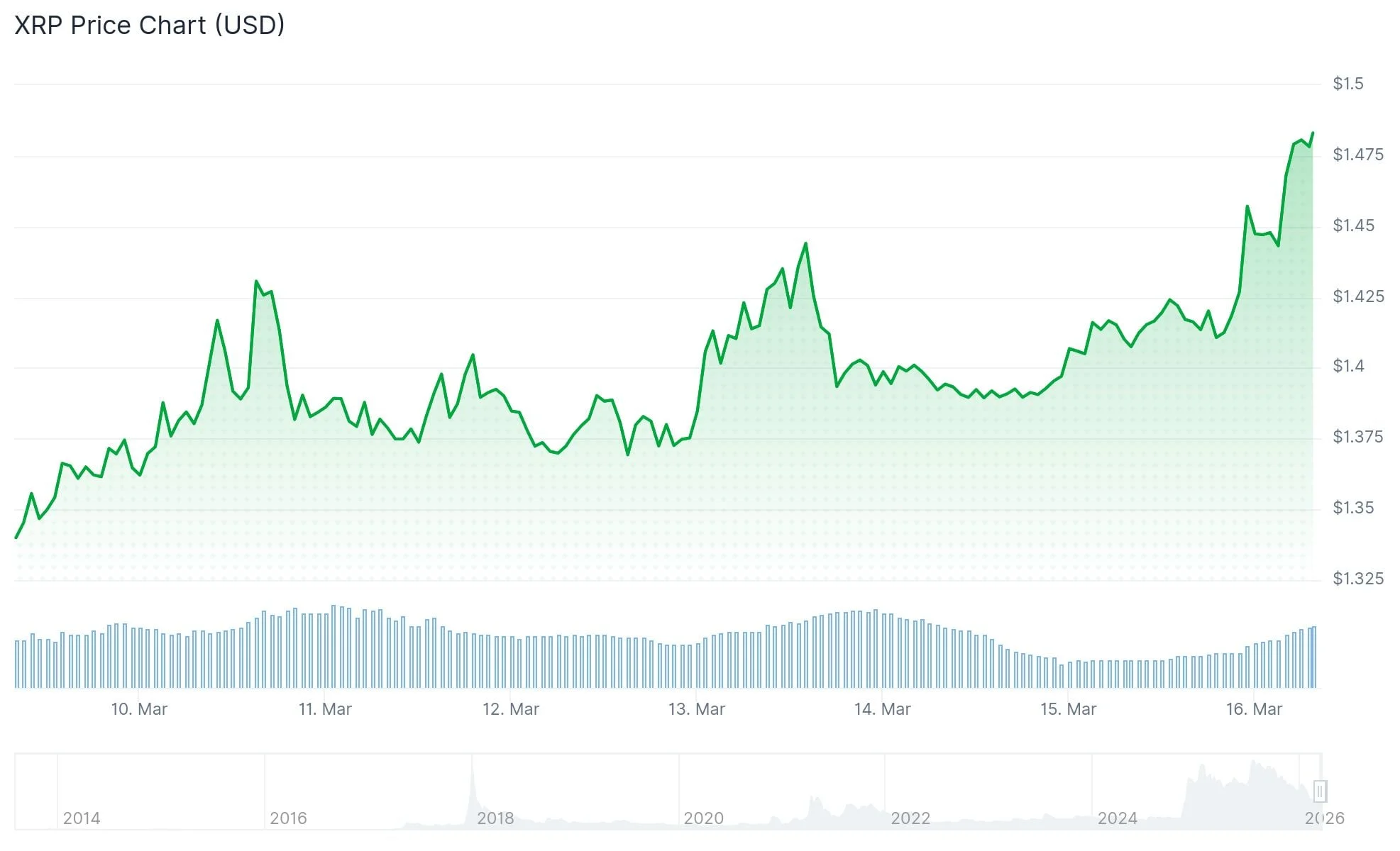
- The digital asset cleared the critical $1.426 resistance barrier for the first time since the beginning of 2026 following an extended period of sideways price action.
- Price surged from approximately $1.41 to $1.47 within 24 hours, accompanied by a volume increase exceeding 250%.
- The token is currently maintaining levels above $1.4550 and the 100-hour Simple Moving Average, with immediate targets identified near $1.48–$1.50.
- Real-world asset tokenization on the XRP Ledger continues expanding, with commodity tokens nearing $1.14 billion in total value.
- Maintaining support above the $1.43–$1.44 zone could open the door for further advances toward $1.50 and possibly $1.55.
On March 16, 2026, XRP finally broke free from a stubborn resistance level that had confined price action for several months during the early part of 2026.
The cryptocurrency rallied from the $1.41 region to reach an intraday peak of $1.4798 during the most recent trading session. Volume activity exploded by more than 250% as the breakout unfolded, with approximately 170 million tokens traded at peak levels.
Price action is currently stabilizing just above the $1.4550 level, maintaining its position over the 100-hour Simple Moving Average.
The pivotal barrier that finally broke was positioned at $1.426—a level that had repeatedly rejected upward momentum during multiple rally attempts in recent months. After clearing this threshold on robust volume, the asset rapidly advanced toward the $1.47 zone.
Near-term technical analysis reveals a pattern of ascending lows developing post-breakout. This formation indicates buying pressure is attempting to establish the previous resistance area as fresh support.
Rising Activity on the XRP Ledger
The price breakthrough doesn’t seem to correlate with any specific XRP-related news event. That said, on-chain activity across the XRP Ledger has been steadily increasing.
Tokenization of real-world assets on the network has shown continuous growth. Commodity-backed tokens on the XRP Ledger climbed toward $1.14 billion in valuation during 2026’s opening quarter.
Critical Price Zones Under Observation
XRP now confronts its next resistance barrier in the $1.48 to $1.50 range. Historical price action shows that rallies have encountered difficulty in this zone, making a decisive move beyond $1.50 particularly significant.
Should the asset successfully breach $1.50, market participants are eyeing subsequent targets at $1.5250 and $1.5320. Continued strength could drive price action into the $1.55 territory.
For downside protection, the essential support zone lies between $1.43 and $1.44. This represents the breakout level, and maintaining these prices is crucial for validating the current upward movement.
A decline beneath $1.4325 would mark a 50% Fibonacci retracement of the entire move from $1.3855 to $1.4798. Further weakness could find support around $1.410, with the primary demand zone located near $1.3680.
Currently, XRP is holding above $1.4550 with the 100-hour Simple Moving Average providing immediate support.
TLDR
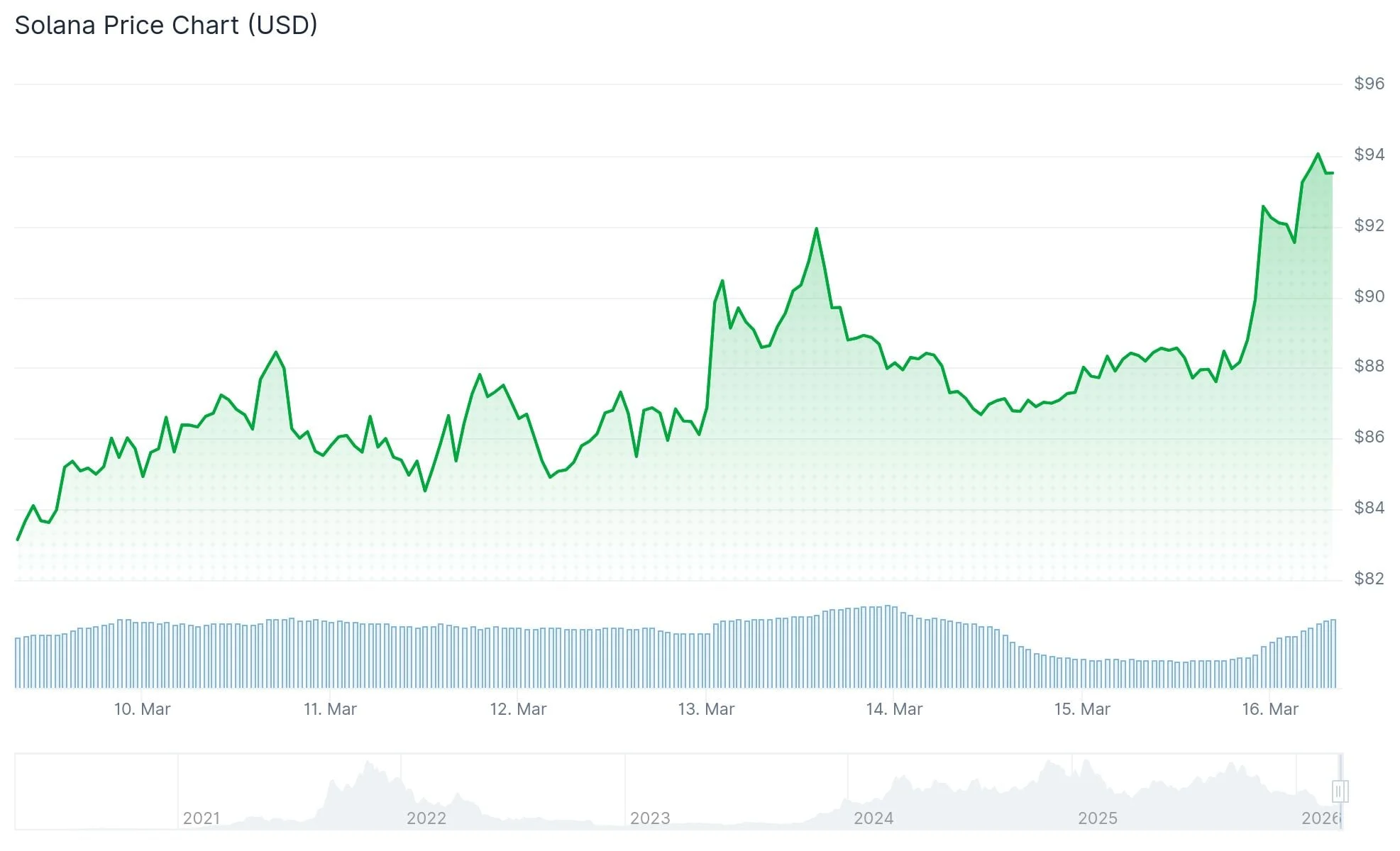
- SOL has climbed to the $92–$93 range, posting gains of approximately 4–5% daily following a 13% weekly increase.
- Institutional demand persists with SOL-focused ETFs recording $10.70 million in net weekly capital inflows.
- Futures Open Interest surged more than 7% within 24 hours to reach $5.57 billion, accompanied by $14.43 million in bear position liquidations.
- The 50-day EMA at $94.17 represents immediate technical resistance, with the 100-day EMA at $109.58 serving as the subsequent upside target.
- Real-world asset tokenization on the Solana network has expanded to approximately $873 million, based on Bitwise data.
Solana is demonstrating a notable rebound following its steep correction from the January 2026 high near $295. The digital asset has accumulated approximately 13% in gains throughout the past seven days and currently hovers within the $92–$93 price zone.
Exchange-traded funds dedicated to SOL accumulated $7.60 million in a single trading session on Friday, elevating the seven-day aggregate to $10.70 million. This sustained capital influx demonstrates persistent institutional appetite despite the recent downward pressure on prices.
Within the derivatives market, futures Open Interest experienced an upward movement exceeding 7% over a 24-hour period, reaching $5.57 billion. Bearish traders absorbed substantial losses, with short liquidations accounting for $14.43 million of the total $15.50 million in forced position closures.
The present trading level remains marginally beneath the 50-day Exponential Moving Average positioned at $94.17. Successfully closing above this threshold on a daily timeframe could establish momentum toward the 100-day EMA target of $109.58.
Technical momentum signals are exhibiting bullish tendencies. The MACD indicator has crossed into positive territory while the RSI registers at 58, positioned above neutral levels.
Real-World Asset Growth Supports Solana’s Case
Among the most compelling narratives supporting SOL’s price recovery is the expansion of tokenized real-world assets on its blockchain infrastructure. Bitwise research indicates that RWAs on Solana have reached approximately $873 million in valuation, spanning on-chain treasury products, private credit instruments, and yield-generating assets.
Spot-based Solana ETFs, which received regulatory approval in late 2025, have maintained capital attraction even throughout periods of adverse price movement. These investment vehicles provide traditional financial market participants with SOL exposure without the complexities of direct cryptocurrency custody.
Blockchain metrics corroborate this institutional interest. Active wallet addresses have exceeded the 5 million threshold while daily transaction volume approaches 87 million.
Network and Supply Context
The Solana validator network has expanded to encompass more than 2,000 validators according to certain estimates, though the count of active validators may be closer to 795. The Solana Foundation’s proportion of staked SOL tokens has declined substantially from above 40% in 2020 to below 6% by late 2025.
The network operates with an annual inflation rate of approximately 4%. Roughly 67% of SOL tokens remain staked, effectively constraining the freely circulating supply available for trading.
Funding rates across perpetual swap contracts remain relatively neutral to marginally negative at approximately −0.0095% daily. This metric indicates that leveraged long positions have not yet entered an aggressive accumulation phase.
Immediate downside support is identified within the $76–$80 range. Significant overhead resistance persists near $245–$250, corresponding to the January peak formation.
Presently, SOL exchanges hands at approximately $92–$93 with the 50-day EMA at $94.17 functioning as the immediate technical barrier.
Key Points
- Institutional crypto platform BlockFills declared Chapter 11 bankruptcy in Delaware on March 15, 2026
- Assets valued at $50M–$100M were reported against debts ranging from $100M–$500M
- Customer withdrawals were halted in February following approximately $75 million in losses
- A federal court issued an order freezing 70.6 Bitcoin connected to BlockFills after Dominion Capital filed suit
- Co-founder Nicholas Hammer resigned as CEO; Joseph Perry assumed the interim leadership position
On March 15, 2026, BlockFills—a Chicago-based institutional cryptocurrency trading and lending platform—submitted Chapter 11 bankruptcy documents to the US Bankruptcy Court for the District of Delaware.
Reliz Ltd., the platform’s primary operating entity, initiated the bankruptcy alongside three related companies. The documentation revealed assets valued between $50 million and $100 million, while liabilities ranged from $100 million to $500 million.
As an institutional service provider, BlockFills offers liquidity solutions, financing options, and risk-management tools to professional clients such as hedge funds, asset management firms, and cryptocurrency mining operations. According to company data, the platform facilitated over $60 billion in transaction volume throughout 2025—representing a 28% increase compared to the previous year.
The platform maintains a client base of approximately 2,000 institutional investors and has received backing from notable investors including Susquehanna Private Equity Investments, CME Ventures, and Nexo Inc.
In February, BlockFills announced the suspension of both customer deposits and withdrawals, attributing the decision to worsening market conditions. Company representatives stated the pause was necessary to safeguard the business and client interests while working toward restoring adequate liquidity.
According to CoinDesk’s reporting, the platform had suffered losses totaling roughly $75 million and had actively pursued acquisition offers or emergency capital injection prior to the bankruptcy declaration.
Bitcoin’s significant price decline appears to have contributed substantially to the firm’s financial difficulties. The leading cryptocurrency plummeted from above $97,000 to below $64,000 during the period spanning mid-January through early February 2026.
Court Actions Intensified Financial Strain
In early March, a US court issued an order freezing 70.6 Bitcoin associated with BlockFills operations. This action followed litigation initiated by Dominion Capital, a client alleging misappropriation of customer assets and improper commingling of funds.
Dominion Capital’s complaint asserted that BlockFills leadership had repeatedly acknowledged possessing a balance sheet deficit and improperly mixing client assets.
A federal judge additionally granted a temporary restraining order against the platform in response to Dominion Capital’s lawsuit. The court mandated a comprehensive accounting of all customer funds as part of the ongoing legal proceedings.
The Financial Times published a report on March 6 indicating that BlockFills had begun preparing for restructuring proceedings and was actively consulting with legal and advisory professionals.
Executive Transition Amid Crisis
Co-founder and chief executive Nicholas Hammer vacated his leadership position during the unfolding crisis. Joseph Perry accepted the appointment as interim chief executive officer.
In BlockFills’ official announcement, the company characterized the Chapter 11 filing as the “most responsible path forward” following extensive discussions with investors, clients, and creditors.
Management indicated the bankruptcy process would provide necessary time to stabilize operations, secure additional liquidity sources, and evaluate potential strategic alternatives or transactions.
The BlockFills bankruptcy echoes the 2022 cryptocurrency lending sector collapse, which saw major platforms including Celsius, Voyager Digital, BlockFi, and Genesis all declare bankruptcy following severe market corrections.
Joseph Perry currently oversees the company as it navigates the court-supervised restructuring proceedings.

PearOS Brings Mac-Level Polish to Any Aging Laptop for Free

I can’t believe how good these new Unusual Money Makers are

3,800 workers set to strike at one of the nation’s largest slaughterhouses


-
 Tech5 days ago
A 1,300-Pound NASA Spacecraft To Re-Enter Earth’s Atmosphere
-
Crypto World2 days ago
HYPE Token Enters Net Deflation as HyperCore Buybacks Outpace Staking Rewards
-

 News Videos7 days ago
10th Algebra | Financial Planning | Question Bank Solution | Board Exam 2026
-

 Business6 days ago
ExxonMobil seeks to move corporate registration from New Jersey to Texas
-

 Crypto World7 days ago
Paradigm, a16z, Winklevoss Capital, Balaji Srinivasan among investors in ZODL
-

 Fashion3 days ago
Weekend Open Thread: Addict Lip Glow
-

 Tech6 days ago
ChatGPT will now generate interactive visuals to help you with math and science concepts
-
Sports2 days ago
Why Duke and Michigan Are Dead Even Entering Selection Sunday
-

 NewsBeat5 days ago
Residents reaction as Shildon murder probe enters second day
-

 Business5 days ago
Search Enters Sixth Week With New Leads in Tucson Abduction Case
-
 NewsBeat6 days ago
Pagazzi Lighting enters administration as 70 jobs lost and 11 stores close across Scotland
-

 Business14 hours ago
Search for Savannah Guthrie’s Mother Enters Seventh Week with No Arrests
-

 Tech7 days ago
Despite challenges, Ireland sixth in EU for board gender diversity
-

 Business2 days ago
US Airports Launch Donation Drives for Unpaid TSA Workers as Partial Government Shutdown Enters Fifth Week
-
Crypto World2 days ago
Coinbase and Bybit in Investment Talks: Could Bybit Finally Enter the US Crypto Market?
-

 NewsBeat5 days ago
I Entered The Manosphere. Nothing Could Prepare Me For What I Found.
-

 Business7 days ago
Search Enters 39th Day with FBI Tip Line Developments and No Major Breakthroughs
-

 Sports7 days ago
Skateboarding World Championships: Britain’s Sky Brown wins park gold
-

 Business2 days ago
Country star Brantley Gilbert enters growing non-alcoholic beer market
-

 Crypto World6 days ago
Will Chainlink price reclaim $10 amid volatility squeeze?

