

Crypto World
Why Is Crypto Up: BTC USD Decoupling From Gold Amid Heated Israel-Iran War

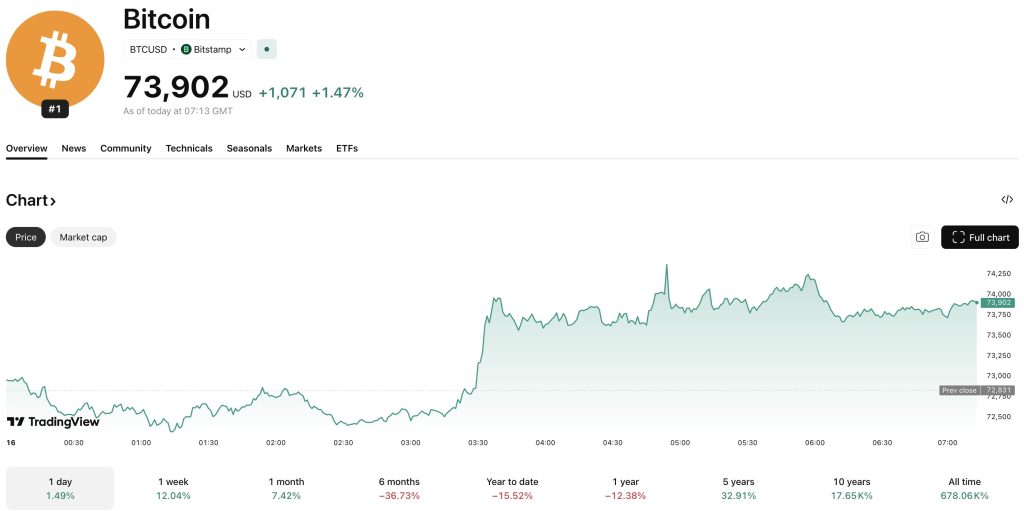
The Bitcoin price shattered the $74,000 ceiling on Monday, posting its highest daily close since early February 2026, while gold prices retreated. While BTC USD has since dropped to $73,700, traders have been left asking ‘Why is crypto up?’
This move signals a decisive shift in asset correlations as institutional capital rotates from precious metals back into digital assets following weeks of consolidation.
Bitcoin surged to an intraday high of $74,150, marking a +7.5% single-day rally that has effectively erased the losses sustained in late February.
Trading volume on the day exploded to $70.8Bn, a liquidity spike that validates the breakout above the consolidated $68,000–$72,000 range.

Why is Crypto Up? Is Bitcoin Replacing Gold as the Crisis Hedge?
The most compelling narrative driving this rally is the Crypto Decoupling from traditional precious metals. Historically, Bitcoin and gold have moved in tandem during periods of geopolitical uncertainty. However, recent data suggest a structural break in this relationship.
Institutional flows tell the story clearly. While gold ETFs saw net outflows of approximately -$400M last week, US-based Spot Bitcoin ETFs absorbed +$750M in net new capital over the same five-day period, per CoinGlass data.
This divergence suggests that sophisticated allocators are increasingly viewing Bitcoin as a high-beta risk-off asset rather than merely a speculative tech play. The Gold vs Bitcoin debate has shifted from theoretical store-of-value arguments to visible liquidity preferences in the ETF market.
Analysts at JPMorgan have previously noted this rotation, highlighting that younger demographics and tech-forward hedge funds prefer Bitcoin’s portability and verifiability over the logistical drag of gold.
DISCOVER: The 16 Best Meme Coins to Buy in March 2025
Institutional ETF Flows Signal Renewed Accumulation

The engine behind this move is unmistakably institutional. Institutional ETF Flows have turned aggressively positive after a month of stagnation, with five consecutive green days.
BlackRock’s IBIT and Fidelity’s FBTC led the charge, accounting for nearly 70% of the recent inflows, which stand at a combined +$750M.
On-chain data corroborates this buying behavior. Large Bitcoin holders have started accumulating again as the asset stabilized above $71,000, creating a floor regarding ‘whale’ support layers.
According to Santiment data, wallets holding between 1,000 and 10,000 BTC added significantly to their stacks in the 48 hours preceding the breakout, suggesting insider confidence or smart money positioning ahead of the move.
This accumulation is happening despite lingering geopolitical fears. In fact, analyzing Bitcoin’s resilience during geopolitical tensions reveals that the market is pricing in long-term monetary debasement over short-term conflict risk.
Bitcoin Price Prediction: Bull vs Bear Scenarios
After asking themselves, ‘Why is crypto up?’, traders are now adjusting targets as market analysis shifts from recovery to expansion. Bulls aim to turn the $73,000 level from resistance to support.
Bull Scenario: If Bitcoin closes the day above $73,500, it could target the $76,000-$78,000 supply zone. A strong hold here could invalidate the lower-high structure from early 2026, bringing the psychological $80,000 level into play.
Bear Scenario: Falling below $71,500 could indicate a liquidity grab or “bull trap,” leading to a quick drop to the $68,200 demand zone. Low-volume dips are potential buying opportunities, while high-volume rejections may signal the end of the current uptrend.
Upcoming Federal Reserve meeting minutes on March 17-18 could act as a catalyst. If hints at continued rate pauses emerge, the risk-on environment may push targets toward $78,000. The key question is whether retail enthusiasm will match institutional buying; until then, volatility is likely.
EXPLORE: Best Crypto Presales to Buy in 2026
The post Why Is Crypto Up: BTC USD Decoupling From Gold Amid Heated Israel-Iran War appeared first on Cryptonews.

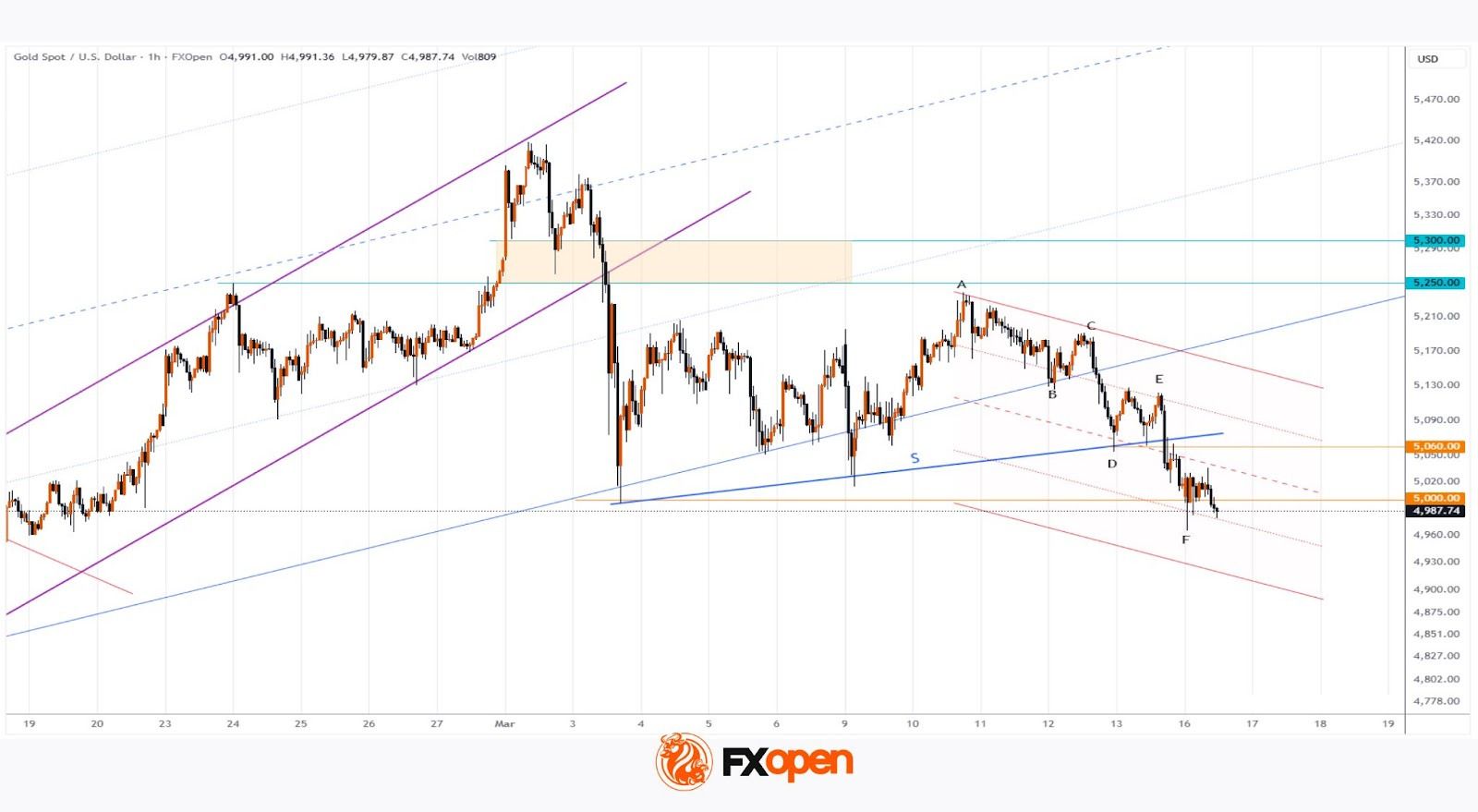
As the XAU/USD chart shows, gold prices today dropped below the 3 March low, reaching levels last seen in the third week of February.
Why Is Gold Declining Despite the War?
Geopolitical turmoil typically supports demand for gold as a safe-haven asset. However, in the current environment — with the Middle East conflict now lasting more than two weeks — the surge in oil prices and the associated inflation risks have moved to the forefront.
Market participants appear to believe that the Federal Reserve will keep interest rates higher for longer. This increases the attractiveness of US dollar-denominated instruments, particularly US Treasuries and money market assets. Rising yields on US government bonds confirm this shift in expectations and simultaneously weigh on gold, which does not generate interest income.
Technical Analysis of XAU/USD
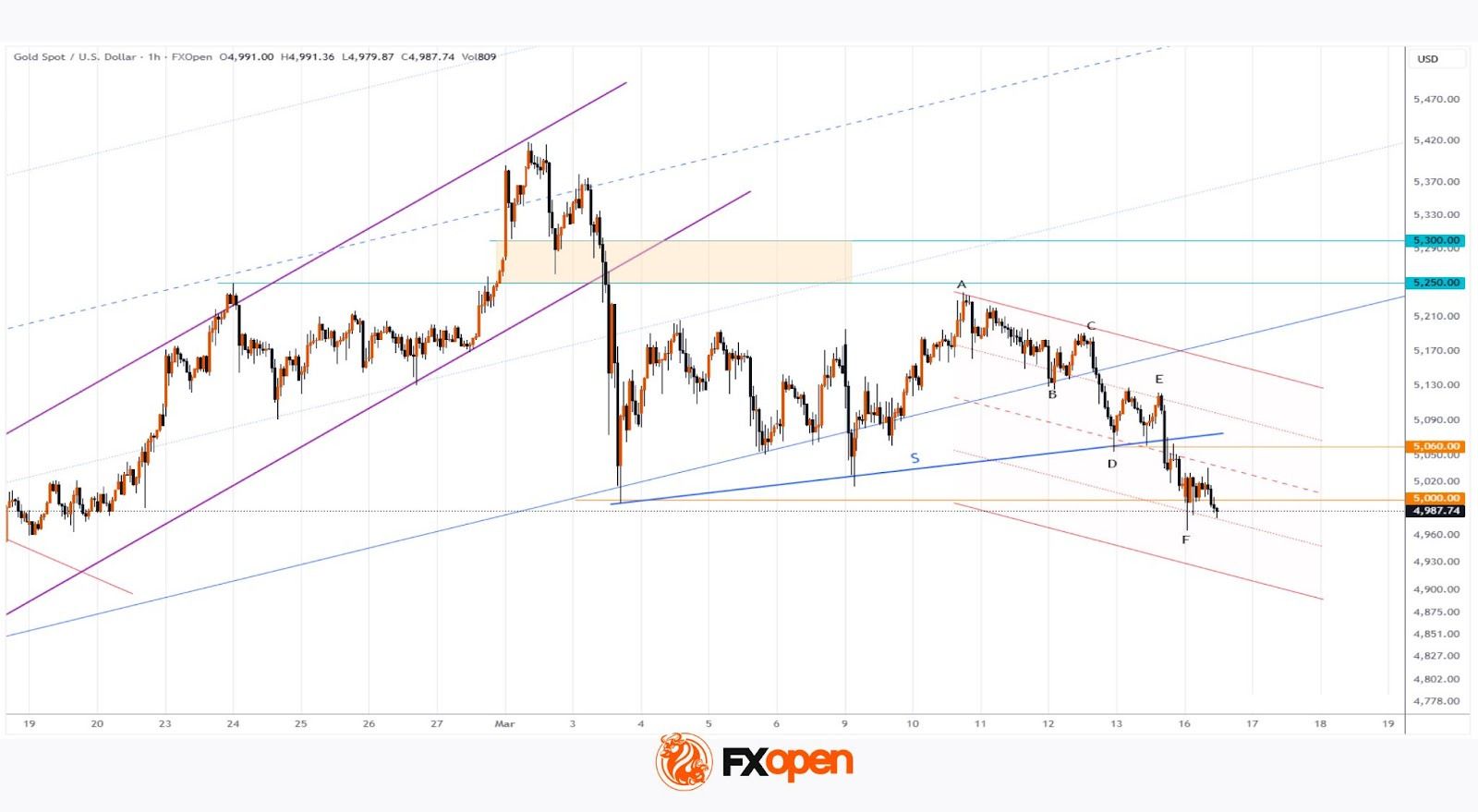
On the morning of 10 March, while analysing gold price movements, we confirmed that the long-term ascending channel remains in effect and also:
→ suggested that its lower boundary could provide support for gold prices;
→ noted that an important test of bullish momentum could come at the breakout level of the purple channel, near $5250.
As indicated by the arrow, the XAU/USD chart showed a continuation of the bullish impulse later that same day. However, the move lost momentum around $5235, forming peak A, after which a sequence of lower highs and lower lows (A–B–C–D–E) developed.
At the same time:
→ the lower boundary of the long-term rising channel was broken following a weak rebound from B to C;
→ a descending channel (shown in red) has now become relevant;
→ the $5060 level may act as an important resistance area, where sellers were strong enough to break the local support S and push gold prices into the lower half of the red channel.
If bears continue to maintain control, the price of an ounce could decline towards the lower boundary of the red channel.
Start trading commodity CFDs with tight spreads (additional fees may apply). Open your trading account now or learn more about trading commodity CFDs with FXOpen.
This article represents the opinion of the Companies operating under the FXOpen brand only. It is not to be construed as an offer, solicitation, or recommendation with respect to products and services provided by the Companies operating under the FXOpen brand, nor is it to be considered financial advice.
Crypto World
Trump-linked WLFI passes proposal letting $5 million stakers buy ‘direct access’ to team
World Liberty Financial, the decentralized finance (DeFi) protocol linked to the family of U.S. President Donald Trump, put a $5 million price tag on ‘direct access’ to team members in an almost unanimous governance vote.
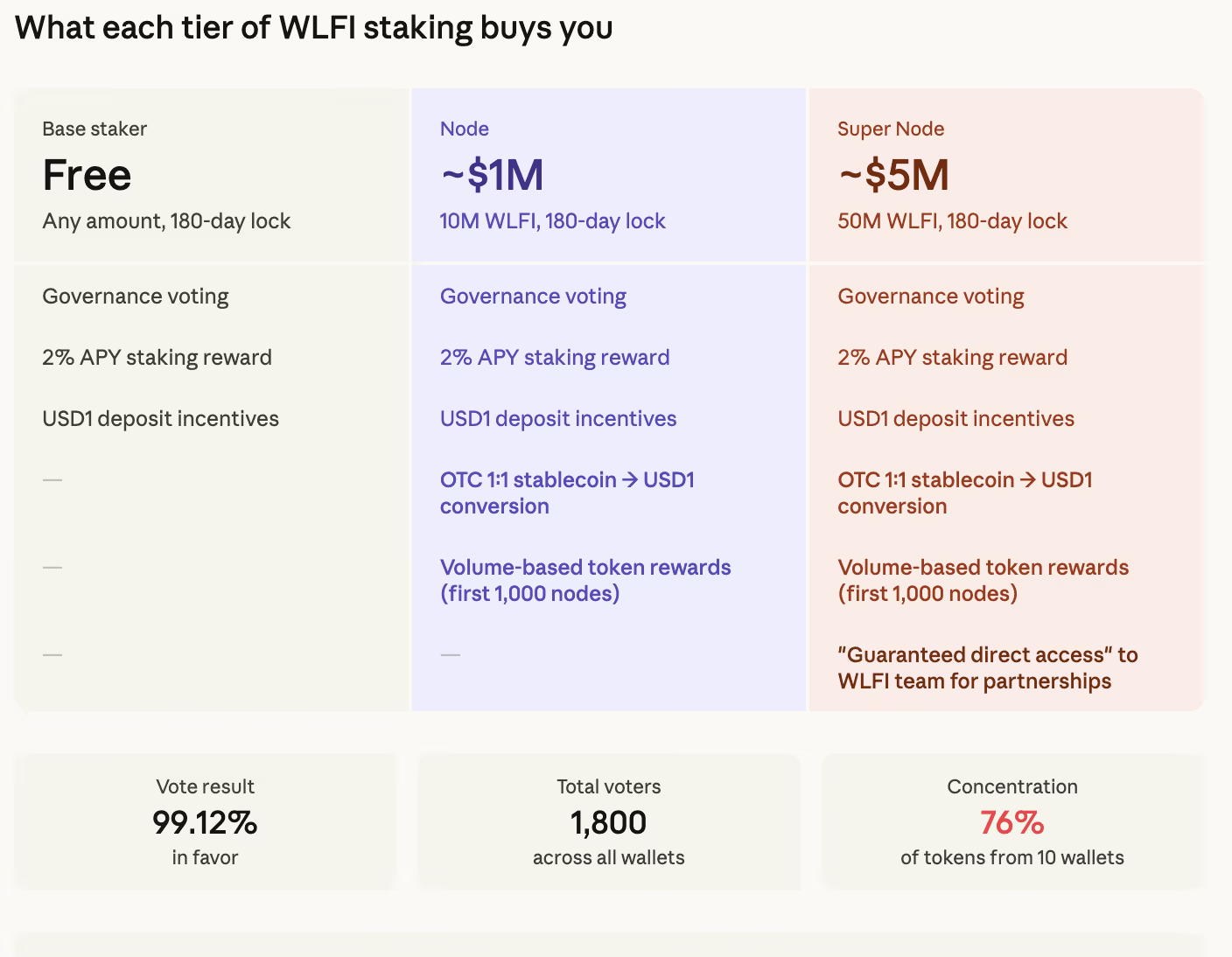
Token holders of the venture backed by Eric and Barron Trump passed a proposal on Friday that creates a three-tier staking system for its WLFI governance token.
The Base tier requires a 180-day lock-up to vote. The Node tier requires staking 10 million WLFI, roughly $1 million, and grants the ability to convert stablecoins to WLFI’s USD1 at 1:1 parity through licensed market makers. The Super Node tier requires 50 million WLFI, roughly $5 million, and grants “guaranteed direct access to the WLFI team for partnership discussions.”

The vote passed 99.12% in favor out of 1,800 votes cast. Over 76% of the voting tokens came from just 10 wallets.
WLFI spokesman David Wachsman told Reuters on Sunday that the “direct access” refers to the business development team and executives, not specific founders, and doesn’t guarantee a partnership.
The company’s own Gold Paper, however, lists co-founders Eric Trump, Barron Trump and Steven Witkoff’s sons Zach and Alex as part of the team “supporting the WLF commitment.”
The proposal’s stated motivation is redirecting value from market makers to long-term participants.
WLFI said that during its USD1 stablecoin expansion, market makers captured millions in arbitrage at roughly 15 basis points per cycle, and WLFI paid millions more in redemption subsidies. The Node and Super Node structure routes those economics to large stakers instead.
The Super Node tier is where the proposal goes beyond governance mechanics. WLFI currently receives “more partnership inquiries than it can productively engage with,” the proposal says.
The $5 million staking requirement “serves as a filter to prioritize projects and platforms that are actively supporting and participating in the WLFI ecosystem, rather than those seeking partnership on a purely opportunistic basis.”
Projects that want to talk to the team now need to invest in WLFI tokens and lock them for six months. That creates buying pressure on the token, reduces circulating supply, and generates a captive audience of large holders who are financially invested in the protocol’s success before any partnership discussion even begins.
Meanwhile, WLFI is also pursuing a national trust bank charter through the OCC, exploring tokenization of real estate and oil and gas assets, and considering the creation of a publicly traded company to hold WLFI tokens.
Crypto World
Australia Senate committee pushes bill to bring crypto platforms under financial services rules


Australia’s Senate Economics Legislation Committee is considering a new bill that would require crypto exchanges and tokenization platforms to operate in accordance with the country’s existing financial services regime.
Summary
- Australia’s Senate Economics Legislation Committee has backed a bill that would bring crypto exchanges and tokenised custody platforms under the country’s financial services licensing regime.
- Platforms that hold customer assets would be required to meet ASIC custody and settlement standards and follow governance and disclosure rules.
Australian regulators are pushing for the passage of the Corporations Amendment (Digital Assets Framework) Bill 2025, which regulators hope will bring “digital asset platforms” (DAPs) and “tokenised custody platforms” (TCPs) under a clear licensing and oversight framework.
The goal is to prevent a repeat of failures involving platforms that hold customer assets, as seen in the past with high profile collapses such as FTX.
As previously reported by crypto.news, the legislation was first introduced in November last year and would require digital asset and tokenized custody platforms to operate under the Corporations Act and the Australian Securities and Investments Commission Act.
To comply with the framework, platforms will have to meet ASIC set custody and settlement standards, provide tailored disclosures for retail clients, and operate under platform-specific conduct and governance requirements, while small providers with annual transaction thresholds under 10 million Australian dollars ($7 million) would be exempt.
However, some industry participants have argued that the bill’s broad “digital token” and “factual control” tests could inadvertently include wallet software and infrastructure providers within the regulatory scope.
Concerns come at a time when firms like Ripple are looking to expand their presence in the Australian market and obtain the required regulatory licenses to operate in the country.
US blockchain firm Ripple Labs backed the concept of “control” as the “appropriate nexus” for defining the regulatory perimeter but said the framework would need adjustments to better accommodate modern security architectures such as multi party computation wallets.
Further, the company warned that under a strict reading of the “factual control” test, technology providers that only hold a single key shard in a multi party setup could be misclassified as regulated custodians even though they cannot independently move client assets.
The committee has acknowledged these concerns but has sided with Treasury’s proposal to refine the regulatory perimeter through future regulations rather than rewriting the core definitions in the bill.
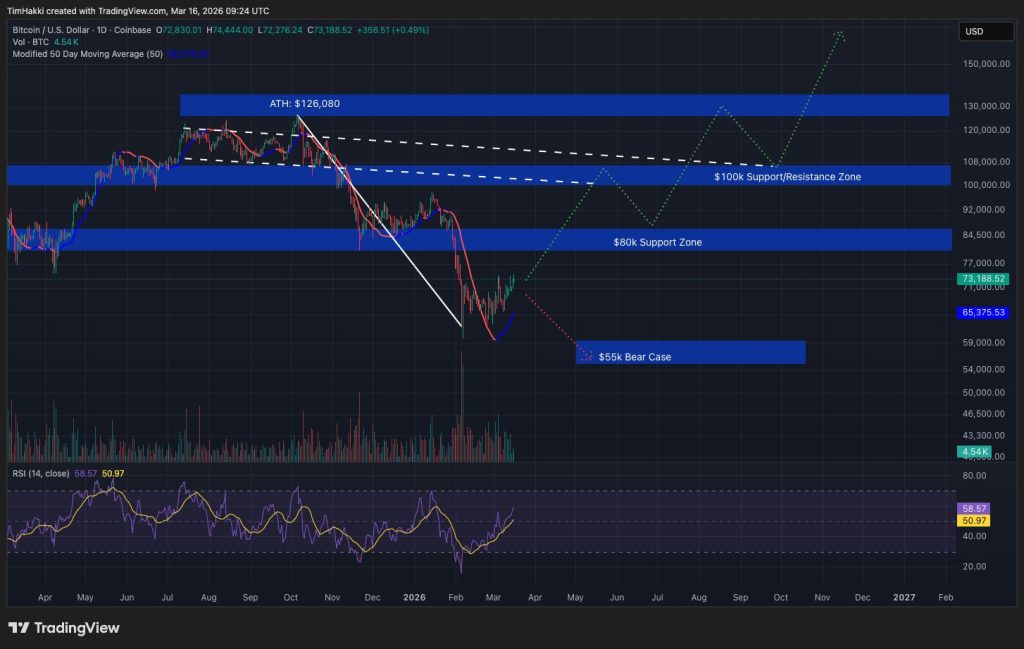
Bitcoin (BTC) trades more and more bullishly these days. The world’s favourite crypto reclaimed a pivotal technical level by surging past its 50-day moving average and briefly rising above $74,000, before pulling back to around $73,300, a 2.4% gain in the last 24 hours, according to CoinGecko.
Traders and fans alike are now wondering if the latest upswing represents a potential end to the consolidation phase that has gripped markets since early February.
So, is buyer conviction finally strengthening?
Discover: The best pre-launch crypto sales
Today’s Bullish Bitcoin Breakout: Is it Sustainable?
Traders widely track the 50-day moving average as a gauge of market health, and Bitcoin’s inability to surpass it in recent weeks has been a source of bearish sentiment.
By clearing $71,125, the asset has flipped a previously formidable resistance level into potential support.
The bullish price action is conspicuous given the backdrop of market fears around the US-Iran conflict, although Bitcoin has largely shrugged off war fears, causing many to wonder if its extended downturn from October 2025 was the market pricing in the possibility of war.
Traders are now mapping the next zones of interest as volatility returns to the market. The technical picture suggests a battle between bulls aiming for new highs and bears looking to fade the rally.

In the bull case, Bitcoin must sustain its position above $73,000 to confirm the breakout. The immediate target is $75,000, a psychological and technical level laden with liquidity. A daily close above $75,000 could open the path toward $80,000, invalidating the bearish structure formed over the last two months.
On the flipside, if the price fails to hold above the 50-day MA at $71,125, the breakout could indicate a “bull trap.” In this event, support levels at $62,000 and $60,500 become the primary downside targets. A drop below recent lows would likely re-engage bearish momentum.
Bitcoin Trades a Little Higher Every Day, But Will it Break Out?
The push toward $75,000 is not just a technical event; it is also a liquidity trigger.
Market makers currently hold net short gamma positions worth billions around the $75,000 strike. As prices approach this level, these entities have to buy the underlying asset to delta-hedge their exposure to neutral, potentially creating a feedback loop that accelerates the rally.
This technical squeeze coincides with on-chain shifts. Large Bitcoin wallets have resumed accumulation as the price stabilizes above $71,000, signaling that “smart money” is positioning for a leg up.
Conversely, some institutional analysts are watching to see if the divergence between Bitcoin and Gold ETFs holds before deciding whether risk-on appetite is truly returning to the crypto sector.
Going forward, if Bitcoin trades above $73,500 for most of this week, it would suggest the bulls are in control, while a low-volume retreat could signal that the 50-day moving average remains a hurdle rather than a launchpad.
Discover: The best meme coins!
The post Bitcoin Trades Above 50-Day Moving Average as Bullish Momentum Builds appeared first on Cryptonews.

Australia’s Senate Economics Legislation Committee has endorsed a bill that would bring crypto exchanges and tokenisation platforms under the country’s existing financial services regime. The Corporations Amendment (Digital Assets Framework) Bill 2025, recommended for passage on March 16, marks a significant step toward a bespoke licensing regime for “digital asset platforms” (DAPs) and “tokenised custody platforms” (TCPs). The move aims to close oversight gaps that emerged in the wake of high‑profile collapses in the digital asset space, including the FTX debacle, and to align digital asset activities with established financial regulation.
Key takeaways
- The committee backed the Corporations Amendment (Digital Assets Framework) Bill 2025, signaling government momentum toward formal licensing for DAPs and TCPs.
- The bill would treat DAPs and TCPs as financial products under the Corporations Act and ASIC Act, pushing many exchanges and custody providers into the Australian Financial Services Licence regime.
- Austere exemptions exist for smaller players, with annual transaction thresholds under A$10 million and certain public blockchain infrastructure carved out from licensing requirements.
- Industry groups cautioned that broad terms like “digital token” and “factual control” could sweep in wallet software and multi‑party computation architectures, potentially widening the regulatory perimeter beyond intent.
- Industry reactions included support from Coinbase Australia but concerns about debanking risks, underscoring the need for clear rules to foster a competitive, innovation‑friendly environment.
Tickers mentioned:
Market context: The move sits within ongoing global regulatory shifts as jurisdictions seek to harmonise digital asset activities with traditional finance rules while balancing innovation with consumer protection.
Why it matters
The proposal to classify DAPs and TCPs as financial products signals a measurable tightening of Australia’s crypto regulatory framework. By requiring compliance with custody, settlement, and disclosure standards set forth by ASIC, the framework seeks to bolster confidence among retail and institutional users that assets held on regulated platforms are safeguarded under robust governance. The designated framework also aims to harmonise standards across platforms that hold customer assets, reducing the risk of fund misappropriation and escalating enforcement actions that followed gaps exposed during major industry disruptions.
From a market perspective, the committee’s recommendation could have two meaningful effects. First, it may accelerate the onboarding of compliant platforms into Australia’s financial services regime, potentially expanding the country’s appeal as a regional hub for digital asset activity. Second, the proposal’s carve‑outs for smaller providers and certain infrastructure projects may preserve a space for innovation and niche services, though the thresholds introduce a calculus for compliance costs that could influence the business models of smaller operators.
The testimony and documents also illustrate the tension between regulatory ambition and technical realities. Industry voices warn that the current wording—particularly terms like “digital token” and “factual control”—could inadvertently encompass wallet software and distributed architectures used by modern custodians. Ripple Labs, for example, argued that while a clear regulatory perimeter is appropriate, modern security architectures such as multi‑party computation wallets should be accommodated. The concern is not only about classification but about ensuring that technology providers aren’t swept into a regime designed for centralized custodians merely because they operate within a multi‑party framework. This debate underscores the challenge regulators face in drawing boundaries that reflect both traditional finance risk controls and evolving cryptographic architectures.
The committee’s stance acknowledged these concerns and endorsed Treasury’s approach to refine the regulatory perimeter through targeted future regulations rather than reopening the core definitions. In practical terms, this means Australia is pursuing a calibrated path: extend licensing to platforms with customer assets while allowing smaller or foundational infrastructure players to operate under exemptions that recognise their different risk profiles.
In parallel, major industry stakeholders have weighed in on the path forward. Coinbase Australia’s leadership welcomed the recommendation as a meaningful step for Australia’s role in the global digital economy, while cautioning that issues such as debanking continue to pose risks in the absence of clear, consistent fintech‑bank collaboration. The emphasis remains on establishing a predictable, rules‑based environment that enables innovation without compromising consumer protection or market integrity.
What to watch next
- The bill moves to the Senate for debate and a final vote, with potential amendments to definitions and exemptions.
- Regulatory guidance or secondary legislation from the Australian Treasury and regulators that clarifies what constitutes “unilateral transfer” rights and how MPC wallets are treated.
- Details on the application and administration of the A$10 million exemption threshold for small providers, including practical examples and reporting requirements.
- Prospective licensing timelines for DAPs and TCPs, including anticipated capital and conduct standards that platforms must meet to obtain an Australian Financial Services Licence.
Sources & verification
- Parliament of Australia, Senate Economics Legislation Committee report on the Corporations Amendment (Digital Assets Framework) Bill 2025 (Tabled Documents 15556).
- Australia introduces bill regulate crypto under existing finance laws — Cointelegraph coverage of the framework’s scope and implications.
- Ripple Labs commentary on regulatory perimeters and security architectures in the context of Australian licensing discussions — Cointelegraph article.
- Coinbase Australia perspective on licensing progress and debanking risks, as reported by Cointelegraph.
- Discussion of the broader regulatory environment following high‑profile digital asset incidents, including references to the FTX collapse.
Australia’s digital asset licensing push gains momentum
The March recommendation by the Senate committee consolidates a long‑running discussion about aligning digital asset activities with Australia’s financial services regime. By treating DAPs and TCPs as financial products, the government signals intent to apply established consumer protections, custody standards, and governance requirements to platforms that hold customer funds. The bill’s architecture suggests a bifurcated pathway: a robust licensing regime for the larger, asset‑holding platforms, and a more measured approach for smaller operators and certain infrastructure services. This approach mirrors global regulatory patterns that balance risk management with the need to avoid stifling innovation.
Proponents argue that a clear, rules‑based framework will attract both retail and professional participants, helping to safeguard assets while enabling legitimate use cases—from regulated token custody to transparent settlement mechanics. Critics, however, warn that overly broad terminology could sweep in a wider ecosystem than intended, potentially elevating compliance costs for startups and deterring competitive dynamics in the Australian market. The Treasury’s preference for incremental refinement rather than wholesale redefinition indicates a deliberate, consultative path forward, one that seeks to harmonise domestic rules with international standards while preserving Australia’s appeal as a digital asset jurisdiction.
Looking ahead, the government and regulators will need to articulate concrete guidance on custody standards, disclosure obligations for retail clients, and governance requirements tailored to platform types. As the regulatory perimeter takes shape, market participants will monitor whether the exemptions for small providers create a workable environment for early‑stage platforms and whether the evolving framework can accommodate future security innovations without diluting risk controls. In the meantime, the industry will likely press for timely regulatory clarity to reduce uncertainty and facilitate strategic investments in Australia’s digital asset ecosystem.

Key Takeaways
- SanDisk (SNDK) shares exploded 25.5% over the past week, with Friday’s trading session contributing a 6.92% gain.
- Q2 FY2026 net income skyrocketed 672% year-over-year to $803 million, while revenue climbed 61% to reach $3.025 billion.
- Management forecasts Q3 FY2026 revenue of $4.4B–$4.8B, representing potential year-over-year growth of up to 183%.
- The company expects Q3 gross margins between 65%–67% and has slashed debt from approximately $2 billion down to ~$603 million.
- Analyst consensus suggests approximately 19% upside potential over 12 months, though the stock commands a premium valuation at 4.41x forward sales with a Value Score of F.
SanDisk Corp. (SNDK) delivered an impressive weekly performance, surging 25.5% as market participants aggressively bought the dip during widespread selling pressure. The stock added 6.92% in Friday’s trading alone.
The rally occurred as institutional money rotated away from sectors most exposed to escalating Middle East geopolitical risks and toward technology and storage companies. Nvidia’s $2 billion commitment to an AI infrastructure venture earlier in the week provided additional tailwinds across the tech sector.
The company’s operational performance gave buyers substantial reasons for optimism. During Q2 FY2026, SanDisk reported net income of $803 million—representing an extraordinary 672% increase from the $104 million earned in the year-ago period. Revenue expanded 61% to $3.025 billion from $1.876 billion previously.
Enterprise solid-state drive sales are the primary catalyst behind this expansion. Enterprise SSD revenue surged 64% quarter-over-quarter in Q2, and executives anticipate another significant sequential increase in Q3 with momentum building through year-end.
For the upcoming Q3 period, SanDisk projects revenue between $4.4 billion and $4.8 billion. The midpoint would mark growth of 159% to 183% versus the $1.695 billion generated in Q3 of the previous fiscal year. Gross margin projections stand at 65%–67%.
Executives also indicated that NAND supply constraints will intensify in Q3 compared to Q2 levels. CEO David Goeckeler has publicly stated that demand will continue exceeding supply “well beyond calendar year 2026,” providing structural support for favorable pricing dynamics.
Financial Position Strengthens
SanDisk’s balance sheet has undergone rapid improvement. The company concluded Q2 with approximately $1.5 billion in cash reserves and generated $843 million in adjusted free cash flow. Operating cash flow totaled $1.019 billion.
Total debt declined to roughly $603 million—a dramatic reduction from the previous $2 billion level. Executives indicate plans to continue deleveraging while simultaneously investing in BiCS8 NAND technology advancement and expanding the enterprise SSD product portfolio.
The company has also begun securing multiyear customer agreements that incorporate prepayment structures, which management believes will enhance forecasting accuracy and operational planning.
Valuation Considerations
Following a remarkable 1,194% climb over the past year and 206% appreciation in just three months, some market observers are questioning whether valuation has stretched too far.
SanDisk currently commands a 4.41x forward 12-month sales multiple, significantly above the 2.3x industry average. The stock receives a Value Score of F, indicating premium pricing relative to comparable companies. Western Digital and Seagate trade at 6.21x and 6.4x forward sales respectively, while Silicon Motion Technology is valued at 3.22x.
Wall Street’s consensus 12-month price target suggests approximately 19% appreciation potential from current levels. This compares favorably to Micron, whose average analyst target trades slightly below its present market price.
Micron carries a more modest 12.7x forward earnings multiple compared to SanDisk’s 15.8x. Some analysts contend that Micron’s business diversification across DRAM, NAND, and high-bandwidth memory technologies positions it more favorably for sustained growth, whereas SanDisk maintains pure-play NAND exposure.
Both companies report their respective product lines are completely sold out through 2026.
SanDisk maintains a Zacks Rank #1 rating with a Growth Score of A. Shares closed Friday’s session at $661.49.

Crypto World
Advanced Micro Devices (AMD) Stock Falls Despite Strong Q4 as Executives Unload $33M in Shares

Key Takeaways
- Advanced Micro Devices delivered Q4 earnings of $1.53 per share versus analyst expectations of $1.32, while revenue hit $10.27B — representing 34.1% growth year-over-year
- Management forecasts 35% compound annual revenue growth over three years, with data center operations projected to expand at 60% CAGR
- Eminence Capital increased its AMD holdings by 5.5% to approximately $241.6M, joining Vanguard and State Street as major institutional holders
- Company executives have offloaded 154,392 shares worth approximately $33.1M over the last 90 days, with two EVPs making recent transactions
- Emerging threats include a new Chinese GPU manufacturer (Lisuan Technology) and Meta’s internal chip development efforts
AMD crushed quarterly estimates, secured a partnership with Meta, and continues developing its MI450 accelerator — yet company insiders are reducing positions while a Chinese challenger enters the arena. Here’s what investors need to know.
Advanced Micro Devices, Inc., AMD
Advanced Micro Devices posted fourth-quarter earnings of $1.53 per share, surpassing Wall Street’s $1.32 estimate by $0.21. The company generated $10.27 billion in revenue, exceeding projections of $9.65 billion and marking a 34.1% increase compared to the prior year period.
The data center division represents AMD’s primary growth driver. Management outlined expectations for 60% compound annual growth in this segment through the next three years, significantly outpacing the company-wide 35% CAGR target.
AMD’s stock started Friday’s session at $193.39. The equity currently trades beneath both its 50-day moving average of $216.16 and 200-day moving average of $210.13 — a technically bearish configuration.
Shares have traded within a broad 52-week band spanning from $76.48 to $267.08. Current pricing reflects a substantial discount from recent highs.
AMD carries a price-to-earnings ratio near 73, though the forward-looking P/E metric projects at 31 — aligning closely with the S&P 500’s 29 average. This forward valuation proves more relevant for investors conducting fundamental analysis.
The semiconductor company finalized a multi-year patent licensing deal with Adeia and unveiled AI telecommunications products at MWC 2026. While strategically important, these developments haven’t generated immediate upward momentum in share price.
AMD also announced a partnership with Meta Platforms to supply chips for Meta’s next-generation artificial intelligence infrastructure. This represents a significant customer acquisition in a market where Nvidia has maintained dominance.
Institutions Accumulate While Executives Exit
Eminence Capital expanded its position by 5.5% to 1,493,555 shares, representing approximately $241.6M in value. Vanguard maintains 155.9M shares, while State Street controls 72M shares. Institutional ownership accounts for 71.34% of outstanding shares.
Conversely, company insiders have been reducing their holdings. EVP Forrest Norrod divested 19,450 shares on February 11th at $216.81 per share. EVP Paul Darren Grasby sold 7,500 shares on March 11th at $204.87. Combined insider transactions over 90 days total 154,392 shares worth approximately $33.1M.
Wall Street analysts maintain an overall “Moderate Buy” rating with a consensus price target of $290.53. Evercore leads with the most bullish $358 target, while Goldman Sachs takes a more reserved stance at $240 with a “neutral” rating.
Emerging Competitive Challenges
Two notable headwinds have materialized. Chinese GPU manufacturer Lisuan Technology unveiled new products, contributing to selling pressure across GPU stocks and introducing competitive uncertainty for both AMD and Nvidia.
Meta’s development of proprietary AI chips represents another concern, potentially shrinking the total addressable market for external semiconductor suppliers in the long term.
AMD’s forthcoming MI450 AI accelerator positions for direct competition against Nvidia’s Vera Rubin chip. According to industry assessments, the MI450 demonstrates superior performance across multiple technical benchmarks.
AMD maintains a market capitalization of $315.3B. Company insiders collectively own just 0.06% of outstanding shares.

TLDR
- Lululemon will release Q4 fiscal 2025 results after Tuesday’s closing bell on March 17.
- Wall Street forecasts earnings per share of $4.78, representing a 22.2% year-over-year decrease, alongside revenue of $3.57 billion, down 1.1%.
- Shares have plunged approximately 24% since the start of the year and more than 50% over the trailing twelve months.
- Analysts maintain a collective Hold stance, with a mean price target of $205.53 — roughly 30% higher than the current trading price.
- Chief Executive Calvin McDonald announced his departure, with the board currently seeking his successor.
As Lululemon approaches its Tuesday earnings announcement, the athleisure giant’s shares hover near multi-year lows. The stock has tumbled roughly 24% year-to-date and lost more than half its market value during the past year. Expectations are mixed as investors await quarterly results.
Lululemon Athletica Inc., LULU
Wall Street analysts project fourth-quarter revenue will reach $3.57 billion, marking a 1.1% year-over-year contraction. This represents a stark contrast to the 12.7% revenue expansion the company delivered in the comparable period last year. Earnings per share are anticipated to land at $4.78, reflecting a 22.2% year-over-year decrease.
Management previously indicated that fourth-quarter performance could approach the upper boundary of their guidance range, citing robust holiday shopping activity, increased foot traffic at retail locations, and successful promotional campaigns including their Black Friday initiatives.
Recent earnings results across the broader apparel industry have been inconsistent. Tilly’s reported 5.3% revenue growth and exceeded analyst projections, with shares surging 46.4% following the announcement. Zumiez achieved 4.4% revenue growth but saw its stock decline 10.9% after reporting. The apparel sector broadly has retreated approximately 9.7% during the past month.
LULU has fallen short of Wall Street revenue projections on several occasions throughout the previous two years. Analyst estimates have remained relatively stable over the past 30 days, indicating expectations for in-line results rather than significant surprises.
Leadership Transition Underway
Chief Executive Calvin McDonald revealed in January his intention to depart the role he has held since 2018. He is scheduled to remain with the organization as a senior advisor until March 31 while the board conducts its search for his replacement.
Should the company unveil a new CEO appointment concurrent with earnings results, investor sentiment could improve. Major leadership transitions often provide an opportunity to recalibrate market expectations and generate renewed optimism.
Global Expansion Offers Growth Potential
While foot traffic at North American locations has decelerated and domestic growth projections have been reduced, Lululemon has aggressively expanded its international footprint — especially in China and Mexico — through strategic new store launches aimed at compensating for sluggish performance in its home market.
This international expansion initiative represents one of the company’s most promising growth catalysts in the current environment.
From a valuation perspective, LULU presently trades at a forward price-to-earnings ratio of approximately 12.1x, notably beneath the sector median of roughly 16x. This valuation discount indicates that much of the recent negative sentiment may already be reflected in the share price.
Broader economic challenges persist as potential obstacles. Tariff uncertainties, inflationary pressures, and conservative consumer spending patterns — particularly among budget-conscious shoppers — could impact quarterly performance. Additionally, competitive intensity within the athleisure category continues to escalate.
The Street’s consensus recommendation stands at Hold, derived from one Buy rating and 17 Hold ratings issued during the previous three months. The average analyst price target stands at $205.53, compared to the current market price near $158.
Lululemon is scheduled to report fourth-quarter results after Tuesday’s market close on March 17.
Crypto World
Micron (MU) Stock: AI Memory Boom Drives Massive Growth Expectations for Wednesday Earnings

TLDR
- Micron’s Q2 FY26 earnings release is scheduled for March 18, with analyst estimates calling for approximately $19.1B in revenue, marking a 137% year-over-year increase
- Earnings per share projections range from $8.60 to $8.74, reflecting approximately 460% annual growth
- The company’s HBM inventory is completely sold out through calendar year 2026, with capacity covering only 50%–66% of major customer requirements
- Micron finalized the acquisition of a Taiwan-based chip manufacturing facility, planning DRAM and HBM output starting in fiscal 2028
- Wall Street analysts from Wedbush and Wells Fargo increased their price targets to $500 and $470 respectively, while 27 analysts maintain a consensus Strong Buy rating
Micron Technology is preparing to unveil its fiscal Q2 2026 results this Wednesday, March 18, and market watchers are anticipating remarkable figures.
Wall Street consensus calls for quarterly revenue approaching $19.1 billion, representing approximately 137% growth versus the year-ago quarter. For earnings per share, projections land between $8.60 and $8.74 — more than quintupling the Q2 FY25 result.
The catalyst fueling this explosive growth is artificial intelligence. Hyperscale data centers powering AI workloads require enormous memory resources, creating insatiable demand for both DRAM and high-bandwidth memory (HBM) that far exceeds current industry production capabilities.
Micron has publicly acknowledged it can fulfill only 50% to two-thirds of memory orders from several major customers. Rather than a limitation, this represents significant pricing leverage.
Production Constraints Persist
Expanding semiconductor fabrication facilities requires multi-year timelines. Micron projects that substantial new production capacity won’t be available until 2027 at minimum. Between now and then, the chipmaker has completely allocated its HBM output for the entirety of calendar 2026.
This persistent supply-demand mismatch is the critical metric analysts are monitoring ahead of Wednesday’s results. Should Micron’s leadership indicate this imbalance extends through 2026 and beyond, the pricing power narrative remains firmly in place.
Based on at-the-money straddle pricing, options markets are anticipating approximately 10.6% volatility in either direction following the earnings announcement.
Shares have already climbed roughly 42% year to date, last trading near $425.96.
Street Lifts Price Objectives
Wedbush’s Matthew Bryson elevated his MU price target to $500 from $320 while maintaining an Outperform rating. His analysis highlights strengthening earnings projections even as the stock trades below historical peak valuations typical for memory sector companies.
Wells Fargo analyst Aaron Rakers also maintained a Buy rating and raised his target to $470 from $410. Rakers projects peak earnings potential of $50–$60 per share, with normalized long-term earnings power between $30–$40. He anticipates management will address competitive dynamics around HBM4 related to Nvidia’s forthcoming Rubin GPU platform.
Across 27 Wall Street analysts currently covering the stock, the consensus stands at Strong Buy — comprised of 26 Buy ratings and one Hold. The mean price target reaches $448.07, suggesting roughly 5% appreciation from present levels.
Regarding capacity expansion, Micron wrapped up its purchase of the P5 fabrication facility from Powerchip Semiconductor located in Tongluo, Taiwan. The site features approximately 300,000 square feet of cleanroom infrastructure. Micron intends to modernize the facility for DRAM and HBM manufacturing, targeting initial production shipments in fiscal 2028.
The transaction was initially disclosed in January 2026.

TLDR
- Senate Banking Committee approval before April’s end is critical, or the CLARITY Act’s 2026 passage probability plummets
- Prediction markets show declining confidence: Polymarket at 56% (down 9 points), Kalshi at merely 30% by June
- Central controversy revolves around permitting stablecoin issuers to distribute yield to holders
- Coinbase withdrew endorsement in January, asserting a flawed bill is worse than no legislation
- Gnosis co-founder cautions the legislation might consolidate crypto control among centralized entities
Time is running short for the CLARITY Act, America’s proposed cryptocurrency market structure legislation. According to Galaxy Research head Alex Thorn, the bill requires Senate floor consideration by early May to maintain viable 2026 passage prospects. This necessitates Senate Banking Committee clearance before April concludes.
Senate Majority Leader John Thune has publicly acknowledged the April timeline appears unrealistic. Current Senate priorities center on the SAVE America Act, relegating the CLARITY Act to secondary status on the legislative calendar.
According to Thorn, each day of postponement reduces available time for floor consideration. Without committee approval during April, he characterized 2026 passage prospects as “extremely low.”
Prediction platforms mirror this growing skepticism. Polymarket indicates the legislation’s 2026 enactment probability has declined 9 percentage points to 56%. Kalshi demonstrates greater pessimism, calculating 30% likelihood before June and merely 7% before May.
Stablecoin Yield Remains Central Flashpoint
The most contentious issue involves stablecoin yield distribution. The controversy focuses on whether stablecoin issuers should possess authority to pass interest earnings to users.
Representative French Hill stated that prohibiting stablecoin yield represents a non-negotiable requirement for Senate advancement. Traditional banking institutions contend that interest-bearing stablecoins would divert deposits from regulated financial entities.
Cryptocurrency firms counter that reward-bearing stablecoins enhance payment utility. Coinbase retracted support during January. CEO Brian Armstrong argued the current draft undermines decentralized finance, prohibits stablecoin yield, and restricts tokenized real-world assets. “We’d rather have no bill than a bad bill,” he declared.
Senator Angela Alsobrooks suggested compromise from both factions may prove necessary. White House crypto adviser and Coinbase CLO Paul Grewal also condemned banks for impeding progress.
DeFi and Regulatory Turf Wars Still Unresolved
Thorn suggested the stablecoin controversy may not represent the final hurdle. He identified outstanding questions regarding decentralized finance regulation, developer liability protections, and SEC-CFTC jurisdictional boundaries.
Attorney Jake Chervinsky noted that banking institutions also express concern about stablecoin liquidity migrating toward DeFi platforms, beyond just yield distribution issues.
Gnosis co-founder Dr. Friederike Ernst cautioned the bill’s present framework threatens to channel all cryptocurrency activity through licensed intermediaries. She expressed concern this could consolidate crypto infrastructure control among a limited group of major institutions.
Ernst acknowledged the legislation includes positive elements, such as safeguarding peer-to-peer transactions and self-custody rights, plus defining SEC and CFTC regulatory boundaries.
Senator Bernie Moreno expressed continued optimism for April passage and presidential signature. Thorn indicated that schedule now appears increasingly unrealistic.

Politics Home | Britain’s economy cannot afford a false choice between creativity and innovation

UKRI and Research Ireland’s memorandum of understanding to increase innovation

Police investigate ‘death to IDF’ chants led by Bobby Vylan at Al Quds rally as 12 arrested

Smart energy pays enters the US market, targeting scalable financial infrastructure

Why Israel is blocking foreign journalists from entering

Bitcoin: We’re Entering The Most Dangerous Phase

HE JUST NUKED XRP. (OFFICIALLY CONFIRMED BY RIPPLE CTO)

Ajjappamada Video Song | Kadakan | Hakim Shajahan | Gopi Sundar |Sajil Mampad |Kadathanadan Cinemas

Young Investors: Smart risks for financial security? | DW Business
-
 Tech5 days ago
A 1,300-Pound NASA Spacecraft To Re-Enter Earth’s Atmosphere
-
Crypto World2 days ago
HYPE Token Enters Net Deflation as HyperCore Buybacks Outpace Staking Rewards
-

 News Videos7 days ago
10th Algebra | Financial Planning | Question Bank Solution | Board Exam 2026
-

 Business6 days ago
ExxonMobil seeks to move corporate registration from New Jersey to Texas
-

 Crypto World7 days ago
Paradigm, a16z, Winklevoss Capital, Balaji Srinivasan among investors in ZODL
-

 Fashion3 days ago
Weekend Open Thread: Addict Lip Glow
-

 Tech6 days ago
ChatGPT will now generate interactive visuals to help you with math and science concepts
-
Sports2 days ago
Why Duke and Michigan Are Dead Even Entering Selection Sunday
-

 NewsBeat5 days ago
Residents reaction as Shildon murder probe enters second day
-

 Business5 days ago
Search Enters Sixth Week With New Leads in Tucson Abduction Case
-
 NewsBeat6 days ago
Pagazzi Lighting enters administration as 70 jobs lost and 11 stores close across Scotland
-

 Business15 hours ago
Search for Savannah Guthrie’s Mother Enters Seventh Week with No Arrests
-

 Tech7 days ago
Despite challenges, Ireland sixth in EU for board gender diversity
-

 Business2 days ago
US Airports Launch Donation Drives for Unpaid TSA Workers as Partial Government Shutdown Enters Fifth Week
-
Crypto World2 days ago
Coinbase and Bybit in Investment Talks: Could Bybit Finally Enter the US Crypto Market?
-

 NewsBeat5 days ago
I Entered The Manosphere. Nothing Could Prepare Me For What I Found.
-

 Business7 days ago
Search Enters 39th Day with FBI Tip Line Developments and No Major Breakthroughs
-

 Business2 days ago
Country star Brantley Gilbert enters growing non-alcoholic beer market
-

 Crypto World6 days ago
Will Chainlink price reclaim $10 amid volatility squeeze?
-

 Sports5 days ago
PWHL, Senators discussing plan to keep Charge in Ottawa

